Momentum and Energy

M. Rocha   

Physics 1 - Week 3 - Chapters 6 and 7
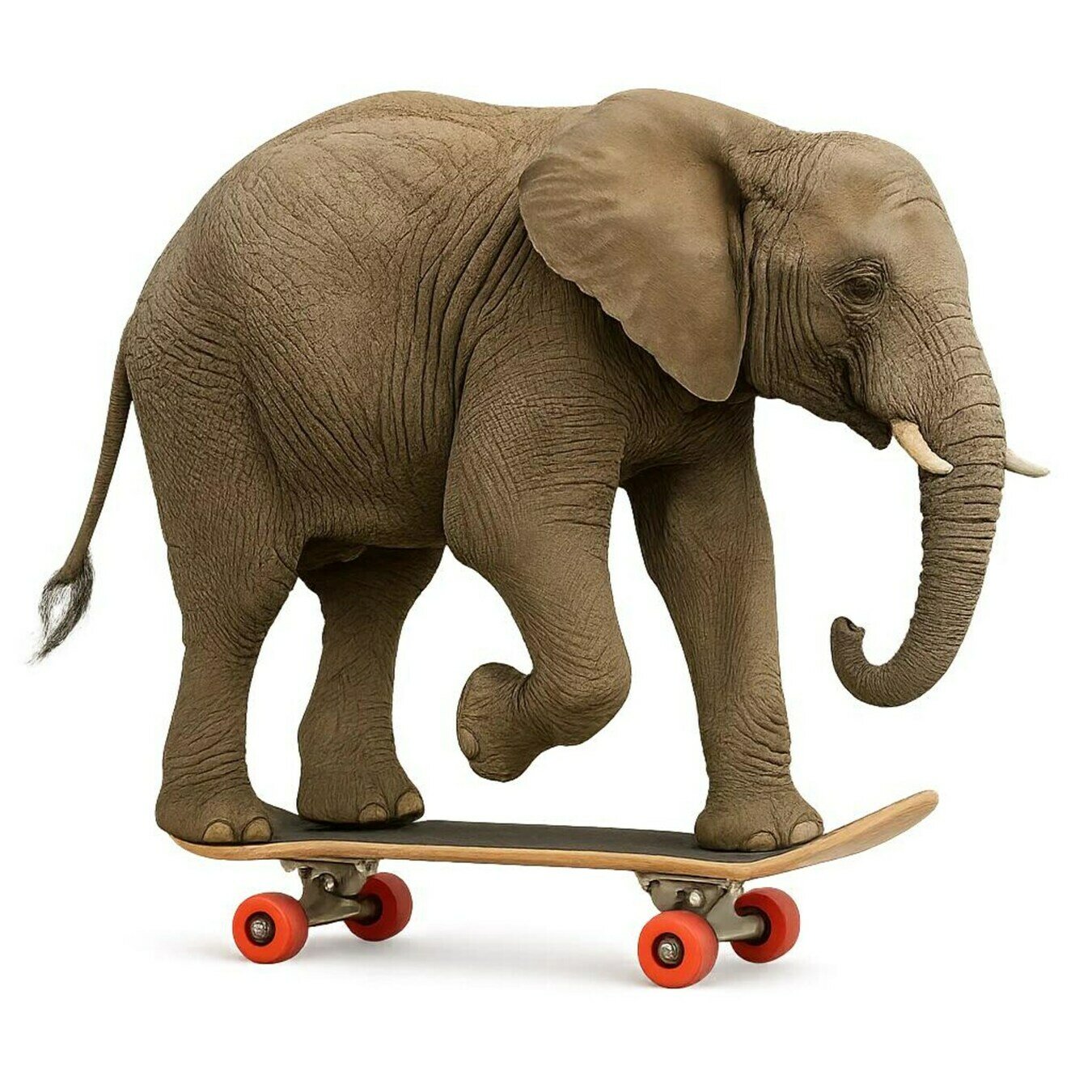
Small rat riding a skateboard, representing a small mass m

Elephant has more inertia than skaterat

Large elephant standing, representing a large mass M and greater inertia

m           <                M 

Small rat moving on a skateboard, possessing momentum

Moving

Not Moving

Elephant has no momentum at rest

What about momentum?

Large elephant stationary at rest with zero velocity and zero momentum

Moving

Moving

Elephant got momentum!

Animation of an elephant moving on skateboards, demonstrating momentum from large mass and velocity
Small rat moving on a skateboard

Momentum is inertia in motion

\mathrm{Momentum} = \mathrm{mass} \times \mathrm{velocity}
p = mv

A container ship has lots of momentum even when moving slow because it has a lot of mass

Large container cargo ship cruising at slow speed with high momentum due to its massive size

Checkpoint

Which has more momentum, a 3000 kg elephant moving at 1 km/h or a 0.3 kg mice moving at 10000 km/h?

Both have the same momentum of 3000 kg km/h

p = mv

Impulse is change in momentum

\mathrm{Impulse} = \mathrm{change \ in \ momentum}
\mathrm{Force} \times \mathrm{time} = \Delta(mv)
Ft = \Delta(mv)

Impulse-momentum relationship

\mathrm{Impulse} = \mathrm{Force} \times \mathrm{time}
Diagram illustrating the impulse-momentum relationship (Ft = Δmv)
Ft = \Delta(mv)

Impulse-Momentum Relationship

Comparison of a car crashing into a haystack (longer stopping time, smaller impact force) versus crashing into a brick wall (shorter time, larger impact force)
Ft = \Delta(mv)

Large t, small F

Large F, small t

Impulse-Momentum Relationship

Rock climber suspended by a stretchy dynamic rope that reduces peak impact force during a fall

Dynamic ropes reduce the force by increasing the time to stop

Checkpoint

If a dynamic rope is able to increase the duration of a rock climber's fall by four times, how much would the force of impact change?

The force is reduced by four

Ft = \Delta(mv)

Bouncing increases impulse

Comparison of impulse: an object dropping and stopping with no bounce versus an elastic ball bouncing upward, creating a greater total change in momentum

Change in momentum of teddy bear vs. bouncing ball

Bouncing increases impulse

Conservation of momentum

In the absence of an external force, the momentum of a system remains unchanged

Diagram showing recoil of a cannon firing a cannonball, illustrating conservation of momentum where initial and final total momentum equal zero
p_\mathrm{cannon} + p_\mathrm{ball} = 0

Initial momentum

Final momentum

=

Conservation of momentum

Animation of a large moving fish swallowing a stationary smaller fish, demonstrating an inelastic collision and momentum conservation
m(v)

Initial momentum

Final momentum

Big Fish

Small Fish

5m(\frac{v}{5})
4m(0)

Small Fish

Big Fish

0
+
+
=

?

Elastic Collisions

Inelastic Collisions

Energy and momentum are conserved

Momentum is conserved but energy is not

Momentum is always conserved regardless of the type of collision!

vs.

Illustration of an elastic collision where objects bounce off each other without lasting deformation or loss of kinetic energy

Objects rebound without lasting deformation or heat generation

Objects get tangled and/or generate heat

Illustration of an inelastic collision where objects couple or deform upon impact, conserving momentum while kinetic energy transforms into heat

Collisions

Diagram depicting colliding carts illustrating that net momentum before collision equals net momentum after collision

Net momentum before collision = Net momentum after collision

Diagram showing momentum conservation during collisions between moving objects

Checkpoint

What is the velocity of the blue truck after the collision?

5 m/s

See Solution

\sum{p_\mathrm{before}} = \sum{p_\mathrm{after}}
Collision physics problem showing a moving truck colliding with a stationary blue truck

Checkpoint

What is the velocity of grandma and grandson after the collision?

4 m/s

See Solution

\sum{p_\mathrm{before}} = \sum{p_\mathrm{after}}
Diagram of grandma on roller skates catching her stationary grandson in an inelastic collision problem

Momentum is a vector

Vector diagram showing two objects moving at right angles before a collision
Vector diagram showing the resultant diagonal momentum vector after the collision

The sum of the momenta vectors is the same before and after the collision/explosion

Energy

Energy may be the most familiar concept in science, yet it is one of the most difficult to define

Visual overview of energy types highlighting mechanical energy, kinetic energy, and potential energy

Here we are going to focus on Mechanical Energy: Work, Kinetic and Potential Energy

Work

Illustration showing force applied over a distance to do work on an object

Work is proportional to force and distance

Work

Work is proportional to force and distance

\mathrm{Work} = \mathrm{Force} \times \mathrm{distance}
W = F d
Illustration demonstrating work defined as force multiplied by distance (W = F d)

Work

W = F d
Person exerting force pushing against a stationary wall where distance is zero, resulting in zero mechanical work done

The wall is not moving, so d = 0 and thus W = 0

Is he doing work on the wall?

Work

Diagram of a block pulled by an angled rope, resolving the applied force into horizontal Fx (doing work) and vertical Fy (doing no work) components

W = Fx d

Fx

Fy

Fy is not doing any work since the block doesn't move on the y direction
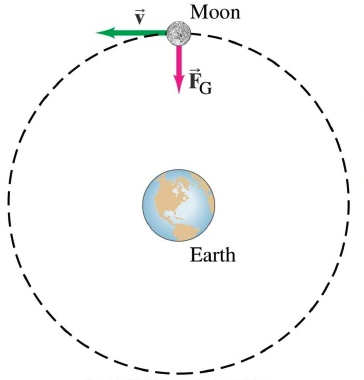
Diagram of the Moon orbiting Earth showing gravitational force perpendicular to the direction of motion, doing no work on the Moon

Is the Earth doing work on the Moon?

No because the force is not in the direction of motion

Checkpoint 1

Units of Work

W = F d
\mathrm{Work \ Units} = \mathrm{Force \ Units} \times \mathrm{Distance \ Units}
= N \times m = kg \frac{m}{s^2} \times m = kg \frac{m^2}{s^2} = 1 \ \mathrm{Joule}

Work has units of Energy

Work is Energy in transfer!

Checkpoint 2

How much work is needed to lift a bag of groceries that weights 300 N to a height of 2 m?

600 Joules

W = F d

Power

\mathrm{Power} = \frac{\mathrm{Work \ done}}{\mathrm{Time \ interval}} = \frac{W}{t}
\mathrm{Power \ Units} = \frac{\mathrm{Work \ Units}}{\mathrm{Time \ Units}} = \frac{J}{s} = \mathrm{watt}

1 horsepower = 746 watts

Power is the rate at which work is done.

Power is the rate at which energy is transferred!

Checkpoint 3

To lift a bag of groceries up the stairs in half the time you need ________ as much power?

Twice

\mathrm{Power} = \frac{W}{t}

With twice as much power you can do either the same work in half the time or twice as much work in the same time

\mathrm{Work} = \Delta{\mathrm{E}}

Work-Energy theorem

Illustration of a bicycle braking on the ground, where friction work changes kinetic energy into heat

The Floor is doing work on the bicycle, thus the bicycle's Energy must change (it decreases as it stops moving).

The Energy due to the bicycle's motion turns into heat

Kinetic Energy

The energy due to an object moving 

Animation depicting moving kinetic energy in action

Kinetic Energy

\mathrm{KE} = \frac{1}{2} \mathrm{mass} \times \mathrm{velocity^2}
\mathrm{KE} = \frac{1}{2} m v^2

Potential Energy

Archer pulling back a bowstring, storing elastic potential energy in the drawn bow

The energy that is stored and held in readiness due to the position of an object (the arrow in this case)

Potential Energy -> Kinetic Energy

Animation of an arrow being fired, converting stored elastic potential energy into motion (kinetic energy)

The Potential Energy of the arrow is converted to Kinetic Energy 

Potential Energy

The energy that is stored and held in readiness due to the position of an object (the car in this case)

Diagram showing work done pushing a car to an elevated ramp, converting work into potential energy and subsequent kinetic energy

Work --> Potential Energy

Potential Energy --> Kinetic Energy

Gravitational Potential Energy

The potential energy of the ball is independent of how the ball got to its position, in all cases

PE = mg (3 meters) 

Diagram showing three different paths lifting a ball 3 meters high, demonstrating gravitational potential energy depends only on elevation height (PE = mgh)

Gravitational Potential Energy = weight x height

\mathrm{PE} = mg \ h

h = 3 meters

The energy associated to the gravitational force and the work it does on objects

Checkpoint 4

Ignoring friction, which path requires the most work? (hint: remember that work is transfer of energy)

They all require the same amount of work =

Checkpoint diagram comparing vertical lifting, an inclined ramp, and stairs to identical height h
\mathrm{PE} = mg \ h

Mechanical Energy

E = \frac{1}{2} m v^2 + mg h
\mathrm{Mechanical \ Energy} = \mathrm{Kinetic \ Energy} + \mathrm{Potential \ Energy}
E = \mathrm{KE} + \mathrm{PE}

When the Potential Energy is gravitational:

Conservation of Energy

Energy cannot be created or destroyed: it may be transformed from one form into another, but the total amount of energy never changes

Conservation of Energy

E = \frac{1}{2} m v^2 + mg h = \mathrm{Constant}
E = \mathrm{KE} + \mathrm{PE} = \mathrm{Constant}

When the Potential Energy is gravitational

In the absence of external work the mechanical energy of a systems remains constant

Diagram showing a roller coaster track illustrating continuous conservation and transformation between potential energy and kinetic energy at different heights

Conservation of Energy

The End

Playful photo of an elephant balancing with one foot on each of four separate skateboards