Journal Article Versions:
Five years of my life. Five years of my life.


Mike Nason | NISO JAV Co-chair
Open Scholarship & Publishing Librarian | UNB Libraries
Open Scholarly Infrastructure Advisor | PKP

Context / Mandate
Evolving Publication Landscape
Since the 2008 JAV, preprints and flexible, iterative publishing models have grown in number and complexity, making it critical to update how versions of research articles are defined, identified, and cited.
DOI Inconsistencies
These issues, additionally, have implications for consistent DOI use throughout scholarly publishing.
Standardization Need*
A new framework will provide clear guidelines for version terminology and DOI assignment, improving clarity for publishers, researchers, and libraries.
JAV is not a standard.
It is a recommendation.
*
Status / Timeline
Working Group Appointment:
Spring 2021
Draft Public Comments Period:
May 23 to July 7, 2024
Current Status:
Finished!
Target Release
Fall/Early Winter 2025
Actual Release
Fall 2026
Makeup / Membership
Just as it was with the 2008 working group, the JAV revision working group was made up of a diverse cross-section of stakeholders with responsibilities and expertise across/throughout the research life-cycle.
It was very much a cross-sectional, international effort including publishers, platforms, libraries, service providers, and maintainers of open infrastructure.
American Chemical Society (ACS)
arXiv
Atypon
Clarivate Analytics
Cornell University
Crossref
F1000 Research
IOP Publishing
National Library of Medicine (NLM)
Rutgers University Libraries
Taylor & Francis Group
Silverchair
Spanish National Research Council (CSIC)
Springer Nature
SSRN
University of Florida Libraries
University of New Brunswick Libraries
Ideally, the collaborative breadth would ensure the practicality, acceptance, and broad adoption of these recommendations across the wide range of the scholarly publishing community.
This version of the recommendation was very publisher-forward. For example, you're unlikely to find a "proof" in the wild.
Additionally, short of having three different VoR-based terms, it was pretty clear the working group was in the early days of having to reckon with versions of the version of record.
Journal Article Versions | 2008
While the original document had a lot of examples of workflows and potential labels, we felt it was light on clarity for users outside of the publishing industry.
As we've increased iterations of works in publishing, it was clear to the working group that we needed options for both more specificity, and also a way to promote transparency to users/readers/researchers.
Journal Article Versions | 2008
And finally, the intervening years saw a significant uptake in the application of persistent identifiers.
Ultimately, users ought to know what version of a work they're reading and citing. And, they should know what's happened to a work if there's been changes.
Of course, secondarily, the disruption of publishing brought on by open access mandates and the overall push to make publicly-funded work available to that same public continues apace.
More versions of works are available more often across open scholarly infrastructure.
Probably the biggest thing to happen between then and now was COVID.
In particular, the potential dissemination of earlier versions of works (both before or during peer review) by media outlets. Knowing where in a publishing workflow a version of a work is can be crucial.
Between ~2008 and ~2021
FIVE
YEARS
LATER
JAV Revision | 2026
JAV Revision | 2026
TERMS
TERMS
2026
2008
The version of the article that is considered by the author to be an initially completed version of their work. The author may make this version public through a preprint server or other repository. The author accepts full responsibility for the article. May have a version number or date stamp. Content and layout as set out by the author according to their publishing objective.
Notes:
1) The AO stage applies before submission to a publication or platform for peer review (e.g., a preprint, or any version of an article external to a publishing and/or peer review workflow).
2) Also known as a preprint colloquially or, specifically, if deposited on a preprint server or other repository.
AO
Author's Original
Is not a kind of hard candy.
The article that is submitted by the author for formal review managed by a recognized publishing entity. The entity recognizes its responsibility to provide objective expert review and feedback to the author, and, ultimately, to pass judgment on the fitness of the article for publication with an "accept" or "reject" decision. Content and layout may follow a publisher’s submission requirements. A formal act of submission has been undertaken by the author to seek acceptance or endorsement by an organization that acts as a publisher.
Notes (abridged):
This stage highlights the contribution made by the engagement with the peer review process to the formal record of scholarship. The author has submitted the manuscript to an organization that acts as a publisher and that takes responsibility for the accuracy and validity of the contents, manages the peer review and editorial processes...
SMUR
Submitted Manuscript Under Review
Is one letter short of "smurf", which is fun.
A published article that has entered a process either by the author or by an external entity for formal review managed by a recognized publishing entity whose publication workflow uses open peer review, "Publish Review Curate," or other such open publication models and platforms. In these workflows, articles are submitted to a publishing entity (or entities), run through a predefined vetting process, and then published online for open, publishing entity-led and/or community peer review. In this state, these articles are functionally undergoing the peer review process. The entity responsible for this workflow recognizes its responsibility to facilitate peer review and feedback to the author. If the work passes a positive review threshold and revisions are accounted for, the work will shift stages to Accepted Manuscript (AM) or directly to Version of Record (VoR) depending on the publisher policies.
PMUR
Published Manuscript Under Review
A new addition for the new edition.
The article that has been accepted for publication in a journal. From this point asecond party, i.e., the publisher (see 2.2.3), becomes responsible for the article endorsement and ongoing maintenance and preservation of the article versions under their control. Content and layout follow a publisher’s submission requirements.
Notes (abridged):
3) This stage is referred to by a wide variety of synonyms across a number of organizations, institutions, and publishers. Final Peer-Reviewed Manuscript, Author’s Manuscript, Author’s Accepted Manuscript, and postprint may be applied variably. Regardless, we believe that the key point to be highlighted is the acceptance of the manuscript by a second party.
AM
Accepted Manuscript
Ephemerality forever.
The article that is created as part of the journal production process. This includes the copy-edited manuscript, galley proofs (i.e., a typeset version that has not been made up into pages), page proofs, and revised proofs. The Proof may be intended to be for the publisher’s internal use but may be released from the internal environment (e.g., the Proof is sent to the authors) and may thus become public, even though it is not authorized to be so. Content has been changed from the AM or the AO; layout is the publisher’s.
PF
Proof
It's in the pudding.
A stable article that has been made available by any organization that acts as a publisher by formally and exclusively declaring the article stable and published as well as being responsible for its endorsement and ongoing maintenance and preservation. The article can be assumed to have undergone peer review. This may include any article that is formally identified as being published even before the compilation of a volume issue and assignment of associated metadata, as long as it is citable via persistent identifier(s). This event generally marks the publication date used in citations. This version may be deposited by the publisher into a long-term preservation archive. It may subsequently be updated for enhancements or corrections, preferably using semantic versioning to track the version and adhering to community recognized practices to provide transparency.
VoR
Version of Record
Now with versions of version of record.
JAV Revision | 2026
JAV Revision | 2026
CONSUMER VIEW
CONSUMER VIEW
Consumer View(s)
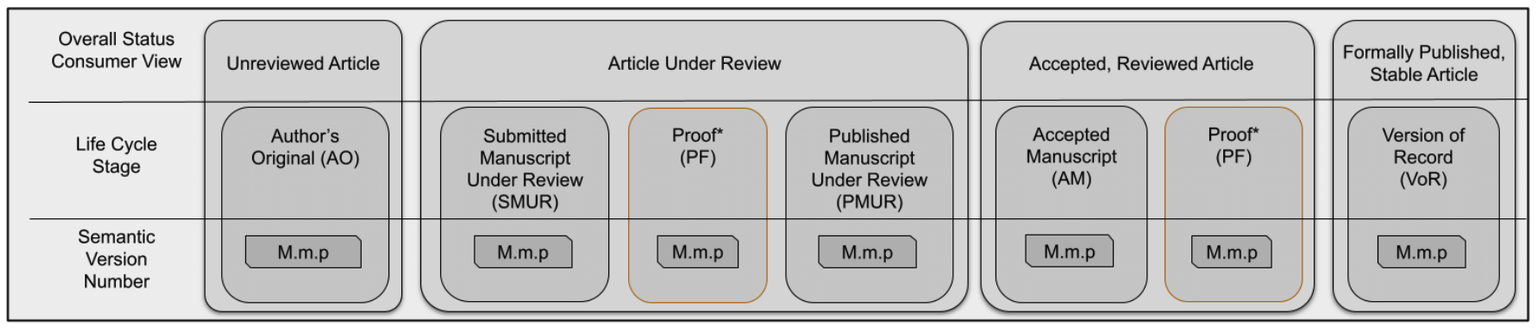
One of the major changes for NISO JAV 2026 is a deliberate recommendation to improve the experience of users. Because of evolutions in peer review, emerging publishing models, and a broader range of places to find/read research, the working group introduced new "article overall status" language meant for display on publisher websites, repositories, and platforms.
The original JAV 2008 recommendations focus on the publisher’s view of journal article stages, from authoring to the final Version of Record. They presume a level of comfort with and knowledge of the traditional journal or article publishing workflow that may not be common among researchers, journalists, and the general public. With this update to the Recommended Practice, mapping is introduced between version/stages of an article and the overall status of an article based on how consumers interact with different stages.
Article Overall Status
Unreviewed: An Author's Original (AO) article. An article in this stage would be under author control and may be open to less formal forms of peer review, say, those that might occur within a community of practice.
Under Review: An article in this stage may be the Submitted Manuscript Under Review (SMUR), the Published Manuscript Under Review (PMUR) or Proof (PF). Either type represents a work actively in the process of peer review.
Accepted, Reviewed: Accepted Manuscript (AM) or Proof (PF) are both versions of the manuscript that have passed through peer review and/or a formal acceptance process but have yet to be finalized in publication.
Formally Published, Stable: An article in this stage is considered the Version of Record (VoR) that is being tracked for its authority, curation, and citation. The article may have post-publication corrections and updates applied following the policies of the publishing organization responsible for maintaining the article.
JAV Revision | 2026
JAV Revision | 2026
SEMANTIC VERSIONING
SEMANTIC VERSIONING
Semantic Versioning
They said it would never happen.
It's a good idea no matter how optional it is.
At any stage of an article’s life cycle, there can be multiple, iterative versions of the article. The changes that are made between one version of an article and the next might be major or minor alterations to the article, and it can be important to signal the significance of these changes in addition to being able to specifically identify a particular version of an article. For example, altering significant amounts of text may be considered a major change, correcting a spelling mistake may be considered aminor change, and a technical enhancement may be considered a very minor change or patch. Semantic version numbering provides a way to uniquely identify versions and signify whether a new version has major or minor changes from the previous version.
Semantic Versioning
They said it would never happen.
It's a good idea no matter how optional it is.
In this recommendation, a semantic version number is an incrementing number with three parts that is formatted similarly to a decimal number: MAJOR.MINOR.PATCH
- MAJOR is a number that is incremented to indicate major changes
- MINOR is a number that is incremented to indicate minor changes
- PATCH is a number that is incremented to indicate very minor changes
There may be editorial as well as technical concerns that control whether the semantic version numbering that is applied to an article uses all three parts MAJOR, MINOR, and PATCH, or two parts MAJOR and MINOR, or only one part MAJOR (a simple integer number).
Semantic Versioning
This is certainly the most aspirational element of the new recommendations. We acknowledge that in this particular case we have put the cart before the horse. But, we were also quite certain that the value of the cart would attract horses.
Maybe more crucially, I can remind you of the reality that...
JAV is not a standard.
It is a recommendation.
*
JAV Revision | 2026
JAV Revision | 2026
OVERVIEW
OVERVIEW
Summary of Changes
- Removed CVoR and EVoR | These weren't widely used and semantic versioning made them redundant.
- Changed Proof from P to PF | For clarity and to avoid conflation with "preprint", a phrase that haunted us throughout.
- Added PMUR | To better accommodate emerging publishing models.
- Added consumer view.
- Added semantic versioning.
Other Updates:
- explicit DOI recommendations in deference to registration agencies and related improvements to language clarity.
- metadata representation
- applying JAV to the "preprint"
- backwards compatibility
- guidance around retractions
- updated/modernized use cases
consumer view label
jav term/stage
semantic version
major.minor.patch
JAV Revision | 2026
JAV Revision | 2026
IN PRACTICE
IN PRACTICE
Metadata Metadata Metadata
Appendix F of the recommendations includes some guidance around how to represent the article overall status, article life cycle stage, and semantic version number in JATS and XMP.
We were fortunate that JATS > 1.2 could accommodate everything with existing attributes within the <article-version> element. This is thanks to the prior NISO JAV working group's work.
<article-meta>
    <article-version
        vocab=
        vocab-identifier=
        content-type=
        vocab-term=
        designator=
    />
</article-meta>
Metadata Metadata Metadata
I'll illustrate a few examples, but do please see Appendix F of the recommendations for more. In order to accommodate both the consumer view metadata and the version metadata, you'll need to repeat the <article-version> element.
This might have implications!
<article-version
vocab="jav"
vocab-identifier="http://www.niso.org/schemas/jav/1.0/"
content-type="article-lifecycle-stage"
vocab-term="Version of Record"
article-version-type="vor"/>
Metadata Metadata Metadata
Article Overall Status
<article-version
vocab="jav"
vocab-identifier="http://www.niso.org/schemas/jav/1.0/"
content-type="article-overall-status"
vocab-term="Formally Published, Stable Article"/>
Article Version
<article-version
vocab="jav"
vocab-identifier="http://www.niso.org/schemas/jav/1.0/"
content-type="semantic-version-number"
designator="1.0.0"/>
Moving Forward
Policy Development
Publishers and publications platforms should be thinking about developing policies around semantic versioning. Chiefly, what constitutes major/minor/patch level changes.
Accommodating Consumer View
Publishers and publications platforms should be considering adoption of consumer view labels with clear indications of article history.
Metadata Matters
This language has implications for service providers, repositories, publishers, and platforms. PID registration agencies may want to accommodate JAV and version elements/attributes. Controlled vocabulary in organizations like COAR will also need updating to ensure accuracy. And, citation styles/formats should consider reflecting article versions.
Moving Forward
I would anticipate some adjustment period and, likely, some deliberate response from the JATS maintainer community.
I'll note that a substantial volume of time was spent in the working group ruminating on questions like "how might these be cited?"
Ultimately, it was vital for us to focus on our scope for the recommendation. But, there are already examples for citation of versions of software in major citation styles, and we felt citations are reactive in nature. We could not expect citation styles to preemptively know how to accommodate a new type of information for journal articles.
Thanks / Questions
Co-chairs
Mike Nason
Patrick Hargitt
We were at this for 5+ grueling years. I just want to acknowledge the labour, attention, and care of the working group members who stuck it out to the end and also those who moved on to other jobs/projects/less contentious interests. Thanks also to those at NISO who were very patient in their cat wrangling.