Border Gateway protocol (BGP)
Dr. Alexios Louridas
Index

Dynamic Routing Protocol Overview
- Internet is made up of a large number of independent networks or as they are called Autonomous Systems (ASes).
- Internal routing algorithm selection is done by individual organisations and usually called intradomain routing using Interior Gateway Protocols (IGP).
- Routing between independently operate networks, or interdomain routing, use Exterior Gateway Protocols (EGP).
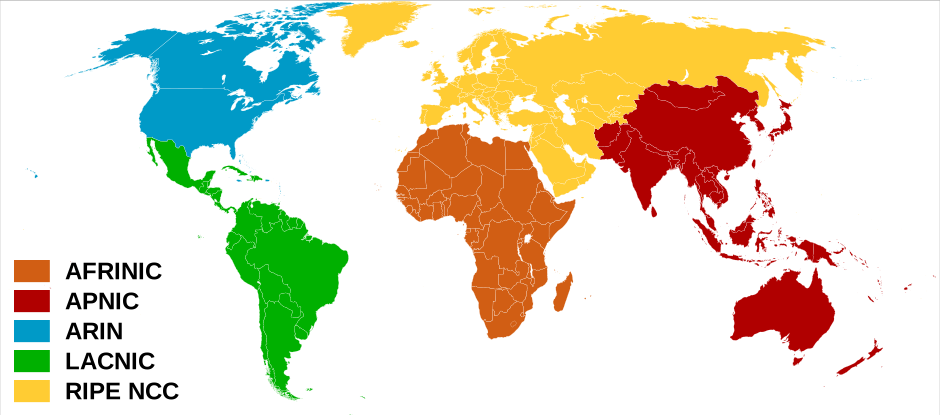
IANA (Internet Assigned Numbers Authority
- The IANA is responsible for allocating AS numbers through five Regional Internet Registries (RIRs).
- RIRs are non-profit corporations established for the purpose of administration and registration of IP address space and AS numbers in key geographic locations.
-
An AS typically belongs to one organization.
-
A single or multiple interior gateway protocols (IGP) may be used within the AS.
-
In either case, the outside world views the entire AS as a single entity.
-
-
If an AS connects to the public Internet using an exterior gateway protocol such as BGP, then it must be assigned a unique AS number which is managed by the Internet Assigned Numbers Authority (IANA).
-
AS numbers can be between 1 to 65,535.
-
RIRs manage the AS numbers between 1 and 64,512.
-
The 64,512 - 65,535 numbers are reserved for private use (similar to IP Private addresses).
-
The IANA is enforcing a policy whereby organizations that connect to a single provider use an AS number from the private pool.
-
-
If an AS connects to the public Internet using an exterior gateway protocol such as BGP, then it must be assigned a unique AS number which is managed by the Internet Assigned Numbers Authority (IANA).
AS numbering





Politics in routing
Interdomain routing protocols need to deal with politics
Typical political policies:
- Educational institutions do not want to carry commercial traffic.
- Military, Secret service or some government traffic do not want to route via certain countries.
- Traffic from Google to Apple and vice versa do not want to crossover
- Certain ISPs do not want traffic to pass to another due to cost or poor perfomance.
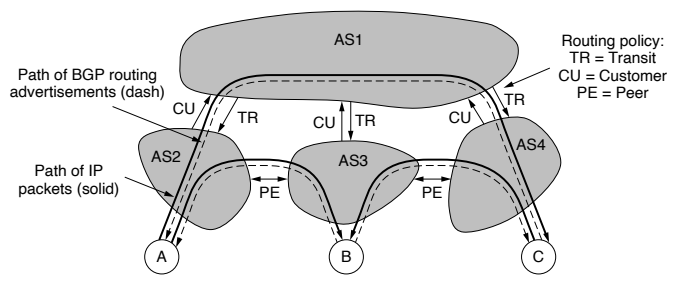
Terminology
- Internet eXchange Points (IXPs)
- A “BGP peer,” also known as a “BGP neighbour,” is a specific term that is used for BGP speakers that have established a neighbour relationship.
Settlement-free peering
- AS2 and AS3 exchange a lot of traffic.
- Since they are connected they can use a policy to send traffic directly to each other bypassing AS1 for free.
- Settlement-free peering between ASes happens by sending routing advertisments to each other for the addresses that reside in their networks.
- So A and B can communicating between them directly.
Settlement-free peering not transitive
- AS3 and AS4 also peer to each other, so traffic from B to C is also settlement-free peerring.
- What if C wants to send to A?
-
AS3 is only advertising a route to B to AS4. It is not advertising a route to A.
-
Traffic will not pass from AS4 to AS3 to AS2 even though a physical connection exists.
-
AS4 would need to go through AS1.
-
Router will prefer routes learned from paying customers first.
-
Secondly will prefer routes learned from settlement-free peers.
-
Last will prefer routes learned from provider networks.
Thus:
-
An AS will advertise all of its routes to customers, but it will not re-advertise routes learned from a settlement-free peer or transit provider to other peers or providers.
Except: -
If two ASes have made specialised money arrangments - PAID PEERING
routing policies


BGP Route Selection - Path Vector Protocol
- Policy Decision
- Shortest AS path length
- Closest Next-Hop - Hot Potato routing
BGP routers communicate with each other by TCP connections. Provides reliable communications and hides all the detail of networks being passed along the way,
-
OPEN: opens TCP connection to remote BGP peer and authenticates sending BGP peer
-
UPDATE: advertises new path (or withdraws old)
-
KEEPALIVE: keeps connection alive in absence of UPDATES; also ACKs OPEN requests
-
NOTIFICATION: reports errors in previous msg; also used to close connection
BGP Messages

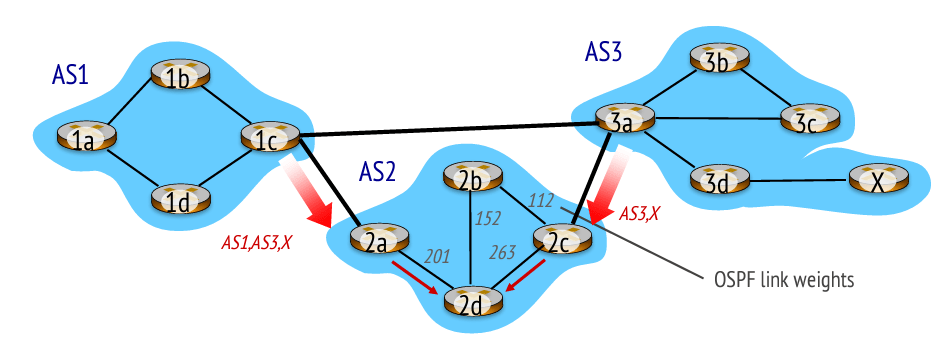
Hot Potato routing
- 2d learns it can route to X via 2a or 2c
- hot potato routing: choose local gateway that has least intra-domain cost (e.g., 2d chooses 2a, even though more AS hops to X): do not worry about inter-domain cost!
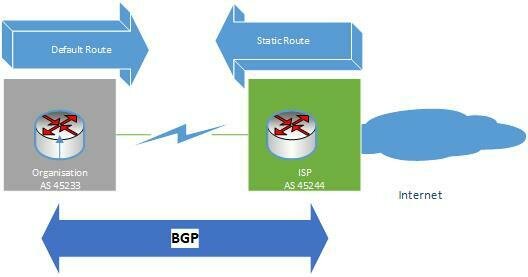
SingleHoming
- Using Static routes an organisation can connect to an ISP.
- Using BGP, the organization announces its public networks to the ISP, and the ISP provides a default route to the organization, ensuring efficient internet connectivity and routing
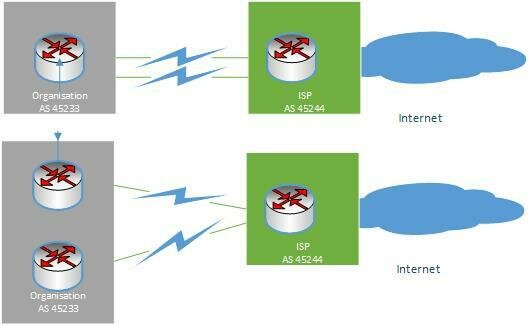
dualHoming
- Two link from the ISP to the one router owned by an organisation
- Or Two links from the ISP to two routers for each link owned by an organisation
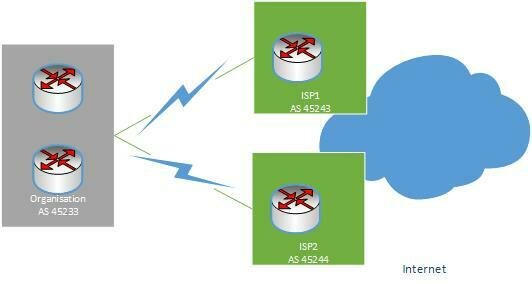
multiHoming
- Increase redundancy by connecting to two ISPs which each terminate in two routers owned by an organisation. BGP is used for advertisement.
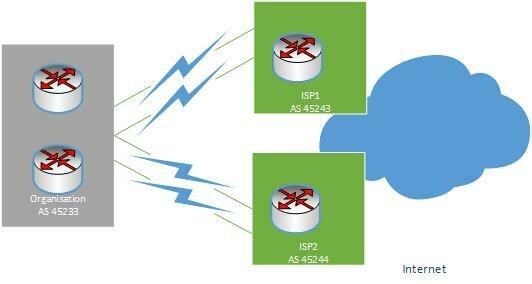
dualmultiHoming
- Load sharing
- Scalability of network solution
- Even more resilient to failures
-
Routing Money
-
Usually rely on settlement free peering
-
Can change to payment
-
No agreement
-
Peering Dispute
-
Peering Disputes



Peering Dispute Examples
1. NTT Communications vs. Cogent Communications:
Context: NTT Communications (a Japanese firm) and Cogent Communications (a U.S.-based company) engaged in a disagreement about peering arrangements.
Issue: The dispute revolved around peering in Asia.
Result: As a consequence, Cogent de-peered NTT in Europe, leading to inefficient routing. Traffic had to traverse the Atlantic and back again between these two networks in Europe, causing latency issues for users unless broadband providers found workarounds.
2. Verizon vs. Cogent Communications:
Context: Verizon, a major telecommunications company, and Cogent Communications, a bandwidth provider, engaged in a peering dispute.
Issue: The dispute centred around unbalanced peering—essentially an arrangement where two networks exchange traffic reciprocally without payment.
Details: Cogent accused Verizon of causing poor video streaming quality for Netflix content due to unbalanced peering arrangements.
Resolution: Verizon defended itself, emphasizing that the issue was not solely its responsibility.
3. Netflix vs. Comcast:
Context: Netflix, being a major content provider, generates a significant amount of internet traffic.
Issue: Comcast (an internet service provider) and Netflix had disagreements over peering arrangements.
Result: In 2014, after contentious negotiations, Netflix agreed to pay Comcast for direct access to its network, improving streaming quality for Comcast subscribers.

Traffic Prioritasation
1. Latency-Sensitive Traffic Prioritization:
Objective: Ensure smooth performance for applications like gaming and interactive video.
Challenge: Prevent high utilization by other traffic types (e.g., large file transfers) from degrading user experience.
Methods: Network operators employ techniques like weighted fair queueing and low-latency queues for interactive apps.
2. Paid Prioritization Dilemma:
Issue: Money enters the equation.
Scenario 1: Paid prioritization—where a party pays an ISP for higher traffic priority—can be seen as anti-competitive.
Scenario 2: Transit networks may prioritize their own services over competitors’, impacting overall fairness.
3. Sensitive Flash Point:
Example: AT&T blocking FaceTime video calls.
Conclusion: Prioritization discussions often involve policy, competition, and user experience considerations.

Bright Line RULES
- No blocking
- No throttling
- No paid prioritisation
- Disclosure of any prioritisation practices
-
The autonomous system (AS) value is either an internally generated number (if not connecting
to a provider network) or obtained from an ISP or RIR. -
It is a required parameter.
-
It can be any positive integer in the range from
1 to 65535.
Enabling BGP in routers

Router(config)# router bgp autonomous-system-
The ip address is the destination address of the BGP peer.
-
The address must be reachable before attempting to establish the BGP relationship.
-
The AS value is used to identify if the session is with internal BGP (IBGP) peers or with external BGP (EBGP)
Defining BGP Neighbours

Router(config)# neighbor { ip address | peer group name } remote as autonomous system-
The BGP network command determines which networks this router advertises.
-
The mask parameter indicates that BGP 4 supports subnetting and supernetting.
-
If the mask is not specified, this command announces only the classful network
-
It is also important to note that the prefix must exactly match (address and mask) an
entry in the IP routing table.
Identify BGP Networks

Router(config)# network network-number [mask network-mask] [route-map map-tag]