Designing Delegation
An Experimental Examination of Veto Bargaining
Virtual AMBER
September, 2026
Brandon Williams
Alistair Wilson
Richard Van Weelden
Setup
- Tend to get inefficiency when we consider interactions between uninformed and informed parties:
- Sender-receiver
- Market for lemons
- Bargaining
- In some of these settings, delegating decision power to the informed party:
- Potential for efficient solution
- But share of surplus created is smaller for the party ceding power
Motivation
Constrained Delegation allows for an intermediate outcome:
- The uninformed party delegates some of their decision power to the informed party
- But imposes some constraints on the choices the informed party can make
- For example, minimum and maximum limits
Veto bargaining provides an economically important setting to examine this:
- Veto represents an outside option
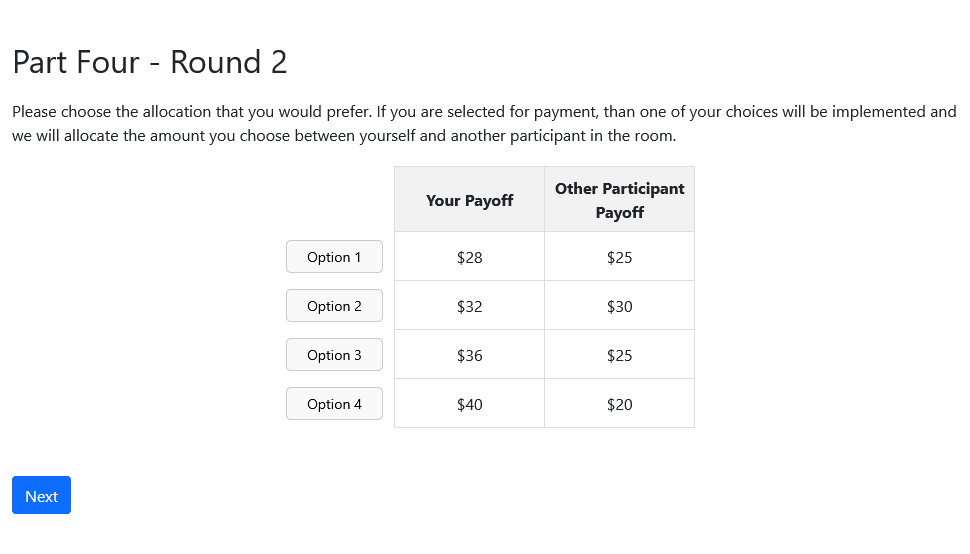
- Theory identifies constrained delegation as optimal mechanism (Kartik, Kleiner, and Van Weelden, 2021)
- Simple setting for a clear experimental assessment!
Setup
Consider the following bargaining context:
- Nature determines the informed party's preference
- An uninformed principal makes a proposal
- An informed agent responds, comparing the offer it to her outside option




Findings
- Comparing Constrained Delegation to Take-it-or-Leave it offers we find:
- Delegation substantially increases efficiency
- Informed party captures lion's share
- Proposers fail to optimize, providing more latitude/discretion
- Preplay communication improves both mechanisms, though Delegation does worse overall
- Broadly the theory organizes the results well
Literature
Models of similar bargaining forms have been proposed in theory...
- Under complete information - Romer and Rosenthal (1978)
- Under cheap talk negotiation - Matthews (1989)
- With valuable expertise involved - Holmström (1977, 1984)
- More recently: Kartik, Kleiner, Van Weelden (2021)
And used in experiments...
- Early bargaining - e.g. Roth and Murnighan (1980, 1982)
- Vetoes within committees - Kagel, Sung, and Winter (2010)
- Multiple rounds of bargaining - Nunnari (2021)
More recently: Kartik, Kleiner, Van Weelden (2021)
Take a mechanism design approach to show when Proposer:
- Fully delegates
- Makes a take-it-or-leave-it offer
- Offers a limited set of offers
Theory
Theory


Vetoer
0
1
Proposer
\( \theta \)
- Proposer has:
- Increasing payoff \( \pi (z) \) over outcome \( z \)
- \(\pi(z)\) linearly increasing in experiment
- Makes an offer \(X\subset\left[0,1\right]\) to the vetoer
- Increasing payoff \( \pi (z) \) over outcome \( z \)
- Veteor has:
- Private information: ideal point \(\theta \) with \( \theta \sim F(\theta) \), preference with convex loss in \(\left|z-\theta\right|\)
- Veto point given by \(0\), chooses \(z\in \left\{0\right\}\cup X \)
Theory
0
1
Proposer
Vetoer
\( \theta \)
- Vetoer's realized preference can be...
- more aligned with Proposer (\(\theta\) closer to 1)
Theory
0
1
Proposer
Vetoer
\( \theta \)
- Vetoer's realized preference can be...
- more aligned with Proposer (\(\theta\) closer to 1)
- or less aligned (\(\theta\) closer to 0)
Theory
0
1
Proposer
Vetoer
?
Key experimental/theoretical manipulation for Proposer:
- Take it or leave it offer \(X=\left\{ x\right\}\)
- Delegation of multiple choices to vetoer \(X\subset\left[0,1\right]\)
- Interval optimal choice, so \(X=\left[\underline{x},\overline{x}\right]\)
Theory: Take it or Leave It
0
1
Proposer
Offer \( x \)
\( \frac{ x}{2} \)
These types veto
These types take offer
\( z = 0 \)
\( z = x \)
Theory: Take it or Leave It
0
1
Proposer
Offer \( x \)
\( \frac{ x}{2} \)
Suboptimal:
inefficient as \(\theta\)
preferred by both
Breakdown:
inefficient as \( \theta\) preferred by both
Theory: TIOLI equilibrium
- Marginal increase in offer \(x\) leads to:
- Marginal gain of \(\pi'(x)\cdot(1-F(\tfrac{x}{2}))\)
- Marginal loss of \(\left(\pi(x)-\pi(0)\right)\cdot \tfrac{1}{2}f(\tfrac{x}{2})\)
0
1
\(\tfrac{x}{2}\)
\(z=0\)
\(z=x\)
\(x\)
\(f(\theta)\)
Theory: TIOLI equilibrium
0
1
\(\tfrac{x}{2}\)
- Marginal increase in offer \(x\) leads to:
- Marginal gain of \((1-F(\tfrac{x}{2}))\)
- Marginal loss of \(\tfrac{x}{2}\cdot f(\tfrac{x}{2})\)
\(z=0\)
\(z=x\)
\(x\)
\(f(\theta)\)
\(f(\tfrac{x}{2})\)
Theory: Delegation
0
\( \theta \)
1
Vetoer ideal
Proposer
- Proposer delegates a set of options \(X\)
- Vetoer chooses \(z\in\left\{0\right\}\cup X\)
- either the veto threat point (here \(0\))
- or some offer in delegation set
Theory: Delegation
0
1
\( \frac{ x}{2} \)
These types veto
These types
choose minimum offer
\( z = 0 \)
\( z = x \)
Offer \( [x,1] \)
\( x\)
These types
choose their ideal point
\( z = \theta \)
Theory: Delegation
0
1
\( \frac{ x}{2} \)
Offer \( [x,1] \)
\(x \)
No suboptimal deals:
The delegation mechanism ensures
these options are available
Breakdown:
inefficient as \( \theta > 0 \)
Theory: Delegation Equilibrium
0
1
\(\tfrac{x}{2}\)
\(x\)
\(f(\theta)\)
- Marginal increase in lower offer \(x\) leads to:
- Marginal gain of \((F(x)-F(\tfrac{x}{2}))\)
- Marginal loss of \(\tfrac{x}{2}\cdot f(\tfrac{x}{2})\)
Offer \( [x,1] \)
Theory: Delegation Equilibrium
0
1
\(\tfrac{x}{2}\)
\(x\)
\(f(\theta)\)
- With increasing density we get a corner solution \(X=\left\{1\right\}\):
- coincides with TIOLI solution, \(x^\star=1\)
Offer \( [x,1] \)
Theory: Delegation Equilibrium
- With decreasing density we get the other corner solution:
- Full delegation, with \(X^\star=\Theta\)
- Results in first-best for responder with \(z^\star=\theta\)
0
1
\(\tfrac{x}{2}\)
\(x\)
\(f(\theta)\)
Offer \( [x,1] \)
Theory: Environment Characteristics
- Delegation here is a compromise over veto threat:
- Proposer has state-independent preferences
- Tension here is over failure to agree
- This is not Delegation over information a la Holmstrom (1984)
- Expert there has valuable information for Proposer's state-dependent preference
- Tension is over expert's preference misalignment
Theory: Hypotheses
- Delegation increases efficiency through:
- Reduced breakdown
- Reduced suboptimal deals
- Delegation is a valuable tool to Proposers
- Delegation moves with expected alignment:
- Full delegation with decreasing density
- No compromise with increasing density
- Constrained with single-peaked density
- Cheap talk is:
- Partially Informative in TIOLI (Matthews QJE 1989)
- Uninformative in Delegation (Kartik et al AER 2021)
Experiment
Experimental Design
- Construct environment that directly follows the veto-bargaining framework
- One challenge: how to bring this abstract environment to a participants in a way that is easier to understand?
Experimental Design
- Construct environment that directly follows the veto-bargaining framework
- One challenge: how to bring this abstract environment to a participants in a way that is easier to understand?
Experimental Design: Framing
Proposer
Seller
Vetoer
Buyer
State
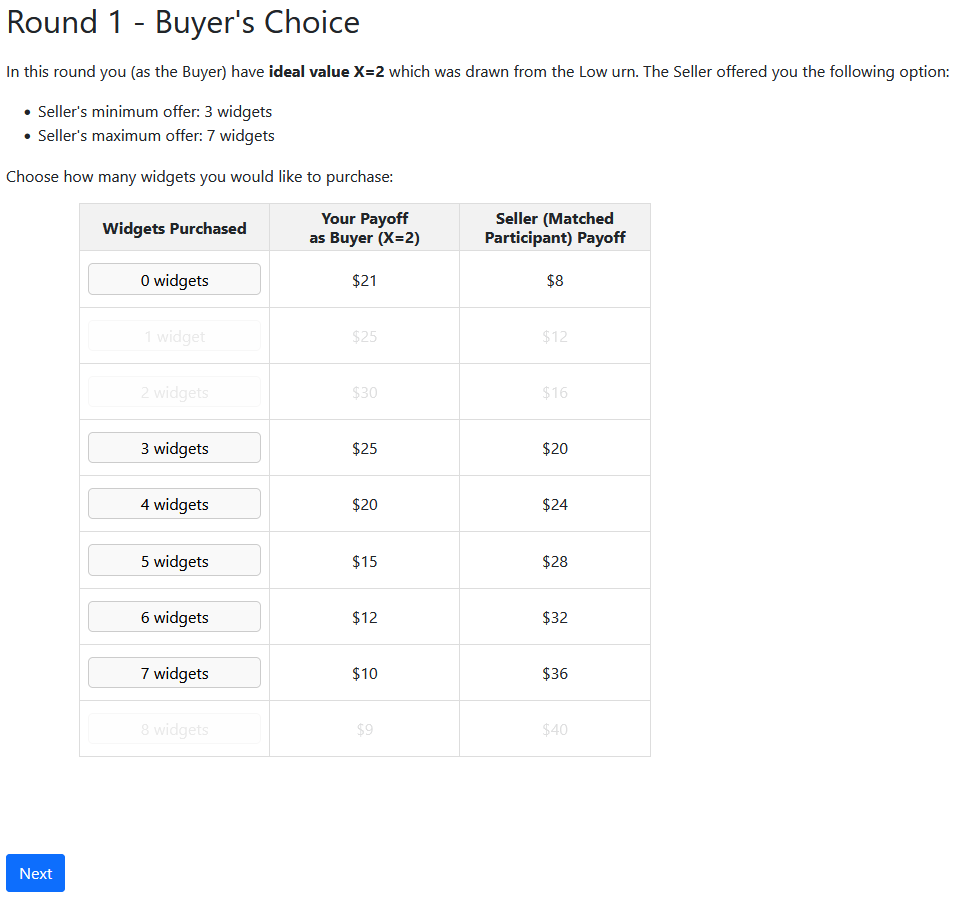
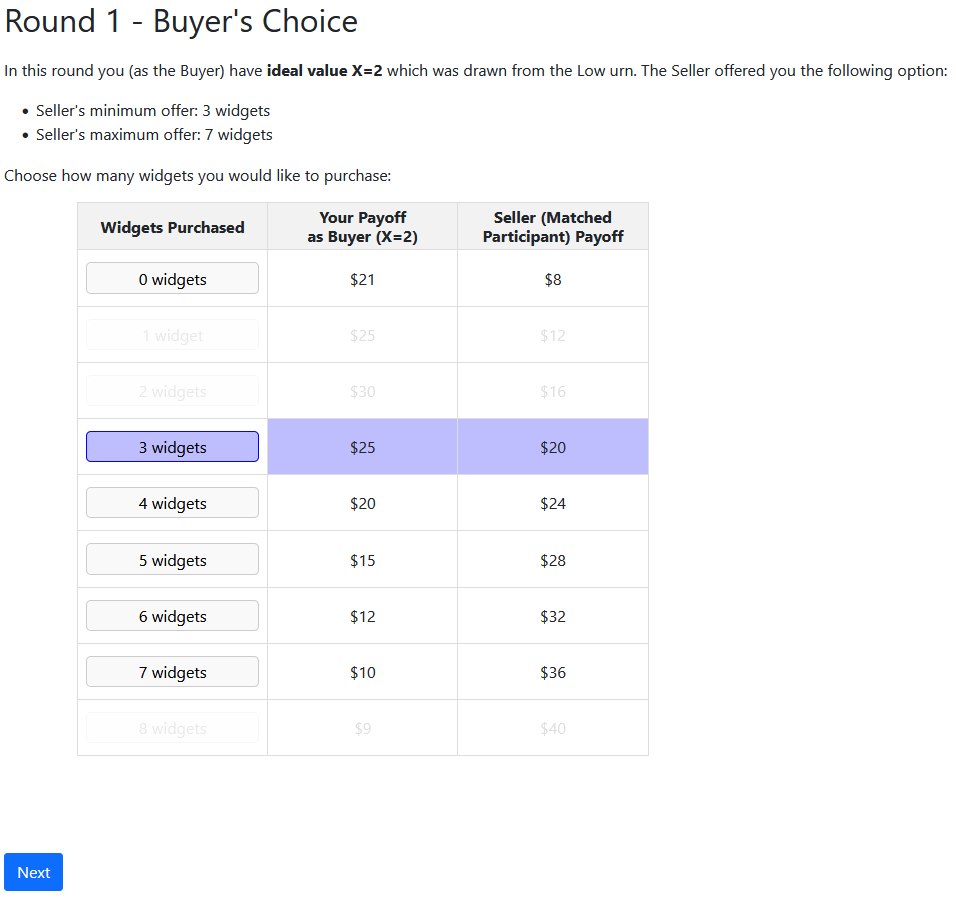
Ideal Demand
Offer
Widgets
Delegation
Widget Menu
Types
Urn Draws
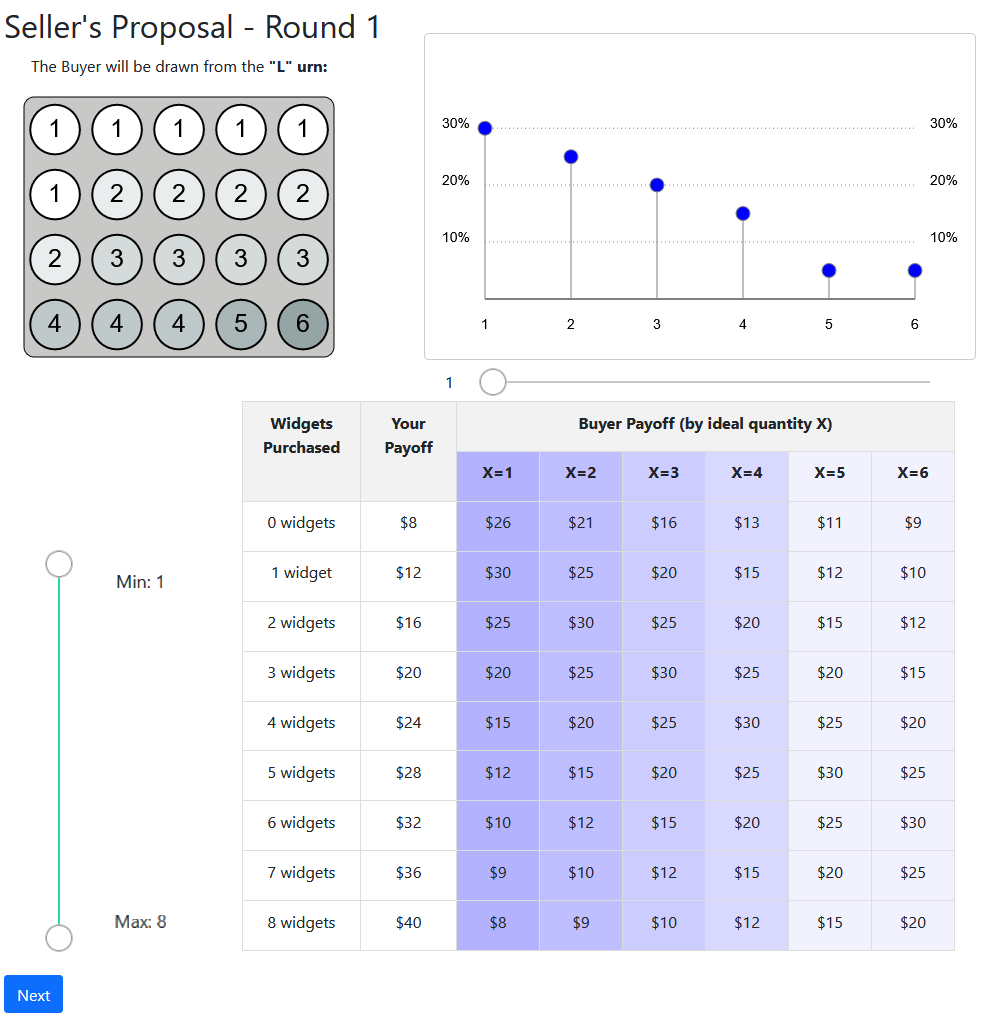
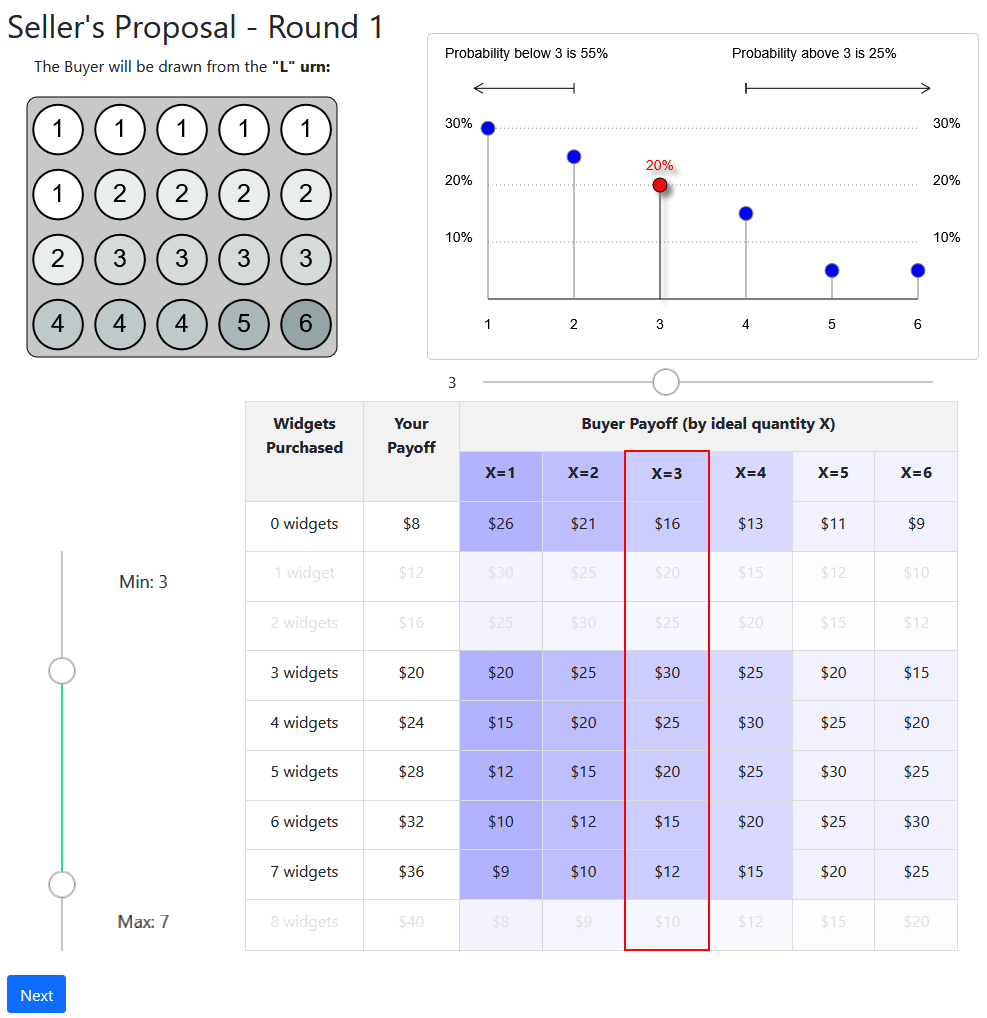
Delegation treatment:
offer a range
Take it or leave it:
single offer
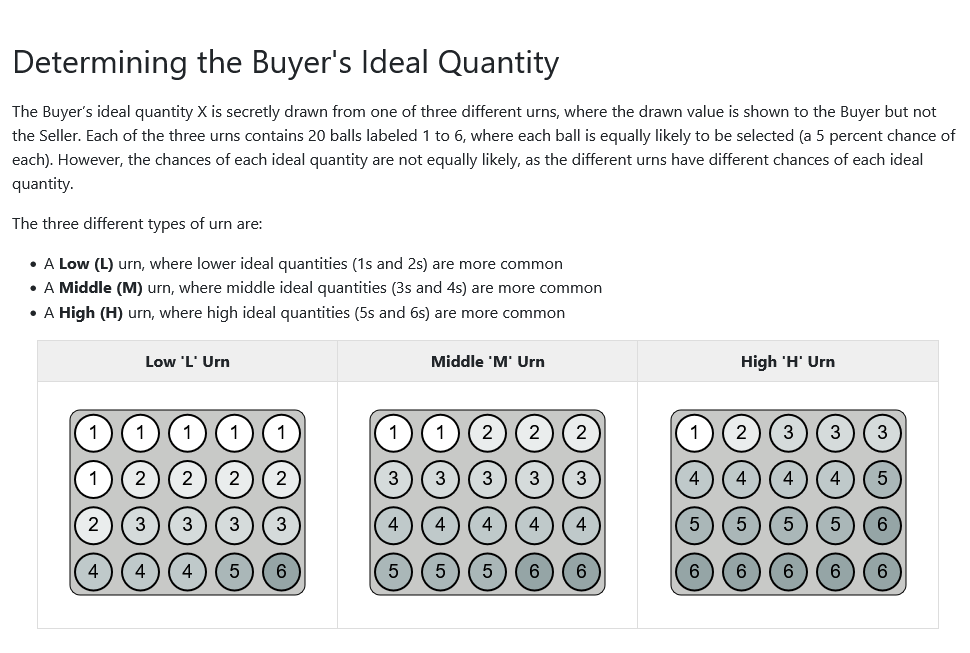
Decreasing
probability
Inverse-U shaped
Increasing probability
Experimental Design
- Within-subject variation:
- Varying distributions (high, middle, low) for the Responder
- Changing roles: 5 rounds in one role, 5 rounds in the other, and back to first role for 5 more rounds
- Between subject 2 x 2:
| No Chat | Chat | |
| Take-it-or-leave-it | N=66 | N=60 |
| Delegation | N=64 | N=66 |
Experimental Design
Collect other behavioral variables:
- Robot Responder: remove strategic uncertainty/other regarding
- Pure incentives: present mechanism choice as lottery (remove mechanism complexity)
- Pure allocation: remove uncertainty and mechanism
Addendum collection (70 more subjects in NoChat):
- No veto: Remove responder's veto threat
- Expected Value: remove risk and other regarding
- CF Mechanism Value: Elicit WTP for the Delegation/TIOLI
Predictions for the Experiment from Theory
Assuming fixed distribution of risk preferences:
- Within mechanism \(\Phi\) proposer's outcomes ranked: \[ \Phi_{\text{High}} \succ \Phi_{\text{Middle}} \succ\Phi_{\text{Low}} \]
- Across mechanism for each distribution \(k\) both sender and proposer outcomes ranked:\[\text{DELEG}_k \succ \text{TIOLI}_k\]
- Communication\(^\star\) before the game:
- Partial improvements in TIOLI: \[\text{TIOLI}^\star_k \succ \text{TIOLI}_k\]
- No effect in Delegation: \[\text{DELEG}^\star_k \sim \text{DELEG}_k\]
Results
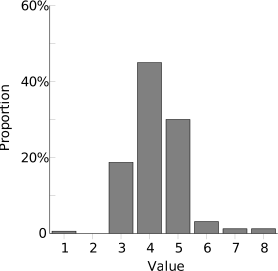
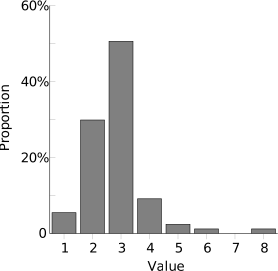
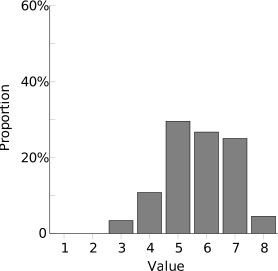
Low
Middle
High
Sanity check: Proposers respond to alignment
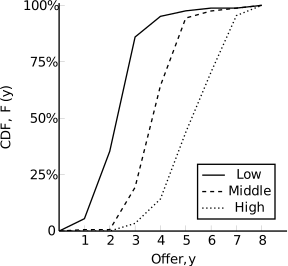
Sanity check: Proposers respond to alignment
Theory expectation: \( \text{TIOLI}_{\text{High}} \succ \text{TIOLI}_{\text{Middle}} \succ \text{TIOLI}_{\text{Low}} \) ✅
Low
Middle
High
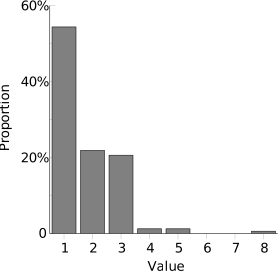
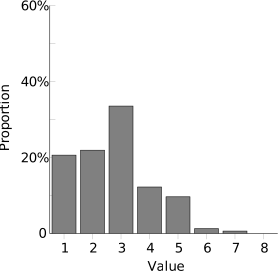
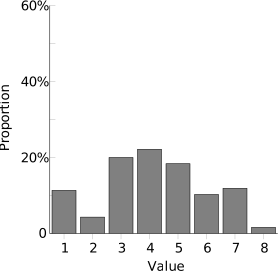
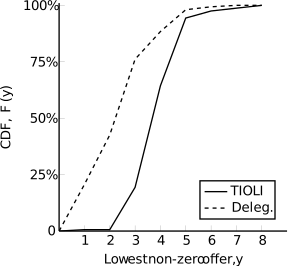
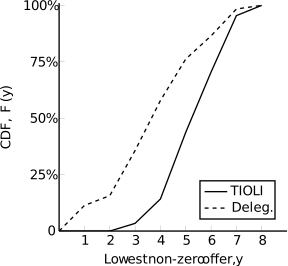
Minimal offer in Delegation interval:
Sanity check: Proposers respond to alignment
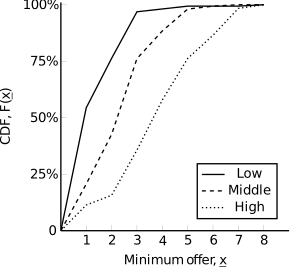
Sanity check: Proposers respond to alignment
Theory expectation: \( \text{DELEG}_{\text{High}} \succ \text{DELEG}_{\text{Middle}} \succeq \text{DELEG}_{\text{Low}} \) ✅-ish
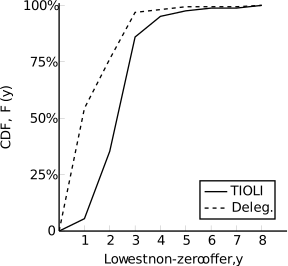
Eqbm Effect: More Latitude with Delegation
Low
Middle
High
Theory expectation: \(\forall k, \text{DELEG}_k \succ \text{TIOLI}_k \) ✅
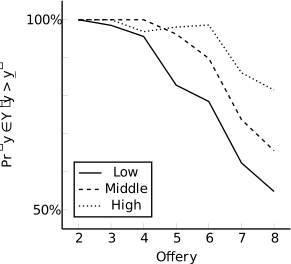
Do Proposers use full interval:
- Proposers mostly include all possible options in \(\Theta\) above minimum offer \(\underline{x}\)
- Some exceptions in Low
- More reluctance to offer options above \(\max(\Theta)\)
Model of Responder Behavior
- Large majority (~90%) of Responder decisions are selfish/rational
- The remaining 10% are inefficient, but tend to choose more generously for Proposers
- Estimate a model of Responder behavior
- we will later use this model to integrate out the exogenous shock \(\theta\) (not realized until after Proposer decision)
Model of Buyer Behavior
- Fehr-Schmidt parameterized logit model for Resp. behavior:
\(U_R(x_R,x_P)=\lambda \left( x_R - \alpha\cdot \max(x_P-x_R,0) - \beta\cdot \max(x_R- x_P ,0) \right)\)
Parameters:
- \(\lambda\): Response to incentives (Noisier as \(\downarrow 0\))
- \(\alpha\) : Disadvantageous inequality aversion
- \(\beta\) : Advantageous inequality aversion
| Param | TIOLI | DELEG | p-Val |
|---|---|---|---|
| Scale | 0.32 | 0.53 | <0.001 |
| Disadv. Ineq | 0.12 | 0.30 | 0.04 |
| Adv. Ineq | 0.14 | 0.08 | 0.45 |
Using model allows us to integrate out exogenous shock \(\theta\) to give expected Proposer/Responder outcomes
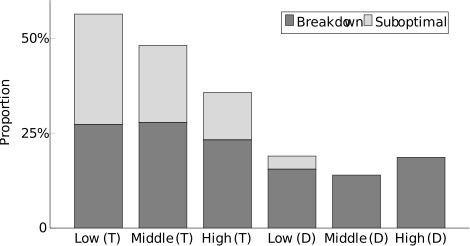
Efficiency of Outcomes
Take it or Leave It
Delegation
Delegation decreases inefficiencies
Rounds with Pareto efficient outcome
| Urn | TIOLI | DELEG | p-value |
|---|---|---|---|
| Low | 45% | 83% | <0.001 |
| Middle | 53% | 87% | <0.001 |
| High | 57% | 83% | <0.001 |
| p-value: | 0.07 | 0.60 |
Result 1:
Conditional Delegation substantially increases efficiency relative to a Take-it-or-leave-it offer. Efficiency increases from both
- Reduced suboptimality (direct effect)
- Reduced breakdown (equilibrium effect)
Distribution of Outcome
Who benefits from delegation?
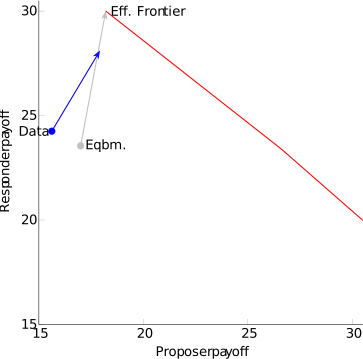
Low
Decreasing density
Who benefits from delegation?
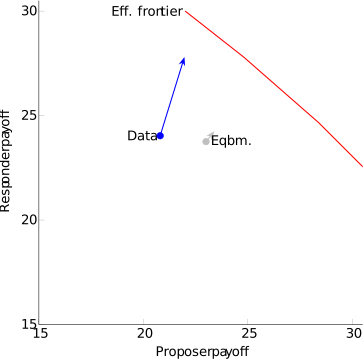
Middle
Single-peaked density
Who benefits from delegation?
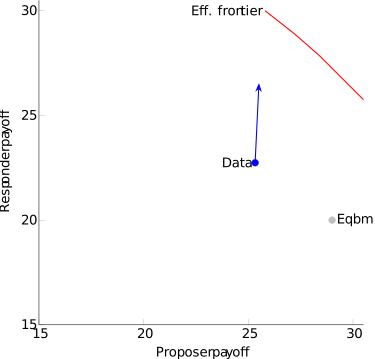
High
Increasing density
Who benefits from delegation?
| Urn | TIOLI | DELEG | Diff. | p-value |
|---|---|---|---|---|
| Low | $15.62 | $17.93 | $2.31 | <0.001 |
| Middle | $20.81 | $21.97 | $1.16 | <0.001 |
| High | $25.32 | $25.51 | $0.18 | 0.217 |
| p-value: | <0.001 | <0.001 |
Proposer payoffs:
| Urn | TIOLI | DELEG | Diff. | p-value |
|---|---|---|---|---|
| Low | $24.25 | $28.11 | $3.86 | <0.001 |
| Middle | $24.03 | $27.80 | $3.77 | <0.001 |
| High | $22.74 | $26.54 | $3.81 | <0.001 |
| p-value: | <0.001 | <0.001 |
Responder payoffs:
✅
✅
✅
✅
✅
❌
✅
✅
✅
✅
Who benefits from delegation?
| Urn | TIOLI | DELEG | Diff. |
|---|---|---|---|
| Low | -14.2% | -2% | 12.7pp |
| Middle | -5.4% | -0.1% | 5.3pp |
| High | -1.8% | -1.1% | 0.7pp |
Proposer payoffs:
| Urn | TIOLI | DELEG | Diff. |
|---|---|---|---|
| Low | -19.2% | -6.3% | 12.9pp |
| Middle | -19.9% | -7.3% | 12.6pp |
| High | -24.2% | -11.5% | 12.7pp |
Responder payoffs:
Normalized to full-delegation (Responder optimal outcome):
Result 2:
While Proposers do benefit from Delegation -- moreso when they lack alignment -- efficiency gains are primarily captured by the Responder.
What would happen if...
Force Responders to be selfish maximizers?
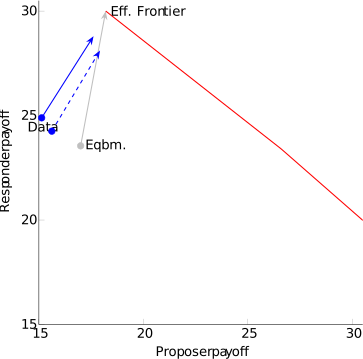
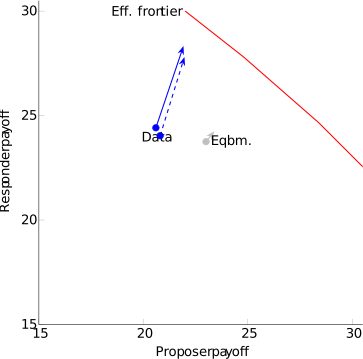
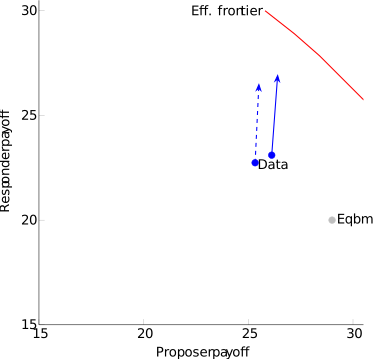
Dotted shows original, solid is with selfish Responder
Force Proposer to max-out top of interval
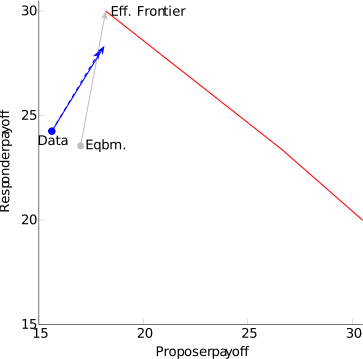
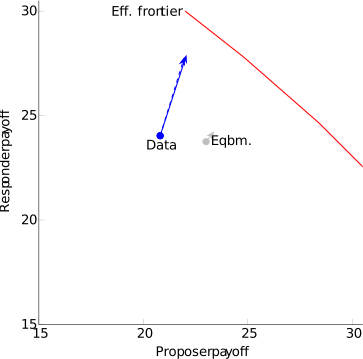
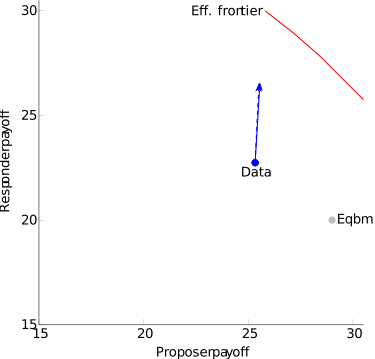
Dotted shows original, solid is with \([\underline{x}_i,8]\) interval
What explains behavioral deviations?
Additional experimental treatments:
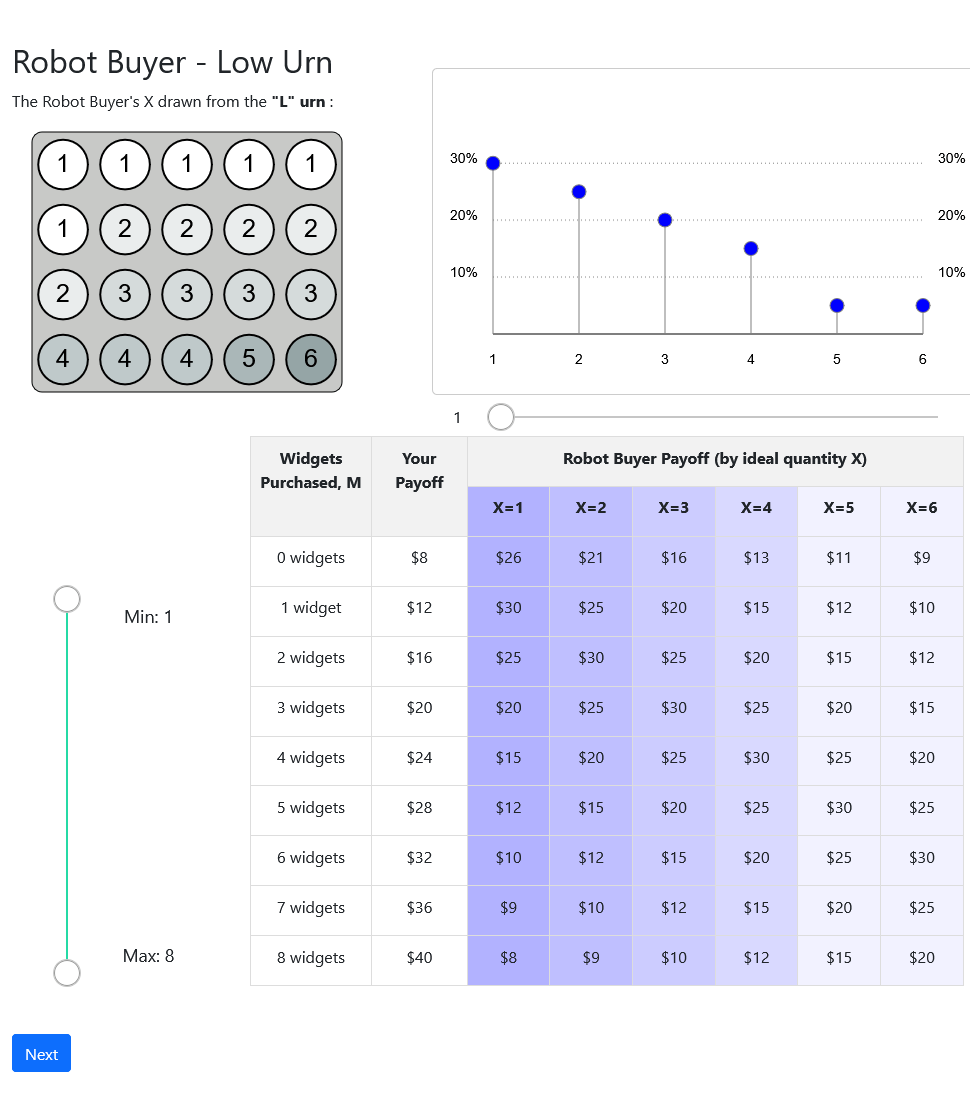
- Replace Responder with a payoff-maximizing Robot player
- Remove strategic uncertainty and other-regarding concerns
- Maintain Robot; remove mechanism framing
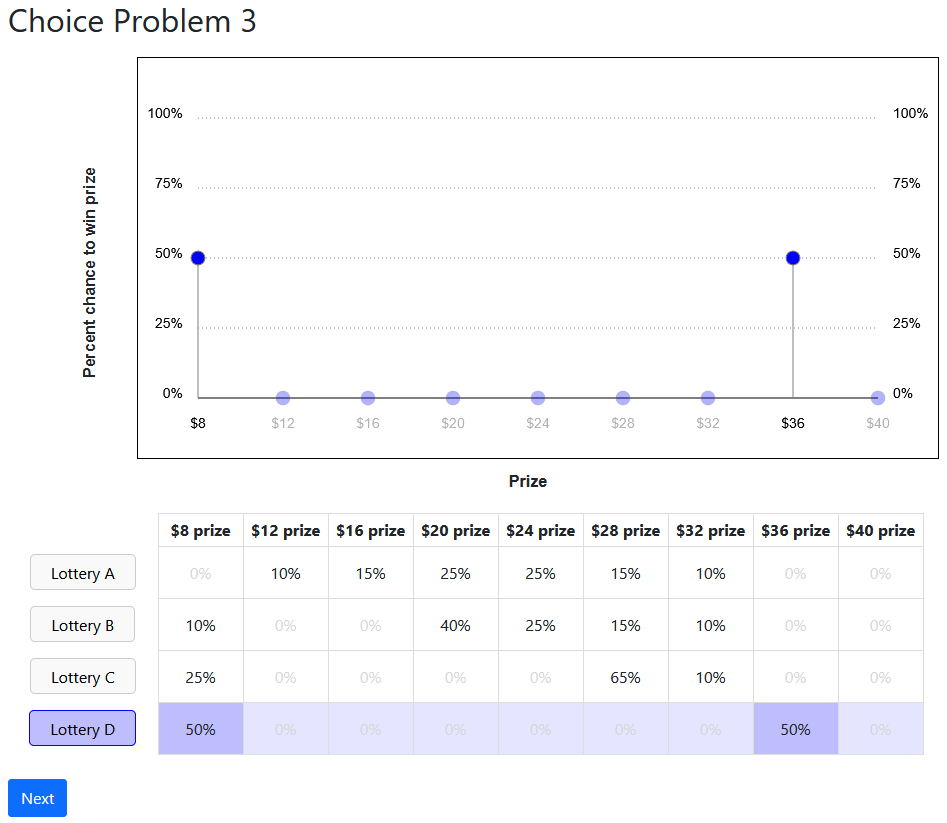
- Removes complexity, pure choice over lotteries
- Pure other-regarding decision
- Remove risk, purely distributive decision
- Remove veto threat
- Assess effect of deliberation in dictator analog
- Pay with expectation of decision
- Remove risk maintain strategic uncertainty
- Counterfactual assessment
- Assess behavior and valuation for Alt. Mechanism with experience of other mechanism
Robot Buyer
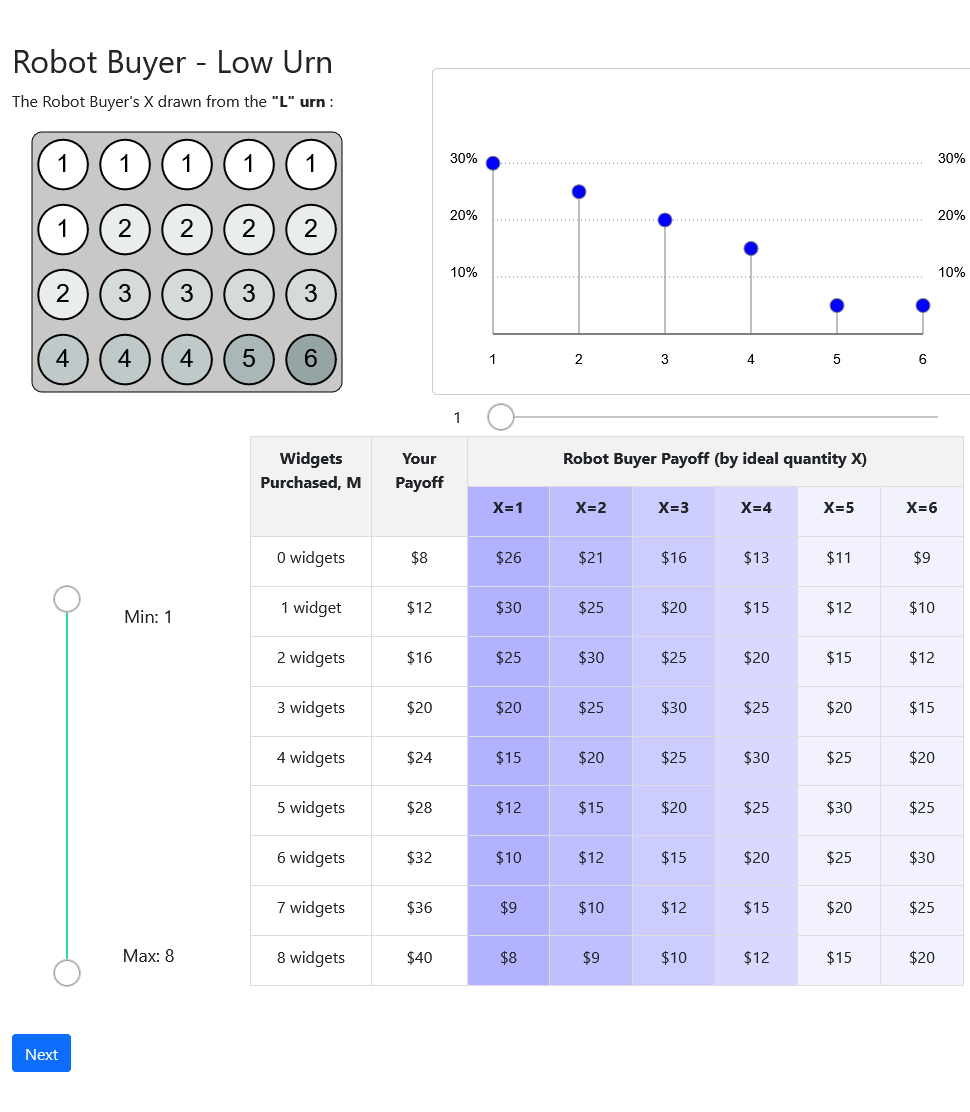
- Same decision screen/interface
- Same payoffs
- Repeat for all three urns
Remove mechanism framing
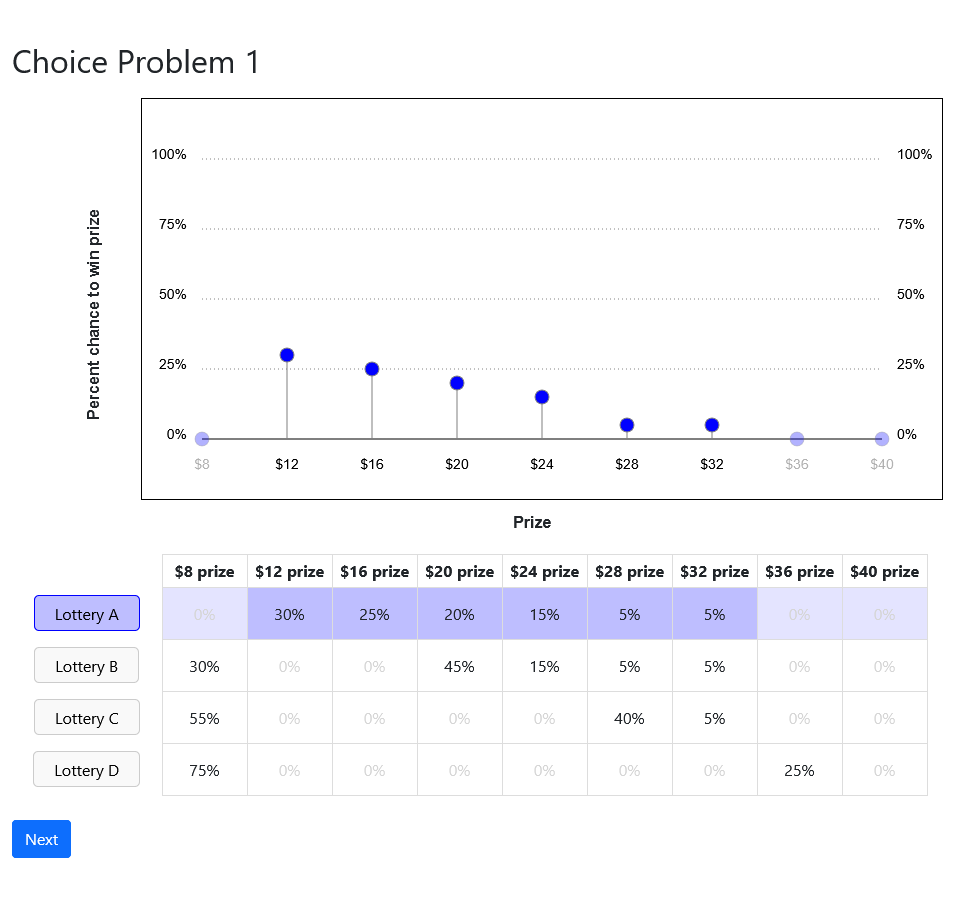
- Choices as a lottery
- Each lottery option corresponds to delegation decision
- Do this for all three urns
- TIOLI and Delegation
Self/Other Distribution Choice
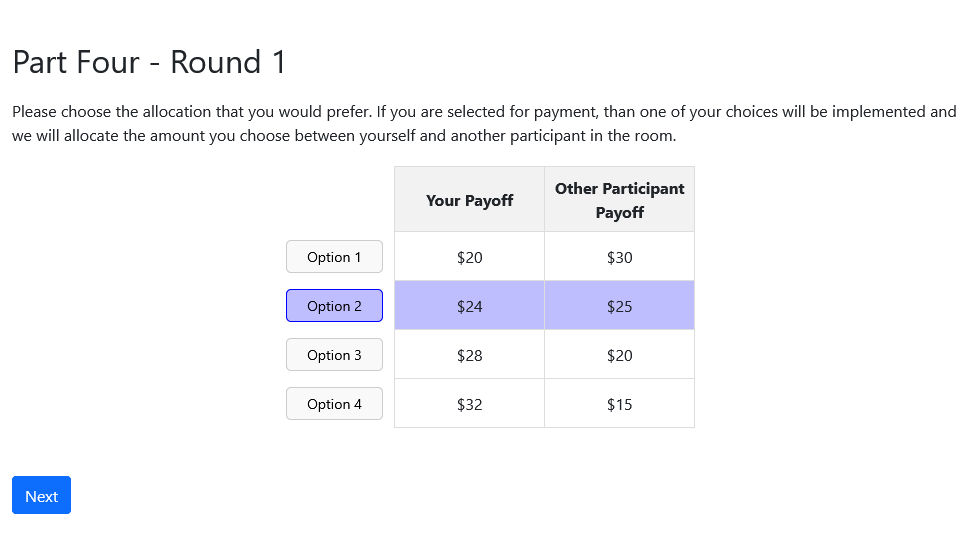
- Fix state, look at dictator problem for Seller under complete information
- Repeat this for low/med/high states
What explains behavioral deviations?
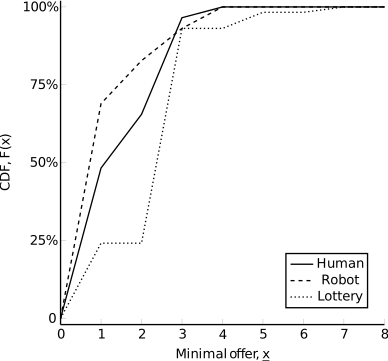
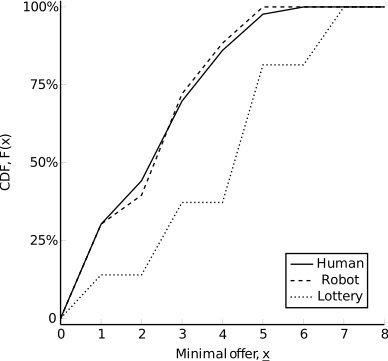
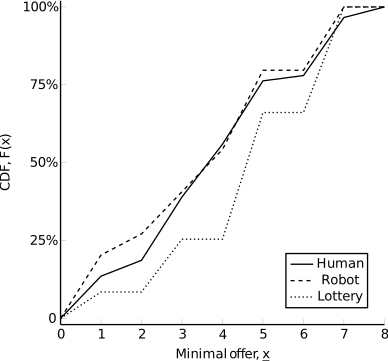
Proposer failure with delegation not driven by other regarding behavior, as when we replace the Buyer with a Robot observed choices closely mirror delegation choices
What explains behavioral deviations?
However, when we remove the mechanism framing, lottery choices indicate movement toward less latitude in delegation
Replace delegation decisions with lottery?
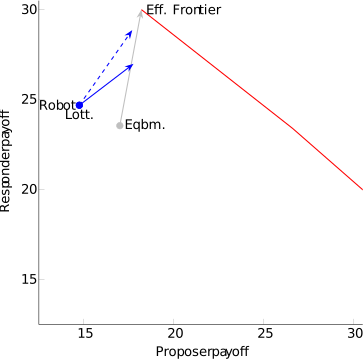
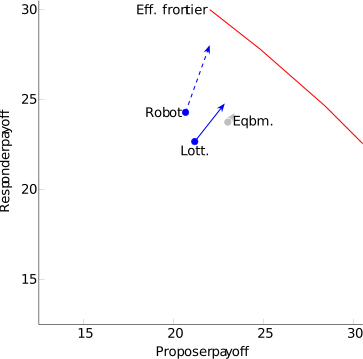
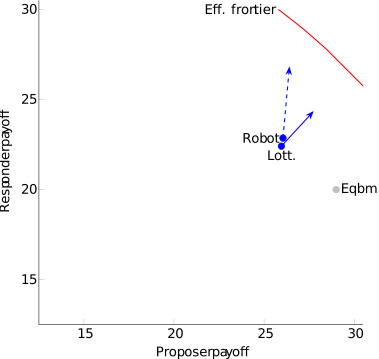
| Urn | Robot | Lottery |
|---|---|---|
| Low | 16.4pp | 10.7pp |
| Middle | 6.5pp | 7.6pp |
| High | 3.5pp | 7.0pp |
\(\Delta\)Proposer payoffs:
| Urn | Robot | Lottery |
|---|---|---|
| Low | 14.6pp | 8.2pp |
| Middle | 14.1pp | 7.1pp |
| High | 14.0pp | 6.5pp |
\(\Delta\)Resp payoffs:
Replace delegation decisions with lottery?
- Sellers do better with Delegation when presented as pure lottery in Middle/High.
- Esp. when more-aligned with the Responder and they have more bargaining power
- Suggests optimization failure over their use of the mechanism
How is delegation affected by veto?
- Can remove the veto threat point to examine value of delegation absent the veto threat mechanic
- Analagous to comparing Ultimatum vs Dictator game:
- With uncertainty over Responder preference
- Selfish BR outcome unaffected by Delegation v. TIOLI
Delegation with No Veto
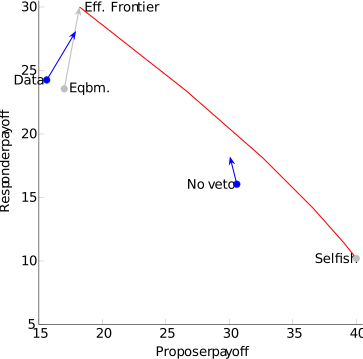
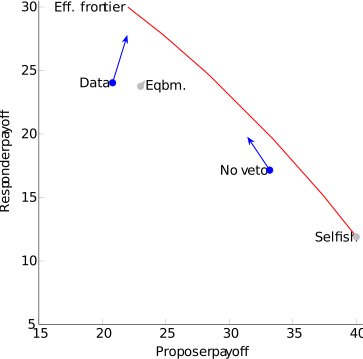
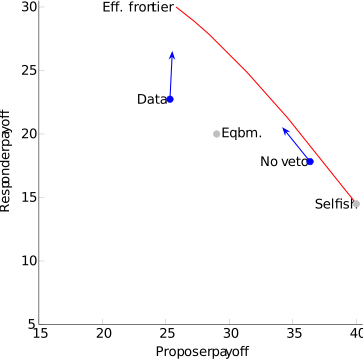
Without veto-threat having Delegation options reduces the Proposer's payoff and increases the Responder's payoff.
- Delegation is something you don't want to have as an option when you have decision power, as behavior is to be more conciliatory
Is Delegation valued by Proposers???
- Gain Experience: Subjects complete 15 rounds under fixed rule
- Remove risk: Asked to make a Proposer decision paid with the average behavior across many Robots buyers trained to mirror prior subjects
- Counterfactual: Explain alternative CF rule, make decision paid with average across Robot buyers trained to CF
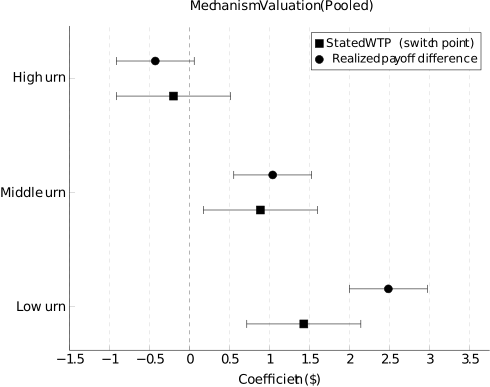
- Assess relative value: Ask about preference over payment in Parts 2 and Parts 3 where we add/subtract money.
(A. TIOLI or B. DELEG)
(A. DELEG or B. TIOLI)
Behavior across Counterfactuals
- Looking within-subject at:
- TIOILI: \(x_i\)
- DELEG: \([\underline{x}_i,\overline{x}_i]\)
| Low | Middle | High | |
|---|---|---|---|
| Move upper bound 6+ | 73% | 83% | 94% |
| Move lower bound below | 67% | 72% | 77% |
| Both directions | 49% | 56% | 74% |
- Movements
- \(\underline{x}_i-x_i>0\)
- \(\overline{x}_i\geq6\)
Perceived Value of Delegation
Results: Key Points
- Proposers respond to the expected alignment
- Offer more latitude than theory point prediction
- Delegation offers even more latitude
- Delegation mechanism substantially increases efficiency
- This is not true without the veto mechanic
- Efficiency gains not shared equally:
- Responder gets the lion's share
- Value to Proposer well ordered by theory
- This is also true for their expectations over the CF
- Proposers give away some of their share through optimization failures
- But this affects distribution rather than efficiency
Pre-play Communication
Theory: Communication
- For TIOLI, partially informative
- Two vague messages
- High/Low
- For Delegation, no gain predicted when using interval
- Only useful for No Compromise outcome (High urn)
Results: Chat
Seller: What are you willing to buy?
Buyer: A middle number will work for me
Seller: Okay, which is better, three or four
Buyer: 3
- TIOLI, \(\theta=3\), Middle urn
- Offer is \(x=4\)
- Outcome \(z=4\)
Results: Chat
Buyer: 0-4 or i walk
Buyer: simple
Seller: hehe
Buyer: ok ok
Seller: 2-4?
Buyer: so what u gonna offer
Seller: hows that bud
Buyer: hows what bud
Seller: 2-4
- Delegation, \(\theta=3\), Middle urn
- Offer is \(X=[2, 4]\)
- Outcome \(z=3\)
Results: Chat
Buyer: i got 1
Seller: hi
Buyer: pls help me out
Seller: ok ok
Buyer: tyyy
Seller: i got you
Buyer: :)
Seller: :)
- Delegation, \(\theta=2\), Low urn
- Offer is \(X=[1, 6]\)
- Outcome \(z=2\)
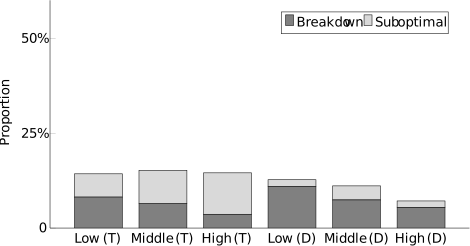
Results: Inefficiency (Data with No Comm)
TIOLI
Delegation
Results: Inefficiency (Data with Comm)
Results: Communication
- Still a lot of work to do with the communication data
- Cannot integrate out Responder state realization \(\theta\) as conversation before Proposer choice
- Use LLMs to code the chats:
- Across treatments Responders reveal their ideal:
- 76% in TIOLI (no effect by \(\theta\))
- 52% in Delegation (decreasing in \(\theta\))
- Lies are to claim lower values of \(\theta\)
- False claims in Delegation are much lower than TIOLI
- More breakdown in Delegation with chat when Responders honestly reveal
- Across treatments Responders reveal their ideal:
Results: Prop. Outcome (relative to full deleg)
| Dist. | TIOLI | Delegation |
|---|---|---|
| Low | -14.2% | -1.5% |
| Middle | -5.4% | -0.1% |
| High | -1.8% | -1.1% |
Without Chat:
| Dist. | TIOLI | Delegation |
|---|---|---|
| Low | 9.9% | 2.3% |
| Middle | -0.8% | -0.1% |
| High | 0.7% | 2.6% |
With Chat:
Chat Summary
- Our initial behavioral hypothesis was that chat might hurt Proposers in Delegation (relative to No Chat) through appeals to social preferences.
- No evidence for this
- There is some weak evidence that delegation hurts
Conclusion
- Examine constrained delegation
- Here in an ideal setting (veto bargaining)
- Participants respond to key tensions from the theory
- Clear efficiency gains from delegation
- But more of the surplus goes to the responder
- An optimization failure in using the mechanism leads to over-delegation
- However, in expectation this error helps increase efficiency!
- Preplay communication leads to:
- Much greater efficiency in TIOLI
- Slight increase in efficiency for Delegation
- Proposers do worse with Chat & Delegation than Chat & TIOLI
Thank you! 🙏
Questions or Comments?
Diagnosing the Failures: Pure Optimization
Diagnosing the Failures: Lotteries
Diagnosing the Failures: Distribution