Decentralized Futures and Options Markets
Instructor: Andreas Park


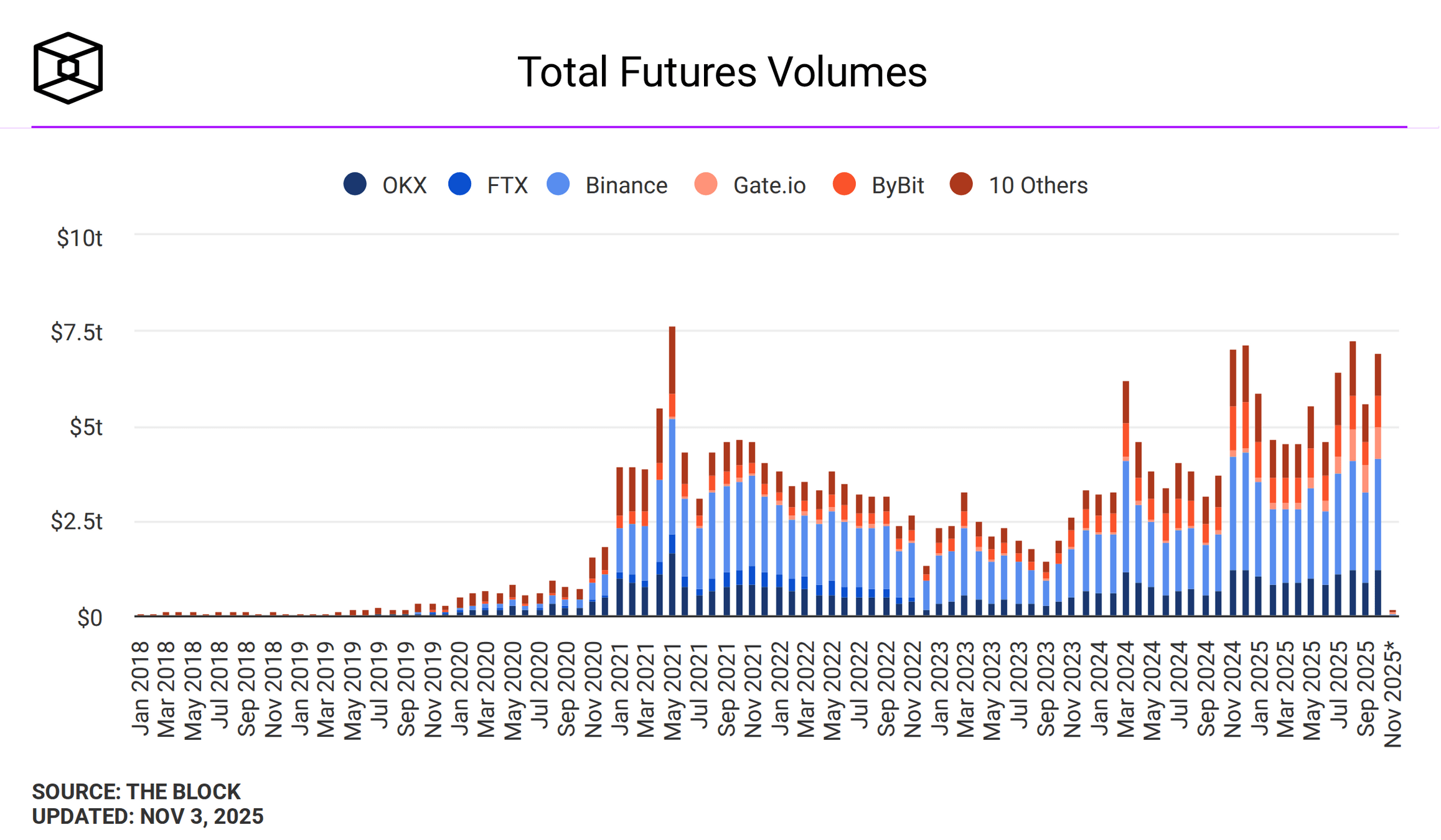
- Perpetual futures are a main finance innovation in crypto
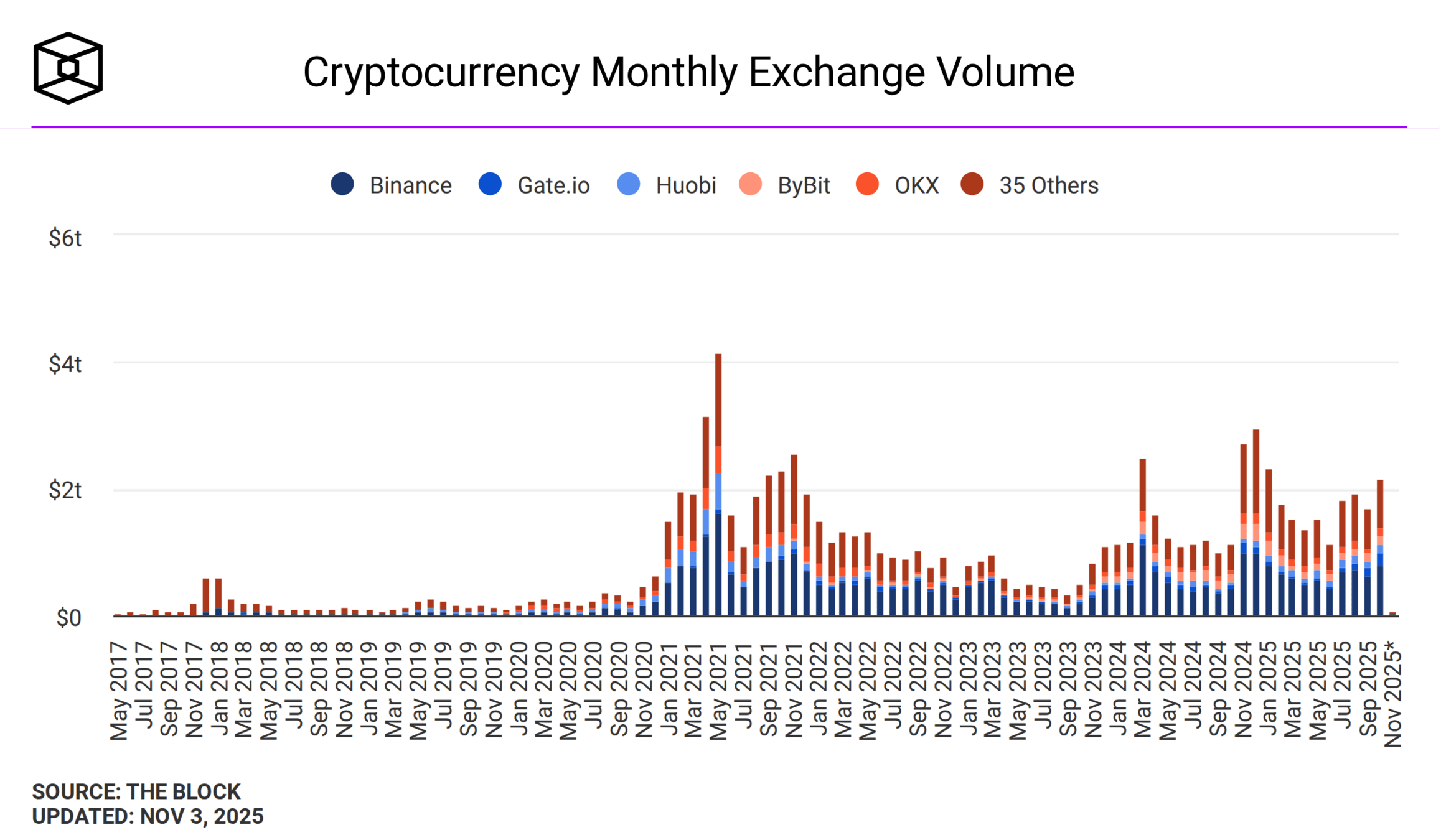
- one of the biggest markets by notional volume
- unique challenges for decentralized markets:
- How do we ensure delivery with pseudo-anonymity
- \(\to\) Lyra liquidity pools
- options and AMM spot highly related: Panoptic
Content
Some Data
Perpetual Futures:
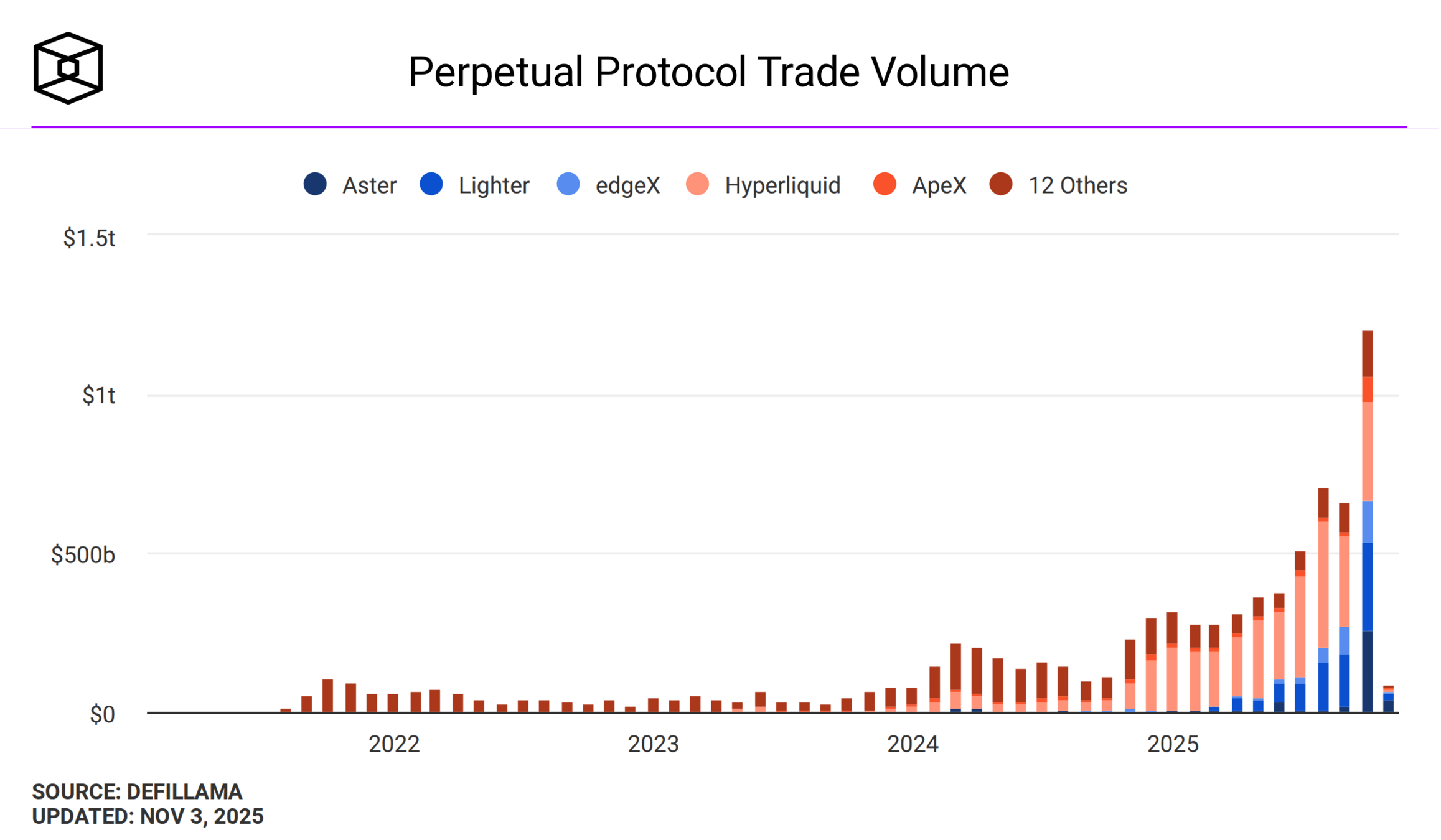
Centralized (Derebit/BitMEX/Binance) and Decentralized (Hyperliquid)
Forward (OTC)
- Bilateral contract to buy/sell at price K on date T
- Fully customized (size, date, settlement)
- No daily settlement; full counterparty risk
Futures (Exchange-Traded)
- Standardized contracts cleared through an exchange
- Daily mark-to-market: profits/losses settled each day
→ losing side pays, winning side receives variation margin - Key standardized terms:
- Contract size (e.g., 1,000 barrels WTI; 50× S&P index)
- Tick size and tick value
- Delivery months (Mar/Jun/Sep/Dec)
- Settlement type (cash vs physical)
-
Exchanges:
- US: CME Group, ICE Futures U.S., Cboe Futures Exchange
- Canada: Montréal Exchange (MX)
- Risks: liquidity gaps, margin calls, basis risk, and clearing-member operational risk
Forwards \(\to\) Futures: Definitions
| Spot Move | Leverage | Change in Futures P&L on Margin | Comment |
|---|---|---|---|
| +5 % | 1× | +5 % | Same as spot |
| +5 % | 5× | +25 % | Gains magnified |
| +5 % | 10× | +50 % | Gains amplified further |
| –5 % | 10× | –50 % | Same magnification on losses |
| –10 % | 10× | –100 % | Position wiped out (liquidation) |
- Futures returns scale roughly linearly with leverage until margin exhaustion.
- Both long and short must post initial margin.
Why trade with futures? Profit and Leverage Basics
-
Purpose: collateral protects against default; losses paid daily via variation margin.
- Initial margin: minimum deposit to open position (1–10 % typical).
- Maintenance margin: lower threshold triggering liquidation when breached.
-
Mark price:
- Estimated “fair” value from a basket of spot exchanges.
- Used for unrealized P&L and liquidation to avoid false triggers.
- Mark-to-market: exchange continuously credits winners and debits losers.
-
Differences crypto vs traditional futures:
- Crypto markets trade 24/7, with exchanges combining broker + clearinghouse functions.
- No external CCP; default risk absorbed by insurance fund.
Margin Basics for Futures
- Introduced by BitMEX (2016)
-
No expiry:
- position stays open as long as margin is sufficient.
- \(\to\) no rollovers, continuous exposure.
-
Spot anchoring (perp):
- normally spot and futures price converge close to expiry
- in crypto funding payments that are made every few hours (8) pull perp price toward index.
What is a Perpetual Future (="perp")?
-
Index price
- Average of spot prices across major exchanges.
- Reference value for “fair” pricing.
-
Mark price
- Index plus smoothed short-term premium adjustment.
- Used for liquidation and unrealized P&L to avoid volatility spikes.
- Traditional jargon: basis= the difference between the futures price and the spot (index) price.
-
Positive basis (futures > spot) → market in contango.
-
Negative basis (futures < spot) → market in backwardation.
-
-
Premium: Difference between perp and index prices.
- Positive premium (Perp > Index): longs pay shorts.
- Negative premium (Perp < Index): shorts pay longs.
- Premium in perpetuals is analogous to the ‘basis’ in standard futures, except that it’s continuously settled through funding rather than expiring and converging at maturity.
Key Terms: Index, Mark, and Premium/Basis
Numerical Example: Funding and Margin Lifecycle
Funding
- Suppose perp > index → funding = +0.01 %/8 h.
- Each side’s notional = $10 000.
- Long pays $10 000 × 0.0001 = $1 to the short every 8 h.
- If perp < index (negative premium), direction reverses.
Setup
- BTC index = $10 000
- Contract size = 1 BTC
- Initial margin = 10 % ($1 000); maintenance = 5 % ($500)
- Both sides post margin.
Price + 2 % → $10 200
- Long gains $200; short loses $200.
- Exchange credits long margin account and debits short’s.
- New long equity = $1 200; short equity = $800.
Price – 2 % → $9 800
- Long loses $200; short gains $200.
- Long equity = $800; short equity = $1 200.
- No liquidation (above maintenance).
Isolated Margin
- Margin allocated per position.
- Liquidation limited to that position’s equity.
- Preferred for high leverage and short-term trades.
Cross Margin
- All positions share one margin pool.
- Profits on one leg offset losses elsewhere.
- Preferred by hedgers and market-makers.
| Collateral | Margin Currency | Volatility Impact |
|---|---|---|
| USDC | Stable | Margin value fixed |
| ETH | Volatile | Margin value fluctuates; can fall as ETH price drops |
- Exchanges apply “haircuts” or higher initial margin on volatile collateral.
Background: Margin Modes and Collateral Types
| Feature | Binance (Centralized) | Hyperliquid (On-Chain) |
|---|---|---|
| Matching | Central server engine | Smart-contract order book |
| Custody | Exchange holds collateral | User retains custody on-chain |
| Counterparty | Exchange is CCP | Protocol smart contract as clearing layer |
| Funding | Exchange computes & nets | On-chain funding redistributes automatically |
| Liquidation | Managed by exchange engine | Triggered by contract logic; backed by protocol insurance |
| Margin modes | Cross / Isolated | Cross / Isolated |
| Funding interval | 8 h (1 h if capped) | 1 h default |
Key takeaway: even with an on-chain order book, funding and liquidation remain pooled, not bilateral.
Decentralized Futures: Hyperliquid
Decentralized Options: Aevo/Lyra
- Spot (cash) markets: direct exchange of assets.
- Options: contracts for future trades — require assurance that the writer can deliver.
- In pseudonymous systems, collateral replaces credit.
- On-chain models pool collateral and price options algorithmically (AMMs).
From Cash Markets to On-Chain Options
- Liquidity providers deposit collateral into Market Maker Vaults (MMVs).
- MMVs back multiple strikes and maturities for one asset.
- AMM layer: dynamically quotes option premiums and adjusts implied volatility.
- Delta pool: hedges exposure by trading the underlying on external markets.
- LPs earn option premiums minus hedging costs; positions remain fully collateralized.
- Withdrawals allowed subject to vault risk limits and cooldown.
Aevo/Lyra Overview
-
Traditional OCC (Options Clearing Corporation):
- Acts as central counterparty; guarantees exercise and assignment.
- Requires margin reflecting net portfolio risk (SPAN methodology).
- Allows offsets across positions (e.g., spreads, covered calls).
-
Aevo:
- Smart contract replaces OCC; collateral locked on-chain.
- 100 % collateralization — each option’s full exposure is backed in the vault.
- Automated hedging substitutes for clearing-house margin monitoring.
- Result: Aevo provides certainty of settlement but with higher capital lock-up.
Margin and Collateralization (OCC Analogy)
| Feature | OCC (Traditional) | Aevo / Lyra (On-Chain) |
|---|---|---|
| Collateral Basis | Partial — margin equals estimated portfolio risk (SPAN) | Full — 100 % collateralization of notional exposure |
| Offsets / Netting | Allowed across related positions | None; each vault independent |
| Leverage | Moderate; efficient use of capital | None; fully funded |
| Counterparty Risk | Mutualized through clearinghouse fund | Virtually none (smart-contract enforcement) |
| Capital Efficiency | High — lower margin requirements | Low — higher locked capital |
| Residual Risk | Credit and operational (clearing members) | Protocol, oracle, and contract risk |
| Collateral Type | Cash, Treasuries, or approved securities | Stablecoins (e.g., USDC) held on-chain |
Collateral and Margin Risk: Aevo vs OCC
Interpretation
- OCC achieves efficiency via margin netting but carries small default and operational risk.
- Aevo eliminates credit risk but locks roughly 2–4× more capital for comparable exposure.
- Risk transfer: counterparty → protocol.
- Aevo replicates clearinghouse collateralization through smart contracts.
- AMM + Delta Pool maintain solvency and automate hedging.
- LPs earn option premiums, carry Vega risk, but face minimal counterparty exposure.
- Main trade-off: safety and transparency vs. capital efficiency.
Summary
Decentralized Options: Panoptic
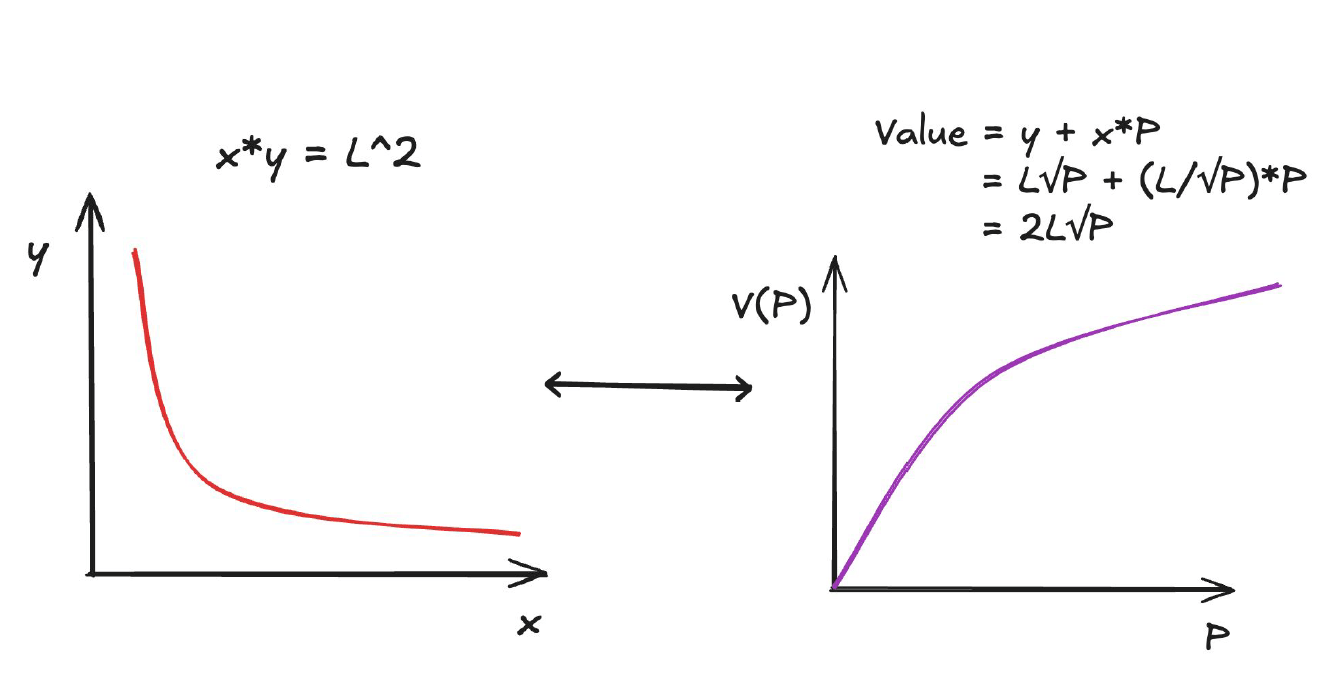

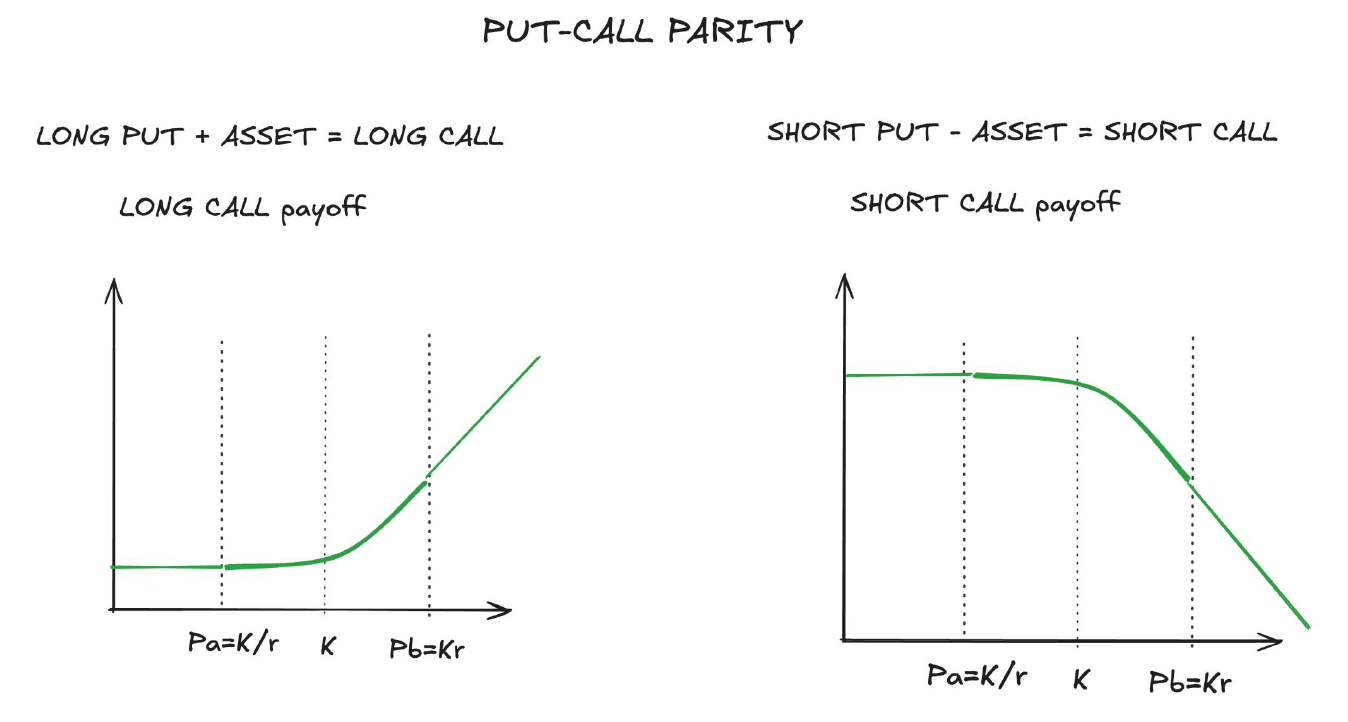
short put = short call + asset = covered call
-long call = - long put - asset = covered put
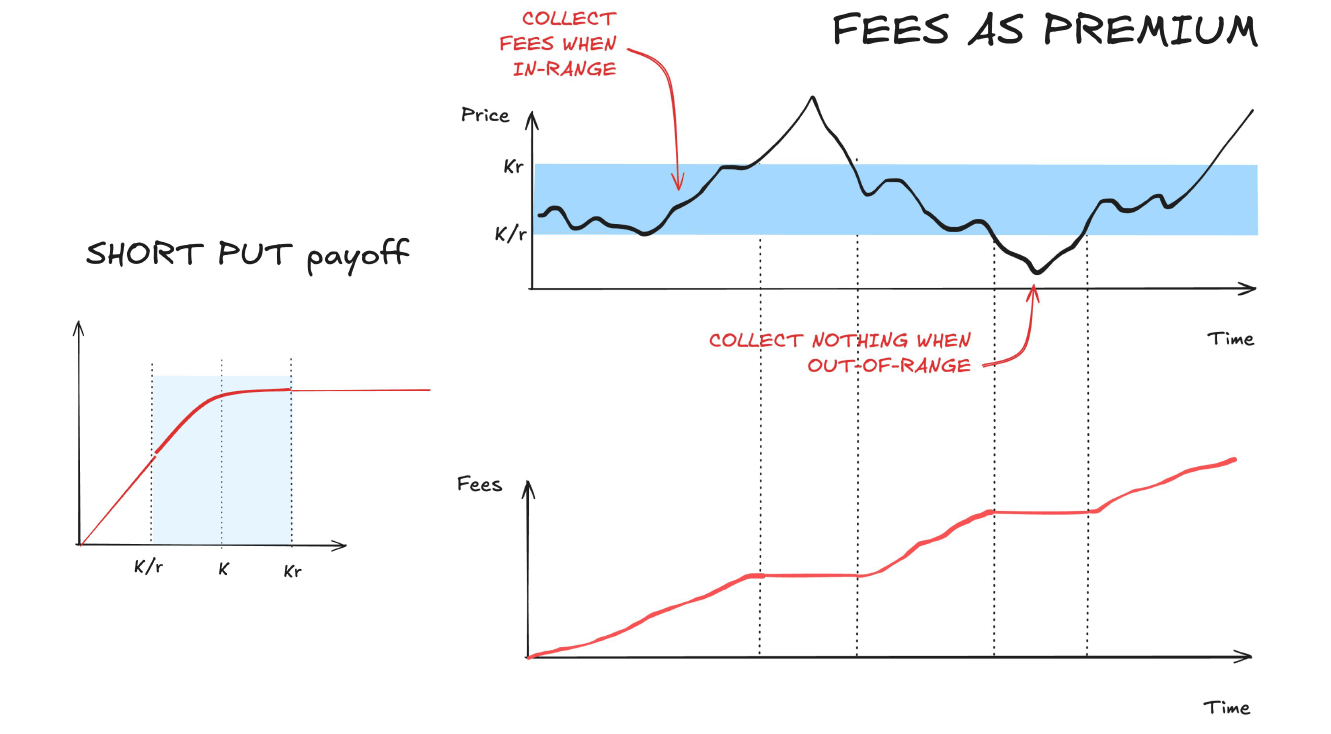
Panoptic's Overarching Idea
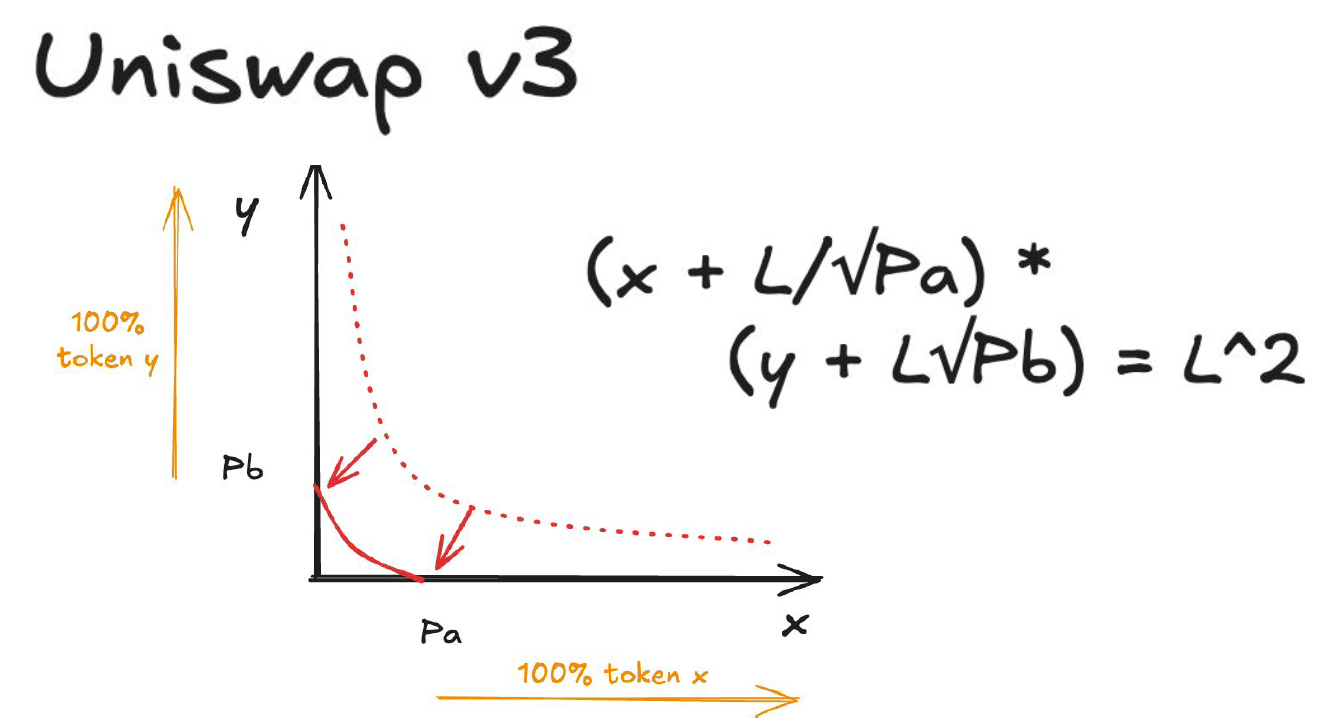
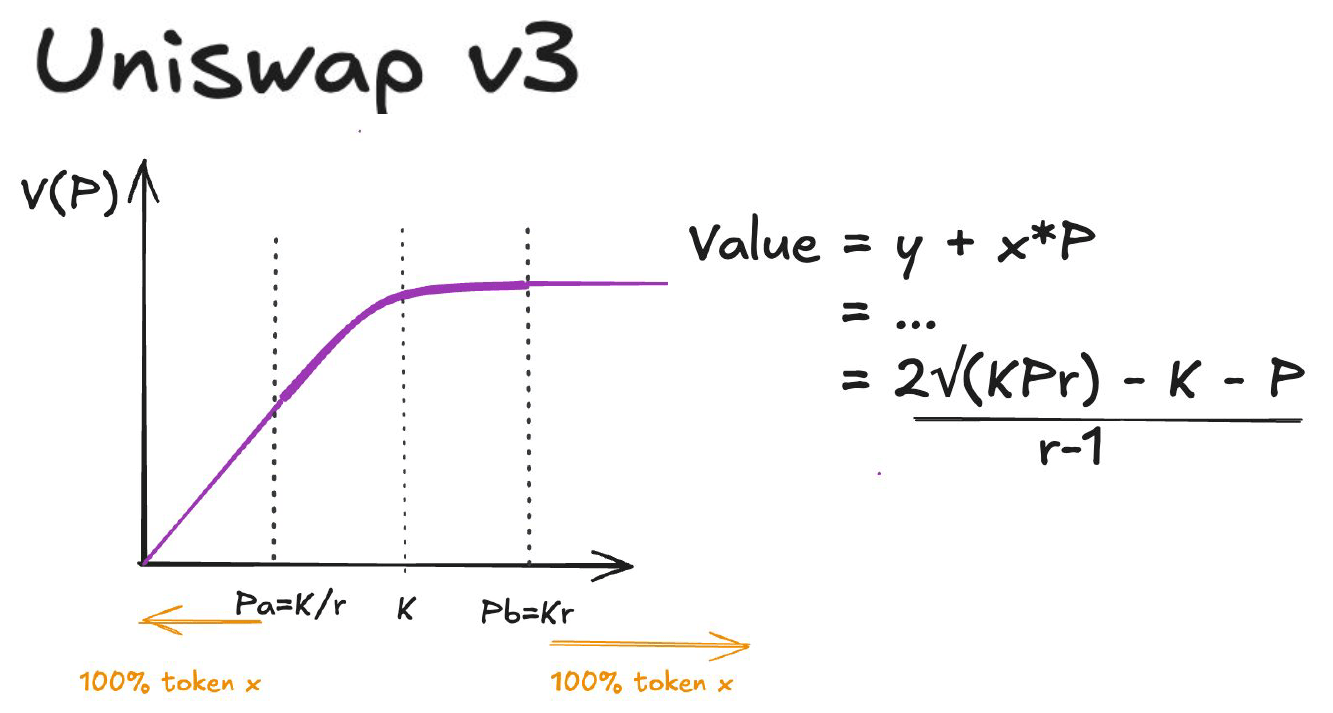
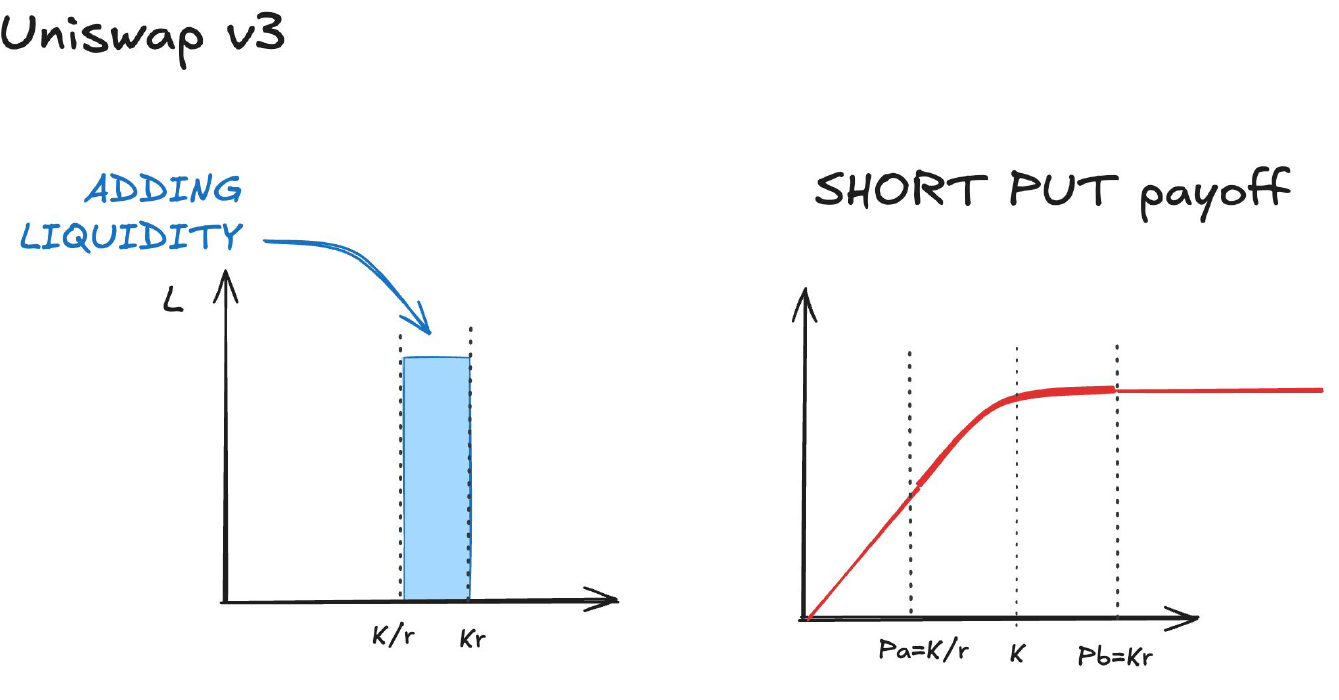
- LP position payoff \(\Rightarrow\) short put option (locally)
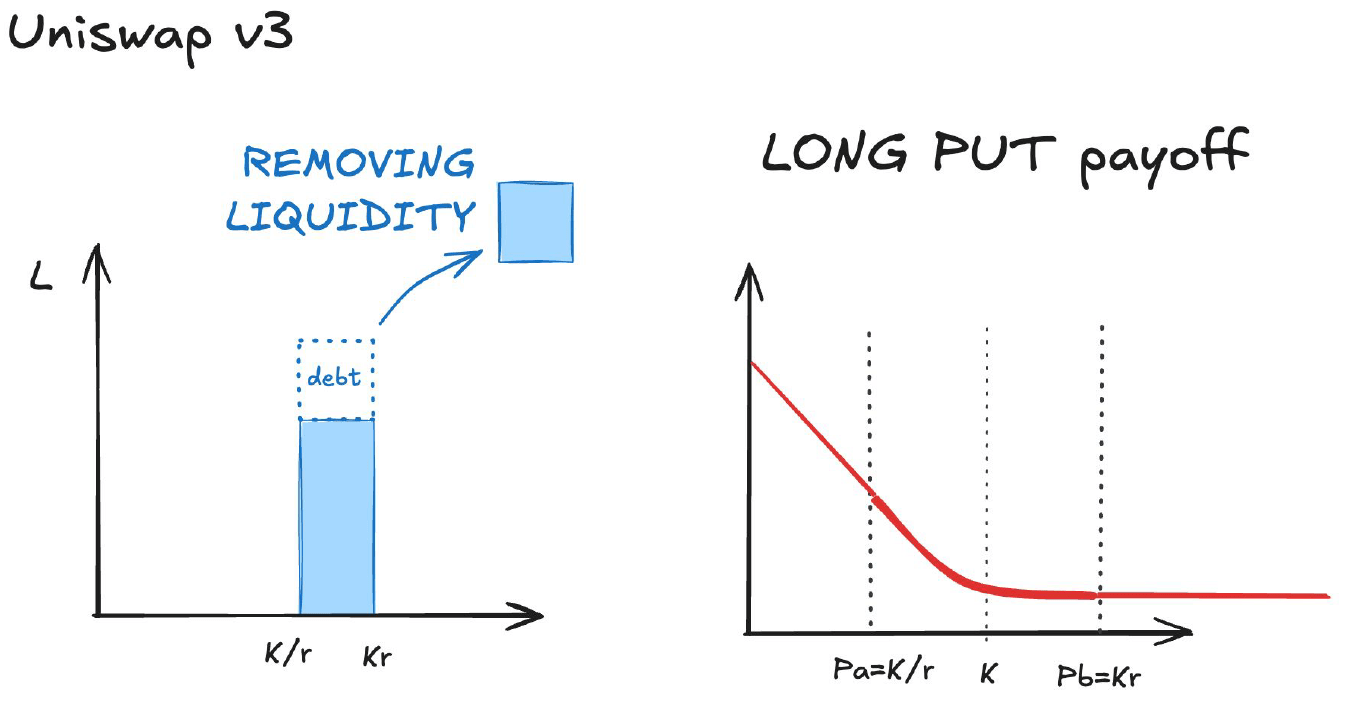
- Short LP position \(\Rightarrow\) long option (whether call or put depends on current price relative to range (last slide)
- Fees Collected \(\Rightarrow\) options premium payment
\(\Rightarrow\) they become an options clearing house
- Liquidity Providers (LPs) deposit tokens into Panoptic vaults.
- Vaults place funds into Uniswap v3 as price-range liquidity.
- LPs earn both swap fees and option premiums.
- Traders open synthetic option positions:
- Panoptic constructs the corresponding Uniswap LP position on their behalf.
- Traders post collateral (e.g., USDC or ETH) to ensure solvency.