Discussion of
Systemic Risk in Decentralized Markets
Paper by Alfred Lehar & Christine Parlour
Discussion by Andreas Park
AFA 2022


What is Decentralized Finance?
What is Decentralized Finance?
decentralized finance =
provision of financial services without the necessary involvement of a traditional financial intermediary at extremely low costs
key ingredient =
blockchain technology =
a common infrastructure for decentralized code execution


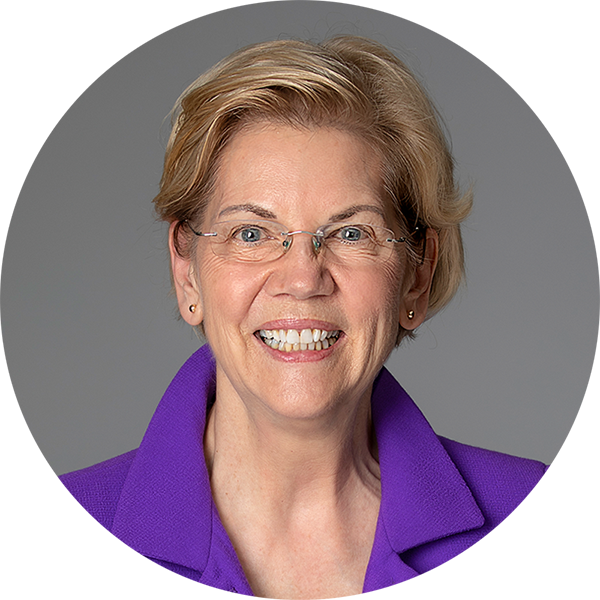
- "DeFi refers to a fast-growing and highly opaque corner of the cryptocurrency market which allows users to engage in a variety of financial activities – including lending, borrowing, and trading derivatives to take on leverage – without an intermediary like a bank.
- Given that participants and project developers may remain anonymous, DeFi could present particularly severe financial stability risks.
- According to a 2019 Financial Stability Board report, decentralized financial technologies may raise new forms of concentration risks, unclear allocation of liability, and recovery and resolution challenges."
Source: Letter to Janet Yellen, Chair of the Financial Stability Oversight Council (FSOC) https://www.warren.senate.gov/imo/media/doc/FSOC%20Crypto%20Letter%2007.26.2021.pdf
The prevailing view among angry middle-aged folks
“[…] the need for a coordinated and cohesive regulatory strategy to mitigate the growing risks that cryptocurrencies pose to the financial system”
DeFi Risks
Risk regulation and avoidance in defi
- What risks do we worry about in traditional financial markets?
- What's different about DeFi?
- What new risks emerge in DeFi?
- Wrong approach: map traditional world to DeFi and regulate the hell out of it
- Right approach: understand what's new and different and what's the same
Traditional Finance Risks
market
liquidity
credit/counterparty
operational
regulatory
systemic
What's different about DEFI?
self-custody
no-recourse
high transparency
miner interventions
composability
exploits
"hidden" smart contract features
oracles
Decentralized Finance Risks
market
liquidity
credit/counterparty
operational
regulatory \(\subset\) systemic
composability \(\subset\) systemic
scam/custody hacks
liquidity
credit/counterparty
"dark forest"
exploits
smart contract
oracle risk
self-custody \(\to\) worry about all risks
DeFi Borrowing
DeFi Borrowing




4 ETH
(1 ETH = $3000)
(Jan 8, 2022)
\(\approx\) $12,000
\(\vdots\)
up to 8,000 DAI
(1 DAI = $1)
formally: this smart contract is a collateralized debt position (CDP)
"over-collateralization ratio: 150%"
fractional collateral \(\to\) collateralization factor \(=\) 150%
total collateral = $12,000
maximum loan = $8,000
overcollateralization = $4,000
actual loan (example) = $4,000
buffer = $4,000
DeFi Borrowing
user perspective: what happens if the price of ETH falls?
ETH \(\searrow\) $1,500
value of ETH collateral = $6,000
maximum loan = $6,000/150%=$4,000
total collateral = $6,000
maximum loan = $4,000
overcollateralization = $2,000
actual loan (example) = $4,000
buffer = $0
for reference: former value of collateral
user perspective: what happens if the price falls & max loan is exceeded?
ETH \(\searrow\) $1,250
value of ETH collateral = $5,000
maximum loan = $5,000/150%=$3,333
total collateral = $5,000
maximum loan = $3333
required overcollateralization = $1,667
actual loan (example) = $4,000
buffer = -$667
for reference: former value of collateral
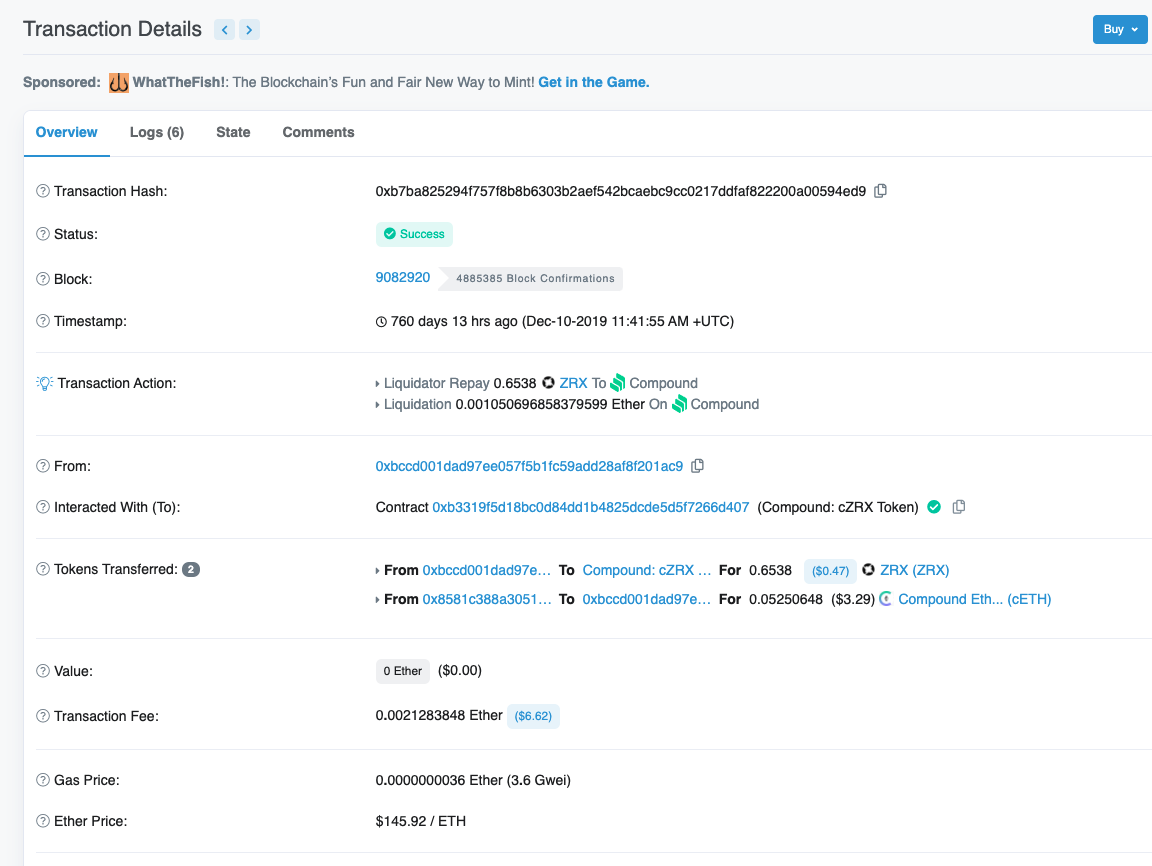
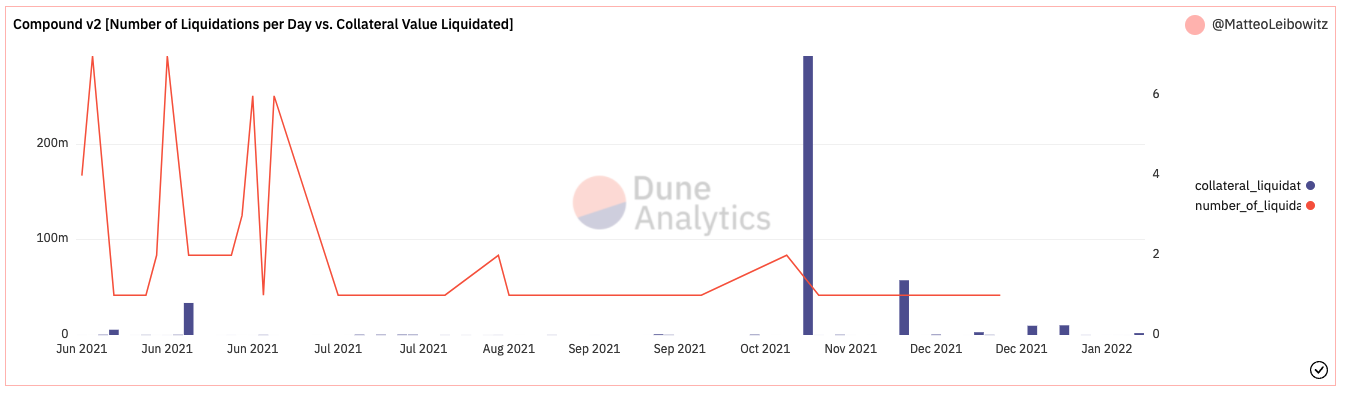
Loan liquidation

pay oracle price \(\times 95\%\)
(max liquidation is 50%)
What do you do with the collateral? - SWap to DAI





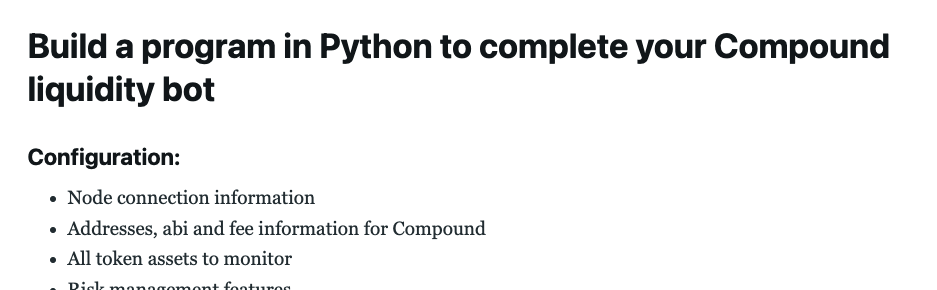
Where do you get the collateral? - Flash loan

1. borrow DAI
5. repay DAI

2. liquidate ETH loan with DAI

3. receive ETH
4. convert ETH to DAI
Economics:
- borrow $1,000 DAI
- receive $1,050 ETH for $1,000
- pay swap fees
- pay gas fees
https://chiragkhatri.me/compound-liquidator/
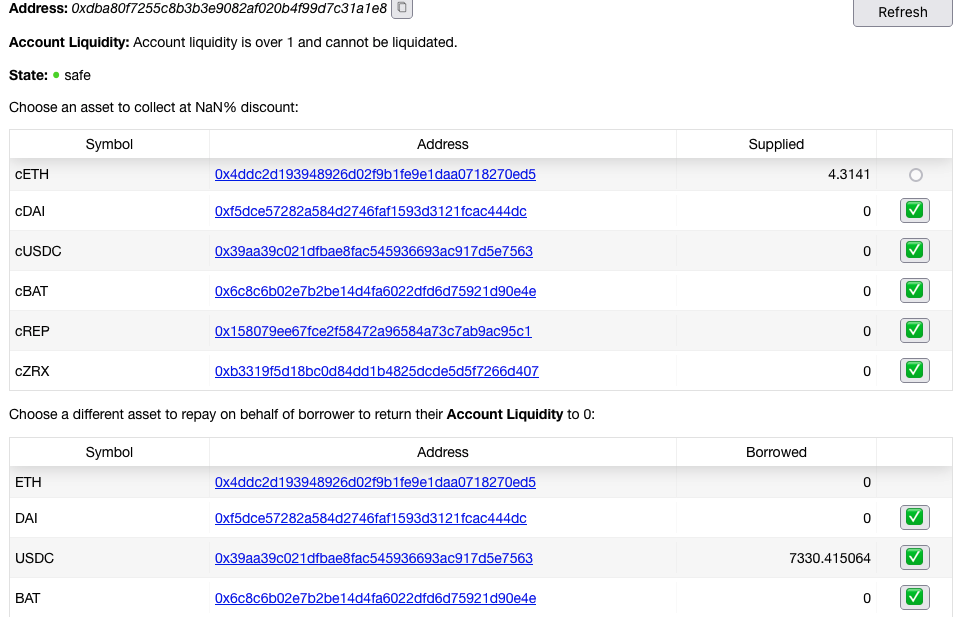
https://zengo.com/understanding-compounds-liquidation/#Section_3_Liquidation_in_practice

Some observations
- phenomenal system
- integrated/composable apps, transparency, accessible to anyone
- in many ways, as pure a market as economists could dream one up
- details matter:
- Where does Compound get the price from?
- Does the conversion trade have price impact?
This paper
What do they do?
- collect extensive data on liquidations
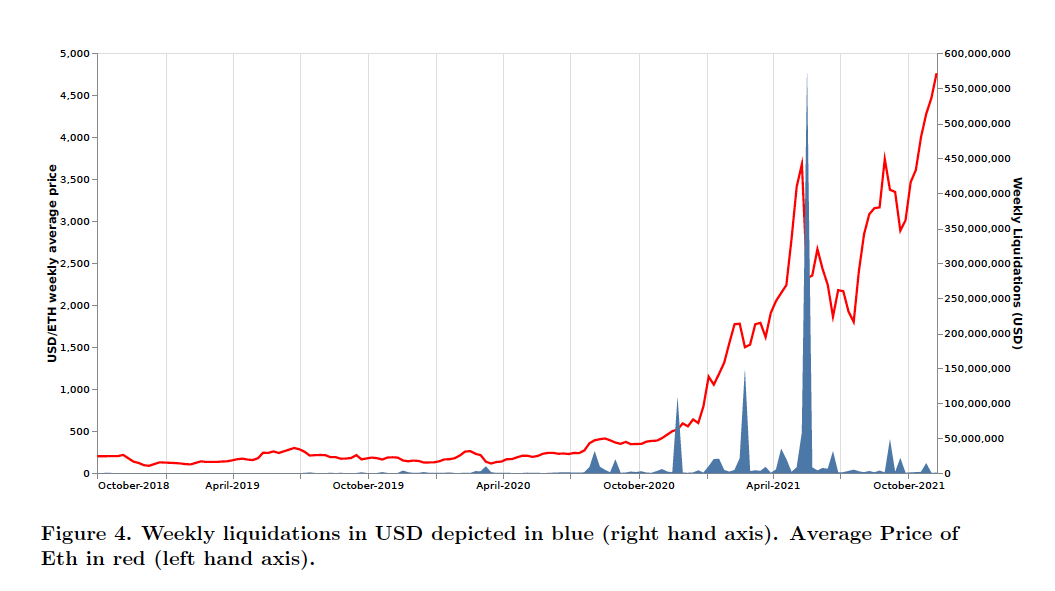
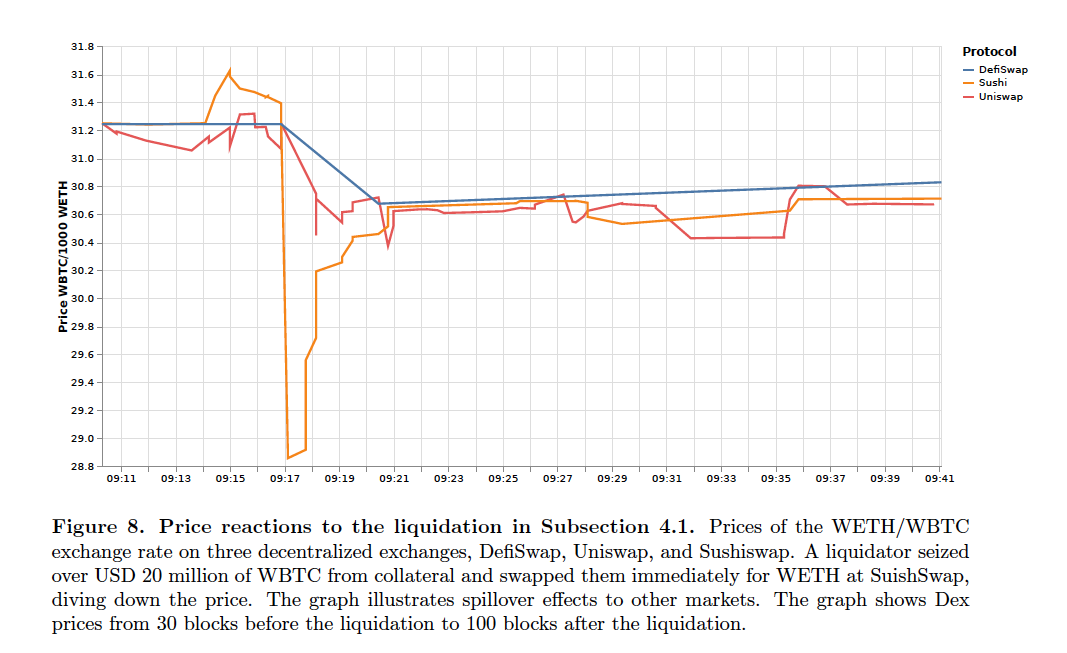
- show that trades have price impact
- ~42% of initial price movement persists
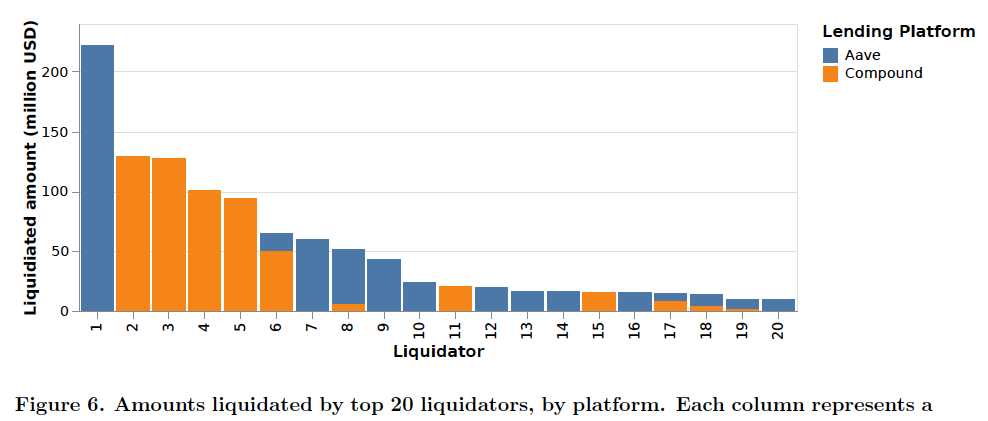
- \(\ldots\) per "account"
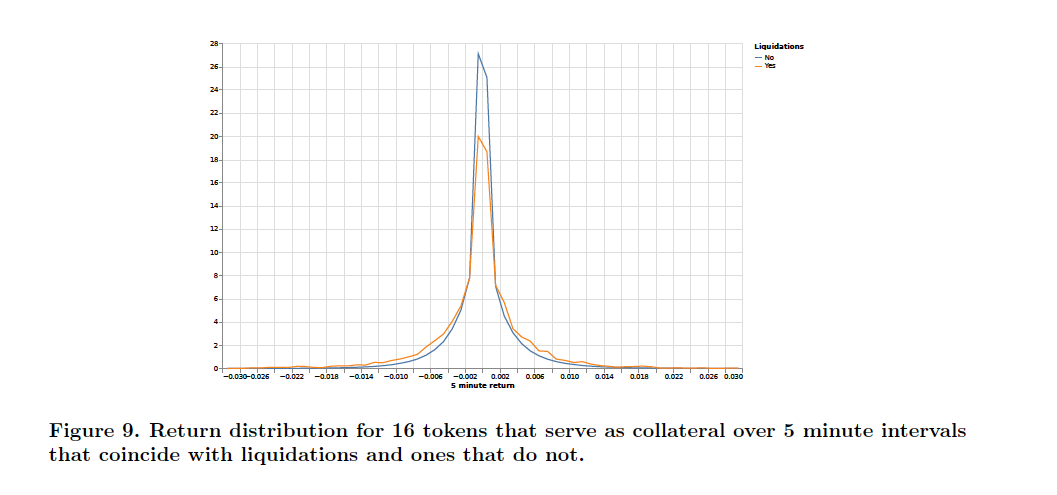
Figure 9: Return distribution for 16 tokens that serve as collateral over 5 minute intervals that coincide with liquidations and ones that do not.
Looks like stochastic dominance!
Finding: returns with vs. without liquidations
Returns/Price Impact
When? Regression result: "waves" of liquidation have lasting impact, one-off events do not.
What could explain the findings?
- lasting price impact for pure liquidity trades is surprising
- with blockchain transparency, the market should figure this out
- shift in willingness of market to absorb inventory risk?
- information?
- or (boring) maybe the market isn't fully developed yet
- Idea (may be a stretch):
- liquidation is costly and preventable
- price movement that triggered came as shock
- the shock is new information
- \(\to\) liquidation is informative
Path forward
- Use the per-account data: What are the characteristics?
- Active liquidators more likely in wave?
- Connected to miner to avoid MEV?
- Have more or less price impact?
- Do they make more or less money per liquidation?
- Oracle risk
- Cream Finance exploit manipulated an oracle
- Is there evidence of liquidation triggering?
- Leverage risk
- With collateralization ratio \(\delta\) one can leverage capital \(K\) to create position \(K/\delta\).
- Do we see this? Are these more or less likely to get liquidated? (Info story?)
-
Systemic risk
- suggests risk of unravelling
- what are the odds? examples?
Summary
- Start of an exciting and important research agenda:
- collect data on loan liquidations
- quantifying risk in DeFi
- Nice finding:
- genuine liquidity trades have price impact
- genuine liquidity trades have price impact
- Many questions on DeFi risk and markets remain
\(\to\) lots of papers to write (for all of us)!

@financeUTM

andreas.park@rotman.utoronto.ca

slides.com/ap248

sites.google.com/site/parkandreas/

youtube.com/user/andreaspark2812/