Brandon Williams
Experimental/Behavioral Brown Bag
October 23, 2024
Experiment(s) in the Repeated Volunteer's Dilemma
-
Detail motivation and experimental design for second-year paper (and collect feedback)
-
Develop modular, "future-proof" environment
-
Present additional directions for research
Objectives
- Gender differences in volunteering for tasks with low-promotability:
Motivation
- Gender differences in volunteering for tasks with low-promotability: women disproportionately take on the cost of an action for a group's benefit (Babcock, Recalde, Vesterlund, & Weingart, 2017 henceforth NPT)
Motivation
- Gender differences in volunteering for tasks with low-promotability:
Motivation
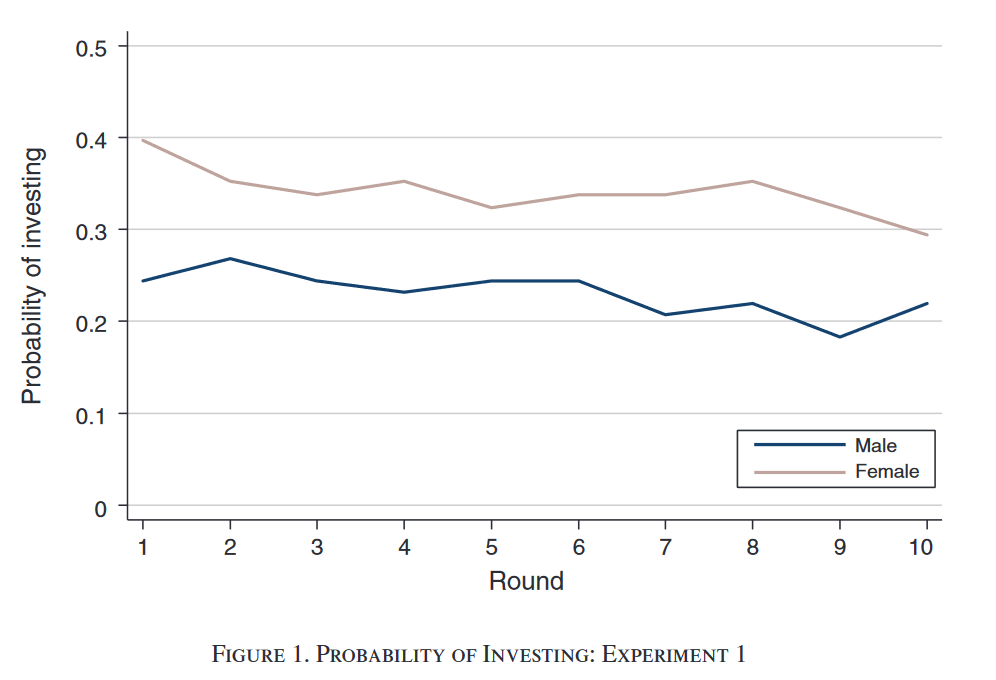
- Gender differences in volunteering for tasks with low-promotability:
- NPT experiment restricted to a one-shot environment
- Many applications involve repeated interactions within teams
- Joining a faculty committee
- Volunteer for the IRB
- TSA employees taking on undesirable tasks (Chan and Anteby, 2016)
- Repeated interactions require team reputation and inter-temporal trade-offs
Motivation
Are women more likely than men to volunteer in repeated group settings?
Research Question
- Do women volunteer earlier?
- Are women more likely to over-provide? Men more likely to free-ride?
- Do men volunteer reciprocally?
- Is it the case that, as pointed out in NPT, "initial gender differences may become self-reinforcing in repeated interactions?"
- Do teams with women do better than teams of only men?
-
Why the Volunteers Dilemma?
-
One-shot volunteer's dilemma provides an ideal setting for exploring how individuals choose actions that benefit a group at personal cost
-
Motivation


-
Why the Volunteers Dilemma?
-
One-shot volunteer's dilemma provides an ideal setting for exploring how individuals choose actions that benefit a group at personal cost
-
Motivation
-
Why the Volunteers Dilemma?
-
One-shot volunteer's dilemma provides an ideal setting for exploring how individuals choose actions that benefit a group at personal cost
-
Motivation
-
Why the Volunteers Dilemma?
-
One-shot volunteer's dilemma provides an ideal setting for exploring how individuals choose actions that benefit a group at personal cost
-
Deikmann (2015): "it shares important properties with a range of other social dilemmas and has been shown to map many real-world situations relatively well"
- Requires an individual (and just one) make a costly choice for the benefit of other members
- Strictly better to volunteer than to have no volunteer
- Strictly better to free ride than to volunteer
-
Motivation
-
Why the Volunteers Dilemma?
-
Repeated VD presents a more complicated coordination environment
-
Motivation
-
Why the Volunteers Dilemma?
-
Repeated VD presents a more complicated coordination environment
-
How can we find a volunteer in every period?
-
Conceding a lower payoff now may facilitate future gains
-
-
Motivation
-
Why the Volunteers Dilemma?
-
Repeated VD presents a more complicated coordination environment
-
How can we find a volunteer in every period?
-
Conceding a lower payoff now may facilitate future gains
- Inter-temporal cooperation based on history
-
-
Motivation
Literature
-
There is a long history of studying the volunteer's dilemma: introduction and theory of the dilemma (Diekmann 1985, 1993);
Literature
-
There is a long history of studying the volunteer's dilemma: introduction and theory of the dilemma (Diekmann 1985, 1993); varied group size, horizon points, ordering of players, and uncertainty (Goeree et al.; 2017Otsubo & Rapoport, 2008; Bolle, 2011; Hillenbrand and Winter, 2018);
Literature
-
There is a long history of studying the volunteer's dilemma: introduction and theory of the dilemma (Diekmann 1985, 1993); varied group size, horizon points, ordering of players, and uncertainty (Goeree et al.; 2017Otsubo & Rapoport, 2008; Bolle, 2011; Hillenbrand and Winter, 2018); one-shot asymmetries increase success rates and are largely the result of advantaged players volunteering most (Kopanyi-Peuker, 2019; Healy and Pate, 2018; Diekmann and Przepiorka, 2016)
Literature
-
There is a long history of studying the volunteer's dilemma: introduction and theory of the dilemma (Diekmann 1985, 1993); varied group size, horizon points, ordering of players, and uncertainty (Goeree et al.; 2017Otsubo & Rapoport, 2008; Bolle, 2011; Hillenbrand and Winter, 2018); one-shot asymmetries increase success rates and are largely the result of advantaged players volunteering most (Kopanyi-Peuker, 2019; Healy and Pate, 2018; Diekmann and Przepiorka, 2016)
-
More recently, use of the volunteer's dilemma to study gender gap in tasks with low promotability: in one-shot settings, women both volunteer more and are expected to volunteer more (Babcock et al., 2017);
Literature
-
There is a long history of studying the volunteer's dilemma: introduction and theory of the dilemma (Diekmann 1985, 1993); varied group size, horizon points, ordering of players, and uncertainty (Goeree et al.; 2017Otsubo & Rapoport, 2008; Bolle, 2011; Hillenbrand and Winter, 2018); one-shot asymmetries increase success rates and are largely the result of advantaged players volunteering most (Kopanyi-Peuker, 2019; Healy and Pate, 2018; Diekmann and Przepiorka, 2016)
-
More recently, use of the volunteer's dilemma to study gender gap in tasks with low promotability: in one-shot settings, women both volunteer more and are expected to volunteer more (Babcock et al., 2017); gender gap under asymmetries (Bacine & Eckel, 2020);
Literature
-
There is a long history of studying the volunteer's dilemma: introduction and theory of the dilemma (Diekmann 1985, 1993); varied group size, horizon points, ordering of players, and uncertainty (Goeree et al.; 2017Otsubo & Rapoport, 2008; Bolle, 2011; Hillenbrand and Winter, 2018); one-shot asymmetries increase success rates and are largely the result of advantaged players volunteering most (Kopanyi-Peuker, 2019; Healy and Pate, 2018; Diekmann and Przepiorka, 2016)
-
More recently, use of the volunteer's dilemma to study gender gap in tasks with low promotability: in one-shot settings, women both volunteer more and are expected to volunteer more (Babcock et al., 2017); gender gap under asymmetries (Bacine & Eckel, 2020); gender gap under social recognition (Banerjee & Mustafi, R&R)
Literature
-
There is a long history of studying the volunteer's dilemma: introduction and theory of the dilemma (Diekmann 1985, 1993); varied group size, horizon points, ordering of players, and uncertainty (Goeree et al.; 2017Otsubo & Rapoport, 2008; Bolle, 2011; Hillenbrand and Winter, 2018); one-shot asymmetries increase success rates and are largely the result of advantaged players volunteering most (Kopanyi-Peuker, 2019; Healy and Pate, 2018; Diekmann and Przepiorka, 2016)
-
More recently, use of the volunteer's dilemma to study gender gap in tasks with low promotability: in one-shot settings, women both volunteer more and are expected to volunteer more (Babcock et al., 2017); gender gap under asymmetries (Bacine & Eckel, 2020); gender gap under social recognition (Banerjee & Mustafi, R&R)
-
Very few papers have looked at the repeated setting: repeated asymmetries cause cooperation to deteriorate (Kloosterman & Mago, 2023);
Literature
-
There is a long history of studying the volunteer's dilemma: introduction and theory of the dilemma (Diekmann 1985, 1993); varied group size, horizon points, ordering of players, and uncertainty (Goeree et al.; 2017Otsubo & Rapoport, 2008; Bolle, 2011; Hillenbrand and Winter, 2018); one-shot asymmetries increase success rates and are largely the result of advantaged players volunteering most (Kopanyi-Peuker, 2019; Healy and Pate, 2018; Diekmann and Przepiorka, 2016)
-
More recently, use of the volunteer's dilemma to study gender gap in tasks with low promotability: in one-shot settings, women both volunteer more and are expected to volunteer more (Babcock et al., 2017); gender gap under asymmetries (Bacine & Eckel, 2020); gender gap under social recognition (Banerjee & Mustafi, R&R)
-
Very few papers have looked at the repeated setting: repeated asymmetries cause cooperation to deteriorate (Kloosterman & Mago, 2023); what threshold public goods games foster dynamic turn-taking (Riyanto & Roy, 2019);
Literature
There is a long history of studying the volunteer's dilemma: introduction and theory of the dilemma (Diekmann 1985, 1993); varied group size, horizon points, ordering of players, and uncertainty (Goeree et al.; 2017Otsubo & Rapoport, 2008; Bolle, 2011; Hillenbrand and Winter, 2018); one-shot asymmetries increase success rates and are largely the result of advantaged players volunteering most (Kopanyi-Peuker, 2019; Healy and Pate, 2018; Diekmann and Przepiorka, 2016)
More recently, use of the volunteer's dilemma to study gender gap in tasks with low promotability: in one-shot settings, women both volunteer more and are expected to volunteer more (Babcock et al., 2017); gender gap under asymmetries (Bacine & Eckel, 2020); gender gap under social recognition (Banerjee & Mustafi, R&R)
Very few papers have looked at the repeated setting: repeated asymmetries cause cooperation to deteriorate (Kloosterman & Mago, 2023); what threshold public goods games foster dynamic turn-taking (Riyanto & Roy, 2019); turn-taking in the volunteer's dilemma with private random costs (Leo, 2018)
Literature
-
Very few papers have looked at the repeated setting: repeated asymmetries cause cooperation to deteriorate (Kloosterman & Mago, 2023); what threshold public goods games foster dynamic turn-taking (Riyanto & Roy, 2019); turn-taking in the volunteer's dilemma with private random costs (Leo, 2018)
Despite the relatively large experimental literature on the Volunteer's Dilemma, the question of volunteering in a repeated game setting remains relatively unexplored.
Literature
-
Very few papers have looked at the repeated setting: repeated asymmetries cause cooperation to deteriorate (Kloosterman & Mago, 2023); what threshold public goods games foster dynamic turn-taking (Riyanto & Roy, 2019); turn-taking in the volunteer's dilemma with private random costs (Leo, 2018)
Literature
-
Very few papers have looked at the repeated setting:
-
repeated asymmetries cause cooperation to deteriorate (Kloosterman & Mago, 2023);
-
what threshold public goods games foster dynamic turn-taking (Riyanto & Roy, 2019);
-
turn-taking in the volunteer's dilemma with private random costs (Leo, 2018)
-
Contribution
-
Very few papers have looked at the repeated setting:
-
repeated asymmetries cause cooperation to deteriorate (Kloosterman & Mago, 2023);
-
Two-player game
-
Played online with little gender salience
-
-
what threshold public goods games foster dynamic turn-taking (Riyanto & Roy, 2019);
-
Three-player public goods game with random endowment in each round
-
Gender not focus of the research question (path of inter-temporal turn-taking)
-
N=39 in symmetric case, likely under-powered
-
Modest gender effect (10% level) in at least one of the treatments
-
-
-
turn-taking in the volunteer's dilemma with private random costs (Leo, 2018)
-
Two-player game
-
Randomly drawn private costs with "obligation" assignment
-
-
Contribution
-
Very few papers have looked at the repeated setting:
-
repeated asymmetries cause cooperation to deteriorate (Kloosterman & Mago, 2023);
-
what threshold public goods games foster dynamic turn-taking (Riyanto & Roy, 2019);
-
turn-taking in the volunteer's dilemma with private random costs (Leo, 2018)
-
-
Contribution:
-
Speak directly to the research question extending the NPT environment to the repeated setting and with power
-
Evaluate subquestions (e.g. when do men volunteer, how do teams perform differently based on gender composition?)
-
Establish a baseline for continued study under different treatments
-
Experimental Design
-
Participants recruited to PEEL:
-
18 participants per session (can also run with 15 or 21)
-
4 sessions, N=72 (powered to roughly 60% original effect)
-
Teams of 3, 12 repeated interactions within group
-
Rematched between supergames and never paired with the same player twice
-
-
Participants in 5 supergames, paid for one at random (with show-up fee, min pay: $14; max: $32)
-
Mouse and monitor interface on oTree
-
No direct communication, but gender composition of other participants is known
Experimental Design
Group Match
Volunteer's
Dilemma
Feedback
x12
x5
Experimental Design
- Basic setup:
- If a volunteer is found: all players receive V = $2
- The volunteer pays the costs C = $1
- If no volunteer is found, all players receive M = $0.50
- Always V > V - C > M
- Notice that these payments are starker than NPT incentives
- Worse no volunteer payoff (down from M = $1.00)
- Higher cost to volunteer (up from $0.75)
- Designed with additional treatments in mind:
- Allows for a cheaper cost to volunteer with appropriate ratios that facilitate exactly fair turn-taking
Experimental Design
- Consistent with the literature, players are given the choice to "invest"
Click here if you want to invest this round.
INVEST
You have been randomly paired with two participants for 12 rounds. In each round, if no member of your group invests then you will each make $0.50. If a member of your group invests, then that member will make $1.00, and the other two group members will each make $2.00.
Seconds remaining: 17
Experimental Design
- Players have 30 seconds to choose to invest
- Collapsed from 120 seconds in NPT to allow for sufficient number of repeated games
- Gender difference is robust to drop to 60 seconds (see Recalde and Vesterlund recent BEDI Workshop presentation)
- Sufficient time to "communicate" by timing of choice
- This eliminates coordination failure from over-provision
- Early signals have been shown to facilitate inter-temporal cooperation in other types of games (Kopanyi-Peuker, 2019)
Experimental Design
- Why finitely repeated?
- Perfect fairness can be achieved but need not be sequential or perfect turn-taking
- For future-proofing: allows for easier calculation of share of fairness under asymmetry
- Downside: may unravel cooperation by inducing free-riding towards later rounds
- Behavioral result, as this is not necessarily related to the equilibrium play of the game
Experimental Design
- Feedback after each round:
That concludes round 6 of 12. You have earned $6.50 with this team.
You are player 1. You have invested 1 time.
Player 2 has invested 2 times.
Player 3 has invested 0 times.
Are women more likely than men to volunteer in repeated group settings?
- Do women volunteer earlier?
- Are women more likely to over-provide? Men more likely to free-ride?
- Do men volunteer reciprocally?
- Is it the case that, as pointed out in NPT, "initial gender differences may become self-reinforcing in repeated interactions?"
- Do teams with women do better than teams of only men?
Data Collection and Hypotheses
Data Collection and Hypotheses
Individual-level volunteering results:
Volunteering rate:
Volunteering by round:
Volunteering types:
Data Collection and Hypotheses
Individual-level volunteering results:
Volunteering rate:
Volunteering by round:
Volunteering types:
Are women more likely than men to volunteer in repeated group settings?
Data Collection and Hypotheses
Individual-level volunteering results:
Volunteering rate:
Volunteering by round:
Volunteering types:
Hypothesis 1: women volunteer more frequently than men / women are more likely to volunteer than men
- Probability of investing probit regression
- Median investment contribution by gender Mann-Whitney rank-sum (contributionF > contributionM)
H0: No difference in volunteering by gender
Data Collection and Hypotheses
Individual-level volunteering results:
Volunteering rate:
Volunteering by round:
Volunteering types:
Do women volunteer earlier?
Data Collection and Hypotheses
Individual-level volunteering results:
Volunteering rate:
Volunteering by round:
Volunteering types:
Hypothesis 2: women volunteer more in early rounds
- Median investment by gender in early rounds Mann-Whitney rank-sum (contributionF(t<7) > contributionM(t<7))
H0: No difference in volunteering by gender in early rounds
Data Collection and Hypotheses
Individual-level volunteering results:
Volunteering rate:
Volunteering by round:
Volunteering types:
Do men volunteer reciprocally?
Is it the case that, as pointed out in NPT, "initial gender differences may become self-reinforcing in repeated interactions?"
Data Collection and Hypotheses
Individual-level volunteering results:
Volunteering rate:
Volunteering by round:
Volunteering types:
Hypothesis 3: conditional on early volunteer success, women (men) volunteer more in later rounds
- Median investment by gender in late rounds Mann-Whitney rank-sum (contributionF(t>6) > contributionM(t>6))
H0: No difference in volunteering by gender in late rounds
Data Collection and Hypotheses
Individual-level volunteering results:
Volunteering rate:
Volunteering by round:
Volunteering types:
Are women more likely to over-provide? Men more likely to free-ride?
Data Collection and Hypotheses
Individual-level volunteering results:
Volunteering rate:
Volunteering by round:
Volunteering types:
Hypothesis 4: women are more likely to volunteer more than fair amounts (investment > 4) and men are more likely to free-ride (investment <4)
- Kolmogorov-Smirnov difference in investment distribution
H0: No difference in distribution of total investments by gender
Data Collection and Hypotheses
Group-level "success" results:
Success defined by achieving a volunteer in a given round, and fairness defined by deviation from even split of volunteering
By chance, less than 10% of groups are only men
Do teams with women do better than teams of only men?
Data Collection and Hypotheses
Group-level "success" results:
Success defined by achieving a volunteer in a given round, and fairness defined by deviation from even split of volunteering
By chance, less than 10% of groups are only men
Hypothesis 5: success/fairness is increasing in share of women in a group
- OLS regression on success and fairness, with robustness for censoring
H0: No significant coefficient on share of women
Experimental Design
Instructions
Raven's
Matrices
Group Match
Volunteer's
Dilemma
Feedback
Demographics
& Payment
x12
x5
Experimental Design
Raven's Matrices:
- Abbreviated 12 question version
- Future-proof implementation for cost assignment mechanism: sufficient to generate significant differences in performance for sorting
- Strategic cognitive ability collected "for free": Evidence that higher performance on RPM generates more strategic cooperation (Proto et al., 2019)
Current design does not incorporate risk-preferences or altruism, as they have not shown to be relevant in the literature.
Roadmap for Future Research
- Experiment presented here is meant to be modular to accommodate extensions beyond initial gender differences
- We might think that volunteering tasks are differentially costly for people to complete: asymmetric costs
- The person for whom the cost is lower is "cursed" with a focal point for volunteering,
- Pays less in the one-shot version, but ultimately pays higher long-run costs
- This might be particularly important depending on how the costs are assigned: randomly (luck) or earned (merit)
- Do men/women strategically hide their ability to avoid this curse of responsibility? Weaponized incompetence
- Policy solutions to alleviate gender differences
Conclusion
- Presented an experimental design meant to answer key research question: Are women more likely than men to volunteer in repeated group settings?
- Extension of NPT environment with appropriate modifications
- Repeated interactions map to many real-life scenarios
- Identified statistical tests to identify gender differences in the evolution of volunteering behavior over the course of a repeated game
- Design accommodates extensions to asymmetric costs and assignment mechanisms
brandon.williams@pitt.edu
Thank You!
Power Calculations
Volunteer/not binary outcome variable per round:
Sufficiently powered to detect a 30% difference (8.5 pp given equivalent baseline volunteer rate for men):