Non-Standard Preferences and Decision-Making
Brandon Williams
Development Economics
October 22, 2024
Non-Standard Pref. and Decision-Making
Development Economics
October 22, 2024
Self-Control at Work (2017)
- Traditional principal-agent problems stress the tension between workers and firms leading to moral hazard
- Self-control emphasizes that the worker might not be working as hard as they would like (time inconsistent)
- Key prediction: workers who know they have a self-control problem will value sharper incentives to motivate themselves
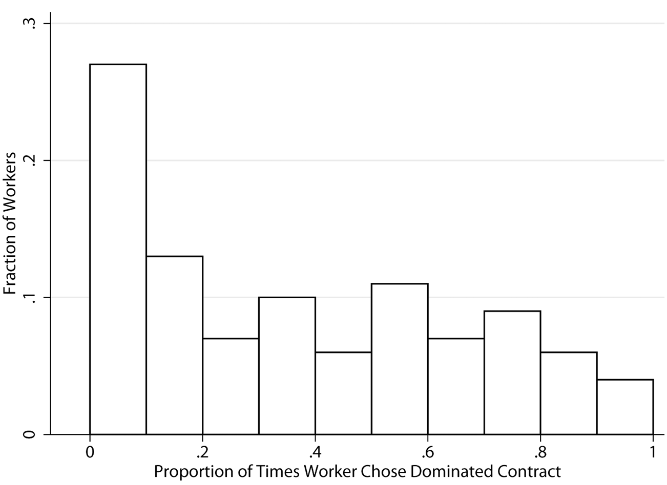
- "Sophisticated" workers may voluntarily choose a dominated contract: pays less for low-output and the same for high
- This should increase in the degree of self-control problems
- As payday gets closer, the rewards of work and the cost of work are closer together in time and output should increase
Non-Standard Pref. and Decision-Making
Development Economics
October 22, 2024
Self-Control at Work (2017)
income
individual variation in effort cost
cost of effort
Non-Standard Pref. and Decision-Making
Development Economics
October 22, 2024
Self-Control at Work (2017)
key element: when I'm not in the current period of the effort, I discount future time disproportionately
Non-Standard Pref. and Decision-Making
Development Economics
October 22, 2024
Self-Control at Work (2017)
choose contract k period in advance and solve:
Non-Standard Pref. and Decision-Making
Development Economics
October 22, 2024
Self-Control at Work (2017)
choose contract k period in advance and solve:
Non-Standard Pref. and Decision-Making
Development Economics
October 22, 2024
Self-Control at Work (2017)
choose contract k period in advance and solve:
Cost of effort decreases as pay period nears
Non-Standard Pref. and Decision-Making
Development Economics
October 22, 2024
Self-Control at Work (2017)
choose contract k period in advance and solve:
From the perspective of k, the person desires more effort than at current, so choose the dominated contract
Non-Standard Pref. and Decision-Making
Development Economics
October 22, 2024
Self-Control at Work (2017)
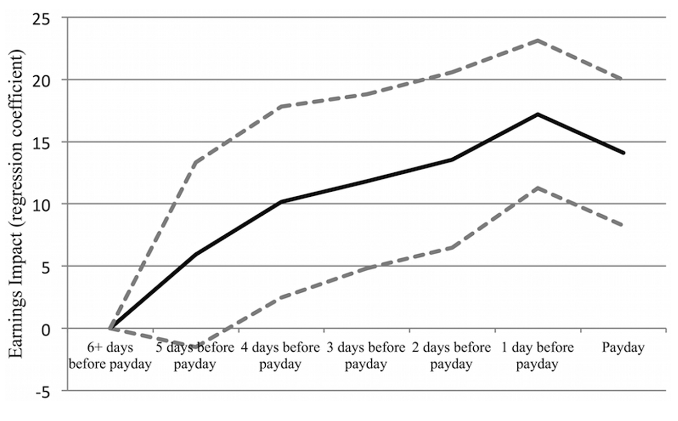
Higher productivity
as payday nears
Non-Standard Pref. and Decision-Making
Development Economics
October 22, 2024
Self-Control at Work (2017)
Workers are choosing
dominated contracts
Non-Standard Pref. and Decision-Making
Development Economics
October 22, 2024
Self-Control at Work (2017)
Heterogeneity: more dominated contracts for above-mean payday effects
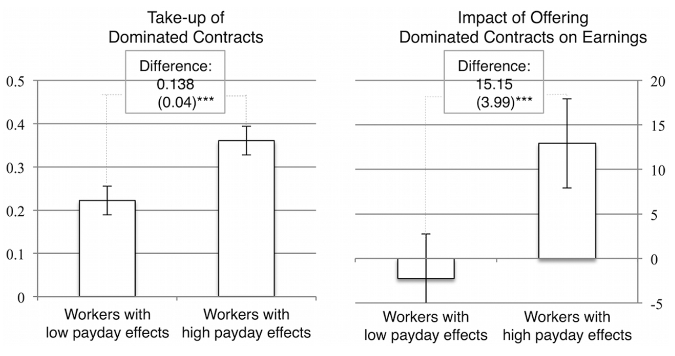
And leads to higher earnings
Non-Standard Pref. and Decision-Making
Development Economics
October 22, 2024
Do Financial Concerns Make Workers Less Productive? (2021)
Earning less, almost by definition, is what makes someone poor. The causality, however, might also run in the other direction: being poor may also lead someone to earn less.
Non-Standard Pref. and Decision-Making
Development Economics
October 22, 2024
Do Financial Concerns Make Workers Less Productive? (2021)
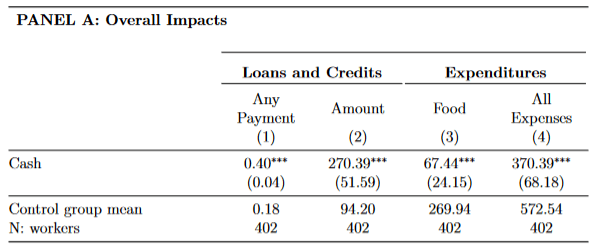
- Manufacturing workers in India, set in the lean season when workers are strapped for cash
- Randomize the timing of receiving their payments
- Alleviating financial constraints boosts worker productivity: workers are 0.12 SDs more productive (.22 SDs among those most in need)
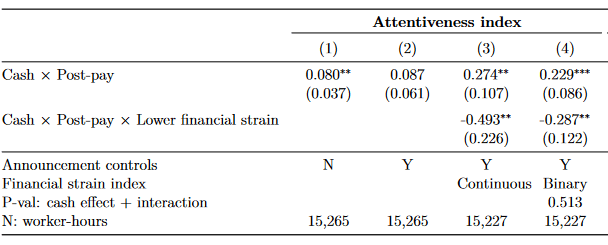
- Fewer attentional lapses seem to drive this
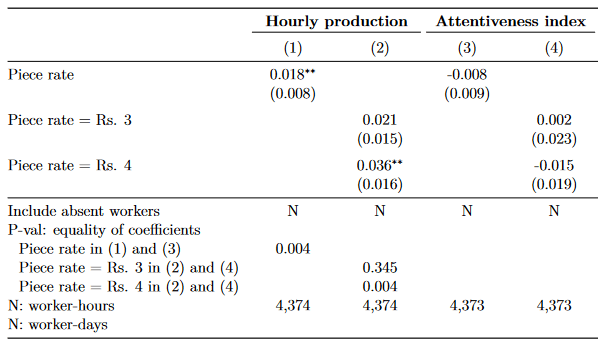
- This attentional change cannot be induced by increasing the piece rate (though this does seem to drive their motivation)
Non-Standard Pref. and Decision-Making
Development Economics
October 22, 2024
Do Financial Concerns Make Workers Less Productive? (2021)
Non-Standard Pref. and Decision-Making
Development Economics
October 22, 2024
Do Financial Concerns Make Workers Less Productive? (2021)
- Manufacturing workers in India, set in the lean season when workers are strapped for cash
- Randomize the timing of receiving their payments
- Alleviating financial constraints boosts worker productivity: workers are 0.12 SDs more productive (.22 SDs among those most in need)
- Fewer attentional lapses seem to drive this
Non-Standard Pref. and Decision-Making
Development Economics
October 22, 2024
Do Financial Concerns Make Workers Less Productive? (2021)
Non-Standard Pref. and Decision-Making
Development Economics
October 22, 2024
Do Financial Concerns Make Workers Less Productive? (2021)
- Manufacturing workers in India, set in the lean season when workers are strapped for cash
- Randomize the timing of receiving their payments
- Alleviating financial constraints boosts worker productivity: workers are 0.12 SDs more productive (.22 SDs among those most in need)
- Fewer attentional lapses seem to drive this
- This attentional change cannot be induced by increasing the piece rate (though this does seem to drive their motivation)
Non-Standard Pref. and Decision-Making
Development Economics
October 22, 2024
Do Financial Concerns Make Workers Less Productive? (2021)