Selection of State Personnel: Politicians
Brandon Williams
Development Economics
October 8, 2024
Politicians
Development Economics
October 8, 2024
The truth is that the city where those who rule are least eager to do so will be the best governed.
- Plato
Politicians
Development Economics
October 8, 2024
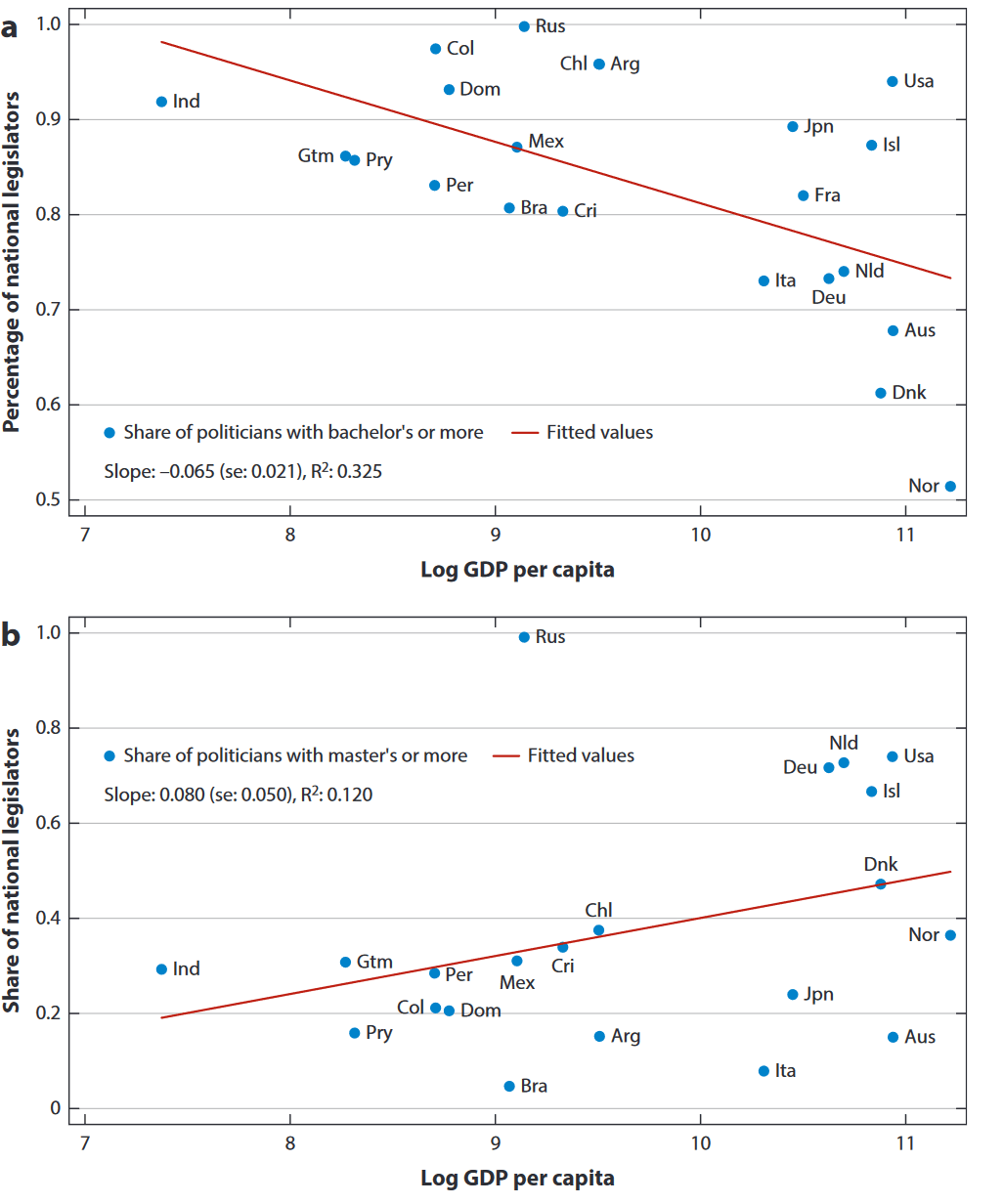
Study of Political Selection (2018)
- What is quality in a politician?
- Consider a model with valence: things that are valued outside of ideology, such as charisma, competence, and integrity
Politicians
Development Economics
October 8, 2024
Study of Political Selection (2018)
- What is quality in a politician?
- Consider a model with valence: things that are valued outside of ideology, such as charisma, competence, and integrity
Politicians
Development Economics
October 8, 2024
Study of Political Selection (2018)
- What is quality in a politician?
- Consider a model with valence: things that valued outside of ideology, such as charisma, competence, and integrity
- Two key assumptions:
- Valence is important
- Rewards to office are positive
- Comparative statics:
- Impact of benefits to office
- Impact of political competition
- Impact of group size and cohesion
Politicians
Development Economics
October 8, 2024
Study of Political Selection (2018)
- Comparative statics:
- Impact of benefits to office
- If costs increase with quality, higher benefits induce quality
- If costs are constant, higher benefit means lesser quality
- Dependent on type of benefit (e.g. direct salary needs to compete with outside option)
- Impact of political competition
- If costs constant, helps quality in strong parties and hurts in weak parties
- If costs are increasing, only affects increase in weak party
- Impact of group size and cohesion
- If costs constant, quality decreases in group size and own-group affiliation
- Impact of benefits to office
Politicians
Development Economics
October 8, 2024
Bad Politicians (2004)
- Politicians have at least two dimensions:
- Competence - appropriate policy objectives at minimum cost
- Honesty - perform duties without harassing private citizens for bribes or other kickbacks
- Simple model of democratic political representation to illustrate three ideas of why disparity in quality of politicians exist:
- Low-quality citizens have a comparative advantage in seeking office
- There exists multiple equilibria
- Path dependence
Politicians
Development Economics
October 8, 2024
Bad Politicians (2004)
- Simple model of democratic political representation:
- Low-quality citizens have a comparative advantage in seeking office
- They have more to gain (through nefarious means)
- Good candidates have more to give up in private life
- BUT: counterbalanced by preferences for good candidates
- There exists multiple equilibria
- Good lead to good or bad to bad, through externalities
- What opportunities exist when they leave office?
- Path dependence
- Good politicians will pass rules to generate effectiveness and constrain bad actors
- Bad politicians more concerned with winning next period
- Low-quality citizens have a comparative advantage in seeking office
Politicians
Development Economics
October 8, 2024
Bad Politicians (2004)
- Simple model of democratic political representation:
- Continuum of individuals
- Three stages:
- Choose to run at some cost
- Vote (most votes win)
- Collect rewards
- Candidate quality varies: High types and low types
- Tax burden decreasing in quality of office holder as they are more efficient:
- Continuum of individuals
voters
candidates
Politicians
Development Economics
October 8, 2024
Bad Politicians (2004)
- Simple model of democratic political representation:
- Citizens have a utility if they don't run
- Or if they do and lose
- Or if they do and win
voters
candidates
cost
tax burden
reward to office
high type income
low type income
Politicians
Development Economics
October 8, 2024
Bad Politicians (2004)
- Simple model of democratic political representation:
- Electorate can only view a signal that is correct with probability
voters
candidates
cost
tax burden
don't run
run and lose
run and win
reward
Politicians
Development Economics
October 8, 2024
Bad Politicians (2004)
- Simple model of democratic political representation:
- High quality candidate runs iff
voters
cost
tax burden
don't run
run and lose
run and win
reward
bad signal and lose
candidates
candidates
good signal and win
Politicians
Development Economics
October 8, 2024
Bad Politicians (2004)
- Simple model of democratic political representation:
- High quality candidate runs iff expected gain more than cost
voters
cost
tax burden
don't run
run and lose
run and win
reward
candidates
Politicians
Development Economics
October 8, 2024
Bad Politicians (2004)
- Simple model of democratic political representation:
- High quality candidate runs iff expected gain more than cost
voters
cost
tax burden
don't run
run and lose
run and win
reward
candidates
Politicians
Development Economics
October 8, 2024
Bad Politicians (2004)
- Simple model of democratic political representation:
- Compare to low types to see comparative advantage
voters
cost
tax burden
don't run
run and lose
run and win
reward
candidates
Politicians
Development Economics
October 8, 2024
Bad Politicians (2004)
- Simple model of democratic political representation:
- If we let the return to office be endogenous (driven up by high quality candidates and externalities)
voters
cost
tax burden
don't run
run and lose
run and win
reward
candidates
Politicians
Development Economics
October 8, 2024
Bad Politicians (2004)
- Simple model of democratic political representation:
- If we let the return to office be endogenous (driven up by high quality candidates and externalities) - threshold rule driven by share of high types, which drives up the high types
voters
cost
tax burden
don't run
run and lose
run and win
reward
candidates
Politicians
Development Economics
October 8, 2024
Bad Politicians (2004)
- Simple model of democratic political representation:
- If we let the return to office be dependent on previous share of high types
voters
cost
tax burden
don't run
run and lose
run and win
reward
candidates
Politicians
Development Economics
October 8, 2024
Bad Politicians (2004)
- Simple model of democratic political representation:
- If we let the return to office be dependent on previous share of high types - path dependence that drives up the share by increasing the rewards from the previous (or opposite)
voters
cost
tax burden
don't run
run and lose
run and win
reward
candidates
Politicians
Development Economics
October 8, 2024
Good Politicians (2004)
Nobody (who we know of) gets randomly assigned to become a politician, nor are the reasons why people become politicians typically determined at random.
- Progress and Perspectives in the Study of Political Selection
Politicians
Development Economics
October 8, 2024
Good Politicians (2004)
- RCT in Pakistan, randomized citizens and encourage them to run for local office, varying what is salient:
- Social villages: you can help the community
- Personal villages: you can gain respect and status
- Citizens are more likely to run in social villages (supply side)
- They are also more likely to be elected (demand side)
- Do they actually represent their constituents better?
- Social village representatives are more likely to align on policy
- And more likely to have higher satisfaction with voters
- These results appear to work through a social norm and beliefs about their decisions channel
Politicians
Development Economics
October 8, 2024
Good Politicians (2004)
- How did it affect policy alignment?
- Did the supply of candidates fundamentally change?
- More pro-social candidates ran
- More educated candidates ran
- Or were they driven by demand and preference changes?
- Citizens preferences did not change
- Citizen behavior did not change
- Did the supply of candidates fundamentally change?
- The likely mechanism is who ran for office rather than a change in citizens behavior or interests
Politicians
Development Economics
October 8, 2024
Good Politicians (2004)
Douglas Adams, The Restaurant at the End of the Universe:
“The major problem—one of the major problems, for there are several—one of the many major problems with governing people is that of whom you get to do it; or rather of who manages to get people to let them do it to them.
Politicians
Development Economics
October 8, 2024
Good Politicians (2004)
Douglas Adams, The Restaurant at the End of the Universe:
“The major problem—one of the major problems, for there are several—one of the many major problems with governing people is that of whom you get to do it; or rather of who manages to get people to let them do it to them.
To summarize: it is a well-known fact that those people who must want to rule people are, ipso facto, those least suited to do it.
Politicians
Development Economics
October 8, 2024
Good Politicians (2004)
Douglas Adams, The Restaurant at the End of the Universe:
The major problem—one of the major problems, for there are several—one of the many major problems with governing people is that of whom you get to do it; or rather of who manages to get people to let them do it to them.
To summarize: it is a well-known fact that those people who must want to rule people are, ipso facto, those least suited to do it.
To summarize the summary: anyone who is capable of getting themselves made President should on no account be allowed to do the job.”
Politicians
Development Economics
October 8, 2024
Good Politicians (2004)
Douglas Adams, The Restaurant at the End of the Universe:
The major problem—one of the major problems, for there are several—one of the many major problems with governing people is that of whom you get to do it; or rather of who manages to get people to let them do it to them.
To summarize: it is a well-known fact that those people who must want to rule people are, ipso facto, those least suited to do it.
To summarize the summary: anyone who is capable of getting themselves made President should on no account be allowed to do the job.”
But maybe we can do something to make it better!