Biases in Belief Updating Within and Across Domains
Francesca Bastianello & Alex Imas
What we know about updating in two domains
- People are not good (Bayesian) at updating beliefs in response to new information
- Forecasting - using information for future prediction
- Inference - using information to assess quality or characteristics
- Substantial difference in the literature in how people do these two types of belief changes:
- Over-reaction in forecasting
- Primarily: over-reaction for long horizons and transitory series
- But: Under-reaction for short horizons and persistent processes
- Under-reaction in inference
- Primarily: Under-reaction when signals are diagnostic
- But: over-reaction when signals are weak
- Over-reaction in forecasting
Incentives of State Personnel
Development Economics
Inputs, Incentives, and Complementarities (2019)

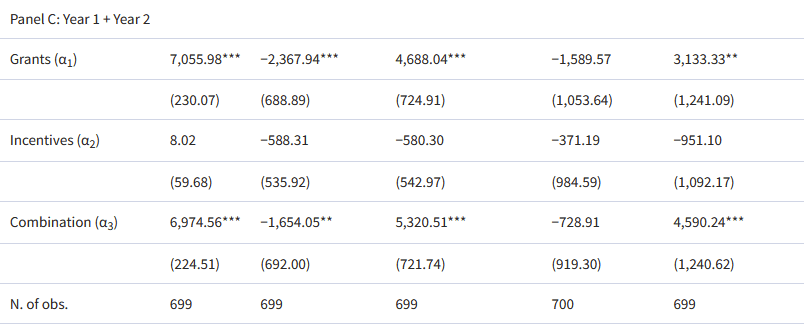
Schools are spending more
But (correctly) not in the incentives treatment
Household spending drops but not enough to offset
November 19, 2024
Incentives of State Personnel
Development Economics
Inputs, Incentives, and Complementarities (2019)
Evidence of complementarities in grant and teacher incentives
Choose effort
Wage
Intrinsic benefit from a change in learning
s.t.
Base pay plus possible incentives
Production of effort and other inputs
Wth normal and reasonable assumptions about the shape of these, including:
November 19, 2024
Bare minimum effort to not be fired
Incentives of State Personnel
Development Economics
Inputs, Incentives, and Complementarities (2019)
Evidence of complementarities in grant and teacher incentives
Choose effort
Wage
Intrinsic benefit from a change in learning
s.t.
If no incentives and motivation is low:
Inputs increase, but teachers can re-optimize and achieve the required minimum change in learning by decreasing effort
This equation binds
November 19, 2024
Incentives of State Personnel
Development Economics
Inputs, Incentives, and Complementarities (2019)
Evidence of complementarities in grant and teacher incentives
Choose effort
Wage
Intrinsic benefit from a change in learning
s.t.
If no incentives and motivation is low:
One channel is that intrinsic motivation is far from 0, and then inputs will generate a change
November 19, 2024
Incentives of State Personnel
Development Economics
Inputs, Incentives, and Complementarities (2019)
Evidence of complementarities in grant and teacher incentives
Choose effort
Wage
Intrinsic benefit from a change in learning
s.t.
If no incentives and motivation is low:
The other channel is to force this higher with change in incentives and then increase outputs, to take advantage of
November 19, 2024
Incentives of State Personnel
Development Economics
Inputs, Incentives, and Complementarities (2019)
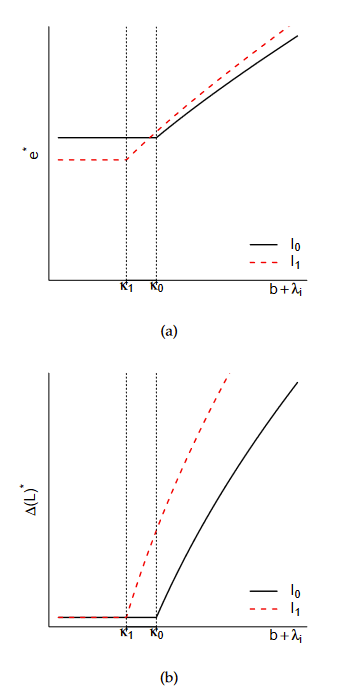
We need to clear this
Or, effort drops
And we see no gains
Even as inputs increase
November 19, 2024
Incentives of State Personnel
Development Economics
Inputs, Incentives, and Complementarities (2019)
Schools see little result from increasing funding
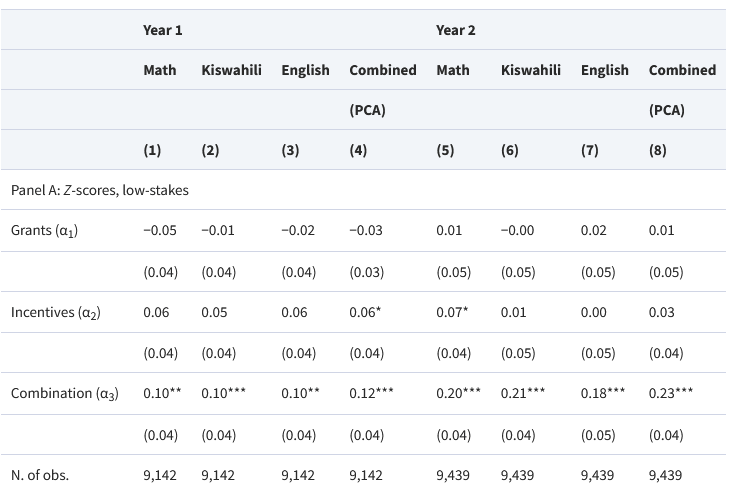
Overall, our results are consistent with and add to a large body of research that finds that merely increasing school resources rarely improves student learning outcomes in developing countries
November 19, 2024
Incentives of State Personnel
Development Economics
Inputs, Incentives, and Complementarities (2019)
Schools see little result from increasing funding
Teacher incentives seem to have little benefit on "low stakes" results
Evidence of complementarities in grant and teacher incentives
November 19, 2024
Spending on Education
Development Economics
November 19, 2024
Inputs, Incentives, and Complementarities (2019)
- Education may be constrained by low effort (e.g. absenteeism)
- "Even well motivated staff may not be able to deliver services effectively if they lack the resources to do so."
- Or it may be constrained by resources (but does "throwing money" at the problem solve it?)
- "Large and growing body of evidence on the limited impact on learning outcomes of simply providing more resources"
- Complementarity: the impact of jointly increasing both may be greater than the sum of doing each individually
- " Our results show that the marginal returns of introducing reforms to better reward improved effort of frontline service providers may be particularly high in settings where inputs are being expanded."
What can reconcile this?
- Common framework for both forecasting and inference:
- People mis-perceive signal strength due to insensitivity to the the features:
- People approach problems with an experience-based perception
- Limited attention leads them to only partially adjust from this default
- Across domains: inference and forecast lead to different default of signal strength
- Within domain: attention modulates the response
- More neglected features generate under- and over-reaction
- Insensitivity to one feature can create excess sensitivity to another, leading to over-reaction to both strong and weak signals
Ball and Urn A Pool of Firms
- Pool of firms with equal number of good and bad
- Firms evolve according to an AR(1), with a higher unconditional mean for good firms
- One firm is drawn, no type is revealed, and they are able to see a sequence of monthly profits
- Inference: how likely is this good or bad?
- Forecast: beliefs about future profits
Model Predictions
Everyone attends to all features and correctly assesses signal strengths- People approach a problem with an experience-based perception
- They have a default for each feature
- People pay attention differently to different features
- This affects the degree to which they modify the default
- Across domains: different default perceptions of signal strength
- High default persistence for forecasting = today's signal is close to tomorrow's = strong signal on forecast
- High default persistence for inference = not much new information = weak signal on inference
- Within domains: variation in attention to features
Model Predictions
- Within domains: variation in attention to features
- Change just one feature and we see a result replication (Augenblick et al., 2025) - over-reaction to weak signals and under-reaction to strong signals for both inference and forecasting
- Comparative statics:
- Increasing persistence strengthens the signal in forecasting
- Increasing persistence weakens the signal in inference
- With multiple factors:
- Not all changes in signal strength lead to the same over- or under-reaction
- Interaction of multiple factors can break comparative static
Model Predictions
- Within domains: variation in attention to features
- With multiple factors:
- Not all changes in signal strength lead to the same over- or under-reaction
- Features that are less relevant, harder to process, and less salient are neglected more
- Changes in neglected features generate wedge between true and perceived signal strength
- E.g. most recent profit shock (salient) gets more attention than persistence (harder to process and map)
- Exogeneously increasing attention to persistence decreases attention to profit shock, changing which component generates over- and under-reaction
- Not all changes in signal strength lead to the same over- or under-reaction
- With multiple factors:
Model Predictions
- Within domains: variation in attention to features
- With multiple factors:
- Interaction of multiple factors can break comparative static
- Insensitivity to a feature can lead to excess sensitivity to another
- E.g. insensitivity to persistence can lead to excess sensitivity to the shock
- Interaction of multiple factors can break comparative static
- With multiple factors: