Inequality, Redistribution, and Discrimination:
An Experiment
Brandon Williams
Applied Micro Brown Bag
April 21, 2025
Motivation: Some Facts
- 71% of the population live in country where wealth inequality has risen since 1990
- The source of inequality matters for preferences about redistribution (Young, 1958; Fong, 2001; Alesina and Angelitos, 2005; Andre, 2024)
- Some accept all forms of inequality
- Some accept inequality only if it is earned
- Some do not accept any form of inequality
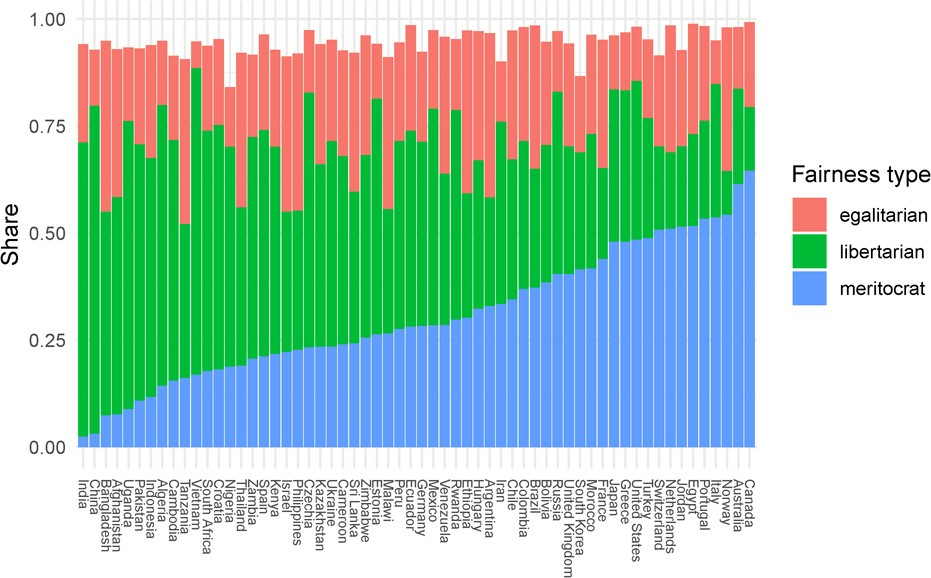
- A considerable amount of literature has used spectator designs to study the share of these types across country, political views, and gender (Cappelen et al., 2007; Almas et al., 2020; Almas et al., 2024)
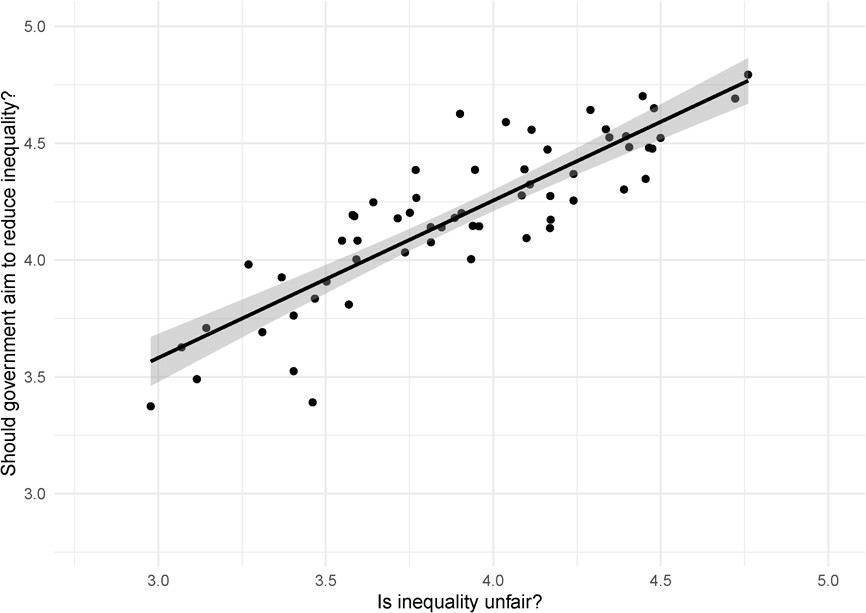
- Preferences about inequality are important because they strongly correlate with preferences about policy
Types Around the World
Motivation: Some More Facts
- Discrimination and in-group bias are real phenomena (Becker, 1958; Tajfel et al., 1971; Chen and Li, 2009)
- Social desirability bias can lead to attenuated estimates of discriminatory intent in experiments (Kuklinski et al., 1997a, Kuklinski et al., 1997b)
- Evidence of discrimination tends to emerge more strongly when it can be hidden by other possible explanations, like list randomization techniques (e.g. Coffman et al., 2013)
- Or when observation is not apparent
- Correspondence resume studies (Bertrand and Mullainathan, 2004)
- Choice of flowers to allocate to downstream workers (Hjort, 2013)
Research Question
- Are redistributive preferences (partially) determined by who will benefit from redistribution?
Research Question
- Are redistributive preferences (partially) determined by who will benefit from redistribution?
Research Question
- Are redistributive preferences (partially) determined by who will benefit from redistribution?
- Preferences about implemented inequality
Research Question
- Are redistributive preferences (partially) determined by who will benefit from redistribution?
- Preferences about implemented inequality
- Social in- and out-group, focusing on ethnicity
Research Question
- Are redistributive preferences (partially) determined by who will benefit from redistribution?
- Preferences about implemented inequality
- Social in- and out-group, focusing on ethnicity
- Under-performing or unlucky in-group benefits from redistribution; advantaged in-group benefits from "libertarian" outcomes
Research Question
- Are redistributive preferences (partially) determined by who will benefit from redistribution?
- Preferences about implemented inequality
- Social in- and out-group, focusing on ethnicity
- Under-performing or unlucky in-group benefits from redistribution; advantaged in-group benefits from "libertarian" outcomes
-
- What is the function of in-group relationship that informs one's willingness to redistribute?
Research Question
- Are redistributive preferences (partially) determined by who will benefit from redistribution?
- Preferences about implemented inequality
- Social in- and out-group, focusing on ethnicity
- Under-performing or unlucky in-group benefits from redistribution; advantaged in-group benefits from "libertarian" outcomes
-
- What is the function of in-group relationship that informs one's willingness to redistribute?
Pr(redistributing)
% share disadvantaged co-ethnic group
Research Question
- Are redistributive preferences (partially) determined by who will benefit from redistribution?
- Preferences about implemented inequality
- Social in- and out-group, focusing on ethnicity
- Under-performing or unlucky in-group benefits from redistribution; advantaged in-group benefits from "libertarian" outcomes
-
- What is the function of in-group relationship that informs one's willingness to redistribute?
Pr(redistributing)
% share disadvantaged co-ethnic group
Research Question
- Are redistributive preferences (partially) determined by who will benefit from redistribution?
- Preferences about implemented inequality
- Social in- and out-group, focusing on ethnicity
- Under-performing or unlucky in-group benefits from redistribution; advantaged in-group benefits from "libertarian" outcomes
-
- What is the function of in-group relationship that informs one's willingness to redistribute?
Pr(redistributing)
% share disadvantaged co-ethnic group
Research Question
- Are redistributive preferences (partially) determined by who will benefit from redistribution?
- Preferences about implemented inequality
- Social in- and out-group, focusing on ethnicity
- Under-performing or unlucky in-group benefits from redistribution; advantaged in-group benefits from "libertarian" outcomes
-
- What is the function of in-group relationship that informs one's willingness to redistribute?
Pr(redistributing)
% share disadvantaged co-ethnic group
An Ideal Experiment...
- Have workers complete a task with an equivalent ex-ante expected outcome by group
- Identify "blind" redistribution preferences of spectators
- Have clear, salient and preferably binary in- and out-groups
- Natural variation in the distribution of groups that is well-known by decision-makers
- Choices in redistribution unbiased by social desirability (e.g. a plausible "out")
- Leverage the changing distribution to test the slope of redistribution probability function
- Match the blind elicitation to the corresponding point in the redistribution function
Overall Design
- Lab-in-the-field design using a worker-spectator redistribution paradigm
- Control treatment: generic workers
- Information treatment: reveal location of workers
- Leverage Fiji as "technology":
- Stark and salient in- and out-group differences between ethnic groups
- Wide-ranging geographical variation in group distribution
- Measure within-group preferences about redistribution
- Measure shift in group preferences about redistribution
- Redistribution towards in-group with unfavorable allocation
- No/limited redistribution with favorable allocation
Experimental Paradigm
- From Almas et al. (2024), two types of participants:
- Workers - complete task for possible payment
- Spectators - can decide on possible redistribution of payment


- The task requires little skill but real effort (e.g. ball-catching task, counting zeros)
Experimental Paradigm
- One worker gets initial allocation according to treatment
- Luck - a fair coin determines who is paid the whole amount
- Merit - the more productive worker is paid the whole amount
$
$
$
$
$
$
Experimental Paradigm
- Spectators know the source of the allocation
- Workers are not informed of the initial distribution, but are aware a spectator will have final say
$
$
$
$
$
$
Experimental Paradigm
- Before the workers are paid, the spectator can choose to redistribute: none
$
$
$
$
$
$
Experimental Paradigm
- Before the workers are paid, the spectator can choose to redistribute: none, some,
$
$
$
$
$
$
Experimental Paradigm
- Before the workers are paid, the spectator can choose to redistribute: none, some, or all
$
$
$
$
$
$
Experimental Paradigm
- Spectators can be classified by their choices over redistribution depending on treatment
$
$
$
$
$
$
Experimental Paradigm
- Spectators can be classified by their choices over redistribution depending on treatment
$
$
$
$
$
$
Experimental Paradigm
- Spectators can be classified by their choices over redistribution depending on treatment
$
$
$
$
$
$
Experimental Paradigm
- Spectators can be classified by their choices over redistribution depending on treatment
$
$
$
$
$
$
Meritocrat*
Experimental Paradigm
- Spectators can be classified by their choices over redistribution depending on treatment
$
$
$
$
$
$
Experimental Paradigm
- Spectators can be classified by their choices over redistribution depending on treatment
$
$
$
$
$
$
Egalitarian
Experimental Paradigm
- Spectators can be classified by their choices over redistribution depending on treatment
$
$
$
$
$
$
Experimental Paradigm
- Spectators can be classified by their choices over redistribution depending on treatment
$
$
$
$
$
$
Experimental Paradigm
- Spectators can be classified by their choices over redistribution depending on treatment
$
$
$
$
$
$
Libertarian
Experimental Paradigm
- Spectators can be classified by their choices over redistribution depending on treatment
$
$
$
$
$
$
Experimental Paradigm
- Spectators can be classified by their choices over redistribution depending on treatment
$
$
$
$
$
$
Egalitarian*
Experimental Paradigm
- Spectators can be classified by their choices over redistribution depending on treatment
- Egalitarians - share dividing equally in the merit treatment
- Libertarians - share allocating everything to the lucky worker in the luck treatment
- Meritocrats - difference between the share of participants allocating more to the productive worker in the merit treatment and the share allocating more to the lucky worker in the luck treatment
- Other - share redistributing in other ways
Experimental Paradigm
- Equivalently, we can use the solution to the utility from the distribution between two workers:
Egalitarian
Meritocrat
Libertarian
giving us the following solutions based on preference:
Experimental Paradigm
Experimental Paradigm
- Under "blind" elicitation, spectator should choose their optimal preference for inequality, but may be informed by assumptions about who would benefit
- Hypothesis/claims to be tested:
- Introducing information about workers changes the redistributive choice towards a preferred group
- Suddenly egalitarians look like meritocrats (or vice versa) when their choice benefits a certain type of worker
- "Real" policy preferences exist with knowledge and inference about who will benefit from redistribution schemes
- It is vital to know if inequality preferences are robust or subject to the context of who benefits
Context: Fiji
- Island country in Melanesia north of New Zealand
- Consists of 330 islands, with about 100 inhabited, most of the population (87%) lives on one of two islands

- 1874: Fiji as a British colony
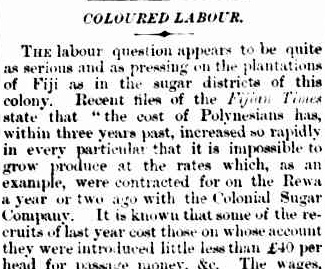
- A catastrophic measles outbreak (mortality rate of 540 out of 1000 workers) and rebellion led to limited labor force
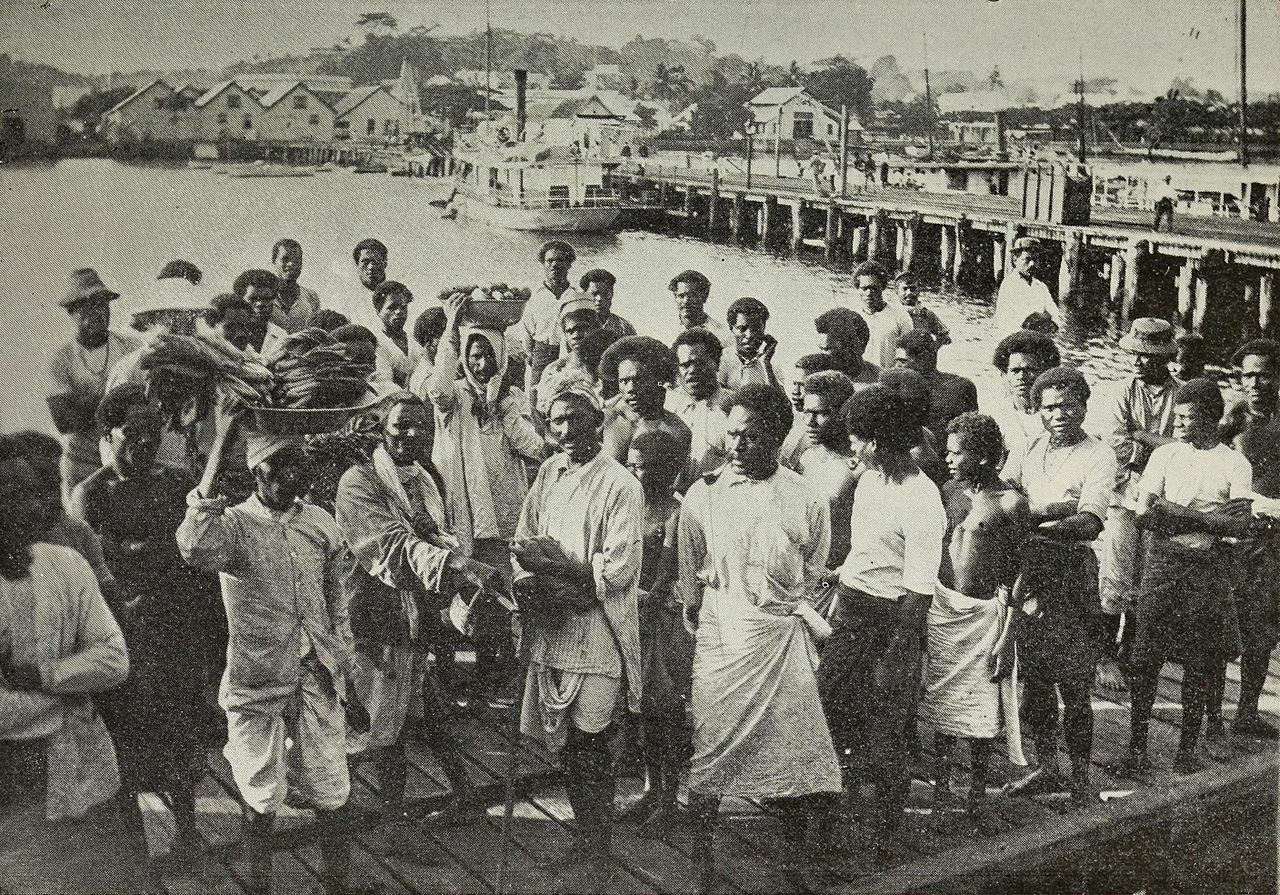
- Beginning in 1878, the UK began bringing indentured "laborers" from India to work, eventually over 60,000
- Today, 35% of the population is Indo-Fijian, with 60% indigenous iTaukei
Context: Fiji
Context: Fiji
- Meanwhile "Fiji is for the Fijians" was adopted as official land ownership policy
- Traditional chiefs granted control over governing
- Most land could not be sold, only leased
- Since independence in 1970, "Two Fijis" is the norm
- iTaukei own land rights and receive rent payments
- Redistributive scheme within tribes
- Often iTaukei do not work the land they own, or only subsistence farm on small percentages of it
- Indo-Fijians largely comprise the cash crop production and urban business development
- Lower poverty rate (20% vs 36%)
- Generate considerable economic activity through land use
- iTaukei own land rights and receive rent payments
Context: Fiji
- Cultural differences are extremely prevalent (and salient):
- iTaukei have a stronger social identity, in-group identification, and are more collectivistic than Indo-Fijians
- iTaukei more likely to be Christians, while Indo-Fijians more likely to be Hindus or Muslims
- Geographic differences are also clearly defined:
- iTaukei: native land under traditional clan structure
- Indo-Fijian: urban centers and towns
- Political strength largely vested in iTaukei (esp. following 2000 coup), but economic strength with Indo-Fijians
Context: Fiji
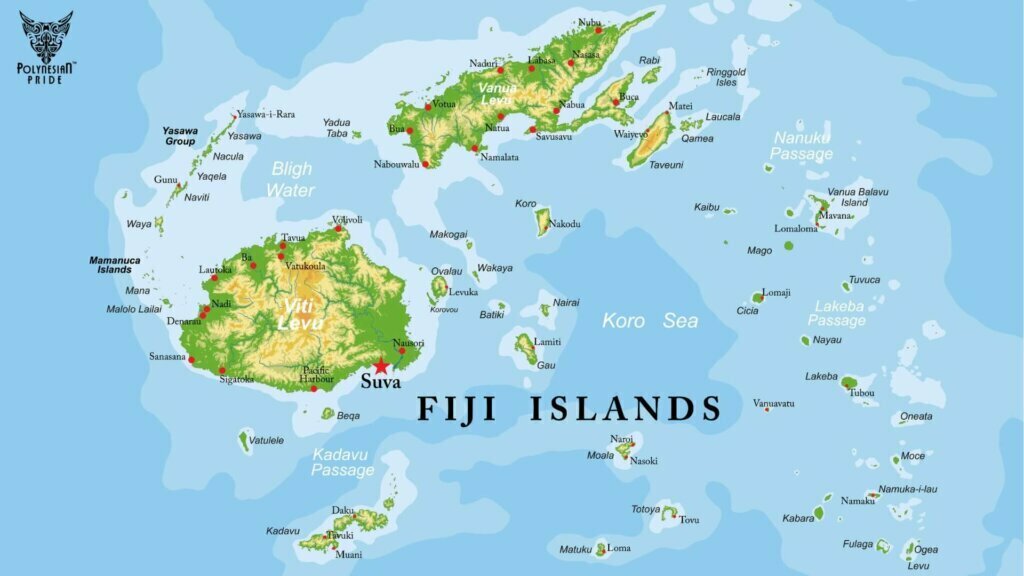
Where do the iTaukei live?
Nuku: 90%
Baravi: 77%
Lautoka: 51%
Ba: 23%
Experimental Procedure
- Standard spectator game
- Each with two sub-treatments for determining types:
- Luck
- Merit
- Two experimental treatments:
- Blind treatment - no information about the workers provided to the spectator
- Information - location information about each worker, such that ethnic group of worker is readily inferred
- N = 400, balanced on iTaukei and Indo-Fijian split
- Collect their justification for making redistributive choice
Empirical Specification
- There are two key measures from the spectator game:
- The share of each type (as defined before)
- Implemented inequality:
where the outcome is equivalent to the GINI coefficient:
Empirical Specification
- There are two key measures from the spectator game:
- The share of each type (as defined before)
- Implemented inequality:
- In the information treatment this becomes:
where the captures if the "losing" worker is in-group coethinic
Hypothesis 1: the collectivist tradition of the iTaukei and the redistribution scheme for rents will lead to more egalitarian views
- Hypothesis 1a: there is more inequality implementation by Indo-Fijian spectators than iTaukei spectators in blind treatments
- Hypothesis 1b: there are fewer Indo-Fijian egalitarians than iTaukei egalitarians
Hypotheses
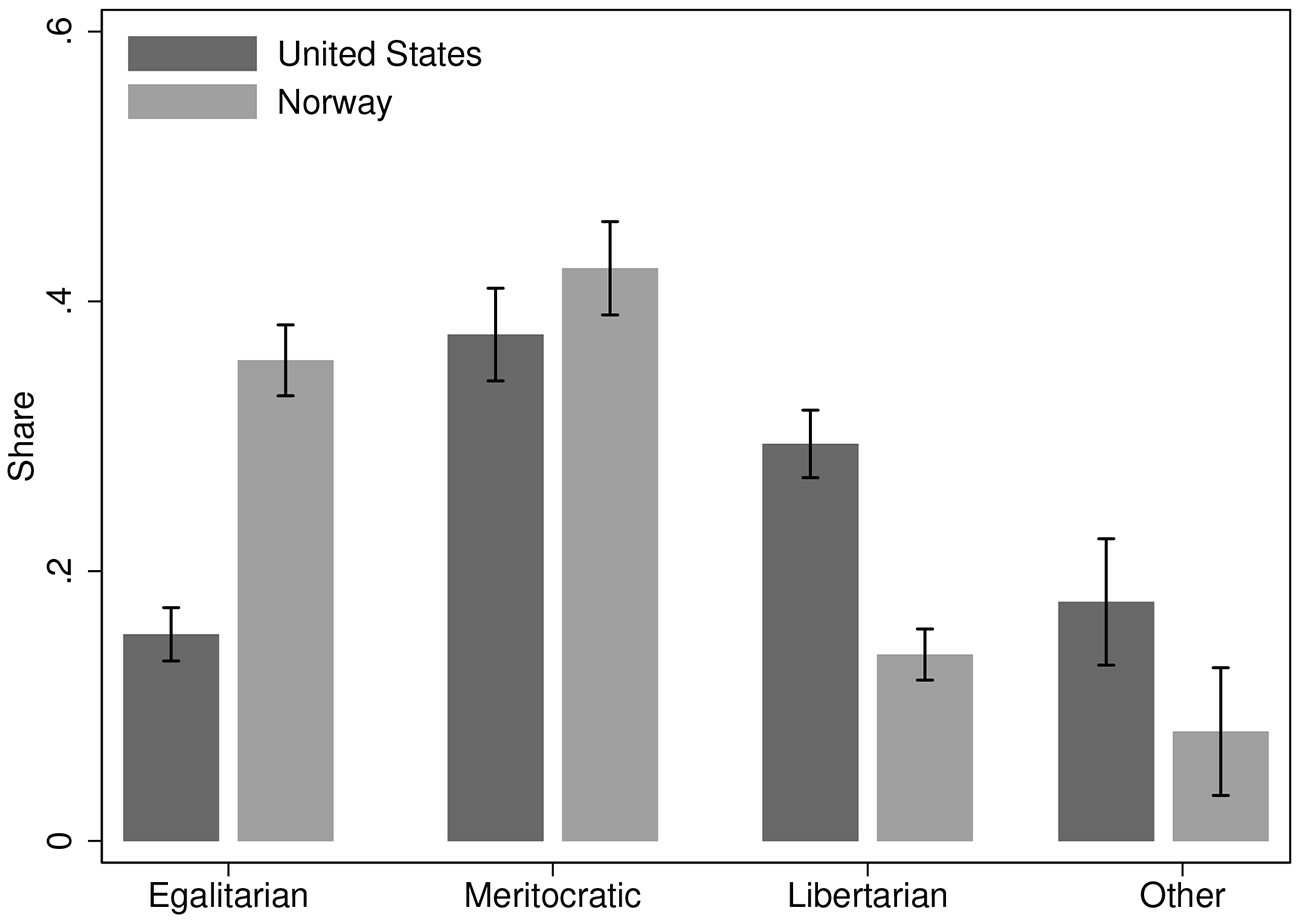
While not causal, this would provide further suggestive evidence along the lines of the differences observed between the United States and Norway
Hypothesis 2: there are systematic shifts in inequality preferences towards the in-group in information treatment
- Hypothesis 2a: when the in-group benefits from the initial payment scheme, fewer people choose to redistribute
- Hypothesis 2b: when the in-group does not benefit from the initial payment scheme, more people choose to redistribute
- Hypothesis 2c: conditioning on in-group performance, the distribution of types is not the same
Hypotheses
Given blind versus information conditioning on in-group performing worse (merit treatment) or being unlucky (luck):
Additional Things I'm Thinking About
- Adding a treatment with specific details about the workers to test direct pathway to in-group preference
- Developing a meaningful / useful task for the workers, and determining logistically how to pay the workers
- Repeating the task within-subject to determine if spectators attenuate the bias shift in order to stay consistent
- For example, going from blind in first rounds to geographic in later rounds
- Or, seeing the immediate beneficiaries of payment switch from in-group to out-group
Conclusion
- Understand how in- and out-group differences affect inequality preferences
- E.g. to what degree does who benefits from redistribution change those preferences?
- Leverage the stark and salient binary ethnic groups in Fiji
- Natural variation in geographical location allows for inferring co-ethnic beneficiaries with minimal social desirability bias
- Experimental procedure that uses an established paradigm and introduces an in- and out-group dimension with testable implications
Thank you!
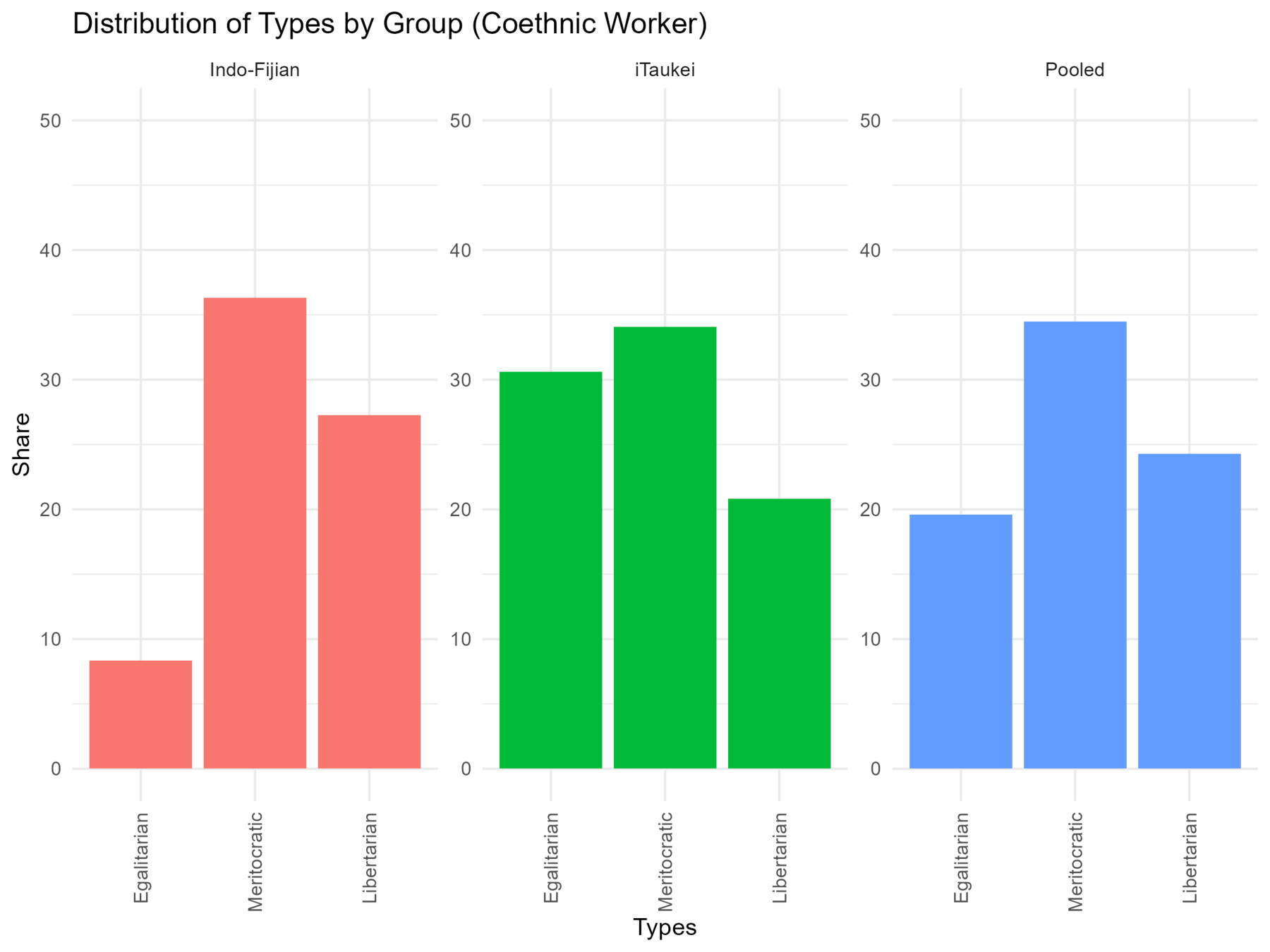
Preferences about inequality and policy
Norway and the US
A Model of (Context-Dependent) Inequality
The spectator seeks to maximize their utility from the distribution of resources:
Weight to worker 1
Allocation to worker 1
Strength of inequality preferences
Inequality preferences
A Model of (Context-Dependent) Inequality
The spectator seeks to maximize their utility from the distribution of resources:
Since the overall pot is fixed, we can rewrite this as:
A Model of (Context-Dependent) Inequality
The spectator seeks to maximize their utility from the distribution of resources:
A Model of (Context-Dependent) Inequality
The spectator seeks to maximize their utility from the distribution of resources:
Difference in weights on two types of workers
Discrimination
A Model of (Context-Dependent) Inequality
The spectator seeks to maximize their utility from the distribution of resources:
A Model of (Context-Dependent) Inequality
The spectator seeks to maximize their utility from the distribution of resources:
If we assume there is no benefit from giving to a particular worker:
A Model of (Context-Dependent) Inequality
The spectator seeks to maximize their utility from the distribution of resources:
If we assume there is no benefit from giving to a particular worker:
This is the traditional model, solved by FOC:
A Model of (Context-Dependent) Inequality
This is the traditional model, solved by FOC:
We can classify people by type given their redistribution choice:
Egalitarian
Meritocrat
Libertarian
A Model of (Context-Dependent) Inequality
The spectator seeks to maximize their utility from the distribution of resources:
If we allow for some preference over who gets redistribution:
Which yields FOC:
A Model of (Context-Dependent) Inequality
Which yields FOC:
Then only allocate according to inequality preferences if spectator really cares about inequality preferences
Otherwise, bias towards one participant causes misrepresentation as a different type, which disguises the discrimination
A Model of (Context-Dependent) Inequality
We need not allow for direct discrimination by providing the identity of the workers; it can be probabilistic:
Potentially, the probability attenuates the bias based on inference.
However, it behaviorally provides more "cover" for discrimination under an inequality preference
A Model of (Context-Dependent) Inequality
- Key takeaways:
- Under "blind" elicitations, spectator should always choose their personal optimal preference for inequality
- Introducing any information about workers may bias the redistributive choice
- Suddenly egalitarians look like meritocrats (or vice versa) when their choice benefits a certain type of worker
- My argument henceforth
- "Real" preferences (in the sense of policy) are made with knowledge and inference about who will benefit from redistribution schemes
- It is vital to know if inequality preferences are stable or subject to the context of who benefits
Power Simulation
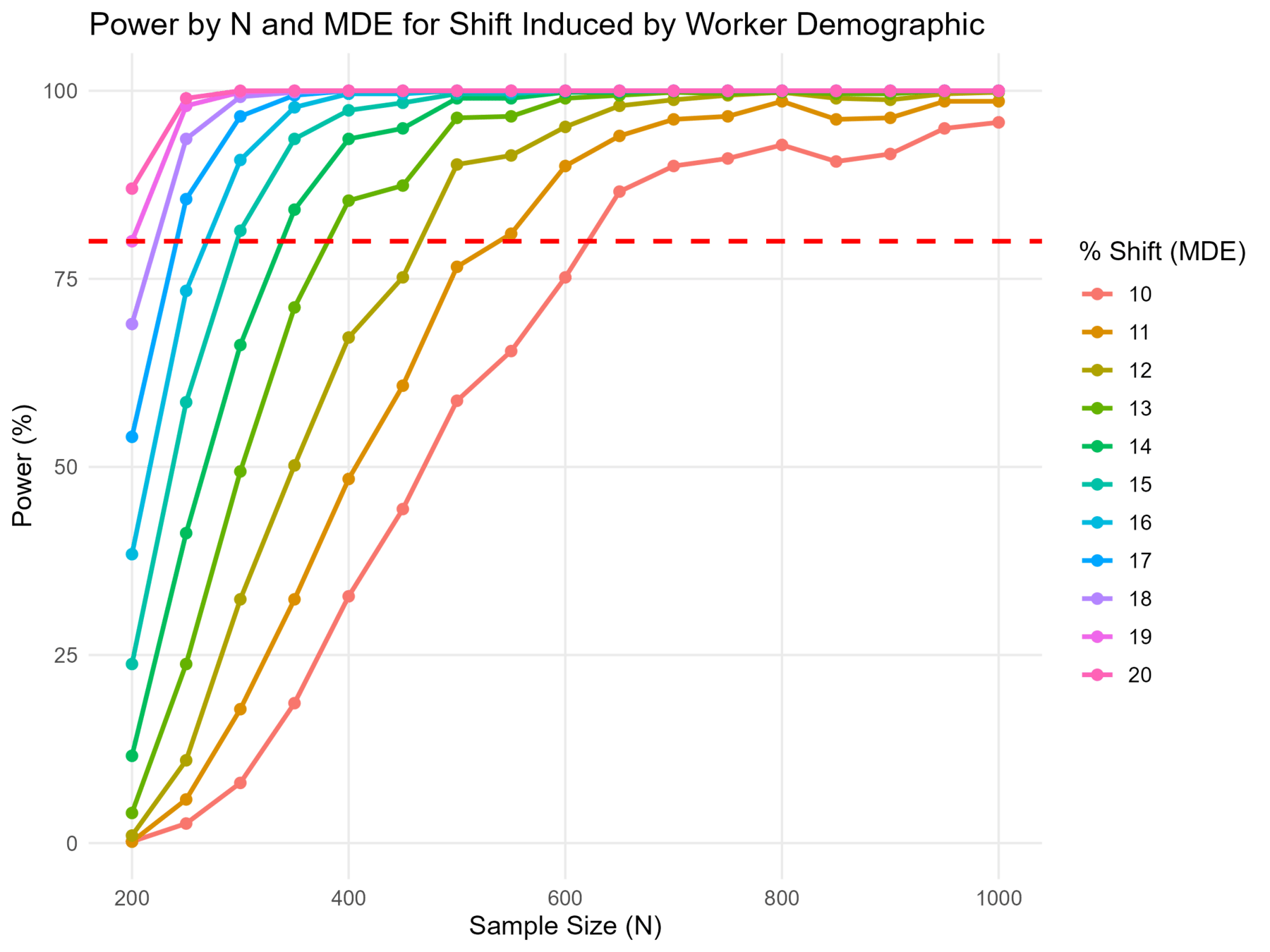
Simulated Data
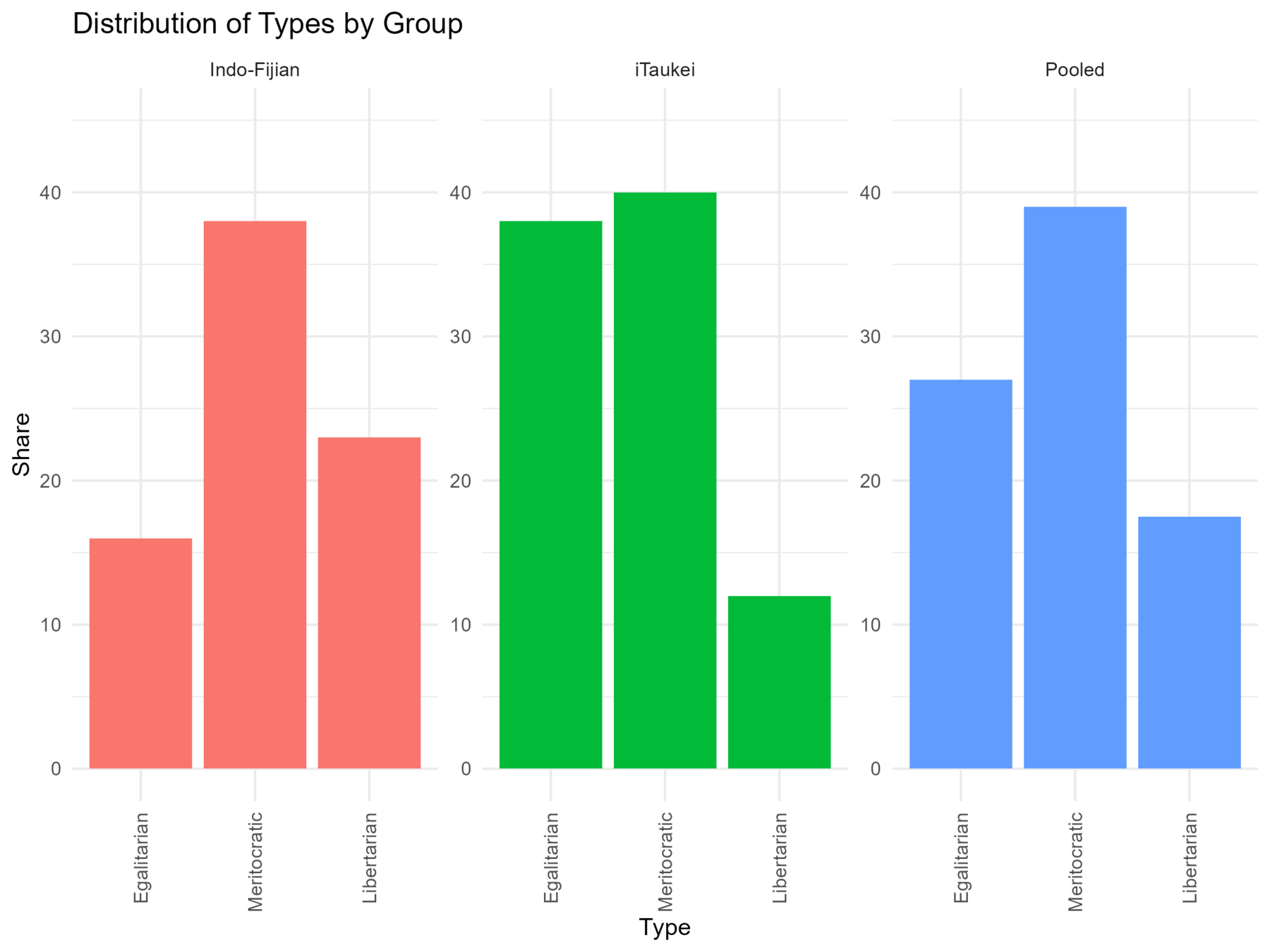
Simulated Data
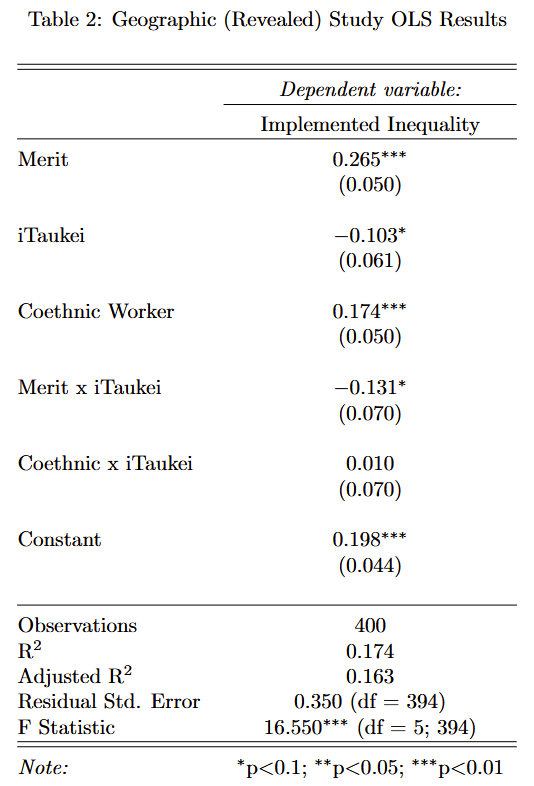
Simulated Data
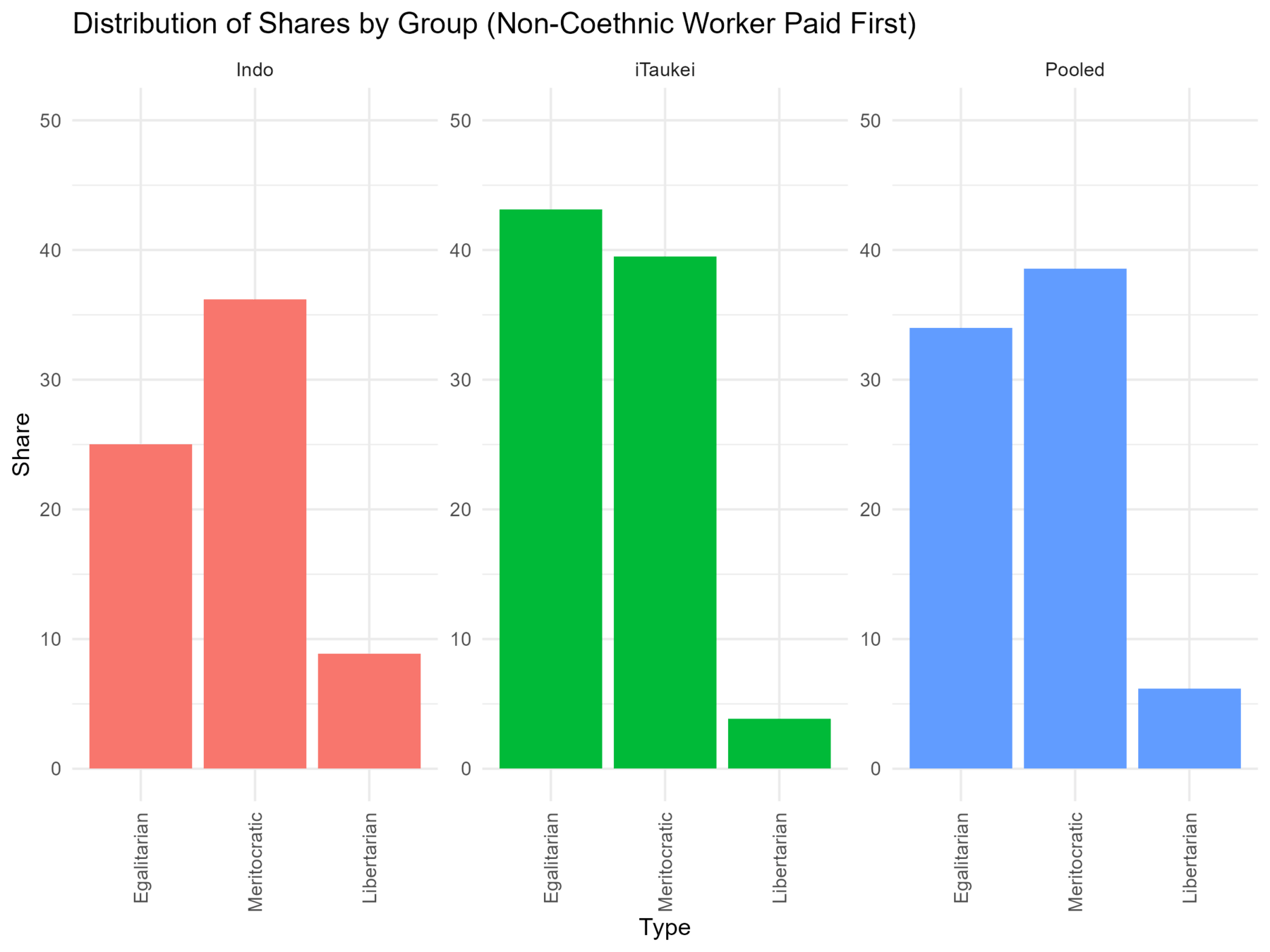
Simulated Data