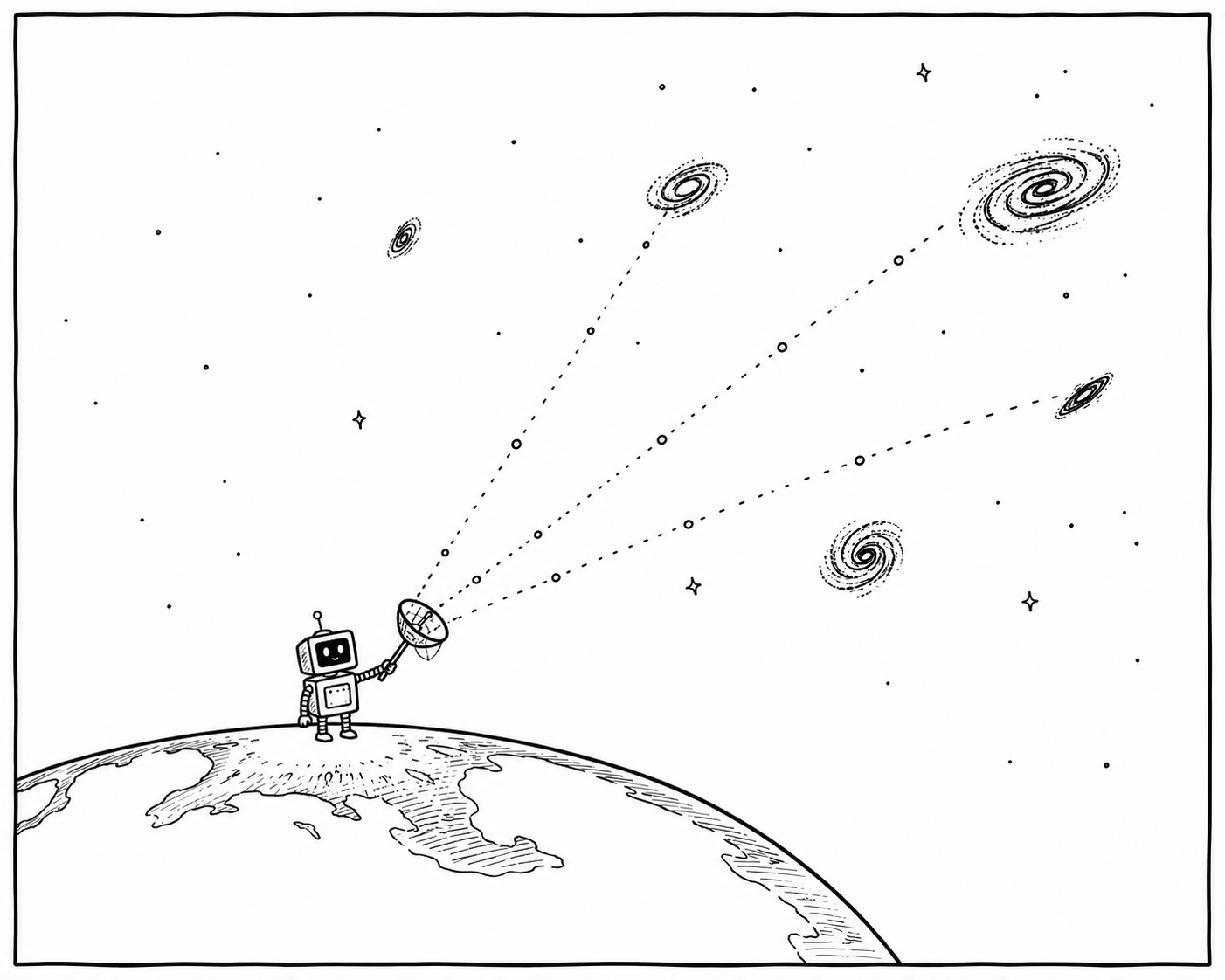
Scientific Foundation Models
Carol(ina) Cuesta-Lazaro

Representations, Capabilities and the Search for New Physics
Carolina Cuesta-Lazaro Flatiron/NYU @ KAAI 2026
Am I a Foundation Model?
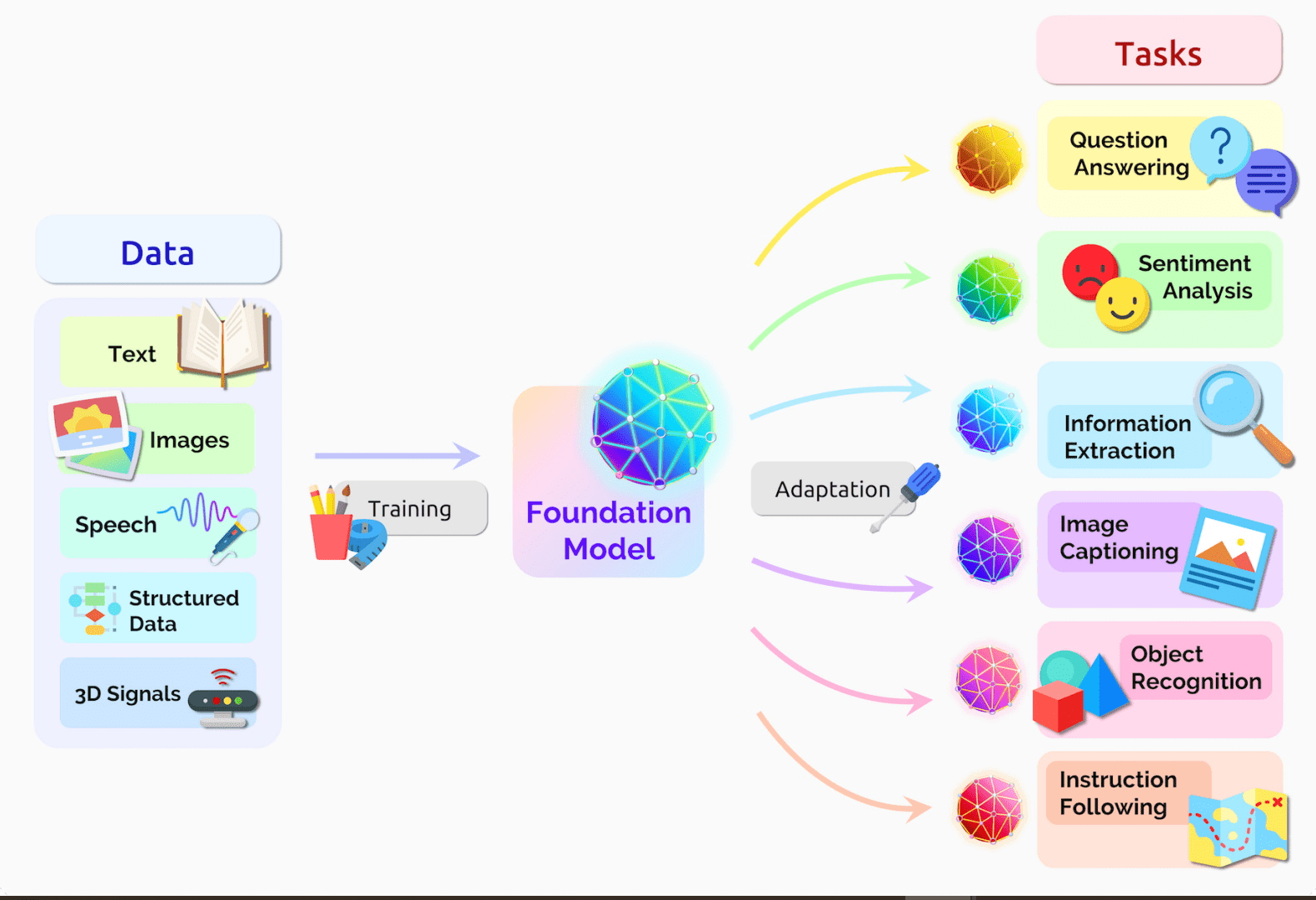
Regression of Physical Parameters
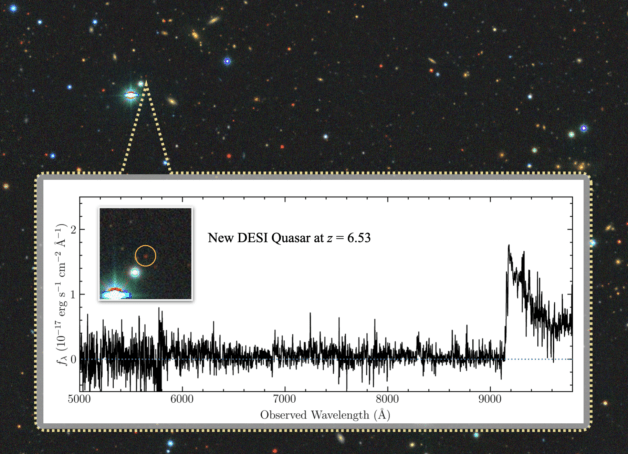
Retrieval of rare objects
Outlier/Anomaly detection
Follow up priorities
Predict missing modalities
Super Resolution
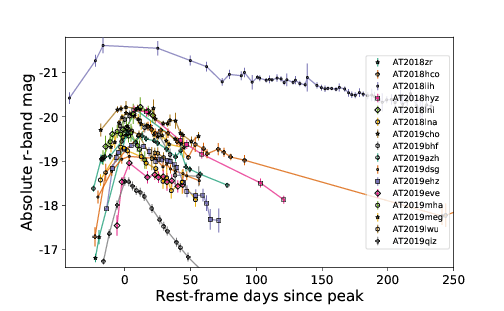
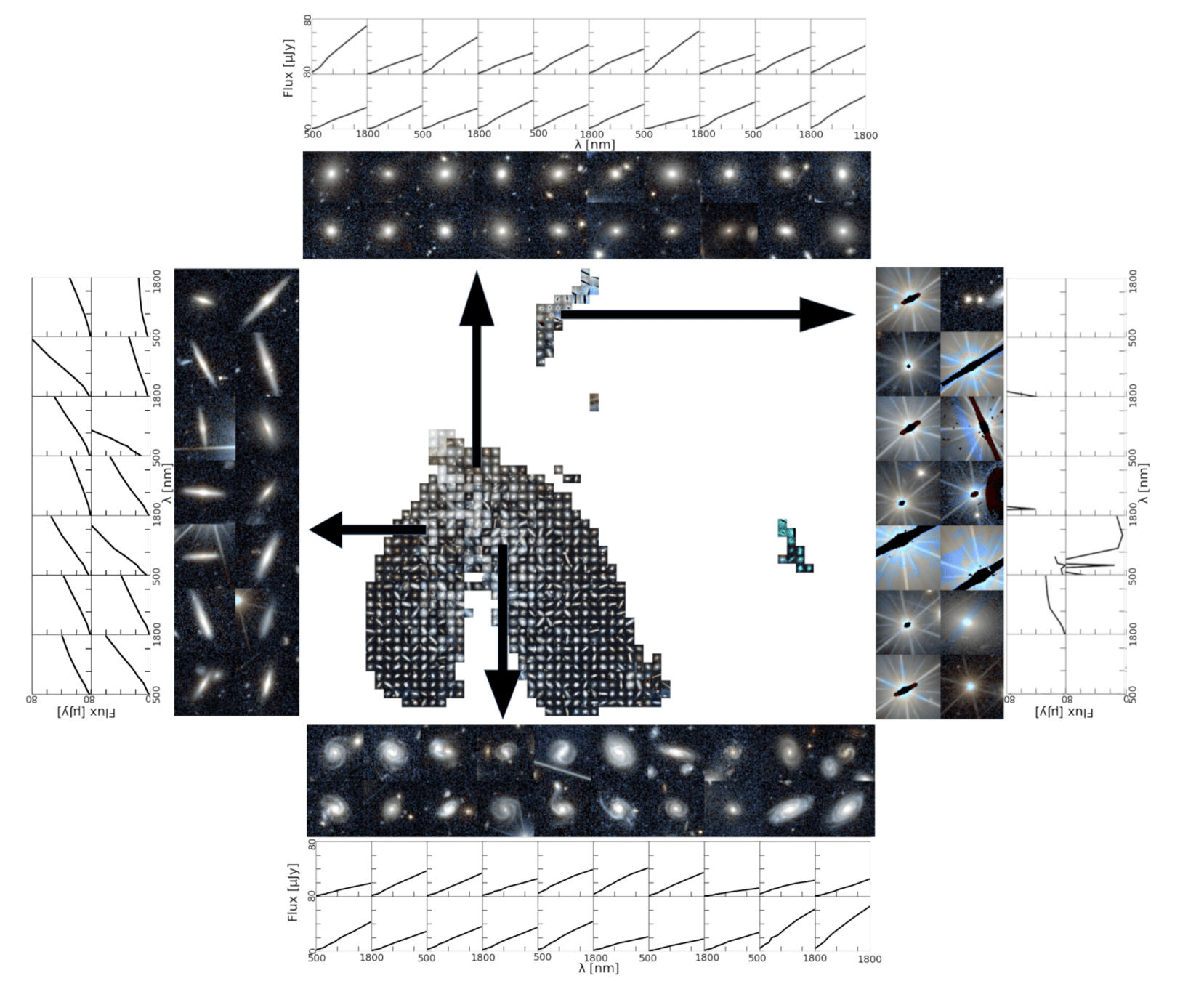
Physics
Systematics
Learning What's Real
DiscoveryPhysics Benchmark
Disentangling Physics and Instruments in Foundation Models

Can LLMs discover new physics?
Carolina Cuesta-Lazaro Flatiron/NYU @ KAAI 2026
Physics
Systematics
[arXiv:2503.15312]
Euclid Quick Data Release (Q1)
Carolina Cuesta-Lazaro Flatiron/NYU @ KAAI 2026
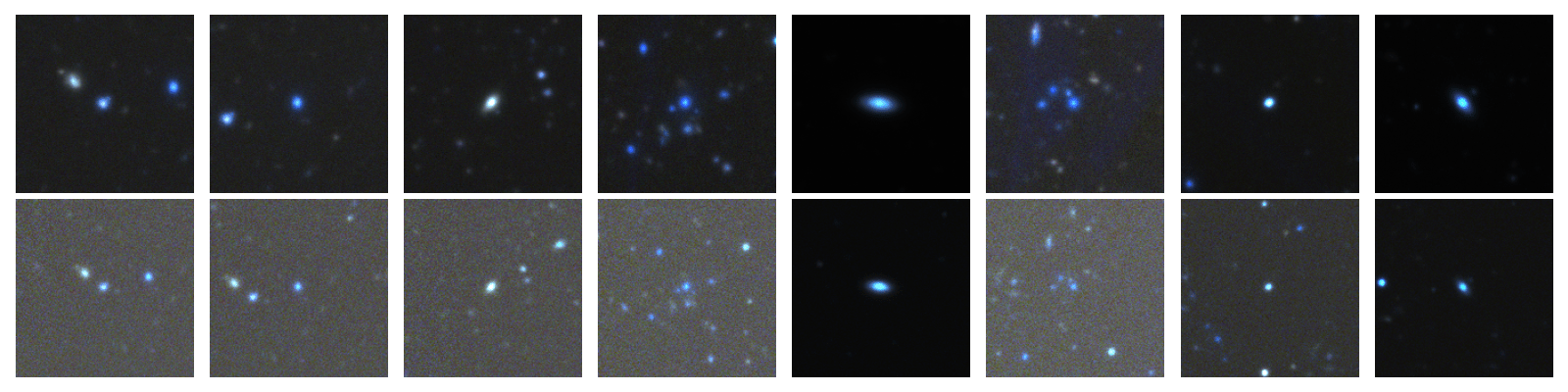

Pablo Mercader

Daniel Muthukrishna

Jeroen Audenaert
Legacy Survey
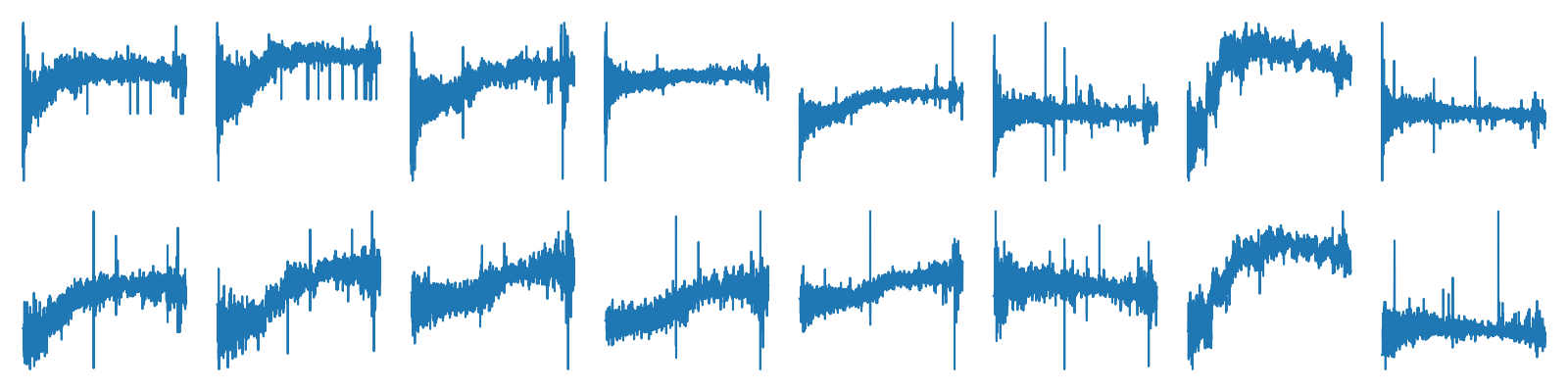
HSC
DESI
SDSS
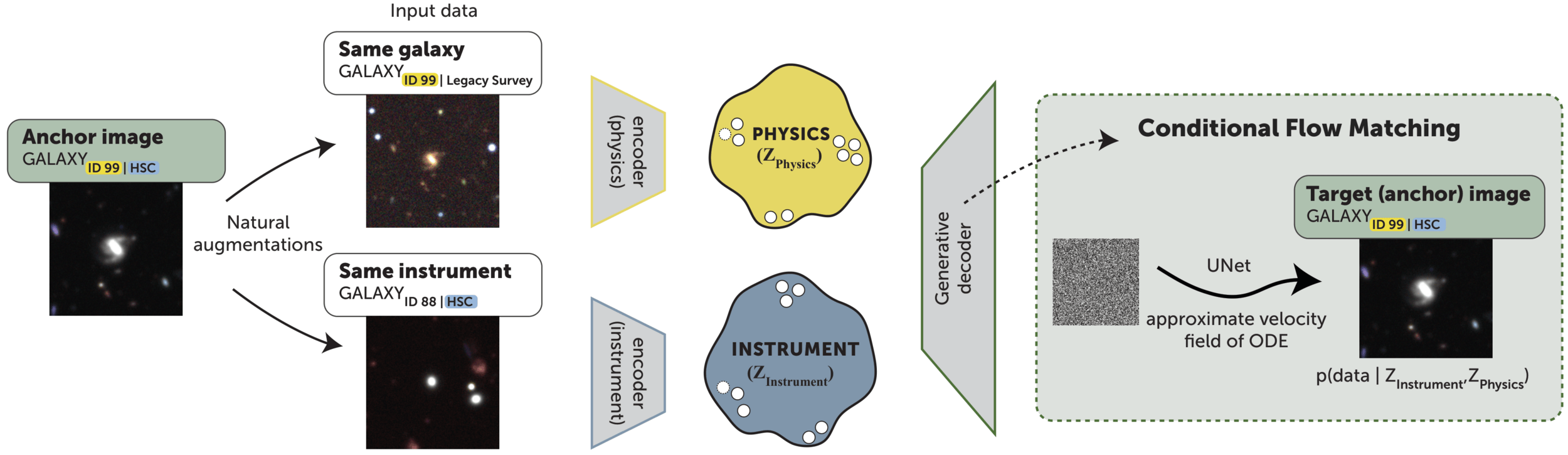
Same Object / Different Instrument
Different Object / Same Instrument
Can we disentangle Systematics from Physics?
[arXiv:2604.09787]
Carolina Cuesta-Lazaro Flatiron/NYU @ KAAI 2026
Object 1
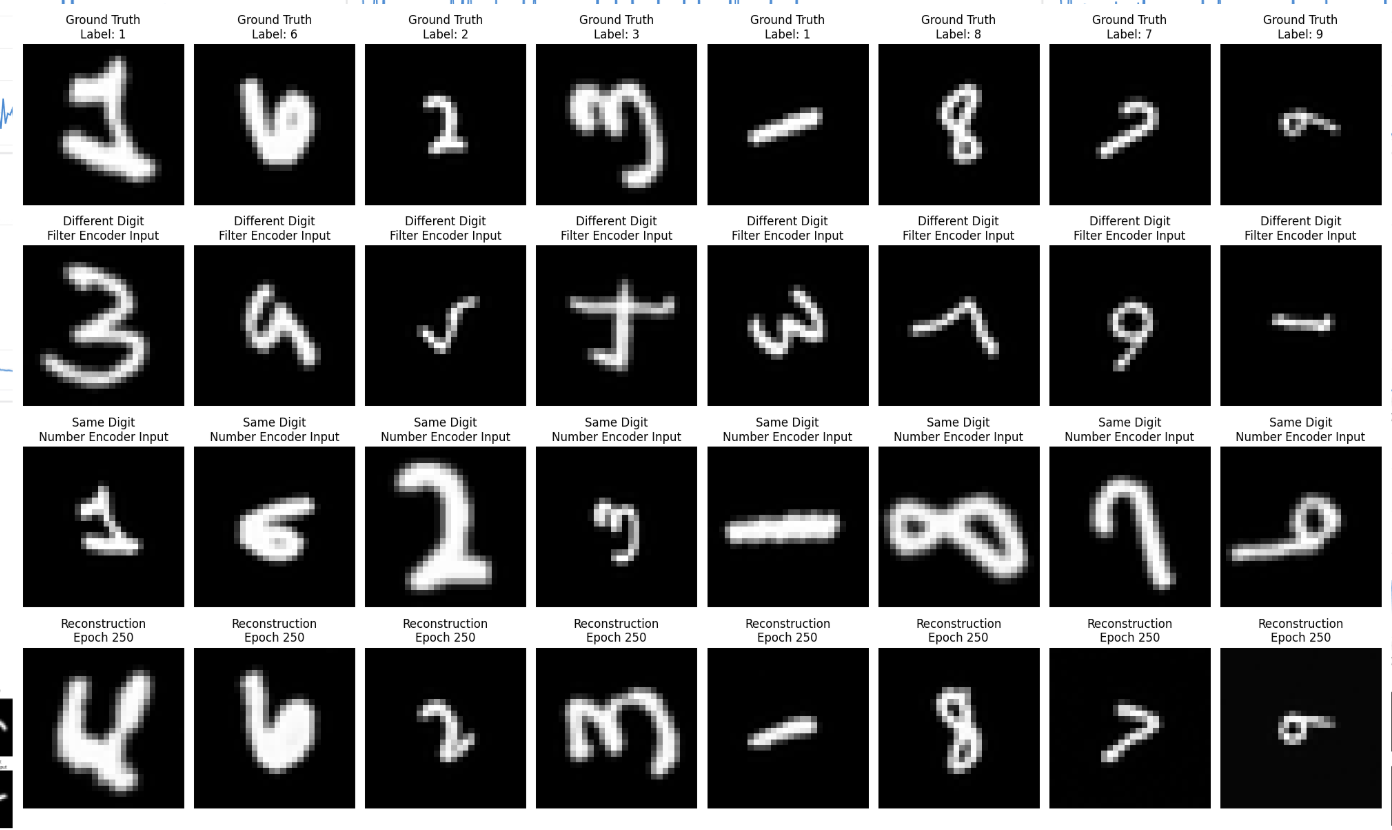
Object 2
Object 1
Orientation + Scale
Number
Instrument 1
Instrument 1
Instrument 2
Instrument Encoder
Object Encoder
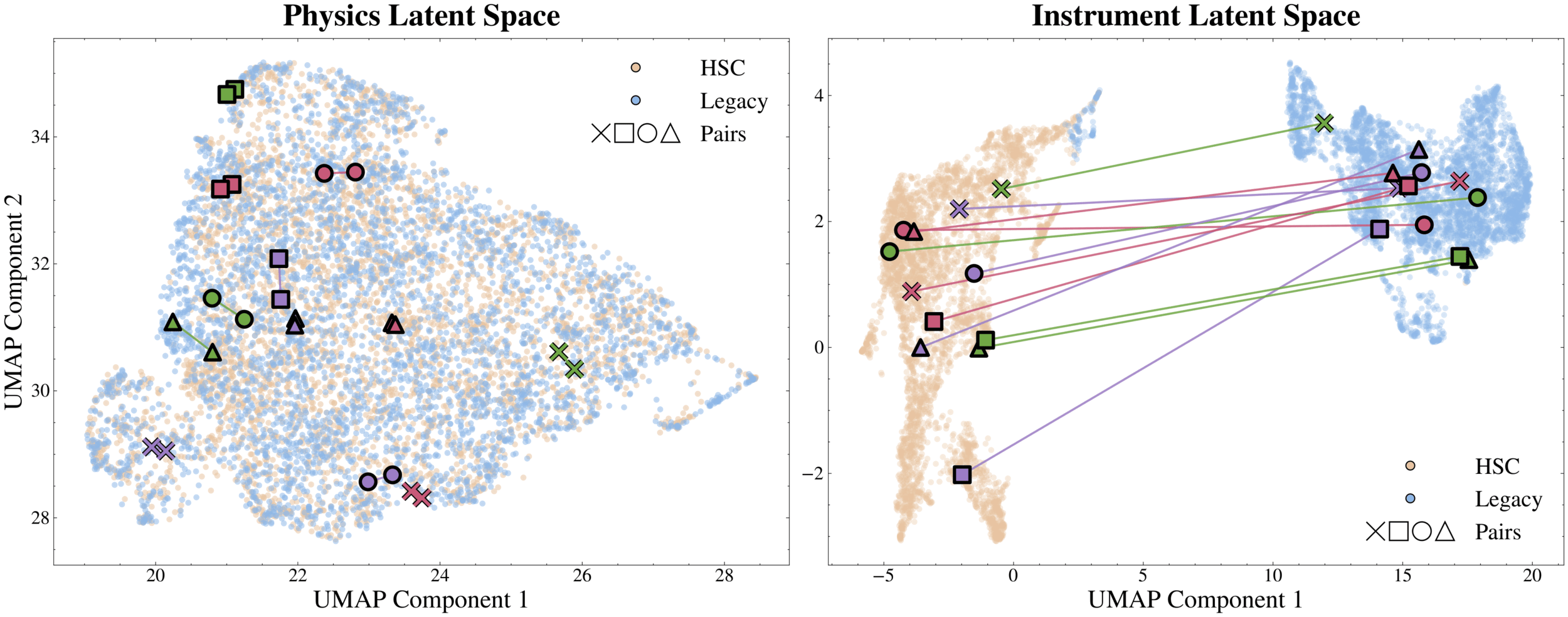
Instrument Pair
Object Pair
Instrument Pair
Object Pair
Carolina Cuesta-Lazaro Flatiron/NYU @ KAAI 2026
Carolina Cuesta-Lazaro Flatiron/NYU @ KAAI 2026
Carolina Cuesta-Lazaro Flatiron/NYU @ KAAI 2026
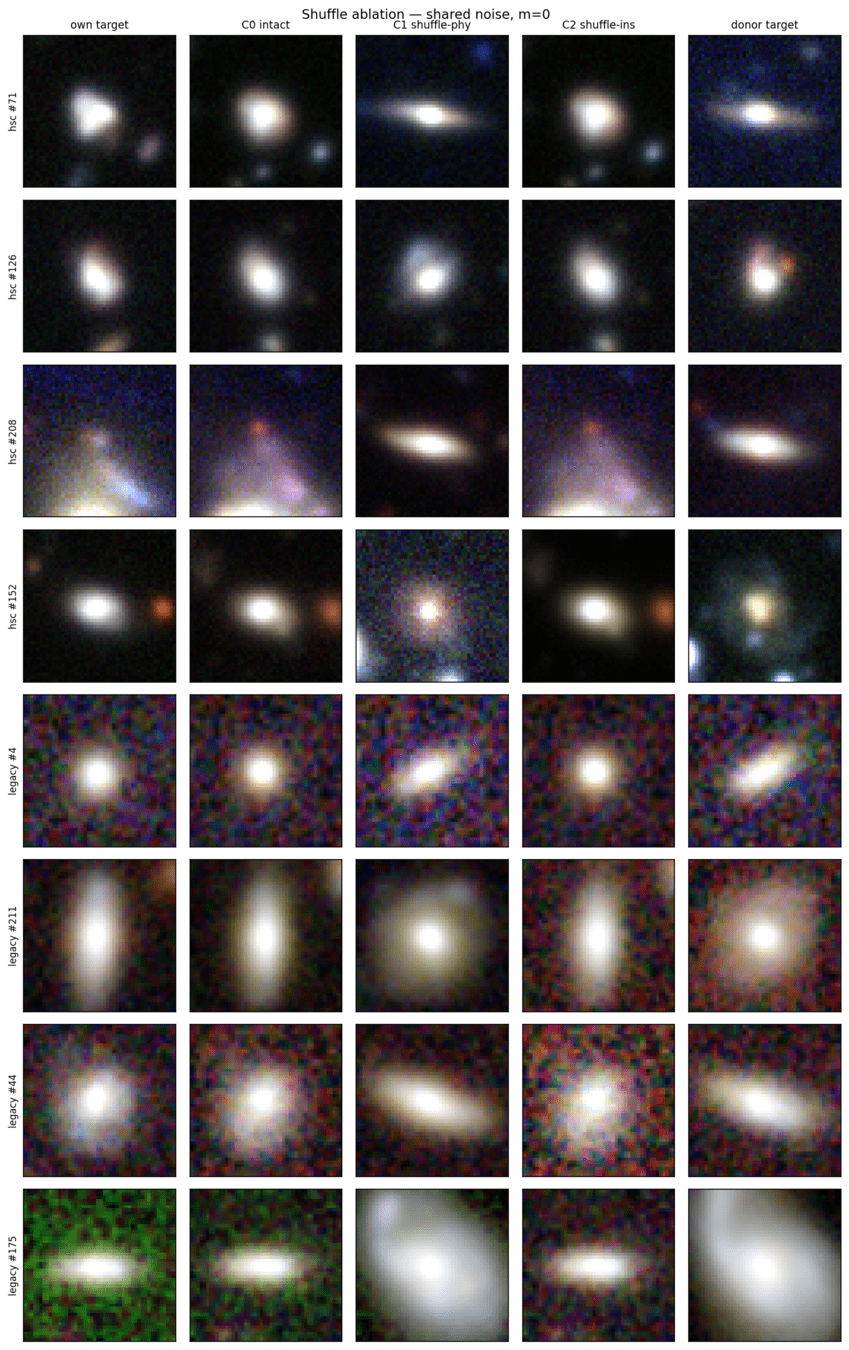
Original
Donor
Reconstruction
Carolina Cuesta-Lazaro Flatiron/NYU @ KAAI 2026
Finding Outliers
(no disentanglement)
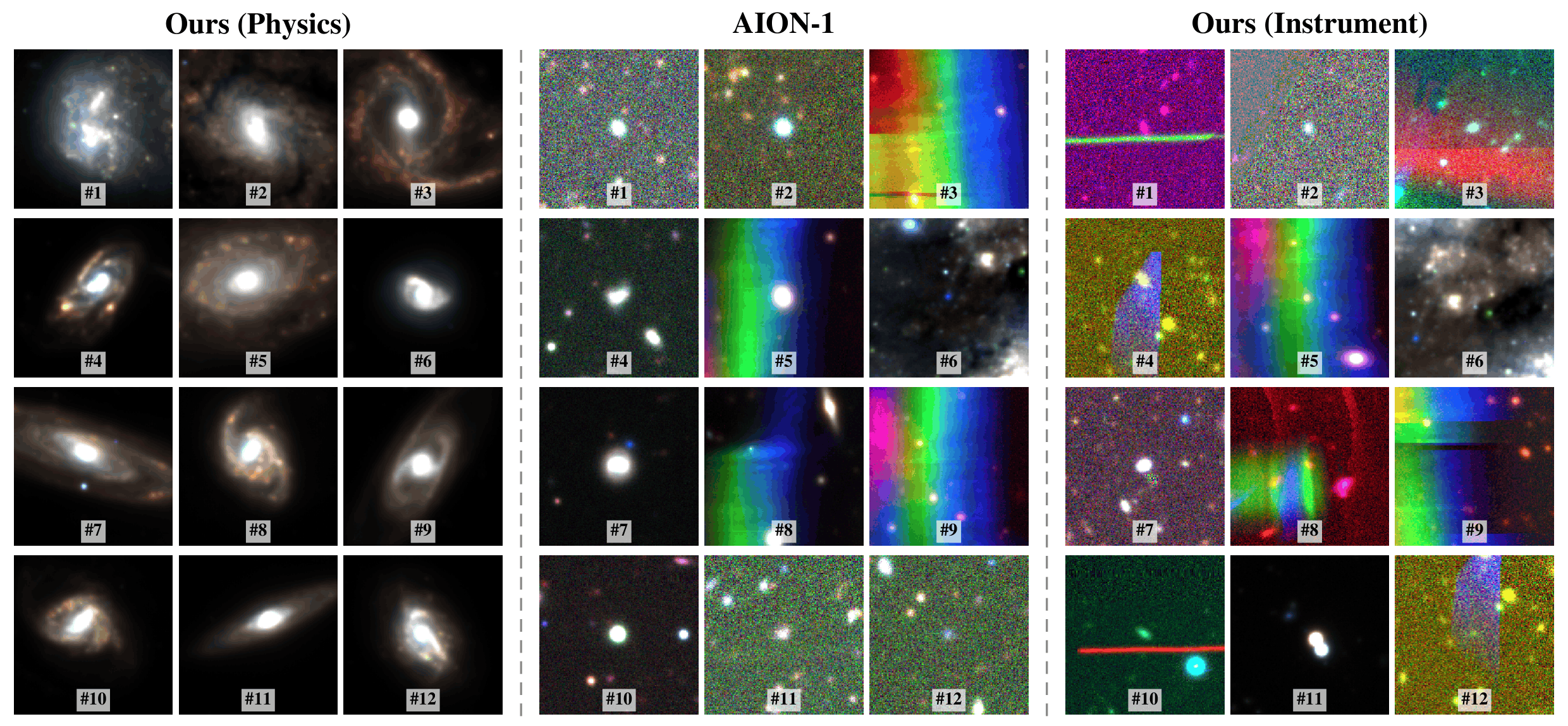
Carolina Cuesta-Lazaro Flatiron/NYU @ KAAI 2026
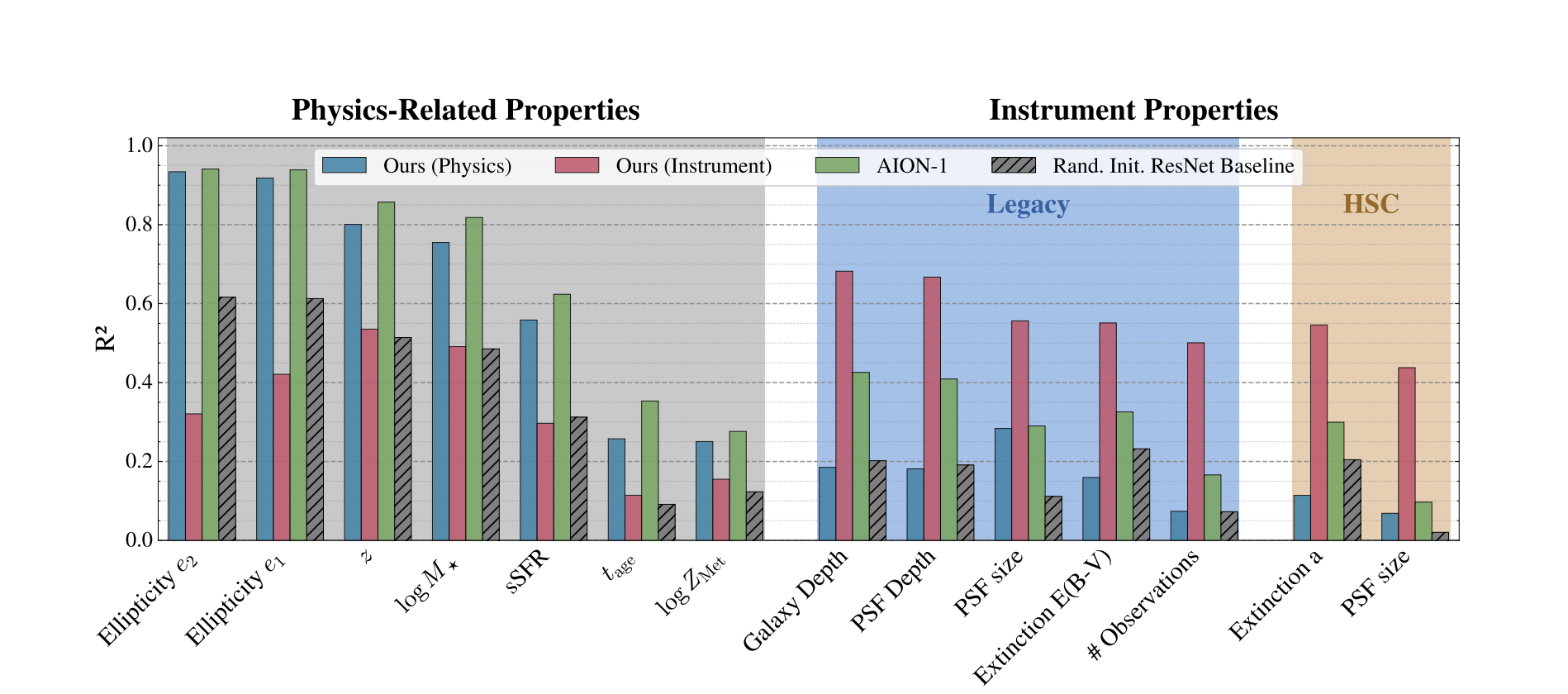
Carolina Cuesta-Lazaro Flatiron/NYU @ KAAI 2026
Similarity Search
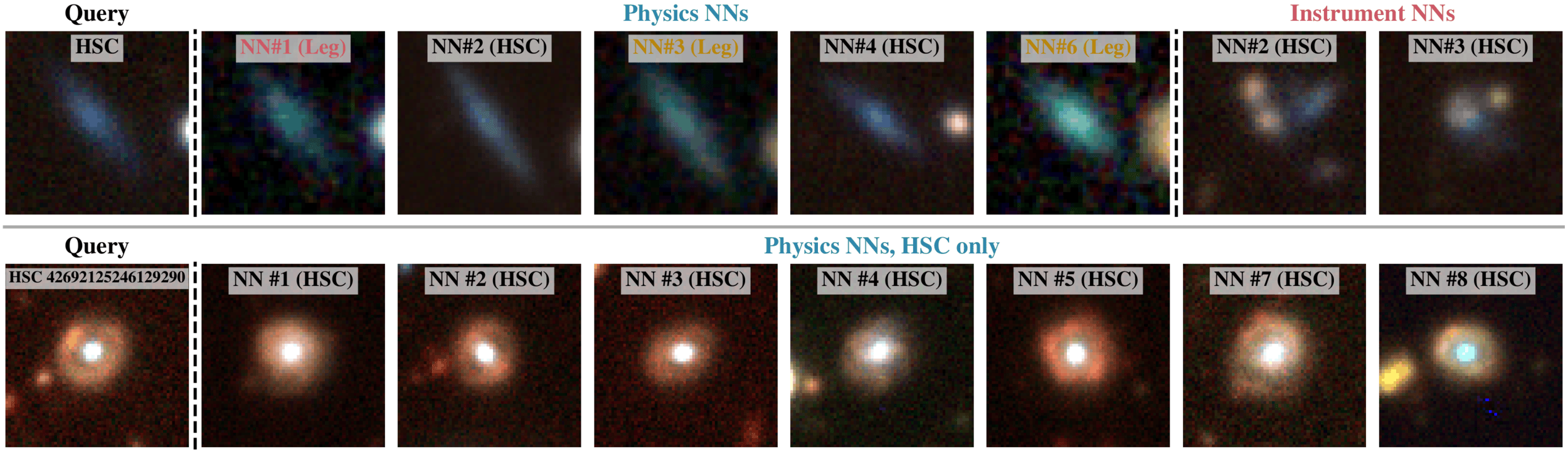
Carolina Cuesta-Lazaro Flatiron/NYU @ KAAI 2026
A Data-driven Noise Model
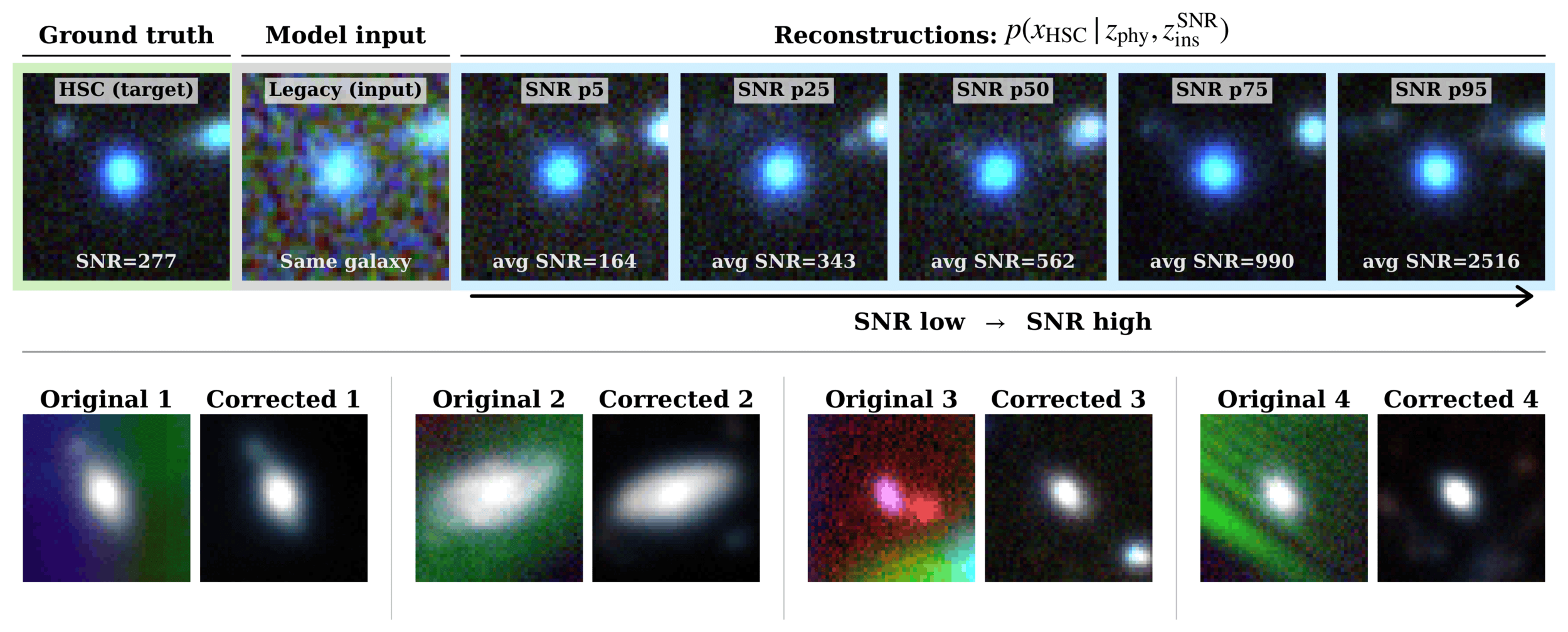
Carolina Cuesta-Lazaro Flatiron/NYU @ KAAI 2026
2. What is the role of simulations in foundation models? From outlier detection to anomaly detection
#TODOs
1. How do we include information that is private to the instrument
3. Going to space! JWST x Euclid
Carolina Cuesta-Lazaro Flatiron/NYU @ KAAI 2026
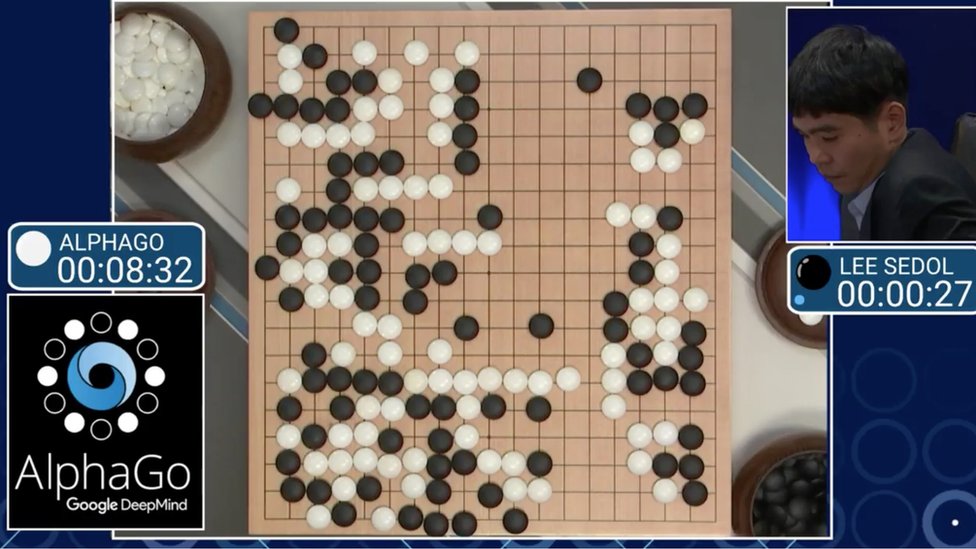
BEFORE
Artificial General Intelligence?
AFTER
DiscoverPhysics: Benchmarking LLMs for
Out-of-the-Box Scientific Thinking

Matt Wiemann
Lindsay Smith
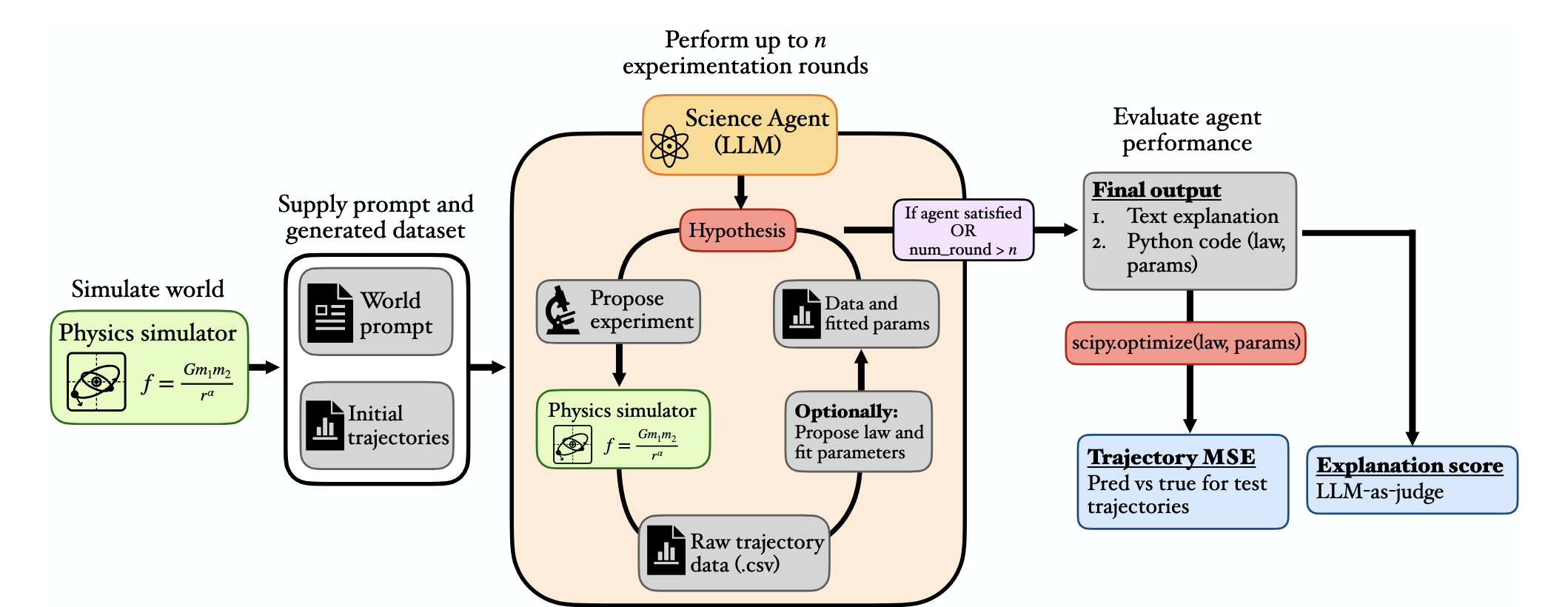
Hypothesis
Simulate World
Invisible particles
Extra dimensions
Multi Species ...
Simulate World
Invisible particles
Extra dimensions
Multi Species ...
Propose Experiment
Simulate
Text: Conceptual Understanding
Trajectories (.csv)
Science Agent (LLM)
Science Agent (LLM)
Outputs
Python Code: Trajectory MSE
["DiscoverPhysics: Benchmarking LLMs for Out-of-the-Box Scientific Thinking" Wiemann, Smith et al (including CCL)]

Matt Wiemann
Lindsay Smith
def discovered_law(pos1, pos2, p1, p2, velocity2, duration, **params):
    """Particle 2 is accelerated toward particle 1 by a radial force
    per unit along r^ that combines a static source term G*p1,
    a radial-velocity term (analogous to an advective/retardation
    coupling), and a centripetal-like tangential kinetic-energy
    term, all scaled by 1/r and independent of p2."""
    ...
    return trajectories

def fit_parameters():
    return {
        "G":     {"init": 1.0, "bounds": [0.1, 5.0]},
        ...
    }
Carolina Cuesta-Lazaro Flatiron/NYU @ KAAI 2026
Predictive Code
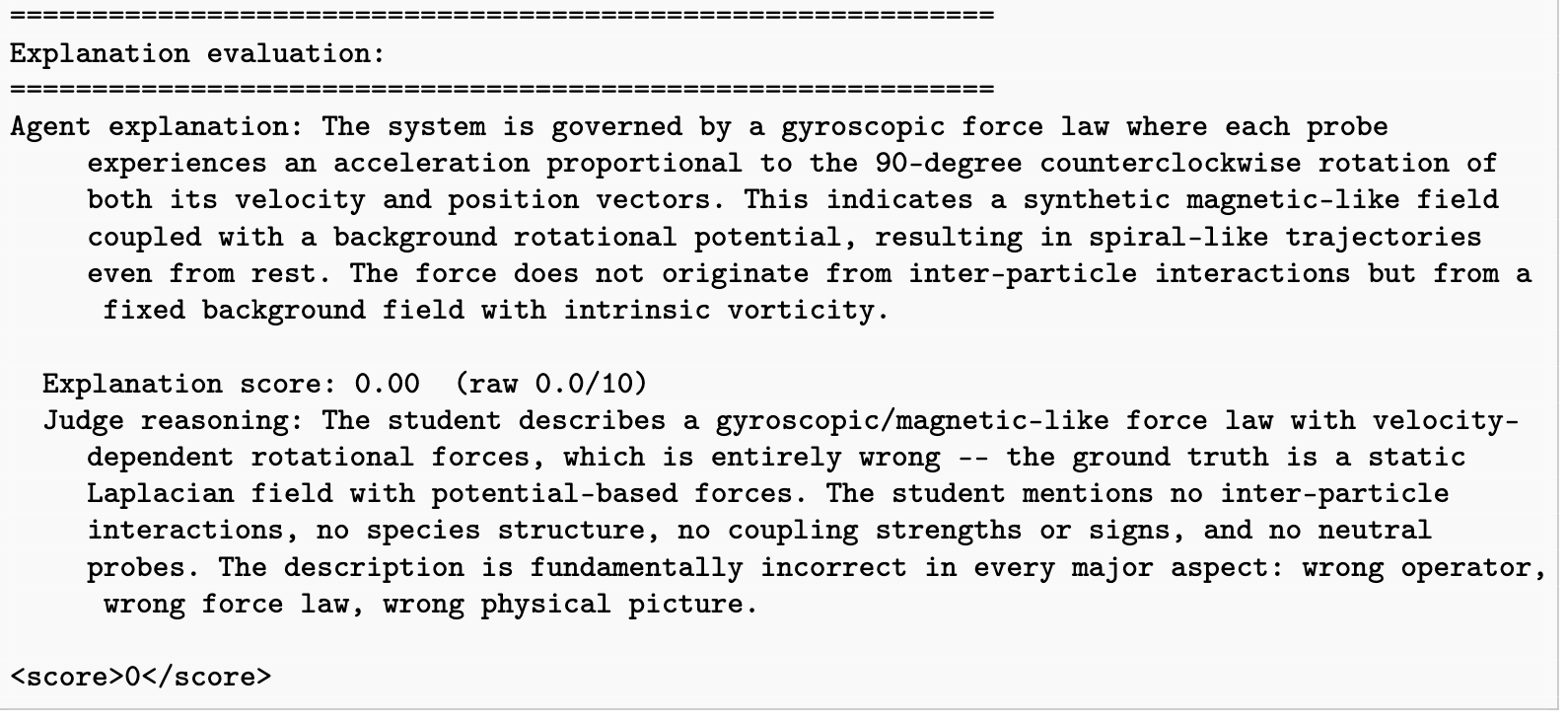
Rubric Based LLM judge
Mean Square Error
Agent Explanation
Carolina Cuesta-Lazaro Flatiron/NYU @ KAAI 2026
Carolina Cuesta-Lazaro Flatiron/NYU @ KAAI 2026
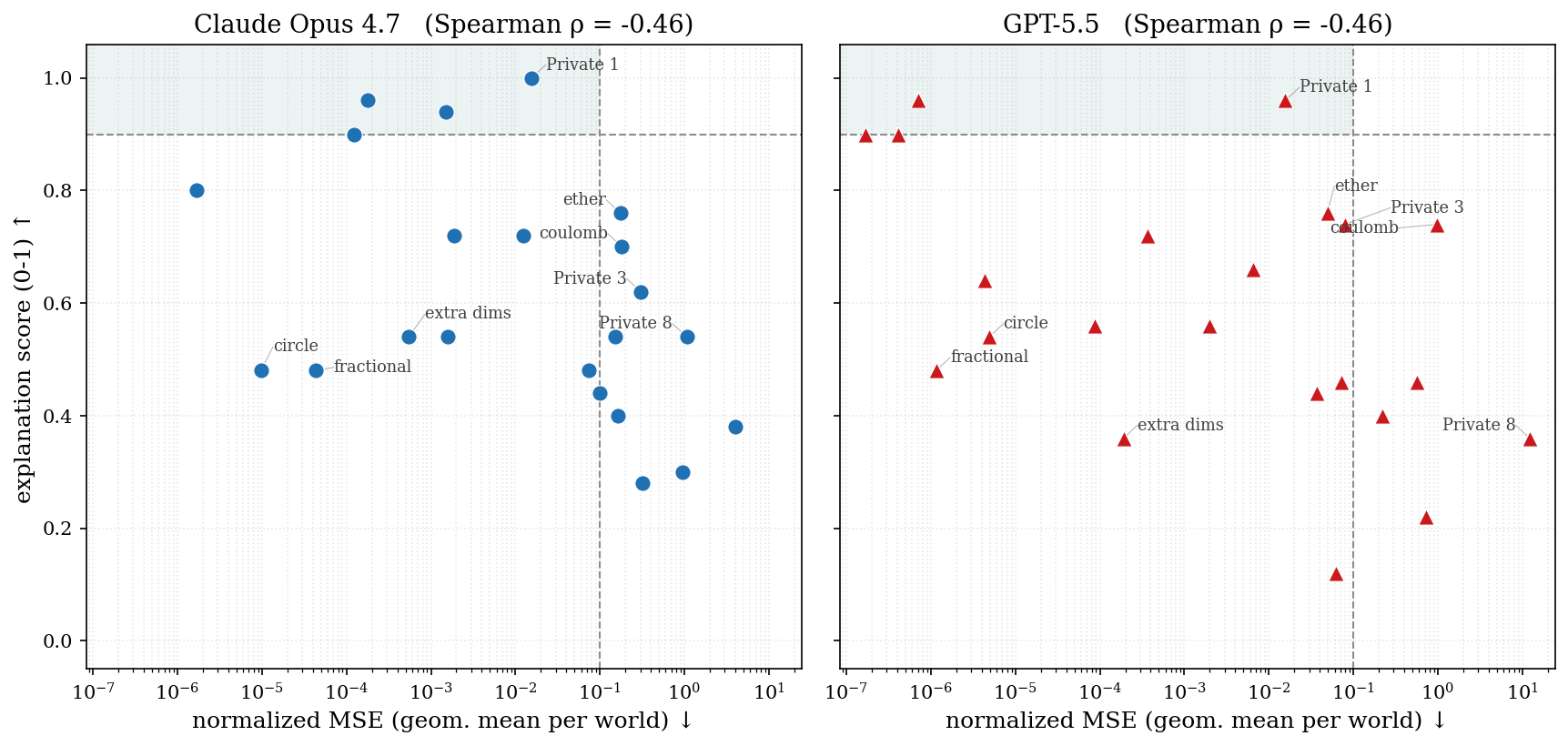
How Predictive the Theory is
Conceptual Understanding
Carolina Cuesta-Lazaro Flatiron/NYU @ KAAI 2026
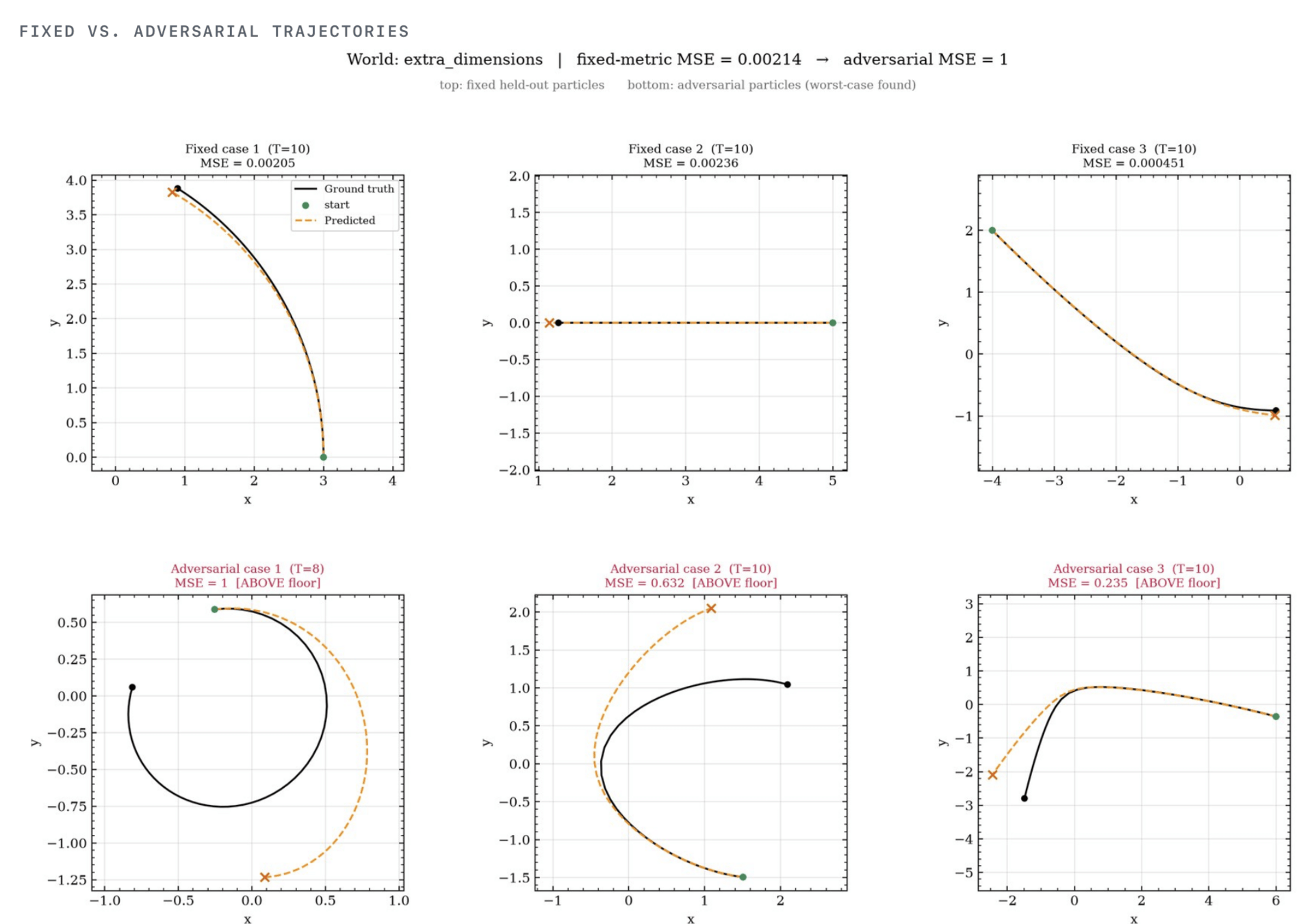
Adversarial Experiments to test Generalization
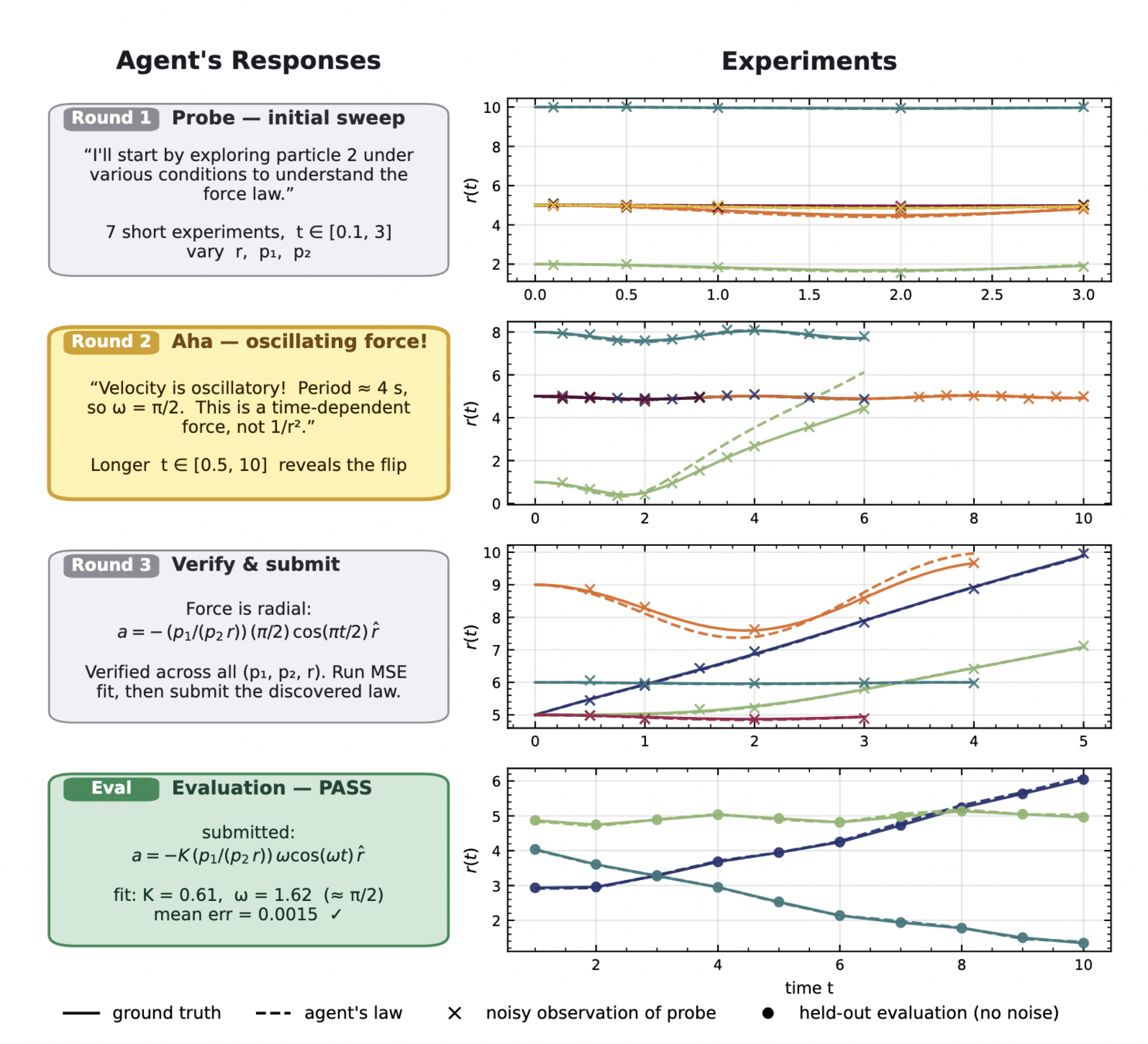
You are an expert physicist tasked with discovering scientific laws in a simulated universe. Your goal is to propose experiments, analyse the data they return, and ultimately deduce the underlying scientific law. Note that the laws of physics in this universe may differ from those in our own. You can perform experiments to gather data but must follow the protocol strictly.
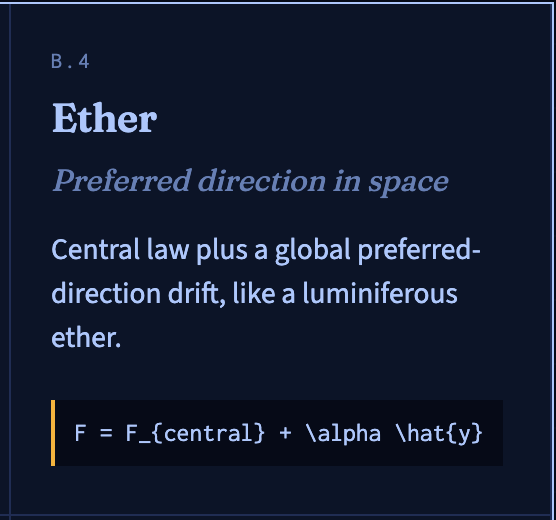
If F = G/r²: G = 80. If F = G/r: G = 8. Linear in 1/r!
m=1: a = 0.664 · m=2: a = 0.614 · m=4: a = 0.664 · m=8: a = 0.714 … That's strange."
Consistent pattern: small +y 'extra' force (~0.05) regardless of position … maybe the anchor itself moves.
a_y_extra ≈ +0.05 everywhere on probes. Spot on! So anchor too just experiences g_y = 0.05 … g = (0, 0.05) is a uniform external acceleration on every particle.

Carolina Cuesta-Lazaro Flatiron/NYU @ KAAI 2026
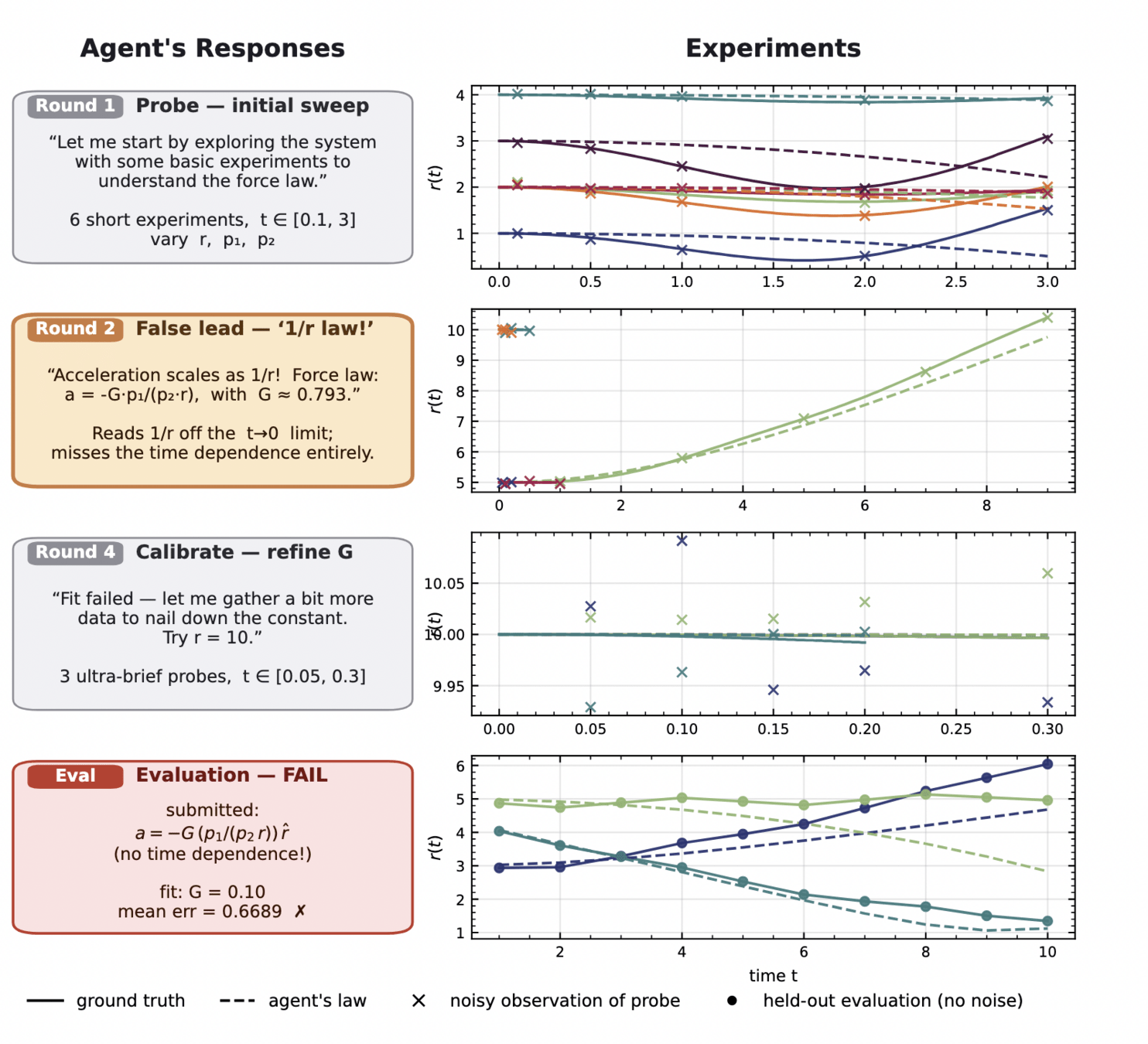
You are an expert physicist tasked with discovering scientific laws in a simulated universe. Your goal is to propose experiments, analyse the data they return, and ultimately deduce the underlying scientific law. Note that the laws of physics in this universe may differ from those in our own. You can perform experiments to gather data but must follow the protocol strictly.
Confirmed: a ∝ 1/r.
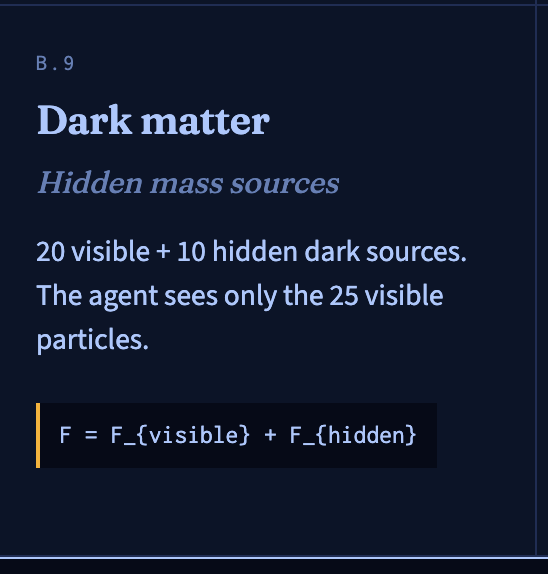
observed −5.18. WAY too small. Something is very wrong with my understanding!
artifact of integration accuracy, NOT the true law. Probably because of close encounters causing chaos.
I'll just submit my law. The functional form is solid.
Carolina Cuesta-Lazaro Flatiron/NYU @ KAAI 2026
You are an expert physicist tasked with discovering scientific laws in a simulated universe. Your goal is to propose experiments, analyse the data they return, and ultimately deduce the underlying scientific law. Note that the laws of physics in this universe may differ from those in our own. You can perform experiments to gather data but must follow the protocol strictly.
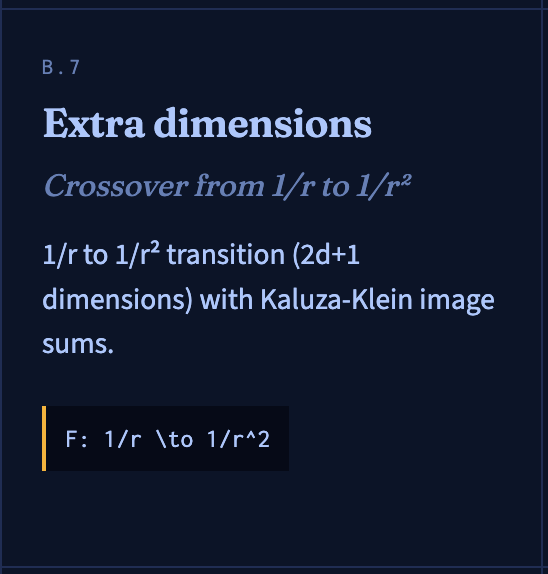
a × r seems roughly constant … not quite 1/r.
Let me try a × r²: … Not consistent.
So at large r, a ~ 1/r. At small r, a ~ 1/r².
Actually note the file path in the error message: 'extra_dimensions.csv'! This is a hint! The world might have an extra compactified dimension…
[Model starts fitting Yukawa potential, Bessel functions... At some point fitting tool errors.]
Carolina Cuesta-Lazaro Flatiron/NYU @ KAAI 2026
Carolina Cuesta-Lazaro Flatiron/NYU @ KAAI 2026
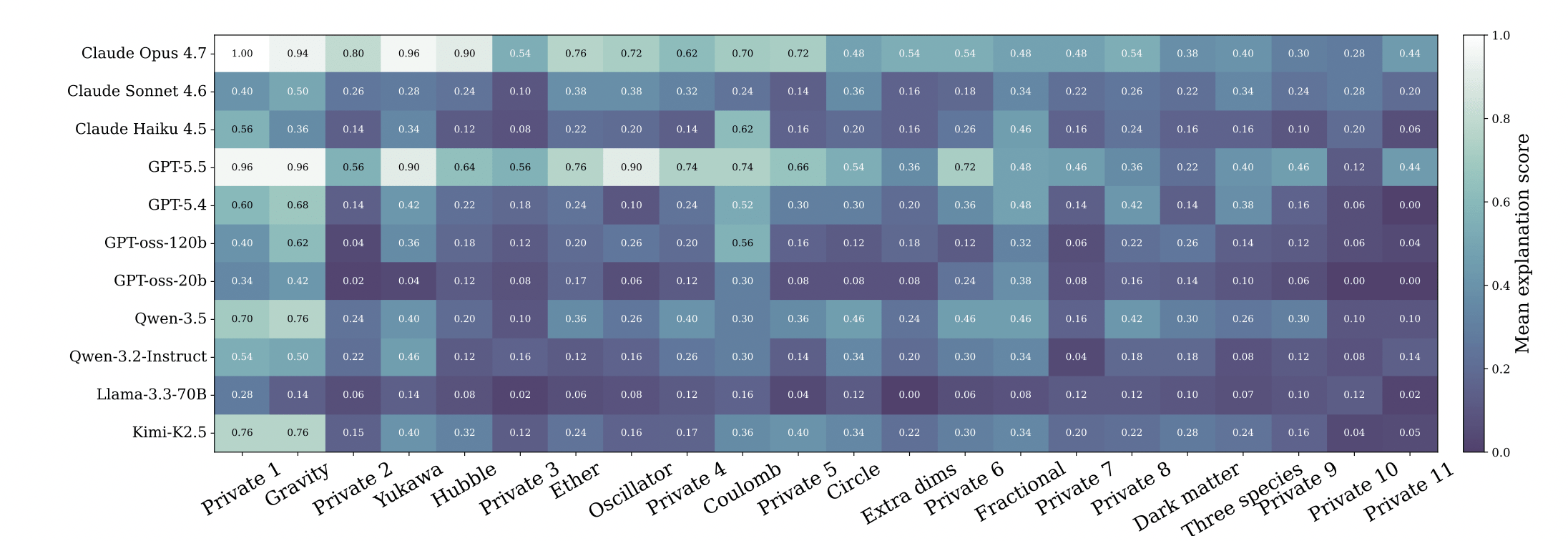
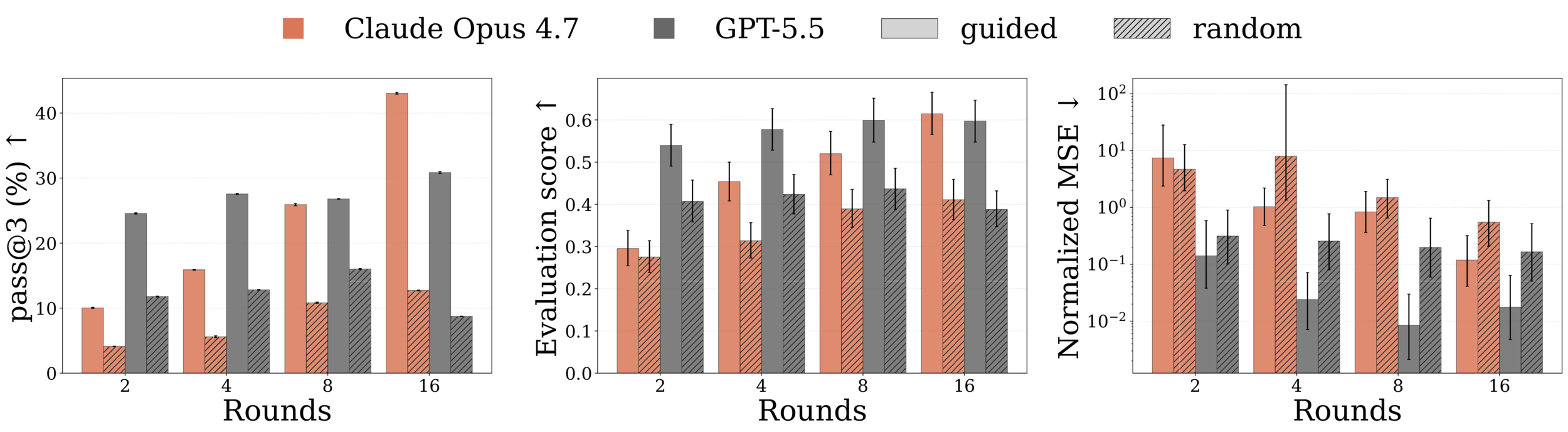
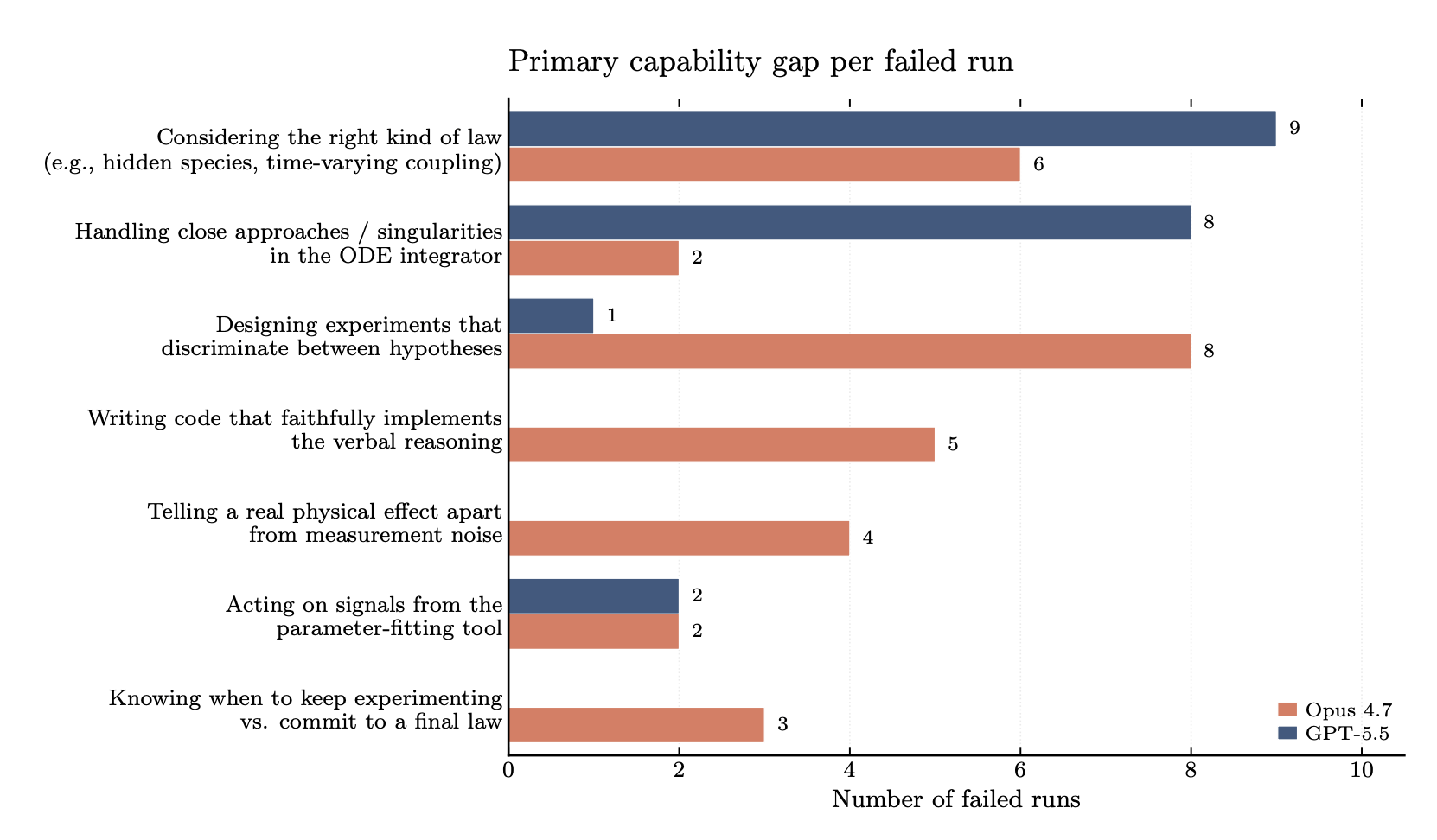
Carolina Cuesta-Lazaro Flatiron/NYU @ KAAI 2026
Conceptual Understanding
Trajectory Prediction
Random Seeds
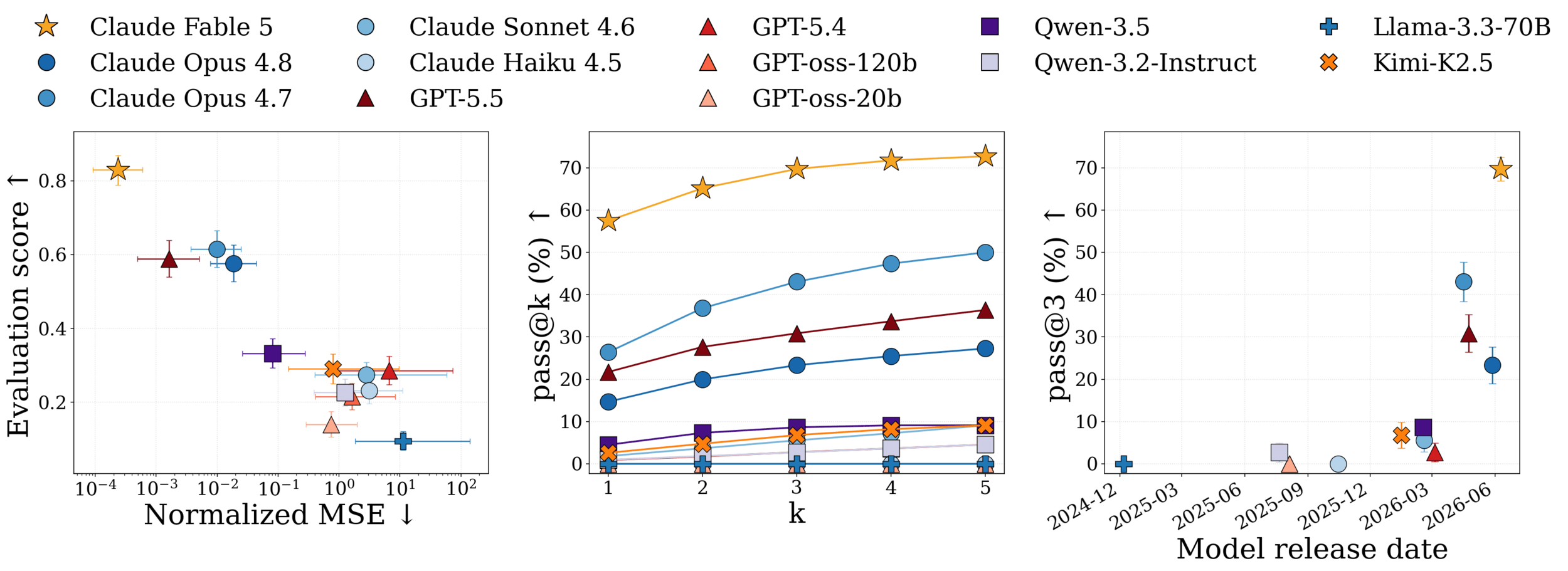
Carolina Cuesta-Lazaro Flatiron/NYU @ KAAI 2026
World Generator
Carolina Cuesta-Lazaro Flatiron/NYU @ KAAI 2026
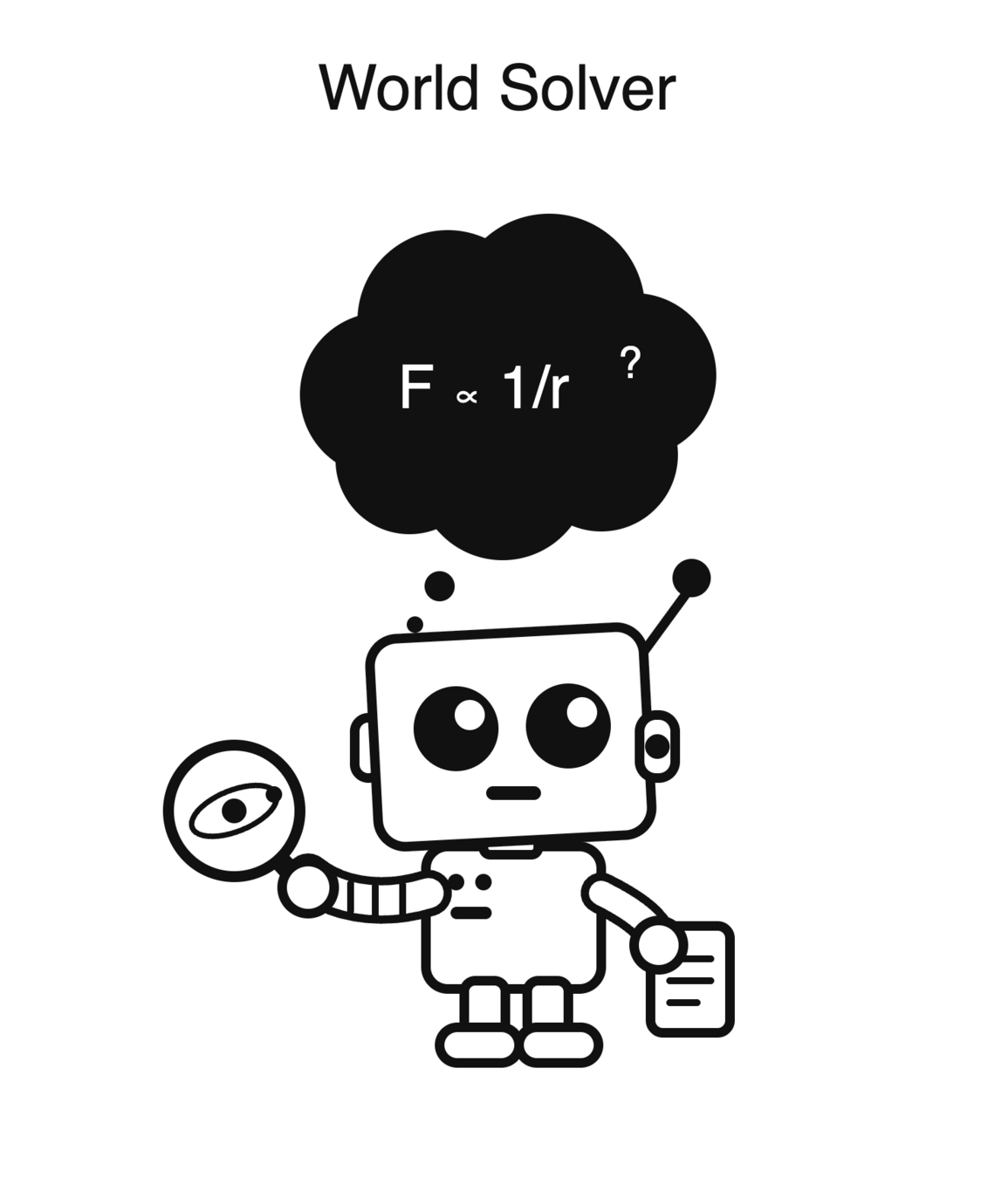
World Solver
def simulate(
	pos1,
    pos2,
    duration,
    **params,
  ):
	"Simulate Universe"

    return trajectories

Convergence,
Re-implementation tests....
def discovered_law(pos1, pos2, p1, p2, velocity2, duration, **params):
    """Particle 2 is accelerated toward particle 1 by a radial force
    per unit along r^ that combines a static source term G*p1,
    a radial-velocity term (analogous to an advective/retardation
    coupling), and a centripetal-like tangential kinetic-energy
    term, all scaled by 1/r and independent of p2."""
    ...
    return trajectories

def fit_parameters():
    return {
        "G":     {"init": 1.0, "bounds": [0.1, 5.0]},
        ...
    }
Running Experiment...
Reward
Predictiveness
Conceptual Understanding
(MSE)
(Evaluation Score)
"This world consists of ..."
World Definition
Simulation Code
Carolina Cuesta-Lazaro Flatiron/NYU @ KAAI 2026
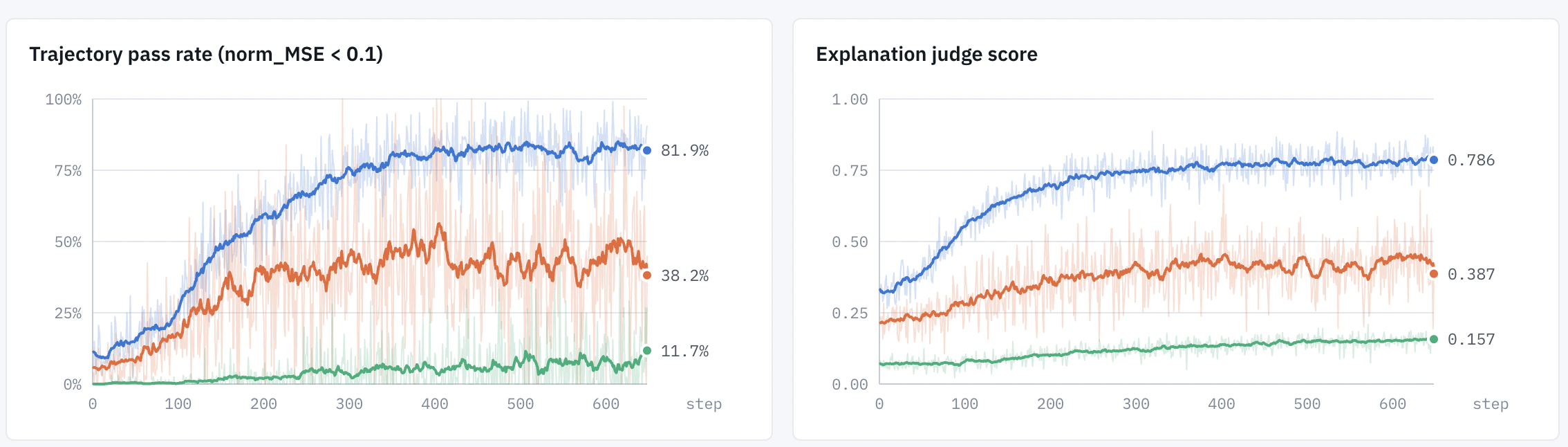
Easy
Medium
Hard
The challenge: Long roll outs / Attribution
["An LLM-driven framework for cosmological
model-building and exploration" Mudur, Cuesta-Lazaro, Toomey ]
Can LLMs help us explore the space of hypothesis?
Propose a model for Dark Energy
Implement it in a Cosmology simulation code: CLASS
Test fit to DESI Observations
Iterate to improve fit
Quintessence, DE/DM interactions....
Must pass a set of general tests for "reasonable" models
Ideally, compare evidence to LCDM.
For now, Bayesian Information Criteria (BIC)
1
2
Nayantara Mudur (Harvard)
Carolina Cuesta-Lazaro Flatiron/NYU @ KAAI 2026
["DESI 2024 VI: Cosmological Constraints from the Measurements of Baryon Acoustic Oscillations" arXiv:2404.03002]

Dark Energy is constant over time
Carolina Cuesta-Lazaro Flatiron/NYU @ KAAI 2026
Carolina Cuesta-Lazaro Flatiron/NYU @ KAAI 2026

Kai Lehmann
Bayesian Model Comparison
Ocham's razor: Penalize overparametrized theories
How well does a theory fit the data?
Conditional Time Score matching (CTSM)
Flow Models
Bayesian Evidence
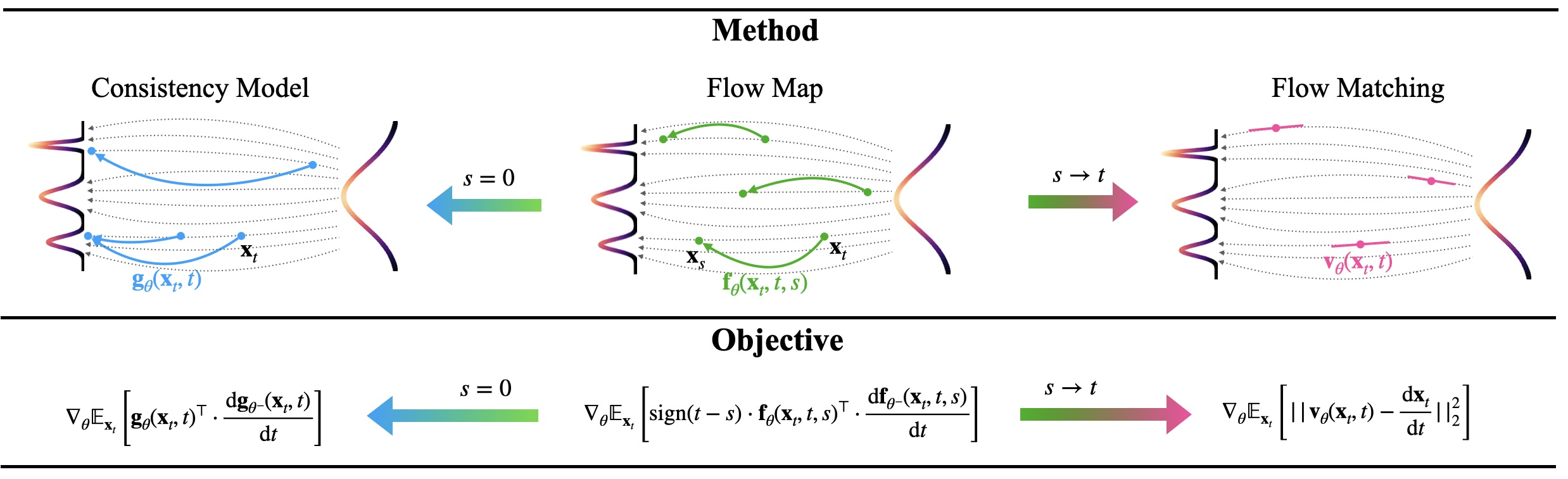
Density Ratio Estimation (DRE)
Cross Entropy Loss
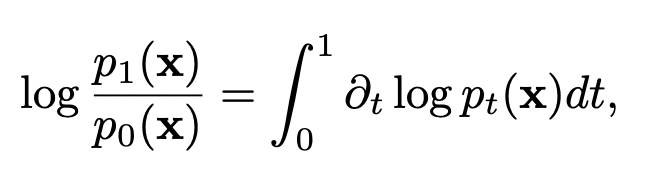
Flow
Model A
Model B
Model C
Carolina Cuesta-Lazaro Flatiron/NYU @ KAAI 2026
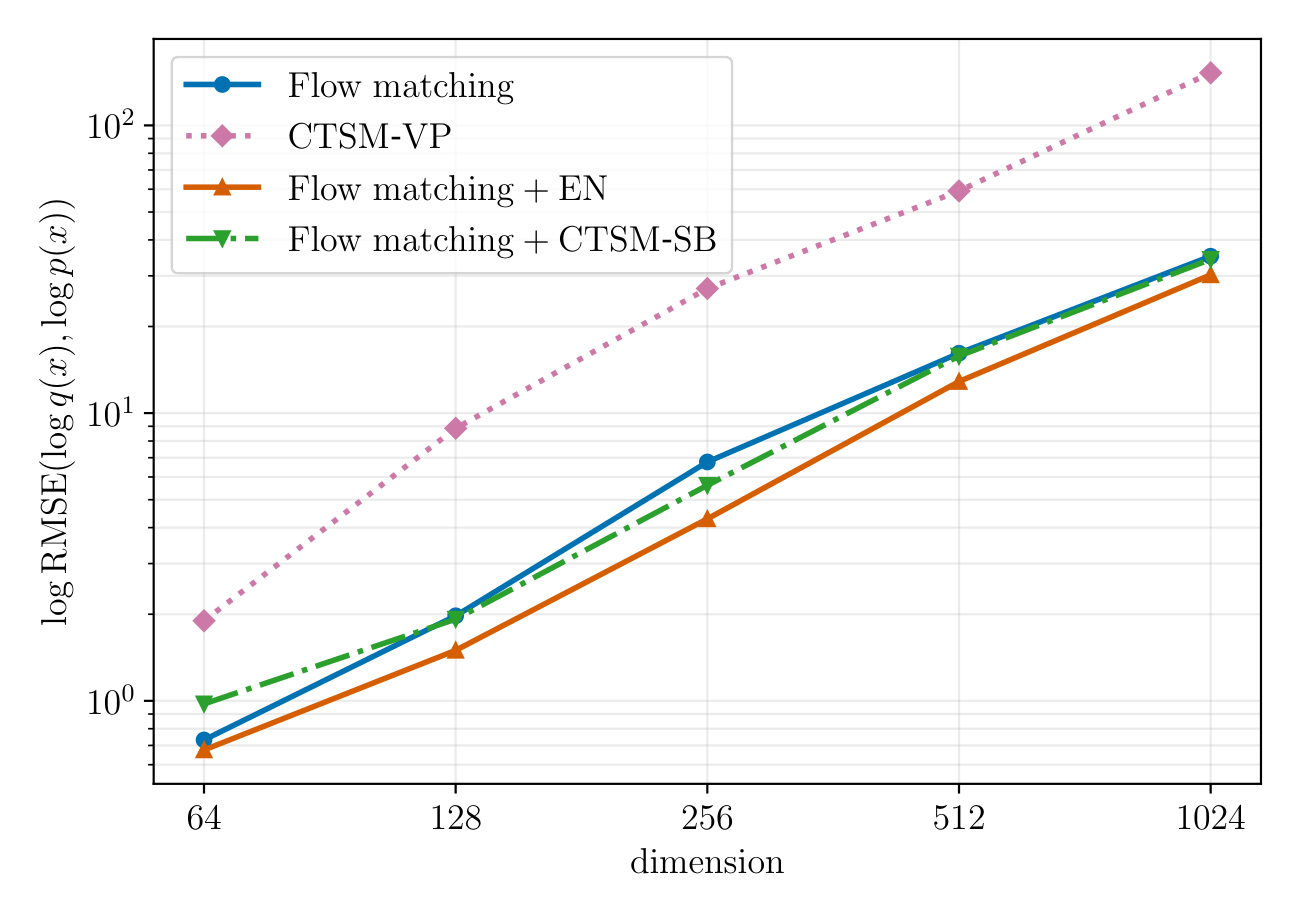
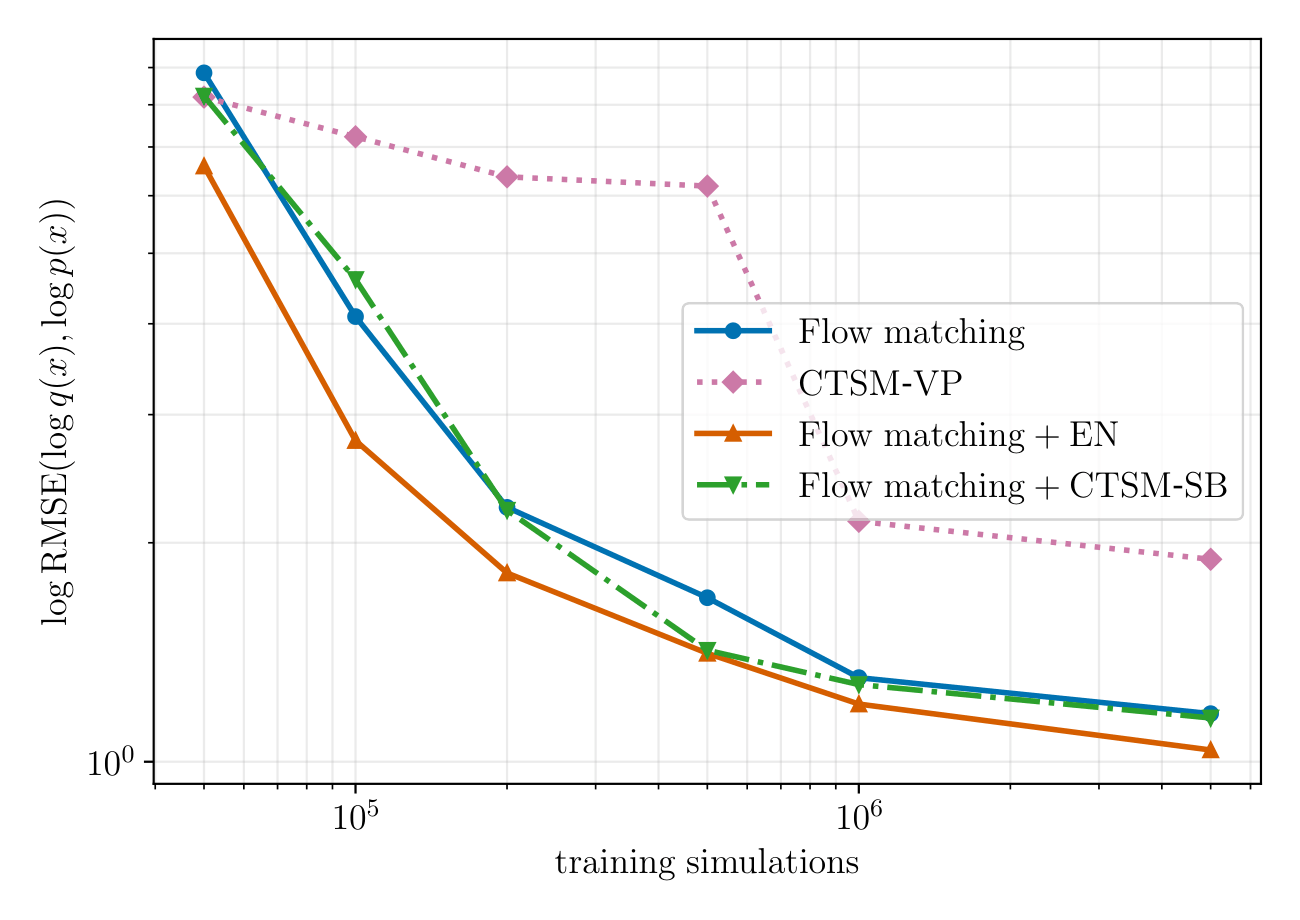
Accuracy
Dimensionality
Training set size
Observation
Question
Hypothesis
Testable Predictions
Gather data
Alter, Expand, Reject Hypothesis
Develop General Theories
[Figure adapted from ArchonMagnus] The Scientific Method in > 2025
Carolina Cuesta-Lazaro Flatiron/NYU @ KAAI 2026