Corentin Cadiou
Contributors: Dominique Aubert (ObAS), Lucas Barbier-Goy (CEA), Sylvain Breton (LAB), Catherine Blume (CU Boulder), Michel-Andrès Breton (CEA), Grégoire Doebele (CEA), Solange Druelle (CEA), Adam J. Finley (ESTEC), San Han (IAP), Olivier Marchal (ObAS), Mike Petrault (CRIStAL), Leodasce Sewanou (CRAL), Anatole Storck (Oxford), Guillaume Tcherniatinsky (IAP), Kerwann Tep (ObAS)
Dyablo:
a new* GPU-based astrophysical code
* started in 2019

{{author}} — {{#}}/{{total}}

Cosmological simulations
Self-consistent formation of galaxies
Initial conditions
Simulated galaxies
-
understand:
What's needed to reproduce observations? -
explain:
How do galaxies form? -
predict:
Future observations?
NASA
{{author}} — {{#}}/{{total}}

\(<1\,\%\)
Exponentially-expanding Universe
Dark matter
Gas (H+He)
Stars
{{author}} — {{#}}/{{total}}
Orders of magnitude
The simulation challenge
Time
Universe: \(13.7\,\mathrm{Gyr}\)
Supernova: \(1\,\mathrm{kyr}\)
⇒ \(10^7\) steps/simulation
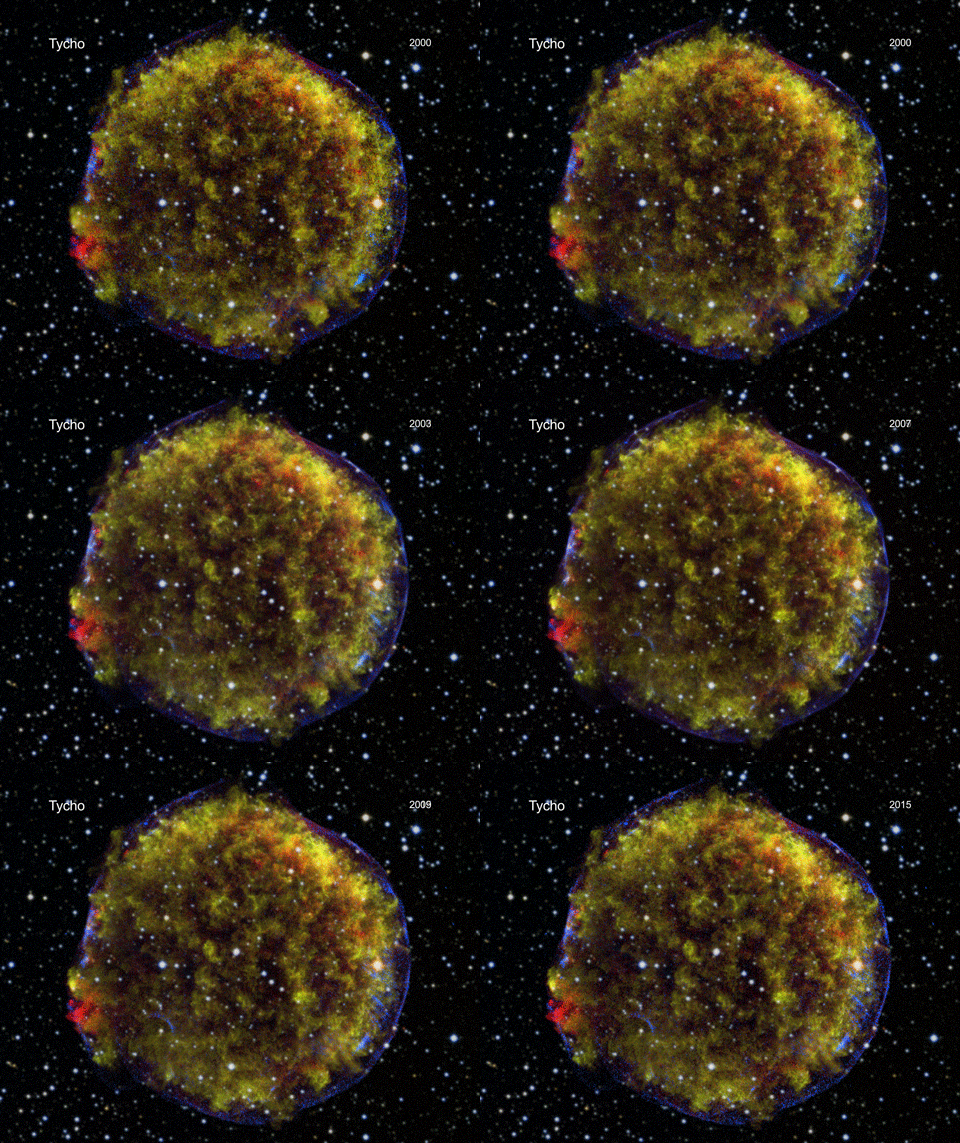
NASA/CXC/A.Jubett
Mass
\(10^{11}\,\rm M_\odot\): Milky-Way
\(1\,\rm M_\odot\): typical star
⇒ \(10^{11}\) particles
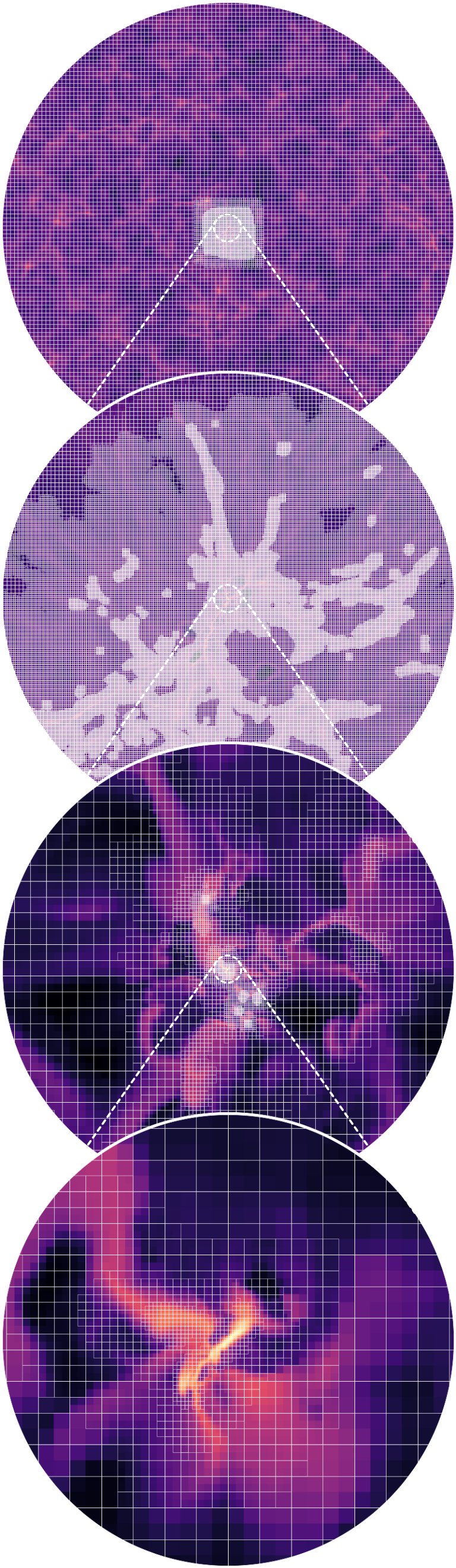
Resolution:
\(\sim 10^{6}\,\mathrm{ly}\): cosmological env.
\(\sim 1\,\mathrm{ly}\): supernova scale
⇒ \(>6\) orders of magnitude resolution
⇒ \(10^{18}\) updates
\(230\,\mathrm{yr}\) on my laptop's CPU
\(18\,\mathrm{yr}\) on my GPU
\(11\,\mathrm{month}\) on an NVIDIA H100
{{author}} — {{#}}/{{total}}
Orders of magnitude
of existing code (RAMSES) / Vintergatan simulation
Took:
- 4 MCPU.hr on 1500 cores (\(460\,\mathrm{yr}\))
- \(10^8\) particles + \(3\times10^{8}\) cells (\(M=10^3\,\mathrm{M_\odot}\))
- \(67\,\mathrm{GiB}\) of data/output, 200 outputs
- Would take the same time on… 6 H100 GPUs
RAMSES: Teyssier 2003
Vintergatan: Cadiou in prep, Agertz+21
Efficiency: green top 500
DM
gas
star
\(\sim 5-15\,\mathrm{Gflop/W}\)
\(\sim 30-70\,\mathrm{Gflop/W}\)
\(\sim2\,\mathrm{tCO_{2,eq}}\)
\(<1\,\mathrm{tCO_{2,eq}}\)?
{{author}} — {{#}}/{{total}}
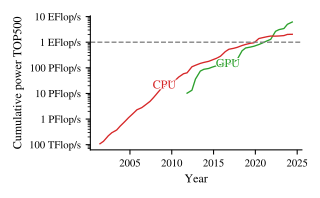
Data: Top-500
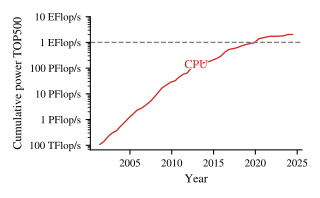
The need for a GPU-based code
Various architectures with very different and fast-changing
architectures
- AMR CPUS (LineShine),
- AMD GPUs (El Capitan, Frontier, Alice Recoque),
- NVIDIA GPUs (Jupiter)
- x86 CPUs (TGCC).
Consequently:
- Unrealistic to maintain \(>1\) versions of each kernel,
- Performance portability is key!
{{author}} — {{#}}/{{total}}
Dyablo Simulation Code
Manage grid, simple computation
Computation-heavy
(hydro, gravity, …)
CPU
GPU
[…]
wasted
time
wasted
time
Typical approach: offloading ⇒ hard to benefit from shared parallelism
Dyablo's approach:
Amdahl's law: latency kills gains of parallelisation
San+25 (RAMSES w/ OpenMP)
Kim'26 (RAMSES w/ CUDA)
Teyssier+26 (RAMSES w/ CUDA Fortran)
{{author}} — {{#}}/{{total}}
Dyablo Simulation Code
Manage grid, simple computation
Computation-heavy
(hydro, gravity, …)
CPU
GPU
(or CPUs)
[…]
Dyablo's approach: “true” GPU computing, CPU as a puppeteer
Typical approach: offloading ⇒ hard to benefit from shared parallelism
{{author}} — {{#}}/{{total}}
Dyablo structure
Dyablo
Dyablo
…
MPI
distributed
parallelism
Kernel 1
Kernel 2
Kernel 3
Kernel 4
…
Kokkos ⇒ shared parallelism
OpenMP
Sycl
CUDA
HIP
Users write plugins that invoque kernels. Eg:
- hydrodynamical solver,
- form stars (subgrid model),
- explode stars (subgrid model).
Plugins have limited access to:
- context (current time),
- data,
through a strict API ⇒ change of backend doesn't change the plugin
MPI
distributed
parallelism
{{author}} — {{#}}/{{total}}
Open source and community centered
Open-source:
- Developments are made on CEA hosted GitLab: https://drf-gitlab.cea.fr
- Anyone can create an account
- Three repositories: Dyablo, pyablo, documentation
- Protected branches (dev, main) are mirrored automatically on GitHub: https://github.com/Dyablo-HPC/
- Dyablo dev meeting once every month
- Regular hands-on sessions
- GDR Cophy 2-4 dec 2026
- École des Houches on numerical simulation June 2027
Community:
- 2 (+1) full time developers + ~20 users/contributors
- Local initiatives:
- National initiatives:
- GINEA: Groupement d’Instrumentation Numérique pour l’Exascale en Astrophysique
- PEPR Numpex: Exa-DoST (PC3); Exa-DI (PC5)
- PEPR Origins: MHD@Exascale
- International projects:
Git workflow
dyablo-core
Application specific branches (eg)
- Radiative transfer
- Thermo-chemistry
- Solid body rotation
Applicative branches
- Cosmology
- Solar/Stellar physics
- Interstellar medium
Core feature branches (eg)
- Common features
- Optimizations
- Adaptive mesh improvements
Slide adapted from M. Delorme
{{author}} — {{#}}/{{total}}
- Scientific community:
4 publications in prep.
(1 code + 2 cosmo + 1 galaxy) - Astro-developer community:
4 community branches
(galaxy, cosmology, ISM, solar interior) - User community (in progress):
Training at DAp, DPhP
Hand-on sessions GDR COPHY 2-4 of dec.
⇒ big thanks to RAMSES for the tutorials!
🚧 Community building
- Performance portability:
we run on all major French and international supercomputers - Modern software enrgineering:
separation of concern and clean APIs - (Astro)physics communities are picking up
State-of-the-art galaxy model, cosmology, interstellar medium, solar interior - Able to perform simulations on GPUs
at scale
☑️ Modern code
{{author}} — {{#}}/{{total}}