Corentin Cadiou
CNRS Researcher @ IAP, Paris
State of the Circumgalactic medium in the Megatron simulations
PIs: Corentin Cadiou, Harley Katz & Martin Rey
Collaborators: Oscar Agertz, Jeremy Blaizot, Alex J. Cameron, Nicholas Choustikov, Julien Devriendt, Uliana Hauk, Gareth Jones, Taysun Kimm, Isaac Laseter, Aayush Saxena, Sergio Martin-Alvarez, Kosei Matsumoto, Camilla T. Nyhagen, Autumn Pearce, Francisco Rodriguez-Montero, Victor Rufo-Pastor, Joki Rosdahl, Adrianne Slyz, Richard Stiskalek, Anatole Storck, Wonjae Yee
Rey+26 | Katz+26 | Cadiou+26 | Choustikov+26 | Storck+26
See also Katz+26; Attard+26

Why study the CGM? From cosmological to galactic scales

Tornotti+25a · \(z\simeq3.2\)
See also Herwig+24; Gallego+18
\(L \approx 700\,\mathrm{kpc}\)
CGM–IGM transition: \(R \approx 100\,\mathrm{kpc}\)

Peng+25 · \(z=2.8\)
\(L \approx 100\,\mathrm{kpc}\)
Enriched filaments; feedback
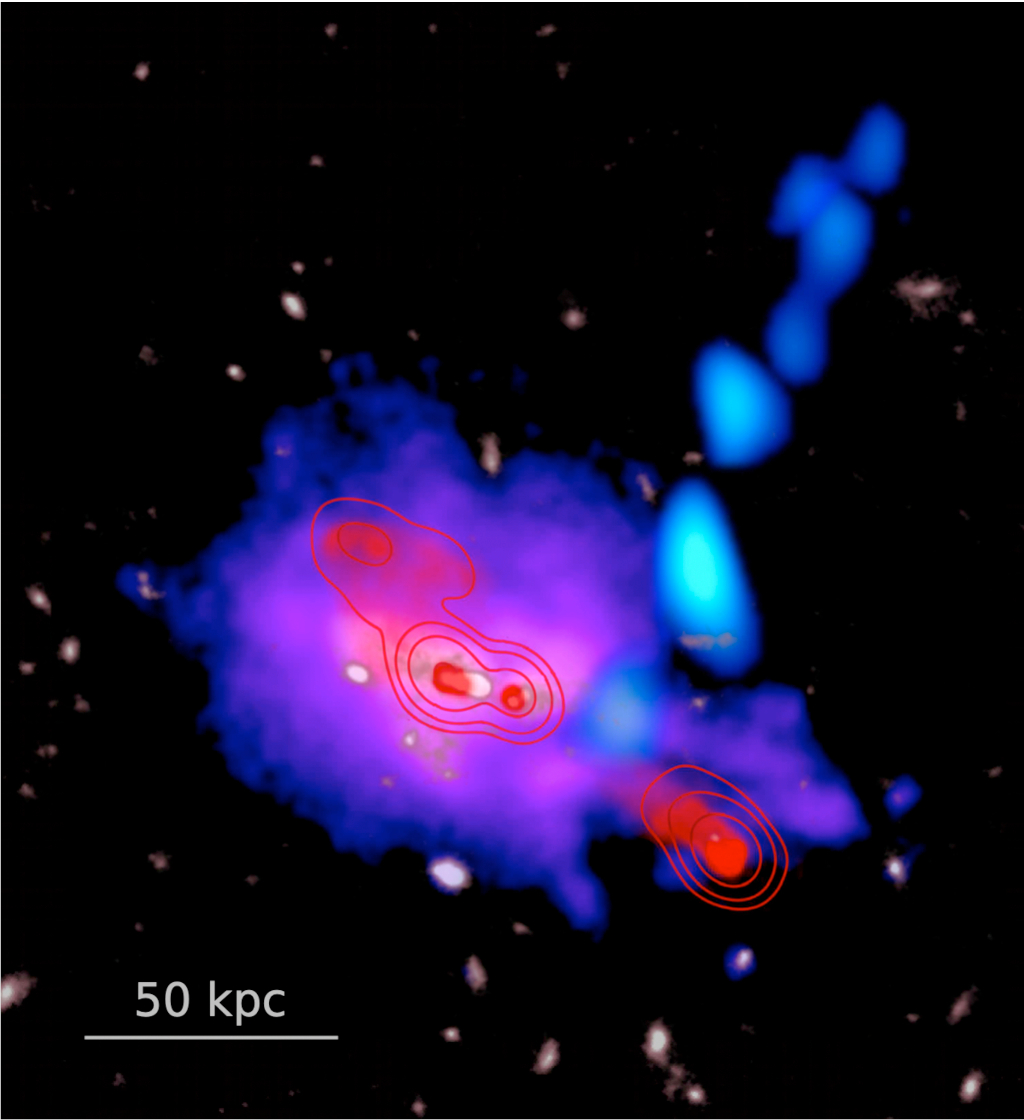
Emonts+23 · \(z=3.8\)
Stream \(L \approx 100\,\mathrm{kpc}\)
Typical path from sims to observations
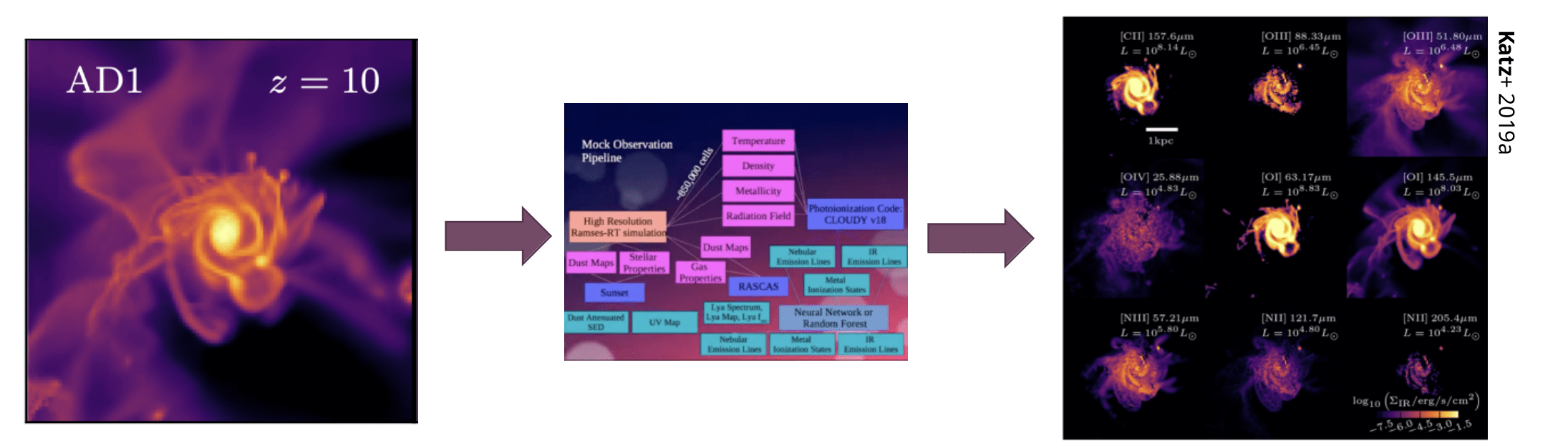
Lots of assumptions
(equilibrium, geometry, element abundances, …)
\(\rho, T, Z,v\)
sometimes \(n_\mathrm{H}, n_{\mathrm{H^+}}, n_\mathrm{He}, n_\mathrm{He^+},n_\mathrm{He^{2+}},n_\mathrm{e^{-}}\)
Physical space
Observable
Two questions:
- Are interpretations of the CGM robust?
- Are simulations converged?
- What's the future for CGM simulations?
Two questions:
- Are interpretations of the CGM robust?
- Are simulations converged?
- What's the future for CGM simulations?

Megatron suite of simulations
- On-the fly radiative transfer,
- 81-ions non-equilibrium thermochemistry,
- Chemical enrichment from SN and stellar winds,
- Milky-Way progenitor,
- 4 “high-resolution” sims at \(10\,\mathrm{pc}\) comoving,
- 3+3 “CGM” sims at \(23\,\mathrm{pc}\) proper.

\(\Sigma\)HI
\(\Sigma\)HII
\(\Sigma\)MgII
\(\Sigma\)OII
Mocks in absorption (different \(\Sigma\)!)
Main object, \(z=4\), raw file outputs, no postprocessing
Mocks in emission:
Main object, \(z=9\), from Choustikov, CC+25
Model [i]
- Based on RAMSES-RT (Rosdahl+13)
- Out-of-equilibrium chemistry (Katz 23)
Primordial species: \(\text{H~{\small I}-{\small II}}\), \(\text{He~{\small I}-{\small III}}\), \(e^{-}\)
Metal ions: \(\text{C~{\small I}-{\small VI}}\), \(\text{N~{\small I}-{\small VII}}\), \(\text{O~{\small I}-{\small VIII}}\), \(\text{Ne~{\small I}-{\small X}}\), \(\text{Mg~{\small I}-{\small X}}\), \(\text{Si~{\small I}-{\small XI}}\), \(\text{S~{\small I}-{\small XI}}\) & \(\text{Fe~{\small I}-{\small XI}} \)
Molecules: \(\text{H}_2\) & \(\text{CO}\) - “Dust model” (Rémy-Ruyer+14)
Assuming dust-to-gas ratio - Heating & Cooling
photoheating, photoelectric heating, excitation/dissociation heating, primordial, dust recombination, dust-gas collisions, metal lines
\(\text{C~{\small I}}\), \(\text{C~{\small II}}\), \(\text{N~{\small II}}\), \(\text{O~{\small I}}\), \(\text{O~{\small III}}\), \(\text{Ne~{\small II}}\), \(\text{Si~{\small I}}\), \(\text{Si~{\small II}}\), \(\text{S~{\small I}}\), \(\text{Fe~{\small I}}\), \(\text{Fe~{\small II}}\)


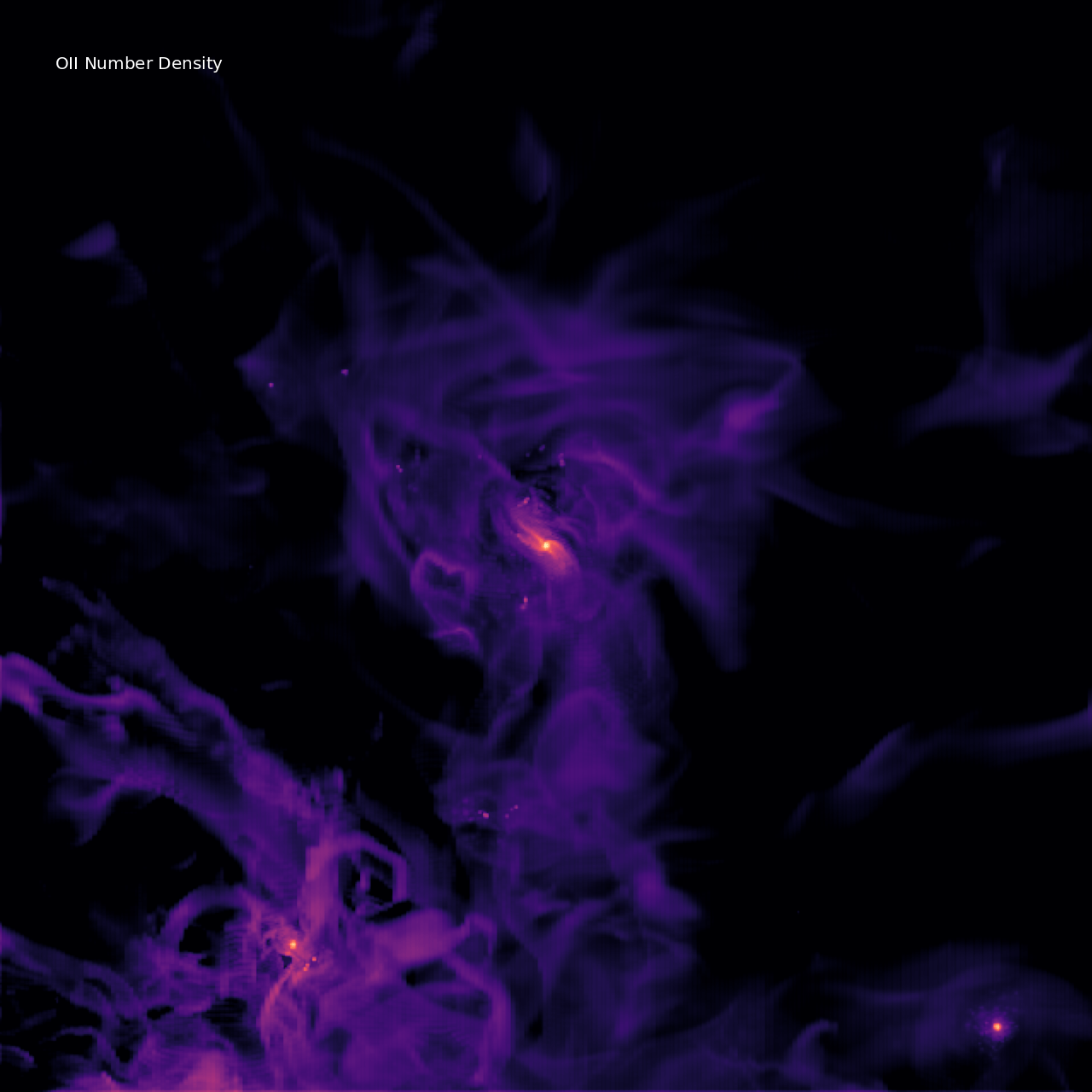


\(\text{O\small{II}}\)
\(\text{O\small{I}}\)
\(\text{N\small{I}}\)
\(\text{Mg\small{II}}\)
\(\text{Ne\small{II}}\)
\(\text{CO}\)
\(\rho\)
\(v_r\)
\(\text{O\small{III}}\)
Model [ii]
- Turbulence-based star formation
(Padoan & Nordlund 11, Agertz+21)
\(\dot{\rho_\star} = \varepsilon_\star\rho/t_\mathrm{ff}\)- if \(Z<10^{-6}Z_\odot\) ⇒ Pop. III
- if \(Z\geq10^{-6}Z_\odot\) ⇒ Pop. I & II, Kroupa
- \(M_\star = 500\,\mathrm{M}_\odot\)
\(M_{\star,\rm III} \sim 100\,\mathrm{M}_\odot\) - Feedback (Agertz+21; Rey+23)
core-collapse SN, type Ia, winds + HN (Nomoto+06). - Yields (Limongi & Chieffi 18)
AGB winds (Ritter+18)
Model [iii]
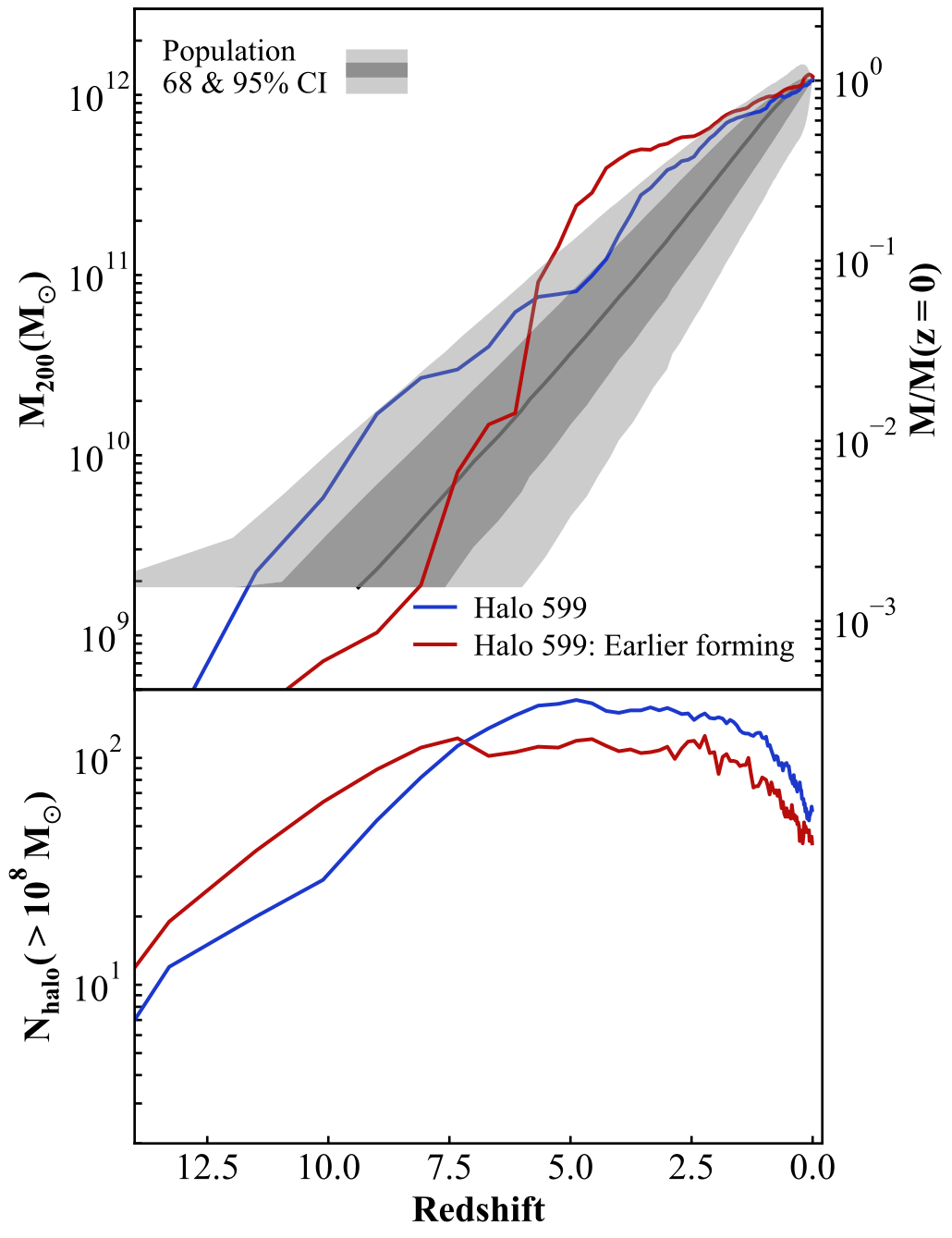
- MW analogue @ \(z=0\)
- Genetically engineered to form earlier
ICs generated withgenetIC - 2 main runs
- constant physical \(\Delta x_\mathrm{min} \approx 20-40\,\mathrm{pc}\)
6 runs :- 3 different ICs
- 3 CGM super-resolution
- constant comoving \(\Delta x_\mathrm{min}(z=2) = 20\,\mathrm{pc}\)
\(\Delta x_\mathrm{min}(z=5)=10\,\mathrm{pc}\)
\(\Delta x_\mathrm{min}(z=14)=4\,\mathrm{pc}\)
3 runs:- efficient SF
- bursty SF
- variable IMF
- hypernova + high \(\varepsilon_\mathrm{ff}\)
- constant physical \(\Delta x_\mathrm{min} \approx 20-40\,\mathrm{pc}\)
RTZ model
\[ \frac{\mathrm{d}n_i}{\mathrm{d}t} = \textcolor{red}{n_{i+1}\alpha_{i+1}n_\mathrm{e}} + \left(\sum_k [ \textcolor{blue}{n_{i+1}\xi_{i+1}}+ \textcolor{green}{n_{i-1}\chi_{i-1}}]n_k\right)\! + n_{i-1}(\textcolor{purple}{\beta_{i-1}n_\mathrm{e}} + \textcolor{brown}{\Gamma_{i-1}})\\ \]
\(\textcolor{red}{X^+ + e^- \rightarrow X }\) (recombination)
\(\textcolor{blue}{X^+ + Y \rightarrow X + Y^+}\) (charge exchange recombination)
\(\textcolor{green}{X^- + Y \rightarrow X + Y^-}\) (charge exchange ionization)
\(\textcolor{purple}{X + e^{-*} \rightarrow X^+ + 2e^-} \) (collisional excitation)
\(\textcolor{brown}{X + h\nu \rightarrow X^+ + e^-} \) (photoionization)
\[ \frac{\mathrm{d} E}{\mathrm{d}t} = \sum_{k}^{\mathrm{processes}}\sum_i^{\mathrm{species}} n_i \Gamma_k - \sum_{k}^{\mathrm{processes}}\sum_i^{\mathrm{species}}\sum_j^{\mathrm{species}} n_i n_j \Lambda_k\]
Katz 22, Katz+22, Katz+CC+24
\[- \ \textcolor{red}{n_i \alpha_i n_\mathrm{e}} - \left(\sum_k[ \textcolor{blue}{n_i\xi_i} + \textcolor{green}{n_i\chi_i}]n_k\right) - n_i(\textcolor{purple}{\beta_i n_\mathrm{e}} + \textcolor{brown}{\Gamma_i})\]
RTZ model
\[ \frac{\mathrm{d}n_i}{\mathrm{d}t} = \textcolor{red}{n_{i+1}\alpha_{i+1}n_\mathrm{e}} + \left(\sum_k [ \textcolor{blue}{n_{i+1}\xi_{i+1}}+ \textcolor{green}{n_{i-1}\chi_{i-1}}]n_k\right)\! + n_{i-1}(\textcolor{purple}{\beta_{i-1}n_\mathrm{e}} + \textcolor{brown}{\Gamma_{i-1}})\\ \]
\[- \ \textcolor{red}{n_i \alpha_i n_\mathrm{e}} - \left(\sum_k[ \textcolor{blue}{n_i\xi_i} + \textcolor{green}{n_i\chi_i}]n_k\right) - n_i(\textcolor{purple}{\beta_i n_\mathrm{e}} + \textcolor{brown}{\Gamma_i})\]
\[ \frac{\mathrm{d} E}{\mathrm{d}t} = \sum_{k}^{\mathrm{processes}}\sum_i^{\mathrm{species}} n_i \Gamma_k - \sum_{k}^{\mathrm{processes}}\sum_i^{\mathrm{species}}\sum_j^{\mathrm{species}} n_i n_j \Lambda_k\]
- CR heating
- photoheating
- \(\mathrm{H}_2\) heating (formation, dissoc., pumping)
- H+He cooling (\(T>8000\,\mathrm{K}\))
- \(\mathrm{H}_2\) cooling (esp. \(Z < 10^{-5}\))
- metal-line cooling
fine-structure O I, O III, C I, C II, N II, Fe I, Fe II, Si I, Si II, S I, Ne II @ \(T<10^{4}\,\mathrm{K}\)
otherwise cloudy table - CO cooling + dust recombination + grain-gas collisional cooling
Katz 22, Katz+22, Katz+CC+24
State of the CGM of a MW progenitor at \(z \approx 3-4\)
Is the CGM in (chemical) equilibrium?
\[ \frac{\mathrm{d}n_i}{\mathrm{d}t} = \textcolor{red}{n_{i+1}\alpha_{i+1}n_\mathrm{e}} + \left(\sum_k [ \textcolor{blue}{n_{i+1}\xi_{i+1}}+ \textcolor{green}{n_{i-1}\chi_{i-1}}]n_k\right)\! + n_{i-1}(\textcolor{purple}{\beta_{i-1}n_\mathrm{e}} + \textcolor{brown}{\Gamma_{i-1}})\\ \]
\[- \ \textcolor{red}{n_i \alpha_i n_\mathrm{e}} - \left(\sum_k[ \textcolor{blue}{n_i\xi_i} + \textcolor{green}{n_i\chi_i}]n_k\right) - n_i(\textcolor{purple}{\beta_i n_\mathrm{e}} + \textcolor{brown}{\Gamma_i})\]
RTZ model
- Out of equilibrium
- Depends on past thermochemical state
- Depends on local radiation field through \(\Gamma\)
- Ion-ion dependencies
\[ \frac{\mathrm{d}n_i}{\mathrm{d}t} = \textcolor{red}{n_{i+1}\alpha_{i+1}n_\mathrm{e}} + \left(\sum_k [ \textcolor{blue}{n_{i+1}\xi_{i+1}}+ \textcolor{green}{n_{i-1}\chi_{i-1}}]n_k\right)\! + n_{i-1}(\textcolor{purple}{\beta_{i-1}n_\mathrm{e}} + \textcolor{brown}{\Gamma_{i-1}})\\ \]
\[- \ \textcolor{red}{n_i \alpha_i n_\mathrm{e}} - \left(\sum_k[ \textcolor{blue}{n_i\xi_i} + \textcolor{green}{n_i\chi_i}]n_k\right) - n_i(\textcolor{purple}{\beta_i n_\mathrm{e}} + \textcolor{brown}{\Gamma_i})\]
\[ \frac{\mathrm{d}n_i}{\mathrm{d}t} = \textcolor{red}{n_{i+1}\alpha_{i+1}n_\mathrm{e}} \phantom{+ \left(\sum_k [ \textcolor{blue}{n_{i+1}\xi_{i+1}}+ \textcolor{green}{n_{i-1}\chi_{i-1}}]n_k\right)}\! + n_{i-1}(\textcolor{purple}{\beta_{i-1}n_\mathrm{e}} + \textcolor{brown}{\Gamma_{i-1}})\\ \]
\[- \ \textcolor{red}{n_i \alpha_i n_\mathrm{e}} \phantom{- \left(\sum_k[ \textcolor{blue}{n_i\xi_i} + \textcolor{green}{n_i\chi_i}]n_k\right)} - n_i(\textcolor{purple}{\beta_i n_\mathrm{e}} + \textcolor{brown}{\Gamma_i})\]
Photoionization equilibrium
\[0 = \textcolor{red}{n_{i+1}\alpha_{i+1}n_\mathrm{e}}+ n_{i-1}(\textcolor{purple}{\beta_{i-1}n_\mathrm{e}} + \textcolor{brown}{\Gamma_{i-1}})- \ \textcolor{red}{n_i \alpha_i n_\mathrm{e}} - n_i(\textcolor{purple}{\beta_i n_\mathrm{e}} + \textcolor{brown}{\Gamma_i}) \]
\[ \frac{\mathrm{d}n_i}{\mathrm{d}t} = \textcolor{red}{n_{i+1}\alpha_{i+1}n_\mathrm{e}} + \left(\sum_k [ \textcolor{blue}{n_{i+1}\xi_{i+1}}+ \textcolor{green}{n_{i-1}\chi_{i-1}}]n_k\right)\! + n_{i-1}(\textcolor{purple}{\beta_{i-1}n_\mathrm{e}} + \textcolor{brown}{\Gamma_{i-1}})\\ \]
\[- \ \textcolor{red}{n_i \alpha_i n_\mathrm{e}} - \left(\sum_k[ \textcolor{blue}{n_i\xi_i} + \textcolor{green}{n_i\chi_i}]n_k\right) - n_i(\textcolor{purple}{\beta_i n_\mathrm{e}} + \textcolor{brown}{\Gamma_i})\]
RTZ model
RTZ model
Photoionization equilibrium
\[0 = \textcolor{red}{n_{i+1}\alpha_{i+1}n_\mathrm{e}}+ n_{i-1}(\textcolor{purple}{\beta_{i-1}n_\mathrm{e}} + \textcolor{brown}{\Gamma_{i-1}})- \ \textcolor{red}{n_i \alpha_i n_\mathrm{e}} - n_i(\textcolor{purple}{\beta_i n_\mathrm{e}} + \textcolor{brown}{\Gamma_i}) \]
- In equilibrium
- Suppose \(n_\mathrm{e} = n_\mathrm{H\,II} + n_\mathrm{He\,II} + 2n_\mathrm{He\,III}\)
- Suppose \(\Gamma\) is UV background only
\[ \frac{\mathrm{d}n_i}{\mathrm{d}t} = \textcolor{red}{n_{i+1}\alpha_{i+1}n_\mathrm{e}} + \left(\sum_k [ \textcolor{blue}{n_{i+1}\xi_{i+1}}+ \textcolor{green}{n_{i-1}\chi_{i-1}}]n_k\right)\! + n_{i-1}(\textcolor{purple}{\beta_{i-1}n_\mathrm{e}} + \textcolor{brown}{\Gamma_{i-1}})\\ \]
\[- \ \textcolor{red}{n_i \alpha_i n_\mathrm{e}} - \left(\sum_k[ \textcolor{blue}{n_i\xi_i} + \textcolor{green}{n_i\chi_i}]n_k\right) - n_i(\textcolor{purple}{\beta_i n_\mathrm{e}} + \textcolor{brown}{\Gamma_i})\]
CGM in absorption at \(z \approx 3-4\)
Is the CGM in equilibrium?
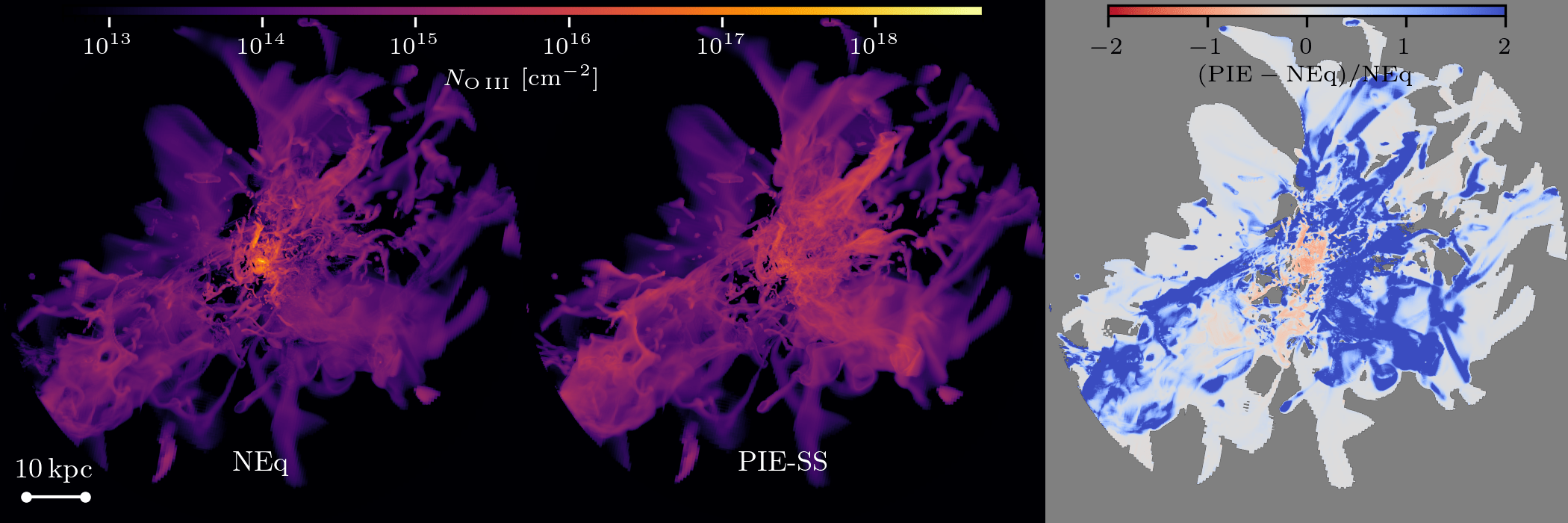
Relax to photo-ionisation equilibrium (PIE)
No local radiation field, no time-dependence, assume \(n_\mathrm{e}\) dominated by primordial species, self-shielding
\[ \frac{\mathrm{d}n_i}{\mathrm{d}t} = \textcolor{red}{n_{i+1}\alpha_{i+1}n_\mathrm{e}} + \left(\sum_k [ \textcolor{blue}{n_{i+1}\xi_{i+1}}+ \textcolor{green}{n_{i-1}\chi_{i-1}}]n_k\right)\! + n_{i-1}(\textcolor{purple}{\beta_{i-1}n_\mathrm{e}} + \textcolor{brown}{\Gamma_{i-1}})\\ \]
\[- \ \textcolor{red}{n_i \alpha_i n_\mathrm{e}} - \left(\sum_k[ \textcolor{blue}{n_i\xi_i} + \textcolor{green}{n_i\chi_i}]n_k\right) - n_i(\textcolor{purple}{\beta_i n_\mathrm{e}} + \textcolor{brown}{\Gamma_i})\]
\[0 = \textcolor{red}{n_{i+1}\alpha_{i+1}n_\mathrm{e}}+ n_{i-1}(\textcolor{purple}{\beta_{i-1}n_\mathrm{e}} + \textcolor{brown}{\Gamma_{i-1}})- \ \textcolor{red}{n_i \alpha_i n_\mathrm{e}} - n_i(\textcolor{purple}{\beta_i n_\mathrm{e}} + \textcolor{brown}{\Gamma_i}) \]
\(\Sigma \propto n\)
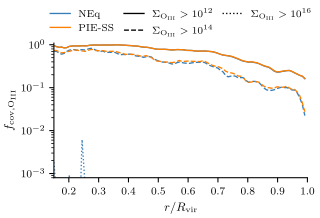
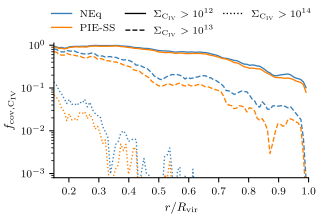
Covering fractions may vary overall
and within individual l.o.s.
OIII covering fraction
CIV
OVI
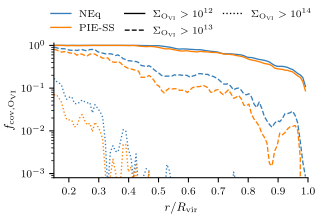
CGM in absorption: covering fractions
CGM in emission at \(z \approx 3-4\)
Is the CGM in equilibrium?
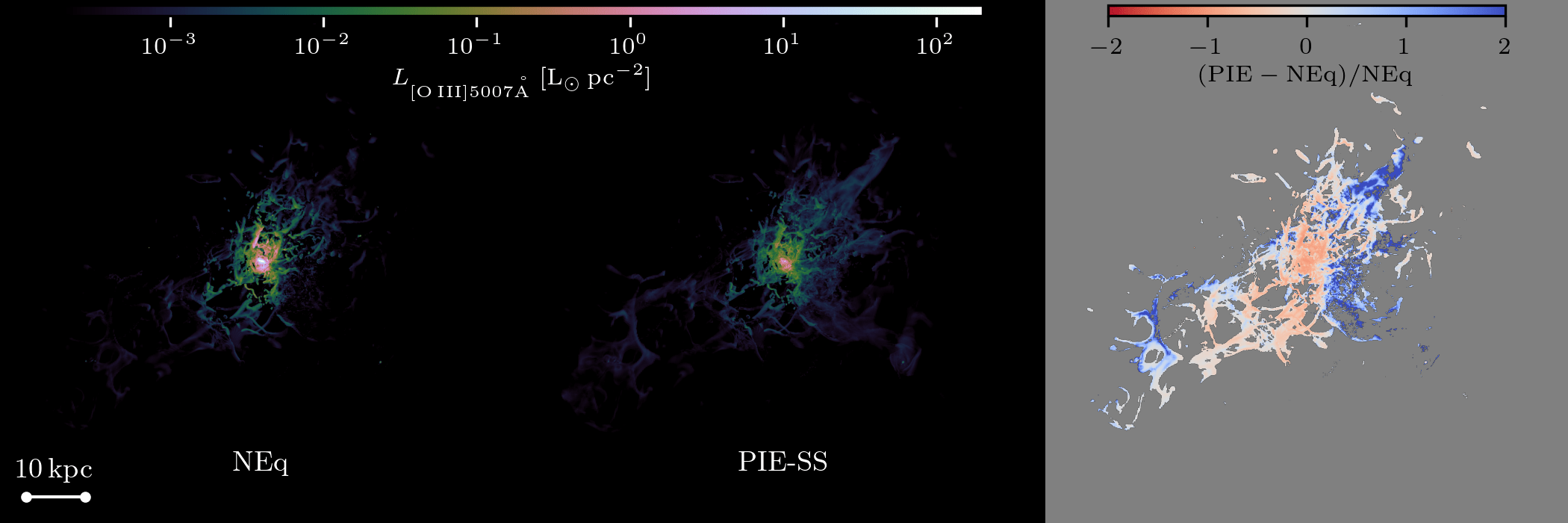
\(\Sigma \propto n\)
\(L \propto n^2\)
Emission lines most strongly affected in inner CGM
due to \(n^2\) effects
CGM in emission at \(z \approx 3-4\)
Is the CGM in equilibrium?
See as well Oppenheimer&Schaye'13 [but AGN-triggered]
CGM at \(z \approx 3-4\)
Is the CGM in equilibrium?
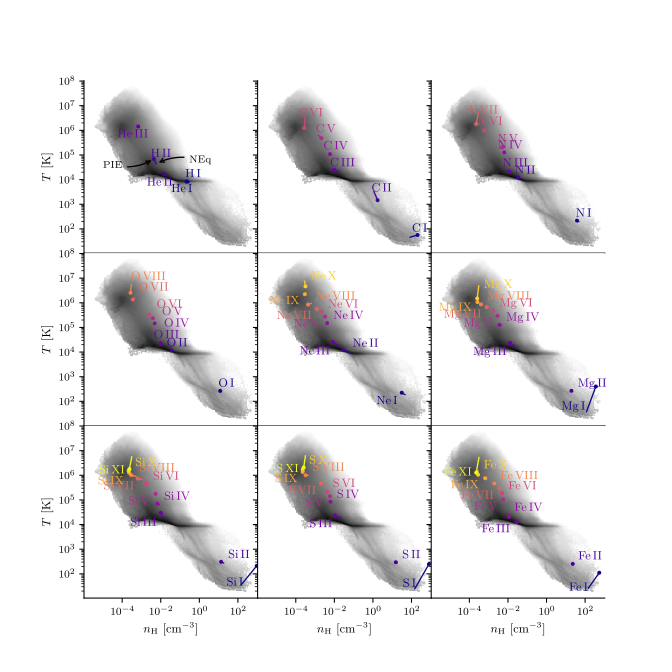
CGM at \(z \approx 3-4\)
Is the CGM in equilibrium?
NEq.
PIE
Assuming PIE ⇒ biased towards colder/denser gas
\(T\)
\(n_\mathrm{H}\)
CGM at \(z \approx 3-4\)
Is the CGM in equilibrium?
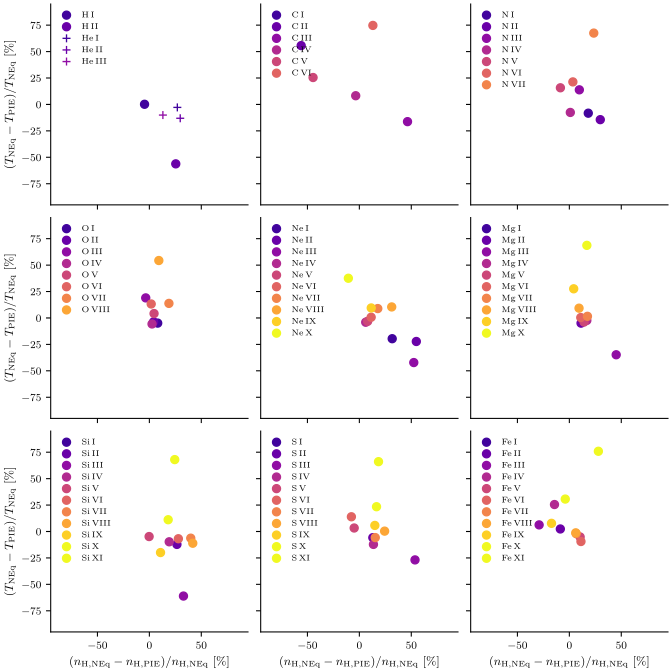
\(\pm0.5\,\mathrm{dex}\)
Non-equilibrium effects:
\(\Delta(T, n_\mathrm{H}) \sim 0.2-0.5\,\mathrm{dex}\)
⇒ \(\Delta L \sim 1\,\mathrm{dex}\)
for some lines
\(\pm0.5\,\mathrm{dex}\)
Non-equilibrium changes the inferred CGM
CGM at \(z \approx 3-4\)
CGM not in equilibrium
Why?
CGM at \(z \approx 3-4\)
CGM out of equilibrium: why?
40 kpc
- Local radiation dominate locally over UVB
Anisotropic effects
- Recombination lag
\(t_\mathrm{cool} \ll t_\mathrm{rec}\), worse with time

CGM at \(z \approx 3-4\)
CGM out of equilibrium: why?
- Local radiation dominate locally over UVB
Anisotropic effects
- Recombination lag
\(t_\mathrm{cool} \ll t_\mathrm{rec}\), worse at low \(z\)
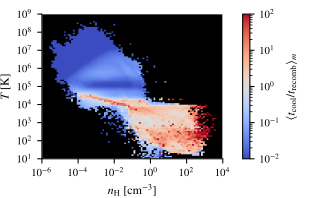
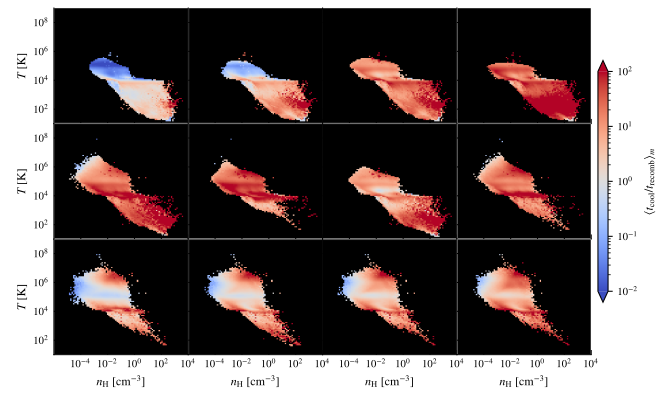
Recombination lag in the CGM
fast cooling,
slow recombination
⇒ recombination lag
slow cooling,
fast recombination
⇒ photo-ionizing eq.
\(t_\mathrm{cool} = \dfrac{nk_{\rm B}T}{\Lambda(T,n)}\)
\(t_\mathrm{rec} = \dfrac{1}{\alpha(T)n_e}\)
Recombination lag in the CGM
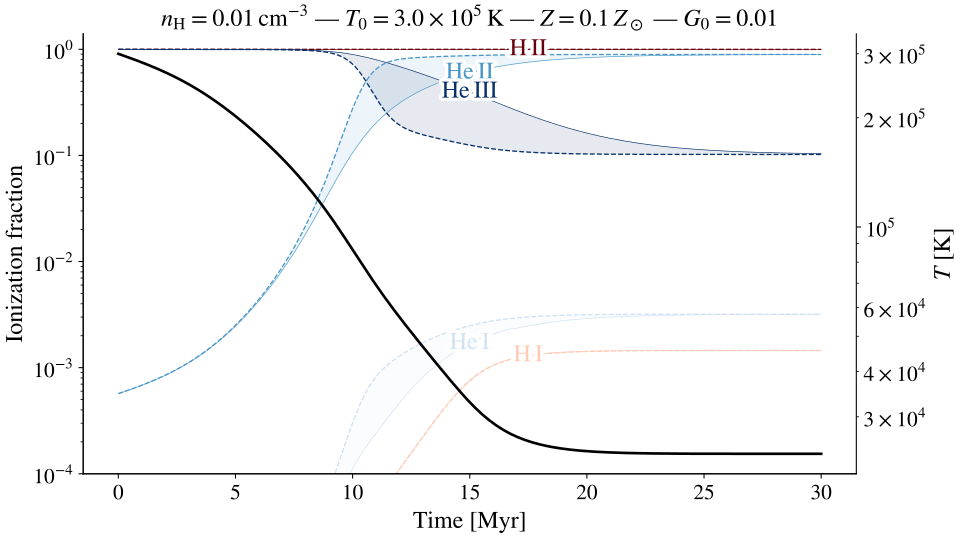
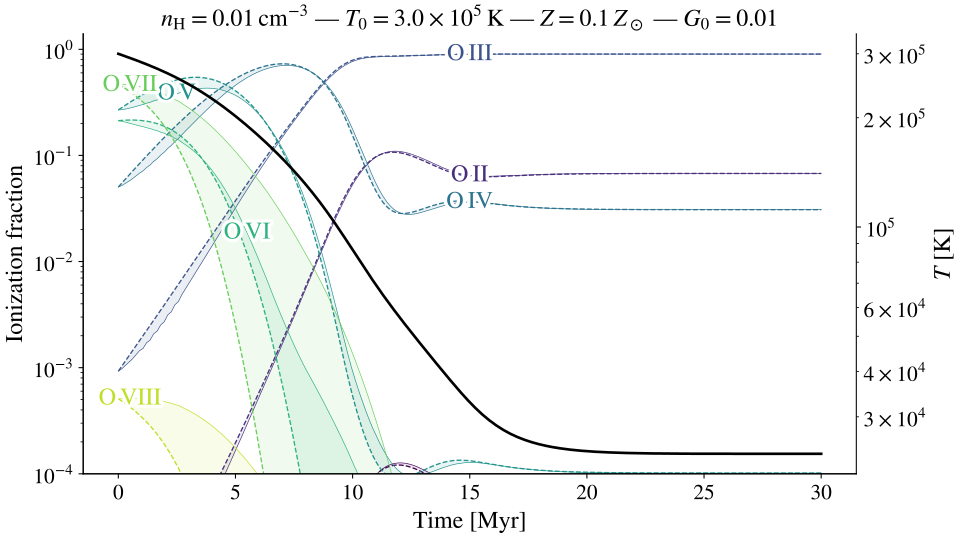
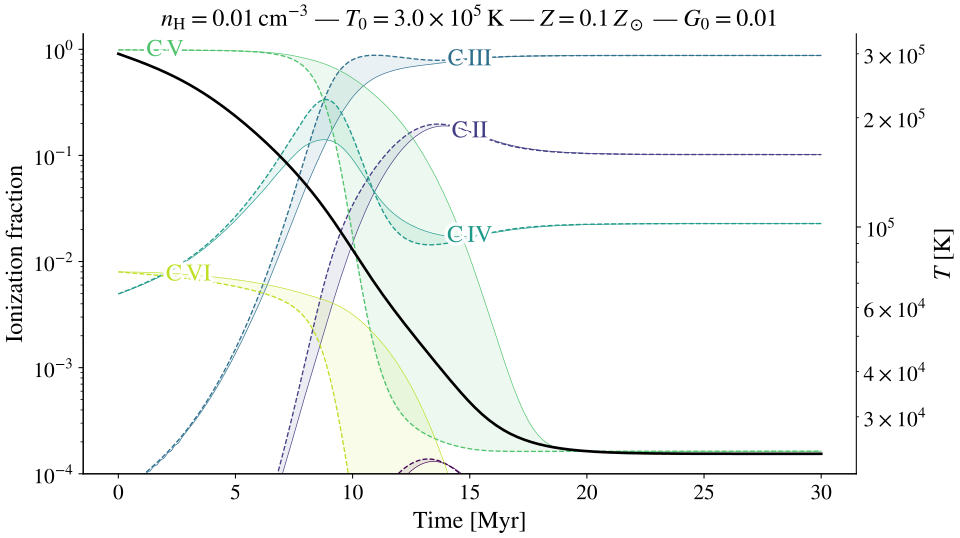
Assuming (PIE)
equilibrium
Non-equilibrium
integration
Isochoric setup, similar to Gnat&Sternberg'07
Recombination lag in the CGM
Recombination lags affect
different ions at different timescales.
Create two temperature “spikes”, isochoric setup
Take away from plot?
A simple \(\mathcal{M}\sim 3\) shock is enough to getting e.g. \(\mathrm{O\,VI}\)
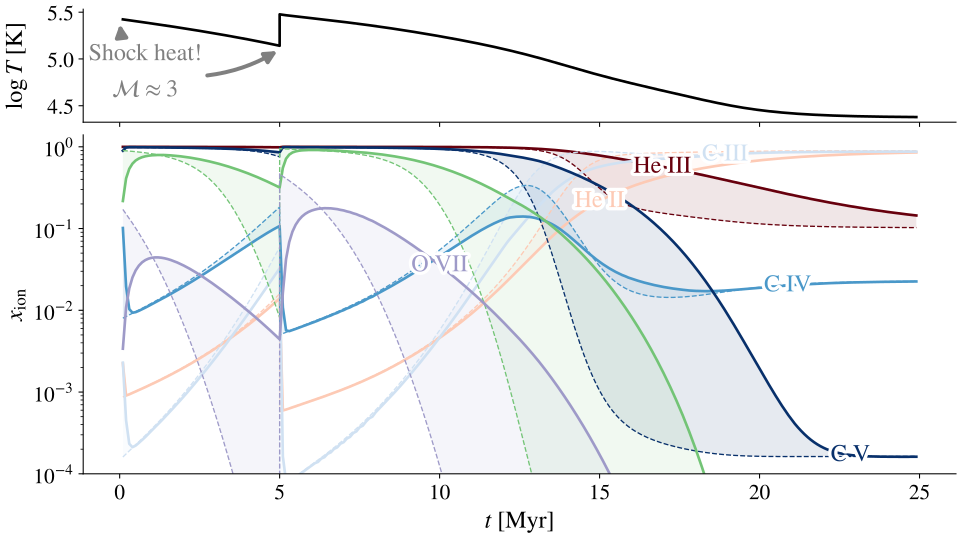
\(n_\mathrm{H}=0.01\,\mathrm{mp/cm^3}\)
\(Z=0.1\,Z_\odot\)
\(G_0 = 0.01\)
So the CGM is not in equilibrium
But are our predictions even converged? (no)
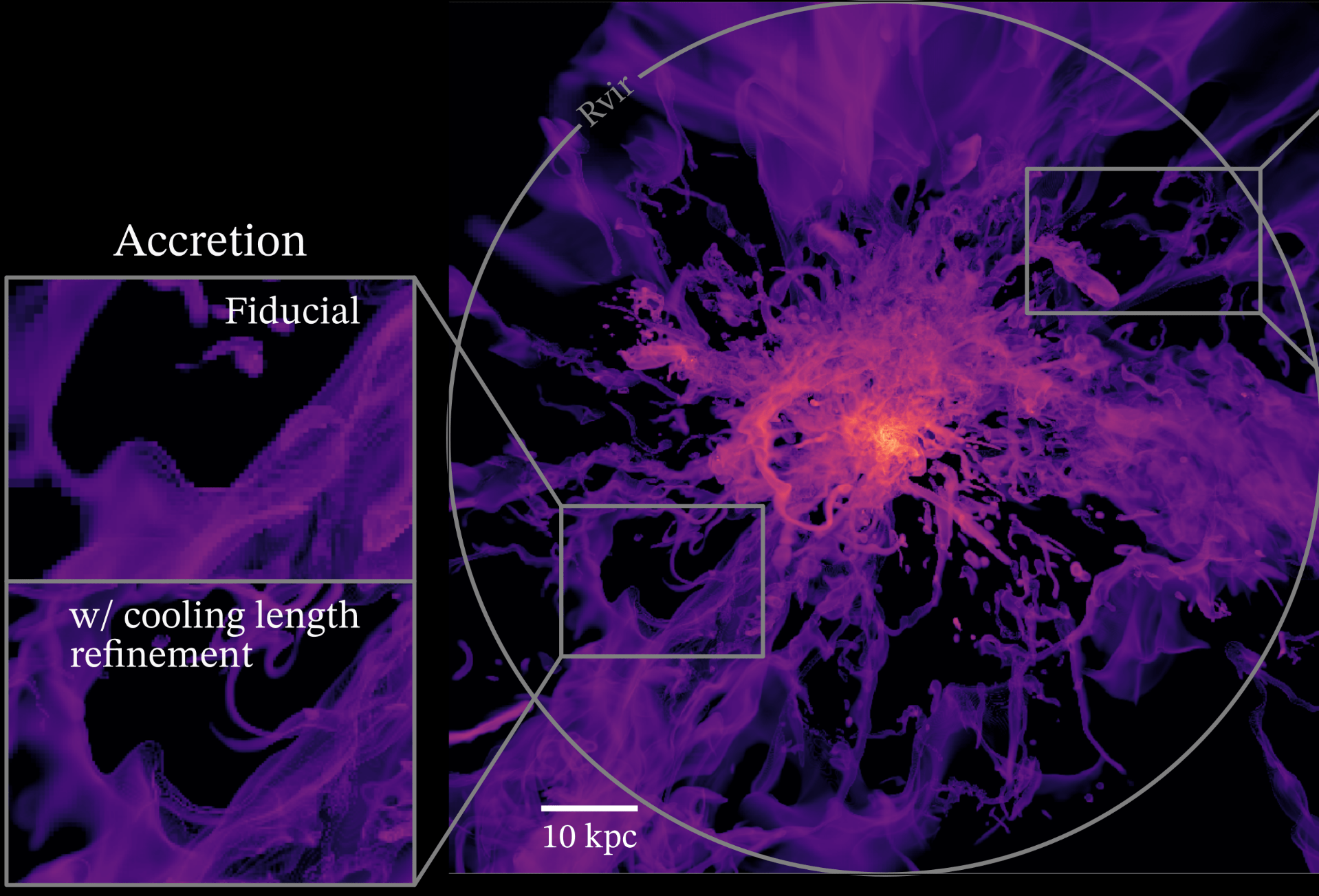
Cooling-length refinement
Refining at \(z=4\) where \( \Delta x > 2 \sqrt{\dfrac{P_\mathrm{th}}{\rho}}\times {t_\mathrm{cool}},\) (Rey+23)
best resolution…
- \(80\,\mathrm{pc}\) for \(200\,\mathrm{Myr}\)
- \(40\,\mathrm{pc}\) for \(100\,\mathrm{Myr}\)
- \(20\,\mathrm{pc}\) for \(20\,\mathrm{Myr}\)
\(\mathrm{H\alpha}\)
Cooling-length refinement
\(\mathrm{[C\,IV]}\lambda1548\mathrm{Å}\)
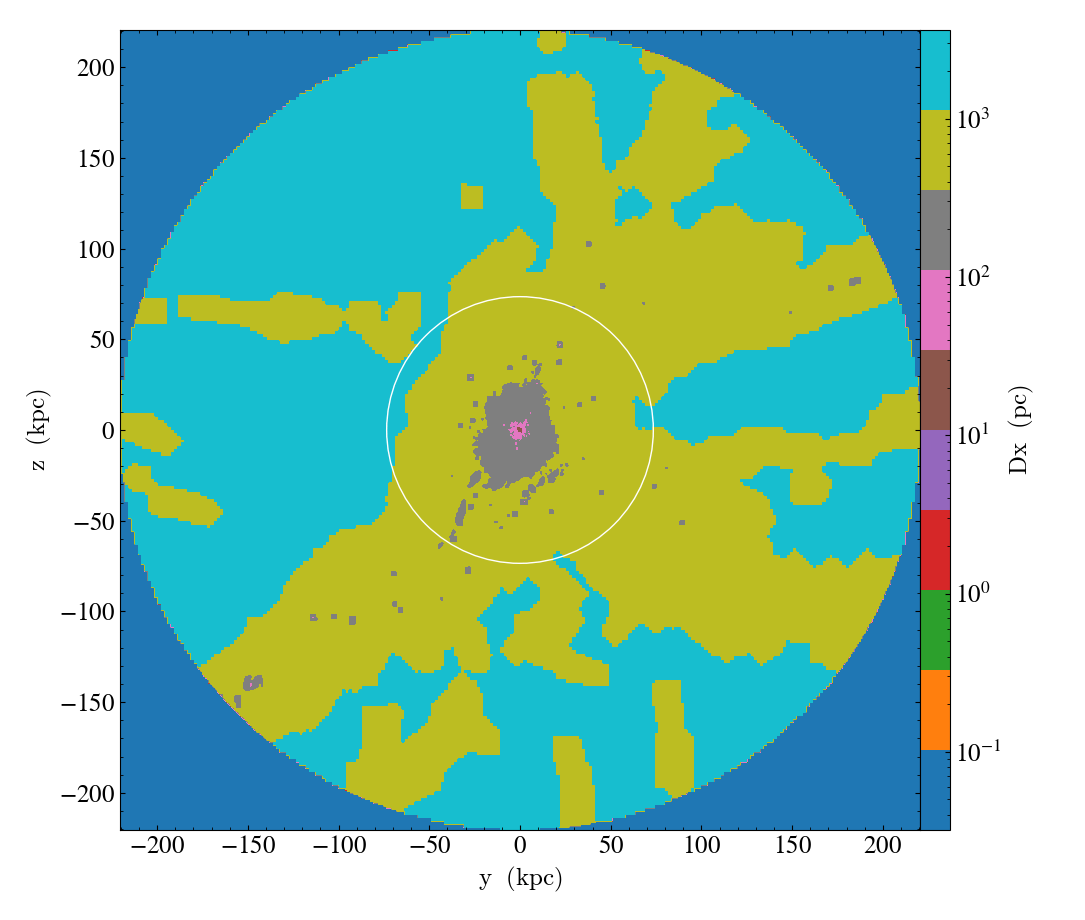
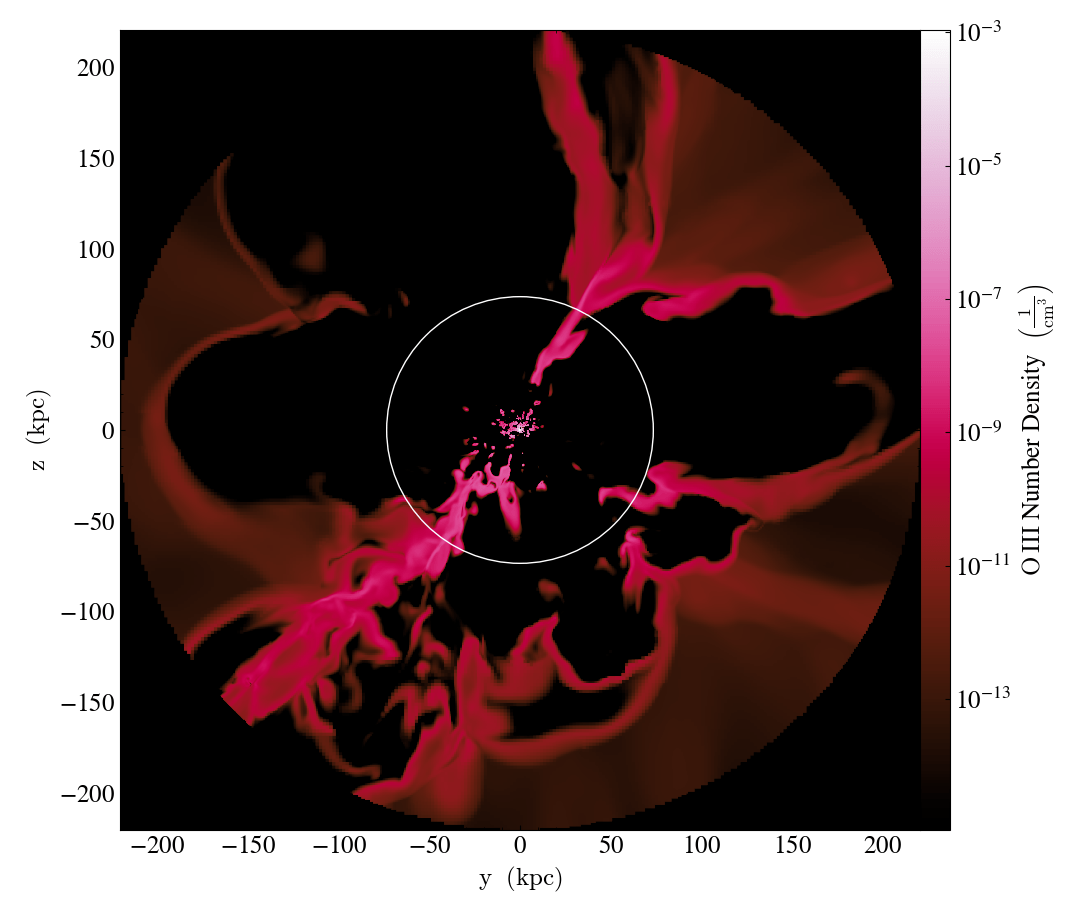
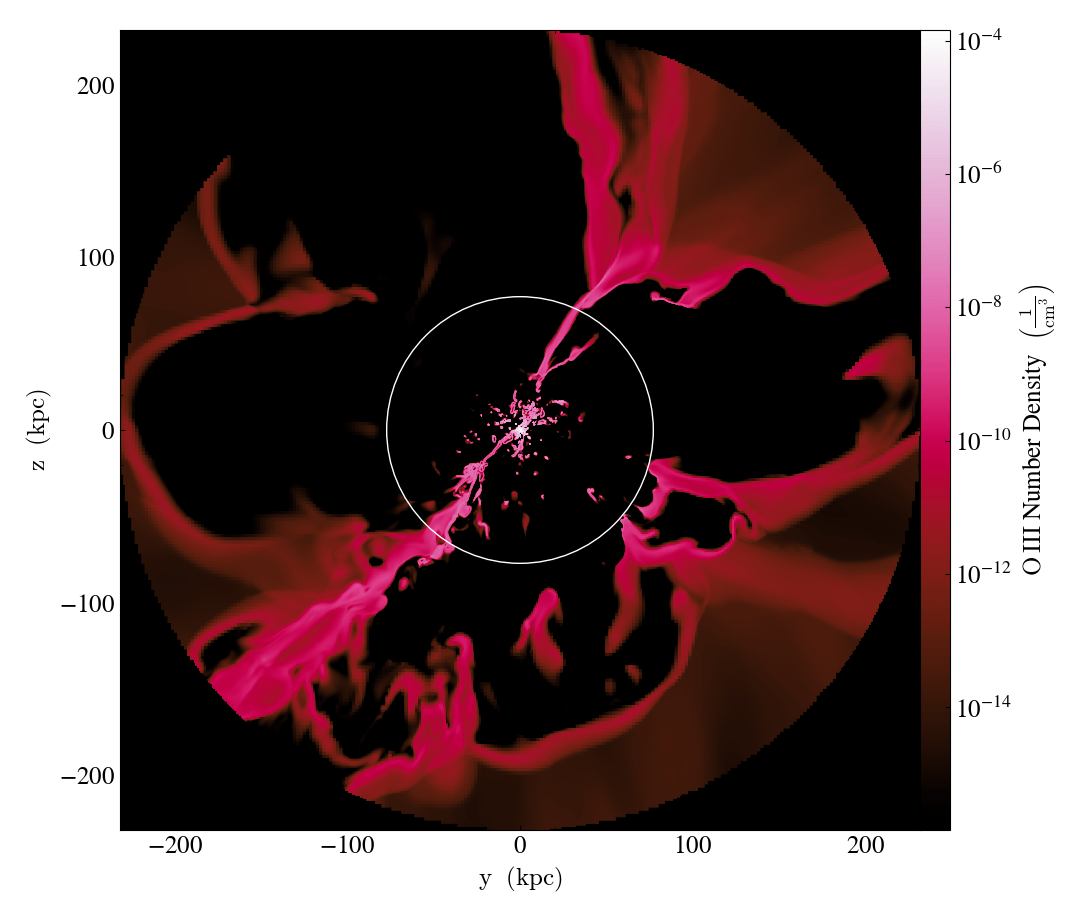
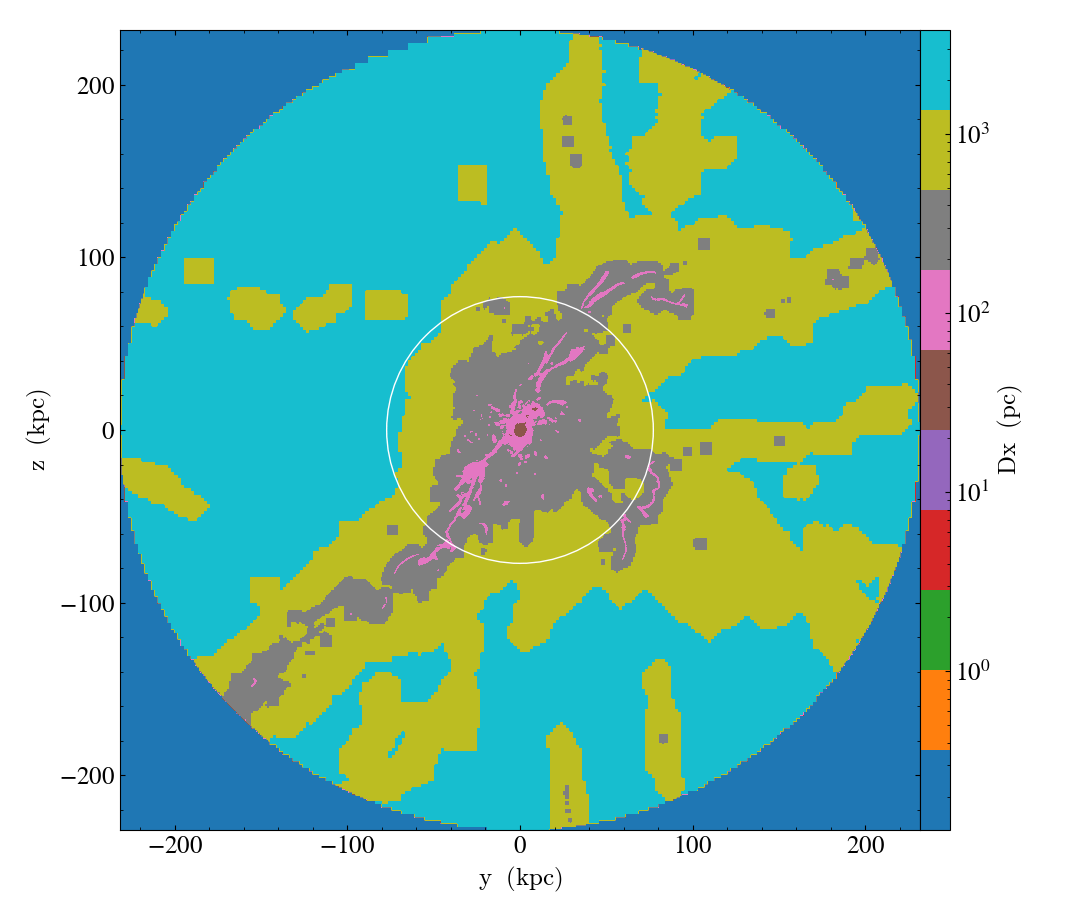
Cooling-length refinement
\(\Sigma\)OIII


Resolving the multiphase CGM
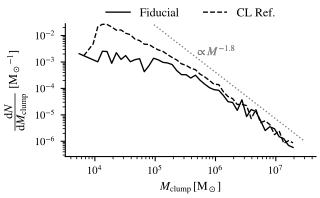
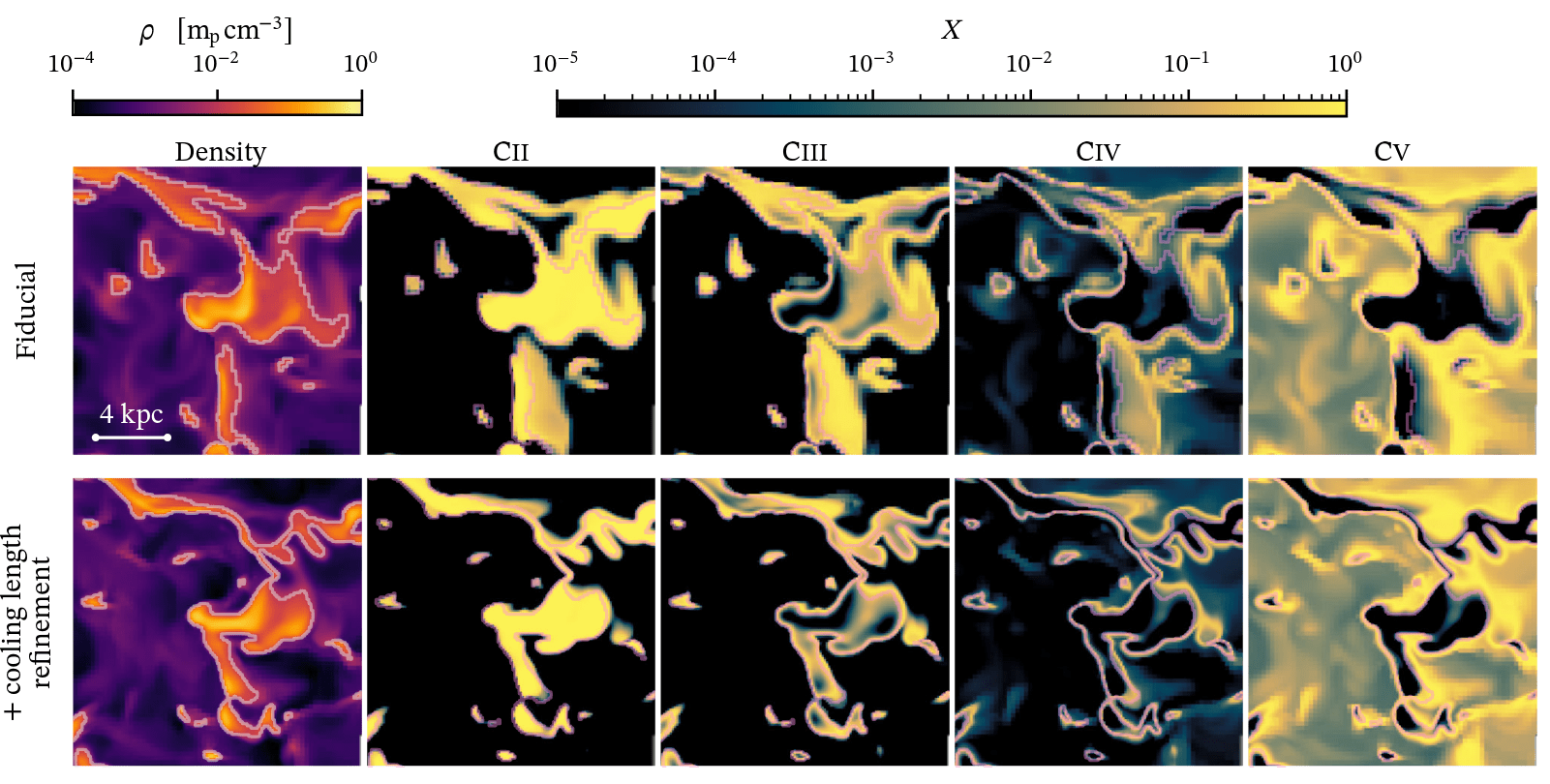
CGM clumps: are we converged?
Clump mass function? Not converged!
Clump structure? Not converged either
See e.g. Corlies+20 · Schimek+24 · Ramesh+25
CGM clumps: are we converged?
Take-home messages
Megatron · CGM of a Milky-Way progenitor at \(z\approx3\text{–}4\)
- The CGM remembers its thermochemical history
Local radiation + recombination lag ⇒ equilibrium assumptions can bias CGM interpretation. - Ion abundances and observables respond differently
Selected ions: \(0.2\text{–}0.5\,\mathrm{dex}\) shifts in characteristic \(T,n_\mathrm{H}\).
Changes reach \(\sim1\,\mathrm{dex}\) in luminosity for some lines; emission weights dense gas more strongly. - CGM structure is still not converged
Cooling-length refinement reveals smaller clumps.
Both the clump mass function and internal structure continue to change.
Time-dependent microphysics + resolved multiphase gas
⇒ towards robust CGM predictions.
Paper splash: Rey+26 | Katz+26 | Cadiou+26 | Choustikov+26 | Storck+26
Also, I will soon announce
- 3-yr postdoc (w/ H. Katz, UChicago),
- 3-yr PhD,
to develop RTZ/Dyablo & CGM science.
Contact me if you're interested/know good students!
Take-home messages
- Megatron simulation suite
200,000+ spectra in 4 “ISM” runs (\(z\gtrapprox 8\)) ⇒ Katz, CC+25
3+1 “CGM” runs (\(z\gtrapprox 3.5\)) ⇒ CC+25
Link to low-\(z\) UFDs ⇒ Rey, ..., CC+25
Properties of Pop. III stars ⇒ Storck, ..., CC+25
Sensitivity of line diagnostics to subgrids ⇒ Choustikov, ..., CC+25
Origin of steep \(\beta\) slopes ⇒ Katz, CC+ (in prep)
- CGM (incl. inner CGM!) is out-of-equilibrium
Assuming PIE leads to 0.5 dex (median), and factors of
2-3× on individual line of sight
- Data release ⇒ CC+ (in prep)
✔ Pre-computed spectra, halo catalogues, cut-outs
✔-ish data viewer + 3D viewer
🚧 JWST images, ALMA Cubes, RASCAS post-processing (\(f_\mathrm{esc}\), \(L_\mathrm{Mg\,II}\), ...)