Nash Equilibrium
Christopher Makler
Stanford University Department of Economics
Econ 51: Lecture 9
-
Part I: Pure strategies with discrete actions
-
Part II: Pure strategies with continuous actions
-
Part III: Mixed strategies
Today's Agenda
Best Response: From Last Time
In plain English: given my beliefs about what the other player(s) are doing, a strategy is my "best response"
if there is no other strategy available to me
that would give me a higher payoff.
Best Response under Strategic Certainty
In plain English: given the strategies chosen by the other player(s),
a strategy is my "best response"
if there is no other strategy available to me
that would give me a higher payoff.
Possible rationales for strategic certainty:
- People play this game all the time, and reasonably expect
the other player to play according to the equilibrium. - The players have agreed on a strategy before the game is played;
as long as no one has an incentive to deviate, it's OK. - An outside mediator (society, the law) recommends a strategy profile
Stag Hunt Game
1
2
Stag
Hare
Stag
Hare
5
5
,
4
0
,
4
4
,
0
4
,
Equilibrium
Definition: Best Response (Nash) Equilibrium
In plain English: in a Nash Equilibrium, every player is playing a best response to the strategies played by the other players.
In other words: there is no profitable unilateral deviation
given the other players' equilibrium strategies.
I. Discrete Pure Strategies
1
2
1
2
,
4
3
,
1
4
,
1
1
,
T
M
L
C
B
R
3
0
,
2
1
,
3
2
,
8
0
,
8
0
,
Nash equilibrium occurs when every player is choosing strategy which is a
best response to the strategies chosen by the other player(s)
1
2
1
2
,
4
3
,
1
4
,
1
1
,
T
M
L
C
B
R
3
0
,
2
1
,
3
2
,
8
0
,
8
0
,
Nash equilibrium occurs when every player is choosing strategy which is a
best response to the strategies chosen by the other player(s)
Because B is a best response to C,
and C is a Best response to B,
the strategy profile (B,C)
is a Nash Equilibrium.
IMPORTANT: THE NASH EQUILIBRIUM IS THE STRATEGY PROFILE (B,C), NOT THE PAYOFFS (2,1)!
II. Continuous Strategies
What is firm 2's best response function?
2
P
"Firm 2's Residual Demand Curve"
Firm 2's "best response function"
Cournot Model:
Both firms choose simultaneously and independently
Firm 1's
best response function
Firm 2's
best response function
In equilibrium, each firm's quantity is a best response to the other firm's quantity; so neither has an incentive to unilaterally deviate from their equilibrium quantity.
Cournot (Nash) equilibrium: \(q_1^* = q_2^* = 4\)

Multiple Equilibria
A Simple Coordination Game
1
2
L
R
1
1
,
0
0
,
1
1
,
0
0
,
L
R
Pareto Coordination
1
2
A
B
A
B
2
2
,
0
0
,
1
1
,
0
0
,
pollev.com/chrismakler

Stag Hunt Game
-
Proposed by philosopher Jean-Jacques Rousseau in his Discourse on Inequality (1755)
-
Two hunters independently choose whether to hunt a stag or a hare.
-
A player who chooses to hunt a hare always gets a payoff of 4 regardless of the other player's choice.
-
A stag hunt only succeeds if both players do it.
In that case, the players divide the stag, giving a payoff of 5 to each. -
But if only one player hunts a stag, he fails and gets a payoff of zero.
1
2
Stag
Hare
Stag
Hare
5
5
,
4
0
,
4
4
,
0
4
,
Stag Hunt Game
1
2
Stag
Hare
Stag
Hare
5
5
,
4
0
,
4
4
,
0
4
,
pollev.com/chrismakler
Suppose your payoff is the expected value if you were to play against a random person in the class. Which would you choose?
Conflict!
1
2
A
B
2
1
,
0
0
,
1
2
,
0
0
,
pollev.com/chrismakler
A
B
Where to Apply
1
2
A
B
4
4
,
10
8
,
5
5
,
8
10
,
A
B
- Players: two Stanford students applying to summer internships, at Accenture (A) and Bain (B)
- Each internship will hire at most one Stanford student
- Accenture pays $8K;
- Bain pays $10K
- If they apply to different internships, they're both hired
- If they apply to the same internship, they're each hired with probability \({1 \over 2}\)
Mixed Strategies
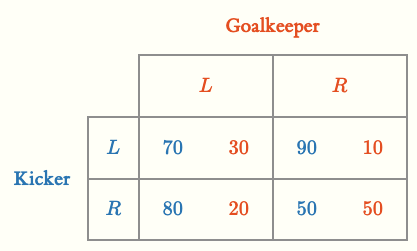
Beliefs for Kicker:
probability distribution
over {Defend Left, Defend Right}
Suppose the kicker believed there was a 50% chance the keeper chooses Defend Left.
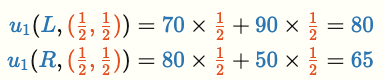
What is her best response?
Kick Left (because 80 > 65)
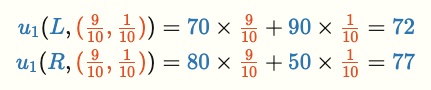
What if she believed there was a 90% chance the keeper chooses Defend Left.
What is her best response?
Kick Right (because 80 > 65)
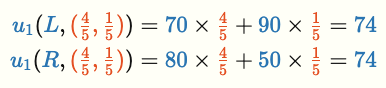
What if she believes that there is an 80% chance the keeper chooses Defend Left?
What is her best response?
Either one!
Suppose the kicker believed there was a 50% chance the keeper chooses Defend Left.
What is her best response?
Kick Left (because 80 > 65)
What if she believed there was a 90% chance the keeper chooses Defend Left.
What is her best response?
Kick Right (because 80 > 65)
What if she believes that there is an 80% chance the keeper chooses Defend Left?
What is her best response?
Either one!
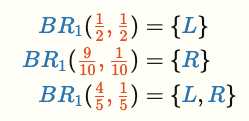
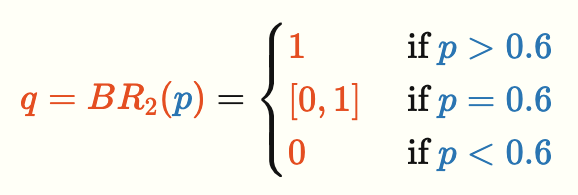
The best response to a belief is the set of strategies
which yield the highest payoffs, given those beliefs.
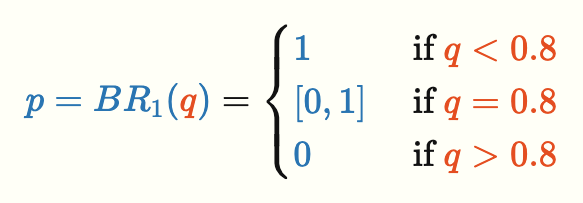
If the keeper is playing the mixed strategy
(defend left with probability \(q\))
Suppose we think of the kicker's strategy as
(kick left with probability \(p\))
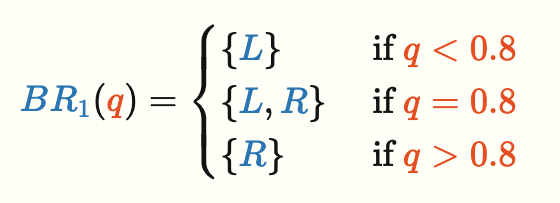
The best response of the kicker is
We can write their best response strategy as
pollev.com/chrismakler
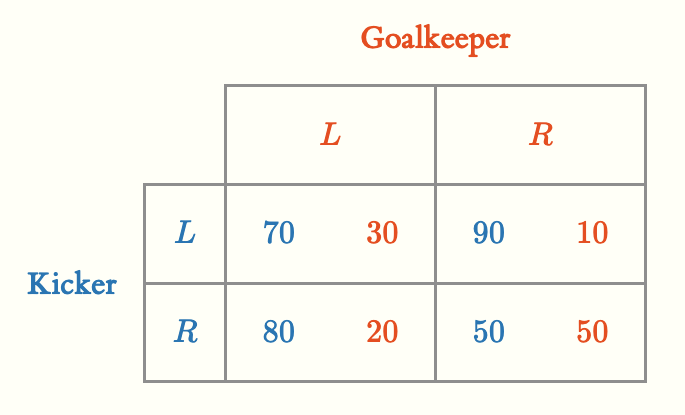
With what probability \(p\) would the kicker have to choose \(L\)
for the goalkeeper to play
a mixed strategy?
Games with Both Pure and Mixed Strategy Equilibria
Where to Apply
1
2
A
B
4
4
,
10
8
,
5
5
,
8
10
,
A
B
Suppose the other player is applying to A with probability \(p\). For what value of \(p\) would you be indifferent between applying to the two firms? That is, for what value of \(p\) would you be willing to play a mixed strategy?
pollev.com/chrismakler