

Product Definitions
OTC Documentation & Confirmation


Learning Outcome
5
Understand their role in OTC documentation.
4
Match products with financial risks.
3
Compare their purpose and features.
2
Explain exchanges and settlements.
1
Define four common OTC derivatives.
FX Forward
An FX Forward is a contract between two parties to buy or sell one currency against another at a pre-agreed rate, on a specific future date. On that date, both currencies are physically exchanged.

Example: An Indian company has to pay USD 1 million to a US supplier after 3 months. To avoid the risk of the rupee weakening, it enters into an FX Forward with a bank and agrees to buy USD at ₹84 per USD after 3 months, regardless of the market exchange rate on that day.
Interest Rate Swap (IRS)
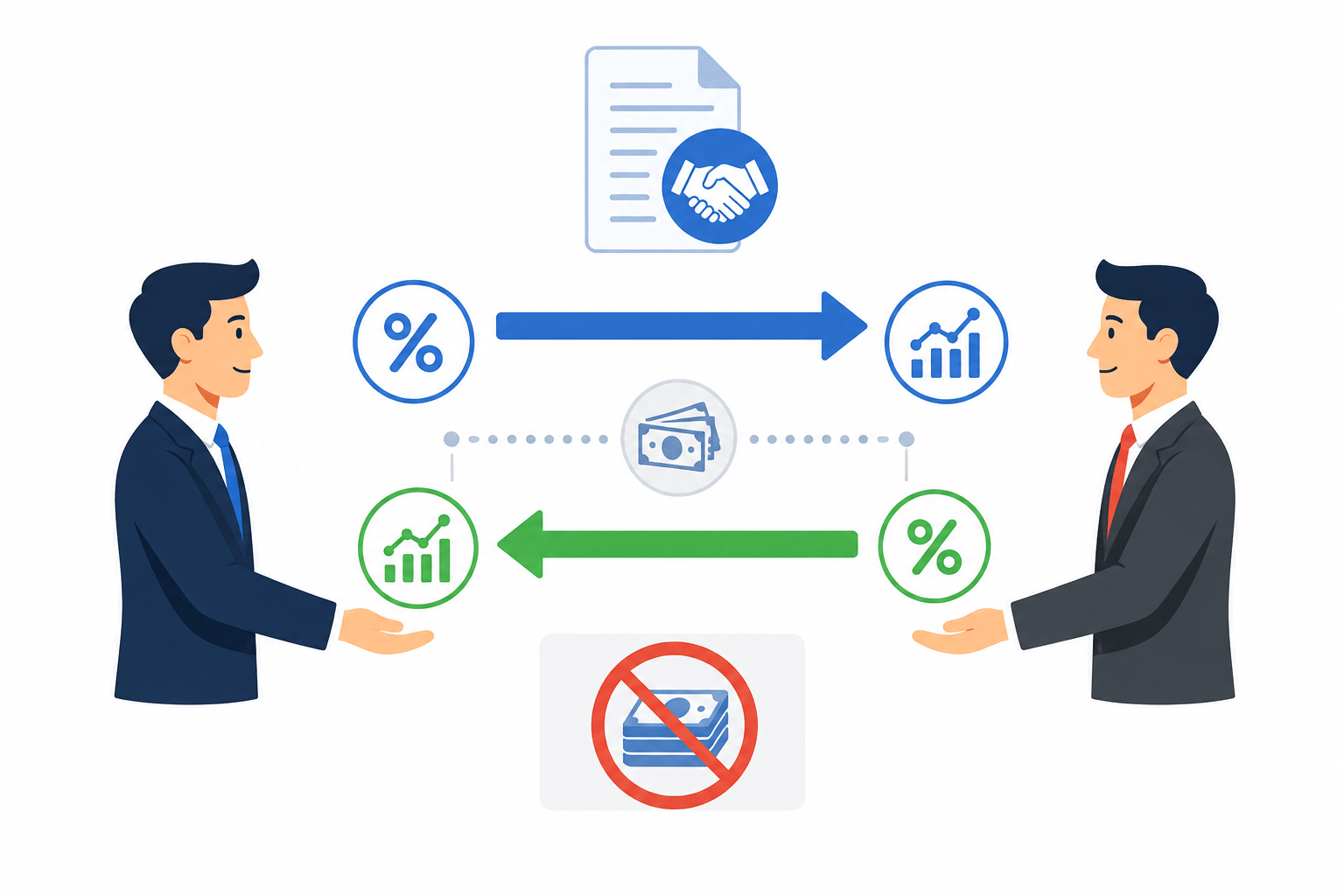
An Interest Rate Swap is a contract where two parties exchange interest payments on the same notional principal — typically one pays a Fixed rate and the other pays a Floating rate linked to a benchmark (e.g., MIBOR, SOFR). No principal changes hands.
Example: Company A has a ₹100 crore loan with a floating interest rate, but wants predictable payments. It enters into an Interest Rate Swap with a bank, where it pays a fixed interest rate and receives a floating rate. The loan principal is not exchanged—only the interest payments are.
Currency Swap

A Currency Swap is a contract where two parties exchange principal amounts in different currencies at the start, pay each other interest in their respective currencies during the life of the swap, and then re-exchange the original principal at maturity.
Example: An Indian company needs USD for its US operations, while a US company needs INR for its business in India. They enter into a Currency Swap, exchanging the principal amounts at the start, paying interest in the borrowed currencies during the swap, and exchanging the original principal back at maturity.
Credit Default Swap (CDS)

A Credit Default Swap is a contract where a Protection Buyer pays a regular premium (the CDS spread) to a Protection Seller. If a defined Credit Event occurs — such as default or bankruptcy of a Reference Entity — the seller compensates the buyer for the loss.
Example: A bank owns ₹500 crore worth of corporate bonds and wants protection against the issuer defaulting. It buys a Credit Default Swap (CDS) from another financial institution by paying a regular premium. If the bond issuer defaults, the CDS seller compensates the bank for the agreed loss.
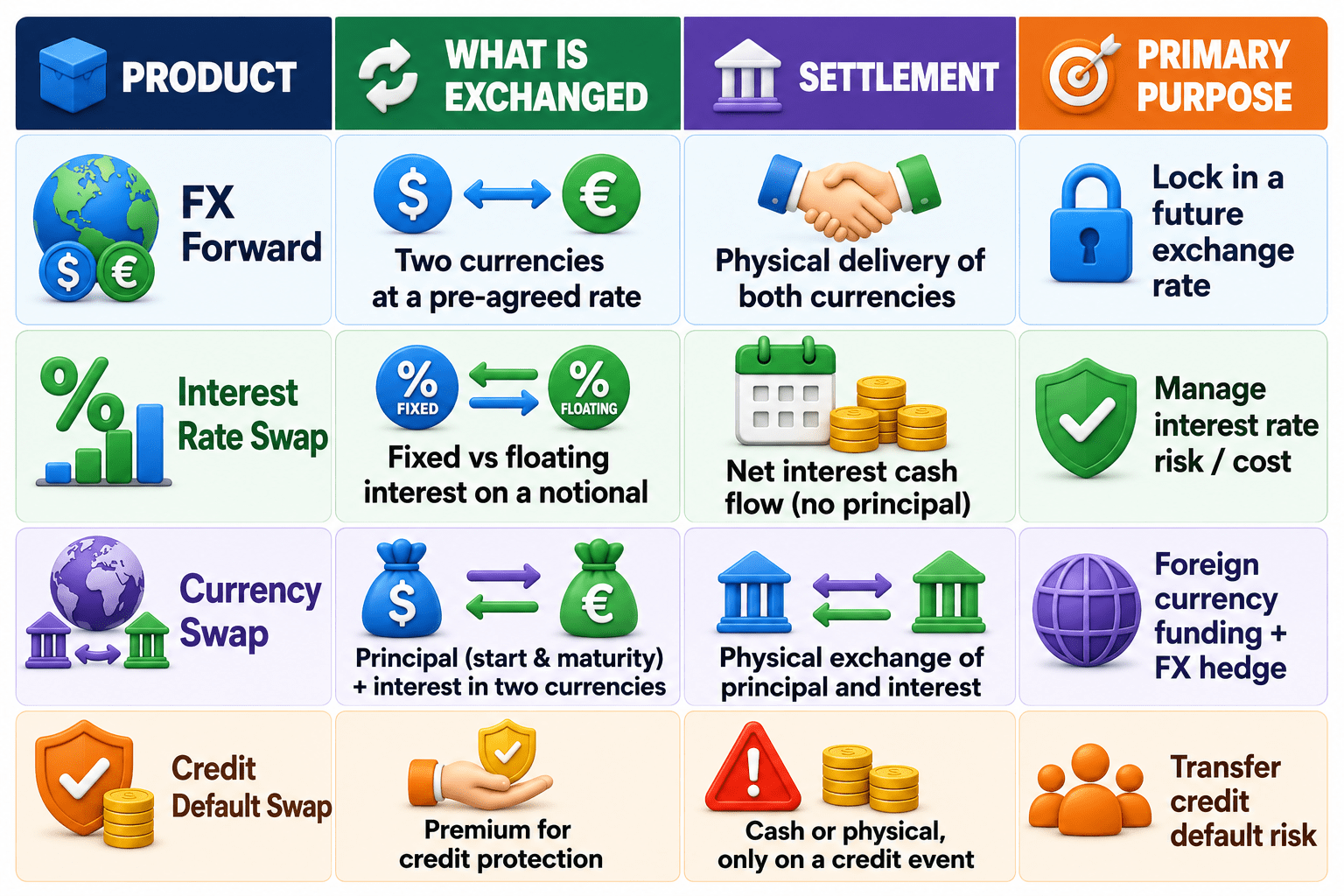
At a Glance — Comparing the Four Products
Summary
5
CDS transfers credit default risk.
4
Currency Swap exchanges principal and interest.
3
IRS exchanges fixed and floating interest.
2
FX Forward locks a future exchange rate.
1
OTC documentation starts with product understanding.
Quiz
Which OTC product is primarily used to lock in a future exchange rate?
A. Interest Rate Swap
B. Currency Swap
C. FX Forward
D. Credit Default Swap

Quiz-Answer
Which OTC product is primarily used to lock in a future exchange rate?
A. Interest Rate Swap
B. Currency Swap
C. FX Forward
D. Credit Default Swap