Mutual Fund Structure


Open ended vs Close ended funds


Learning Outcome
5
Explore Indian mutual fund examples.
4
Identify suitable fund types for investors.
3
Understand NAV and price differences in close-ended funds.
2
Learn how units are issued and redeemed.
1
Understand open-ended and close-ended funds.
Before we go further, here is what you have already covered that connects directly to this topic:

AMC (Asset Management Company)
is the company that manages the fund — decides what to invest in and is responsible for the fund's performance.
NAV (Net Asset Value) is the per-unit value of a mutual fund. Investors buy and redeem units at the fund's NAV.
Mutual funds are broadly categorised into Equity, Debt, and Hybrid funds based on what they invest in. But each of these can be further structured as open-ended or close-ended — and that is what this module is about.

Open-Ended Fund = Monthly gym membership.
You can join any day. You can cancel any day. The gym does not close. Your fee reflects the current membership rate. There is no commitment — you are always free to walk in or walk out.
Close-Ended Fund = Annual fitness programme.
You pay upfront to join a specific batch. The batch has a fixed start and end date. You cannot join mid-way, and you cannot leave before the programme ends (though you might find someone to take over your spot). At the end of the programme, it concludes for everyone.
Think of it as the difference between two types of memberships at a gym:
Inshort:
1.Monthly gym = Open-Ended Fund
Join any day, leave any day, priced daily at NAV.
2.Annual fitness programme = Close-Ended Fund
Fixed entry window (NFO), fixed end date (maturity), secondary exit only.
What are Open ended funds?
An open-ended fund has no expiry date and no limit on the number of investors. It is the most common type of mutual fund in India — when someone talks about a SIP in an equity fund or a liquid fund for parking cash, they are almost always talking about an open-ended fund.
Here is how it works in simple steps:
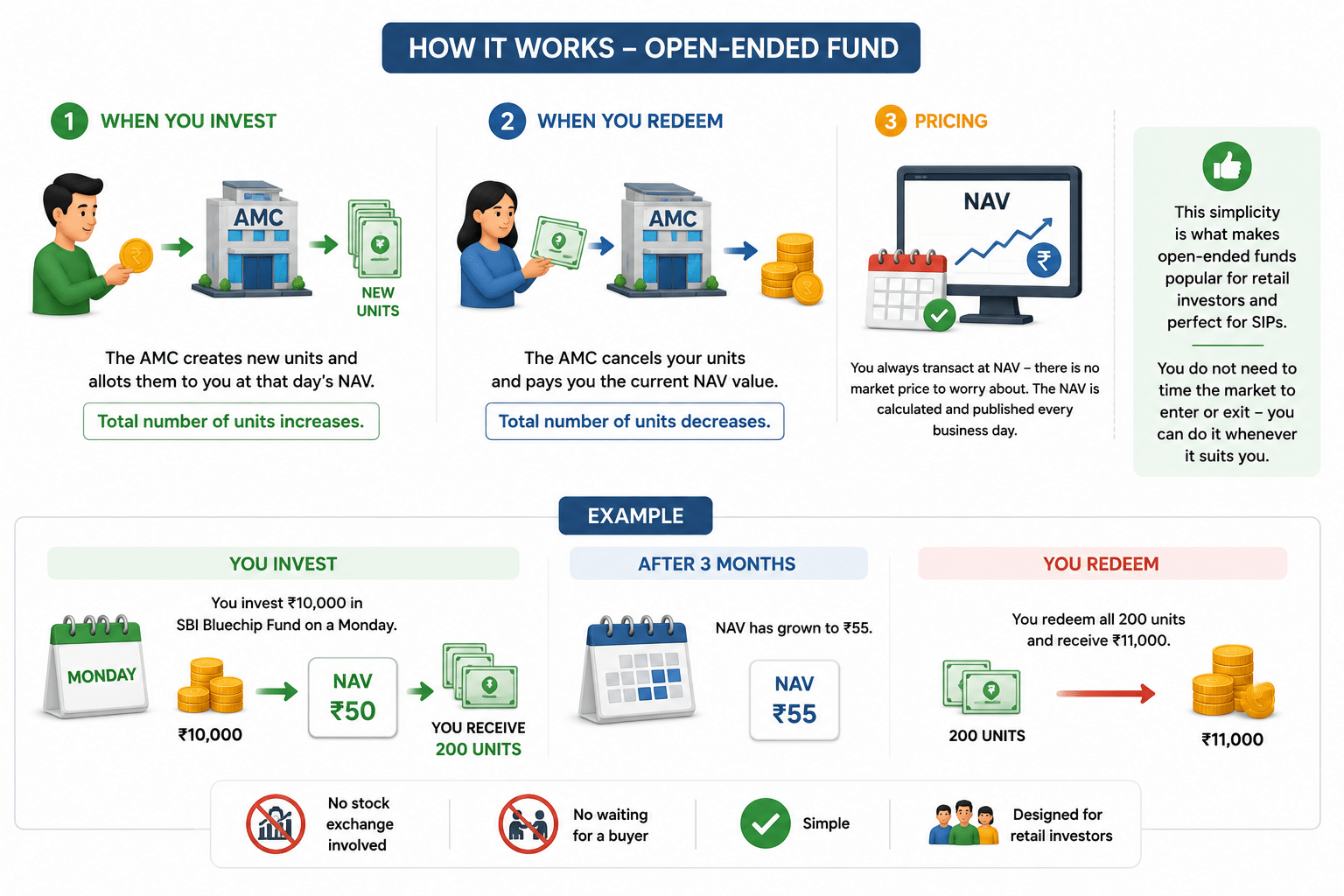
When you invest: The AMC creates new units and allots them to you at that day's NAV. The total number of units in the fund increases.
When you redeem: The AMC cancels your units and pays you the current NAV value. The total number of units decreases.
Pricing: You always transact at NAV — there is no market price to worry about. The NAV is calculated and published every business day.
This simplicity is what makes open-ended funds popular for retail investors and perfect for SIPs. You do not need to time the market to enter or exit — you can do it whenever it suits you.
Example:
You invest ₹10,000 in SBI Bluechip Fund on a Monday. NAV that day is ₹50. You receive 200 units.
Three months later, NAV has grown to ₹55. You redeem all 200 units and receive ₹11,000.
No stock exchange involved. No waiting for a buyer. Simple.
What are Closed ended funds?
A close-ended fund has a fixed maturity date and a fixed number of units. It opens for investment only once — during the NFO (New Fund Offer) period — and then it closes. You cannot invest more, and you cannot redeem directly with the AMC until the fund matures.
Here is how it works in simple steps:
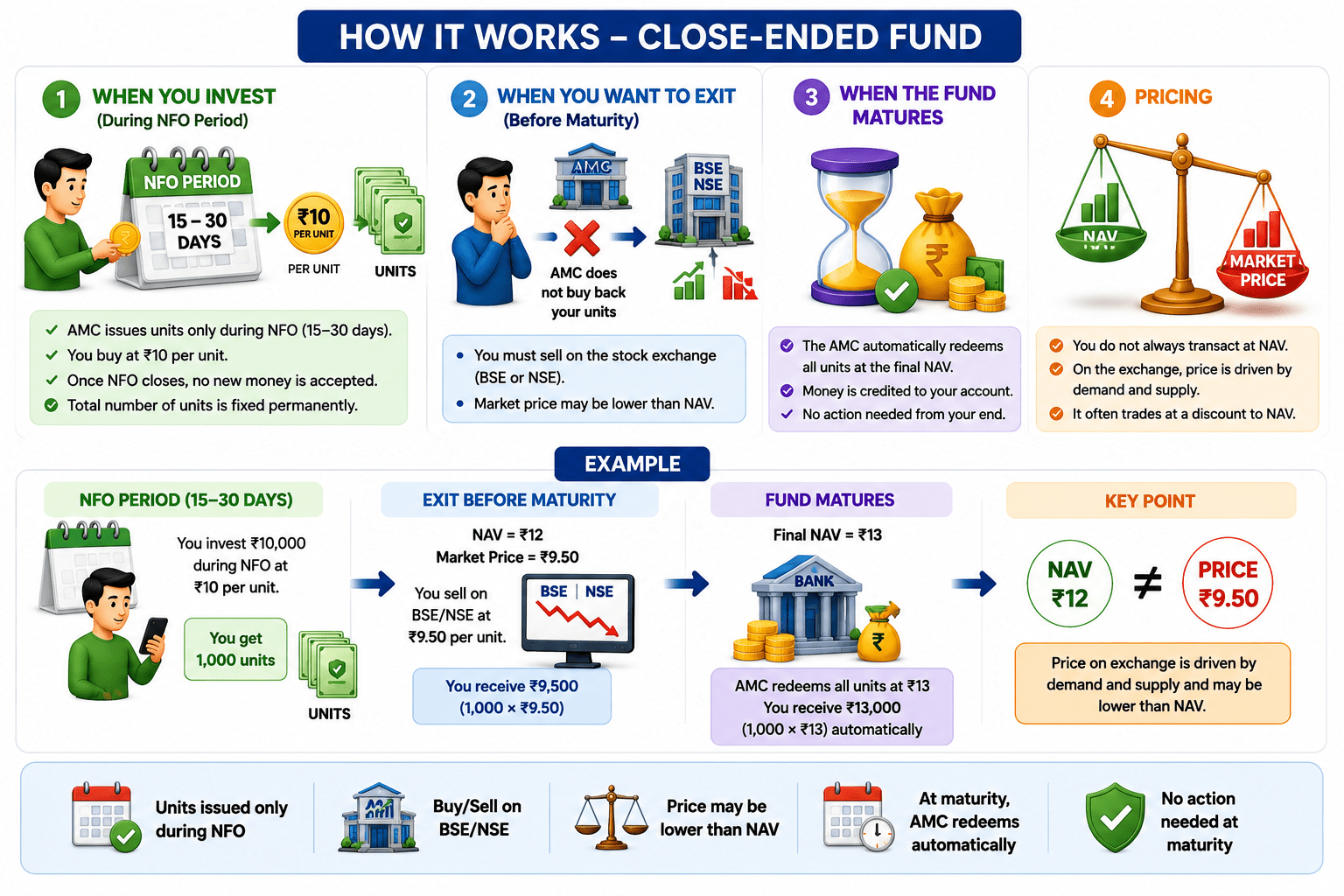
When you invest: The AMC issues units only during the NFO period — typically 15 to 30 days. You buy at ₹10 per unit. Once the NFO closes, no new money is accepted. The total number of units is fixed permanently.
When you want to exit before maturity: The AMC does not buy back your units. You must sell them on the stock exchange (BSE or NSE) at the market price — which may be lower than the actual NAV.
When the fund matures: The AMC automatically redeems all units at the final NAV and credits the money to your account. No action needed from your end.
Pricing: You do not always transact at NAV. On the exchange, price is driven by demand and supply — and it often trades at a discount to NAV.
Example: You invest ₹10,000 in SBI Debt Fund Series (FMP) during its NFO. NAV is ₹10. You receive 1,000 units. Three years later, NAV has grown to ₹13.20. The AMC automatically redeems all 1,000 units and credits ₹13,200 to your account. No stock exchange involved. No waiting for a buyer. Simply hold to maturity.
No stock exchange needed — if you hold to maturity. But if you exit early, you depend on the exchange, wait for a buyer, and may get less than your NAV. Not simple.
NFO — New Fund Offer
-
An NFO is the first time a mutual fund scheme is open for public subscription similar to an IPO for stocks.
-
NFO price is typically ₹10 per unit for a new scheme.
-
For open-ended funds, the NFO is just the launch window — units can be bought later at prevailing NAV.
-
For close-ended funds, the NFO is the only direct entry point — after NFO closure, investors must go to the exchange.
- SEBI requires NFOs to collect a minimum corpus before the fund can be launched and activated.
NAV vs Market Price — A Critical Difference
|
Open-Ended Fund: Transaction always at NAV. If NAV = ₹45.00, you buy/sell at ₹45.00.
Close-Ended Fund: Trades at market price on the exchange. • If NAV = ₹45.00 but market price = ₹42.00 → Trading at a DISCOUNT (investor loses value on exit) • If NAV = ₹45.00 but market price = ₹48.00 → Trading at a PREMIUM (investor gains over NAV)
This discount/premium arises from demand-supply on the exchange and investor sentiment — a risk unique to close-ended funds. |
Summary
5
Flexibility vs long-term investing.
4
Close-ended: price may differ from NAV.
3
Open-ended: high liquidity.
2
Close-ended: invest during NFO, redeem at maturity.
1
Open-ended: buy/sell anytime at NAV.
Quiz
What is the only direct entry point for a close-ended fund?
A. SIP
B. Stock exchange
C. NFO
D. NAV

Quiz-Answer
What is the only direct entry point for a close-ended fund?
A. SIP
B. Stock exchange
C. NFO
D. NAV