Critical Thinking Skills


Application & Practice


Learning Outcome
5
Communicate solutions confidently and logically
4
Make clear and informed decisions under pressure
3
Solve logical reasoning and aptitude problems
2
Use structured thinking to organize responses
1
Apply critical thinking in workplace scenarios
You’ve already learned how to think critically...
how to pause, analyze, and respond.
But in an interview...
can you actually use it at that moment?”

(Pause... look around)
“Because knowing critical thinking is step one...
applying it under pressure is the real test.”
In that moment, there’s a silent battle in your mind—

one voice says, ‘Answer fast!’
other says, ‘Wait… think.’
And whichever voice wins... shapes your answer.
Because under pressure, you don’t use what you know—
you use what you’ve practiced.
So it’s not just about learning critical thinking...
It's about training your mind to use it.
And that’s where we’re heading next
Application & Practice of Critical Thinking.
Why Applying Critical Thinking matters (Workplace)

1.Helps solve real workplace problems
2.Improves decision-making under pressure
3.Reduces errors and confusion
4.Builds confidence in communication
5.Increases professional effectiveness
Applying Critical & Structured Thinking at Work

1.Solves real workplace problems effectively
2.Improves decision-making under pressure
3.Brings clarity to complex situations
4.Organizes thoughts logically
5.Enhances clear and confident communication
6.Increases overall professional effectiveness
Why Aptitude Practice Matters?
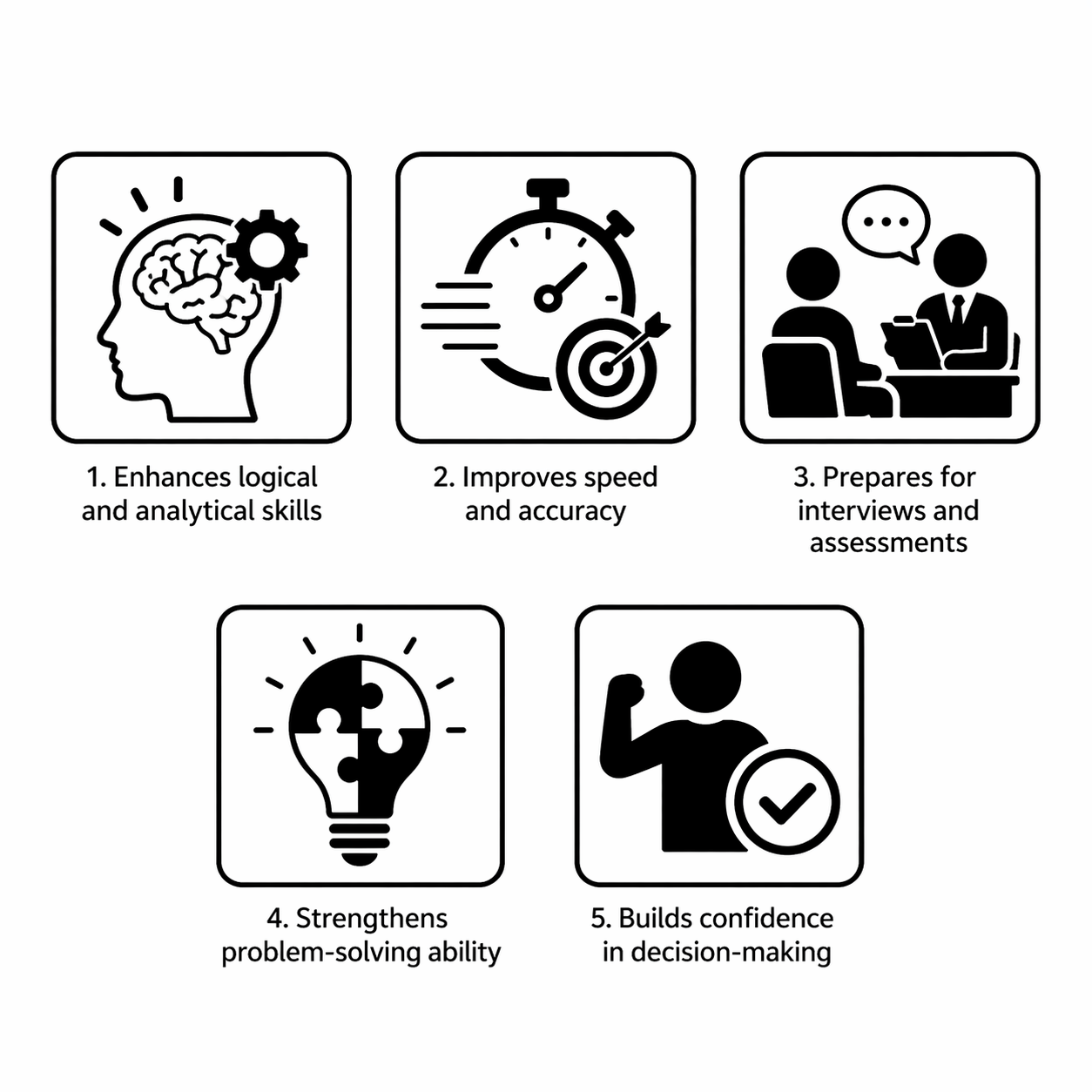
1.Enhances logical and analytical skills
2.Improves speed and accuracy
3.Prepares for interviews and assessments
4.Strengthens problem-solving ability
5.Enhances logical and analytical skills
Introduction to Aptitude Tests
What is it?
What it does?
Who takes it?
Measures your natural or learned abilities and skills in various areas
Employers & schools to determine your suitability for a job or course
Type of assessment



Sections of Aptitude Tests







Logical Reasoning
Numerical Reasoning
Verbal Reasoning
Situational Judgement
Critical Reasoning
Logical Reasoning
Syllogism
All birds can fly.
Penguins are birds.
Can penguins fly?
Analogies
Finger is to Hand
as Toe is to _____.
Code-Decode
If "BREAD" is coded as "215348,"
how is "CRANE" coded?
Relations
If John is Mary's brother and
Mary has a son named Tom,
what is Tom to John?
Data-based
Is the sum of two numbers X and Y even?
Statement 1: X is even.
Statement 2: Y is odd.
Series
2, 6, 12, 20, ____?
Verbal Reasoning
Reading Comprehension
What is the main idea of the passage? Provide a brief summary
Vocabulary
Find the synonym for the word "ephemeral."
Grammar and Usage
"She _____ been to that museum before."
Para Jumbles
Rearrange the following sentences to
form a coherent paragraph.
a. The sun was setting.
b. The travelers set up camp.
c. They gathered around the fire.
Analogies
If "Cat" is to "Kitten," then "Dog" is to?
Sentence Correction
The team haven't been practicing enough..
Critical Reasoning
Strengthening/
Weakening
Which statement, if true, would most support the argument?
Assumption
What underlying assumption does the argument rely on?....
Cause and Effect
Does the evidence support a clear cause-and-effect relationship?
Conclusion
What is the primary conclusion or main point of the argument?
Interpretation
How would the author likely interpret the conflicting viewpoints presented?
Inference
What can be reasonably inferred from the information provided?
Situational Judgement
Leadership
Leading a team through a challenging project, how do you inspire and guide team members?
Priority Setting
You have tight deadlines for two tasks. How do you decide which one to tackle first?
Adaptability
Project requirements suddenly change. How do you adjust plans and guide your team through the transition?
Decision-Making
Faced with a critical project decision, how do you choose the best course of action?
Conflict Resolution
Two team members disagree. How do you resolve the conflict and maintain team harmony?
Time Management
Faced with tight deadlines, how do you organize tasks to manage time effectively?
Numerical Reasoning Topics in Order of Importance
Permutation & Computation
Percentage
Profit & Loss
Probability
Time & work
Simple & compound interest
Time, speed & distance
Number systems
Ages
Averages
Most important
Least important
Tips to Ace the Test
Practice, Practice & Practice!
Rule
1

Tips to Ace the Test
Practice, Practice & Practice!
Rule
1
Make most of online mock tests
Rule
2

Tips to Ace the Test
Practice, Practice & Practice!
Rule
1
Make most of online mock tests
Rule
2

Focus more on easier questions
Rule
3
Tips to Ace the Test
Practice, Practice & Practice!
Rule
1
Make most of online mock tests
Rule
2
Focus more on easier questions
Rule
3

Be sure to read questions carefully
Rule
4
Take the Aptitude Test Now!


What is Structured Thinking

1.Breaking problems into steps
2.Organizing ideas logically
3.Using frameworks (Problem → Analysis → Solution)
4.Presenting clear, structured responses
In-Class Activity
Case Study Activity – Guidelines
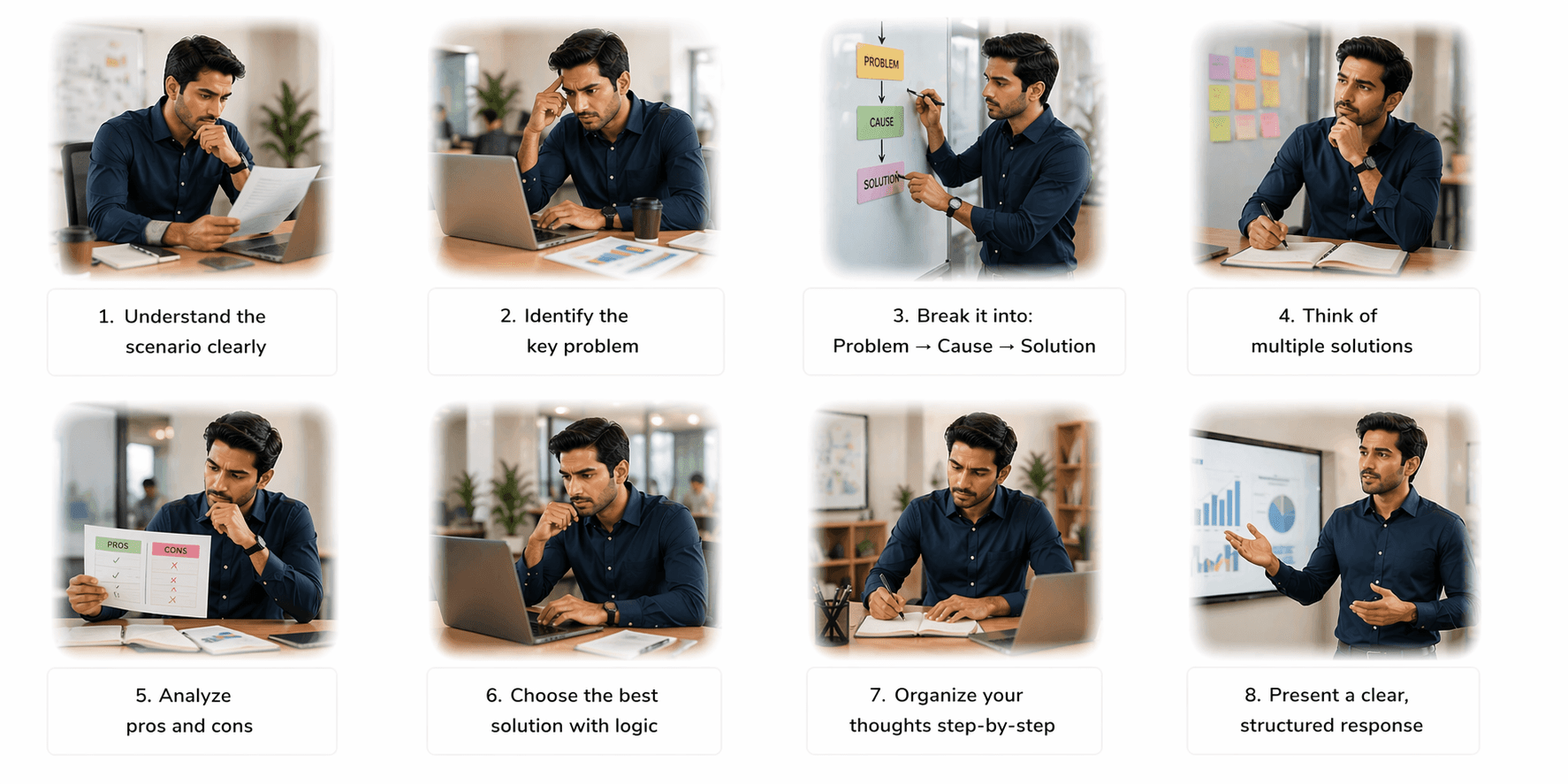
1.Understand the scenario clearly
2.Identify the key problem
3.Break it into: Problem → Cause → Solution
4.Think of multiple solutions
In-Class Activity
5.Analyze pros and cons
6.Choose the best solution with logic
7.Organize your thoughts step-by-step
8.Present a clear, structured response
Summary
5
Clear thinking leads to confident decisions
4
Practice regularly to improve thinking
3
Apply logic in real situations
2
Use structure to organize ideas
1
Think before you respond
Quiz
Aptitude practice mainly improves:
A. Memory only
B. Communication only
C. Logical and analytical skills
D. Writing skills

Quiz-Answer
Aptitude practice mainly improves:
A. Memory only
B. Communication only
C. Logical and analytical skills
D. Writing skills