Regulatory Framework


SEBI



Learning Outcome
5
Apply SEBI grievance and legal mechanisms.
4
Evaluate the impact of major SEBI regulations.
3
Identify key SEBI-regulated market participants.
2
Describe SEBI’s powers and functions.
1
Explain SEBI’s origin, framework, and role.

SEBI = Umpire
Just like an umpire ensures fair play in cricket, SEBI ensures fairness and transparency in the securities market.
Investors = Players
They participate in the market, but must follow SEBI’s rules.
Rulebook = Regulations & Guidelines
SEBI sets disclosure norms, insider trading rules, and listing requirements just like an umpire enforces the laws of the game.
Whistle & Signals = Enforcement Actions
SEBI can penalize, suspend, or warn violators, just like an umpire calls fouls or gives out signals.
Audience = Public Confidence
The crowd trusts the game only if the umpire is impartial; similarly, investors trust markets only if SEBI ensures discipline.

Think of SEBI as the umpire of India’s capital markets. It doesn’t play the game itself, but it ensures that investors (players) follow the rules, companies (teams) disclose information honestly, and the market (match) runs smoothly.
By enforcing regulations, preventing unfair practices, and protecting investors, SEBI builds confidence in the financial system.
Background & Historical Context
Prior to 1988, India's capital markets were governed loosely by the Capital Issues Control Act (1947) and the Securities Contracts (Regulation) Act (1956). These laws were outdated, enforcement was weak, and investor exploitation was common. The Harshad Mehta scandal of 1992 (though it surfaced after SEBI's creation) further validated the urgent need for a robust regulator.

SEBI was set up as a non-statutory advisory body on 12 April 1988. The landmark SEBI Act, 1992 gave it full statutory powers, making it an autonomous body with quasi-legislative, quasi-executive, and quasi-judicial authority.
Three Core Mandates of SEBI

1.Protection- Safeguard the interests of investors in the securities market by ensuring fair practices, timely redressal of grievances, and deterrence against fraud.
2.Development- Promote the development of the securities market by introducing new instruments, encouraging innovation, and improving market infrastructure.
3.Regulation- Regulate the business of the securities market, including stock exchanges, brokers, depositories, and other intermediaries.
Organisational Structure
SEBI's Board comprises:
The Board is headquartered in Mumbai and has regional offices in New Delhi, Kolkata, Chennai, and Ahmedabad. It also has local offices across various cities for effective reach.
One Chairman (appointed by the Central Government)
Two members from the Ministry of Finance
One member from the Reserve Bank of India
Five other members appointed by the Central Government
Who Does SEBI Regulate?
SEBI's regulatory umbrella covers a wide spectrum of market participants:

Stock Exchanges:
NSE, BSE, and other recognised exchanges
Stockbrokers and Sub-brokers: Intermediaries facilitating trade
Portfolio Managers and Investment Advisers
Mutual Funds and Asset Management Companies (AMCs)
Who Does SEBI Regulate?

Foreign Portfolio Investors (FPIs) and Custodians
Depositories:
NSDL and CDSL
Credit Rating Agencies:
CRISIL, ICRA, CARE, etc.
Listed Companies:
for disclosure, corporate governance, and insider trading compliance
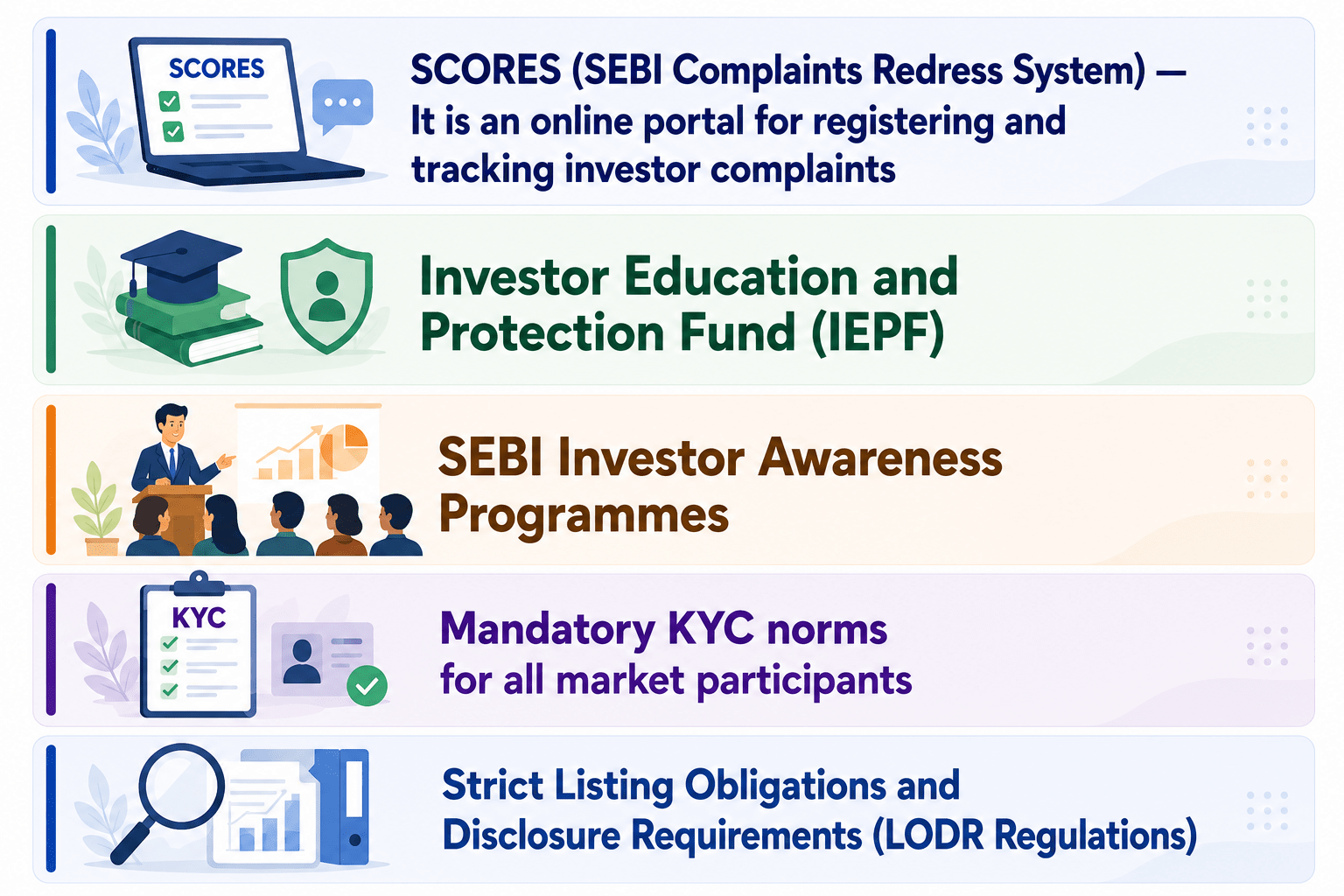
Investor Protection Mechanisms
SEBI has established several mechanisms to safeguard retail and institutional investors:
Summary
5
Protects investors through SCORES, KYC, and LODR.
4
Regulates market intermediaries and listed firms.
3
Has legislative, executive, and judicial powers.
2
Protects, develops, and regulates markets.
1
SEBI started in 1988; statutory in 1992.
Quiz
SEBI was granted statutory status through which of the following?
A. Securities Contracts (Regulation) Act, 1956
B. SEBI Act, 1992
C. Capital Issues Control Act, 1947
D. Companies Act, 2013

Quiz-Answer
SEBI was granted statutory status through which of the following?
A. Securities Contracts (Regulation) Act, 1956
B. SEBI Act, 1992
C. Capital Issues Control Act, 1947
D. Companies Act, 2013