Calculation and Analysis of Trading Margin

Business Scenario
You are working as a Risk Analyst at a financial advisory firm. A client wants to start trading in the stock market but is a complete beginner. They are confused about how much money they actually need to start trading and what risks are involved.
Your job is to simplify these concepts so that anyone with no financial background can understand them. First, you will explain what trading margin is using a simple real-life example. Next, you will use the official National Stock Exchange (NSE) Margin Calculator to calculate the margin required for different companies.

Pre-Lab Preparation
Finally, you will observe why different companies require different margin amounts and understand how the exchange manages trading risk.
Topic : Derivatives fundamentals
1) Hedging vs speculation
2) Exchange-traded vs OTC derivatives
3) Contract specifications
4) Margin concepts
Task 1: Explore Margin Requirements
Understand Important Concepts About Margins Using a Simple Real-Life Example
1
Imagine You Want to Rent an Expensive Bicycle Suppose you want to rent a premium bicycle worth ₹60,000 for one month. The bicycle owner does not ask you to pay the entire ₹60,000. Instead, he asks you to deposit ₹10,000 as a refundable security
deposit before taking the bicycle home. Why? Because if the bicycle gets damaged, the owner already has some money to recover the loss. This is exactly how Trading Margin works in the stock market.
1. Margin (The Safety Deposit): In the stock market, especially while trading Futures and Derivatives, you do not pay the entire value of the contract. Instead, the exchange asks you to deposit only a small percentage of the contract value as a Margin. Think of Margin as a security deposit. It protects the exchange if the market moves against you.
Example: Suppose you want to trade 250 shares of Reliance.
-
Current Market Price = ₹2,900 per share
-
Total Contract Value = ₹2,900 × 250 = ₹7,25,000
You might think you need ₹7,25,000 to enter this trade. Actually, you don't. The NSE may ask you to deposit only ₹1,45,000 as margin. This means you are controlling a trade worth ₹7.25 lakh by depositing only 20% of its value. This concept is known as Leverage
2. Mark-to-Market (The Daily Check-up): Now imagine the bicycle owner checks the bicycle every evening. If you scratched it today, he deducts the repair cost from your security deposit immediately. He doesn't wait until the end of the month. The stock exchange works exactly the same way. At the end of every trading day, the exchange calculates whether your Futures position has made a profit or loss.
-
If you make a profit, money is added to your trading account.
-
If you made a loss, money is deducted from your margin account.
This daily settlement process is called Mark-to-Market (MTM).
Example:
-
Monday Margin Balance: ₹1,45,000
-
Daily Loss: -₹8,000
-
Tuesday Morning Remaining Margin: ₹1,37,000
3. Margin Call (The Warning Bell): Suppose you continue damaging the bicycle every day. Eventually, your ₹10,000 security deposit becomes too small. The owner immediately calls you and says, "Please deposit another ₹5,000 today, otherwise I will
will take back the bicycle." This is exactly what happens in Futures trading. If your trading losses reduce your margin below the minimum required level, your broker sends you a Margin Call. You must immediately deposit additional money. If you fail to do so, your broker has the right to close your trade automatically to prevent further losses.
Many beginners think the exchange collects margin simply to earn money. This is not true. The exchange collects margin to protect every participant in the financial market. Imagine two traders enter into a Futures contract:
-
Trader A agrees to buy.
-
Trader B agrees to sell.
If the market suddenly crashes and Trader A loses a large amount of money, what happens if Trader A refuses to pay? Without margin, Trader B would suffer losses even though they followed all the rules. To prevent this situation, the exchange collects margin from both traders before allowing the trade. Therefore, Margin protects the entire financial system from default risk.
Understand Why the Exchange Collects Margin
2
Understanding the Components of Total Margin
3
The Total Margin shown by the NSE calculator is generally made up of two important parts.
1. SPAN Margin (Value at Risk) Think of this as the main security deposit. SPAN stands for Standard Portfolio Analysis of Risk. It estimates the maximum possible loss that could occur in one trading day under normal market conditions. Stocks that fluctuate more require higher SPAN Margins.
Example: Suppose two stocks behave differently.
-
Company A: Price changes by only 1% every day.
-
Company B: Price changes by 7% every day.
Which company is riskier? Obviously Company B. Therefore, Company B will require a higher SPAN Margin.
2. Exposure Margin (Extra Cushion) Even after calculating SPAN Margin, unexpected events can occur (e.g., Natural disasters, Political events, Economic crises, Sudden market crashes).
To ensure that the stock market remains safe and stable, the National Stock Exchange (NSE) specifies how much margin traders must maintain before entering a trade. The required margin depends on several factors, including the price of the stock, volatility, market risk, and contract size (Lot Size).
To help investors calculate these values, the NSE provides a free online Margin Calculator.
Therefore, the exchange collects one additional safety buffer called the Exposure Margin. Think of this as carrying an umbrella even though the weather forecast says it won't rain. It is simply an extra layer of protection.
Total Margin = SPAN Margin + Exposure Margin (The NSE Margin Calculator automatically performs this calculation for you.)
Explore Margin Requirements using the NSE Website
4
Open the Official NSE Margin Calculator:
a
-
Open any web browser such as Google Chrome, Microsoft Edge, or Mozilla Firefox. In the address bar, type the following website address exactly as shown below and press Enter:
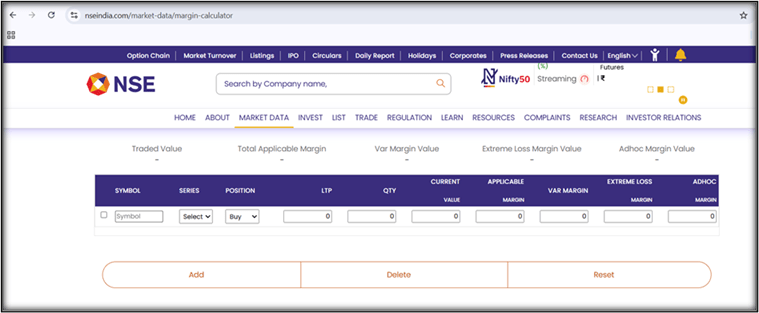
The National Stock Exchange (NSE) Margin Calculator webpage will open.
2. The National Stock Exchange (NSE) Margin Calculator webpage will open. The Margin Calculator is an online tool provided by the NSE that helps traders estimate the amount of margin required before entering a trade.
Learn the Input Boxes and Buttons:
b
When you look at the official NSE calculator, you will see a row of boxes. You will fill out the first few boxes yourself, and the calculator will automatically do the math for the rest.
Input Fields – Information entered by the user:
-
SYMBOL: This is the search box where you type the short name of the company you want to trade (for example, type RELIANCE or TCS).
-
SERIES: This is a drop-down menu that lets you pick the type of stock. For regular company shares, you usually select EQ (which stands for Equity).
-
POSITION: A drop-down menu where you select whether you want to Buy the shares or Sell them.
-
LTP (Last Traded Price): This is the current market price of just one share
right now. You type this number in.
-
QTY (Quantity): This is where you type exactly how many shares you want to buy or sell (like 150, 250, 500, etc.).
Output Fields – Values automatically calculated by the NSE:
-
CURRENT VALUE: This is the total, full price of the shares you want to buy. (It automatically multiplies the LTP by your Quantity).
-
APPLICABLE MARGIN: This is the total percentage of the current value that you need to pay as your safety deposit.
-
VAR MARGIN (Value at Risk): This is the main part of your safety deposit.
-
EXTREME LOSS MARGIN: This is the "extra cushion" deposit collected just to be super safe in case the market acts crazy.
-
ADHOC MARGIN: This is a special, extra deposit the exchange might occasionally ask for if a specific company's stock is jumping around too wildly. Most of the time, this will just say zero.
The Action Buttons at the Bottom:
-
Add: Once you have typed in your Symbol, LTP, and Quantity, click this button! It adds your trade to the list and instantly fills in all the automatic margin boxes.
-
Delete: If you made a mistake or want to remove a trade you already added, just click the little checkbox next to the Symbol and hit this button to throw it in the trash.
-
Reset: Think of this button as a giant eraser. If you click it, it wipes the entire calculator clean so you can start a brand new calculation from scratch.
Task 2: Calculate Margin using Real Trade Scenarios
Now that you understand the tool and the terms, let's put it into practice by calculating actual margin requirements.
Test a Real Example:
1
Let's see how much margin you need to buy a large chunk of shares.
-
Click inside the Symbol search box and type RELIANCE.
-
For Quantity, type 250 (imagine we are buying a bundle of 250 shares).
-
Type in the LTP as ₹1,304.00 .
-
Ensure the action is set to Buy.
-
Click the Add button.
-
Next, click the Compute button at the bottom of the list.

Understanding the Magic of Margin:
2
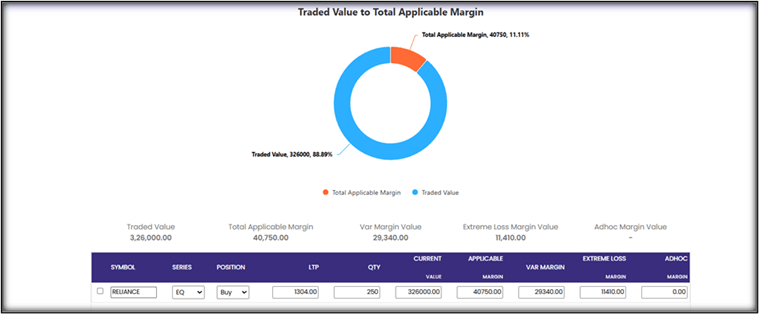
Let's do some simple math. If 1 share of Reliance costs ₹1,304, and you want to buy 250 shares, the actual full cost of those shares (Total Traded Value) is ₹3,26,000 (1,304 x 250).
But look at the results on the NSE calculator! You do not need over three lakhs. The exchange only requires a total safety deposit (Total Applicable Margin) of ₹40,750. You are able to control a massive trade by only putting down a fraction of the actual cost.
Spotting the Margin % in the Pie Chart: Take a look at the pie chart in the results! It shows that the Total Applicable Margin is 11.11%. This is your Margin %. It proves that you only had to pay about 11% of the total ₹3,26,000 cost to safely control this trade.
Check Margin for Various Companies
3
Now it is your turn to practice being a Risk Analyst! Go to the NSE Margin Calculator and find the Total Margin Required for the following companies. Imagine you are buying 500 shares of each company.
(Hint to calculate the missing boxes:
-
Total Trade Value = Quantity × Current Market Price
-
Margin % = (Total Margin Required ÷ Total Trade Value) × 100)
| Company Symbol | Quantity | Fill Current Market Price | Total Trade Value (Full Price) | Total Margin Required (From NSE Website) | Margin % |
|---|---|---|---|---|---|
| HDFC BANK | 500 | ||||
| TCS | 500 | ||||
| INFOSYS | 500 |
Task 3: Analyze Derivatives Trading Failure & Risk – Barings Bank:
"If the stock exchange already collects margins and performs daily Mark-to-Market (MTM) settlement, how can a financial institution still suffer huge losses from derivatives trading?"
To answer this question, your manager asks you to investigate one of the most famous financial disasters in history the collapse of Barings Bank.
As a Risk Analyst, your objective is to identify how poor risk management, excessive leverage, failure to monitor trading positions, and weak internal controls allowed a single trader to bring down one of the world's oldest investment banks.
Using the knowledge gained in Tasks 1 and 2, you will analyse the events that led to the collapse and recommend measures that modern financial institutions should adopt to prevent similar incidents.
Recommended Reading
Before beginning this activity, read the following case study carefully.
The case provides an overview of how Barings Bank collapsed because of poor risk
management, excessive leverage, hidden trading losses, and failure to follow margin requirements.
Recommended Resource
Barings Bank Collapse – Case Study (University of Texas at Austin)
https://ethicsunwrapped.utexas.edu/wp-content/uploads/2022/10/22-The-Collapse-of-Barings-Bank.pdf
Background
About Barings Bank
Barings Bank was established in 1762 and was one of the oldest and most respected merchant banks in the United Kingdom.
For over two centuries, it financed governments, supported international trade, and was widely recognised as one of Britain's most prestigious financial institutions.
Among its many achievements, Barings Bank helped finance the Louisiana Purchase and served as the banker to the British Royal Family.
The Trader
In the early 1990s, Nick Leeson was appointed as the head derivatives trader at the bank's Singapore office.
His official responsibility was to execute low-risk arbitrage trades, where profits are earned from small price differences between two markets without taking significant market risk.
What Went Wrong?
Instead of following approved trading strategies, Leeson began taking massive speculative positions in Nikkei 225 Futures contracts.
Rather than reporting his losses, he concealed them in a secret account known as Account 88888.
Because he supervised both the trading desk and the back-office settlement process, there was little independent oversight.
As a result, his losses remained hidden for several months.
The Kobe Earthquake and Margin Calls
In January 1995, a devastating earthquake struck Kobe, Japan.
The Japanese stock market fell sharply.
Since Leeson had taken large unhedged positions expecting the market to rise, his trading portfolio suffered enormous losses.
As you learned in Task 1, the exchange performs Mark-to-Market (MTM) settlement every day.
Each day the exchange calculated Leeson's losses and issued increasingly large Margin Calls, requiring additional funds to maintain his positions.
Instead of informing senior management about the true situation, Leeson falsely claimed that the money was required to meet client margin obligations.
Believing his explanation, Barings Bank continued transferring hundreds of millions of pounds to Singapore without independently verifying the actual trading positions.
The Collapse
Rather than closing his losing positions, Leeson continued increasing his exposure in the hope that the market would recover.
Unfortunately, the losses continued to grow.
By 24 February 1995, the hidden trading losses had reached approximately £827 million, exceeding the bank's available capital.
Unable to meet further margin obligations, Barings Bank collapsed on 26 February 1995 and was later sold for just £1.
Activity
1: Identify the Risk Management Failures
Based on the case study above, complete the following table.
| Risk Management Failure | Description | Impact on the Bank |
|---|---|---|
| Excessive Leverage | ||
| No Hedging Strategy | ||
| Hidden Trading Losses | ||
| Poor Internal Controls | ||
| Failure to Monitor Margin Calls |
2: Case Study Reflection
Based on the Barings Bank failure and your understanding of derivative margins from Tasks 1 and 2, answer the following questions.
Question 1
Importance of Mark-to-Market (MTM)
How does the daily Mark-to-Market (MTM) process and the issuing of Margin Calls help protect the stock exchange and market participants?
Why could Nick Leeson not simply wait until the end of the month to settle his losses?
Question 2
The Role of Hedging
Suppose Nick Leeson had followed proper hedging strategies similar to those explored in Task 2.
How might hedging have affected:
-
His SPAN Margin requirements?
-
His maximum potential losses?
-
The overall financial position of Barings Bank?
Explain your answer.
Question 3
Risk Management Failure
Which internal control weaknesses allowed Nick Leeson to hide losses in Account 88888 for such a long period?
Discuss the importance of separating front-office trading activities from back-office settlement and monitoring functions
Question 4
Your Recommendation
Imagine you are the Head of Risk Management at Barings Bank.
Recommend five practical controls that should be implemented to prevent a similar derivatives trading disaster in the future.
3: Advisory Report
Prepare a one-page advisory report for your client covering the following points:
-
Why trading margin is essential in derivative markets.
-
How Mark-to-Market (MTM) and Margin Calls reduce market risk.
-
What mistakes were made by Barings Bank.
-
Lessons that modern traders and financial institutions should learn from this case study.
Congratulations on completing this lab!
Checkpoint
You learned how to calculate trading margins using the NSE Margin Calculator and understood the concepts of SPAN Margin, Exposure Margin, MTM, and Margin Calls. You also analyzed real trading scenarios and explored the Barings Bank case study to understand the consequences of poor risk management and excessive leverage. These concepts provide a strong foundation for safe and informed participation in derivative markets.