Electrostatics
The Electrostatic Force
Electrostatics
The Electrostatic Force
between two point-charges
Electrostatics
The Electrostatic Force
Summary of observations
Qualitative Observation
Charge Interactions
Like Charges Repel
Charges of the same sign (+ / + or − / −) exert a repulsive force on each other.
Unlike Charges Attract
Charges of opposite signs (+ / −) exert an attractive force on each other.
Key takeaway: Force direction is determined by the signs of interacting charges.
For Point Charges
Magnitude Dependencies
Proportional to Charge F ∝ q
Changing either charge changes the electrostatic force proportionally.
• e.g., doubling either charge doubles the force.
Inverse-Square with Distance F ∝ 1/r²
The force decreases as the distance increases (and vice versa), varying quadratically with distance.
• e.g., halving the distance quadruples the force.
Foundation of Coulomb's Law: Combining these proportionalities gives F ∝ (|q₁q₂| / r²).
Electrostatics
The Electrostatic Force
Coulomb's Law
\vec{F}_{ij}=\tfrac{1}{4\pi\epsilon}\frac{q_i\ q_j}{r^2_{\tiny ij}}\ \hat{r}_{\tiny ij}
\text{the electric force of $q_i$ on $q_j$}
\text{permittivity}
\text{ the distance between $q_i$ and $q_j$}
\text{ direction $i\rightarrow j$}
\text{ square}
\text{the (source) charge exerting the force}
\text{the (target) charge experiencing the force}
\left( k
=\frac{1}{4\pi\epsilon_0}
=8.99\times10^9
\quad \frac{\text{N$\cdot$ m$^2$}}{\text{C}^2}\right)
(\text{in free-space: } \epsilon_0
=8.85\times10^{-12}
\quad \frac{\text{C}^2}{\text{N$\cdot$ m$^2$}}
\vec{F}_{q_i \text{ on } q_j}
Electrostatics
Coulomb's Law -- direction information
\vec{F}_{ij}=k\frac{q_i\ q_j}{r^2_{\tiny ij}}\ \blue{\hat{r}_{\tiny ij}}
\textcircled{\mathbf{\cdot}}
\textcircled{\cdot}
q_j
q_i
\vec{r}_{i}
\vec{r}_{j}

\hat{r}_{ij}
\vec{r}_{ij}
The Electrostatic Force
Step 1
Displacement Vector
Define the displacement vector pointing from the source charge (qi) to the target charge (qj):
\vec{r}_{ij} = \vec{r}_{j} - \vec{r}_{i}
Step 2
Unit Direction Vector
Normalize the displacement to obtain the dimensionless unit vector specifying the line of action:
\hat{r}_{ij} = \frac{\vec{r}_{ij}}{r_{ij}} = \frac{\vec{r}_{j} - \vec{r}_{i}}{|\vec{r}_{j} - \vec{r}_{i}|}
Electrostatics
Coulomb's Law -- attraction & repulsion
q_j
q_i
\vec{F}_{ij}=k\frac{\blue{q_i\ q_j}}{r^2_{\tiny ij}}\ {\hat{r}_{\tiny ij}}
q_i\ q_j\gt 0 \ \implies\ \vec{F}_{ij} \propto \hat{r}_{ij}
q_j
q_i
q_j
q_i
q_i
q_j
\vec{F}_{ij}
\vec{F}_{ij}
\vec{F}_{ij}
\vec{F}_{ij}
\hat{r}_{ij}
\hat{r}_{ij}
\hat{r}_{ij}
\hat{r}_{ij}
q_j
q_i
\hat{r}_{ij}
\vec{r}_{ij}


The Electrostatic Force
q_i\ q_j\lt 0 \ \implies\ \vec{F}_{ij} \propto -\hat{r}_{ij}
Electrostatics
Coulomb's Law -- direction information
\vec{F}_{ij}=k\frac{q_i\ q_j}{r^2_{\tiny ij}}\ \blue{\hat{r}_{\tiny ij}}
\textcircled{\mathbf{\cdot}}
\textcircled{\cdot}
q_j
q_i
\vec{r}_{i}
\vec{r}_{j}
\hat{r}_{ij}
\vec{r}_{ij}
q_i
\textcircled{\mathbf{\cdot}}
\vec{r}_{ji}
\hat{r}_{ji}
\vec{r}_{i}
\textcircled{\cdot}
q_j
\vec{r}_{j}
The Electrostatic Force
Step 3
Reversed Vectors
For the force of qj acting on qi, the displacement points in the exact opposite direction:
\vec{r}_{ji} = \vec{r}_i - \vec{r}_j = -\vec{r}_{ij}
\implies\ \hat{r}_{ji} = -\hat{r}_{ij}
Step 4
Newton's Third Law
Substituting the inverted unit vector into Coulomb's Law yields equal and opposite force:
\vec{F}_{ji} = k\frac{q_j q_i}{r^2_{ji}}\,\hat{r}_{ji} = k\frac{q_i q_j}{r^2_{ij}}(-\hat{r}_{ij}) = -\vec{F}_{ij}
Electrostatics
The Electrostatic Force
The Net Electrostatic Force due to a configuration of charges
Electrostatics
The Net Electrostatic Force
\textcircled{\mathbf{+}}
\textcircled{-}
\textcircled{+}
\textcircled{-}
For a given configuration of point charges
q_1
q_2
q_4
q_3
The Electrostatic Force
Electrostatics
\textcircled{\mathbf{+}}
q_1
\textcircled{-}
\textcircled{+}
q_2
\textcircled{-}
q_4
q_3
The interaction can be described in terms of force-pairs
\text{the electric force}
\text{of $q_4$ on $q_2$}
\text{the electric force}
\text{of $q_2$ on $q_4$}
The Electrostatic Force
The Net Electrostatic Force
Electrostatics
\textcircled{-}
q_4
The
Net Electrostatic Force
on a charge of interest
is the vector sum of all the electric forces acting on it.
\text{the electric force}
\text{of $q_2$ on $q_4$}
\textcircled{-}
q_4
\text{the electric force}
\text{the electric force}
\text{of $q_1$ on $q_4$}
\Sigma\vec{F}_\text{on $q_4$}
\vec{F}_\text{$q_1$ on $q_4$}
\vec{F}_\text{$q_2$ on $q_4$}
\vec{F}_\text{$q_3$ on $q_4$}
=
+
+
\text{of $q_3$ on $q_4$}
\Sigma \vec{F}_\text{on $q_4$}
\vec{F}_\text{$q_1$ on $q_4$}
\vec{F}_\text{$q_2$ on $q_4$}
\vec{F}_\text{$q_3$ on $q_4$}
The Electrostatic Force
The Net Electrostatic Force
Electrostatics
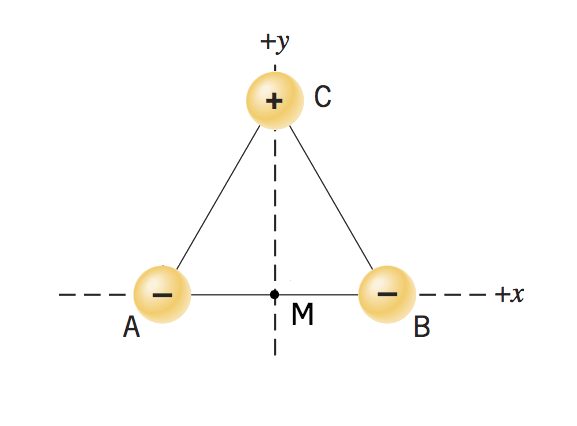
Three identical small spheres are fixed on the vertices of an equilateral triangle whose side is [d] in length. The spheres at vertices A and B carry negative net charges, and the sphere at vertex C carries net positive charge.
Suppose that qA=qB=-Q and qC=+q, what is the magnitude and direction of the net electric force on the sphere at C due to the charges at A and B.