Taiji: China’s Space-based Gravitational-Wave Program
He WANG
On behave of Taiji Scientific Collaboration
International Centre for Theoretical Physics Asia-Pacific (ICTP-AP)
University of Chinese Academy of Sciences (UCAS)
@The University of Maryland, Washington, DC
From Taiji-1 heritage to full-mission development and data-analysis preparation






Taiji: China’s Space-based Gravitational-Wave Program
He WANG
International Centre for Theoretical Physics Asia-Pacific (ICTP-AP)
University of Chinese Academy of Sciences (UCAS)
@The University of Maryland, Washington, DC

From Taiji-1 heritage to full-mission engineering and data-analysis preparation
Section 0 — Opening
- Taiji/TJ: China’s Space-borne Gravitational-Wave Program and Science Readiness
- A brief history: from early studies to Taiji-1 in-orbit heritage
- Three scientific frontiers: astrophysics, cosmology, and fundamental physics
Section 1 — Science and mission concept
- The millihertz window: source classes and discovery space
- Taiji/TJ full-mission concept
- From Taiji-1 heritage to full-mission preparation
Section 2 — Taiji-1 heritage
- Taiji-1: in-orbit technology demonstration
- Taiji-1 beyond technology: global gravity-field output
Section 3 — Key enabling technologies
- Eight key technology areas for full-mission readiness
- Optical metrology and inter-satellite laser link
- Inertial reference, micro-propulsion, and drag-free control
- Ultra-stable platform and environmental coupling
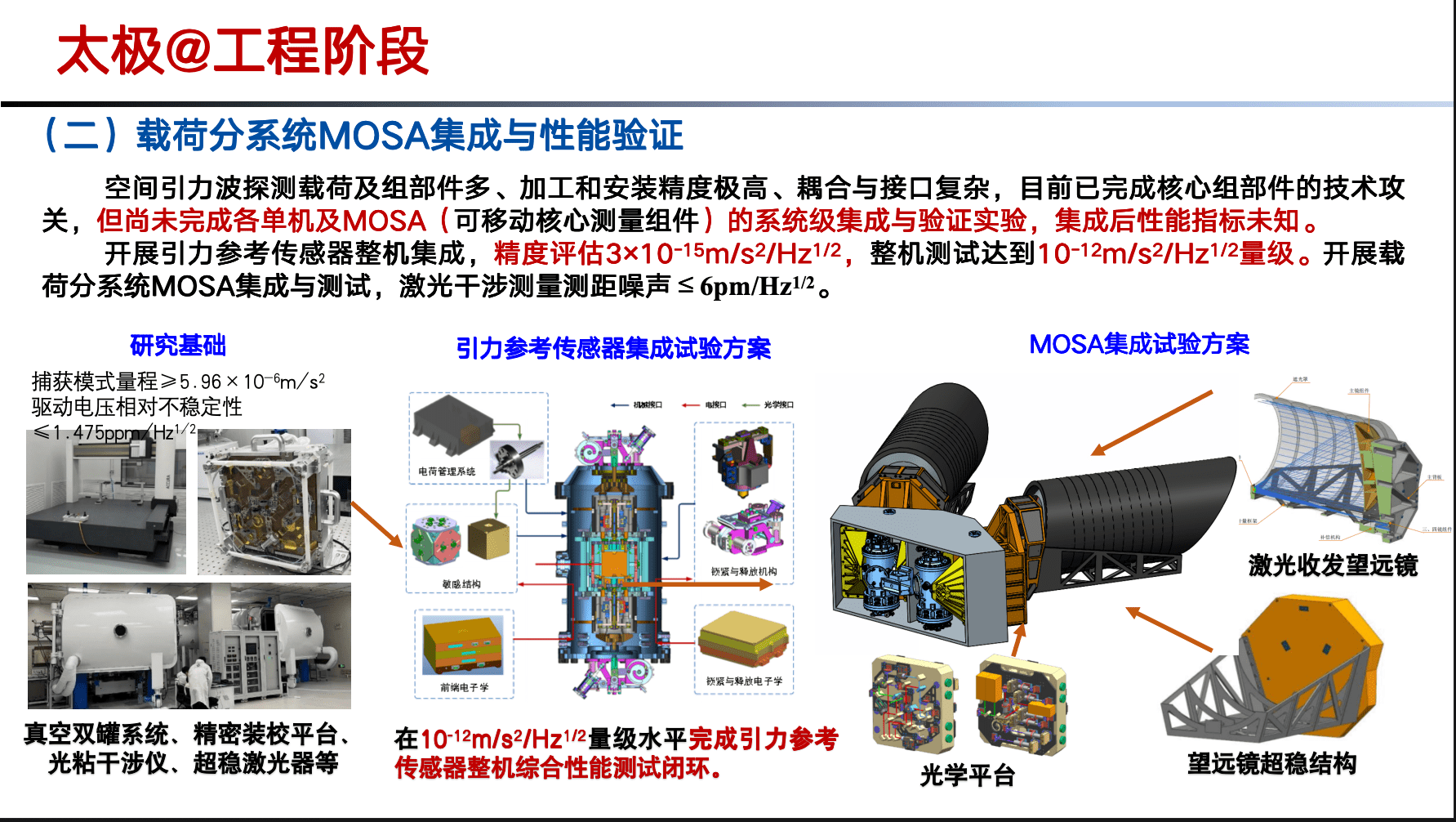
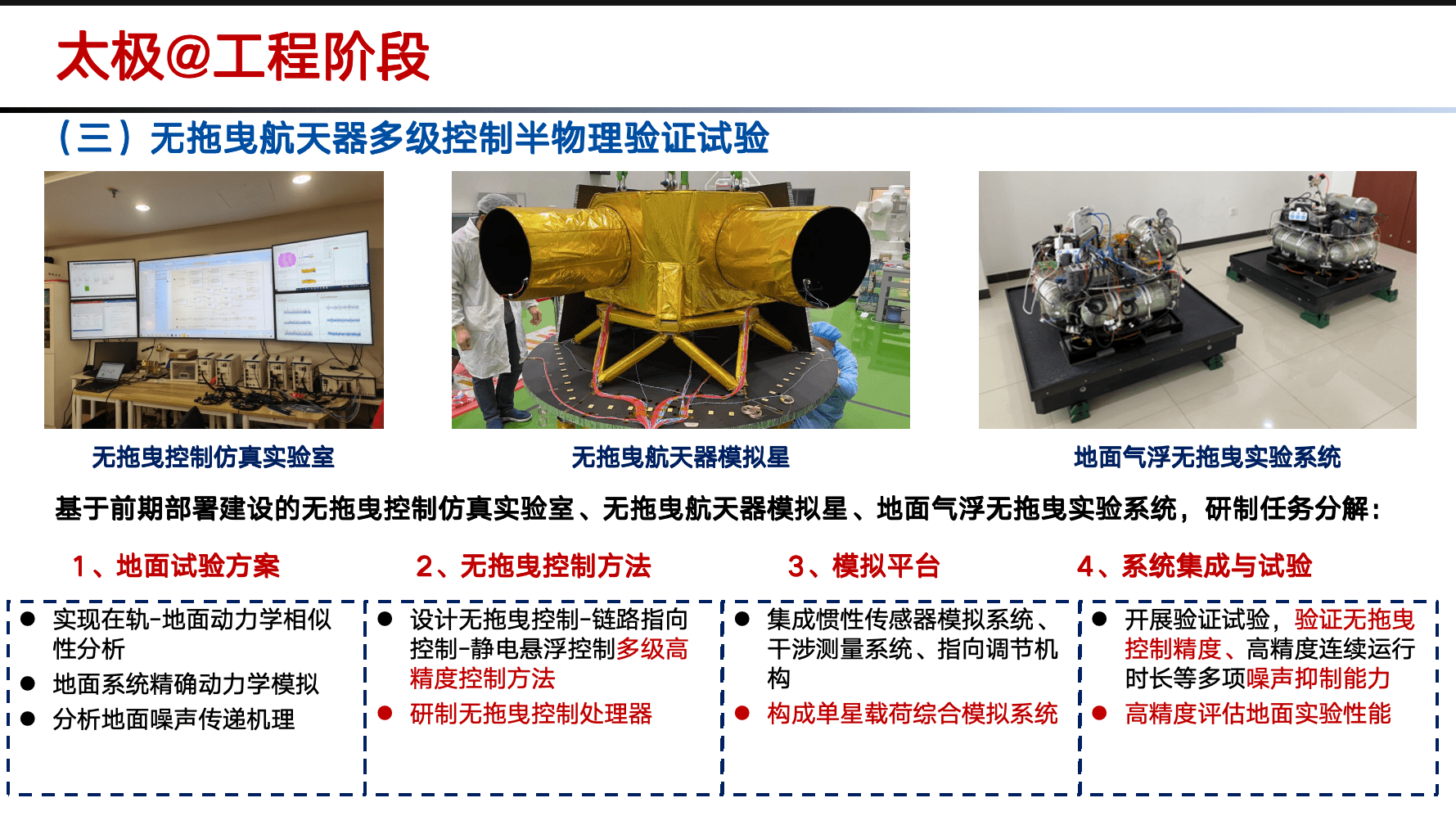
- System integration: MOSA, drag-free semi-physical verification, and three-arm interferometry
Section 4 — Data-analysis readiness
- Why data challenges are mission-critical
- Taiji Data Challenge: full-chain simulation and mock datasets
- Data preprocessing: TDI, calibration, and detector characterization
- Science data analysis: source pipelines, global fit, and population products
Section 5 — Science examples
- Galactic compact binaries: verification sources, foreground, and Milky Way structure
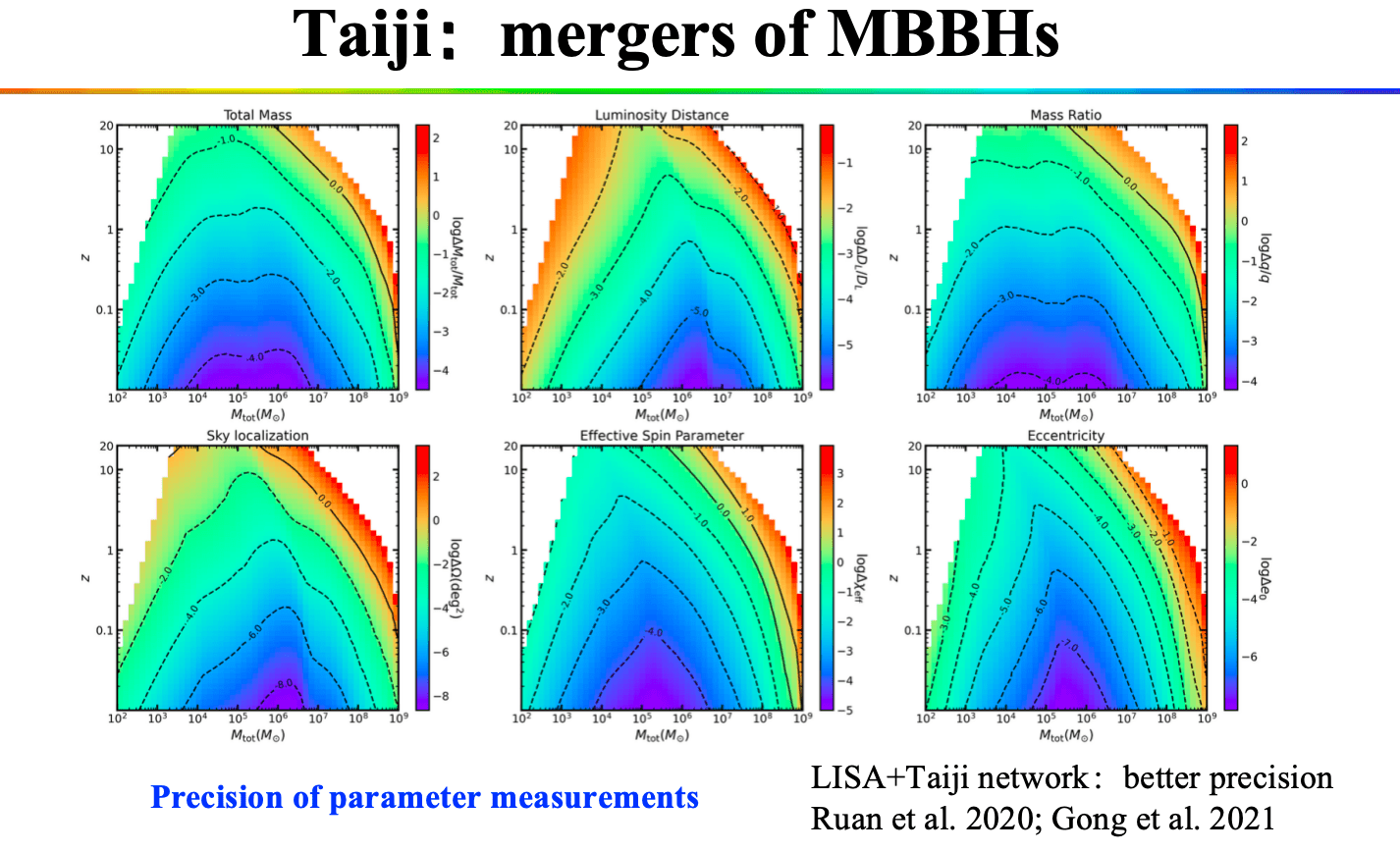
- Massive black holes: seeds, growth, and assembly history
- EMRIs/IMRIs and strong-field gravity
- Stochastic backgrounds, cosmology, and fundamental physics
【如果时间紧,这四页 science examples 可以压缩成两页。】
Section 6 — Network science
- From Taiji/TJ to network science: LISA-Taiji-TianQin synergies
- Network science as population inference: the origin of SMBHs
- Summary and outlook
- Taiji: China’s Space-based Gravitational-Wave Program
- The millihertz window: sources and science questions
- Primary science targets of Taiji/TJ
- Mission concept: a heliocentric triangular constellation
- A staged roadmap: from Taiji-1 to a full three-satellite mission
- Taiji-1: in-orbit technology-demonstration heritage
- Toward Taiji-2 and full mission readiness
- The measurement chain: from test masses to science data
- Inter-satellite interferometry and laser-link development
- Acquisition, tracking and pointing over million-kilometer baselines
- Inertial sensing, micro-thrusters and drag-free control
- Stable platform and environmental coupling
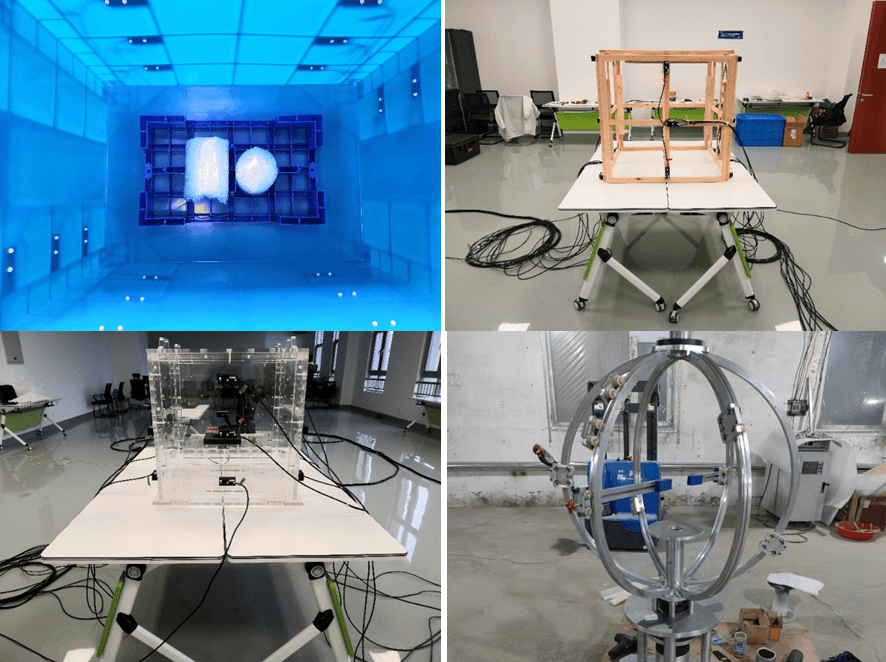
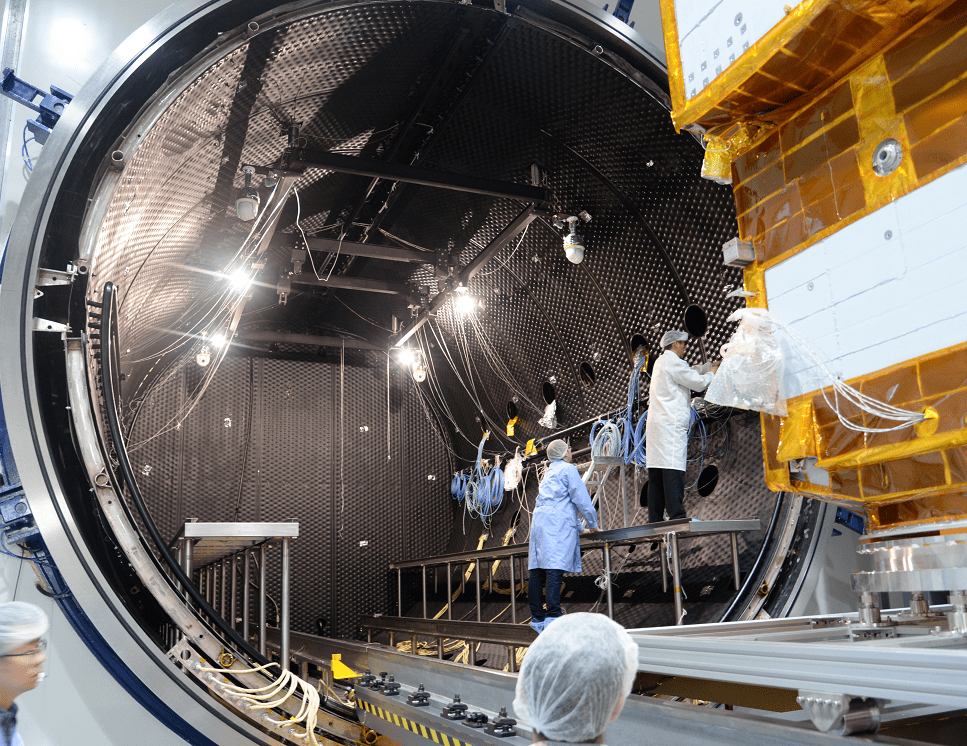
- Ground-based equivalent verification and system integration
- Why data challenges are mission-critical
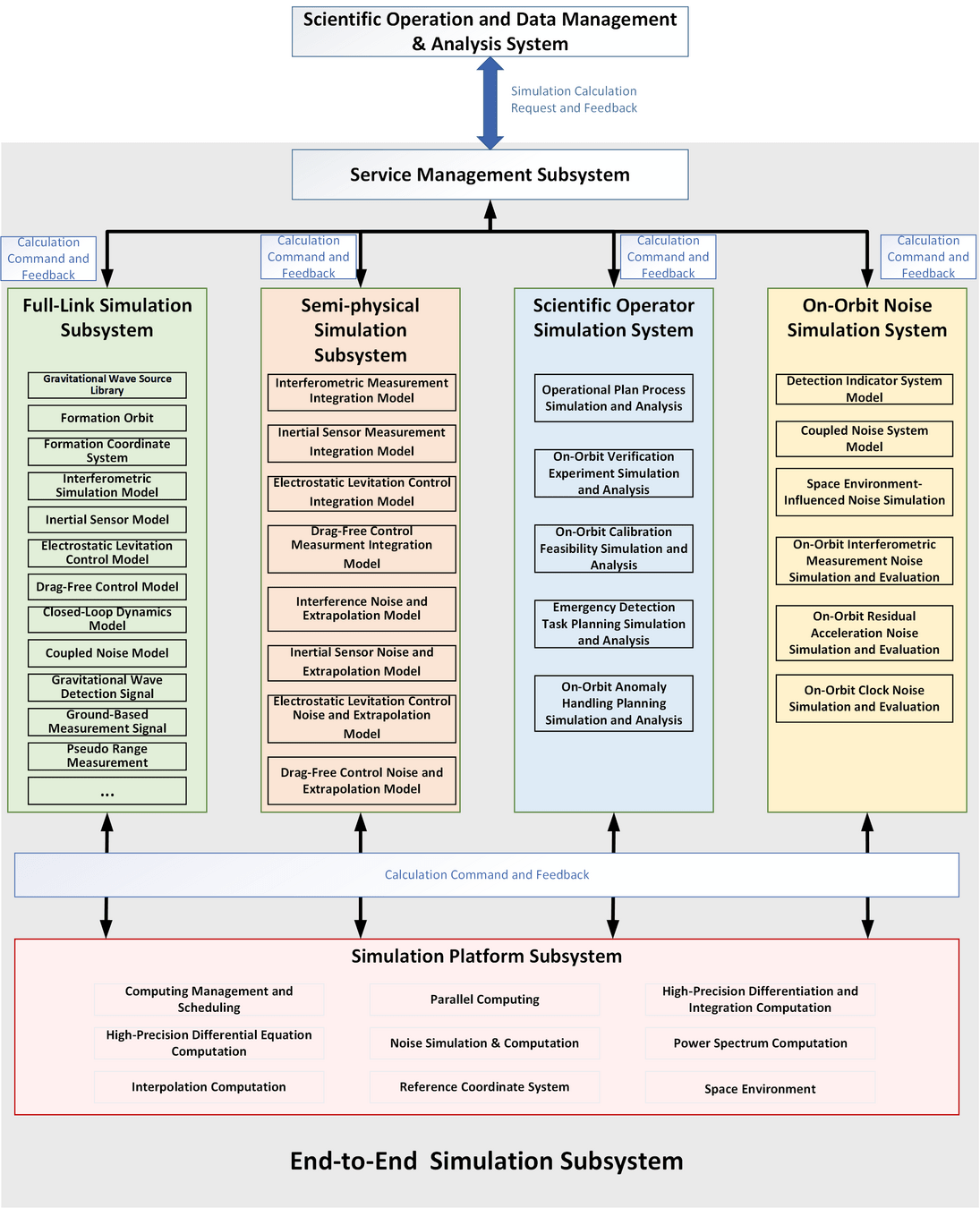
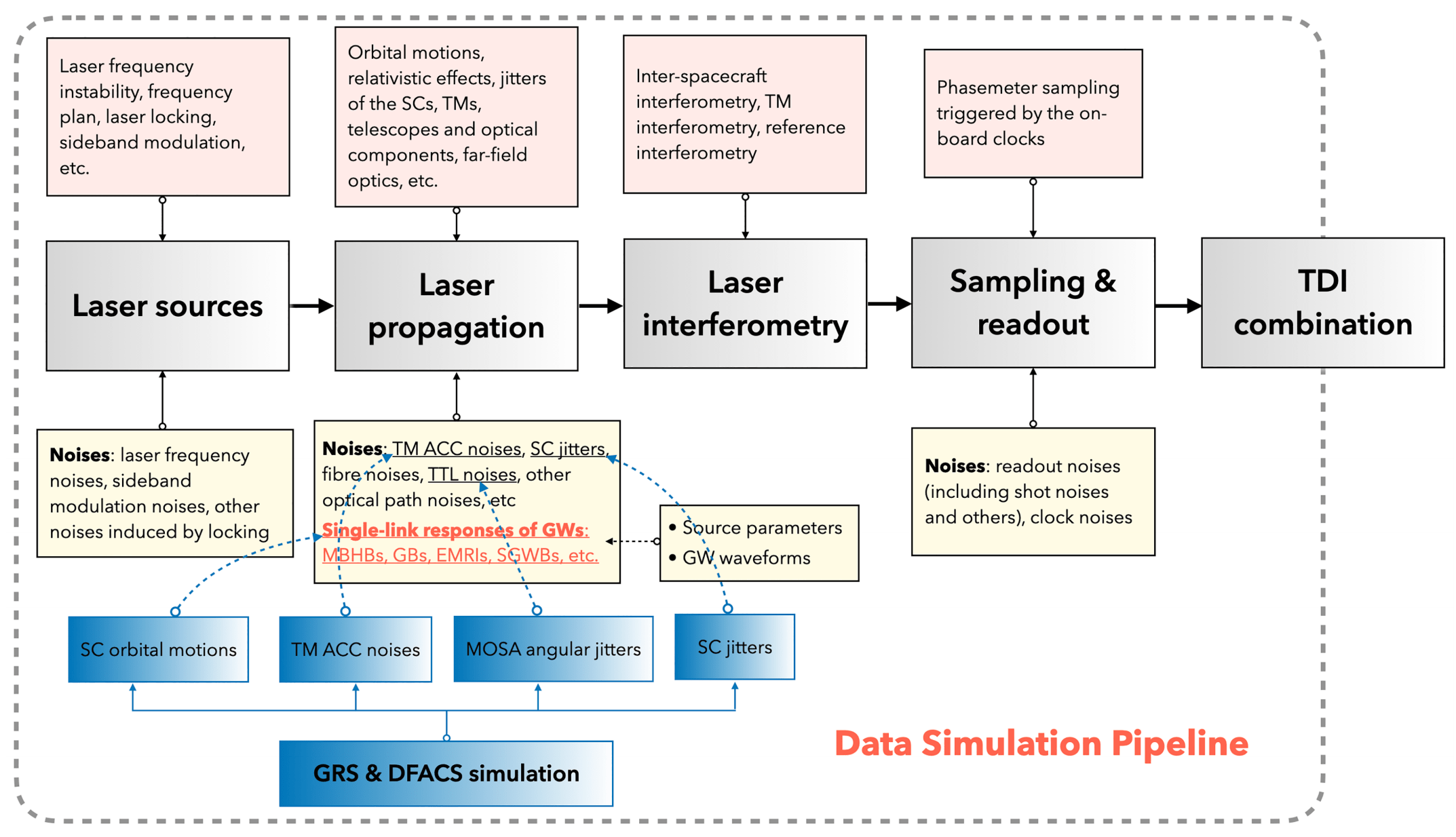
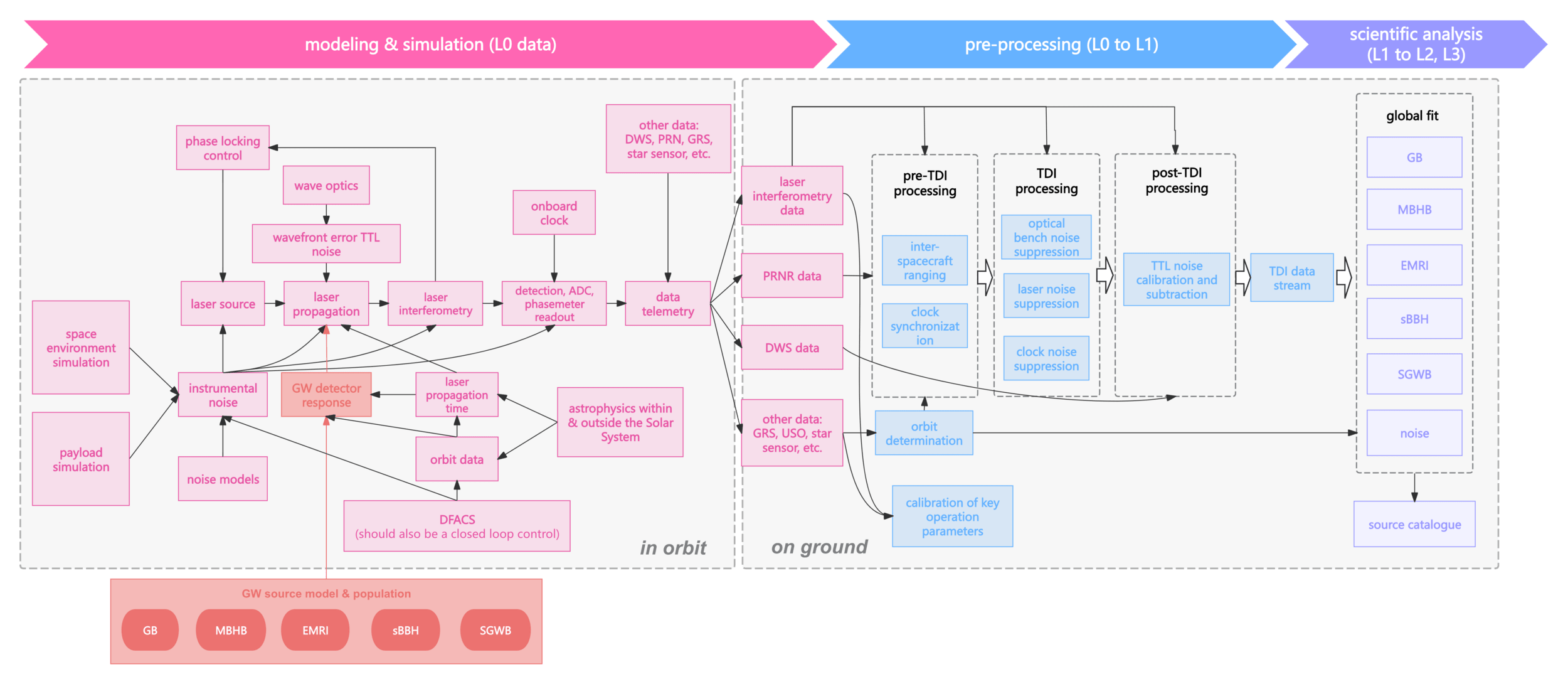
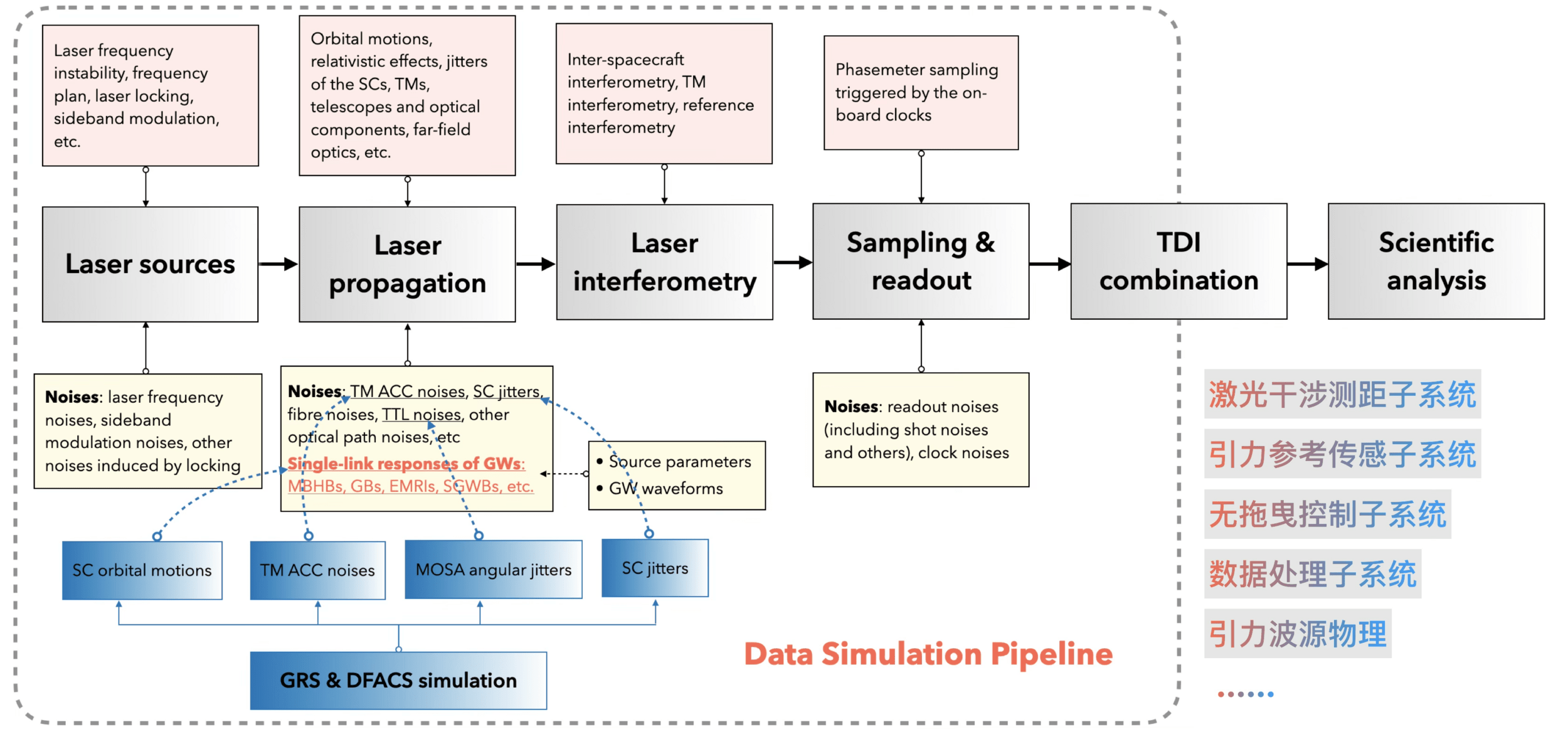
- Taiji Data Challenge: full-chain simulation pipeline
- Mock datasets: from L0 raw data to source-level products
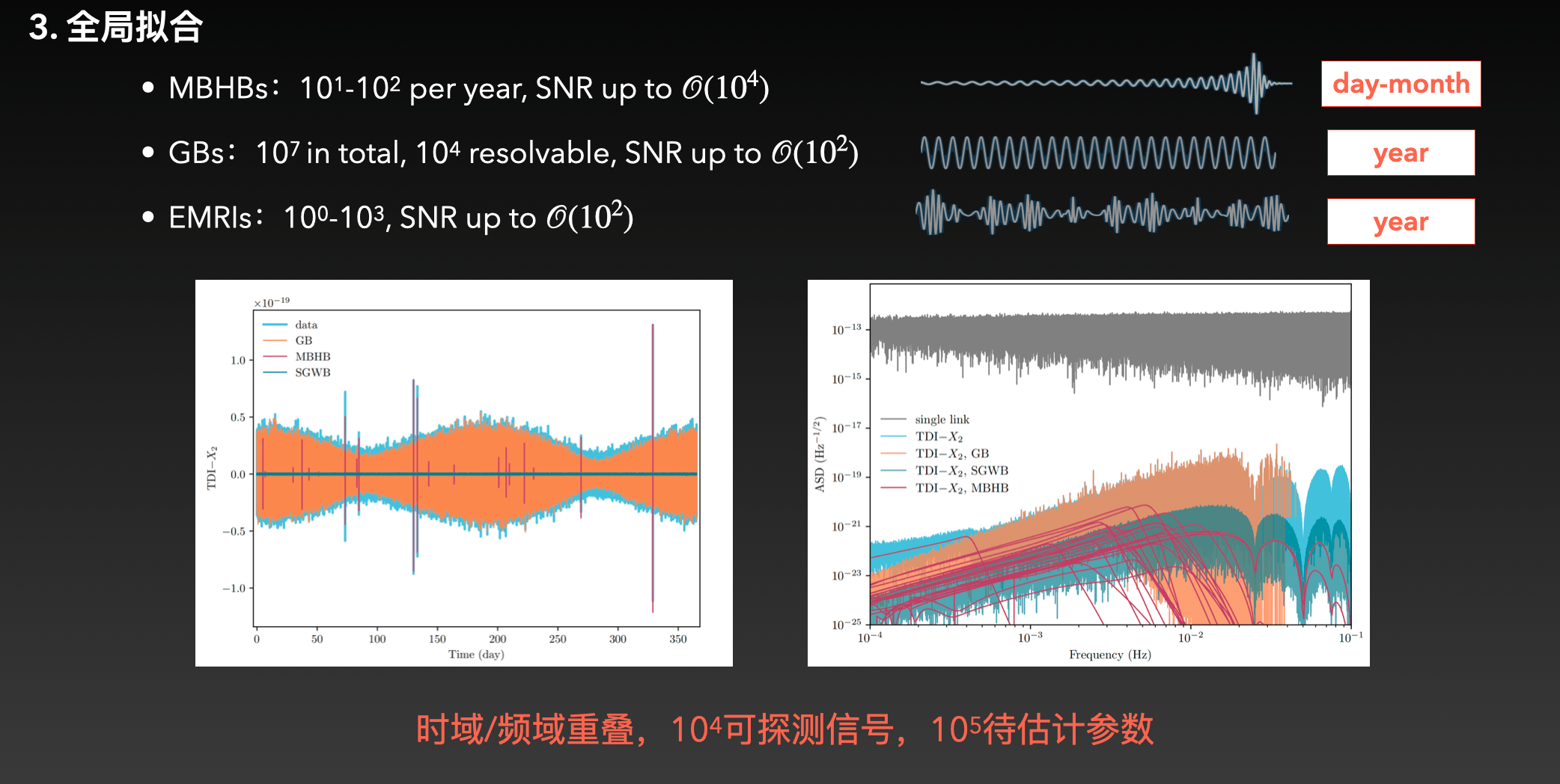
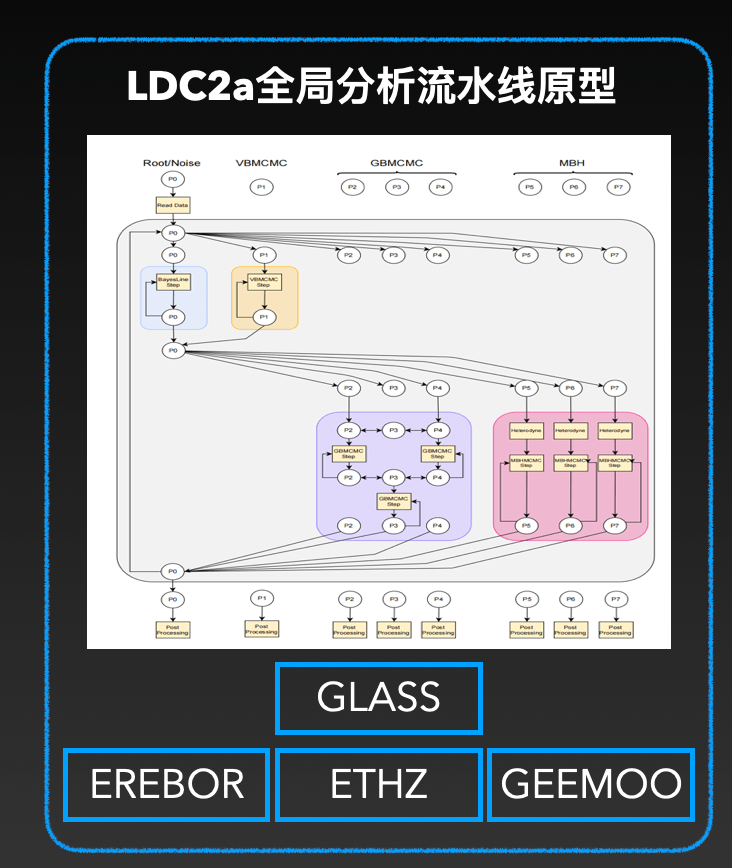
- The global-fit challenge: multi-source, multi-noise, high-dimensional inference
- Prototype analysis modules: MBHB, GB, SGWB/noise
- From Taiji to network science: LISA-Taiji-TianQin synergies
- Open interfaces for international collaboration
- Summary and outlook
A brief history: from early studies to Taiji-1 in-orbit heritage
Wen-Rui Hu , Yue-Liang Wu, Natl. Sci. Rev. Vol 4 (2017)
Yue-Liang Wu et al., Commun. Phys. 4, 34 (2021)
2008
— CAS initiated early studies on space-based gravitational-wave detection.
2010
— Early national proposal for space-based GW observation.
— Taiji was publicly introduced to the international community.
2016
— Taiji-1 was approved and launched as an in-orbit technology demonstrator.
2018-2019
— Overall mission design and development roadmap were published.
2021
— Current focus: engineering preparation, system-level verification, data challenges, and science-pipeline development.
2025-2026
He WANG · ICTP-AP / UCAS
Taiji: China's Space-based GW Program
Taiji/TJ has evolved from early conceptual studies to in-orbit technology heritage and is now moving toward full-mission engineering and science-data readiness.
He WANG · ICTP-AP / UCAS
Taiji: China's Space-based GW Program
Three Scientific Frontiers
Astrophysics, cosmology, and fundamental physics in the mHz band
Astrophysics
- Massive black holes and host-galaxy co-evolution
- Black-hole seeds and intermediate-mass black holes
- Galactic compact binaries and Milky Way structure
- Environments of massive black holes
Cosmology
- Cosmic expansion history and standard sirens
- Hubble constant tension
- Early-universe phase transitions
- Dark matter and stochastic backgrounds
Fundamental Physics
- Strong-field dynamics of black holes
- No-hair theorem and ringdown tests
- Tests of gravity beyond general relativity
- Black-hole horizons and exotic compact objects
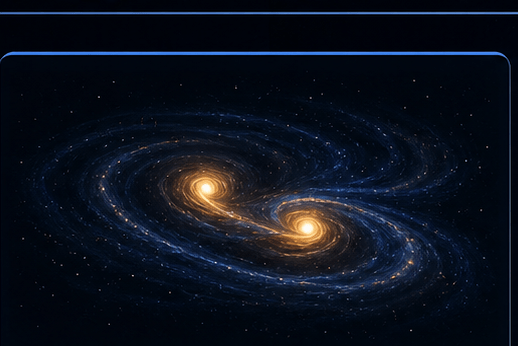
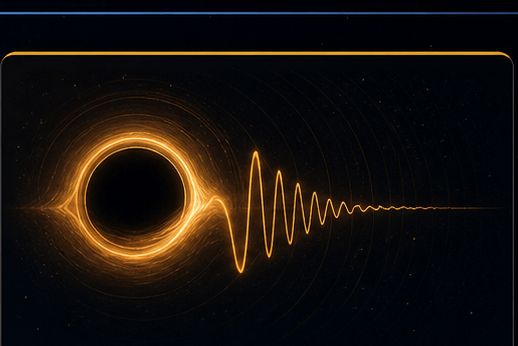
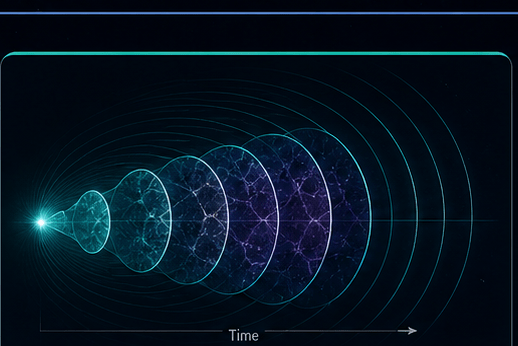
Taiji/TJ is motivated by three broad frontiers: black-hole astrophysics, cosmology, and fundamental physics.
He WANG · ICTP-AP / UCAS
Taiji: China's Space-based GW Program
The millihertz window
From Galactic binaries to massive black holes, stochastic backgrounds, and unknown sources
HW, Minghui Du et al., Sci Sin-Phys Mech Astron 54, 270403 (2024)
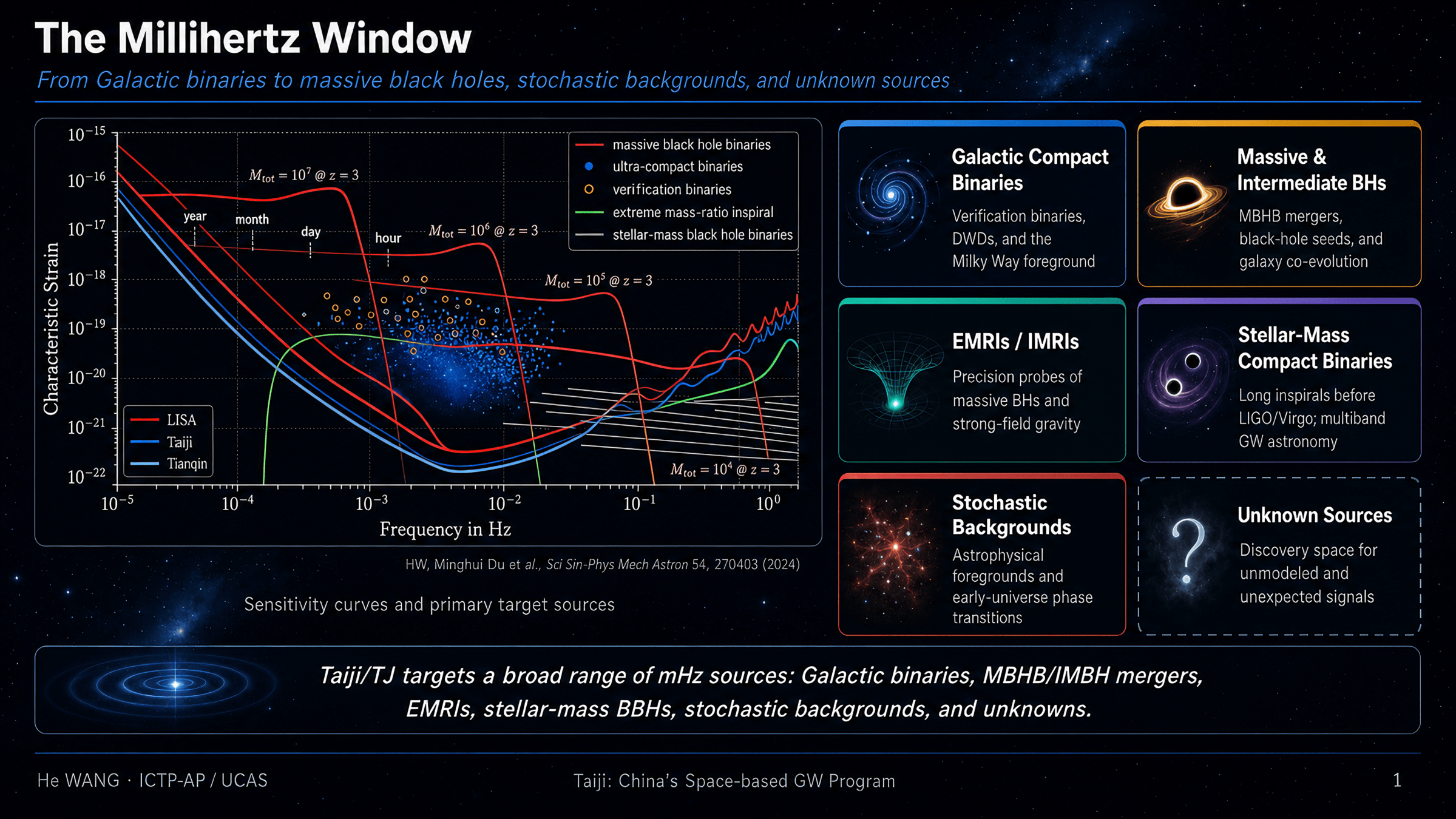
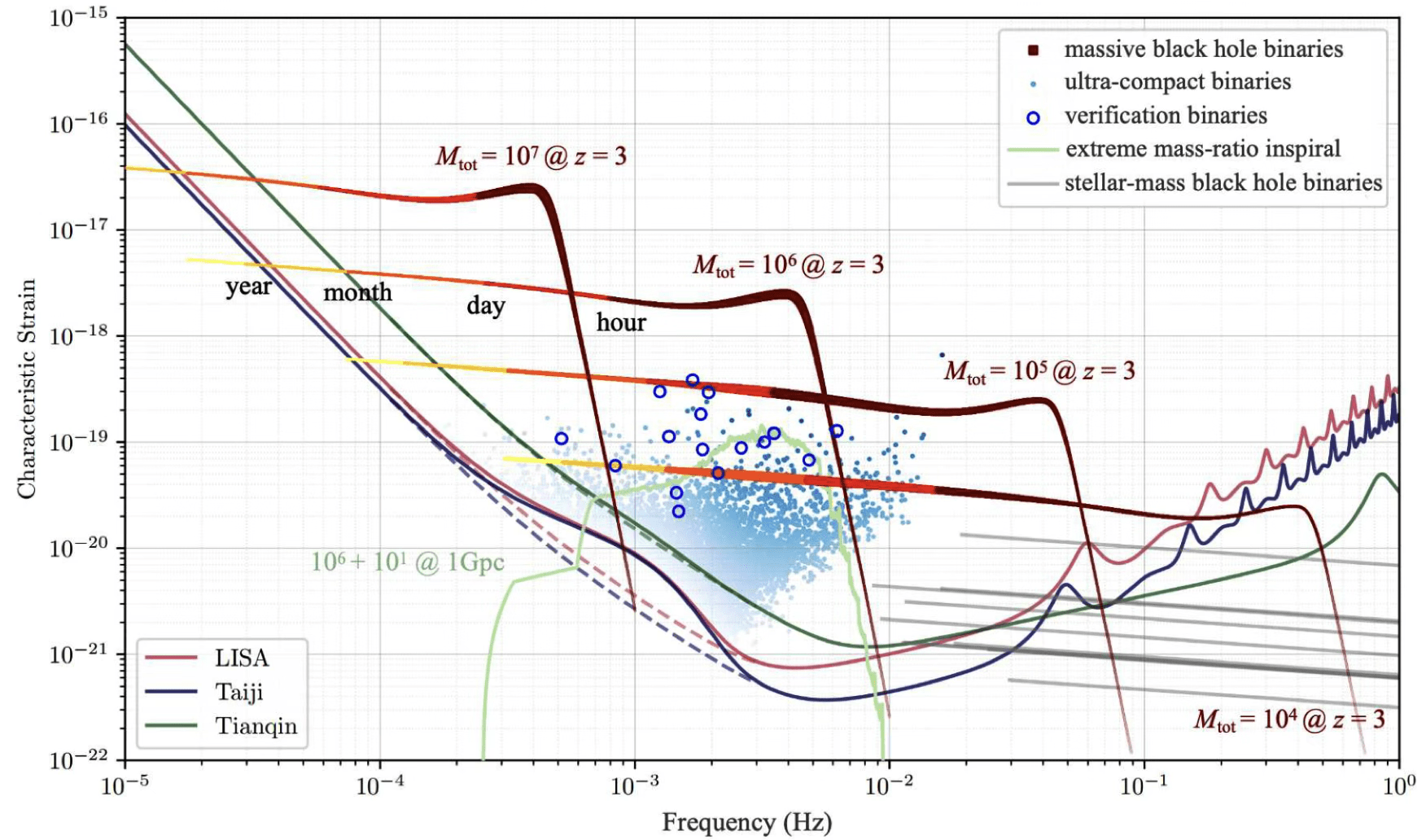
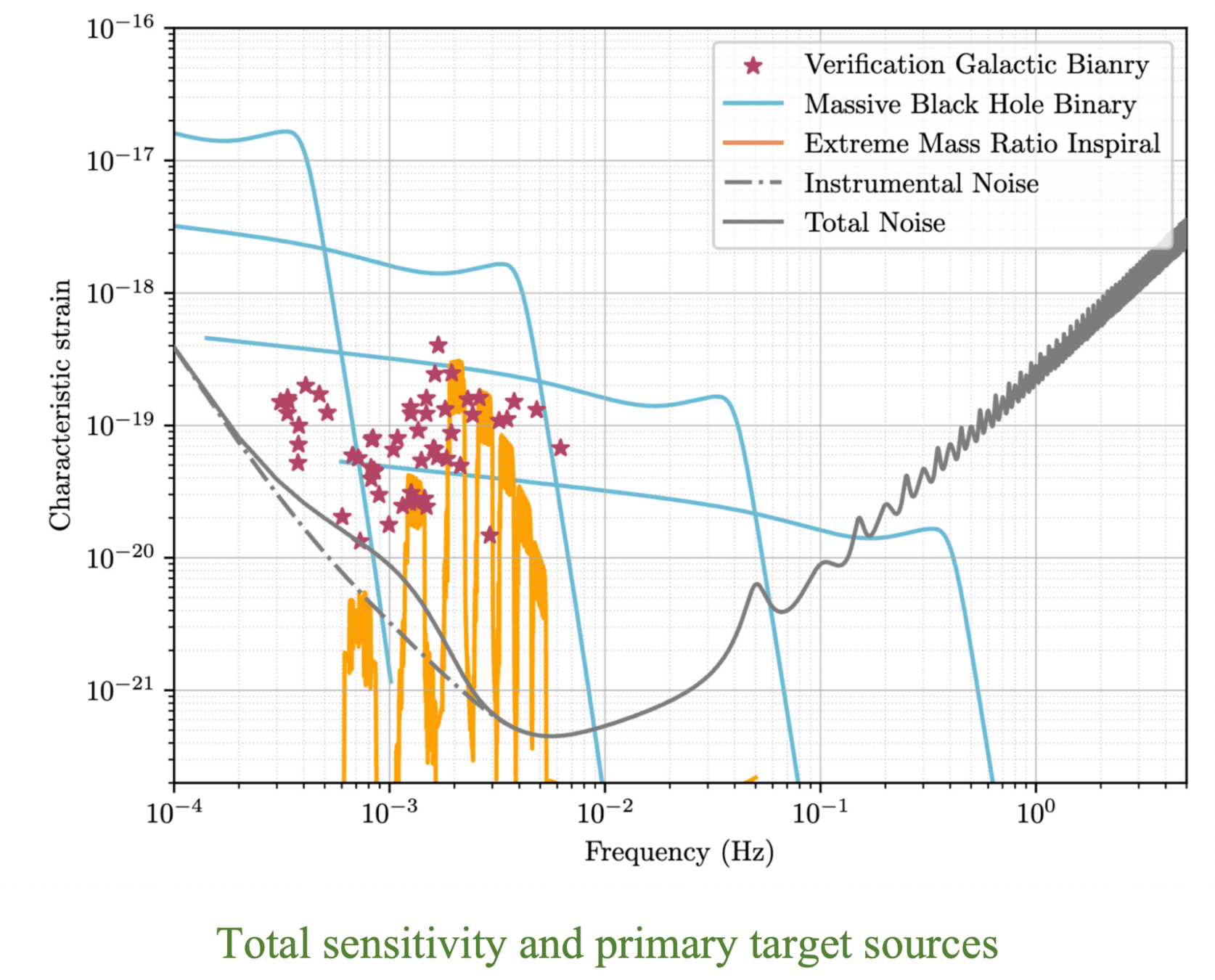
Taiji/TJ targets a broad range of mHz sources: Galactic compact binaries, MBHB/IMBH mergers, EMRIs/IMRIs, stellar-mass BBHs, stochastic backgrounds, and unknown sources.
Galactic Compact Binaries
Verification binaries,
DWDs, and the
Milky Way foreground
Massive & Intermediate BHs
EMRIs / IMRIs
Stellar-Mass Compact Binaries
Stochastic Backgrounds
Unknown Sources
MBHB mergers,
black-hole seeds, and
galaxy co-evolution
Precision probes of
massive BHs and
strong-field gravity
Long inspirals before
LVK; multiband GW astronomy
Astrophysical
foregrounds and
early-universe phase
transitions
Discovery space for
unmodeled and
unexpected signals
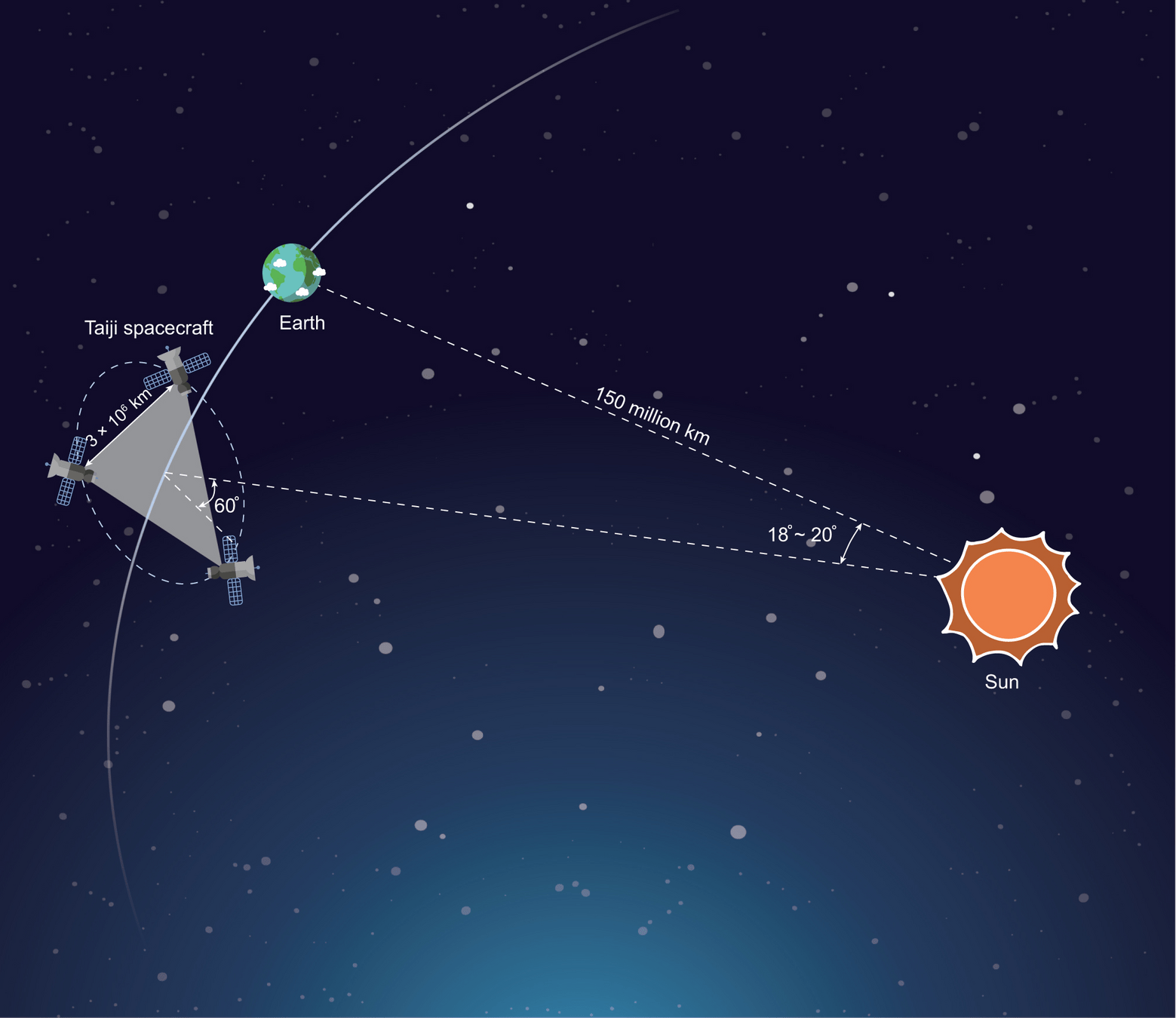
Baseline full-mission concept
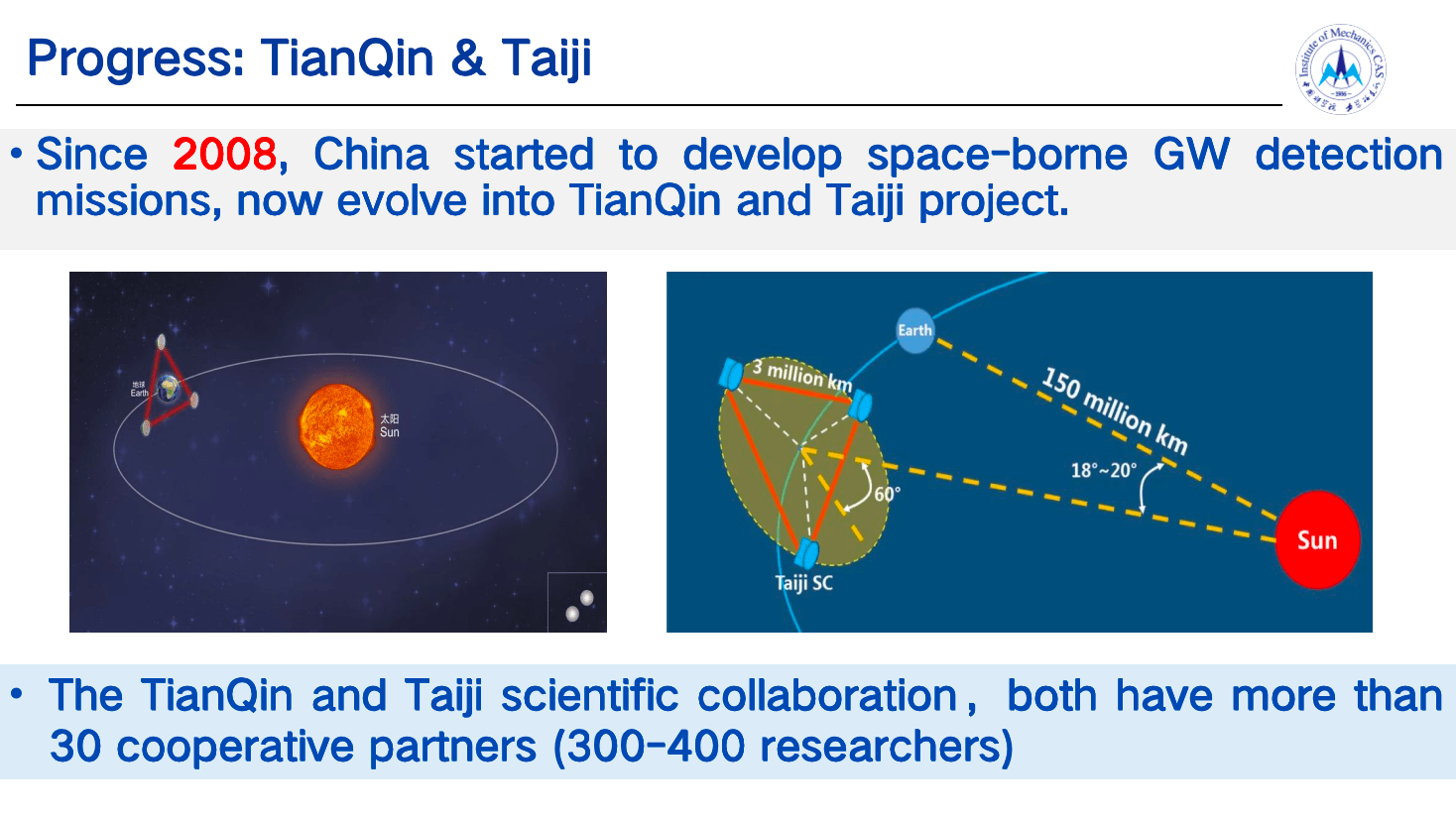
- Three drag-free spacecraft forming a near-equilateral triangular constellation
- Arm length: \(3\times 10^6\) km
- Heliocentric orbit, leading/trailing the Earth by ~\(20^\circ\)
- Laser displacement sensitivity: \(8\,\mathrm{pm}/\sqrt{\mathrm{Hz}}\)
- Test-mass acceleration noise: \(3 \times 10^{-15}\,\mathrm{m\,s^{-2}}/\sqrt{\mathrm{Hz}}\)
He WANG · ICTP-AP / UCAS
Taiji: China's Space-based GW Program
Taiji/TJ Full-Mission Concept
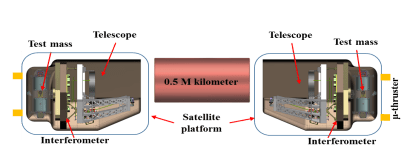
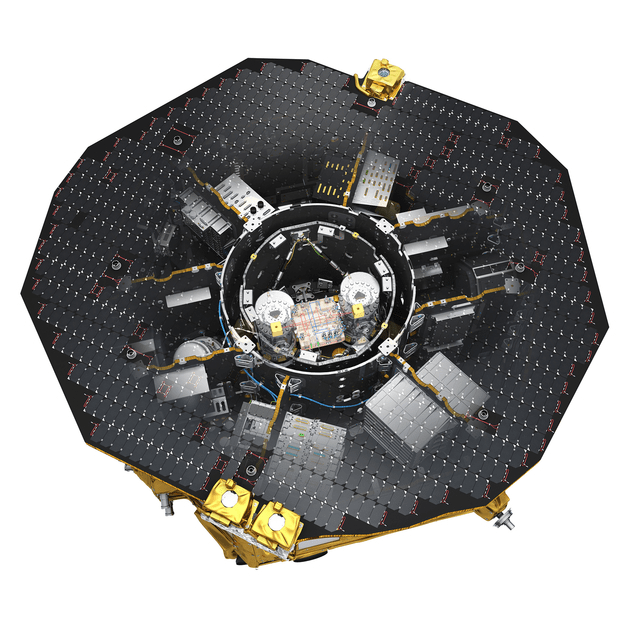
A heliocentric triangular constellation for mHz gravitational-wave astronomy
Credit: Shucheng Yang
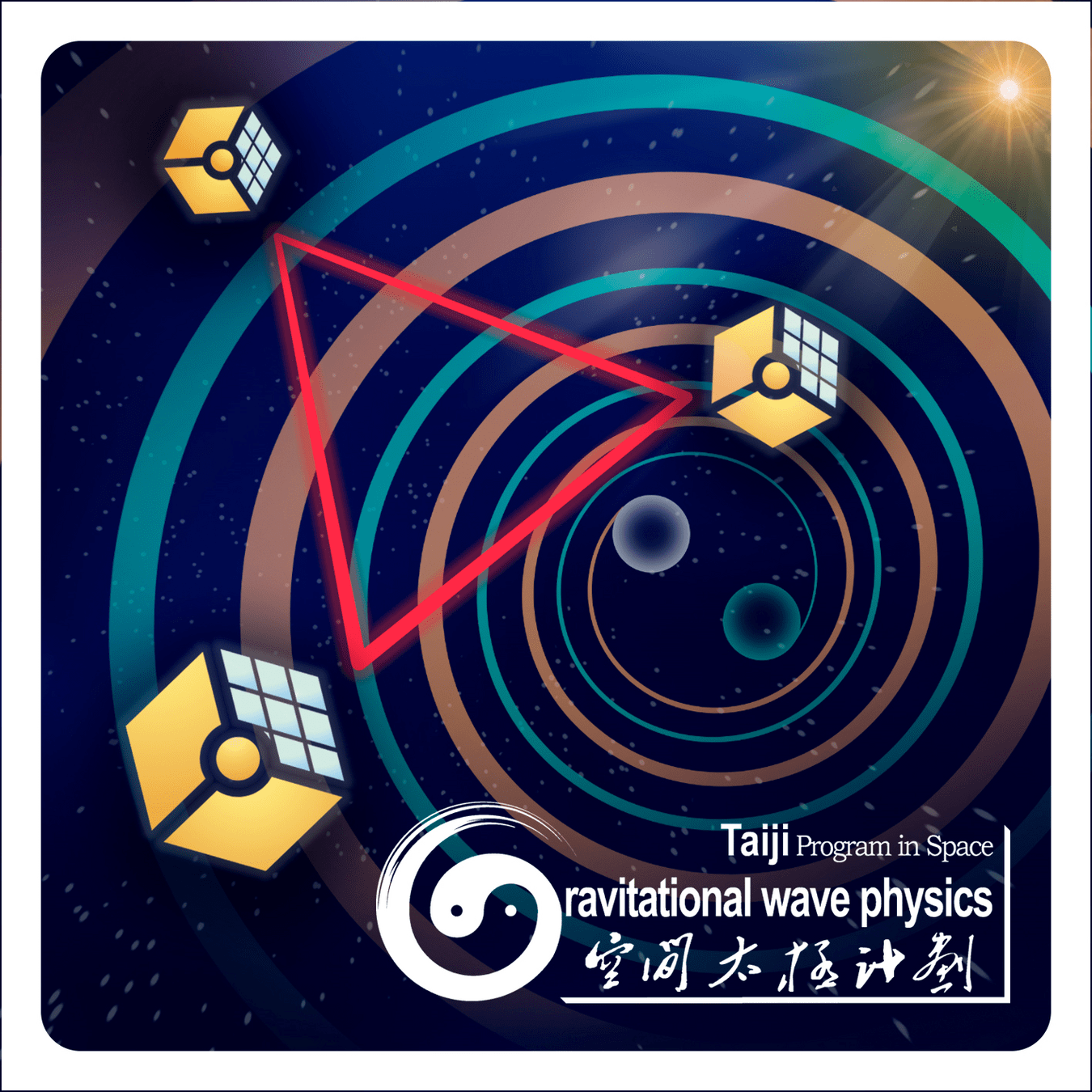
Mission idea: use million-kilometer laser interferometry to measure differential optical-path changes between free-falling test masses.
He WANG · ICTP-AP / UCAS
Taiji: China's Space-based GW Program
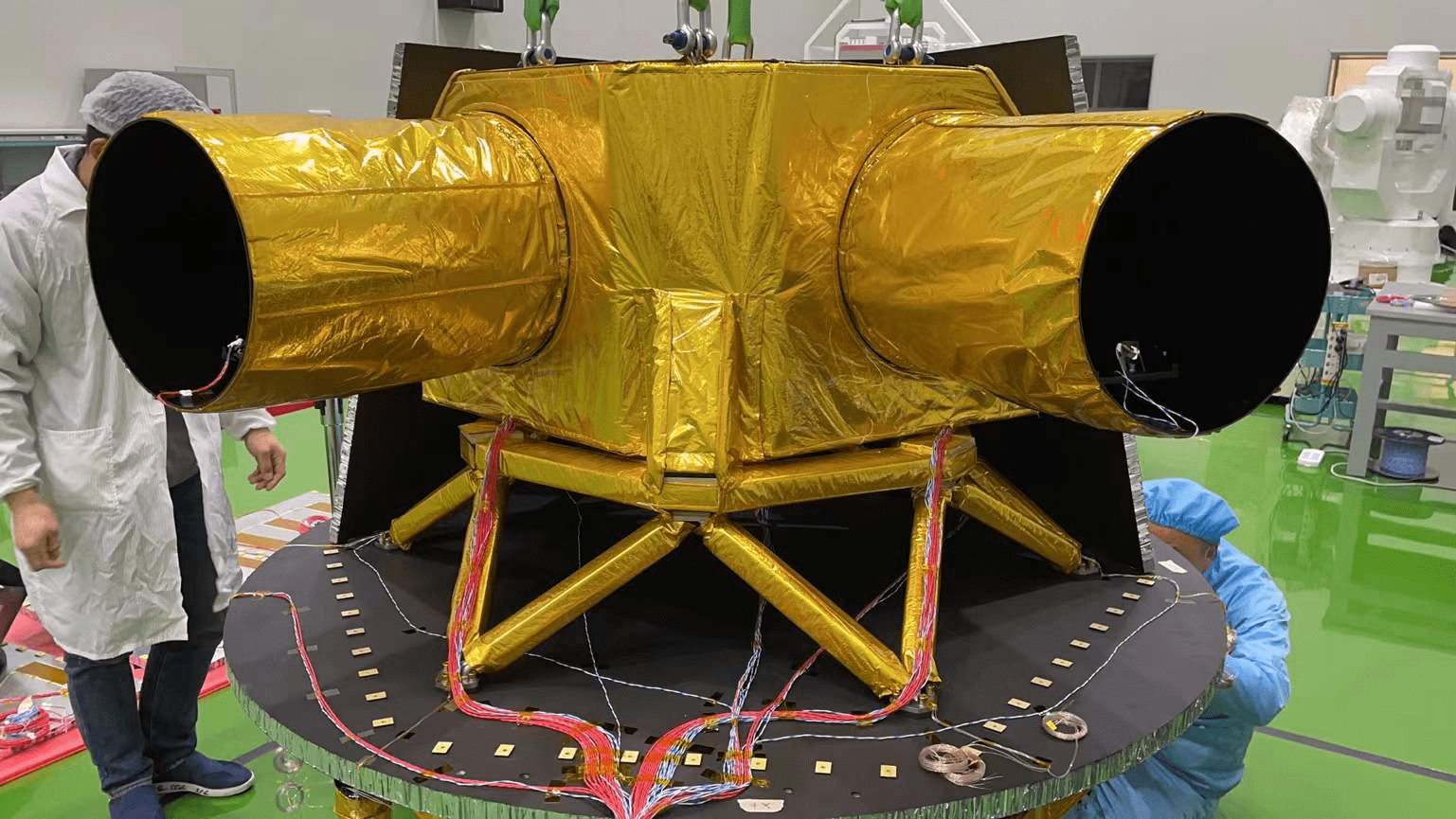
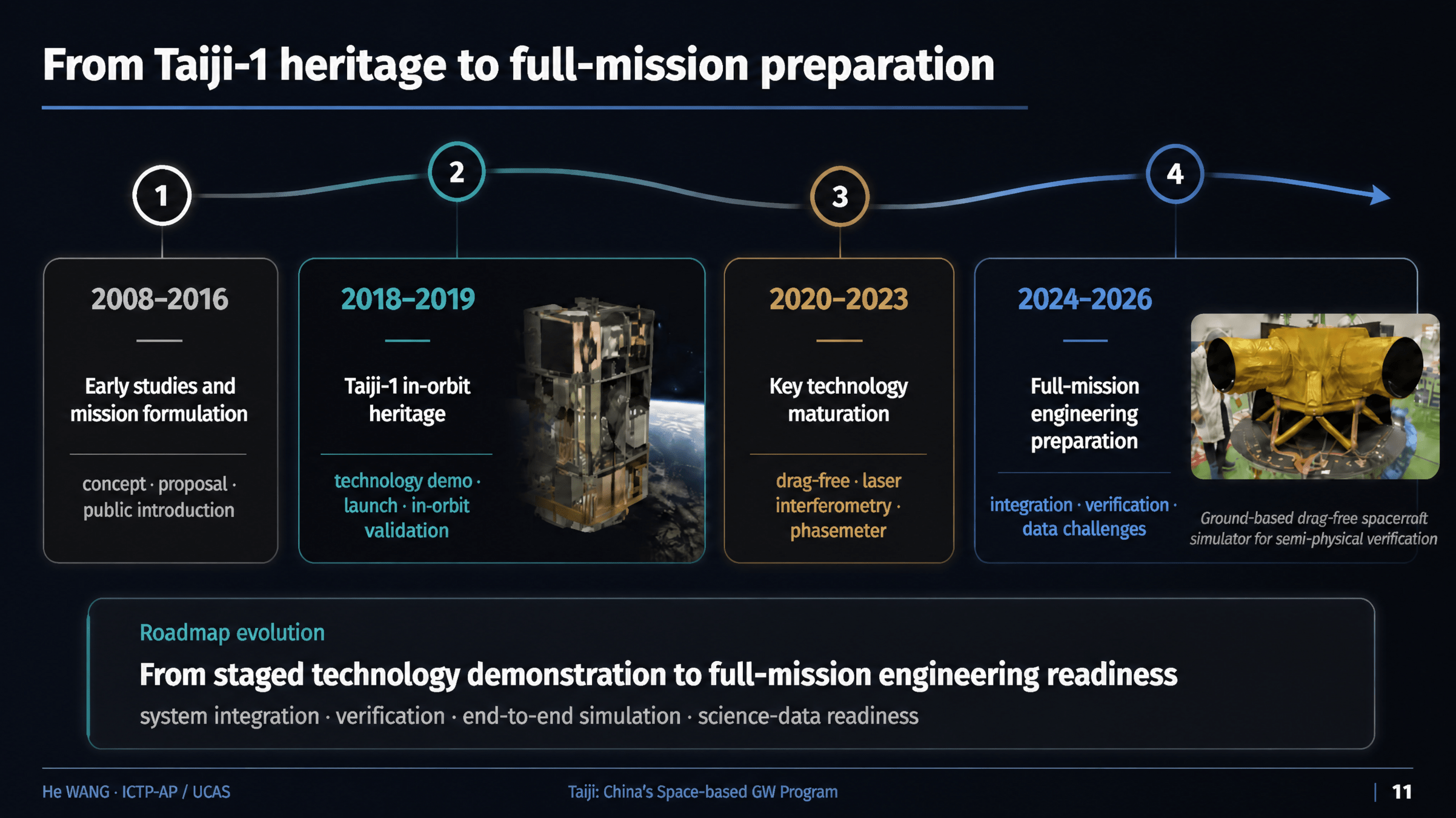
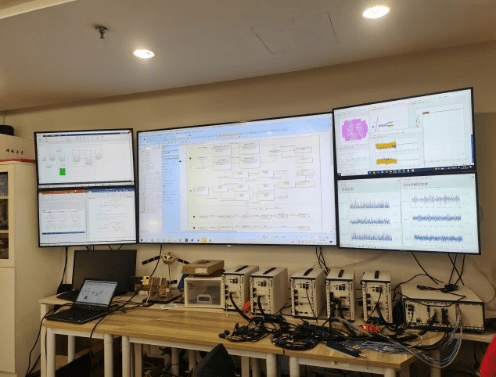
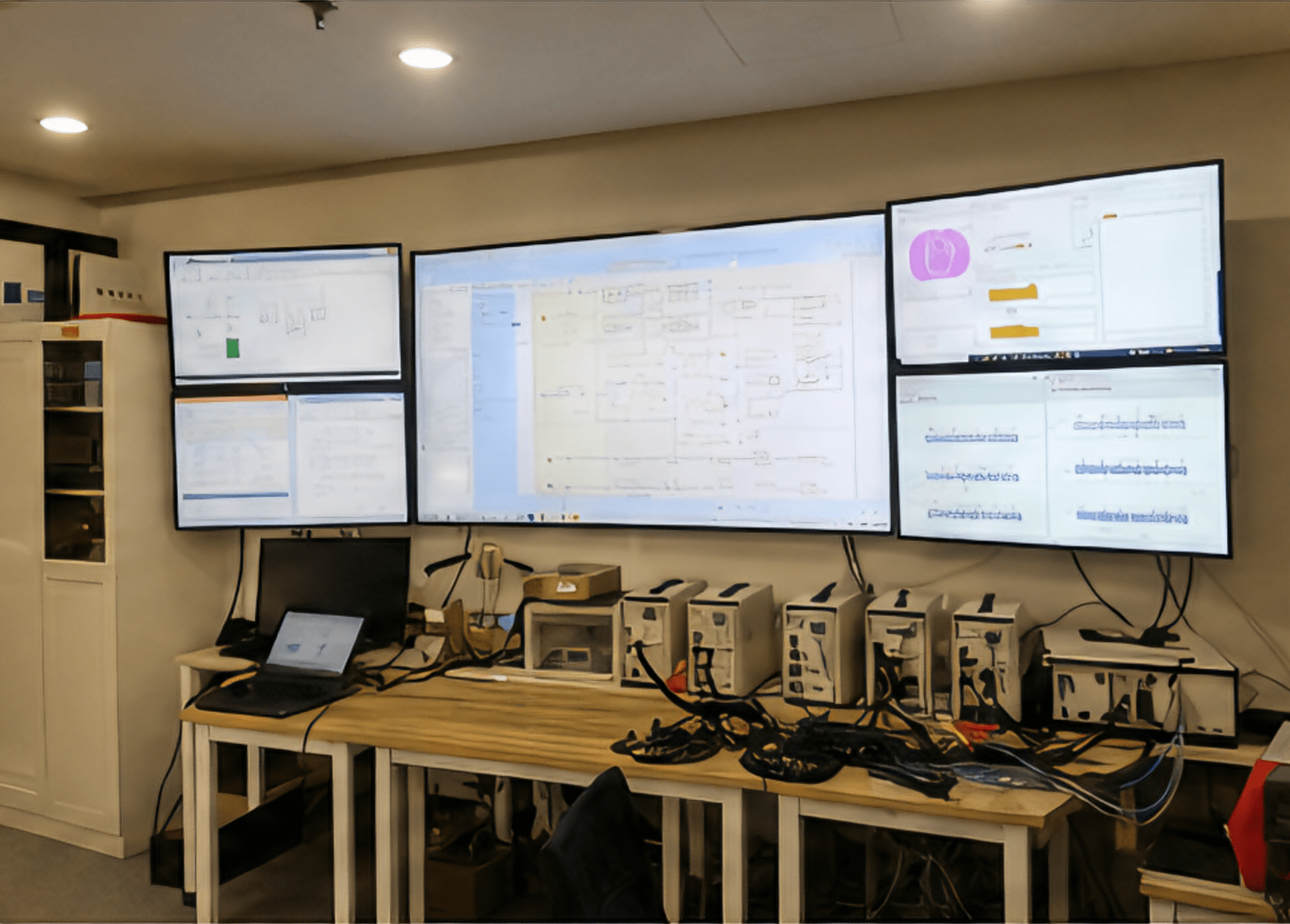
Ground-based drag-free spacecraft simulator for semi-physical verification
2008-2016
2018-2019
2020-2023
2024-2026
From Taiji-1 heritage to full-mission preparation
Roadmap evolution
The historical Taiji-1/2/3 roadmap has evolved toward full-mission engineering, integration, verification, and science-data readiness.
Early studies and
mission formulation
Taiji-1 in-orbit
heritage
Key technology
maturation
Full-mission
engineering
preparation
concept · proposal ·
public introduction
technology demo ·
launch · in-orbit
validation
drag-free · laser
interferometry ·
phasemeter ·
grav. reference sensor
integration · verification · data challenges
Stage 3 — Key technology maturation
2020–2025: key technology breakthroughs and TRL assessment
* interferometer;
* ATP/acquisition tracking pointing;
* GRS;
* micro-propulsion;
* drag-free control;
* ultra-stable platform;
* noise suppression and signal inversion;
* end-to-end simulation.
Stage 4 — Full-mission engineering preparation
Current focus: full three-satellite mission engineering, integration, and verification
* mission engineering design;
* MOSA payload subsystem integration;
* drag-free multi-level semi-physical verification;
* three-arm scientific interferometer verification;
* end-to-end simulation and data pipeline readiness.
Stage 1 — Early studies and mission concept
2008–2018: concept studies and mission formulation
* CAS-led early studies of space-borne GW detection;
* Taiji publicly introduced internationally in 2016;
* mission concept and science objectives matured through published studies.
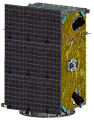
1. Taiji-1 (2019)
发射“太极一号”单星
目标:验证技术路线可行性
干涉测距指标:100pm/Hz1/2量级
加速度噪声指标:3×10⁻⁹ms-2/Hz1/2
Stage 2 — Taiji-1 in-orbit heritage
2019: Taiji-1 technology demonstration and geodetic output
* single-satellite technology demonstration;
* laser interferometry, GRS, micro-thrusters, drag-free control, thermal control;
* global gravity field / geoid model as a scientific-geodetic output.
2. Taiji-2 (202x)
发射“太极二号”卫星
目标:日心轨道高精度控制与星间高精度干涉测量关键技术
干涉测距指标:xx pm/Hz1/2量级
加速度噪声指标:xx m s-2/Hz1/2量级
The historical Taiji-1/2/3 roadmap has evolved into a more engineering-oriented path toward a full three-satellite science mission. The current emphasis is no longer simply the next technology demonstrator, but system-level design, integration, verification, and data-analysis readiness for the full mission concept.
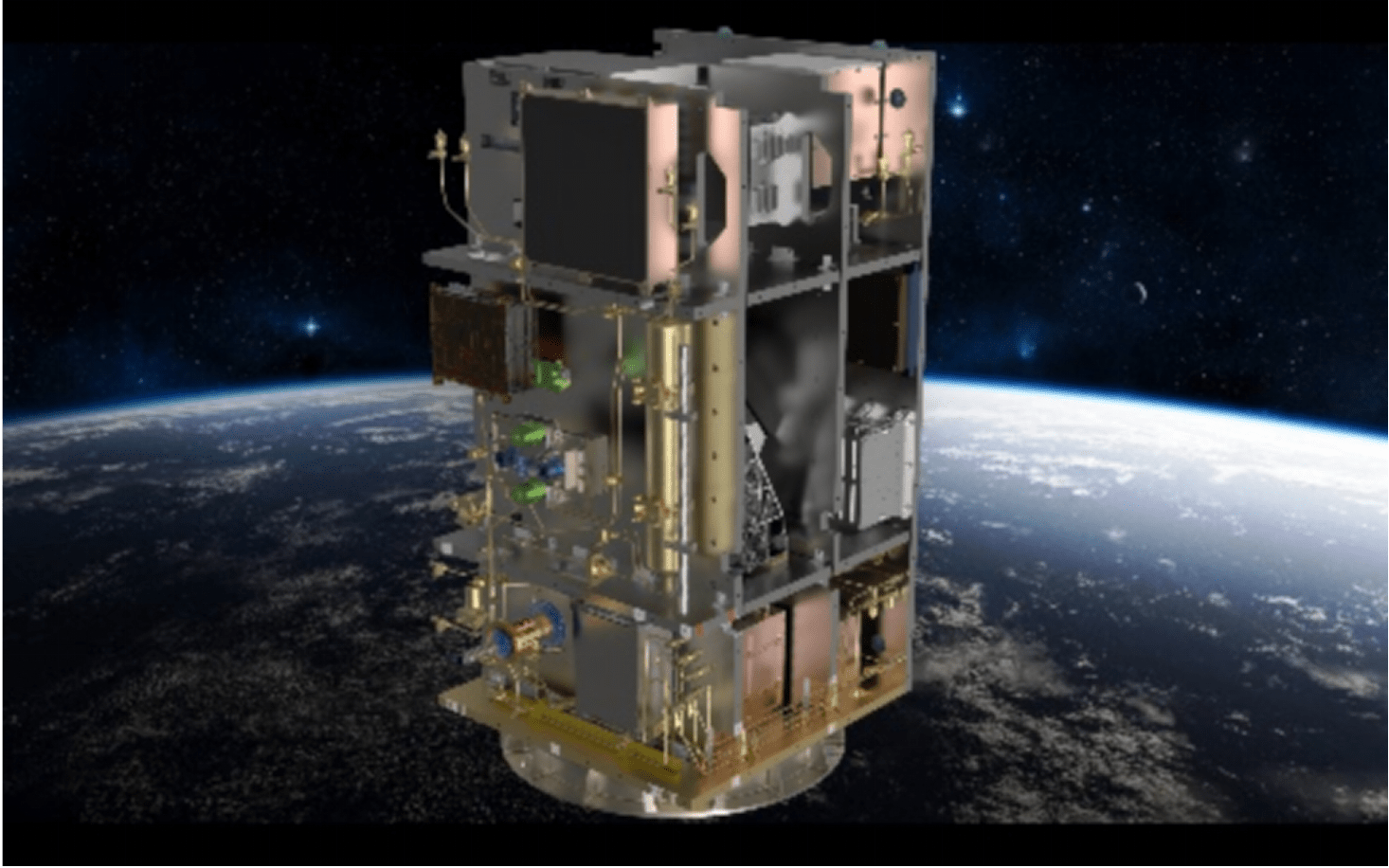
From Taiji-1 heritage to full-mission preparation
1. Taiji-1 (2019)
发射“太极一号”单星
目标:验证技术路线可行性
干涉测距指标:100pm/Hz1/2量级
加速度噪声指标:3×10⁻⁹ms-2/Hz1/2
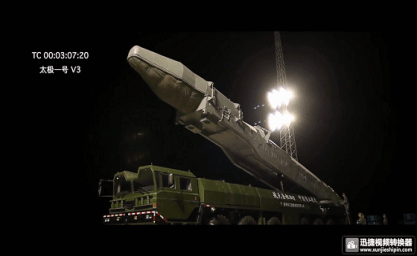
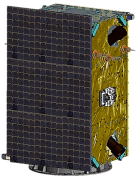
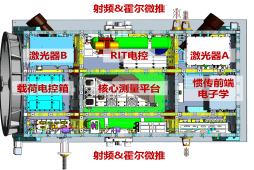
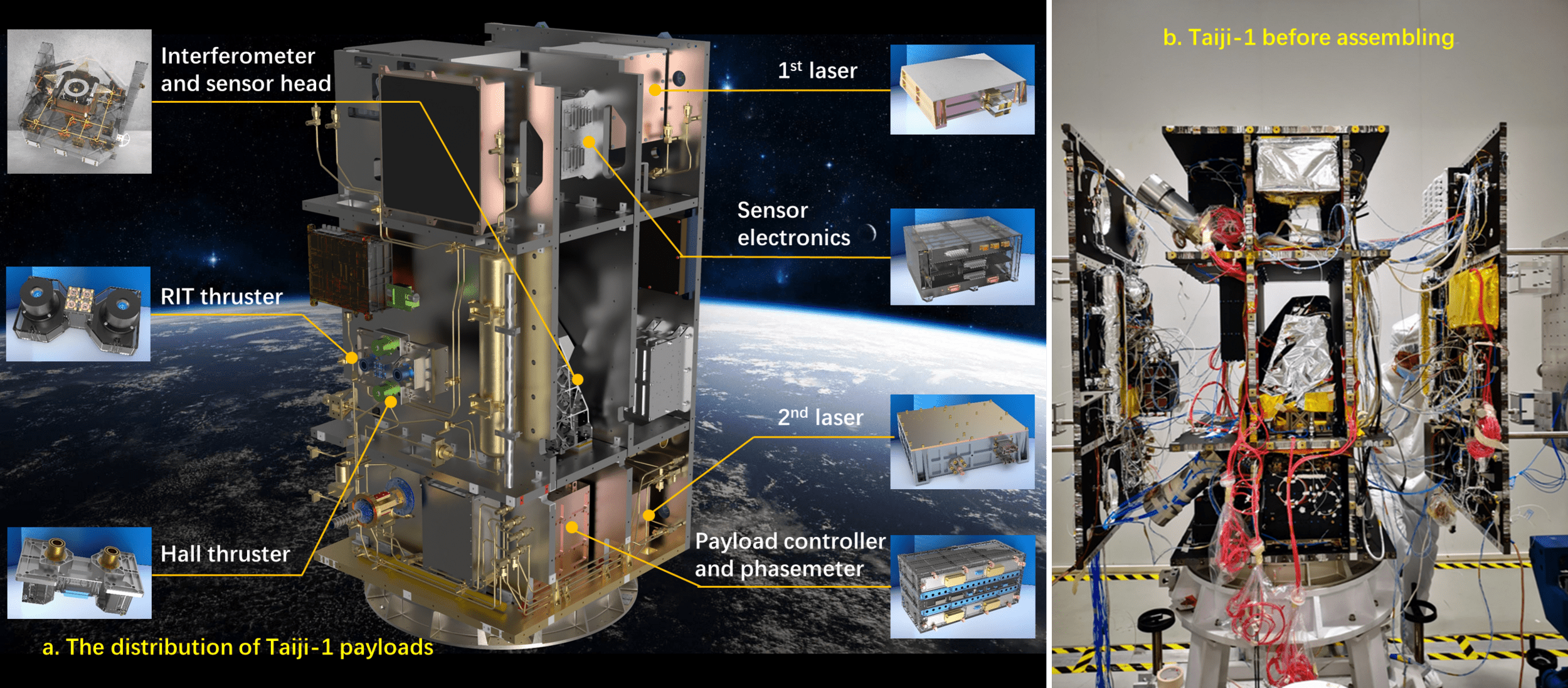
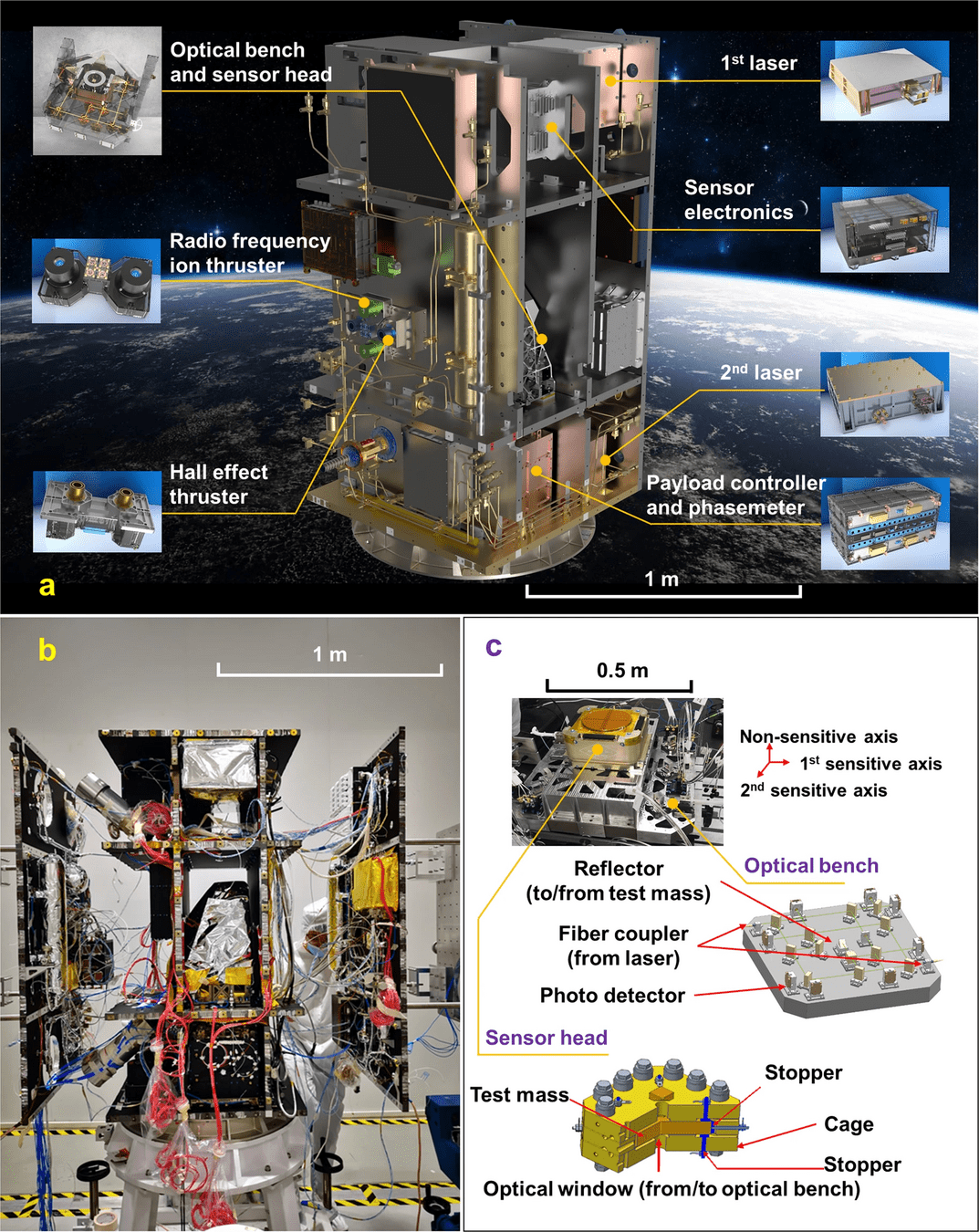
- Launched in 2019 as a technology demonstrator for space-based GW detection.
He WANG · ICTP-AP / UCAS
Taiji: China's Space-based GW Program
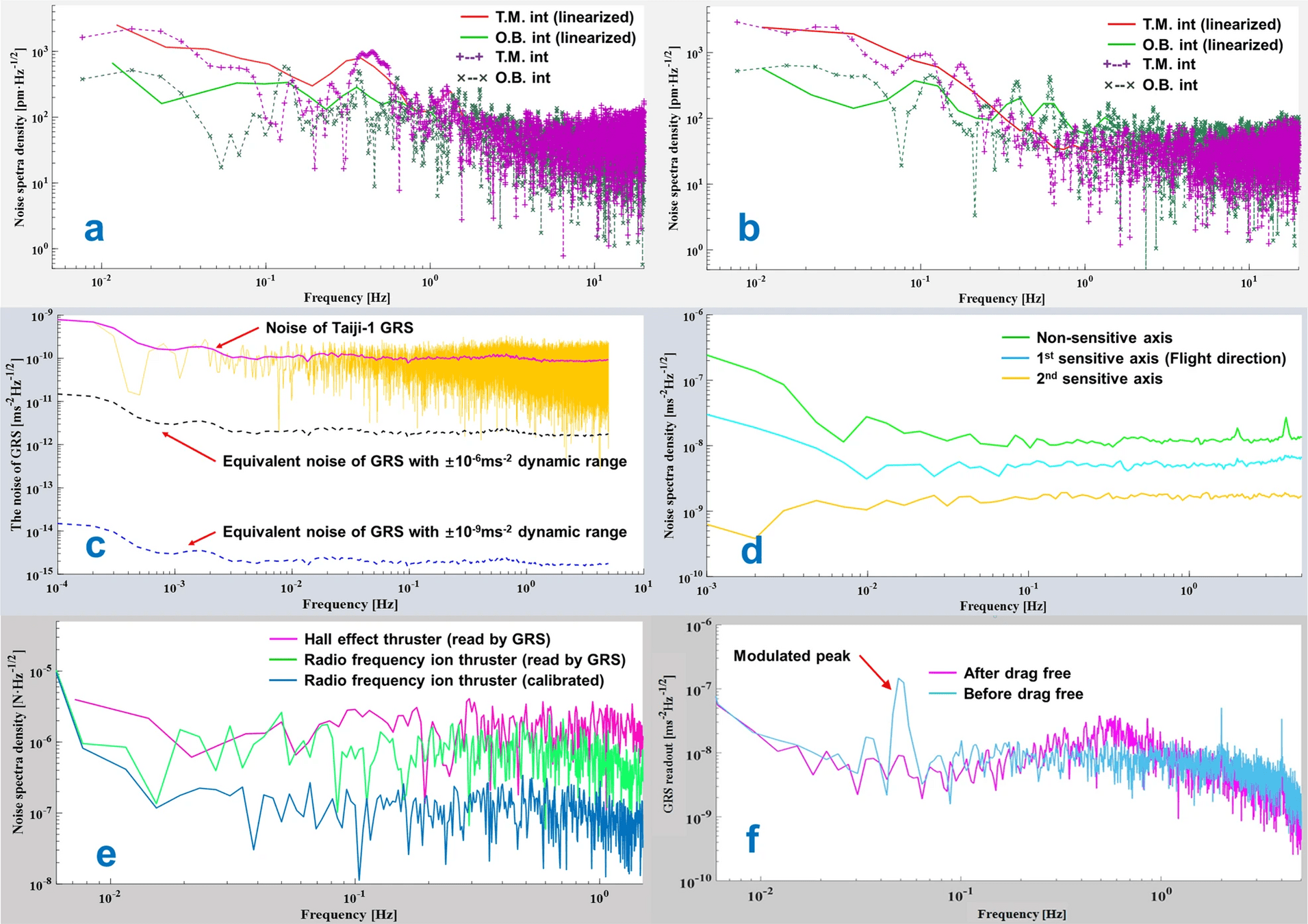
Taiji-1: in-orbit technology demonstration
Single-satellite validation of key payload and control technologies
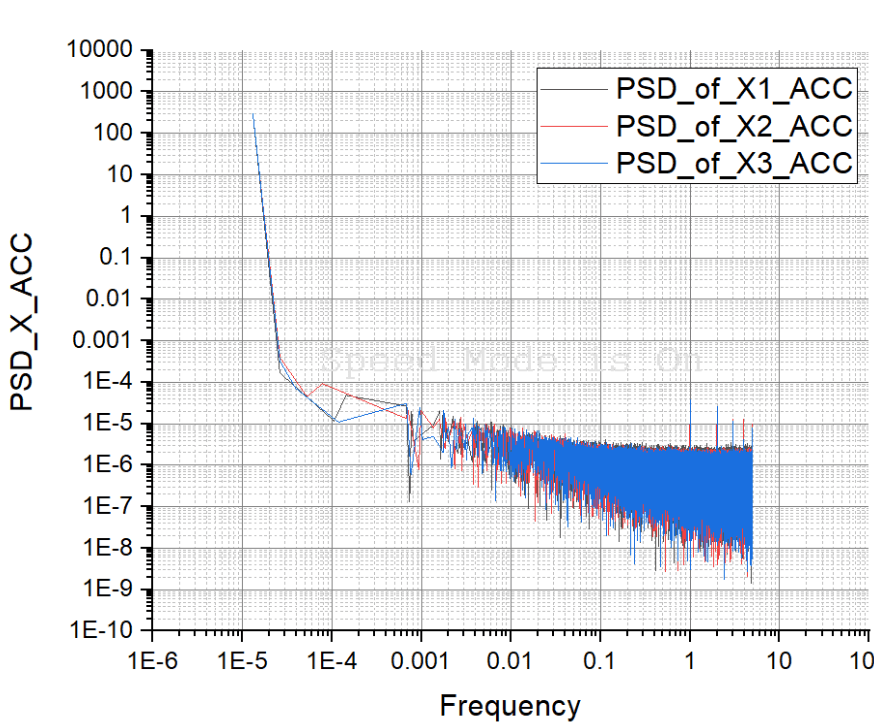
Drag-free test: residual acceleration before/after control-loop closure
Representative in-orbit results
- Laser interferometry: \(100\,\mathrm{pm}/\sqrt{\mathrm{Hz}}\), reaching \(25\,\mathrm{pm}/\sqrt{\mathrm{Hz}}\)
- Gravitational reference sensing: \(\sim 10^{-10}\,\mathrm{m\,s^{-2}}/\sqrt{\mathrm{Hz}}\)
- Micro-thrusters: \(\sim 1.5\times10^{-7}\,\mathrm{N}/\sqrt{\mathrm{Hz}}\)
- Drag-free test: \(\sim 10^{-8}\,\mathrm{m\,s^{-2}}/\sqrt{\mathrm{Hz}}\)
- Thermal control: \(\pm 2.6\,\mathrm{mK}\)
Source: Taiji Scientific Collaboration, Communications Physics 4, 34 (2021)
Take-away: Taiji-1 was not a full GW detector, but it provided in-orbit heritage for the measurement and control technologies required by Taiji/TJ.
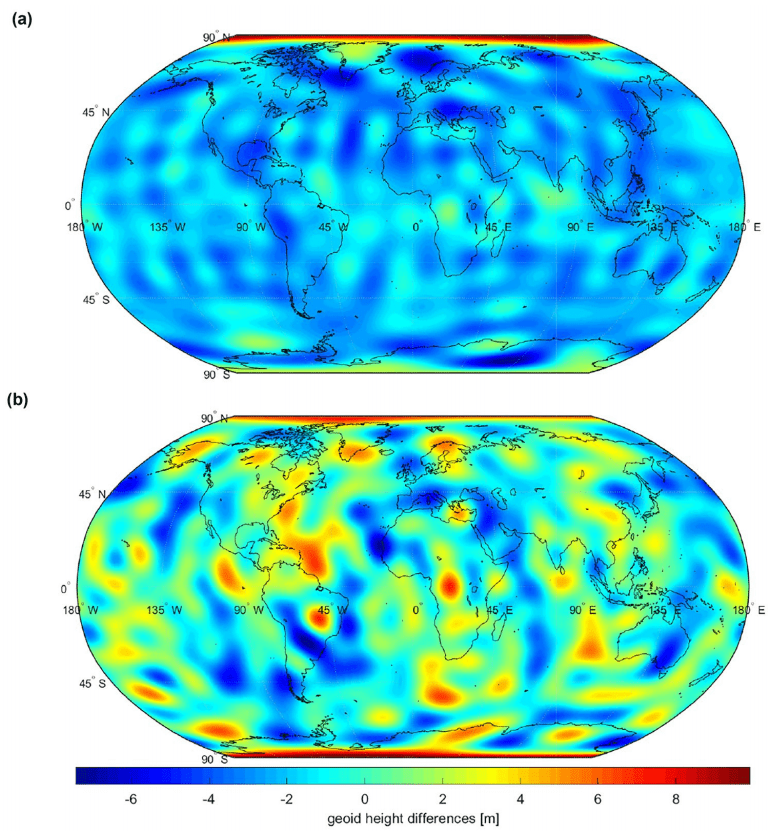
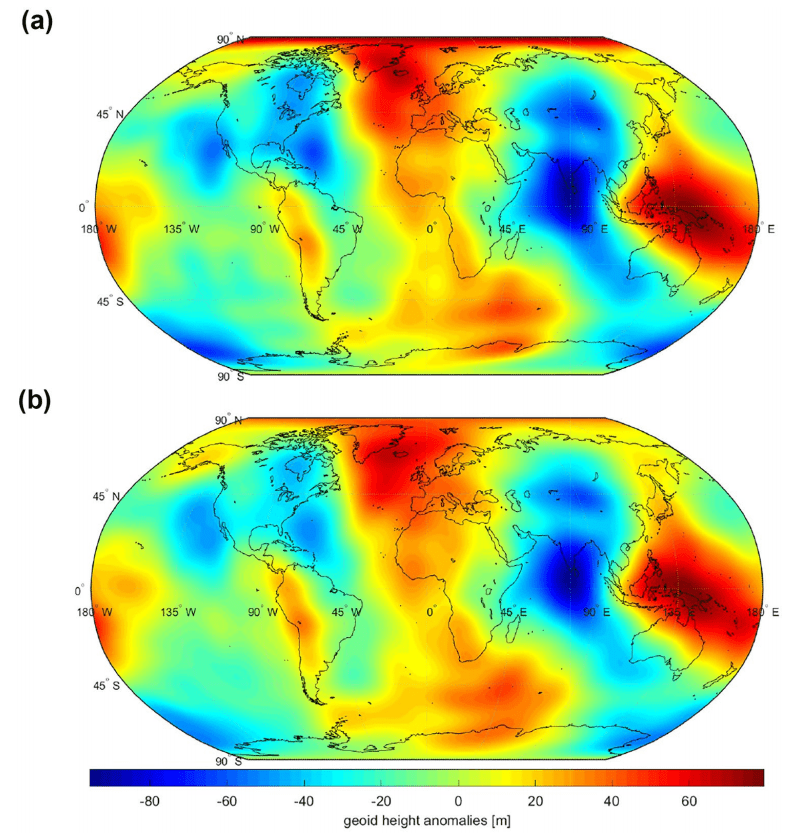
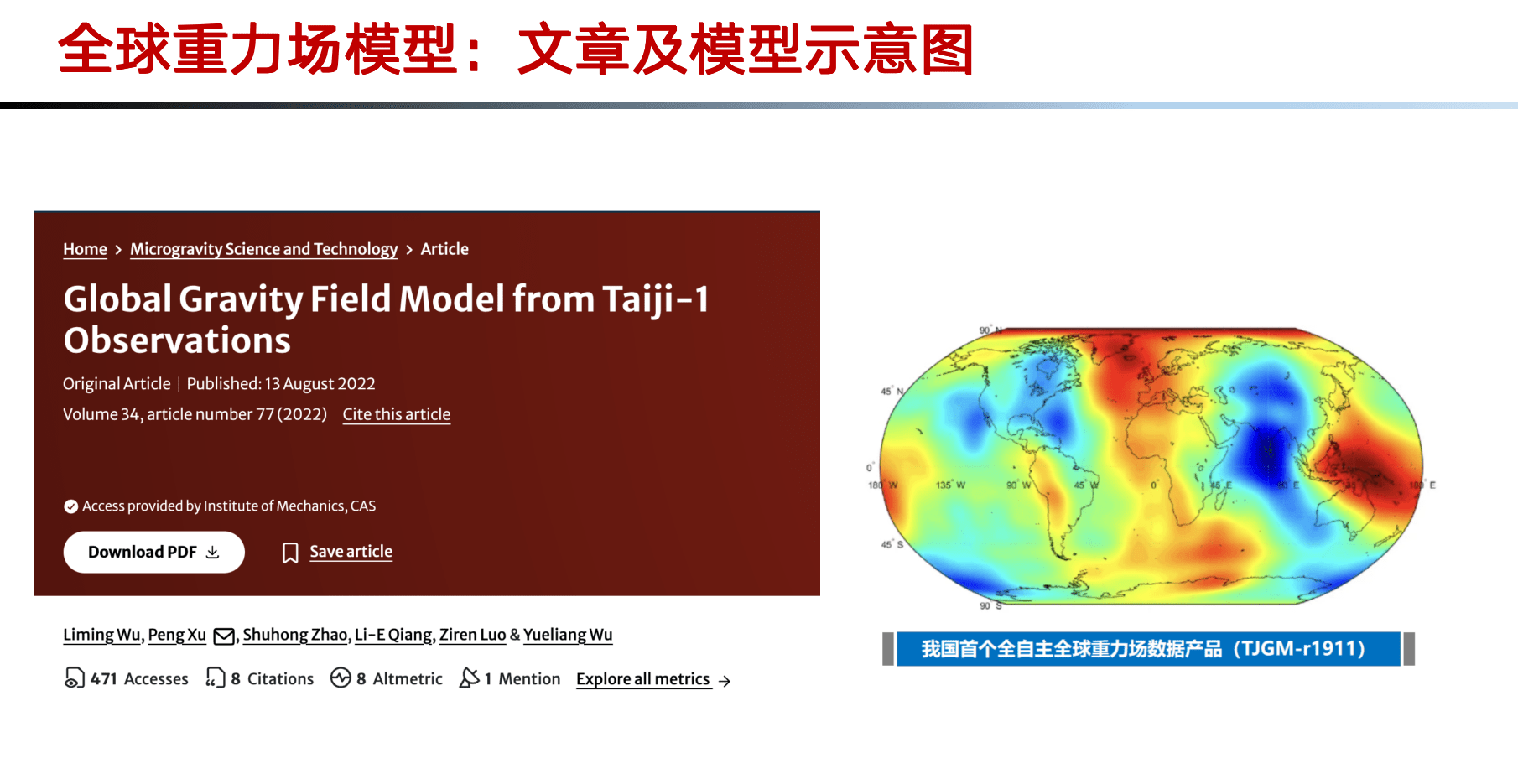
Yue-Liang Wu et al., Microgravity Sci., Technol. 34, 77 (2022). arXiv:2203.05876
Taiji-1 observations enabled the construction of a global gravity-field model: TJGM-r1911
Taiji-1 beyond technology: global gravity-field output
From in-orbit precision measurement to geodetic science
He WANG · ICTP-AP / UCAS
Taiji: China's Space-based GW Program

Geoid height anomalies from TJGM-r1911
Geoid height differences relative to EGM2008
PUBLISHED GEODETIC RESULT
GLOBAL GRAVITY-FIELD MODEL
COMPARISON WITH REFERENCE MODEL
Global Gravity Field Model from Taiji-1 Observations
Model: TJGM-r1911
Take-away: Taiji-1 demonstrated broader precision-measurement capability beyond technology validation, producing a concrete geodetic science output.
Toward Taiji-2 and full mission readiness
- Progress: Taiji-2
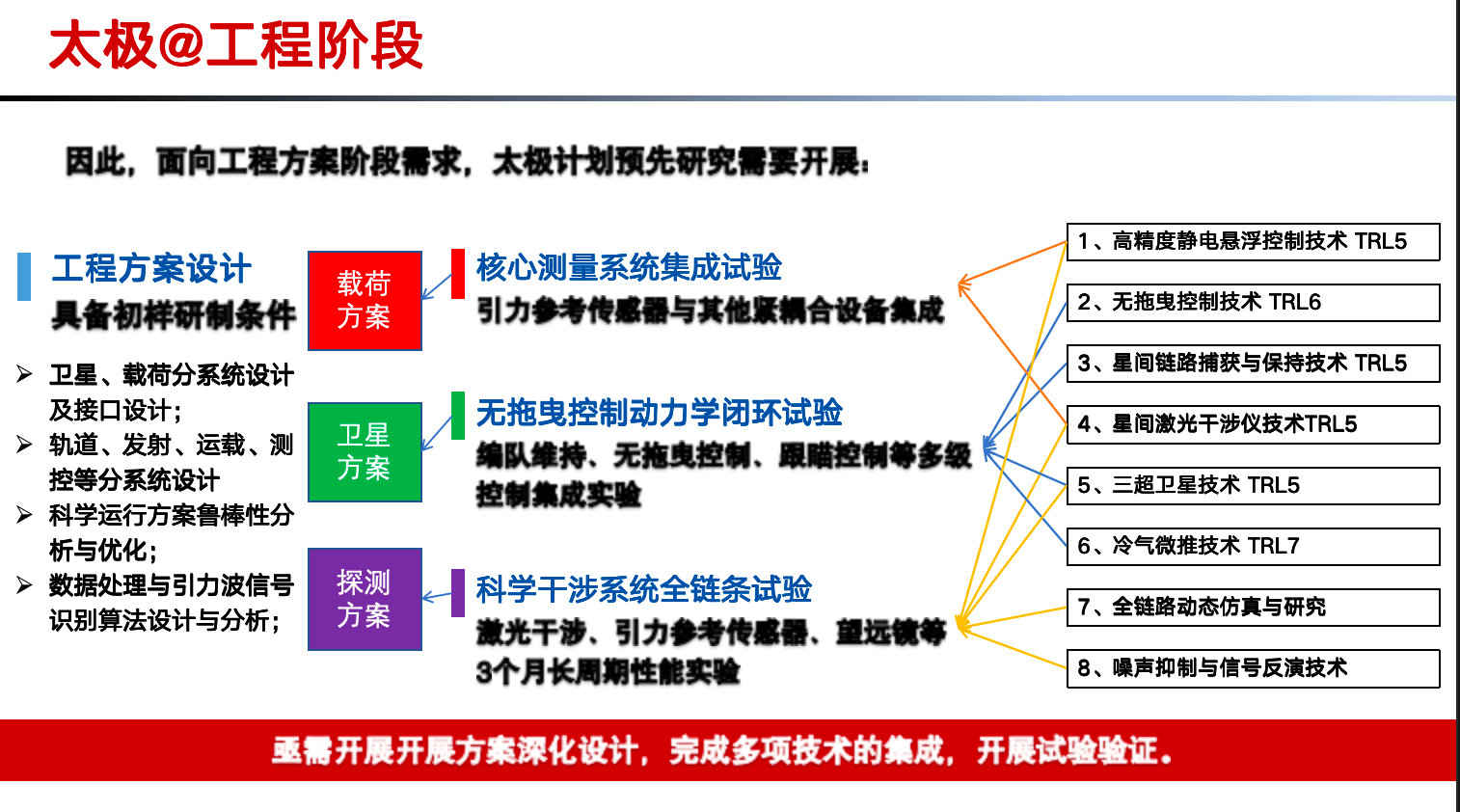
- Taiji-2 just finished phase A study, all technologies is now TRL 5 or above according to 《ISO 16290》. Ready to be approved to enter phase B1。Helio-centric, millions of kilometers arm
- The engineering model of payloads(ATP、interferometer、inertial sensor、drag-free、SC…)were experimentally tested。
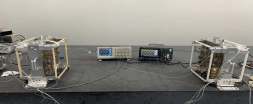
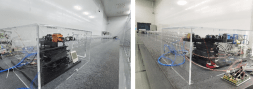
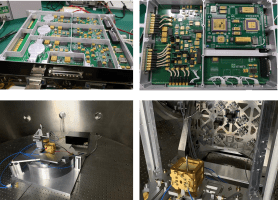
TJ-1 比较重要的科学产出(如技术验证+全球重力场)
- Target: Taiji-3
- 白皮书
The measurement chain: from test masses to science data
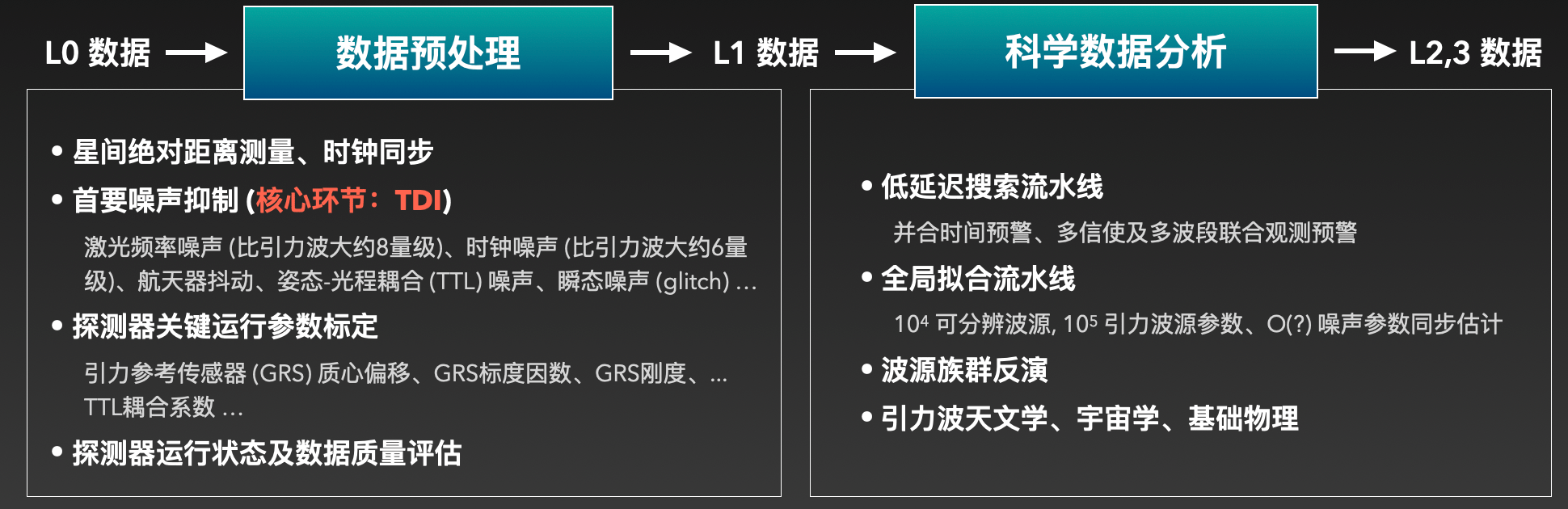
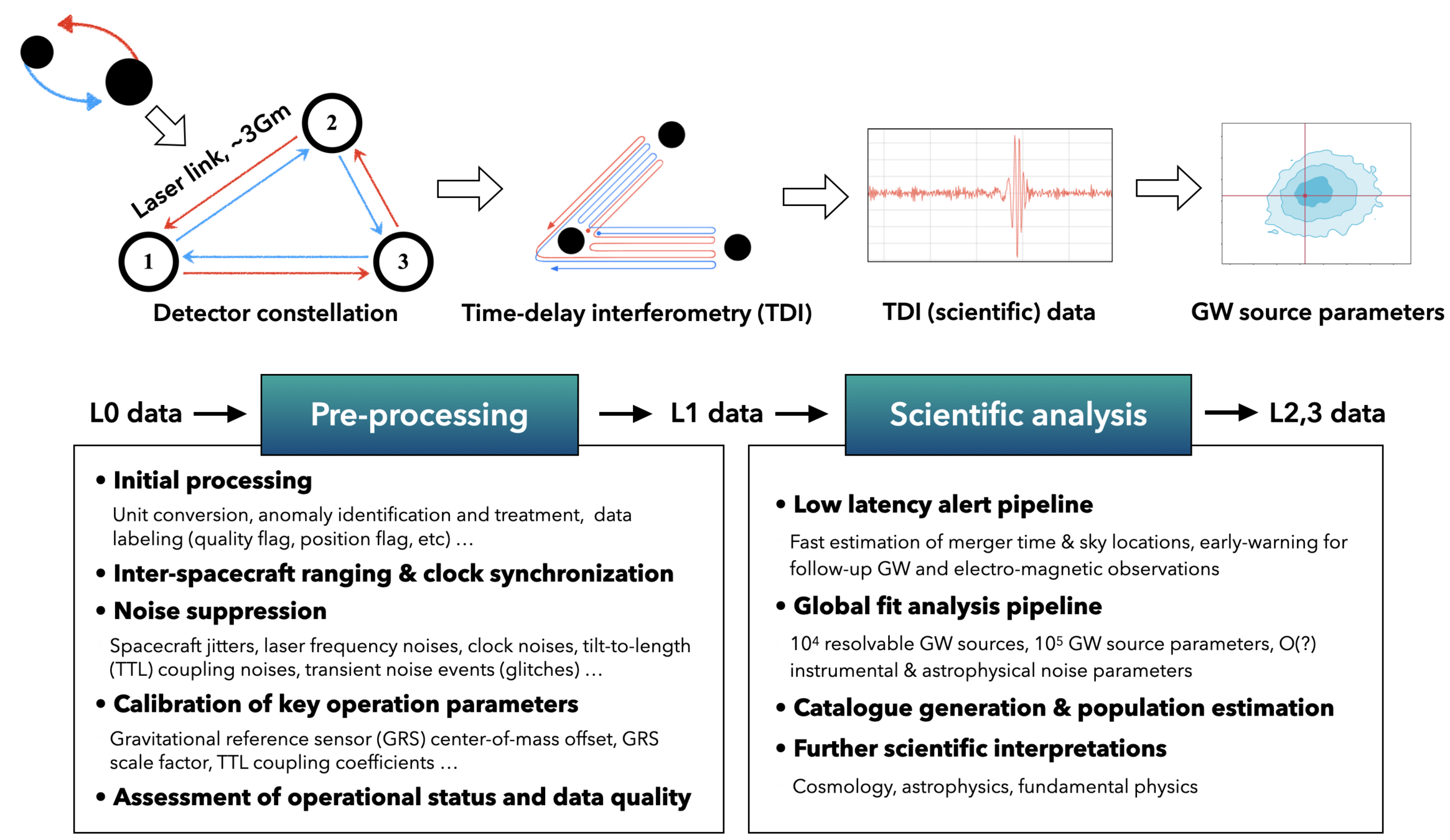
L0: 原始激光干涉测量数据
TDI处理
L1: TDI科学数据
L2,3: 波源及参数目录
Inter-satellite interferometry and laser-link development
Interferometer
- Optical bonding
- Precise positioning
- Two 1:1 models
- Establishing laser link and test
- Phase-meter
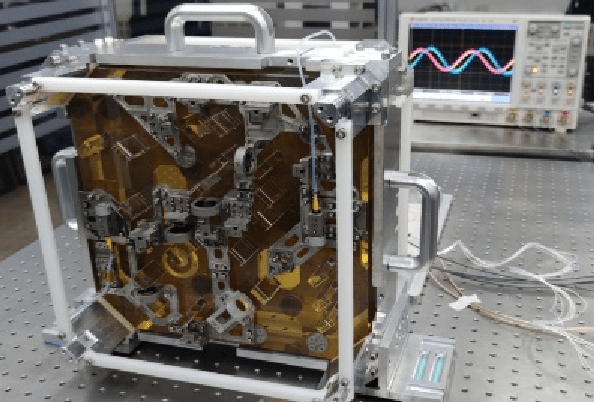
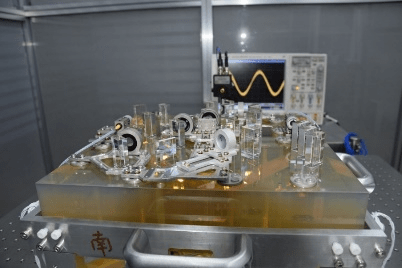
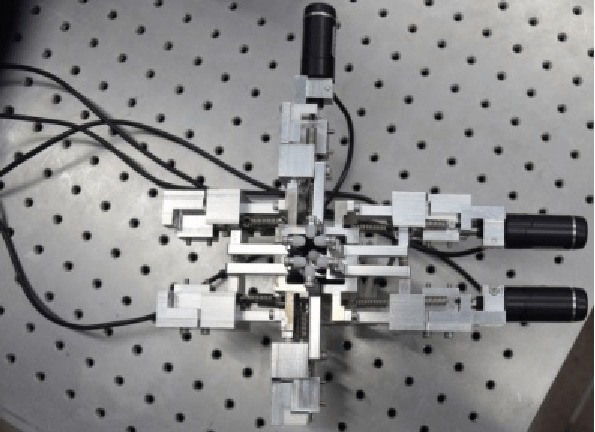
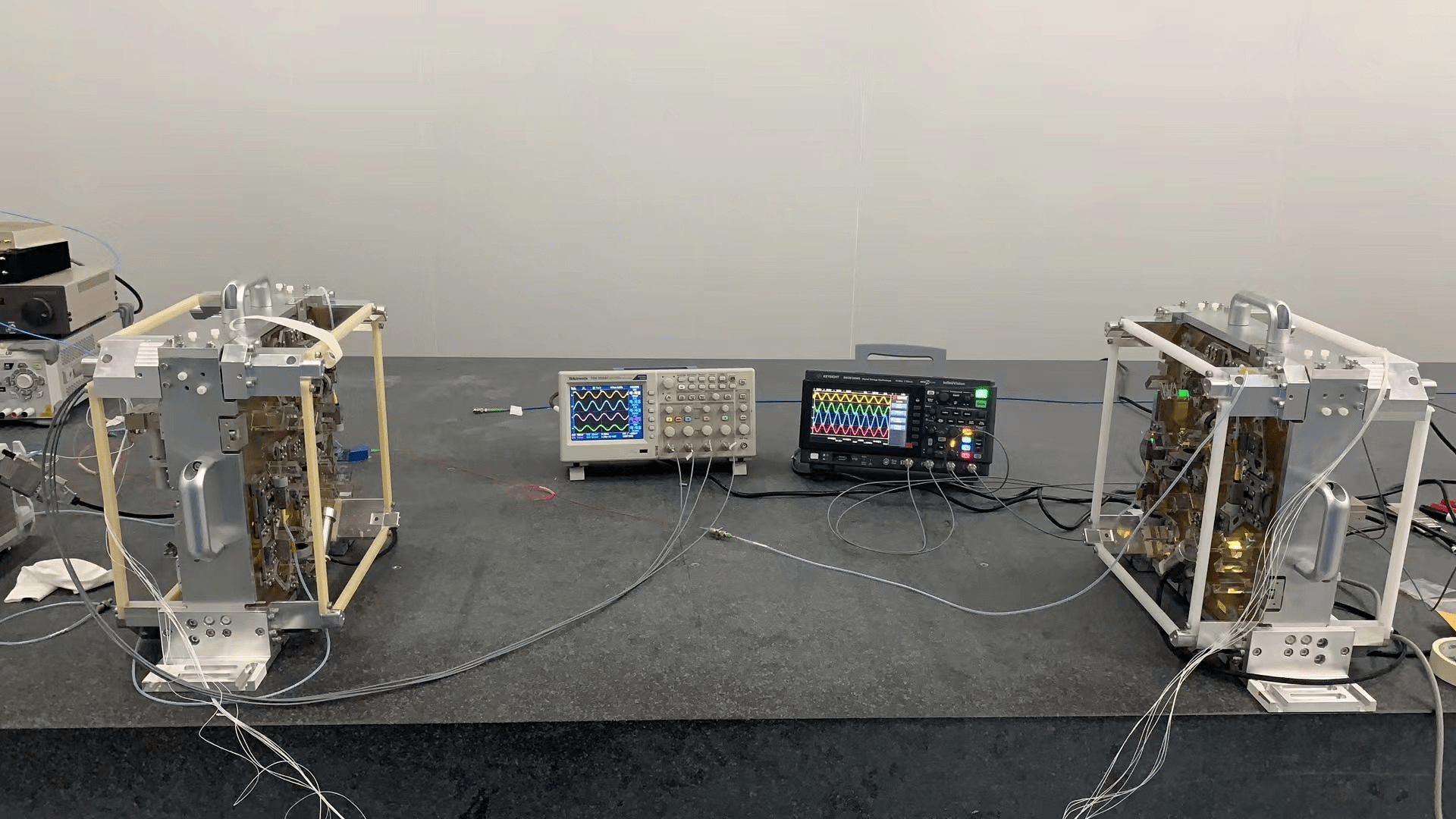
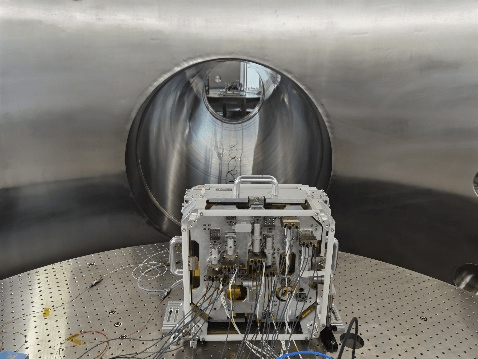
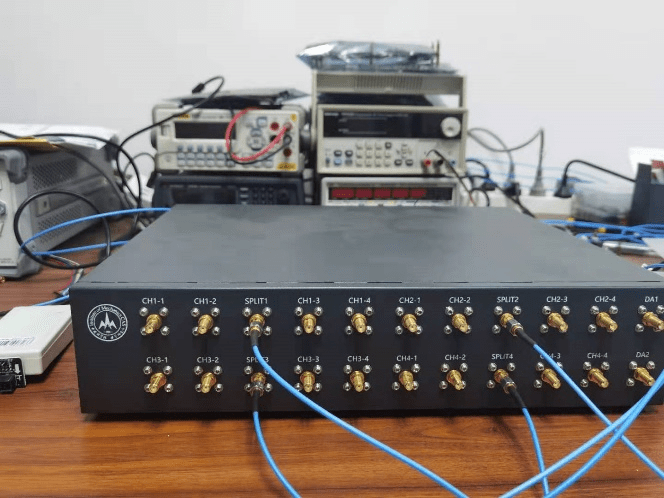
- Deviation: 42 μrad, 9 μm
- Noise PSD: 6pm/Hz\(^{1/2}\)
- Phase meter: 1μrad/Hz\(^{1/2}\)
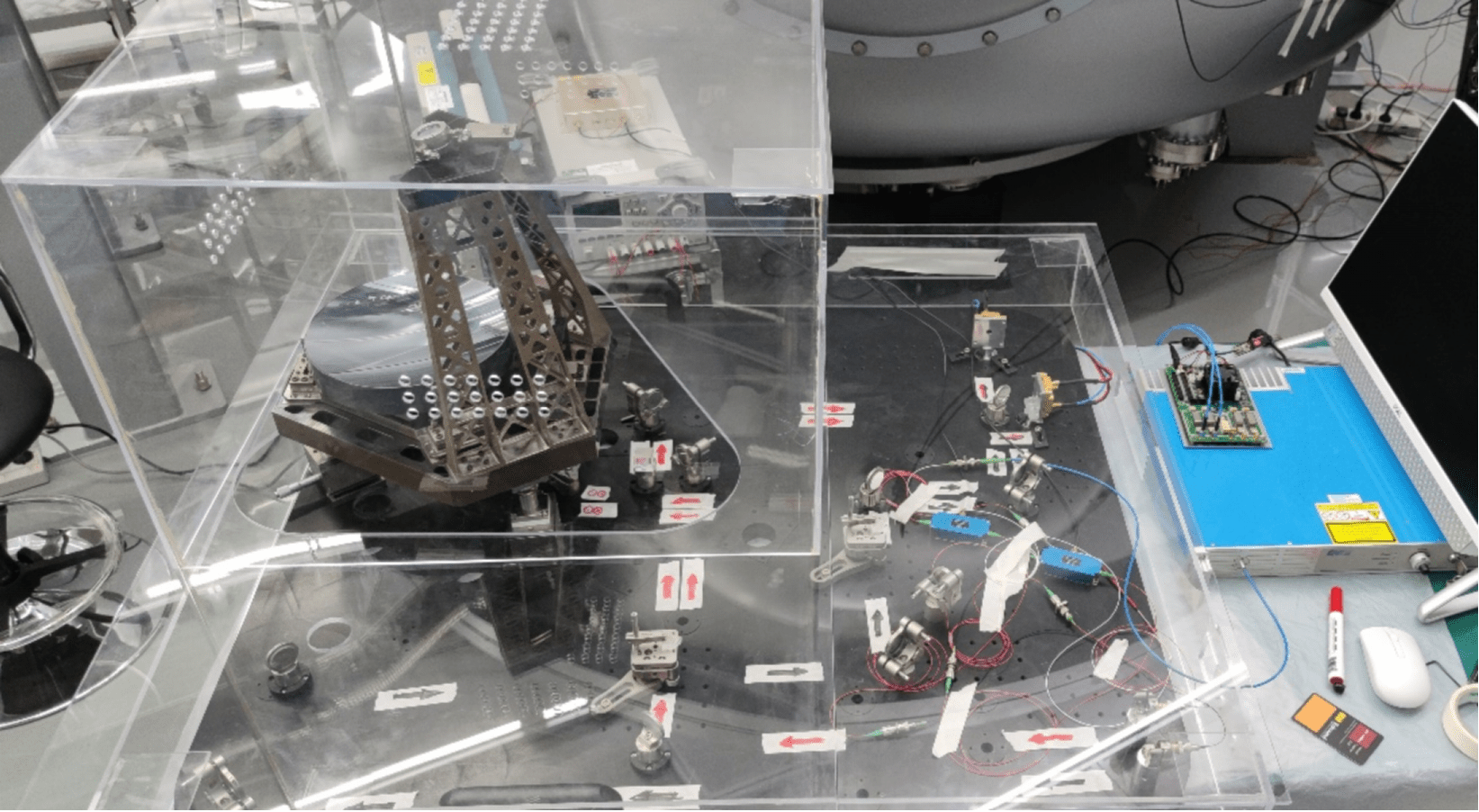
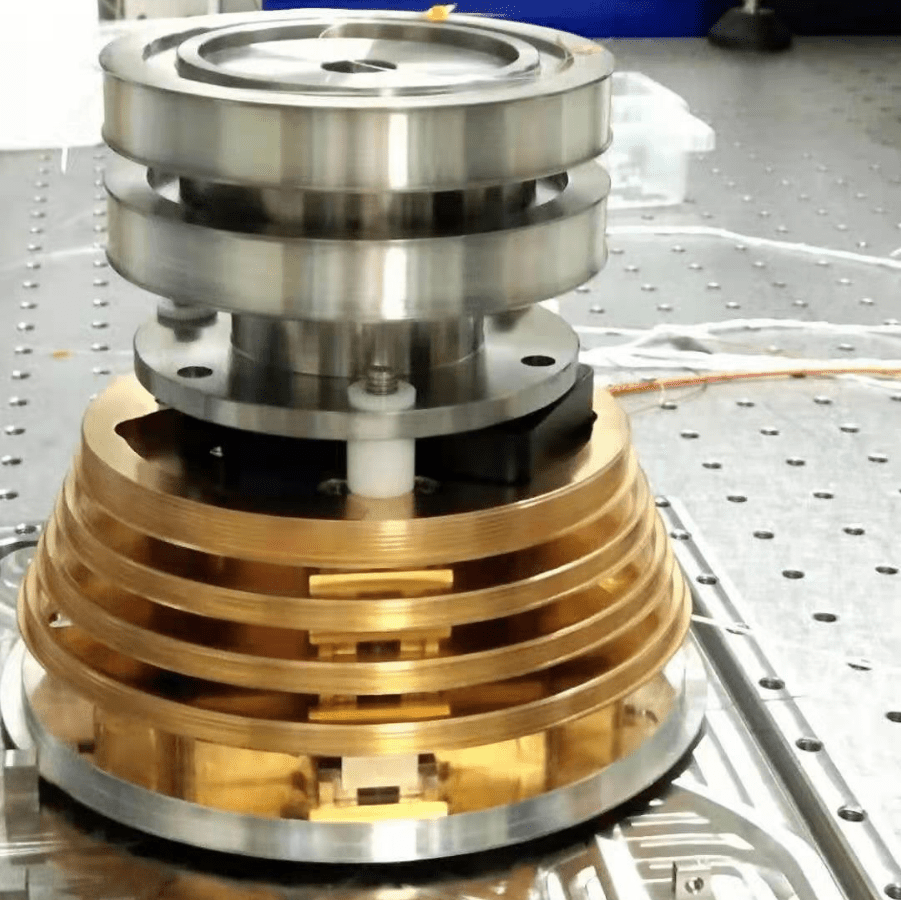
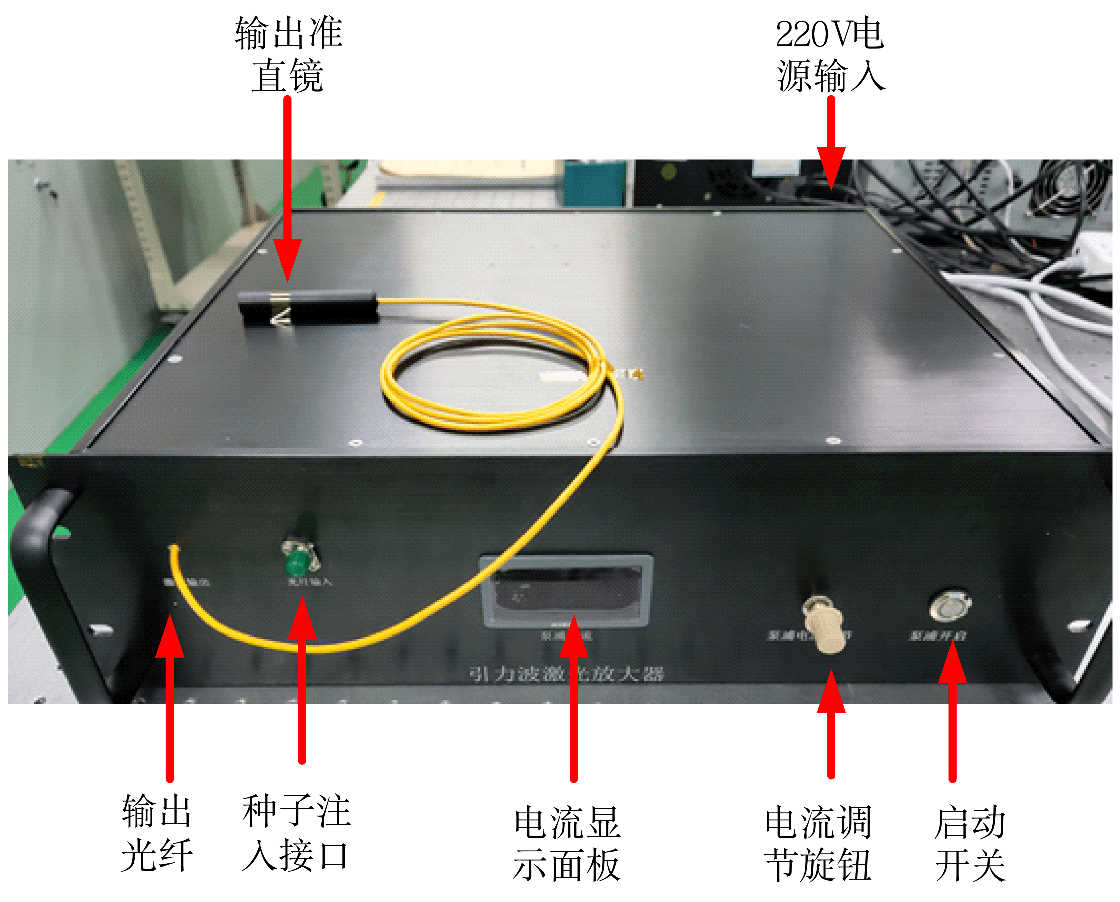
- Laser head, amplifier, FP locking
- 6Hz/Hz\(^{1/2}\), 4W, 10\(^{-4}\)/Hz\(^{1/2}\)
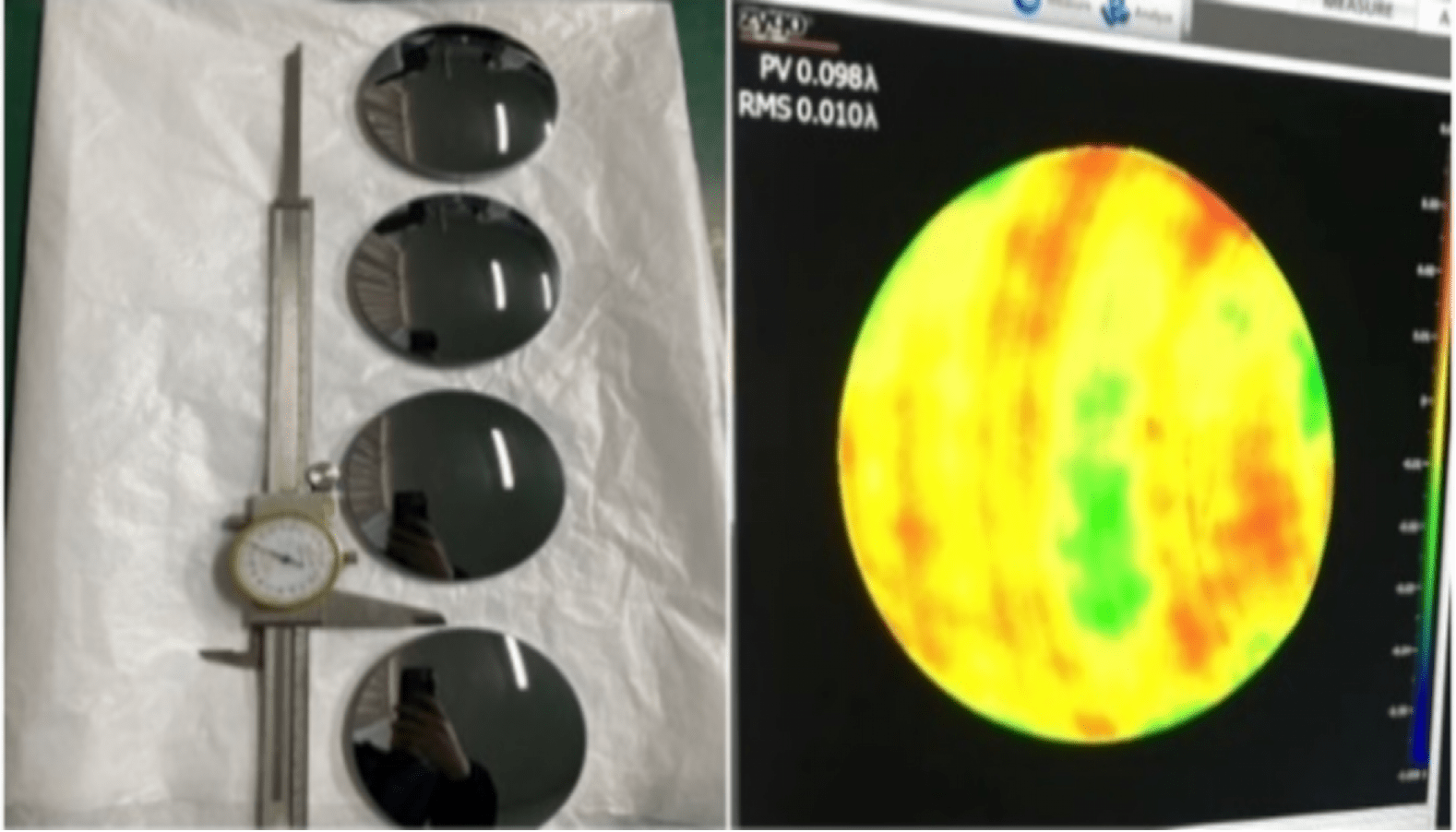
- Mirror
- Structure
- Invar steel, silicon carbide ……
- λ/100, 10pm/Hz\(^{1/2}\)
Acquisition, tracking and pointing over million-kilometer baselines
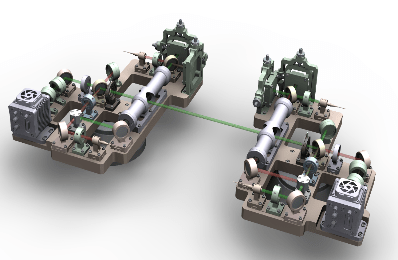
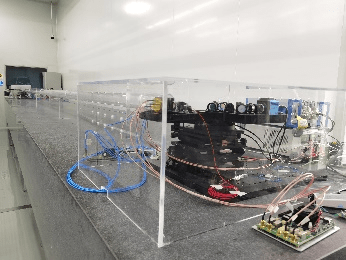
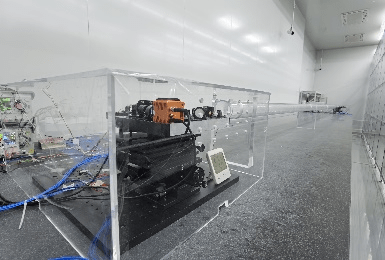
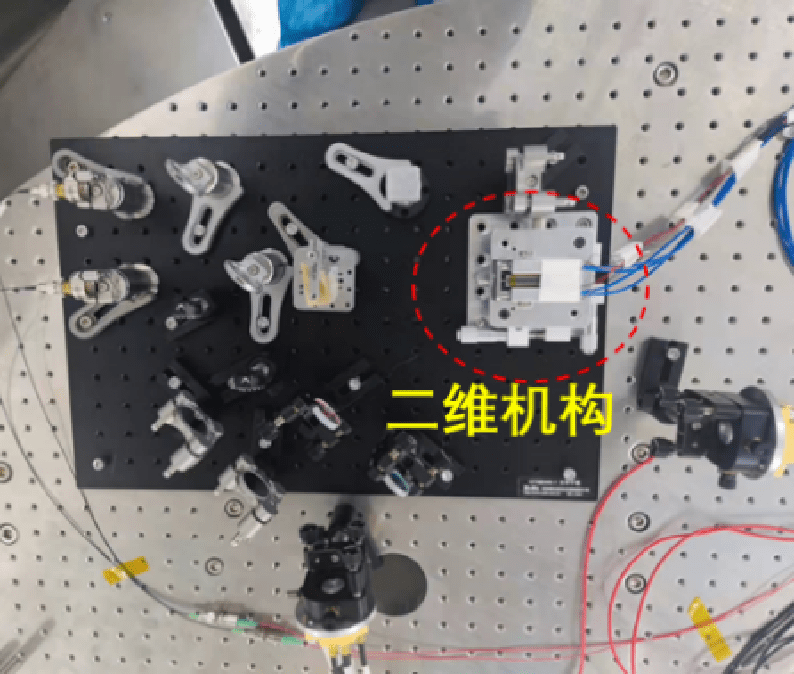
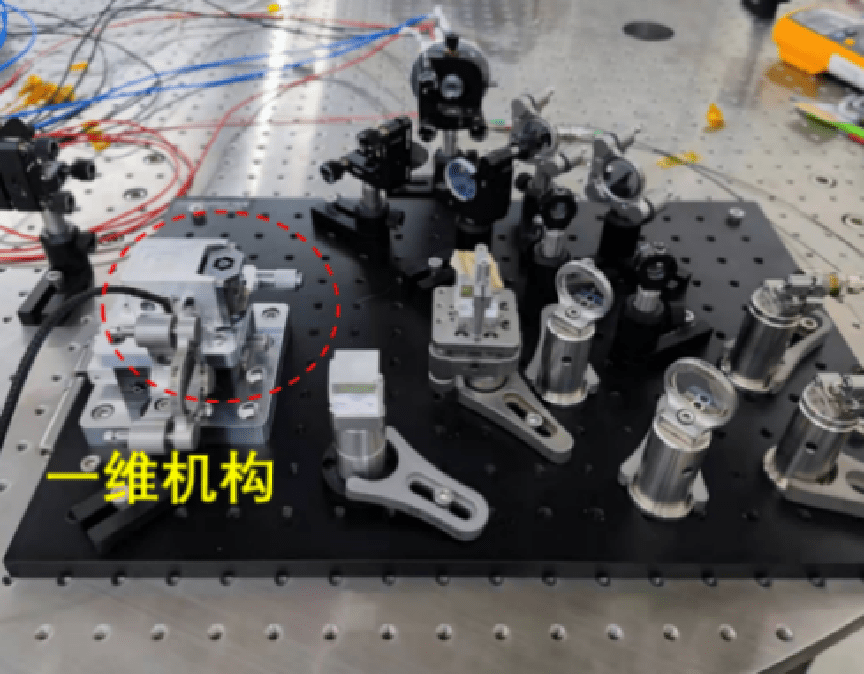
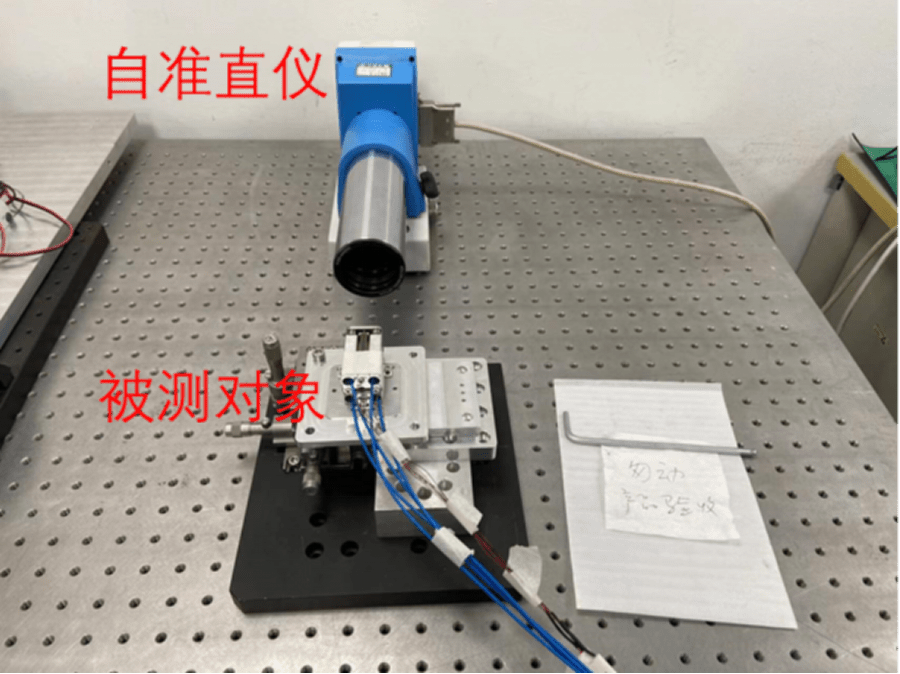
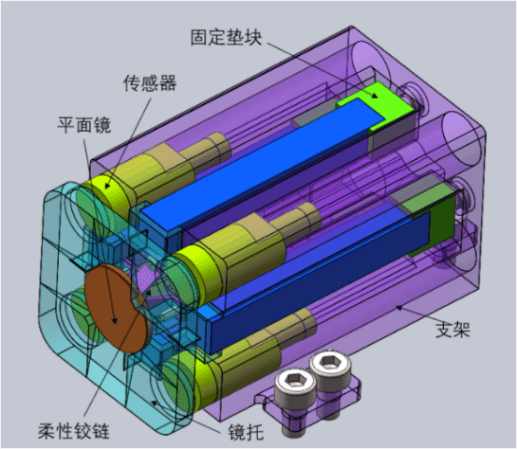
Taiji R&D progress —— ATP
- Acquisition with camera
- Pointing with DWS
- Archimedes spiral
- Acquisition 0.1μrad
- Pointing 20.25 nrad/Hz\(^{1/2}\)
- Field (out of telescope 100×) 6.23μrad (1d), 5.4μrad (2d); θ deviation (out of telescope 100×) 4.4 nrad(1d), 6.8nrad(2d); longitudinal noise 8.3pm/Hz\(^{1/2}\) (1d), 8.5pm/Hz\(^{1/2}\) (2d)
- Pointing ahead angle mechanism (1 dimensional & 2 dimensional)
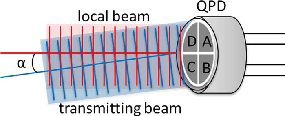
Technologies: phase-locking amplification
- Millions of Kilometers、nano radian tracking & pointing
- Uncertain cone (mrad), precision (nrad), 6 orders of magnitude
- Multi-steps: star tracking, acquisition with camera, DWS
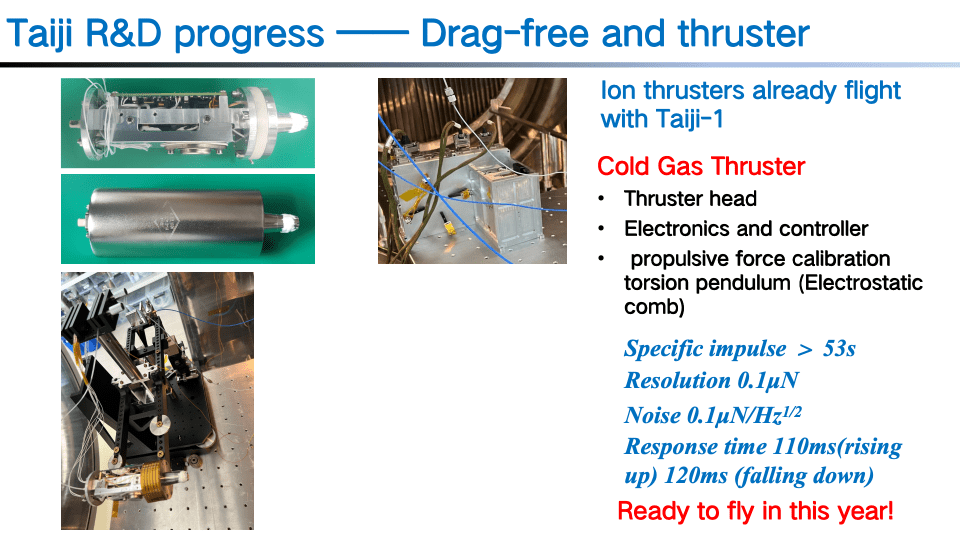
Inertial sensing, micro-thrusters and drag-free control
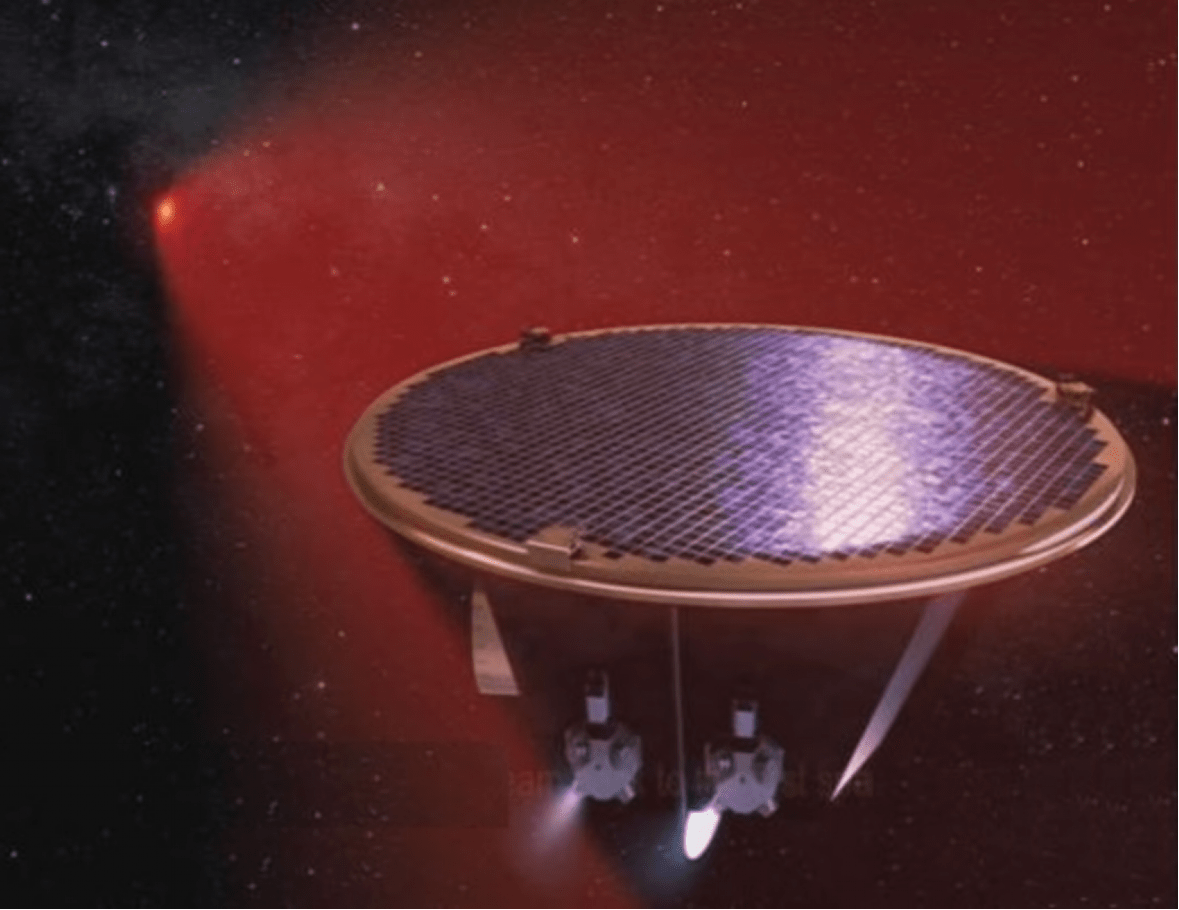
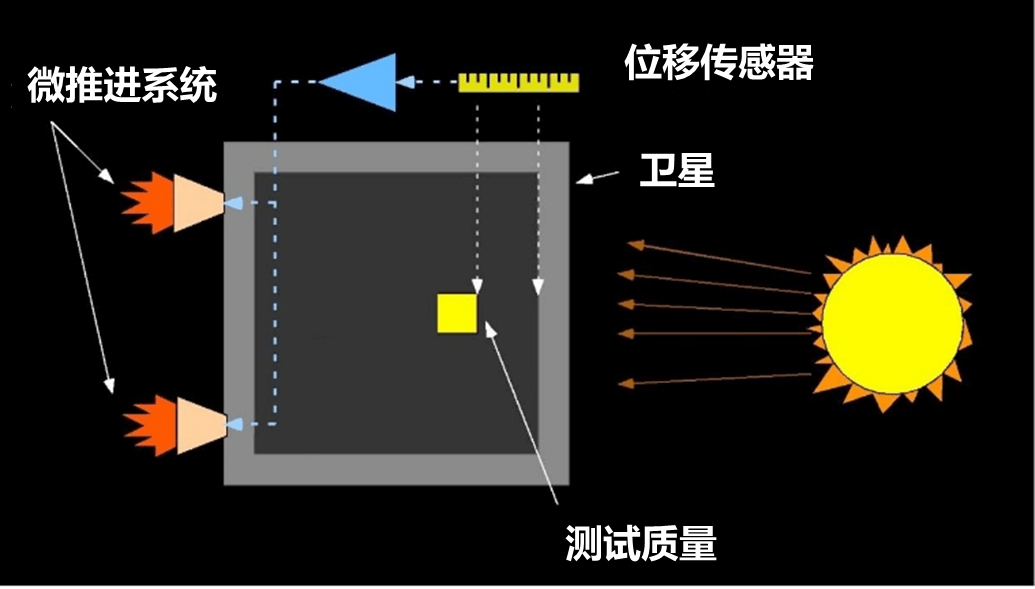
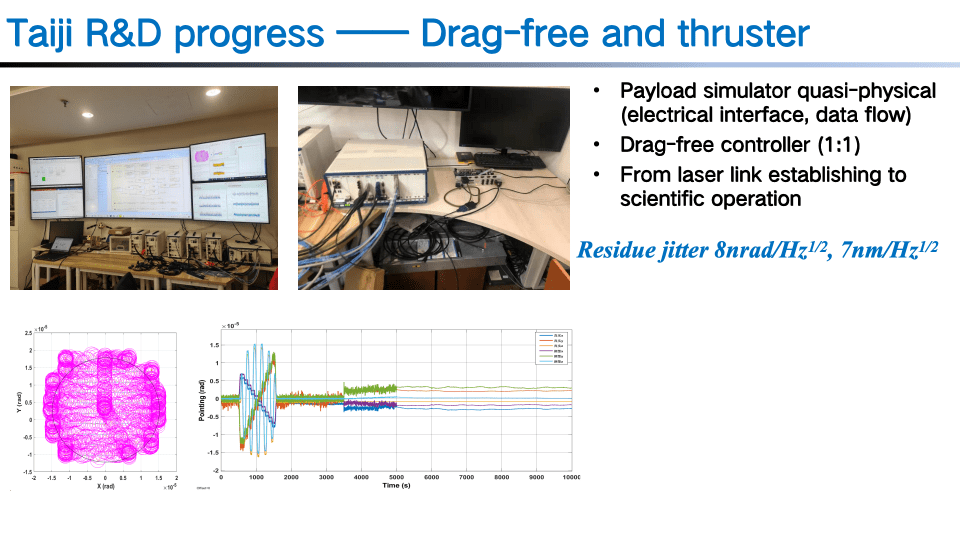
Technologies: drag-free
- Solar wind and radiation, need to be compensated
- Drag free——measure、feed back,net force zero on SC
- Core payload——inertial sensor
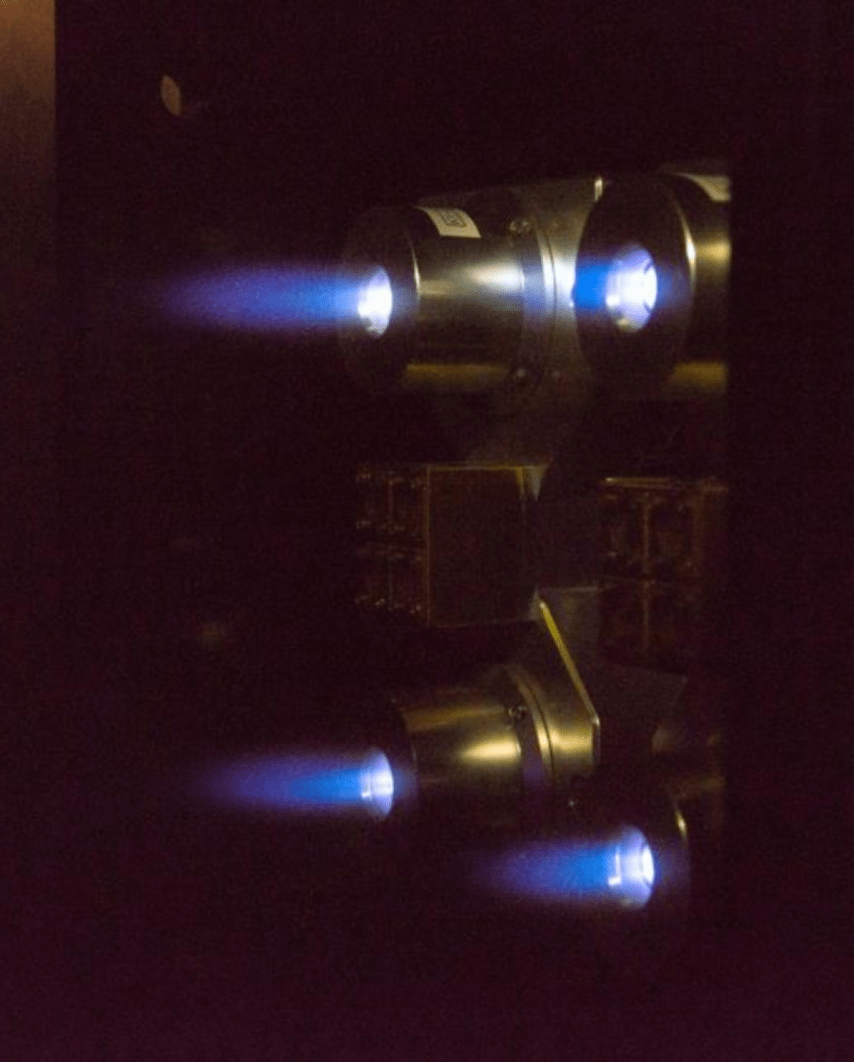
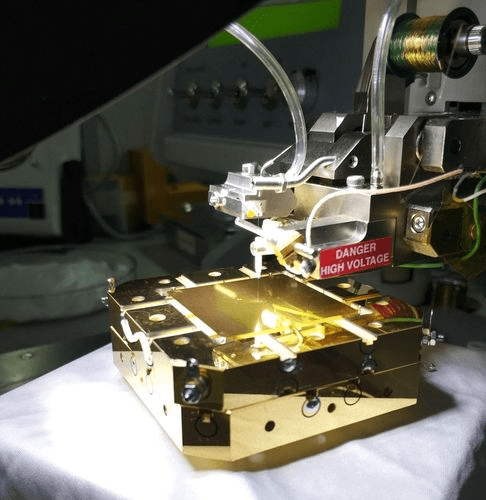
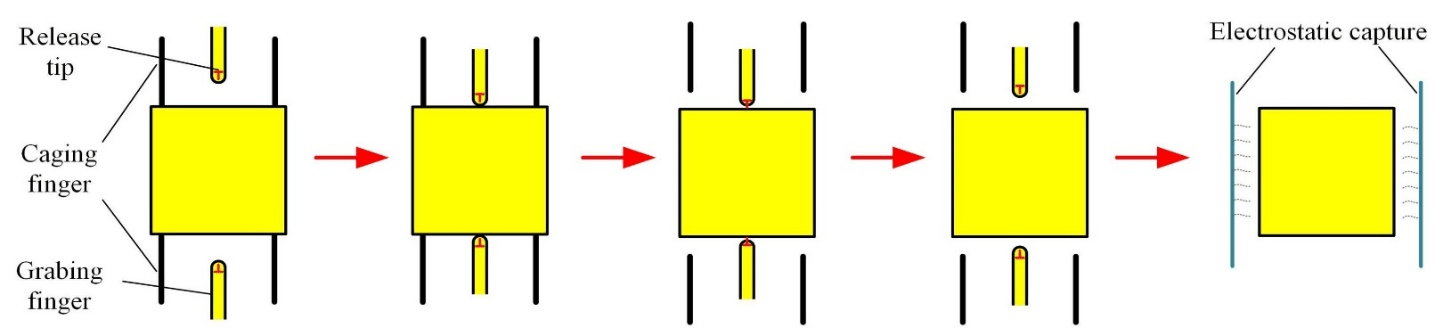
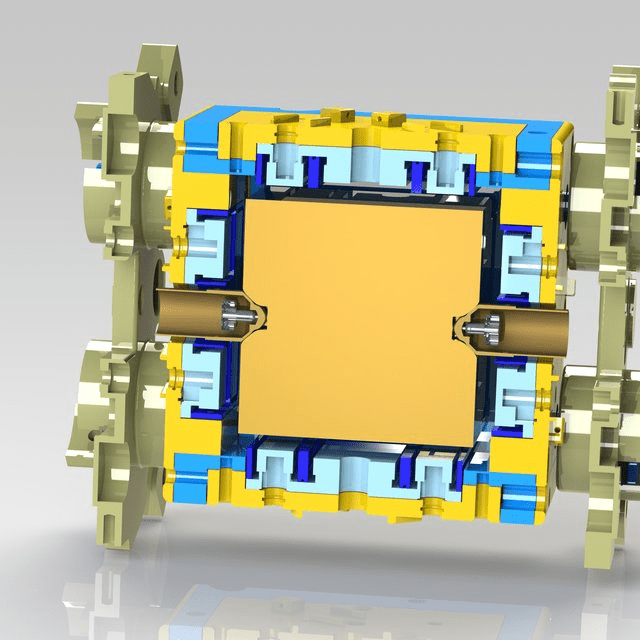
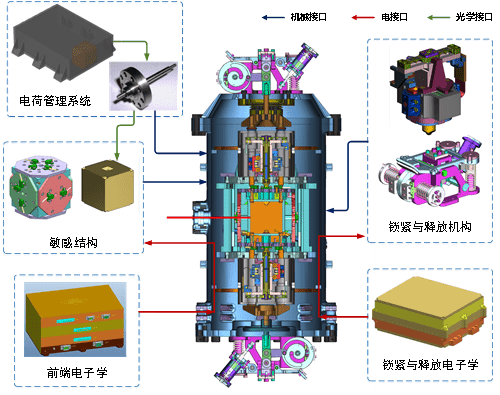
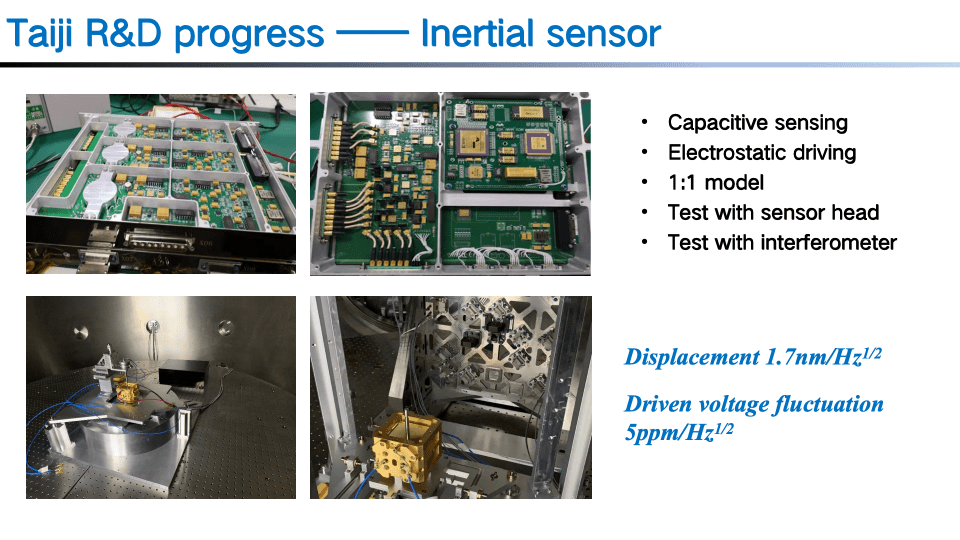
Technologies: inertial sensor
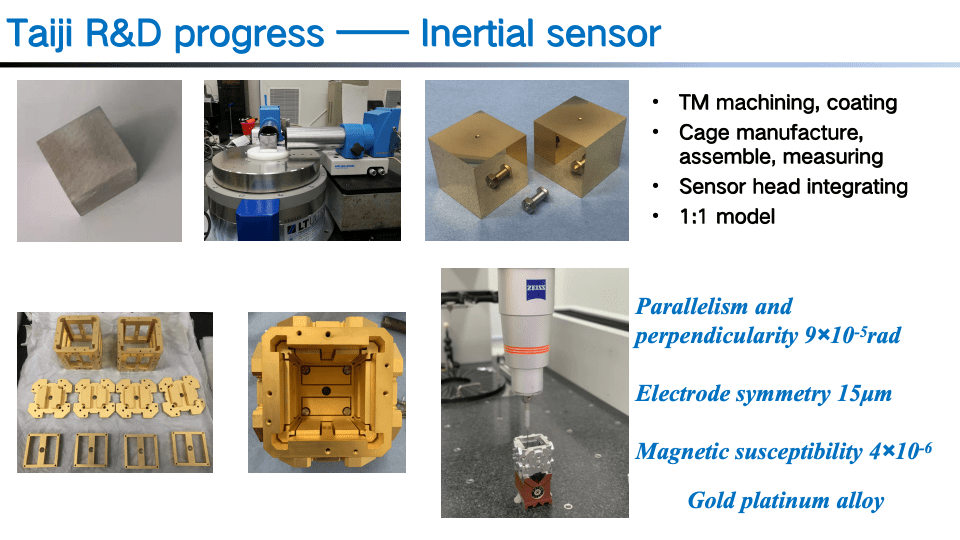
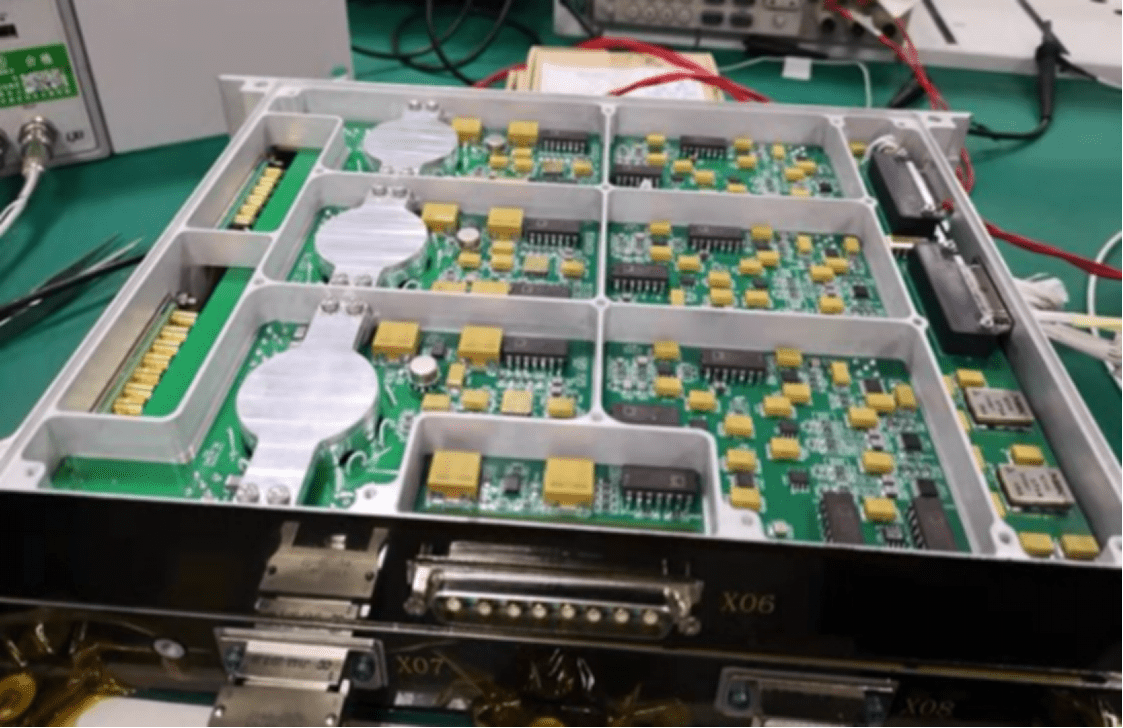
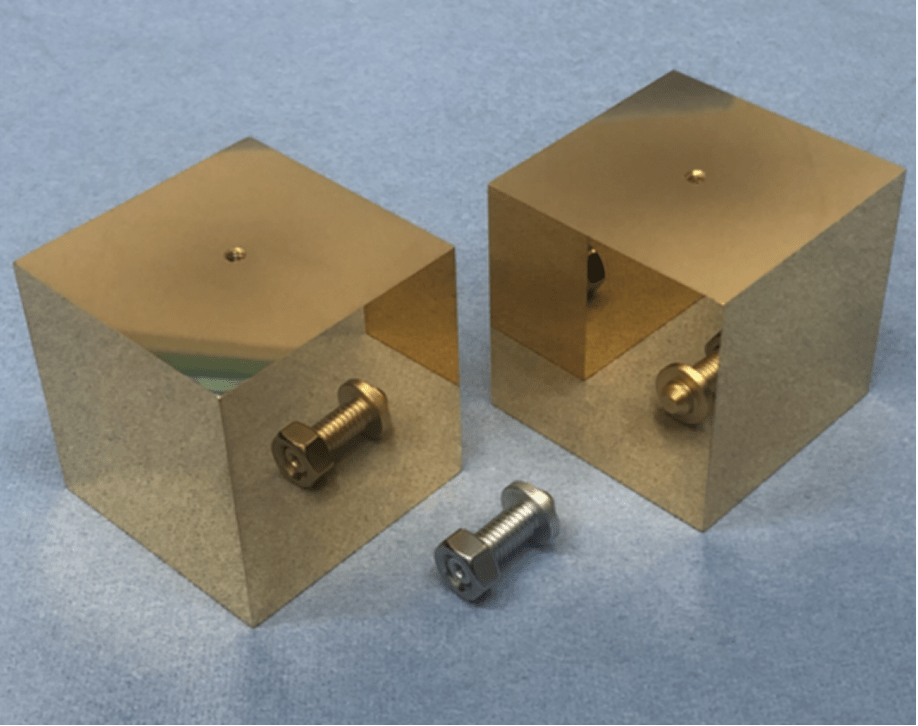
- Component:TM+Cage、capacitive sensing+electrostatic actuation、charge management、locking and releasing mechanism
- Locking and releasing (lock during launch,release on orbit,5μm/s,100μrad/s);various noises to deal with
- obstacles:electrostatic force very small、surface adhesion
Stable platform and environmental coupling
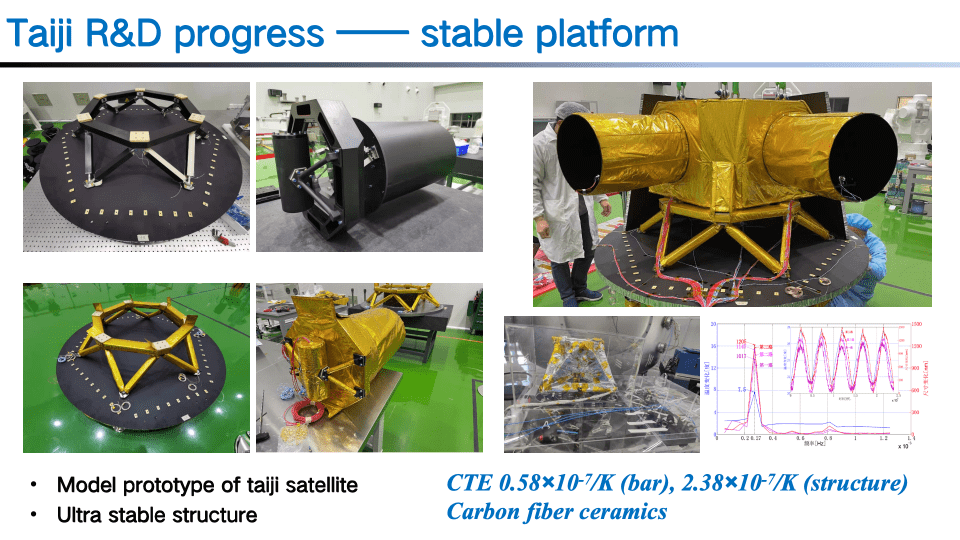
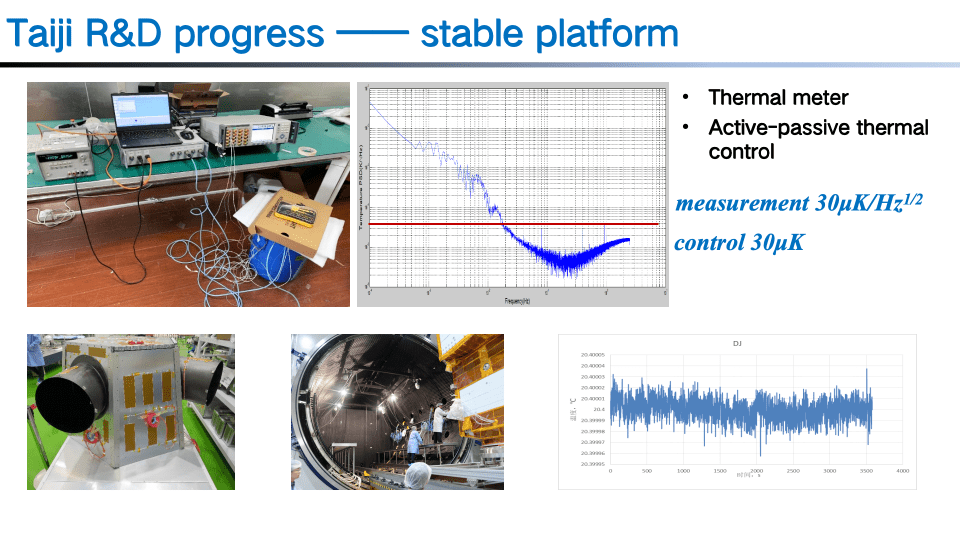
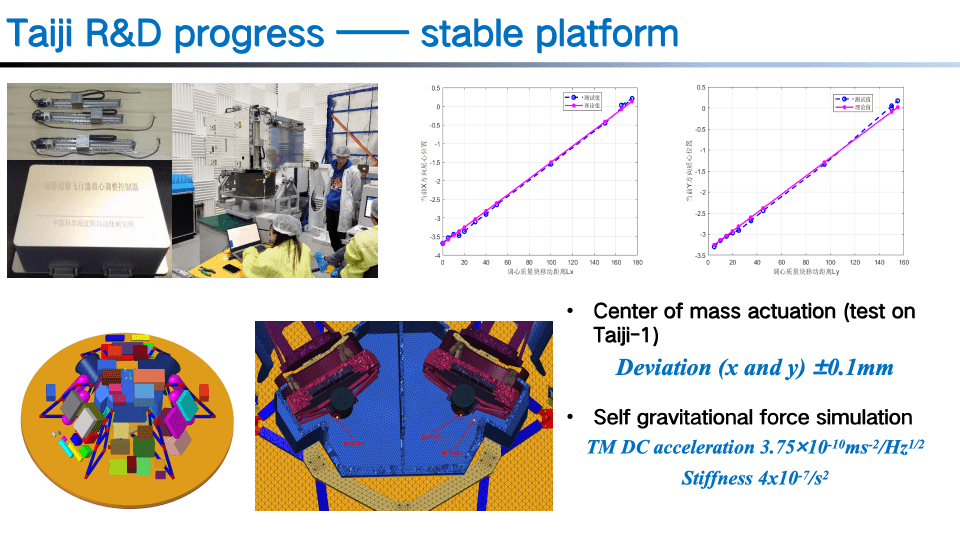
Technologies: stable platform
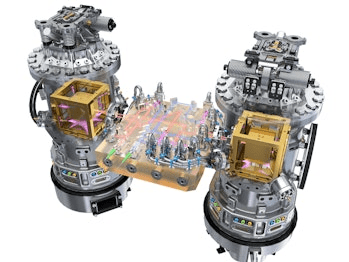
- The spacecraft highly coupled to the payloads。
- Stable platform(self gravity、thermal、residue magnetic field…)。
- Self gravity:gravitational stiffness and gravitational bias around TMs
Ground-based equivalent verification and system integration
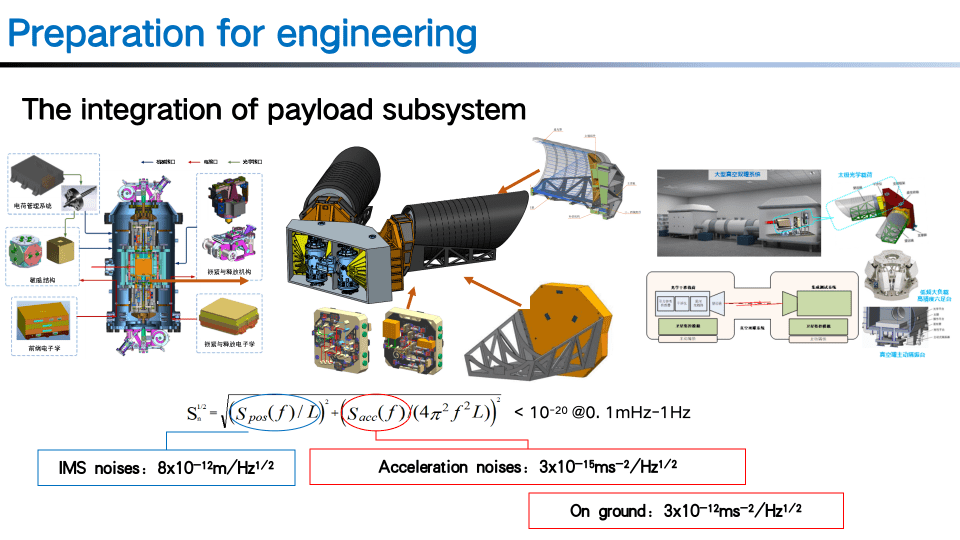
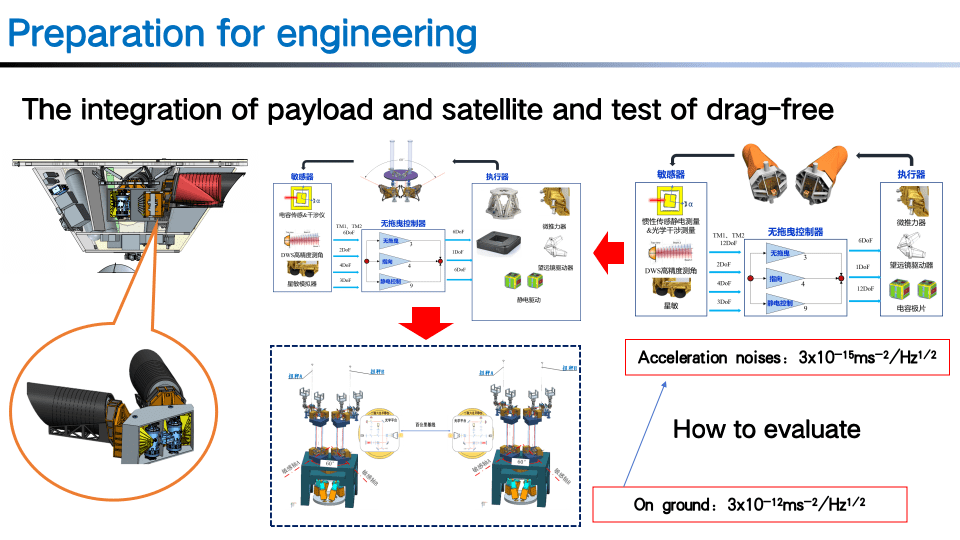
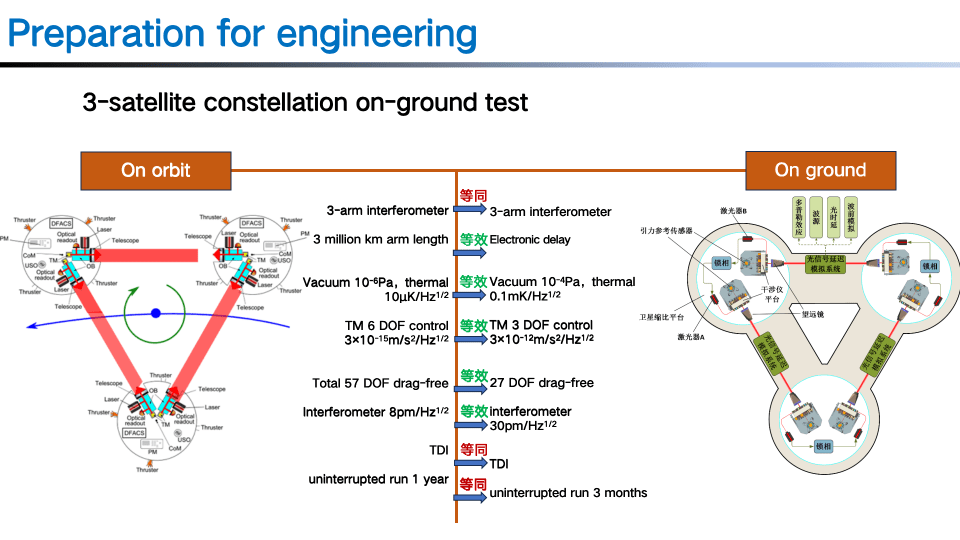
From key technologies to full-mission engineering readiness
One mission-design track and three system-verification tracks
He WANG · ICTP-AP / UCAS
Taiji: China's Space-based GW Program
SUPPORTING KEY TECHNOLOGY
TRL 5
TRL 6
TRL 5
TRL 5
TRL 5
under validation
GRS / electrostatic suspension
Drag-free control
Laser-link acquisition & tracking
Laser interferometry
Unltra-stable plaform
Cold-gas micro-propulsion
End-to-end dynamic simulation
Noise suppression & signal inversion
TRL 6-7
under validation
Scientific interferometer full-chain verification
Three-arm interferometry · inertial reference · ranging / optical-path simulation · TDI-related noise suppression · long-duration stability
FULL-CHAIN VERIFICATION
04
Drag-free closed-loop dynamics verification
Spacecraft–test-mass dynamics · drag-free control · pointing/control coupling · semi-physical closed-loop tests
CLOSED-LOOP VERIFICATION
03
Core measurement-system integration
MOSA-level integration of GRS, optical metrology, laser-link acquisition, and pointing subsystems
PAYLOAD INTEGRATION
02
Mission and engineering design
Launch · orbit · transfer · TT&C · spacecraft–payload interfaces · science operations · data-processing design
MISSION DESIGN
01
Take-away: System-level verification is the bridge from key-technology maturity to full-mission readiness.
Spacecraft / payload system
- Inter-satellite laser interferometry
- Acquisition, tracking and pointing
- Gravitational reference sensor
- Micro-propulsion
- Drag-free control
- Ultra-clean / ultra-precise / ultra-stable platform
Science application system
7. Noise suppression and signal inversion
8. End-to-end dynamic simulation
Optical metrology and laser-link acquisition
From component performance to link-level measurement stability
He WANG · ICTP-AP / UCAS
Taiji: China's Space-based GW Program
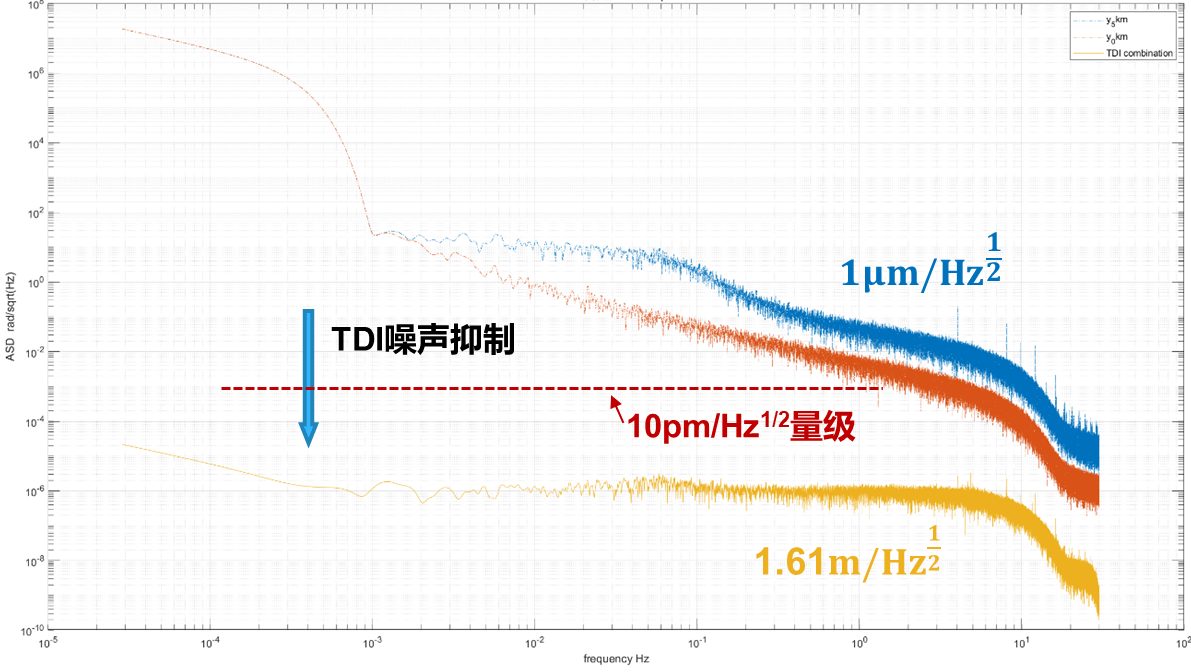
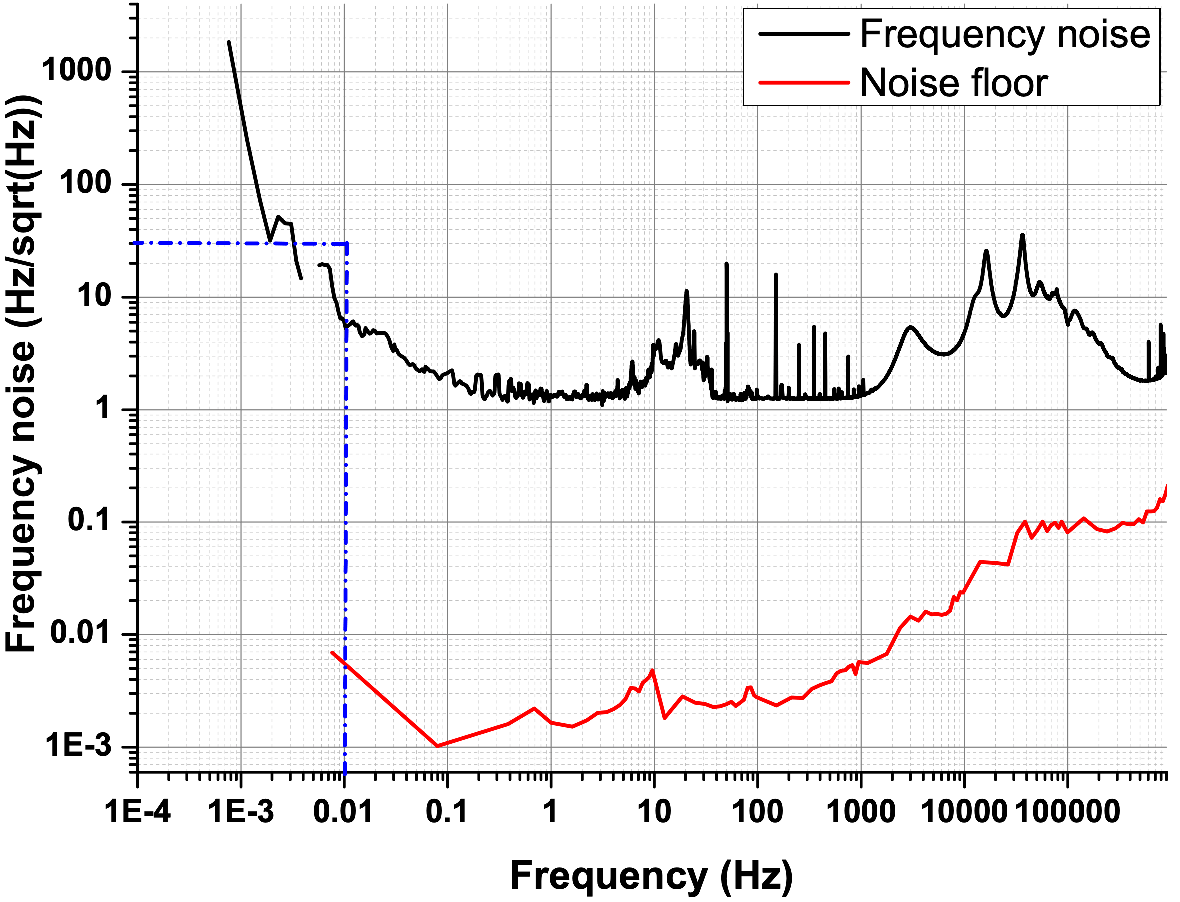
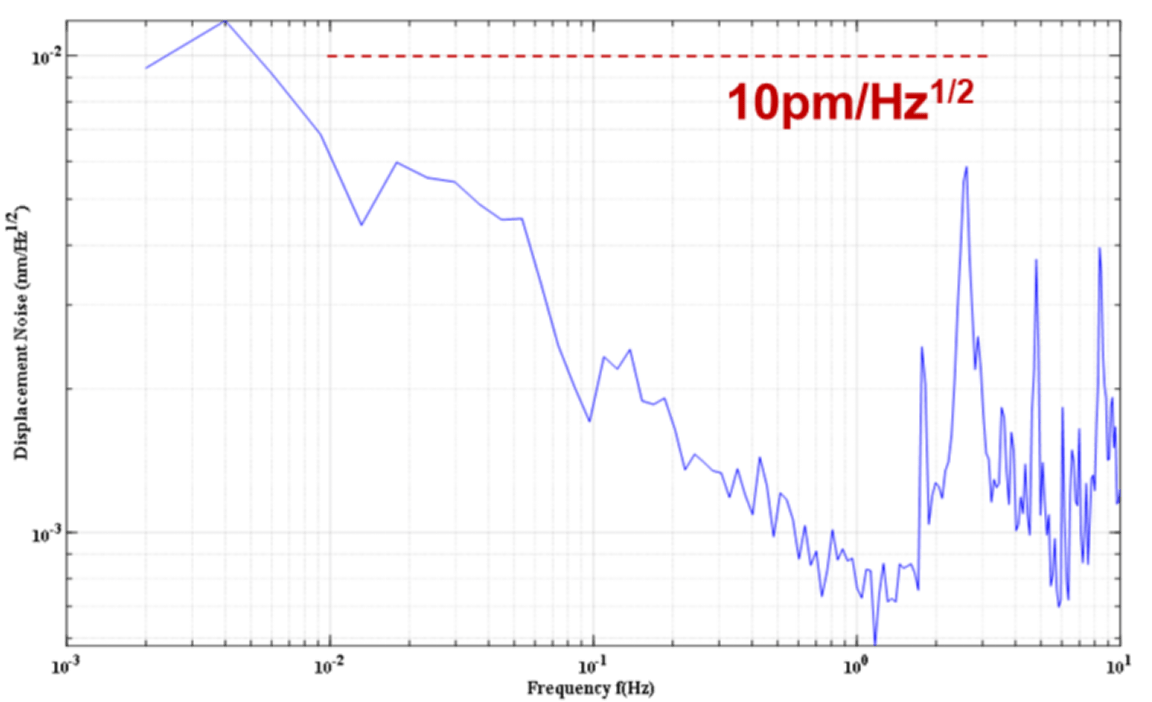
Interferometer noise: representative ground-test result
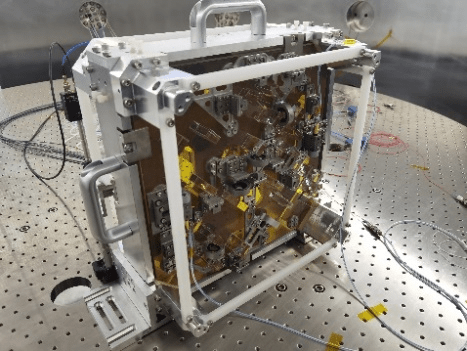
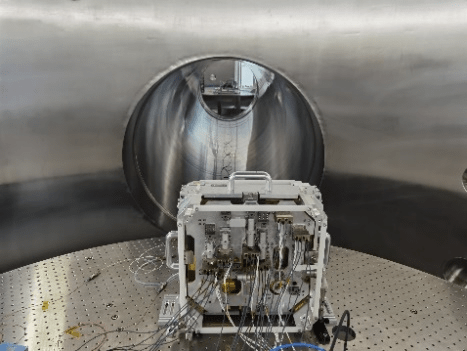
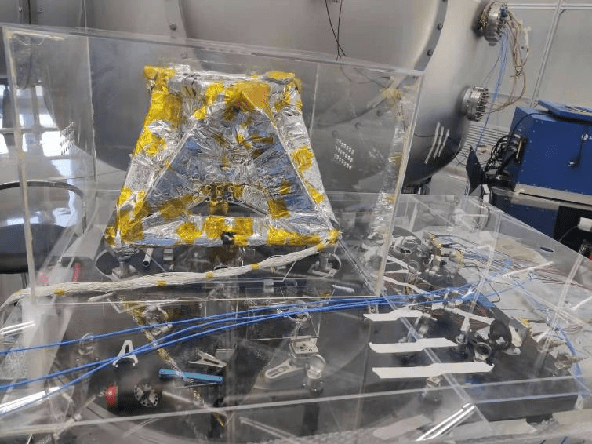
Interferometer optical bench (engineering model)
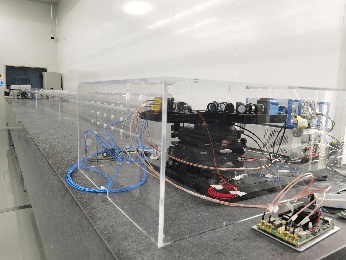
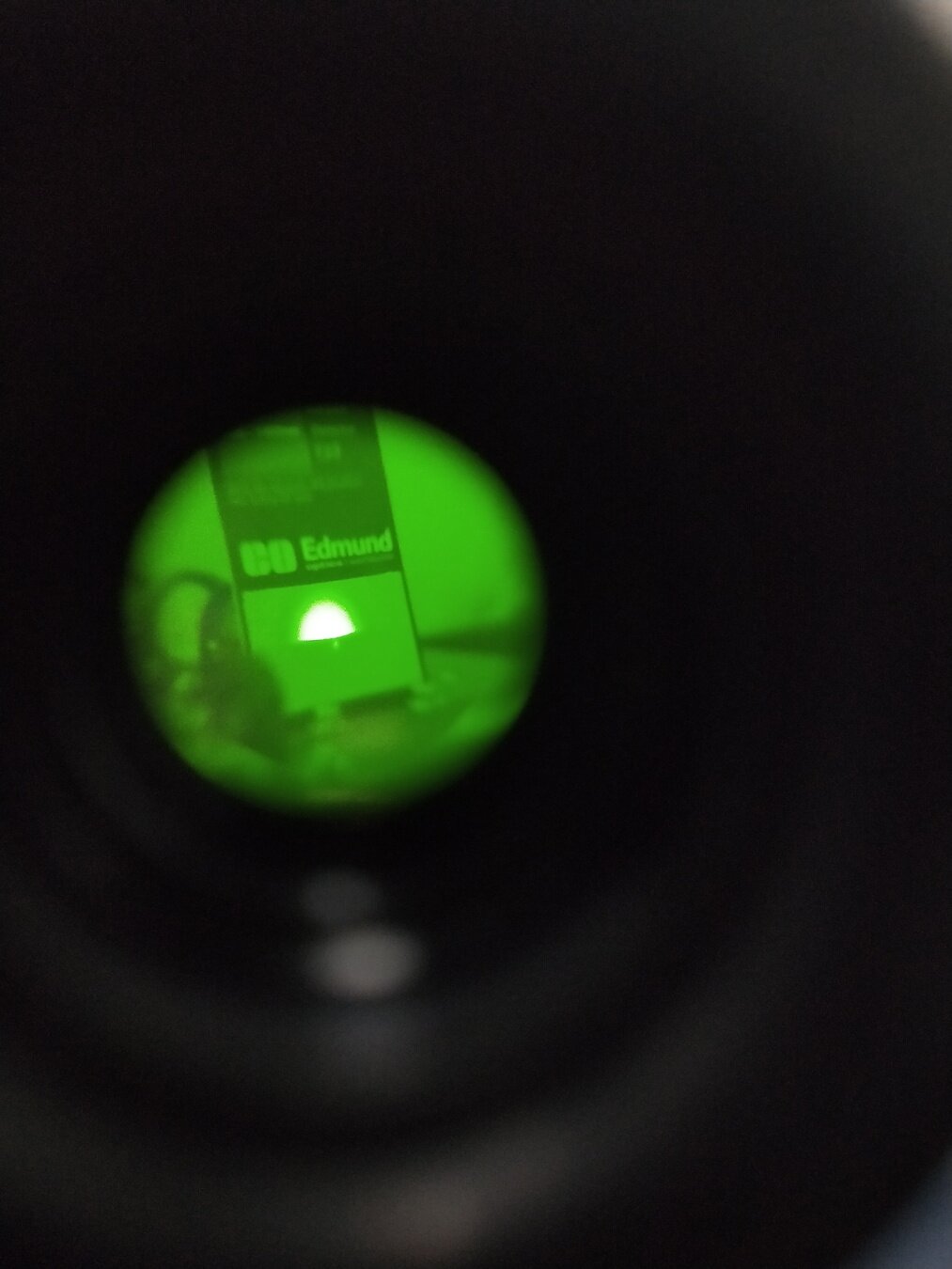
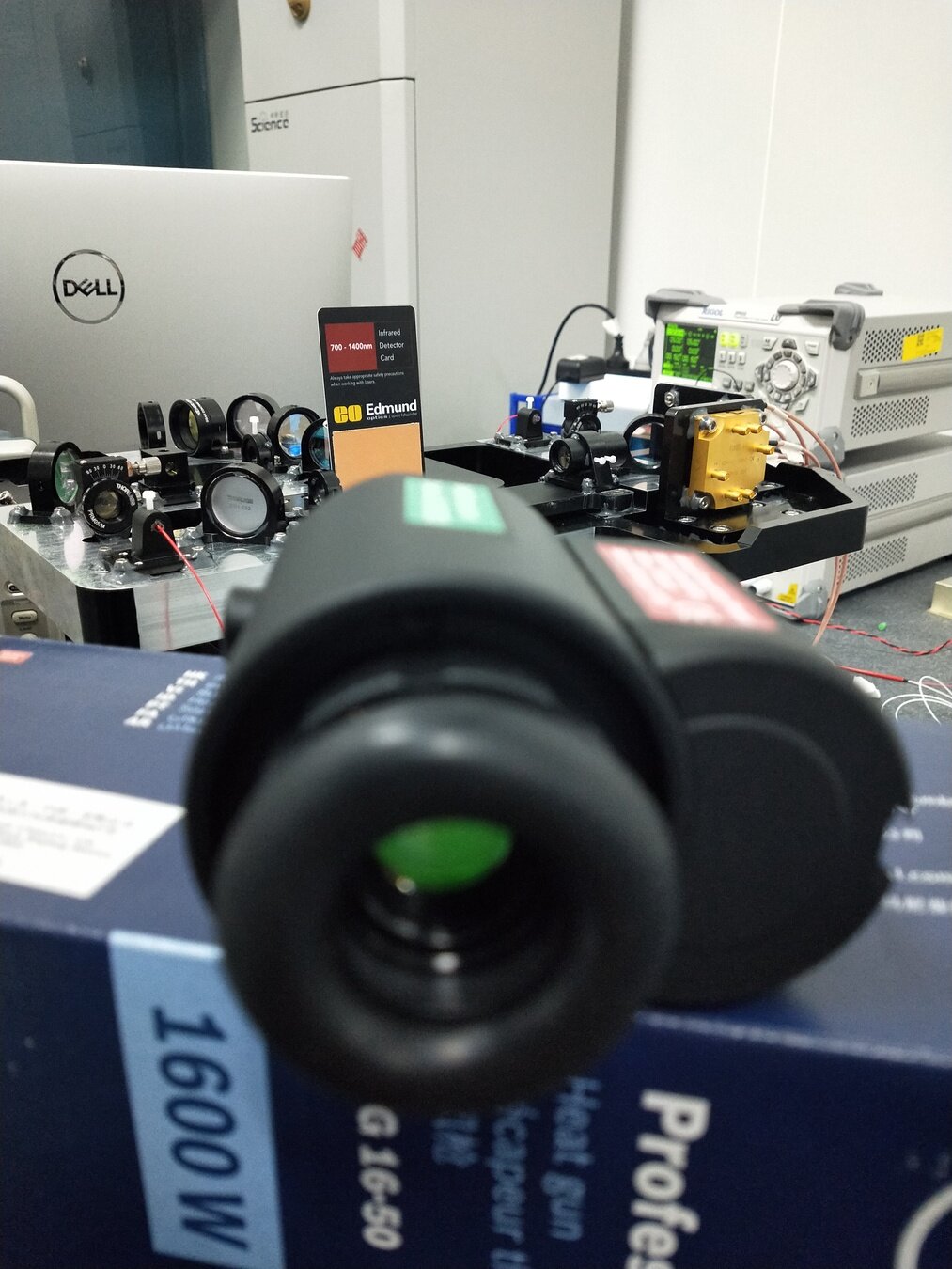
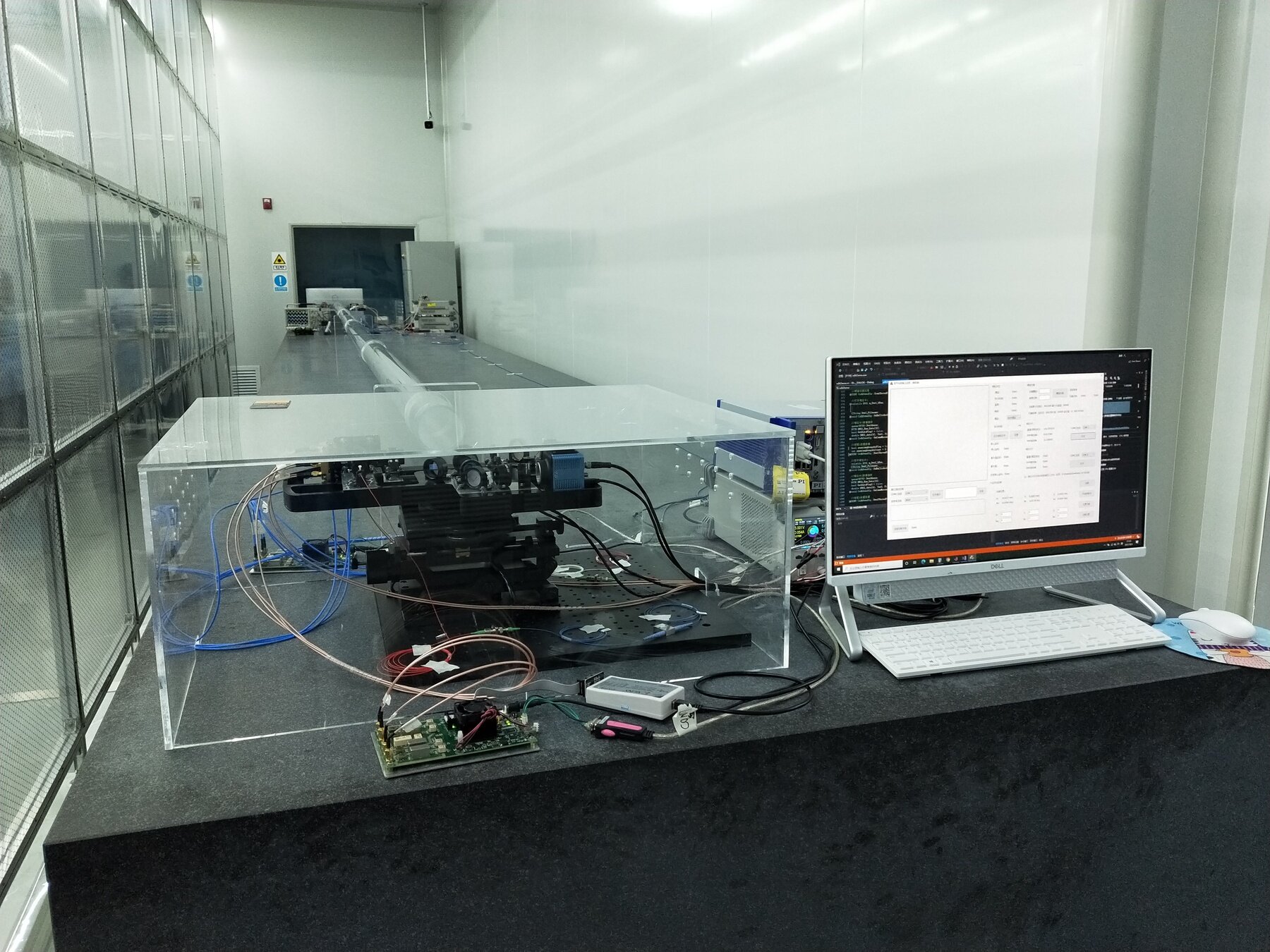
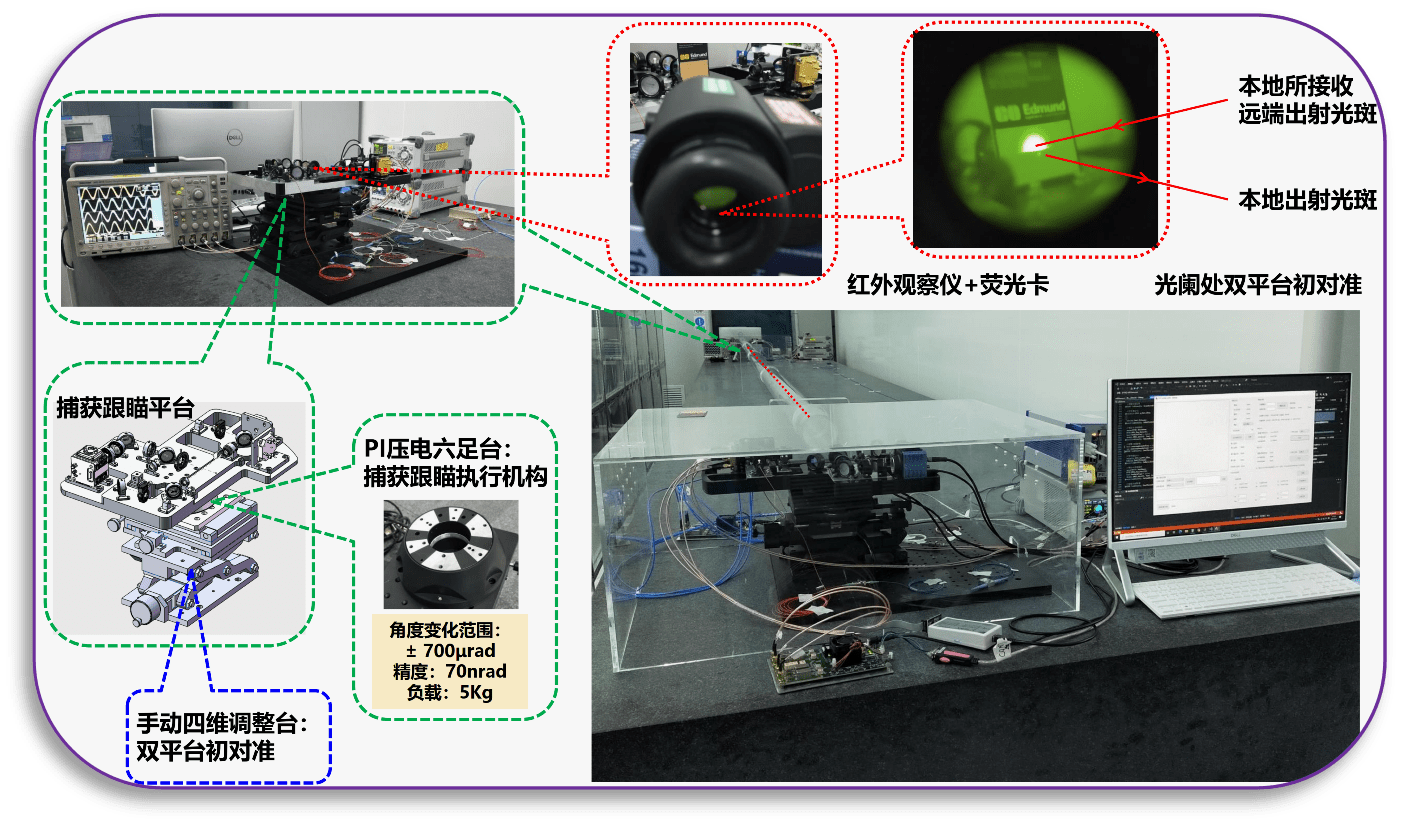
ATP acquisition and tracking experiment platform
Engineering-model and ground-test results. Full mission performance requires integrated system-level verification.
Ultra-stable laser
Frequency stability:
Output power:
STEP 1
(req. \(30 \mathrm{Hz}/\sqrt{\mathrm{Hz}}\))
(req. \(2 \) W)
\(6 \mathrm{Hz}/\sqrt{\mathrm{Hz}}\)
\(>4 \) W
Interferometer + phasemeter
STEP 2
Intra-platform interferometery:
Phasemeter precision:
Measurement range:
(req. \(6 \mu \mathrm{rad}/\sqrt{\mathrm{Hz}}\))
auto-acquistion
\(1 \mathrm{pm}/\sqrt{\mathrm{Hz}} \ \)
\(1 \mu \mathrm{rad}/\sqrt{\mathrm{Hz}}\)
\(2-20 \mathrm{MHz}\)
Acquisition / tracking / pointing
STEP 3
Acquisition precision:
Tracking precision:
(req. \(1 \mu\mathrm{rad}/\sqrt{\mathrm{Hz}} \ \))
(req. \(30 \mathrm{nrad}/\sqrt{\mathrm{Hz}} \ \))
\(0.1 \mu\mathrm{rad}/\sqrt{\mathrm{Hz}} \ \)
\(21 \mathrm{nrad}/\sqrt{\mathrm{Hz}} \ \)
Pointing-noise control
STEP 4
Optical-path noise:
Pointing-stability noise:
(req. \(1 \mathrm{pm}/\sqrt{\mathrm{Hz}} \ \))
(assessed)
\(<8 \mathrm{pm}/\sqrt{\mathrm{Hz}} \ \)
\(2.1 \mathrm{pm}/\sqrt{\mathrm{Hz}} \ \)
Take-away: Optical metrology is being developed toward a coupled laser-link measurement chain.
Optical metrology and laser link
Optical metrology is being developed not only as a set of components, but as a link-level measurement chain involving laser stability, phasemeter performance, acquisition/tracking/pointing, and pointing-noise control.
- 超稳激光器:采用光纤延长线+超稳腔结合的技术稳频,采用MOPA技术进行光放大;完成工程样机研制及环境实验,频稳达到6Hz/Hz1/2( 30Hz/Hz1/2 ),输出功率大于4W(2W)
- 干涉仪:采用光粘及高精度装调技术完成全功能工程样机研制,开展力、热环境实验;平台内干涉精度1pm/Hz1/2(1pm/Hz1/2),十米平台间50nm/Hz1/2,TDI后1.6pm /Hz1/2(5pm/Hz1/2)
- 相位计:采用数字锁相环(DPLL)技术和峰值查找算法,研制完成具有频率信息捕获功能的工程样机,在2-20MHz内可自动捕获和测量,精度达到1μrad/Hz1/2( 6μrad/Hz1/2 )
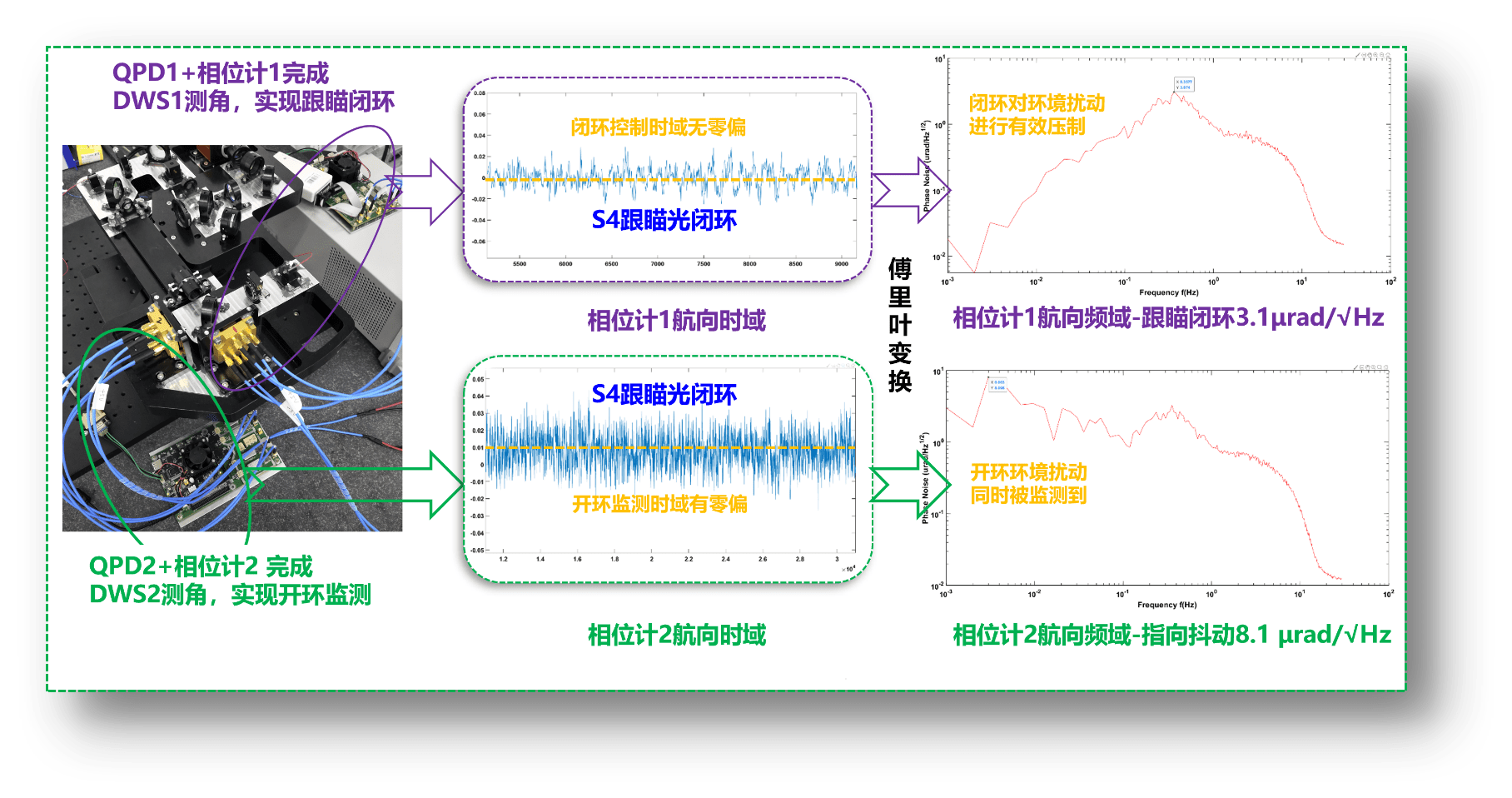
- 捕获跟瞄:采用扫描-捕获-跟瞄多级捕获策略,在十米平台上完成捕获跟瞄双平台搭建和全流程调试,捕获精度达到0.1μrad/Hz1/2( 1μrad/Hz1/2 ),跟瞄精度21nrad/Hz1/2( 30nrad/Hz1/2 )
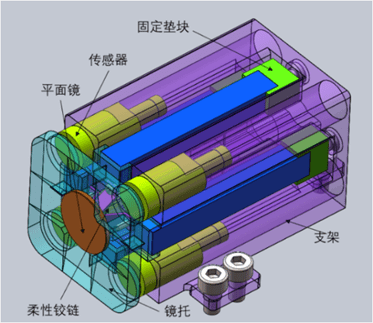
- 超前瞄准机构:利用新型柔性铰链实现无光程差镜面偏转;基于新型可伸缩压电堆叠和电容传感实现低噪声压电驱动;研制工程样机,光程噪声实测小于8pm/Hz1/2(1pm/Hz1/2)
- 指向噪声评估:基于超前指向静态偏差和激光指向抖动的实测结果,评估激光指向稳定性噪声2.1pm/Hz1/2(2pm/Hz1/2)
Inertial reference and drag-free spacecraft control
From test-mass sensing to closed-loop spacecraft control
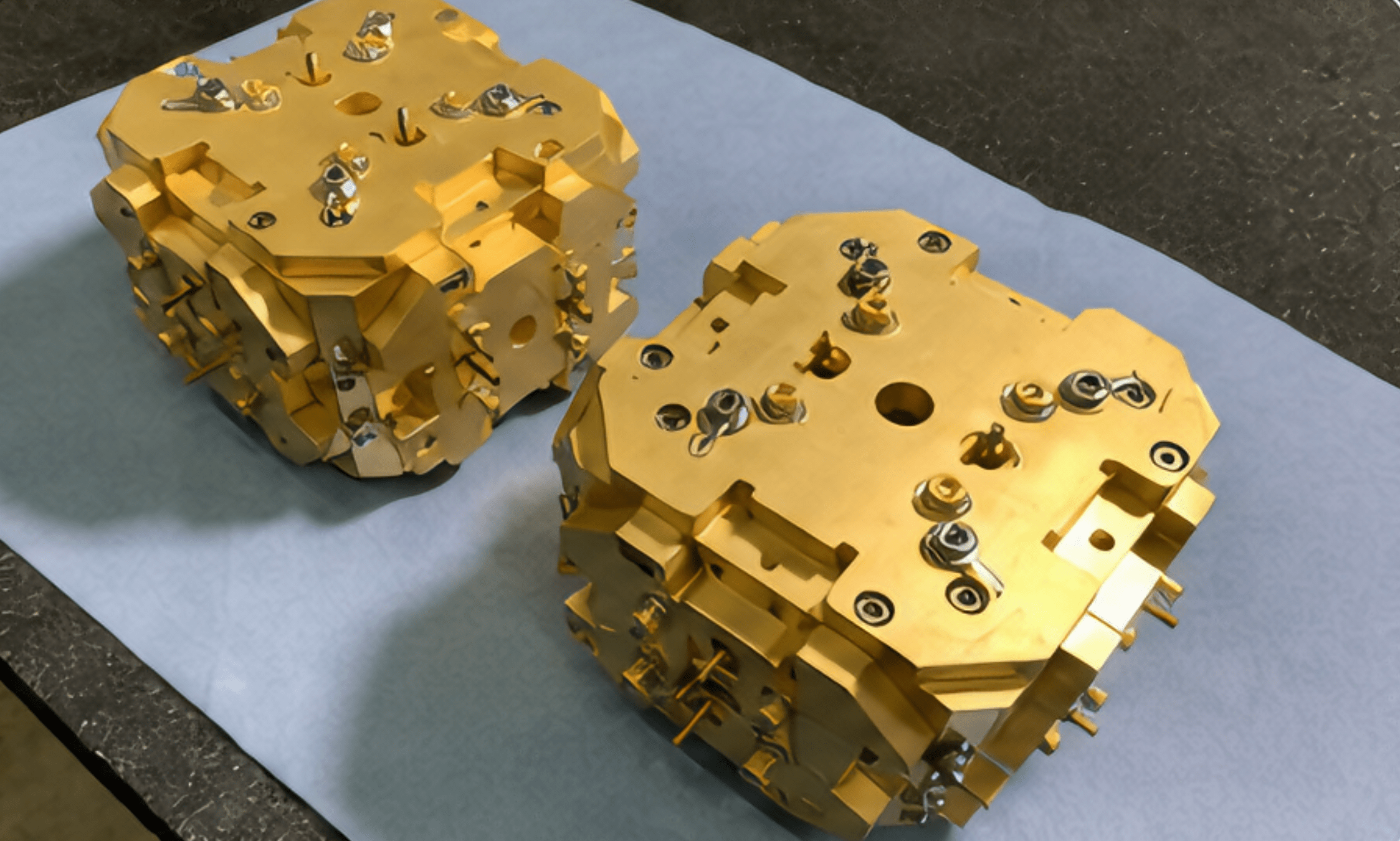
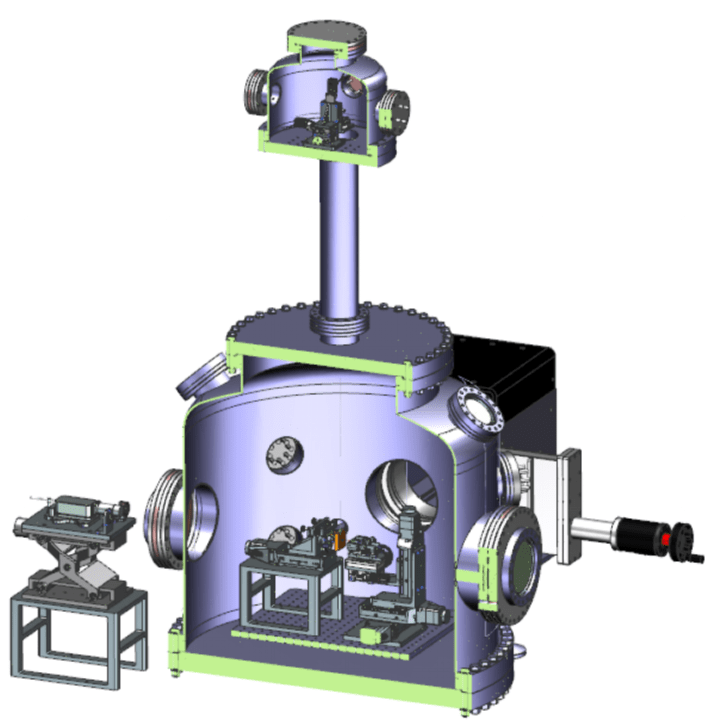
GRAVITATIONAL REFERENCE SENSOR
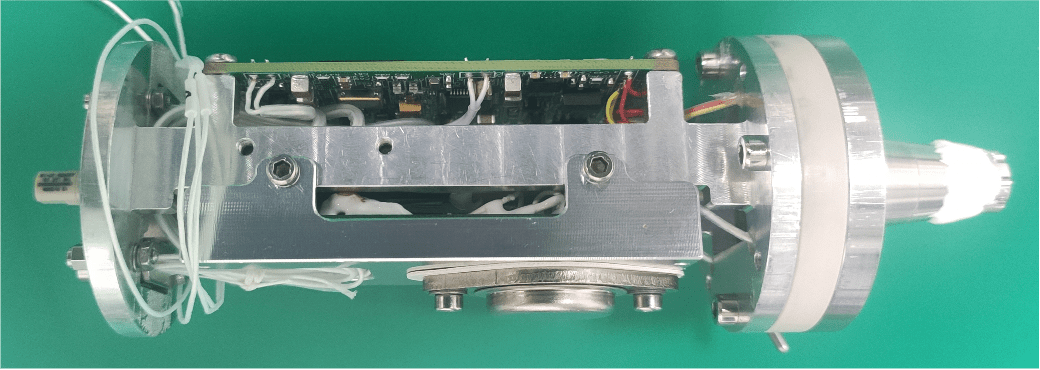
COLD-GAS MICRO-PROPULSION
DRAG-FREE CONTROL
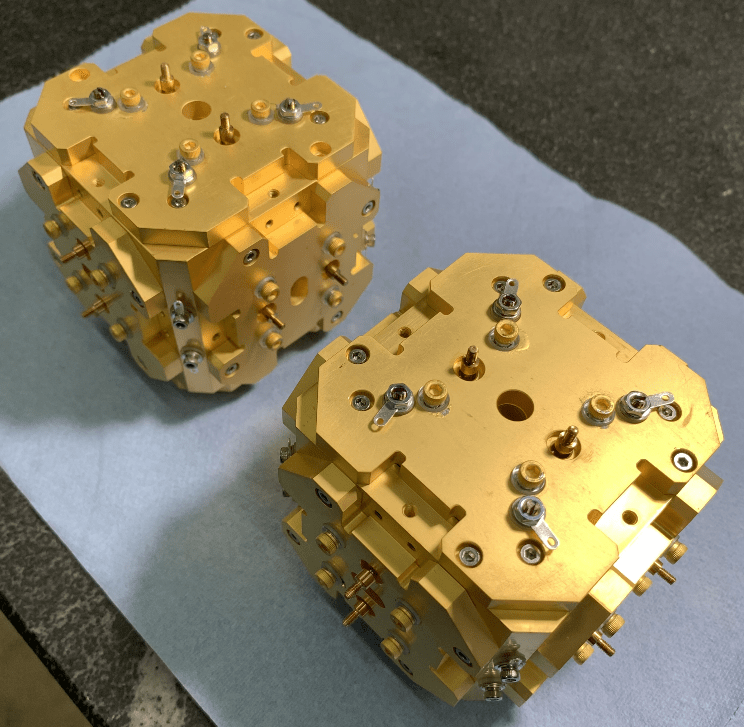
Axis coupling coefficient:
Electrode symmetry:
Displacement readout:
Drive-voltage stability:
Release residual velocity:
Release angular velocity:
\(< 9 \times10^{-5}\) (req. \(10^{-4}\))
\(< 15 \mu\mathrm{m}\) (req. \(150 \mu\mathrm{m}\))
\(1.7 \mathrm{nm}/\sqrt{\mathrm{Hz}}\) (req. \(3 \mathrm{nm}/\sqrt{\mathrm{Hz}}\))
\(3.3 \mathrm{ppm}/\sqrt{\mathrm{Hz}}\)
\(4 \mu\mathrm{m}/s\) (req. \(20 \mu\mathrm{m}/s\))
\(86 \mu\mathrm{rad}/s\) (req. \(400 \mu\mathrm{rad}/s\))
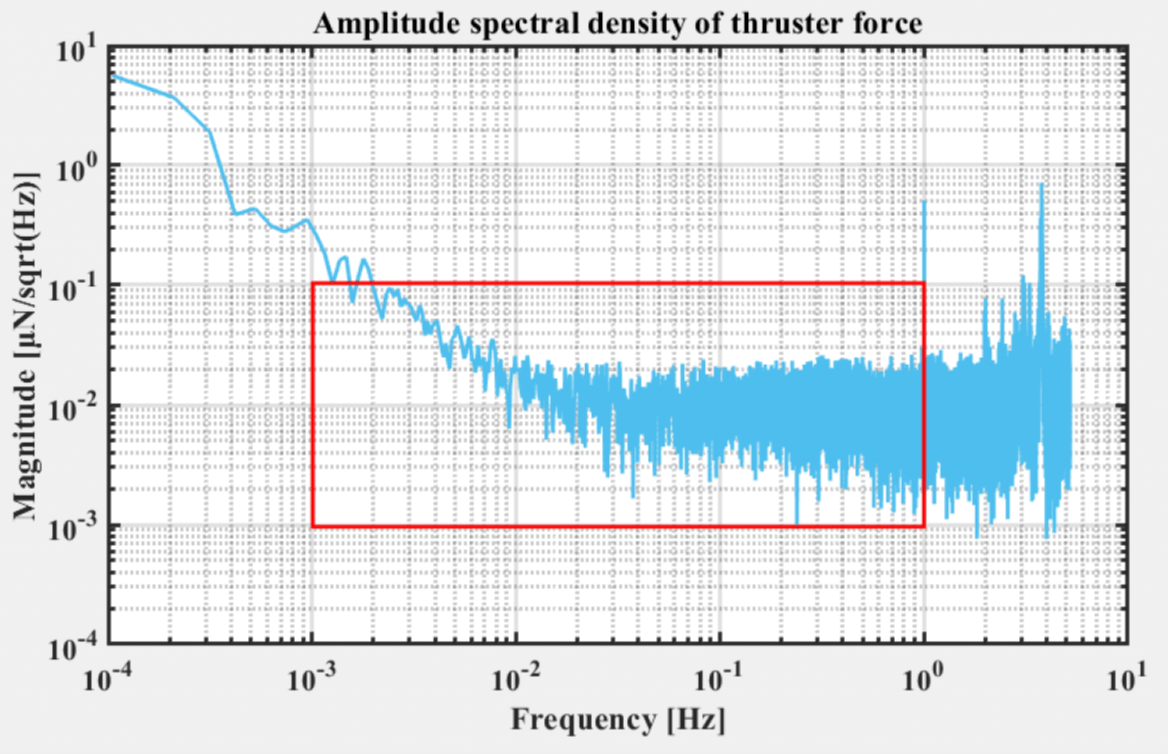
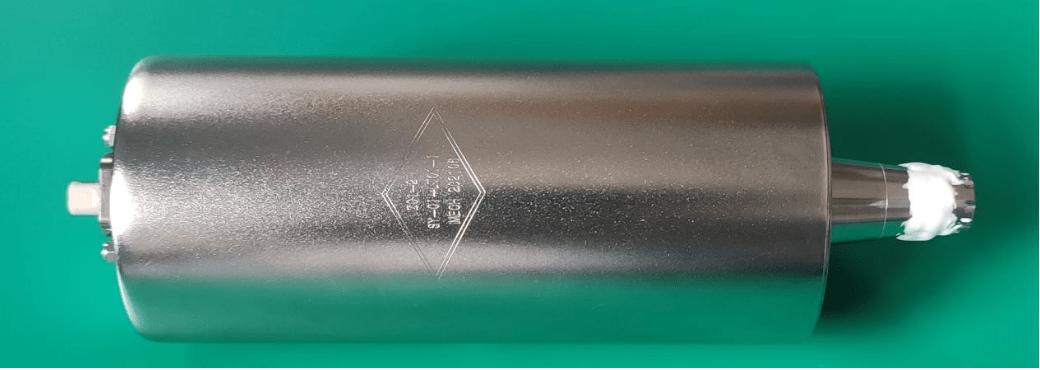
Thrust noise:
Thrust resolution:
Response time:
\(0.02 \mu \mathrm{N}/\sqrt{\mathrm{Hz}}\) (req. \(0.1 \mu \mathrm{N}/\sqrt{\mathrm{Hz}}\))
\(0.05 \mu\mathrm{N}\) (req. \(0.1 \mu\mathrm{N}\))
\(<120 \mathrm{ms}\) (req. \(150 \mathrm{ms}\))
SENSING & ACTUATION
FAST-RESPONSE ACTUATION
CLOSED-LOOP VERIFICATION
He WANG · ICTP-AP / UCAS
Taiji: China's Space-based GW Program
Engineering-model and ground-test results. Residual acceleration figure refers to numerical simulation; full closed-loop in-orbit verification pending.
SC-TM state estimation:
Simulated residual acceleration:
Ground semi-physical
verification platform:
Status:
multi-loop decoupling
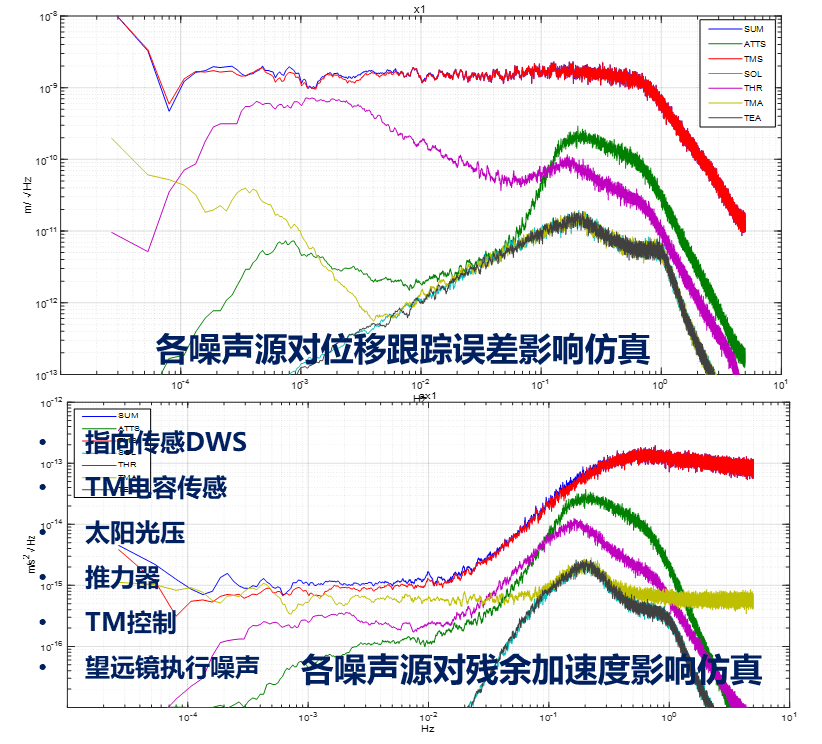
\(\le3\times10^{-15}\,\mathrm{m\,s^{-2}}/\sqrt{\mathrm{Hz}}\)
Completed
toward closed-loop verification
Ground semi-physical
verification platform:
Take-away: The key challenge is closed-loop performance: sensing the test mass, actuating the spacecraft, and suppressing residual acceleration as one integrated system.
Inertial reference and drag-free spacecraft
The target is not simply a quiet test mass or a precise thruster, but a coupled inertial-reference and spacecraft-control system.
- 敏感结构:采用高精度结构加工、检测和集成技术,完成敏感结构样机研制,实现了优于9×10⁻⁵(10-4)的轴间耦合系数及优于15μm(150μm)的电极对称性
- 电容传感与静电驱动:采用信号增益、读出电路噪声和驱动电压噪声抑制技术,完成样机研制,位移检测分辨率为1.7nm/Hz1/2(3nm/Hz1/2),驱动电压稳定性3.3ppm/Hz1/2(10ppm)
- 锁紧释放结构:采用释放粘附力抑制技术,搭建了粘附力测量平台,开展了释放机构释放同步性分析评估,最大释放残余速度为4μm/s(20μm/s),最大释放角速度为86μrad/s(400μrad/s)
- 冷气微推:突破了快响应低噪声微推力比例控制技术,研制了原理样机,开展了环境实验,搭建了推力测试系统,对样机指标进行实验验证,推力噪声达到0.02μN/Hz1/2(0.1μN/Hz1/2),推力分辨率0.05μN(0.1μN),推力响应时间小于120ms(150ms)
- 无拖曳控制:突破了噪声传播模型与多回路解耦、多源扰动抑制鲁棒控制算法等技术,完成地面半物理仿真系统搭建,实现SC-TM状态融合估计,实现TM捕获释放至稳定过程,数字仿真达到指标,残余加速度水平≤3×10-15 m/s2/Hz1/2( 3×10-15 m/s2/Hz1/2 )
He WANG · ICTP-AP / UCAS
Taiji: China's Space-based GW Program
Ultra-stable platform and environmental-coupling control
The spacecraft is part of the measurement system
SELF-GRAVITY & CoM CONTROL
THERMAL STABILITY
ENVIRONMENTAL CLEANLINESS
Self-gravity stiffness:
Center-of-mass accuracy:
Structural thermal expansion:
Design:
controlled near test mass
Temperature-sensing resolution:
Temperature-control stability:
Method:
Platform:
\(<0.5 \mu \mathrm{K}\) (req. \(10 \mu \mathrm{K}\))
PRECISION MECHANICS
THERMAL CONTROL
NOISE BUDGET COUPLING
- Magnetic-cleanliness allocation verified by spacecraft-level simulation
- Thermal / magnetic / gravitational / structural couplings enter acceleration-noise budget
Taiji/TJ target allocation verified
multi-stage damping + local fine control
\(6.5 \mu \mathrm{K}/\sqrt{\mathrm{Hz}}\)
(req. \(10 \mu \mathrm{K}/\sqrt{\mathrm{Hz}}\))
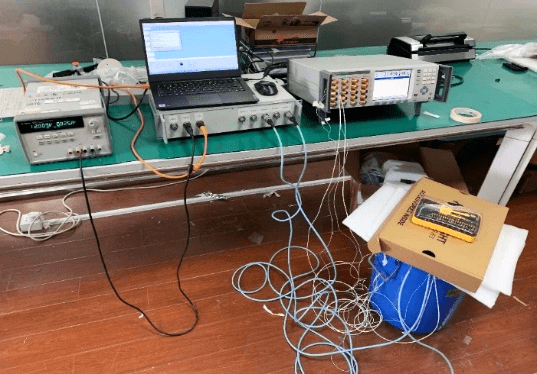
thermal measurement & control testbed
low-thermoelastic-coefficient structure
\(<0.1 \mathrm{mm}\)
(req. 0.1 mm)
\(0.58\times10^{-7} /K\)
(req. \(1\times10^{-7} /K\))
Take-away: In space-borne GW detection, the spacecraft is part of the instrument, and environmental coupling is part of the noise model.
Ultra-stable platform and environmental coupling
- 自引力控制:突破低热弹结构设计、自引力刚度控制和质心在轨测控技术,采用多级阻尼控温+局部精细化控温的方案,实现结构热膨胀系数测试结果0.58×10⁻⁷/K( 1×10⁻⁷/K ),质心调整精度实验结果优于0.1mm(0.1mm)
- 精密温控:完成高精度测温仪研制,搭建测温和温控实验平台,测温分辨率优于5μK(10μK),温控达到6.5μK/Hz1/2(10μK/Hz1/2)
- 通过已有型号完成整星仿真,验证了设计阶段磁洁净指标分配有效性,达到太极指标
In space-borne GW detection, the spacecraft is part of the instrument, and environmental coupling is part of the noise model.
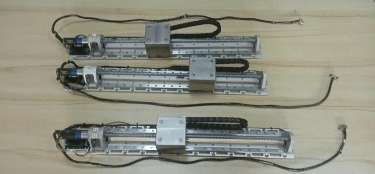
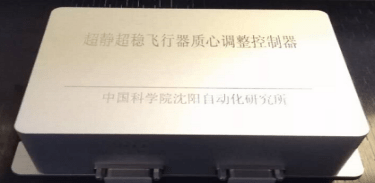
Take-away: System-level verification is the bridge from key-technology maturity to full-mission readiness.
System integration and verification
MOSA integration, drag-free closed-loop tests, three-arm scientific interferometry, and end-to-end simulation
He WANG · ICTP-AP / UCAS
Taiji: China's Space-based GW Program
MOSA PLAYLOAD INTEGRATION
END-TO-END SIMULATION
DRAG-FREE CLOSED-LOOP VERIFICATION
THREE-ARM SCIENTIFIC INTERFEROMETER
GRS · optical metrology · laser link · pointing subsystem
Payload-level noise coupling and interface verification
Engineer-model MOSA assembly and calibration
Verify coupled noise transfer across the full payload subsystem
Subsystem:
Focus:
Method:
Goal:
PAYLOAD INTERGRATION
SEMI-PHYSICAL LOOP
SC-TM dynamics · micro-thrusters · pointing/control coupling
Closed-loop drag-free control under ground-equivalent conditions
Hardware-in-the-loop semi-physical simulation platform
Test closed-loop drag-free residual-acceleration performance
Subsystem:
Focus:
Method:
Goal:
FULL-CHAIN VERIFICATION
Inerial reference · laser link · optical-path simulation · TDI
Three-arm interferometry and ranging verification
ground-equivalent semi-physical test
TDI-related laser-frequency-noise suppression · long-duration stability
Subsystem:
Focus:
Method:
Goal:
\(\Rightarrow\)DATA CHALLENGE BRIDGE
Orbit · payload interfaces · instrument noise · TDI · GW injection
Taiji science-application simulation prototype subsystem
Full-chain simulation model library and validation
Generate mock science-data products for downstream analysis
Subsystem:
Focus:
Method:
Goal:
End-to-end simulation prototype
System-level experimental testbed
Engineering-stage verification architecture; full mission performance requires further integrated tests.
From mission dynamics to science-data products
Ground-equivalent integration and environmental control
System integration and verification
The next bottleneck is system-level integration: verifying how payloads, spacecraft control, environmental coupling, TDI, and data processing work together as one measurement system.
System integration: MOSA, drag-free semi-physical verification, and three-arm interferometry
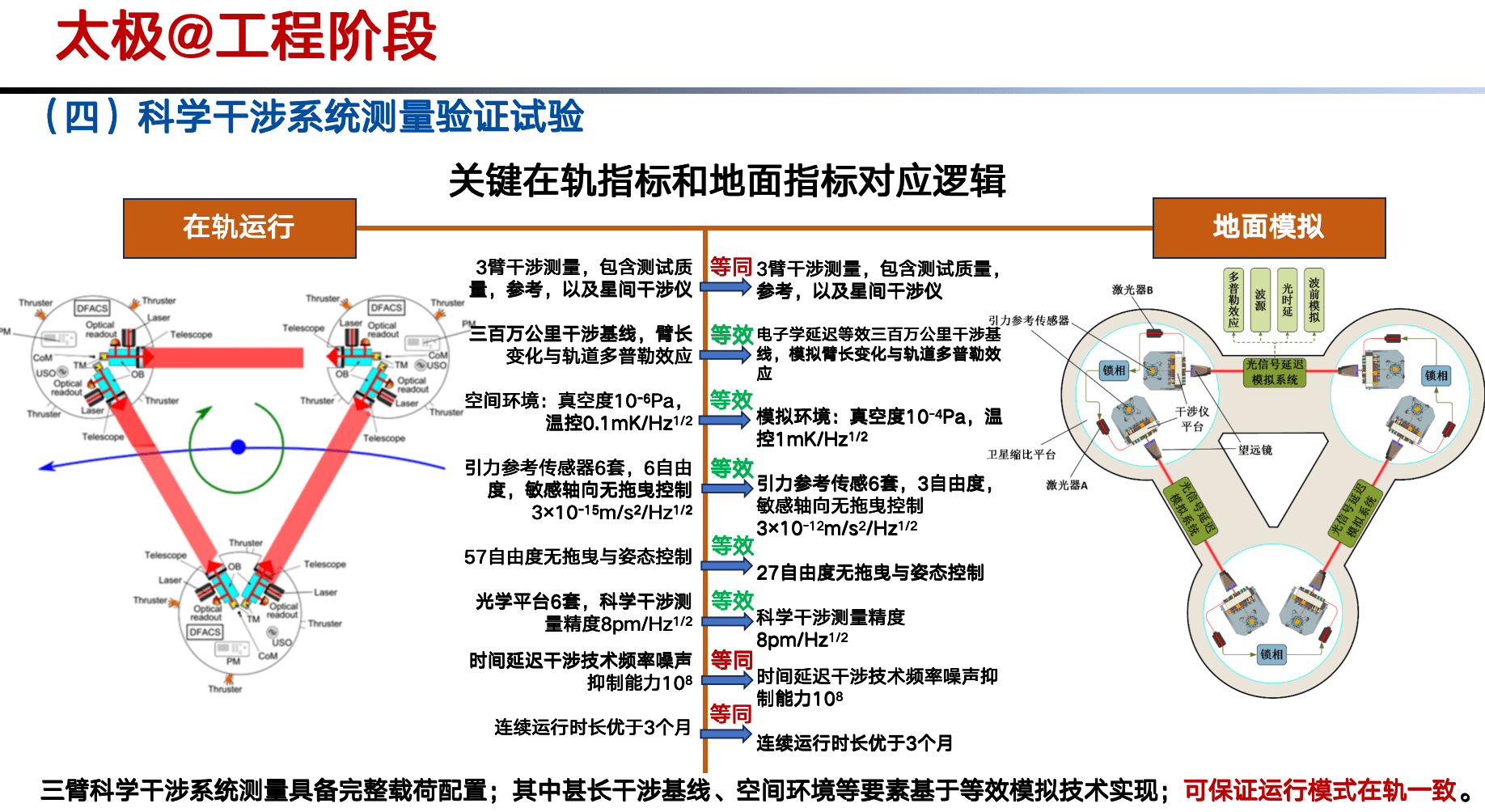
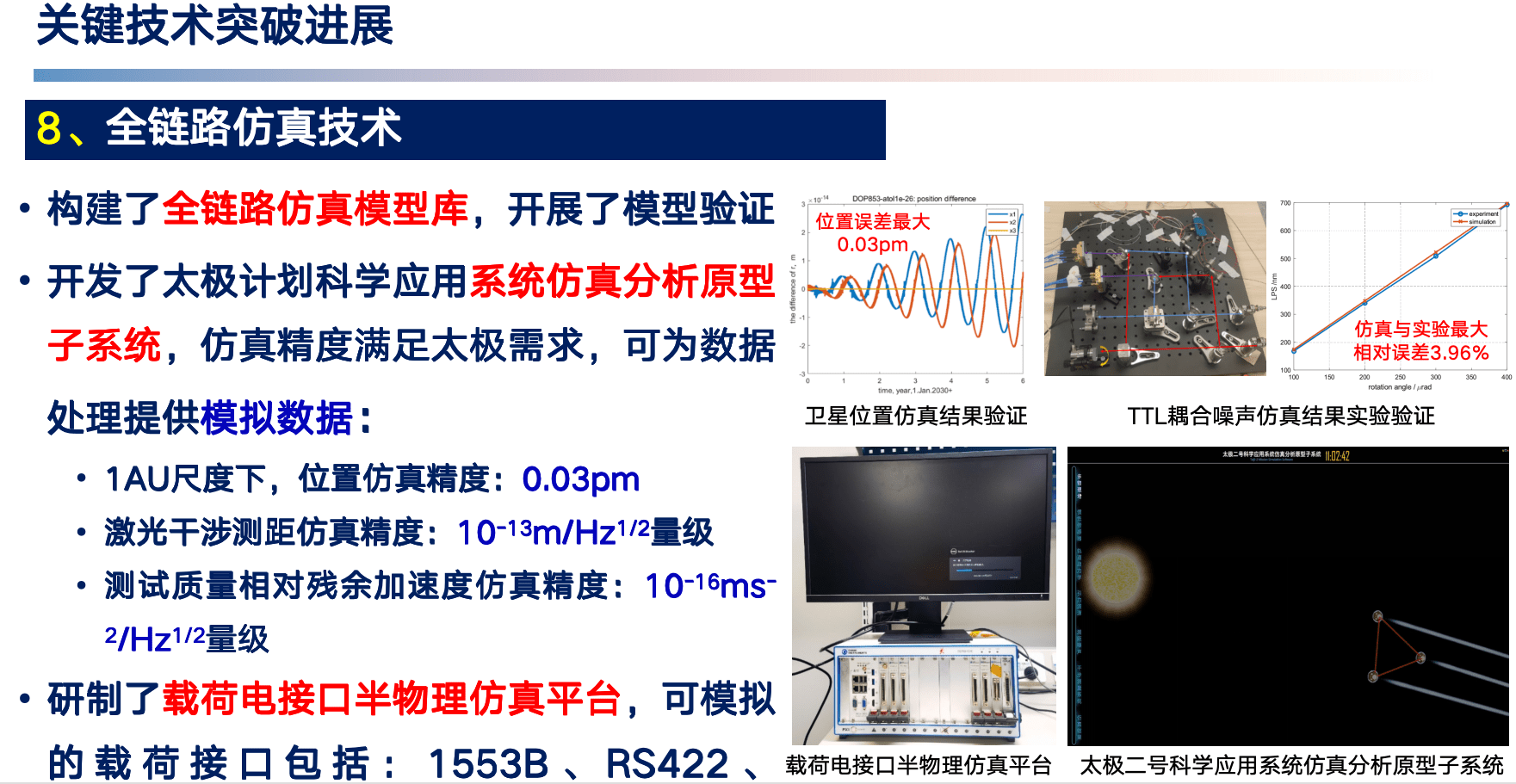
Why data challenges are mission-critical
The analysis starts from measurements—not idealized strain
He WANG · ICTP-AP / UCAS
Taiji: China's Space-based GW Program
L0
L0 - L1
L1 - L2
L2 - L3
Phase · ranging
timing · telemetry
Clock sync · calibration
TDI · noise · data quality
Low-latency search
global fitting · noise characterization
Catalogs · cosmology
fundamental physics
Raw
Measurements
Preprocessing
Scientific
Inference
Science
Products
Simulation closes the loop · science requirements constrain instrument design
Orbit-dependent signal response · laser-frequency noise
MEASUREMENT REALISM
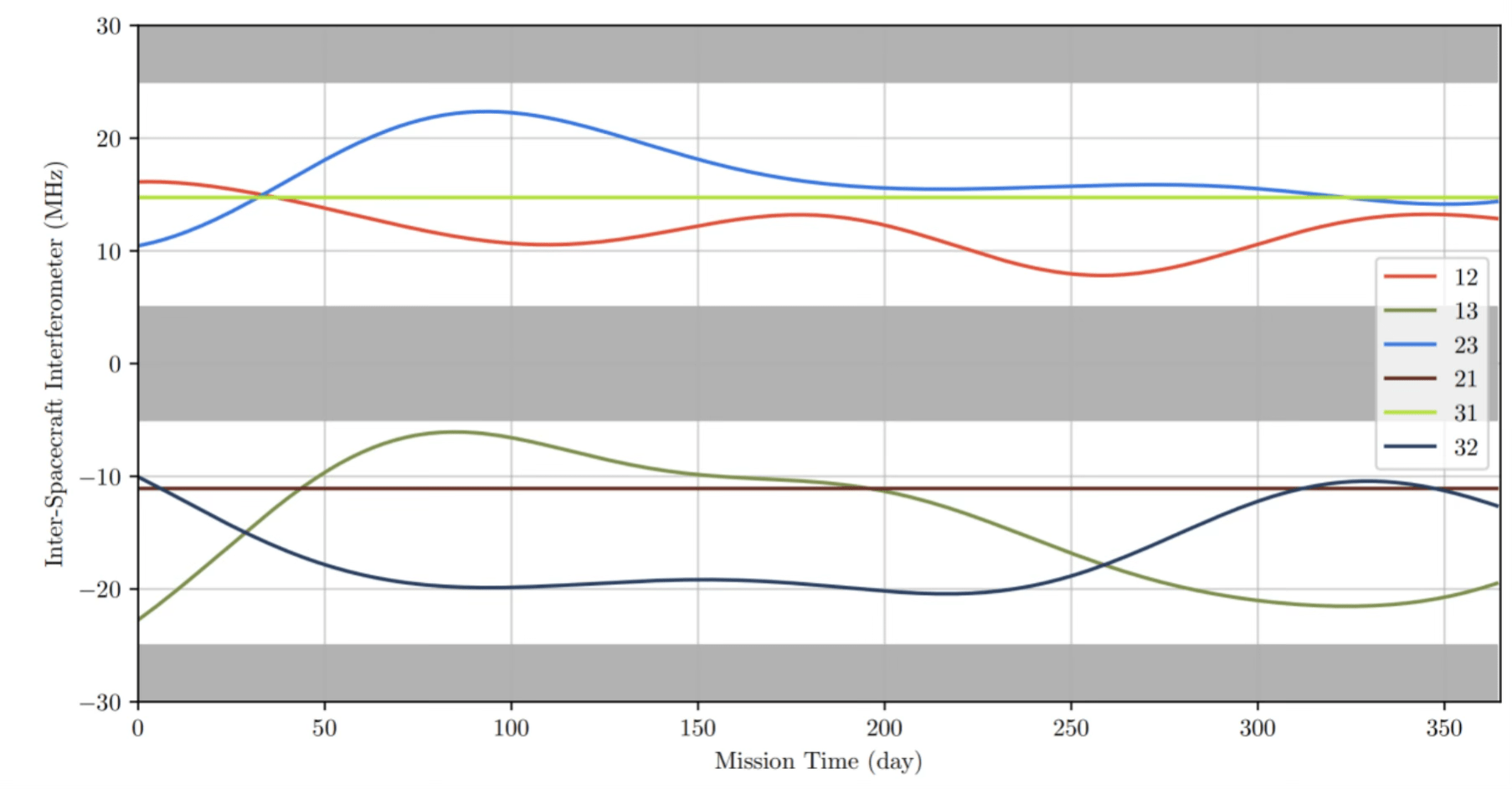
Clock noise & desynchronization · TTL coupling
GRS center-of-mass offsets · instrument transfer functions
Gaps · non-stationary noise · spectral lines
Unknow noise transients · anomaly identification
Observation interruptions · missing-data recovery
DATA IMPERFECTIONS
Overlapping signals · Galactic foreground · multi-source inference
Instrumental noise · stochastic backgrounds · source–noise degeneracy
Global fit · \(\sim10^4\) resolvable sources
SOURCE–NOISE COMPLEXITY
Data challenges connect instrument realism, full-chain simulation, and validated science products
Take-away: Data analysis is part of mission design and validation — not a post-launch add-on.
Image credit: TDCII&MH Du
From raw measurements to gravitational-wave source parameters
Taiji Data Challenge
Toward an end-to-end L0→L2 benchmark
He WANG · ICTP-AP / UCAS
Taiji: China's Space-based GW Program
Minghui Du et al., China-Phys. Mech. Astron. (2026)
Example TDC II training data
Open datasets and selected analysis tools: https://github.com/TriangleDataCenter
Released datasets · documented injections · reproducible pipeline benchmarking
Open validation framework
Massive black-hole binaries · Galactic binaries · extreme mass ratio inspiral · stochastic background · instrumental noise
Multi-source mock data
Numerical orbits · unequal arms · TDI 2.0 · spacecraft–payload couplings
Realistic detector configuration
Laser generation · propagation · interferometry · sampling/readout · TDI
Full-chain simulation
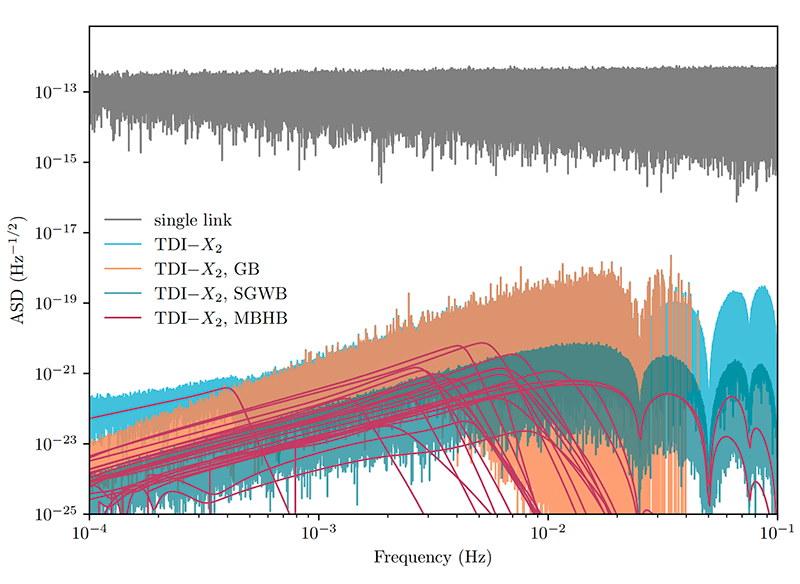
Take-away: TDC connects realistic instrument simulation to reproducible end-to-end scientific validation.
POSTER
2.06

Mock datasets: from L0 raw data to source-level products
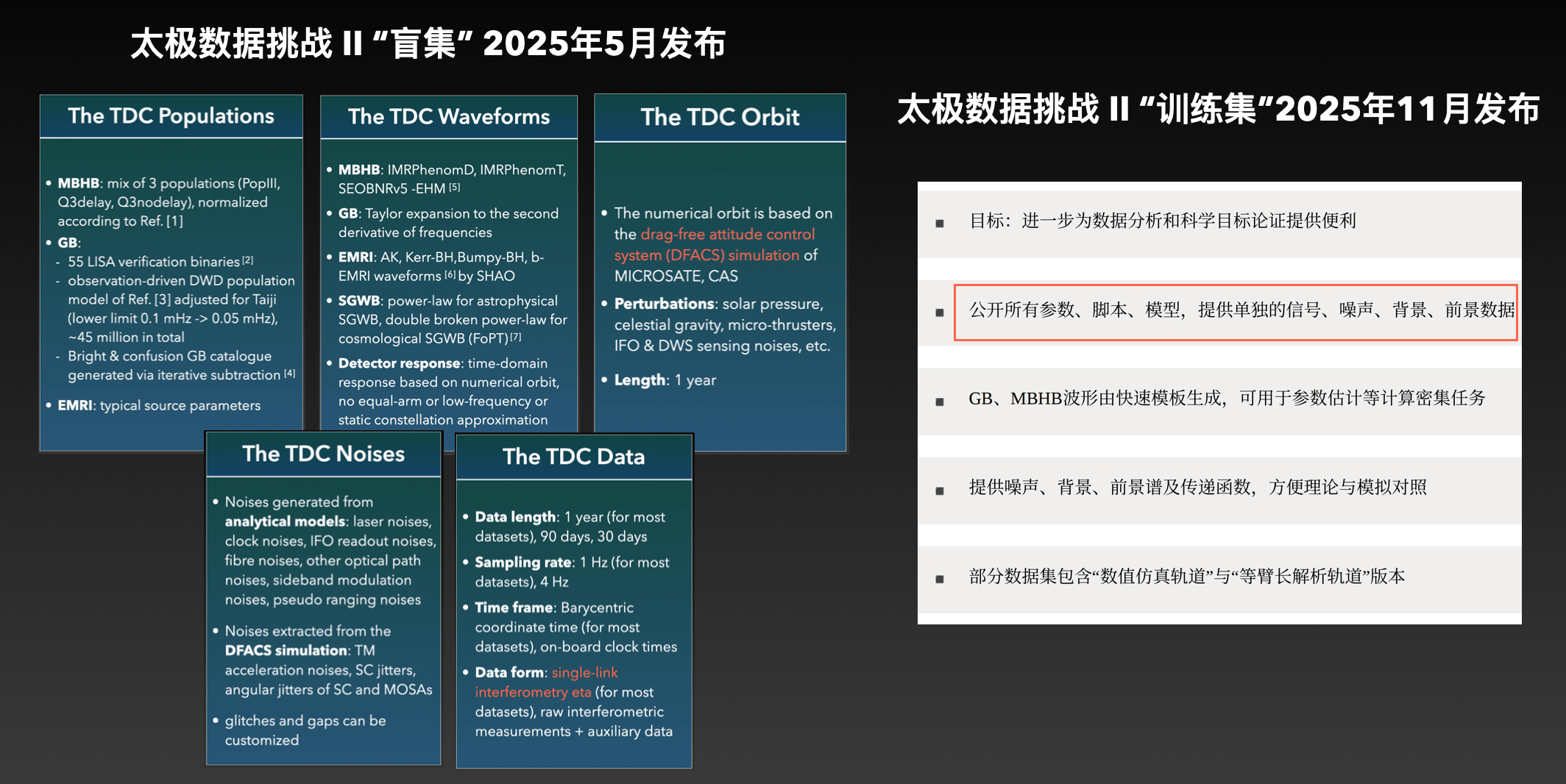
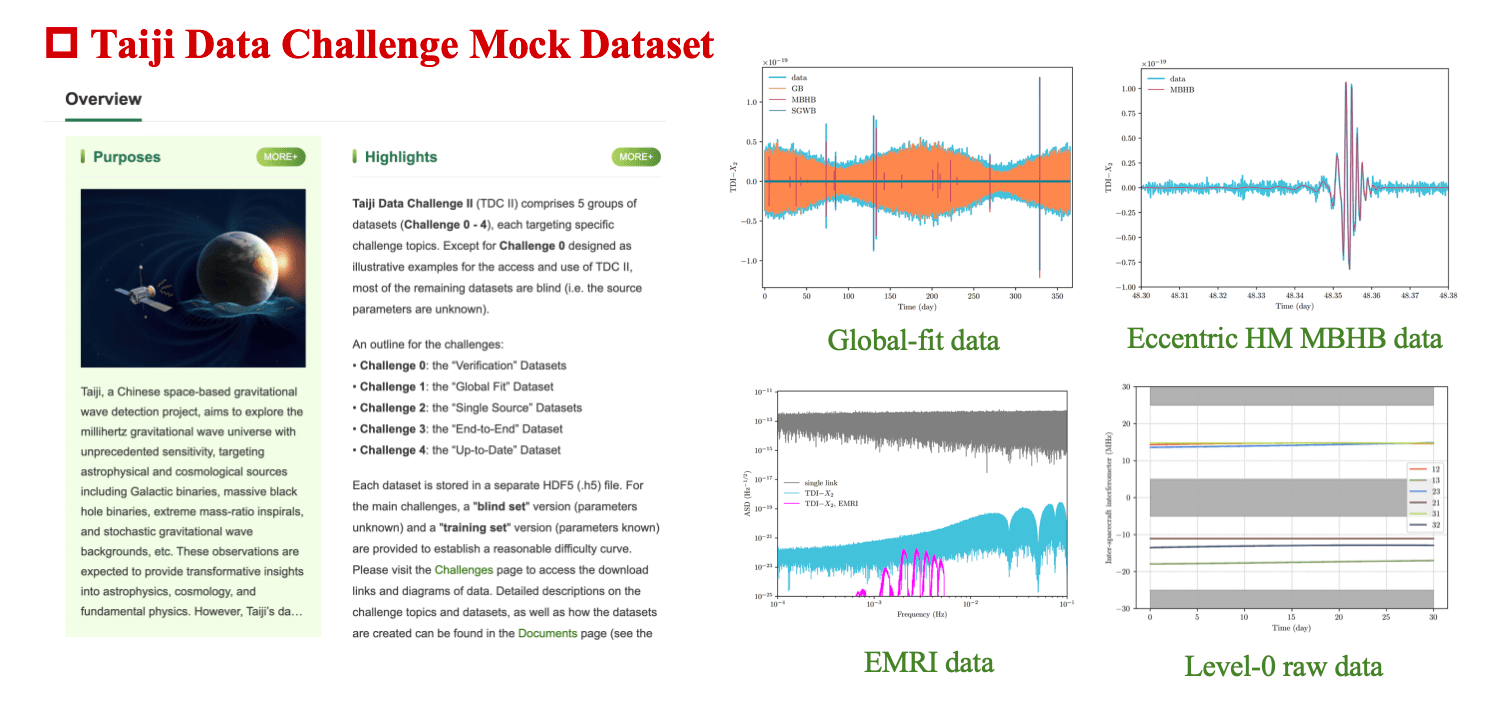
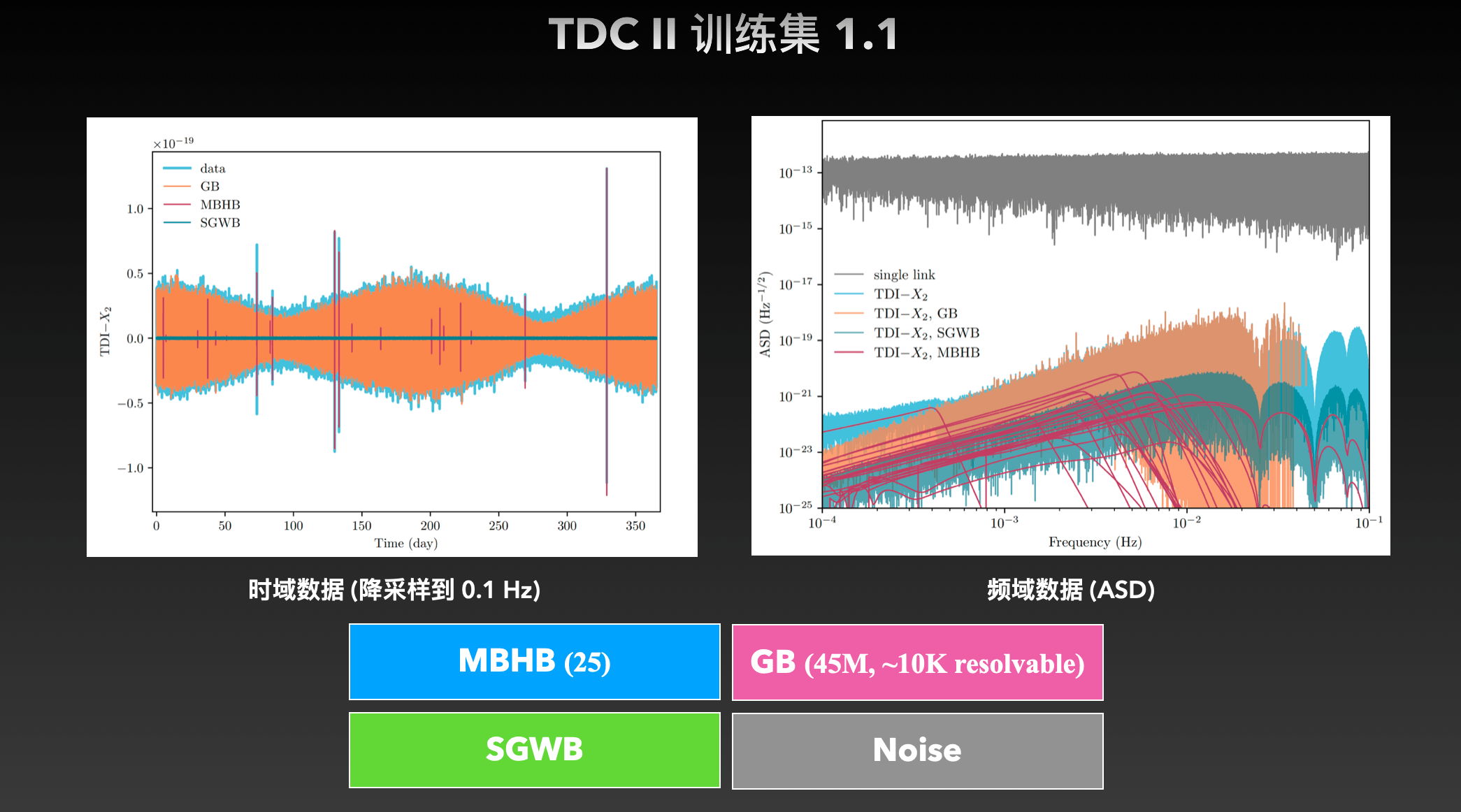
The goal is not only to inject astrophysical waveforms, but to simulate the measurement chain where signal, noise, orbit, TDI, and detector operation are coupled.
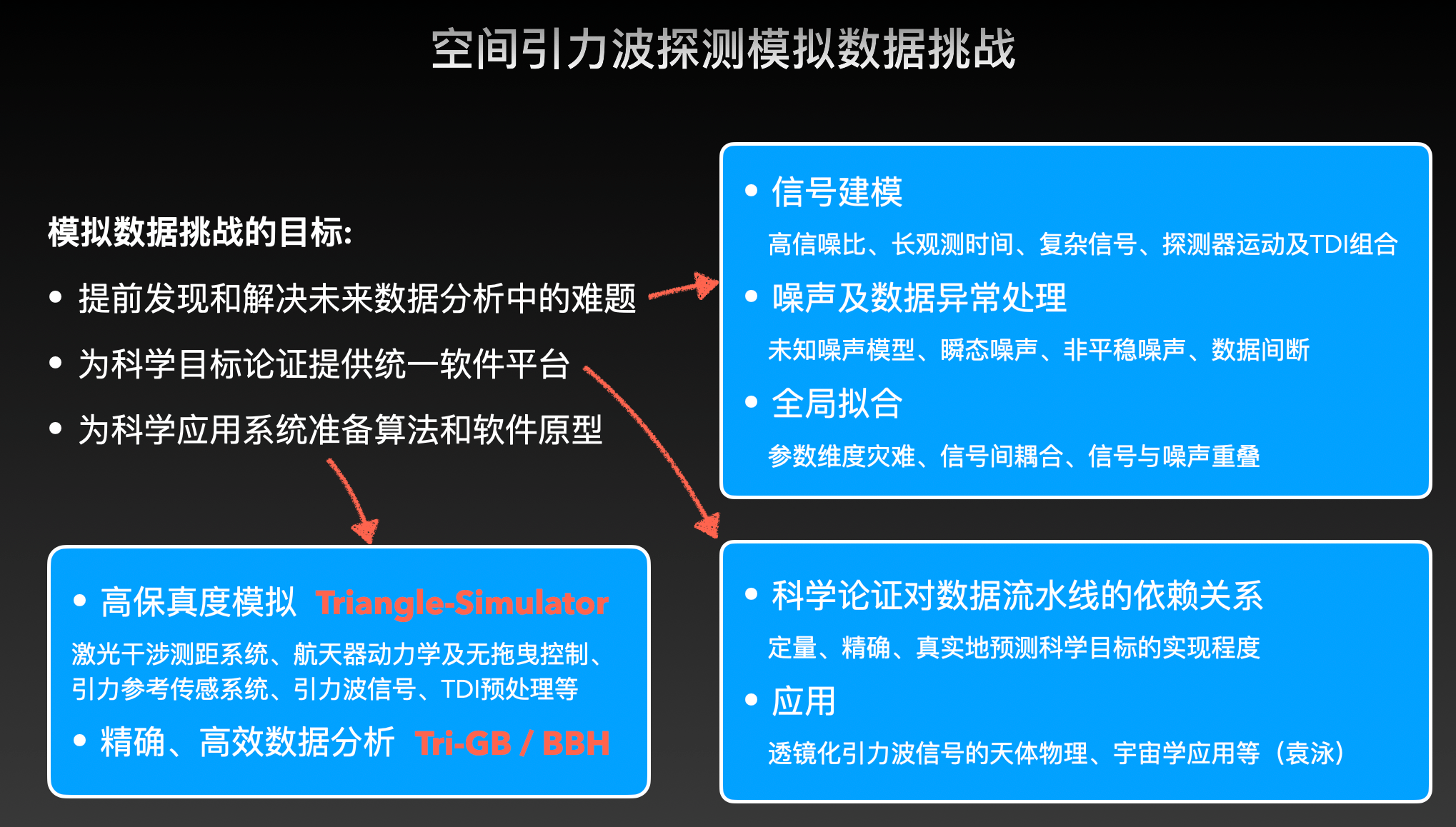
Space-GW analysis is an ecosystem problem
- 目标:进一步为数据分析和科学目标论证提供便利
- 公开所有参数、脚本、模型,提供单独的信号、噪声、背景、前景数据
- GB、MBHB波形由快速模板生成,可用于参数估计等计算密集任务
- 提供噪声、背景、前景谱及传递函数,方便理论与模拟对照
- 部分数据集包含“数值仿真轨道”与“等臂长解析轨道”版本
- 提供数据预处理挑战的 datasets: raw inter-spacecraft interferometer readouts
你可以从2502.03983, 2507.18397, 2602.06731取图并cite这几篇文章
Tang:XX
DU:https://doi.org/10.1364/OE.540561
用特殊TDI组合抑制测试质量glitch的
Data preprocessing: TDI, calibration, and detector characterization
For Taiji/TJ, preprocessing is a scientific step: it defines how raw interferometric measurements become calibrated TDI science data.
Calibration determines what enters TDI; the next step is laser-frequency-noise suppression through time-delay interferometry.
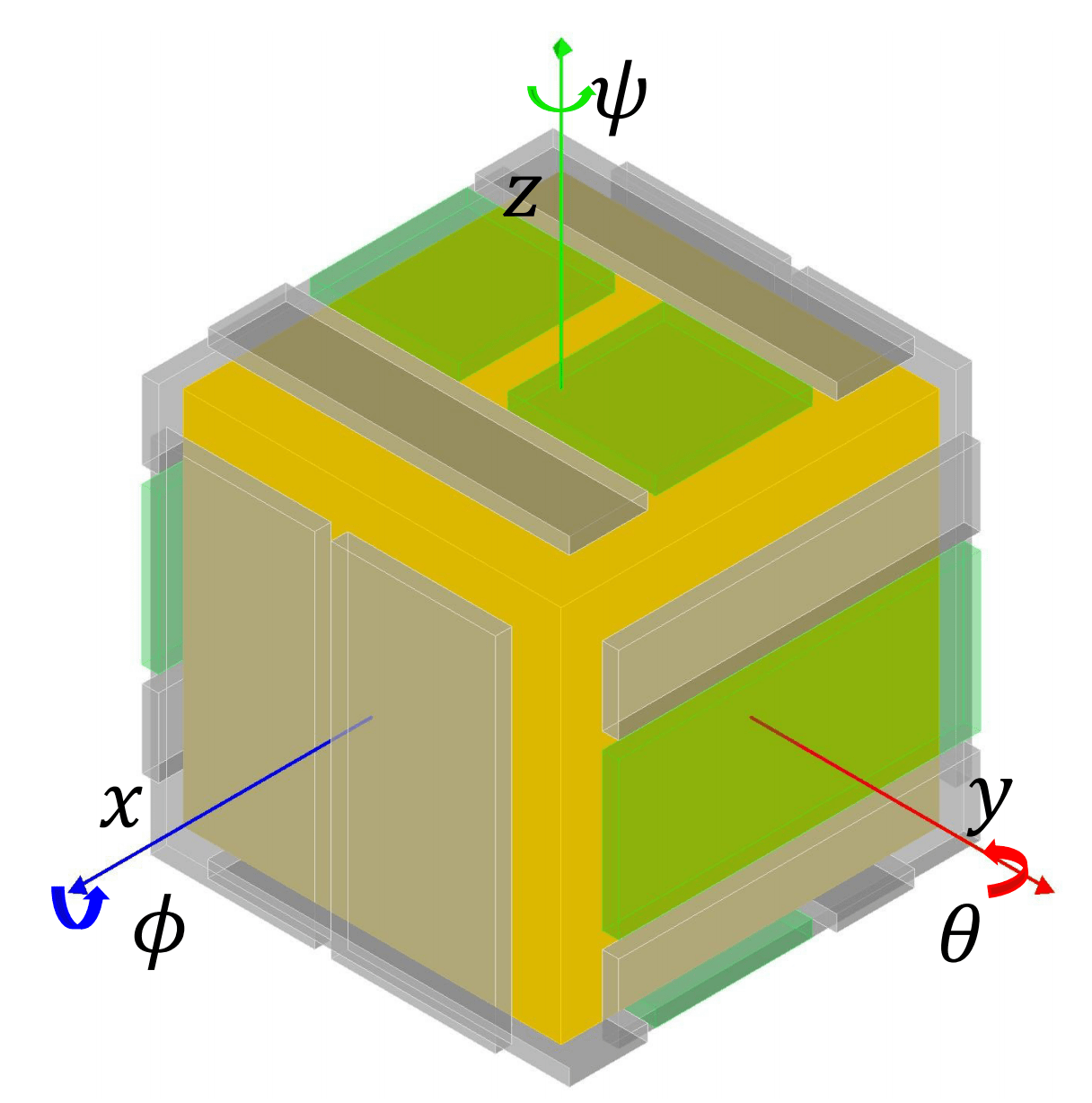
shematic Taiji GRS layout
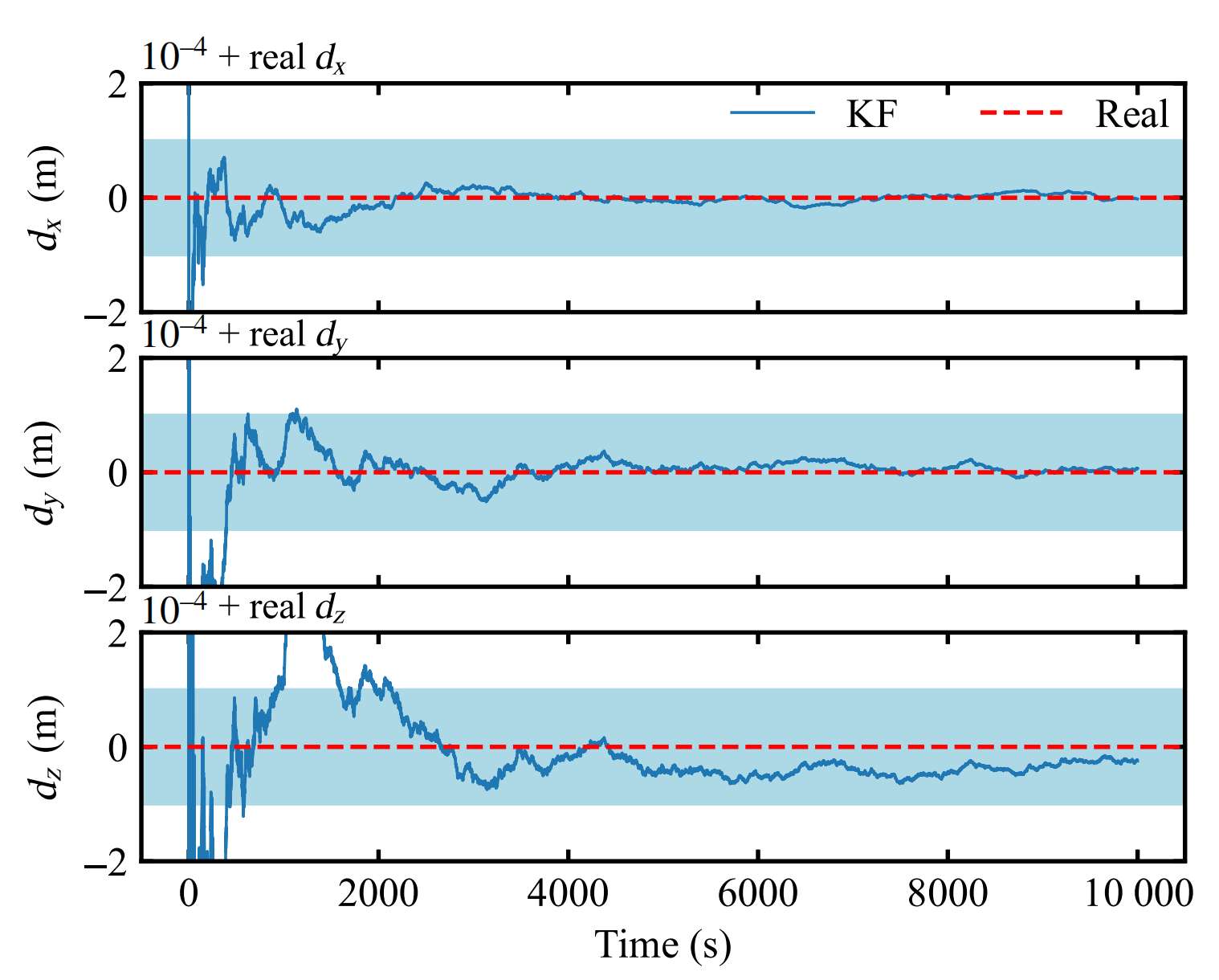
GRS c.o.m calibration result
GRS key parameter calibration for Taiji-1 and Taiji missions
[X. Wei et al, Phys. Rev. D 108, 082001, 2023]
[H. Zhang et al, Remote Sens. 2023, 15, 3817]
[H. Zhang et al, Phys. Rev. Appl. 25, 044043 (2026)]
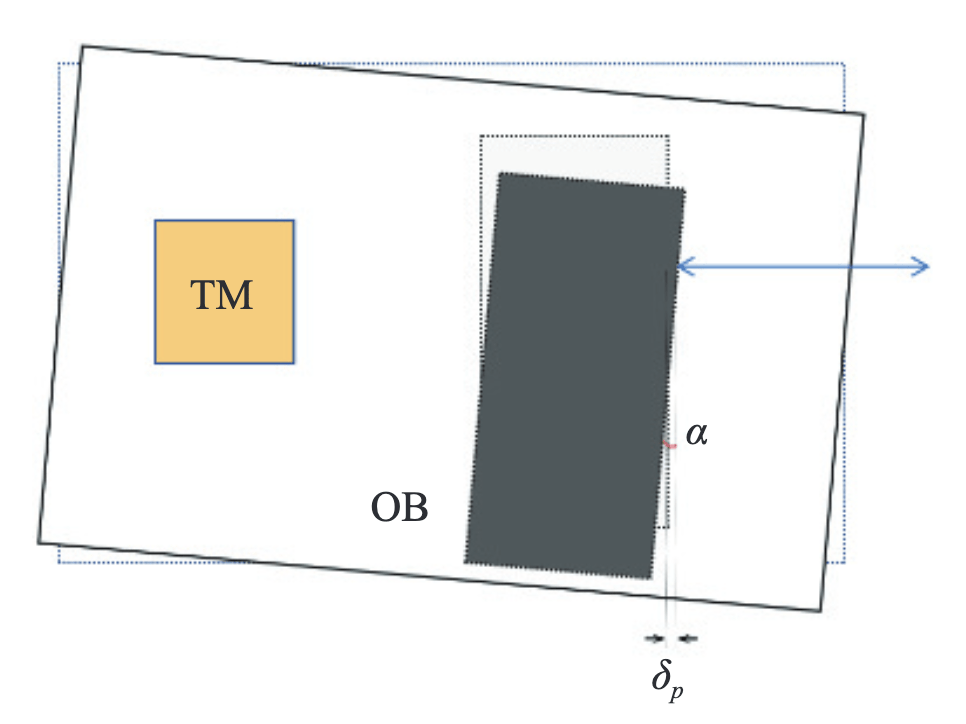
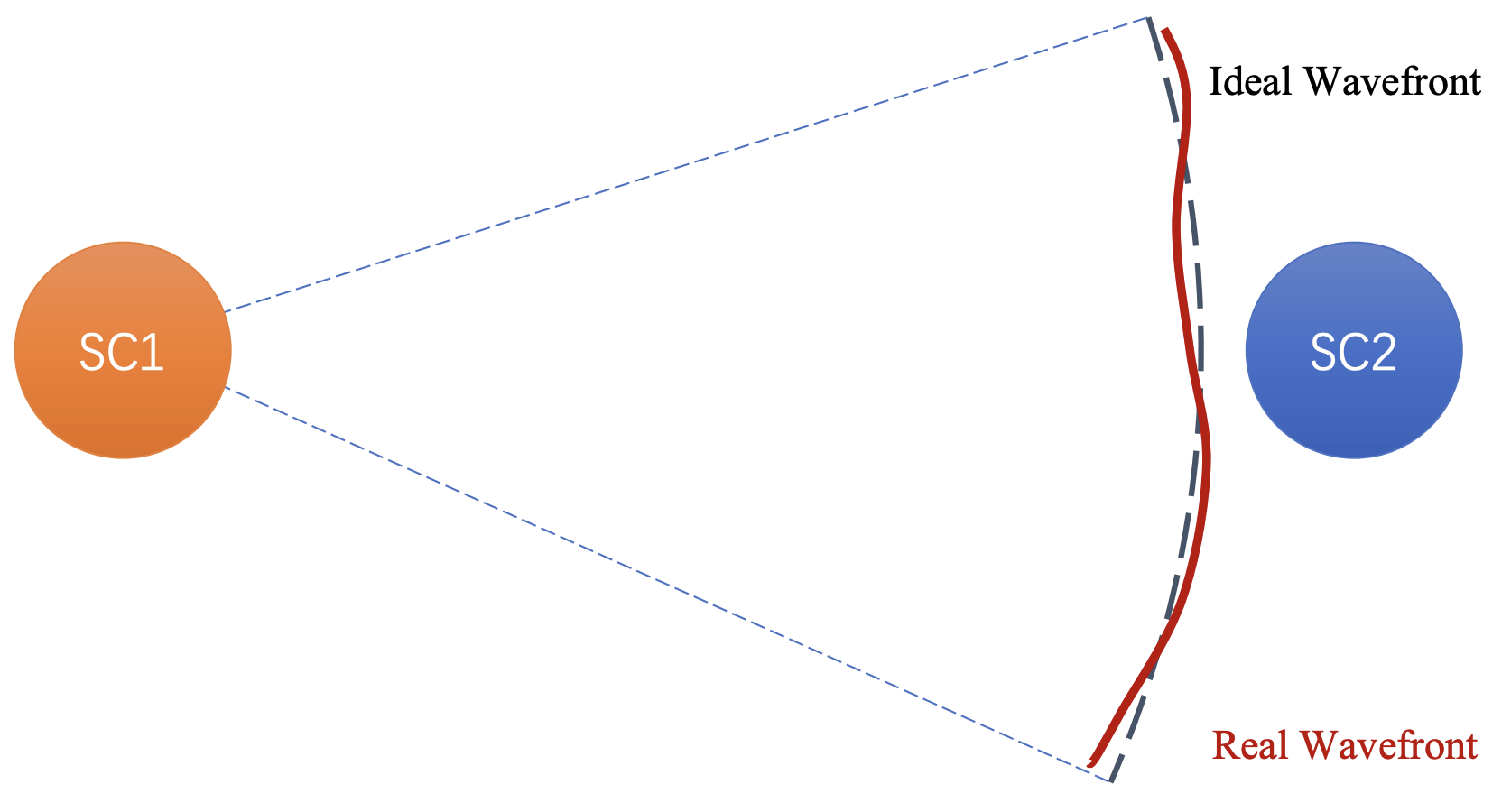
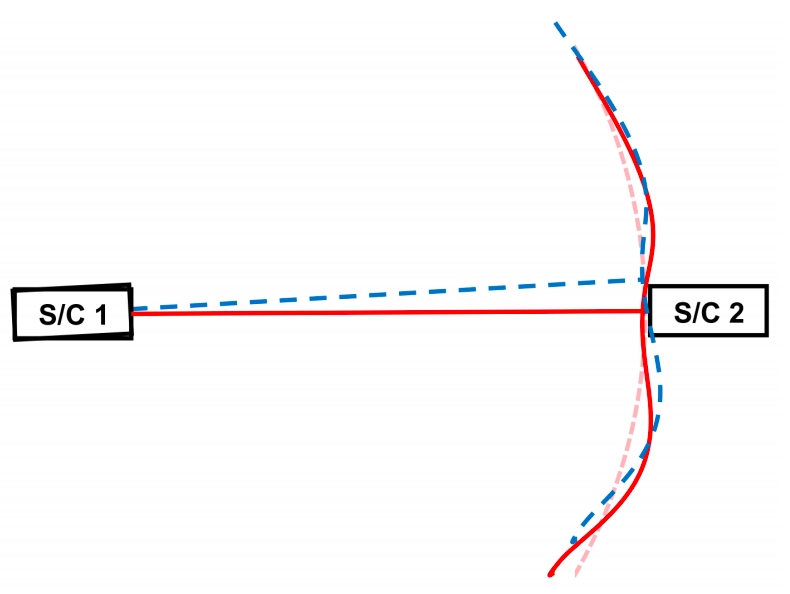
TTL mechanisms
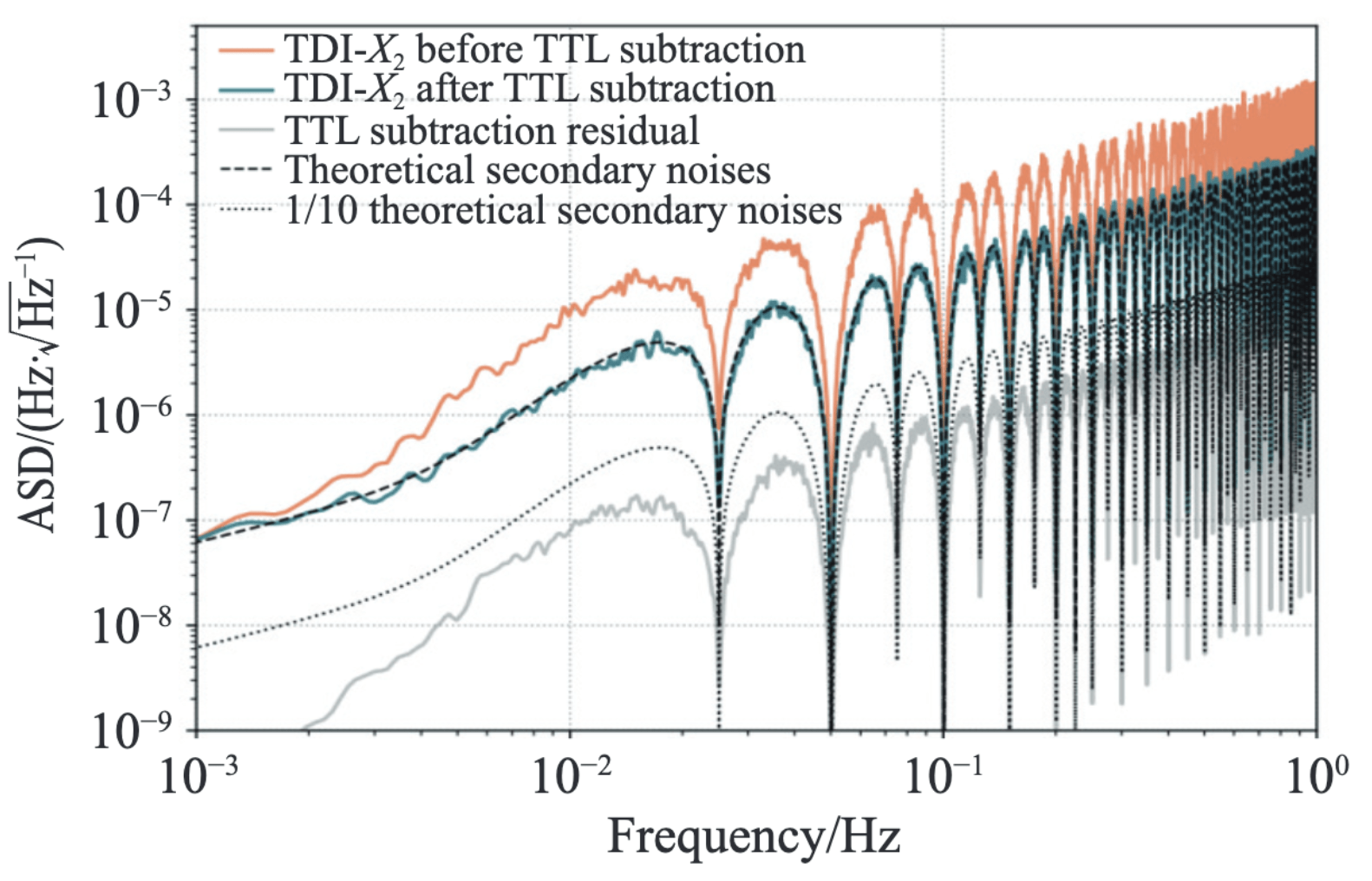
TTL noise suppression result
TTL coupling coefficient calibration for Taiji
[L. Ye et al, Chinese Optics, 2025, 18(3): 583-595]
[X. Wang et al, 2602.06731]
He WANG · ICTP-AP / UCAS
Taiji: China's Space-based GW Program
Data preprocessing I: calibration of key operation parameters
From raw measurements to calibrated observables
GRS and center-of-mass calibration
Center-of-mass offsets and readout-axis misalignment
He WANG · ICTP-AP / UCAS
Taiji: China's Space-based GW Program
From raw measurements to calibrated observables
GRS operation parameter calibration
- Scale factors, center-of-mass offsets, and residual stiffness along the sensitive axes
- Readout-axis misalignment and spacecraft–test-mass cross-coupling
- Calibrated parameters for drag-free control loop closure and noise budgeting
GRS c.o.m calibration result
Tilt-to-length coupling calibration
- Angular jitter couples into optical path length through wavefront errors and misalignment
- TTL coefficients are estimated from instrument and auxiliary channels
- Calibrated TTL contamination is modeled and subtracted within the TDI preprocessing chain
Example residual after TTL-coefficient estimation and subtraction
TTL calibration: L. Ye et al., Chinese Optics (2025); X. Wang et al., arXiv:2602.06731.
L0 telemetry
Initial processing
CALIBRATION & Link-state estimation
TDI & noise reduction
L1 science observables
Target CoM-offset calibration accuracy: \(<75 \mu\mathrm{m}\)
GRS calibration: X. Wei et al., PRD (2023); H. Zhang et al., Remote Sens.(2023); PR Applied , (2026).
Data preprocessing I: calibration of key operation parameters
Data preprocessing II: time-delay interferometry
From unequal-arm measurements to L1 science observables
L0 telemetry
Initial processing
Calibration & Link-state estimation
TDI & NOISE REDUCTION
L1 science observables
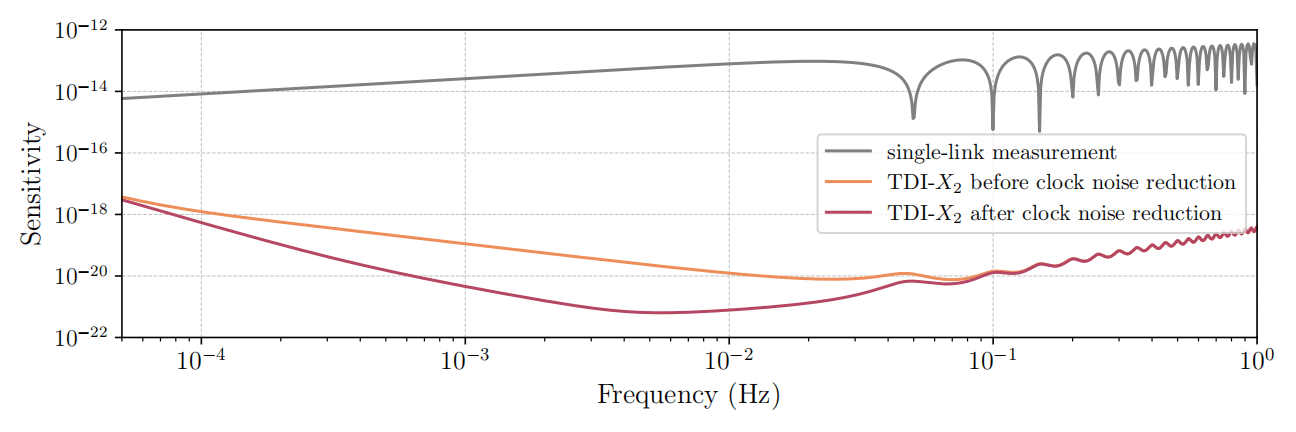
Why TDI?
- Unequal the time-varying arms prevent direct laser-noise cancellation
- Raw laser noise exceeds GW signal by ~8 orders of magnitude
- Second-generation TDI synthesizes virtual equal-arm interferometers
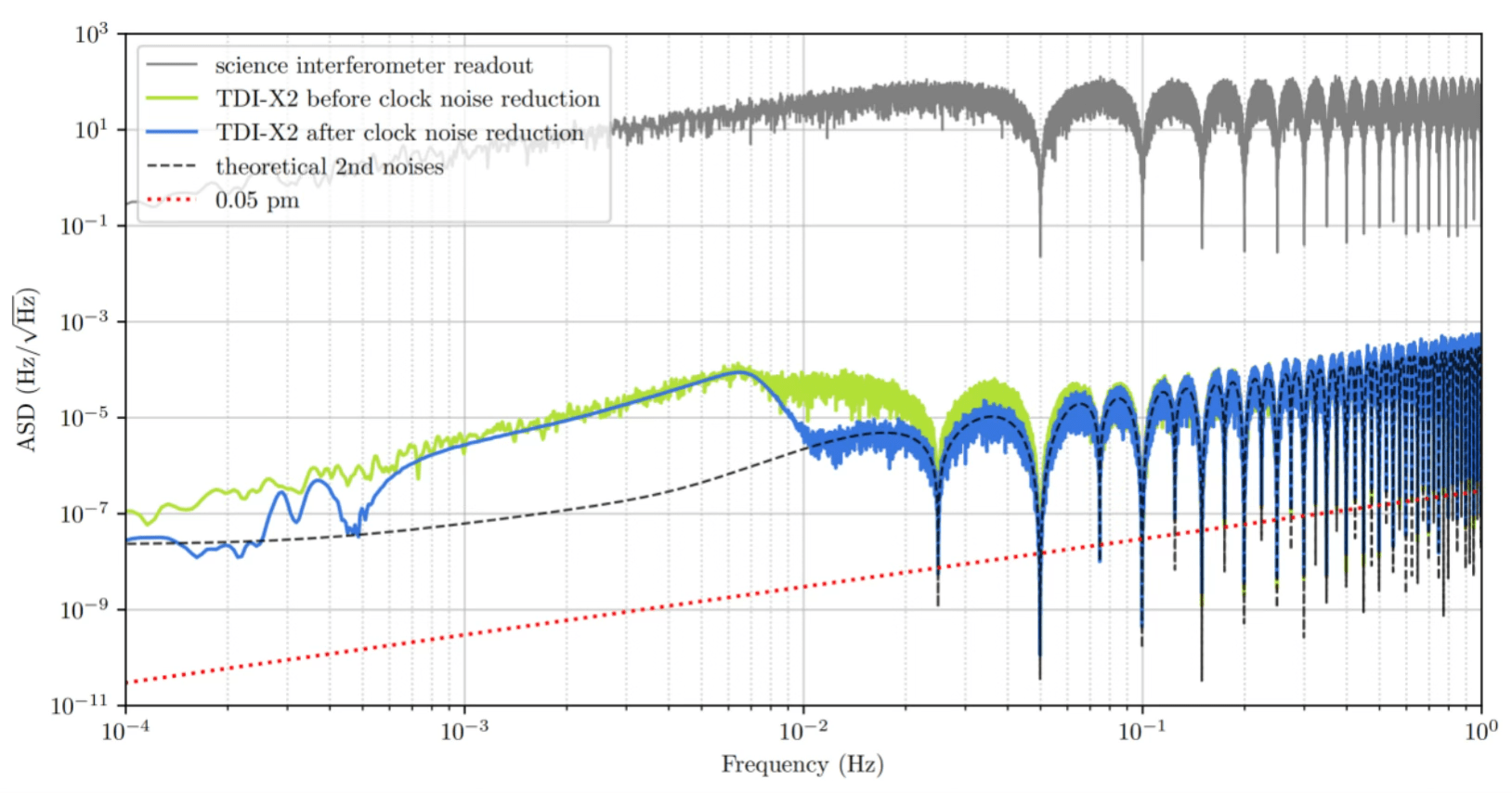
Pre-stabilized laser noise: \(\sim30 \mathrm{Hz}/\sqrt{\mathrm{Hz}}\)
GW target at mHz is 8 orders below laser noise
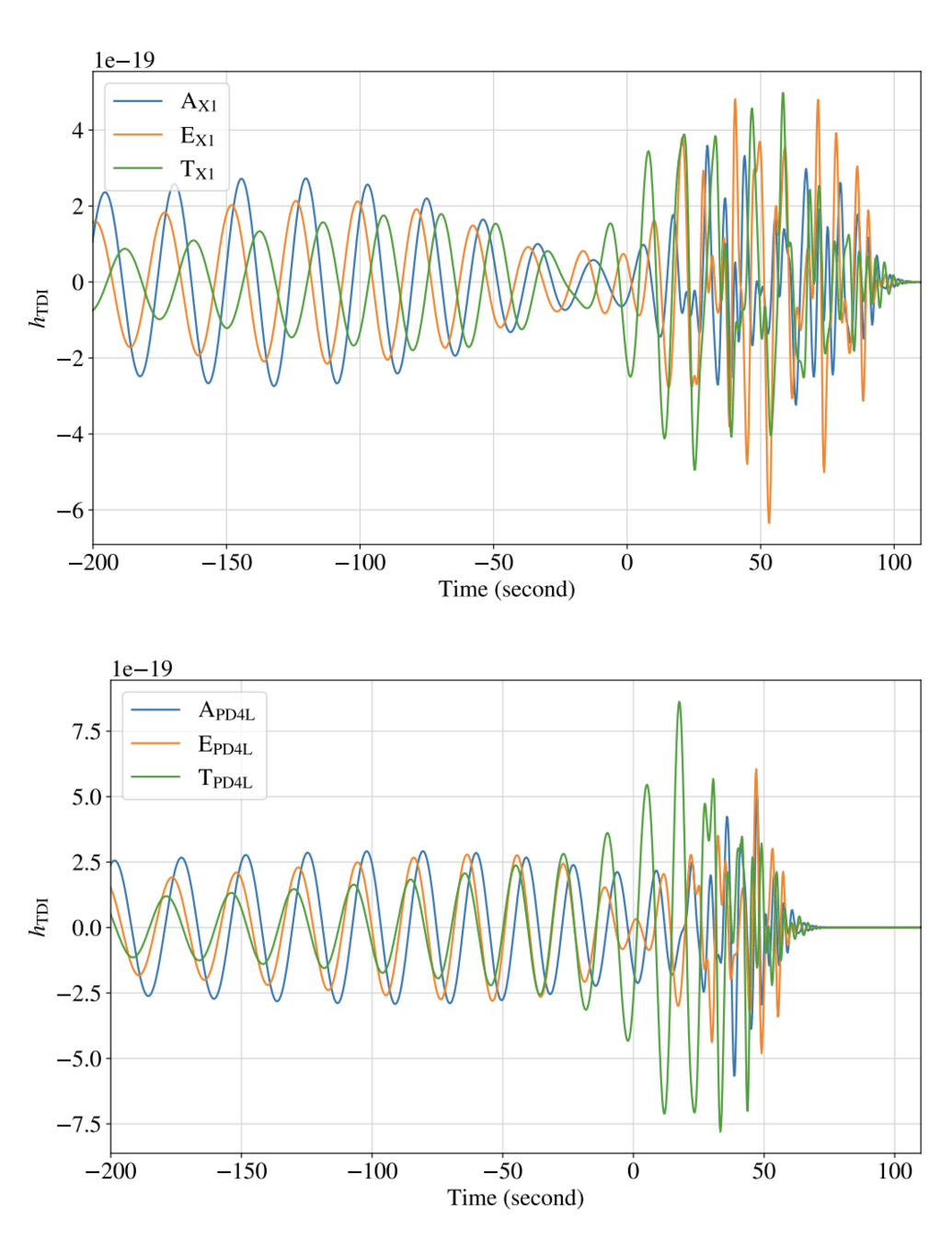
Noise suppression cascade: ISI / \(\xi\) / \(\eta\) \(\rightarrow\) second-generation TDI-X\(_2\) \(\rightarrow\) clock-noise-reduced X\(_2\)
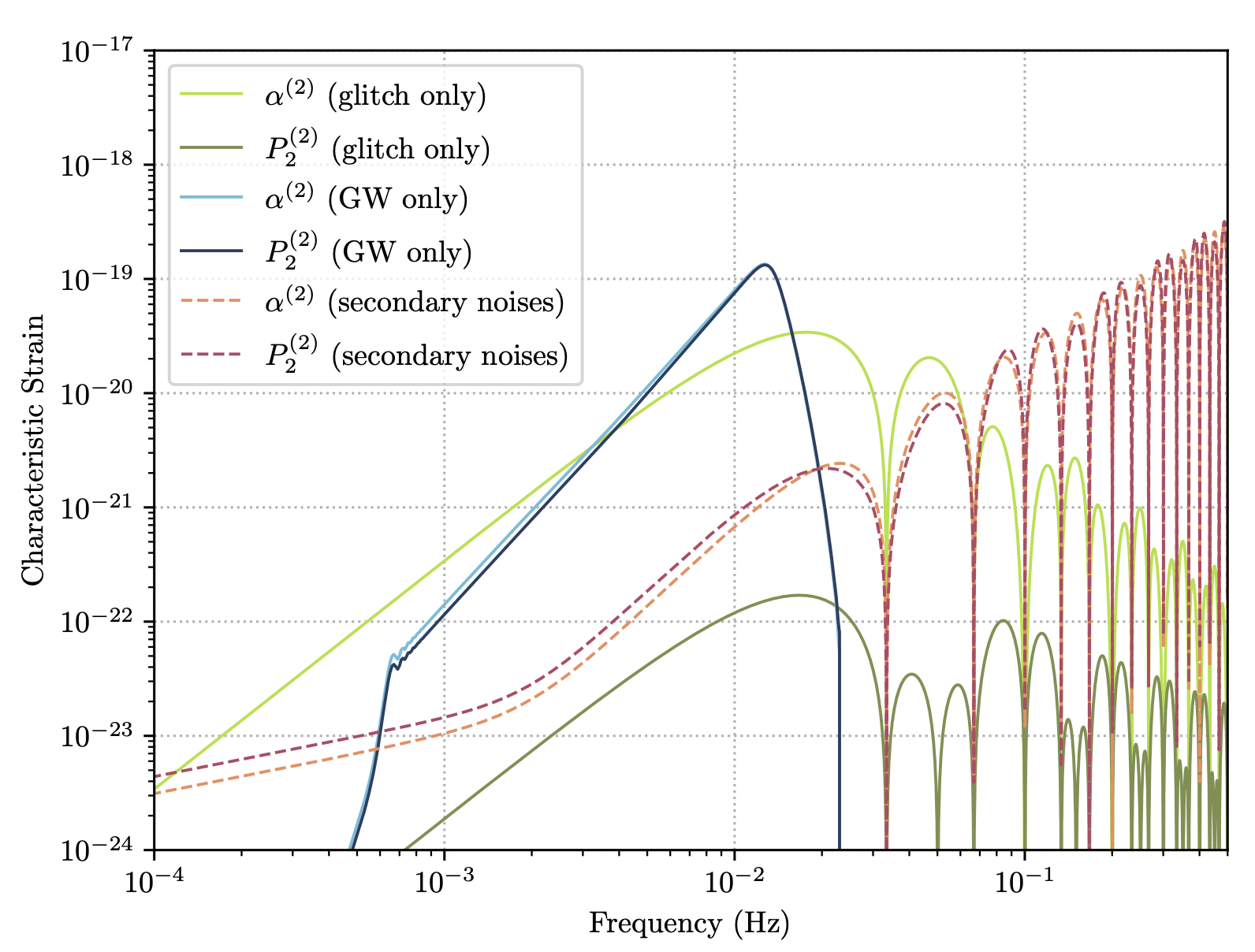
GRS-glitch propagation in TDI
Instrumental-noise characterization
Science-optimized TDI configurations
TDI response to lacalized GRS glitches compared with secondary-noise levels
P. Wu et al., Opt. Express 32 (2024) 24
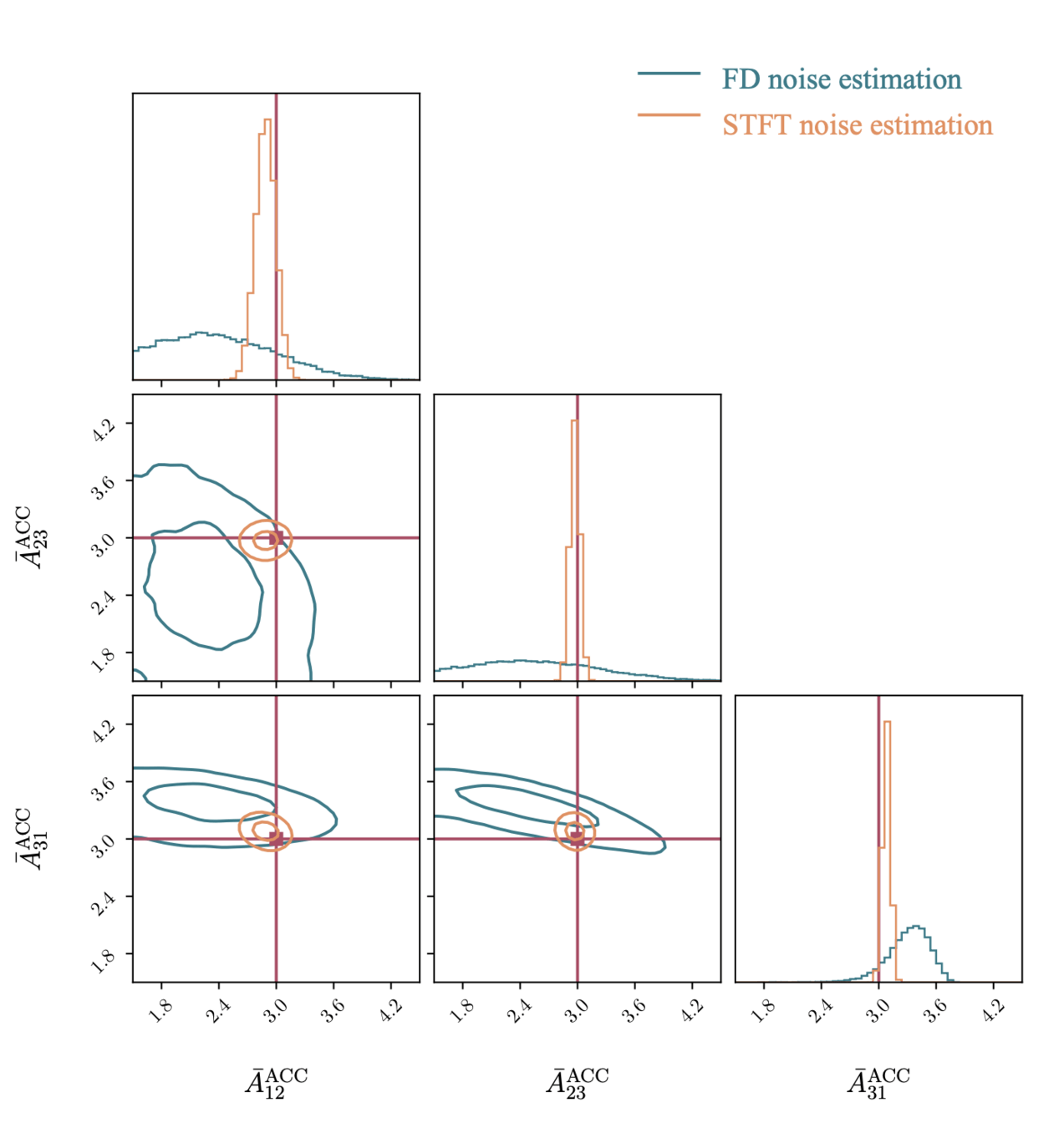
Frequency-domain and time-frequency noise inference from TDI observables
M. Du et al., PRD 112, 083036 (2025);
G. Wang, PRD 110, 064085 (2024)
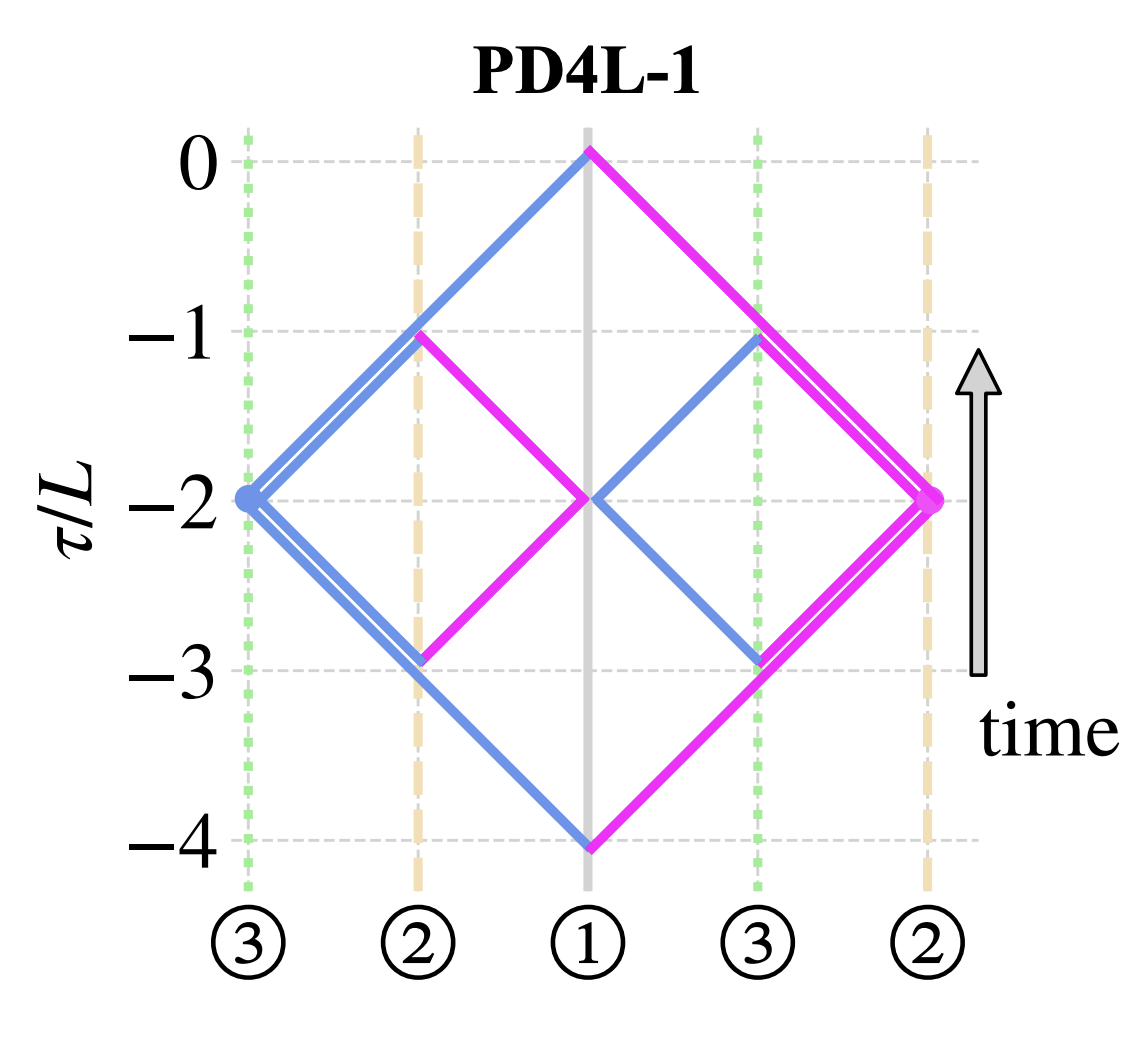
PD4L: alternative second-generation geometry for robust analysis
G. Wang, Sci. China PMA 69, 220411 (2026);
G. Wang, PRD 113, 124072 (2026)
PRELIMINARY
你可以从2502.03983, 2507.18397, 2602.06731取图并cite这几篇文章
Tang:XX
DU:https://doi.org/10.1364/OE.540561
用特殊TDI组合抑制测试质量glitch的
Data preprocessing: TDI, calibration, and detector characterization
For Taiji/TJ, preprocessing is a scientific step: it defines how raw interferometric measurements become calibrated TDI science data.
GW Sources pipeline
Population studies / H0 pipeline
Science data analysis: from source pipelines to population inference
The final data-analysis goal is not only event detection, but a validated catalog and population-level science products.
The global-fit challenge: multi-source, multi-noise, high-dimensional inference
Prototype analysis modules: MBHB, GB, SGWB/noise
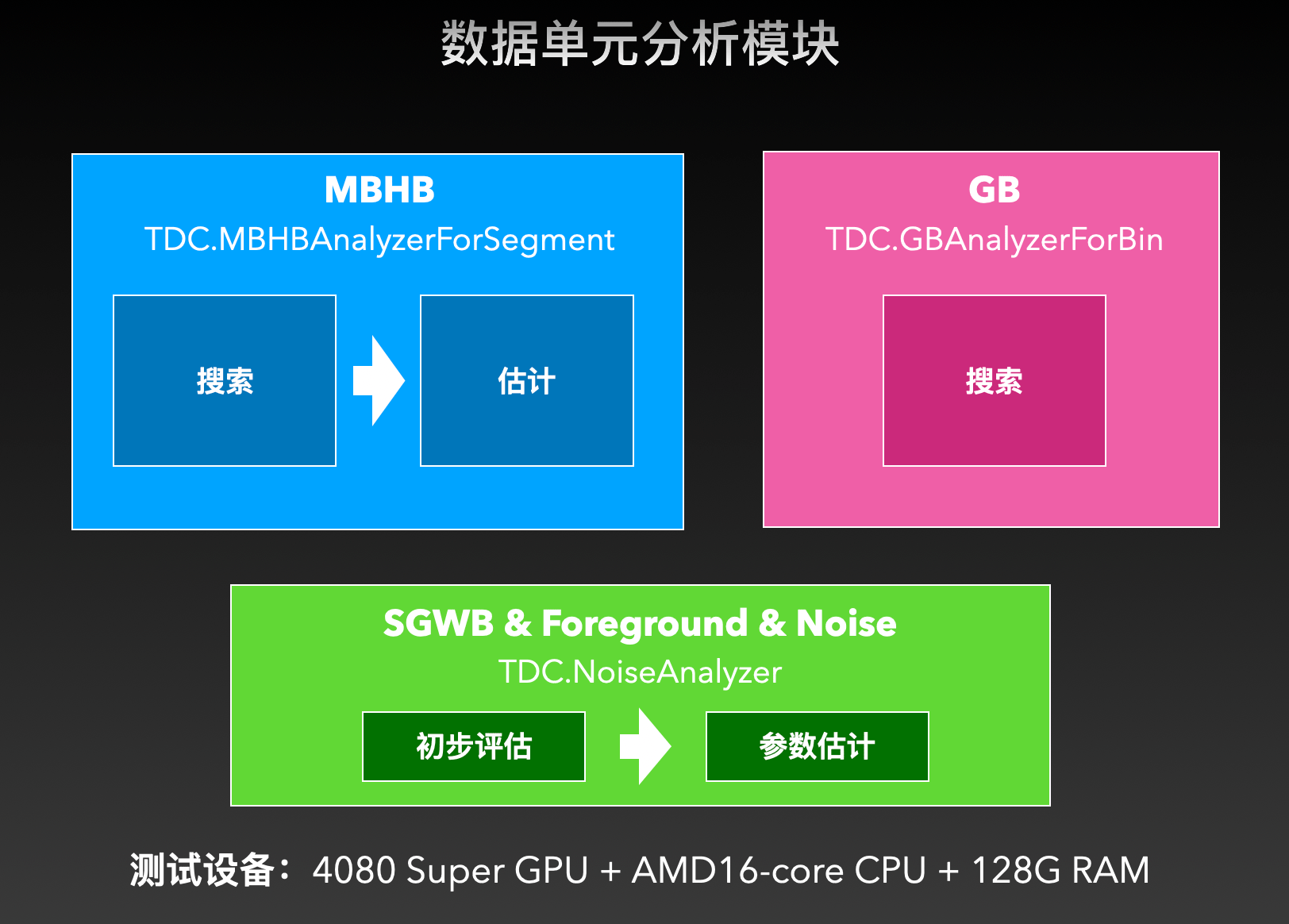
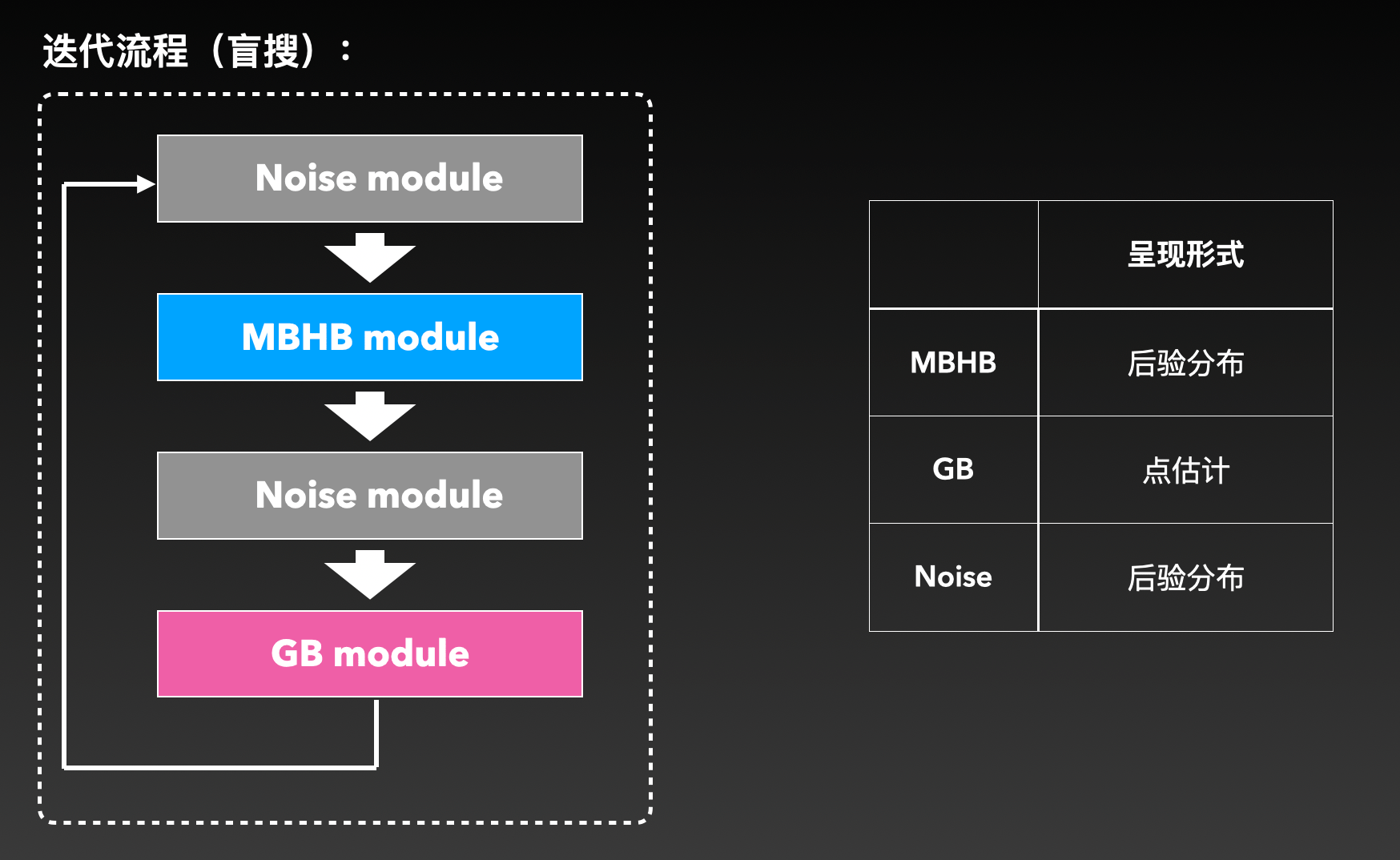
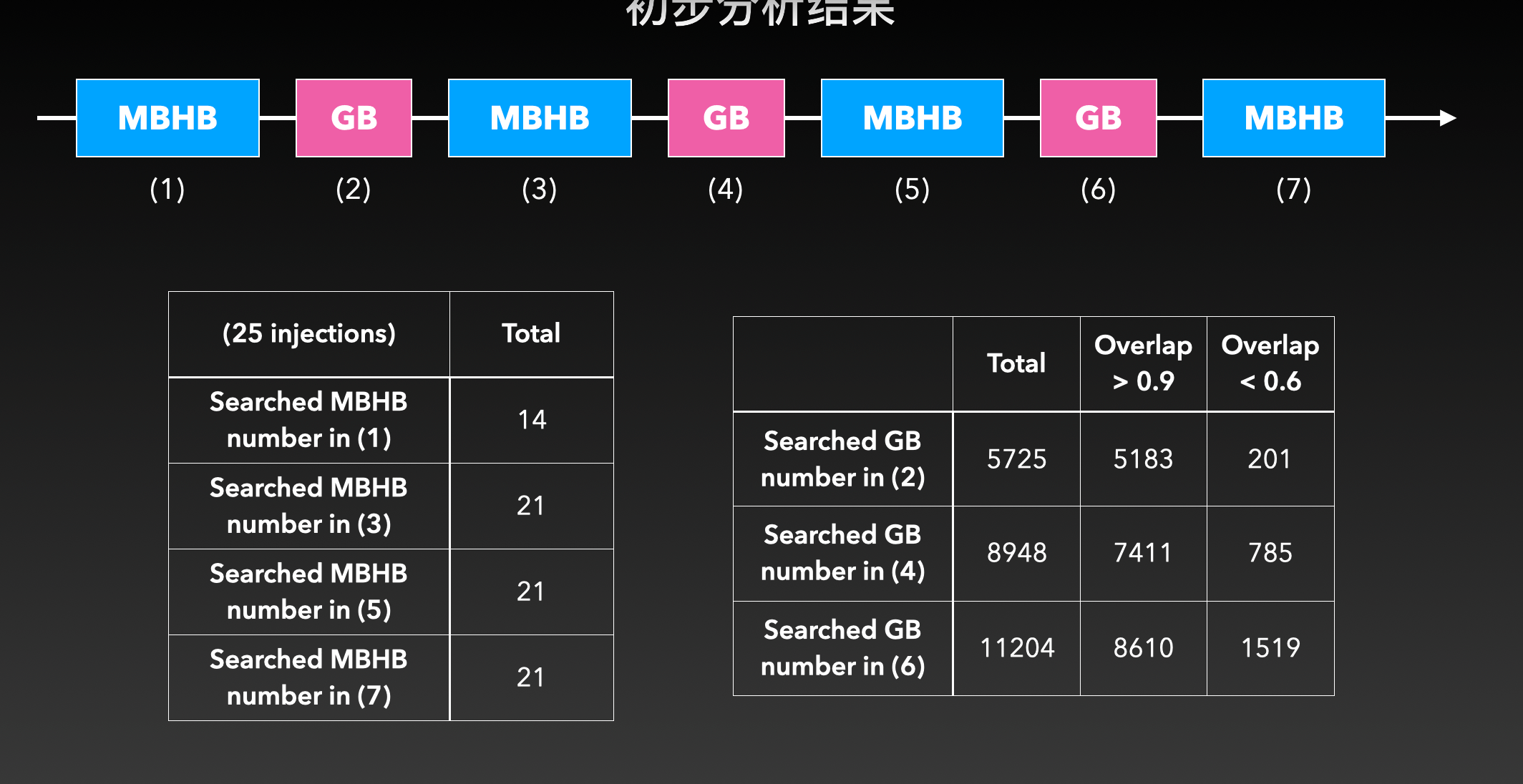
Resolving Galactic binaries in a confusion-dominated sky
Iterative source extraction and foreground reconstruction
He WANG · ICTP-AP / UCAS
Taiji: China's Space-based GW Program
Why it matters
Resolved catalog — Galactic populations and structure
Foreground reconstruction — effective sensitivity after subtraction
Downstream analyses — cleaner searches for MBHBs, EMRIs, and SGWB
Network preview: coherent LISA–Taiji recovery — revisited later
P. Gao et al., PRD (2023); X. Zhang et al., PRD (2022), PRD (2021)
Residual TDI PSD after iterative GB subtraction
Challenge
A confusion-dominated millihertz sky
- Tens of millions of simulated Galactic binaries overlap in time and frequency
Approach
- GBSIEVER combines the \(\mathcal{F-}statistic\), particle-swarm optimization, iterative subtraction, and candidate validation
- Performance must be judged by both source recovery and the residual foreground
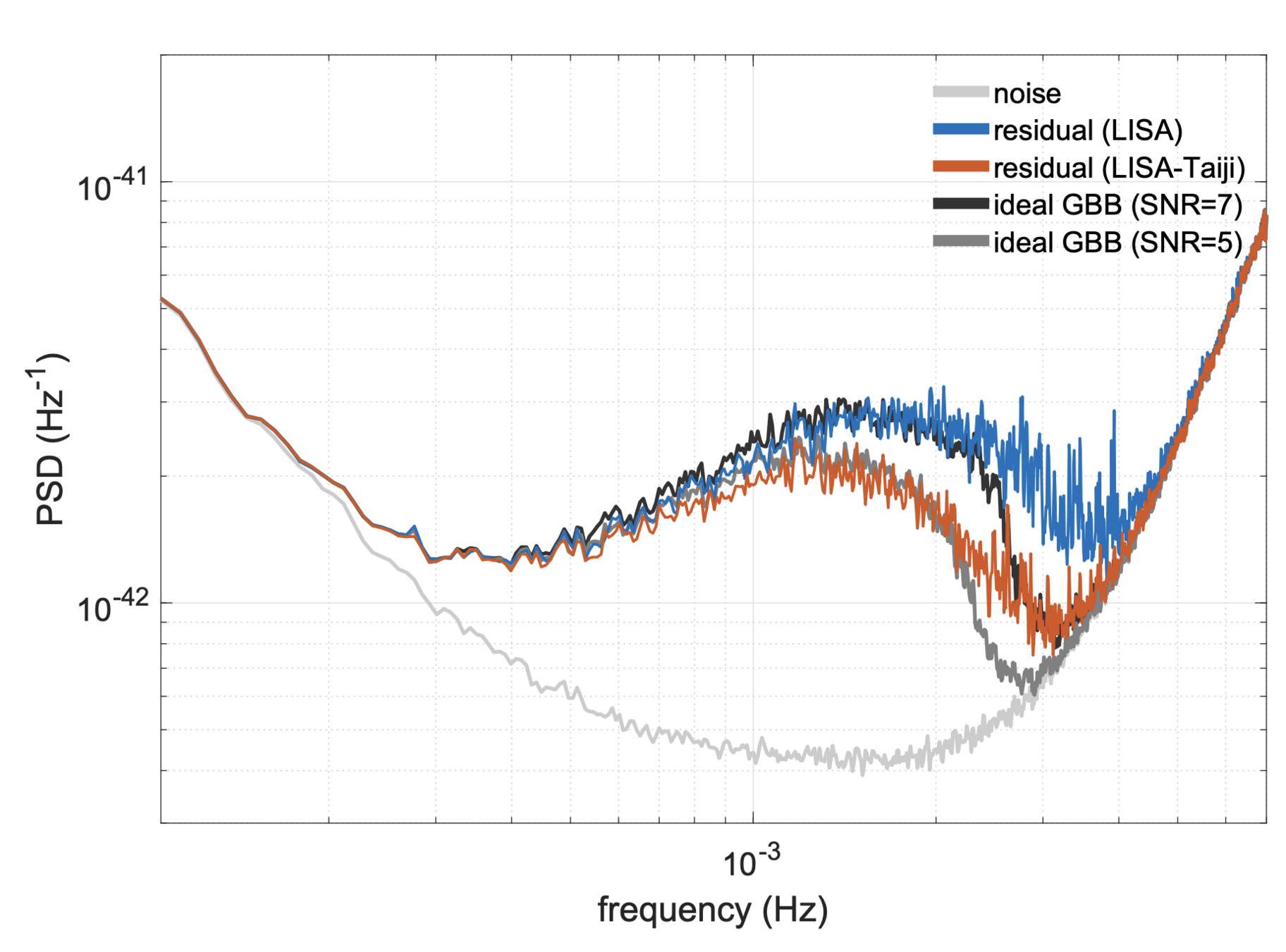
single-detector residual
network residual
POSTER
2.07
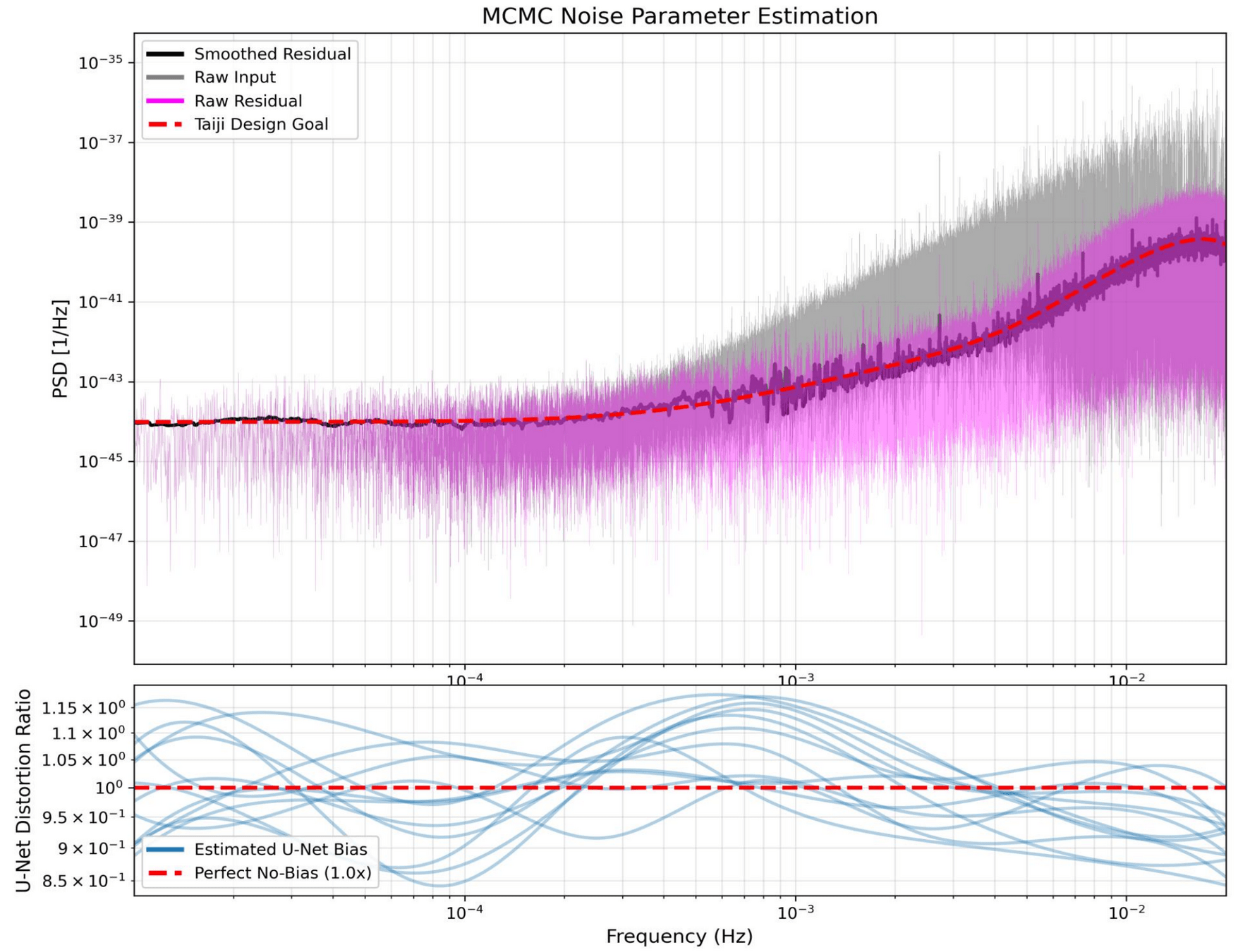
Take-away: GB subtraction determines both the source catalog and the foreground floor seen by downstream searches.
PRELIMINARY
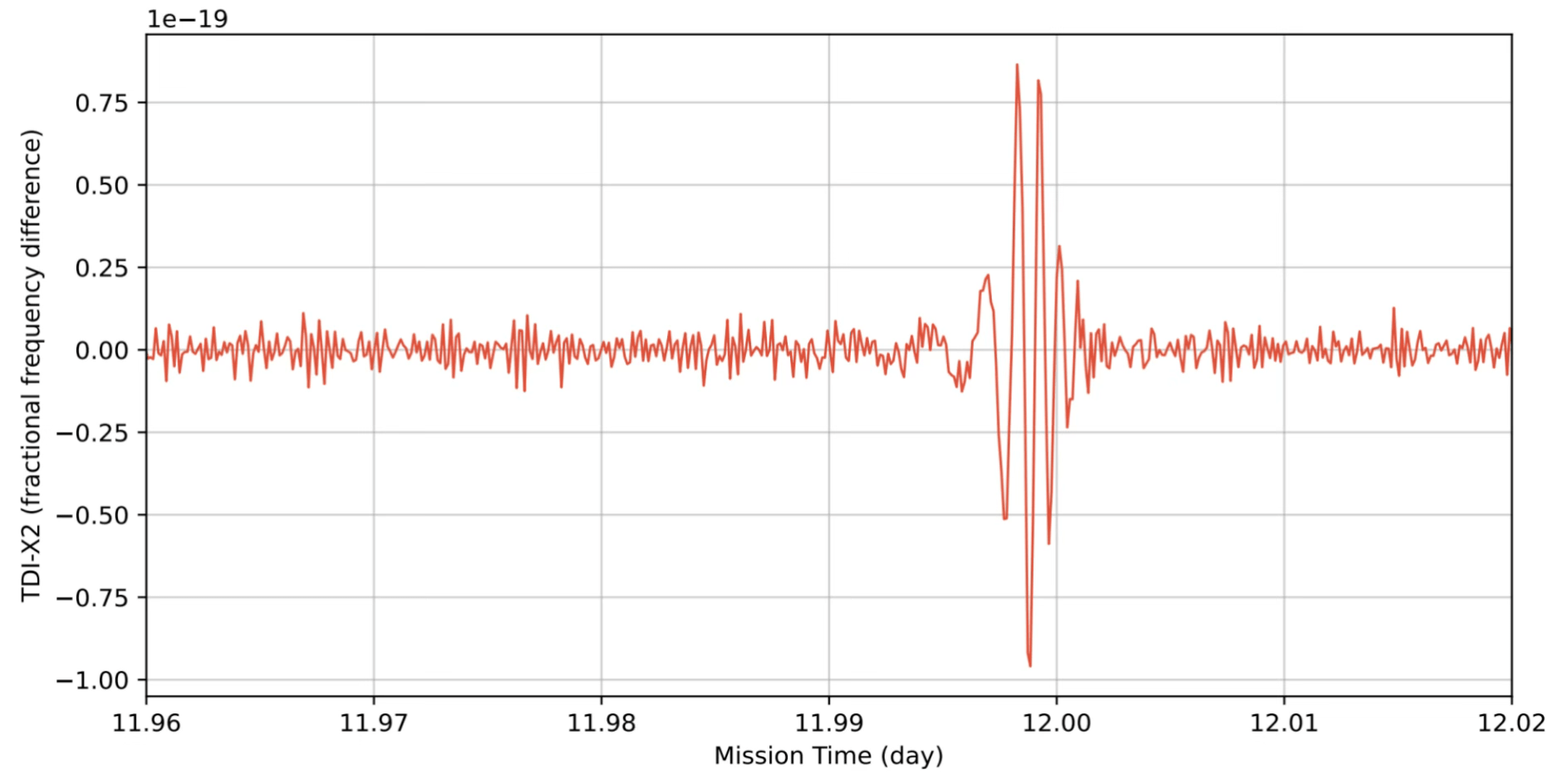
Accelerating inference for MBHBs and EMRIs
Low-latency mergers and long-duration, multimodal signals
He WANG · ICTP-AP / UCAS
Taiji: China's Space-based GW Program
Challenge
M. Du et al., SCPMA (2024);
B. Liang et al., MLST (2024)
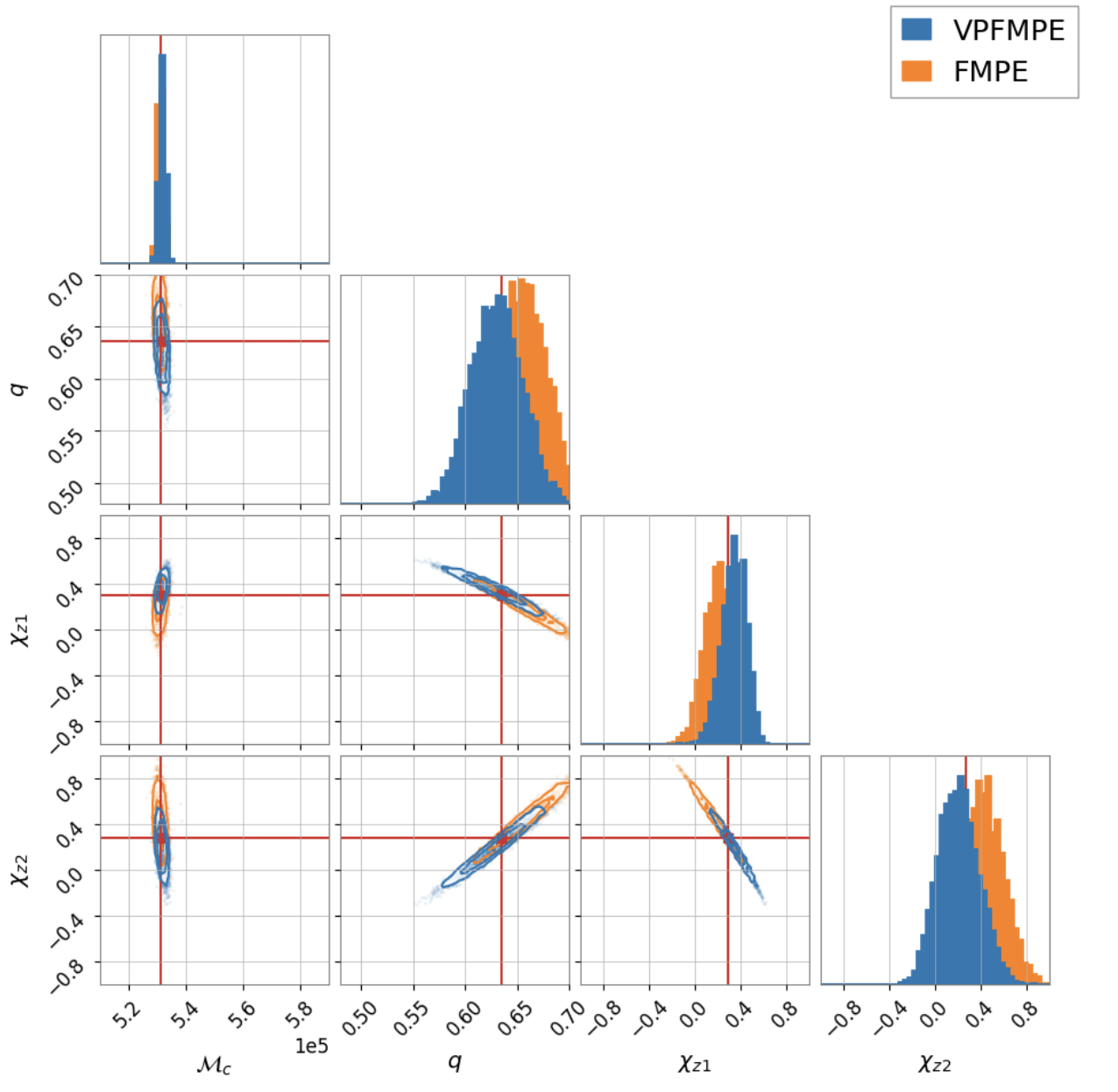
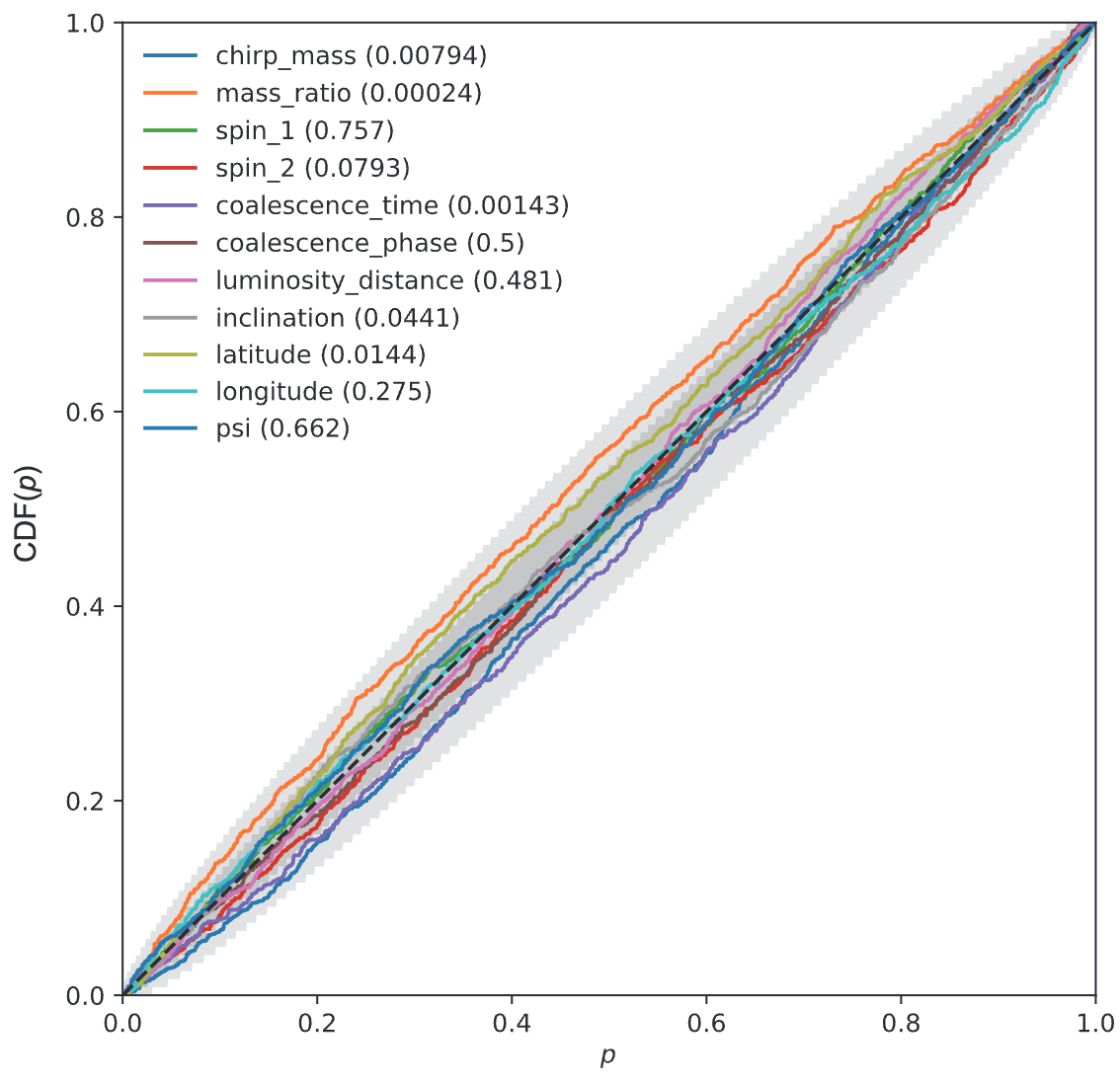
X. Zou et al., PRD (2025), in preparation (2026); B. Liang et al., CPL (2025), Research (2026)
Massive black-hole binaries
Extreme-mass-ratio inspirals
- Low-latency inference in a time-dependent detector response
Approach
- Normalizing-flow / continuous-flow posterior inference
- Reference-time transformation exploits the annual symmetry of the Taiji response
- Instrumental noise and unresolved Galactic confusion included
Evidence
- Orders-of-magnitude inference speed-up
- Supports rapid characterization and global-fit updates
Challenge
- Long-duration signals with narrow, multimodal likelihood structure
Optimization-based search
- PSO-assisted matched filtering for targeted or restricted searches
- Useful for locating viable likelihood modes and studying degeneracies
Amortized posterior inference
- Flow matching rapidly identifies posterior support
- Provides informative initialization for expensive stochastic sampling
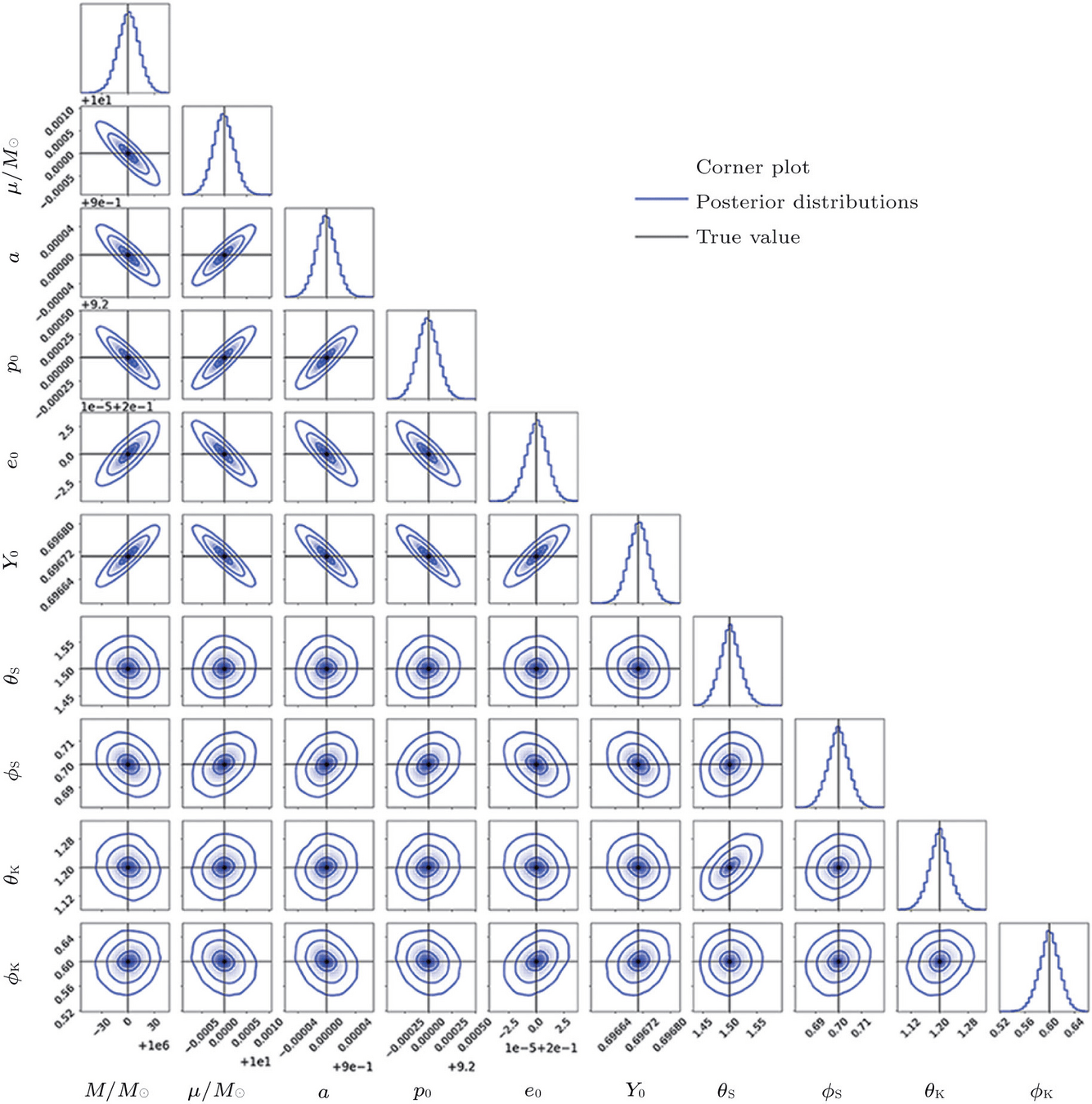
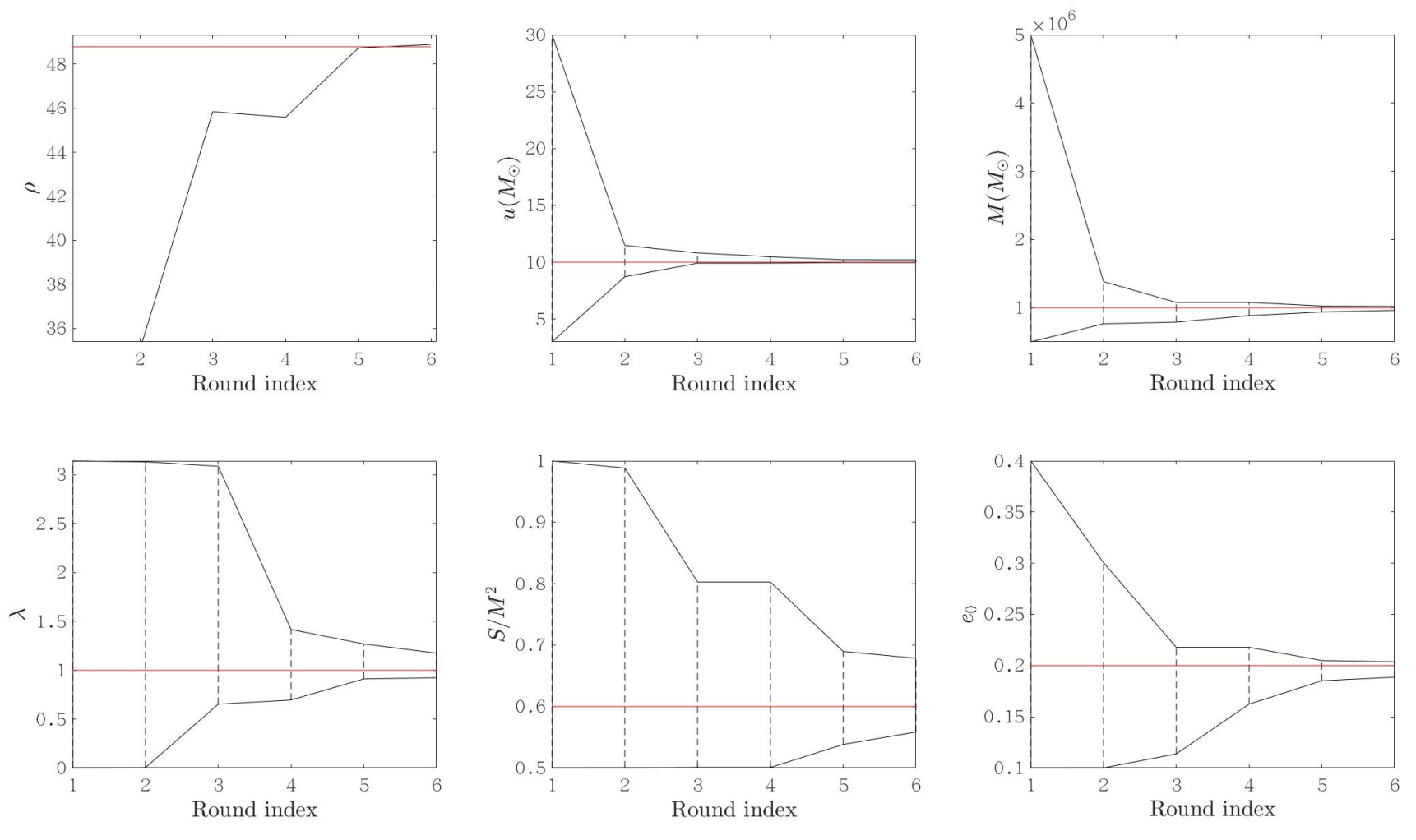
Take-away: MBHB and EMRI inference present different computational bottlenecks, and Taiji-related studies are exploring complementary acceleration strategies matched to each problem.
PSO search
Flow posterior
Flow posterior
P-P plot
POSTER
5.06
PRELIMINARY
Stochastic-background inference as a component-separation problem
Detector response, astrophysical foregrounds, and instrumental noise
He WANG · ICTP-AP / UCAS
Taiji: China's Space-based GW Program
Take-away: Reliable SGWB inference requires joint modeling of backgrounds, foregrounds, and instrumental noise.
Y. Jiang et al., JCAP 06, 024 (2026); arXiv:2601.00169; Q. Liang et al., PRD 113, 083004 / 075014 (2026)
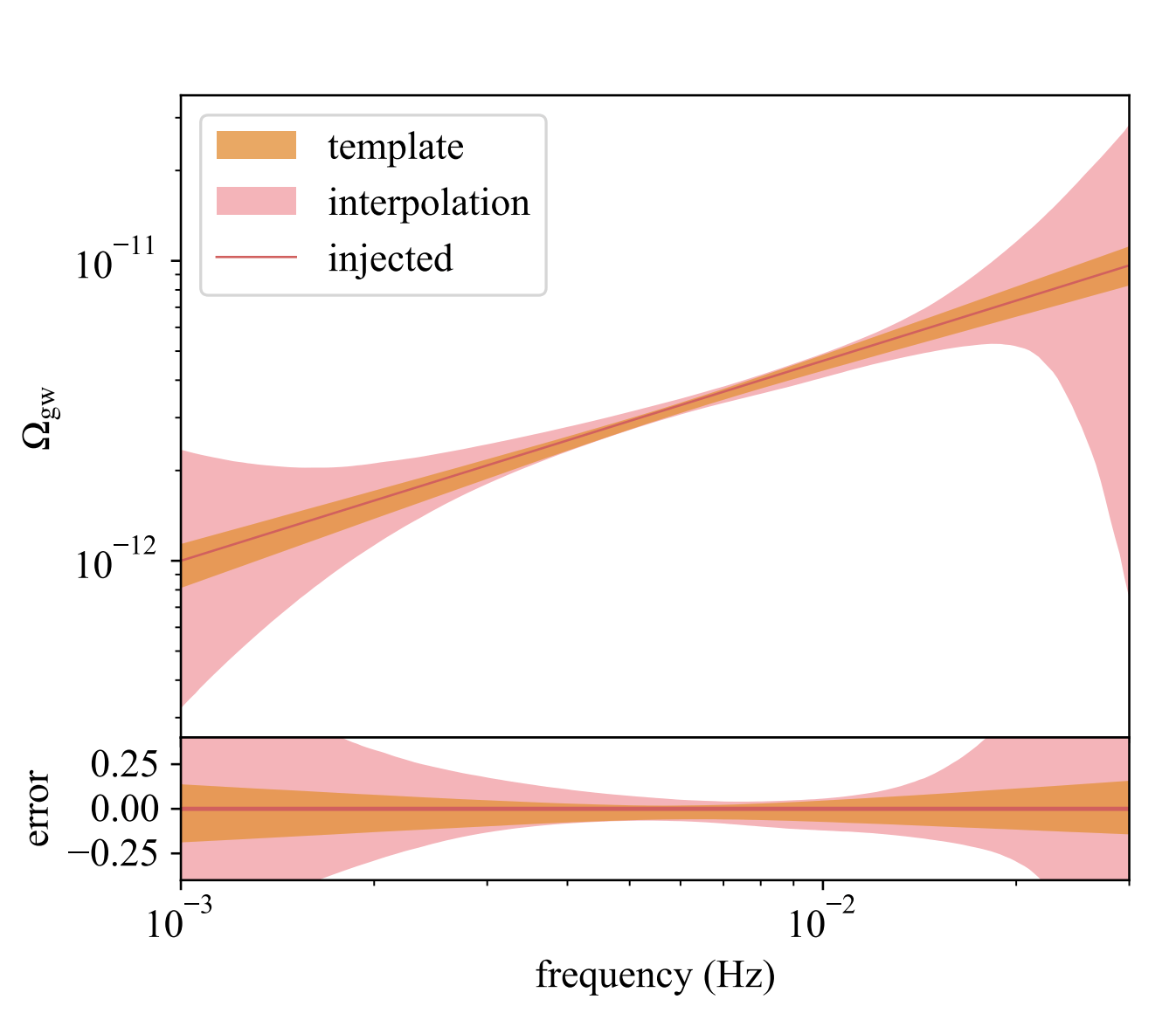
Current scope: reduced instrumental-noise and foreground parameterizations; full anisotropic/cyclostationary separation remains future work.
Realistic TDI response
- Unequal and time-varying arm lengths
- Time-segmented detector response
- Full cross-channel TDI covariance
Equal-arm or diagonal-covariance approximations can bias SGWB recovery.
Model-flexible spectral reconstruction
- Physical templates when the source model is well motivated
- Flexible interpolation when the spectral shape is uncertain
- Trans-dimensional inference controls spectral complexity
Avoids forcing an incorrect spectral template across the sensitive band.
template-based vs model-flexible SGWB reconstruction
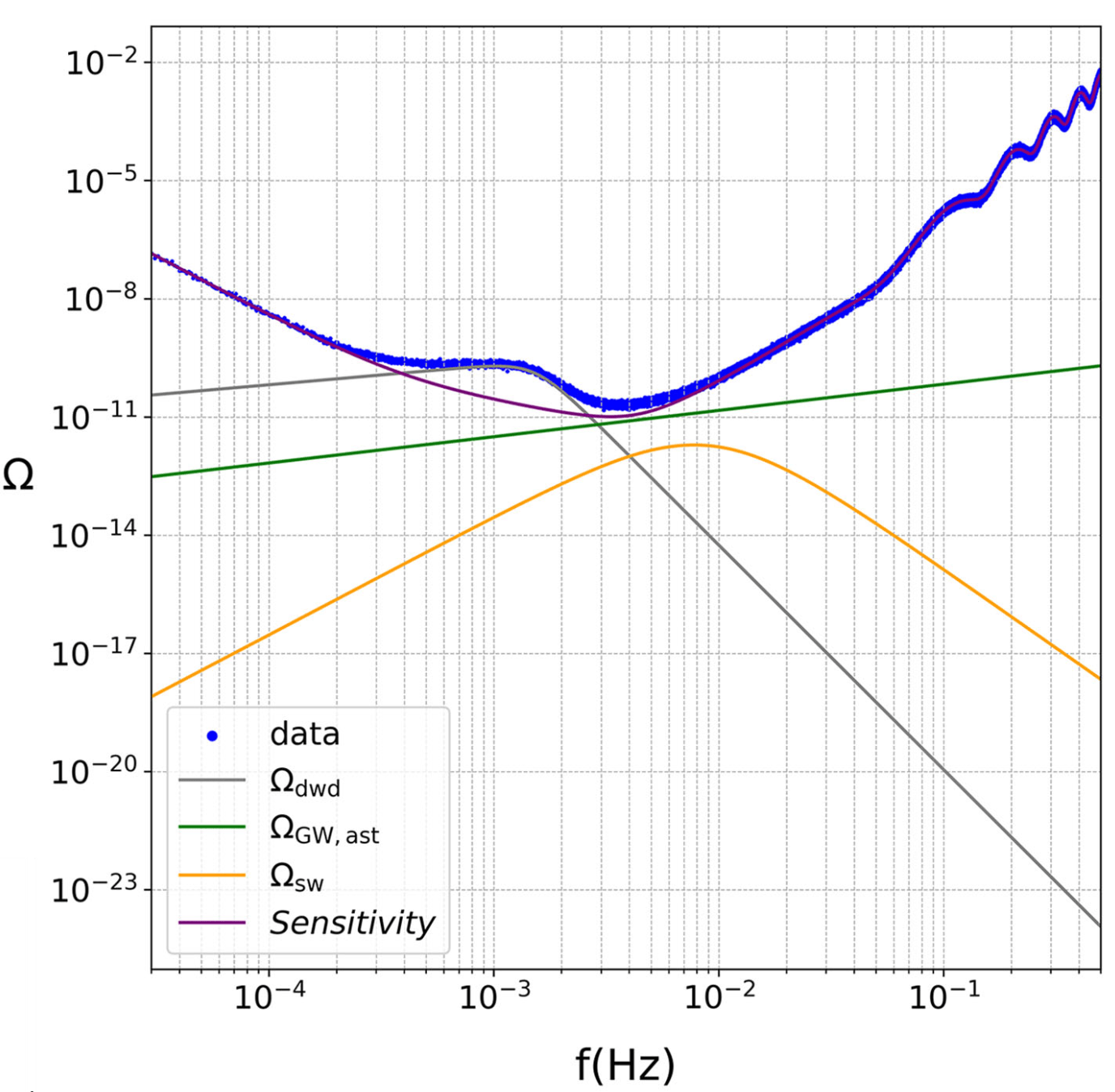
Illustrative component mixture in Taiji data
Joint component separation
- Cosmological SGWB
- Galactic foreground and extragalactic background
- Instrumental noise and channel correlations
All component uncertainties must be propagated into the SGWB posterior.
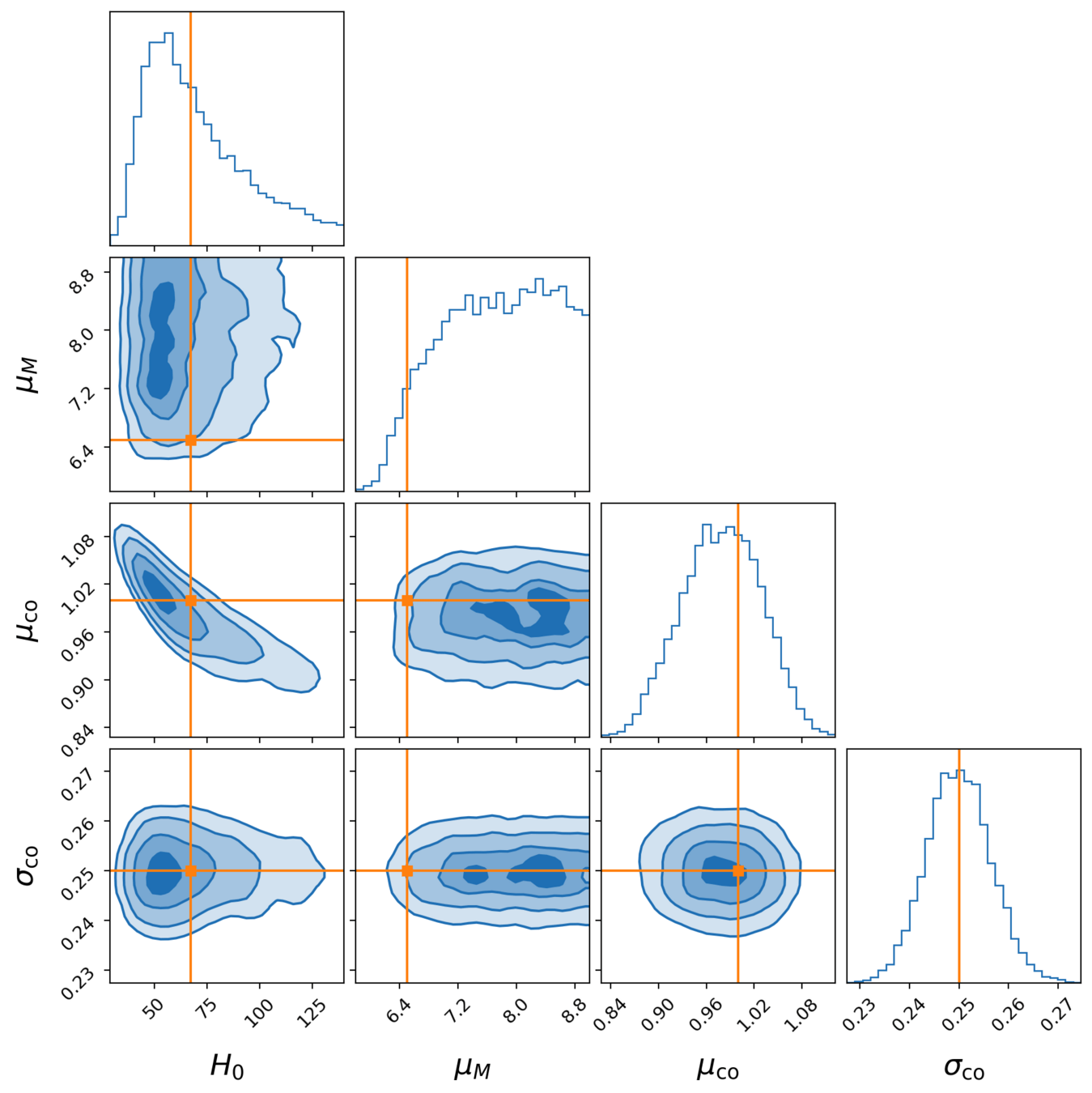
From source catalogs to population and cosmological inference
A preliminary spectral-siren demonstration with simulated Taiji EMRI populations
He WANG · ICTP-AP / UCAS
Taiji: China's Space-based GW Program
Preliminary: one simulated catalog realization; selection effects, population-model uncertainty, and catalog-to-catalog variance remain to be quantified.
Fixed source-frame mass features
STEP 1
- EMRI mass-spectrum parameters (\(\log_{10} M/M_\odot\)):
\(\mu_M\) (central MBH scale) · \(\mu_{CO}\) (compact-object peak) · \(\sigma_{CO}\) (compact-object width in dex)
Redshifted detector-frame masses
STEP 2
- The detector measures redshifted quantities:
\(m_{det}=(1+z) \cdot m_{source}\) - Degeneracy: intrinsic mass vs. redshift
Breaking the mass–redshift degeneracy
STEP 3
- Source-frame mass features remain fixed across the population, while their detector-frame locations shift with redshift.
- A catalog spanning a range of redshifts statistically separates intrinsic mass scales from cosmological redshift, enabling joint inference of \(H0\) and the population hyperparameters.
- Fixed source-frame features + redshift diversity → cosmological information
Population features define intrinsic statistical rulers
Redshift is imprinted on the observable masses
\(H_0\) constraint from GW alone
The \(H_0\)–mass-scale correlations encode the residual mass–redshift degeneracy.
Detector networks can sharpen both individual-source measurements and the population features used for cosmological inference.
Ji-Yu Song et al. in preparation (2026)
PRELIMINARY
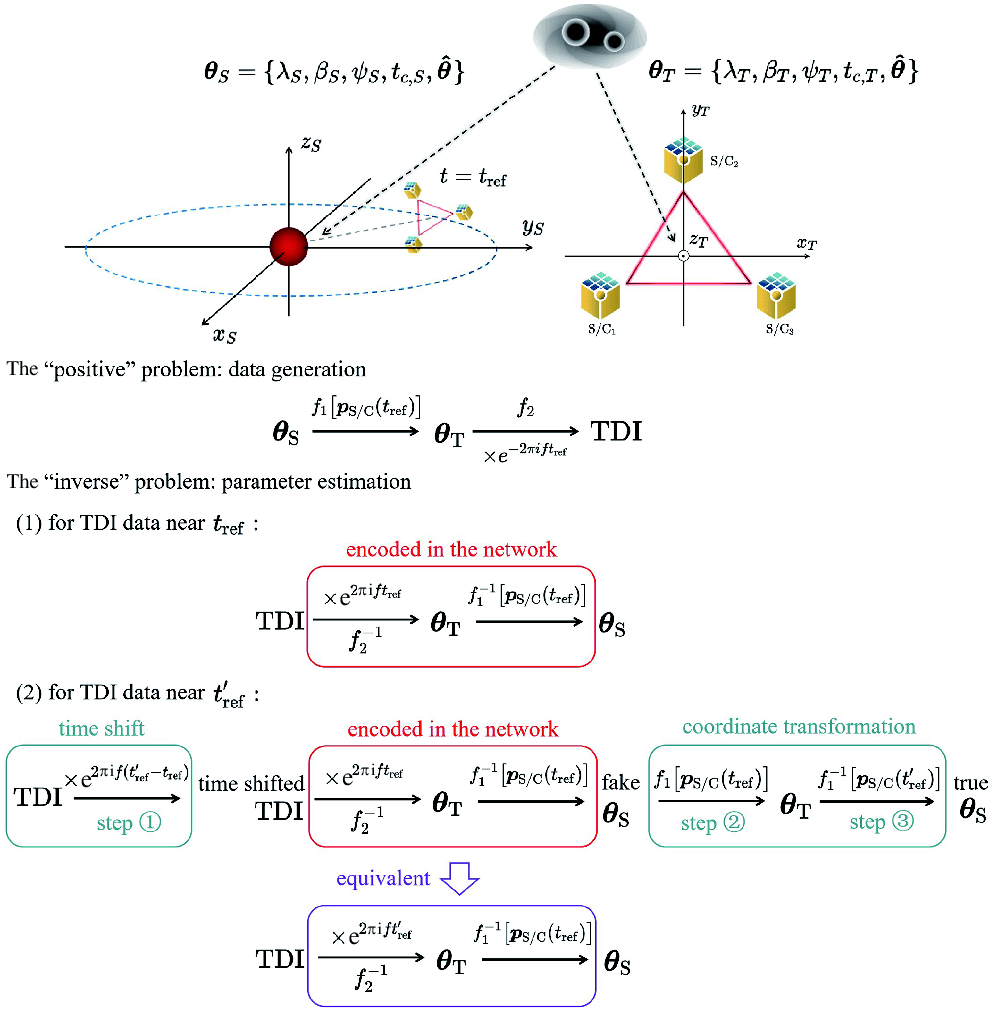
Overlapped GB resolution
The PSO-based GBSIEVER pipeline
[P. Gao et al, Phys. Rev. D 107, 123029 (2023)]
[X. Zhang et al, Phys. Rev. D 106, 102004 (2022)]
[X. Zhang et al, Phys. Rev. D 104, 024023 (2021)]
AI-based MBHB inference algorithm
[M. Du et al, SCPMA, Vol 67, Issue 3: 230412 (2024)]
[B. Liang et al, Mach.Learn.Sci.Tech. 5 (2024) 4, 045040]
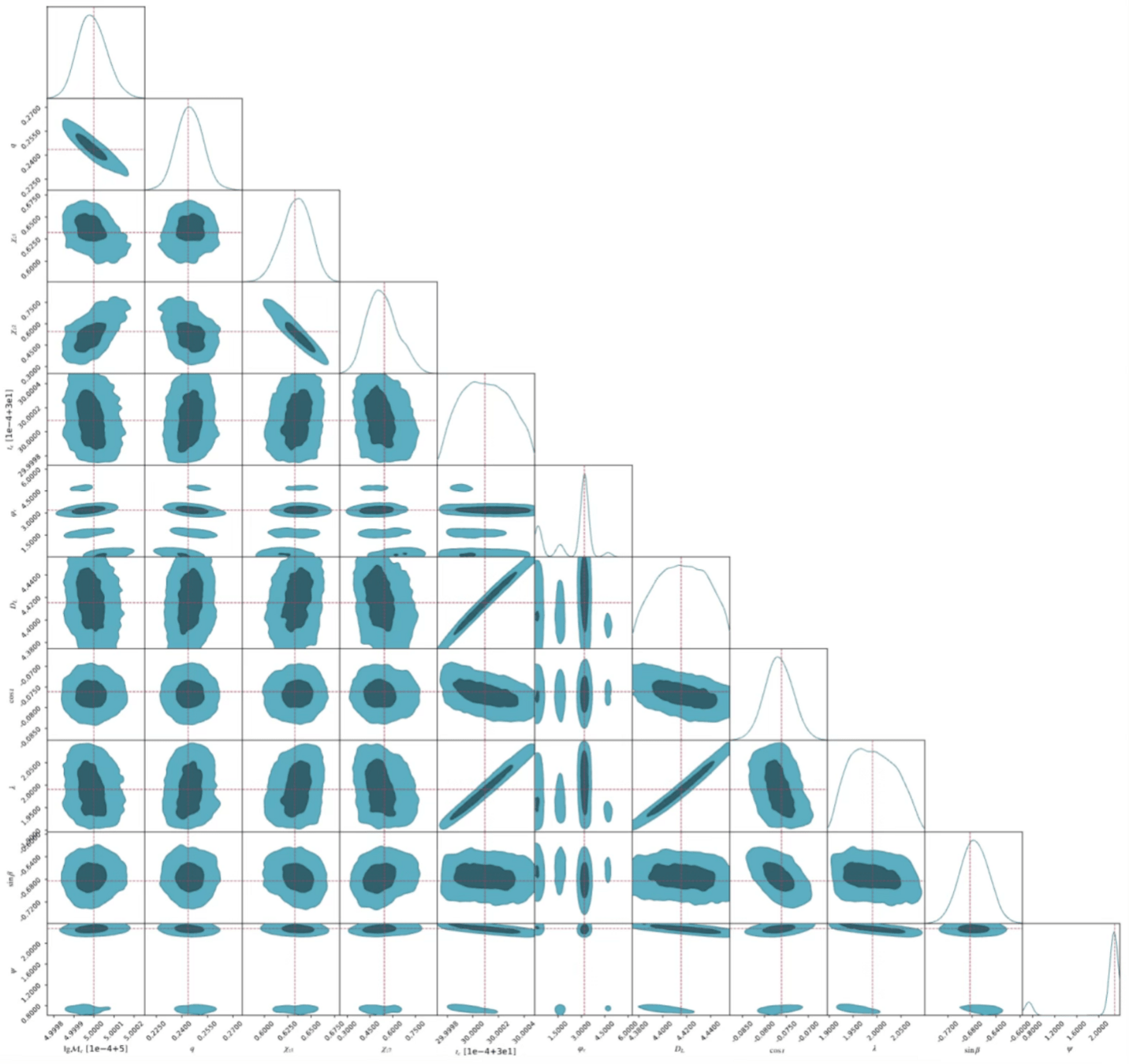
Fast MBHB parameter estimation
Rapid posterior inference from TDI A, E data
- Incorporates instrumental noise and unresolved GB confusion
Time-dependent Taiji response
- Reference-time transformation — generalizes across the full year
Normalizing-flow inference
- Orders of magnitude fast than MCMC · calibrated on 1000 injections
EMRI search
SGWB analysis
EMRI search with PSO, AI & MCMC
[X. Zou et al, Phys. Rev. D 112, 084075 (2026)]
[B. Liang et al, Research. 2026;9:1055]
[B. Liang et a., Chin. Phys. Lett., 2025, 42(8): 081101.]
Model-dependent and agnostic SGWB analysis
[Y. Jiang et al, JCAP 06 (2026) 024]
[Q. Liang et al, Phys. Rev. D 113, 083004 (2026)]
[Q. Liang et al, Phys. Rev. D 113, 075014 (2026)]
EMRI (model M6)
H0, mu_M, mu_co, sigma_co
含主标尺, mu_M 偏差被其余参数摊薄
【参数物理含义】
(所有 mu/sigma 定义在 log10 质量空间, 描述源族 source-frame 质量分布)
H0 哈勃常数 km/s/Mpc 真值 67.27
mu_m MBHB 质量谱峰位置 (不对称对数正态中心) log10 Msun 真值 3.3 -> ~2e3 Msun
sigma_R MBHB 质量谱峰右侧 (高质量侧) 宽度 dex 真值 1.20
mu_M EMRI 中心MBH特征质量 M* (Schechter 指数截断) log10 Msun 真值 6.5 -> ~3e6 Msun
mu_co EMRI 致密次星(CO)质量谱峰位置 (对数正态中心) log10 Msun 真值 1.0 -> 10 Msun
sigma_co EMRI CO 质量谱宽度 dex 真值 0.25
太极空间引力波源 谱汽笛 局部 corner
preliminary
From a single constellation to network observatories
Coherent SNR, geometric complementarity, and cross-detector consistency
He WANG · ICTP-AP / UCAS
Taiji: China's Space-based GW Program
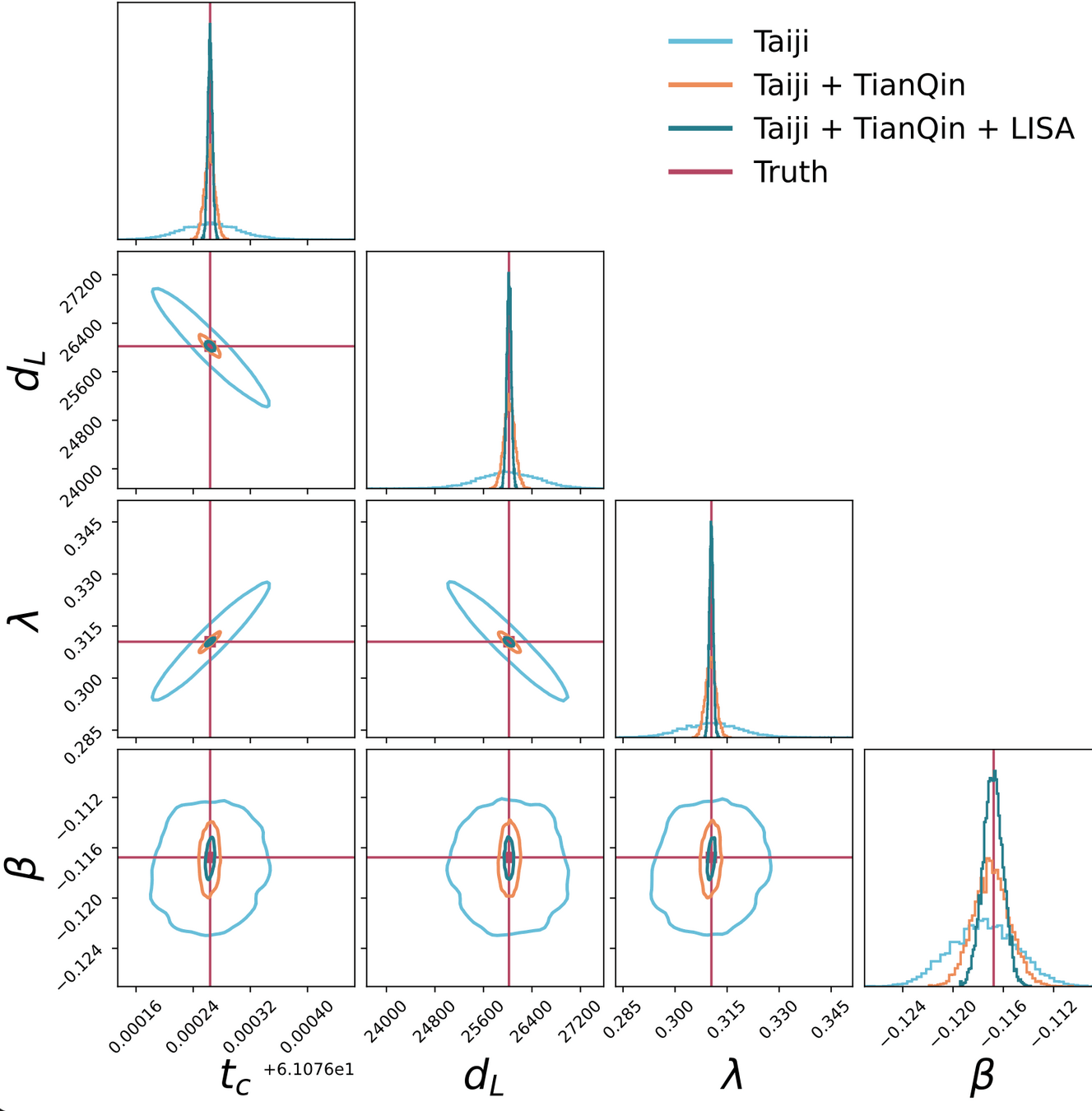
Take-away: Network gains combine SNR accumulation, geometric degeneracy breaking, and cross-detector consistency.
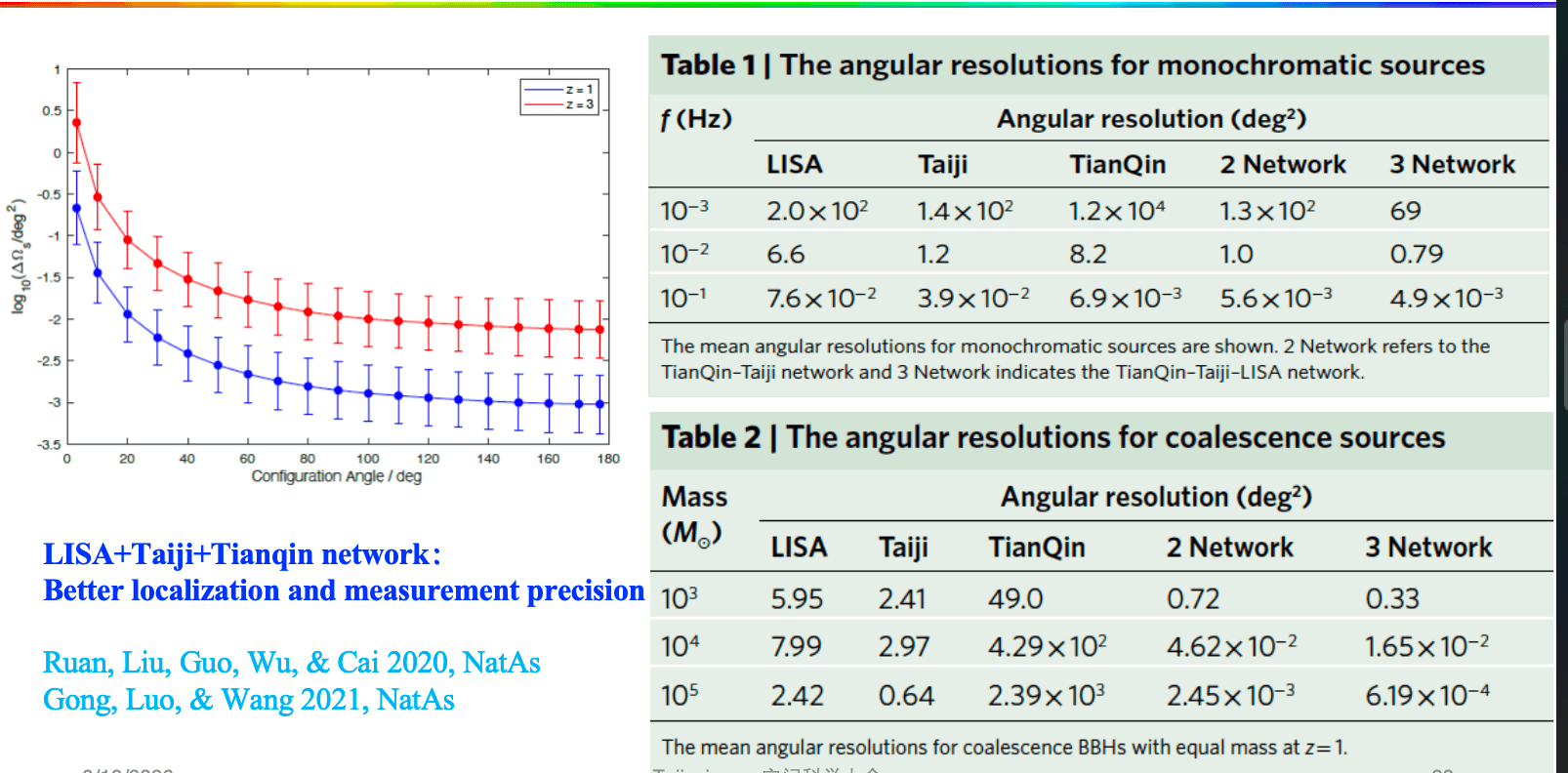
Guo, Luo & Wang, Nature Astronomy (2021)
Illustrative MBHB posterior contraction
(Preliminary simulation by M. Du)
At \(10^{-2}\,\mathrm{Hz}\), the three-detector network improves the monochromatic-source angular resolution from \(6.6\,\mathrm{deg}^2\) for LISA alone to \(0.79\,\mathrm{deg}^2\).
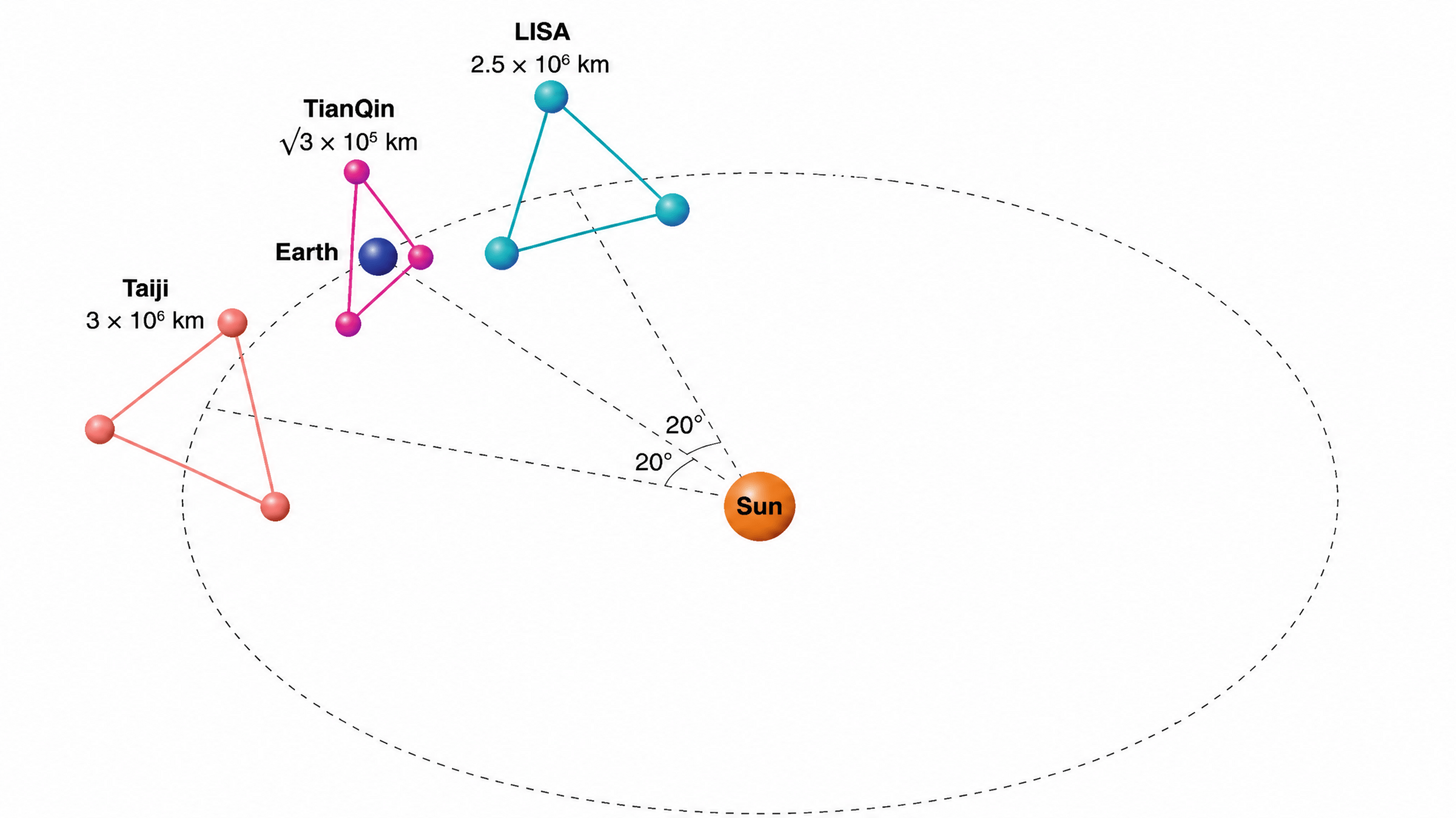
Complementary orbital configurations of Taiji, TianQin, and LISA
Adapted from Ruan et al., Nature Astronomy (2020).
Illustrative localization gain
Forecast for a monochromatic source at \(10^{-2}\,\mathrm{Hz}\)
LISA
Taiji–TianQin
LISA–Taiji–TianQin
\(6.6\,\mathrm{deg}^2\)
\(1.0\,\mathrm{deg}^2\)
\(0.79\,\mathrm{deg}^2\)
Event-level network gains
More sensitivity and tighter waveform-parameter constraints.
Coherent SNR accumulation
Different baselines and antenna patterns break sky-position, distance, inclination, and polarization degeneracies.
Geometric degeneracy breaking
Common source parameters across detectors distinguish astrophysical signals from detector-specific artifacts.
Coherent validation
Cross-spectra distinguish largely detector-specific noise from correlated Galactic foregrounds and SGWBs.
Component separation
Shared source parameters; detector-specific noise, calibration, and data-quality models.
Network global fit
— open challenge
PRELIMINARY
From a single constellation to network observatories
Coherent SNR, geometric complementarity, and cross-detector consistency
He WANG · ICTP-AP / UCAS
Taiji: China's Space-based GW Program
Take-away: Network gains combine SNR accumulation, geometric degeneracy breaking, and cross-detector consistency.
Guo, Luo & Wang, Nature Astronomy (2021)
Illustrative MBHB posterior contraction
(Preliminary simulation by M. Du)
At \(10^{-2}\,\mathrm{Hz}\), the three-detector network improves the monochromatic-source angular resolution from \(6.6\,\mathrm{deg}^2\) for LISA alone to \(0.79\,\mathrm{deg}^2\).
Complementary orbital configurations of Taiji, TianQin, and LISA
Adapted from Ruan et al., Nature Astronomy (2020).
Illustrative localization gain
Forecast for a monochromatic source at \(10^{-2}\,\mathrm{Hz}\)
LISA
Taiji–TianQin
LISA–Taiji–TianQin
\(6.6\,\mathrm{deg}^2\)
\(1.0\,\mathrm{deg}^2\)
\(0.79\,\mathrm{deg}^2\)
Event-level network gains
More sensitivity and tighter waveform-parameter constraints.
Coherent SNR accumulation
Different baselines and antenna patterns break sky-position, distance, inclination, and polarization degeneracies.
Geometric degeneracy breaking
Common source parameters across detectors distinguish astrophysical signals from detector-specific artifacts.
Coherent validation
Cross-spectra distinguish largely detector-specific noise from correlated Galactic foregrounds and SGWBs.
Component separation
Shared source parameters; detector-specific noise, calibration, and data-quality models.
Network global fit
— open challenge
PRELIMINARY
From better events to network-level inference
Component separation, catalog consistency, and formation-channel constraints
He WANG · ICTP-AP / UCAS
Taiji: China's Space-based GW Program
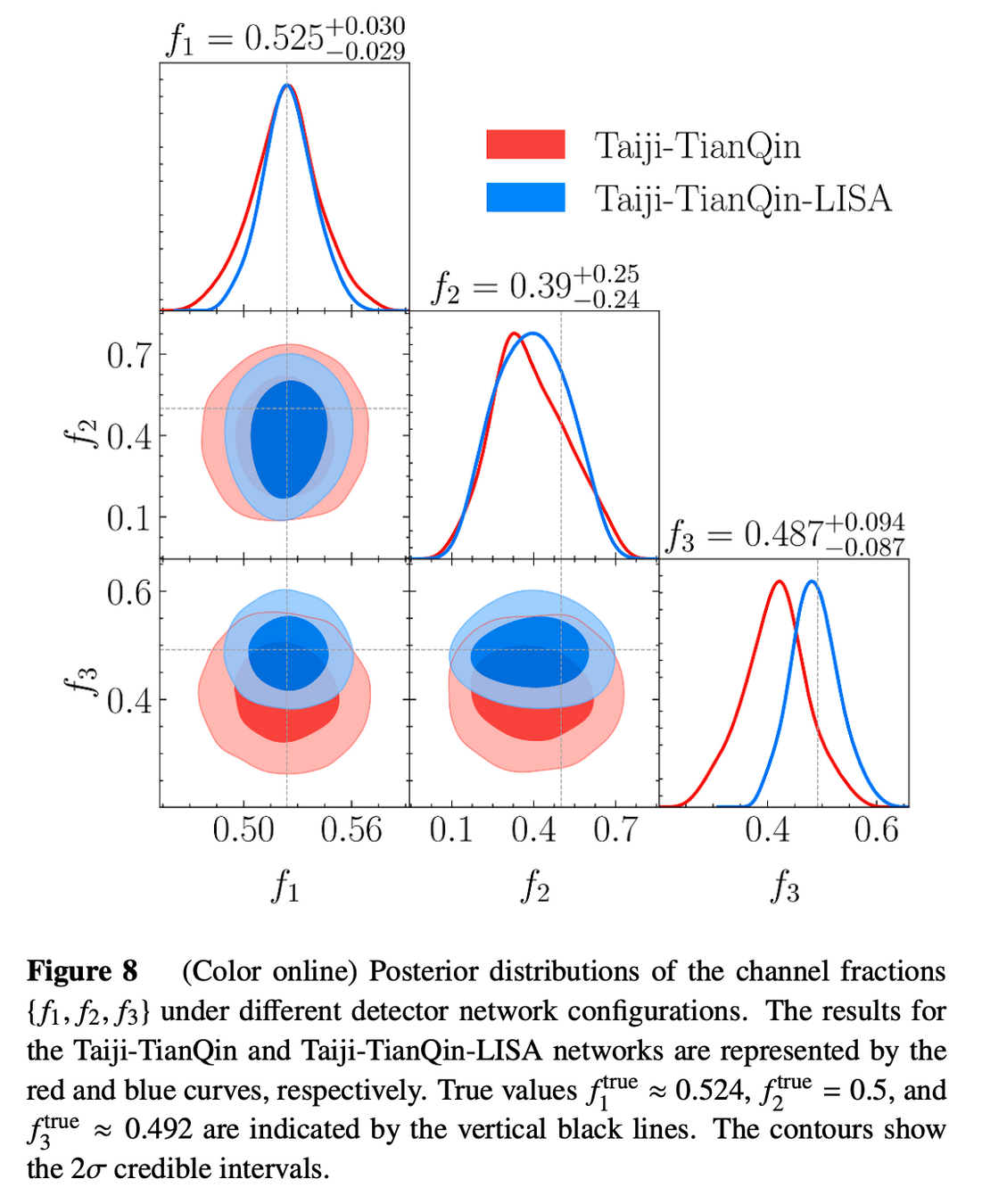
Formation-channel mixture inference
Beyond event catalogs
More sensitivity and tighter waveform-parameter constraints.
Coherent SNR accumulation
Different baselines and antenna patterns break sky-position, distance, inclination, and polarization degeneracies.
Geometric degeneracy breaking
Common source parameters across detectors distinguish astrophysical signals from detector-specific artifacts.
Coherent validation
Cross-spectra distinguish largely detector-specific noise from correlated Galactic foregrounds and SGWBs.
Component separation
Model-dependent simulation forecast
Detection sensitivity
TianQin-alone SNR
\(2.2\text{–}3.0\times\)
Catalog gain
more light-seed detections than Taiji alone
\(2.2\text{–}3.0\times\)
Shared source parameters; detector-specific noise, calibration, and data-quality models.
Network global fit
— open challenge
P. Shen et al., Sci. China-Phys. Mech. Astron. March (2026)
Take-away: Event-level complementarity becomes additional structure for component separation, global fitting, and population inference.
Taiji-alone SNR
\(1.06\text{–}1.14\times \)
Taiji–TianQin network; simulated MBHBs at \(z\gtrsim10\)
heavy-seed detection is already near saturation, with \(>96\%\) recovered by the network.
Formation-channel inference
Relative uncertainties at \(2\sigma\); adding LISA further contracts the channel-fraction posteriors.
light-seed fraction \(f_1\)
\(7.4\%\)
delayed fraction within HS, \(f_3\)
\(24\% \)
delayed fraction within LS, \(f_2\)
\(58\% \)
\(f_1\): LS fraction · \(f_2\): delayed fraction within LS · \(f_3\): delayed fraction within HS
Network science: localization, parameter estimation, and cross-validation
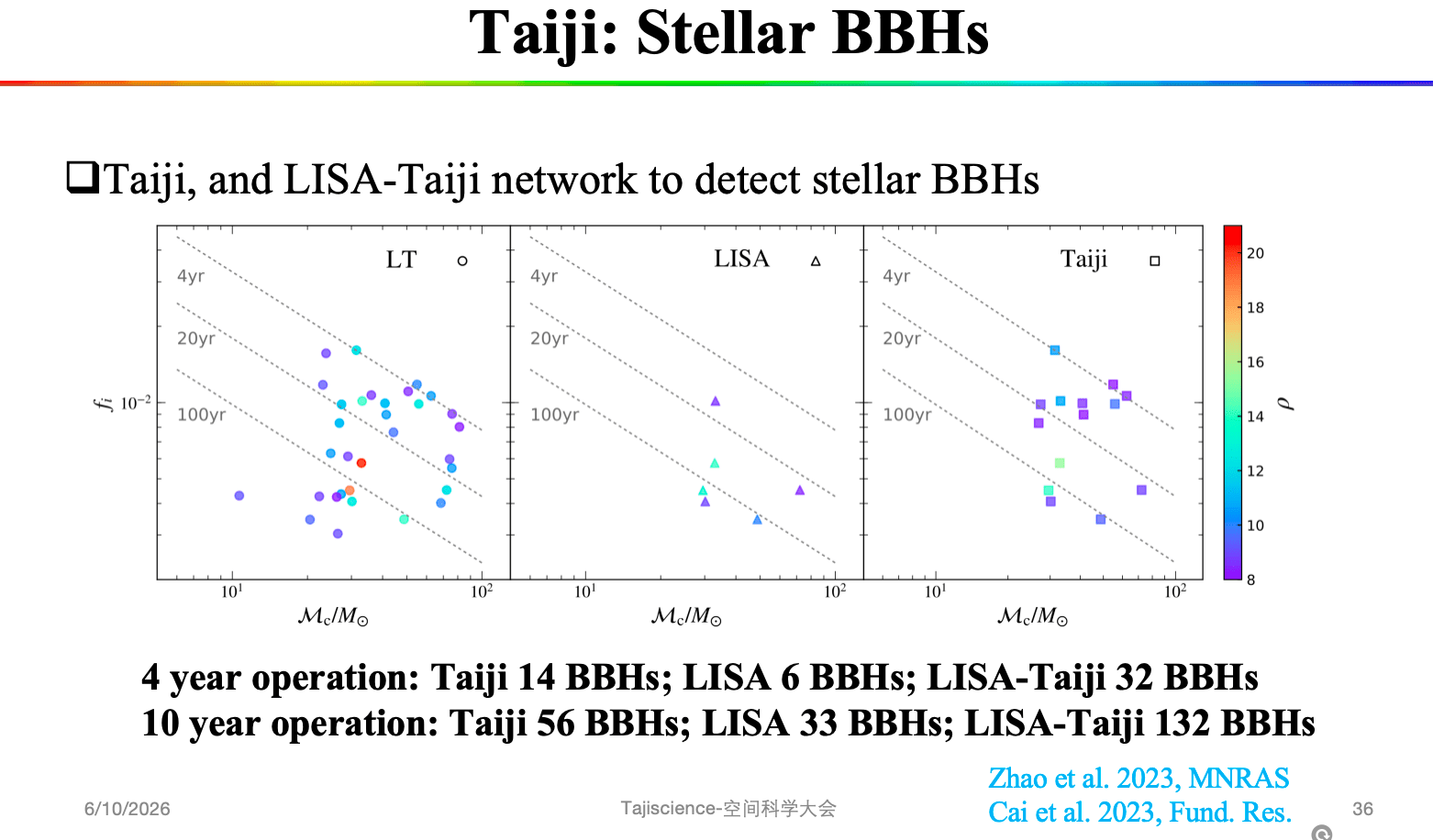
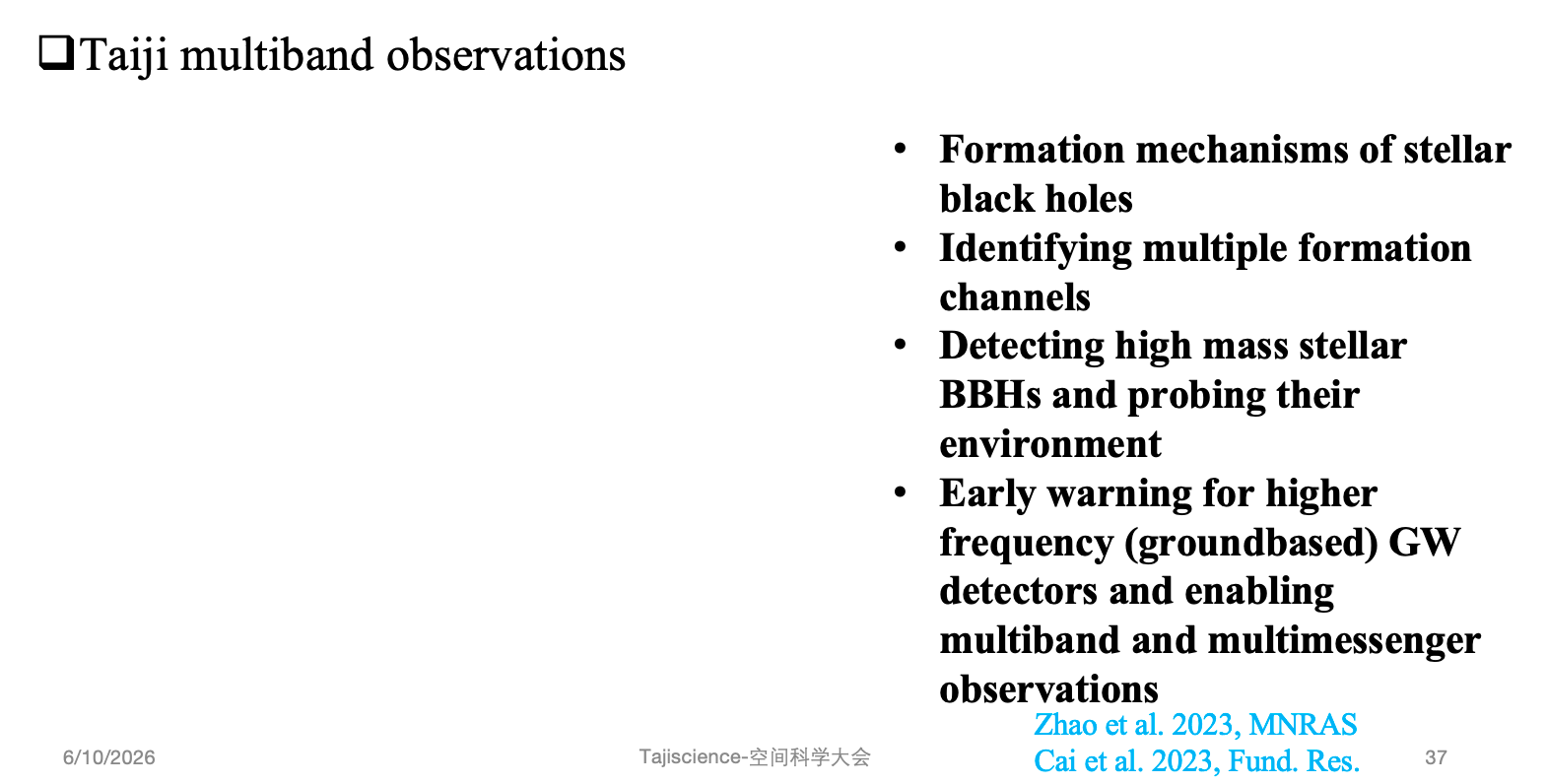
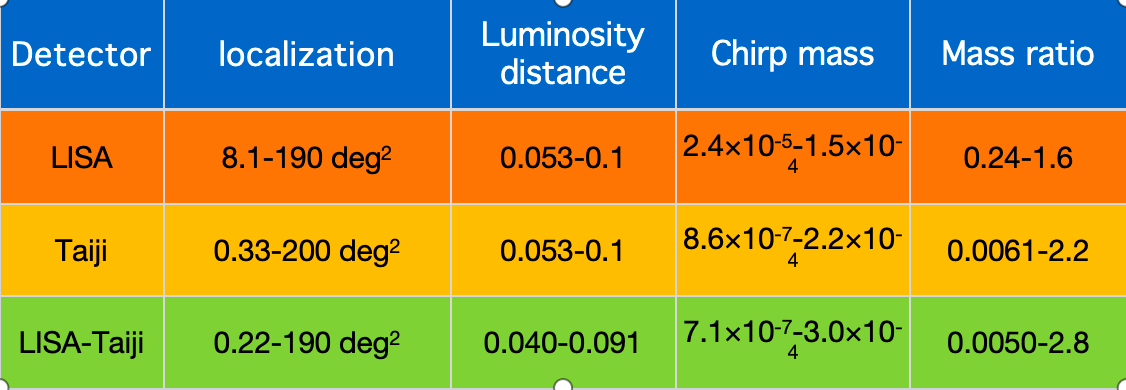
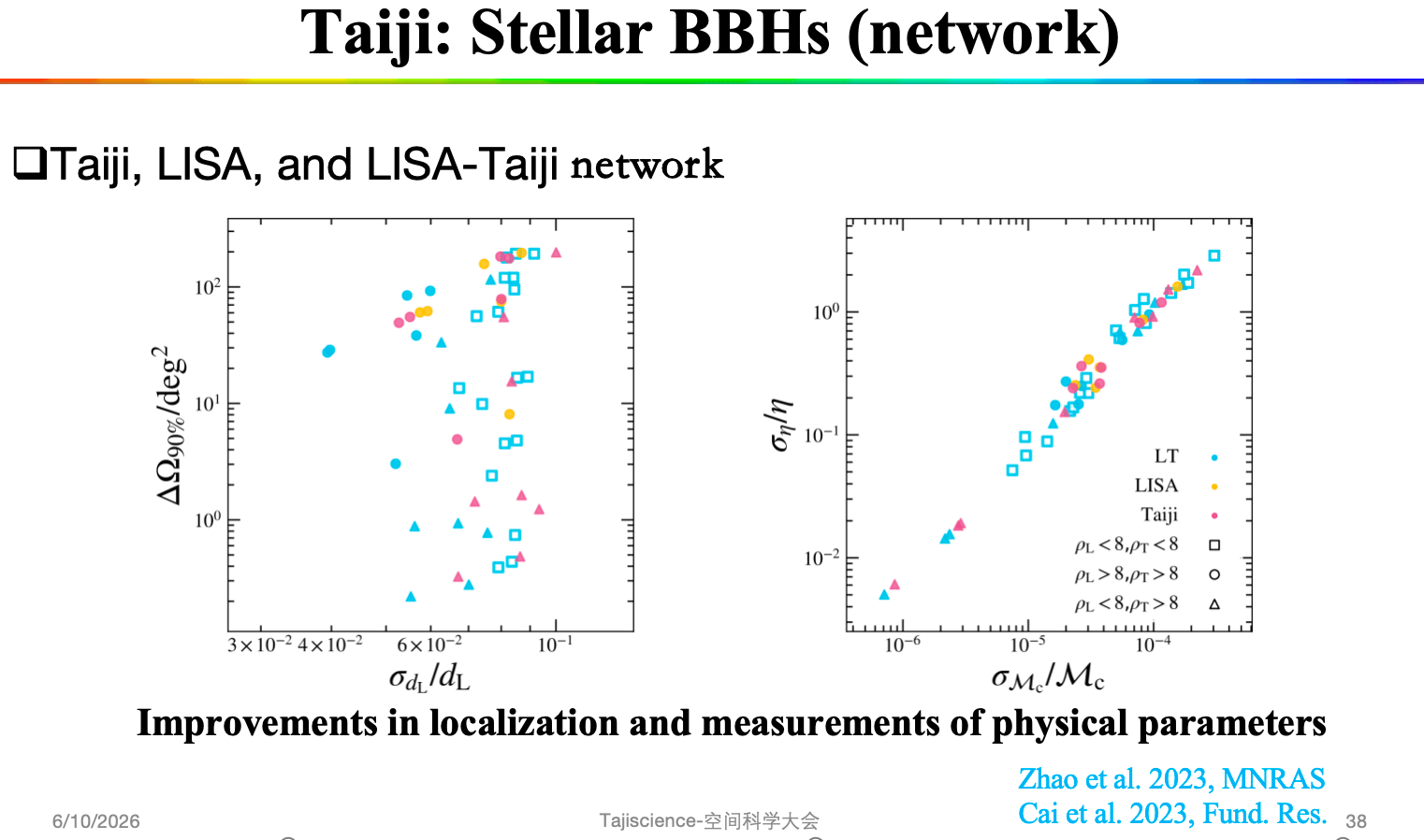
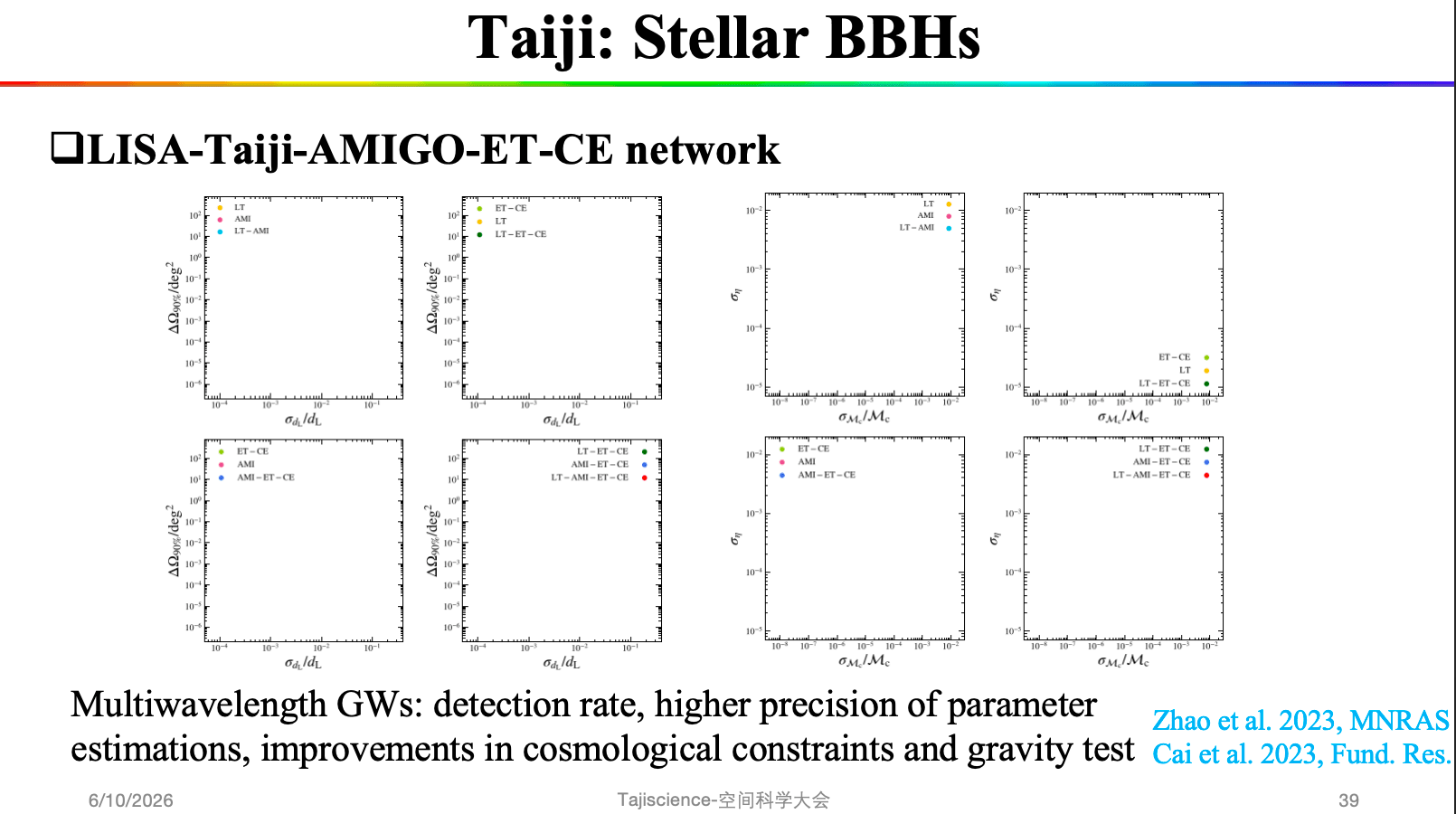
Ping Shen: Sci. China-Phys. Mech. Astron. March (2026) Vol. 69 No. 3
Jun Chen: SGWB
- different orbital configurations;
- improved sky localization;
- improved parameter estimation;
- independent cross-validation;
- better standard-siren and multimessenger potential。
From Taiji/TJ to network science: LISA-Taiji-TianQin synergies
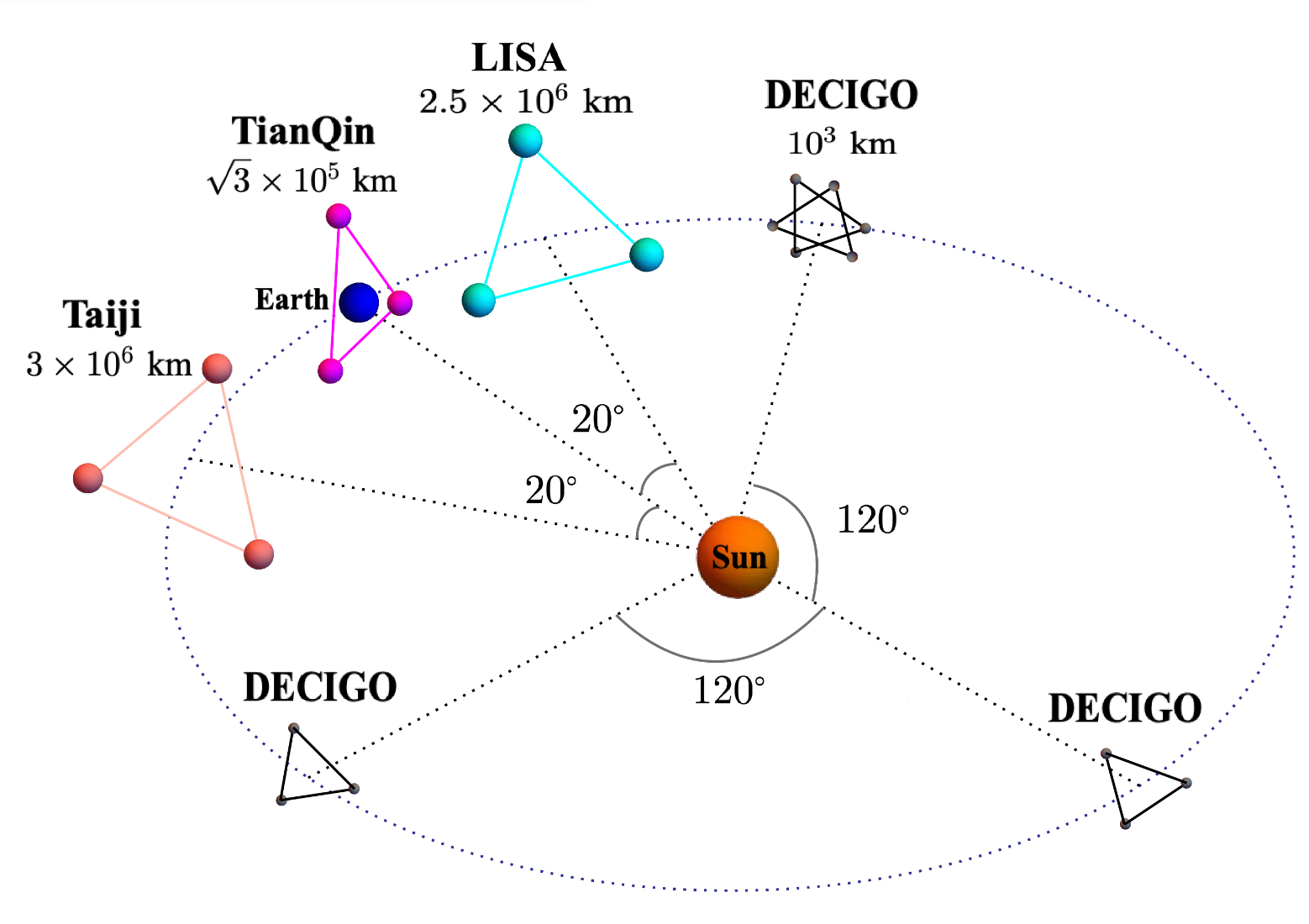
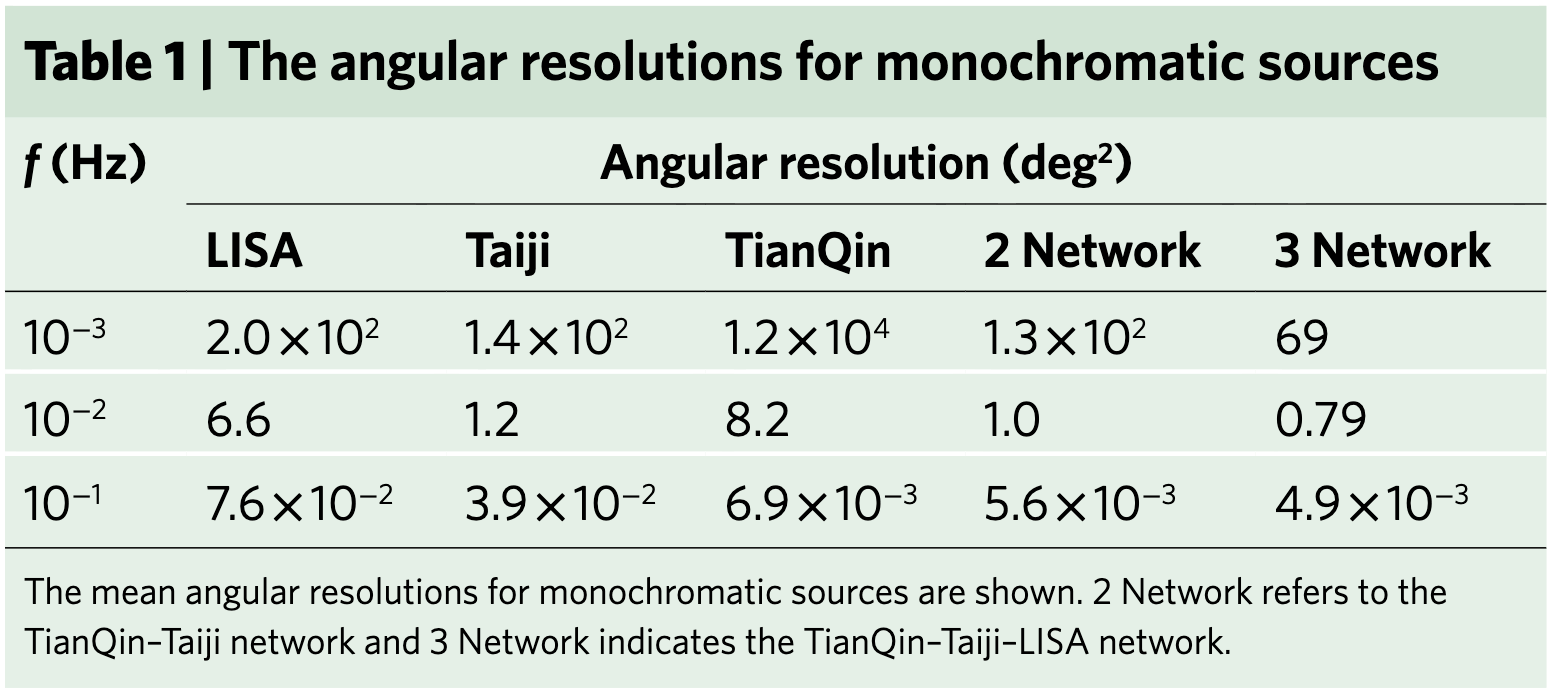
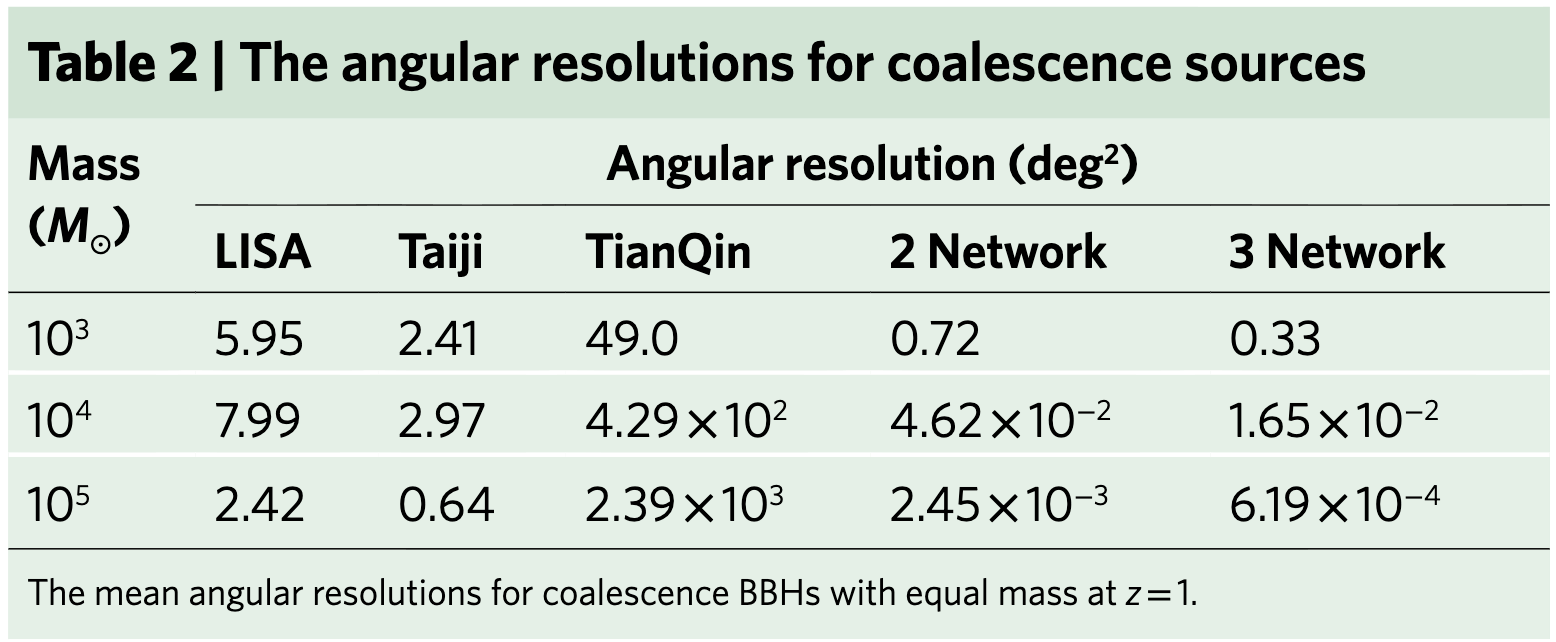
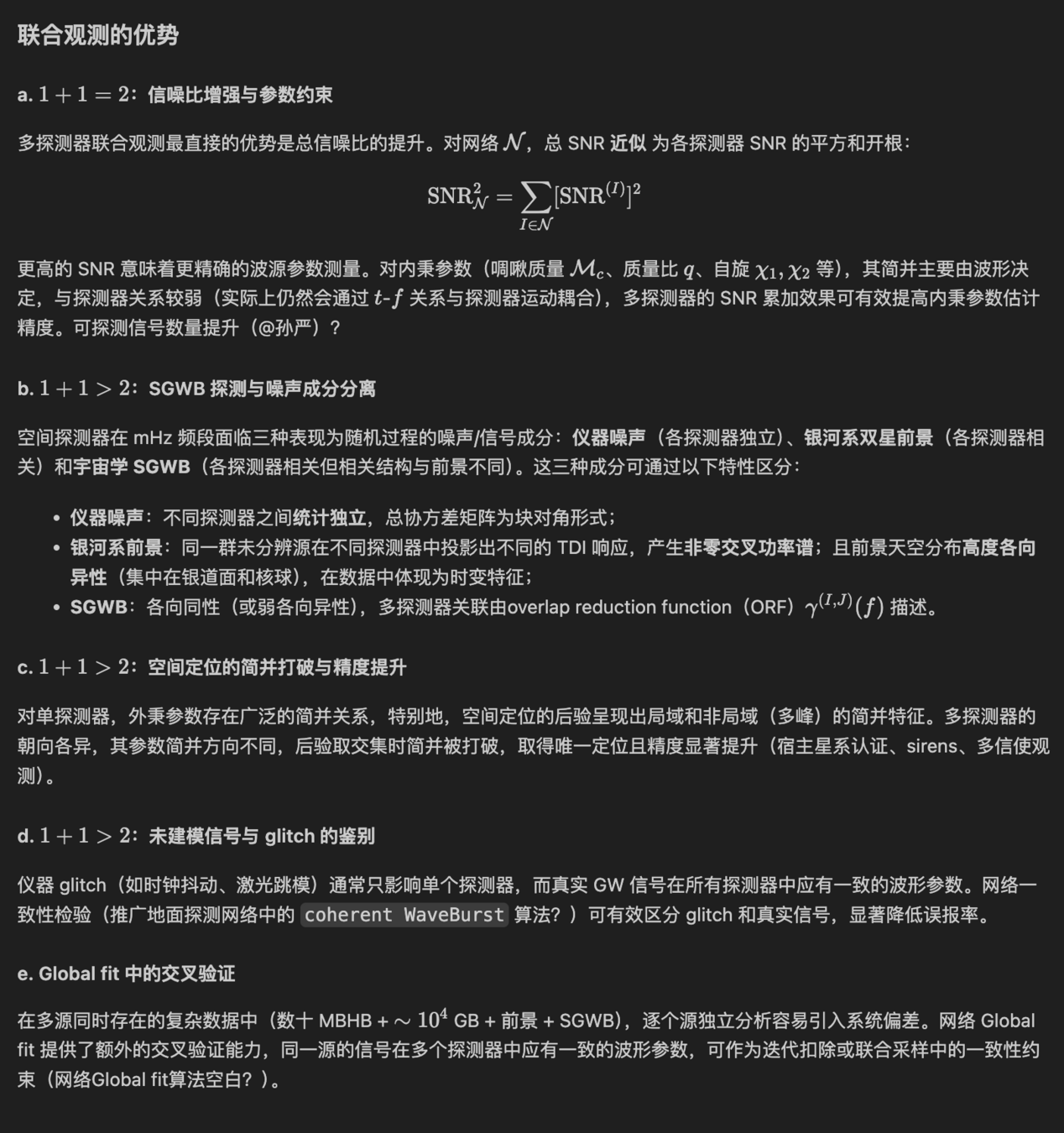
Ruan, Liu, Guo, Wu, & Cai, Nature Astronomy (2020);
Guo, Luo & Wang, Nature Astronomy (2021)
- different orbital configurations;
- improved sky localization;
- improved parameter estimation;
- independent cross-validation;
- better standard-siren and multimessenger potential。
(prelimitnary)
Ping Shen: Sci. China-Phys. Mech. Astron. March (2026) Vol. 69 No. 3
- Taiji-TianQin network improves SNR by 2.2–3.0 relative to TianQin alone and 1.06–1.14 relative to Taiji alone;
- LS model detection rate increases by 2.2–3 compared with Taiji alone;
- HS models achieve >96% detection efficiency;
- formation channel fractions can be inferred, with LS vs HS relative uncertainty 7.4% at 2σ;
- adding LISA further improves the three-detector network, including SNR and channel fraction constraints.
The purpose of network science is not only to increase SNR; it is to turn individual detections into robust population-level statements about black-hole formation, cosmology, and fundamental physics.
Why networks help
Separated constellations sample the same source with different baselines, antenna patterns, time delays, and orbital modulations.
Inference
- Long baselines break sky-position degeneracies.
- Complementary responses improve distance, inclination, polarization, and intrinsic-parameter constraints.
Validation
- Consistency across detectors strengthens confidence against detector-specific artifacts and modeling systematics.
Localization
Network science as population inference: the origin of SMBHs
- Taiji-TianQin network improves SNR by 2.2–3.0 relative to TianQin alone and 1.06–1.14 relative to Taiji alone;
- LS model detection rate increases by 2.2–3 compared with Taiji alone;
- HS models achieve >96% detection efficiency;
- formation channel fractions can be inferred, with LS vs HS relative uncertainty 7.4% at 2σ;
- adding LISA further improves the three-detector network, including SNR and channel fraction constraints.
The purpose of network science is not only to increase SNR; it is to turn individual detections into robust population-level statements about black-hole formation, cosmology, and fundamental physics.
From mission readiness to open collaboration
Taiji/TJ as part of a shared millihertz gravitational-wave ecosystem
He WANG · ICTP-AP / UCAS
Taiji: China's Space-based GW Program
- The long-term science case is network-facing: interoperable simulations, common benchmarks, cross-mission analysis, and joint population inference.
03 · From one mission to network science
- Key subsystems are advancing toward integration and coupled verification.
01 · From heritage to engineering readiness
- Simulation, calibration, TDI, data challenges, and global fitting are being developed as mission capabilities—not post-launch additions.
02 · From hardware to science readiness
Open interfaces for collaboration
Simulation interoperability · calibration and TDI · data challenges · global fitting · source populations · detector-network science
Taiji/TJ welcomes international collaboration across the full chain—from mission simulation and data processing to joint scientific inference.
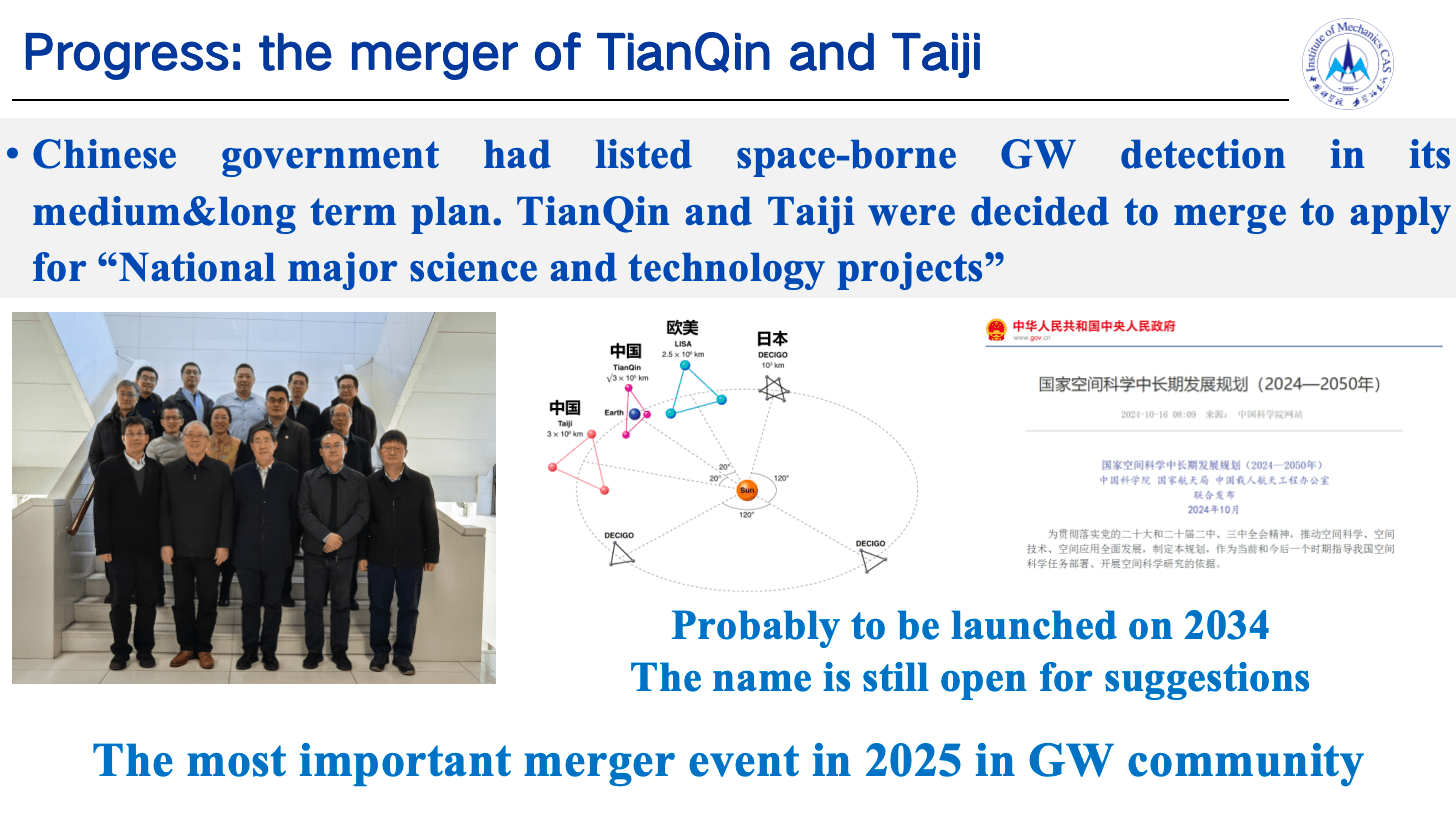
Leadership coordination within China’s space-based GW community · 2025
Prof. J. Luo
TianQin Chief Scientist
Prof. Y.-L. Wu
Taiji/TJ Chief Scientist
From mission readiness to open collaboration
Taiji/TJ as part of a shared millihertz gravitational-wave ecosystem
He WANG · ICTP-AP / UCAS
Taiji: China's Space-based GW Program
- The long-term science case is network-facing: interoperable simulations, common benchmarks, cross-mission analysis, and joint population inference.
03 · From one mission to network science
- Key subsystems are advancing toward integration and coupled verification.
01 · From heritage to engineering readiness
- Simulation, calibration, TDI, data challenges, and global fitting are being developed as mission capabilities—not post-launch additions.
02 · From hardware to science readiness
Prof. J. Luo
TianQin Chief Scientist
Prof. Y.L. Wu
Taiji/TJ Chief Scientist
Open interfaces for collaboration
Simulation interoperability · calibration and TDI · data challenges · global fitting · source populations · detector-network science
Taiji/TJ welcomes international collaboration across the full chain—from mission simulation and data processing to joint scientific inference.
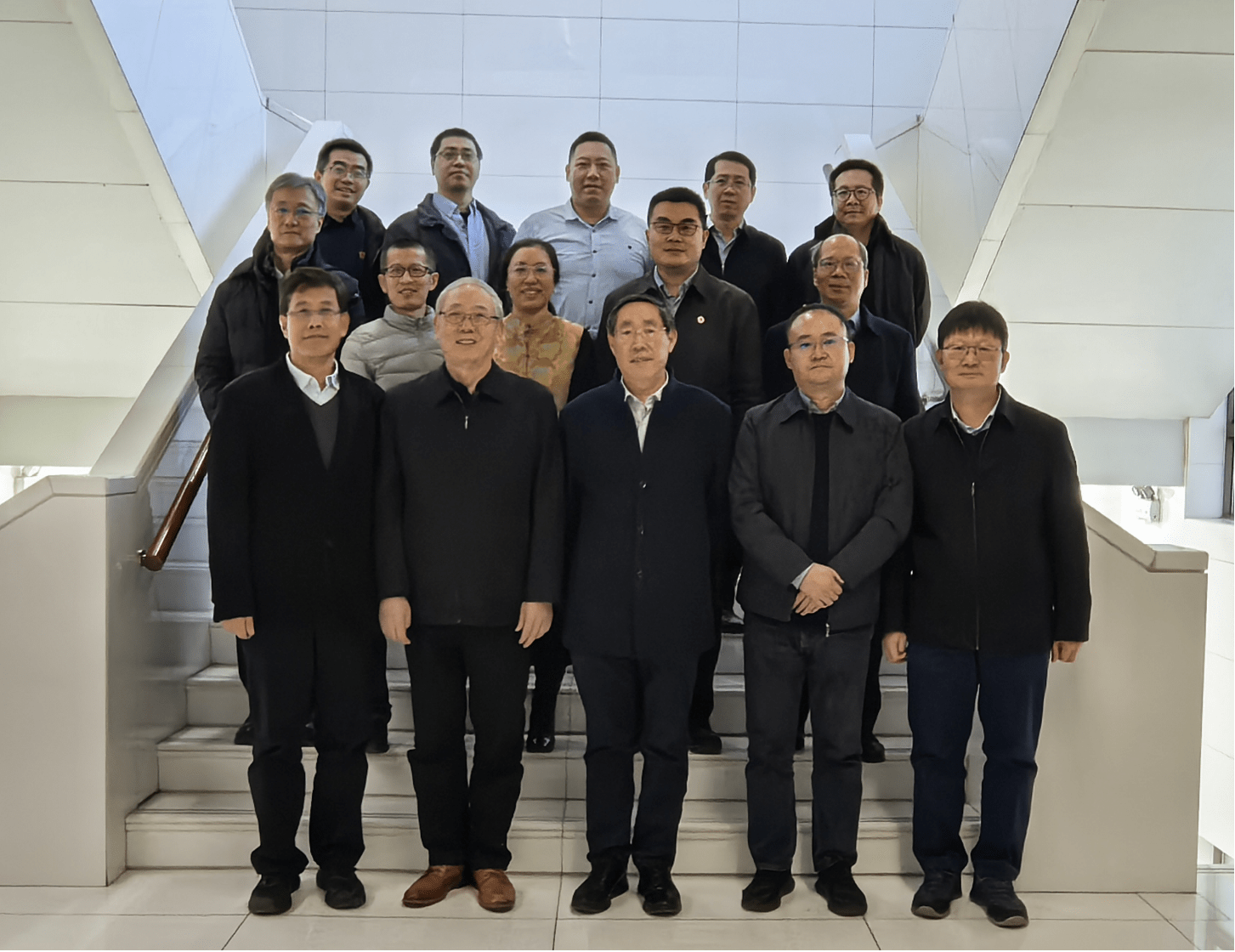
Leadership coordination across China’s space-based GW community (2025)
Leadership coordination within China’s space-based GW community · 2025
Prof. J. Luo
TianQin Chief Scientist
Prof. Y.-L. Wu
Taiji/TJ Chief Scientist
Summary and outlook
Take-home messages
- Taiji/TJ has a long-term development path, from early Chinese space-GW studies to Taiji-1 in-orbit heritage.
- The roadmap has evolved toward full-mission engineering readiness, with emphasis on system integration, verification, and end-to-end performance.
- Key technologies have moved from component development toward coupled-system validation, including optical metrology, inertial sensing, drag-free control, ultra-stable platform, and scientific interferometry.
- Data analysis is part of mission readiness, through full-chain simulation, TDI preprocessing, detector characterization, source pipelines, and global-fit studies.
- The strongest scientific case is network-facing, with Taiji/TJ contributing to future LISA-Taiji-TianQin synergy and population-level mHz gravitational-wave astronomy.
Open interfaces for international collaboration
Thank you
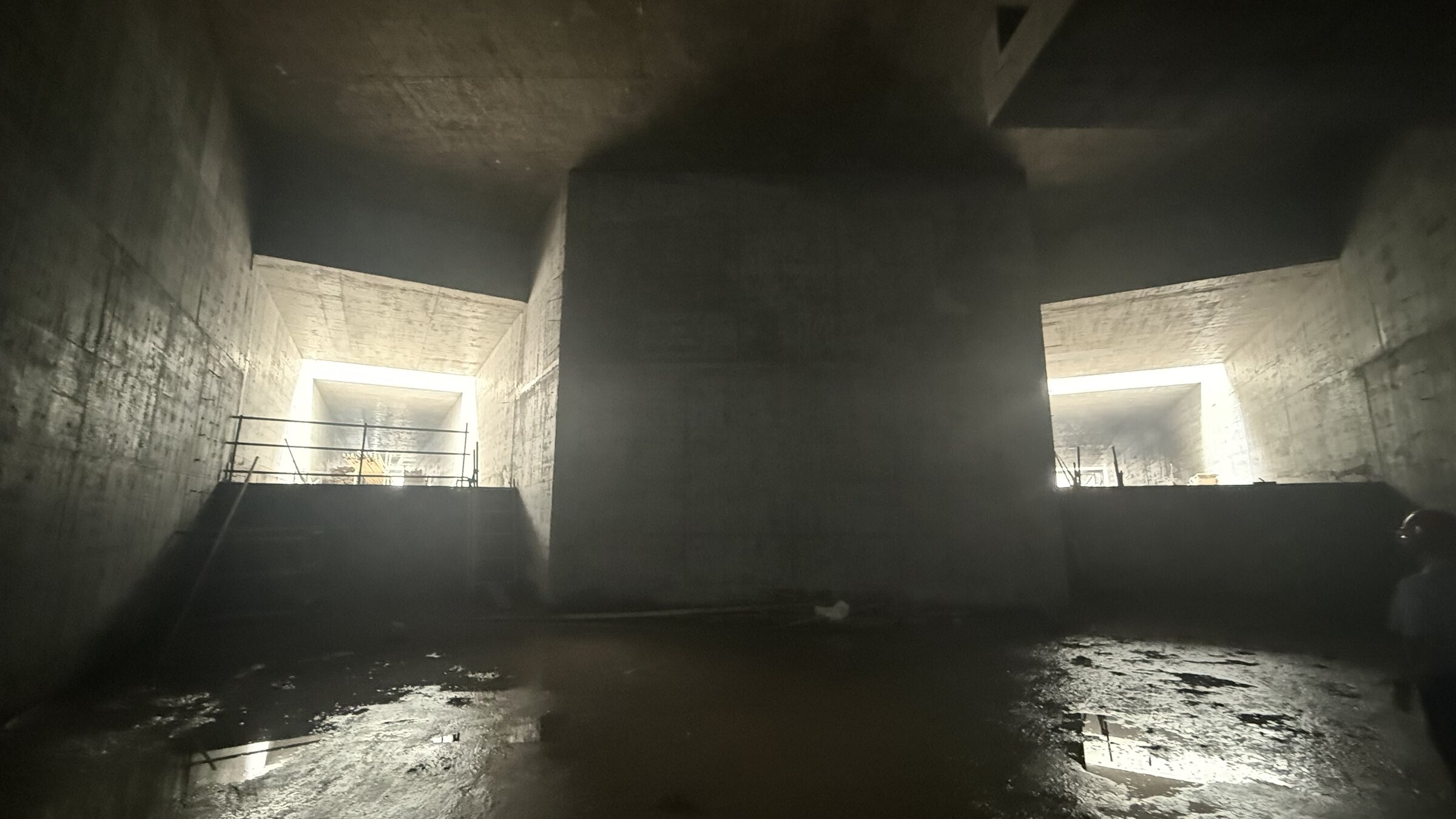
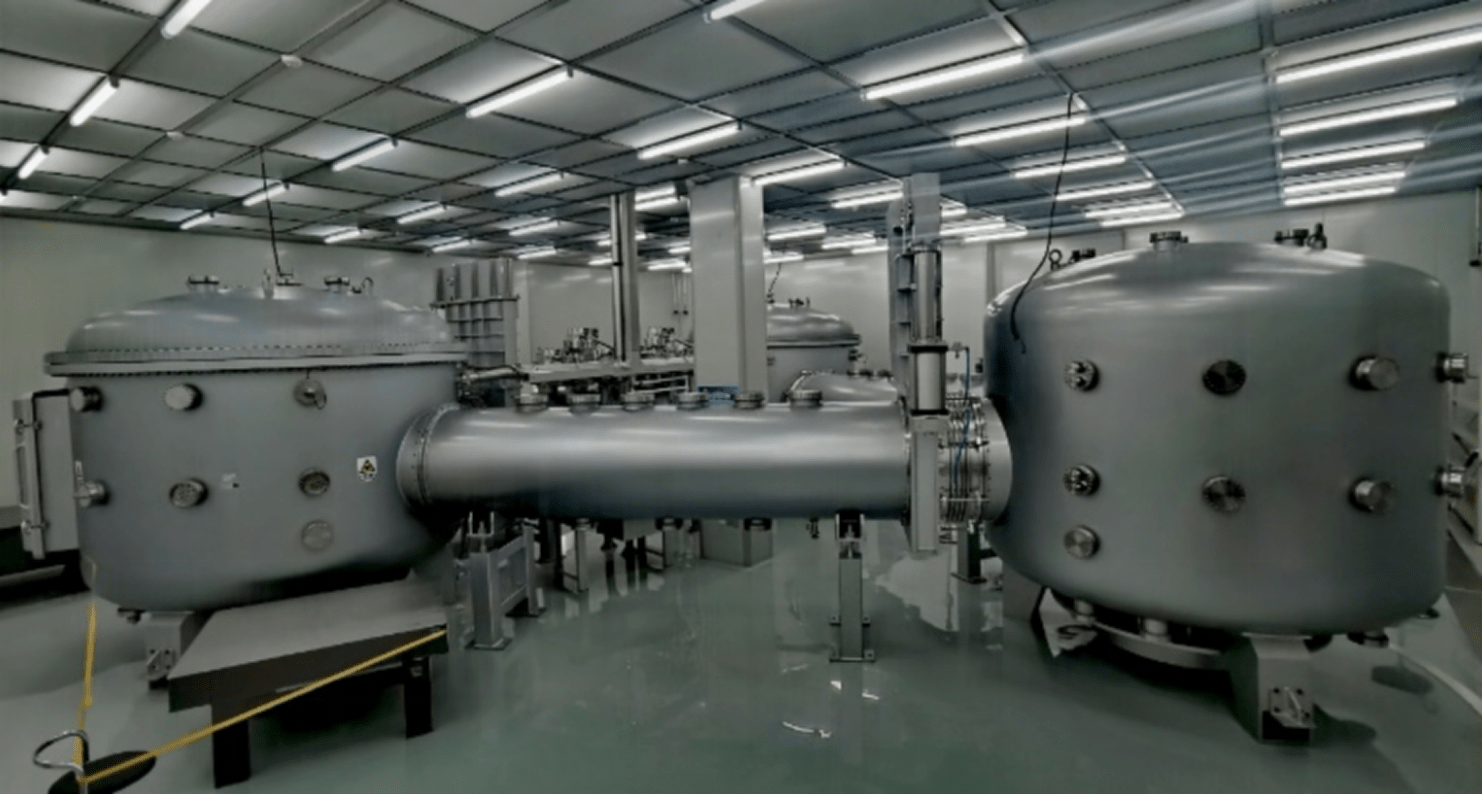
Toward full-constellation verification

100-m-baseline facility under construction · Hangzhou, May 2026
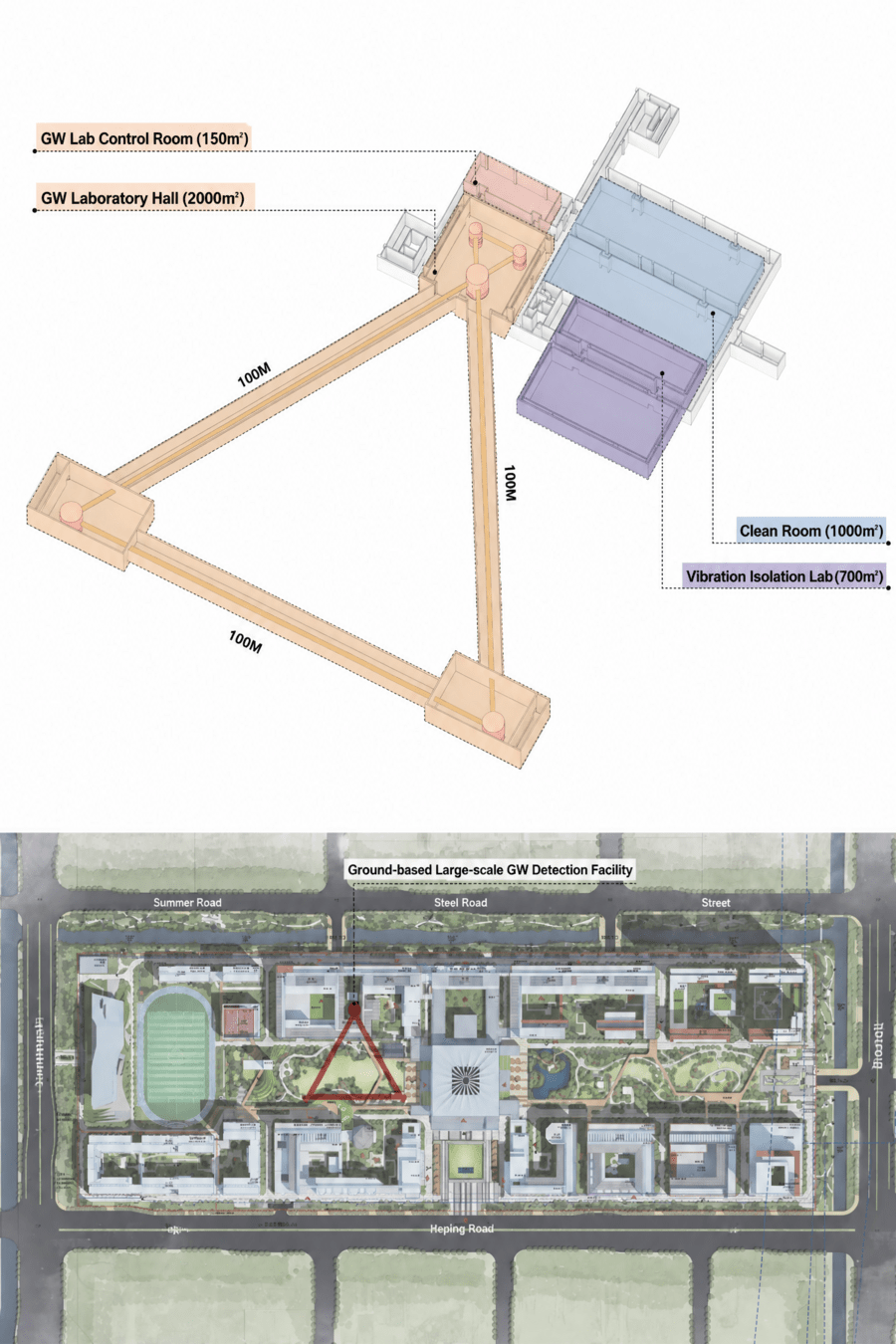
GROUND-TEST FACILITY CONCEPT
100-m triangular baseline
Ground-facility site layout
100-m-baseline triangular laser-interferometry test facility