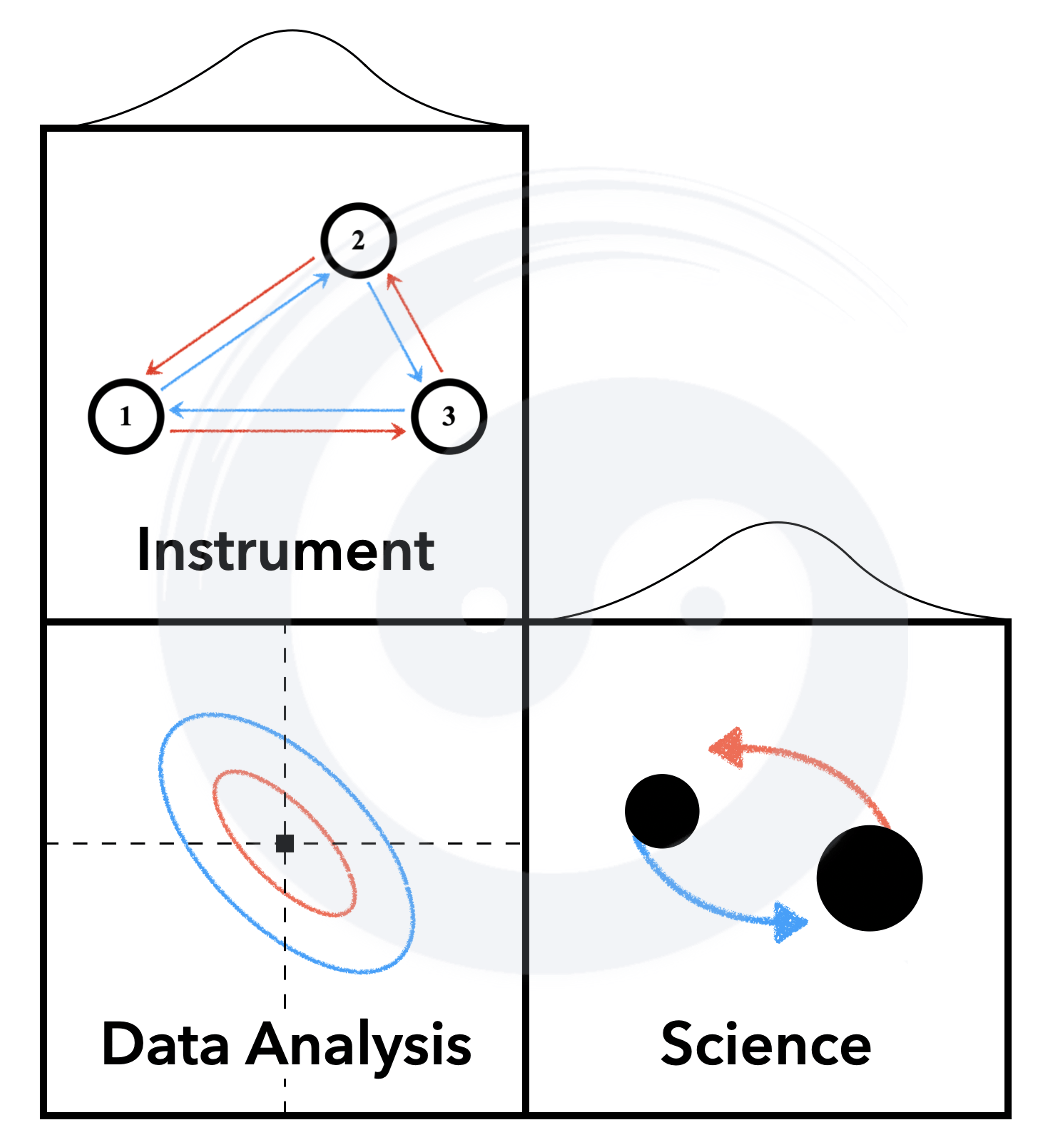
Progress of Taiji:
Data Challenge and Data Analysis
Minghui DU (CAS, speaker), He WANG (UCAS)
On behave of Taiji Scientific Collaboration
@NUS, EMRI Search and Inference within the LISA Global Fit - Part II


A brief history: from early studies to Taiji-1 in-orbit demonstration
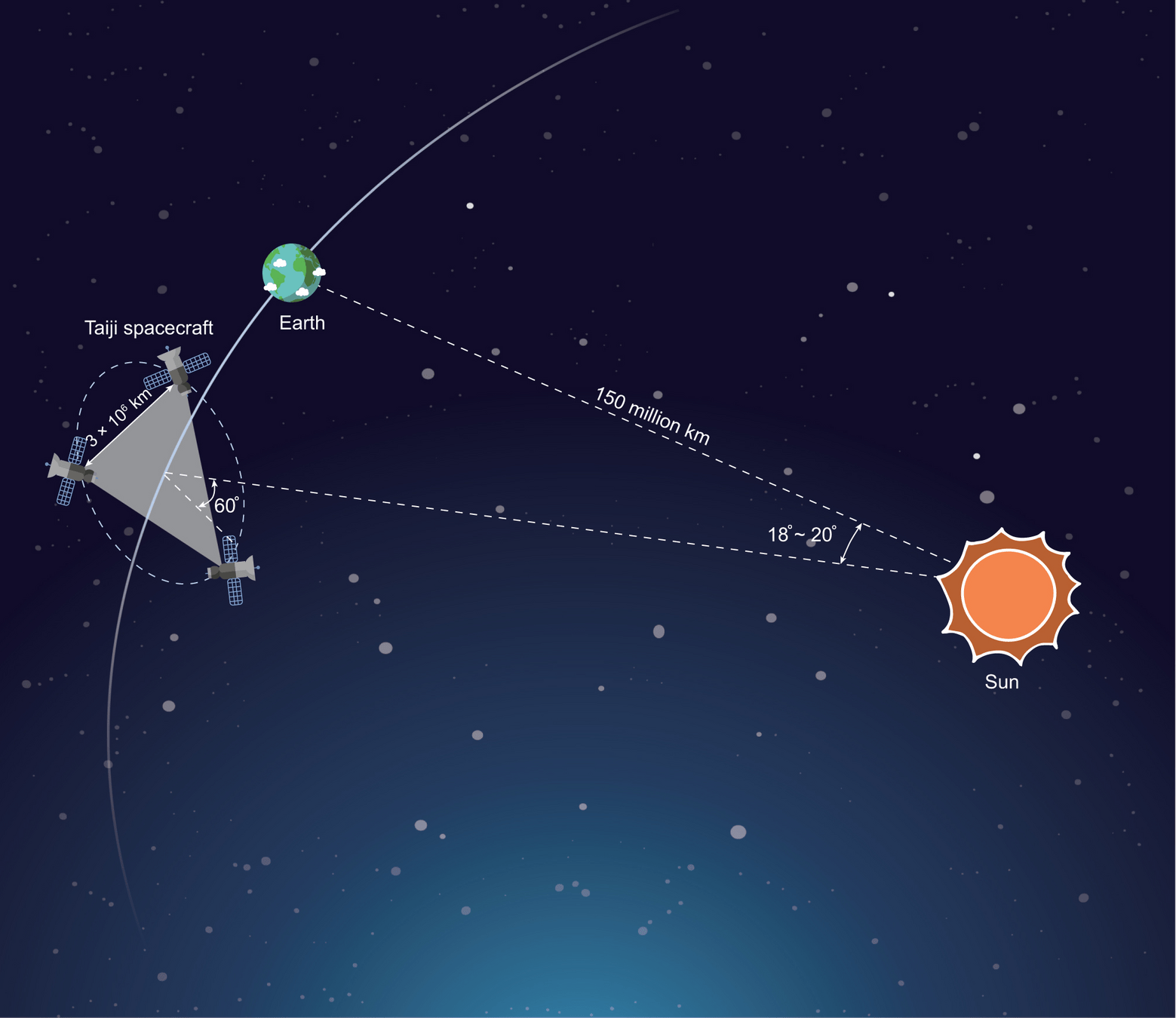
Wen-Rui Hu , Yue-Liang Wu, Natl. Sci. Rev. Vol 4 (2017)
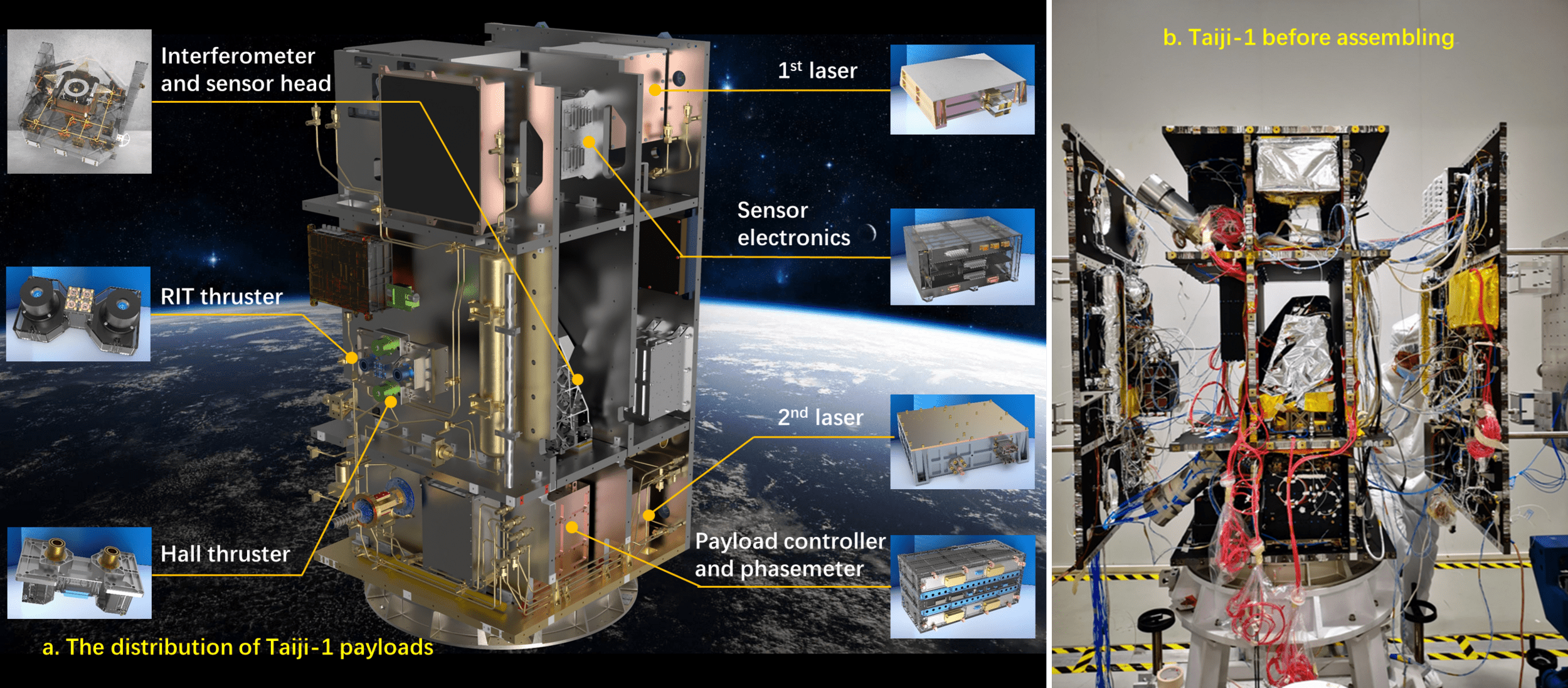
Yue-Liang Wu et al., Commun. Phys. 4, 34 (2021)
2008
— CAS initiated early studies on space-based gravitational-wave detection.
2010
— Early national proposal for space-based GW observation.
— Officially named Taiji, and publicly introduced to the international community.
2016
— Taiji-1 was launched as an in-orbit demonstrator for Taiji's technologies.
2018-2019
— Overall mission design and development roadmap were published.
2021
— Current focus: engineering preparation, system-level verification, data challenges, and science-pipeline development.
2025-2026
Taiji has evolved from early conceptual studies to in-orbit technology verification and is now moving toward full-mission engineering and science-data readiness.
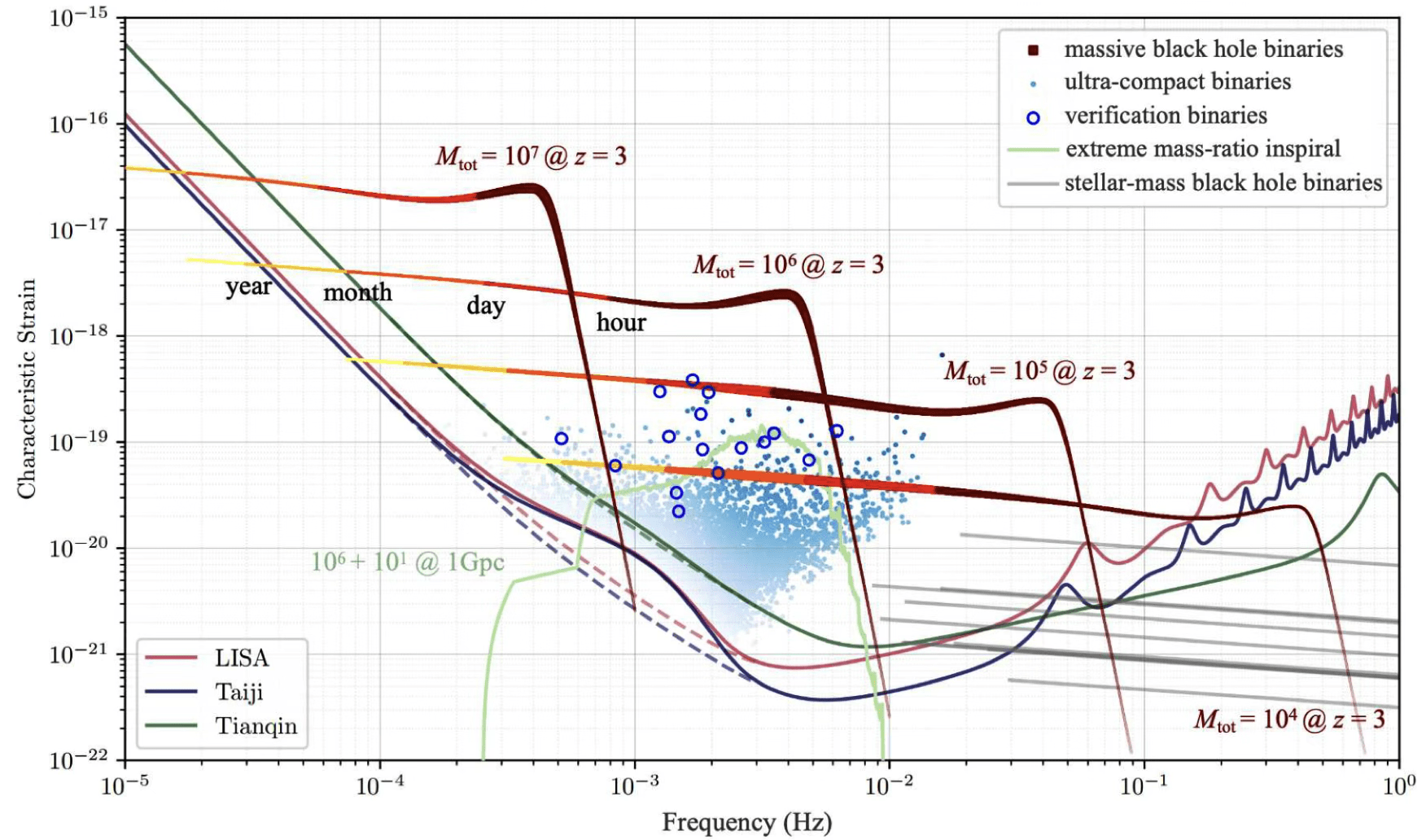
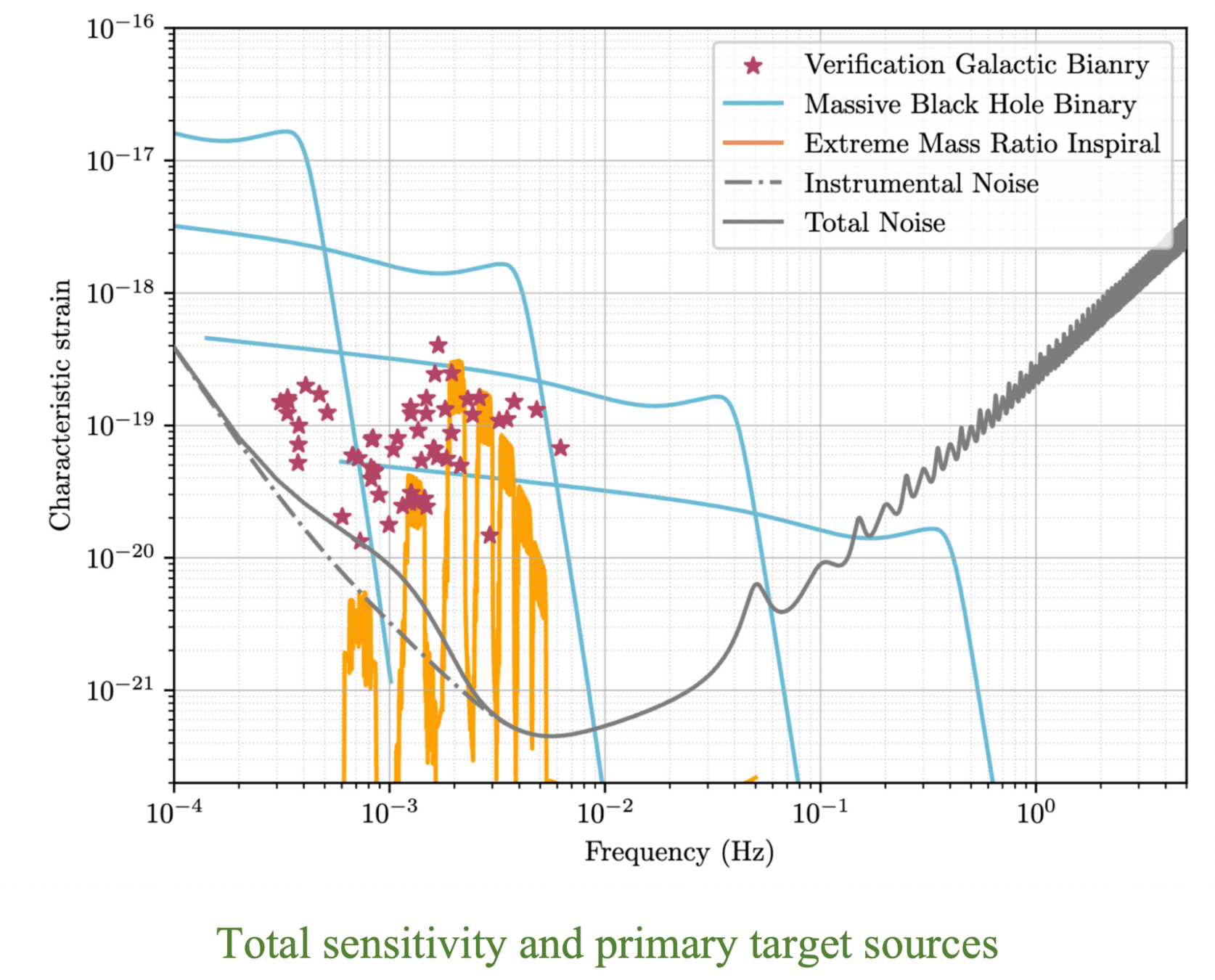
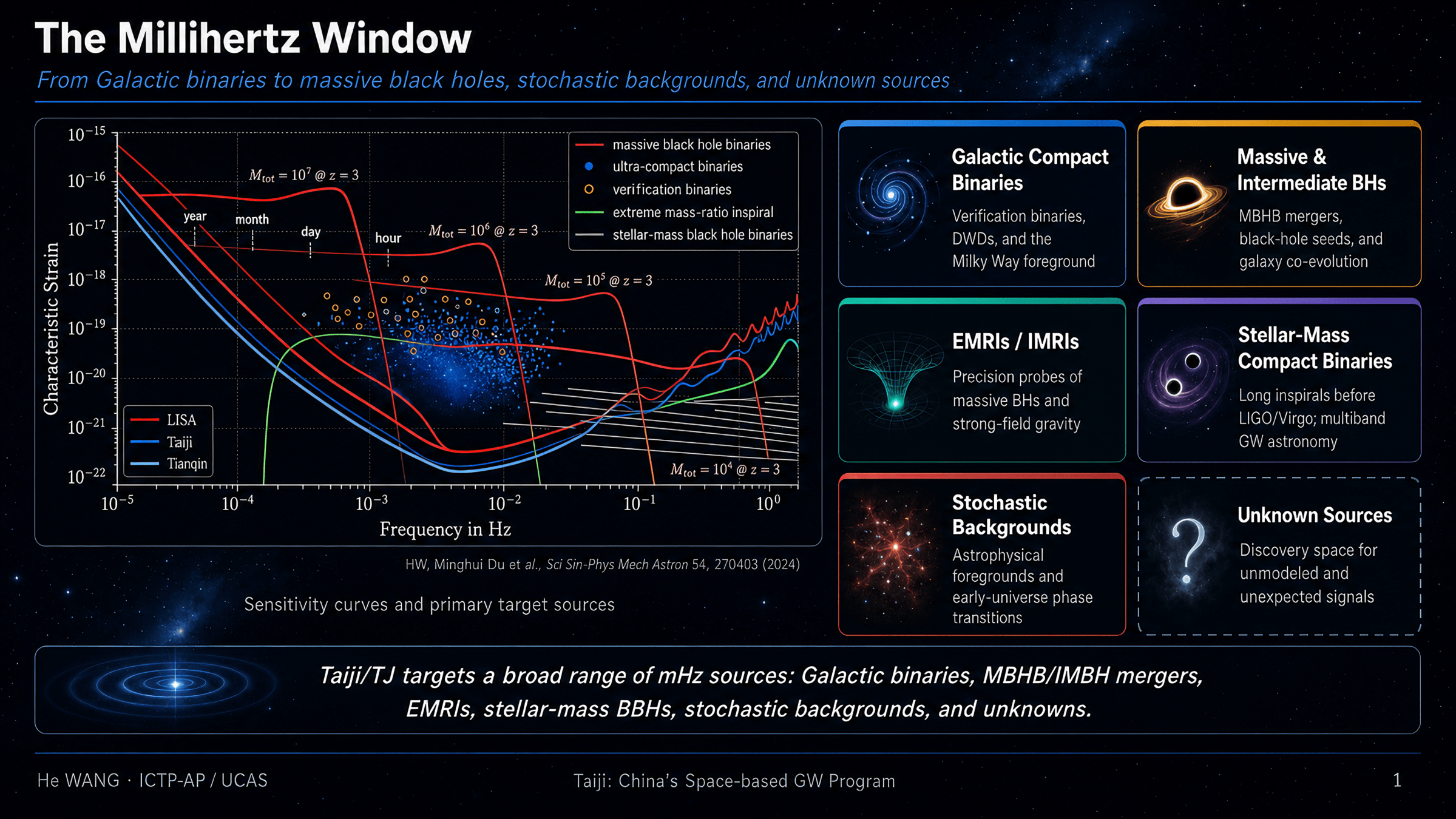
The millihertz window
HW, Minghui Du et al., Sci Sin-Phys Mech Astron 54, 270403 (2024)
Taiji targets a broad range of mHz sources: Galactic compact binaries, MBHB/IMBH mergers, EMRIs/IMRIs, stellar-mass BBHs, stochastic backgrounds, and unknown sources.
Galactic Compact Binaries
Verification binaries,
DWDs, and the
Milky Way foreground
MBHBs / IMBHBs
EMRIs / IMRIs
Stellar-Mass BBHs
Stochastic Backgrounds
Unknown Sources
MBHB mergers,
black-hole seeds, and
galaxy co-evolution
Precision probes of
massive BHs and
strong-field gravity
Long inspirals before
LVK; multiband GW astronomy
Astrophysical
foregrounds and
early-universe phase
transitions
Discovery space for
unmodeled and
unexpected signals
Baseline full-mission concept
- Three drag-free spacecraft forming a near-equilateral triangular constellation
- Arm length: \(3\times 10^6\) km
- Heliocentric orbit, leading/trailing the Earth by ~\(20^\circ\)
- Laser displacement sensitivity: \(8\times 10^{-12}\mathrm{m} /\sqrt{\mathrm{Hz}}\)
- Test-mass acceleration noise: \(3 \times 10^{-15}\,\mathrm{m\,s^{-2}}/\sqrt{\mathrm{Hz}}\)
Taiji Full-Mission Concept
A heliocentric triangular constellation for mHz gravitational-wave astronomy
100-m underground interferometer
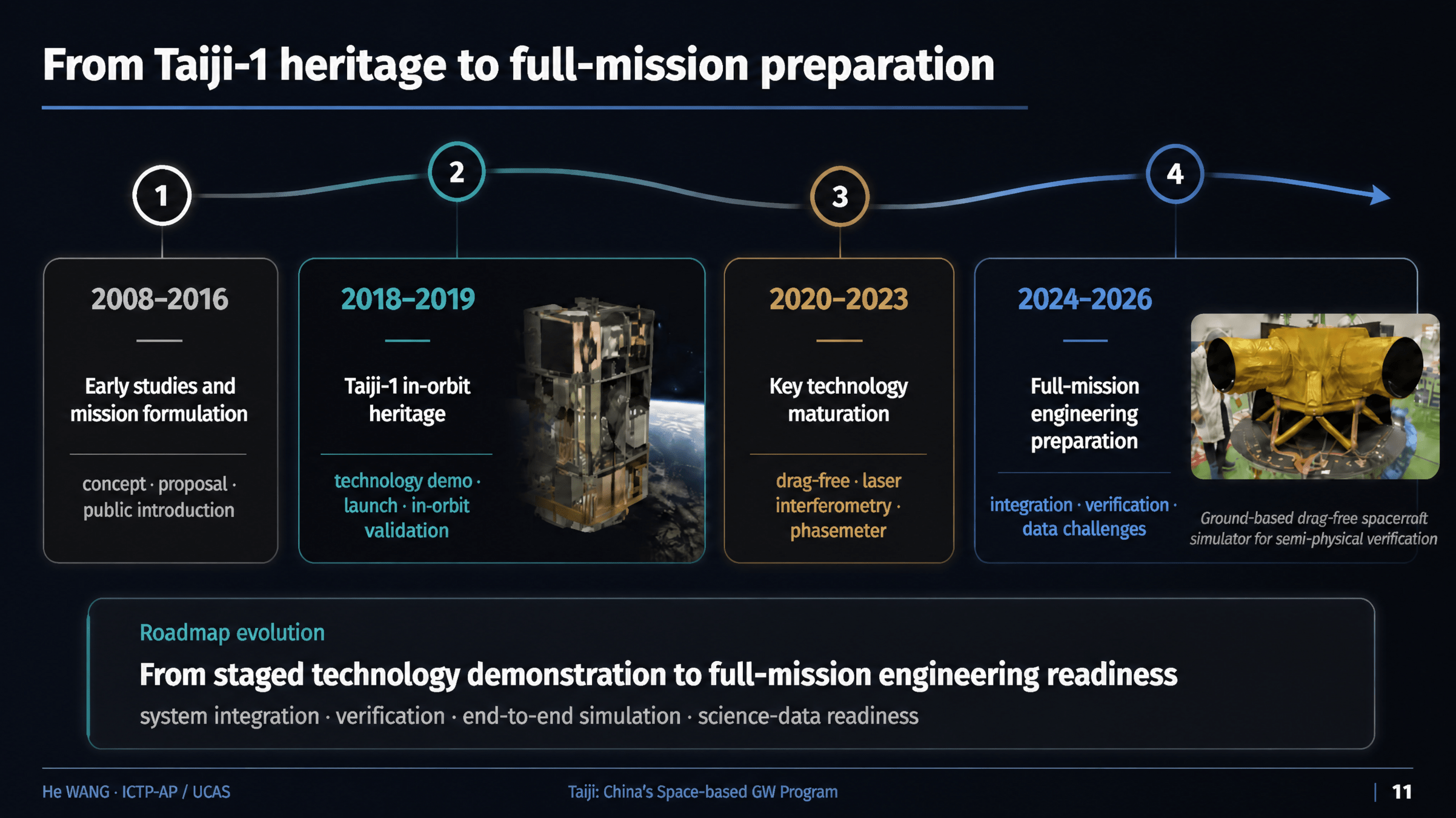
2008-2016
2018-2019
2020-202x
202x-203x
From Taiji-1 to full-mission preparation
Early studies and
mission formulation
Taiji-1 in-orbit
demonstration
Key technology
development
Full-mission
engineering
preparation
concept · proposal ·
public introduction
technology demo ·
launch · in-orbit
validation
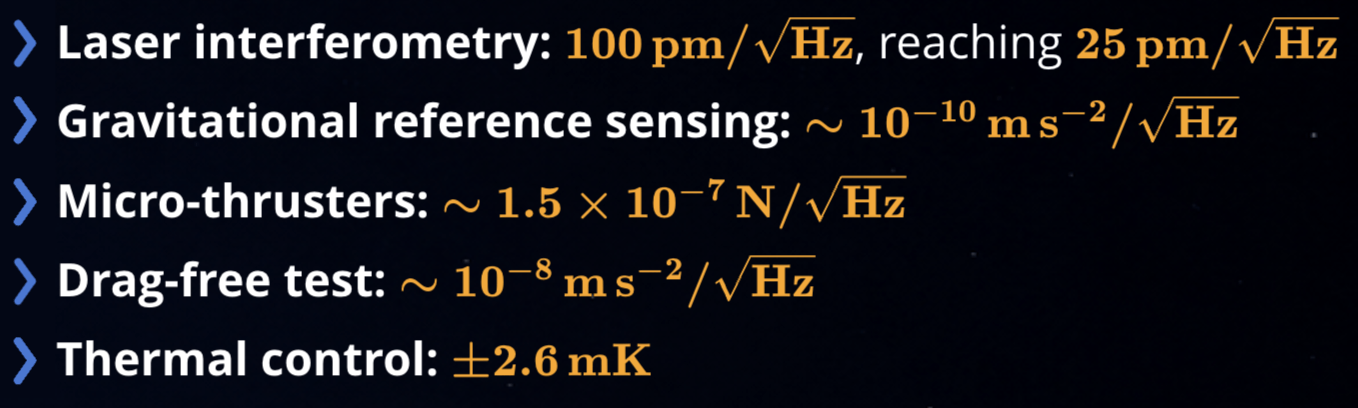
drag-free · laser
interferometry ·
phasemeter ·
grav. reference sensor
integration · verification · data challenges
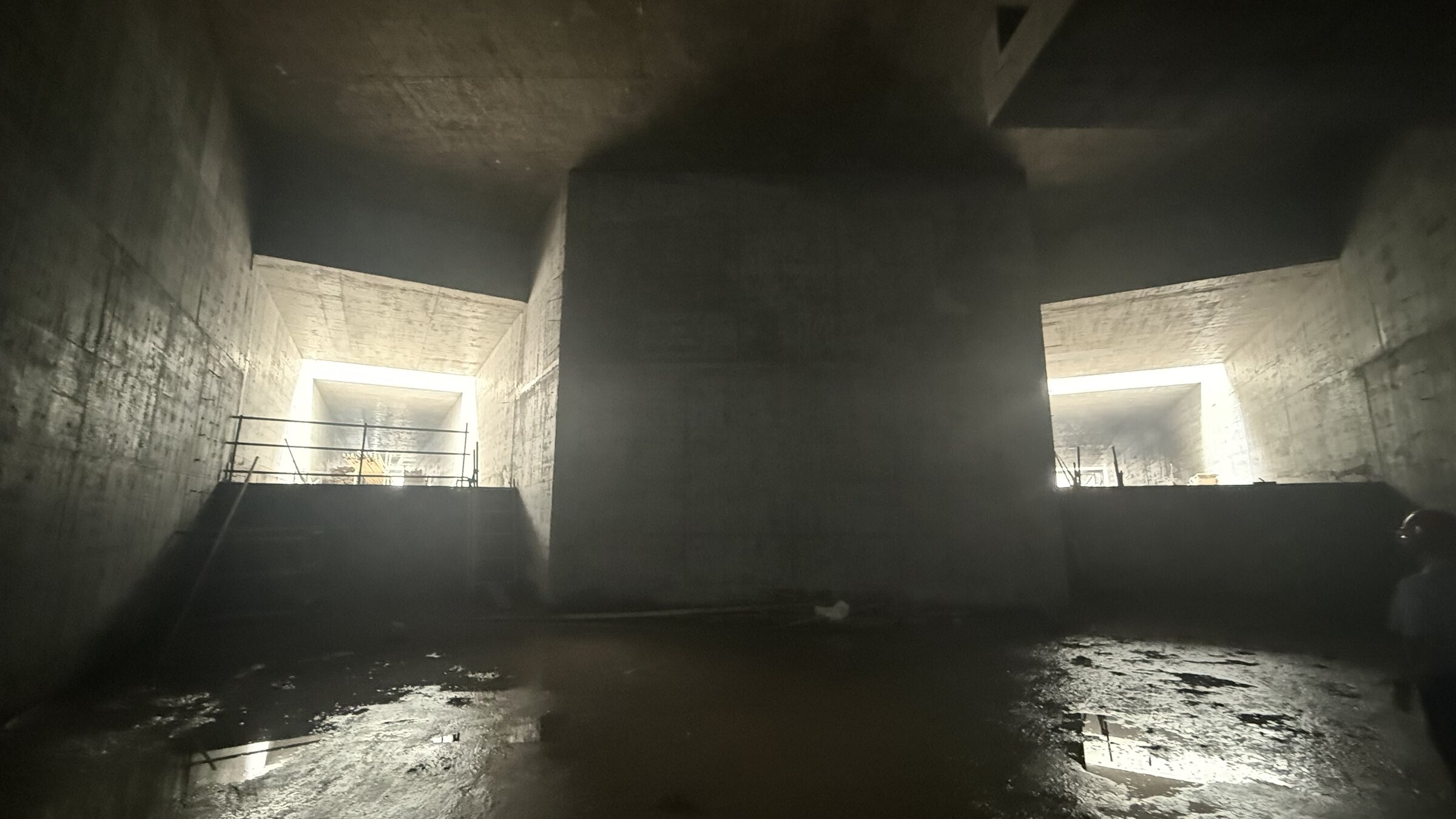

10-m ground interferometer
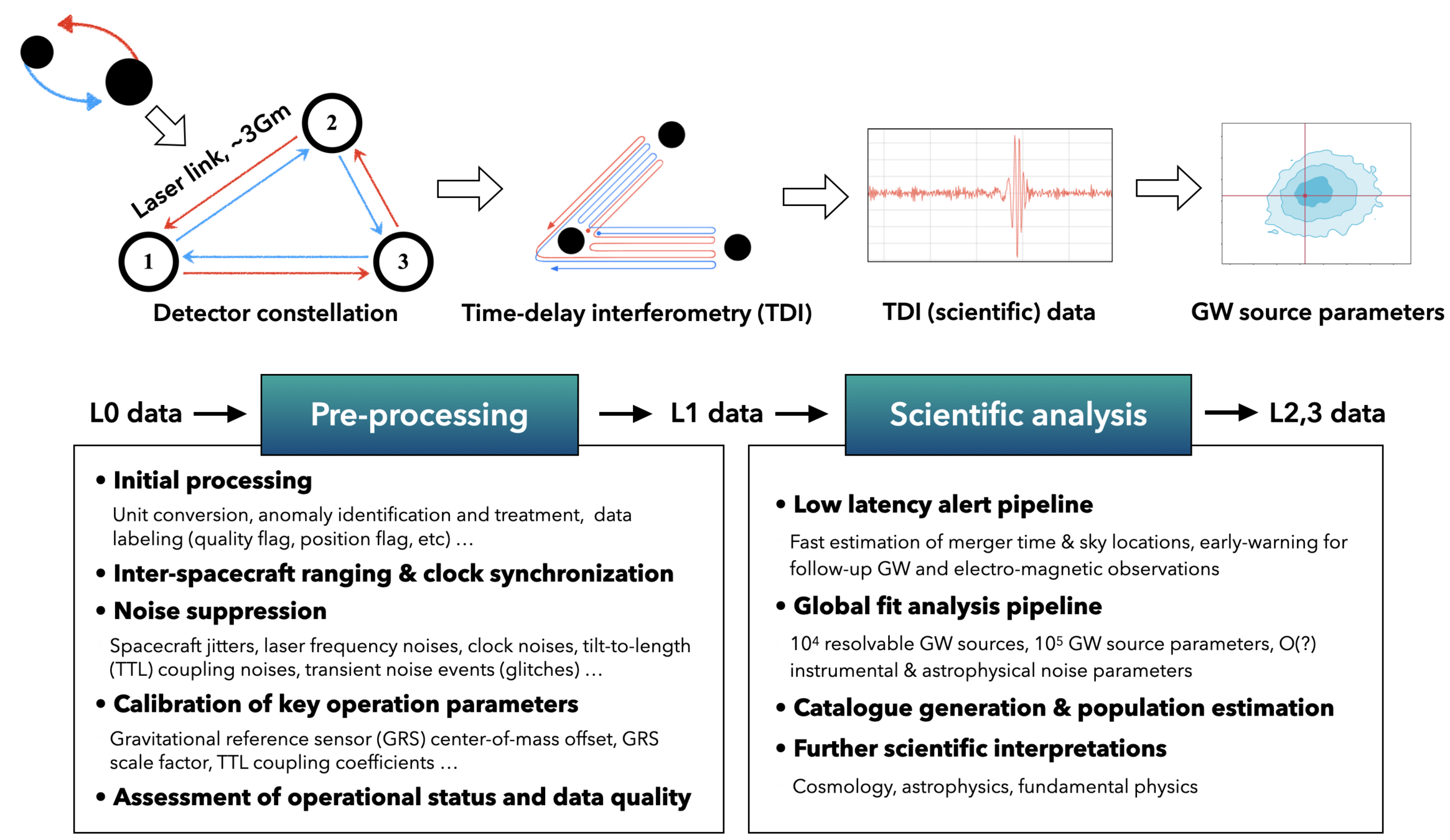
Outline of Taiji Data Processing Pipeline
The analysis starts from raw telemetry and ends at scientific interpretations
L0
L0 - L1
L1 - L2
L2 - L3
scientific measurements
auxililary data channels
Ranging · Clock sync ·
· data quality · calibration · TDI
Low-latency search ·
global fitting
Catalogs · cosmology · astrophysics ·
fundamental physics
Raw
Telemetry
Preprocessing
Scientific
Analysis
Science
Products
Data processing pipeline: raw telemetry to scientific interpretation of the signals
Developing this pipeline is part of mission design and preparation.
Data Challenge serves as benchmark for reflecting and addressing the data analysis problems.
Taiji Data Challenge
A typical criterion for unbiased parameter estimation:
What are the challenges? These are what we found from the simulations:

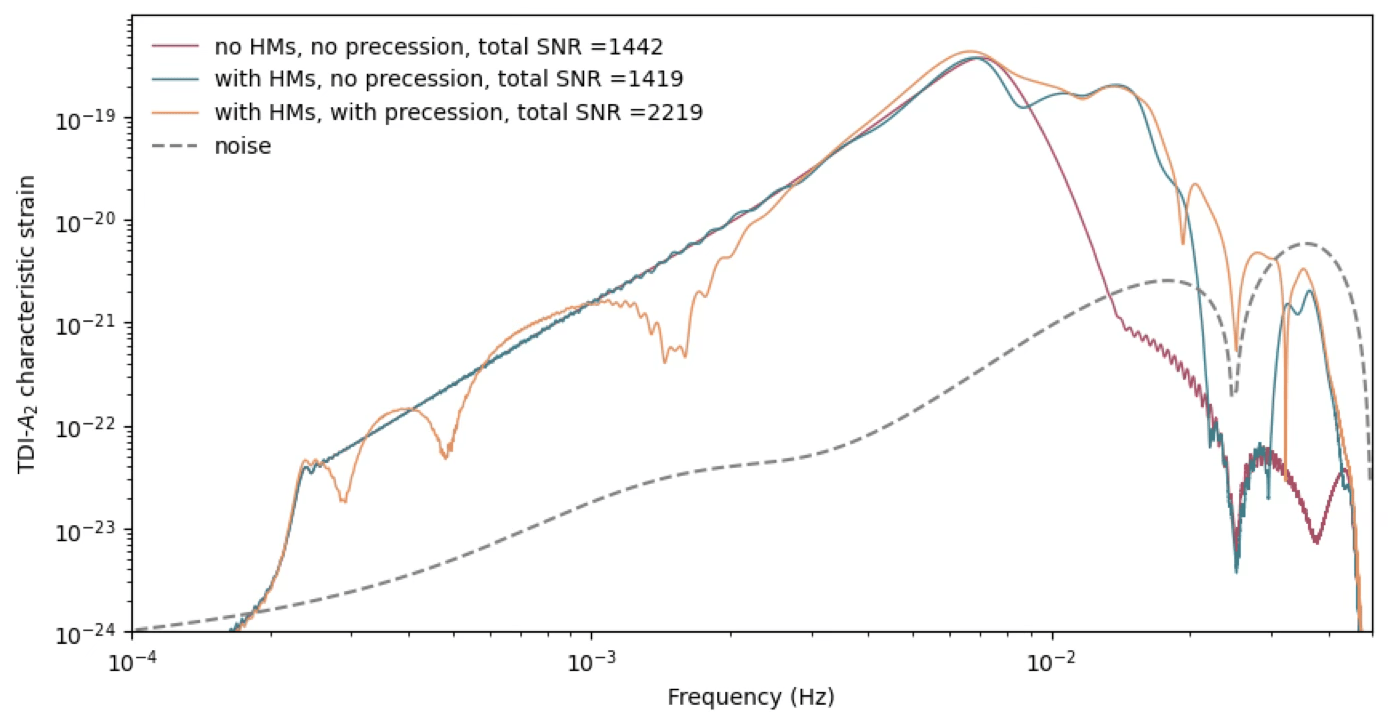
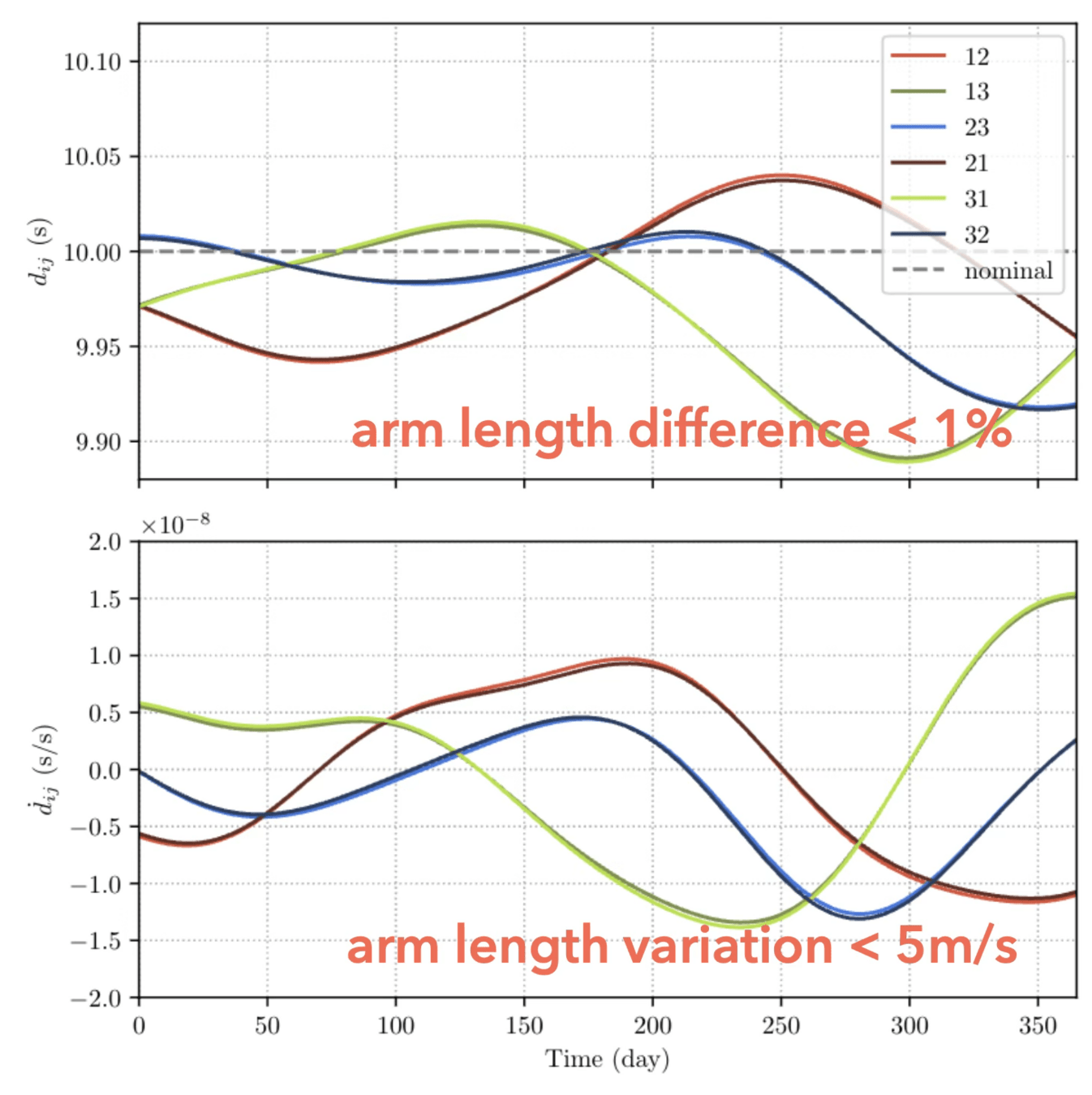
The effect of realistic orbital motion (especially armlength variation ) in response:

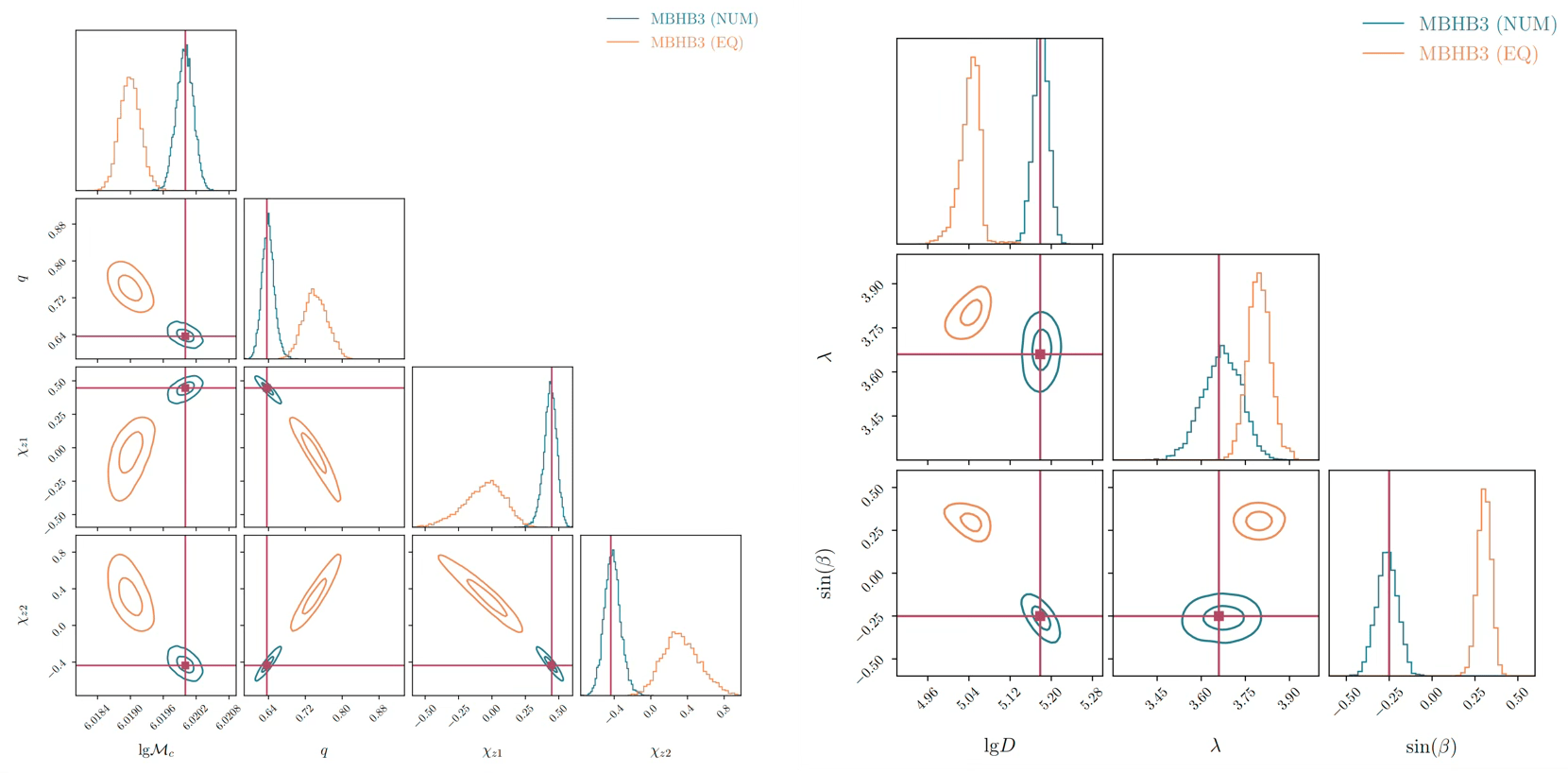
1. Complexity in waveform and response modeling
difference between waveforms with / without the subdominant features: HMs, precession ...
Taiji Data Challenge
A typical criterion for unbiased parameter estimation:
1. Complexity in waveform and response modeling
The effect of realistic orbital motion (especially armlength variation ) in response:
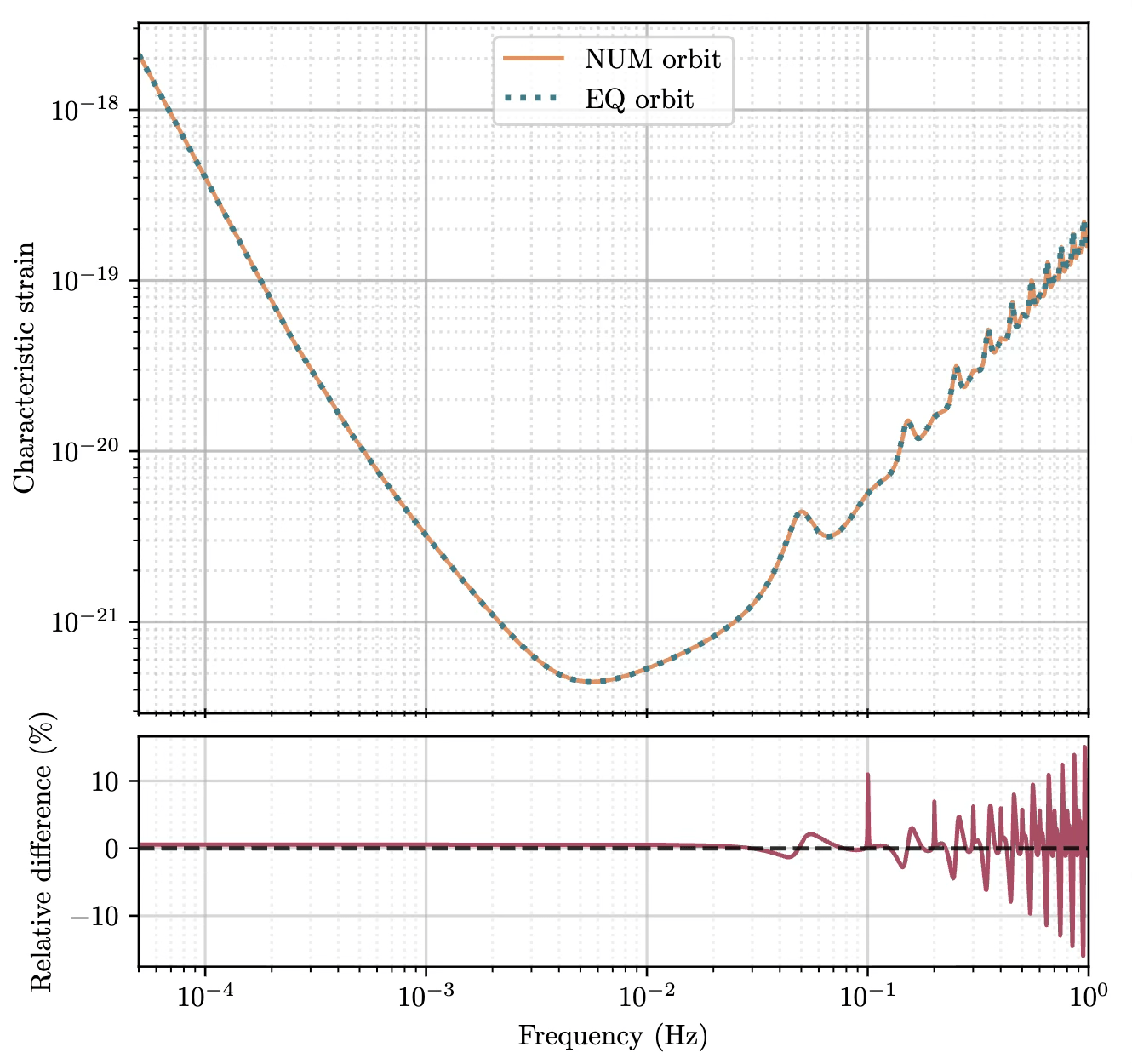
sensitivity averaged over a year, with all the covariance among TDI channels considered
What are the challenges? These are what we found from the simulations:
Taiji Data Challenge
Drag-free control simulation vs. mission requirement
2. The unknown and non-stationary noise properties (besides glitches and gaps)
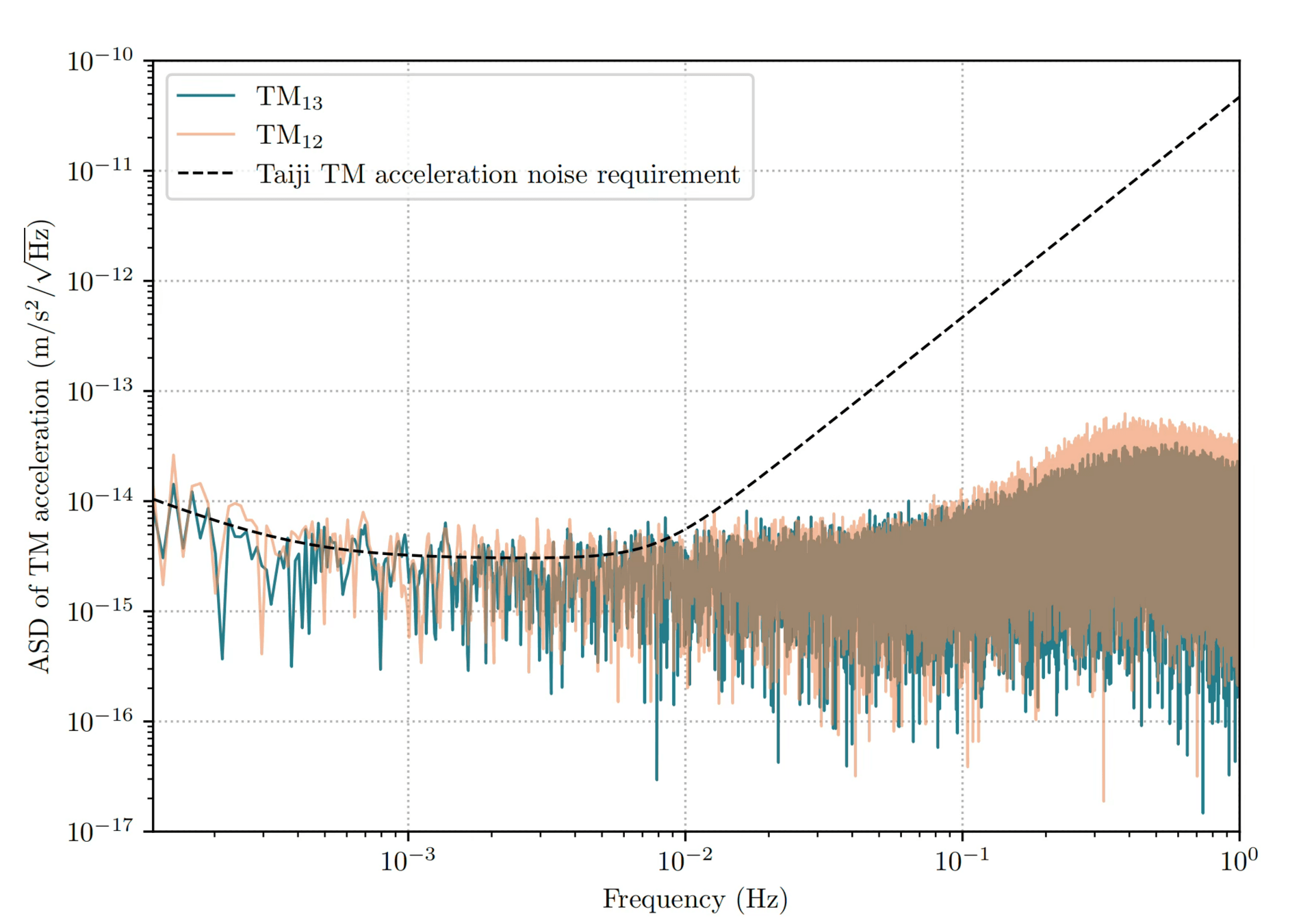
What are the challenges? These are what we found from the simulations:
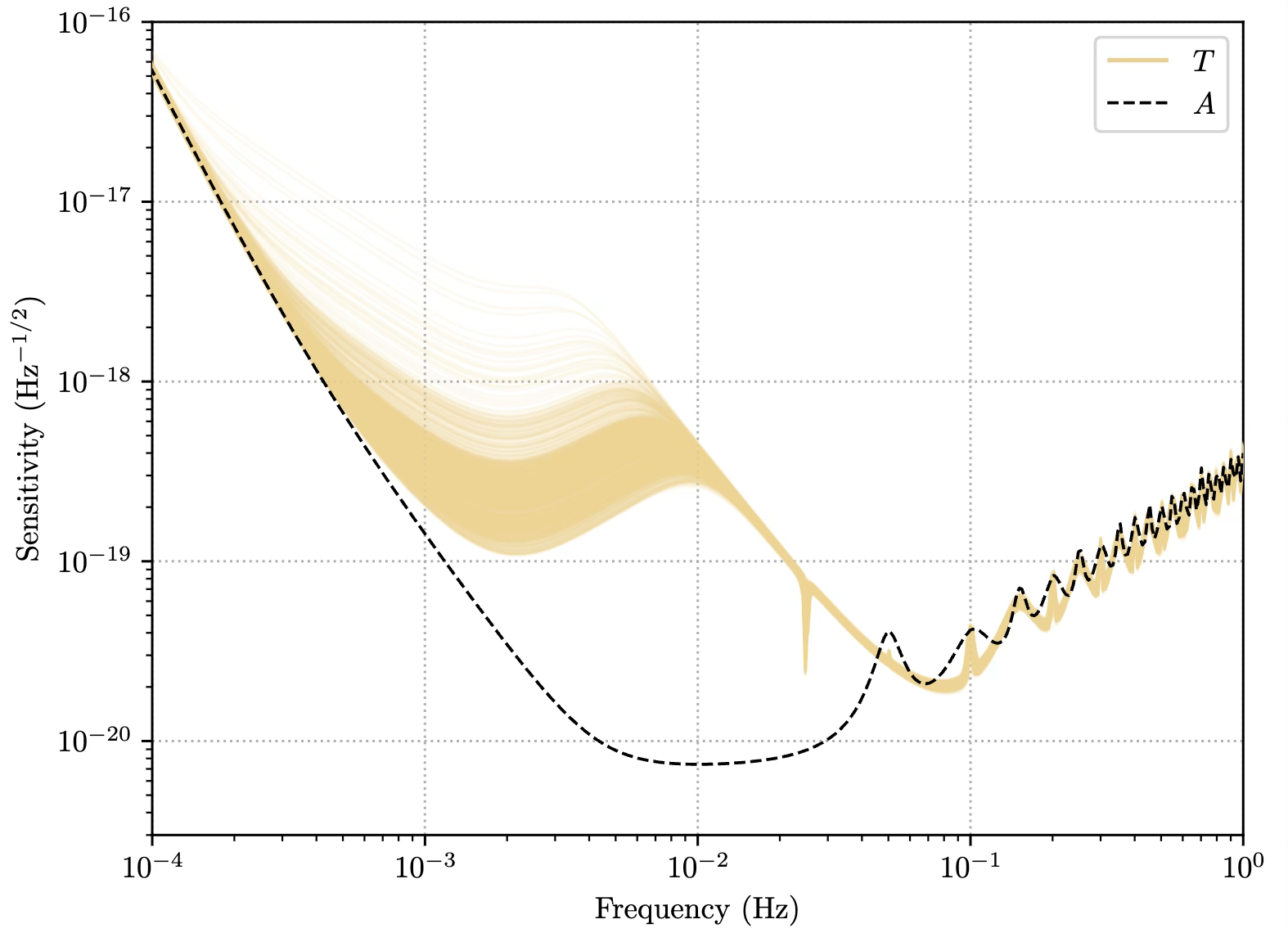
The non-stationarity of T channel's sensitivity introduced by arm variation. Also, It fails to serve as a null channel in the unequal-arm regime.
Taiji Data Challenge
3. The coupling between pre-processing and scientific analysis stages
Tilt-to-noise coupling noise suppression with GW signals in the data
What are the challenges? These are what we found from the simulations:
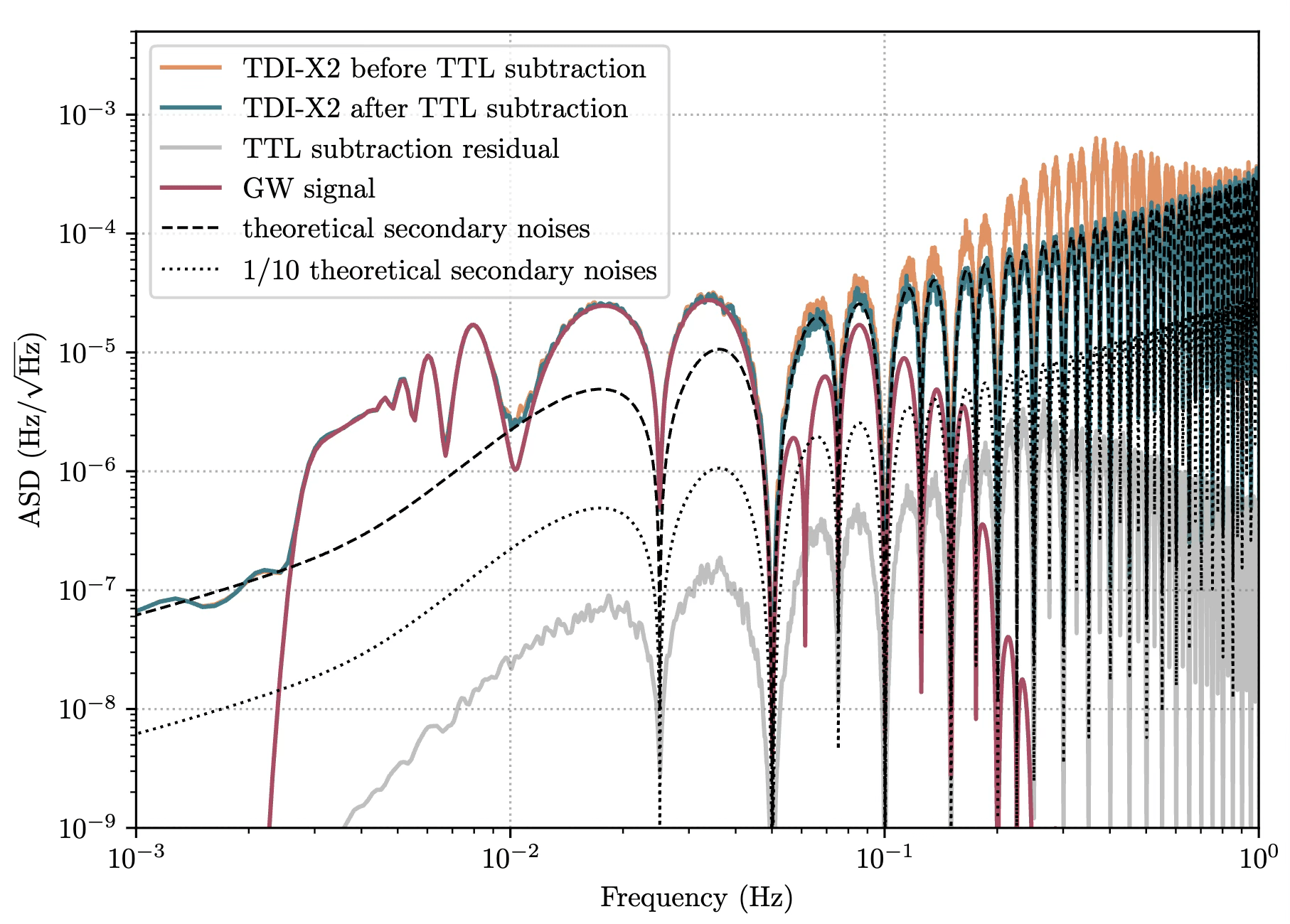
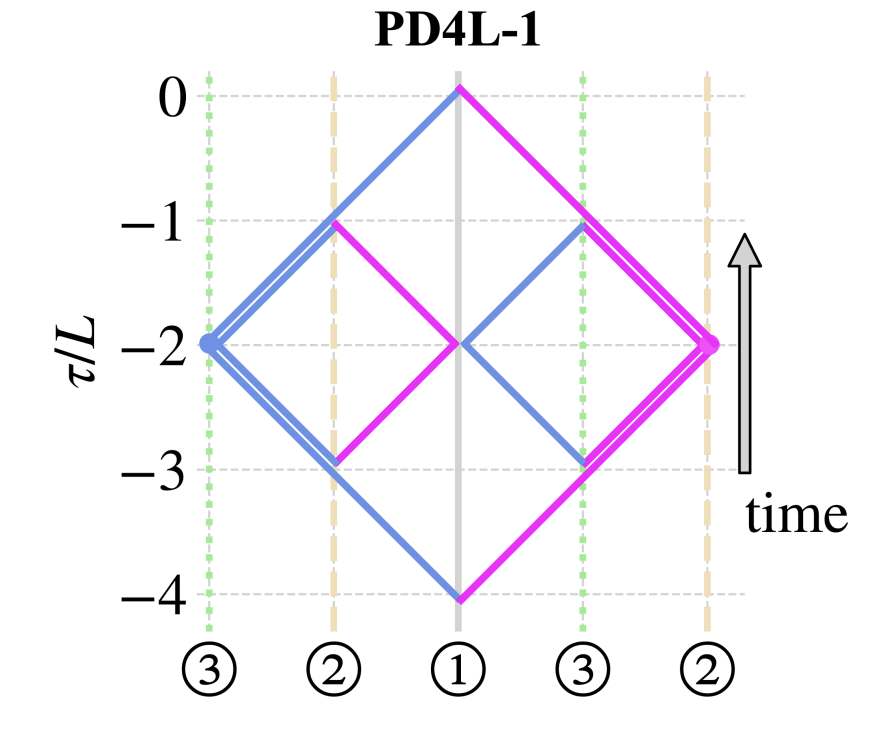
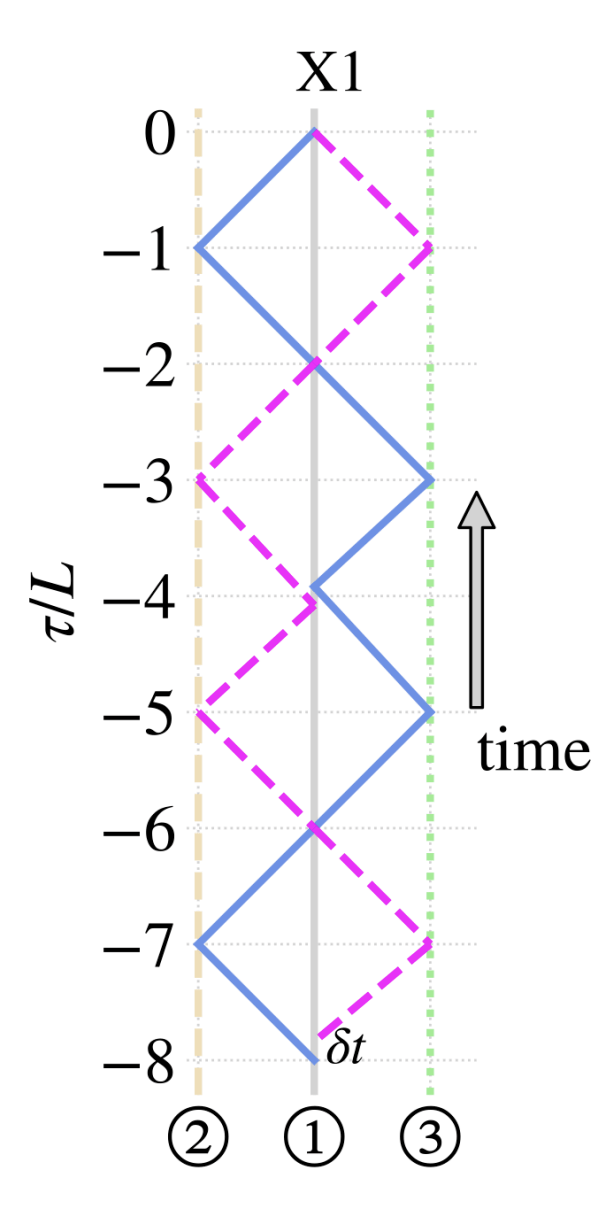
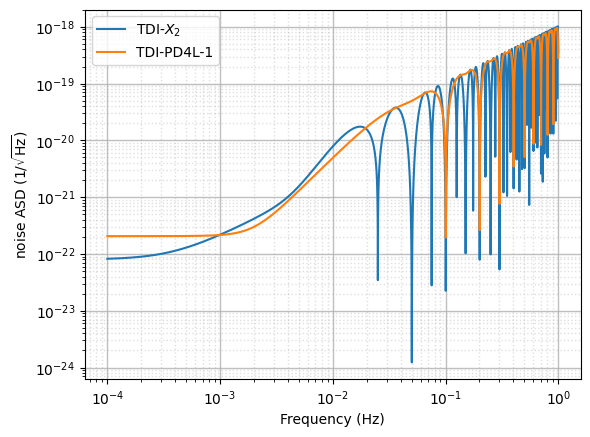
PD4L channel has much less zero points in the noise spectrum than Michelson channel (much less divergence in the evaluation of likelihood)
Proposed by Gang Wang in 2502.03983, verified via TDC simulation code.
Michelson-X
PD4L-1
Taiji Data Challenge
What are the challenges? These are what we found from the simulations:
4. The global fit problem
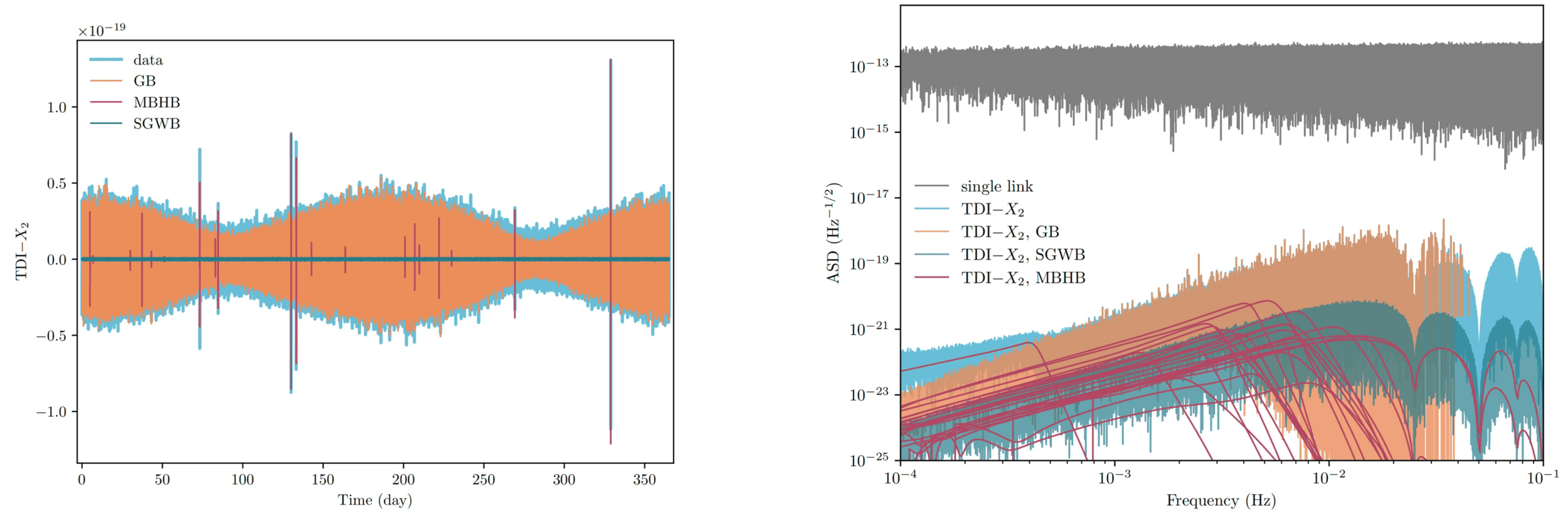
signal and noise overlap in both time and frequency domains, 10^4 resolvable signals, 10^5 undetermined parameters
Taiji Data Challenge
Open datasets and analysis tools: https://github.com/TriangleDataCenter
- Release date: May 2025 for blind set, Nov 2025 for training set
- Aim: building Taiji's data simulation & analysis pipelines
- Triangle: open-source toolkit for TDC
Triangle-Simulator
Time-domain prototype simulator for signals, raw measurements and TDI
Triangle-BBH
Fast frequency-domain MBHB modeling, search and parameter estimation
Triangle-GB
Fast frequency-domain GB modeling, search and parameter estimation
- Activities: training schools, invited talks, workshops. Participation and suggestion are encouraged!
EMRI ?
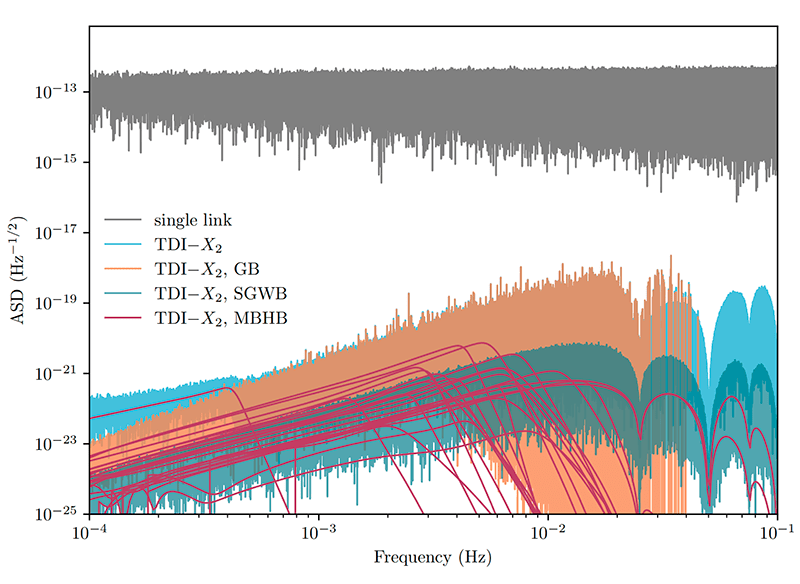
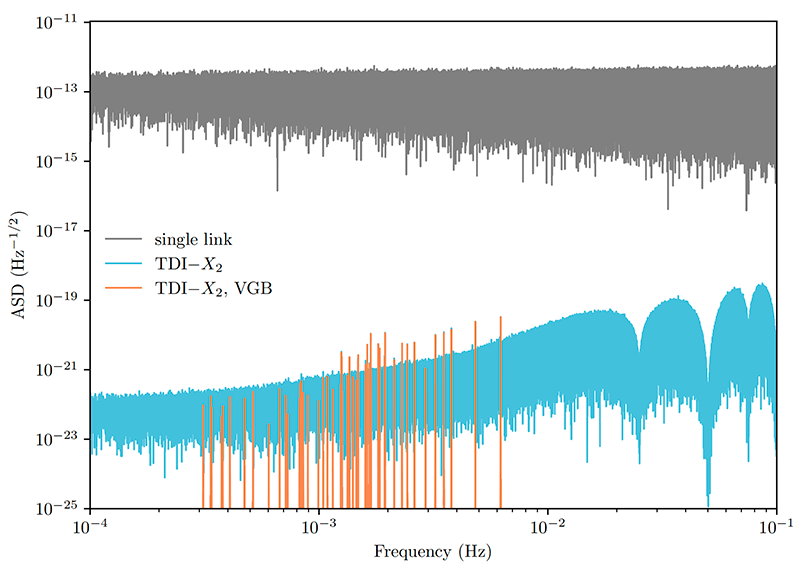
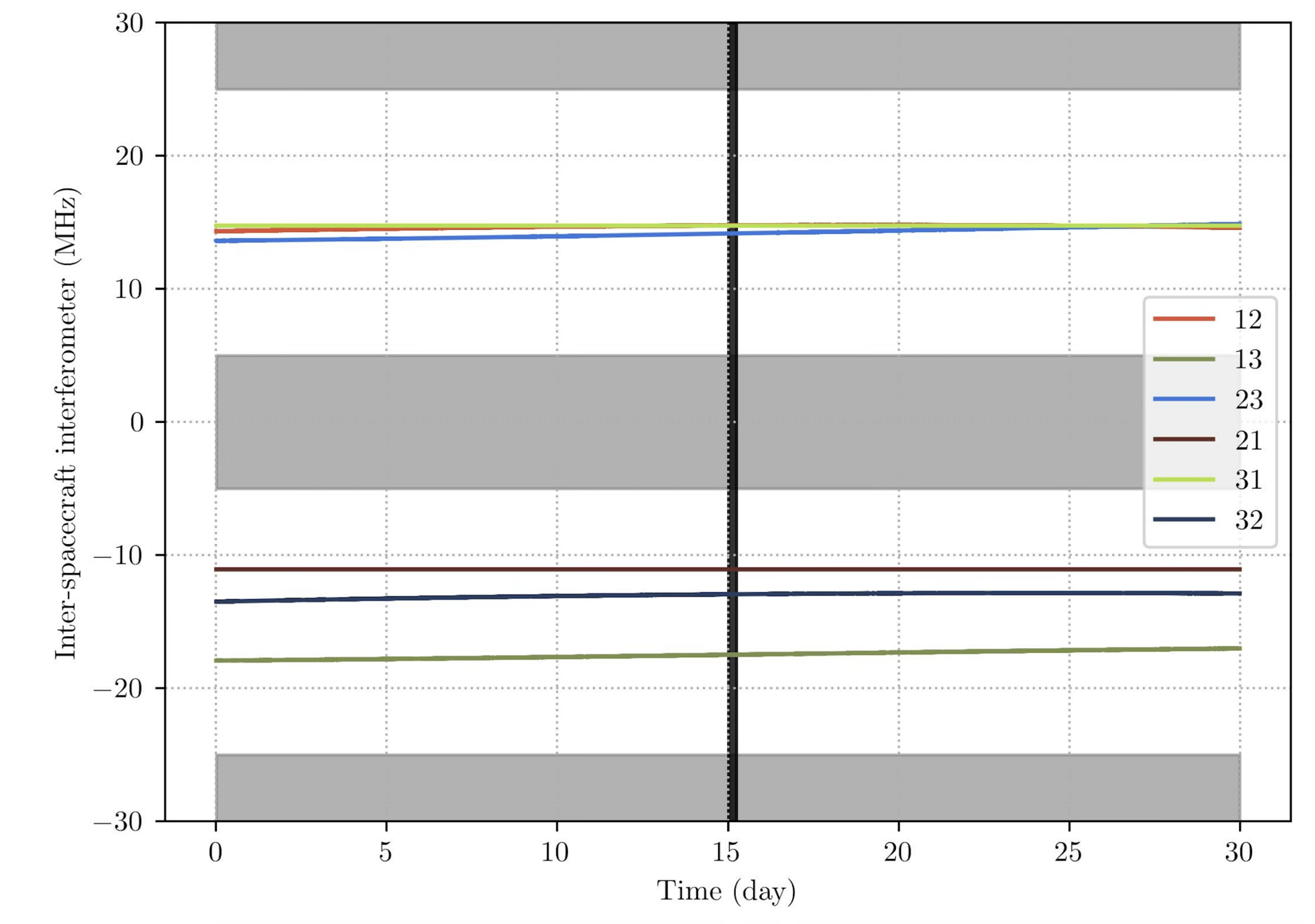
verification binary data: warm up
global-fit data
pre-processing data: not detrended, unsynchronized
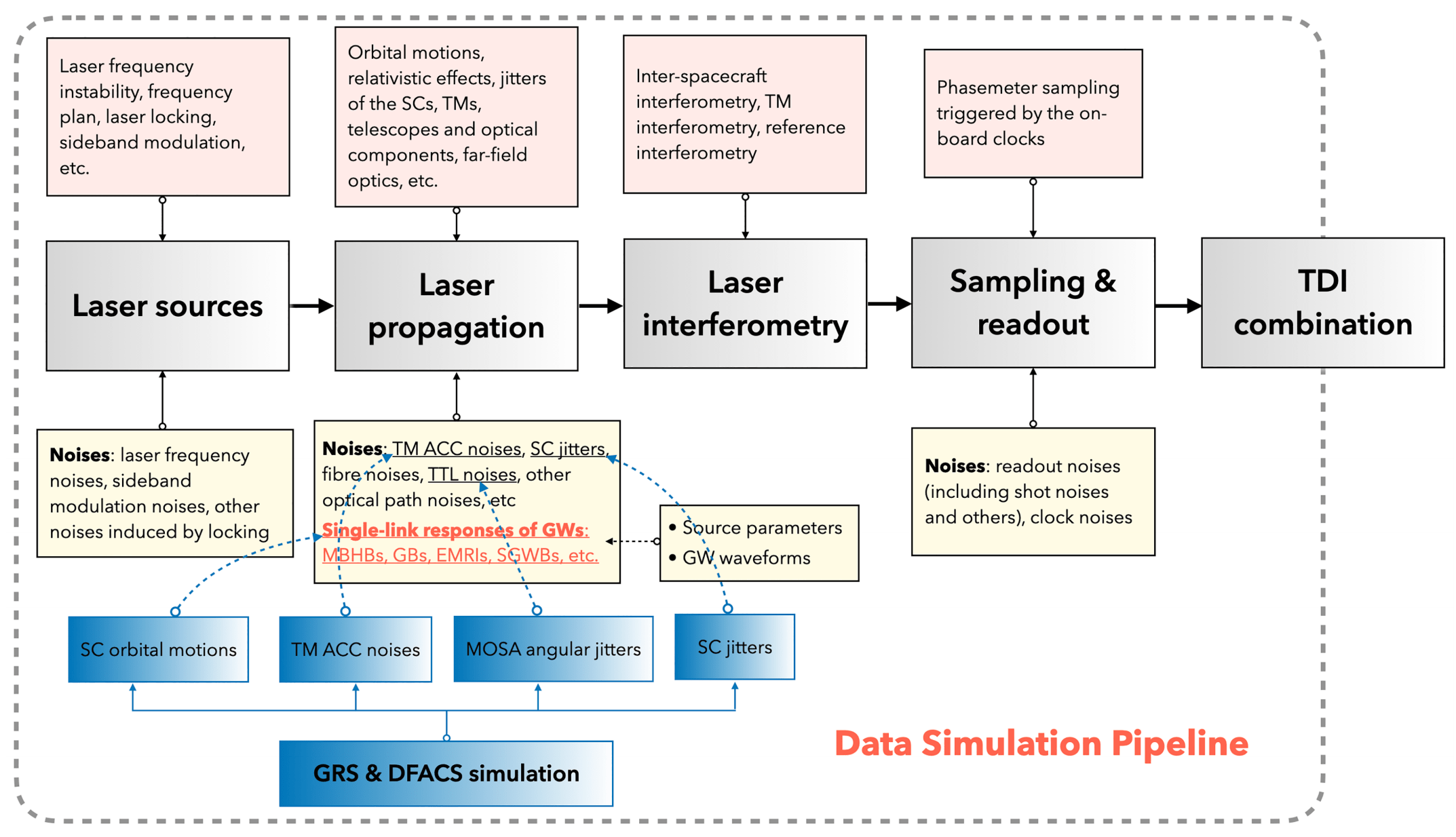
Minghui Du et al., 2505.16500
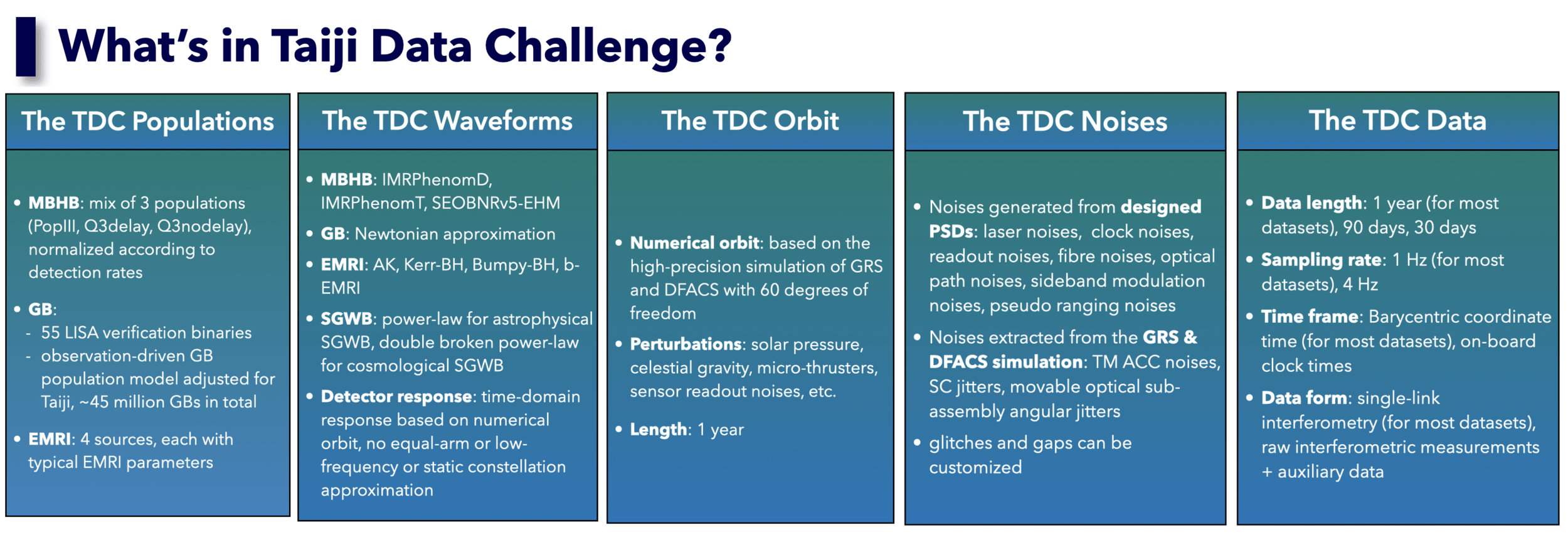
Taiji Data Challenge
Triangle-Simulator
Triangle-BBH
The reconstruction of MBHB waveforms
The reconstruction of GB waveforms
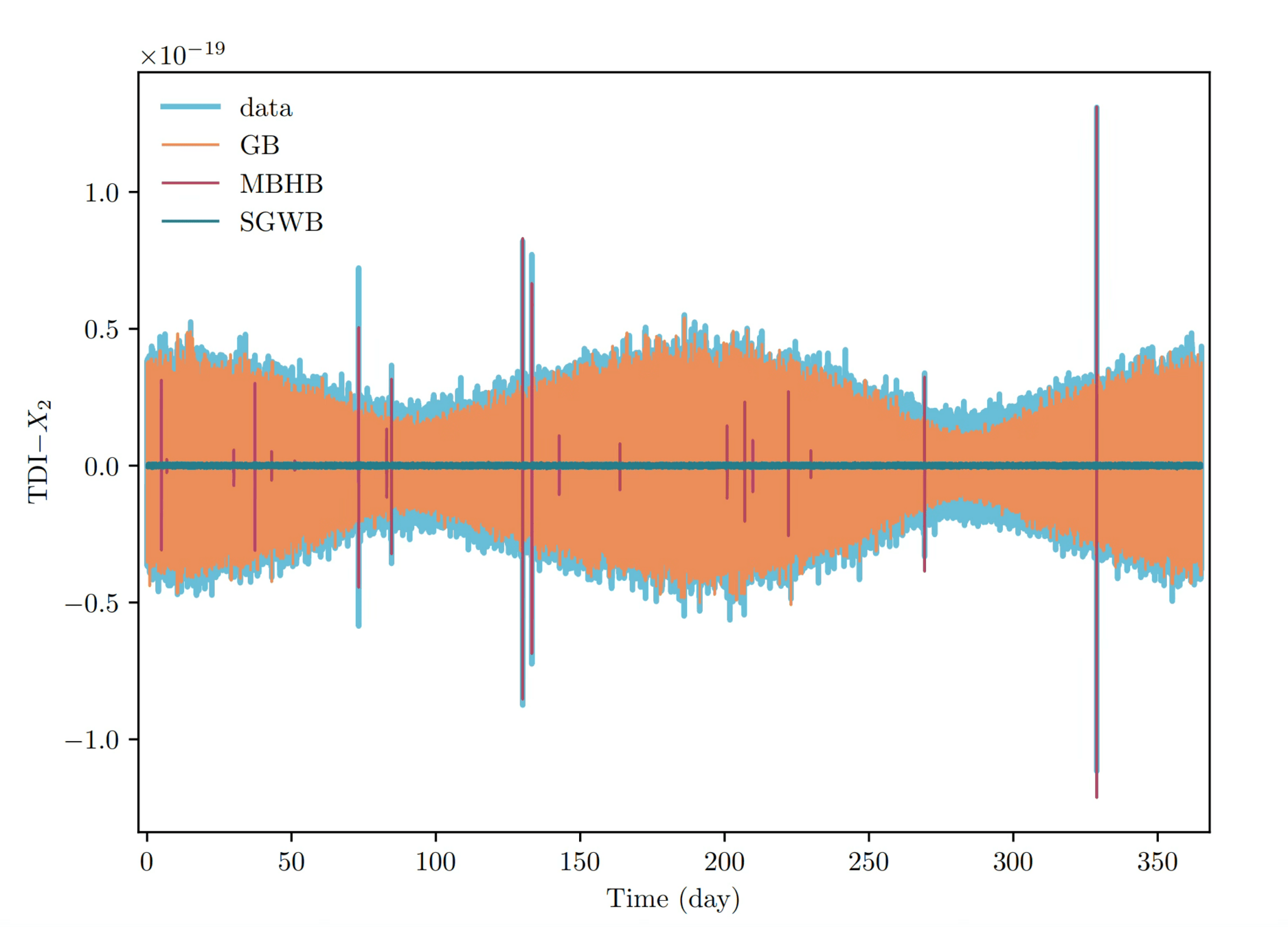
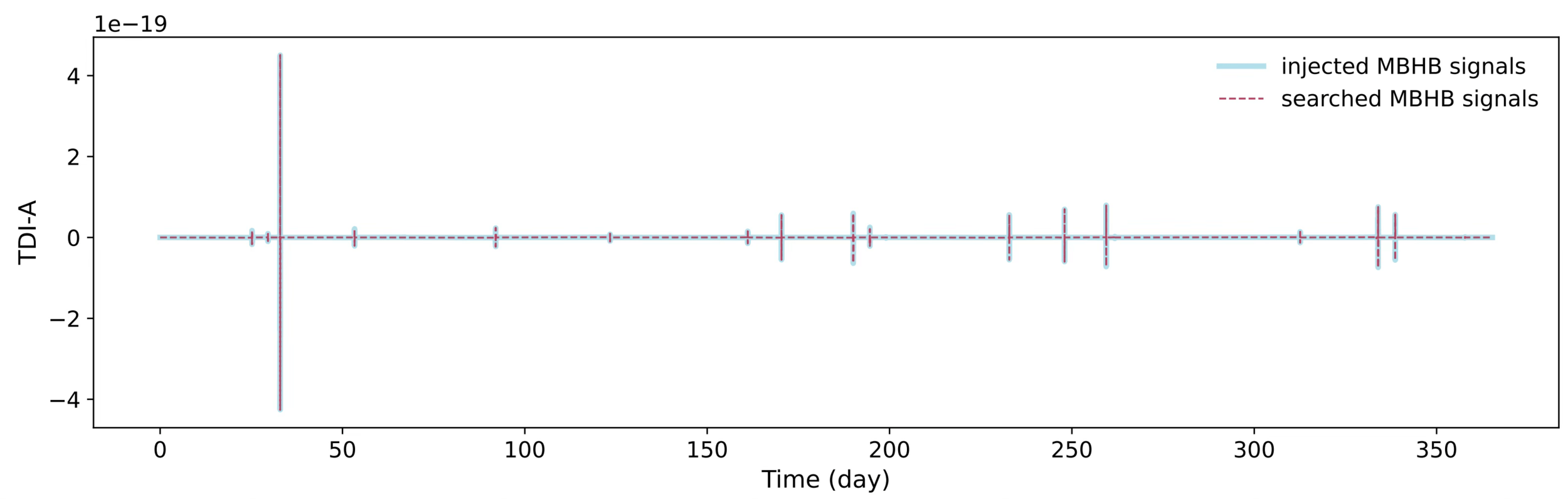
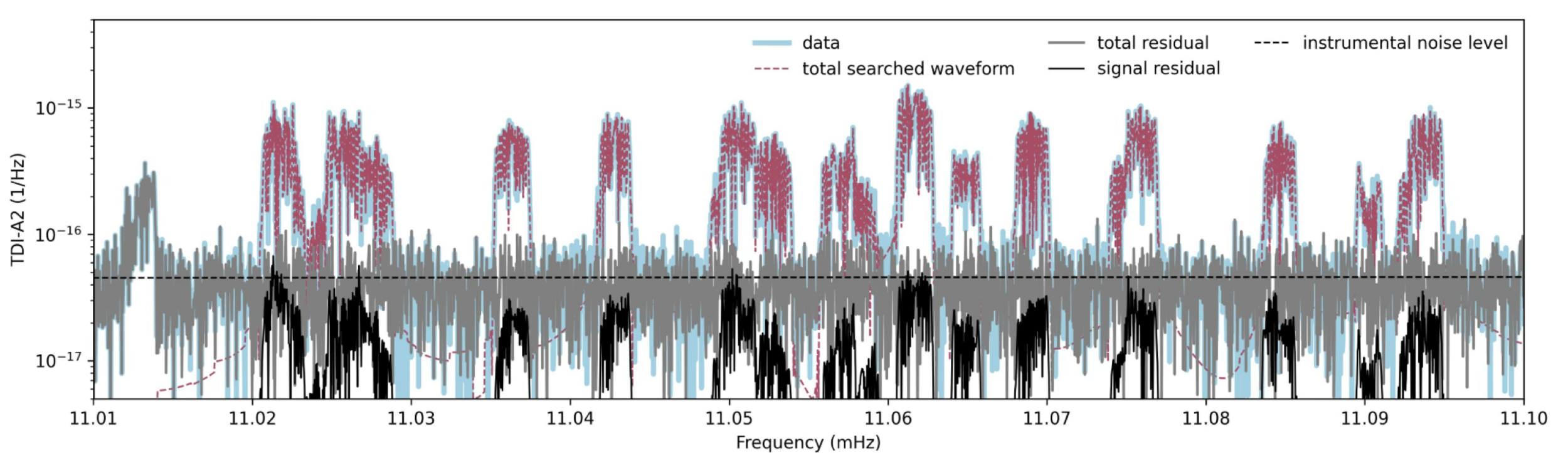
The TDC global fit data
The collaboration is working on the multiple-source analysis of TDC: an iterative search-subtraction approach
Taiji Data Challenge
Triangle-Simulator
Triangle-BBH
Decreased GB foreground noise
GB location in different stages
The TDC global fit data
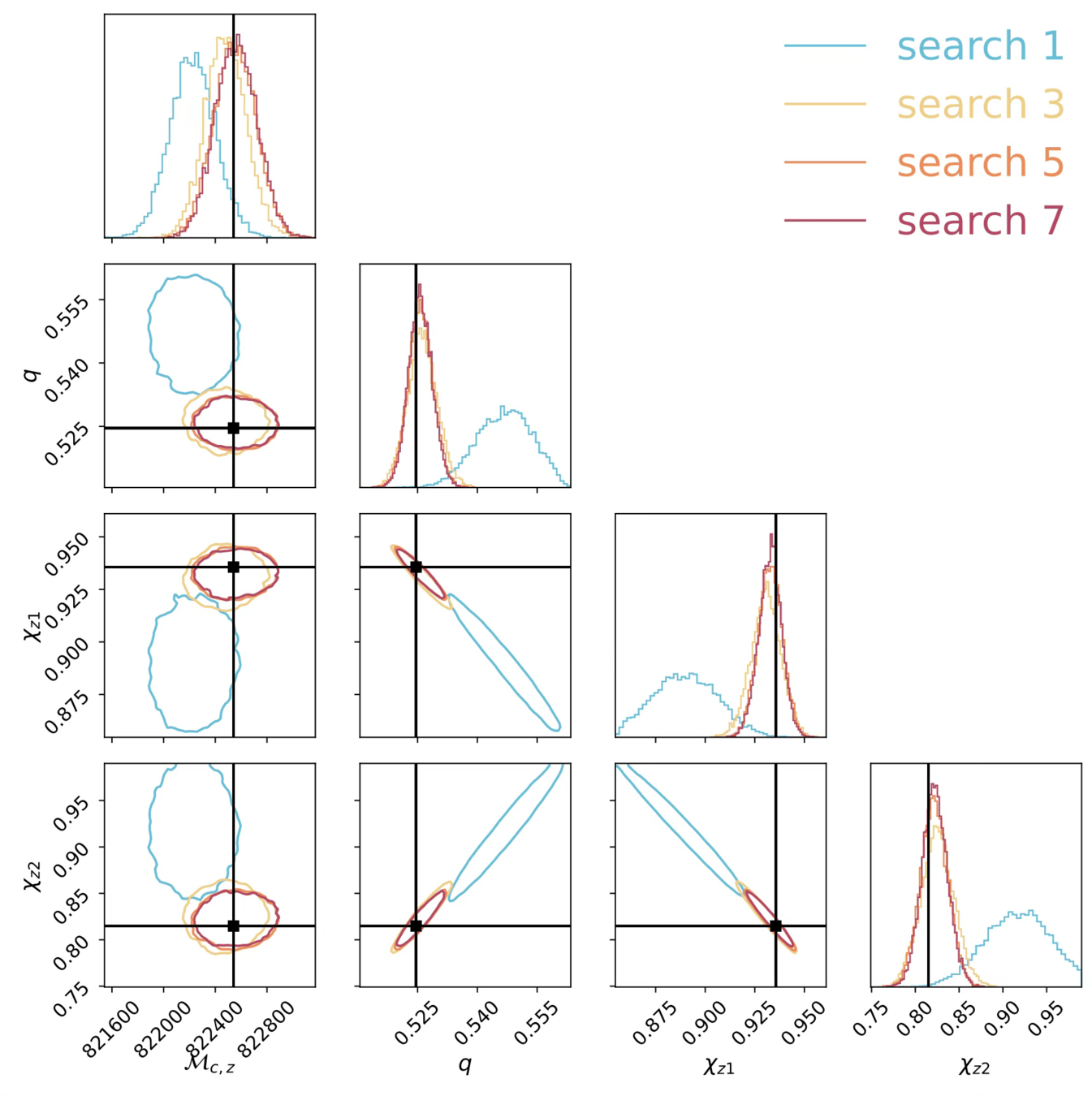
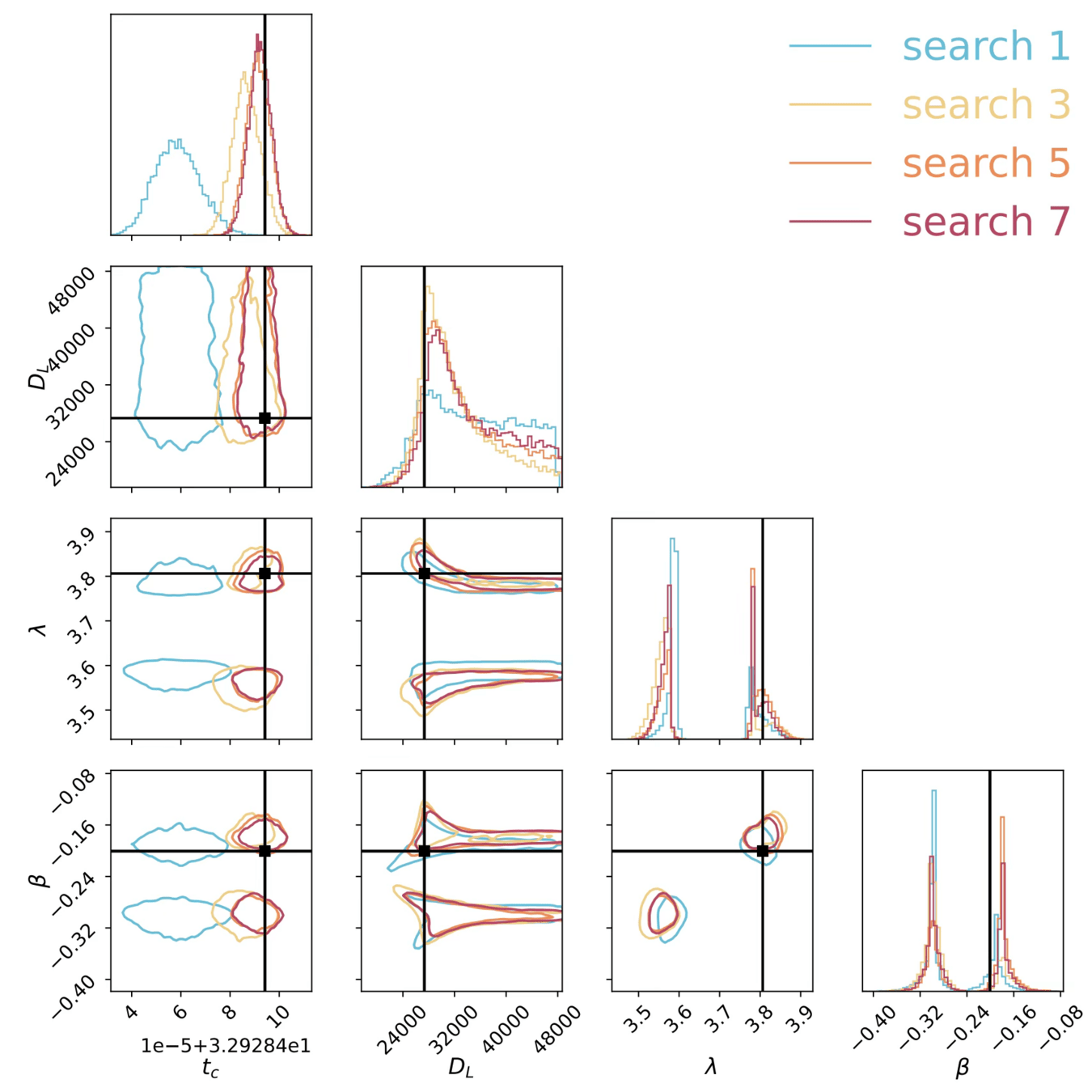
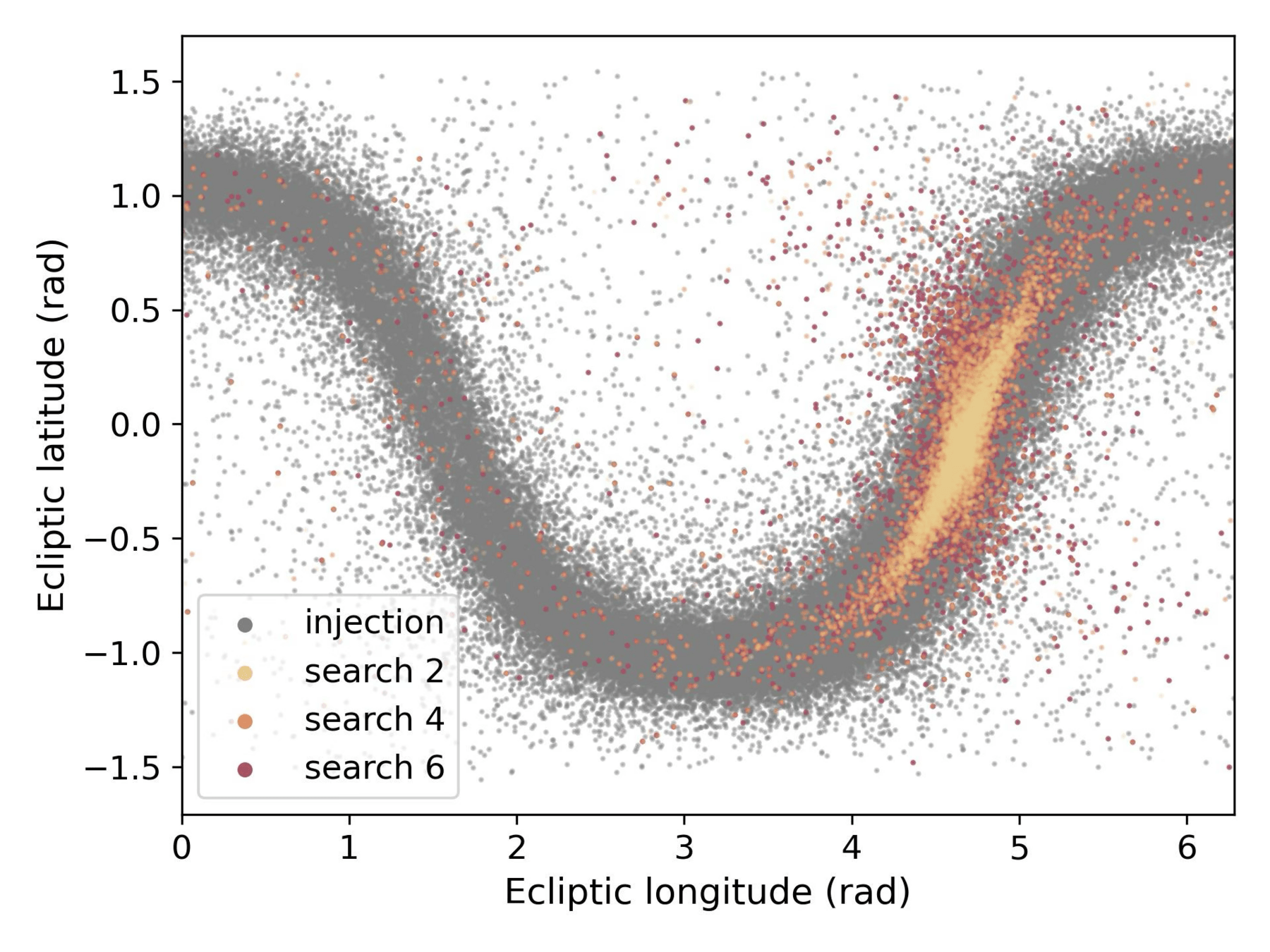
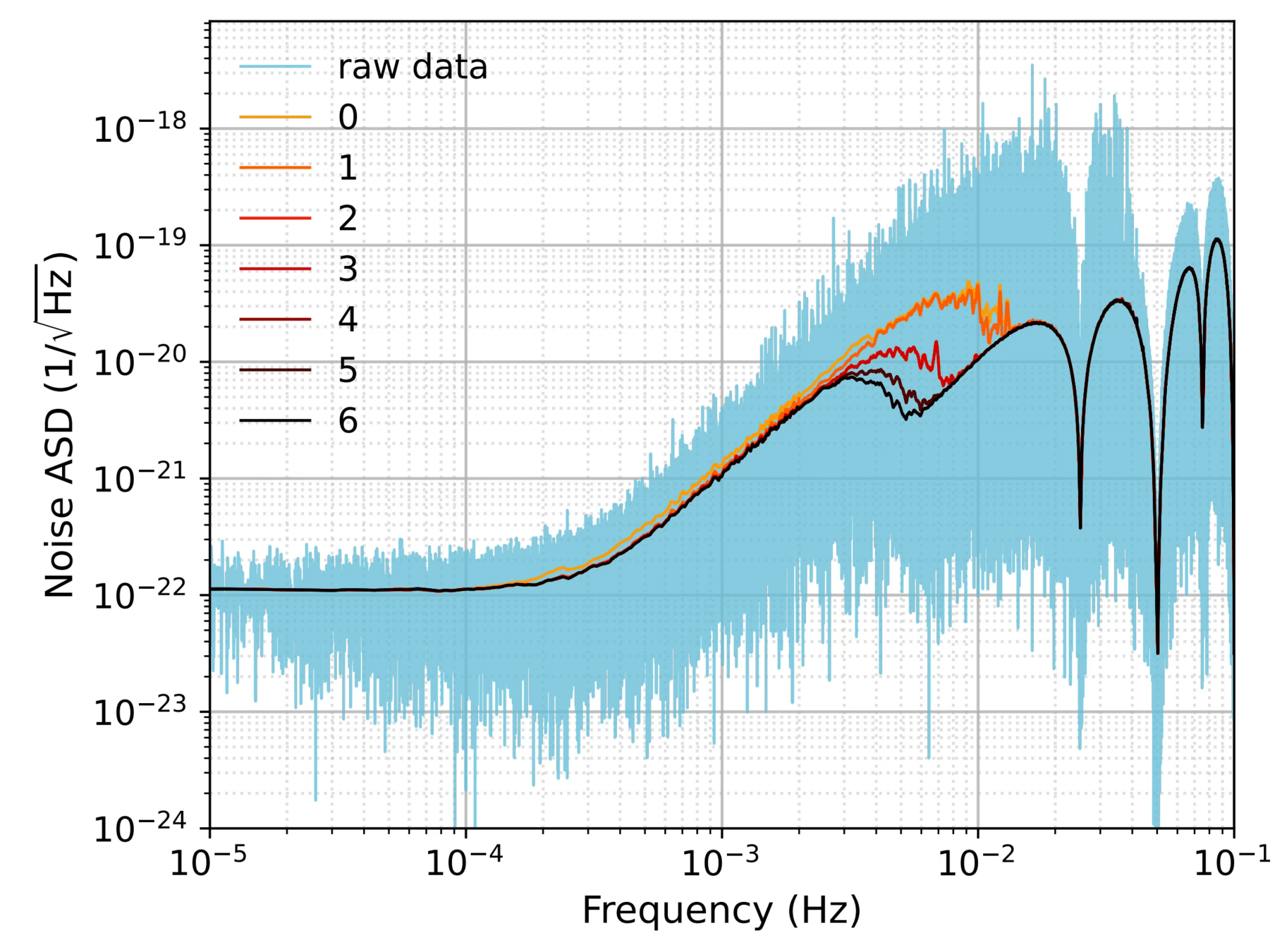
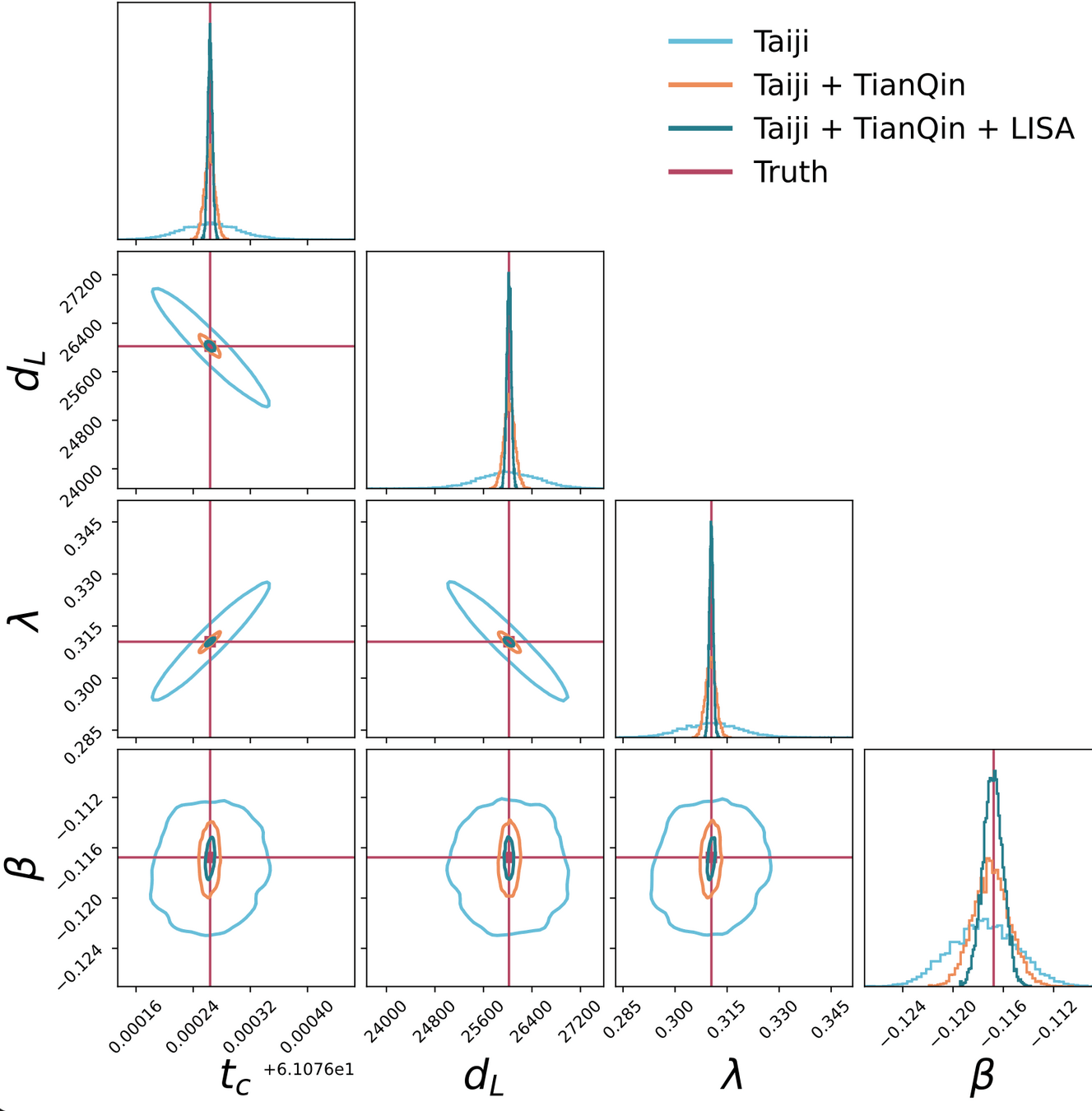
MBHB parameter posteriors in different stages
Taiji Data Challenge
Triangle for space detector network
- Enhancing sensitivity -> better constraints on parameters
- Breaking sky location degeneracy -> unique and more precise
- Separating SGWB & GB foreground & noise
- Cross-validation in global fit (open question)
- EMRIs?
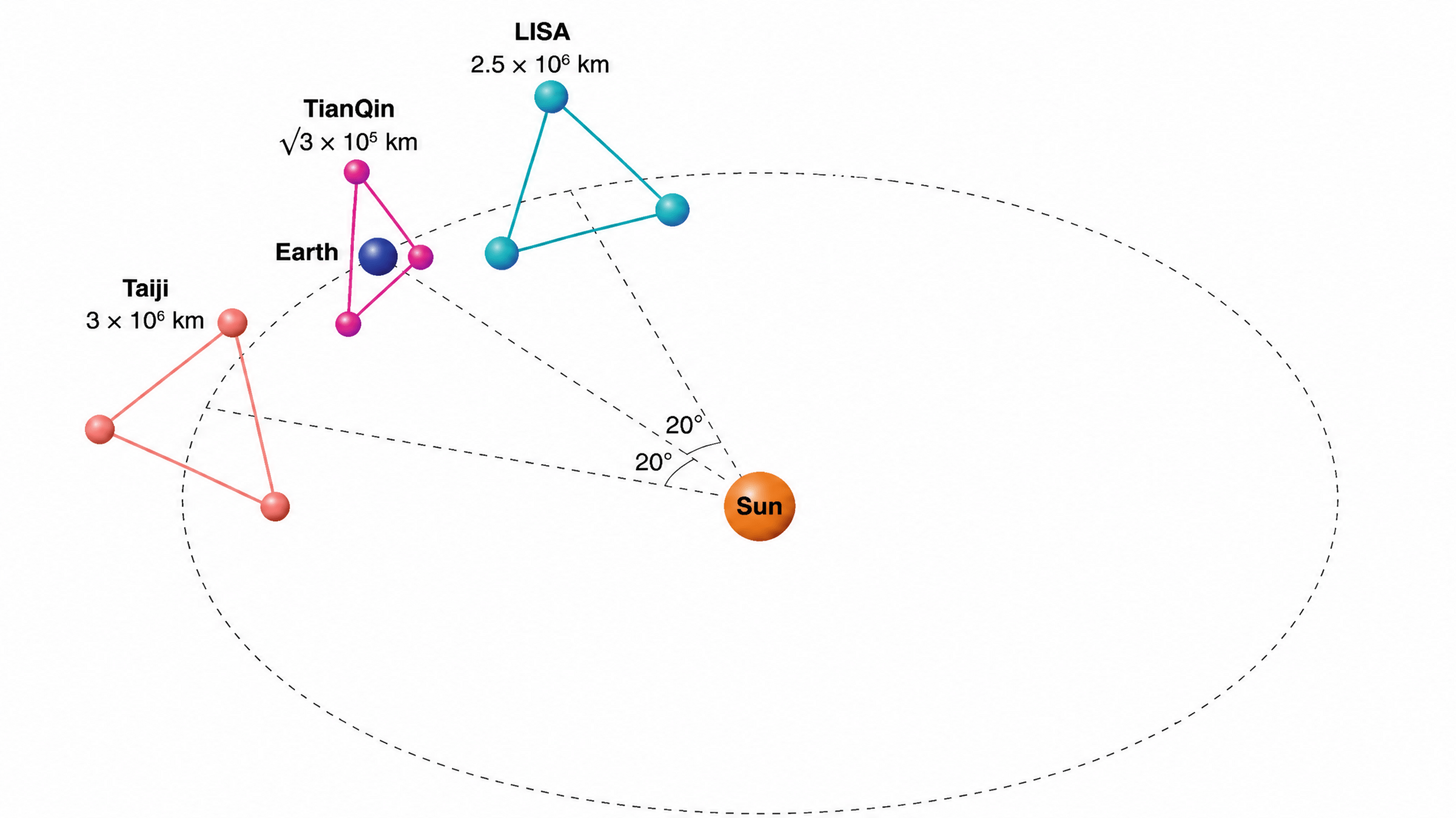
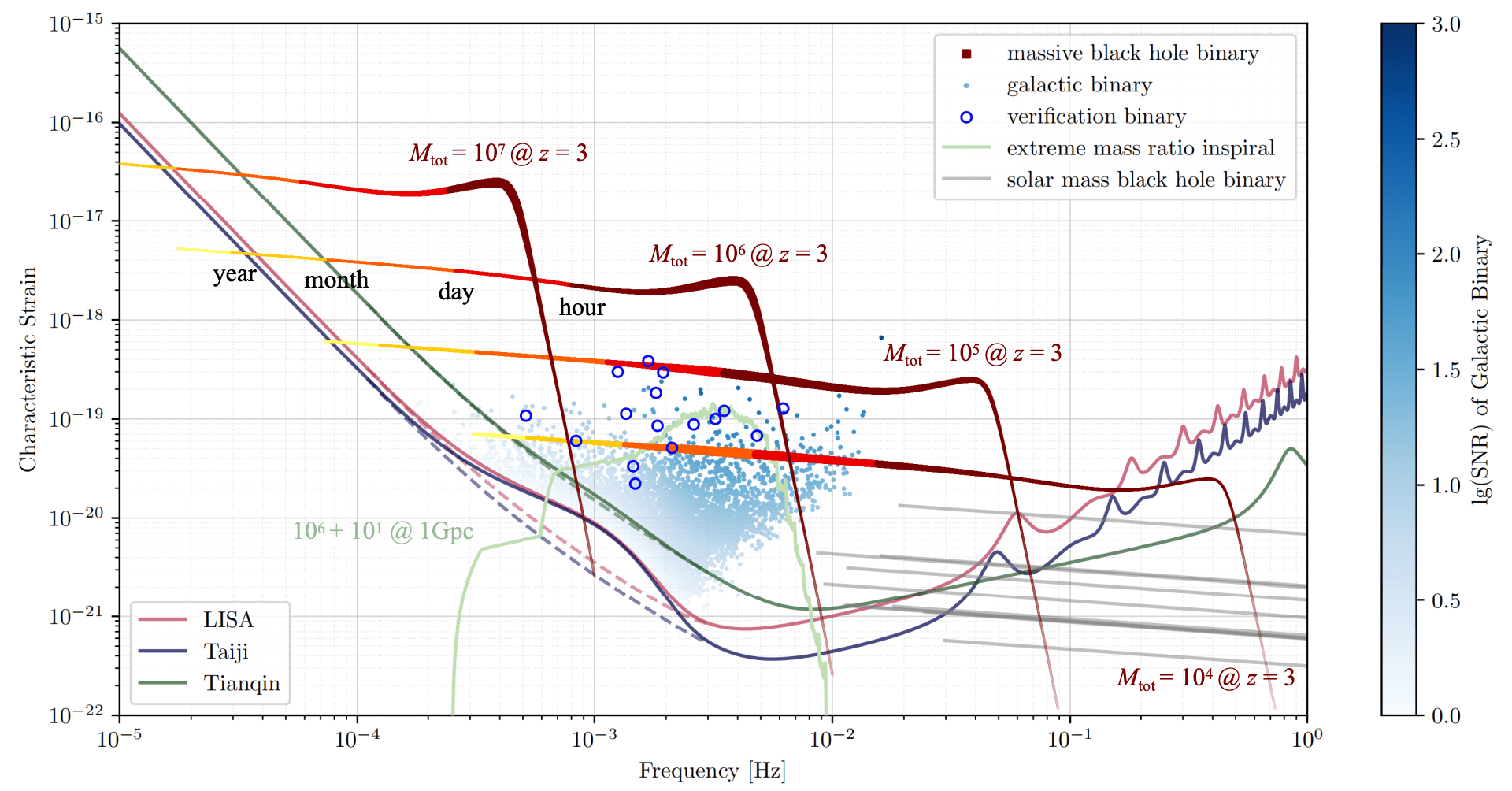
Complementary orbital configurations of Taiji, TianQin, and LISA
Adapted from Ruan et al., Nature Astronomy (2020).
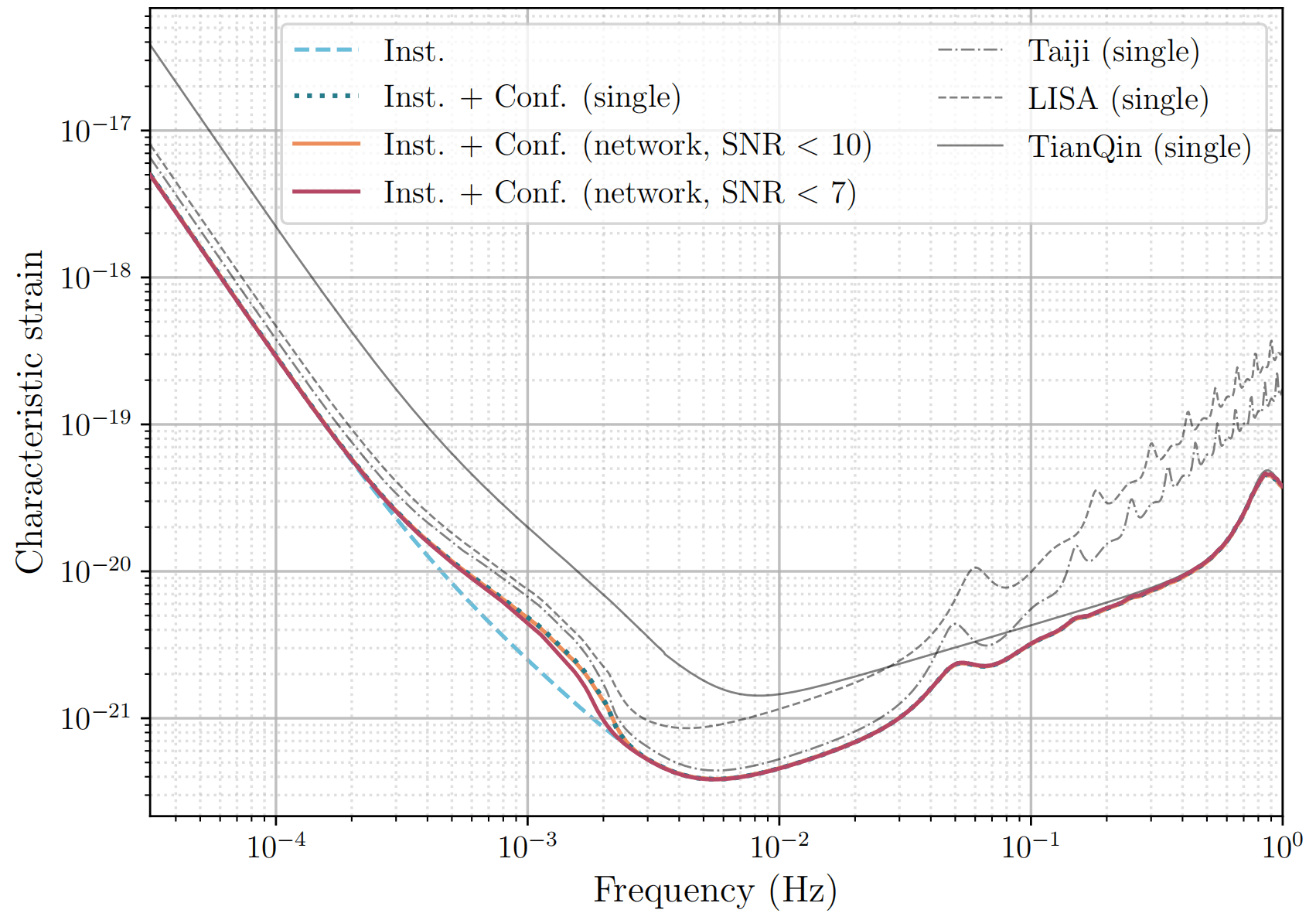
PRELIMINARY
Network sensitivity
Network location of MBHB
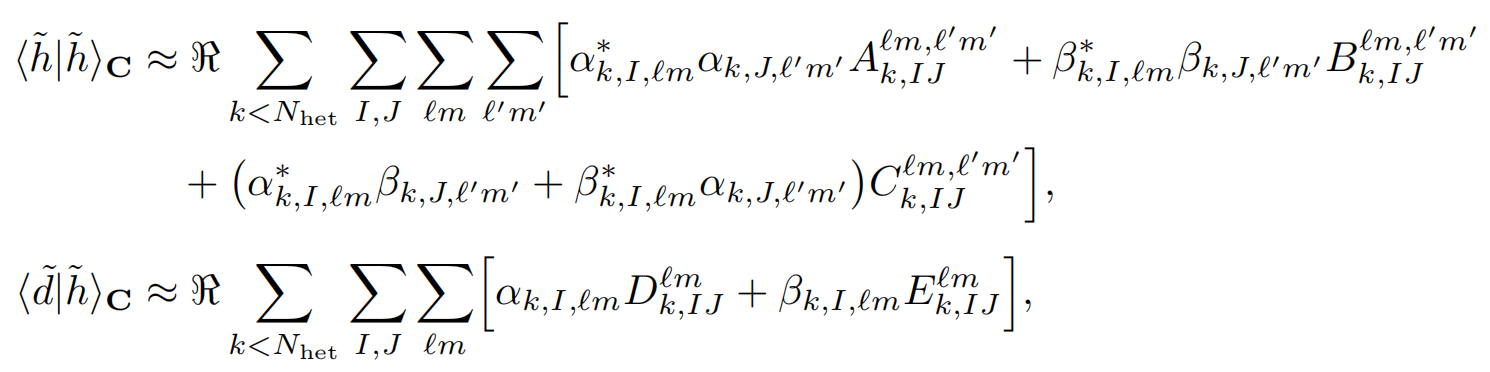
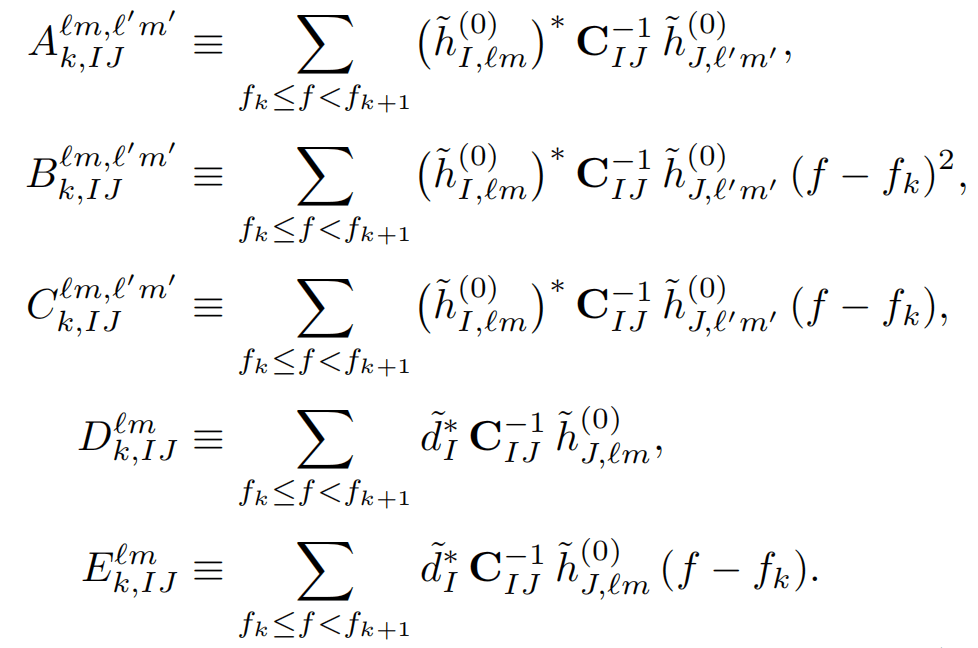
mode-by-mode heterodyned likelihood with network-covariance will be released in Triangle-BBH
PRELIMINARY
From mission readiness to open collaboration
Taiji as part of a shared millihertz gravitational-wave ecosystem
- The long-term science case is network-facing: interoperable simulations, common benchmarks, cross-mission analysis, and joint population inference.
03 · From one mission to network science
- Key subsystems are advancing toward integration and coupled verification.
01 · From heritage to engineering readiness
- Simulation, calibration, TDI, data challenges, and global fitting are being developed as mission capabilities—not post-launch additions.
02 · From hardware to science readiness
Open interfaces for collaboration
Simulation interoperability · calibration and TDI · data challenges · global fitting · source populations · detector-network science
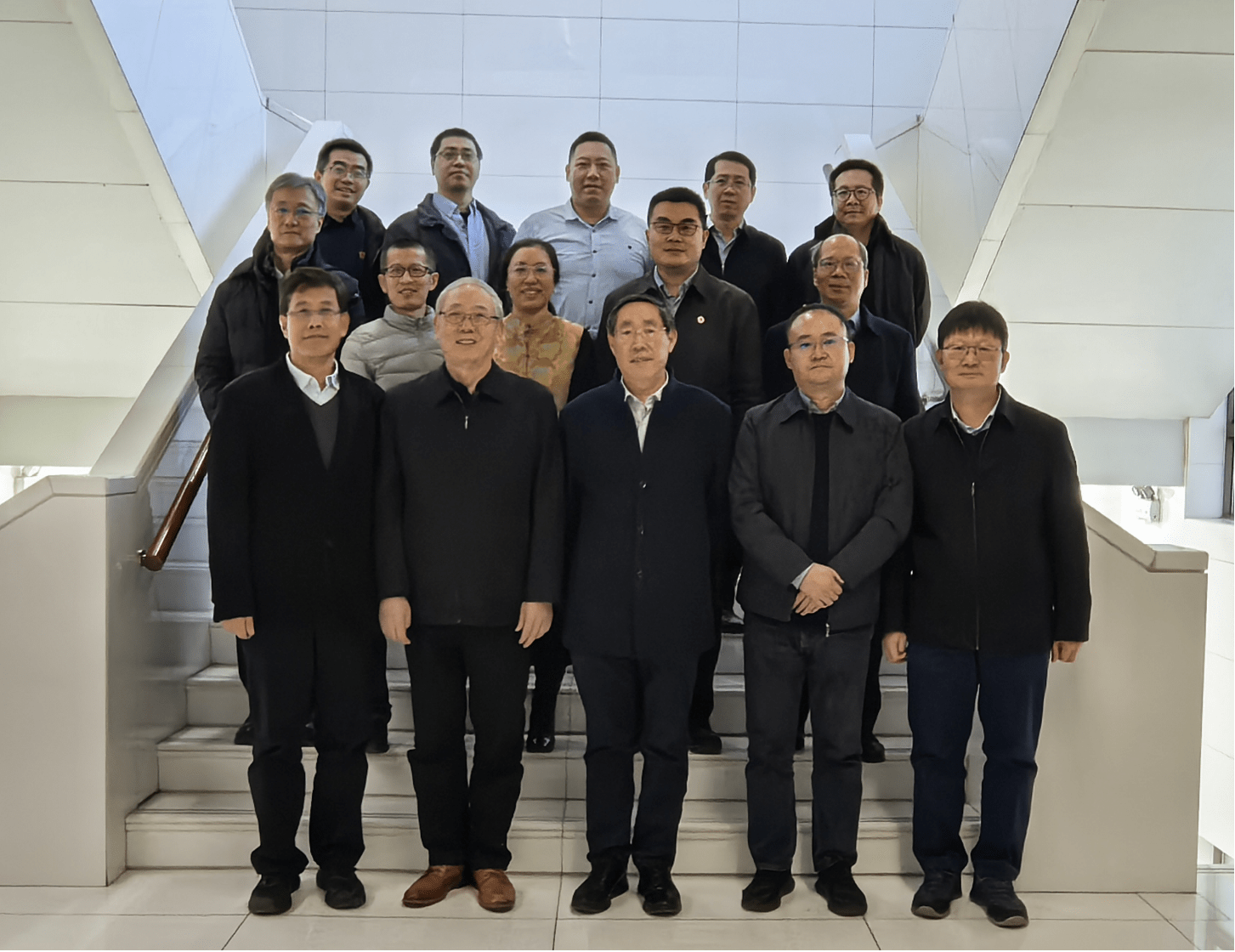
Leadership coordination within China’s space-based GW community · 2025
Prof. J. Luo
TianQin Chief Scientist
Prof. Y.-L. Wu
Taiji Chief Scientist