Large Science Models:
Foundation Models for
Generalizable Insights Into Complex Systems
with Psycho-social Application
PI: Ishanu Chattopadhyay, PhD
Assistant Professor of Biomedical Informatics & Computer Science
University of Kentucky


DARPA-EA-25-02-05-MAGICS-PA-025
HR0011-26-3-E016

October 2026
Authorized for Public Release
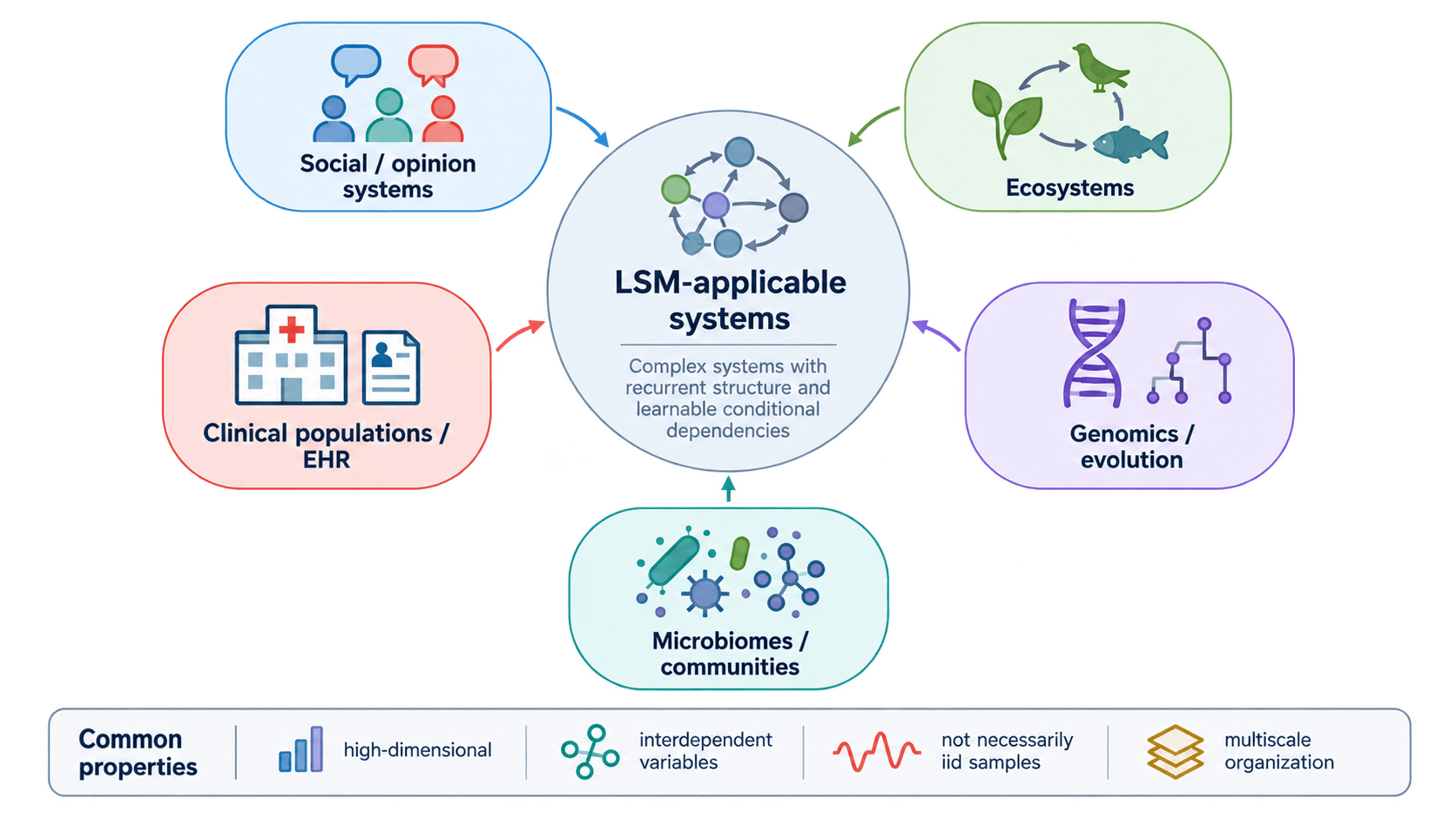
LSMs for complex systems arising in non-sequential multivariate measurements
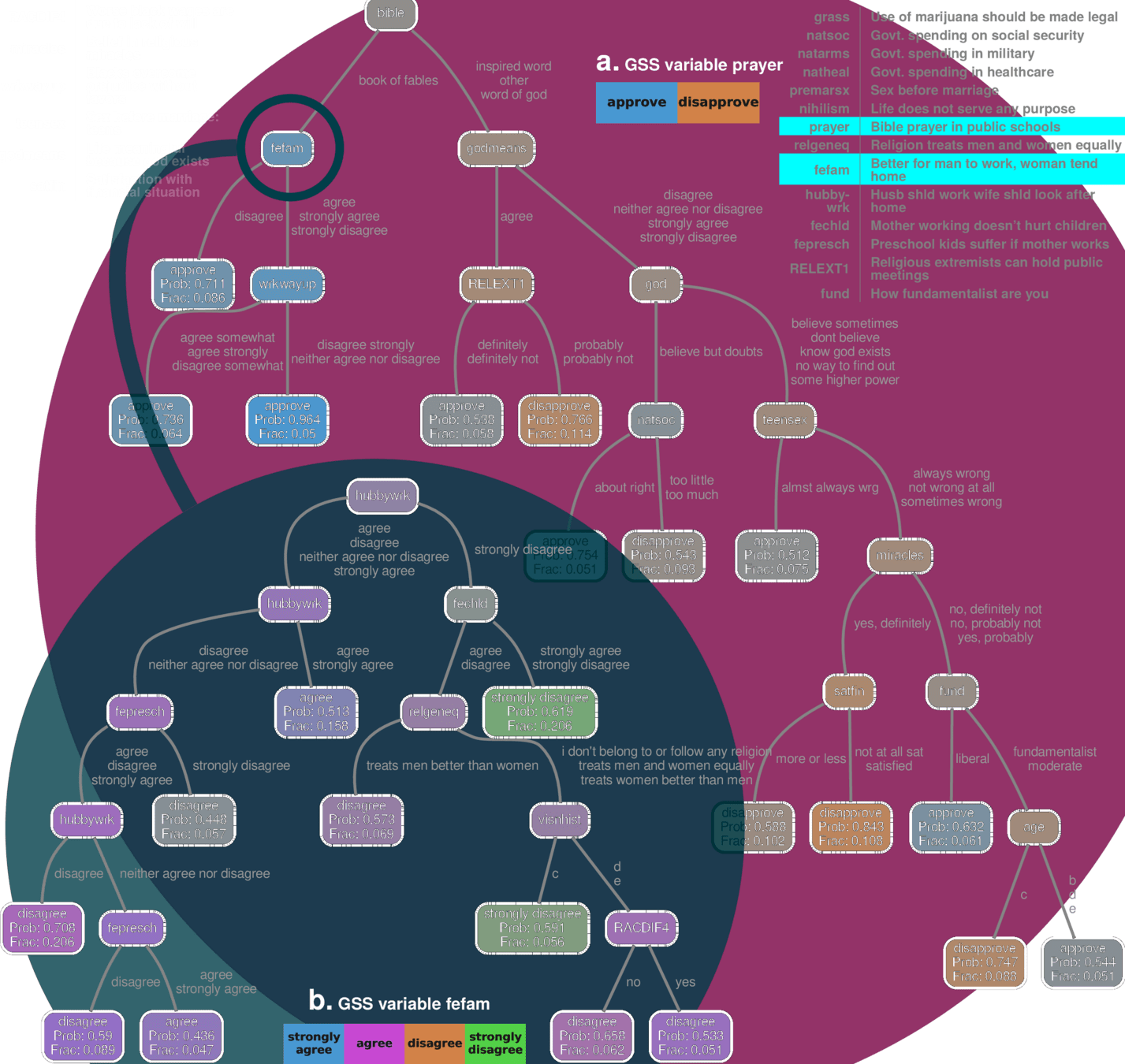
LSM Forest
1. How will proposer form and maintain a computationally tractable LSM tree structure given, as proposed, hundreds to thousands of observable variables?
\(\checkmark\)
Recursive LSM forest: hyperlinked nodes capturing emergent macro-structures
GSS 2018 dataset
- Set of conditional inference trees (CIT)
- Strict statistical guarantees: quantifies inference uncertainty
- Each tree models exactly one variable as a function of potentially all other variables
- Non-leaf nodes are "hyperlinked" to other trees
Large Science Models
Computationally tractable LSM tree structure given, as proposed, hundreds to thousands of observable variables.
GSS 2018 dataset
- Each predictor is inferred independently
- Can scale up to thousands of variables in Python implementation
- Further scale-up \(10^6 - 10^8\) needs C/C++ implementation
Full Example of Hyperlinked Trees
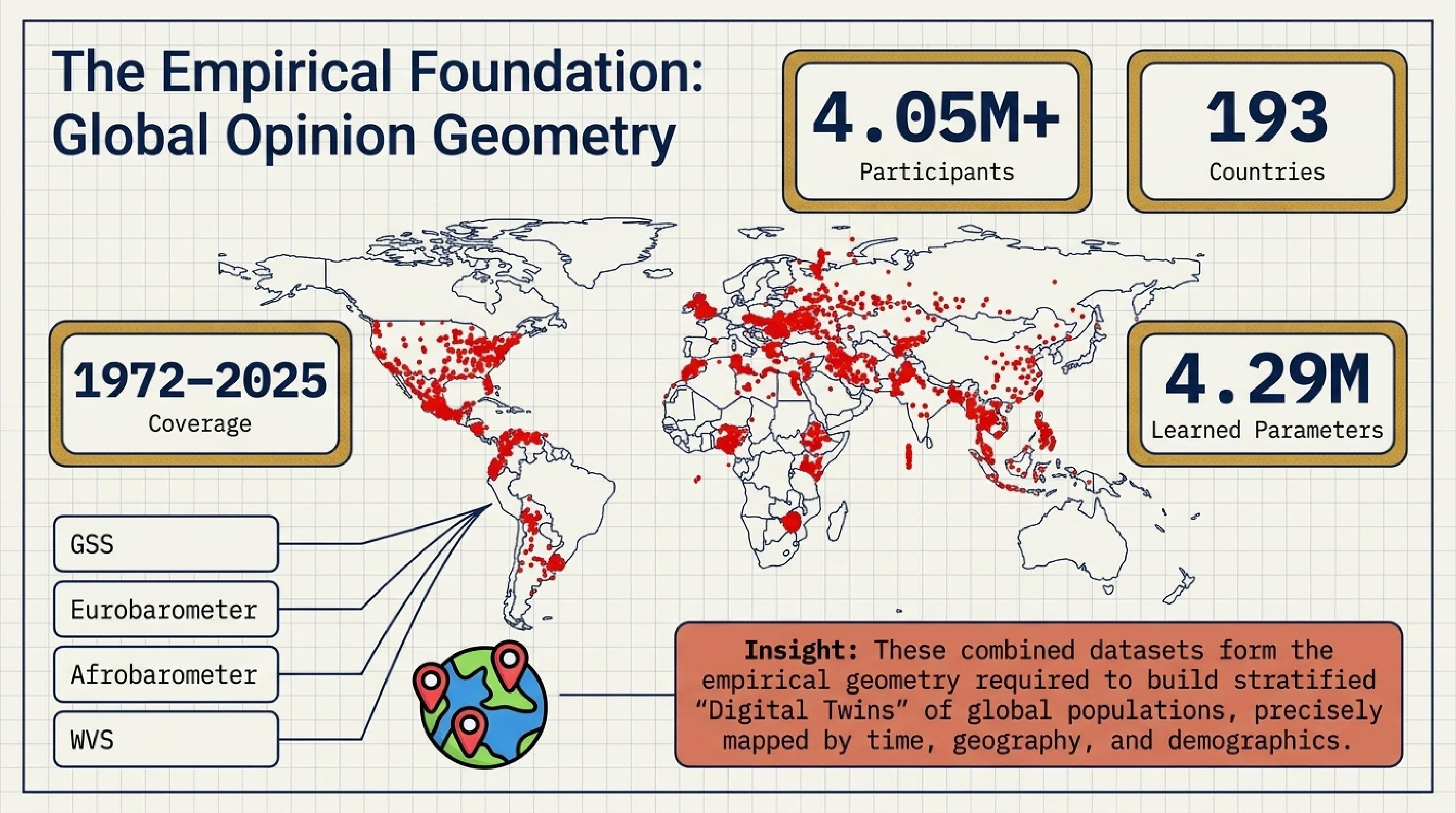
252 surveys "digitized"
Goal: Global Coverage
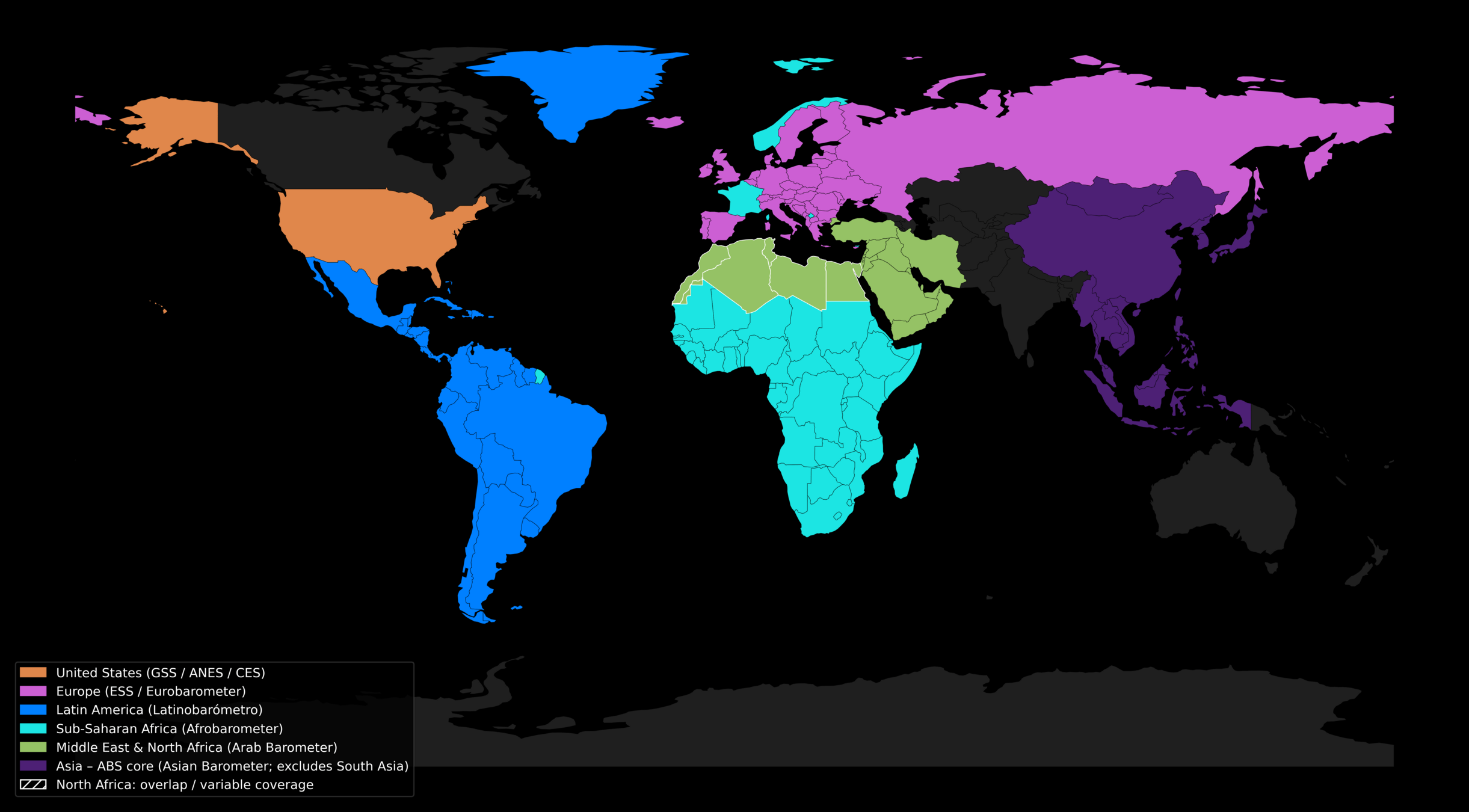
World Value Survey (WVS) is global
\(\checkmark\) Overlapping survey datasets
Large Science Models: Mathematical Framework
reliten |
gunlaw |
abany |
--- |
grass |
|
|---|---|---|---|---|---|
Person 1 |
|||||
Person 2 |
|||||
--- |
|||||
Person m |
observables
samples
Distributions over alphabet \(\Sigma^i\)
Individual Predictor (CIT)
cross-talk
Tension between predicted and observed distribution drives change
Example
GSS topic: There should be more gun-control
\(\psi^i\)
strongly agree |
agree |
neutral |
disagree |
strongly disagree |
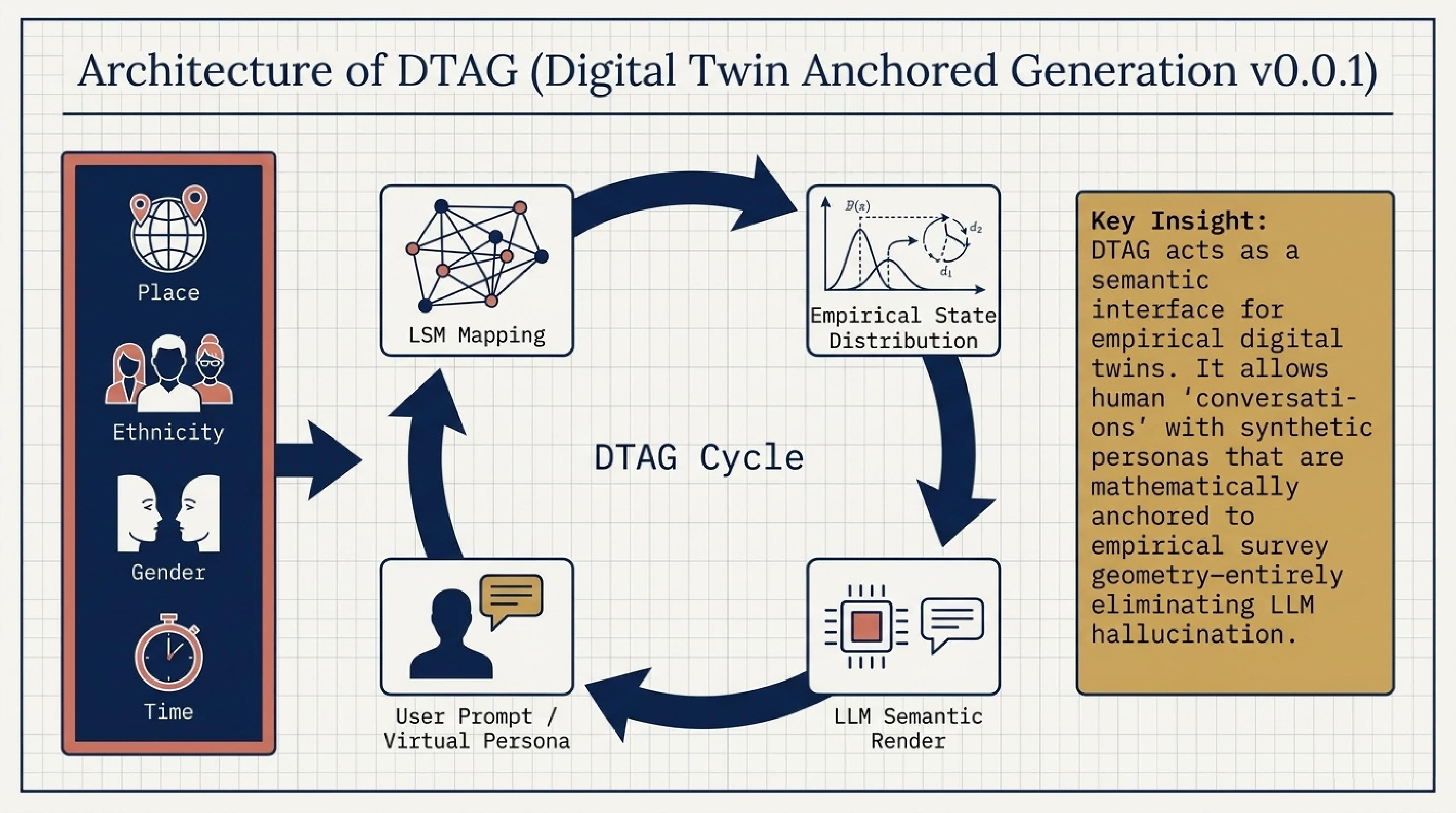
Digital Twin
\(\phi\) estimates \(\psi\)
Examples: GSS, ANES, WVS, ESS, Eurobarometer, Afrobarometer, Asian Barometer etc
group
individual
estimate is always a non-empty non-degenerate distribution
missing observation
Large Science Models: Properties
LSM-Distance Metric*
where \(D_{JS}(P\vert \vert Q)\) is the Jensen-Shannon divergence.
Large Deviation Bound*
Induced Riemannian metric tensor
This bound connects ``closeness'' of samples to the odds of perturbing from one to the other, bridging geometry to dynamics
Ergodic Projection
(Sanov's Theorem, Pinkser's Inequality)
\(\psi\)
\(\psi'\)
\(\theta\)
"spatial average": average of all plausible worldviews or states
* Sizemore, Nicholas, Kaitlyn Oliphant, Ruolin Zheng, Camilia R. Martin, Erika C. Claud, and Ishanu Chattopadhyay. "A digital twin of the infant microbiome to predict neurodevelopmental deficits." Science Advances 10, no. 15 (2024): eadj0400. https://www.science.org/doi/full/10.1126/sciadv.adj0400
persistence probability
Ergodic dispersion
Central to Model Drift Quantification
Start with opinion vector with all entries missing
This is a standard Physics construct, quantifying curvature of the underlying latent geometry
Easily computable in LSM framework!
Apply \(\phi^i\)
Random variable quantifying dispersion around the spatial average of worlviews
const. scaling as \(N^2\)
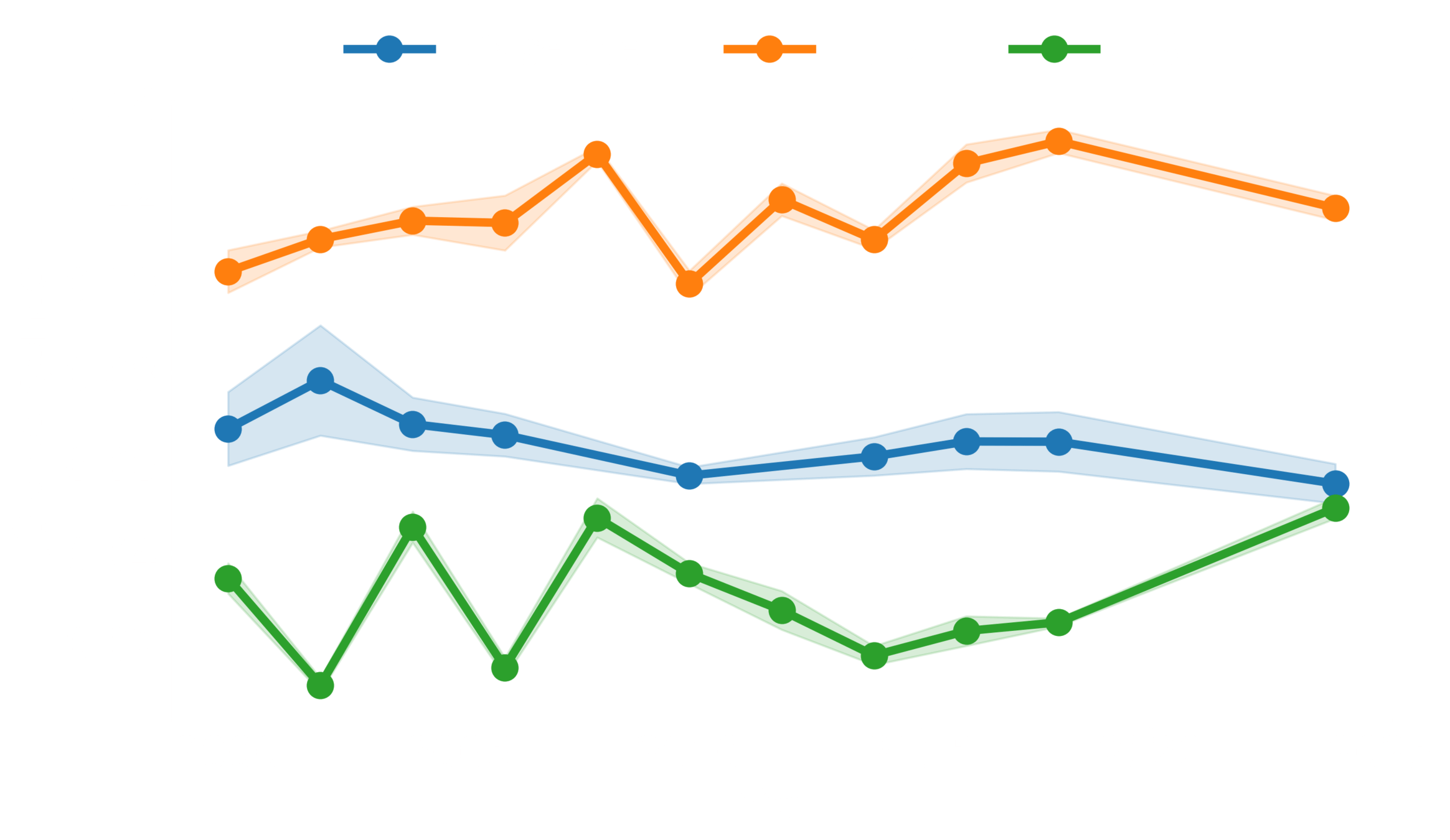
Old Validation Strategy: Compare with LLMs
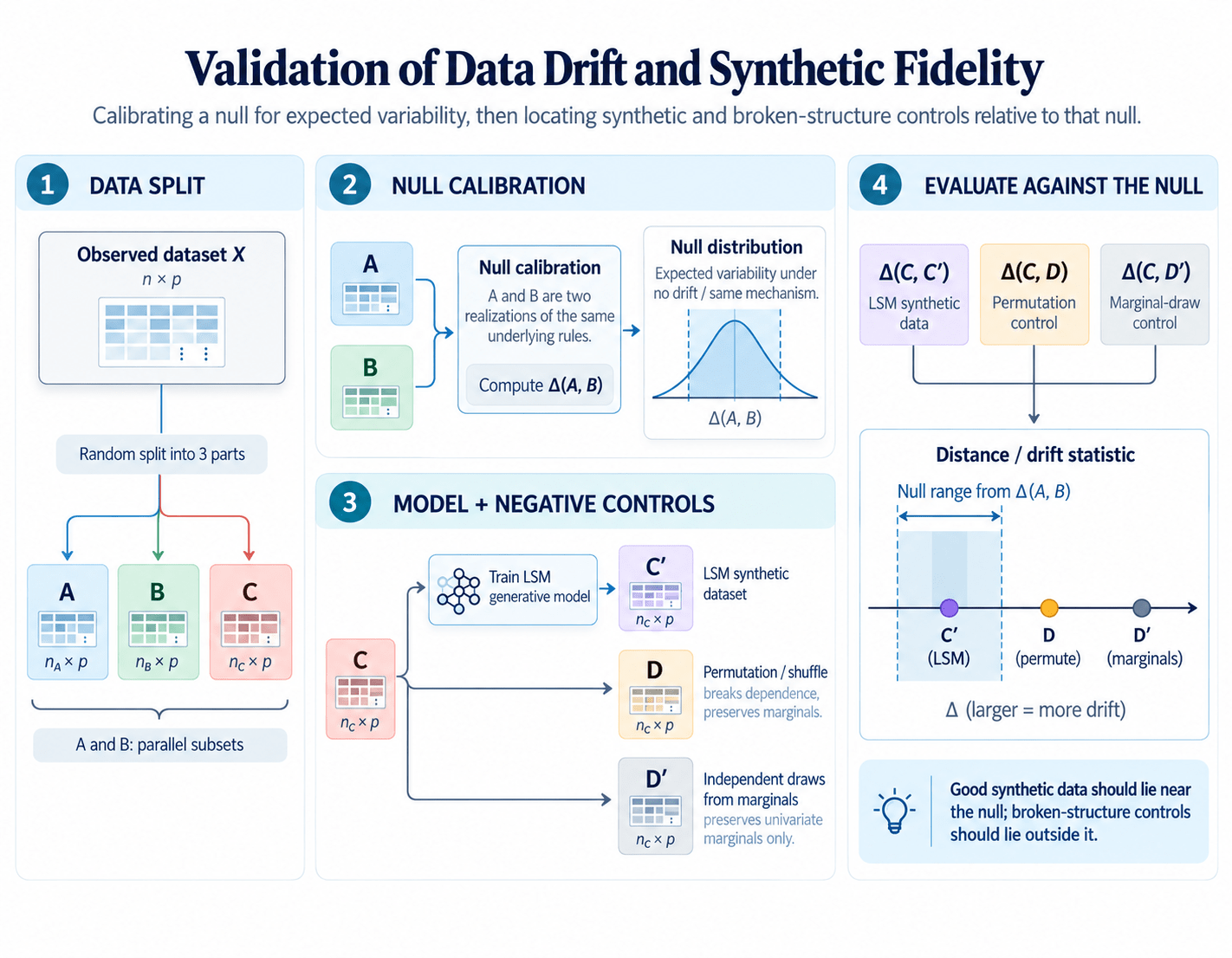
Validation?
Sample Persistence:
\(x^i\)
\(\phi^i(x^i | x^{-i})\)
How well does sample \(x\) fit the model, or doesnot tend to perturb?
Multi-scale LSM vi Progressive Persistence Peeling
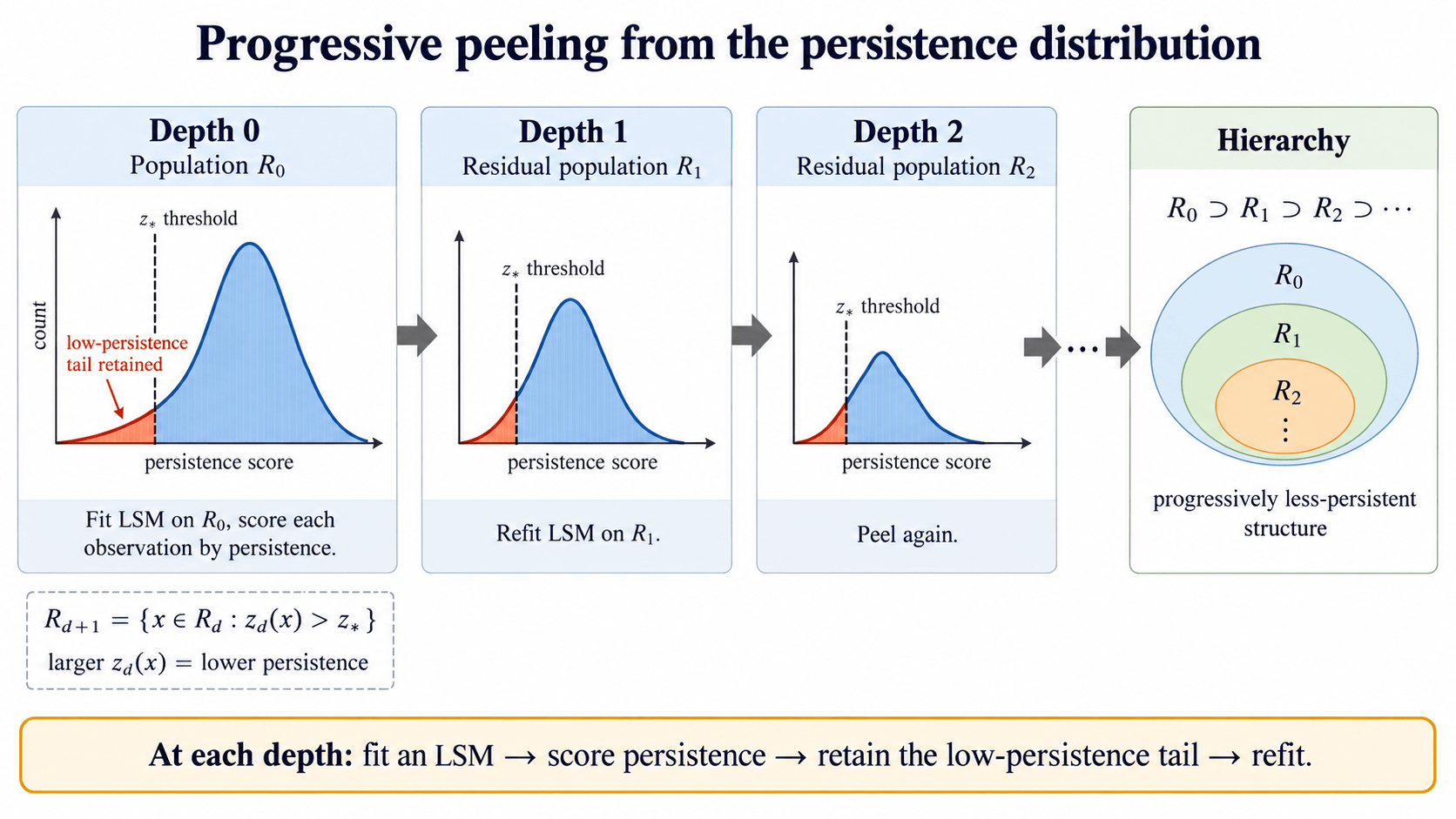
Fit an LSM to the current population:
Score each observation by its conditional persistence:
Peel the low-persistence tail:
Repeatedly isolate progressively less-persistent observations and relearn LSM
Refit LSM
MAP error \(\rightarrow\)
Conditional displacement:
Description length \(\rightarrow \)
Information displacement:
Fingerprinting LSMs
How likely was the actual outcome?
How many bits needed to describe the distributions?
Multiscale spectrum \(\rightarrow\)
The trajectory across depth fingerprints how organization is distributed from persistent to progressively less-persistent structure.
Fingerprinting LSMs
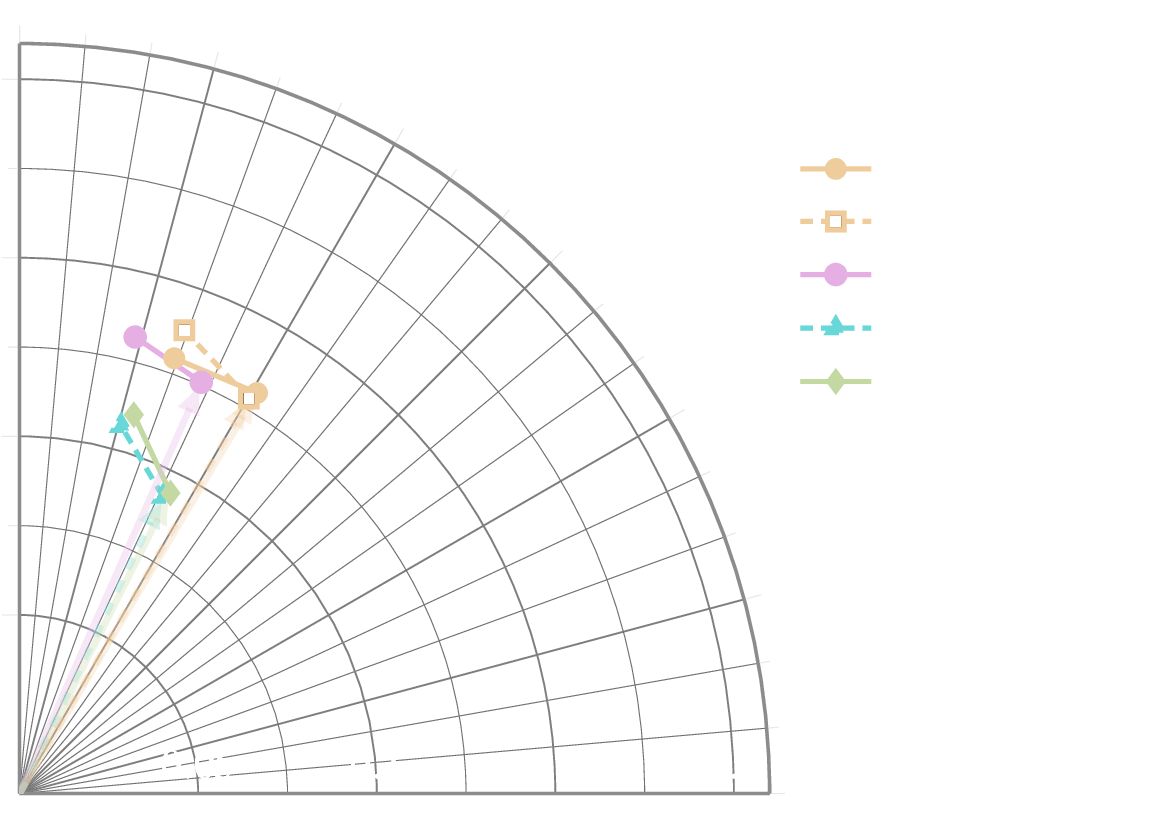
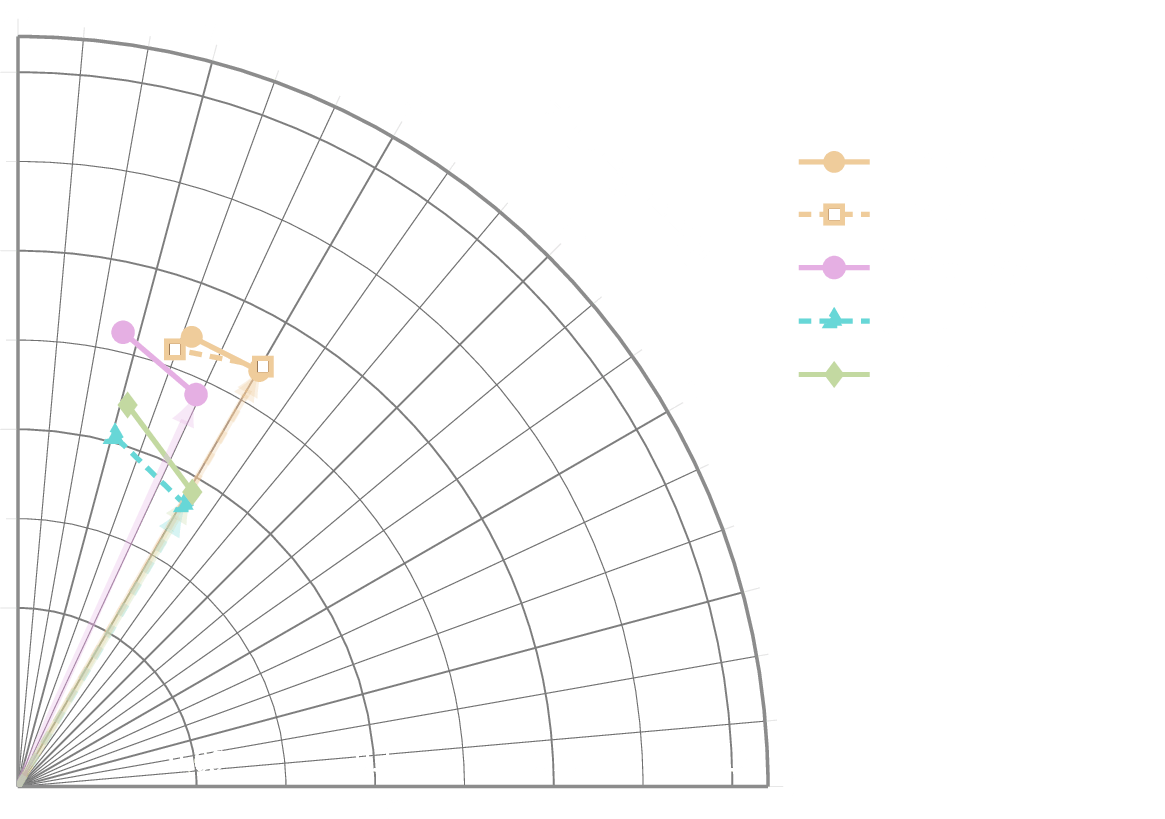
2018
Multiscale spectrum \(\rightarrow\)
The trajectory across depth fingerprints how organization is distributed from persistent to progressively less-persistent structure.
Fingerprinting LSMs
2008
SECOND SURVEY PROGRAM
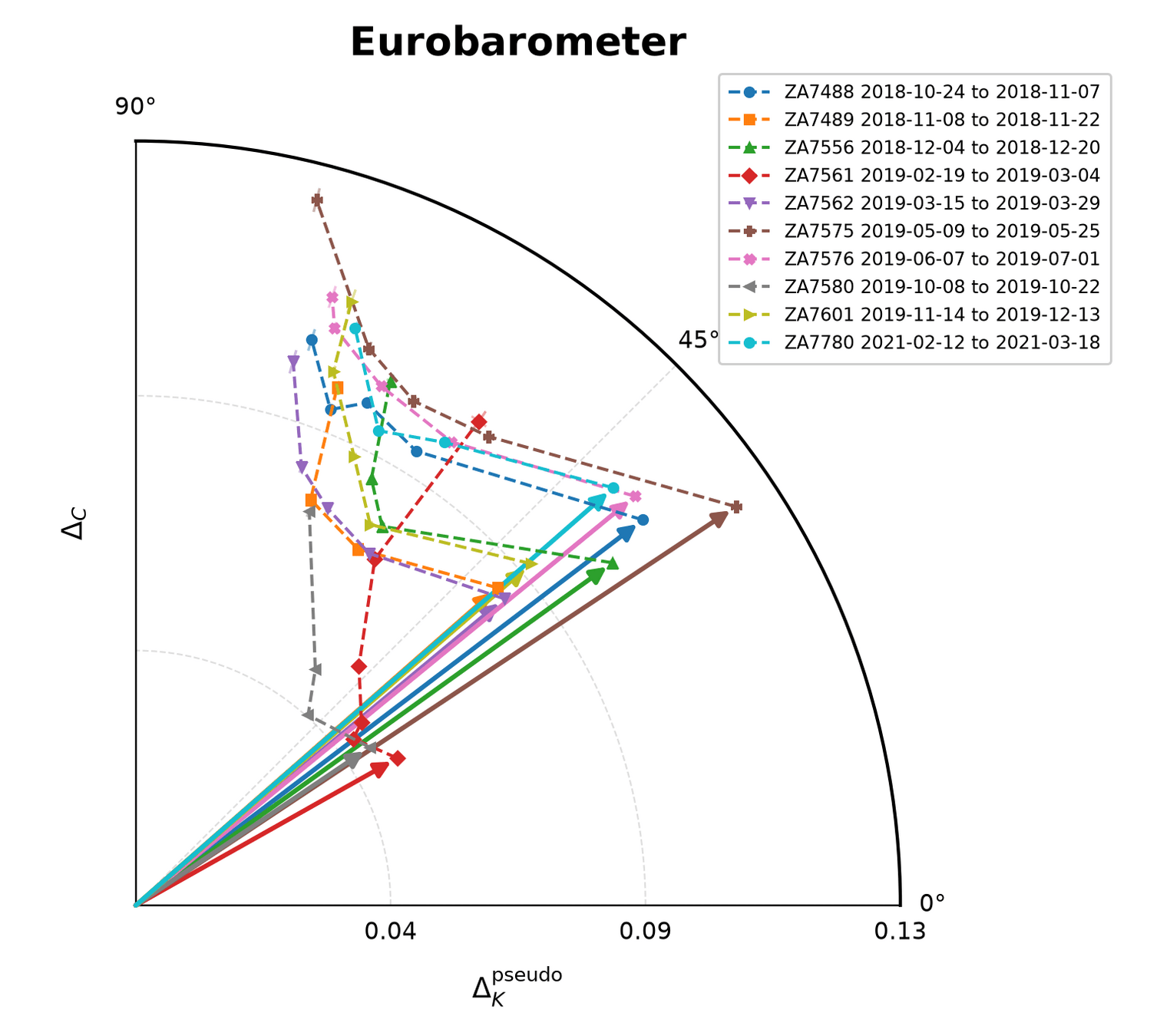
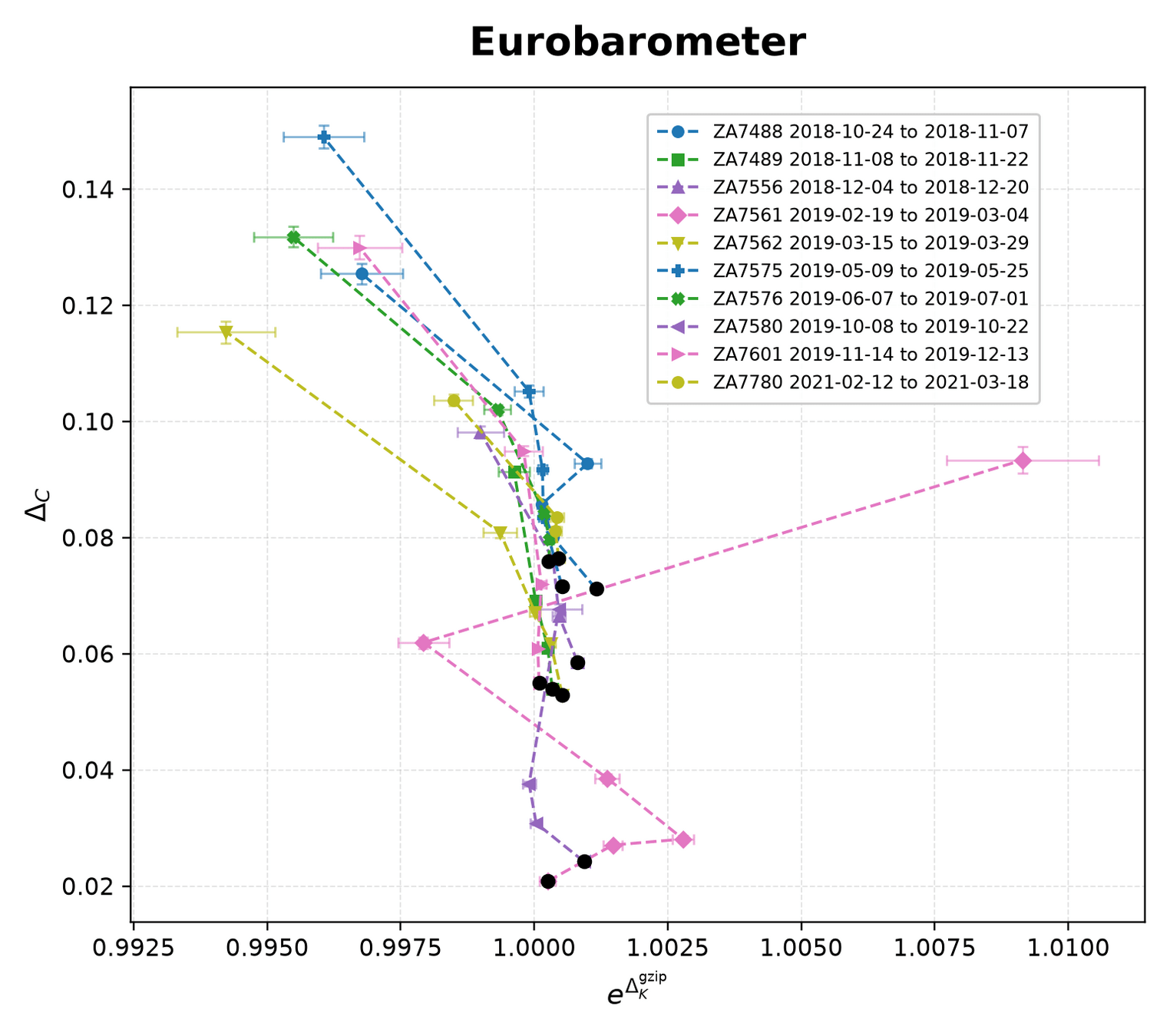
Eurobarometer: ten waves, 2018–2021
Characteristic Drift Spectra of Complex Systems
15 / 18
a
b
DIRECTION
All ten arrows point within ≈30–43° in the (information drift, structural drift) plane.
MAGNITUDE
Arrow lengths range from ≈0.045 to ≈0.12; the 2021 wave, ZA7780, lies within the 2018–19 range.
KOLMOGOROV DRIFT
Within ≈ ±0.006 for every wave except one ZA7561 transition at ≈ +0.009.
Validation
-
Multiscale Spectral fingerprinting
-
Corruption Recognition
-
Synthetic Data Generation
Multiscale spectrum \(\rightarrow\)
Validating LSMs via Spectral Fingerprinting
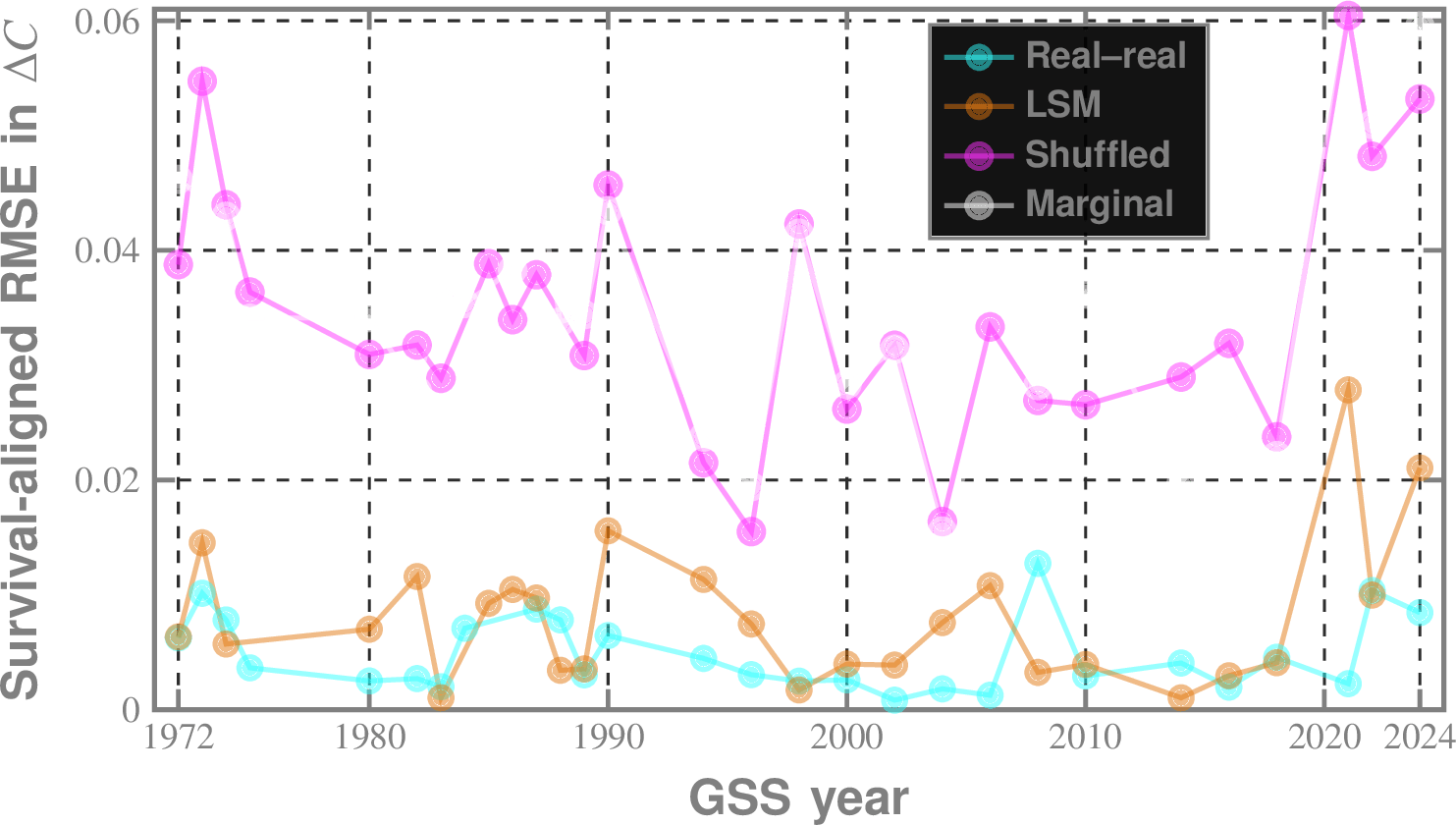
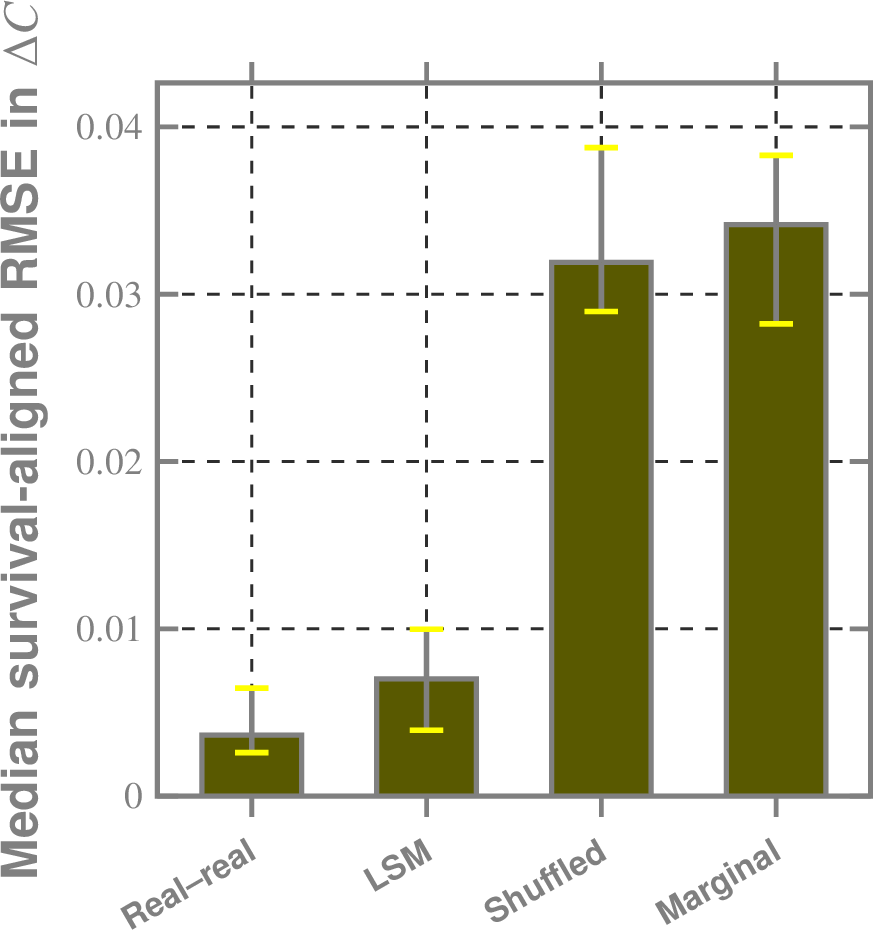
Validating LSMs via Spectral Fingerprinting
\(| \Delta C_X|\)
MAP alignment score
Multi-scale Measure of conditional organization
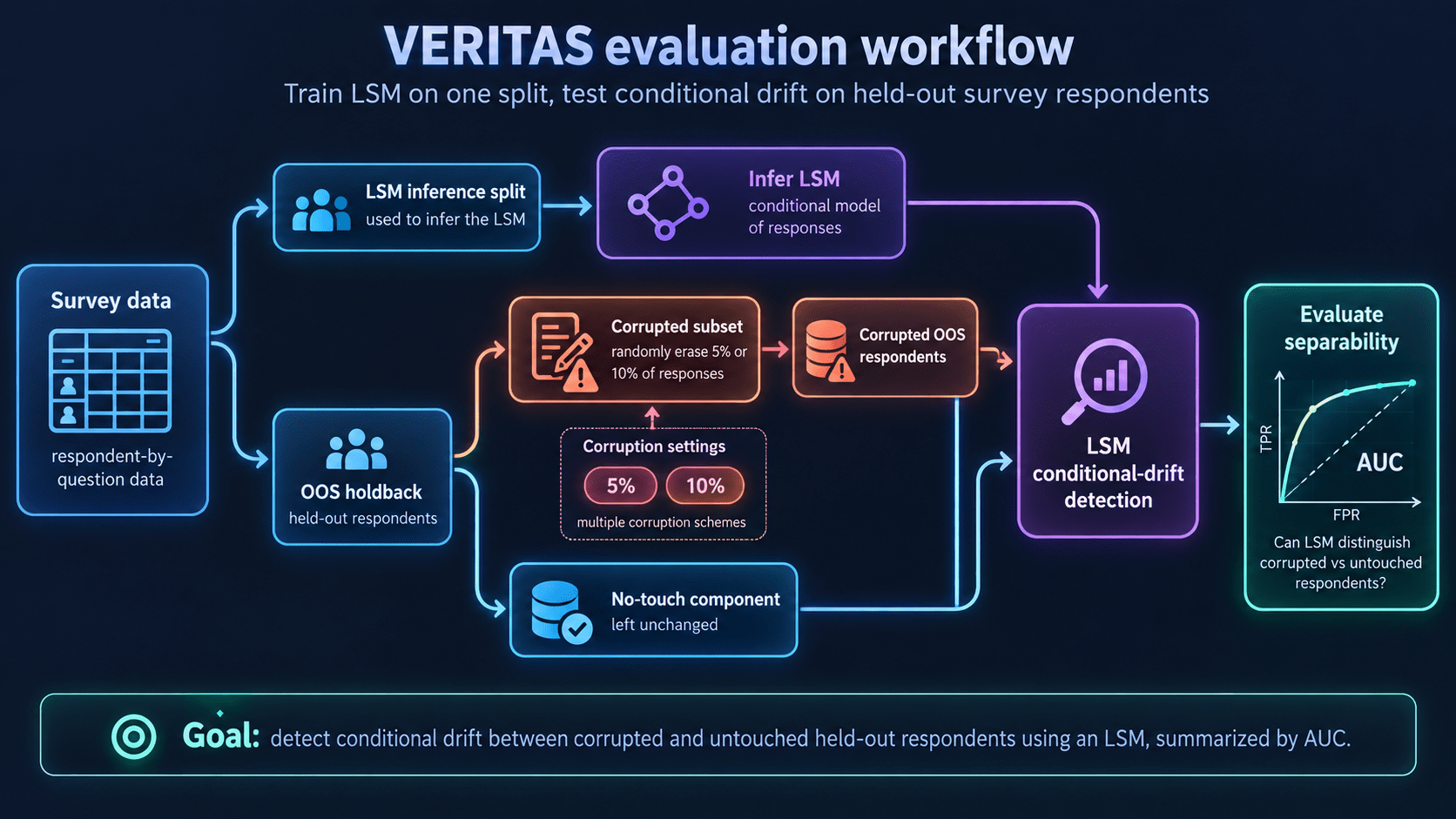
Validating via Corruption Recognition
VeRITAS: Vetting Response Integrity from cross-Talk in Adversarial Surveys
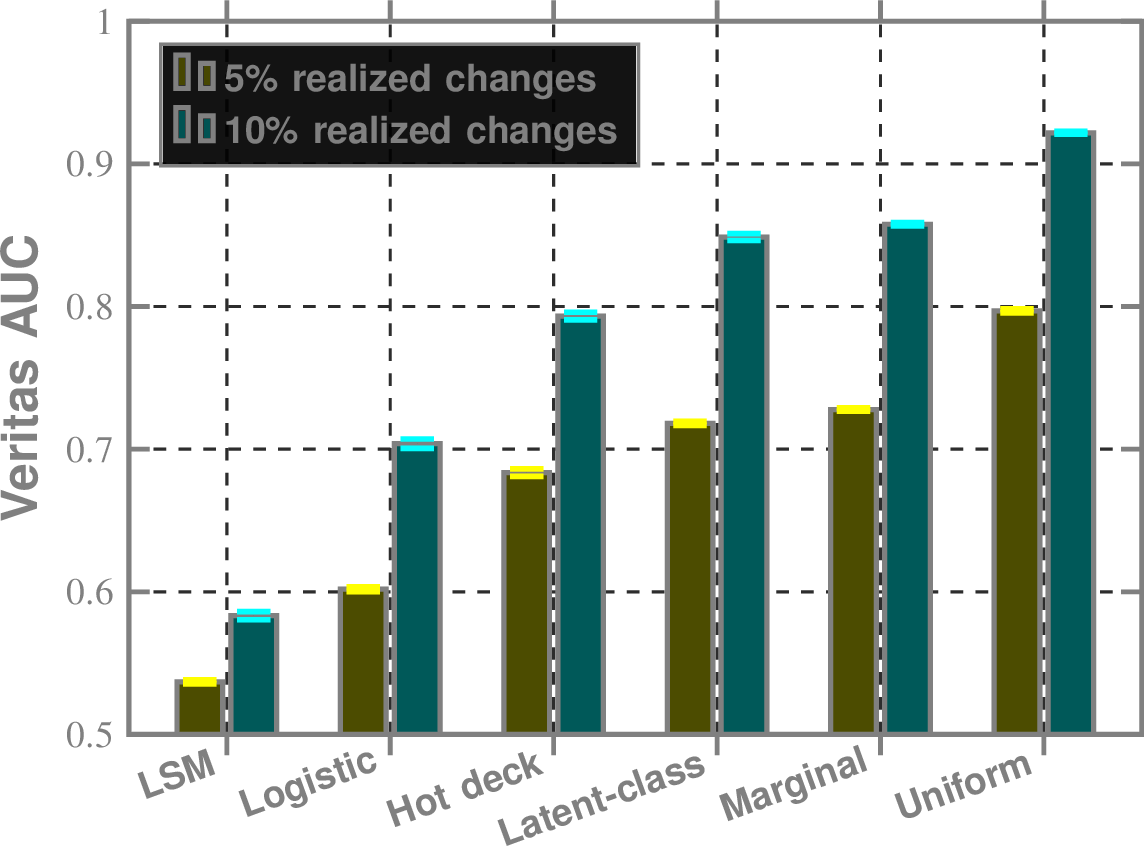
| Corruption | AUC |
|---|---|
| >25% | ~100% |
| ~10% | 80-90% |
| ~5% | 60-80% |
If using LSM to corrupt (LSM-imputation)
AUC < 60%
2.
1.
Validating LSMs Corruption Recognition
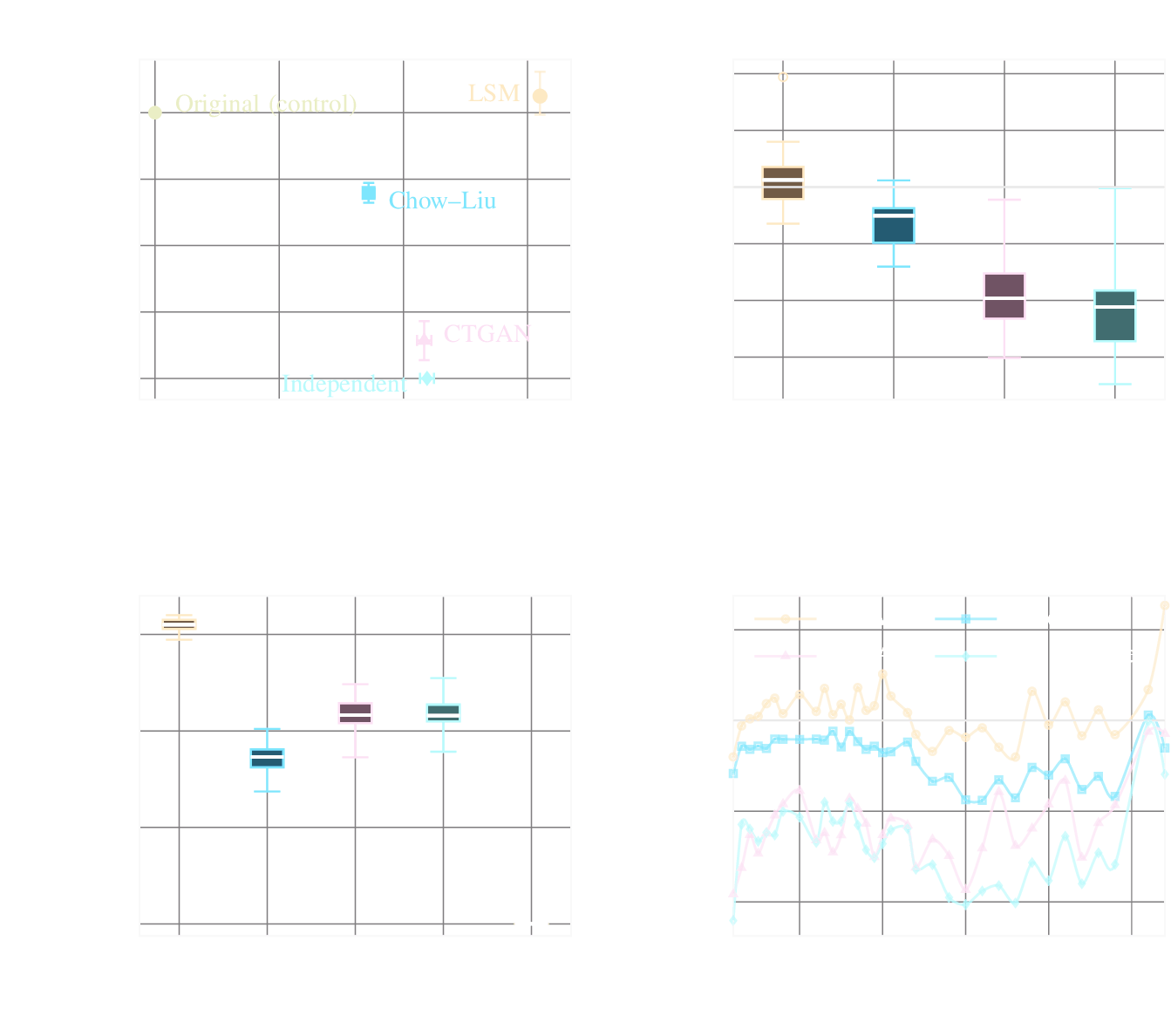
Comparing Against SOTA for Synthetic Data Generation
Easy to match conditionals if we just shuffle the data! LSM keeps that error low while having high novelty
\(\Delta \) MAP score
Novelty
Conditional Kolmogorov complexity
Reflexivity
Making observations changes the system
Towards a Functional TOM (theory of mind)
Opinion Control via Reflexivity
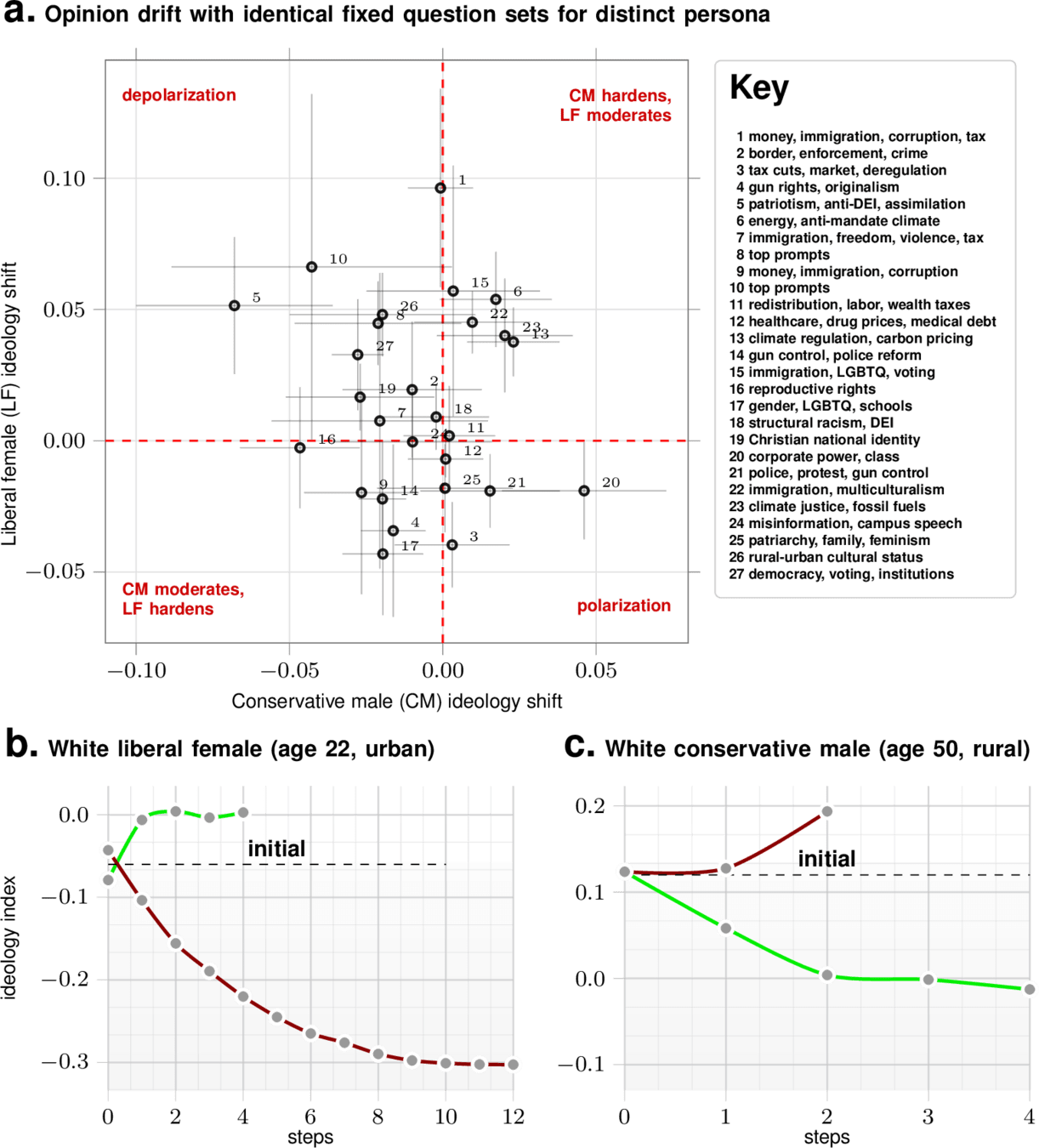
Future Goal: Show Fixed Question Sets Exist That Move Different Persona Towards Polarization/Depolarization
Goal2: Show We can optimize question sequences to move the same persona in a chosen direction
Note: It is relatively easy to polarize than to depolarize
Progress & Dissemination
- Publications: 1 published (Emergenet), 1 under review, 2 in preparation
- Conference: CSS 2026 poster
- Personnel: Hari Dahal, PhD — Postdoctoral Scholar
Request: No-Cost Extension
- Postdoctoral start was delayed by ~5–6 months, compressing the planned research period
- If administratively feasible, request a 3–6 month no-cost extension
- Would allow completion of planned validation, analysis, and dissemination
Potential Follow-on Alignment
- Next steps? Future Programs at IPTO?
- LSMs for trust, influence, and population-level belief dynamics
- Potential alignment with AFOSR Trust & Influence (Dr. Laura Steckman) https://www.afrl.af.mil/