Empirical validation of the polarization transition in a double-random field model of elections

Remah Dahdoul
Jan Korbel
Stefan Thurner
web: jankorbel.eu
slides: slides.com/jankorbel


accepted to Physical Review Letters

Motivation
Recent elections show increasing political polarization.
However, it is unclear how campaign spending interacts with social influence among voters.
Key question:
How does campaign spending influence this polarization?
We use a simple physics-inspired model combining two key factors: voter homophily and campaign intensity.


Illustration of the model
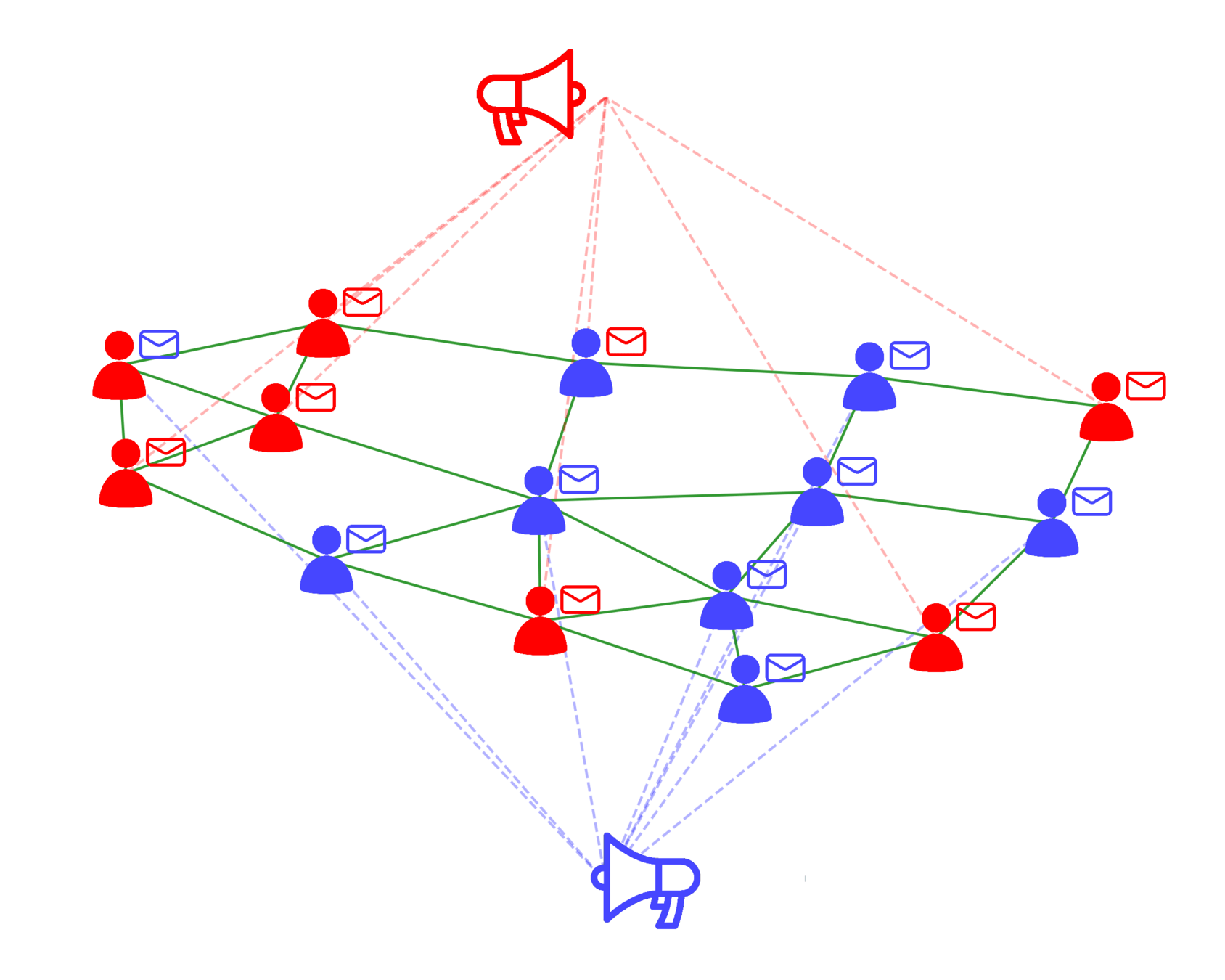
Ising model with random bimodal field
- We model the individual opinion as a binary spin $$s_i \in \{-1,+1\}$$
- The homophily is given by the standard Ising model $$ - J \sum_{ij} A_{ij} s_i s_j \quad \textrm{where} \ A_{ij} \textrm{\ is \ adj. \ matrix} $$
- The external campaign is given by the random external field $$- \sum_i h_i s_i \quad \textrm{where} \ h_i \in \{+h^+,-h^-\}$$
- Here \(h^+\) denotes the intensity of the campaign to promote opinion \(s = +1\) and \(h^-\) is the intensity of the campaign to promote opinion \(s = -1\)
Mean-field approximation
- The Hamiltonian describes a Random-Field Ising model $$H(s) = - J\sum_{ij} A_{ij} s_i s_j - \sum_i h_i s_i$$ with a bimodal (and binary) field
- By using mean-field approximation and configuration model approximation we obtain $$H^{MF}(s) = - \sum_i (\tilde{J} m + h_i) \sigma_i$$ where \(\tilde{J} = J/\langle k \rangle\) and \(h_i\) is a binary random variable with the probability distribution \((p(h^+),p(h^-))\) where \(p \equiv p({h^+})\)
- The random component models affiliation to one or the other campaign
Self-consistency equation
- By averaging of the random field, the opinion distribution is $$p(s) = \frac{p e^{- \beta(\tilde{J} m + {h^+}) s) } + (1-p) e^{-\beta (\tilde{J} m - h^-)s}}{Z}$$
- The average magnetization can be determined as $$m = \langle s \rangle = p \langle s \rangle_{h=h^+}+ (1-p) \langle s \rangle_{h=h^-}$$ from which we get the self-consistency equation
$$m= p \tanh(\beta(\tilde{J} m + h^+)) + (1-p) \tanh(\beta \tilde{J} m - h^-)$$
Critical point and phase transition
- For \(T \geq 1\), we observe no phase transition
- For \(T<1\) we observe a phase transition where the transition is observed at critical points$$h_c^+ = T \, \textrm{arctanh}\left(\sqrt{(1-T) \frac{1-p}{p}}\right)$$$$h_c^- = T \, \textrm{arctanh}\left(\sqrt{(1-T) \frac{p}{1-p}}\right)$$
- This is a generalization of the well-known critical curve for symmetric case \( (p=1/2) \)
- Thus, for \(T<1\) the system has a hysteresis region
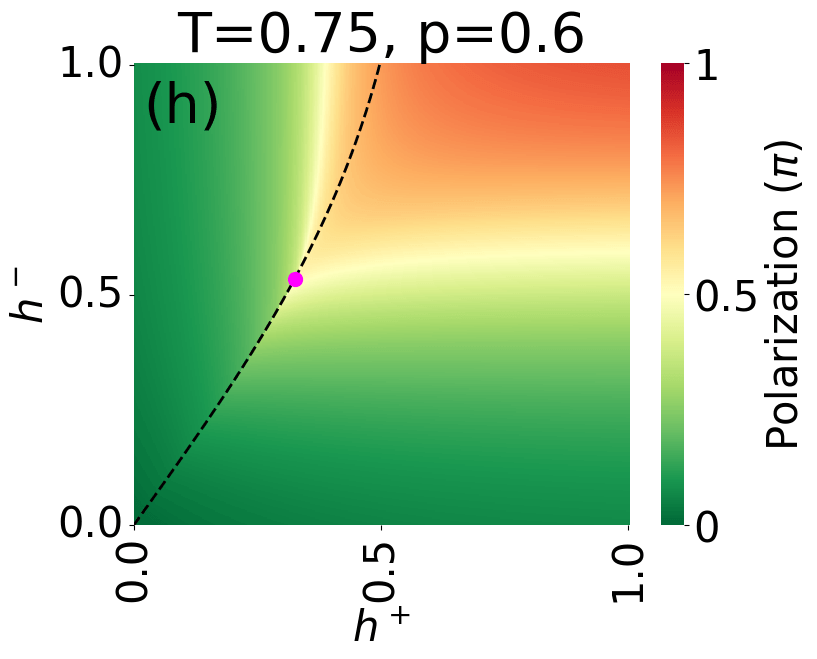
Polarization
- To measure whether the society is in consensus or polarized, we define a quantity
$$\pi = \frac{1}{2} \left( \langle s \rangle_{h=h^+} - \langle s \rangle_{h=h^-} \right)$$
- This quantity, which is called campaign polarization, measures the difference between the opinion of groups affected by the opposite campaigns.
Phase diagrams
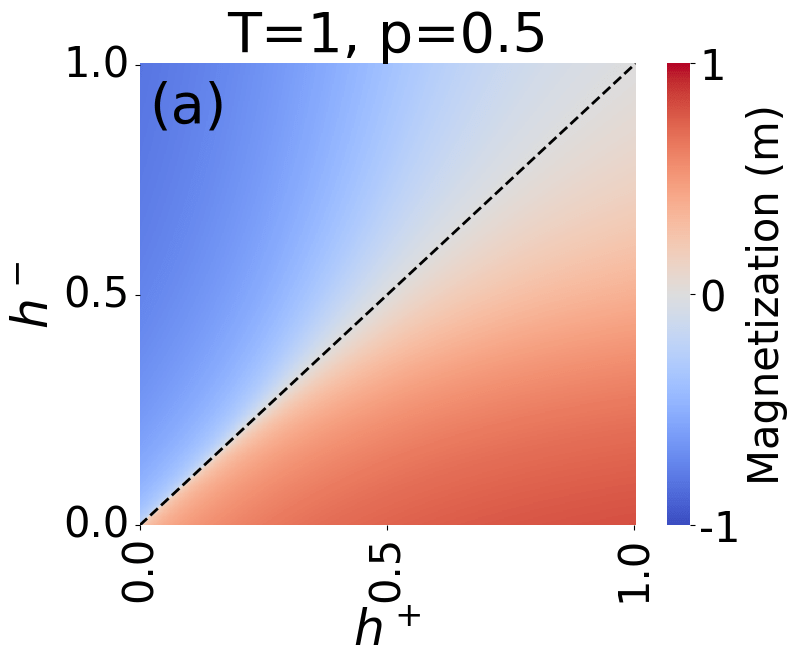
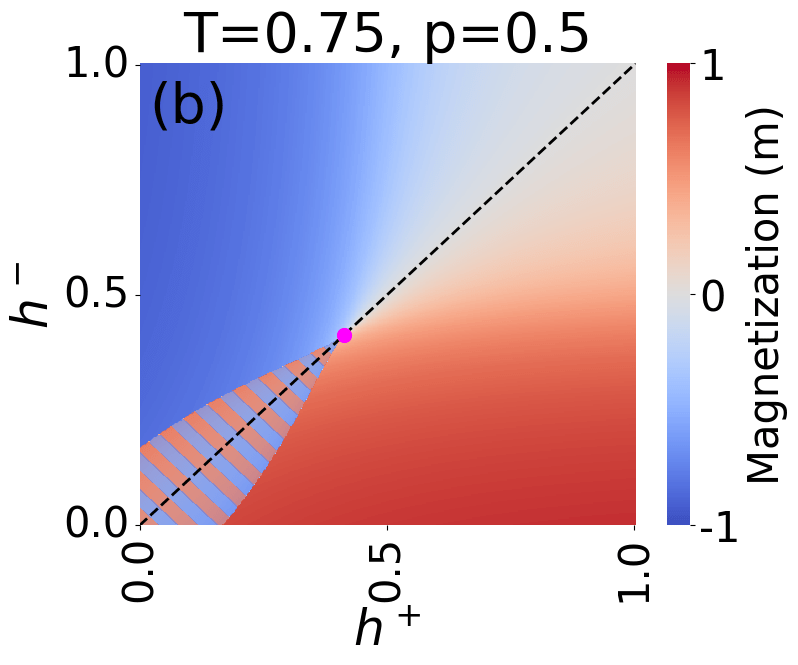
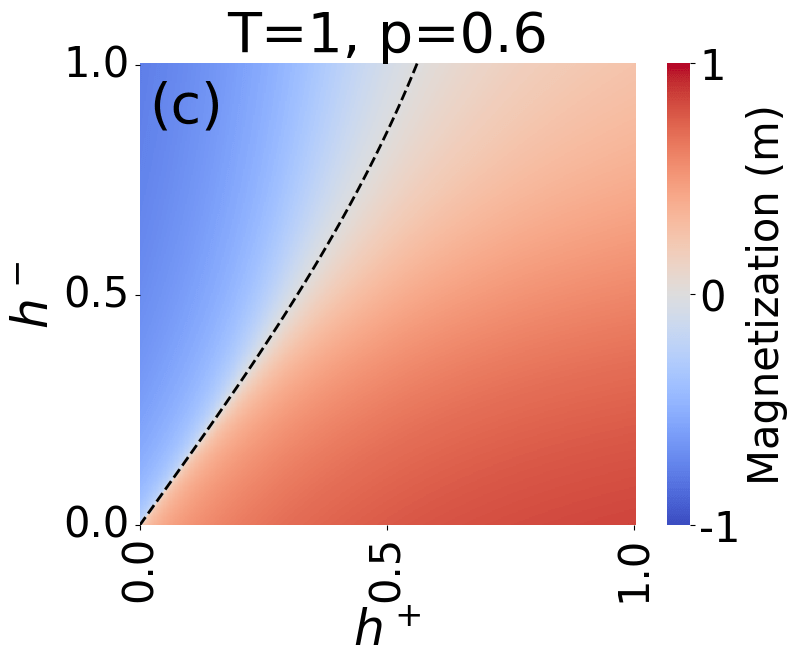
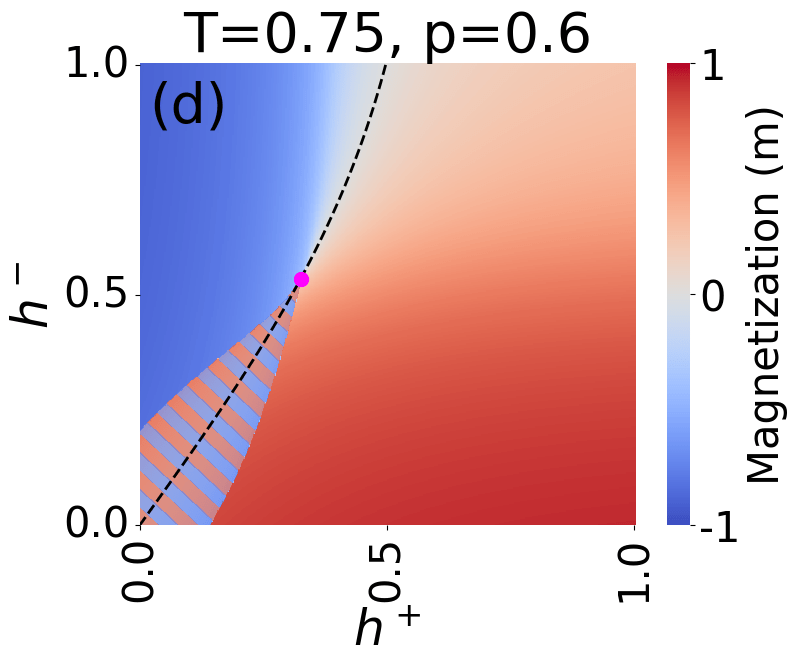
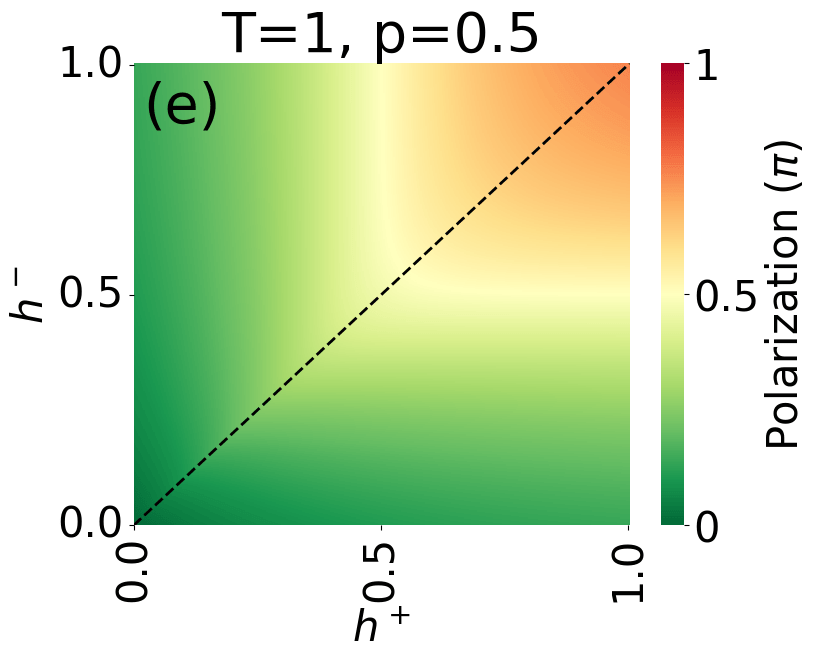
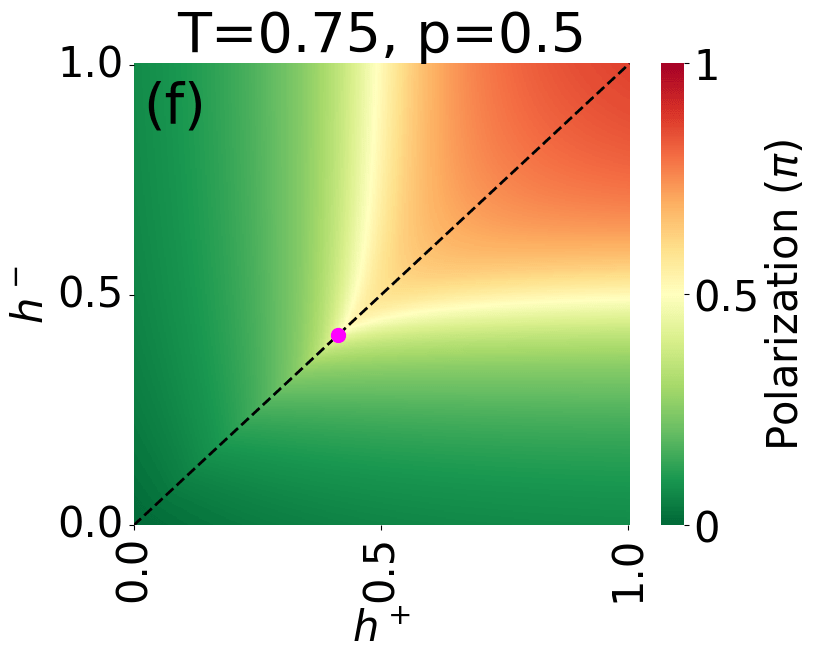
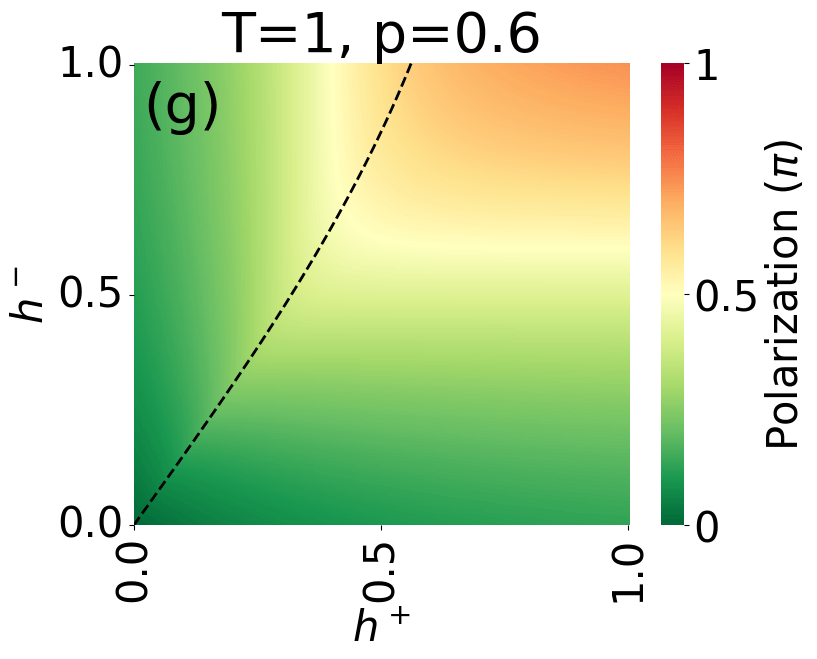
Magnetization
Polarization
Application to US House elections 1980-2020
- We apply our model to the US House elections
- We include only bipartisan races (all races with more than 2 candidates with non-negligible outcome are excluded)
- Altogether, we analyze 6357 races
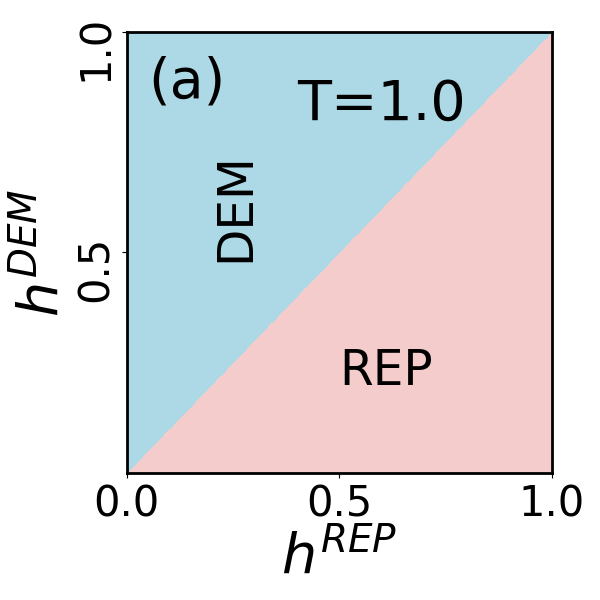
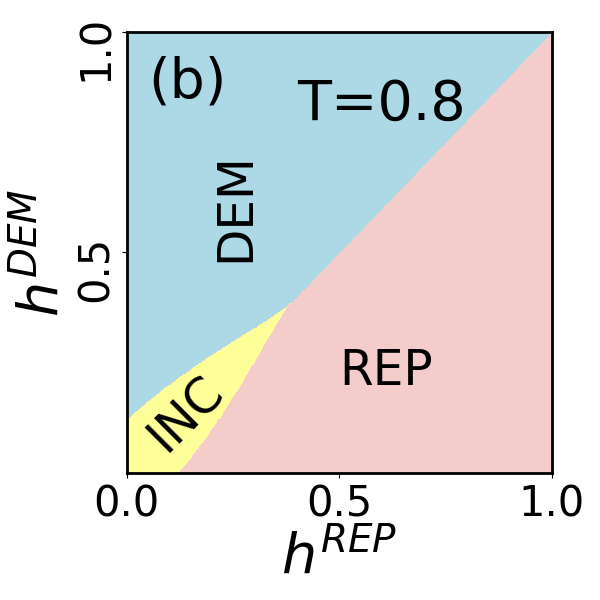
- We use our model as a winner classifier
- If m>0, the Republican wins
- If m<0 , the Democrat wins
- The hysteresis region is interpreted as incumbency region (i.e., incumbent wins even if they spend less)
- We use the hysteresis region to calibrate the model parameters \(T\) and \(h_c\)
Classifiers
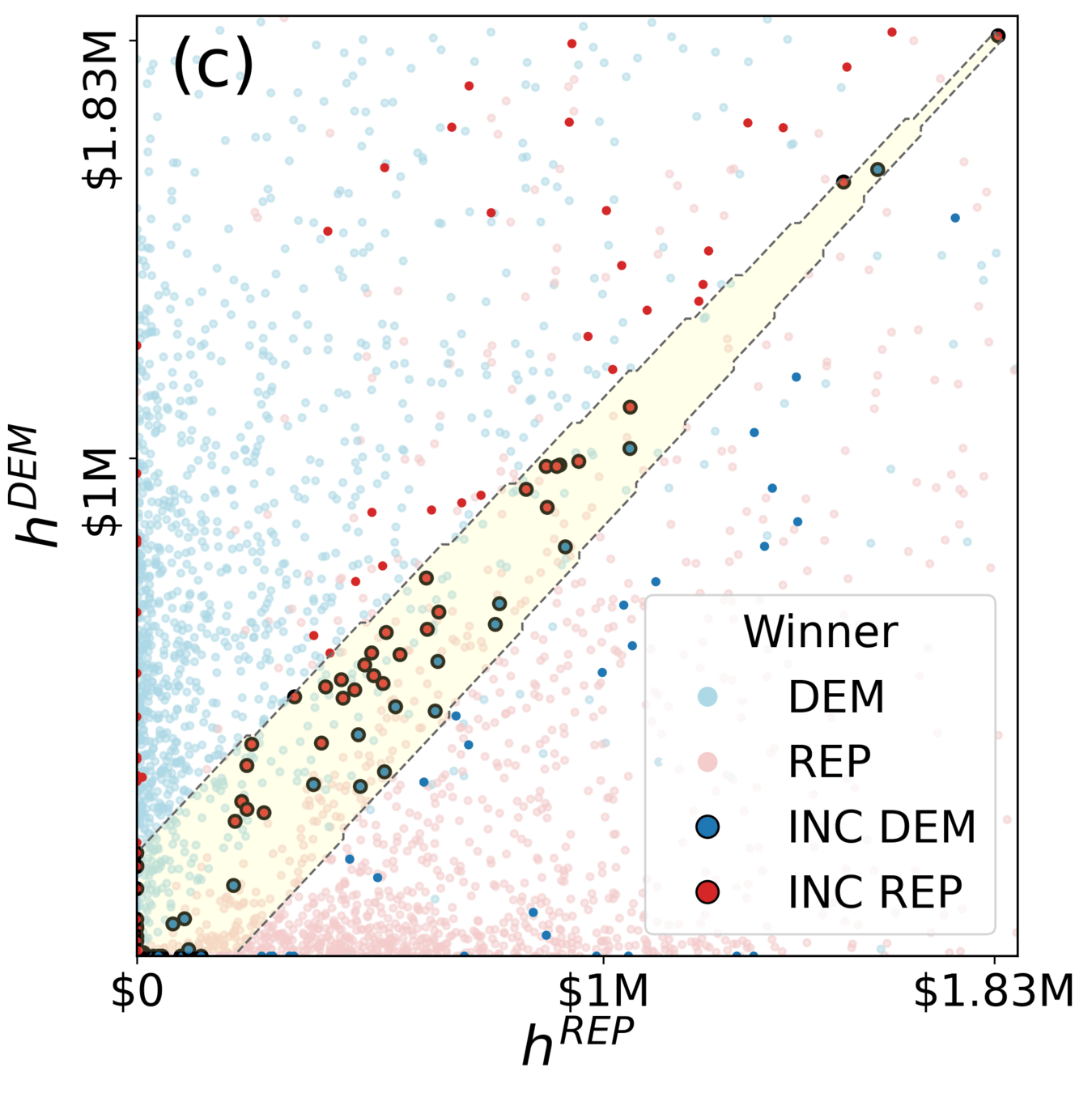
incumbency region
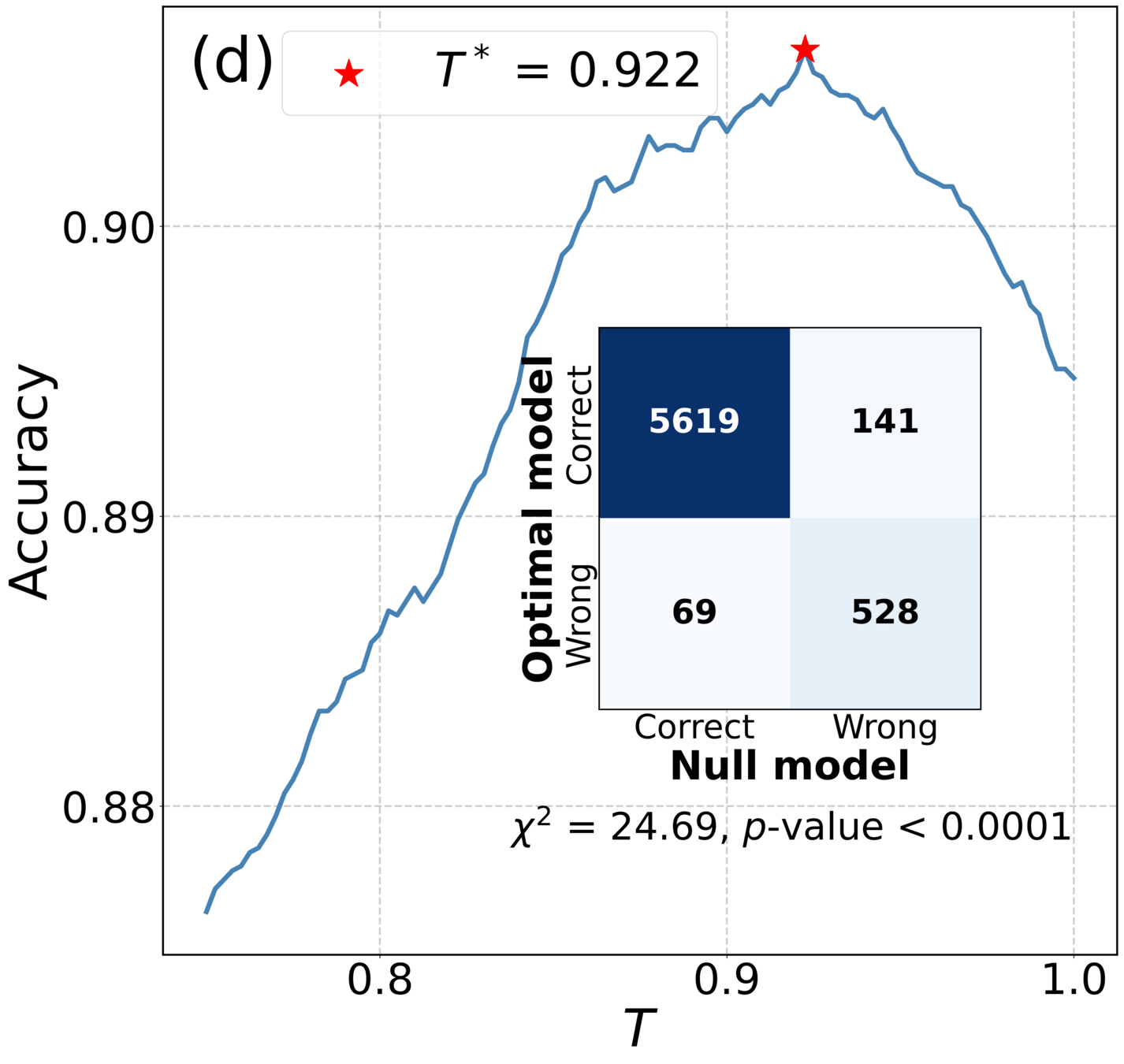
optimal temperature
Application to US House elections 1980-2020
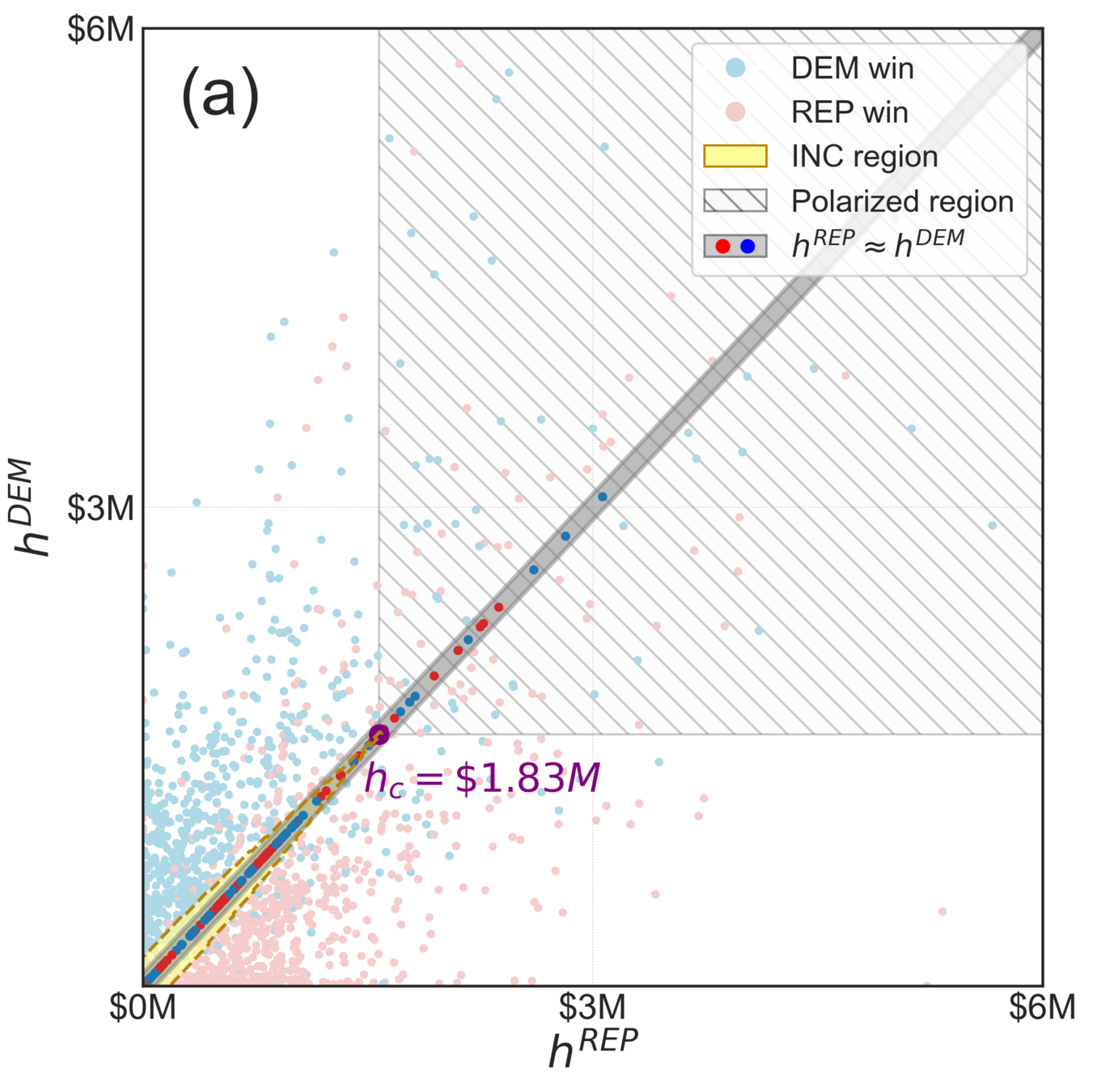
full region
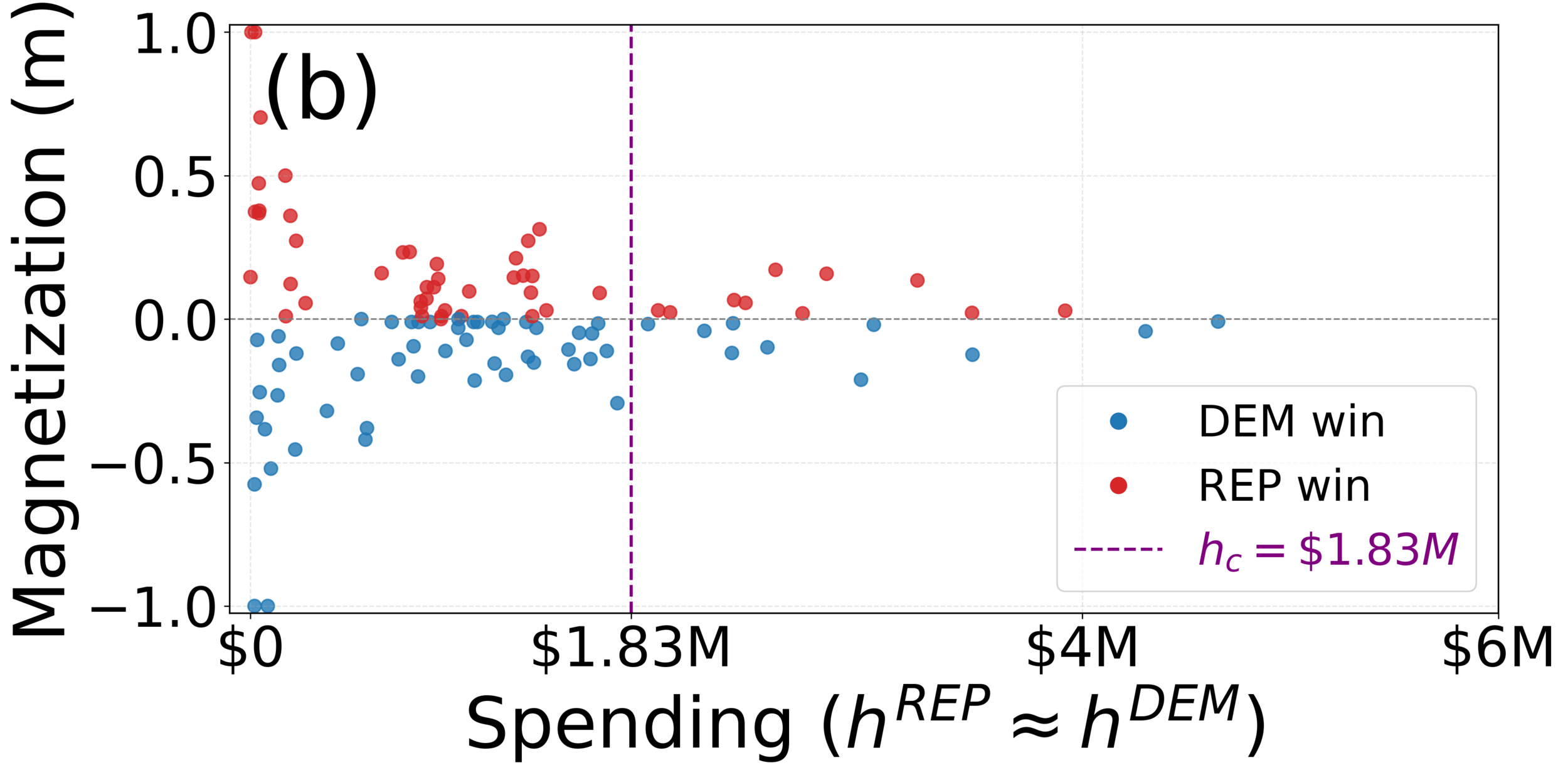
results for close races
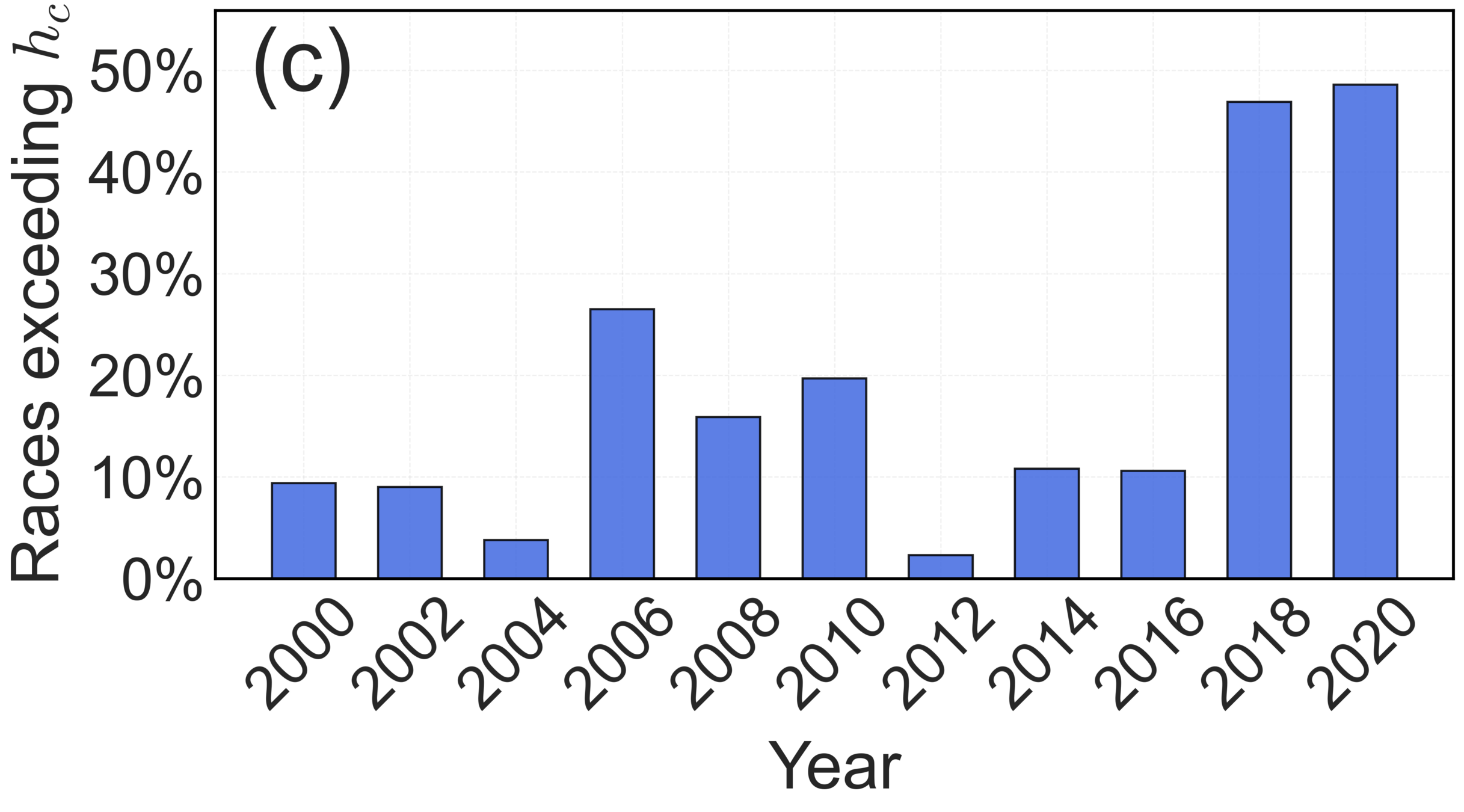
spending above \(h_c\)
Application to US House elections 1980-2020
1. Polarization phase transition
- Campaign spending can trigger a phase transition from socially driven voting to strongly polarized elections.
2. Hysteresis and incumbency
- The model exhibits hysteresis, which can be interpreted as an incumbency advantage.
3. Estimation of social temperature
- Thermodynamic quantities like temperature can be estimated from the shape of the hysteresis region.
4. Empirical relevance
- Analysis of US House elections (1980–2020) suggests the existence of a hysteresis region and a critical spending threshold.
- Above a critical spending level (~$1.8M), campaign spending dominates social interactions, and polarization increases.
Summary
Thank you for your attention
csh.ac.at
preprint