Complete definition of how mutations affect antibodies used to prevent RSV
Jesse Bloom
Fred Hutch Cancer Center / HHMI

Study led by Cassie Simonich
Pediatrics Medical Fellow
Seattle Childrens / Fred Hutch
These slides: https://slides.com/jbloom/grc-2026

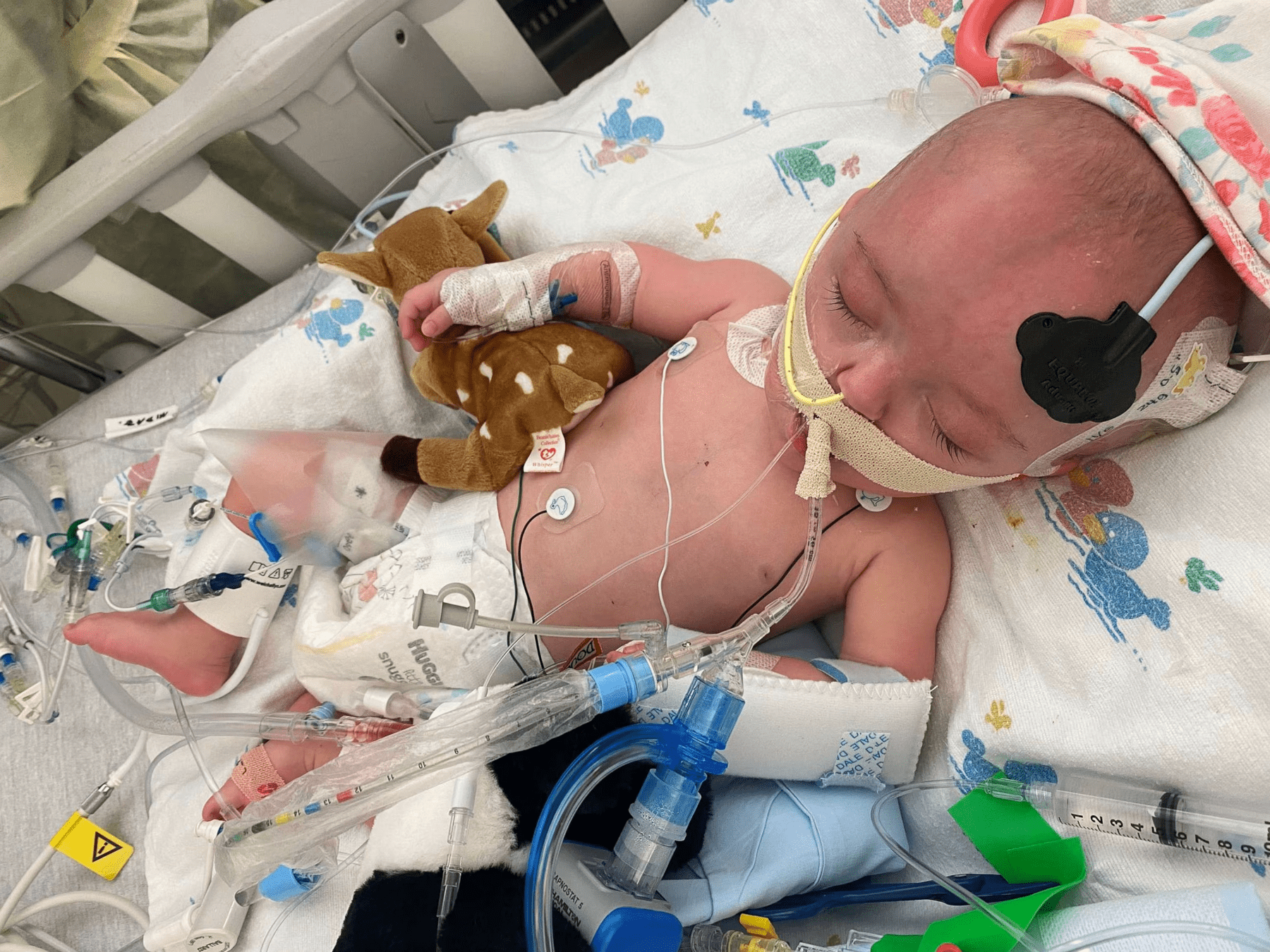
Respiratory syncytial virus (RSV) is leading cause of infant hospitalization in USA
In developed world, infants hospitalized with RSV receive supportive care (eg, oxygen, ventilation, fluids) and usually recover (~0.1% in-hospital case-fatality rate)
In developing world where supportive care not available, RSV is a leading cause of infant mortality (~100,000 infant deaths per year)
Two approaches have recently been developed to protect infants from RSV
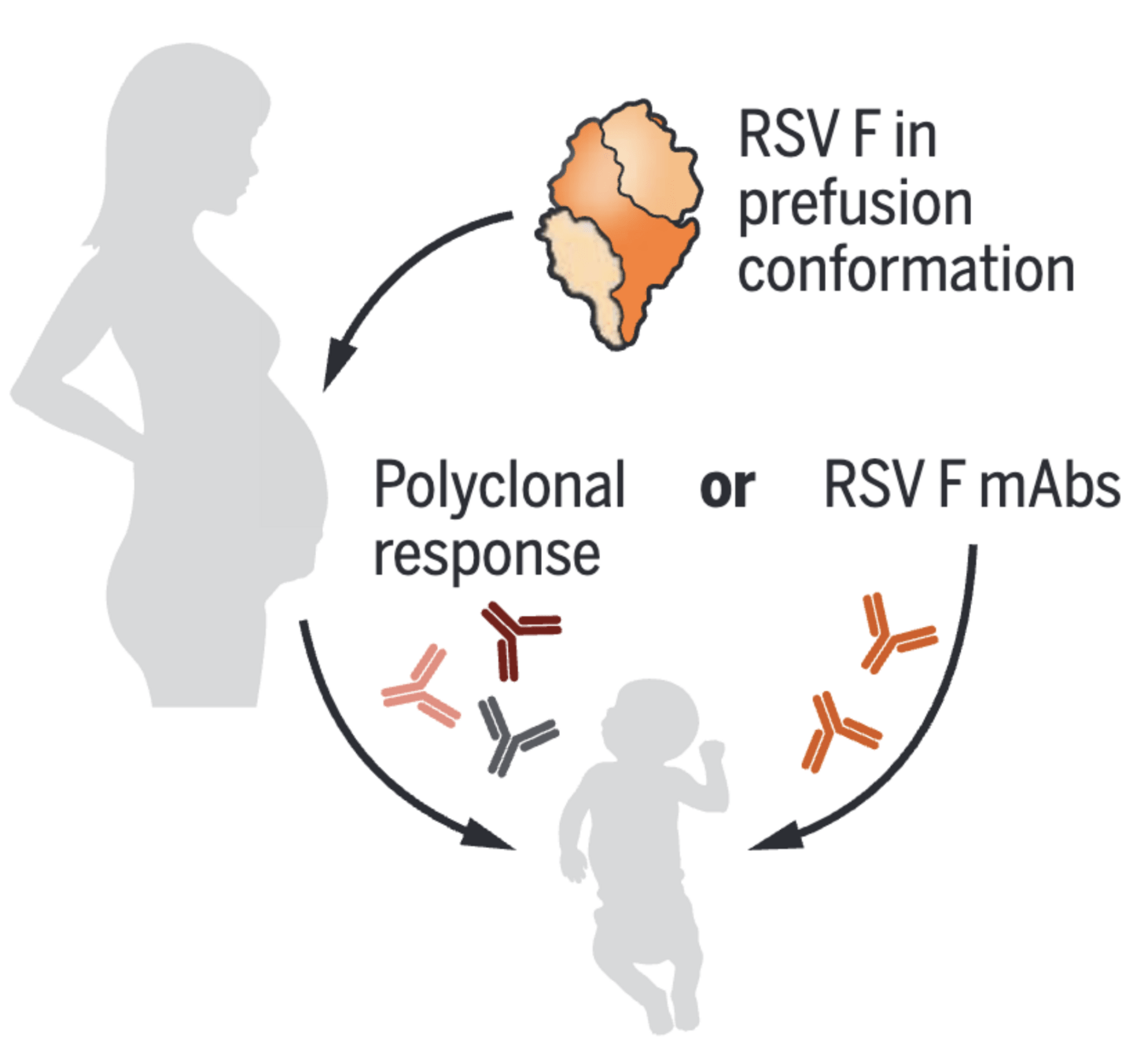
Direct administration of monoclonal antibody targeting RSV F protein
Maternal vaccination with prefusion stabilized RSV F protein
Direct administration of monoclonal antibody targeting RSV F protein
Maternal vaccination with prefusion stabilized RSV F protein
This talk focuses on anti-F monoclonal antibodies
RSV F fuses viral and cell membranes
Antibodies can bind to RSV F and neutralize viral infection of cells
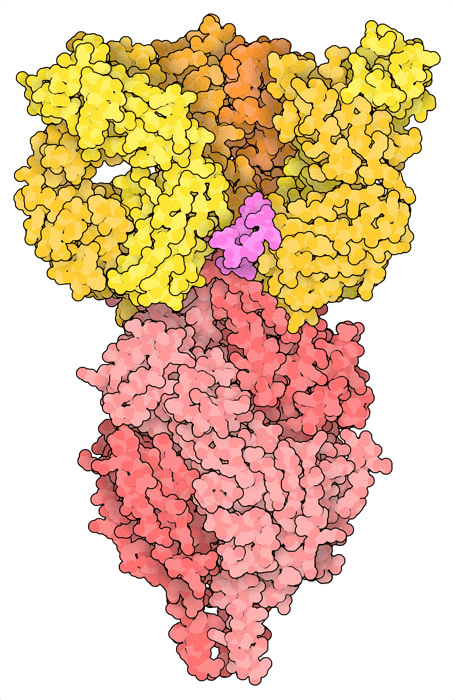
the antibody nirsevimab bound to prefusion F at epitope that includes glycan
the antibody nirsevimab bound to prefusion F at epitope that includes glycan
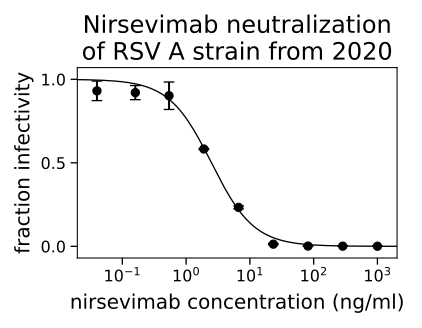
Antibodies can bind to RSV F and neutralize viral infection of cells
Economic challenges of antibodies against respiratory viruses
Although population disease burden is substantial, annual risk to any individual is low, and impossible to prospectively identify who will become severely ill at any given time.
Monoclonal antibodies are expensive to produce, and repeated dosing is required for sustained protection.
Viruses can evolve to become resistant.
Although population disease burden is substantial, annual risk to any individual is low, and impossible to prospectively identify who will become severely ill at any given time.
Monoclonal antibodies are expensive to produce, and repeated dosing is required for sustained protection.
Viruses can evolve to become resistant.
Why anti-RSV antibody prophylaxis for infants is economically feasible
Severe disease concentrated in an easily identifiable population (infants).
Although population disease burden is substantial, annual risk to any individual is low, and impossible to prospectively identify who will become severely ill at any given time.
Monoclonal antibodies are expensive to produce, and repeated dosing is required for sustained protection.
Viruses can evolve to become resistant.
Severe disease concentrated in an easily identifiable population (infants).
Infants require lower dose, protection most needed only for first year, and antibodies have been engineered to be more potent and long lived.
Why anti-RSV antibody prophylaxis for infants is economically feasible
Although population disease burden is substantial, annual risk to any individual is low, and impossible to prospectively identify who will become severely ill at any given time.
Monoclonal antibodies are expensive to produce, and repeated dosing is required for sustained protection.
Viruses can evolve to become resistant.
Severe disease concentrated in an easily identifiable population (infants).
Topic of this talk.
Why anti-RSV antibody prophylaxis for infants is economically feasible
Infants require lower dose, protection most needed only for first year, and antibodies have been engineered to be more potent and long lived.
Brief history of anti-F antibodies for RSV prevention in infants
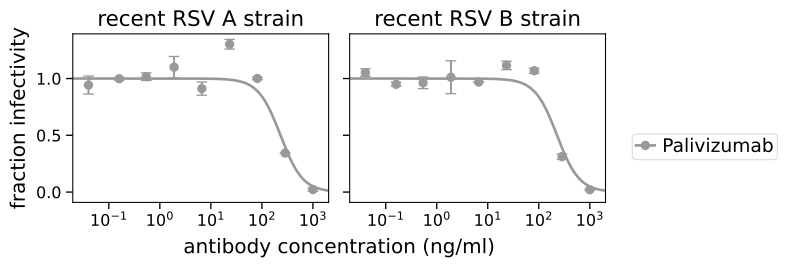
Palivizumab
Lower potency than subsequent antibodies.
Due in part to cost, recommendation only for infants born <29 weeks gestational age or <32 weeks with chronic lung disease
Neutralization curves from Simonich et al (2025)
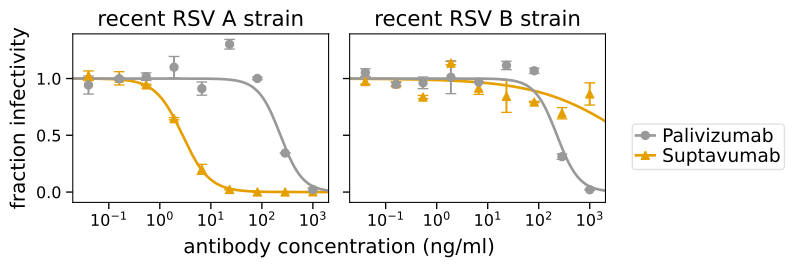
Suptavumab
Much more potent against some strains than palivizumab.
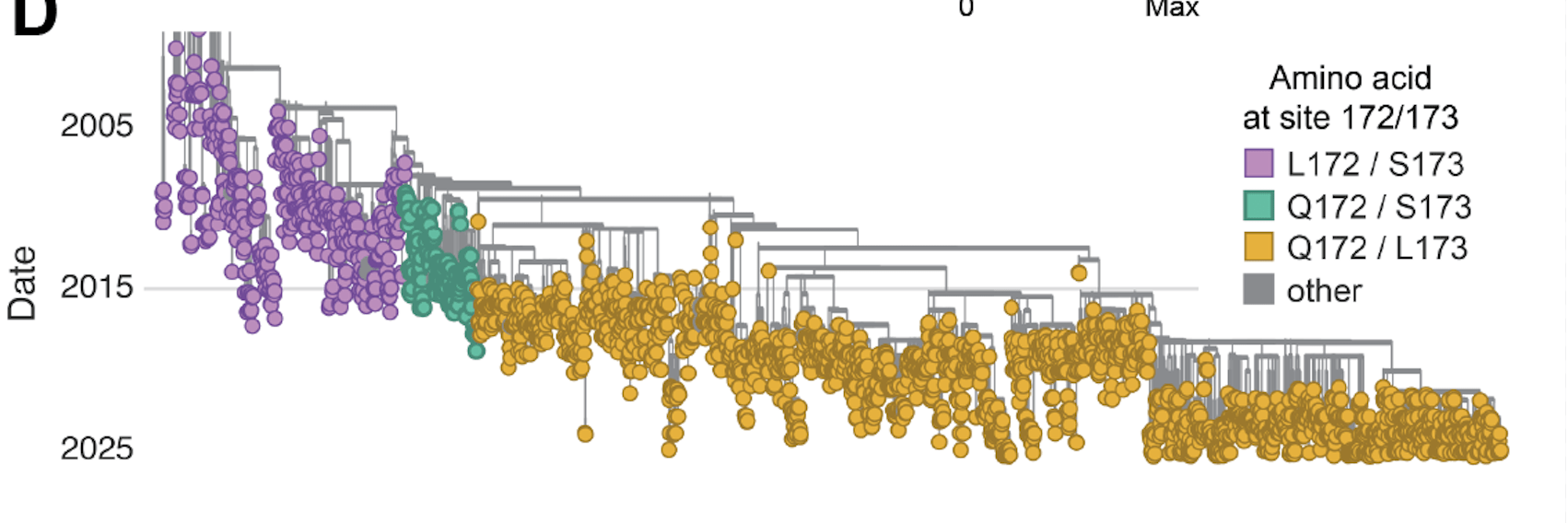
Failed Phase 3 clinical trial from 2015-2017 due to lack of efficacy against subtype B; coincided with evolution of new variants with mutations at F sites 172 and 173.
Neutralization curves from Simonich et al (2025)
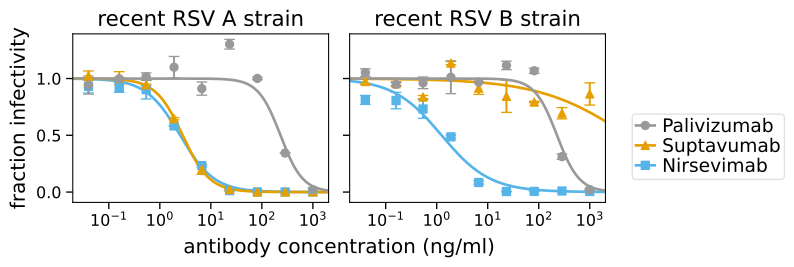
High potency and extended half life.
Recommended in United States in 2023 for all infants <8 months old entering their first RSV season.
~80% effectiveness in preventing RSV hospitalization.
Nirsevimab
Neutralization curves from Simonich et al (2025)
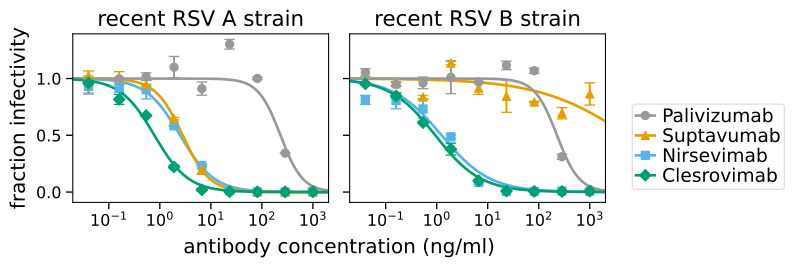
Clesrovimab
High potency and extended half life similar to nirsevimab but targets different region of F.
Approved in United States in 2025.
Neutralization curves from Simonich et al (2025)
Impact of RSV evolution on clinical antibodies so far
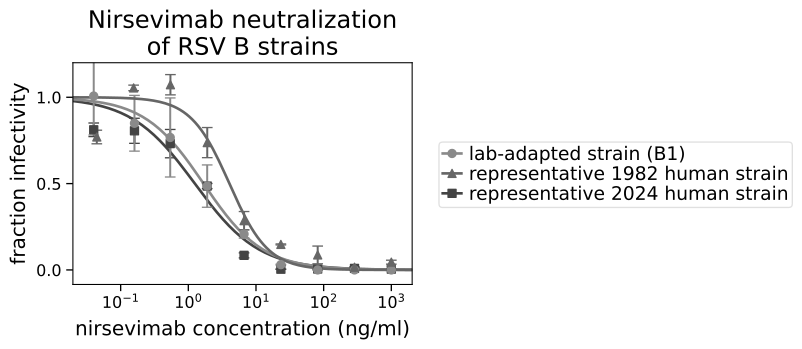
The clinical antibody nirsevimab neutralizes most RSV strains
plotted data from Simonich et al (2025)
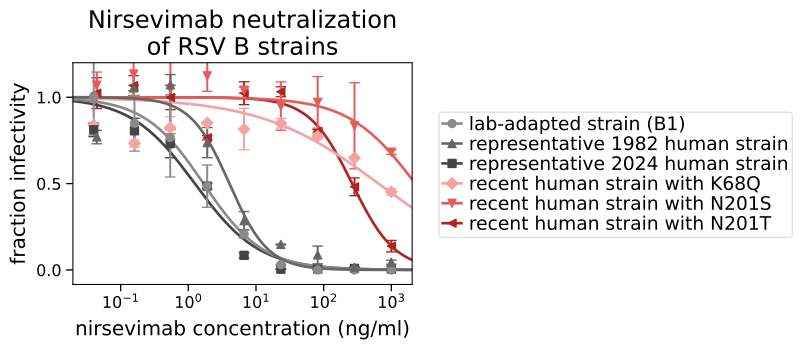
Resistant strains have been identified in clinical and lab-passaging studies, plotted data from Simonich et al (2025)
But some (currently rare) natural RSV strains escape nirsevimab neutralization
The mysterious subtype-dependence of nirsevimab-escape mutations
Two subtypes of RSV: A & B. Their F proteins have ~90% sequence identity & similar structures
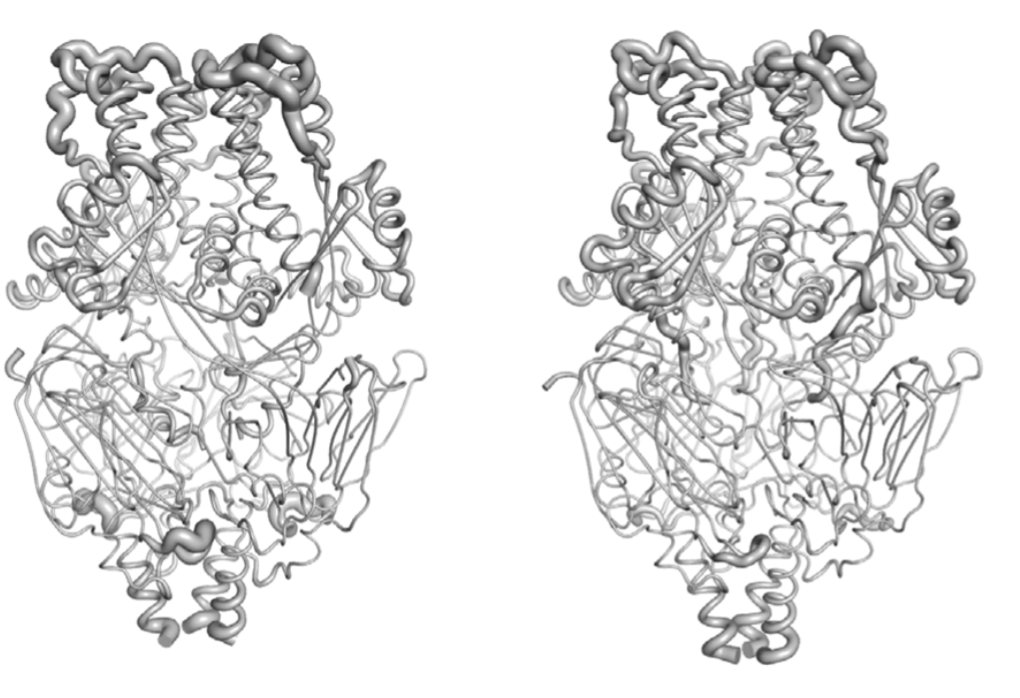
RSV B F structure
RSV A F structure
The structures have a RMSD deviation of only 1.8 angstroms.
Nirsevimab IgG has similar neutralization of RSV A and RSV B
plotted data from Simonich et al (2025)
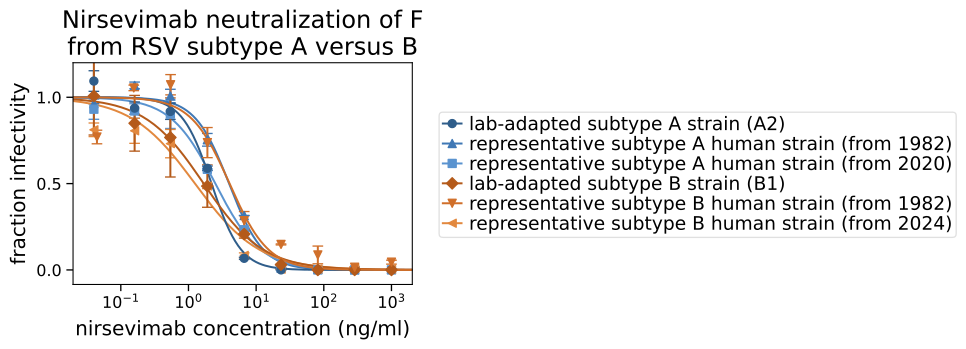
But resistance is more common for RSV B than A in nirsevimab-treated infants
| study | resistance in RSV-A | resistance in RSV-B |
|---|---|---|
| Fourati et al (2025a) | 2/195 = 1% | 23/184 = 13% |
| Fourati et al (2025b) | 0/236 = 0% | 2/24 = 8% |
| Ahani et al (2023) | 0/11 = 0% | 2/14 = 14% |
Rates of resistance to nirsevimab neutralization in RSV breakthrough infections of infants who received nirsevimab.
Some F mutations reduce nirsevimab neutralization of subtype B but not A
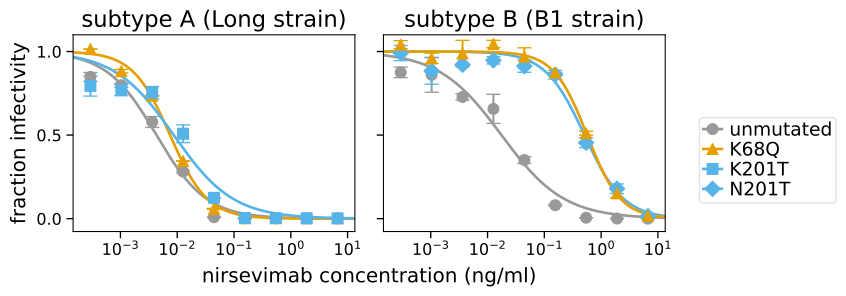
Why is RSV B more prone to nirsevimab resistance despite IgG neutralizing both subtypes similarly?
IgG antibodies are bivalent, with two connected Fabs
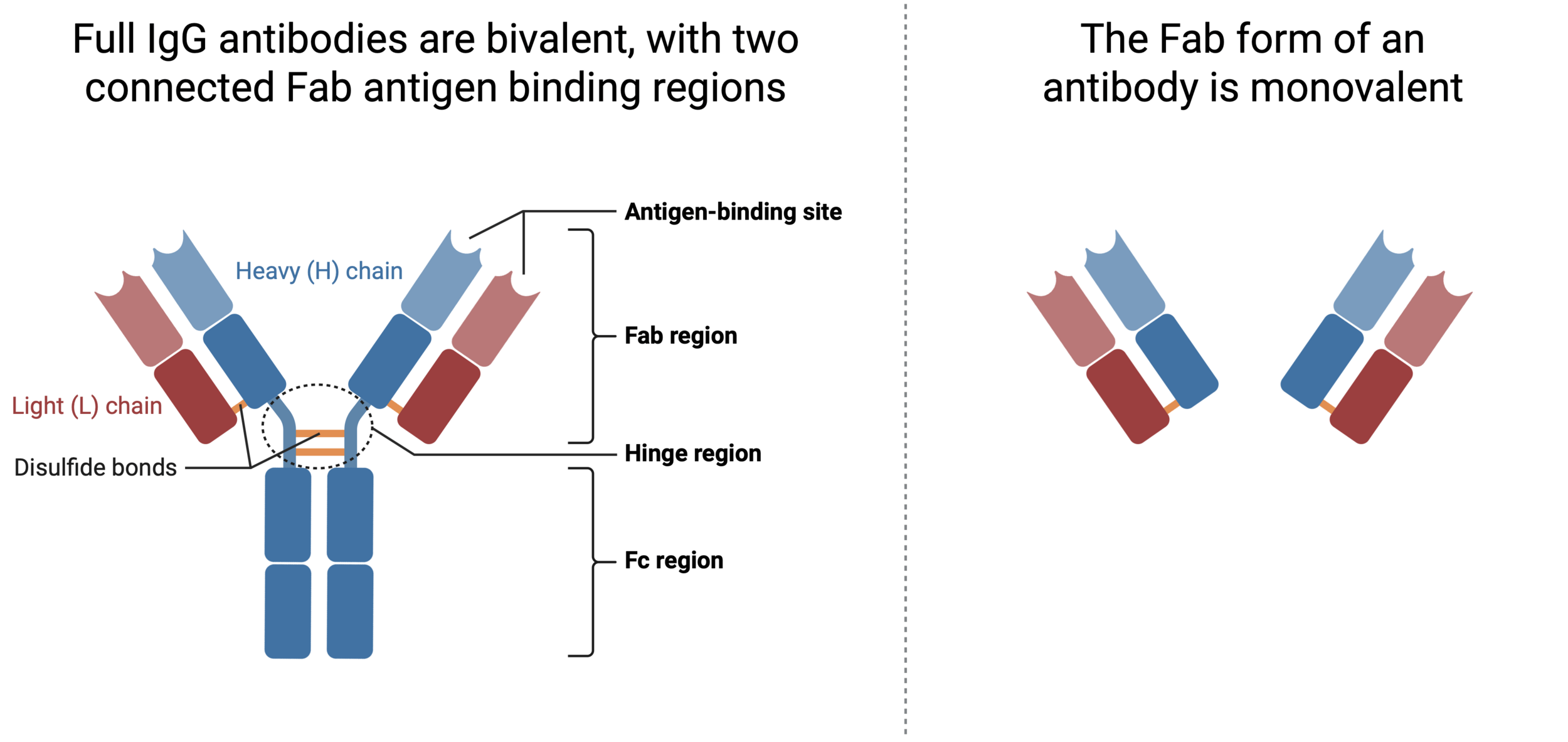
Apparent affinity (avidity) of bivalent IgG can be very high
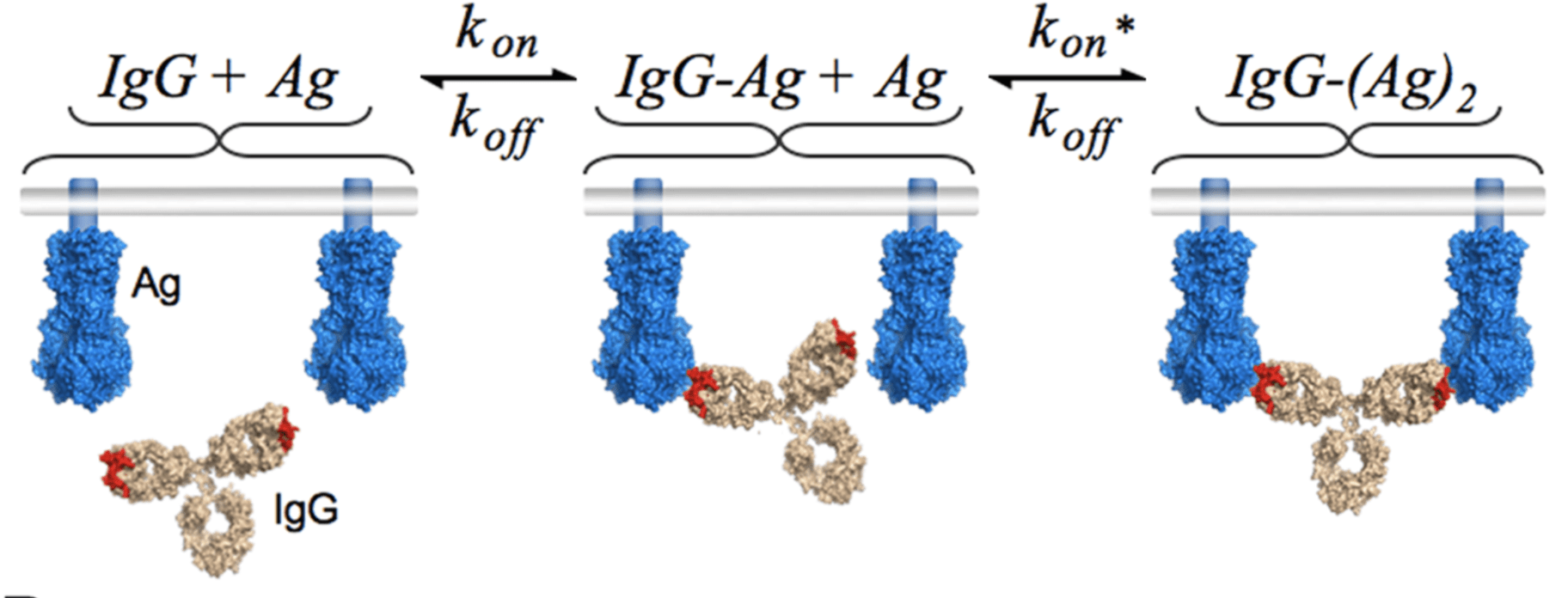
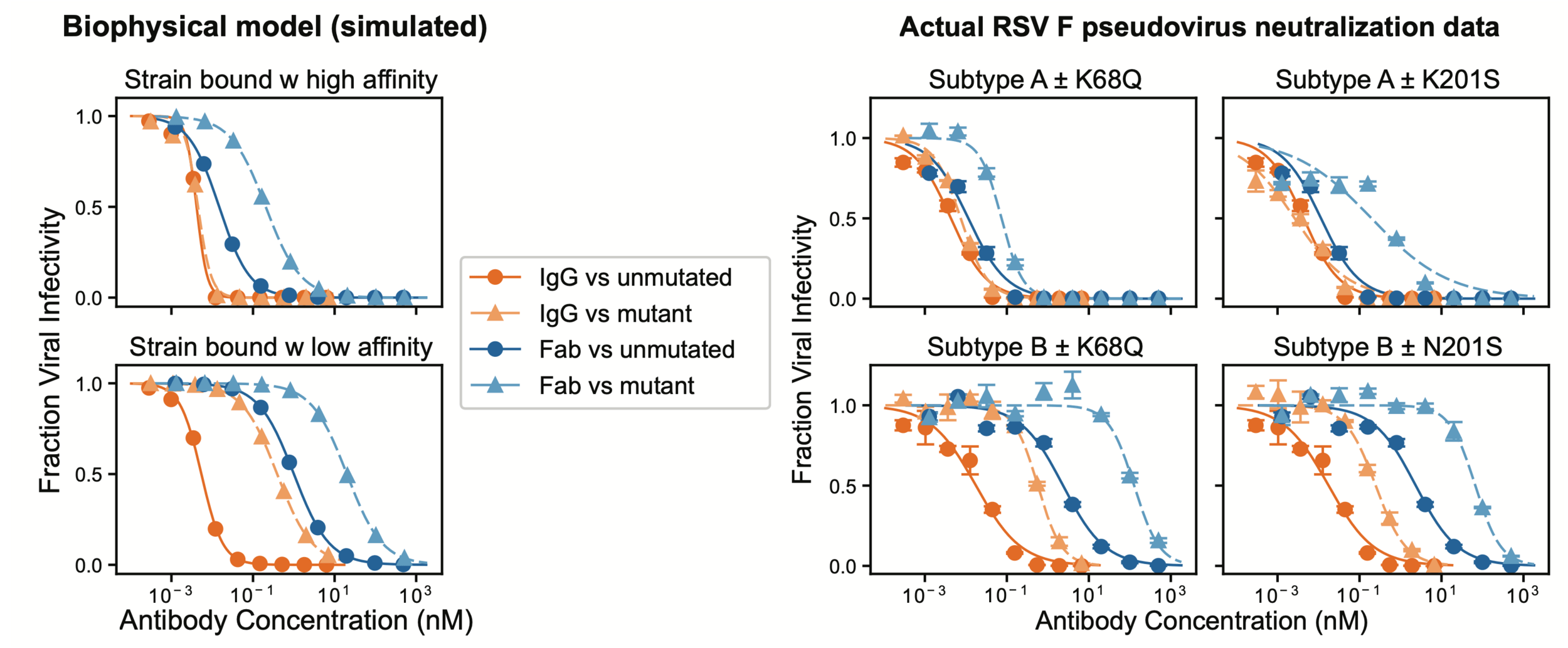
Biophysical model: IgG neutralization buffered against viral mutations when Fab potency high
See https://jbloomlab.github.io/IgG-vs-Fab-neutralization/notebook.html for full mathematical model
In real data, Fab potency higher to subtype A, thereby buffering IgG neutralization to mutations
Measurement of mutation effects to inform surveillance for RSV antibody resistance
Previously, resistance mutations identified by viral passaging and characterizing clinical isolates
Example studies serial passaging RSV in presence of antibodies:
Example studies identifying resistance mutations in clinical infections:
These approaches identify just a fraction of mutations that affect antibody neutralization, and do not distinguish causal and hitchhiking mutations.
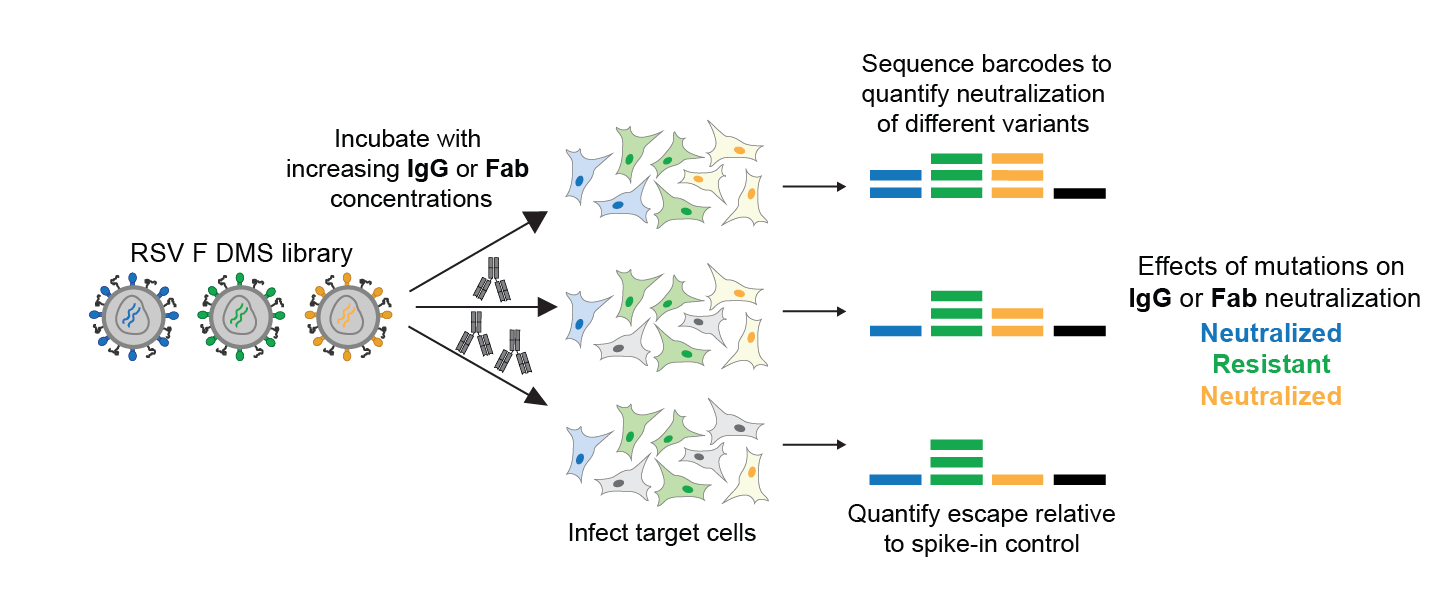
We used deep mutational scanning to quantify how all F mutations affect neutralization

Library of pseudoviruses expressing all single amino-acid mutants of RSV F.
Pseudoviruses can only undergo single round of cell entry, and so provide safe way to study effect of F mutations.
Workflow for measuring how all F mutations affect antibody neutralization
We can also measure how all mutations affect pseudovirus cell entry in absence of antibody, providing a measure of functional constraint.
How F mutations affect nirsevimab neutralization
We can compare functional tolerance for escape from different antibodies
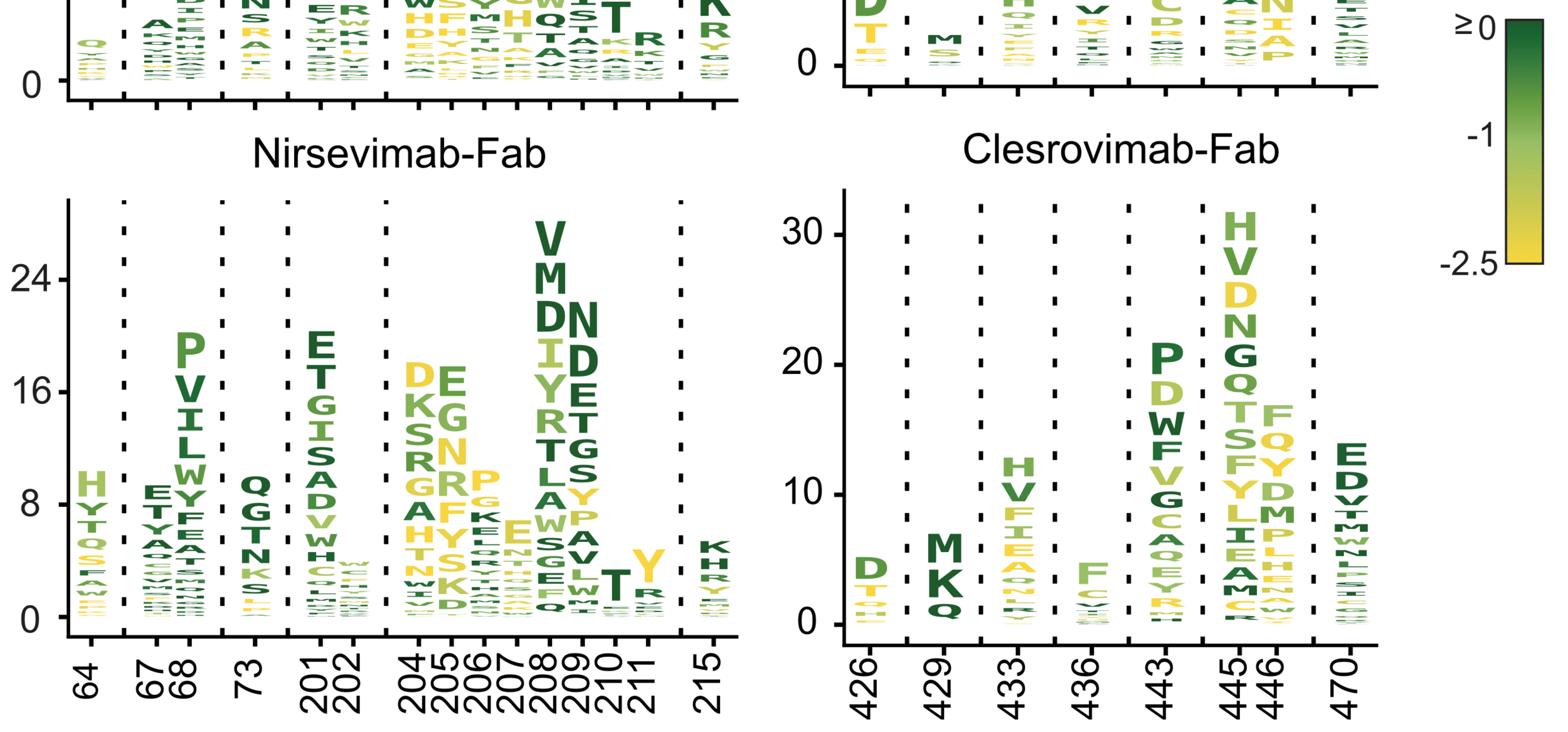
Letter heights indicate reduction in antibody neutralization, color indicates impact on F's cell entry function. These visualizations help quantify how constraint limits escape from different antibodies.
Nirsevimab
Clesrovimab
reduction in neutralization
site
cell entry function
Experimentally informed sequence surveillance
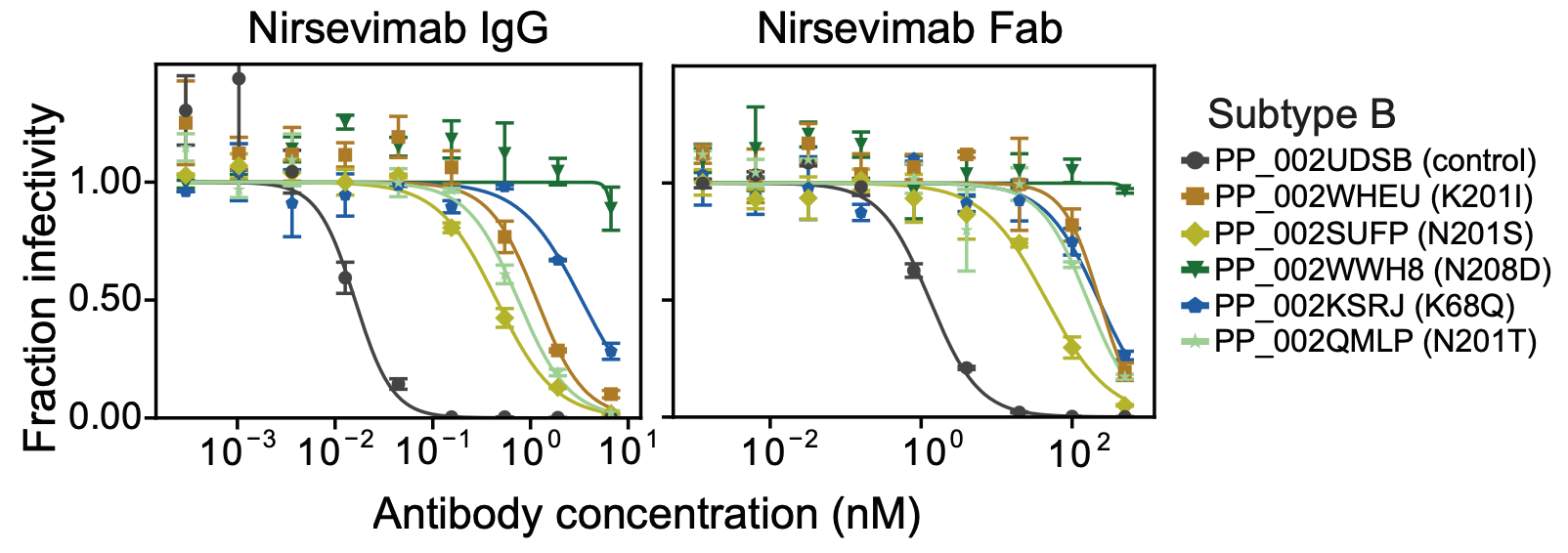
We can identify and validate natural strains with resistance
Conclusions
RSV antibodies are effective at preventing infant hospitalizations, but we need to be vigilant about potential resistance.
Difference in nirsevimab IgG resistance between RSV subtypes is explained by a biophysical model that accounts for different Fab potencies.
We have completely measured how RSV F mutations affect neutralization by antibodies in clinical use.
These data enable real-time surveillance for natural strains with resistance mutations.
Thanks




Cassie Simonich
Pediatrics Medical Fellow
Seattle Childrens / Fred Hutch
Teagan McMahon
Research Technician
Fred Hutch
Lucas Kampman (Grad Student, Fred Hutch)
Gavin Juviler (Research Tech, Fred Hutch)
Helen Chu (University of Washington)
Richard Neher (University of Basel)
These slides: https://slides.com/jbloom/grc-2026
Full data: https://dms-vep.org/RSV_Long_F_DMS/
Check out Lucas's poster about avidity based buffering of antibody escape