Flexible uncertainty quantification in medical imaging

12th CVPR Workshop on Medical Computer Vision
2026

 

Jeremias Sulam

50 years ago ... 
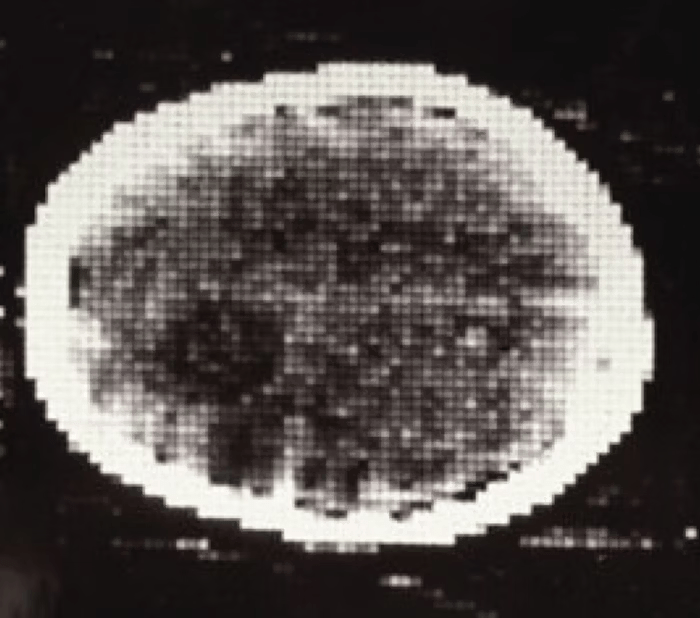
first CT scan

ELECTRIC & MUSICAL INDUSTRIES

50 years ago ... 

imaging
diagnostics

complete hardware & software description

human expert diagnosis and recommendations
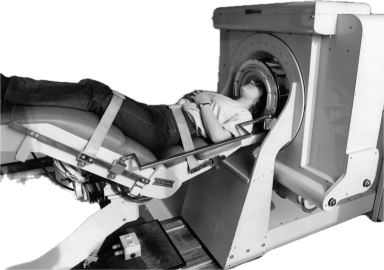
imaging was "simple"

... 50 years forward 

Data

Compute & Hardware

Sensors & Connectivity

Research & Engineering

... 50 years forward 

data-driven  imaging
automatic analysis and rec.
societal implications

Data

Compute & Hardware

Sensors & Connectivity

Research & Engineering
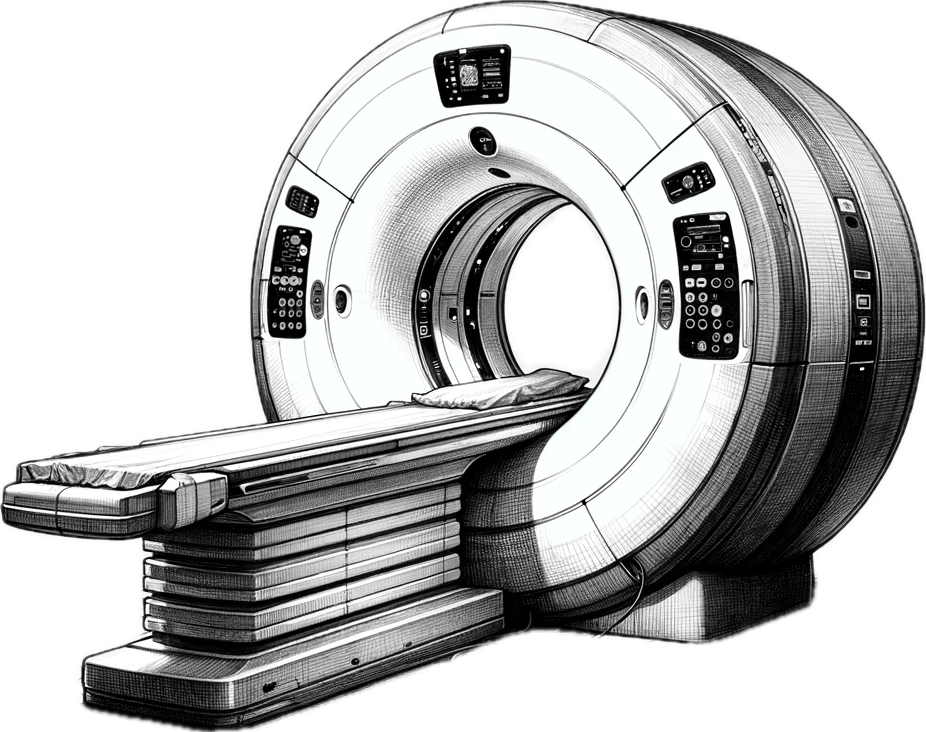
data-driven  imaging
automatic analysis and rec.
societal implications

Problems in trustworthy biomedical imaging

inverse problems

uncertainty quantification

robustness

generalization

demographic fairness

hardware & protocol optimization

model-agnostic interpretability

policy & regulation

monitoring & auditing

data-driven  imaging
automatic analysis and rec.
societal implications

Problems in trustworthy biomedical imaging

inverse problems

uncertainty quantification

robustness

generalization

demographic fairness

hardware & protocol optimization

model-agnostic interpretability

policy & regulation

monitoring & auditing

in a box

Denoiser

Measurements
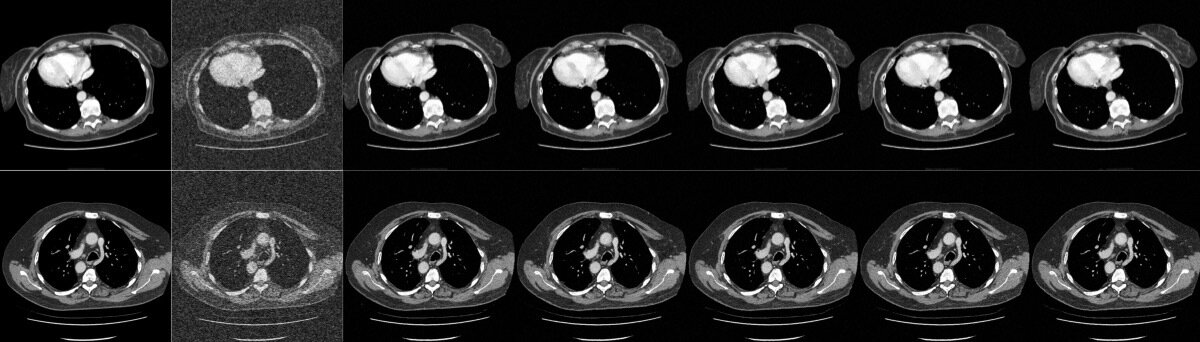
Reconstruction

Uncertainty Quantification in Inverse Problems

x^=fθ(y)\hat{x} = f_\theta(y)

pixelj\text{pixel}_j

x^j\hat{x}_j

(point predictors)

What is the uncertainty in the guess x^j\hat x_j?

y=Ax+ϵ,  ϵN(0,σ2I)y = Ax + \epsilon,~~\epsilon \sim \mathcal{N}(0, \sigma^2\mathbb{I})

How do we report uncertainty rigorously?

Measurements

y=Ax+ϵ,  ϵN(0,σ2I)y = Ax + \epsilon,~~\epsilon \sim \mathcal{N}(0, \sigma^2\mathbb{I})

Uncertainty Quantification in Inverse Problems

X^=F(y)Py\hat{X} = F(y) \sim \mathcal{P}_y

Sampling

in a box

Denoiser

pixelj\text{pixel}_j

x^j\hat{x}_j

(predictive distribution)

What is the uncertainty in the guess x^j\hat x_j?

How do we report uncertainty rigorously?

Mathematical tractability vs Complexity

in a box

simpler models

 more assumptions

any model

no assumptions

Denoiser

Linear models

Linear networks

Shallow

ReLU Networks

Just ask GPT

Conformal guarantees

Bayesian

MC Dropout

00

11

l(y)j l(y)_j

u(y)j u(y)_j

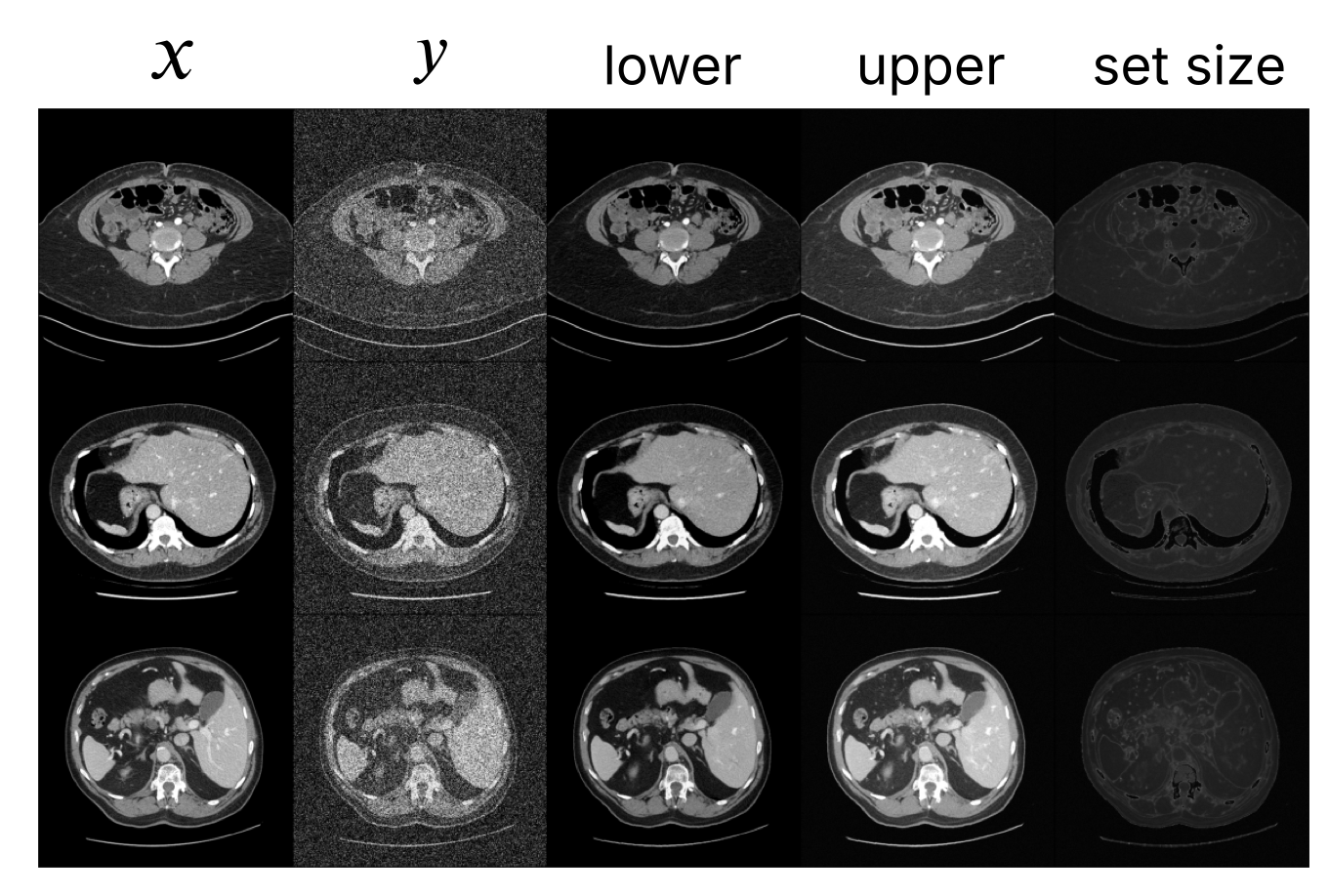
Uncertainty through Prediction Sets

How do we construct them?

  • pixel-wise mean ±\pm standard deviation
  • Quantile regression
  • MC-dropout (Gal & Ghahramani, 2016)
  • any other heuristics... 

C:yC(y)[0,1]dC: y \mapsto C(y) \subseteq [0,1]^d

C(y)j=[l(y)j,u(y)j]\mathcal C(y)_j = [l(y)_j,u(y)_j]

Conformal Risk Control (CRC)

(y,x)=1dj[d]1 ⁣{xjC(y)j}\ell(y,x) = \frac{1}{d} \sum_{j\in[d]} \mathbf{1}\!\left\{x_j \notin C(y)_j\right\}

00

11

l(y)j l(y)_j

u(y)j u(y)_j

Uncertainty through Prediction Sets

C:yC(y)[0,1]dC: y \mapsto C(y) \subseteq [0,1]^d

ground truth!

C(y)C(y) controls risk at level ϵ\epsilon if

"On average, no more than ϵ\epsilon pixels are outside the sets"

E ⁣[ ⁣(C(Y),X)]ϵ \mathbb{E}\!\left[\ell\!\bigl(C(Y), X\bigr)\right] \le \epsilon

\(x_j\)

Conformal Risk Control (CRC)

00

11

l(y)j l(y)_j

C(y)j\mathcal C(y)_j

u(y)j u(y)_j

λ\lambda

λ\lambda

C(y)j=[lj(y),uj(y)]    Cλ(y)j=[lj(y)λ,  uj(y)+λ] C(y)_j = [l_j(y),u_j(y)] \;\longrightarrow\; C_{\lambda}(y)_j = [l_j(y)-{\color{green}{\lambda}},\;u_j(y)+{\color{green}\lambda}]

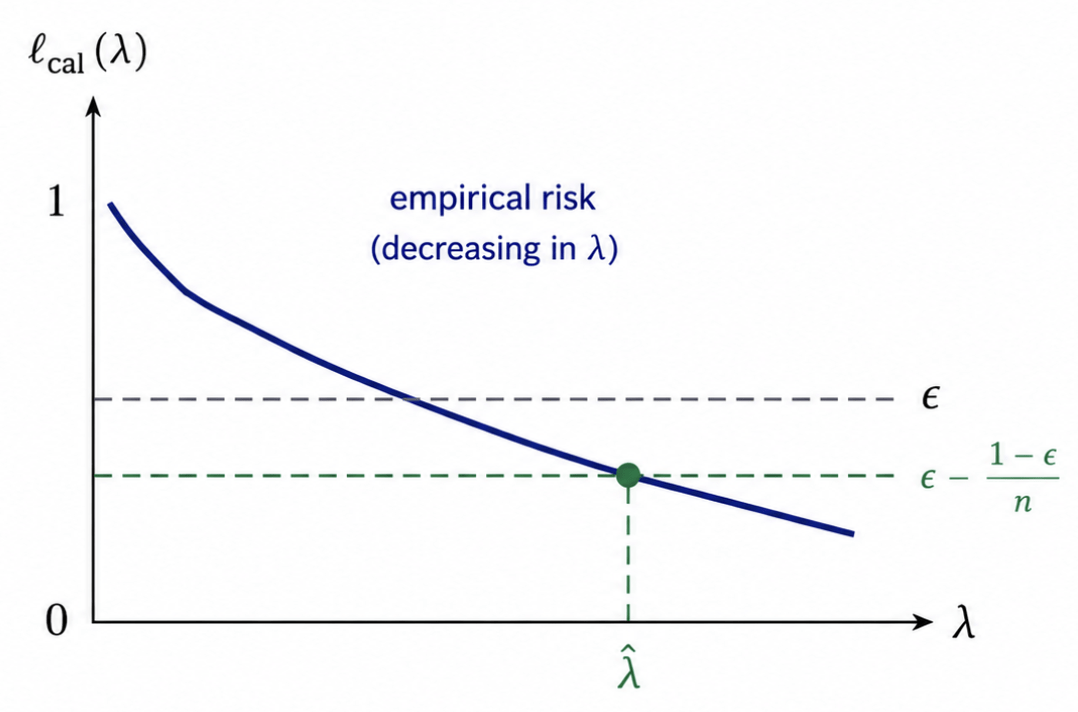
Given cal. set Scal={Xi,Yi}i=1nS_\text{cal}=\{X^i,Y^i\}_{i=1}^n,  let cal(λ)=1n(Cλ(Yi,Xi))\ell_\text{cal}(\lambda) = \frac1n\sum \ell(C_\lambda(Y^i,X^i))

λ^= smallest λ  so that  nn+1cal(λ)+11+nϵ\hat{\lambda} = \text{ smallest } \lambda ~~\text{so that}~~ \frac{n}{n+1 } \ell_\text{cal}(\lambda) + \frac1{1+n}\leq \epsilon

Lemma

[Angelopoulos et al, 2024]

Then,   E[(Cλ(Y),X)]ϵ\mathbb{E}\bigl[\ell(C_\lambda(Y),X)\bigr] \le \epsilon.

Conformal Risk Control (CRC)

00

11

l(y)j l(y)_j

C(y)j\mathcal C(y)_j

u(y)j u(y)_j

λ\lambda

λ\lambda

Cλ(y)j=[lj(y)λ,  uj(y)+λ]C_{\lambda}(y)_j = [l_j(y)-{\color{green}{\lambda}},\;u_j(y)+{\color{green}\lambda}]

Given cal. set Scal={Xi,Yi}i=1nS_\text{cal}=\{X^i,Y^i\}_{i=1}^n,  let cal(λ)=1n(Cλ(Yi,Xi))\ell_\text{cal}(\lambda) = \frac1n\sum \ell(C_\lambda(Y^i,X^i))

λ^= smallest λ  so that  nn+1cal(λ)+11+nϵ\hat{\lambda} = \text{ smallest } \lambda ~~\text{so that}~~ \frac{n}{n+1 } \ell_\text{cal}(\lambda) + \frac1{1+n}\leq \epsilon

Then,   E[(Cλ(Y),X)]ϵ\mathbb{E}\bigl[\ell(C_\lambda(Y),X)\bigr] \le \epsilon.

Lemma

[Angelopoulos et al, 2024]

High Dimensional Risk Control

Cλ(y)j=[lj(y)λ,  uj(y)+λ]C_{\lambda}(y)_j = [l_j(y)-{\color{green}{\lambda}},\;u_j(y)+{\color{green}\lambda}]

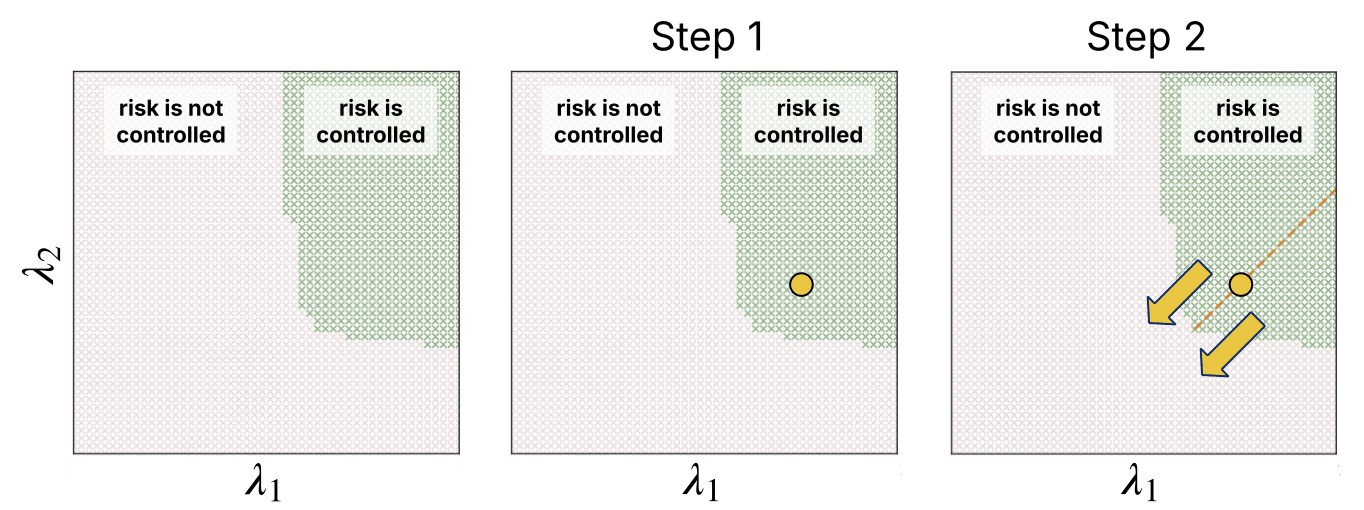
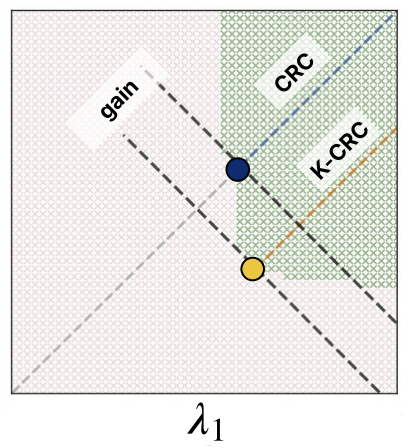
Observation 1:   Single λ\lambda for all dd dimensions... suboptimal

High dimensional alternative λRd:\boldsymbol{\lambda} \in \mathbb R^d:

λ=(λ1,λ2,,λd)\boldsymbol{\lambda} = (\lambda_1, \lambda_2, \dots, \lambda_d)

Cλ(y)j=[lj(y)λj,  uj(y)+λj]C_{\lambda}(y)_j = [l_j(y)-{\color{green}{\lambda_j}},\;u_j(y)+{\color{green}\lambda_j}]

Goal: minimize the mean interval length

minλRdj[d]λjs.t.E ⁣[(Cλ(X),Y)]ϵ \min_{\lambda \in \mathbb{R}^d} \sum_{j \in [d]} \lambda_j \quad \text{s.t.} \quad \mathbb{E}\!\left[\ell(C_{\boldsymbol{\lambda}}(X),Y)\right] \leq \epsilon

[Teneggi et al, 2023]

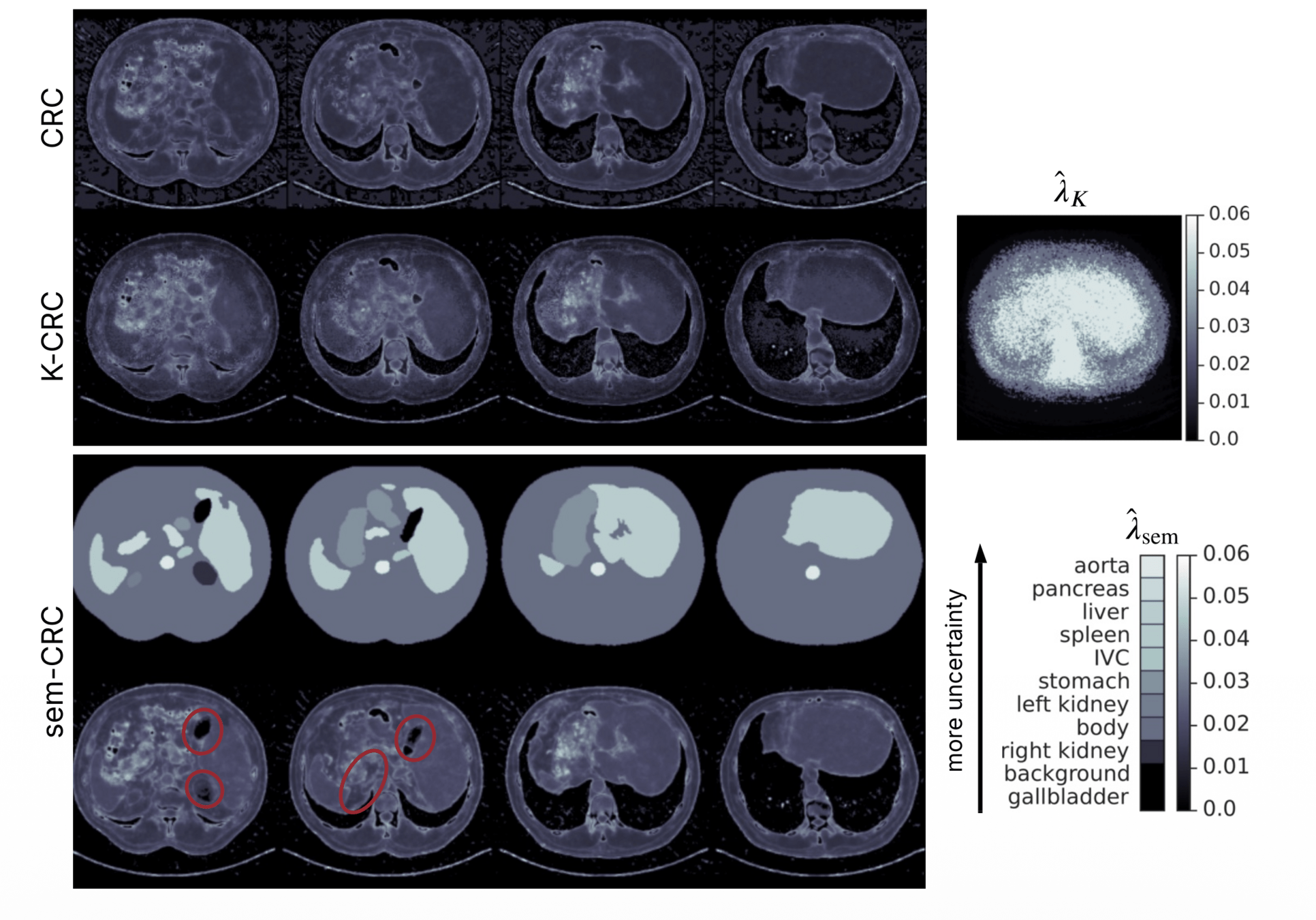
Semantic Risk Control

Cλ(y)j=[lj(y)λj,  uj(y)+λj]C_{\lambda}(y)_j = [l_j(y)-{\color{green}{\lambda_j}},\;u_j(y)+{\color{green}\lambda_j}]

Observation 2:   High-dim data is heterogenous
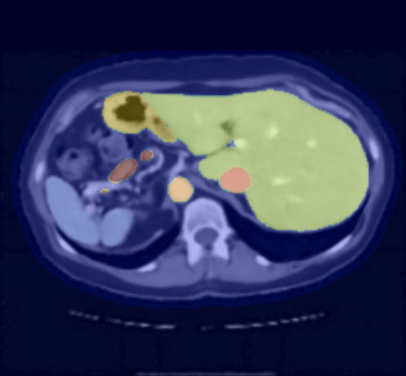
Let λ\lambda vary according to content/semantics (e.g. per organ via a segmentation model)

Cλ(y)j=[lj(y)λs(y)j,  uj(y)+λs(y)j]C_{\boldsymbol \lambda}(y)_j = [l_j(y)-{\color{green}{\lambda_{s(y)_j}}},\;u_j(y)+{\color{green}\lambda_{s(y)_j}}]

Segmentation model s(y):Y[K]ds(y) : \mathcal Y \to [K]^d

Semantic uncertainty λsem=(λ1,,λK)RK\boldsymbol{\lambda}_{\text{sem}} = (\lambda_1,\dots,\lambda_K) \in \mathbb R^K

Semantic Risk Control

1. Find an anchor λ~sem\tilde{\lambda}_\text{sem}:

λ~sem=argminλsemRK  k[K]skλks.t.^optγ ⁣(λsem)ϵ \tilde{\lambda}_{\mathrm{sem}} = \underset{\lambda_{\mathrm{sem}} \in \mathbb{R}^{K}}{\arg\min} \; \sum_{k \in [K]} s_k \lambda_k \quad \text{s.t.} \quad \hat{\ell}^{\gamma}_{\mathrm{opt}} \!\left(\lambda_{\mathrm{sem}}\right) \le \epsilon

^γ\hat{\ell}^\gamma: convex upper bound to (λ)\ell(\lambda)

2. Calibrate

λ^sem=λ~sem+ω1K, \hat{\lambda}_{\mathrm{sem}} = \tilde{\lambda}_{\mathrm{sem}} + \omega^\star \mathbf{1}_K, ω=inf{ω0:Rcal+ ⁣(λ~sem+ω1K)ϵ}. \omega^\star = \inf \left\{ \omega \ge 0 : R_{\mathrm{cal}}^{+} \!\left( \tilde{\lambda}_{\mathrm{sem}} + \omega \mathbf{1}_K \right) \le \epsilon \right\}.

\(s_k:\) expected size of organ \(k\)

Semantic Risk Control

2. Calibrate

λ^sem=λ~sem+ω1K, \hat{\lambda}_{\mathrm{sem}} = \tilde{\lambda}_{\mathrm{sem}} + \omega^\star \mathbf{1}_K, ω=inf{ω0:Rcal+ ⁣(λ~sem+ω1K)ϵ}. \omega^\star = \inf \left\{ \omega \ge 0 : R_{\mathrm{cal}}^{+} \!\left( \tilde{\lambda}_{\mathrm{sem}} + \omega \mathbf{1}_K \right) \le \epsilon \right\}.

1. Find an anchor λ~sem\tilde{\lambda}_\text{sem}:

λ~sem=argminλsemRK  k[K]skλks.t.^optγ ⁣(λsem)ϵ \tilde{\lambda}_{\mathrm{sem}} = \underset{\lambda_{\mathrm{sem}} \in \mathbb{R}^{K}}{\arg\min} \; \sum_{k \in [K]} s_k \lambda_k \quad \text{s.t.} \quad \hat{\ell}^{\gamma}_{\mathrm{opt}} \!\left(\lambda_{\mathrm{sem}}\right) \le \epsilon

Guarantee

For any segmentation model \(s(Y)\in[K]\), any \(\epsilon > 0\) and exchangeable and independent calibration samples,


\[ \mathbb{E}\!\left[ \ell\!\left(\mathcal C_{\hat{\lambda}_{\mathrm{sem}}}(Y),X\right) \right] \le \epsilon . \]

Experiments

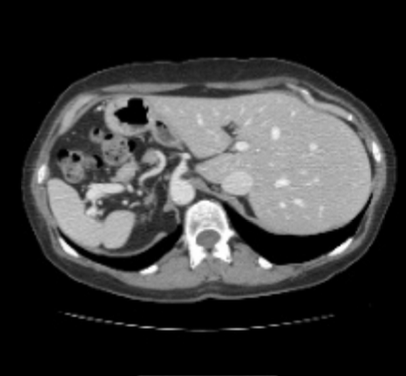
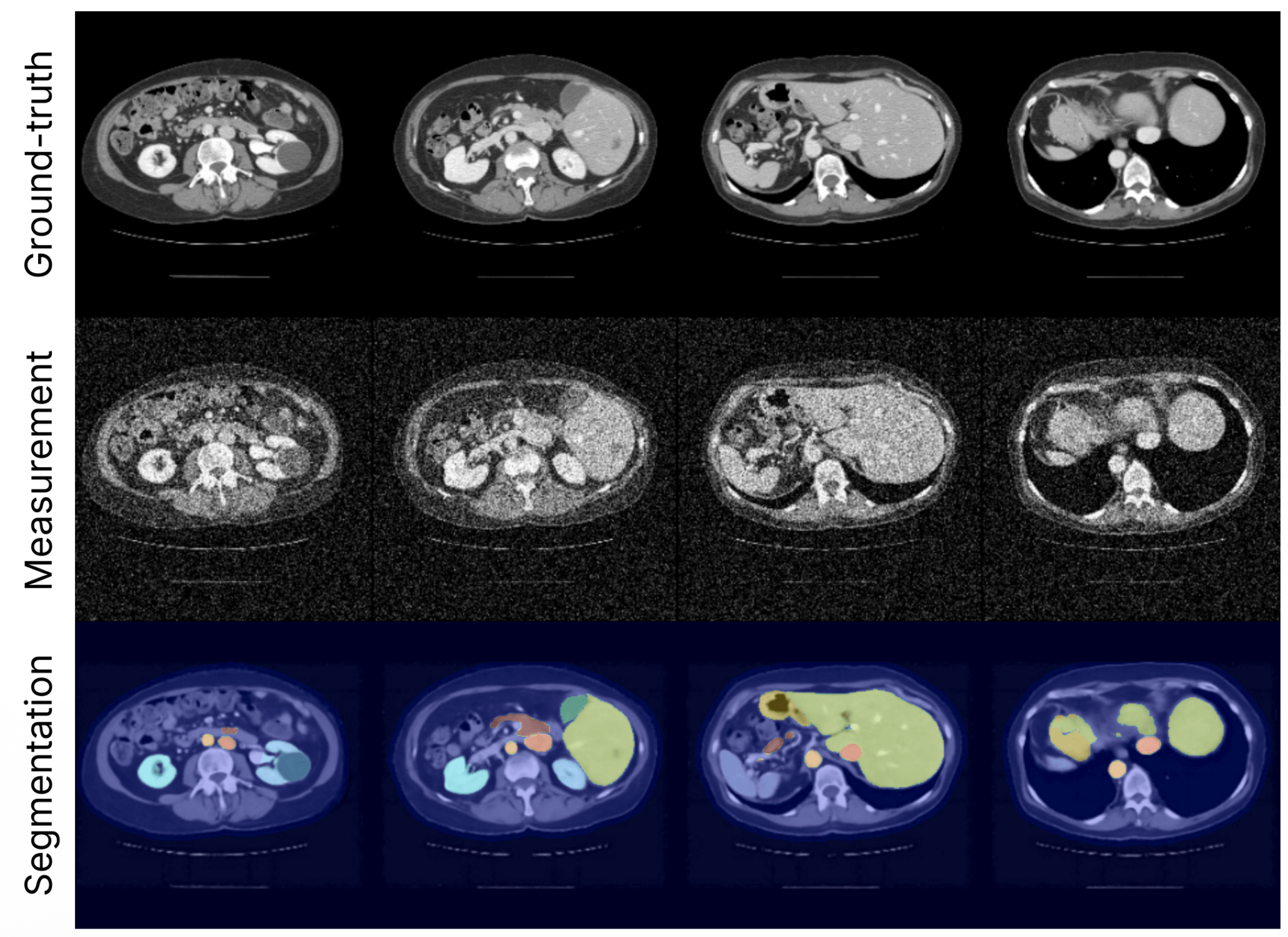
  • CT reconstruction on TotalSegmentor (Wasserthal et al. 2023)
  • Quantile Regression (Unet) for heuristic l(y)l(y) and u(y)u(y)

Experiments

  • CT reconstruction on TotalSegmentor (Wasserthal et al. 2023)
  • Quantile Regression (Unet) for heuristic l(y)l(y) and u(y)u(y)
  • Segmentation via SuPrem (Li, Yuille, and Zhou 2024)
spleen, kidneys, gallbladder, liver, stomach, aorta, inferior vena cava (IVC), pancreas

Semantic risk control

Semantic risk control
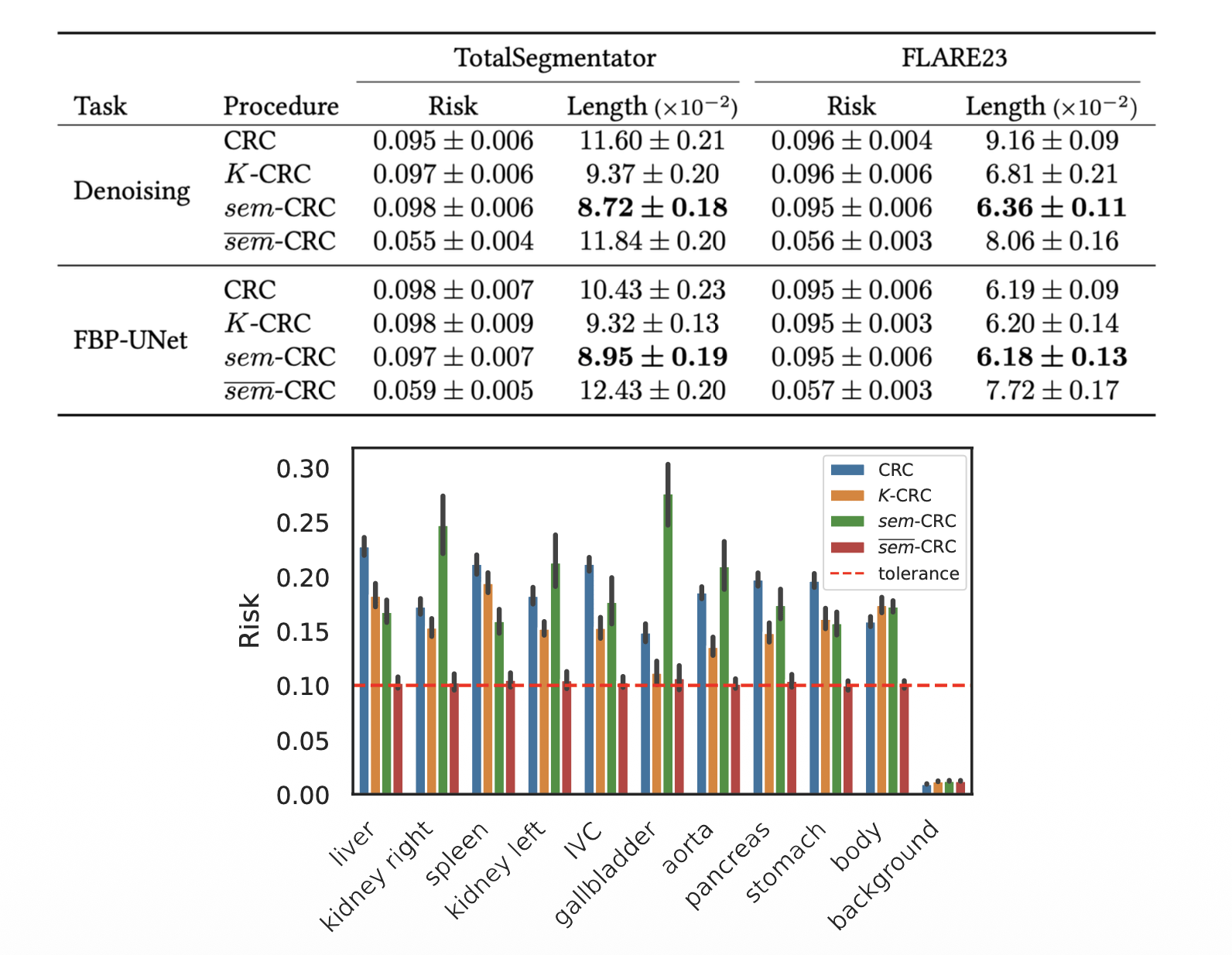
risk controlled uniformly for every organ

Recap

  • Conformal prediction allows for flexible UQ, with minimal assumptions
     

  • In high-dimensional settings, K-CRC allows for optimizing mean interval lengths
     

  • When samples are heterogeneous, semantic CRC allows for input-specific semantic calibration

Acknowledgements
Jacopo Teneggi 

sem-CRC   https://github.com/Sulam-Group/semantic_uq

K-CRC     https://github.com/Sulam-Group/k-rcps

Funding: NSF CAREER Award CCF 2239787 and NIH R01CA287422

Teneggi, J., Tivnan, M., Stayman, W., & Sulam, J. 
How to trust your diffusion model: A convex optimization approach to conformal risk control. 
ICML 2023


Teneggi, J., Stayman, J. W., & Sulam, J. 
Conformal risk control for semantic uncertainty quantification in computed tomography. 
MICCAI 2025

policy & regulation

robustness

generalization

uncertainty quantification