Introduction to Snakemake
Köster lab
University of Duisburg-Essen
2026
- check computational validity
- apply same analysis to new data
- check methodological validity
- understand analysis
Data analysis
Reproducibility
Transparency
- modify analysis
- extend analysis
Adaptability
>1.6 million downloads since 2015
>3000 citations
>14 citations per week in 2024


dataset
results
dataset
dataset
dataset
dataset
dataset
Define workflows
in terms of rules
Define workflows
in terms of rules
rule mytask:
    input:
        "path/to/{dataset}.txt"
    output:
        "result/{dataset}.txt"
    script:
        "scripts/myscript.R"


rule myfiltration:
     input:
        "result/{dataset}.txt"
     output:
        "result/{dataset}.filtered.txt"
     shell:
        "mycommand {input} > {output}"


rule aggregate:
    input:
        "results/dataset1.filtered.txt",
        "results/dataset2.filtered.txt"
    output:
        "plots/myplot.pdf"
    script:
        "scripts/myplot.R"
Define workflows
in terms of rules
Define workflows
in terms of rules
rule mytask:
    input:
        "data/{sample}.txt"
    output:
        "result/{sample}.txt"
    shell:
        "some-tool {input} > {output}"
rule name
how to create output from input
define
- input
- output
- log files
- parameters
- resources
rule mytask:
    input:
        "path/to/{dataset}.txt"
    output:
        "result/{dataset}.txt"
    script:
        "scripts/myscript.R"


rule myfiltration:
     input:
        "result/{dataset}.txt"
     output:
        "result/{dataset}.filtered.txt"
     shell:
        "mycommand {input} > {output}"


rule aggregate:
    input:
        "results/dataset1.filtered.txt",
        "results/dataset2.filtered.txt"
    output:
        "plots/myplot.pdf"
    script:
        "scripts/myplot.R"
Automatic inference of DAG of jobs
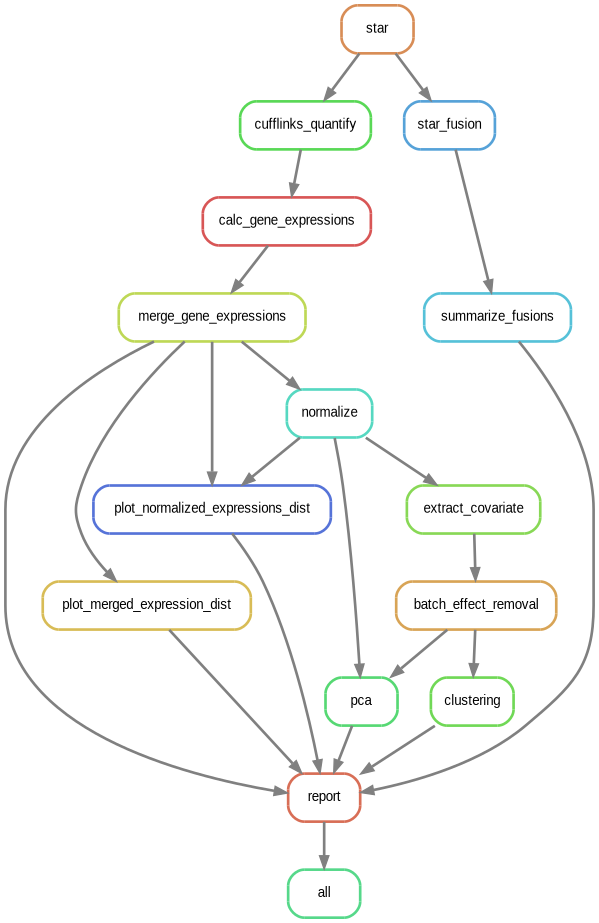
Boilerplate-free integration of scripts
rule mytask:
    input:
        "data/{sample}.txt"
    output:
        "result/{sample}.txt"
    script:
        "scripts/myscript.py"
reusable scripts:
- Python
- R
- Julia
- Rust
- Bash
- Xonsh
- Hy
import pandas as pd

data = pd.read_table(snakemake.input[0])
data = data.sort_values("id")
data.to_csv(snakemake.output[0], sep="\t")
Python:
data <- read.table(snakemake@input[[1]])
data <- data[order(data$id),]
write.table(data, file = snakemake@output[[1]])
Boilerplate-free integration of scripts
R:
import polar as pl

pl.read_csv(&snakemake.input[0])
  .sort()
  .to_csv(&snakemake.output[0])
Rust:
$XONSH_TRACEBACK_LOGFILE = snakemake.log[0]

xsv sort -s id @(snakemake.input[0]) > @(snakemake.output[0])
Xonsh:
(import pandas :as pd)

(setv data (pd.read_table (get snakemake.input 0)))
(setv data (.sort_values data "id"))
(.to_csv data (get snakemake.output 0) :sep "\t")
Hy:
#!/usr/bin/env bash
exec 2> "${snakemake_log[0]}"

xsv sort -s id ${snakemake_input[0]} > ${snakemake_output[0]}
Bash:
Reusable wrappers
rule map_reads:
    input:
        "{sample}.bam"
    output:
        "{sample}.sorted.bam"
    wrapper:
        "0.22.0/bio/samtools/sort"
reuseable wrappers from central repository
Reusable wrappers
job selection
job resource usage
free resources
job temp file consumption
temp file lifetime fraction
job priority
job thread usage
Scheduling
temp file size
temp file deletion
DAG partitioning
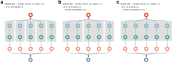
--groups a=g1 b=g1
--groups a=g1 b=g1
--group-components g1=2
--groups a=g1 b=g1
--group-components g1=5
Scalable to any platform


workstation
compute server
cluster
grid computing
cloud computing



rule mytask:
    input:
        "path/to/{dataset}.txt"
    output:
        "result/{dataset}.txt"
    conda:
        "envs/some-tool.yaml"
    shell:
        "some-tool {input} > {output}"
Conda integration
channels:
 - conda-forge
dependencies:
  - some-tool =2.3.1
  - some-lib =1.1.2
Container integration
rule mytask:
    input:
        "path/to/{dataset}.txt"
    output:
        "result/{dataset}.txt"
    container:
        "docker://biocontainers/some-tool:2.3.1"
    shell:
        "some-tool {input} > {output}"
Self-contained HTML reports
Interoperability with other WMS
rule chipseq_pipeline:
    input:
        input="design.csv",
        fasta="data/genome.fasta",
        gtf="data/genome.gtf",
        # any --<argname> pipeline file arguments can be given here as <argname>=<path>
    output:
        report="results/multiqc/broadPeak/multiqc_report.html",
    params:
        pipeline="nf-core/chipseq",
        revision="2.0.0",
        profile=["test", "docker"],
        outdir=subpath(output.report, ancestor=2),
        # any --<argname> pipeline arguments can be given here as <argname>=<value>
    handover: True
    wrapper:
        "v7.2.0/utils/nextflow"
Many more features
- dynamic DAG rewiring
- service jobs (providing sockets, loading databases, or ramdisks)
- semantic helper functions for minimizing boilerplate code
- fallible rules
- caching of shared results across workflows
- transparent handling of remote storage
- semantic helper functions
- access pattern annotation
Extensible architecture

Extensible architecture
Conclusion
Snakemake covers all aspects of fully reproducible, transparent, and adaptable data analysis, offering
- maximum readability
- ad-hoc integration with scripting and high performance languages
- an extensible architecture
- a plethora of advanced features
https://snakemake.github.io