Day 4:
Manipulating inequalities and the triangle inequality
Proposition. If \(x\in(1,2)\), then \(x^2-3x+2<0\).
Proof. Assume \(x\in(1,2)\). By assumption we have \(x>1\) and \(x<2\). From these we can deduce that \(x-1>0\) and \(x-2<0\). Hence, their product is negative, that is,
\[x^2-3x+2 = (x-2)(x-1)<0.\ \Box\]
Proposition. If \(x\in(-1,1)\), then \(x^2-x-5<0\).
Proof. Assume \(x\in(-1,1)\). The assumption that \(x>-1\) implies
\[x+1>0\] The assumption that \(x<1\) implies \(x<2\), and thus
\[x-2<0.\]
Thus we have
\[x^2-x-2 = (x-2)(x+1)<0.\] Adding \(-3\) we obtain
\[x^2-x-5<-3.\] Since \(-3<0\) we obtain the desired conclusion. \(\Box\)
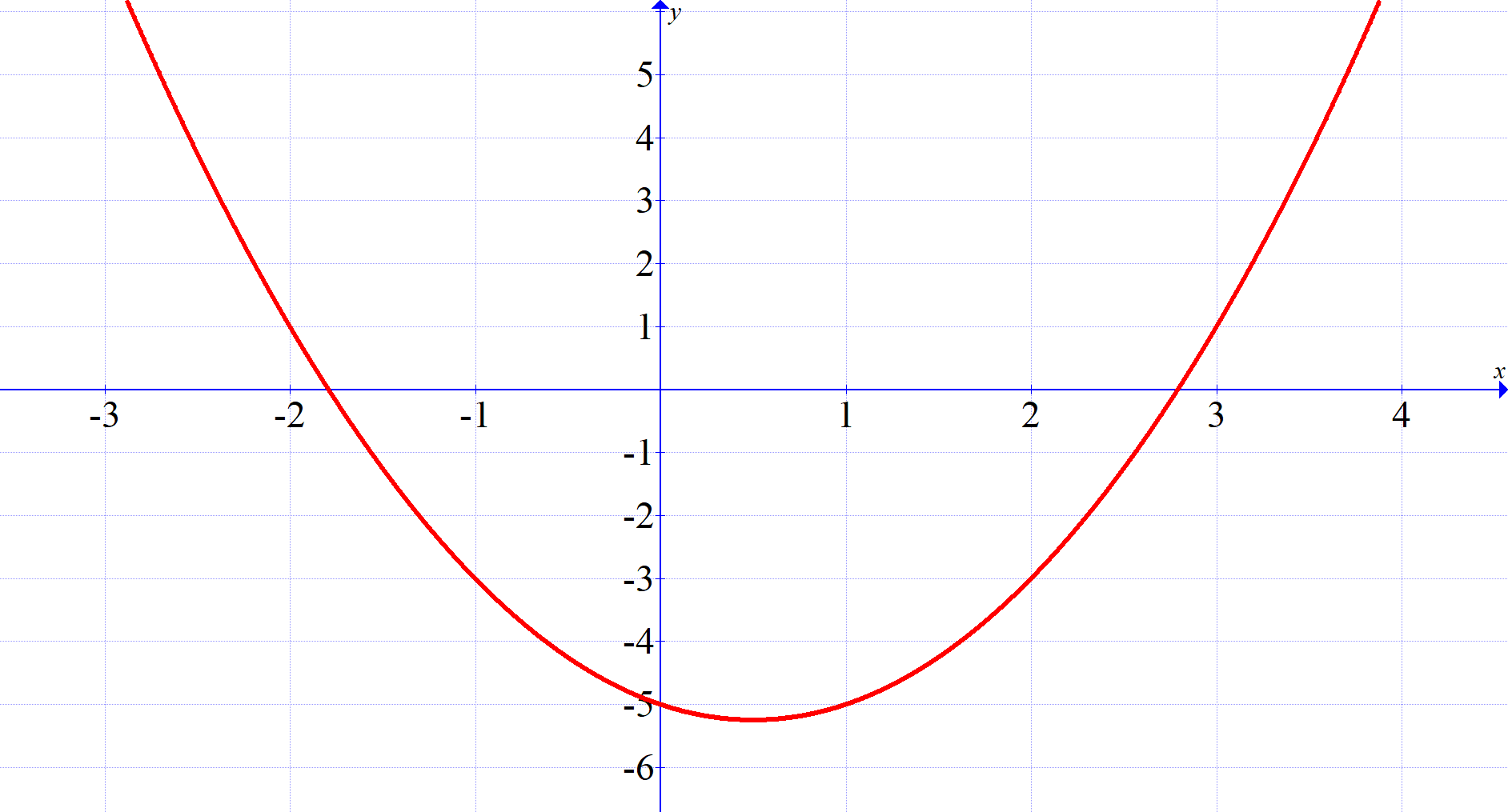
The graph of \(y=x^2-x-5\) is shown below:
Proposition. If \(|x-3|<1\), then \(|x|<\)
4
Proof. Assume \(|x-3|<1\), then by the Triangle Inequality we have
\[|x| = |(x-3)+3|\leq |x-3|+|3| = |x-3|+3<1+3=4.\ \Box\]
Proof. Assume \(|x-3|<1\). This implies that
\[-1<x-3<1\]
and hence \[2<x<4.\] From this we see that \(x>0\) and hence \[|x|=x<4.\ \Box.\]