Real Analysis
Winter 2025
Part 1:
Sets
(See Chapter 1 in Book of Proof)
The central objects in mathematics are sets. A set is a collection of things. The things in a set are called elements.
Sets
Often, we denote a set by simply writing all the elements between \(\{\}\) ("curly braces") separated by commas. For example,
\[\{1,2,4,5\}\]
is the set with four elements, these elements being \(1,2,4,\) and \(5\).
We often give sets names, these will frequently be a single capital roman letter, for example, \[B = \{1,2,4,5\}.\]
To express the statement "\(x\) is an element of \(A\)" we write \(x\in A\). Thus, given the set \(B\) defined above, we see that \(1\in B\) is a true statement, and \(3\in B\) is a false statement.
We will also write \(x\notin A\) to for the statement "\(x\) is not an element of \(A\)."
Equality of sets
Two sets \(A\) and \(B\) are equal (they are the same set) if they contain exactly the same elements, that is, the following two statements hold:
If \(x\in A\), then \(x\in B\).
If \(x\in B\), then \(x\in A\).
In this case we write \(A=B\).
Important example:
Important example: Consider the sets \(A=\{1,2,2,3\}\) and \(B=\{1,2,3\}\). We can easily see that every element of \(A\) is an element of \(B\), and every element of \(B\) is an element of \(A\). Thus
\[\{1,2,2,3\}=\{1,2,3\}.\]
An element is either in a set or it is not. Sets cannot contain multiple copies of an element.
Subsets
Given two sets \(A\) and \(B\), if every element of \(A\) is also an element of \(B\), then we say that \(A\) is a subset of \(B\), and write \(A\subset B\) or \(A\subseteq B\) (these both mean the exact same thing). For example,
\[\{1,2\}\subset\{1,2,4,5\}\]
but \(\{1,2,3\}\) is not a subset of \(\{1,2,4,5\}\) since \(3\in\{1,2,3\}\) and \(3\notin\{1,2,4,5\}\)
Note that the statement "\(A=B\)" can be rewritten as "\(A\subset B\) and \(B\subset A.\)" This will be very useful later.
Ellipsis notation
The set of integers is denoted \(\mathbb{Z}\). The set of positive integers, also called the natural numbers or the naturals, is denoted \(\mathbb{N}\) or \(\mathbb{Z}^{+}\).
We will sometimes write sets like \(\mathbb{N}\) and \(\mathbb{Z}\) with ellipsis notation, as follows,
\[\N=\{1,2,3,\ldots\}\qquad \Z = \{\ldots,-2,-1,0,1,2,3,\ldots\}\]
In this notation, we list the first several elements of a set, until there is an apparent pattern, then write an ellipsis (...). After the ellipsis we write the final element in the pattern. If no element is written after the ellipsis, then the list of elements goes on without end.
Examples.
- \(\{2,4,6,8,\ldots\}\) is the set of even positive integers.
- \(\{3,7,11,15,\ldots,43\}=\{3,5,7,11,15,19,23,27,31,35,39,43\}\)
Problems with ellipsis notation
Consider the set
\[C:=\{2,4,8,\ldots\}.\]
Questions:
Is \(16\in C\)? Is \(14\in C\)?
What is the pattern? Is the \(n\)th term in the sequence \(2^{n}\) or \(n^2-n+2\) or something else?
It's not clear!
Suppose \(N\in\mathbb{N}\) and define the set
\[D:=\{2,4,6,\ldots,2N\}.\] If \(N=5\), then
\[D = \{2,4,6,\ldots,10\}=\{2,4,6,8,10\}\]
but if \(N=2\), then
\[D = \{2,4,6,\ldots,4\}(?)\]
We will interpret this set as \(\{2,4\}\).
Set builder notation
Let \(A\) be a set, and \(S(x)\) denote a statement whose truth value depends on \(x\in A\). The set of \(x\in A\) such that \(S(x)\) is true is denoted
\[\{x\in A : S(x)\}\quad\text{or}\quad \{x\in A\mid S(x)\}\quad\text{or}\quad \{x : x\in A\text{ and }S(x)\}.\]
Both the colon and the vertical line are read as "such that" or "with the property that."
Example. Consider the set of even positive integers:
\[\{x\in\mathbb{N} : x\text{ is even}\}.\]
This would be read:
"The set of \(x\) in the natural numbers such that \(x\) is even."
Using the notation from the above definition we have \(A=\N\) and \(S(x)\) is the statement "\(x\) is even"
Set builder notation
More generally, let \(A\) be a set. For each \(x\in A\) let \(f(x)\) be an expression that depends on \(x\) and \(S(x)\) denote a statement whose truth value depends on \(x\in A\). The set of all elements of the form \(f(x)\) with the property that \(x\in A\) and \(S(x)\) is true is denoted
\[\{f(x) : x\in A\text{ and }S(x)\}.\]
Example. Consider the set of even positive integers:
\[\{2x: x\in \N\}.\]
In the notation of the above definition we have \(A=\N\), \(f(x) = 2x\), and \(S(x)\) is true for all \(x\in\N\).
Using set builder notation we can disambiguate the sets from two slides prior:
\[\{2^{n} : n\in\mathbb{N}\}\quad\text{and}\quad\{n^2-n+2 : n\in\mathbb{N}\}.\]
Examples.
- \(\{2n-1 : n\in\N\text{ and }n\leq 5\} = \{1,3,5,7,9\}\)
- \(\{25-4n : n\in\N\text{ and }n\leq 10\text{ and } n>5\} = \{1,-3,-7,-11,-15\}\)
Consider the set
\[\{x\in\mathbb{R} : x^{2}+1 = 0\}.\]
There does not exist a real number \(x\) such that \(x^{2}+1=0\), and hence this set does not contain any elements!
The set containing no elements is called the empty set. The empty set is denoted \(\varnothing\) or \(\{\}\).
Part 2:
Proofs and Logic
(See Chapters 2,4,5 & 6 in Book of Proof)
Proposition 1. \(\{n\in\mathbb{Z} : n+1\text{ is odd}\} = \{2n : n\in\mathbb{Z}\}.\)
Proving sets are equal.
Proof. First we will show that \(\{n\in\mathbb{Z} : n+1\text{ is odd}\} \subset \{2n : n\in\mathbb{Z}\}.\) Let \(m\in\{n\in\mathbb{Z} : n+1\text{ is odd}\}\) be arbitrary. This implies that \(m+1\) is odd, that is, there exists \(k\in\Z\) such that \(m+1=2k+1.\) Subtracting \(1\) from both sides we deduce \(m=2k\), and hence \(m\in \{2n : n\in\Z\}.\)
Next, we will show \(\{2n:n\in\mathbb{Z}\}\subset\{n\in\mathbb{Z} : n+1\text{ is odd}\}\).
Let \(p\in\{2n:n\in\mathbb{Z}\}\) be arbitrary. Then, there exists \(q\in\mathbb{Z}\) such that \(p=2q\), and hence \[p+1 = 2q+1.\] Since \(q\in\mathbb{Z}\), we conclude that \(p+1\) is odd, and hence
\(p\in\{n\in\mathbb{Z} : n+1\text{ is odd}\}.\) \(\Box\)
Definition. An integer \(n\) is even if there exists an integer \(k\) such that \(n=2k\). An integer \(n\) is odd if there exists an integer \(p\) such that \(n=2p+1\).
Proposition 2. If \(n\in\Z\) is odd, then \(n^{2}\) is odd.
Proving implications (Direct proof)
\(A : n\) is odd
\(B : n^{2}\) is odd
We wish to prove the implication \(A\Rightarrow B\). We will use a direct proof, that is, we will assume \(A\), argue directly to \(B\).
Proof. Suppose \(n\in\Z\) is odd. By definition, this means that there exists \(k\in\Z\) such that \(n=2k+1\). This implies
\[n^{2} = (2k+1)^{2} = 4k^{2}+4k+1 = 2(2k^{2}+2k)+1.\]
Since \(2k^{2}+2k\) is an integer, we conclude that \(n^{2}\) is odd. \(\Box\)
Proposition 3. Suppose \(n\in\Z\). If \(n^{2}\) is even, then \(n\) is even.
Proving implications (Contrapositive proof)
\(A : n^{2}\) is even
\(B : n\) is even
We wish to prove \(A\Rightarrow B\). Instead, we can prove the equivalent statement \((\sim\! B)\Rightarrow(\sim\!A)\), where \(\sim\!A\) denotes the negation of the statement \(A\). The statement \((\sim\! B)\Rightarrow(\sim\!A)\) is called the contrapositive of the statement \(A\Rightarrow B\).
Proof. Suppose \(n\in\Z\) is not even. This implies that \(n\) is odd. By the previous proposition we see that \(n^{2}\) is odd, and therefore \(n^{2}\) is not even. \(\Box\)
In words, the contrapositive of the above proposition takes the form:
Suppose \(n\in\Z\). If \(n\) is not even, then \(n^{2}\) is not even.
Proposition 4. Suppose \(a,b,c\in\Z\). If \(a^{2}+b^{2}=c^{2}\), then either \(a\) is even or \(b\) is even.
Proving implications (Proof by contradiction)
\(A : a^{2}+b^{2}=c^{2}\)
\(B : a\) is even or \(b\) is even
We wish to prove \(A\Rightarrow B\). Instead, we can prove the equivalent implication \(A\wedge(\sim\!B)\Rightarrow C\wedge(\sim\!C)\) for any(!) statement \(C\). That is, we assume \(A\) and \(\sim\!B\), and we argue that some statement \(C\) and it's negation \(\sim\!C\) both hold. This is called proof by contradition.
The statement we will actually prove is:
If there are integers \(a,b,c\) such that both \(a\) and \(b\) are odd, and \(a^{2}+b^{2}=c^{2}\), then \(4\) divides \(2\). Since it is obvious that \(4\) does not divide 2, we are proving \[A\wedge(\sim\!B)\Rightarrow C\wedge(\sim\!C)\] where \(C:\) 4 divides 2.
(Note that \(A\Rightarrow B\) is the same as \((\sim\!A)\vee B\), hence, in proof by contradiction, we begin by assuming the negation \(A\wedge(\sim\!B)\) of the statement we are trying to prove.)
Proposition 4. Suppose \(a,b,c\in\Z\). If \(a^{2}+b^{2}=c^{2}\), then either \(a\) is even or \(b\) is even.
Proof. Assume toward a contradiction that there are integers \(a,b,c\) such that \(a\) and \(b\) are both odd, and \(a^{2}+b^{2}=c^{2}\). By definition there exist integers \(k,p\in\Z\) such that \(a=2k+1\) and \(b=2p+1\). Note that
\[c^{2} = a^{2}+b^{2} = (2k+1)^{2}+(2p+1)^{2} = 4k^{2}+4k+4p^{2}+4p+2.\] From this we see that \(c^{2}\) is even, and by the previous proposition \(c\) is even. By definition there exists \(m\in\Z\) such that \(c=2m\). Using the above equation we see that
\[4(k^{2}+k+p^{2}+p)+2 = c^{2} = (2m)^{2} = 4m^{2}.\] Rearranging we have
\[4(m^{2}-k^{2}-k-p^{2}-p) = 2.\]
This last equation implies that \(2\) is divisible by \(4\). Since we know that \(2\) is not divisible by \(4\), this gives the desired contradiction. \(\Box\)
Proposition 3. Suppose \(n\in\Z\). If \(n^{2}\) is even, then \(n\) is even.
Contrapositive vs. Contradiction
Proof. Assume toward a contradiction that \(n\) is not even and \(n^{2}\) is even. This implies that \(n\) is odd, that is \(n=2k+1\) for some \(k\in\Z\). Squaring, we obtain
\[n^{2} = 4k^{2}+4k+1=2(2k^{2}+2k)+1.\]
Since \(2k^{2}+2k\) is an integer, this shows that \(n^{2}\) is odd. This contradicts the fact that \(n^{2}\) is even.\(\Box\)
Proof by contradiction: \(A\wedge(\sim\!B)\Rightarrow C\wedge(\sim\!C)\)
Contrapositive: \((\sim\!B)\Rightarrow(\sim\!A)\)
Fake proof by contradiciton: \(A\wedge(\sim\!B)\Rightarrow A\wedge(\sim\!A)\)
Moral: If your proof by contradiction concludes with \(\sim\!A\), then you should use proof by contrapositive instead!
Universal quantifier
\(A : n^{2}\) is even
\(B : n\) is even
Note that \(A\) and \(B\) below are not statements. They're truth value depends on \(n\).
These are more precisely called open sentences (or predicates or propositional functions). They should really have variables
\(A(n) : n^{2}\) is even
\(B(n) : n\) is even
Proposition 3. Suppose \(n\in\Z\). If \(n^{2}\) is even, then \(n\) is even.
Recall the proposition:
Now, Proposition 3 can be more precisely written as \[\forall\,n\in\Z,\ A(n)\Rightarrow B(n).\]
Where the symbol \(\forall\) stands for "for all" or "for every," and is called the universal quantifier.
Note that \(A(n) : n^{2}\) is even, is false unless \(n\in\Z\).
Recall that for false statements \(A\), the statement \(A\Rightarrow B\) is true for any statement \(B\). (In this case \(A\Rightarrow B\) is called a vacuously true statement.)
Thus, in the statement \(\forall\,n\in\Z,\ A(n)\Rightarrow B(n)\) the universal quantifier isn't really necessary. It would be very common to see Proposition 3 written as
Proposition 3. If \(n^{2}\) is even, then \(n\) is even.
The universal quantifier "For all \(n\in\Z\)" is there, it's just not written.
Moral: In math we often omit the universal quantifier before an implication.
Existential quantifier
To say that an open sentence \(A(x)\) is true for all \(x\) in a set \(X\) we use the universal quantifier:
\[\forall\,x\in X,\ A(x).\]
In math, we would write this using words:
"For all \(x\in X\), \(A(x)\) is true."
To say that an open sentence \(A(x)\) is true for at least one \(x\) in a set \(X\) we use the existential quantifier \[\exists\, x\in X,\ A(x).\] In words:
"There exists \(x\in X\) such that \(A(x)\) is true."
Universally quantified statements may be more common, but here is an example of a statement that is not:
"The polynomial \(x^{5}+5x^3+10\) has a real root."
Do you see that this statement is of the form \(\exists\, x\in X,\ A(x)\). What are the set \(X\) and the open sentence \(A(x)\)?
Order of quantifiers
Consider the following two statements:
\(A:\ \) For every even \(n\in\N\) there exists an odd \(m\in\N\) such that \(m>n\).
\(B:\ \) There exists odd \(m\in\N\) such that for all even \(n\in\N\), it is true that \(m>n\).
Because it sounds better in English, we will often write \(B\) as
\(B:\ \) There exists odd \(m\in\N\) such that \(m>n\) for all even \(n\in\N\).
Let \(E\) denote the set of even natrual numbers, and let \(D\) denote the set of odd natural numbers. Using symbols, we can write \(A\) and \(B\) as follows: \[A: \forall\, n\in E,\ \exists\,m\in D,\ m>n\]
\[B: \exists\,m\in D,\ \forall\, n\in E,\ m>n\]
Moral: \(A\) is true, and \(B\) is false. The order of the quantifiers matters. You must think hard to figure out the meaning of a statement, there is no shortcut!
Proving universally quantified statements
Every universally quantified statement can be converted to an implication:
\[\forall\, x\in X,\ A(x)\]
is the same as
\[(x\in X)\Rightarrow A(x)\]
Thus, to prove this statement we take an "arbitrary" element \(x\in X\), then reason that \(A(x)\) is true for that \(x\). The proof looks like
Proof. Let \(x\in X\) be arbitrary.
\[\vdots\]
\[\vdots\]
Therefore, \(A(x)\). \(\Box\)
For example, let's say we want to prove the following statement:
Proposition. For every even number \(n\in\N\), the number \(n^2+1\) is odd.
We might start checking cases:
If \(n=2\), then \(n^2+1=5\). (\(n=2\cdot 1\), then \(n^2+1=2\cdot 2+1\))
If \(n=4\), then \(n^{2}+1=17\). (\(n=2\cdot 2\), then \(n^2+1=2\cdot 8+1\))
\(\vdots\)
But this will never prove the claim.
Instead, we take an arbitrary even number \(n\in\N\).
Now, using only our assumptions that \(n\) is an even natural number, we must argue that \(n^2+1\) is odd.
First, note that there exists \(k\in\N\) such that \(n=2k\).
Next, note that \(n^2+1 = 4k^2+1 = 2(2k^2)+1\).
Since \(2k^2\) is an integer, we conclude that \(n^2+1\) is odd.
We might start checking cases:
If \(n=2\), then \(n^2+1=5\).
If \(n=4\), then \(n^{2}+1=17\).
\(\vdots\)
But this will never prove the claim.
For example, let's say we want to prove the following statement:
Proposition. For every even number \(n\in\N\), the number \(n^2+1\) is odd.
Proof. Let \(n\in\N\) be an arbitrary even number. This implies that \(n=2k\) for some integer \(k\), and thus
\[n^2+1 = (2k)^{2}+1 = 4k^{2}+1 = 2(2k^{2})+1.\]
Since \(2k^2\) is an integer, we conclude that \(n^2+1\) is odd. \(\Box\)
Proving quantified statements
Theorem 1.18. For every positive real number \(x\) there exists a natural number \(n\) such that \(n>x.\)
Proposition. For every \(\varepsilon>0\) there exists \(m\in\N\) such that \(\dfrac{1}{m}<\varepsilon\).
Proof. Let \(\varepsilon>0\) be arbitrary. Note that \(1/\varepsilon\) is a positive real number. By the Theorem 1.18 there exists a natural number \(m\in\N\) such that \(m>\frac{1}{\varepsilon}\). This implies
\[\frac{1}{m}<\varepsilon.\]
The following is an important property of the natural numbers and the real numbers. We will prove it later, but for now we will assume it is true.
\(\Box\)
Proving quantified statements
Proposition. For every \(\varepsilon>0\) there exists \(m\in\N\) such that \(\dfrac{1}{m}<\varepsilon\).
Proof. Assume toward a contradiction that there exists \(\varepsilon>0\) such that \(\varepsilon\leq \dfrac{1}{m}\) for all \(m\in\mathbb{N}\). This implies that \(\dfrac{1}{\varepsilon}\geq m\) for all \(m\in\N\). By Proposition 1.18 there is a natural number \(k\in\N\) such that \(k>\dfrac{1}{\varepsilon}\). This is a contradiction. \(\Box\)
What would it look like if we tried to prove this statement by contradiction?
Statement: \(\forall\,\varepsilon>0,\ \exists\,m\in\N,\ \dfrac{1}{m}<\varepsilon.\)
Negation: \(\exists\,\varepsilon>0,\ \forall\,m\in\N,\ \dfrac{1}{m}\geq\varepsilon.\)
In words, the negation might read:
There exists \(\varepsilon>0\) such that \(\varepsilon\leq \dfrac{1}{m}\) for all \(m\in\mathbb{N}\).
Part 3:
Properties of \(\mathbb{R}\)
(See Chapter 1 in Spivak)
The algebraic properties of the real numbers \(\mathbb{R}\):
(P1) (Associativelaw for addition) \[\forall\,a,b,c\in\mathbb{R},\ a+(b+c) = (a+b)+c.\]
(P2) (Existence of an additive idenity) \[\exists\, 0\in\mathbb{R},\ \forall a\in\mathbb{R},\ a+0=0+a=a.\]
(P3) (Existence of additive inverses) \[\forall\, a\in\mathbb{R},\ \exists -a\in\mathbb{R},\ a+(-a) = (-a)+a = 0.\]
(P4) (Commutative law for addition) \(\forall\, a,b\in\mathbb{R},\ a+b=b+a.\)
(P5) (Associative law for multiplication) \(\forall\,a,b,c\in\mathbb{R},\ a\cdot(b\cdot c) = (a\cdot b)\cdot c.\)
(P6) (Existence of a multiplicative identity) \[\exists\, 1\in\mathbb{R}\setminus\{0\}, \forall\, a\in\mathbb{R},\ a\cdot 1 = 1\cdot a = a.\]
(P7) (Existence of multiplicative inverses) \[\forall\, a\in\mathbb{R}\setminus\{0\},\ \exists\, a^{-1}\in\mathbb{R},\ a\cdot a^{-1} = a^{-1}\cdot a = 1.\]
(P8) (Commutative law for multiplication) \(\forall\, a,b\in\mathbb{R},\ a\cdot b = b\cdot a.\)
(P9) (Distributive law) \(\forall\,a,b,c\in\mathbb{R},\ a\cdot(b+ c) = a\cdot b + a\cdot c.\)
Notation
Zero:
- We will see shortly that the additive identity is unique.
- Thus, we can talk about the additive identity, also known as zero, and denoted \(0\).
Subtraction:
- We will see shortly that additive inverses are unique, thus we can talk about the additive inverse \(-a\) of any real number \(a\).
- Instead of \(a+(-a)\) we will write \(a-a\).
- More generally, instead of \(a+(-b)\) we will write \(a-b\).
Division:
- Similarly, multiplicative inverses are unique, thus we can talk about the multiplicative inverse \(a^{-1}\) of any real number \(a\).
- Instead of \(a\cdot b^{-1}\) we will often write \(\frac{a}{b}\) or \(a/b\).
Some consequences:
Proposition 1. The additive identity in \(\mathbb{R}\) is unique.
Proof. Suppose \(0\) and \(0'\) are additive identities in \(\mathbb{R}\). Then, we have both \[0+0' = 0\quad\text{and}\quad 0+0' = 0'.\]
From this we conclude \(0=0'\). \(\Box\)
Proposition 2. Additive inverses in \(\mathbb{R}\) are unique.
This can be restated:
For all \(a,b,c\in\mathbb{R}\), if \(a+b=0\) and \(a+c=0\), then \(b=c\).
But in math we usually omit that universal quantifier and just write
If \(a+b=0\) and \(a+c=0\), then \(b=c\).
Proof. Suppose \(a,b,c\) are real numbers such that \(a+b=0\) and \(a+c=0\). Note that
\[b = b+0 = b+a-a = 0 -a = a+c - a = a-a+c = 0+c = c.\]
Proposition 3. If \(a\in\mathbb{R}\), then \(0\cdot a = 0\).
Try it yourself!
Proof. Let \(a\in\mathbb{R}\) be arbitrary. Note that
\[0\cdot a = 0\cdot a + 0\cdot a - 0\cdot a = (0+0)\cdot a - 0\cdot a = 0\cdot a - 0\cdot a = 0.\ \Box\]
Did you really try?
(because you're about to see my proof)
Proposition 4. \((-1)^2=1\)
Proof.
\[1 = 1+0 \]
\[= 1+0\cdot(-1) \]
\[= 1+(1-1)\cdot(-1)\]
\[= 1+(-1)+(-1)^2 \]
\[= (-1)^2.\ \Box\]
\[= 0+(-1)^2\]
Inequalities
Given real numbers \(x\) and \(y\), we write \(x>y\) (or \(y<x\)) if \(x-y\) is a positive number.
But what is a positive number?
The set of positive numbers \(P\subset\mathbb{R}\) is the unique set satisfying:
(P10) (Trichotomy law)
\(\forall\,a\in\mathbb{R}\) exactly one of the following holds: (i) \(a=0\), (ii) \(a\in P\), (iii) \(-a\in P.\)
(P11) (Closure under addition)
\[\forall\,a,b\in P,\ a+b\in P.\]
(P12) (Closure under multiplication)
\[\forall\,a,b\in P,\ a\cdot b\in P.\]
Proposition 5. \(1>0\).
Proof. From (P6) we see that \(1\neq 0\). Hence, by the trichotomy law, either \(1>0\) or \(-1>0\). Assume toward a contradiction that \(-1>0\). Since positive numbers are closed under multiplication, we see that \((-1)^2>0\). By the previous proposition we conclude \(1>0\). By the trichotomy law this is a contradiction, and we conclude that \(1>0\). \(\Box\)
Proposition 6. If \(a>b\geq 0\), then \(a^2>b^2\).
Proof. Observe that
\[a^{2}-b^{2} = (a+b)(a-b).\]
By assumption \(a-b>0\). If \(b>0\) then both \(a\) and \(b\) are positive and \(a+b>0\). Alternatively, if \(b=0\), then \(a>0\) and hence \(a+b=a>0\). Thus, in any case both \(a+b\) and \(a-b\) are positive. Since the positive numbers are closed under multiplication, we have \(a^2-b^2>0\). \(\Box\)
Proposition 8. If \(a,b\geq 0\) and \(a^2>b^2\), then \(a>b\).
Proof. By assumption we have
\[(a-b)(a+b) = a^2-b^2>0.\]
The assumption that \(a\) and \(b\) are nonnegative implies that \(a+b\geq 0\). However, if it were the case that \(a+b=0\), then from the above equation we would deduce that \(a^2-b^2 = 0\). Since this is false, we conclude that \(a+b>0\). Thus, by Proposition 7 we conclude that \(a-b>0\), that is, \(a>b\). \(\Box\)
Proposition 7. If \(ab > 0\), then \(a\) and \(b\) are either both positive or both negative.
Proof. By Proposition 3 we see that neither \(a\) or \(b\) is zero. We will prove the contrapositive. Without loss of generality we will assume \(a>0\) and \(-b>0\). We see that \(a(-b)>0\). Also note that \(ab+a(-b)=a(b-b)=a\cdot 0 = 0\), which implies \(a(-b) = -(ab)\). We conclude that \(ab<0\). \(\Box\)
Definitions: For \(a,b\in\mathbb{R}\)
(i) \(a<b\) means \(b-a\) is positive
(ii) \(a>b\) means \(a-b\) is positive
(iii) \(a\leq b\) means \(a<b\) or \(a=b\)
(iv) \(a\geq b\) means \(a>b\) or \(a=b\).
We write \(a<b<c\) to mean both \(a<b\) and \(b<c\). (Similarly for expressions such as \(a\leq b<c\).)
More on inequalities
Proposition 9. If \(a<b\) and \(b<c\), then \(a<c\).
Proof. By assumption, both \(b-a\) and \(c-b\) are positive. Since the set of positive numbers is closed under addition, we have
\[c-a = (c-b)+(b-a) >0.\ \Box\]
Note: We don't write statements like \(a<b>c\). Since this tells us nothing about the relationship between \(a\) and \(c\). Just write \(a<b\) and \(c<b\).
Absolute Value
For \(a\in\mathbb{R}\) we define the absolute value of \(a\), denoted \(|a|\) by
\[|a| = \begin{cases} a & a\geq 0,\\ -a & a<0.\end{cases}\]
Theorem 1 (The triangle inequality). For all real numbers \(a\) and \(b\), we have
\[|a+b|\leq |a|+|b|\]
Proof. (On the board and in the text.)
Other properties of \(\mathbb{R}\)
There are many other familiar properties of real numbers that we know and will use.
For example, if \(x,y,z\in\mathbb{R}\), then \(x<y\) if and only if \(x+z<y+z\). That is, given a true inequality, we can add anything to both sides and we get a new true inequality.
Similarly, if \(x,y\in\mathbb{R}\) and \(c>0\), then \(x<y\) if and only if \(cx<cy\). That is, given a true inequality, we can multiply both sides by a positive number and we get a new true inequality.
These are two of the problems on Assignment 2!
Also see Problems 1-6 in Chapter 1 of the text.
Part 4:
Functions
(Read Chapter 3 in the textbook)
Definition. A function is a collection of ordered pairs of numbers with the following property: if \((a,b)\) and \((a,c)\) are both in the collection, then \(b=c\).
Examples. The set \(f = \{(-1,1),(0,0),(1,1)\}\) is a function.
Definition. If \(f\) is a function, then the domain of \(f\) is the set of all \(a\) for which there is some \(b\) such that \((a,b)\) is in \(f\). Denote this set by \(\operatorname{domain}f\).
If \(a\) is in the domain of \(f\), then it follows from the definition of a function that there is a unique number \(b\) such that \((a,b)\) is in \(f\). This unique number \(b\) is denoted by \(f(a)\).
The set \(g = \{(1,1), (2,5), (2,6)\}\) is not a function.
In the above example, instead of \((-1,1)\in f\) we write \(f(-1)=1\).
Defining functions
We will often write something like
\[f(x) = x^2-x+1\]
to denote the function
\[f = \{(x,x^2-x+1) : x\in\mathbb{R}\}\]
More interestingly, we might define a function
\[g(x) = \frac{x}{x^2-1}.\]
Note that \(g(1)\) and \(g(-1)\) don't make sense, thus we implicitly assume that the domain of this function is
\[(-\infty,-1)\cup(-1,1)\cup(1,\infty).\]
Important. When we define a function such as \(h(x) = x^2\), it is important to remember that the function is \(h\). The symbol \(h(x)\) is the output of the function \(h\) at the input \(x\).
Combining functions
Let \(f\) and \(g\) be two functions.
The sum of \(f\) and \(g\), denoted \(f+g\) is the function whose rule is \[(f+g)(x) = f(x) + g(x)\] and \[\operatorname{domain}(f+g) = \operatorname{domain}f \cap \operatorname{domain}g\]
The product of \(f\) and \(g\), denoted \(f\cdot g\) is the function whose rule is \[(f\cdot g)(x) = f(x)\cdot g(x)\] and \[\operatorname{domain}(f\cdot g) = \operatorname{domain}f \cap \operatorname{domain}g\]
The quotient of \(f\) and \(g\), denoted \(f/g\) or \(\frac{f}{g}\) is the function whose rule is
\[\Big(\frac{f}{g}\Big)(x) = \frac{f(x)}{g(x)}\] and \[\operatorname{domain}(f/g) = \operatorname{domain}f \cap \operatorname{domain}g \cap \{x : g(x)\neq 0\}\]
Composing functions
The composition of \(f\) and \(g\), denoted \(f\circ g\) is the function whose rule is
\[(f\circ g)(x) = f(g(x))\] and \[\operatorname{domain}(f\circ g) = \operatorname{domain}g \cap \{x : g(x)\in\operatorname{domain}f \}\]
Examples. Define the functions
\[A(x) = x^2,\quad B(x) = 2^x,\quad s(x) = \sin(x).\]
(i) Note \((A\circ B)(w)+s(w)\) is a number
\[(A\circ B)(w)+s(w) = A(B(w)) + s(w) = A(2^w) + \sin(w) = (2^w)^2+\sin(w)\]
(ii) Consider the function \(f(x) = \sin(x^2) +2^{2\sin(x)}\), then
\[f = s\circ A + (A\circ B\circ s).\]
\[[s\circ A + (A\circ B\circ s)](x) = (s\circ A)(x) + (A\circ B\circ s)(x) = s(A(x)) + A(B(s(x)))\]
\[=\sin(x^2) + (2^{\sin(x)})^2 = \sin(x^2) + 2^{2\sin(x)} = f(x)\]
Part 5:
Limits
(Read Chapters 4 & 5 in the textbook)
Limits (informally)
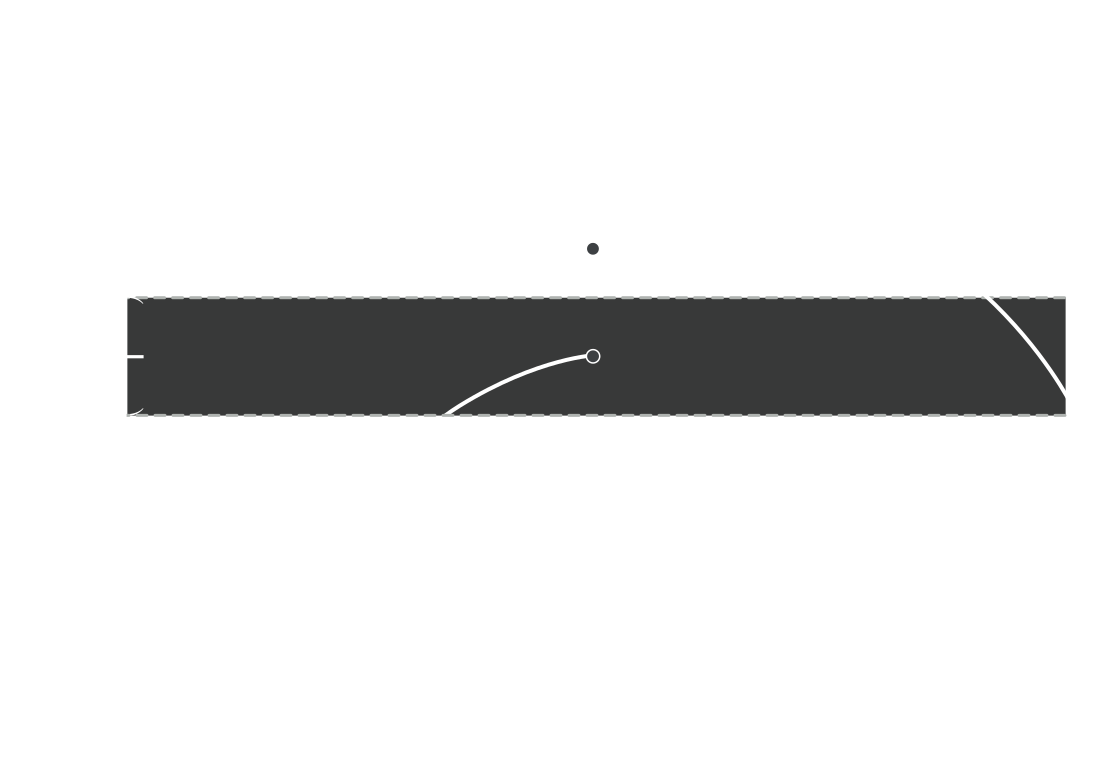
The function \(f\) approaches the limit \(l\) near \(a\), if we can make \(f(x)\) as close as we like to \(l\) by requiring that \(x\) be sufficiently close to, but not equal to, \(a\).
Example. Suppose \(f\) is a function such that
\[f(1) =2+1,\ f(1/2) = 2+1/2,\ f(1/3) = 2+1/3,\ f(1/4)=2+1/4, \ldots\]
in general, \(f(1/n) = 2+\frac{1}{n}\) for \(n\in\mathbb{N}\).
What does \(f\) approach near \(0\)?
It might not approach anything!
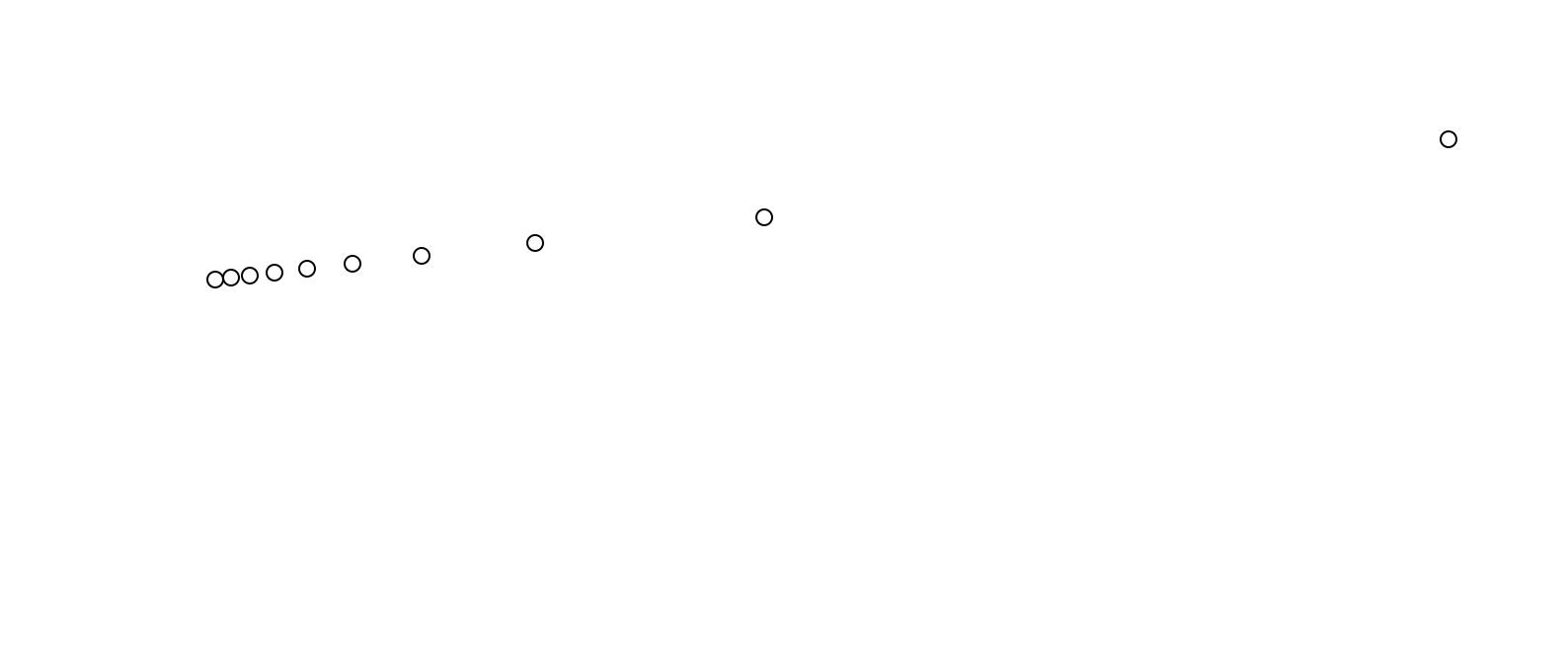
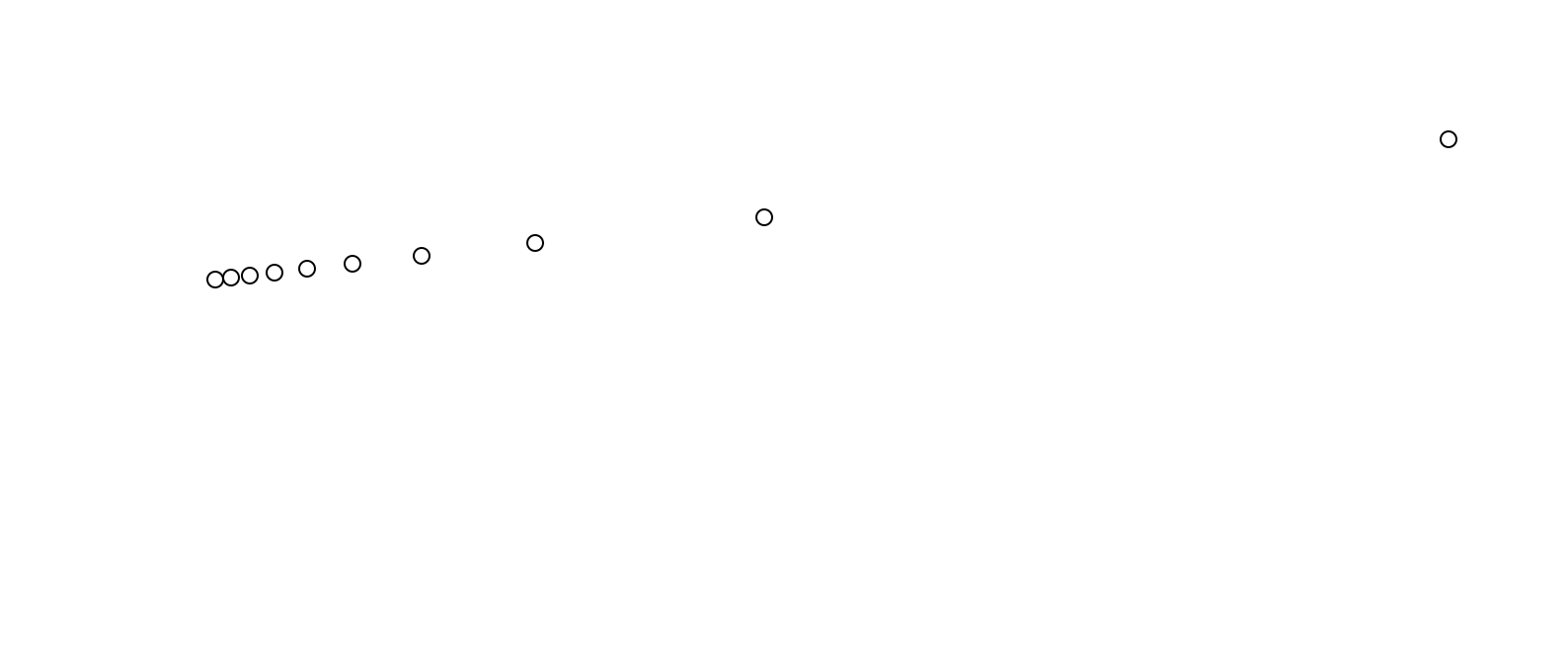
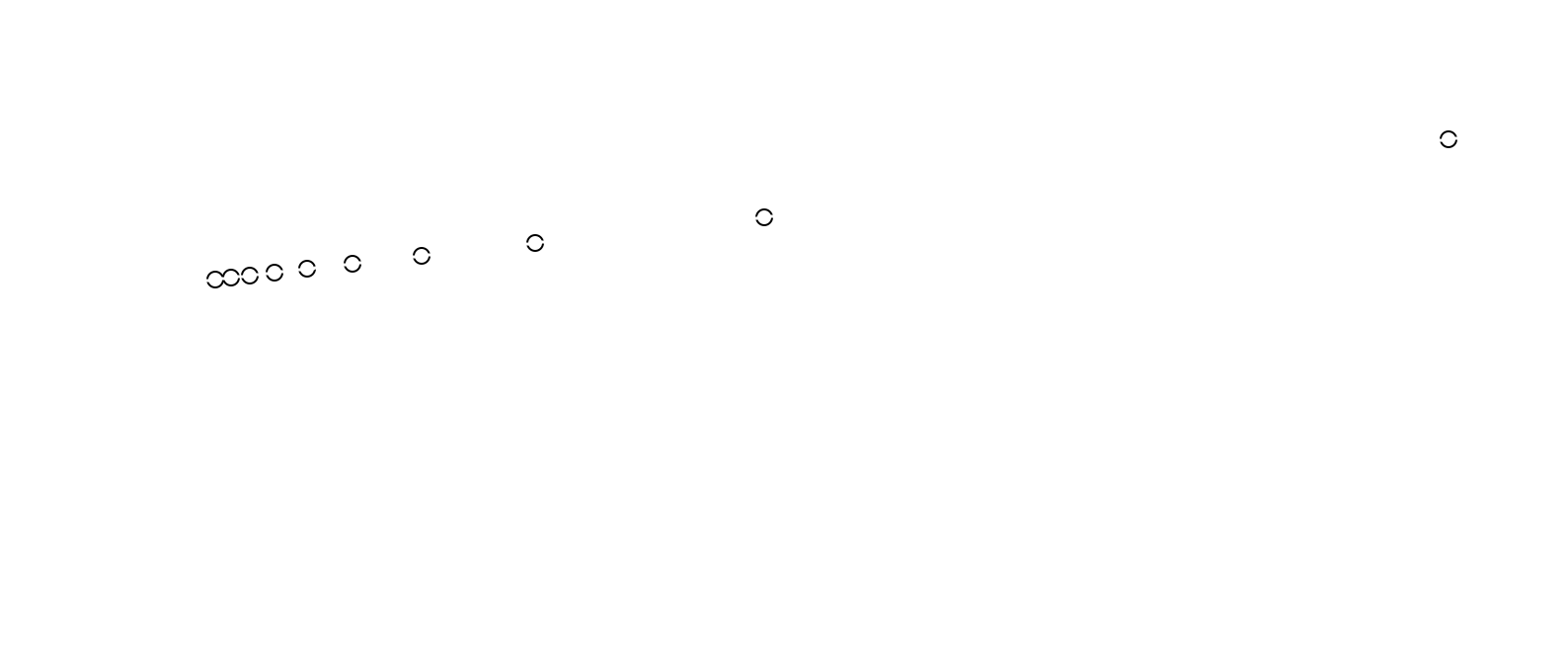
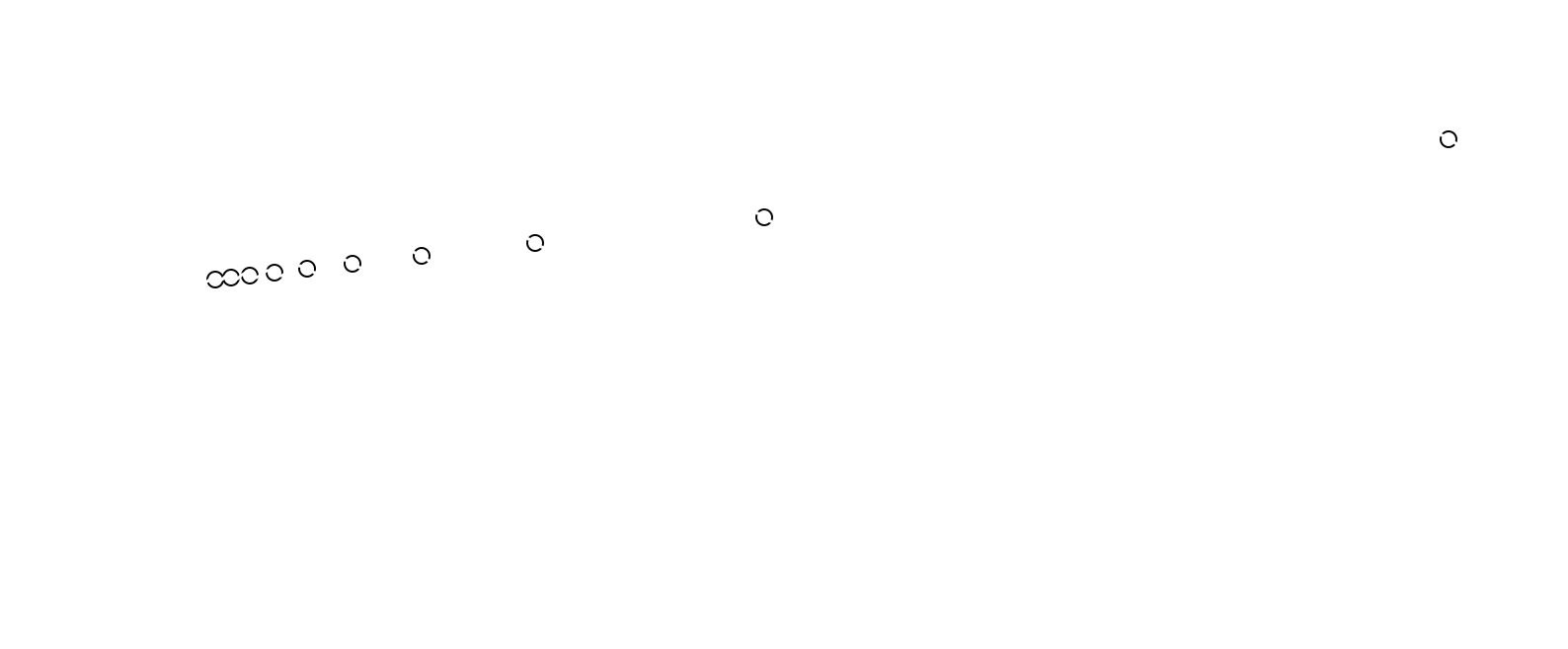
(but if \(f\) approaches any number near \(0\), it must approach \(2\))
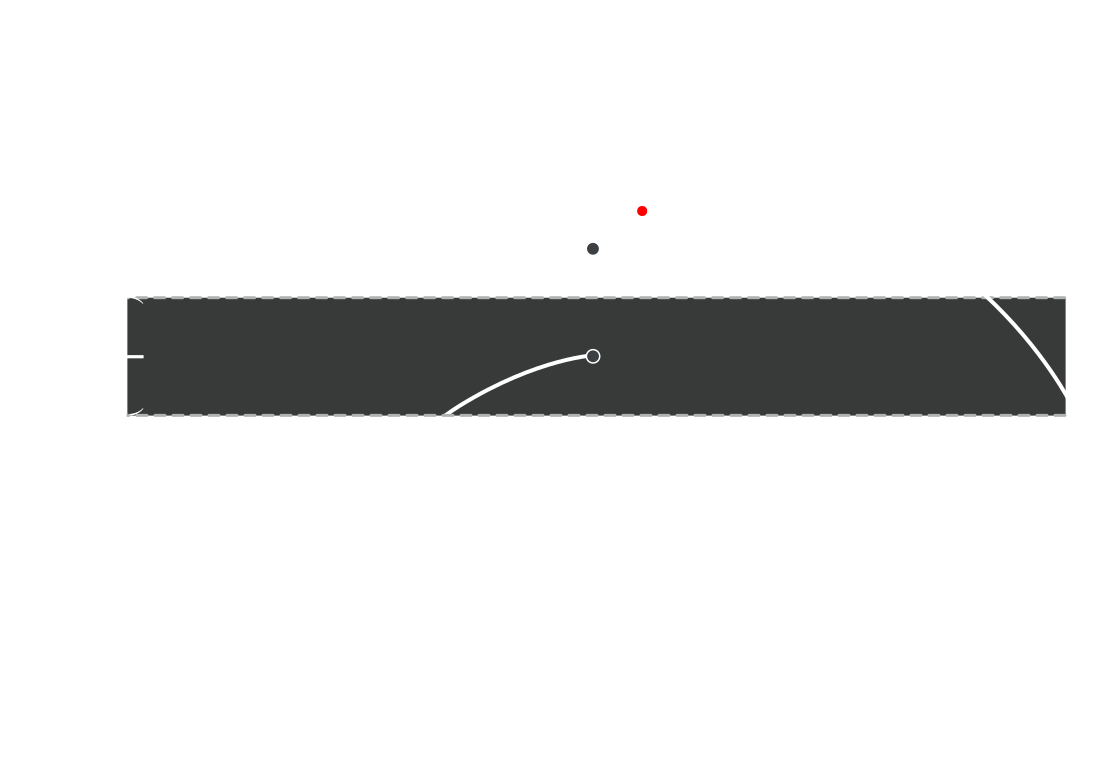
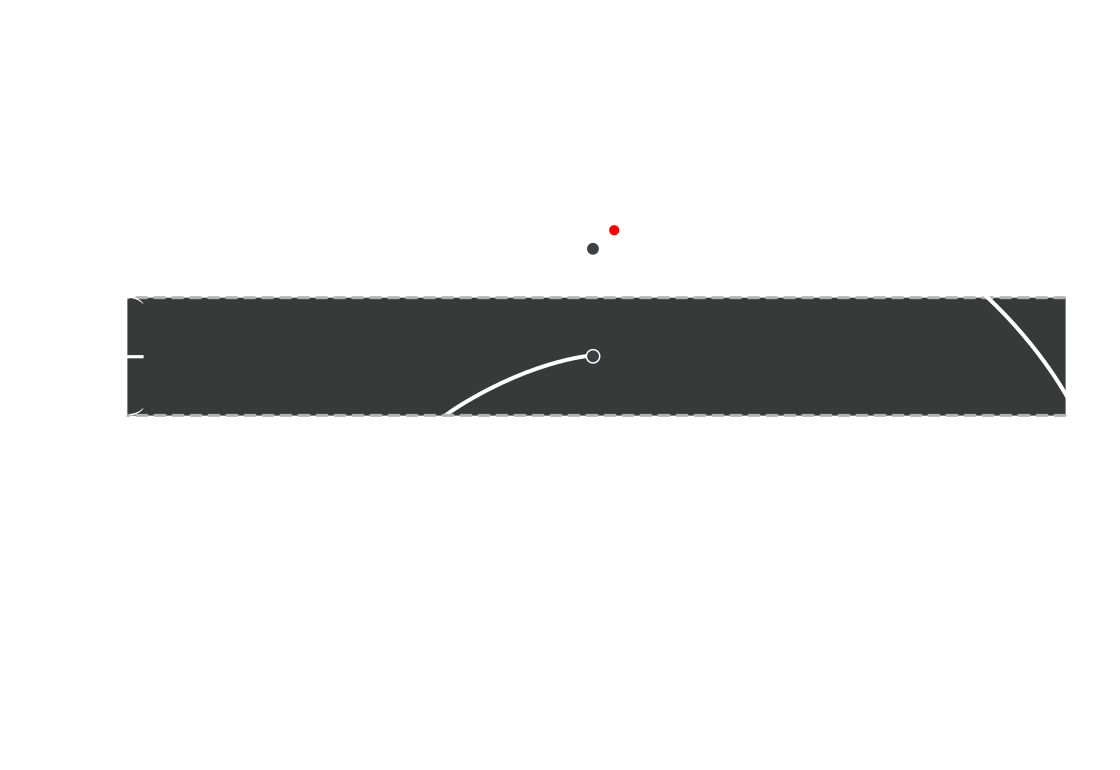
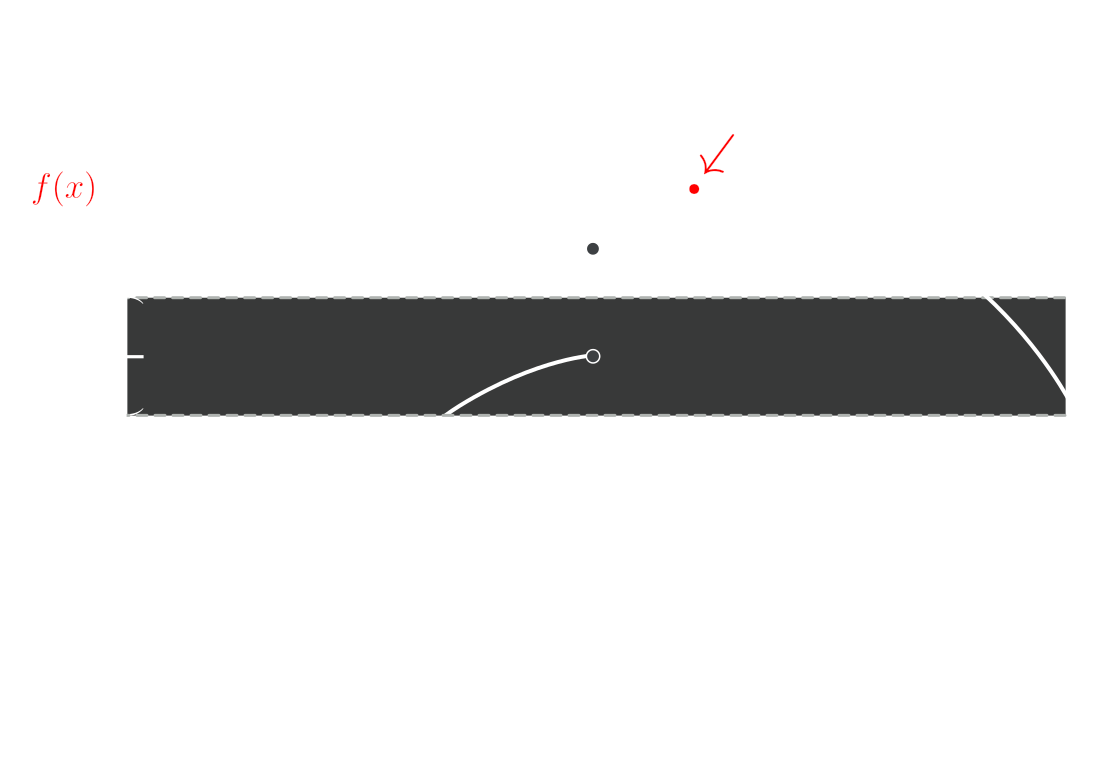
Example. Consider the function \(f\) whose graph is shown below.
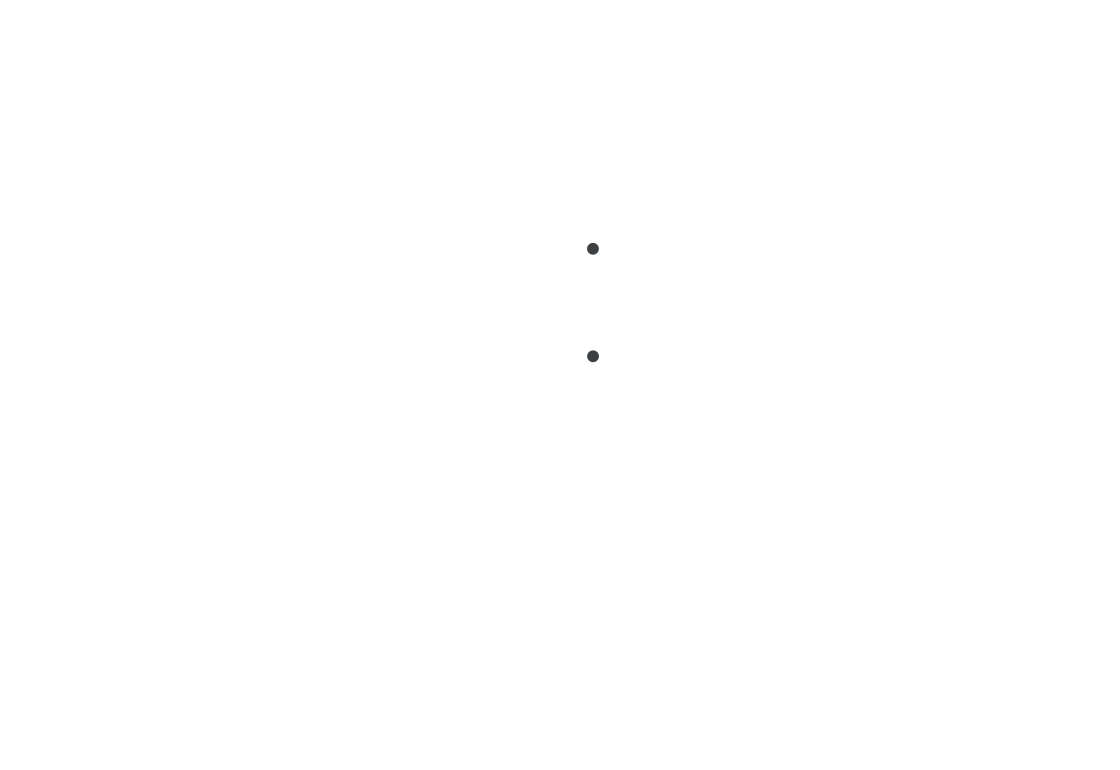
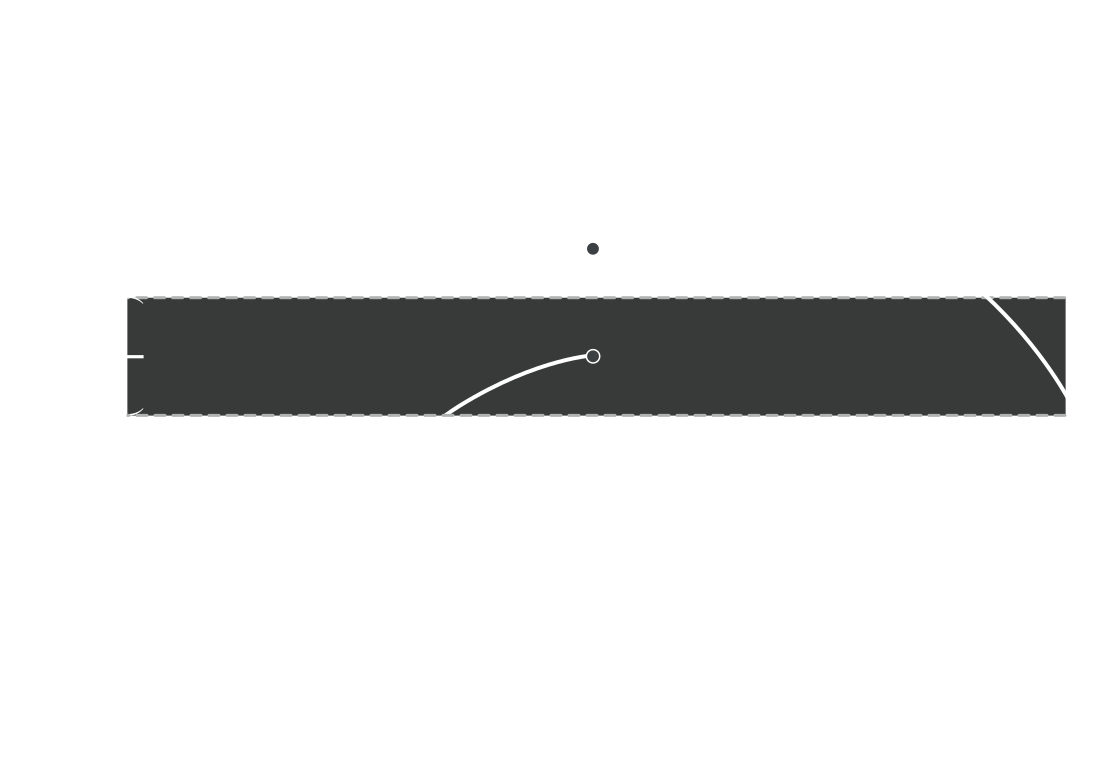
\(f(x)\notin(l-\varepsilon,l+\varepsilon)\)
\(f\) does not approach \(l\) near \(a\)
\(f\) does not approach anything near \(a\)

Examples from the text
How can we prove that \(f\) approaches \(l\) near \(a\)?
Example. Consider the function \(S(x) = x^2\).
We wish to show that \(S\) approaches \(4\) near \(2\).

Take an arbitrary positive distance, call it \(\varepsilon\).
We must find a positive distance \(\delta\) such that
\(x\in(2-\delta,2+\delta)\setminus\{2\}\)
\(\Downarrow\)
\(S(x)\in(4-\varepsilon,4+\varepsilon)\)
\(2-\delta<x<2+\delta\) and \(x\neq 2\)
\(2-\delta<x<2+\delta\) and \(x\neq 2\)
\(4-\varepsilon<S(x)<4+\varepsilon\)
\(4-\varepsilon<S(x)<4+\varepsilon\)
\(\Leftrightarrow\)
\(\Leftrightarrow\)
\(-\delta<x-2<\delta\) and \(x\neq 2\)
\(-\varepsilon<S(x)-4<\varepsilon\)
\(|x-2|<\delta\) and \(x\neq 2\)
\(|S(x)-4|<\varepsilon\)
\(0<|x-2|<\delta\)
How small must we take \(\delta\)?
For any \(x\) such that \(0<|x-2|<\delta\), it must be the case that
\[|S(x) - 4|<\varepsilon\]
\[\Updownarrow\]
\[|x^2-4|<\varepsilon\]
\[|x-2||x+2|<\varepsilon\]
\[\Updownarrow\]
If \(\delta\leq 1\), then the only \(x\)'s we will consider are in \((1,3)\).
Thus \(x+2\in(3,5)\), and hence \(|x+2|=x+2<5\).
Thus, if \(\delta\leq 1\) and \(\delta<\varepsilon/5\), then for any \(x\) such that \(0<|x-2|<\delta\), it should follow that \(|f(x)-4|<\varepsilon\).
Limits (formally)
Definition. The function \(f\) approaches the limit \(l\) near \(a\) means: for every \(\varepsilon>0\) there is some \(\delta>0\) such that, for all \(x\), if \(0<|x-a|<\delta\), then \(|f(x)-l|<\varepsilon\).
Proposition. If \(S(x) = x^2\), then \(S\) approaches \(4\) near \(2\).
Proof. Let \(\varepsilon>0\) be arbitrary. Set
\[\delta = \min\{1,\varepsilon/10\}.\]
Clearly \(\delta>0\). Next, let \(x\) be an arbitrary real number such that \(|x-2|<\delta\). Since \(\delta\leq 1\), we see that \(|x-2|<1\), and thus \(x\in (1,3)\), this implies \(x+2\in(3,5)\), and hence
\[|x+2| = x+2 <5.\]
Since \(\delta\leq \varepsilon/10\) we see that \(|x-2|<\varepsilon/10\). Finally, we have
\[|S(x)-4| = |x^2-4| = |(x-2)(x+2)| = |x-2||x+2|\leq \frac{\varepsilon}{10}\cdot 5 = \frac{\varepsilon}{2}<\varepsilon.\]
Proposition. Suppose \(L(x) = 2x-3\). Then \(L\) approaches \(1\) near \(2\).
Proof. Let \(\varepsilon>0\) be arbitrary. Set \(\delta = \varepsilon/2\). Clearly \(\delta>0\). Let \(x\) be an arbitrary real number such that
\[0<|x-2|<\delta = \frac{\varepsilon}{2}.\]
Hence,
\[|L(x) - 1| = |2x-3-1| = |2x-4| =2|x-2|<2\cdot\frac{\varepsilon}{2} = \varepsilon.\ \Box\]
Proposition. Suppose \(R(x) = 1/x\). Then \(R\) approaches \(2\) near \(1/2\).
From the picture it appears that we should take
\[\delta = \min\left(\frac{1}{2-\varepsilon} - \frac{1}{2}, \frac{1}{2} - \frac{1}{2+\varepsilon}\right)\]
\[=\min\left(\frac{\varepsilon}{2(2-\varepsilon)},\frac{\varepsilon}{2(2+\varepsilon)}\right)\]
\[=\frac{\varepsilon}{2(2+\varepsilon)}\]
??
Proposition. Suppose \(R(x) = 1/x\). Then \(R\) approaches \(2\) near \(1/2\).
Proof. Let \(\varepsilon>0\) be arbitrary. Set
\[\delta = \frac{\varepsilon}{2(2+\varepsilon)}.\]
Let \(x\) be an arbitrary real number such that
\[0<\left|x-\frac{1}{2}\right| <\delta = \frac{\varepsilon}{2(2+\varepsilon)}.\]
Observe that
\[x-\frac{1}{2}>-\delta = \frac{1}{2+\varepsilon}-\frac{1}{2}.\]
This implies
\[x>\frac{1}{2+\varepsilon}.\]
From this we see that \(x>0\) and furthermore
\[\frac{1}{|x|} = \frac{1}{x}<2+\varepsilon.\]
(\(\ast\))
Proof continued. Using (\(\ast\)) we have
\[|R(x) - 2| = \left|\frac{1}{x}-2\right| = \left|\frac{1-2x}{x}\right| = 2\left|x-\frac{1}{2}\right|\frac{1}{|x|}<2\cdot \frac{\varepsilon}{2(2+\varepsilon)}\cdot (2+\varepsilon)\]
\[=\varepsilon.\]
Thus for any \(x\) satisfying \(0<|x-\frac{1}{2}|<\delta\) we see that \(|R(x)-2|<\varepsilon.\) Since \(\varepsilon>0\) was arbitrary, we conclude that \(R\) approaches \(2\) near \(1/2\). \(\Box\)
Is this really a strict inequality??
If \(a\geq 0\), \(b\geq 0\) and \(b<c\), then \[ab\leq ac\]
?
We must choose \(\delta\) small enough that
\[0<\left|x-\frac{1}{2}\right|<\delta \quad\Rightarrow\quad |R(x) - 2| = 2\left|x-\frac{1}{2}\right|\frac{1}{|x|}<\varepsilon.\]
If we always choose \(\delta<1/4\), then this will be \(<4\)
If we pick \(\delta<\varepsilon/16\), then this will be \(<\varepsilon/8\)
\(\ \)
Proof take 2. Let \(\varepsilon>0\) be arbitrary. Set
\[\delta = \min\left(\frac{1}{4},\frac{\varepsilon}{16}\right).\]
Let \(x\) be an arbitrary real number such that
\[0<\left|x-\frac{1}{2}\right| <\delta.\]
Observe that since \(\delta\leq1/4\) we see that \(1/4<x<3/4\). From this we deduce that \(x>0\), and that \(1/|x| = 1/x<4\). Finally, we conclude
\[|R(x) - 2| = \left|\frac{1}{x}-2\right| = \left|\frac{1-2x}{x}\right| = 2\left|x-\frac{1}{2}\right|\frac{1}{|x|}\leq 2\cdot \frac{\varepsilon}{16}\cdot 4 = \frac{\varepsilon}{2} <\varepsilon.\]
Proposition. Suppose \(R(x) = 1/x\). Then \(R\) approaches \(2\) near \(1/2\).
Thus for any \(x\) satisfying \(0<|x-\frac{1}{2}|<\delta\) we see that \(|R(x)-2|<\varepsilon.\) Since \(\varepsilon>0\) was arbitrary, we conclude that \(R\) approaches \(2\) near \(1/2\). \(\Box\)
Theorem 1. A function cannot approach two different limits near \(a\). In other words, if \(f\) approaches \(l\) near \(a\) and \(f\) approaches \(m\) near \(a\), then \(l=m\).
Proof. (In the text and on the board.)
With this theorem in hand, we can make the following definition.
Definition. If \(f\) approaches \(l\) near \(a\), then we write
\[\lim_{x\to a}f(x) = l.\]
Now, the previous proposition could be stated as follows:
Proposition. \(\displaystyle{\lim_{x\to\frac{1}{2}}\frac{1}{x} = 2}.\)
(1) If \(|x-x_{0}|<\frac{\varepsilon}{2}\) and \(|y-y_{0}|<\frac{\varepsilon}{2}\), then
\[|(x+y)-(x_{0}+y_{0})|<\varepsilon.\]
If \[|x-x_{0}|<\min\left(1,\frac{\varepsilon}{2(|y_{0}|+1)}\right)\quad\text{and}\quad |y-y_{0}|<\frac{\varepsilon}{2(|x_{0}|+1)},\] then \[|xy-x_{0}y_{0}|<\varepsilon.\]
If \(y_{0}\neq 0\) and
\[|y-y_{0}|<\min\left(\frac{|y_{0}|}{2},\frac{\varepsilon|y_{0}|^{2}}{2}\right),\] then \(y\neq 0\) and
\[\left|\frac{1}{y}-\frac{1}{y_{0}}\right|<\varepsilon.\]
Proof. (In the text and on the board.)
Lemma.
(2)
(3)
Theorem 2. If
\[\lim_{x\to a}f(x) = l\quad\text{and}\quad \lim_{x\to a}g(x) = m,\]
then
\[\lim_{x\to a}(f+g)(x) = l+m\]
\[\lim_{x\to a}(f\cdot g)(x) = l\cdot m.\]
Moreover, if \(m\neq 0\), then
\[\lim_{x\to a}\left(\frac{1}{g}\right)(x) = \frac{1}{m}.\]
Proof. (In the text and on the board.)
Proposition. If \(a\) and \(c\) are real numbers, then
\[\lim_{x\to a}c = c\quad\text{and}\quad\lim_{x\to a}x = a.\]
Combining the previous proposition with Theorem 2 we obtain the following:
Limits of polynomials and rational functions.
A function \(f\) is called a polynomial function if there are numbers \(a_{0},a_{1},\ldots,a_{n}\) such that
\[f(x) = a_{0}+a_{1}x+a_{2}x^2+\cdots + a_{n}x^{n}\quad\text{ for all } x.\]
A function \(g\) is called a rational function if there are two polynomial function \(p\) and \(q\) such that \(g=p/q\).
Proposition. Suppose \(p\) and \(q\) are polynomial functions and \(f=p/q\). If \(q(a)\neq 0\), then
\[\lim_{x\to a}f(x) = f(a).\]
Note: Since the constant function \(f(x) = 1\) for all \(x\), is a polynomial, every polynomial is a rational function.
Limits from above and below
Consider the function \(\displaystyle{f(x) = \begin{cases} 2x+1 & x>1\\ 1-x^2 & x<1\\ 1 & x=1.\end{cases}}\)
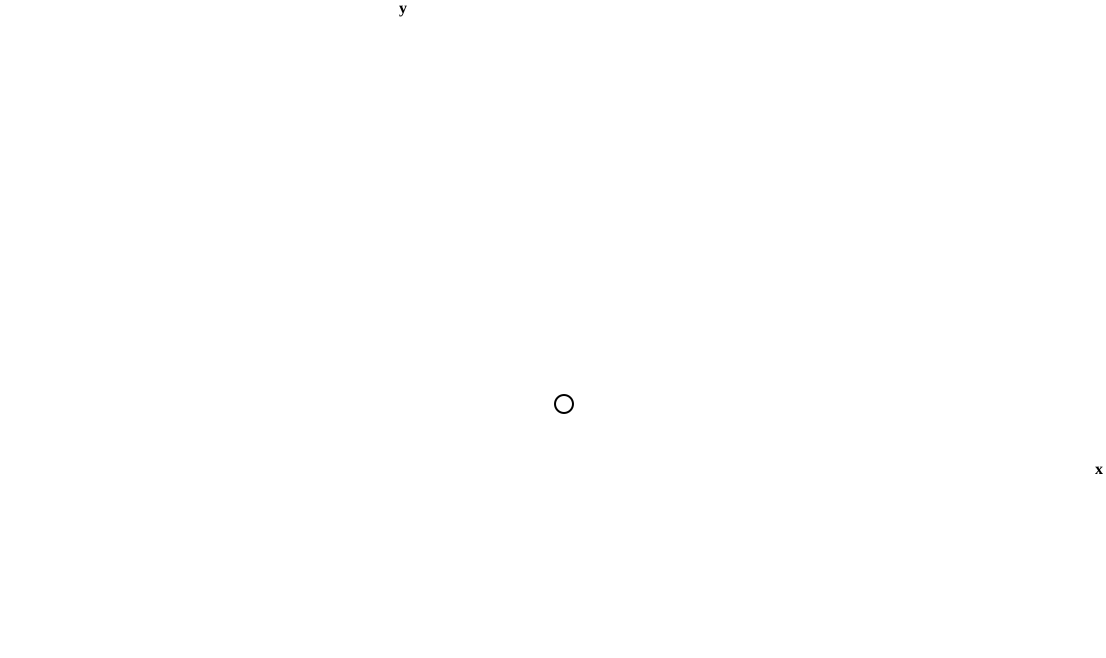
This function doesn't have a limit near 1.
It does have does exists a "limit from above":
\[\lim_{x\to 1^{+}}f(x) = 3.\]
What is the precise definition of this statement?
For every \(\varepsilon>0\) there exists \(\delta>0\) such that for every \(x\), if \(0<x-1<\delta\), then \(|f(x)-3|<\varepsilon.\)
Part 6:
Continuity
(Read Chapter 6 in the textbook)
The function \(f\) is continuous at \(a\) if
\[\lim_{x\to a}f(x) = f(a).\]
Continuity at a point

Equivalently, we can write:
For every \(\varepsilon>0\), there exists \(\delta>0\) such that for all \(x\), if \(|x-a|<\delta\), then \(|f(x)-f(a)|<\varepsilon.\)
Theorem 1. If \(f\) and \(g\) are continuous at \(a\), then \(f+g\) and \(f\cdot g\) are continuous at \(a\). Moreover, if \(g(a)\neq 0\), then \(1/g\) is continuous at \(a\).
Theorem 3. If \(f\) is continuous at \(a\) and \(f(a)>0\), then there exists \(\delta>0\) such that \(f(x)>0\) for all \(x\) in the interval \((a-\delta,a+\delta)\).
I refer to this as the bump theorem.
There's a subtlety in Theorem 1. What if for each \(\delta>0\) there exists \(x\) such that \(|x-a|<\delta\) and \(g(x) = 0\)?
Theorem 2. If \(g\) is continuous at \(a\) and \(f\) is continuous at \(g(a)\), then \(f\circ g\) is continuous at \(a\).

Continuity at on an interval
If \(f\) is continuous at every point \(c\) in the interval \((a,b)\), then we say \(f\) is continuous on \((a,b)\).
If \(f\) is continuous at every real number \(c\), then we say \(f\) is continuous on \((-\infty,\infty)\).
If \(f\) is continuous at every real number \(c\) in the interval \((a,b)\), and
\[\lim_{x\to b^{-}}f(x) = f(b)\quad\text{and} \lim_{x\to a^{+}}f(x) = f(a),\] then we say \(f\) is continuous on \([a,b]\).
We make similar definitions for continuity on \([a,b)\), \((a,b]\), \((-\infty,b)\), \((-\infty,b]\), \((a,\infty)\), and \([a,\infty)\).
Part 7:
Three Hard Theorems
(Read Chapter 7 in the textbook)
Informally, a function \(f\) is continuous on \([a,b]\) if the graph of \(f\) can be drawn without picking up your pencil, starting with your pencil at \((a,f(a))\) and ending at \((b,f(b))\).
This definition is obviously insufficient for proving anything about continuous functions. Thus, we invented our precise definition of continuous.
We must prove that functions satisfying our definition of continuous necessarily have a properties that capture the intuitive notion continuous.
The intuitive notion of continuity
We certainly expect \(A\) to be continuous on any finite time interval.
- If you were below sea level at some time \(t_{0}\), then you were above sea level at some later time \(t_{1}\), then there was a time \(s\), between \(t_{0}\) and \(t_{1}\) when you were exactly at sea level.
- Over a finite period of time, your elevation was not arbitrarily large (even if you own a spaceship).
- Over a finite period of time, there was some point (maybe more than one) where your elevation was largest.
Motivating example
Let
\(A(t) = \) your current distance above sea level,
where \(t = \) number of seconds since you were born.
What are some obvious consequences of that?
Bolzono's Theorem
Theorem 1 (Bolzano's Theorem). If \(f\) is continuous on \([a,b]\) and \(f(a)<0<f(b)\), then there is some \(x\) in \([a,b]\) such that \(f(x)=0\).
The statement \(f\) is continuous on \([a,b]\) is meant to imply a precise version of the intuitive statement
"You can draw the graph without picking up your pencil."
The first of the "three hard theorems" is our first justification that our definition of continuity matches the intuitive definition.
meant to imply
Continuous on \([a,b]\ \Rightarrow\) bounded
Theorem 2. If \(f\) is continuous on \([a,b]\), then \(f\) is bounded above on \([a,b]\), that is, there is a number \(N\) such that \(f(x)\leq N\) for all \(x\) in \([a,b]\).
If \(f\) is continuous on \([a,b]\), then \(f(x)\) should not get arbitrarily large for \(x\) in \([a,b]\), but does our precise definition of continuity imply this?
Yep!
Define \(f(x) = \dfrac{x^2}{x^2+1}\). Note that
\[f(x)\leq 1\quad\text{for all }x\]
but for any number \(x\) we have
\[f(x) = \frac{x^2}{x^2+1}< \frac{x^2+1}{x^2+1}=1.\]
Caution! Bounded above, does not mean that \(N\) is achieved!

Extreme value theorem
Yep!
Theorem 3 (Extreme value theorem). If \(f\) is continuous on \([a,b]\), then there is some number \(y\) in \([a,b]\) such that \(f(y)\geq f(x)\) for all \(x\in[a,b]\).
If \(f\) is continuous on \([a,b]\), then \(f(x)\) should achieve it's maximum value on \([a,b]\). Does our definition imply this?
Consider \(f(x) = x\sin(\frac{1}{1-x})\), shown. It is bounded above by \(1\), but it has no maximum! Note that it is not continuous on \([0,1]\) since \(\displaystyle{\lim_{x\to1^{-}}f(x)}\) does not exist.
\(f\) is continuous on \([0,1)\).

Some consequences of the Big Three:
The intermediate value theorem
Theorem 4 (Intermediate value theorem). If \(f\) is continuous on \([a,b]\) and \(f(a)<c<f(b)\), then there is some \(x\) in \([a,b]\) such that \(f(x)=c\).
The following is a precise version of
"the graph of a continuous function doesn't have any jumps"
Theorem 5 (Intermediate value theorem). If \(f\) is continuous on \([a,b]\) and \(f(a)>c>f(b)\), then there is some \(x\) in \([a,b]\) such that \(f(x)=c\).
We can also prove the analogous theorem where \(f(a)>f(b)\):
Some consequences of the Big Three:
Extreme value theorem from below
Theorem 6. If \(f\) is continuous on \([a,b]\), then \(f\) is bounded below on \([a,b]\), that is, there is a number \(N\) such that \(f(x)\geq N\) for all \(x\) in \([a,b]\).
Theorem 7 (Extreme value theorem). If \(f\) is continuous on \([a,b],\) then there is some number \(y\) in \([a,b]\) such that \(f(y)\leq f(x)\) for all \(x\) in \([a,b]\).
Some consequences of the Big Three:
Roots and polynomials
Theorem 8. If \(\alpha>0\), then there exists a number \(x\) such that \(x^{2}=\alpha\).
This shows that positive numbers have square roots. What about cube roots, fourth roots, ...?
It's quite easy to show that for any natural number \(n\), and any positive number \(\alpha\) has an \(n\)th root. In fact, if \(n\) is odd, then we don't need to assume \(\alpha\) is positive, and we'll prove much more.
Theorem 9. If \(n\) is odd, then any equation of the form
\[x^n+a_{n-1}x^{n-1}+a_{n-2}x^{n-2}+\cdots+a_{1}x+a_{0}=0,\]
has a root.
Note that if \(n\) is odd, and \(\alpha\) is any number, then
\[x^n-\alpha=0\]
is an equation of the form in Theorem 9.
Theorem 10. If \(n\) is even, and
\[f(x) = x^n+a_{n-1}x^{n-1}+\cdots+a_{0},\]
then there exists \(y\) such that \(f(y)\leq f(x)\) for all \(x\).
What about even \(n\)?
Part 8:
Least upper bounds
(Read Chapter 8 in the textbook)
Bounded sets
Definition. A set of real numbers \(A\) is bounded above if thereis a number \(x\) such that
\[x\geq a\quad\text{for every }a\text{ in }A.\]
Such a number \(x\) is called an upper bound for \(A\).
Examples.
- \(\N\) is not bounded above (we'll prove this soon)
- \(\R\) is not bounded above: For any \(x\), the real number \(x+1\) is larger.
- \([0,1]\) is bounded above. Any number \(\geq 1\) is an upper bound for \([0,1]\)
- The set \(\displaystyle{\left\{1-\frac{1}{n} : n\in\N\right\}}\) is bounded above. Any number \(x\geq 1\) is an upper bound for this set
Least upper bound
Definition. A number \(x\) is called a least upper bound of \(A\) if
(1) \(x\) is an upper bound for \(A\), and
(2) if \(y\) is an upper bound for \(A\), then \(x\leq y\).
Examples.
- The least upper bound of \([0,1]\) is \(1\).
- The least upper bound of \(\displaystyle{\left\{1-\frac{1}{n} : n\in\N\right\}}\) is \(1\).
Proposition. Suppose \(A\) is a set of real numbers. If \(x\) and \(y\) are least upper bounds of \(A\), then \(x=y\).
Proof. Both \(x\) and \(y\) are least upper bounds, and hence upper bounds for \(A\). This implies both \(x\leq y\) and \(y\leq x\), hence \(x=y\). \(\Box\)
Do we have to say a least upper bound?
No!
Consider the set
\[A = \{x : x^2<2\}.\]
Does this set have a least upper bound?
Does \(A\) even have an upper bound?
If \(x^2<2\) then \(x^2<4\) and hence \(x<2\). This shows that \(2\) is an upper bound of \(A\).
We want to say that \(\sqrt{2}\) is the least upper bound of \(A\), but we don't know that there is a real number whose square is \(2\) yet! (We proved it by using Theorem 7-1.)
Least upper bound property
We finally arrive at the final property of the real numbers:
(P13)
(Least upper bound property) If \(A\) is a set of real numbers, \(A\neq\varnothing\), and \(A\) is bounded above, then \(A\) has a least upper bound.
By the least upper bound property \(A\) has a least upper bound.
Now, let's reconsider the set
\[A = \{x : x^2<2\}.\]
Note that \(0^2=0<2\). This shows \(0\in A\), and hence \(A\neq \varnothing\).
If \(x\in A\), then \(x^2<2<4\), and hence \(0>x^2-4 = (x-2)(x+2)\). The numbers \(x+2\) and \(x-2\) must have opposite signs, and since \(x-2<x+2\) we conclude that \(x-2<0\) and hence \(x<2\). This shows that \(2\) is an upper bound for \(A\). Thus, \(A\) is bounded above.
What do you think the least upper bound for \(A\) is?
Notation
Given a set of numbers \(A\), if \(A\) has a least upper bound, then we denote the least upper bound of \(A\) with the symbol
\[\sup A.\]
The least upper bound of \(A\) is also known as the supremum of \(A\).
We have similar definitions for a lower bound of a set, a set which is bounded below, and the greatest lower bound. The greatest lower bound of a set is denoted
\[\inf A,\]
and it is also known as the infimum of the set \(A\).
Proof of Theorem 1-7
Theorem 1 (Bolzano's Theorem). If \(f\) is continuous on \([a,b]\) and \(f(a)<0<f(b)\), then there is some \(x\) in \([a,b]\) such that \(f(x)=0\).
Theorem 3 (Bump theorem). If \(f\) is continuous at \(a\) and \(f(a)>0\), then there exists \(\delta>0\) such that \(f(x)>0\) for all \(x\) in the interval \((a-\delta,a+\delta)\).
Conclusion
\(\exists\,\delta>0,\ \forall x\in(a-\delta,a+\delta),\ f(x)>0\)
\(\exists\,\delta>0,\ \forall x\in(a-\delta,a+\delta),\ f(x)<0\)
\(\exists\,\delta>0,\ \forall x\in(b-\delta,b],\ f(x)>0\)
\(\exists\,\delta>0,\ \forall x\in[a,a+\delta),\ f(x)<0\)
\(\Rightarrow\)
\(\Rightarrow\)
\(\Rightarrow\)
\(\Rightarrow\)
Assumption
\(\displaystyle{\lim_{x\to a}f(x) = f(a)}\) and \(f(a)>0\)
\(\displaystyle{\lim_{x\to a^{+}}f(x) = f(a)}\) and \(f(a)<0\)
\(\displaystyle{\lim_{x\to a}f(x) = f(a)}\) and \(f(a)<0\)
\(\displaystyle{\lim_{x\to b^{-}}f(x) = f(b)}\) and \(f(b)>0\)
We're going to need the bump theorem, and some variations of it:
A lemma
Theorem 1. If \(f\) is continuous at \(a\), then there is a number \(\delta>0\) such that \(f\) is bounded above on the interval \((a-\delta,a+\delta)\).
Recall that \(f\) is bounded above on a set \(A\) if there exists a number \(x\) such that \(x\geq a\) for all \(a\in A\).
Similarly, \(f\) is bounded below on \(A\) if there exists a number \(y\) such that \(y\leq a\) for all \(a\in A\).
If \(f\) is both bounded above on \(A\) and bounded below on \(A\), then we say that \(f\) is bounded on \(A\).
Corollary. If \(f\) is continuous at \(a\), then there is a number \(\delta>0\) such that \(f\) is bounded below on the interval \((a-\delta,a+\delta)\).
Similar statements hold for when "\(f\) is continuous at \(a\)" is replaced with either \(\displaystyle{\lim_{x\to a^{+}}f(x) = f(a)}\) and \(\displaystyle{\lim_{x\to b^{-}}f(x) = f(b)}\)
Theorem 2. If \(f\) is continuous on \([a,b]\), then \(f\) is bounded above on \([a,b]\), that is, there is a number \(N\) such that \(f(x)\leq N\) for all \(x\) in \([a,b]\).
Let's prove another.
Proof idea. Set
\[A = \{x : a\leq x\leq b,\ f\text{ is bounded above on }[a,x]\},\]
and set
\[ c = \sup A.\]
- If \(c<b\), Theorem 8-1 \(f\) \(\Rightarrow\) is bounded above on \((c-\delta,c+\delta)\)
- \(f\) is bounded above by \(N_{1}\) on \([a,c-\delta/2]\)
- \(f\) is bounded above by \(N_{2}\) on \([c-\delta/2,c+\delta/2]\)
- \(f\) is bounded above by \(\max(N_{1},N_{2})\) on \([a,c+\delta/2]\)
- \(c+\delta/2\in A\) and \(c<c+\delta/2\) \(\Rightarrow\Leftarrow\)
Theorem 3 (Extreme value theorem). If \(f\) is continuous on \([a,b]\), then there is some number \(y\) in \([a,b]\) such that \(f(y)\geq f(x)\) for all \(x\in[a,b]\).
Proof of the Extreme value theorem
Proof idea.
- By Theorem 7-2, the set \( A = \{f(x) : a\leq x\leq b\}\) is bounded.
- Set \(\alpha = \sup A.\)
- If \(f(x)\neq \alpha\) for all \(x\) in \([a,b]\), then the function \[g(x) = \frac{1}{\alpha-f(x)}\] is well-defined and continuous on \([a,b]\).
- By Theorem 7-2, \(g\) is bounded above on \([a,b]\).
- Note \(N>0\) and \[g(x)=\frac{1}{\alpha-f(x)}\leq N\ \Leftrightarrow\ f(x)\leq \alpha-\frac{1}{N}\]
The Archimedean property
Theorem 8-2. The set \(\N\) is not bounded above.
For every real number \(x\) there exists a natural number \(n\) such that \(n>x\).
What is the precise statement in Theorem 8-2?
There exists a real number \(x\) such that \(x\geq n\) for every natural number \(n\).
What would it mean to say \(\N\) is bounded above?
Now, we negate that statement:
Theorem 8-3. For every \(\varepsilon>0\) there exists a natural number \(n\) such that \(1/n<\varepsilon.\)
A corollary of the Archimedean property that will be very useful:
Part 9:
Derivatives
(Read Chapter 9 in the textbook)
"Locally linear"
What does it mean to say \(f\) is "locally linear" at \(a\)?
We converged on the following definition:
The funtion \(f\) is locally linear at \(a\) with slope \(m\) if for every \(\varepsilon>0\) there exists \(\delta>0\) such that
\[\big|f(x)-\big(m(x-a)+f(a)\big)\big|\leq \varepsilon|x-a|\text{ for each }x\in(a-\delta,a+\delta).\]
Proposition. A function \(f\) is locally linear at \(a\) with slope \(m\) if and only if \[\lim_{h\to 0}\frac{f(a+h)-f(a)}{h}=m.\]
Definition. The function \(f\) is differentiable at \(a\) if \[\lim_{h\to 0}\frac{f(a+h)-f(a)}{h}\text{ exists.}\]
In this case the limit is denoted by \(f'(a)\) and is call the derivative of \(f\) at \(a\). (We also say that \(f\) is differentiable if \(f\) is differentiable at \(a\) for every \(a\) in the domain of \(f\).)
Recall the following useful fact:
If \(f(x) = g(x)\) for all \(x\neq a\), and \(\displaystyle{\lim_{x\to a}f(x) =L}\), then \(\displaystyle{\lim_{x\to a}g(x) =L}\).
Example. For any numbers \(c\) and \(d\), consider the function \(f(x) = cx+d\). For any number \(a\)
\[\lim_{h\to 0}\frac{f(a+h)-f(a)}{h} = \lim_{h\to 0} \frac{c(a+h)+d-ca-d}{h} = \lim_{h\to 0}\frac{ch}{h} = \lim_{h\to 0}c = c.\]
Thus, \(f'(a) = c\).
Example. Consider the function \(S(x) = x^2\) and any number \(a\). Then
\[\lim_{h\to 0}\frac{S(a+h)-S(a)}{h} = \lim_{h\to 0}\frac{(a+h)^2-a^2}{h} = \lim_{h\to 0} \frac{2ah+h^2}{h}\]
\[ = \lim_{h\to 0}(2a+h) = 2a.\]
Thus, \(S'(a) = 2a\) for any \(a\).
Example. Consider the function \(R(x) = \sqrt{x}\) and any number positive number \(a\). Then
\[= \lim_{h\to 0}\frac{\sqrt{a+h}-\sqrt{a}}{h} \cdot\frac{\sqrt{a+h}+\sqrt{a}}{\sqrt{a+h}+\sqrt{a}}\]
Thus, \(R'(a) = 1/(2\sqrt{a})\) for any \(a\).
\[\lim_{h\to 0}\frac{R(a+h)-R(a)}{h} = \lim_{h\to 0}\frac{\sqrt{a+h}-\sqrt{a}}{h} \]
\[= \lim_{h\to 0}\frac{a+h-a}{h(\sqrt{a+h}+\sqrt{a})} = \lim_{h\to 0}\frac{1}{\sqrt{a+h}+\sqrt{a}} = \frac{1}{2\sqrt{a}}.\]
Theorem 9-1. If \(f\) is differentiable at \(a\), then \(f\) is continuous at \(a\).
Proof.
\[= \lim_{h\to 0}\left(\frac{f(a+h)-f(a)}{h}\cdot h\right) + f(a)\]
\[= \lim_{h\to 0}\left(\frac{f(a+h)-f(a)}{h}\right)\cdot \lim_{h\to 0}h + f(a)\]
\[= f'(a)\cdot 0+ f(a) \]
\[= f(a). \ \Box\]
\[\lim_{h\to 0}f(a+h) \]
\[= \lim_{h\to 0}\big(f(a+h)-f(a)\big) + f(a) \]
Differentiable \(\Rightarrow\) continuous
Continuous \(\not\Rightarrow\) differentiable
Example. Consider the function \(A(x) = |x|\).
First, we claim that \(A\) is continuous:
Let \(\varepsilon>0\) and set \(\delta=\varepsilon\). If \(x\) is any number such that \(|x-a|<\delta\), then by the triangle inequality
\[|A(x) - A(a)| = \big||x| - |a|\big|\leq |x-a|<\delta = \varepsilon.\]
Next, note that
\[\lim_{h\to 0^{+}}\frac{A(0+h)-A(0)}{h} = \lim_{h\to 0^{+}} \frac{|h|}{h} = \lim_{h\to 0^{+}} \frac{h}{h} = \lim_{h\to 0^{+}} 1 = 1,\]
and
\[\lim_{h\to 0^{-}}\frac{A(0+h)-A(0)}{h} = \lim_{h\to 0^{-}} \frac{|h|}{h} = \lim_{h\to 0^{-}} \frac{-h}{h} = \lim_{h\to 0^{-}} -1 = -1.\]
Thus, the limit \(\displaystyle{\lim_{h\to 0}\frac{A(0+h)-A(0)}{h}}\) does not exist, and hence \(A\) is not differentiable at \(0\).
A pathological example

3 : being such to a degree that is extreme, excessive, or markedly abnormal
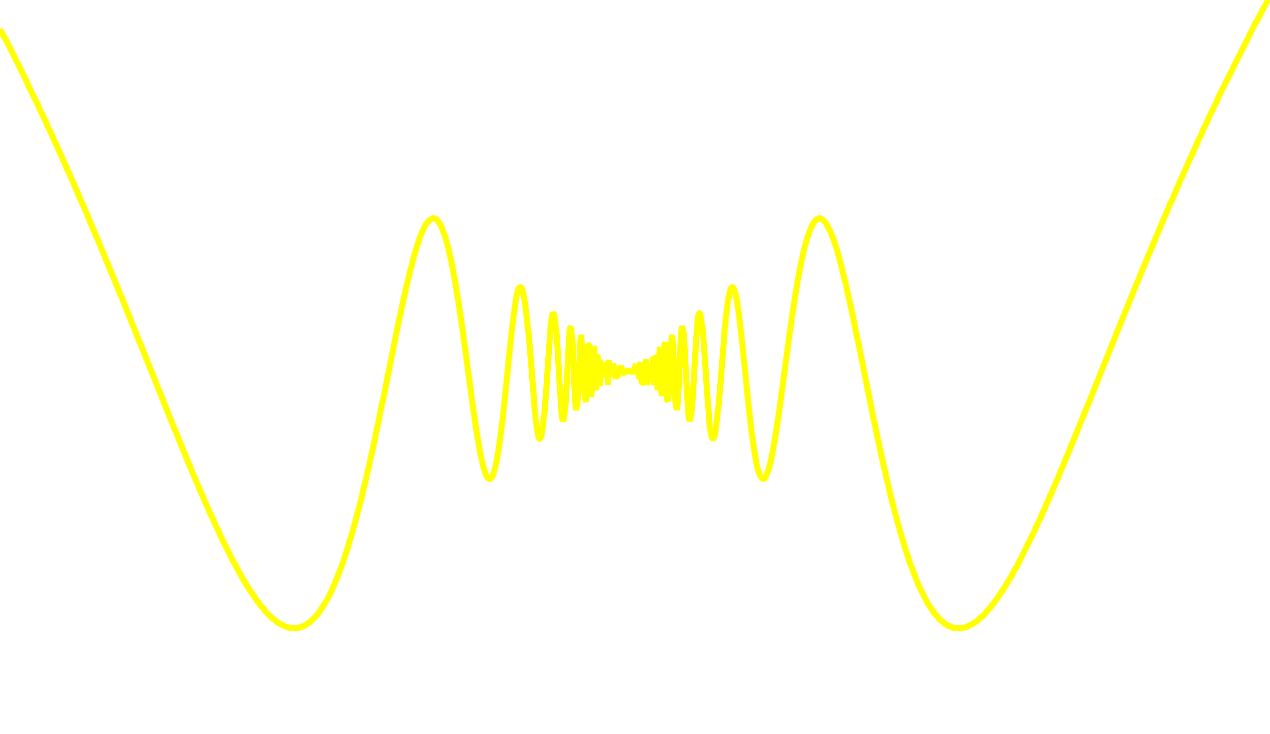
Example. Consider the function
\[f(x) = \begin{cases} x\sin\left(\frac{1}{x}\right) & x\neq 0,\\ 0 & x=0.\end{cases}\]
We will see later that \(f\) is differentiable at any \(a\neq 0\).
For any \(\delta>0\) we can find \(n\in\N\) such that \[h_{1}:=\dfrac{2}{\pi(4n+1)}<\delta\quad\text{ and }\quad h_{2}:=\dfrac{2}{\pi(4n+3)}<\delta\]
However,
\[\lim_{h\to 0}\frac{f(h)-f(0)}{h} = \lim_{h\to 0}\frac{h\sin(\frac{1}{h}) - 0}{h} = \lim_{h\to 0}\sin\left(\frac{1}{h}\right).\]
\[\sin\left(\frac{1}{h_{1}}\right) = \sin\left(\dfrac{\pi(4n+1)}{2}\right) = \sin\big(2\pi n + \frac{\pi}{2}\big) = \sin\big(\frac{\pi}{2}\big) = 1.\]
\[\sin\left(\frac{1}{h_{2}}\right) = \sin\left(\dfrac{\pi(4n+3)}{2}\right) = \sin\big(2\pi n + \frac{3\pi}{2}\big) = \sin\big(\frac{3\pi}{2}\big) = -1.\]
For any \(\delta>0\) we can find \(h_{1},h_{2}\in(-\delta,\delta)\) such that \(|f(h_{1})-f(h_{2})|=2\). By HW 4 Problem 1, \(f\) is not differentiable at \(0\).
Another pathological example
Example. Consider the function
\[f(x) = \begin{cases} x^2\sin\left(\frac{1}{x}\right) & x\neq 0,\\ 0 & x=0.\end{cases}\]
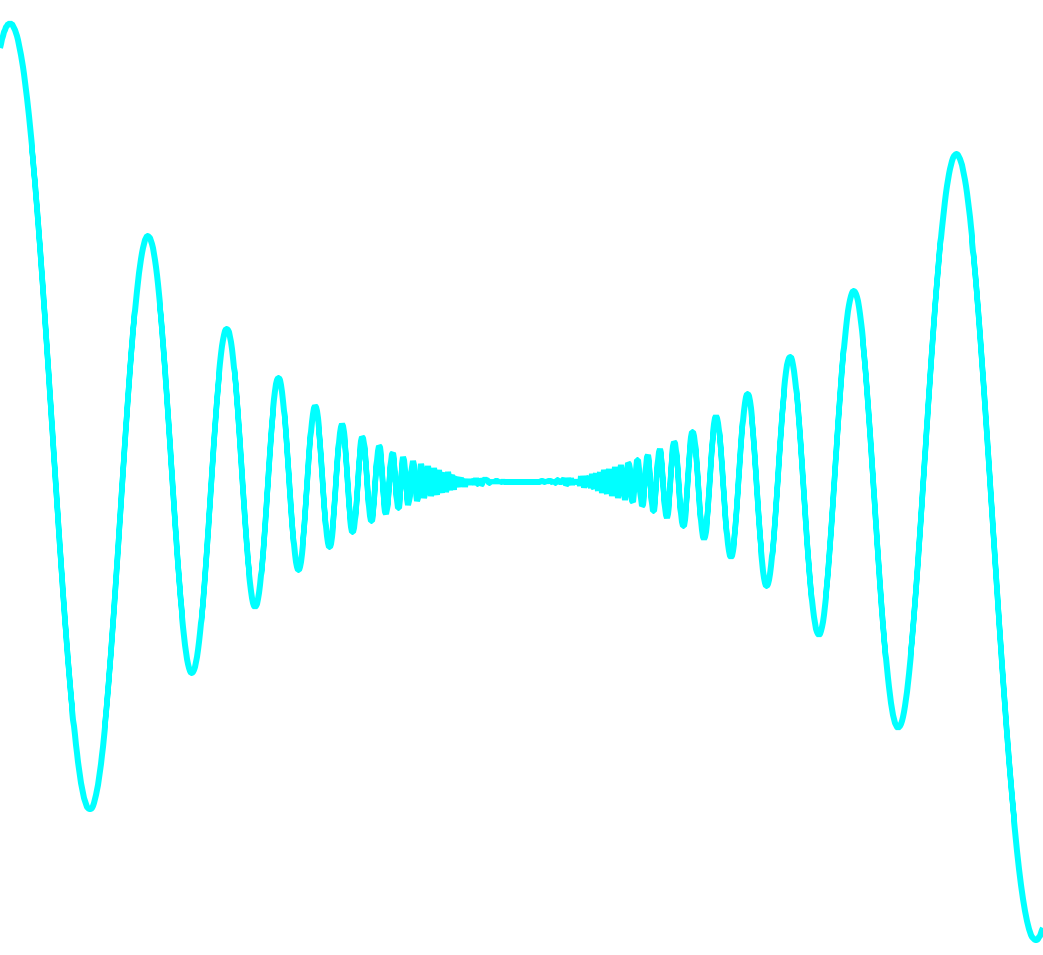
For this function we find
\[f'(0) = 0.\]
In fact, \(f\) is differentiable on all of \(\mathbb{R}\)!!
But \(f'\) is not continuous at \(0\)!!!
Some definitions
Given a function \(f\), the function \(f'\) is called the derivative of \(f\). The domain of \(f'\) is the set of points \(a\) such that \(f\) is differentiable at \(a\), and
\[f'(a) = \lim_{h\to 0}\frac{f(a+h)-f(a)}{h}.\]
Given a function \(f\), the limit
\[\lim_{h\to 0^{+}}\frac{f(a+h)-f(a)}{h}\]
is the right-hand derivative of \(f\) at \(a\), and
\[\lim_{h\to 0^{-}}\frac{f(a+h)-f(a)}{h}\]
is the left-hand derivative of \(f\) at \(a\).
Part 10:
Differentiation
(Read Chapter 10 in the textbook)
Theorem 10-1. If \(f\) is a constant function, \(f(x) = c\), then \[f'(a) = 0\quad\text{for all numbers }a.\]
Theorem 10-2. If \(f\) is the identity function, \(f(x) = x\), then \[f'(a) = 1\quad\text{for all numbers }a.\]
Our first goal is to show that for each \(n\in\N\), the function
\[f(x) = x^{n}\]
is differentiable on all of \(\R\), and
\[f'(x) = nx^{n-1}.\]
(Note that we interpret \(x^{0}\) as \(1\).)
Theorem 10-n. If \(n\in\N\) and \(f(x) = x^{n}\), then \[f'(a) = na^{n-1}\quad\text{for all numbers }a.\]
\(\vdots\)
This is the approach you'll take in the HW, but we're going to do something more general here.
Theorem 10-3. If \(f\) and \(g\) are differentiable at \(a\), then \(f+g\) is differentiable at \(a\) and
\[(f+g)'(a) = f'(a)+g'(a).\]
Theorem 10-4. If \(f\) and \(g\) are differentiable at \(a\), then \(f\cdot g\) is differentiable at \(a\) and
\[(f\cdot g)'(a) = f'(a)g(a)+f(a)g'(a).\]
Theorem 10-6. If \(f(x) = x^{n}\) for some natural number \(n\), then
\[f'(a) = na^{n-1}\quad\text{for all numbers }a.\]
Derivatives of sums and products
The Chain Rule
Theorem 10-9. If \(g\) is differentiable at \(a\), and \(f\) is differentiable at \(g(a)\), then \(f\circ g\) is differentiable at \(a\) and
\[f(x) \approx f'(g(a))(x-g(a)) + f(g(a))\quad \text{for }x\approx g(a)\]
\[g(x) \approx g'(a)(x-a) + g(a)\quad \text{for }x\approx a\]
\[f(g(x)) \approx f'(g(a))(g(x)-g(a)) + f(g(a))\]
\[ \approx f'(g(a))([g'(a)(x-a) + g(a)]-g(a)) + f(g(a))\]
\[ = f'(g(a))g'(a)(x-a) + f(g(a))\]
\[(f\circ g)'(a) = f'(g(a)) g'(a).\]
Part 11:
Significance of the Derivative
(Read Chapter 11 in the textbook)
Definition. Let \(f\) be a function and \(A\) a set of numbers contained in the domain of \(f\). A point \(x\) in \(A\) is a maximum point for \(f\) on \(A\) if
\[f(x)\geq f(y)\quad\text{for every }y\text{ in }A.\]
The number \(f(x)\) itself is called the maximum value of \(f\) on \(A\) (and we also say that \(f\) "has it's maximum value on \(A\) at \(x\).")
Extrema an critical points
Definition. Let \(f\) be a function and \(A\) a set of numbers contained in the domain of \(f\). A point \(x\) in \(A\) is a local maximum point for \(f\) on \(A\) if there is some \(\delta>0\) such that \(x\) is a maximum point for \(f\) on \(A\cap (x-\delta,x+\delta)\).
Definition. A critical point of a function \(f\) is a number \(x\) such that \(f'(x) = 0\). The number \(f(x)\) is called a critical value of \(f\).

Local maximums
Local minimums
Example 1
(Global) maximum
(Global) minimum
Critical points
Example 2

Theorem 11-2. Let \(f\) be any function defined on \((a,b)\). If \(x\) is a local maximum (or a minimum) point for \(f\) on \((a,b)\), and \(f\) is differentiable at \(x\), then \(f'(x) = 0\).
Extrema and derivatives
Theorem 11-1. Let \(f\) be any function defined on \((a,b)\). If \(x\) is a maximum (or a minimum) point for \(f\) on \((a,b)\), and \(f\) is differentiable at \(x\), then \(f'(x) = 0\).
Theorem (Rolle's Theorem). If \(f\) is continuous on \([a,b]\) and differentiable on \((a,b)\), and \(f(a)=f(b)\), then there is a number \(x\) in \((a,b)\) such that \(f'(x) = 0\).
The "baby" mean value theorem

Theorem (The Mean Value Theorem). If \(f\) is continuous on \([a,b]\) and differentiable on \((a,b)\), then there is a number \(x\) in \((a,b)\) such that
\[f'(x) = \frac{f(b)-f(a)}{b-a}.\]
The Mean Value Theorem
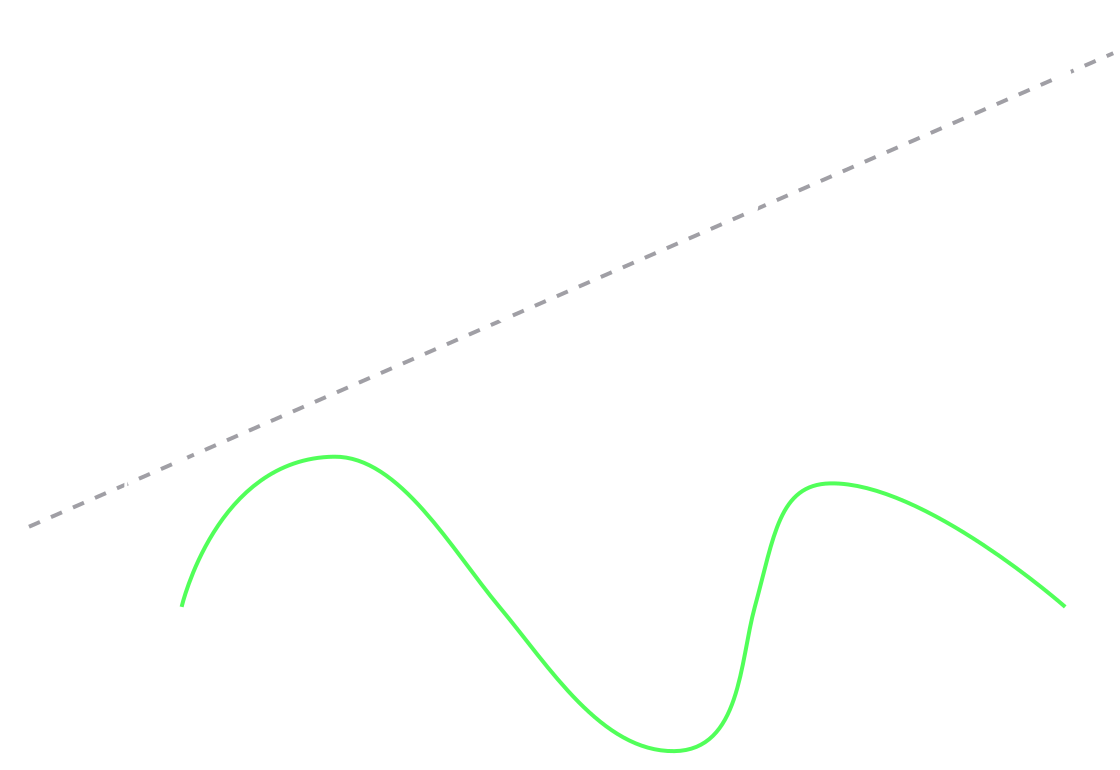
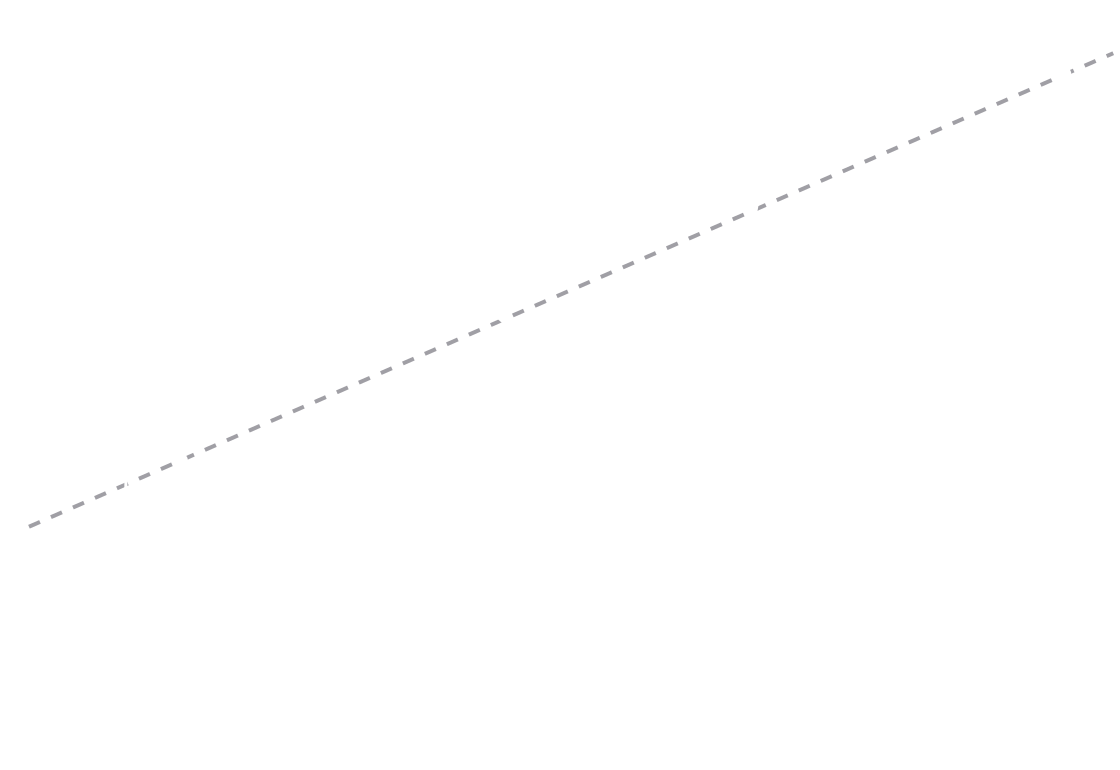
\[L(x) = \frac{f(b)-f(a)}{b-a}(x-a) + f(a)\]
\[g = f-L\]
Presentation 1:
Uniform continuity
(Read Chapter 8, Appendix in the textbook)
Definition. The function \(f\) is uniformly continuous on an interval \(A\) if for every \(\varepsilon>0\) there is some \(\delta>0\), such that, for all \(x\) and \(y\) in \(A\),
\[\text{if }|x-y|<\delta\text{, then }|f(x)-f(y)|<\varepsilon.\]
Lemma. Let \(a<b<c\) and let \(f\) be continuous on the interval \([a,c]\). Let \(\varepsilon>0\), and suppose that
(i) if \(x\) and \(y\) are in \([a,b]\) and \(|x-y|<\delta_{1}\), then \(|f(x)-f(y)|<\varepsilon\), and
(ii) if \(x\) and \(y\) are in \([b,c]\) and \(|x-y|<\delta_{2}\), then \(|f(x)-f(y)|<\varepsilon\),
then there exists \(\delta>0\) such that
if \(x\) and \(y\) are in \([a,c]\) and \(|x-y|<\delta\), then \(|f(x)-f(y)|<\varepsilon\)
Theorem 1. If \(f\) is continuous on \([a,b]\), then \(f\) is uniformly continuous on \([a,b]\).
back to Part 11...
Some differential equation theorems
Corollary 11-1. If \(f\) is defined on an interval and \(f'(x)=0\) for all \(x\) in the interval, then \(f\) is constant on the interval.
Note that this shows that the only solution to the differential equation
\[\frac{dy}{dx} = 0\]
is a constant function.
Corollary 11-2. If \(f\) and \(g\) are defined on the same interval, and \(f'(x) = g'(x)\) for all \(x\) in the interval, then there is a number \(c\) such that \(f(x) = g(x)+c\) for all \(x\) in the interval.
Increasing & Decreasing functions
Corollary 11-3. If \(f'(x)>0\) for all \(x\) in some interval, then \(f\) is increasing on the interval. If \(f'(x)<0\) for all \(x\) in some interval, then \(f\) is decreasing on the interval.
Definition. A function \(f\) is increasing on an interval if \(f(a)<f(b)\) whenever \(a\) and \(b\) are two numbers in the interval with \(a<b\). The function \(f\) is decreasing on an interval if \(f(a)>f(b)\) whenever \(a\) and \(b\) are two numbers in the interval with \(a<b\).
What does it mean to say that \(f\) is increasing on an interval?
Part 12:
Integrals
(Read Chapter 13 in the textbook)
Definition. Let \(a<b\). A partition of \([a,b]\) is a finite set \(P\subset [a,b]\) such that \(\{a,b\}\subset P.\)
Example. The sets \(P=\{0,\frac{1}{2},1\}\) and \(Q=\{0,\frac{1}{4},\frac{3}{4},1\}\) are partions of \([0,1]\).
Example. Given \(a<b\) and \(n\in\N\) the set
\[P = \left\{a,a+\frac{b-a}{n},a+2\frac{b-a}{n},\ldots,a+(n-1)\frac{b-a}{n},b\right\}\]
is an important example of a partition of \([a,b]\).
Example. Partitions don't have to be evenly spaced! The set
\[P=\{0,0.1,0.3,0.33,0.52,0.661,0.87,1\}\]
is a partition of \([0,1]\).
Important! When we write that \(P=\{t_{0},t_{1},\ldots,t_{n}\}\) is a partition of \([a,b]\) we will assume that the points are in the following order
\[a=t_{0}<t_{1}<\cdots<t_{n} = b.\]
Definition. Given a bounded function \(f\) on \([a,b]\) and a partition \(P = \{t_{0},t_{1},\ldots,t_{n}\}\), for each \(i\in\{1,2,3,\ldots,n\}\) we set
\[m_{i} = \inf\{f(x) : t_{i-1}\leq x\leq t_{i}\}\]
and
\[M_{i} = \sup\{f(x) : t_{i-1}\leq x\leq t_{i}\}.\]
The lower sum of \(f\) for \(P\) is the number
\[L(f,P) = \sum_{i=1}^{n}m_{i}(t_{i}-t_{i-1}).\]
The upper sum of \(f\) for \(P\) is the number
\[U(f,P) = \sum_{i=1}^{n}M_{i}(t_{i}-t_{i-1}).\]
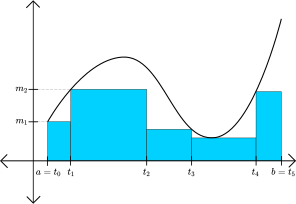
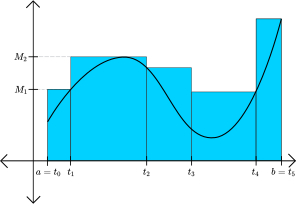
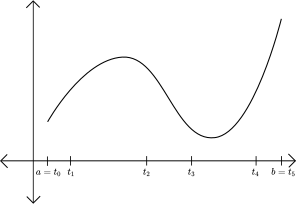
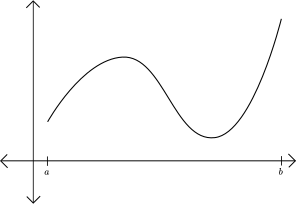
We consider a function \(f\) defined on \([a,b]\)
and a partition \(P=\{t_{0},t_{1},t_{2},t_{3},t_{4},t_{5}\}\)
The sum of the areas of the blue rectangles is the lower sum \(L(f,P)\)
The sum of the areas of the blue rectangles is the upper sum \(U(f,P)\)
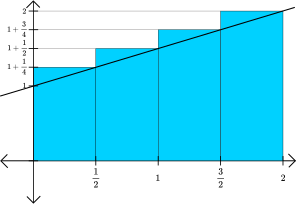
Example. Consider the function \(f(x) = \frac{1}{2}x+1\) on the interval \([0,2]\). For \(n\in\mathbb{N}\) we consider the partition
\[P_{n} = \left\{0,\frac{2}{n},\frac{4}{n},\frac{6}{n},\ldots,\frac{2n-2}{n},2\right\}.\]
Note that for each \(i\in\{1,2,\ldots,n\}\) we have \[m_{i} = \inf\{f(x) : \tfrac{2i-2}{n}\leq x\leq \tfrac{2i}{n}\} = f(\tfrac{2i-2}{n}) = \frac{i-1+n}{n},\]
and \[M_{i} = \sup\{f(x) : \tfrac{2i-2}{n}\leq x\leq \tfrac{2i}{n}\} = f(\tfrac{2i}{n}) = \frac{i+n}{n}.\]
Thus, \[L(f,P_{n}) = \sum_{i=1}^{n}m_{i}\left(\frac{2i}{n} - \frac{2i-2}{n}\right) = \sum_{i=1}^{n}\frac{i-1+n}{n}\left(\frac{2}{n}\right).\]
\[ = \frac{2}{n^{2}}\sum_{i=1}^{n}(i-1+n) = \frac{2}{n^{2}}\left(\sum_{i=1}^{n}i - \sum_{i=1}^{n}1 + \sum_{i=1}^{n}n\right)\]
\[ =\frac{2}{n^{2}}\left(\frac{n(n+1)}{2} - n + n^2\right) = \frac{2}{n^{2}}\left(\frac{3}{2}n^{2}-\frac{1}{2}n\right) = 3-\frac{1}{n}\]
Example continued. Similarly, we can calculate
\[U(f,P_{n}) = 3+\frac{1}{n}.\]
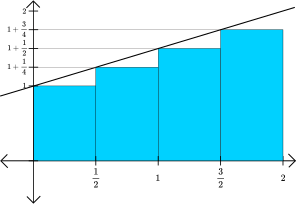
For example, for \(n=4\) we have \[U(f,P_{4}) = \frac{5}{4}\cdot\frac{1}{2} + \frac{3}{2}\cdot\frac{1}{2} + \frac{7}{4}\cdot\frac{1}{2} + 2\cdot\frac{1}{2} = \frac{13}{4} = 3+\frac{1}{4}.\]
For example, for \(n=4\) we have \[L(f,P_{4}) = 1\cdot\frac{1}{2} + \frac{5}{4}\cdot\frac{1}{2} + \frac{3}{2}\cdot\frac{1}{2} + \frac{7}{4}\cdot\frac{1}{2} = \frac{11}{4} = 3-\frac{1}{4}.\]
Lemma. Suppose \(f\) is a bounded function on \([a,b]\). If \(P\) and \(Q\) are partitions of \([a,b]\) and \(P\subset Q\), then
\[L(f,P)\leq L(f,Q)\quad\text{and}\quad U(f,P)\geq U(f,Q).\]
Our first goal is to show that for any two partitions \(P_{1}\) and \(P_{2}\) of \([a,b]\) we always have
\[L(f,P_{1})\leq U(f,P_{2}).\]
First, we need a lemma:
Proof. First, suppose that \(Q\) contains exactly one more point than \(P\), that is, \(P = \{t_{0},t_{1},\ldots,t_{n}\}\) and \(Q=\{t_{0},t_{1},\ldots,t_{k},u,t_{k+1},\ldots,t_{n}\}\) where
\[a=t_{0}<t_{1}<\cdots<t_{k}<u<t_{k+1}<\cdots<t_{n} = b.\]
Define
\[m'=\inf\{f(x) : t_{k}\leq x\leq u\}\quad\text{and}\quad m'' = \inf\{f(x) : u\leq x\leq t_{k+1}\}.\]
Proof continued. Note that \[L(f,P) = \sum_{i=1}^{n}m_{i}(t_{i}-t_{i-1})\] and \[L(f,Q) = \sum_{i=1}^{k}m_{i}(t_{i}-t_{i-1}) +m'(u-t_{k})+m''(t_{k+1}-u) + \sum_{i=k+2}^{n}m_{i}(t_{i}-t_{i-1}).\]
Thus, to show that \(L(f,P)\leq L(f,Q)\) we must show that
\[m_{k+1}(t_{k+1}-t_{k})\leq m'(u-t_{k})+m''(t_{k+1}-u).\]
Note that \(\{f(x) : t_{k}\leq x\leq u\}\) and \(\{f(x) : u\leq x\leq t_{k+1}\}\) are both subsets of \(\{f(x) : t_{k}\leq x\leq t_{k+1}\}\). This implies that the infimums of the first two sets, that is, \(m'\) and \(m''\) can be no smaller than the infimum \(m_{k+1}\) of the third set, and thus \[m_{k+1}\leq m'\quad\text{and}\quad m_{k+1}\leq m''.\]
Therefore, \[m_{k+1}(t_{k+1}-t_{k}) = m_{k+1}(u-t_{k}) + m_{k+1}(t_{k+1}-u)\]
\[ \leq m'(u-t_{k})+m''(t_{k+1}-u).\]
Proof continued. Now, since \(P\subset Q\) and both are finite sets, there is a sequence of partitions
\[P = P_{0}\subset P_{1}\subset P_{2}\subset\cdots\subset P_{m} = Q\]
where each \(P_{m+1}\) contains exactly one more point than \(P_{m}\), and thus
\[L(f,P) = L(f,P_{0})\leq L(f,P_{1})\leq L(f,P_{2})\leq \cdots\leq L(f,P_{m}) = L(f,Q).\]
The proof that \(U(f,P)\geq U(f,Q)\) is similar and you should fill in the details. \(\Box\)
Theorem 1. If \(f\) is a bounded function on \([a,b]\) and \(P_{1}\) and \(P_{2}\) are two partitions of \([a,b]\), then
\[L(f,P_{1})\leq U(f,P_{2}).\]
Proof. Let \(Q = P_{1}\cup P_{2}\), then \(Q\) is a partition of \([a,b]\) such that both \(P_{1}\subset Q\) and \(P_{2}\subset Q\). Clearly we have \(L(f,Q)\leq U(f,Q).\) Thus, by the lemma
\[L(f,P_{1})\leq L(f,Q)\leq U(f,Q)\leq U(f,P_{2}).\quad\Box\]
Given a function \(f\) which is bounded on \([a,b]\) we consider the set of all lower sums:
\[\{L(f,P)\}:=\{L(f,P) : P\text{ is a partition of }[a,b]\}\]
and the set of all upper sums:
\[\{U(f,P)\}:=\{U(f,P): P\text{ is a partition of }[a,b]\}\]
Consider the partition \(Q = \{a,b\}\), then for any partition \(P\) of \([a,b]\) we have
\[L(f,P)\leq U(f,Q) = (b-a)\sup\{f(x) : a\leq x\leq b\}\]
and
\[U(f,P)\geq L(f,Q) = (b-a)\inf\{f(x) : a\leq x\leq b\}.\]
We conclude that
\[\sup\{L(f,P)\} \leq \inf\{U(f,P)\}.\]
In particular, the supremum and infimum above exist.
Example. Let \(g:\mathbb{R}\to\mathbb{R}\) be given by
\[g(x) = \begin{cases} 1 & x\in\mathbb{Q},\\ 0 & x\in\mathbb{R}\setminus\mathbb{Q}.\end{cases}\]
Let \(a<b\) and let\(P = \{t_{0},t_{1},\ldots,t_{n}\}\) be a partition of \([a,b]\). For each \(i\in\{1,2,\ldots,n\}\) there is a rational number \(q\in\mathbb{Q}\) such that \(t_{i-1}<q<t_{i}\) and there is an irrational number \(z\in\mathbb{R}\setminus\mathbb{Q}\) such that \(t_{i-1}<z<t_{i}\). From this we see that \[m_{i} = \inf\{g(x) : t_{i-1}\leq x\leq t_{i}\} = 0\] and \[M_{i} = \sup\{g(x) : t_{i-1}\leq x\leq t_{i}\} = 1.\]
Thus \[L(g,P) = \sum_{i=1}^{n}m_{i}(t_{i}-t_{i-1}) = 0\] and \[U(g,P) = \sum_{i=1}^{n} M_{i}(t_{i}-t_{i-1}) = \sum_{i=1}^{n}(t_{i}-t_{i-1}) = t_{n}-t_{0} = b-a.\]
Example continued. From this, we see that
\[\{L(g,P)\} = \{0\}\] and \[\{U(g,P)\} = \{b-a\}.\]
Thus, we see that
\[\sup\{L(g,P)\} = 0< b-a = \inf\{U(g,P)\}.\]
Definition. A function \(f\) which is bounded on \([a,b]\) is integrable on \([a,b]\) if
\[\sup\{L(f,P) : P\text{ is a partition of }[a,b]\}\]
\[\qquad\qquad = \inf\{U(f,P) : P\text{ is a partition of }[a,b]\}.\]
In this case, the common number is called the integral of \(f\) on \([a,b]\) and is denoted with the symbol
\[\int_{a}^{b}f.\]
Example continued. The function \(g\) is not integrable on \([a,b]\) for any \(a<b\).
Example (constant function). Let \(c\in\mathbb{R}\), and define the function \(h:\mathbb{R}\to\mathbb{R}\) were \(h(x) = c\) for all \(x\in\mathbb{R}\).
Let \(a<b\), and let \(P = \{t_{0},t_{1},\ldots,t_{n}\}\) be a partition of \([a,b]\), then \[m_{i} = c = M_{i}\], and hence
\[L(h,P) = U(h,P) = \sum_{i=1}^{n}c(t_{i}-t_{i-1}) = c(b-a).\]
Thus,
\[\int_{a}^{b}h = c(b-a).\]
Example (a linear function). Recall the function \(f(x) = \frac{1}{2}x+1\) on the interval \([0,2]\). For \(n\in\mathbb{N}\) we consider the partition
\[P_{n} = \left\{0,\frac{2}{n},\frac{4}{n},\frac{6}{n},\ldots,\frac{2n-2}{n},2\right\}.\]
Note that for each \(i\in\{1,2,\ldots,n\}\) we have \[m_{i} = \inf\{f(x) : \tfrac{2i-2}{n}\leq x\leq \tfrac{2i}{n}\} = f(\tfrac{2i-2}{n}) = \frac{i-1+n}{n},\]
and \[M_{i} = \sup\{f(x) : \tfrac{2i-2}{n}\leq x\leq \tfrac{2i}{n}\} = f(\tfrac{2i}{n}) = \frac{i+n}{n}.\]
We saw that
\[L(f,P_{n}) = 3-\frac{1}{n}\quad\text{and}\quad U(f,P_{n}) = 3+\frac{1}{n}.\]
Since \[\left\{2,\frac{5}{2},\frac{8}{3},\ldots, 3-\frac{1}{k},\ldots\right\}\subset \{L(f,P) : P\text{ is a partition of }[a,b]\}\]
We see that \[\sup\{L(f,P) : P\text{ is a partition of }[a,b]\}\geq 3\]
Example (a linear function). Similarly,
Since \[\left\{4,\frac{7}{2},\frac{10}{3},\ldots, 3+\frac{1}{k},\ldots\right\}\subset \{U(f,P) : P\text{ is a partition of }[a,b]\}\]
We see that \[\inf\{U(f,P) : P\text{ is a partition of }[a,b]\}\leq 3.\]
Putting these together we have \[3\leq \sup\{L(f,P)\}\leq \inf\{U(f,P)\}\leq 3\]
and thus \[\sup\{L(f,P)\}=\inf\{U(f,P)\} = 3.\]
This shows \[\int_{0}^{2}f = 3.\]
Note: We will also write this integral as:
\[\int_{0}^{2}\frac{1}{2}x+1\,dx\qquad\text{or}\qquad \int_{0}^{2}\frac{1}{2}w+1\,dw\]
or ANY other variable in place of \(w\).
Theorem 13-3. Suppose \(f\) is bounded on \([a,b]\). The function \(f\) is integrable on \([a,b]\) if and only if for every \(\varepsilon>0\) there exists a partition \(P\) of \([a,b]\) such that
\[U(f,P)-L(f,P)<\varepsilon.\]
Corollary. Suppose \(f\) is bounded on \([a,b]\). If there is a sequence \(\{P_{n}\}\) of partitions of \([a,b]\) such that
\[\lim_{n\to\infty}(U(f,P_{n})-L(f,P_{n})) = 0,\]
then \(f\) is integrable and
\[\int_{a}^{b} f = \lim_{n\to\infty}U(f,P_{n}) = \lim_{n\to\infty}L(f,P_{n}).\]
Proof. In the text. \(\Box\)
Proof. From the definition of the limit we see that for every \(\varepsilon>0\) there exists \(n\in\N\) such that \(U(f,P_{n})-L(f,P_{n})<\varepsilon.\) Thus, by Theorem 3, the function \(f\) is integrable on \([a,b]\). Let
\[I = \int_{a}^{b}f.\]
Then, for each \(n\in\N\) we have \[0\leq I-L(f,P_{n})\leq U(f,P_{n})-L(f,P_{n}).\]
For arbitrary \(\varepsilon>0\) there exists \(N\in\N\) such that \(|U(f,P_{n})-L(f,P_{n})|<\varepsilon\) for all \(n\geq N\), and hence for \(n\geq N\) we have
\[|I-L(f,P_{n})| = I-L(f,P_{n})\leq U(f,P_{n})-L(f,P_{n})<\varepsilon.\]
This shows that the sequence \(\{L(f,P_{n})\}\) converges to \(I\). The proof that \(\{U(f,P_{n})\}\) converges to \(I\) is left to you! \(\Box\)
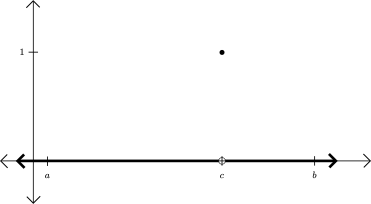
Example. Let \(a<c<b\) and define the function \(\delta_{c}:\mathbb{R}\to\mathbb{R}\) by
\[\delta_{c}(x) = \begin{cases} 1 & x=c\\ 0 & \text{otherwise}.\end{cases}\]
For each \(n\in\mathbb{N}\) define the partition \(P_{n}\) of \([a,b]\) by
\[P_{n} = \left\{a,c-\frac{c-a}{2n},c+\frac{b-c}{2n},b\right\}.\]
Note that this partition only breaks \([a,b]\) into \(3\) subintervals, moreover, \(m_{1}=m_{2}=m_{3}=0\), \(M_{1}=M_{3}=0\), and \(M_{2} = 1.\) Using this, we have
\[L(\delta_{c},P_{n}) = 0\]
and
\[U(\delta_{c},P_{n}) = \left(c+\frac{b-c}{2n}\right)-\left(c-\frac{c-a}{2n}\right) = \frac{b-a}{2n}.\]
It is clear that the sequence \(\{U(\delta_{c},P_{n})-L(\delta_{c},P_{n})\}\) is converging to zero, and thus by the corollary \[\int_{a}^{b}\delta_{c} = \lim_{n\to\infty}L(\delta_{c},P_{n}) = 0.\]
\(U(\delta_{c},P_{1}) = \dfrac{b-a}{2}\)
\(U(\delta_{c},P_{2}) = \dfrac{b-a}{4}\)
\(U(\delta_{c},P_{3}) = \dfrac{b-a}{6}\)
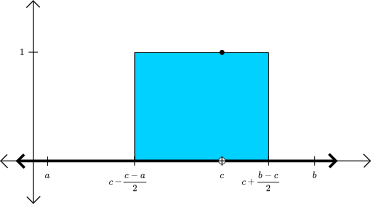
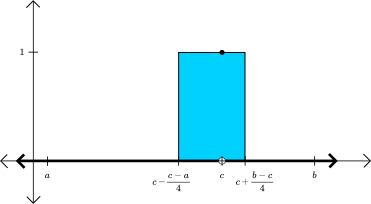
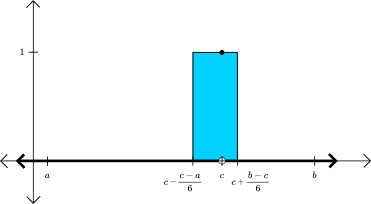
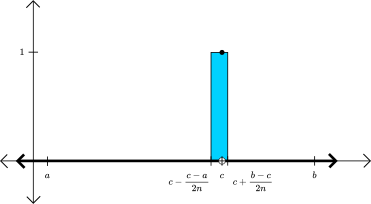
\(U(\delta_{c},P_{n}) = \dfrac{b-a}{2n}\)
Our next goal is to prove the following theorems:
Theorem 5. If \(f\) and \(g\) are both integrable on \([a,b]\), then \(f+g\) is integrable on \([a,b]\) and
\[\int_{a}^{b}(f+g) = \int_{a}^{b}f + \int_{a}^{b} g.\]
Theorem 6. If \(f\) is integrable on \([a,b]\) and \(c\in\mathbb{R}\), then \(cf\) is integrable on \([a,b]\) and
\[\int_{a}^{b}cf = c\int_{a}^{b}f.\]
Together, they will allow us to greatly increase the set of functions that we can integrate.
Presentation 2:
Inverse functions
(Read Chapter 12 in the textbook)
Theorem 12-1. \(f^{-1}\) is a function if and only if \(f\) is one-one.
Some preliminaries
Definitions: A function if one-one if \(f(a)=f(b)\) implies \(a=b\).
Given a function \(f\), the set \(f^{-1}\) is the set of all ordered pairs \((a,b)\) such that \((b,a)\) is in \(f\).
Note that if \(f(0)=f(1)=2\), then the symbol \(f^{-1}(2)\) is not well-defined. This observation leads to the following theorem:
Some preliminaries
Proof. Case 1: \(f(a)<f(c)<f(b)\)
Lemma. If \(f\) is continuous and one-one on an interval, and \(a<b<c\), then \(f(a)<f(b)<f(c)\) or \(f(a)>f(b)>f(c)\)
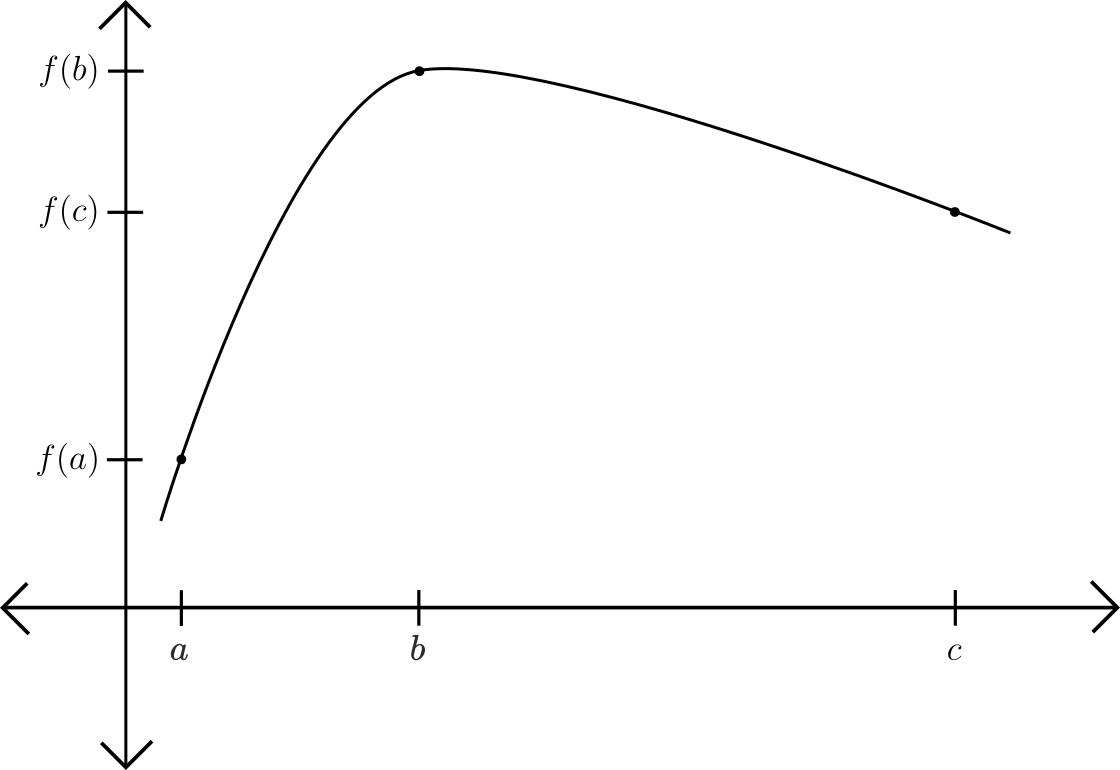
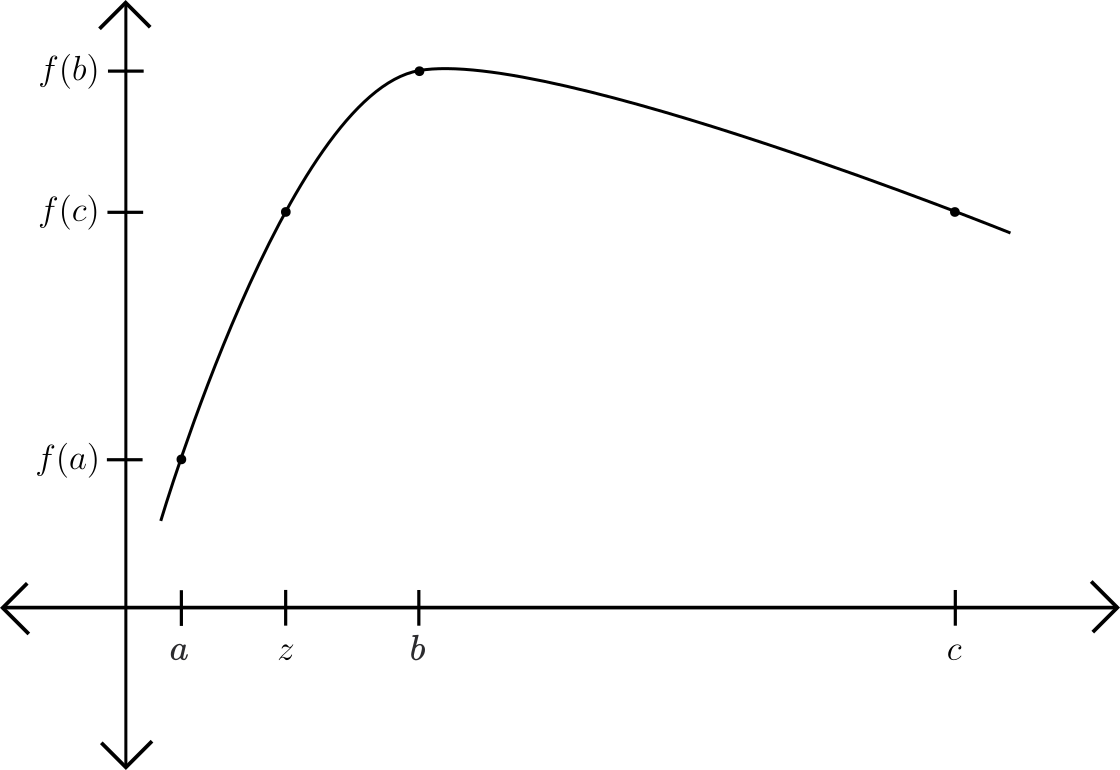
There exists \(z\) in \((a,b)\) such that \(f(z)=f(c)\). \(\Rightarrow\Leftarrow\)
Some preliminaries
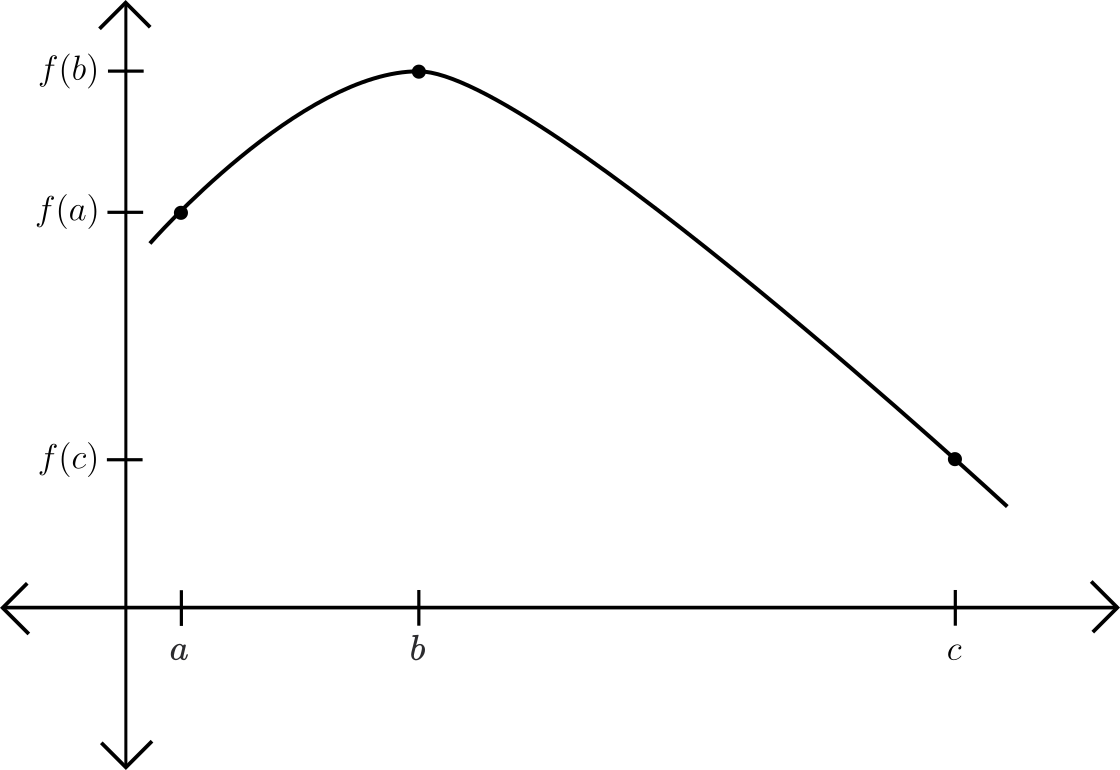
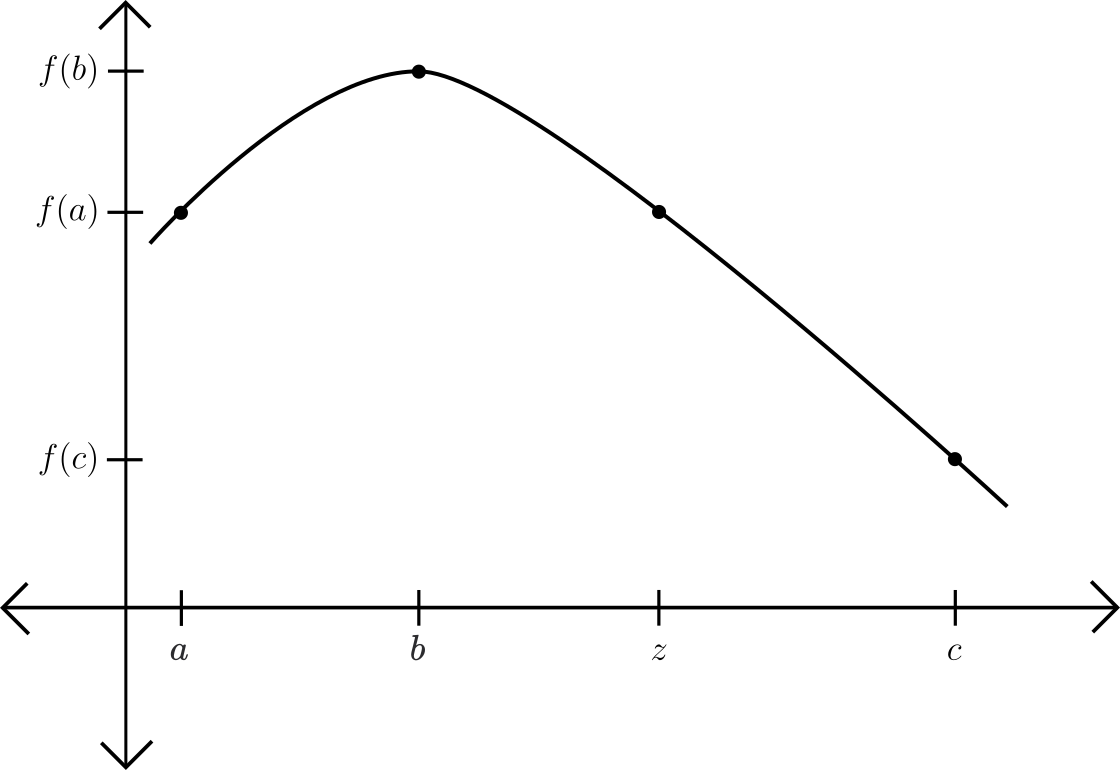
Proof. Case 2: \(f(c)<f(a)<f(b)\)
Lemma. If \(f\) is continuous and one-one on an interval, and \(a<b<c\), then \(f(a)<f(b)<f(c)\) or \(f(a)>f(b)>f(c)\)
There exists \(z\) in \((b,c)\) such that \(f(z)=f(a)\). \(\Rightarrow\Leftarrow\)
Some preliminaries
Proof. We've seen:
Case 1: \(f(a)<f(c)<f(b)\)
Case 2: \(f(c)<f(a)<f(b)\)
The rest of the cases are similar:
Case 3: \(f(b)<f(c)<f(a)\)
Case 4: \(f(b)<f(a)<f(c)\).
Lemma 1. If \(f\) is continuous and one-one on an interval, and \(a<b<c\), then \(f(a)<f(b)<f(c)\) or \(f(c)<f(b)<f(a)\)
Lemma 2. If \(f\) is continuous and one-one on an interval, and \(a<b<c<d\), then
\(f(a)<f(b)<f(c)<f(d)\) or \(f(d)<f(c)<f(b)<f(a)\)
Some preliminaries
Theorem 12-2. If \(f\) is continuous and one-one on an interval, the \(f\) is either increasing or decreasing on the interval.
Proof. Fix numbers \(a<b\) in the interval.
Case 1: Suppose \(f(a)<f(b)\). Let let \(c\) and \(d\) be any two numbers in the interval with \(c<d\). By Lemma 2, no matter what order the numbers \(\{a,b,c,d\}\) are in, we see that \(f(c)<f(d)\). Since \(c\) and \(d\) were arbitrary, we conclude \(f\) is increasing.
Case 2: Suppose \(f(a)>f(b)\). Let let \(c\) and \(d\) be any two numbers in the interval with \(c<d\). By Lemma 2, no matter what order the numbers \(\{a,b,c,d\}\) are in, we see that \(f(c)>f(d)\). Since \(c\) and \(d\) were arbitrary, we conclude \(f\) is decreasing. \(\Box\).
Ray's presentation:
Lemma. If \(f\) is continuous and one-one on an interval \(A\), then the set
\[B = \{f(x) : x\in A\}\]
is an interval.
Theorem 12-3. If \(f\) is continuous an one-one on an interval \(A\), then \(f^{-1}\) is continuous.
Lemma. If \(f\) and \(g\) are bounded functions on \([a,b]\), and \(P\) is a partition of \([a,b]\), then
\[L(f,P)+L(g,P)\leq L(f+g,P)\leq U(f+g,P)\leq U(f,P)+U(g,P),\]
and thus
\[\sup\{L(f,P)\} + \sup\{L(g,P)\}\leq \sup\{L(f+g,P)\}\]
and
\[\inf\{U(f+g,P)\} \leq \inf\{U(f,P)\}+ \inf\{U(g,P)\}.\]
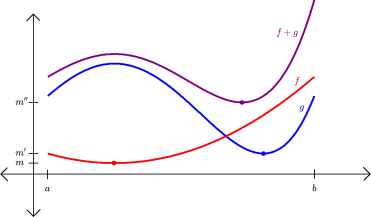
Lemma. If \(f\) and \(g\) are bounded functions on \([a,b]\), and \(P\) is a partition of \([a,b]\), then
\[L(f,P)+L(g,P)\leq L(f+g,P)\leq U(f+g,P)\leq U(f,P)+U(g,P),\]
\(m = \inf\{f(x) : a\leq x\leq b\}\)
\(m' = \inf\{g(x) : a\leq x\leq b\}\)
\(m'' = \inf\{f(x)+g(x):a\leq x\leq b\}\)
Proof. Suppose \(P=\{t_{0},t_{1},\ldots,t_{n}\}\). For each \(i\in\{1,2,\ldots,n\}\) define the numbers
\[m_{i} = \inf\{f(x) : t_{i-1}\leq x\leq t_{i}\},\quad M_{i} = \sup\{f(x) : t_{i-1}\leq x\leq t_{i}\}\]
\[m_{i}' = \inf\{g(x) : t_{i-1}\leq x\leq t_{i}\},\quad M_{i}' = \sup\{g(x) : t_{i-1}\leq x\leq t_{i}\}\]
\[m_{i}'' = \inf\{f(x)+g(x) : t_{i-1}\leq x\leq t_{i}\},\quad M_{i}'' = \sup\{f(x)+g(x) : t_{i-1}\leq x\leq t_{i}\}.\]
We claim that \(m_{i}+m_{i}'\) is a lower bound for the set \[\{f(x)+g(x) : t_{i-1}\leq x\leq t_{i}\}.\]
Indeed, for \(x\in[t_{i-1},t_{i}]\) we see that \(f(x)+g(x) \geq m_{i} + m_{i}'.\)
Lemma. If \(f\) and \(g\) are bounded functions on \([a,b]\), and \(P\) is a partition of \([a,b]\), then
\[L(f,P)+L(g,P)\leq L(f+g,P)\leq U(f+g,P)\leq U(f,P)+U(g,P),\]
and thus
\[\sup\{L(f,P)\} + \sup\{L(g,P)\}\leq \sup\{L(f+g,P)\}\]
and
\[\inf\{U(f+g,P)\} \leq \inf\{U(f,P)\}+ \inf\{U(g,P)\}.\]
Proof continued. This implies that
\[m_{i}+m_{i}'\leq m_{i}''.\]
A similar proof (you should fill in the details) shows
\[M_{i}''\leq M_{i}+M_{i}'.\]
Using this, we have
\[= \sum_{i=1}^{n}(m_{i}+m_{i}')(t_{i}-t_{i-1}) \leq \sum_{i=1}^{n}m_{i}''(t_{i}-t_{i-1}) = L(f+g,P)\]
\[L(f,P)+L(g,P) = \sum_{i=1}^{n}m_{i}(t_{i}-t_{i-1})+\sum_{i=1}^{n}m_{i}'(t_{i}-t_{i-1}) \]
and
\[U(f+g,P) =\sum_{i=1}^{n}M_{i}''(t_{i}-t_{i-1}) \leq \sum_{i=1}^{n}(M_{i}+M_{i}')(t_{i}-t_{i-1})\]
\[=\sum_{i=1}^{n}M_{i}(t_{i}-t_{i-1}) + \sum_{i=1}^{n}M_{i}'(t_{i}-t_{i-1}) = U(f,P)+U(g,P)\]
Proof continued. We have shown that for any partition \(P\) we have
\[L(f,P)+L(g,P)\leq L(f+g,P).\]
Let \(\varepsilon>0\) be arbitrary. Let \(P_{1}\) and \(P_{2}\) be partitions of \([a,b]\) such that
\[L(f,P_{1})>\sup\{L(f,P)\}-\frac{\varepsilon}{2}\quad\text{and}\quad L(g,P_{2})>\sup\{L(f,P)\}-\frac{\varepsilon}{2}.\]
Set \(Q=P_{1}\cup P_{2}\), then we have
\[\leq L(f,Q)+L(g,Q)\leq L(f+g,Q).\]
\[\sup\{L(f,P)\}+\sup\{L(g,P)\}-\varepsilon < L(f,P_{1}) + L(g,P_{2})\]
\[\leq \sup\{L(f+g,P)\}\]
Thus, for any \(\varepsilon>0\) we have
\[\sup\{L(f,P)\}+\sup\{L(g,P)\}<\sup\{L(f+g),P\}+\varepsilon.\]
The only possibility is that
\[\sup\{L(f,P)\}+\sup\{L(g,P)\}\leq \sup\{L(f+g),P\}.\]
The proof of the other inequality is left to you! \(\Box\)
Theorem 13-5. If \(f\) and \(g\) are both integrable on \([a,b]\), then \(f+g\) is integrable on \([a,b]\) and
\[\int_{a}^{b}(f+g) = \int_{a}^{b}f + \int_{a}^{b} g.\]
Proof. Since \(f\) and \(g\) are both integrable on \([a,b]\) we have
\[\sup\{L(f,P)\} = \inf\{U(f,P)\}\quad\text{and}\quad \sup\{L(g,P)\} = \inf\{U(g,P)\}.\]
By the previous lemma
Since the left and right ends of this inequality are equal, we conclude that all of the inequalities are equalities. That the middle inequality is an equality shows that \(f+g\) is integrable on \([a,b]\). The other equalities give the desired formula for the integral of \(f+g\). \(\Box\)
\[\sup\{L(f,P)\} + \sup\{L(g,P)\}\leq \sup\{L(f+g,P)\}\]
\[\leq \inf\{U(f+g,P)\} \leq \inf\{U(f,P)\} + \inf\{U(g,P)\}\]
Theorem 13-6. If \(f\) is integrable on \([a,b]\) and \(c\in\mathbb{R}\), then \(cf\) is integrable on \([a,b]\) and
\[\int_{a}^{b}cf = c\int_{a}^{b}f.\]
Proof. This proof is similar to the proof of Theorem 5. You should fill in the details. One hint is to consider the cases of \(c\geq 0\) and \(c\leq 0\) separately. \(\Box\)
Corollary. If \(f_{1},f_{2},\ldots,f_{n}\) are all integrable on \([a,b]\) and \(a_{1},a_{2},\ldots,a_{n}\) is a list of real numbers, then
\[f = a_{1}f_{1} + a_{2}f_{2} + \cdots + a_{n}f_{n}\]
is integrable on \([a,b]\), and
\[\int_{a}^{b}f =a_{1}\int_{a}^{b}f_{1} + a_{2}\int_{a}^{b}f_{2} + \cdots + a_{n}\int_{a}^{b}f_{n}.\]
Proof. Use induction with Theorems 5 and 6. \(\Box\)
Theorem 13-3. If \(f\) is continuous on \([a,b]\) then \(f\) is integrable on \([a,b].\)
Many theorems require us to know that a function is integrable. It's enough that the function is continuous...
Continuous \(\Rightarrow\) integrable
Recall Theorem 1 Appendix 8:
Theorem 1. If \(f\) is continuous on \([a,b]\) then \(f\) is uniformly continuous on \([a,b]\).
Example. Let \(X = \{c_{1},c_{2},\ldots,c_{k}\}\) be a set of \(k\) points in \([a,b]\). For each \(i\in\{1,2,\ldots,k\}\) let \(a_{i}\in\mathbb{R}\) and define the function \(h:\mathbb{R}\to\mathbb{R}\) by setting \(h(c_{i})=a_{i}\) for each \(i\in\{1,2,\ldots,k\}\) and \(h(x)=0\) for \(x\notin X\).
Let \(\delta_{c}\) be the function given in a previous example. Note that \[h = \sum_{i=1}^{k}a_{i}\delta_{c_{i}}.\] Using induction we can see that \(h\) is integrable, and
\[\int_{a}^{b}h = \sum_{i=1}^{k}a_{i}\int_{a}^{b}\delta_{c_{i}} = \sum_{i=1}^{k}a_{i}\cdot 0 = 0.\]
Thus, a function which is equal to zero everywhere but a finite list of points \(X\) is integrable and has integral \(0\).
Example. In the text and in homework we have/will see that constant functions, \(x\), \(x^{2}\) and \(x^{3}\) are all integrable on \([0,b]\). Using theorems 5 and 6 we see that any polynomial of degree \(\leq 3\) is integrable on \([0,b]\).
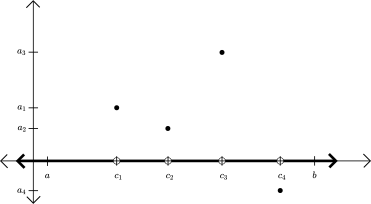
Example.
Example. Consider the functions \(g:[0,1]\to\mathbb{R}\) given by
\[g(x) = \begin{cases} 1 & \text{if }\frac{1}{x}\in\mathbb{N},\\ 0 & \text{otherwise}.\end{cases}\]
In your homework you will show that the integral of \(g\) on \([0,1]\) is zero, however you cannot use Theorem 5 as in the previous example. Note that \(g\) is zero everywhere except a countable infinte set.
However, recall that \(h:\mathbb{R}\to\mathbb{R}\) given by
\[h(x) = \begin{cases} 1 & x\in\mathbb{Q},\\ 0 & x\in\mathbb{R}\setminus\mathbb{Q}.\end{cases}\] is also zero everywhere but a countable infinte set, but \(h\) isn't even integrable on \([0,1]\)!
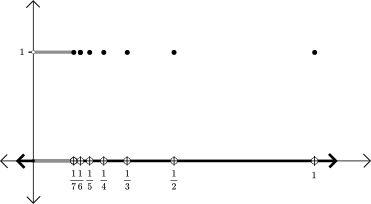
Theorem 13-4. Let \(a<c<b\). If \(f\) is integrable on \([a,b]\), then \(f\) is integrable on \([a,c]\) and on \([c,b]\). Conversely, if \(f\) is integrable on \([a,c]\) and on \([c,b]\), then \(f\) is integrable on \([a,b]\). Finally, if \(f\) is integrable on \([a,b]\) then
\[\int_{a}^{b}f = \int_{a}^{c}f + \int_{c}^{b}f.\]
Given a function \(f\) which is integrable on \([a,b]\) we can define a new function \(F:[a,b]\to\mathbb{R}\) by \[F(x) = \int_{a}^{x}f.\] Our goal is to understand the relationship between \(f\) and \(F\). First, note that \[F(a) = \int_{a}^{a}f = 0.\] Next, if \(a\leq x<y\leq b\) then
\[F(y)-F(x) = \int_{a}^{y}f-\int_{a}^{x}f = \int_{a}^{x}f+\int_{x}^{y}f-\int_{a}^{x}f = \int_{x}^{y}f.\]
On the other hand, if \(a\leq y<x\leq b\) then
\[F(y)-F(x) = \int_{a}^{y}f-\int_{a}^{x}f = \int_{a}^{y}f-\left(\int_{a}^{y}f +\int_{y}^{x}f\right)= -\int_{y}^{x}f.\]
Hence, for \(y<x\) we define
\[\int_{x}^{y}f = -\int_{y}^{x}f.\]
Thus, no matter which order \(x\) and \(y\) are in, we have
\[F(y)-F(x) = \int_{x}^{y}f.\]
Theorem 13-7. If \(f\) is integrable on \([a,b]\) and
\[m\leq f(x)\leq M\quad\text{for all }x\in[a,b],\] then \[m(b-a)\leq\int_{a}^{b}f\leq M(b-a).\]
Theorem 13-8. If \(f\) is integrable on \([a,b]\), then \(F:[a,b]\to\mathbb{R}\) given by \[F(x) = \int_{a}^{x}f\] is continuous on \([a,b]\).
Example. \[f(x) = \begin{cases} 0 & x<c,\\ 1 & x\geq c.\end{cases}\]
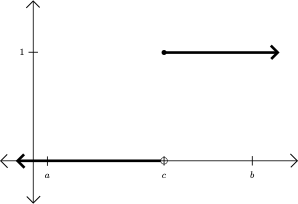
\[F(x) = \int_{a}^{x}f = \begin{cases} 0 & x\leq c,\\ x-c & x\geq c.\end{cases}\]
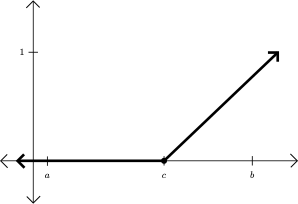
Note that \(F\) is not differentiable at \(c\). The next theorem shows us that if \(f\) were continuous, then \(F\) would be differentiable.
Part 13:
The Fundamental Theorem of Calculus
(Read Chapter 14 in the textbook)
Theorem 14-1 (the fundamental theorem of calculus). Let \(f\) be integrable on \([a,b]\) and define \(F:[a,b]\to\mathbb{R}\) by
\[F(x) = \int_{a}^{x}f.\]
If \(f\) is continuous at \(c\) in \((a,b)\), then \(F\) is differentiable at \(c\), and
\[F'(c) = f(c).\]
Moreover, if \(f\) is continuous at \(a\) or \(b\), then
\[\lim_{h\to 0^{+}}\frac{F(a+h)-F(a)}{h} = f(a)\quad\text{or}\quad \lim_{h\to 0^{-}}\frac{F(b+h)-F(b)}{h} = f(b),\]
respectively.
Note: for \(F\) to be differentiable it is sufficient that \(f\) is continuous. If \(f=\delta_{c}\) for some \(c\in[a,b]\), then \(f\) is not continuous, but we see that \(F\) is the zero function, which is differentiable. Also note that \(F'(c)=0\neq f(c)\).
Show that for \(0<a<b\) and \(p\in\N\)
\[\int_{a}^{b}x^p\,dx = \frac{1}{p+1}(b^{p+1}-a^{p+1}).\]
See Problem 4 in Chapter 13 for an outline.
3rd presentation:
Show that for \(c>1\), we have
\[\lim_{n\to\infty}c^{\frac{1}{n}} = 1,\]
that is, for every \(\varepsilon>0\), there exists a natural number \(M\) such that if \(n\geq M\) and \(n\in \N\), then \(|c^{\frac{1}{n}}-1|<\varepsilon.\) (See Problem 41(a) in Chapter 5.)
4th presentation:
Corollary 14-2. Suppose \(f\) is continuous on \([a,b]\) and for some function \(g\) we have \(f(x) = g'(x)\) for all \(x\in(a,b)\), then
\[\int_{a}^{b}f = g(b) - g(a).\]
Proof. Define
\[F(x) = \int_{a}^{x}f.\]
By the fundamental theorem of calculus we have \(F'(x) = f(x) = g'(x)\) for all \(x\in(a,b)\). By the Corollary 11-2, there exists \(C\in\mathbb{R}\) such that \(F(x) = g(x)+C\) for all \(x\in[a,b]\), and thus
\[\int_{a}^{b}f = F(b)-F(a) = (g(b)+C)-(g(a)+C) = g(b) - g(a).\ \Box\]
Example. For \(a\leq b\) we wish to evaluate \[\int_{a}^{b}x^{4}\,dx\]
Define the function \[F(x) = \int_{a}^{x}t^{4}\,dt,\]
and \(g(x) = x^{5}/5\). Note that \(F'(x) = x^{4} = g'(x)\) for all \(x\in (a,b)\), and hence by Corollary 14-2 we have
\[\int_{a}^{b}x^{4}\,dx = g(b)-g(a) = \frac{b^{5}-a^{5}}{5}.\]
Theorem. Let \(a_{0},a_{1},\ldots,a_{n}\) be real numbers. If
\[f(x) = a_{0}+a_{1}x+\cdots+a_{n}x^{n},\]
and \(a\leq b\), then
\[\int_{a}^{b} f = a_{0}(b-a) + a_{1}\frac{b^{2}-a^{2}}{2} + a_{2}\frac{b^{3}-a^{3}}{3} + \cdots + a_{n}\frac{b^{n+1}-a^{n+1}}{n+1}.\]
We can generalize the previous example in order to integrate any polynomial on a closed interval.
Example. For any \(n\in\mathbb{Z}\setminus \{-1\}\) and \(0<a\leq b\) we can compute
\[\int_{a}^{b} x^{n}\,dx = \frac{1}{n+1}(b^{n+1}-a^{n+1}).\]
But what is
\[\int_{1}^{b}\frac{1}{x}\,dx\ ??? \]
Part 14:
Logs and exponents
(Read Chapter 18 in Book of Proof)
Example continued. We can define the function \(F:(0,\infty)\to\mathbb{R}\) by
\[F(x) = \int_{1}^{x}\frac{1}{t}\,dt.\]
We know from the fundamental theorem of calculus that \(F\) is differentiable on \((0,\infty)\), but is it a function we've heard of before? YES!
Definition. For \(x>0\)
\[\log(x) = \int_{1}^{x}\frac{1}{t}\,dt.\]
Theorem 18-1. If \(x,y>0\), then
\[\log(xy) = \log(x)+\log(y).\]
Corollary 18-2. If \(x>0\) and \(n\in\mathbb{N}\), then
\[\log(x^n) = n\log(x).\]
Corollary 18-3. If \(x,y>0\), then
\[\log\left(\frac{x}{y}\right) = \log(x)-\log(y).\]
The inverse of \(\log\)
Observe that \(\log:(0,\infty)\to\mathbb{R}\) is continuous.
Moreover, for any \(n\in\mathbb{N}\) we have
\[\log(2^{n}) = n\log(2)\]
and
\[\log\left(\frac{1}{2^{n}}\right) = -n\log(2).\]
Since \[\log(2) = \int_{1}^{2}\frac{1}{t}\,dt>0\] we see that \(\log\) is not bounded above or below.
Since \(\log'(x) = 1/x\), we see that \(\log\) is increasing on \((0,\infty)\), and thus \(\log\) is injective.
Thus, by the intermediate value theorem, the range of \(\log\) is all of \(\R\).
Definition. The exponential function, \(\operatorname{exp} = \log^{-1}:\R\to (0,\infty)\)
The exponential function
Theorem 18-2. For each \(x\in\mathbb{R}\),
\[\exp'(x) = \exp(x).\]
Theorem 18-3. For each \(x,y\in\mathbb{R}\),
\[\exp(x+y) = \exp(x)\cdot\exp(y).\]
Theorem 12-5. Let \(f\) be continuous one-one function defined on an interval, and suppose that \(f\) is differentiable at \(f^{-1}(b)\), and \(f'(f^{-1}(b)) \neq 0\). Then \(f^{-1}\) is differentiable at \(b\) and \[(f^{-1})'(b) = \frac{1}{f'(f^{-1}(b))}.\]
Real exponents
Definition. For \(x\in\R\) we define
\[e^x: = \exp(x).\]
This gives us a way to define \(a^x\) for any \(a>0\). Note that for any \(n\in\mathbb{N}\) we have
\[a^{n} = e^{\log(a^n)} = e^{n\log(a)}.\]
Thus, we define
Definition.
\[e: = \exp(1).\]
Note that for \(n\in\N\) we have
\[e^n = \exp(1)\cdot\exp(1) \cdots \exp(1)= \exp(1+1+\cdots+1) = \exp(n)\]
Definition. For \(a>0\) and \(x\in\mathbb{R}\) we define
\[a^x : = e^{x\log(a)}.\]
Note that \(e\) is the (unique) number such that
\[\int_{1}^{e}\frac{1}{x}\,dx = 1.\]
Let's use our definition to estimate \(e\).
Take the partition \(P = \{1,2\}\) of the interval \([1,2]\). The upper sum of \(f(x) = 1/x\) for this partition is \(1\cdot (2-1) = 1\), from which we conclude:
\[\int_{1}^{2}\frac{1}{x}\,dx \leq 1 = \int_{1}^{e}\frac{1}{x}\,dx.\]
Take the partition \(Q = \{1,2,4\}\) of the interval \([1,4]\). The lower sum of \(f(x) = 1/x\) for this partition is \(\frac{1}{2}\cdot 1 + \frac{1}{4}\cdot 2 = 1\), from which we conclude:
\[\int_{1}^{4}\frac{1}{x}\,dx \geq 1 = \int_{1}^{e}\frac{1}{x}\,dx.\]
Thus we see that \[2\leq e\leq 4\]
Theorem 18-4. If \(a>0\), then
\[(a^b)^c = a^{bc}\quad\text{for all }b, c,\]
\[a^{1} = a,\]
and
\[a^{x+y} = a^x\cdot a^{y}\quad\text{for all }x,y.\]
Part 15:
Lebesgue Measure
Generalizing upper and lower sums
Consider the definition of upper and lower sums:
- Break the interval \([a,b]\) into subintervals: \[[a,t_{1}], [t_{1},t_{2}],[t_{2},t_{3}],\ldots,[t_{n-1},b].\]
- Compute an upper and lower bound for the "area" under the function \(f\) on the subinterval: \[\text{lower bound}: \inf\{f(x) : x\in[t_{i-1},t_{i}]\} (t_{i}-t_{i-1})\] \[\text{upper bound}: \sup\{f(x) : x\in[t_{i-1},t_{i}]\} (t_{i}-t_{i-1})\]
- Add up the lower bounds and upper bounds.
Why not break up \([a,b]\) into more general sets?
We would need to know the "length" more types of sets.
The "length" of set
What "should" be the length of these subsets of \(\mathbb{R}\):
set length
\([a,b]\) w/ \(a\leq b\)
\(b-a\)
\((a,b)\) w/ \(a\leq b\)
\(b-a\)
\([a,b] \cup [c,d]\) w/ \(a\leq b\leq c\leq d\)
\((d-c)+(b-a)\)
\(\varnothing\)
\(0\)
\(\{a\}\) for \(a\in\mathbb{R}\)
\(0\)
\(\N\)
\(0\)
\(\mathbb{Q}\)
\(0\)?
Sets with measure zero
Definition. Let \(A\) be a set of real numbers. We say that \(A\) has measure zero if for each \(\varepsilon>0\) there exists a sequence of open intervals \((a_{1},b_{1}),(a_{2},b_{2}),(a_{3},b_{3}),\ldots\) such that
\[A\subset \bigcup_{n=1}^{\infty}(a_{n},b_{n})\quad\text{and}\quad \sum_{n=1}^{\infty}(b_{n}-a_{n})<\varepsilon.\]
Example. Let \(a\in\mathbb{R}\) and set \(A = \{a\}\). For arbitrary \(\varepsilon>0\) we consider the sequence of open intervals
\[\left(a-\frac{\varepsilon}{2^3},a+\frac{\varepsilon}{2^3}\right), \left(a-\frac{\varepsilon}{2^4},a+\frac{\varepsilon}{2^4}\right),\ldots,\left(a-\frac{\varepsilon}{2^n},a+\frac{\varepsilon}{2^n}\right),\ldots\]
Clearly \[\{a\} \subset \bigcup_{n=1}^{\infty}\left(a-\frac{\varepsilon}{2^{n+2}},a+\frac{\varepsilon}{2^{n+2}}\right) = \left(a-\frac{\varepsilon}{8},a+\frac{\varepsilon}{8}\right),\] and \[\sum_{n=1}^{\infty}\left[\left(a+\frac{\varepsilon}{2^{n+2}}\right) - \left(a-\frac{\varepsilon}{2^{n+2}}\right)\right] = \sum_{n=1}^{\infty}\frac{\varepsilon}{2}\left(\frac{1}{2}\right)^{n} = \frac{\varepsilon}{2}<\varepsilon.\]
Example 2. Consider the set \(\N\). For arbitrary \(\varepsilon>0\) and \(n\in\N\) we define the open interval
\[U_{n} = \left(n-\frac{\varepsilon}{2^{n+2}},n+\frac{\varepsilon}{2^{n+2}}\right).\]
Note that
\[\N\subset \bigcup_{n=1}^{\infty} U_{n},\]
and the "length" of \(U_{n}\) is \(\varepsilon 2^{-n-1}\), thus the sum of the lengths of the \(U_{n}\)'s is \(\varepsilon/2<\varepsilon.\)
More generally, if \(A\subset\mathbb{R}\) is a countable set, that is, there exists a surjective (onto) function \(f:\mathbb{N}\to A\), then \(A\) has measure zero.
Countable sets have measure zero
Measure of the rationals
Consider the set
\[A = \left\{0,1,\frac{0}{2},\frac{1}{2},\frac{2}{2},\frac{0}{3},\frac{1}{3},\frac{2}{3},\frac{3}{3},\frac{0}{4},\frac{1}{4},\frac{2}{4},\frac{3}{4},\frac{4}{4},\ldots\right\}.\]
This set is countable, indeed, let \(f(n)\) be the \(n\) element in this list, then \(f:\mathbb{N}\to A\) is a surjection.
Note that \(f(1) = 0 = f(3)\), so this function is not one-one.
What is the set \(A\)?
\(A = \mathbb{Q}\cap[0,1]\).
Thus, \(\mathbb{Q}\cap[0,1]\) has measure \(0\).
Theorem 1. Suppose that for each \(n\in\mathbb{N}\), the set \(A_{n}\) has measure zero, then \[\bigcup_{n=1}^{\infty}A_{n}\] has measure zero.
Which sets can be measured
Definition. Let \(\Sigma\) be a collection of subsets of \(\mathbb{R}\). We say that \(\Sigma\) is a \(\sigma\)-algebra if it satisfies the following three properties:
- \(\displaystyle{\varnothing\in\Sigma}\)
- if \(A\in\Sigma\), then \(A^{c}:=\mathbb{R}\setminus A\in\Sigma\)
- if \(A_{1},A_{2},\ldots,A_{n},\ldots\) is a sequence of sets such that \(A_{n}\in\Sigma\) for each \(n\in\N\), then \(\displaystyle{\bigcup_{n=1}^{\infty}A_{n}\in\Sigma}\).
The set \(\mathcal{B}\) is the smallest \(\sigma\)-algebra such that every open interval is in \(\mathcal{B}\). If \(A\in\mathcal{B}\), then \(A\) is a called a Borel set.
Examples.
- The power set of \(\mathbb{R}\), denoted \(\mathcal{P}(\mathbb{R})\) consisting of all subsets of \(\mathbb{R}\) is a \(\sigma\)-algebra.
- The set \(\Sigma=\{\varnothing,\mathbb{R}\}\) is a \(\sigma\)-algebra.
Consider the set \(\mathcal{X}\) of all \(\sigma\)-algebras that contain all of the open intervals \((a,b)\) such that \(a<b\).
Note that \(\mathcal{P}(\mathbb{R})\in\mathcal{X}\), so \(\mathcal{X}\) isn't empty.
Then the Borel sets is the intersection
\[\mathcal{B} = \bigcap_{\Sigma\in\mathcal{X}}\Sigma.\]
Smallest how?
Some Borel sets
Example 1. A single point set \(\{a\}\) is a Borel set since
\[\{a\} = \big((-\infty,a)\cup(a,\infty)\big)^{c}.\]
Example 2. The sets \(\N,\Z,\) and \(\mathbb{Q}\) are Borel sets. Indeed, all countable sets are Borel sets.
Theorem. If \(A_{1},A_{2},\ldots\) are Borel sets, then
\[\bigcap_{n=1}^{\infty}A_{n}\]
is a Borel set.
Proof. Note that
\[\left(\bigcap_{n=1}^{\infty}A_{n}\right)^{c} = \bigcup_{n=1}^{\infty}A_{n}^{c}.\ \Box\]
What is Lebesgue measure?
Definition. Given a \(\sigma\)-algebra \(\Sigma\), a measure on \(\Sigma\) is a function \(\mu\) which takes elements of \(\Sigma\) as inputs, outputs nonnegative real numbers, and has the following properties:
- \(\mu(\varnothing) = 0\)
- For any countable collection of sets \(A_{1},A_{2},A_{3},\ldots\) in \(\Sigma\) such that \(A_{n}\cap A_{m}=\varnothing\) for all \(m\neq n\), it follows that \[\mu\left(\bigcup_{n=1}^{\infty}A_{n}\right) = \sum_{n=1}^{\infty}\mu(A_{n}).\]
Lebesgue measure denoted \(m\), is the unique measure on Borel sets such that \(m((a,b)) = (b-a)\) for all \(a<b\).
We say that the sets are pairwise disjoint.
Theorem. If \(A\) is a Borel set with measure zero, then the Lebesgue measure of \(A\) is \(0\), that is, \(m(A) = 0\).
Proposition. If \(A_{1},A_{2},\ldots\) is any collection of Borel sets, such that \(\sum_{n=1}^{\infty}m(A_{n})\) converges, then
\[m\left(\bigcup_{n=1}^{\infty}A_{n}\right) \leq \sum_{n=1}^{\infty}m(A_{n}).\]
Proposition. If \(A\) and \(B\) are Borel sets and \(A\subset B\), then \(m(A)\leq m(B).\)
Some fact about Lebesgue measure
The Lebesgue Integral
Suppose \(f\) is a function and \(A\) is a Borel set which is a subset of the domain of \(f\).
Given any finite collection of Borel sets \(A_{1},A_{2},\ldots,A_{n}\subset A\) which are pairwise disjoint and their union is \(A\), we define the upper and lower sums
\[\sum_{i=1}^{n}\big(\inf\{f(x) : x\in A_{i}\}\cdot m(A_{i})\big)\ \ \text{and}\ \ \sum_{i=1}^{n}\big(\sup\{f(x) : x\in A_{i}\}\cdot m(A_{i})\big),\] respectively.
If the supremum of all lower sums is equal to the infimum of all upper sums, then we say that \(f\) is Lebesgue integrable on \(A\), and the integral of \(f\) on \(A\), denoted \[\int_{A}f,\]
is this infimum/supremum.
Example. Consider the function
\[D(x) = \begin{cases} 1 & x\in\mathbb{Q}\\ 0 & x\in\mathbb{Q}^{c}.\end{cases}\]
For any Borel set \(A\) (\(A=[0,1]\) for example), we consider the sets \(A_{1} = A\cap\mathbb{Q}\) and \(A_{2} = A\cap (\mathbb{Q}^{c})\).
Since \(m(A_{1})\leq m(\mathbb{Q}) = 0\), we see that both the upper and lower sums are \(0\), thus
\[\int_{A}D = 0.\]
Hence, the function \(D\) is Lebesgue integrable on any Borel set.
It is not even Rieman integrable on \([0,1]\).
The Dirichlet function
Example. Consider the functions \(g:[0,1]\to\mathbb{R}\) given by
\[g(x) = \begin{cases} 1 & \text{if }\frac{1}{x}\in\mathbb{N},\\ 0 & \text{otherwise}.\end{cases}\]
Let \(A_{1} = \{\frac{1}{n} : n\in\mathbb{N}\}\) and \(A_{2} = [0,1]\setminus A_{1}.\)
Since \(m(A_{1}) = 0\) we see that the upper and lower sums with respect to the sets \(A_{1}\) and \(A_{2}\) are both \(0\).
Thus
\[\int_{[0,1]}g = 0.\]
In Homework 9 we showed for each integer \(n\geq 0\) and each \(x\in(0,1]\) we have
\[0< e^{x} - \left(1+\frac{x}{1!}+\frac{x^{2}}{2!}+\cdots + \frac{x^{n}}{n!}\right)< 3\frac{x^{n+1}}{(n+1)!}.\]
Thus, letting \(x=1\), for any integer \(n\geq 0\) we have
\[0< e - \left(1+\frac{1}{1!}+\frac{1}{2!}+\cdots + \frac{1}{n!}\right)< 3\frac{1}{(n+1)!}.\]
5th presentation:
Theorem 20-5. \(e\) is irrational.