Bridging Simulators with Conditional Optimal Transport

Justine Zeghal, Benjamin Remy,

Yashar Hezaveh, François Lanusse,

Laurence Perreault-Levasseur

Field Level Meeting SkAI, Chicago

February 2026

\underbrace{p(\theta|x=x_0)}_{\text{posterior}}
\underbrace{p(x = x_0|\theta)}_{\text{likelihood}}
\propto

 Full-field inference: extracting all cosmological information

\underbrace{p(\theta)}_{\text{prior}}

Bayes theorem:

\underbrace{p(\theta|x=x_0)}_{\text{posterior}}
\underbrace{p(x = x_0|\theta)}_{\text{likelihood}}
\propto

 Full-field inference: extracting all cosmological information

\underbrace{p(\theta)}_{\text{prior}}

Bayes theorem:

\underbrace{p(\theta|x=x_0)}_{\text{posterior}}
\underbrace{p(x = x_0|\theta)}_{\text{likelihood}}
\propto

 Full-field inference: extracting all cosmological information

\underbrace{p(\theta)}_{\text{prior}}

Bayes theorem:

\underbrace{p(\theta|x=x_0)}_{\text{posterior}}
\underbrace{p(x = x_0|\theta)}_{\text{likelihood}}
\propto

 Full-field inference: extracting all cosmological information

\underbrace{p(\theta)}_{\text{prior}}
\theta

 Simulator

x

Bayes theorem:

\underbrace{p(\theta|x=x_0)}_{\text{posterior}}
\underbrace{p(x = x_0|\theta)}_{\text{likelihood}}
\propto

Bayes theorem:

 Full-field inference: extracting all cosmological information

\underbrace{p(\theta)}_{\text{prior}}
\theta

 Simulator

x

Two ways to get the posterior:

  • Explicit inference:
\rightarrow \text{we need } \nabla_{\theta, z} \log p(x,\theta, z)
\rightarrow \text{we need } (x, \theta) \sim p(x, \theta, z)
  • Implicit inference
\underbrace{p(\theta|x=x_0)}_{\text{posterior}}
\underbrace{p(x = x_0|\theta)}_{\text{likelihood}}
\propto

 Full-field inference: extracting all cosmological information

\underbrace{p(\theta)}_{\text{prior}}
\theta

 Simulator

x

Two ways to get the posterior:

  • Explicit inference:
\rightarrow \text{we need } \nabla_{\theta, z} \log p(x,\theta, z)
\rightarrow \text{we need } (x, \theta) \sim p(x, \theta, z)
  • Implicit inference

Has to be realistic!

Bayes theorem:

 Wrong models generate bias

Fast simulations
Costly simulations

 Wrong models generate bias

e.g. full nbody, hydro

\log p(x)

Fast simulations

Costly simulations

O(ms) runtime
differentiable  
realistic

 Wrong models generate bias

e.g. full nbody, hydro

\log p(x)
\log p(x)

 e.g. log-normal, LPT, PM

O(ms) runtime
differentiable  
realistic

Fast simulations

Costly simulations

O(ms) runtime
differentiable  
realistic

 Learning the correction

We can learn 

the correction!

Fast simulations

Costly simulations

 Learning the correction

We can learn 

the correction!

Fast simulations

x_1 = \phi(x_0)
  • it preserves the conditioning,

Costly simulations

\text{We seek a mapping } \phi:
  •                                ,

such that

  • it minimally correct the simulation.
x_1 \sim p_1(x \mid \theta)

 Learning the correction

We can learn 

the correction!

Fast simulations

x_1 = \phi(x_0)
  • it preserves the conditioning,

Costly simulations

\text{We seek a mapping } \phi:
  •                                ,

such that

  • it minimally correct the simulation.

Requirements:

  •      has to map to a distribution sample.
\phi
  •      has to work in high dimensions.
\phi
  •      has to bridge any two distributions.
\phi
  •      has to bridge conditional distributions.
\phi
  •      has to be the solution of the OT problem.
\phi
x_1 \sim p_1(x \mid \theta)

Conditional Optimal Transport Flow Matching

Conditional Optimal Transport Flow Matching

(Lipman et al. 2023)

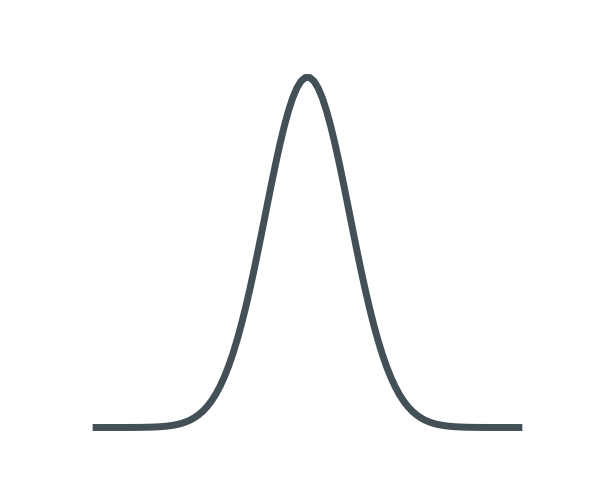
Flow matching
f^{-1}_1
f^{-1}_2
f_1
f_2
x_0 \sim p_0
x_1 \sim p_1
x_t \sim p_t
x_0 \sim p_0

(Lipman et al. 2023)

Flow matching

f^{-1}_1
f^{-1}_2
f_1
f_2
x_0 \sim p_0
x_1 \sim p_1
x_t \sim p_t
x_0 \sim p_0
\rightarrow \text{ learn discrete}\\ \text{ transformations } f_t

(Lipman et al. 2023)

Flow matching

f^{-1}_1
f^{-1}_2
f_1
f_2
x_0 \sim p_0
x_1 \sim p_1
x_t \sim p_t
x_0 \sim p_0
\rightarrow \text{ learn discrete}\\ \text{ transformations } f_t
x_0 \sim p_0
x_1 \sim p_1
x_t \sim p_t
\rightarrow \text{ learn continuous }\\ \text{ transformations } f_t \\ \text{ solution of }\\ \frac{d x_t}{dt} = \color{#ce6eff}{v_\varphi}\color{black}{(x_t, t)}
x_0 \sim p_0
x_0 \sim p_0
x_1 \sim p_1
x_t \sim p_t
x_0 \sim p_0
x_0 \sim p_0
x_1 \sim p_1
x_t \sim p_t
\rightarrow \text{ learn continuous }\\ \text{ transformations } f_t \\ \text{ solution of }\\ \frac{d x_t}{dt} = \color{#ce6eff}{v_\varphi}\color{black}{(x_t, t)}
f^{-1}_1
f^{-1}_2
f_1
f_2
x_0 \sim p_0
x_0 \sim p_0
x_1 \sim p_1
x_t \sim p_t
x_0 \sim p_0
x_0 \sim p_0
x_1 \sim p_1
x_t \sim p_t
x_0 \sim p_0
\rightarrow \text{ learn discrete}\\ \text{ transformations } f_t
\mathcal{L}_{FM}(\theta) = \mathbb{E}_{p(t)q(x_0,x_1)p_t(x_t\mid x_0,x_1)} \Big[ \| \color{#ce6eff}{v_\varphi} \color{black}{(x_t, t)- v(x_t,t) \|^2 \Big]}

(Lipman et al. 2023)

Flow matching

x_0 \sim p_0
x_1 \sim p_1
x_t \sim p_t
\rightarrow \text{ learn continuous }\\ \text{ transformations } f_t \\ \text{ solution of }\\ \frac{d x_t}{dt} = \color{#ce6eff}{v_\varphi}\color{black}{(x_t, t)}
f^{-1}_1
f^{-1}_2
f_1
f_2
x_0 \sim p_0
x_0 \sim p_0
x_1 \sim p_1
x_t \sim p_t
x_0 \sim p_0
x_0 \sim p_0
x_1 \sim p_1
x_t \sim p_t
x_0 \sim p_0
\rightarrow \text{ learn discrete}\\ \text{ transformations } f_t
\mathcal{L}_{FM}(\theta) = \mathbb{E}_{p(t)q(x_0,x_1)p_t(x_t\mid x_0,x_1)} \Big[ \| \color{#ce6eff}{v_\varphi} \color{black}{(x_t, t)- v(x_t,t) \|^2 \Big]}
p(x_t\mid x_0,x_1) = \mathcal{N}((1-t)x_1 + t x_0, \sigma)

(Lipman et al. 2023)

Flow matching

x_0 \sim p_0
x_1 \sim p_1
x_t \sim p_t
\rightarrow \text{ learn continuous }\\ \text{ transformations } f_t \\ \text{ solution of }\\ \frac{d x_t}{dt} = \color{#ce6eff}{v_\varphi}\color{black}{(x_t, t)}
f^{-1}_1
f^{-1}_2
f_1
f_2
x_0 \sim p_0
x_0 \sim p_0
x_1 \sim p_1
x_t \sim p_t
x_0 \sim p_0
x_0 \sim p_0
x_1 \sim p_1
x_t \sim p_t
x_0 \sim p_0
\rightarrow \text{ learn discrete}\\ \text{ transformations } f_t
\mathcal{L}_{FM}(\theta) = \mathbb{E}_{p(t)q(x_0,x_1)p_t(x_t\mid x_0,x_1)} \Big[ \| \color{#ce6eff}{v_\varphi} \color{black}{(x_t, t)- v(x_t,t) \|^2 \Big]}
p(x_t\mid x_0,x_1) = \mathcal{N}((1-t)x_1 + t x_0, \sigma)

(Lipman et al. 2023)

Flow matching

v(x_t, t) = x_1 - x_0

Requirements:

  •      has to map to a distribution sample.
\phi
  •      has to work in high dimensions.
\phi
  •      has to bridge any two distributions.
\phi
  •      has to bridge conditional distributions.
\phi
  •      has to be the solution of the OT problem.
\phi

Conditional Optimal Transport Flow Matching

Requirements:

  •      has to map to a distribution sample.
\phi
  •      has to work in high dimensions.
\phi
  •      has to bridge any two distributions.
\phi
  •      has to bridge conditional distributions.
\phi
  •      has to be the solution of the OT problem.
\phi

Conditional Optimal Transport Flow Matching

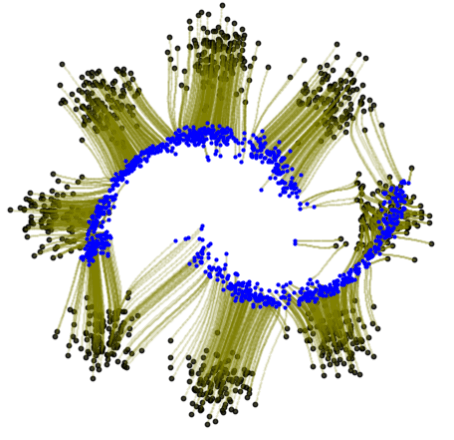
 Optimal Transport Flow matching (Tong et al. 2024)

Flow Matching loss function:

\rightarrow (x_0, x_1) \sim p_0(x_0)p_1(x_1)

Indepent coupling:

Optimal Transport coupling:

\rightarrow (x_0, x_1) \sim \pi^*(x_0,x_1)
W(q_0, q_1)^2_2 = \inf_{p_t, v_t} \int_{\mathbb{R}^d}\int^1_0 p_t(x)\|v_t(x)\|^2 dt dx

i.e. minimizes the path for all trajectories between      and     .

p_0
p_1
\text{ with } \pi^*= \inf_{\pi} \int_{{\mathbb{R}^d}^2} ||x_0 - x_1||^2 d\pi(x_0,x_1)

This coupling, combined with the linear interpolant, solve the dynamic OT:
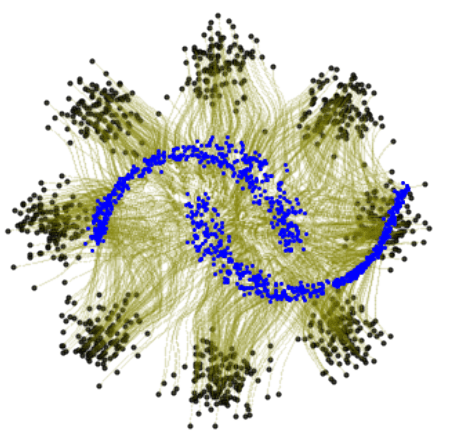
x_0 \sim p_0
\color{blue}{x_1 \sim p_1}
p(x_t\mid x_0,x_1) = \mathcal{N}((1-t)x_1 + t x_0, \sigma)
\mathcal{L}_{FM}(\theta) = \mathbb{E}_{p(t)q(x_0,x_1)p_t(x_t\mid x_0,x_1)} \Big[ \| \color{#ce6eff}{v_\varphi} \color{black}{(x_t, t)- (x_1-x_0) \|^2 \Big]}

Requirements:

  •      has to map to a distribution sample.
\phi
  •      has to work in high dimensions.
\phi
  •      has to bridge any two distributions.
\phi
  •      has to bridge conditional distributions.
\phi
  •      has to be the solution of the OT problem.
\phi

Conditional Optimal Transport Flow Matching

Requirements:

  •      has to map to a distribution sample.
\phi
  •      has to work in high dimensions.
\phi
  •      has to bridge any two distributions.
\phi
  •      has to bridge conditional distributions.
\phi
  •      has to be the solution of the OT problem.
\phi

Conditional Optimal Transport Flow Matching

 Conditional Optimal Transport Flow matching (Kerrigan et al. 2024)

OT Flow Matching loss function:
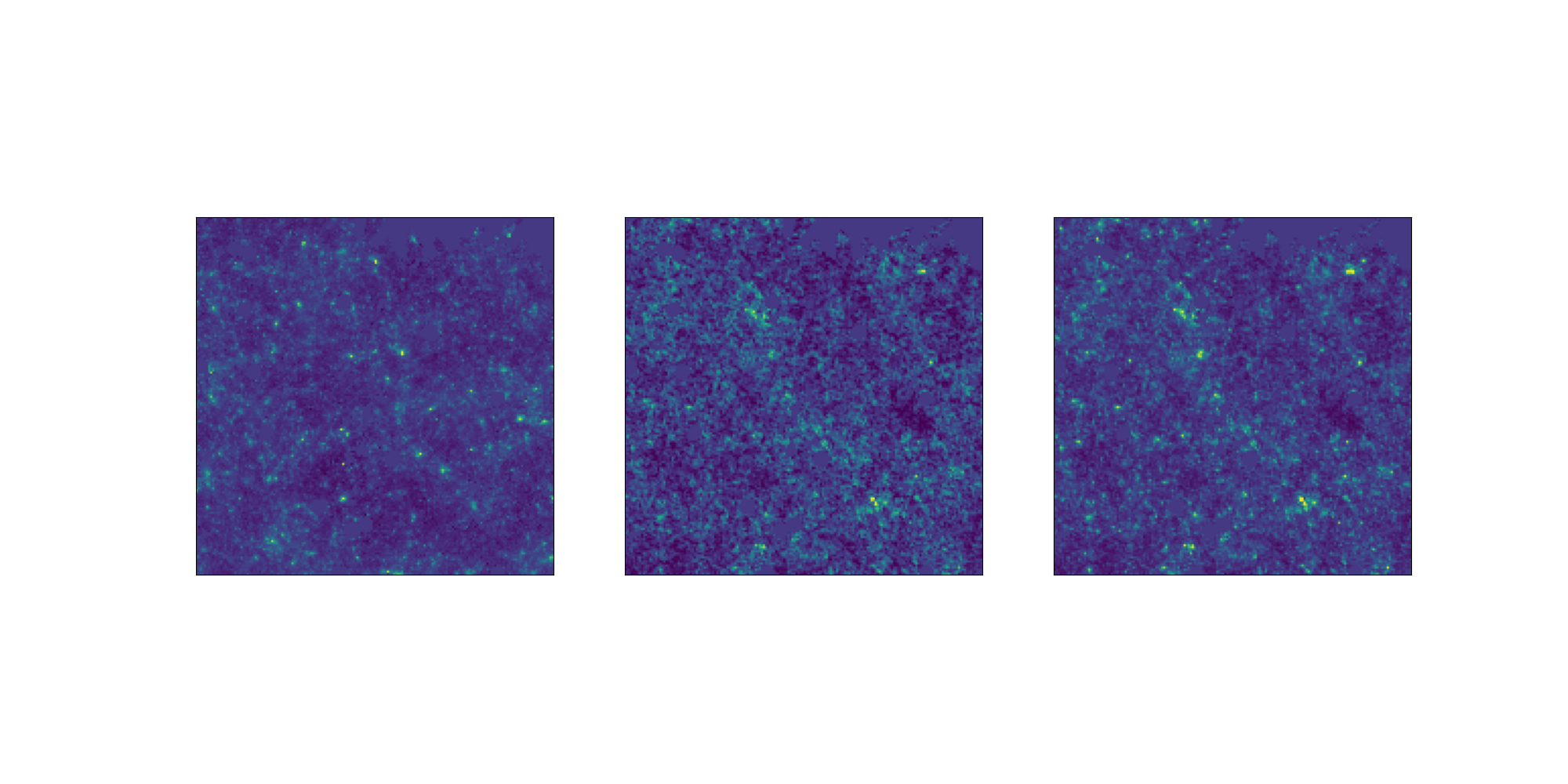
\text{ where } \pi^*= \inf_{\pi} \int_{{\mathbb{R}^d}^2} ||x_0 - x_1||^2 d\pi(x_0,x_1)
v_\varphi\left[\begin{matrix} \theta \\ x \end{matrix}\right] = \left[\begin{matrix} v_\varphi(\theta, t) \\ v_\varphi(\theta, x, t) \end{matrix}\right] = \left[\begin{matrix} 0 \\ v_\varphi(\theta, x, t) \end{matrix}\right]
c(x_0,x_1, \theta_0, \theta_1)= \|\theta_1 - \theta_0 \|^2 + \epsilon \|x_1 - x_0 \|^2
p(x_t\mid x_0,x_1) = \mathcal{N}((1-t)x_1 + t x_0, \sigma) \text{ with } (x_0, x_1) \sim \pi^*(x_0,x_1)
\mathcal{L}_{FM}(\theta) = \mathbb{E}_{p(t)q(x_0,x_1)p_t(x_t\mid x_0,x_1)} \Big[ \| \color{#ce6eff}{v_\varphi} \color{black}{(x_t, t)- (x_1-x_0) \|^2 \Big]}

Dataset 1

Optimal Transport Plan

\pi(x_0, x_1)

Dataset 2

Requirements:

  •      has to map to a distribution sample.
\phi
  •      has to work in high dimensions.
\phi
  •      has to bridge any two distributions.
\phi
  •      has to bridge conditional distributions.
\phi
  •      has to be the solution of the OT problem.
\phi

e.g. full nbody, hydro

\log p(x)
O(ms) runtime
differentiable  
realistic
\log p(x)

 e.g. log-normal, LPT, PM

O(ms) runtime
differentiable  
realistic

Fast simulations

Emulated simulations

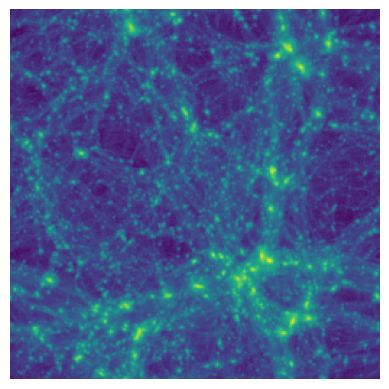
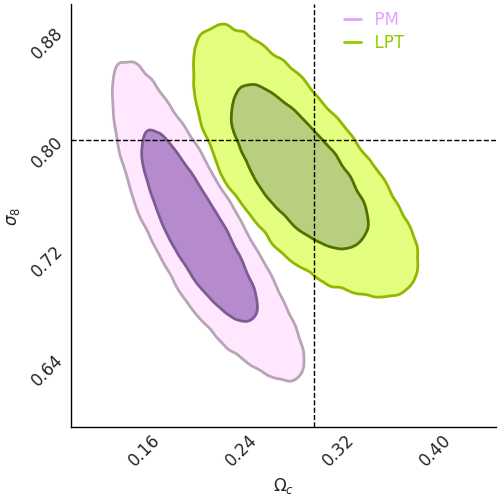
 Results on weak lensing maps

LPT

PM

Learned

Residuals
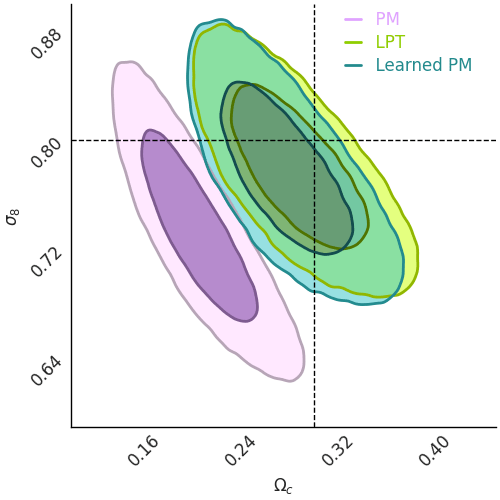
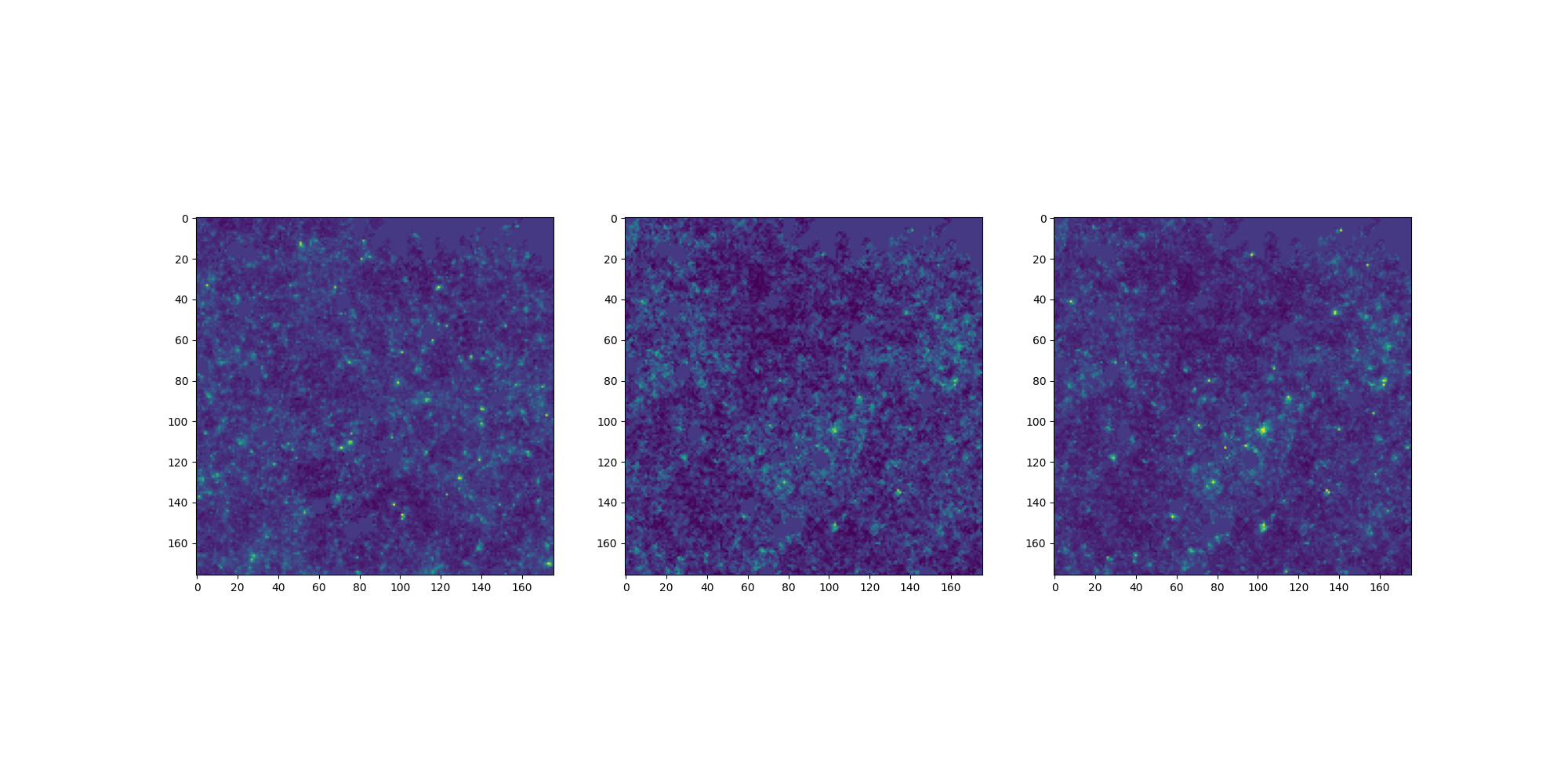
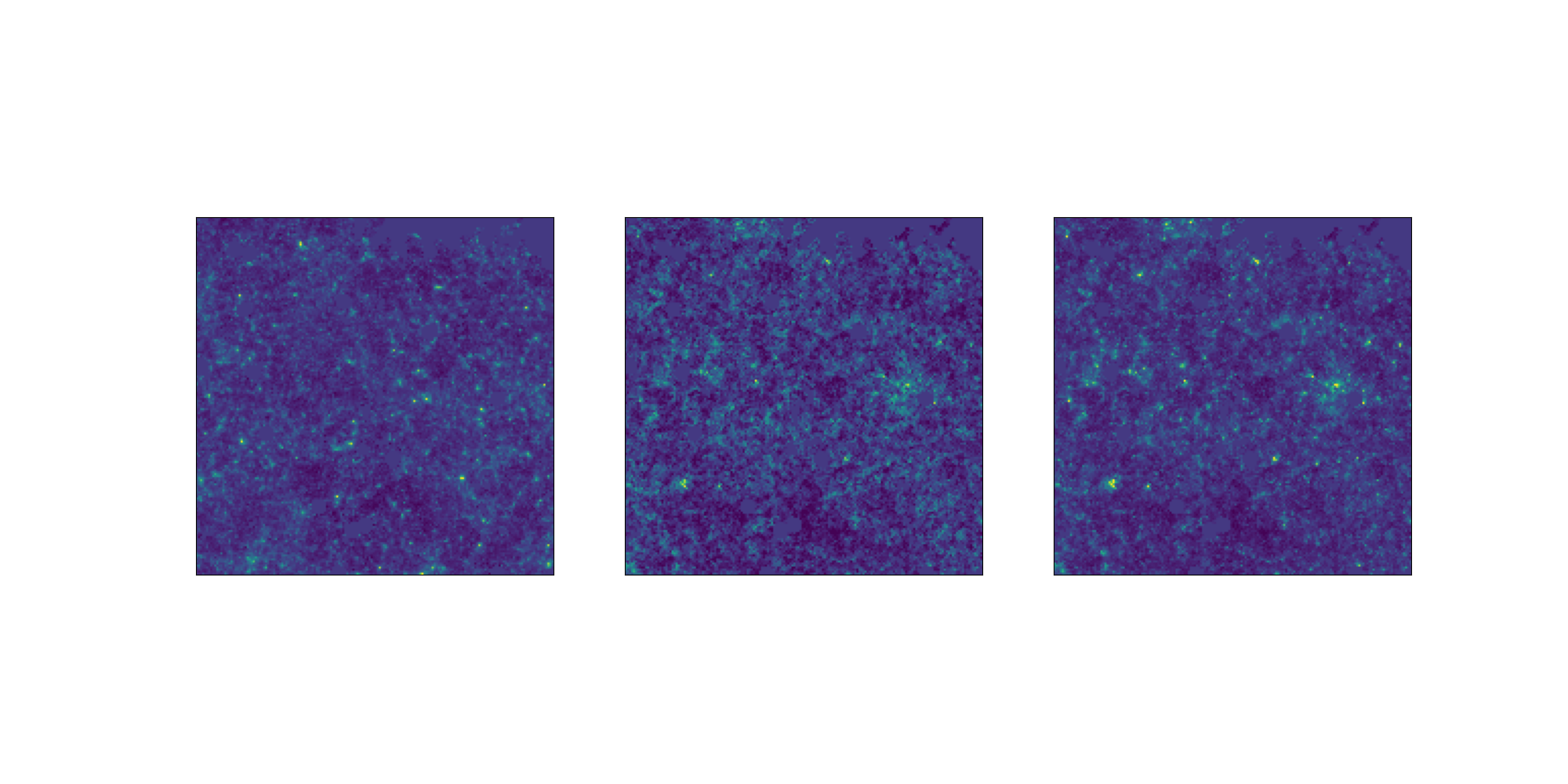
 NeurIPS Challenge: Weak Lensing Uncertainty

LogNormal

Emulated

Challenge simulation

VS

 NeurIPS Challenge: Weak Lensing Uncertainty

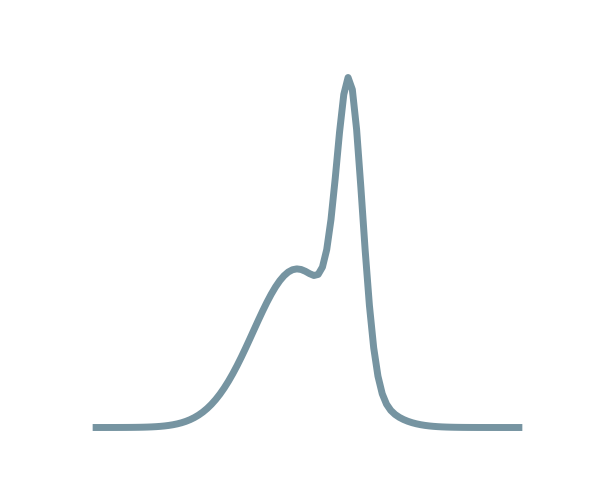
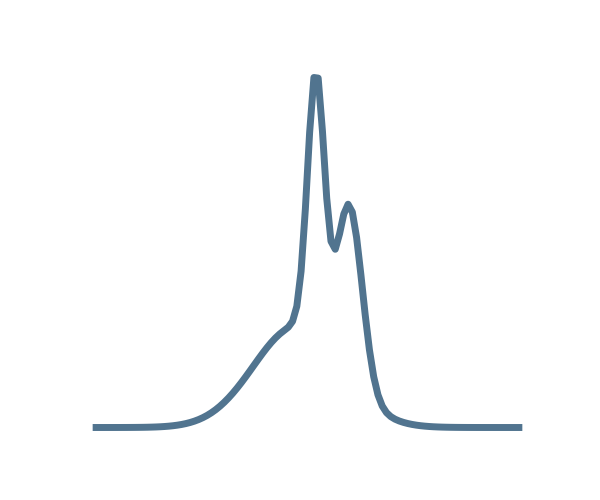
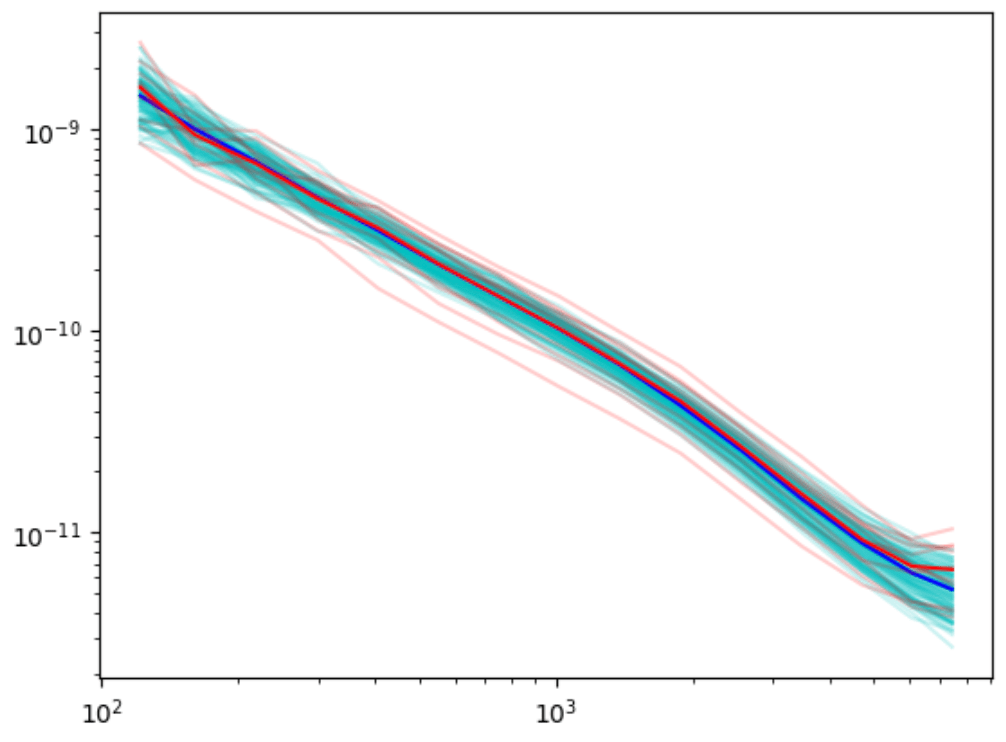
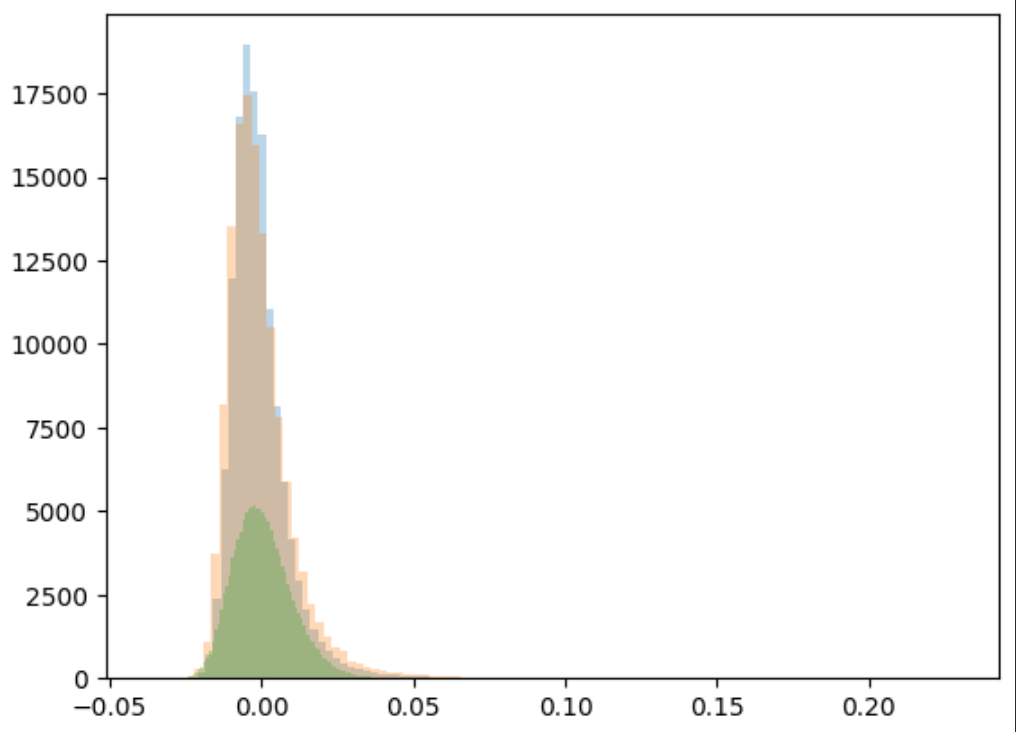
Power spectrum

PDF

LogNormal

Emulated

Challenge simulation

VS

 NeurIPS Challenge: Weak Lensing Uncertainty
🥳

LogNormal

Emulated

Challenge simulation

VS

 NeurIPS Challenge: Weak Lensing Uncertainty
Thank you for your attention!