(OG paper version - superceded!)
Dethroning the Dollar?
Multi-Currency AMMs for FX
Katya Malinova, Degroote School of Business, McMaster University
Andreas Park, University of Toronto
Women in Market Microstructure Workshop, Denver, June 2026
FX Transactions today and in days past
- 90% of FX transactions pass through a "vehicle" currency even when neither counterparty needs USD
- Krugman (1984); Rey (2001) — a dominant currency emerges endogenously whenever it minimizes transaction costs through thick-market externalities.
- OUR QUESTIONS: can DeFi tools do one better? How to design such tools?
gold &silver
sterling
USD
???
pre-1800
British imperial trade
post-Bretton Woods
"Pax" Americana
1944-
multi-lateral stablecoins
The World of MONEY is in flux
Stablecoin FX infrastructure
is being built
- GENIUS Act (2025) — U.S. framework for payment stablecoins
- Project Mariana (BIS, 2023) — three-currency AMM proof-of-concept for wholesale CBDC FX
- Project Rialto (BIS, 2024–25) — applies the Mariana FX layer to retail cross-border payments
- Major banks launching multi-currency stablecoin products
The World's Dependence on the USD is a Risk and has a Cost
- USD-vehicle status has geopolitical risks
- USD-routing status quo has cost because every non-USD pair pays twice — two spreads, two fees
- May be a burden on smaller firms and smaller economies
Two things are happening at once
Why does it matter?
A firm in Mexico pays a supplier in Thailand
MXN
USD
THB
spread + fee
spread + fee
today: routing through the vehicle; two legs, two spreads, two fees
what they want: direct conversion
This paper
Can a multi-currency AMM pool beat USD Routing?
Formalize Optimal AMM Design for Multi-Asset Pool
Micro-founded mechanism: AMM attracts volume \(\to\) attracts liquidity \(\to\) lowers per-trade costs
Identify the cross-subsidy
Identify parameter region where the AMM designer prefers vehicle routing but cross-pair traders don't
Scale to many currencies
Identify parameter region where multi-asset pool improves vehicle routing; extend to \(n\) small currencies
1
2
3
What an AMM is
A pool of reserves + a pricing rule \(R_0\cdot R_1=k\). Three things to know:
① Price = slope
S = R₀ / R₁
② Trade walks the curve
price moves → impact
③ LPs shift it out
more depth, same price
Constant Product AMM
Liquidity pool
\(R_0\) (USD)
\(R_1\) (MXN)
liquidity invariant \[R_0\cdot R_1=k\]
marginal price \[S=\frac{R_0}{R_1}\]
pool depth (at market price)
\[D=R_0+S\cdot R_1=2R_0\]
larger pool \(\to\) smaller price impact
define a trade's price impact:
\[\frac{S^{\text{paid}}-S^{\text{initial}}}{S^{\text{initial}}}\]
\(S^{\text{paid}}\): average rate over the whole trade — the VWAP of "walking" the pool
Proposition: A trade of size \(\Delta\) incurs a price impact of \(\frac{2\Delta}{D}\)
Only the imbalance matters
A trade ("swap") moves the price along the curve.
Liquidity providers have no positional gains on a round trip → they earn on AMM fees.
Fees accrue on all volume; adverse selection only on the imbalance.
- A round trip brings the dot back — LP positions unchanged.
- Only the net imbalance impacts LP positional payoffs.
- Imbalance maps to the period's return 1:1 \(\to\) LP losses are set by holding period returns.
Arbitrageurs pick off the pool whenever fundamentals move
buy & hold
AMM LP: concave relative to buy & hold
exchange rate change
holding value one currency rel. to other
"Impermanent loss" = adverse selection
Adverse selection, priced from returns + volume alone.
Our closed form (Learning from DeFi):
\(\mathbb{E}[\text{IL}] = \dfrac{\sigma^2}{8}\)
The AMM fee must cover it.
More broadly: DEX liquidity provision
Malinova & Park (2025)
Milionis et al. (2022) - "loss vs. rebalancing"
Caparros, Chaudhary & Klein (2024) - are LPs informed?
Our work and this talk is all V2
Constant product is not the only curve
Constant product (Uniswap) is the prevalent AMM — but other pricing curves exist.
Decentralized Exchanges for Stablecoins · Huang, Rostova & Song
- LOB venues (CEX) and AMM venues (DEX) coexist
- DEX uses a flatter, low-convexity curve (Curve protocol)
- Theory + transaction-level empirics: venue structure shapes peg deviations
Flatter curves suit same-currency stable pairs (USDT–USDC).
This paper builds on our "Learning from DeFi"
from returns + volume, no intraday data
optimal fee ≈ σ·√(Δ/V) — the price-impact law, as adverse-selection compensation
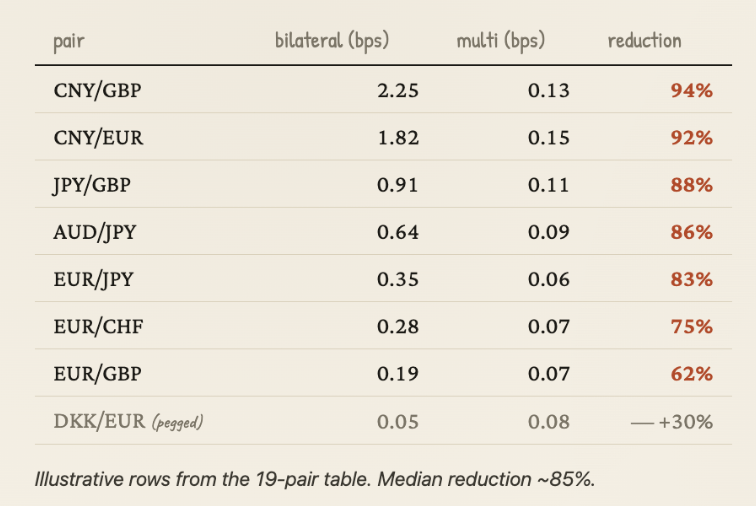
same scale as spreads, ~30% below — prices only adverse selection
the pricing schedule can be interpreted as a continuous order book
We take this to FX: view passive, competitive V2-style LP as a conservative benchmark for the status quo.
A model of an AMM: the AMM fee that minimizes trading cost (price impact + fee) → a measure of per-period adverse selection, calibrated to equities.
FX Trading: Three Structures
MXN
USD
THB
MXN
USD
THB
MXN
USD
THB
MXN
USD
THB
MXN
USD
THB
MXN
USD
THB
MXN
USD
THB
MXN
USD
THB
MXN
THB
MXN
USD
THB
MXN
USD
THB
MXN
USD
THB
MXN
USD
THB
MXN
USD
THB
MXN
USD
THB
MXN
USD
THB
MXN
USD
THB
MXN
USD
THB
MXN
USD
THB
MXN
USD
THB
MXN
USD
THB
MXN
USD
THB
MXN
USD
THB
MXN
USD
THB
MXN
USD
THB
Status Quo (SQ)
Two bilateral USD pools. MXN/THB route through USD
Three Bilateral Pools (BP)
One pool per pair. No forced routing but fragmented capital and volume
Single multilateral pool (MP)
all three currencies in one pool; direct trading of all pairs
Same approach as single pool: LP break even, cost-minimizing planner
Capital multiplexing — the key intuition
Split the capital and each pair gets a book only ⅓ as deep — price impact rises. Pool it, and every dollar backs all three pairs.
⅓ D
⅓ D
⅓ D
USD/MXN
USD/THB
MXN/THB
capital split 3 ways
pool the capital →
D
every dollar backs all 3 pairs
price impact, split capital:
\[\frac{2\Delta}{D/3}=\frac{6\Delta}{D}\]
price impact, pooled:
\[\frac{2\Delta}{\frac{2}{3}D}=\frac{3\Delta}{D}\]
Multi-asset AMM: the setup behind the intuition
liquidity invariant (equal weights) \[R_0\cdot R_1\cdots R_n = k\]
marginal rate vs numeraire \((S_0\equiv 1)\) \[S_i=\frac{R_0}{R_i}\]
pool depth (at market prices) \[D=\sum_i S_i R_i = n\,R_0\]
Lemma (equal thirds). Each currency holds one third of pool depth: \(\;S_i R_i = \dfrac{D}{3}\)
Price impact. A trade \(i\to j\) touches 2 of 3 currencies — backed by \(\tfrac{2}{3}D\):
\[\Pi=\frac{2\Delta}{\frac{2}{3}D}=\frac{3\Delta}{D}\]
Impermanent loss — our closed-form approximation:
\[\mathbb{E}[\text{IL}]=\frac{\Sigma}{18},\quad \Sigma=\sigma_{01}^2+\sigma_{02}^2+\sigma_{12}^2\]
extends bilateral \(\;\sigma^2/8\) · this is what the AMM fee must cover
Bilateral pools vs one multilateral pool
① LPs commit liquidity
until fee revenue covers expected IL — this pins down depth D.
② Designer picks fee F
to minimize price impact + fee — depth substitutes out, leaving the cost.
per-trade cost = price impact + fee, at the optimum:
\(c^{\text{BP}}_{ij}=2\sqrt{\dfrac{\Delta\sigma_{ij}^{2}}{4V_{ij}}}\qquad\qquad c^{\text{MP}}=2\sqrt{\dfrac{\Delta\Sigma}{6V}}\)
Symmetric case: \(\;c^{\text{MP}}=\sqrt{\tfrac{2}{3}}\,c^{\text{BP}}\;\) — about 18% lower.
Bilateral pools vs one multilateral pool
① LPs commit liquidity
until fee revenue covers expected IL — this pins down depth D.
② Designer picks fee F
to minimize price impact + fee — depth substitutes out, leaving the cost.


A useful parametrization
Real FX is not symmetric: dollar pairs dominate volume, cross pairs are (or would be) thinly traded
USD/THB
USD/MXN
MXN/THB
volume \(V\)
volatility \(\sigma\)
volume \(V\)
volatility \(\sigma\)
volume \(v\times V\)
volatility \(s\times\sigma\)
Two "knobs"
\(v\) cross-pair volume, relative to a vehicle pair
\(s\) cross-pair volatility, relative to a vehicle pair
— typically \(v<1\), cross pairs are thin
FX Trading: Three Structures
MXN
USD
THB
MXN
USD
THB
MXN
USD
THB
MXN
USD
THB
MXN
USD
THB
MXN
USD
THB
MXN
USD
THB
MXN
USD
THB
MXN
THB
MXN
USD
THB
MXN
USD
THB
MXN
USD
THB
MXN
USD
THB
MXN
USD
THB
MXN
USD
THB
MXN
USD
THB
MXN
USD
THB
MXN
USD
THB
MXN
USD
THB
MXN
USD
THB
MXN
USD
THB
MXN
USD
THB
MXN
USD
THB
MXN
USD
THB
MXN
USD
THB
Status Quo (SQ)
Two bilateral USD pools. MXN/THB route through USD
Three Bilateral Pools (BP)
One pool per pair. No forced routing but fragmented capital and volume
Single multilateral pool (MP)
all three currencies in one pool; direct trading of all pairs
narket designer considers the volume-weighted costs for all groups
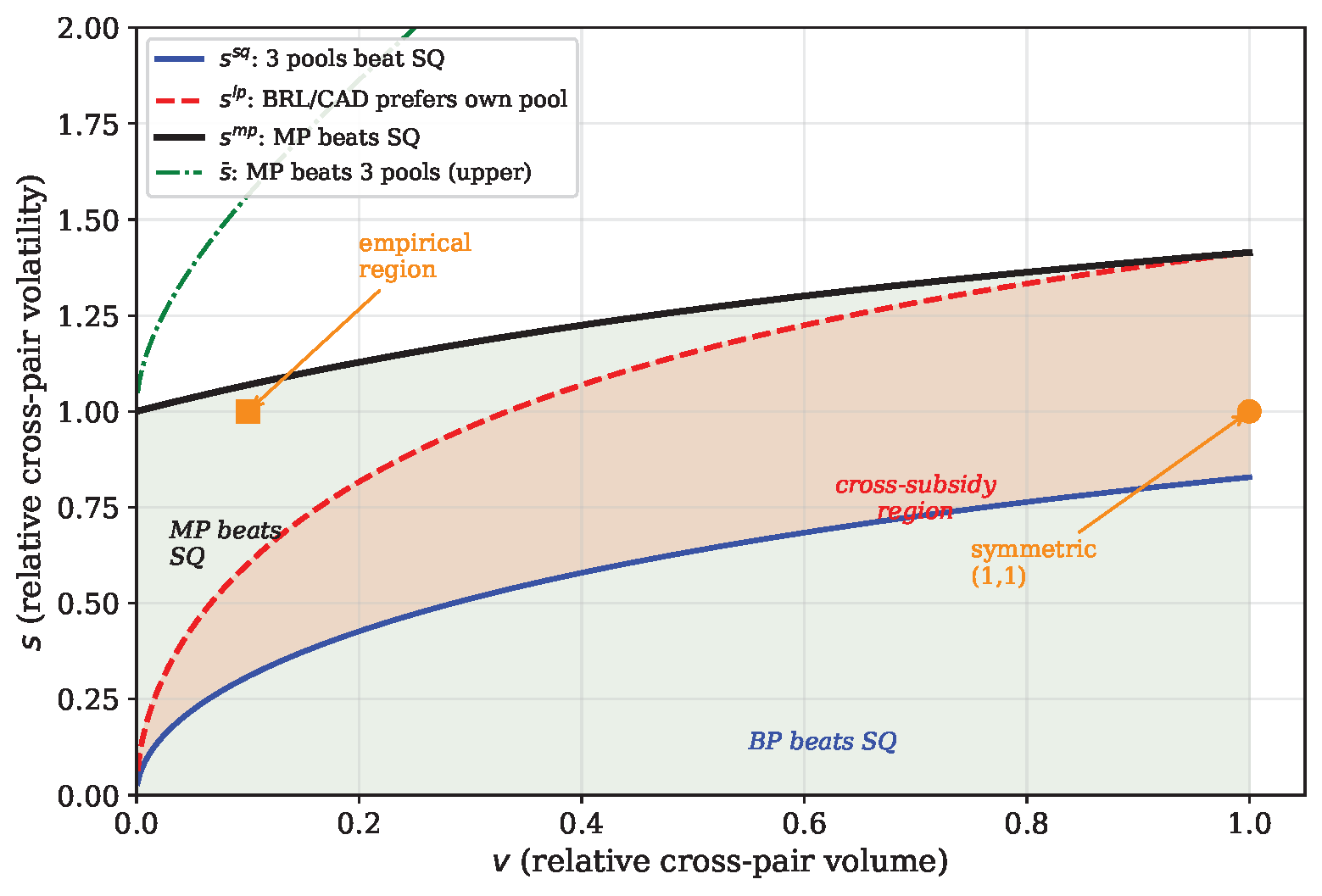
multi-currency pool is better than three bilateral pools
vehicle routing beats three pools
three bilateral pools are better than vehicle routing
multi-currency pool beats vehicle routing
but: small traders would prefer their own pool
MXN/THB
Future directions and extensions
Many small currencies: which to pool?
- Pool currencies that move together against the dollar
- Higher correlation against the dollar lowers cross-pair volatility
- The "high enough correlation" threshold for when "small collective pool" beats the vehicles routing.
- This threshold collapses as the number of small currencies grows.
Optimal weights (AMM curve design)
- Equal thirds isn't optimal
- Tilting toward the dollar does better
More broadly: multi-asset AMM
- letting LPs choose which pools to create -- which assets to place into a single pool
Next steps: taking this to data
Equities: easy — returns + volume, observed.
FX: bilateral volume is unobserved — because of vehicle routing.
Trade data as a proxy?
Takeaways
Vehicle-currency routing is not a coordination failure.
In a wide parameter region it is welfare-maximizing. The dollar earns its role.
But it embeds a cross-subsidy.
Small-pair traders — smaller firms, emerging economies — pay twice so majors pay less.
A multilateral pool resolves the tension.
In the empirically relevant region it beats routing, and the cross-pair trader individually prefers it. Capital multiplexes across all pairs.
The collective of small currencies, not any one challenger, is the threat.
"High enough correlation" threshold collapses as the number of currencies grows.
Design the stablecoin FX layer accordingly.
Closed-form fees and optimal weights are ready for implementation.
01
02
03
04
05
More Multi-Token AMM Maths
Impermanent loss:
\[\text{IL}=\frac{\text{pool value at }T -\text{pool value buy-and-hold at} T}{\text{pool value at start}}\]
\[=\left(\prod_{i=1}^nx_i\right)^{\frac{1}{n+1}}-\frac{1}{n+1}\left(1+\sum_{i=1}^nx_i\right)\]
gross return of currency i relative to numeraire 0: \[x_i:=\frac{S_i(T)}{S_i(0)}\]
Proposition: For three currencies with \(E[x_i]=1\), \(x_i:=1+\epsilon_i,\), \(\sigma_{ij}^2:=Var(\epsilon_i-\epsilon_j)\), and \(\Sigma:=\sigma_{01}^2+\sigma_{02}^2+\sigma_{12}^2\)
\[\mathbb{E}[-\text{IL}]=\frac{\Sigma}{18}\]
recall: bilateral pool \(\mathbb{E}[\text{IL}]=\frac{\sigma^2}{8}\)
Multi-token AMM: setup and price impact
liquidity invariant (equal weights \(w_i=\tfrac1n\)) \[\prod_{i} R_i^{\,w_i}=k\]
marginal rate vs numeraire \((S_0\equiv1)\) \[S_i=\frac{R_0}{R_i}\]
pool value (at market prices) \[V=\sum_{i} S_i R_i = n\,R_0\]
3-currency closed form below; for general \(n\), Li, Park, Singh & Veneris (2026) give a numerical algorithm for optimal weights and pool construction.
Lemma (equal thirds). At market-consistent prices each currency holds one third of pool value: \[S_i R_i=\frac{V}{3}\]
Proposition (price impact). A trade \(i\to j\) of size \(\Delta\) hits a sub-pool of value \(\tfrac23 V\), so \[\Pi=\frac{2\Delta}{\tfrac23 V}=\frac{3\Delta}{V}\]
Looks worse than the bilateral \(2\Delta/V\) — but here \(V\) is the whole pool. (next slide)
LP and pool-designer decision
Trades hit ⅔ of the pool, so LPs bear adverse selection on every pair — the fee must cover it.
Liquidity providers enter until fees cover expected IL — break-even pins depth: \[F\cdot V = D_0\cdot \mathbb{E}[\text{IL}]\]
Pool designer picks \(F\) to minimize all-in cost (price impact + fee):
\[c^{\text{multi}}(F)=\frac{\Delta\Sigma}{6V}\frac{1}{F}+F,\qquad c^{\text{pair}}_{ij}(F)=\frac{\Delta\sigma_{ij}^2}{4V_{ij}}\frac{1}{F}+F\]
\[F^{*}=\sqrt{\frac{\Delta\Sigma}{6V}},\qquad F^{*}_{ij}=\sqrt{\frac{\Delta\sigma_{ij}^2}{4V_{ij}}}\]
at the optimum: price impact \(\approx 2F\) — half impact, half fee
symmetric case: multi-pool cost is
\[\sqrt{\tfrac{2}{3}}\ \text{of pairwise}\]
≈ 18% lower
Optimally designing an multi-currency AMM
Large-volume approximation
When period volume is large relative to any single trade:
Optimal fee
\[F^{*}=\frac{\sigma}{2}\sqrt{\frac{\Delta}{V}}\]
Pool depth
\[D^{*}=\frac{4}{\sigma}\sqrt{\Delta V}\]
Per-trade cost
\[c^{*}=\sigma\sqrt{\frac{\Delta}{V}}\]
\(\sigma\) = period return volatility — captures adverse selection, reminiscent of the square-root price-impact law
\(V\) = expected "noise" (balanced) volume · \(\Delta\) = representative order size · \(D\) = pool depth
FX Trading: Three Structures
Status Quo (SQ)
Two USD pools; MXN/THB routes through USD.
Three Bilateral Pools (BP)
One pool per pair; capital fragmented.
One Multilateral Pool (MP)
All three in one pool; direct trading.
Similar analysis as one pool — LPs break even, planner sets the cost-minimizing fee.
Benchmark: every pair is identical: volume \(V\), volatility \(\sigma\). We relax this with later.
Trading Costs in an optimally calibrated bilateral AMM