Discussion of
"Best Execution Puzzles"
by Indira Puri, Mohan (Fred) Sun, and Mao Ye
Discussant: Katya Malinova
DeGroote School of Business, McMaster University
53rd Annual Meeting of the European Finance Association · August 19–22, 2026
Vlerick Business School, Ghent, Belgium
Some venues are both slower & more expensive. Puzzle: why do they exist?
This paper: a third dimension: timing reliability.
Timing histogram to get the execution time vol
80 off-exchange venues.
Two approaches
Reduced form
Execution time dispersion from Rule 605 bins: <9sec, 10-29, 30-59, 1-5min, 5-30min
Regress effective spread on speed, speed volatility, non-execution
Is execution timing uncertainty priced?
Venue-choice model
Heterogeneous trader preferences over venue attributes
Fitted to observed venue shares
Can we rationalize coexistence?
Data note: 22.6m venue–stock–month cells → 2.6m used. Most cells have zero measured dispersion (single bin); this also removes exchanges, mostly in the <9sec bin.
→ A venue enters only through cells with non-zero dispersion. Conditioning on "hard to fill"?
Q1-A: how much of a puzzle is this?
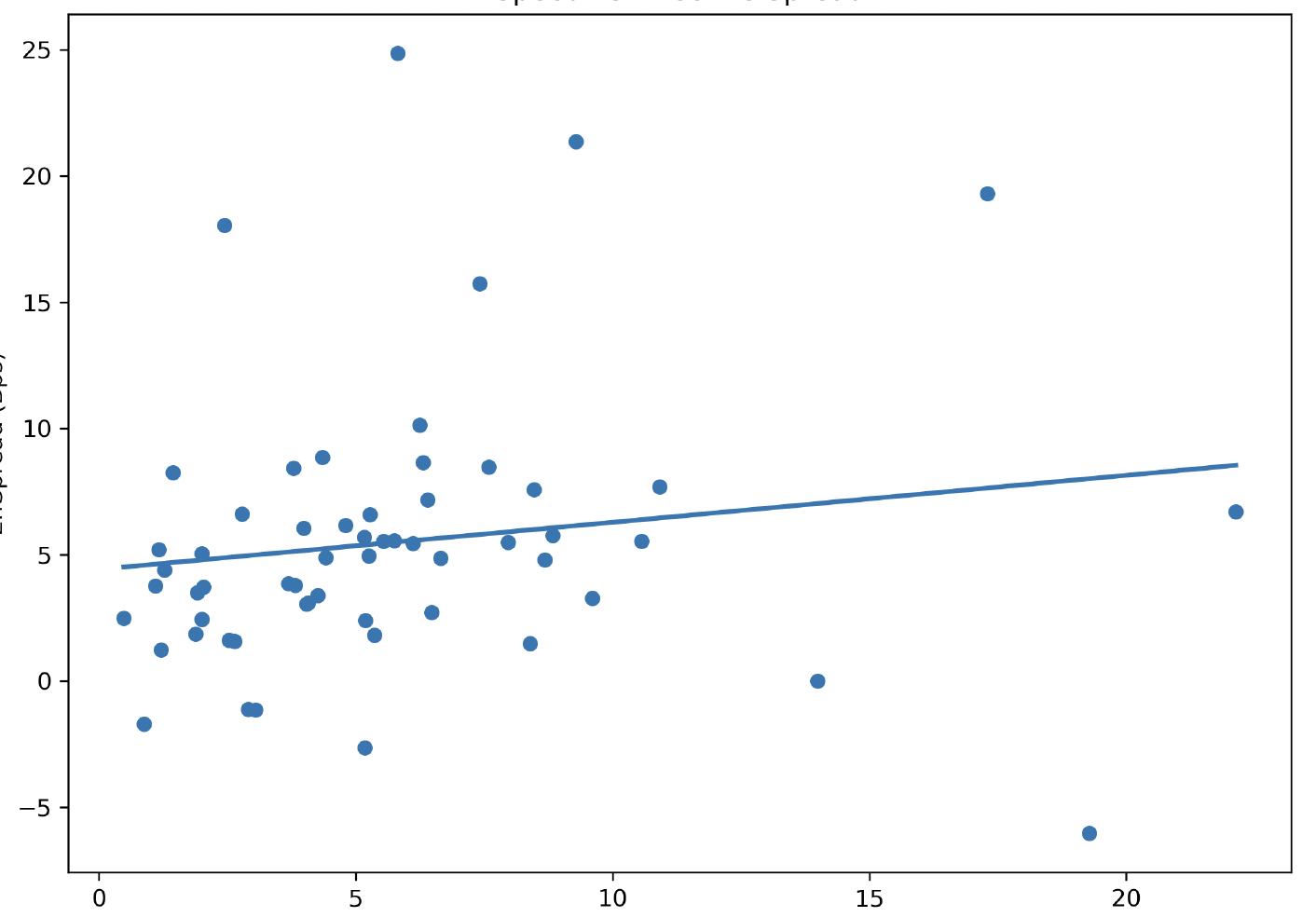
Effective spread (bps) costlier ↑
Time to fill (seconds) slower →
Q1-B: might we expect slow to be expensive?
605 data: “slow” = very slow → over 9 seconds
Orders are marketable on arrival.
→high spread (relative to mdpt @entry)
→ slow can be mechanically more expensive.
→ why not execute? low depth? a liquidity effect?
→ is the bigger puzzle fragmentation/existence of illiquid venues (many explanations
As an aside: once resting, the order supplies liquidity — execution time is now about limit price and queue position (Lo, MacKinlay & Zhang; Yueshen).
Q1-A: how much of a puzzle is this?
Effective spread (bps) costlier ↑
Time to fill (seconds) slower →
Q1-B: might we expect slow to be expensive?
605 data: "slow" = very slow → over 9 seconds
Orders are marketable on arrival.
→ high spread (relative to mdpt @entry)
→ slow can be mechanically more expensive.
As an aside: once resting, the order supplies liquidity — execution time is now about limit price and queue position (Lo, MacKinlay & Zhang; Yueshen).
And: why didn't it execute? Low depth? Is speed volatility partly a liquidity measure?
And: is the broader puzzle the existence of illiquid venues?
Q2: what is being priced?
→ Is the object execution speed volatility — or non-execution risk?
Good news, bad news: amended Rule 605 collection began August 1
- much finer time-to-execution buckets
- median and 99th percentile of time to execution reported directly
Q3: bifurcation of trading venues?
Low-fill venues look faster and cheaper (conditional on execution; Table 1, Panel C — raw means).
"Unfilled" here ≠ never executed: non-execution at the receiving venue can include routing elsewhere.
Is the low spread partly a consequence of selective execution and/or venue business model?
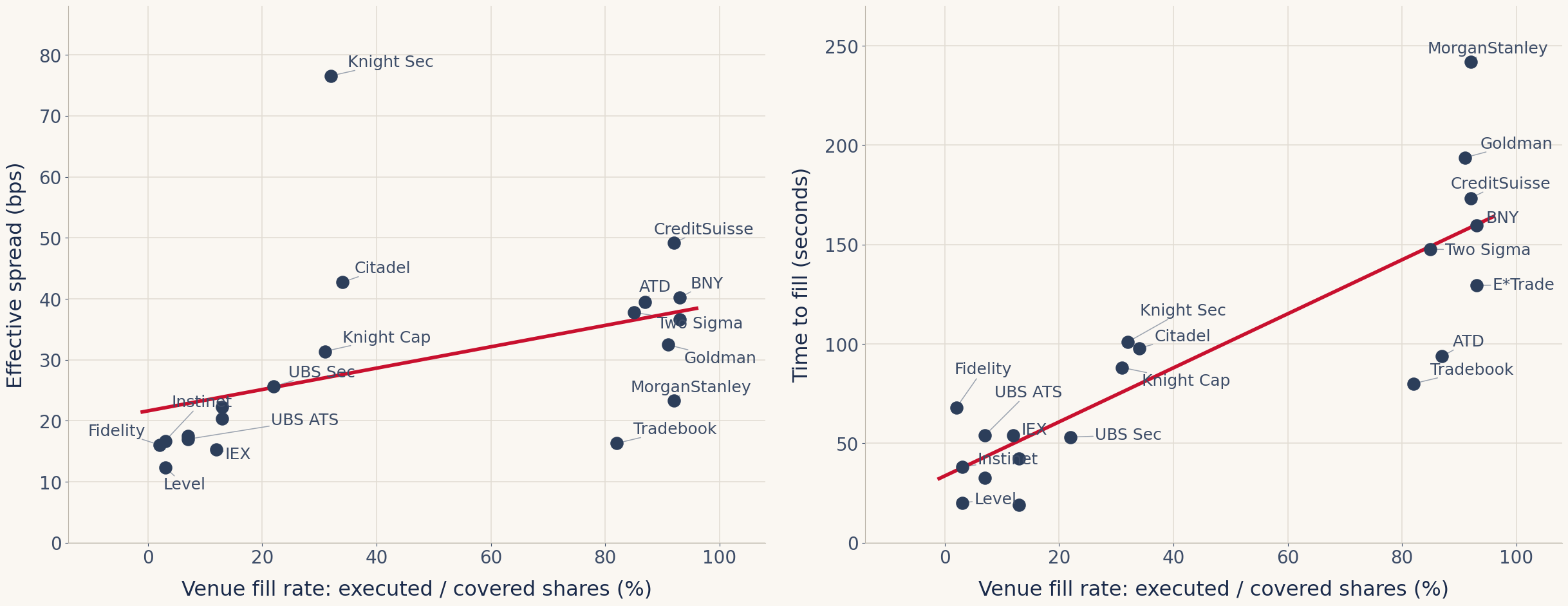
Q4: what explains the pattern?
Less-predictable execution timing ↔ lower effective spreads.
Table 6: ATSs are more predictable & costlier → architecture matters. But through what channel?
Paper: rule-based ATS matching vs greater non-ATS execution discretion.
Different mechanisms allow & attract different orders. Often the broker routes.
- Citadel and Knight internalize; Instinet, Level, UBS ATS match (dark).
- Not freely routing to all 80: PFOF, affiliation, connectivity.
Heterogeneous preferences — or heterogeneous choice sets
→ does this affect the venue-choice model?
Would Rule 605 realized spread help tell some of these apart?
One puzzle solved: execution timing uncertainty is priced.
Would love to know more detail on the next one: why.
Fun paper.
Go read it.