Do LLMs dream of Type Inference?
Leaner Technologies, Inc.
Shunsuke "Kokuyou" Mori
@kokuyouwind
Why Type Inference with LLMs?
class Bird; end

class Duck < Bird
  def cry; puts "Quack"; end
end

class Goose < Bird
  def cry; puts "Gabble"; end
end

def make_sound(bird)
  bird.cry
end

make_sound(Duck.new)
make_sound(Goose.new)
What is the argument type of make_sound method?
Traditional Approach: Algorithmic
make_sound(Duck.new)
make_sound(Goose.new)
Called with Duck
Called with Goose
The argument type of make_sound is (Duck | Goose)
Human Approach: Heuristics
class Bird; end

def make_sound(bird)
  bird.cry
end
The argument name is bird.
The argument type of make_sound is Bird
There is Bird class.
Algorithms are great at logic, but lack heuristic understanding.
LLMs offer the potential for human-like type inference.

I developed
as a tool to guess RBS types using LLMs.
Duck
quacking like geese
Duck
quacking like geese
Duck

Duck Typing
quacking like geese
Goose
RBS Goose: Current State


Ruby
RBS
some small
:

How capable is
:

?
We will need some metrics of RBS Goose performance.
-
Explain how RBS Goose works with LLM and evaluate
-
Better results than traditional methods in several cases
-
-
Share the idea of a type inference benchmark I planned
-
Referring to previous studies
-
Today's Focus
Outline
Basics of Type System and Type Inference
RBS Goose Architecture and Evaluation
Evaluation Method in Previous Studies
The idea of TypeEvalRb
Conclusion
Outline
Basics of Type System and Type Inference
RBS Goose Architecture and Evaluation
Evaluation Method in Previous Studies
The idea of TypeEvalRb
Conclusion
Type System
-
A mechanism to classify the components of a program
-
Strings, numbers, etc.
-
To prevent invalid operations
-
-
Ruby is a dynamically typed language
-
1 + 'a': TypeError is raised at runtime -
1 + 'a' if false: TypeError is not raised
-
Static Type Checking
-
A mechanism to detect type errors before execution
-
Need to know the type of each part of the code
-
Ruby does not use type annotations in its code
-
Define types with RBS / Checking with Steep
-
(Other options include RBI / Sorbet, and RDL, but we will not cover in this session)
-
Static Type Checking: Examples
-
For
1 + 'a', we can detect a type error if we know...-
1is anInteger -
'a'is aString -
Integer#+cannot accept a String
-
class Integer
  def +: (Integer) -> Integer
  # ...
endType Inference
-
Mechanism to infer types of code without explicit annotations
-
For performing static type checks
-
To generate types for Ruby code without type definitions
-
-
TypeProf: Ruby / RBS type inference tool
-
Tracking data flow in variable assignments and method calls
(Dataflow Analysis)
-
Tricky Case - Generalization
class Bird; end

class Duck < Bird
  def cry; puts "Quack"; end
end

class Goose < Bird
  def cry; puts "Gabble"; end
end

def make_sound(bird)
  bird.cry
end

make_sound(Duck.new)
make_sound(Goose.new)
class Bird
end
class Duck < Bird
def cry: -> nil
end
class Goose < Bird
def cry: -> nil
end
class Object
def make_sound: (Duck | Goose) -> nil
endlib/bird.rb
sig/bird.rbs
The argument type of make_sound is
infered as a union of subtypes.
TypeProf
Tricky Case - Dynamic definition
class Dynamic
  ['foo', 'bar'].each do |x|
    define_method("print_#{x}") do
      puts x
    end
  end
end

d = Dynamic.new
d.print_foo #=> 'foo'
d.print_bar #=> 'bar'
class Dynamic
endlib/dynamic.rb
sig/dynamic.rbs
[error] undefined method: Dynamic#print_foo
[error] undefined method: Dynamic#print_bar
TypeProf
Outline
Basics of Type System and Type Inference
RBS Goose Architecture and Evaluation
Evaluation Method in Previous Studies
The idea of TypeEvalRb
Conclusion
RBS Goose
class Bird; end

class Duck < Bird
  def cry; puts "Quack"; end
end

class Goose < Bird
  def cry; puts "Gabble"; end
end

def make_sound(bird)
  bird.cry
end

make_sound(Duck.new)
make_sound(Goose.new)
class Bird
end
class Duck < Bird
def cry: () -> void
end
class Goose < Bird
def cry: () -> void
end
class Object
def make_sound: (Bird arg) -> void
end
lib/bird.rb
sig/bird.rbs
Generate RBS type definitions from Ruby code using LLMs
LLM execution example (ChatGPT)

Prompt (Input Text)
Output Text
LLM Technique: Few-shot Prompting
Few-shot Prompt
(provide some examples)
Zero-shot Prompt
(provide no examples)
(Prompt)
Answer color code.
Q: red
A: #FF0000
Q: blue
A:
(Output)
#0000FF(Prompt)
Answer color code for blue.
(Output)
The color code for blue depends on the system you're using:
HEX: #0000FF
RGB: (0, 0, 255)
CMYK: (100%, 100%, 0%, 0%)
HSL: (240°, 100%, 50%)
Pantone: PMS 2935 C (approximation)
Would you like codes for a specific shade of blue?RBS Goose Architecture




Ruby
RBS
Refined RBS
rbs prototype
examples
Prompt
LLM
(e.g. ChatGPT)
Step.1 Generate RBS prototype
Ruby
RBS
Refined RBS
rbs prototype
examples
Prompt
LLM
(e.g. ChatGPT)
class Bird
end
class Duck < Bird
def cry: () -> untyped
end
class Goose < Bird
def cry: () -> untyped
end
class Object
def make_sound: (untyped bird) -> untyped
endsig/bird.rbs
Ruby
RBS
Refined RBS
examples
Prompt
LLM
(e.g. ChatGPT)
class Example1
attr_reader :quantity
def initialize(quantity:)
@quantity = quantity
end
def quantity=(quantity)
@quantity = quantity
end
end
lib/example1.rb
class Example1
@quantity: untyped
attr_reader quantity: untyped
def initialize: (quantity: untyped) -> void
def quantity=: (untyped quantity) -> void
end
sig/example1.rbs
class Example1
@quantity: Integer
attr_reader quantity: Integer
def initialize: (quantity: Integer) -> void
def quantity=: (Integer quantity) -> void
end
refined/sig/example1.rbs
rbs prototype
(or other tools)
Step.2 Load Few-shot Examples
Ruby
RBS
Refined RBS
rbs prototype
examples
Prompt
LLM
(e.g. ChatGPT)
When ruby source codes and
RBS type signatures are given,
refine each RBS type signatures.
======== Input ========
```lib/example1.rb
...
```
```sig/example1.rbs
...
```
======== Output ========
```sig/example1.rbs
...
```
======== Input ========
```lib/bird.rb
...
```
```sig/bird.rbs
...
```
======== Output ========Examples
Ruby Code
LLM Infer
RBS Prototype
Step.3 Construct Prompt
Step.4 Parse response and output
Ruby
RBS
Refined RBS
rbs prototype
examples
Prompt
LLM
(e.g. ChatGPT)
```sig/bird.rbs
class Bird
end

class Duck < Bird
  def cry: () -> void
end

class Goose < Bird
  def cry: () -> void
end

class Object
  def make_sound: (Bird arg) -> void
end
```Key Points
-
LLMs are not inherently familiar with RBS grammar
-
Pre-generate RBS prototypes
-
Framing the task as a fill-in-the-blanks problem for untyped
-
-
Use Few-shot prompting
-
To format the output for easy parsing
-
Illustrate RBS unique grammar (such as
attr_reader)
-
RBS Goose Results - Generarization
class Bird; end

class Duck < Bird
  def cry; puts "Quack"; end
end

class Goose < Bird
  def cry; puts "Gabble"; end
end

def make_sound(bird)
  bird.cry
end

# The following is not
# provided to RBS Goose
# make_sound(Duck.new)
# make_sound(Goose.new)
class Bird
end
class Duck < Bird
def cry: () -> void
end
class Goose < Bird
def cry: () -> void
end
class Object
def make_sound: (Bird arg) -> void
end
lib/bird.rb
sig/bird.rbs
The argument of make_sound is inferred to be Bird.
RBS Goose Results - Dynamic definition
class Dynamic
  ['foo', 'bar'].each do |x|
    define_method("print_#{x}") do
      puts x
    end
  end
end

# The following is not
# provided to RBS Goose
# d = Dynamic.new
# d.print_foo #=> 'foo'
# d.print_bar #=> 'bar'
class Dynamic
def print_foo: () -> void
def print_bar: () -> void
endlib/dynamic.rb
sig/dynamic.rbs
Correctly infer dynamic method definitions
RBS Goose Results - Proc Arguments
def call(f)
  f.call()
end

f = -> { 'hello' }
p call(f)
# Wrong Syntax
def call: (() -> String f) -> Stringlib/call.rb
# Correct Syntax
def call: (^-> String f) -> String
TypeProf
Correct Syntax
Wrong Syntax
Manual evaluation has limitations

ProcType
OptionalType
RecordType
TuppleType
AttributeDefinition
Generics
Mixin
Member Visibility
Ruby on Rails
ActiveSupport
ActiveModel
Refinement
Quine
method_missing
delegete
We need better methods to evaluate type inference.
Let's look at how previous studies have evaluated this.
Outline
Basics of Type System and Type Inference
RBS Goose Architecture and Evaluation
Evaluation Method in Previous Studies
The idea of TypeEvalRb
Conclusion
Evaluation Method in Previous Studies
-
This session will focus on below two studies
-
Study 1: Evaluation of SimTyper(Ruby Type Inference Tool)
-
Study 2: TypeEvalPy (Python Type Inference Benchmark)
-
-
Ruby type inference tool
-
Constraint-based inference
-
-
Built on RDL, one of the Ruby type checker
-
incompatible with RBS
-
Kazerounian, SimTyper: sound type inference for Ruby using type equality prediction, 2021, OOPSLA 2024
Previous Study 1: SimTyper
SimTyper - Evaluation Method
Compare expected and inferred types
for each argument, return value, and variable
def foo: (Array[String], Array[Integer]) -> Array[String]def foo: (Array[String], Array[String]) -> voidexpected:
inferred:
Match
Match
up to Parameter
Different
SimTyper - Test Data
SimTyper - Evaluation Result
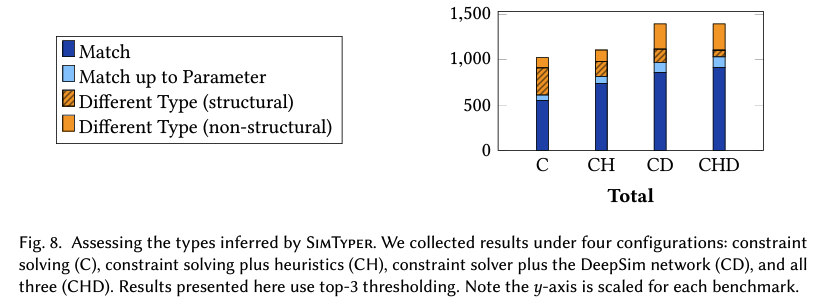
The number of matches can be compared for each method.
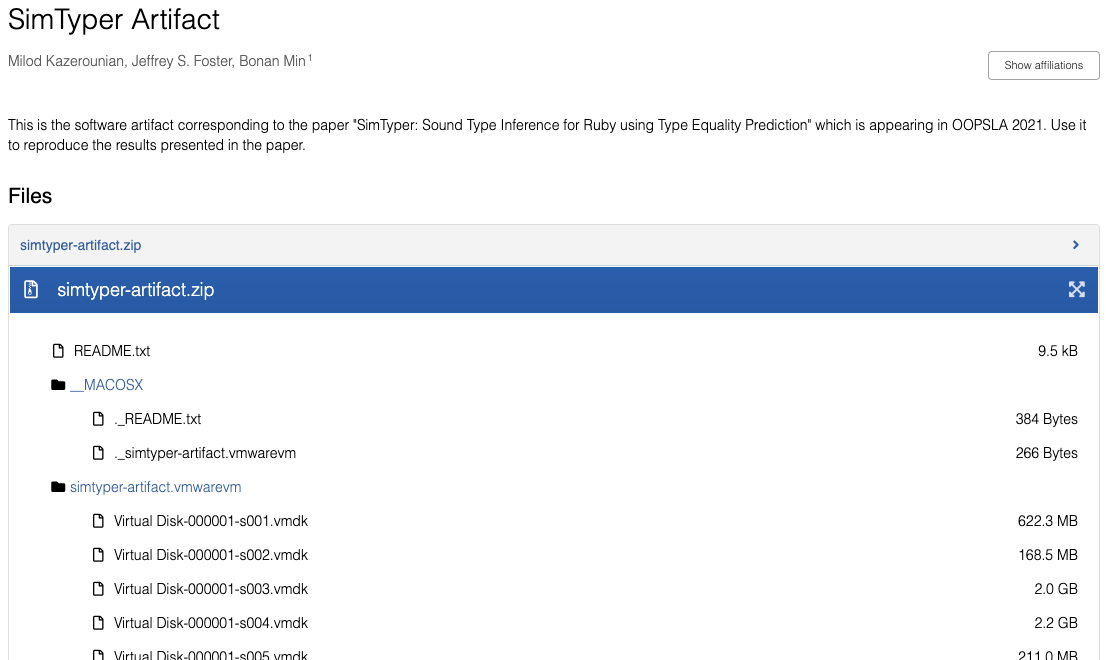
SimTyper - Artifacts
The reproducion data is provided
... as a VM image 😢
TypeEvalPy - Abstract
-
Micro-benchmarks for type inference in Python
-
Small test cases, categorized by grammatical elements, etc.
-
-
Evaluation method is almost the same as SimTyper
-
compares for each parameter, return, and variable
-
only Exact matches counted
-
Venkatesh, TypeEvalPy: A Micro-benchmarking Framework for Python Type Inference Tools, 2023, ICSE 2024
TypeEvalPy: TestCase Categories
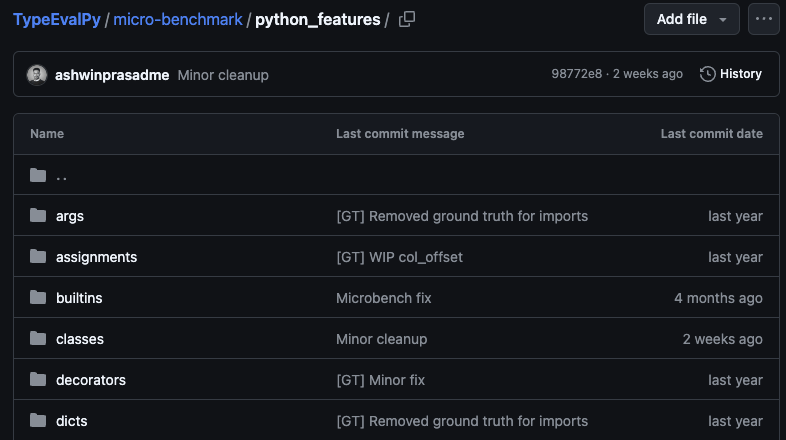
TypeEvalPy: TestCase
def param_func():
    return "Hello from param_func"


def func(a):
    return a()


b = param_func
c = func(b)
main.py
[{"file": "main.py",
  "line_number": 4,
  "col_offset": 5,
  "function": "param_func",
  "type": ["str"]},
 {"file": "main.py",
  "line_number": 8,
  "col_offset": 10,
  "parameter": "a",
  "function": "func",
  "type": [ "callable"]},
  // ...
main_gt.json
TypeEvalPy: Results
| Category | Total facts | Scalpel |
|---|---|---|
| args | 43 | 15 |
| assignments | 82 | 23 |
| builtins | 68 | 0 |
| classes | 122 | 24 |
| decorators | 58 | 19 |
...
Aggregate by category,
measure strengths and weaknesses.
What we can learn from Previous Studies
-
Compare expected and inferred types
-
for each argument, return value, and variable
-
The number of matches can be used as metrics
Two types of test data
-
Real-world code: measures practical performance
-
Micro benchmark: clarify the strengths and weaknesses
-
Outline
Basics of Type System and Type Inference
RBS Goose Architecture and Evaluation
Evaluation Method in Previous Studies
The idea of TypeEvalRb
Conclusion
TypeEvalRb - Architecture

Comparator
Test data
Expected RBS Types
Ruby Code
Inferred RBS Types

Benchmark Result
Aggregate
Match / Unmatch
TypeEvalRb - Comparation
Construct Comparison Tree from two RBS::Environment
# load expected/sig/bird.rbs to RBS::Environment
> loader = RBS::EnvironmentLoader.new
> loader.add(path: Pathname('expected/sig/bird.rbs'))
> env = RBS::Environment.from_loader(loader).resolve_type_names
=> #<RBS::Environment @declarations=(409 items)...>

# RBS::Environment contains ALL types includes stdlib, etc.
> env.class_decls.count
=> 330

# Extract Goose class
> goose = env.class_decls[RBS::Namespace.parse('::Goose').to_type_name]
=> #<RBS::Environment::ClassEntry:0x000000011e478d70 @decls=...>
TypeEvalRb - Comparation
Goose's ClassEntry is... so deeply nested 😅
> pp goose
#<RBS::Environment::ClassEntry:0x000000011f239a40
 @decls=
  [#<struct RBS::Environment::MultiEntry::D
    decl=
     #<RBS::AST::Declarations::Class:0x0000000128d7dd08
      @annotations=[],
      @comment=nil,
      @location=
       #<RBS::Location:371300 buffer=/Users/kokuyou/repos/type_eval_rb/spec/fixtures/examples/bird/refined/sig/bird.rbs, start=8:0, pos=61...105, children=keyword,name,end,?type_params,?lt source="class Goose < Bird">,
      @members=
       [#<RBS::AST::Members::MethodDefinition:0x0000000128d7dd58
         @annotations=[],
         @comment=nil,
         @kind=:instance,
         @location=
          #<RBS::Location:371360 buffer=/Users/kokuyou/repos/type_eval_rb/spec/fixtures/examples/bird/refined/sig/bird.rbs, start=9:2, pos=82...101, children=keyword,name,?kind,?overloading,?visibility source="def cry: () -> void">,
         @name=:cry,
         @overloading=false,
         @overloads=
          [#<RBS::AST::Members::MethodDefinition::Overload:0x000000011f23a968
            @annotations=[],
            @method_type=
             #<RBS::MethodType:0x0000000128d7dda8
              @block=nil,
              @location=
               #<RBS::Location:371420 buffer=/Users/kokuyou/repos/type_eval_rb/spec/fixtures/examples/bird/refined/sig/bird.rbs, start=9:11, pos=91...101, children=type,?type_params source="() -> void">,
              @type=
               #<RBS::Types::Function:0x0000000128d7ddf8
                @optional_keywords={},
                @optional_positionals=[],
                @required_keywords={},
                @required_positionals=[],
                @rest_keywords=nil,
                @rest_positionals=nil,
                @return_type=
                 #<RBS::Types::Bases::Void:0x0000000128892af0
                  @location=
                   #<RBS::Location:371440 buffer=/Users/kokuyou/repos/type_eval_rb/spec/fixtures/examples/bird/refined/sig/bird.rbs, start=9:17, pos=97...101, children= source="void">>,
                @trailing_positionals=[]>,
              @type_params=[]>>],
         @visibility=nil>],
      @name=#<RBS::TypeName:0x000000011f23abc0 @kind=:class, @name=:Goose, @namespace=#<RBS::Namespace:0x000000011f23abe8 @absolute=true, @path=[]>>,
      @super_class=
       #<RBS::AST::Declarations::Class::Super:0x000000011f23a9e0
        @args=[],
        @location=
         #<RBS::Location:371540 buffer=/Users/kokuyou/repos/type_eval_rb/spec/fixtures/examples/bird/refined/sig/bird.rbs, start=8:14, pos=75...79, children=name,?args source="Bird">,
        @name=
         #<RBS::TypeName:0x000000011f23b160 @kind=:class, @name=:Bird, @namespace=#<RBS::Namespace:0x0000000100cdf6a8 @absolute=true, @path=[]>>>,
      @type_params=[]>,
    outer=[]>],
 @name=#<RBS::TypeName:0x000000011f239a68 @kind=:class, @name=:Goose, @namespace=#<RBS::Namespace:0x000000011f23abe8 @absolute=true, @path=[]>>,
 @primary=nil>
TypeEvalRb - Comparation
Take only defined classes and build a tree structure (lack many things)
> compare_bird
=>
ComparisonTree(
  class_nodes=[
    ClassNode(typename=::Bird,  instance_variables=[  ], methods=[ ])
    ClassNode(typename=::Duck,
      instance_variables=[ ],
      methods=[
        MethodNode(name=cry,  parameters=[  ],
          return_type=TypeNode( expected="void", actual="untyped")
        )])
    ClassNode(typename=::Goose,
      instance_variables=[ ],
      methods=[
        MethodNode(name=cry,  parameters=[  ],
          return_type=TypeNode( expected="void", actual="untyped")
        )])
    ])
TypeEvalRb - Test Data
-
Micro-benchmark data like TypeEvalPy
-
Small test data classified by grammatical elements, etc.
-
For detailed evaluation of strengths and weaknesses
-
-
Real-world data, similar to that used to evaluate SimTyper
-
Libraries and Rails applications with RBS type definitions
-
For evaluation of practical performance
-
TypeEvalRb - Microbenchmark Test Data
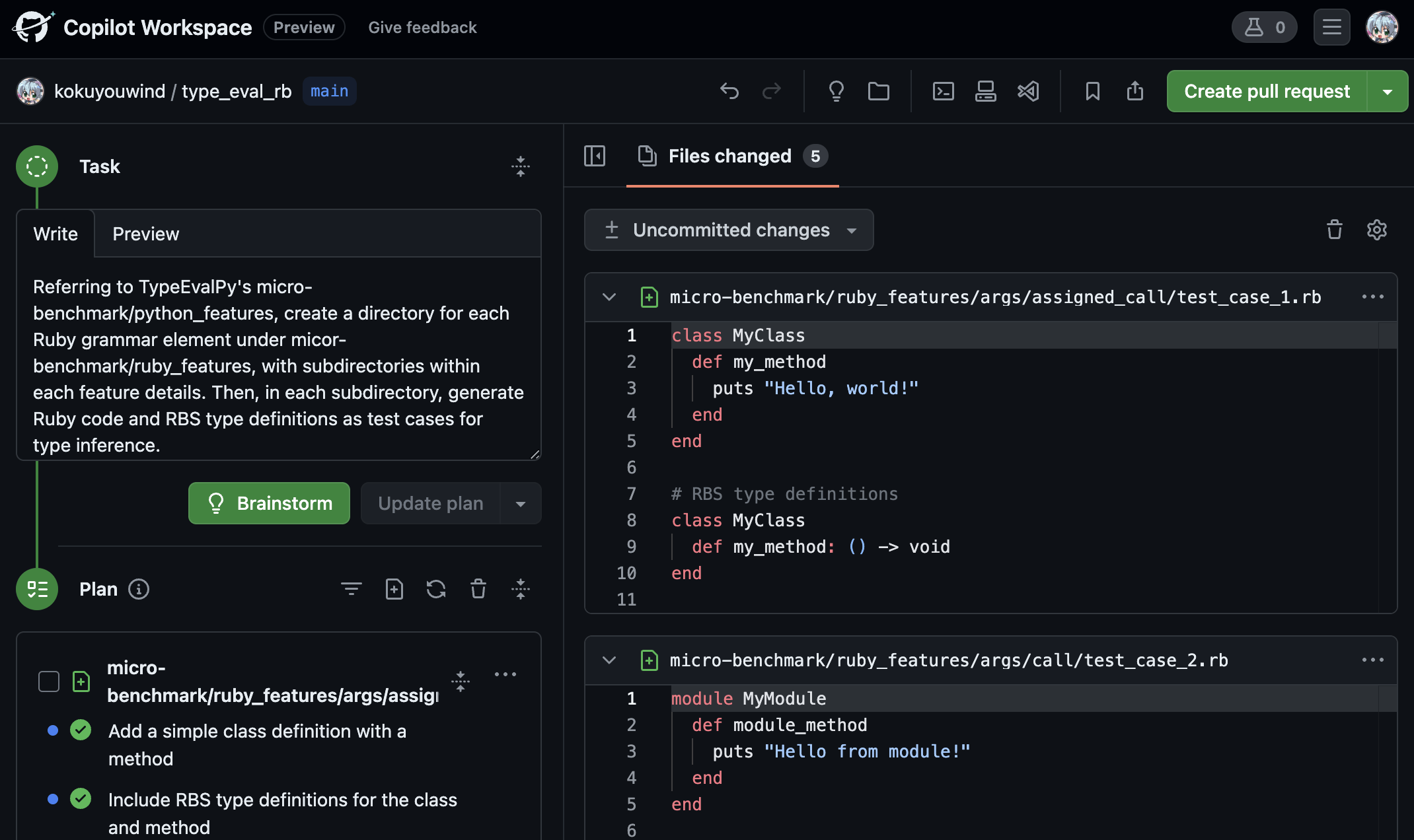
Exploring the possibility of
using the GitHub Copilot Workspace for data preparation.
TypeEvalRb
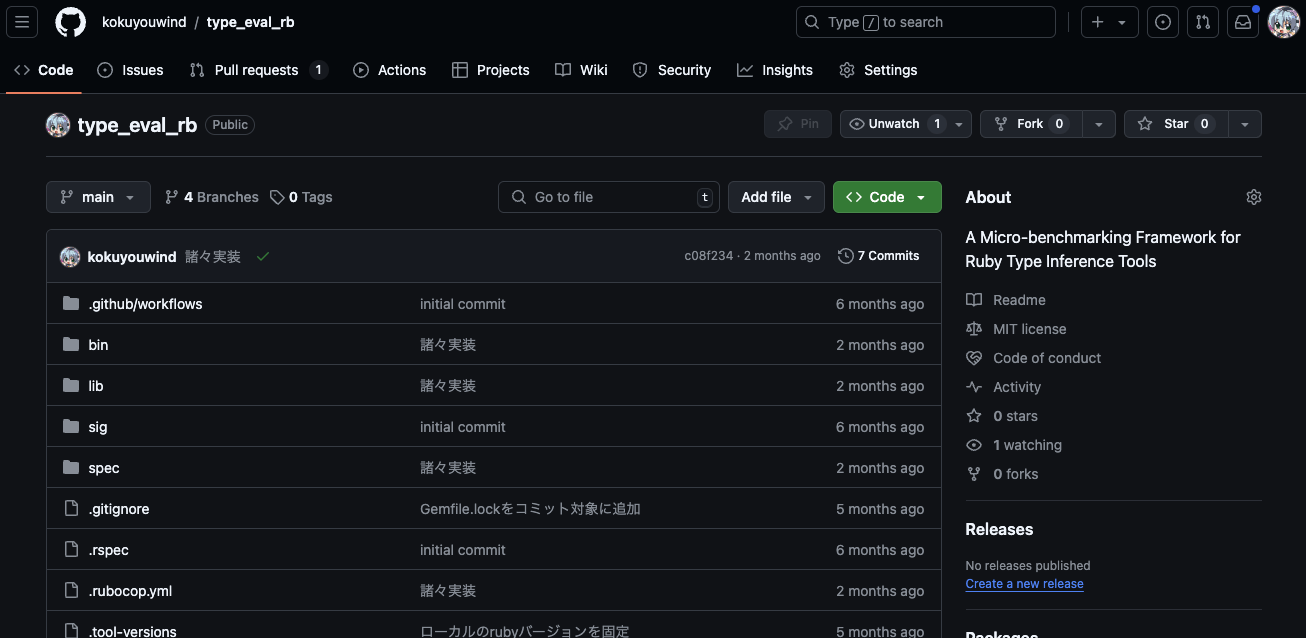
Work in Progress
Outline
Basics of Type System and Type Inference
RBS Goose Architecture and Evaluation
Evaluation Method in Previous Studies
The idea of TypeEvalRb
Conclusion
Conclusion
-
Shared how RBS Goose works and evaluation results
-
Better results than traditional methods in some cases
-
-
Surveyed evaluation methods in previous studies
-
Count matches between expected and inferred types
-
Both Micro-Benchmark and real-world data are useful
-
-
Shared idea of TypeEvalRb, type inference benchmark
-
To reveal inference performance and for future improvement
-