Error Analysis of
the Ensemble Square Root Filter for Dissipative Dynamical Systems
2025/01/23 @Kyoto University
Supervisors
Professor Takashi Sakajo, Kyoto University
Professor Takemasa Miyoshi, Kyoto University & RIKEN
Professor Sebastian Reich, University of Potsdam
Kota Takeda
Department of mathematics, Kyoto University

Introduction
Setup
Bayesian filtering
Algorithms
Results (Error analysis)
Existing results for EnKF
My results
Summary & Discussion
Contents
Related sections in Thesis
Section 1, 2, 5
Section 3
Section 4
Section 6
Section 7
Section 8
Data Assimilation (DA)
The seamless integration of data and models
Model
Dynamical systems and its numerical simulations
ODE, PDE, SDE,
Numerical analysis, HPC,
Fluid mechanics, Physics
chaos
error
Data
Obtained from experiments or measurements
Statistics, Data analysis,
Radiosonde/Radar/Satellite observation
noise
limited
×


Each has uncertainty! (incomplete)
Numerical Weather Prediction (NWP)
Numerical Weather Prediction (NWP) uses atmospheric models
→ Unpredictable in long-term

Typhoon route circles

A small initial error can
grow exponentially fast.
state


time
true/nature state
simulated state
→ Chaotic
NWP and DA
→ chaotic
→ unpredictable in long-term
Numerical Weather Prediction (NWP) uses atmospheric models
Data Assimilation (DA):
simulate
true state
prediction
(not accessible directly)
Atmospheric
model
observation
Correct using observations (noisy, partial)
Correct using
indirect information from the true state
time
NWP & DA
in DA for Numerical Weather Prediction:
chaotic
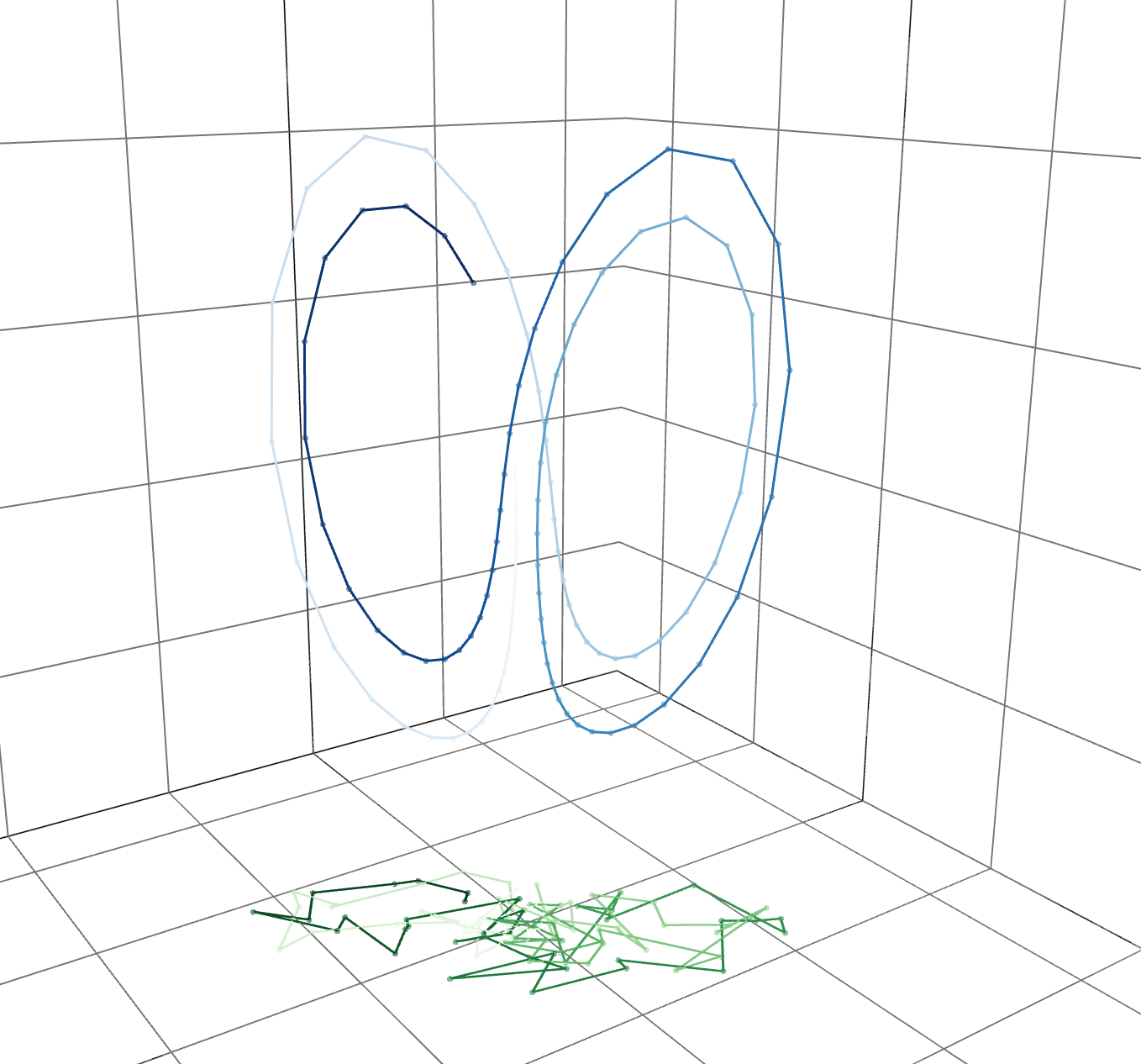
noisy
partial
observation
true state
Example: the trajectory of the Lorenz 63 equation and observations.
Estimating the time series of states of
chaotic dynamical system
using noisy and partial observations.
Three difficulties
Considered
in this talk
Not considered
in this talk
Data Assimilation (DA)
-
Control
- Nudging/Continuous Data Assimilation
-
Bayesian Filtering
- Particle Filter (PF)
- Ensemble Kalman filter (EnKF)
-
Variational
- Four-dimensional Variation method (4DVar)
Several formulations & algorithms of DA:
Focus on the main results
(T.+2024) & Thesis
Related to partial observations
cf. Section 5
Not covered
cf. Section 1
Mathematics on DA:
Functional analysis, Probability theory, Dynamical systems,
Partial differential equations, (Numerical analysis)
cf. Section 2, 5
Control formulation
Problem
Keywords/Mathematics
(Olson+2003), (Azouani+2011)
Nudging/Continuous Data Assimilation
Squeezing property, Determining mode/node
AOT-algorithm
If we have noiseless & continuous time observations
through an orthogonal projection
→ copy obs. to the simulated state
(true)
(simulate)
PDE (Partial Differential Equations)
Control theory/Synchronization
Incomplete atmospheric data
(Charney+1969)
copy
converge
observed
unobserved
Variational formulation
Problem
Keywords/Mathematics
(Law+2015), (Korn+2009)
Four-dimensional Variational method (4DVar)
Adjoint method to compute gradient
Optimization, Iteration method
To estimate the initial state
from observation data
minimize a cost function.
Supervised Learning
Back propagation
Introduction
Setup
Bayesian filtering
Algorithms
Results (Error analysis)
Existing results for EnKF
My results
Summary & Discussion
Contents
Related sections in Thesis
Section 1, 2, 5
Section 3
Section 4
Section 6
Section 7
Section 8
State estimation with chaos, noise
Setup: Model
Model dynamics in
Semi-group in
generates
(assume)
: separable Hilbert space
: separable Hilbert space (state space)
The known model generates
the unknown true trajectory.
unknown trajectory
unknown
See Section 3 for other formulations.
Setup: Observation
Discrete-time model (at obs. time)
We have noisy observations in
Noisy observation
observe
...
bounded linear
(another Hilbert space)
at discrete time steps.
(6.4)
(6.2)
Sequential state estimation
...
given
Problem
estimate
known:
obs. noise distribution.
Bayesian Data Assimilation
Approach: Bayesian Data Assimilation
→ construct a random variable so that
In other words, compute (approximate)
the conditional distribution .
(filtering distribution)
given
Problem
Estimate
Sequential Data Assimilation

For n, two steps with auxiliary variable .
Proposition
The n-iterations (I) & (II)
Decomposition into the iterative algorithm
Definition 3.7, 10

(I) Prediction
(I) Prediction
by model
(II)Analysis
(II) Analysis
by Bayes' rule
likelihood function
Prediction
...
Repeat (I) & (II)
Introduction
Setup
Bayesian filtering
Algorithms
Results (Error analysis)
Existing results for EnKF
My results
Summary & Discussion
Contents
Related sections in Thesis
Section 1, 2, 5
Section 3
Section 4
Section 6
Section 7
Section 8
State estimation with chaos, noise.
Compute
Filtering algorithms
Only focus on the Gaussian-based Algorithms
Many filtering algorithms
PF
Ensemble based
EnKF
"Gaussian based"
KF
KF & EnKF
Kalman filter (KF) [Kalman 1960]
- All Gaussian distribution
- Closed update of mean and covariance.
Assume: linear F, Gaussian noises
Ensemble Kalman filter (EnKF)
Non-linear extension by Monte Carlo method
- Update of ensemble
(Reich+2015) S. Reich and C. Cotter (2015), Probabilistic Forecasting and Bayesian Data Assimilation, Cambridge University Press, Cambridge.
(Law+2015) K. J. H. Law, A. M. Stuart, and K. C. Zygalakis (2015), Data Assimilation: A Mathematical Introduction, Springer.
KF & EnKF
Kalman filter(KF)
Assume: linear F, Gaussian noises
Linear F
Bayes' rule
predict
analysis
Ensemble Kalman filter (EnKF)
Non-linear extension by Monte Carlo method
approx.
ensemble
Two variants
→ next slide
Definition 4.1
- Two major variants of EnKF:
- Perturbed Observation (PO): stochastic → sampling error
- Ensemble Transform Kalman Filter (ETKF): deterministic
Two EnKF variants
...
Repeat (I) & (II)
(II)Analysis
(I) Prediction


(Burgers+1998)
(Bishop+2001)
PO (stochastic EnKF)
(Burgers+1998) G. Burgers, P. J. van Leeuwen, and G. Evensen (1998), Analysis Scheme in the Ensemble Kalman Filter, Mon. Weather Rev., 126, 1719–1724.
Stochastic!
Perturbed Observation
: A transpose (adjoint) of a matrix (linear operator)
Definition 4.10
ETKF (deterministic EnKF)
(Bishop+2001) C. H. Bishop, B. J. Etherton, and S. J. Majumdar (2001), Adaptive Sampling with the Ensemble Transform Kalman Filter. Part I: Theoretical Aspects, Mon. Weather Rev., 129, 420–436.
Deterministic!
The explicit representation exists!
Ensemble Transform Kalman Filter
Definition 4.13
ETKF (deterministic EnKF)
Ensemble Transform Kalman Filter
Lemma (Theorem 4.1)
ETKF is one of the deterministic EnKF algorithms known as ESRF (Ensemble Square Root Filters).
※ESRF (deterministic EnKF)
ESRF
ETKF
EAKF (Ensemble Adjustment Kalman Filter)
: bounded linear
(Anderson 2001) J. L. Anderson (2001), An Ensemble Adjustment Kalman Filter for Data Assimilation, Mon. Weather Rev., 129, 2884–2903.
Key perspective of EnKF (KF)
The analysis state is the weighted average of
the prediction and observation
The weight is determined by estimated uncertainties
: uncertainty in observation (prescribed)
: uncertainty in prediction (approx. by ensemble)
Inflation (numerical technique)
Issue: Underestimation of covariance through the DA cycle
→ Overconfident in the prediction → Poor state estimation
(I) Prediction → inflation → (II) Analysis → ...
Rank is improved
Rank is not improved
Idea: inflating the covariance before (II)
Two basic methods of inflation
※depending on the implementation
※
Section 4.4
PO
Two EnKF variants
Simple
Stochastic
Require many samples
ETKF
Complicated
Deterministic
Require few samples
Practical !
Inflation: add., multi.
Inflation: only multi.
※depending on the implementation
※
Filtering algorithms
Many filtering algorithms
PF
Ensemble based
EnKF
"Gaussian based"
KF
Deterministic
Stochastic
PO
ETKF
EAKF
Introduction
Setup
Bayesian filtering
Algorithms
Results (Error analysis)
Existing results for EnKF
My results
Summary & Discussion
Contents
Related sections in Thesis
Section 1, 2, 5
Section 3
Section 4
Section 6
Section 7
Section 8
State estimation with chaos, noise.
Compute
EnKF: Ensemble & Gaussian approximation.
Error analysis of EnKF
Assumptions on model
(Reasonable)
Assumption on observation
(Strong)
We focus on finite-dimensional state spaces
(T.+2024) K. T. & T. Sakajo (2024), SIAM/ASA Journal on Uncertainty Quantification, 12(4), 1315–1335.
Assumptions for analysis
Assumption (obs-1)
"full observation"
Strong!
Assumption (model-1)
Assumption (model-2)
Assumption (model-2')
Reasonable
"one-sided Lipschitz"
"Lipschitz"
"bounded"
or
Dissipative dynamical system
Dissipative dynamical system
Section 3, 5
Dissipative dynamical systems
Lorenz 63, 96 equations, widely used in geophysics,
Example (Lorenz 96)
non-linear conserving
linear dissipating
forcing
Assumptions (model-1, 2, 2')
hold
incompressible 2D Navier-Stokes equations (2D-NSE) in infinite-dim. setting
Lorenz 63 eq. can be written in the same form.
→ We can discuss ODE and PDE in a unified framework.
can be generalized
bilinear operator
linear operator
dissipative dynamical systems
Mimics chaotic variation of
physical quantities at equal latitudes.
(Lorenz1996) (Lorenz+1998)
Literature review
-
Consistency (Mandel+2011, Kwiatkowski+2015)
-
Sampling errors (Al-Ghattas+2024)
-
Stability (Tong+2016a,b)
-
Error analysis (full observation )
-
PO + add. inflation (Kelly+2014) → next slide
-
ETKF + multi. inflation (T.+2024) → current
-
EAKF + multi. inflation (T.)
-
-
Error analysis (partial observation) → future (partially solved, T.)
How EnKF approximate KF?
How EnKF approximate
the true state?
※ Continuous time formulation (EnKBF)
-
EnKBF with full-obs. (de Wiljes+2018)
Section 6
Error analysis of PO (prev.)
(Kelly+2014) D. Kelly et al. (2014), Nonlinearity, 27(10), 2579–2603.
Strong effect! (improve rank)
Theorem (Kelly+2014)
exponential decay
initial error
Error analysis of PO (prev.)
variance of observation noise
uniformly in time
(Kelly+2014) D. Kelly et al. (2014), Nonlinearity, 27(10), 2579–2603.
Strong effect! (improve rank)
Corollary (Kelly+2014)
Introduction
Setup
Bayesian filtering
Algorithms
Results (Error analysis)
Existing results for EnKF
My results
Summary & Discussion
Contents
Related sections in Thesis
Section 1, 2, 5
Section 3
Section 4
Section 6
Section 7
Section 8
State estimation with chaos, noise.
Compute
EnKF: Ensemble & Gaussian approximation.
PO+add. infl. (Kelly+2014)
Error analysis of ETKF (our)
(T.+2024) K. T. & T. Sakajo (2024), SIAM/ASA Journal on Uncertainty Quantification, 12(4), 1315–1335.
Theorem 7.3 (T.+2024)
※ The same result holds for the EAKF (Theisis)
Error analysis of ETKF (our)
(T.+2024) K. T. & T. Sakajo (2024), SIAM/ASA Journal on Uncertainty Quantification, 12(4), 1315–1335.
Corollary 7.3 (T.+2024)
Sketch: Error analysis of ETKF (our)
①
②
Key point!
Error growth at (I)
Error contraction at (II)
norm of error
Sketch: Error analysis of ETKF (our)
Strategy: estimate the changes in DA cycle
expanded
by dynamics
contract &
noise added
Applying Gronwall's lemma to the model dynamics,
+ {additional term}.
①
subtracting yields
From the Kalman update relation
prediction error
② contraction
③ obs. noise effect
estimated by op.-norm
Sketch: Error analysis of ETKF (our)
Key estimates in
Using Woodbury's lemma, we have
② contraction
③ obs. noise
Contraction (see the next slide)
assumption
Sketch: Error analysis of ETKF (our)
estimate the change
(inflation & analysis)
(prediction)
Comparison
ETKF with multiplicative inflation (our)
PO with additive inflation (prev.)
accurate observation limit
Two Gaussian-based filters (EnKF) are assessed in terms of the state estimation error.
due to
due to
Numerical results
Observing System Simulation Experiment (OSSE)
A standard numerical test framework for DA algorithms.
Numerical results
Observing System Simulation Experiment (OSSE)
(1) Compute the true solution to (6.2).
Numerical results
Observing System Simulation Experiment (OSSE)
(2) Generate random observations as in (6.4).
(1) Compute the true solution to (6.2).
Numerical results
Observing System Simulation Experiment (OSSE)
(3) Assimilate the observed data and obtain the analysis states using a data assimilation algorithm.
(2) Generate random observations as in (6.4).
(1) Compute the true solution to (6.2).
DA algorithm
Numerical results
Observing System Simulation Experiment (OSSE)
(2) Generate random observations as in (6.4).
(1) Compute the true solution to (6.2).
(3) Assimilate the observed data and obtain the analysis states using a data assimilation algorithm.
(4) Compute the error between and for n = 1, 2, ...
Numerical results
OSSE: ETKF for the Lorenz 96 equation
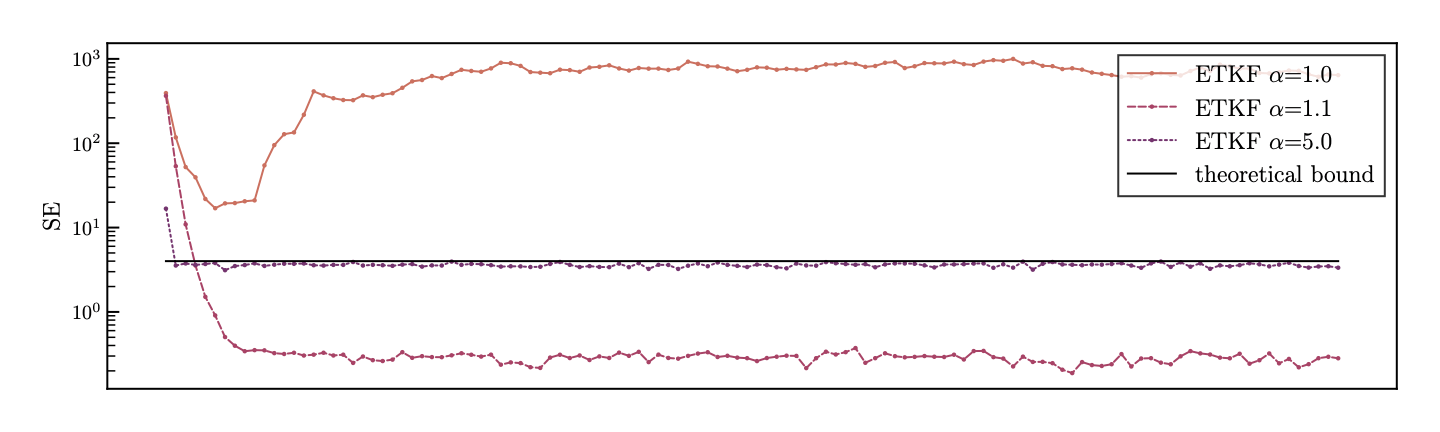
From Theorem 7.3
→ theoretical bound
strong inflation
weak inflation
no inflation
Numerical results

Dependency on observation noise variance .
Numerical results
Animation
Introduction
Setup
Bayesian filtering
Algorithms
Results (Error analysis)
Existing results for EnKF
My results
Summary & Discussion
Contents
Related sections in Thesis
Section 1, 2, 5
Section 3
Section 4
Section 6
Section 7
Section 8
State estimation with chaos, noise.
Compute
EnKF: Ensemble & Gaussian approximation.
PO+add. infl. (Kelly+2014)
ESRF+multi. infl. (T.+2024)
Summary
We focus on
The sequential state estimation using model and data.
Results
Error analysis of a practical DA algorithm (ETKF)
under an ideal setting (T.+2024).
Discussion
Two issues with extending our analysis.
→ should be relaxed in the future
(rank deficient, non-symmetric)
Discussion
Current
(T.+2024)
1. Partial observation
2. Small ensemble
3. Infinite-dimension
partially solved (T.)
extend
Future
→ Issue 1, 2
→ Issue 1
→ Issue 1
Issues:
- rank deficient
- non-symmetric
Discussion
Issue 1 (rank deficient)
② Error contraction in (II)
1. Partial observation
2. Small ensemble
Discussion
Issue 2 (non-symmetric)
③ bound of obs. noise
If non-symmetric, it doesn't hold in general.
Example
Discussion
Infinite-dimension
Theorem (Kelly+2014) for PO + add. infl.
Theorem (T.+2024) for ETKF + multi. infl.
doesn't hold
(due to Issue 1: rank deficient)
※with full-observations
(ex: 2D-NSE with the Sobolev space)
( improve rank)
still holds
Summary
I focus on
Sequential state estimation using model and data.
Results
Error analysis of a practical DA algorithm (ETKF)
under an ideal setting (T.+2024).
Discussion
Two issues with extending our analysis.
→ should be relaxed
(rank deficient, non-symmetric)
→ other problems in the future
Future Plans
NWP /
Fluid Mechanics
Thesis
DA
UQ
UQ (Uncertainty Quantification):
The quantitative studies of uncertainties in the real world applications.
Mathematics:
Functional analysis
Gronwall's inequality
Future Plans
NWP /
Fluid Mechanics
Thesis
DA
UQ
Collaborating with
Numerics, Machine Learning
Contributing to NWP
Continuing
Developing
novel algorithms
Other applications
Mathematics:
Functional analysis
Gronwall's inequality
Numerical analysis
Lyapunov analyis
Large deviations
Operator algebra
Computational topology
...
UQ (Uncertainty Quantification):
The quantitative studies of uncertainties in the real world applications.
References
- (T.+2024) K. T. & T. Sakajo, SIAM/ASA Journal on Uncertainty Quantification, 12(4), 1315–1335.
- (T.) Kota Takeda, Error Analysis of the Ensemble Square Root Filter for Dissipative Dynamical Systems, PhD Thesis, Kyoto University, 2025.
- (Kelly+2014) D. T. B. Kelly, K. J. H. Law, and A. M. Stuart (2014), Well-posedness and accuracy of the ensemble Kalman filter in discrete and continuous time, Nonlinearity, 27, pp. 2579–260.
- (Al-Ghattas+2024) O. Al-Ghattas and D. Sanz-Alonso (2024), Non-asymptotic analysis of ensemble Kalman updates: Effective dimension and localization, Information and Inference: A Journal of the IMA, 13.
- (Tong+2016a) X. T. Tong, A. J. Majda, and D. Kelly (2016), Nonlinear stability and ergodicity of ensemble based Kalman filters, Nonlinearity, 29, pp. 657–691.
- (Tong+2016b) X. T. Tong, A. J. Majda, and D. Kelly (2016), Nonlinear stability of the ensemble Kalman filter with adaptive covariance inflation, Comm. Math. Sci., 14, pp. 1283–1313.
- (Kwiatkowski+2015) E. Kwiatkowski and J. Mandel (2015), Convergence of the square root ensemble Kalman filter in the large ensemble limit, Siam-Asa J. Uncertain. Quantif., 3, pp. 1–17.
- (Mandel+2011) J. Mandel, L. Cobb, and J. D. Beezley (2011), On the convergence of the ensemble Kalman filter, Appl.739 Math., 56, pp. 533–541.
References
-
(de Wiljes+2018) J. de Wiljes, S. Reich, and W. Stannat (2018), Long-Time Stability and Accuracy of the Ensemble Kalman-Bucy Filter for Fully Observed Processes and Small Measurement Noise, Siam J. Appl. Dyn. Syst., 17, pp. 1152–1181.
-
(Burgers+1998) G. Burgers, P. J. van Leeuwen, and G. Evensen (1998), Analysis Scheme in the Ensemble Kalman Filter, Mon. Weather Rev., 126, 1719–1724.
-
(Bishop+2001) C. H. Bishop, B. J. Etherton, and S. J. Majumdar (2001), Adaptive Sampling with the Ensemble Transform Kalman Filter. Part I: Theoretical Aspects, Mon. Weather Rev., 129, 420–436.
-
(Anderson 2001) J. L. Anderson (2001), An Ensemble Adjustment Kalman Filter for Data Assimilation, Mon. Weather Rev., 129, 2884–2903.
-
(Dieci+1999) L. Dieci and T. Eirola (1999), On smooth decompositions of matrices, Siam J. Matrix Anal. Appl., 20, pp. 800–819.
-
(Reich+2015) S. Reich and C. Cotter (2015), Probabilistic Forecasting and Bayesian Data Assimilation, Cambridge University Press, Cambridge.
-
(Law+2015) K. J. H. Law, A. M. Stuart, and K. C. Zygalakis (2015), Data Assimilation: A Mathematical Introduction, Springer.
Appendix
Problems on numerical analysis
- Discretization/Model errors
- Dimension-reduction for dissipative dynamics
- Numerics for Uncertainty Quantification (UQ)
- Imbalance problems
1. Discretization/Model errors
Motivation
- Including discretization errors in the error analysis.
- Consider more general model errors and ML models.
- Error analysis with ML/surrogate models.
cf.: S. Reich & C. Cotter (2015), Probabilistic Forecasting and Bayesian Data Assimilation, Cambridge University Press.
Question
- Can we introduce the errors as random noises in models?
- Can minor modifications to the existing error analysis work?
2. Dimension-reduction for dissipative dynamics
Motivation
- Defining "essential dimension" and relaxing the condition:
- should be independent of discretization.
cf.: C. González-Tokman & B. R. Hunt (2013), Ensemble data assimilation for hyperbolic systems, Physica D: Nonlinear Phenomena, 243(1), 128-142.
Question
- Dissipativeness, dimension of the attractor?
- Does the dimension depend on time and state? (hetero chaos)
- Related to the SVD and the low-rank approximation?
Attractor
3. Numerics for UQ
Motivation
- Evaluating physical parameters in theory.
- Computing the Lyapunov spectrum of atmospheric models.
- Estimating unstable modes (e.g., singular vectors of Jacobian).
cf.: T. J. Bridges & S. Reich (2001), Computing Lyapunov exponents on a Stiefel manifold. Physica D, 156, 219–238.
F. Ginelli et al. (2007), Characterizing Dynamics with Covariant Lyapunov Vectors, Phys. Rev. Lett. 99(13), 130601.
Y. Saiki & M. U. Kobayashi (2010), Numerical identification of nonhyperbolicity of the Lorenz system through Lyapunov vectors, JSIAM Letters, 2, 107-110.
Question
- Can we approximate them only using ensemble simulations?
- Can we estimate their approximation errors?

4. Imbalance problems
Motivation
- Assimilating observations can break the balance relations inherited from dynamics. → numerical divergence
(e.g., the geostrophic balance and gravity waves)
- Explaining the mechanism (sparsity or noise of observations?).
- Only ad hoc remedies (Initialization, IAU).
|
cf.: E. Kalney (2003), Atmospheric modeling, data assimilation and predictability, Cambridge University Press. Hastermann et al. (2021), Balanced data assimilation for highly oscillatory mechanical systems, Communications in Applied Mathematics and Computational Science, 16(1), 119–154. |
Question
- Need to define a space of balanced states?
- Need to discuss the analysis state belonging to the space?
- Can we utilize structure-preserving schemes?
balanced states