Riemannian Line-Search on the Unitary Group: Bridging Gradient Descent and Quantum Signal Processing
Marek Gluza
NTU Singapore
slides.com/marekgluza

Mathematically, states of the quantum computer are like arrows pointing from the center of the sphere to its surface.
Simple observation "Earth is not flat" leads to quantum algorithms. We will use that when we walk along of the equator, we think we are going straight but eventually we will wrap around it.
Fixing a direction and rotating the arrow, corresponds to a type of of quantum computing operation.
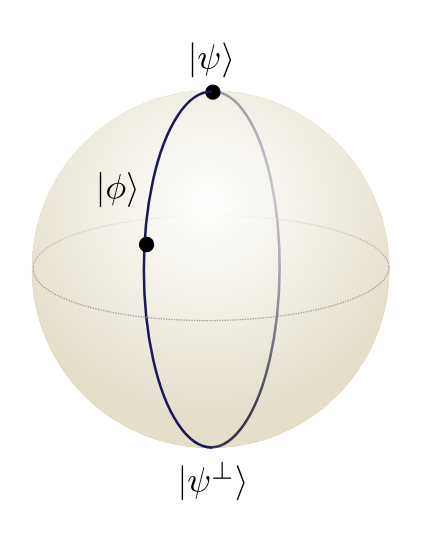
Riemannian geometry underlying quantum algorithms
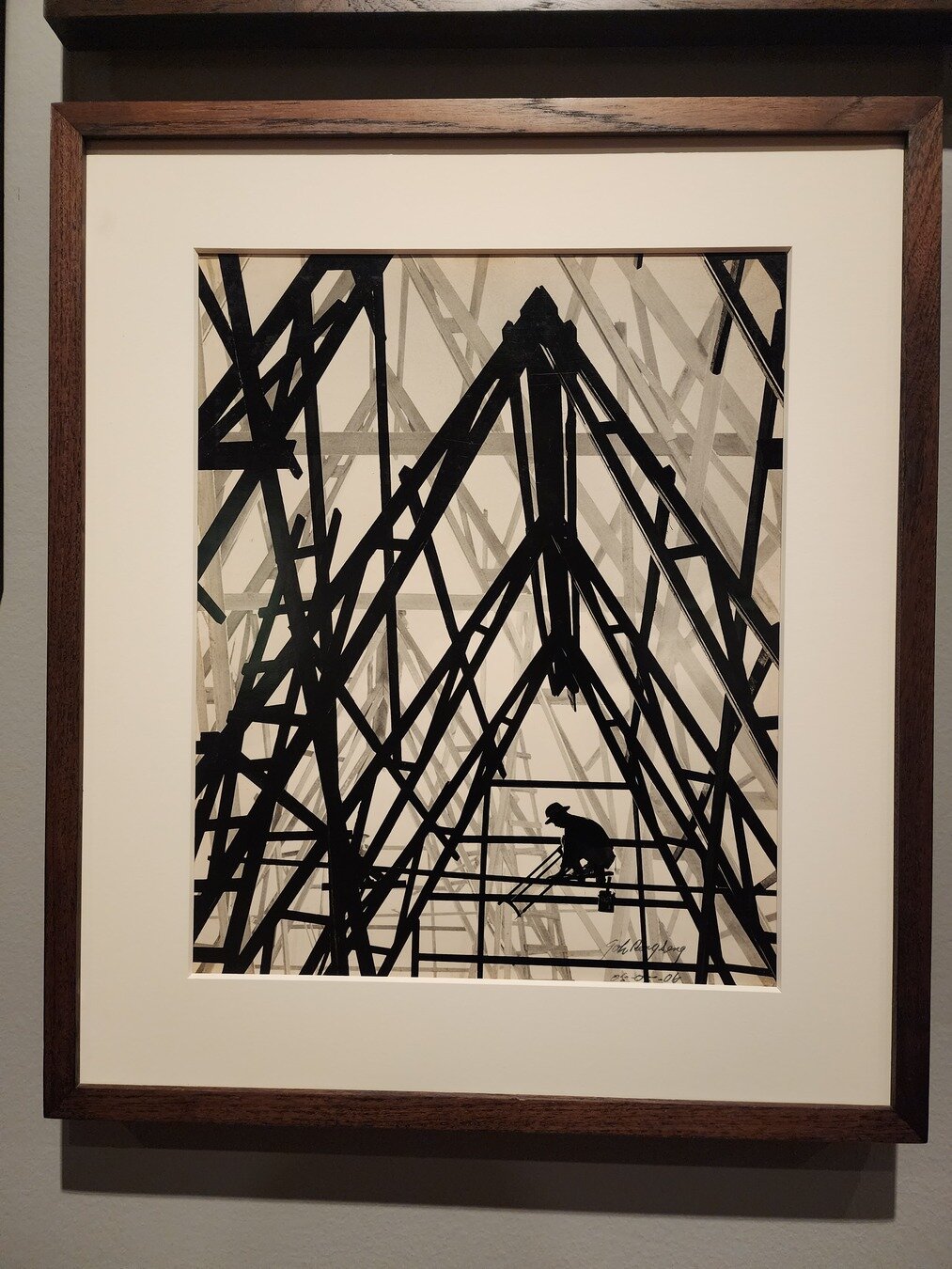
On a flat surface DOWN-LEFT-UP-RIGHT will return to point of origin.
Riemannian geometry underlying quantum algorithms
On a flat surface DOWN-LEFT-UP-RIGHT will return to point of origin.
On a curved surface SOUTH-WEST-NORTH-EAST will spiral way.
Riemannian geometry underlying quantum algorithms
My work on double-bracket quantum algorithms shows how to use this spiraling effect to implement non-Euclidean gradient descent in quantum computing.
Regular machine learning fails for quantum computing but our generalization works. The 'failed' machine learning is still key for us - as a warm-start!

(Physical Review Letters '26)
Riemannian geometry underlying quantum algorithms
Riemannian geometry is essential for quantum computation
- The unitary group \(U(d)\) is a Riemannian manifold
- It is an embedded manifold \(U(d) = \{M\in \mathbb C^{d\times d}:~M^{-1}=M^\dagger\}\)
- The tangent space is \(\{W\in \mathbb C^{d\times d}:~W^{\dagger}= -W\} \simeq\{iH \mathrm{~where~} H=H^\dagger\in \mathbb C^{d\times d}\} \)
- The geodesics are matrix exponentials \( \{e^{sW}\}_{s\in\mathbb R} \subset U(d)\) or \( \{e^{isH}\}_{s\in\mathbb R} \subset U(d)\)
- Computing a "gradient" must output an element of the tangent space

\(\partial_{i,j}\) points to the interior, not tangential
Keep this in mind for later: Unlike in flat space, these 4 steps spiral away from the point of origin
Riemannian geometry is essential for quantum computation
- The unitary group \(U(d)\) is a Riemannian manifold
- The tangent space is \(\{H\in \mathbb C^{d\times d}:~H^{\dagger}= H\} \)
- The geodesics are matrix exponentials \( \{e^{isH}\}_{s\in\mathbb R} \subset U(d)\)
- \(U(d)\) is a curved manifold
Operating a quantum computer is all about the group of unitary matrices
Think of rotations on a sphere
The Lie bracket of two 'velocities' is again a velocity:
Check: \([A,B]^\dagger = (AB- BA)^\dagger = B^\dagger A^\dagger -A^\dagger B^\dagger = -[A,B]\)

\([A,B]^\dagger = -[A,B]\)
Check: \([A,B]^\dagger = -[A,B]\)
Operating a quantum computer is all about the group of unitary matrices
Think of rotations on a sphere
Fact 3: The Lie bracket of two 'velocities' is again a velocity
Operating a quantum computer is all about the group of unitary matrices
Fact 3: The Lie bracket of two 'velocities' is again a velocity
The main tool of double-bracket quantum algorithms
Note that choosing \(A=H\) doesn't change the energy
Let's find which directions \(A\) are more useful!
\(\partial_{i,j}\) points to the interior, not tangential so which direction is best?
Same for \(A=\ket{\psi}\bra{\psi}\) because
Riemannian gradient: Unique vector \(g\) in the tangent space
such that the directional derivative is a projection onto \(g\)
\(\partial_{i,j}\) points to the interior, not tangential so which direction is best?
We will use very simple ingredients to find \(g\) for \(E(\psi) = \langle \psi| H | \psi\rangle\):
Hilbert-Schmidt scalar product:
Cyclicity of trace:
Tangent space:
Riemannian gradient: Unique vector \(g\) in the tangent space such that the directional derivative is a projection onto \(g\)
Double-bracket quantum algorithms:
Systematic framework for implementing exponentials of commutators on quantum computers. This uncovered new unitary synthesis formulas.

Riemannian gradient: Unique vector \(g\) in the tangent space such that the directional derivative is a projection onto \(g\)
Double-bracket quantum algorithms
Click these links at slides.com/marekgluza
| Diagonalization | https://arxiv.org/abs/2206.11772 | ||
|---|---|---|---|
| Imaginary-time evolution | https://arxiv.org/abs/2412.04554 | ||
| Quantum signal processing | https://arxiv.org/abs/2504.01077 | ||
| Grover's search | https://arxiv.org/abs/2507.15065 | Approximates ITE |
Exponentials of commutators solve the unitary synthesis problem in all these cases
Regular gradient descent
Secret sauce when \(x\) is big or \(f(x)\) is costly is the learning rate \(\eta\). Greedy gradient descent will use
\(\eta = \argmin_r f( x_k -r\nabla f(x_k)\))
Next, we do it 'quantumly':
Next, I will show you the optimal line-search solution for linear cost functions like \(C(\ket\psi) = \bra \psi H\ket\psi\)
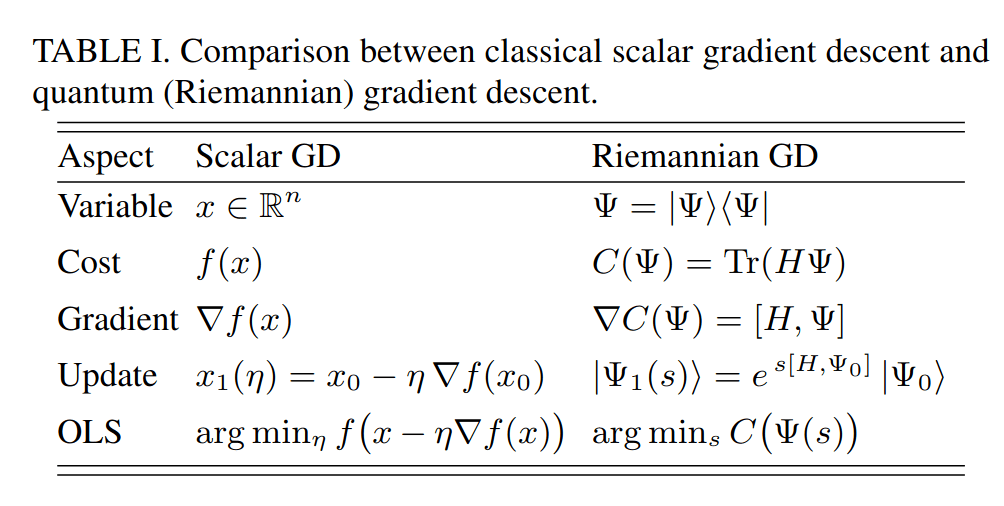
\(s\) is the 'Riemannian' learning rate
Y. Suzuki

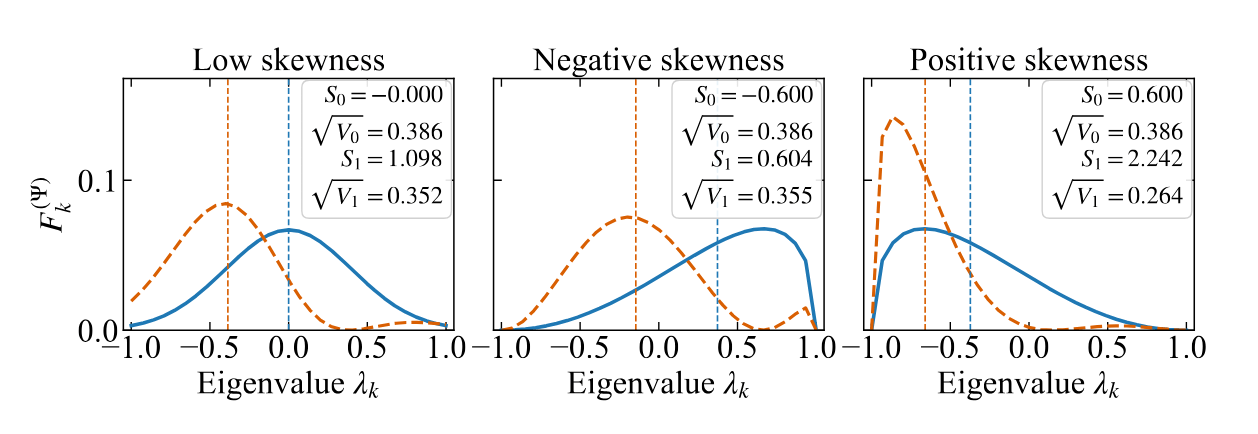
Energy filtering in quantum optimization
Task: Given Hermitian \(H\), prepare quantum computer in eigenvector \(|\lambda_0\rangle\) with smallest eigenvalue \(\lambda_0\).
\(H = \sum_k \lambda_k |\lambda_k\rangle\langle \lambda_k|\) which is braket notation for: If \(H v_k = \lambda_k v_k\) then \(H= \sum_k \lambda_k v_k^\top v_k\)
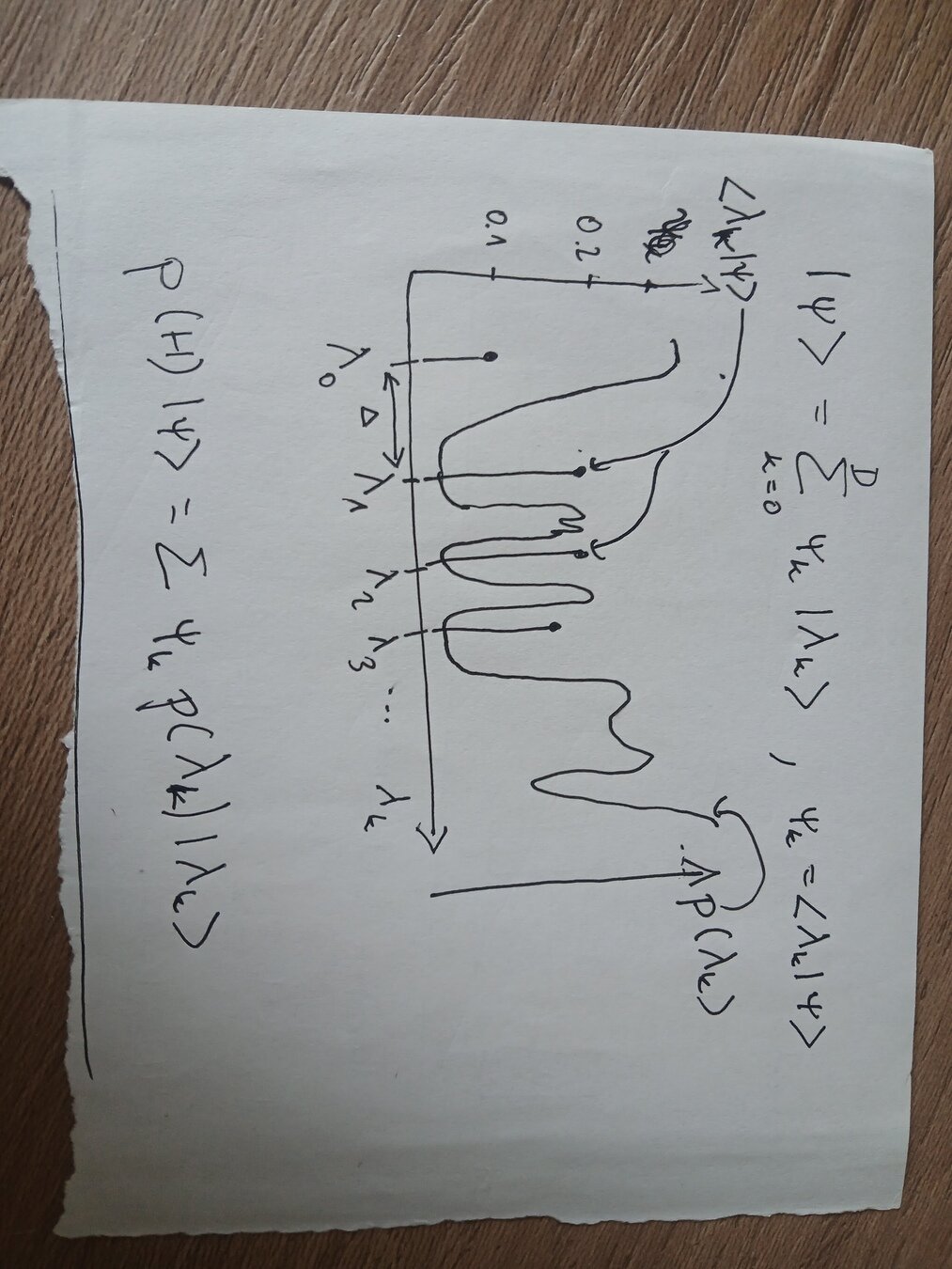
After decomposing \(\ket\psi = \sum_k \psi_k \ket{\lambda_k}\) we can filter energy by \(f(H)\ket\psi = \sum_k \psi_k f(\lambda_k) \ket{\lambda_k}\)
Note: We are optimizing \(E(\psi) = \bra\psi H\ket\psi\) and \( \bra{\lambda_0} H\ket{\lambda_0} = \lambda_0\) is the global minimizer
| Imaginary-time evolution |
|
Non-unitary? |
|---|---|---|
| Quantum signal processing | Probabilistic? |
\(f(\lambda) = e^{-\tau \lambda}\)
\(p(\lambda) = \) Lanczos polynomial
Energy filtering in quantum optimization
Task: Given Hermitian \(H\), prepare quantum computer in eigenvector \(|\lambda_0\rangle\) with smallest eigenvalue \(\lambda_0\).
\(H = \sum_k \lambda_k |\lambda_k\rangle\langle \lambda_k|\) which is braket notation for: If \(H v_k = \lambda_k v_k\) then \(H= \sum_k \lambda_k v_k^\top v_k\)
After decomposing \(\ket\psi = \sum_k \psi_k \ket{\lambda_k}\) we can filter energy by \(f(H)\ket\psi = \sum_k \psi_k f(\lambda_k) \ket{\lambda_k}\)
Note: We are optimizing \(E(\psi) = \bra\psi H\ket\psi\) and \( \bra{\lambda_0} H\ket{\lambda_0} = \lambda_0\) is the global minimizer
Greedy optimal line-search iteration:
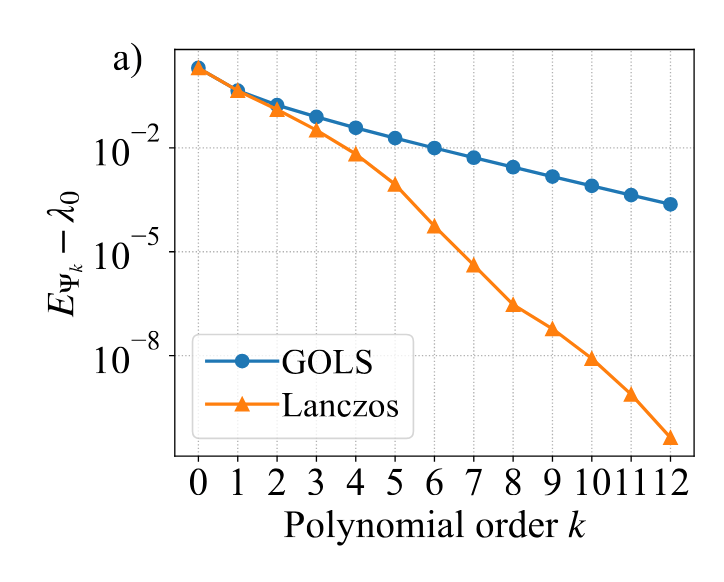
Around step \(k=3\) a global method tempers being greedy.
Then the global method catches up by having a larger \(V_k\) in the subsequent steps.
Greedy optimal line-search iteration:
Geometrically, this means there was a 'ridge' that later eases the climb.
Greedy optimal line-search iteration:
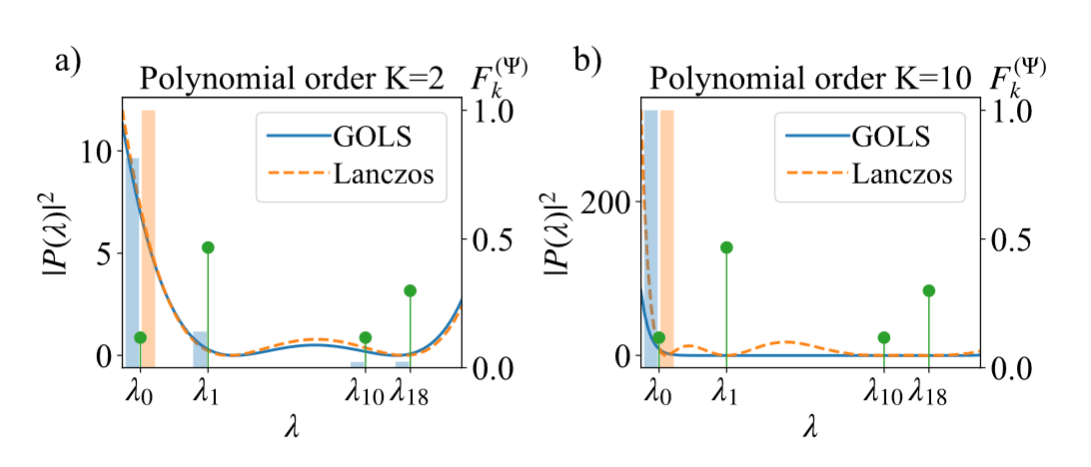
Next, I will tell you that \(k\) steps of Riemannian gradient descent are quantum signal processing by a polynomial of degree \(k\).
This means we can compare to the ideal polynomial the "Lanczos polynomial".
Energy filtering in quantum optimization
| Imaginary-time evolution |
|
Non-unitary? |
|---|---|---|
| Quantum signal processing | Probabilistic? |
Task: Given Hermitian \(H\), prepare quantum computer in eigenvector \(|\lambda_0\rangle\) with smallest eigenvalue \(\lambda_0\).
\(f(\lambda) = e^{-\tau \lambda}\)
\(H = \sum_k \lambda_k |\lambda_k\rangle\langle \lambda_k|\) which is braket notation for: If \(H v_k = \lambda_k v_k\) then \(H= \sum_k \lambda_k v_k^\top v_k\)
\(p(\lambda) = \) Lanczos polynomial
After decomposing \(\ket\psi = \sum_k \psi_k \ket{\lambda_k}\) we can filter energy by \(f(H)\ket\psi = \sum_k \psi_k f(\lambda_k) \ket{\lambda_k}\)
Note: We are optimizing \(E(\psi) = \bra\psi H\ket\psi\) and \( \bra{\lambda_0} H\ket{\lambda_0} = \lambda_0\) is the global minimizer
Energy filtering in quantum optimization
| Imaginary-time evolution |
|
Non-unitary? |
|---|---|---|
| Quantum signal processing | Probabilistic? |
Task: Given Hermitian \(H\), prepare quantum computer in eigenvector \(|\lambda_0\rangle\) with smallest eigenvalue \(\lambda_0\).
\(f(\lambda) = e^{-\tau \lambda}\)
\(H = \sum_k \lambda_k |\lambda_k\rangle\langle \lambda_k|\) which is braket notation for: If \(H v_k = \lambda_k v_k\) then \(H= \sum_k \lambda_k v_k^\top v_k\)
\(p(\lambda) = \) Lanczos polynomial
After decomposing \(\ket\psi = \sum_k \psi_k \ket{\lambda_k}\) we can filter energy by \(f(H)\ket\psi = \sum_k \psi_k f(\lambda_k) \ket{\lambda_k}\)
Note: We are optimizing \(E(\psi) = \bra\psi H\ket\psi\) and \( \bra{\lambda_0} H\ket{\lambda_0} = \lambda_0\) is the global minimizer
We will show that
\(P(H) = 1-\tau_sH\)
Ansatz:
Double-bracket ansatz:
\(n=1\):
\(n=1\):
\(n=2\):
Y. Suzuki
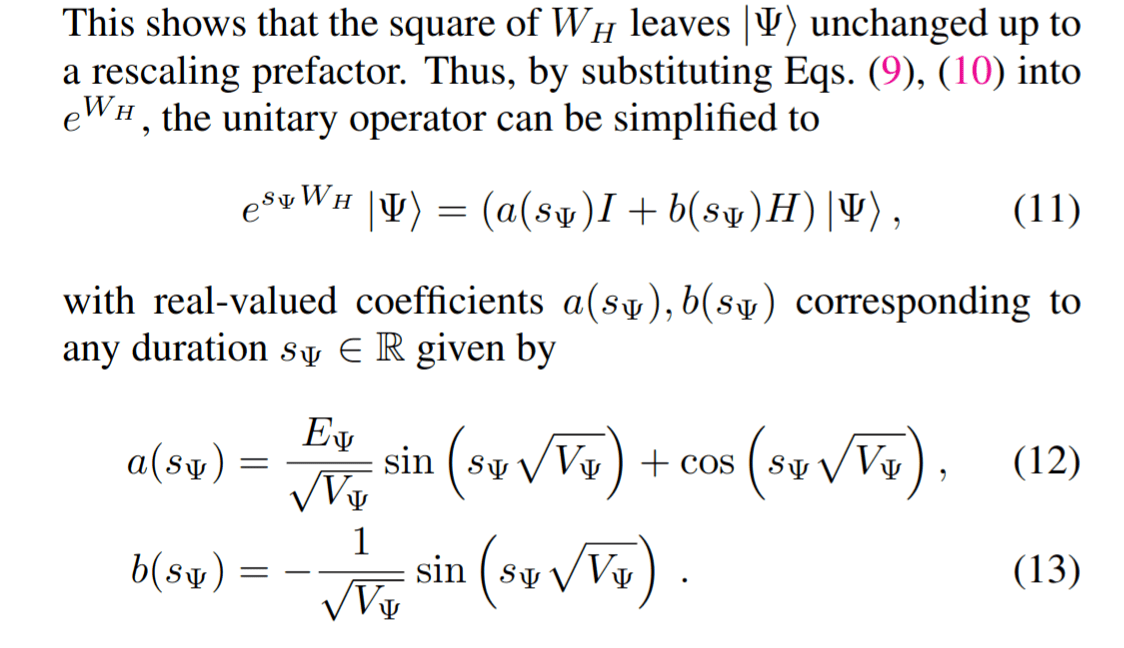
This starts looking like quantum signal processing:
Lemma 1. Any linear polynomial with a real root \(P(H) = 1-\tau H\) can be implemented this way.

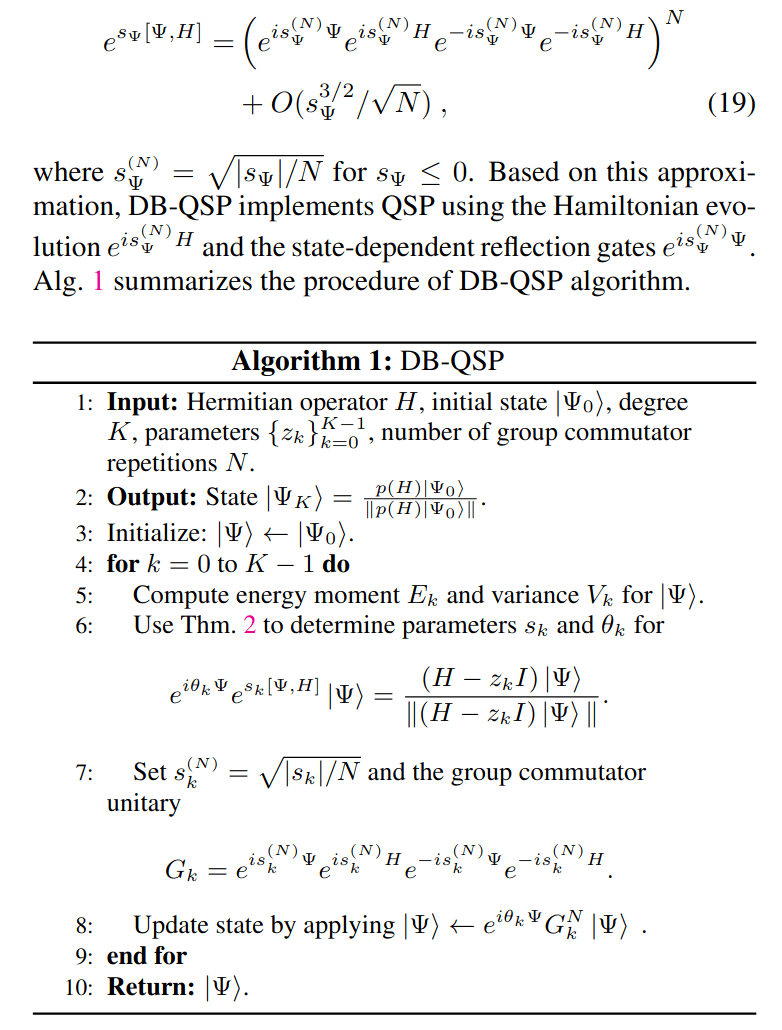

Greedy optimal line-search iteration:

There is a very nice method for finding the Lanczos polynomial from block-encodings
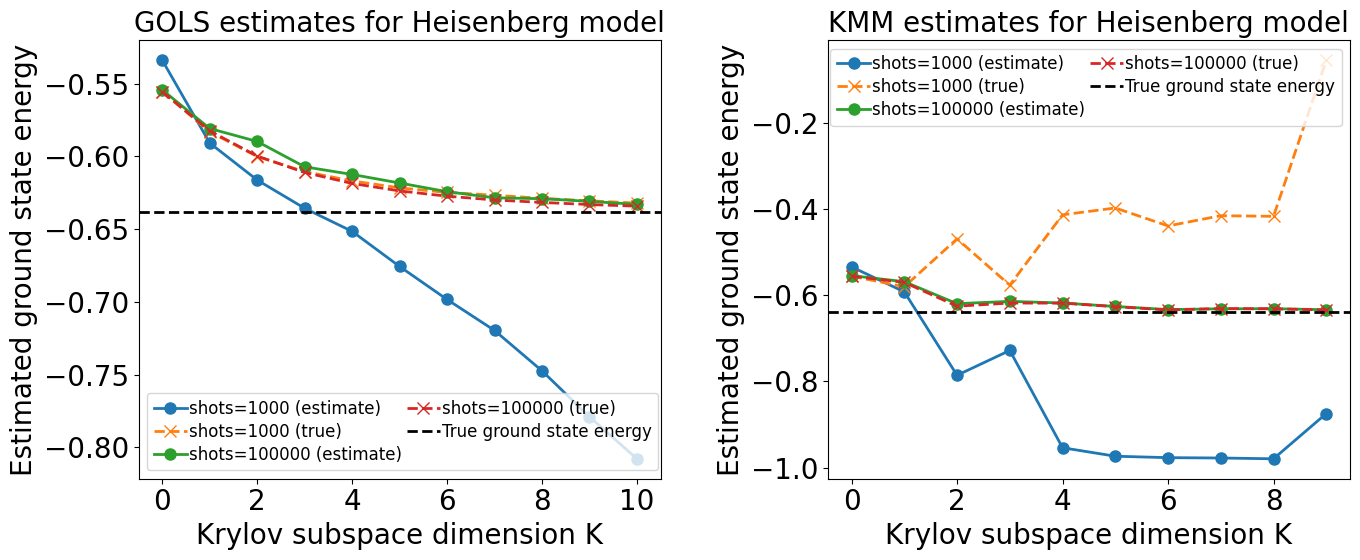
Being greedy makes you globally slower
Being greedy makes you more stable under noise!
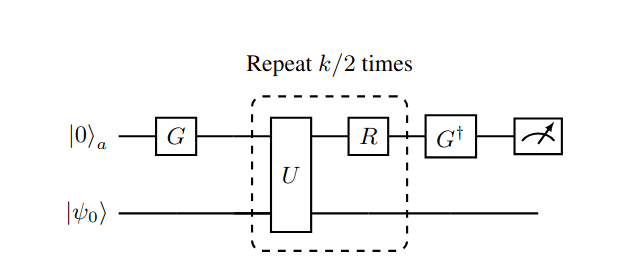

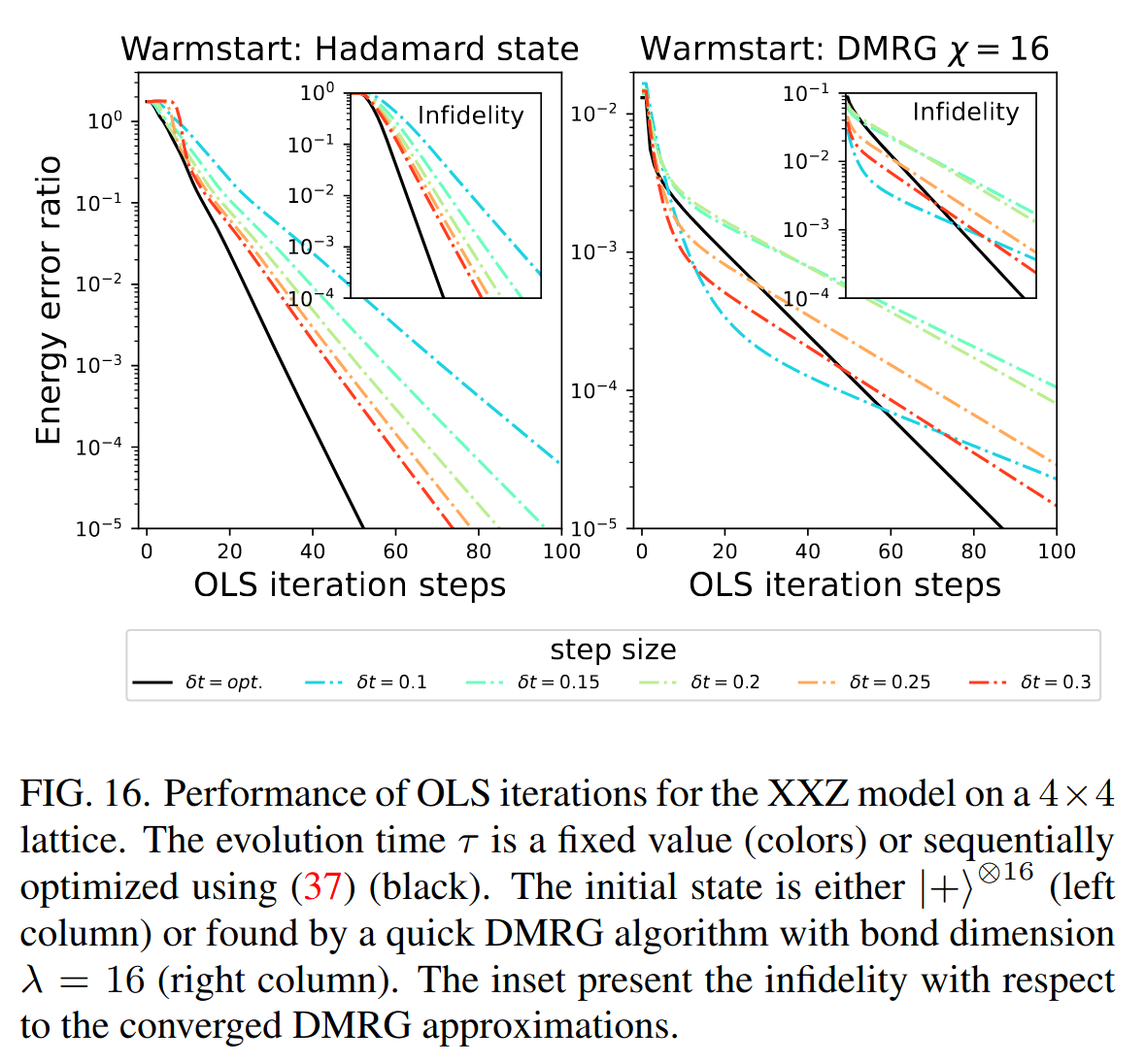
Full compilation in Qrisp of GOLS and KMM
Checking GOLS with MPS
New solver for Krylov spaces:
Iterating OLS to converge to Lanczos by removing random roots and finding new ones
On Arxiv soon-ish
Full compilation in Qrisp of GOLS and KMM
Checking GOLS with MPS
New solver for Krylov spaces:
Iterating OLS to converge to Lanczos by removing random roots and finding new ones
On Arxiv soon-ish
4 stages of creating quantum algorithms
1. Design choice:
How to go about it?
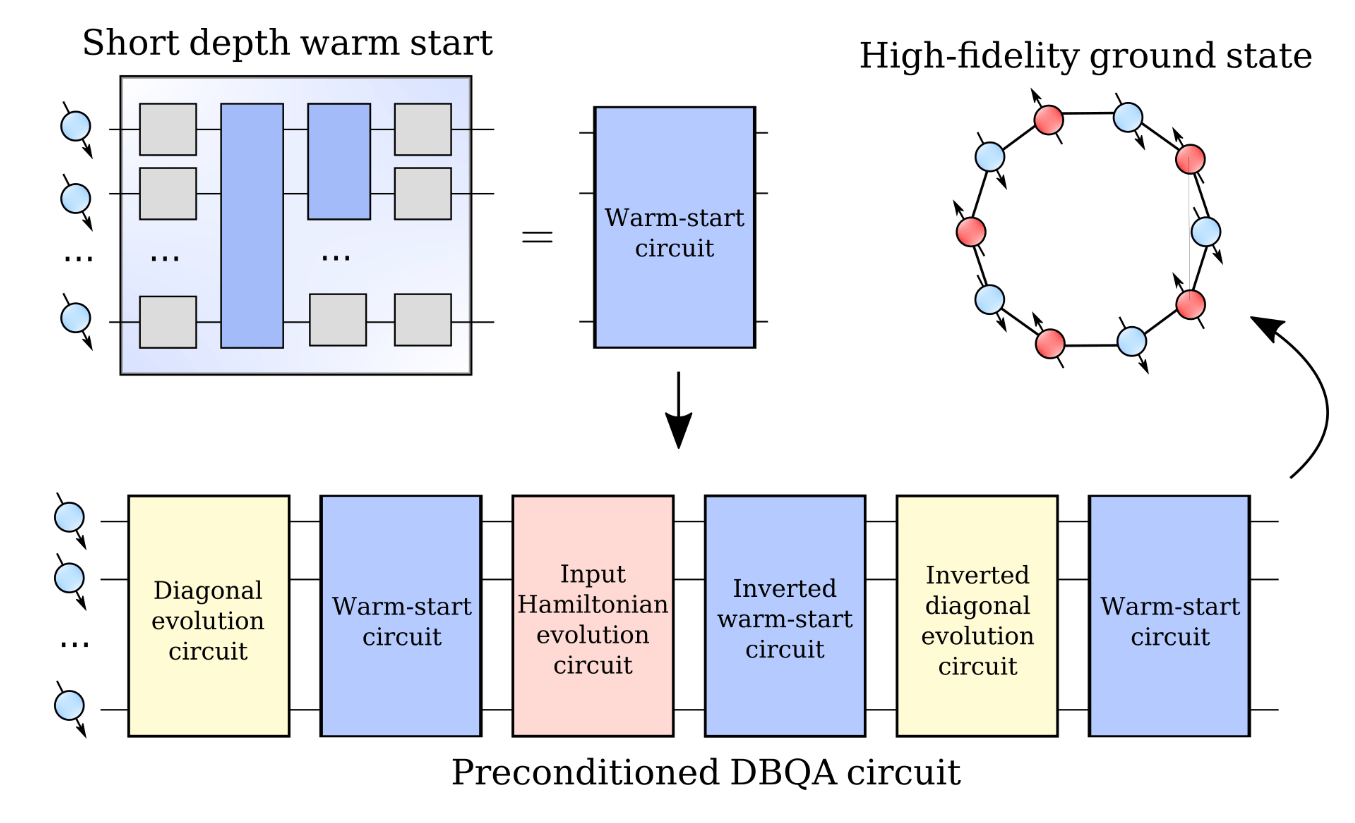
2. Unitary synthesis:
How to do it?

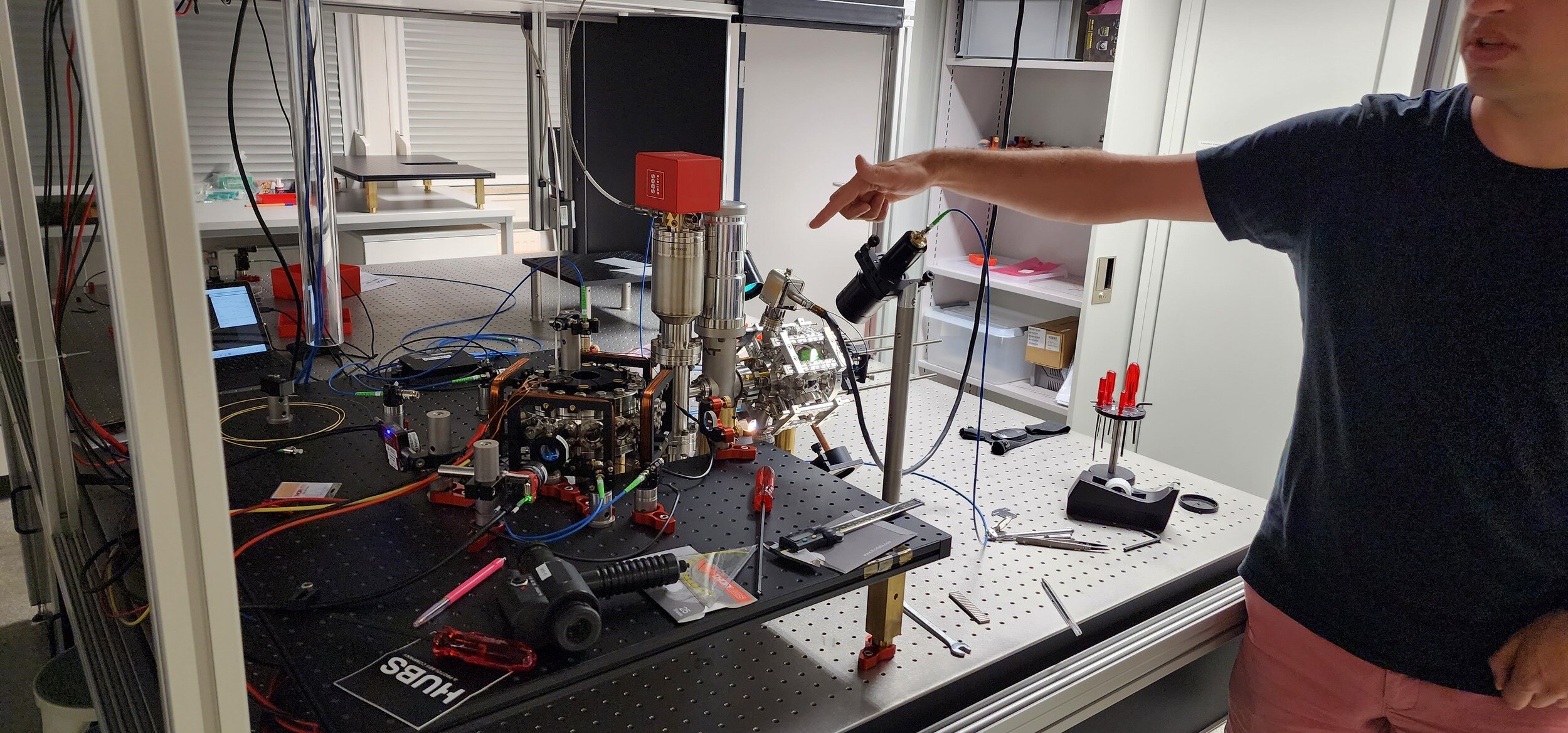
3. Circuit compilation:
What gates to do?

0. Problem choice:
What challenge to take up?
Double-bracket quantum algorithms:
Systematic framework for unitary synthesis
4 stages of creating quantum algorithms
1. Design choice:
How to go about it?
3. Circuit compilation:
What gates to do?
0. Problem choice:
What challenge to take up?
2. Unitary synthesis:
How to do it?
Double-bracket quantum algorithms:
Systematic framework for unitary synthesis
4 stages of creating quantum algorithms
4 stages of creating quantum algorithms
1. Design choice:
How to go about it?
3. Circuit compilation:
What gates to do?
0. Problem choice:
What challenge to take up?
2. Unitary synthesis:
How to do it?
4 stages of creating quantum algorithms
Imaginary-time evolution
4 stages of creating quantum algorithms
1. Design choice:
How to go about it?
3. Circuit compilation:
What gates to do?
0. Problem choice:
What challenge to take up?
2. Unitary synthesis:
How to do it?
4 stages of creating quantum algorithms
4 stages of creating quantum algorithms
1. Design choice:
How to go about it?
3. Circuit compilation:
What gates to do?
0. Problem choice:
What challenge to take up?
2. Unitary synthesis:
How to do it?
Double-bracket quantum algorithms:
Systematic framework for unitary synthesis
4 stages of creating quantum algorithms
Operating a quantum computer is all about the group of unitary matrices
Fact 3: The Lie bracket of two 'velocities' is again a velocity
Operating a quantum computer is all about the group of unitary matrices
Fact 3: The Lie bracket of two 'velocities' is again a velocity
The main tool of double-bracket quantum algorithms
4 stages of creating quantum algorithms
1. Design choice:
How to go about it?
3. Circuit compilation:
What gates to do?
0. Problem choice:
What challenge to take up?
2. Unitary synthesis:
How to do it?
Double-bracket quantum algorithms:
Systematic framework for unitary synthesis
4 stages of creating quantum algorithms
4 stages of creating quantum algorithms
Product formula approximation:
\(e^{\tau[|\psi\rangle\langle\psi|,H]} = e^{i\sqrt{\tau}H}e^{i\sqrt{\tau}|\psi\rangle\langle\psi|}e^{-i\sqrt{\tau}H}e^{-i\sqrt{\tau}|\psi\rangle\langle\psi|} + O(\tau^{3/2})\)
4 stages of creating quantum algorithms
2. Unitary synthesis:
How to do it?
1. Design choice:
How to go about it?
3. Circuit compilation:
What gates to do?
0. Problem choice:
What challenge to take up?
3. Circuit compilation:
What gates to do?
Product formula approximation:
\(e^{\tau[|\psi\rangle\langle\psi|,H]} = e^{i\sqrt{\tau}H}e^{i\sqrt{\tau}|\psi\rangle\langle\psi|}e^{-i\sqrt{\tau}H}e^{-i\sqrt{\tau}|\psi\rangle\langle\psi|} + O(\tau^{3/2})\)
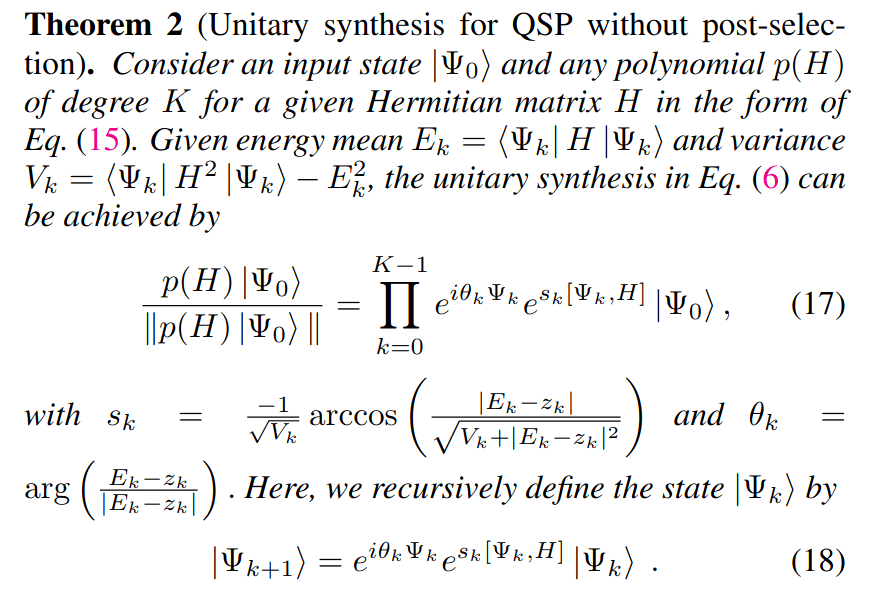
Quantum algorithm DB-QITE - iterate recursively:
- Define \(|{\psi_k}\rangle = U_k |0\rangle\)
- Use \(e^{is |\psi_k\rangle\langle\psi_k|} = U_ke^{is |0\rangle\langle0|}U_k^\dagger \)
- Recursively iterate \( U_{k+1} = e^{is H} U_k e^{is |0\rangle\langle 0|} U_k^\dagger e^{-is H} U_k\)
3 stages of creating quantum algorithms
1. Design choice:
How to go about it?
3. Circuit compilation:
What gates to do?
0. Problem choice:
What challenge to take up?
4 stages of creating quantum algorithms
2. Unitary synthesis:
How to do it?
(PRL '26)
3. Circuit compilation:
What gates to do?
Product formula approximation:
\(e^{\tau[|\psi\rangle\langle\psi|,H]} = e^{i\sqrt{\tau}H}e^{i\sqrt{\tau}|\psi\rangle\langle\psi|}e^{-i\sqrt{\tau}H}e^{-i\sqrt{\tau}|\psi\rangle\langle\psi|} + O(\tau^{3/2})\)
Quantum algorithm DB-QITE - iterate recursively:
- Define \(|{\psi_k}\rangle = U_k |0\rangle\)
- Use \(e^{is |\psi_k\rangle\langle\psi_k|} = U_ke^{is |0\rangle\langle0|}U_k^\dagger \)
- Recursively iterate \( U_{k+1} = e^{is H} U_k e^{is |0\rangle\langle 0|} U_k^\dagger e^{-is H} U_k\)
3 stages of creating quantum algorithms
1. Design choice:
How to go about it?
3. Circuit compilation:
What gates to do?
0. Problem choice:
What challenge to take up?

4 stages of creating quantum algorithms
2. Unitary synthesis:
How to do it?
(accepted at PRL)
Numerical results for DB-QITE:
DB-QITE:
- Define \(|{\psi_k}\rangle = U_k |0\rangle\)
- Recursively iterate \( U_{k+1} = e^{is H} U_k e^{is |0\rangle\langle 0|} U_k^\dagger e^{-is H} U_k\)
Then:


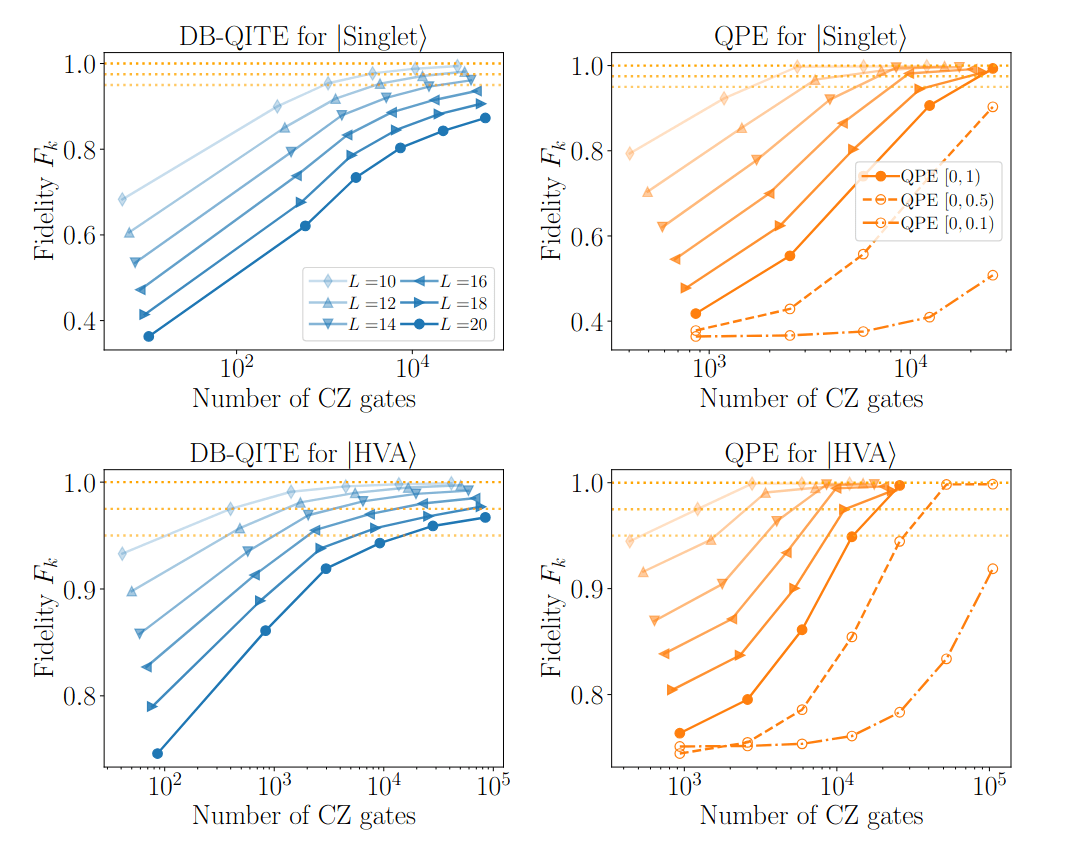
Quantinuum
(accepted at PRL)
Gaussian quantum simulators
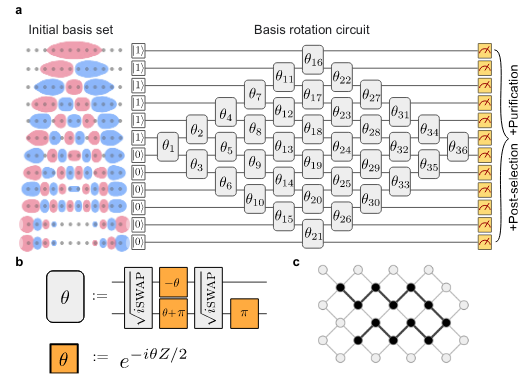
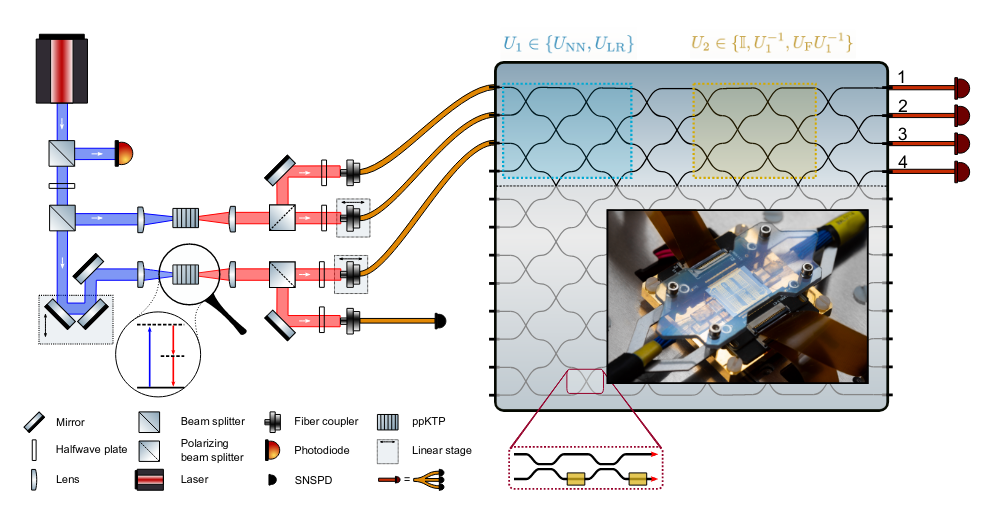
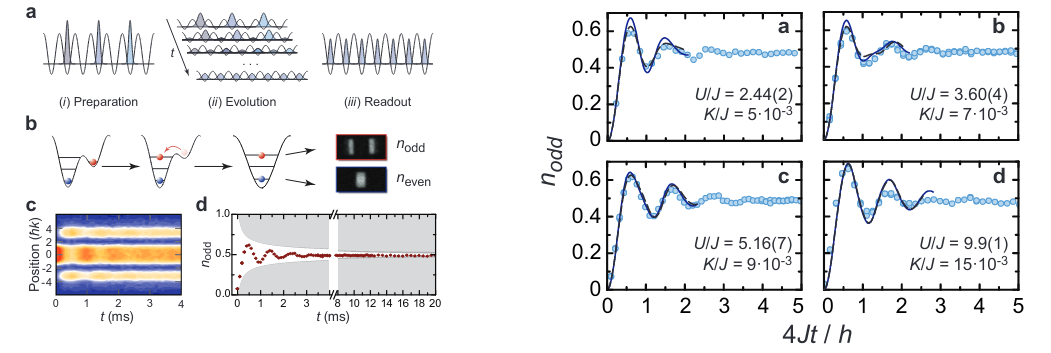

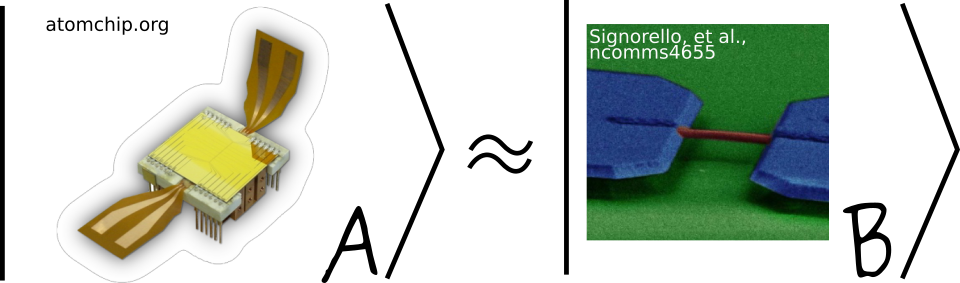
How?

Ultra-cold 1d gases
Inside: atoms
Outside: wavepackets
hydrodynamics
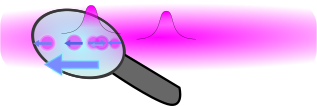
Energy of phonons
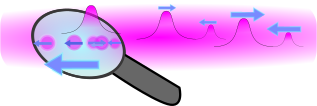
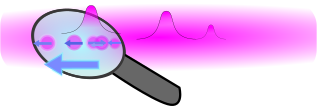
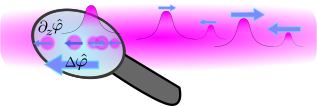
Tomonaga-Luttinger liquid
Quantum field refrigerators in the TLL model:
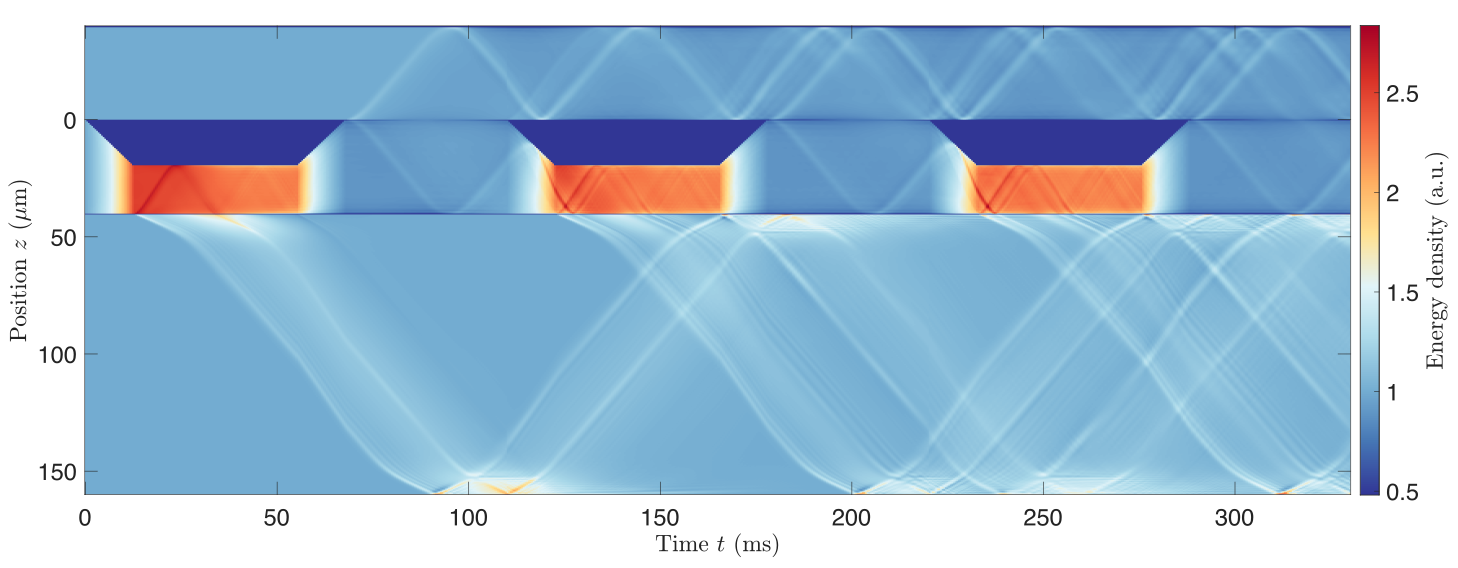
System
Piston
Bath
Bath with excitations
System cooled down
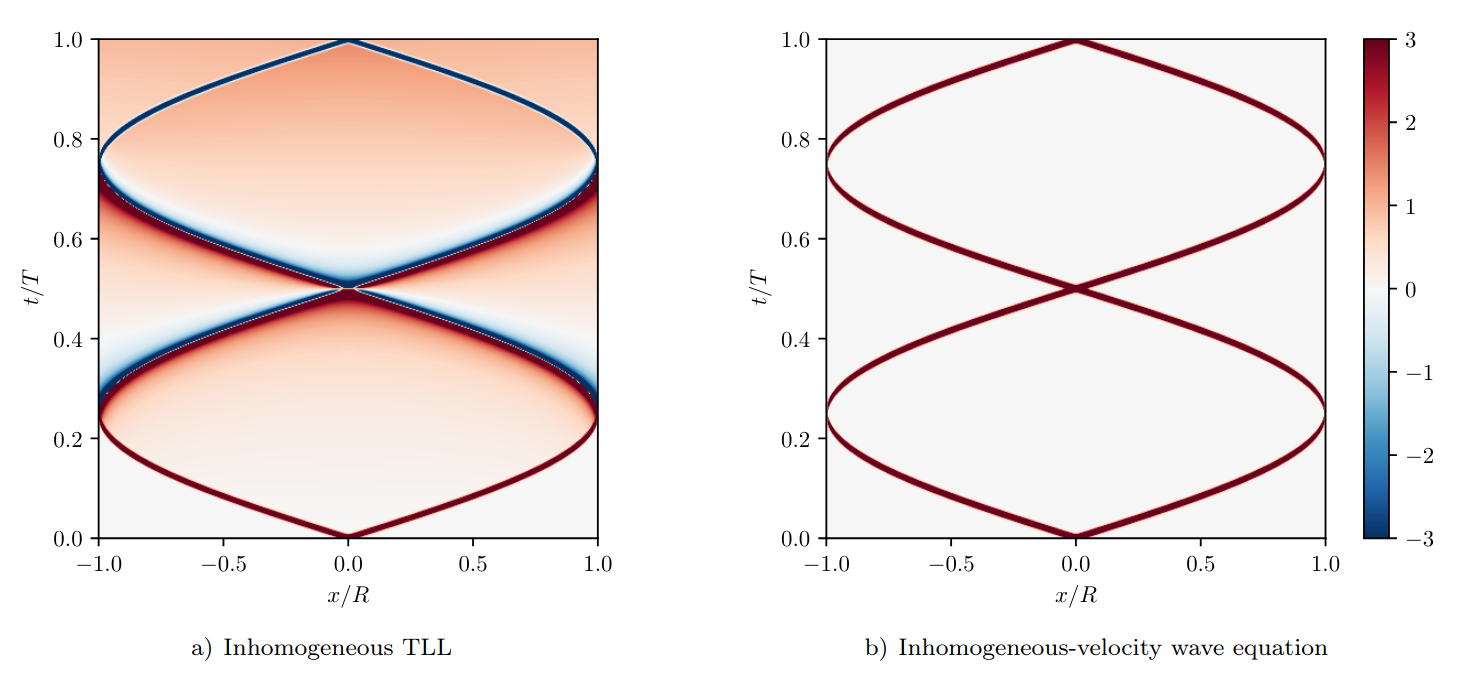
Breaking of the Huygens-Fresnel principle
in the inhomogenous TLL model:
Why?
Why develop continuous field
quantum simulators?
- Representation theory: Quantum information?
- Continuum limits: BQP and QMA or more?
- Are nanowires computationally hard to simulate?
What do we know is difficult?


SM
Fundamental
Universal
Effective
Why develop continuous field
quantum simulators?
- Representation theory: Quantum information?
- Continuum limits: BQP and QMA or more?
- Are nanowires computationally hard to simulate?
What do we know is difficult?
SM
Fundamental
Universal
Effective
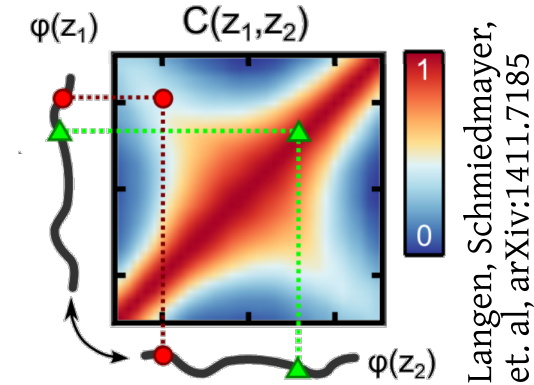
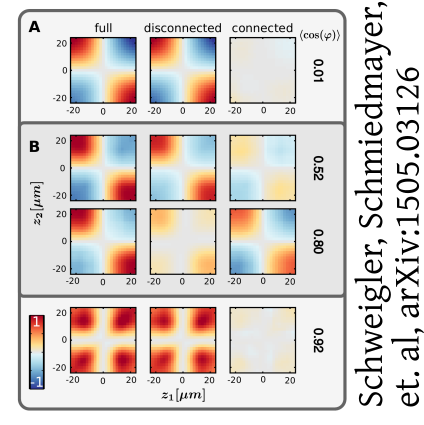
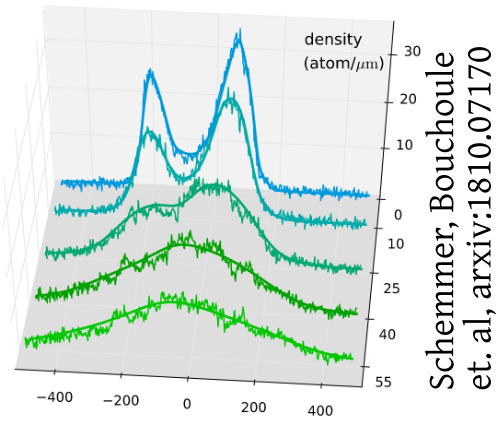
Non-thermal
steady states
Sine-Gordon
thermal states
Atomtronics
Generalized hydrodynamics
Recurrences
Some highlights:
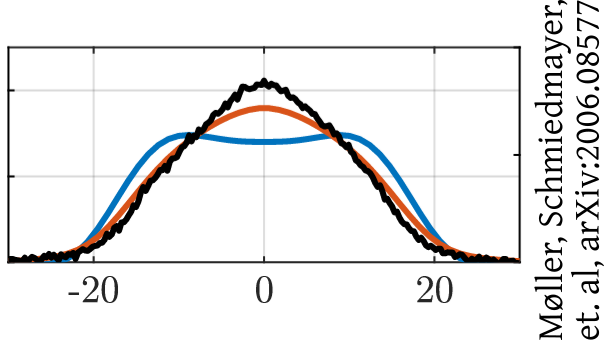
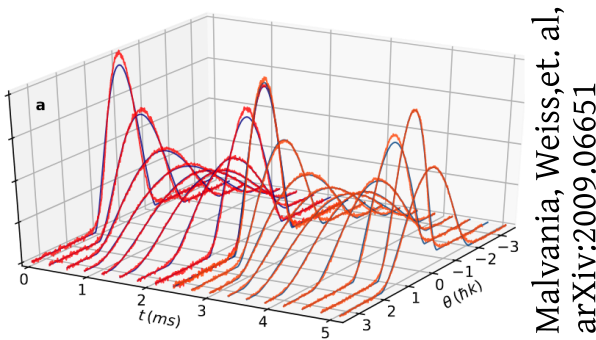
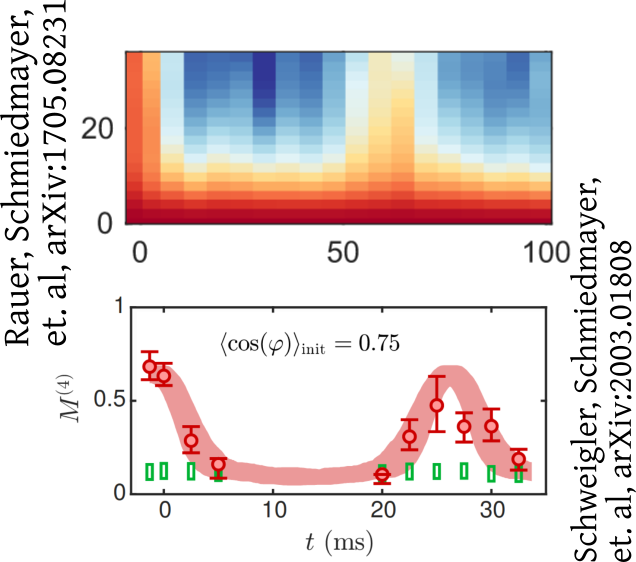
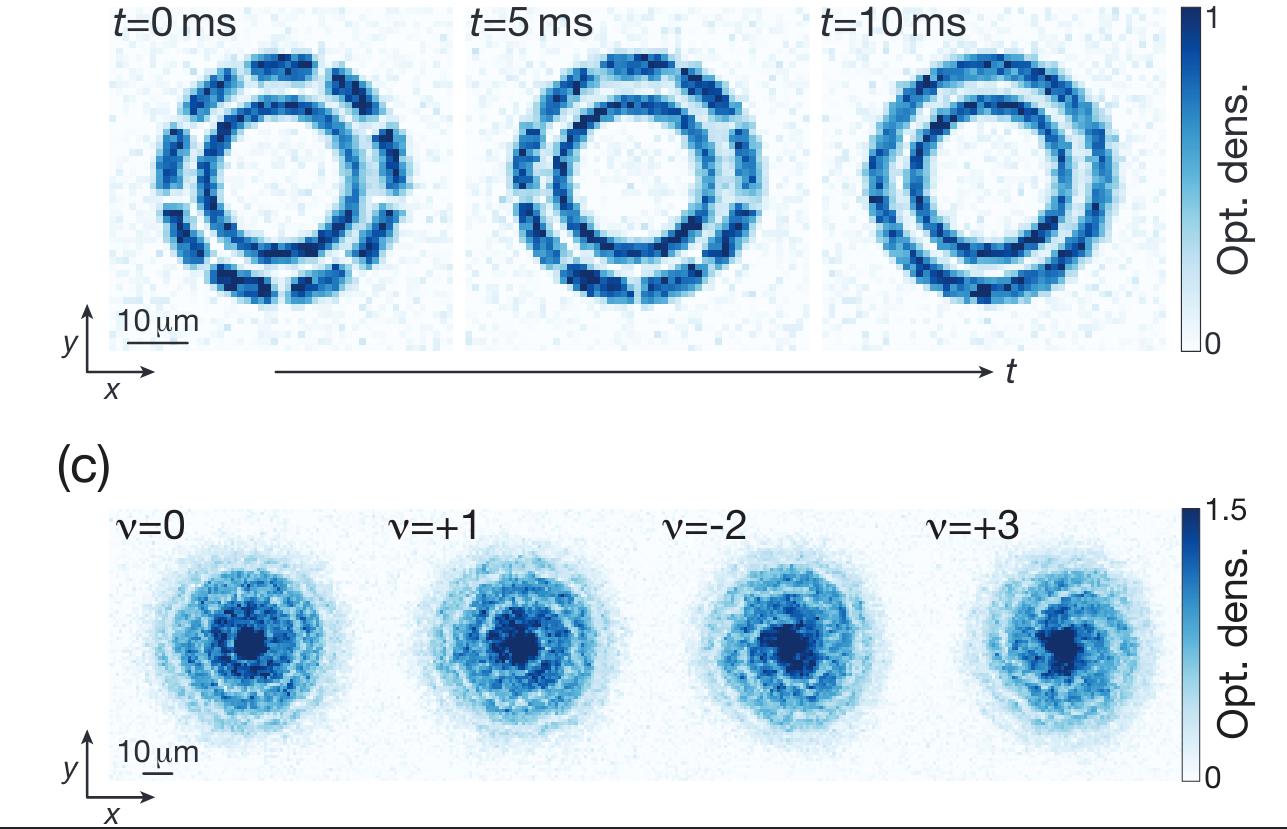
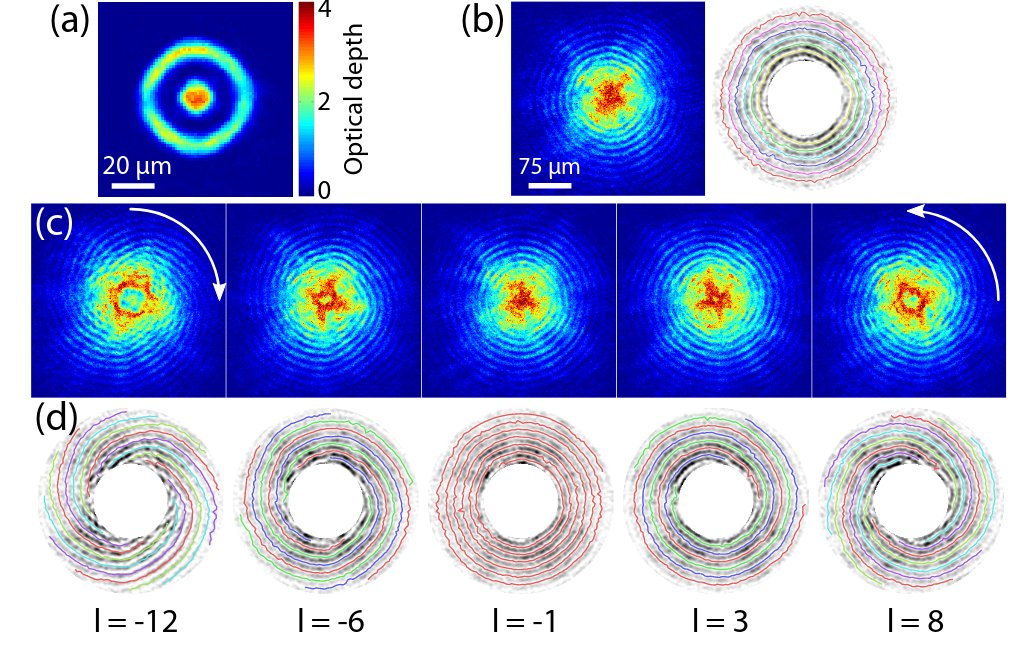
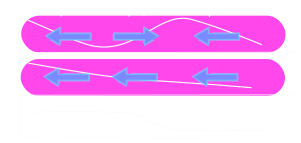
Interferometry measures velocities
van Nieuwkerk, Schmiedmayer, Essler, arXiv:1806.02626
Schumm, Schmiedmayer, Kruger, et al., arXiv:quant-ph/0507047
Tomography
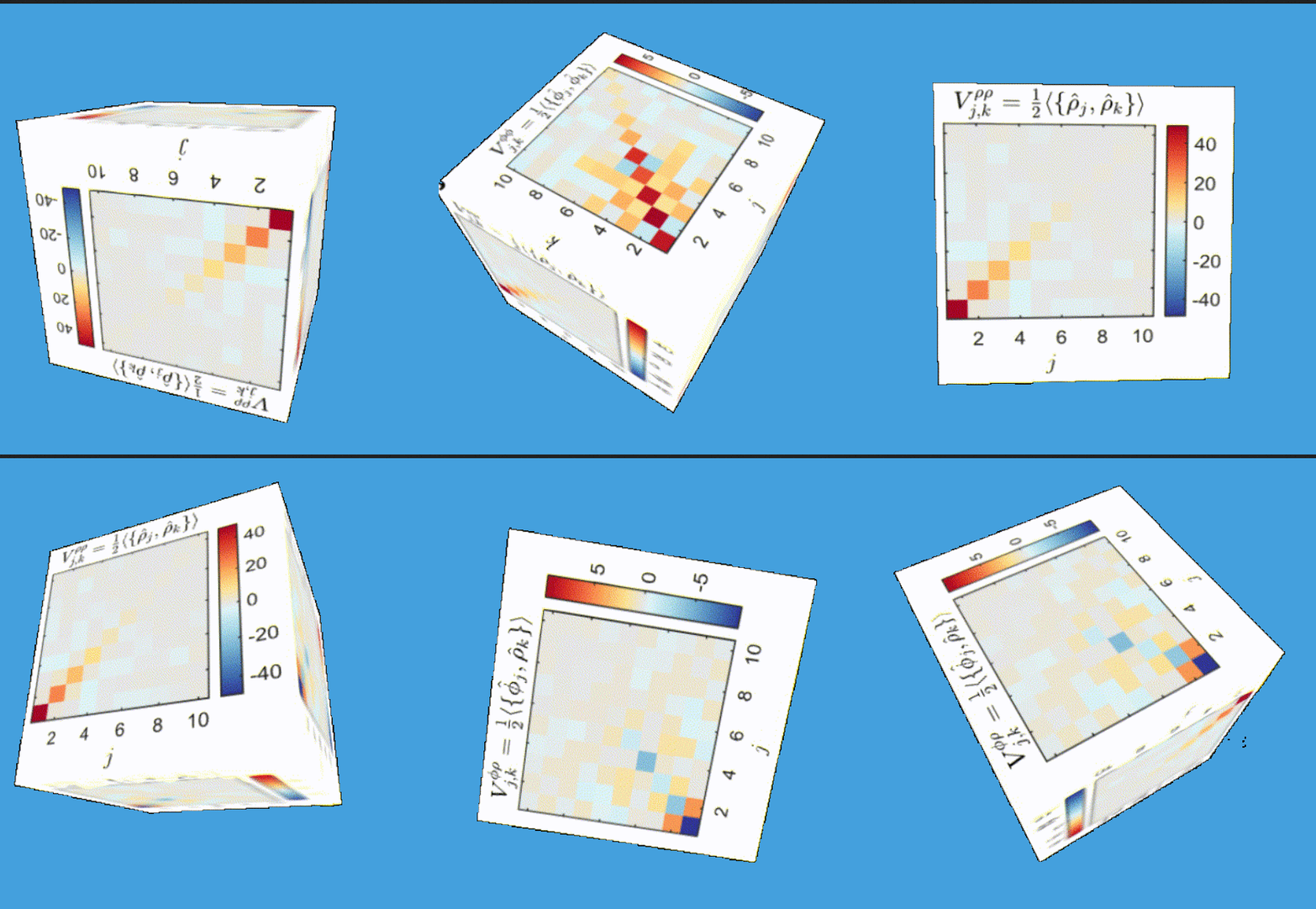
Tomography for phonons
Tomography for phonons
What are eigenmodes?
Transmutation
Tomography
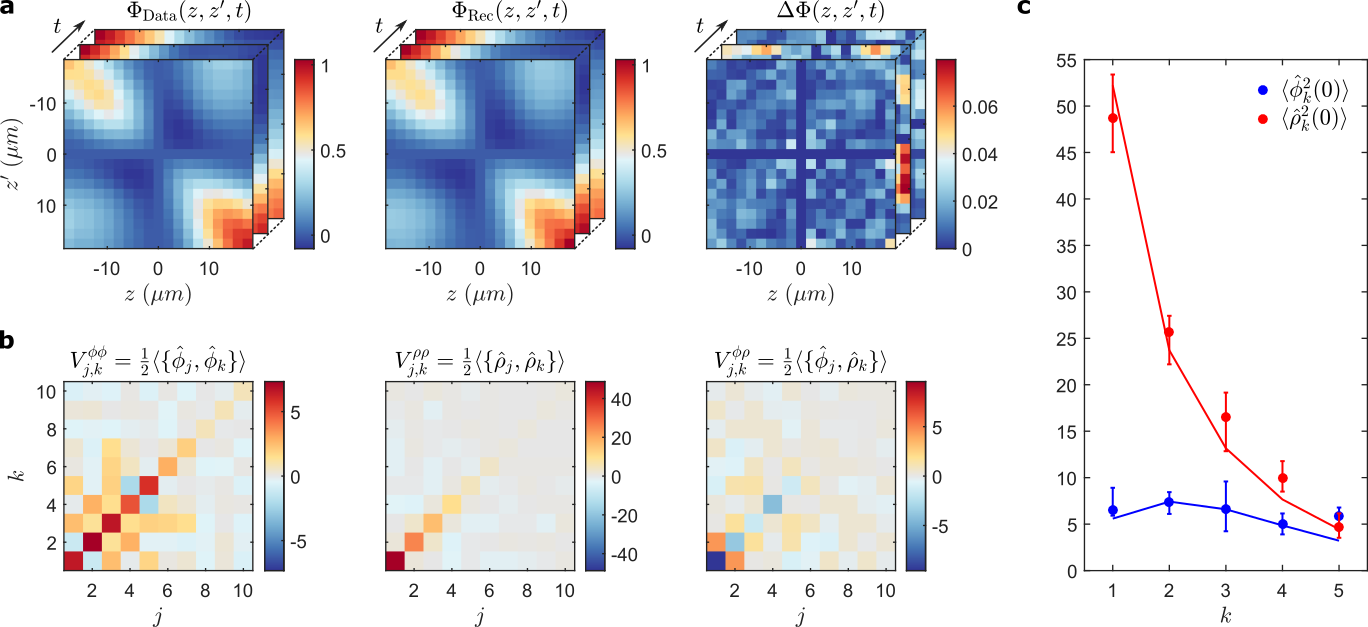
(This formalism: Tomography for many modes)
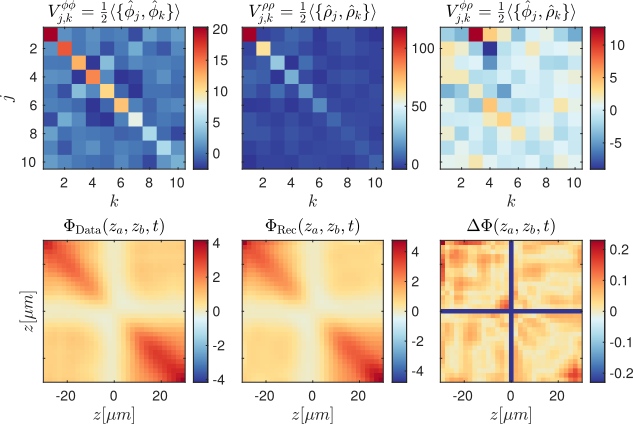
Tomography Klein-Gordon thermal state after quench
Extracting physical properties
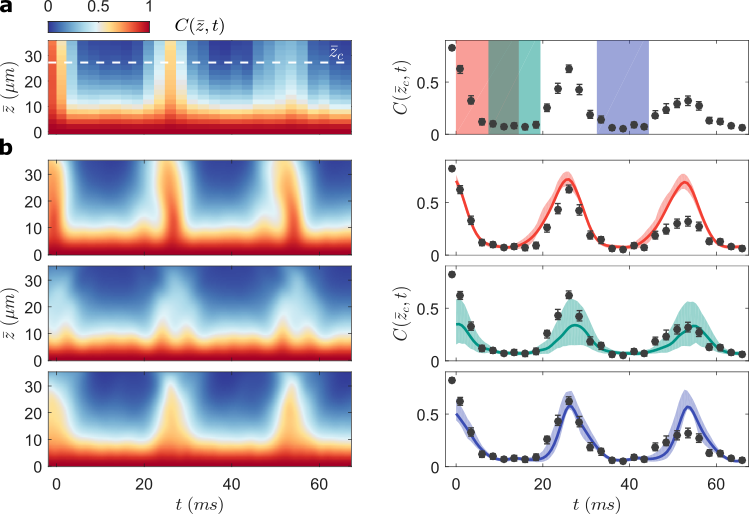
Extracting physical properties
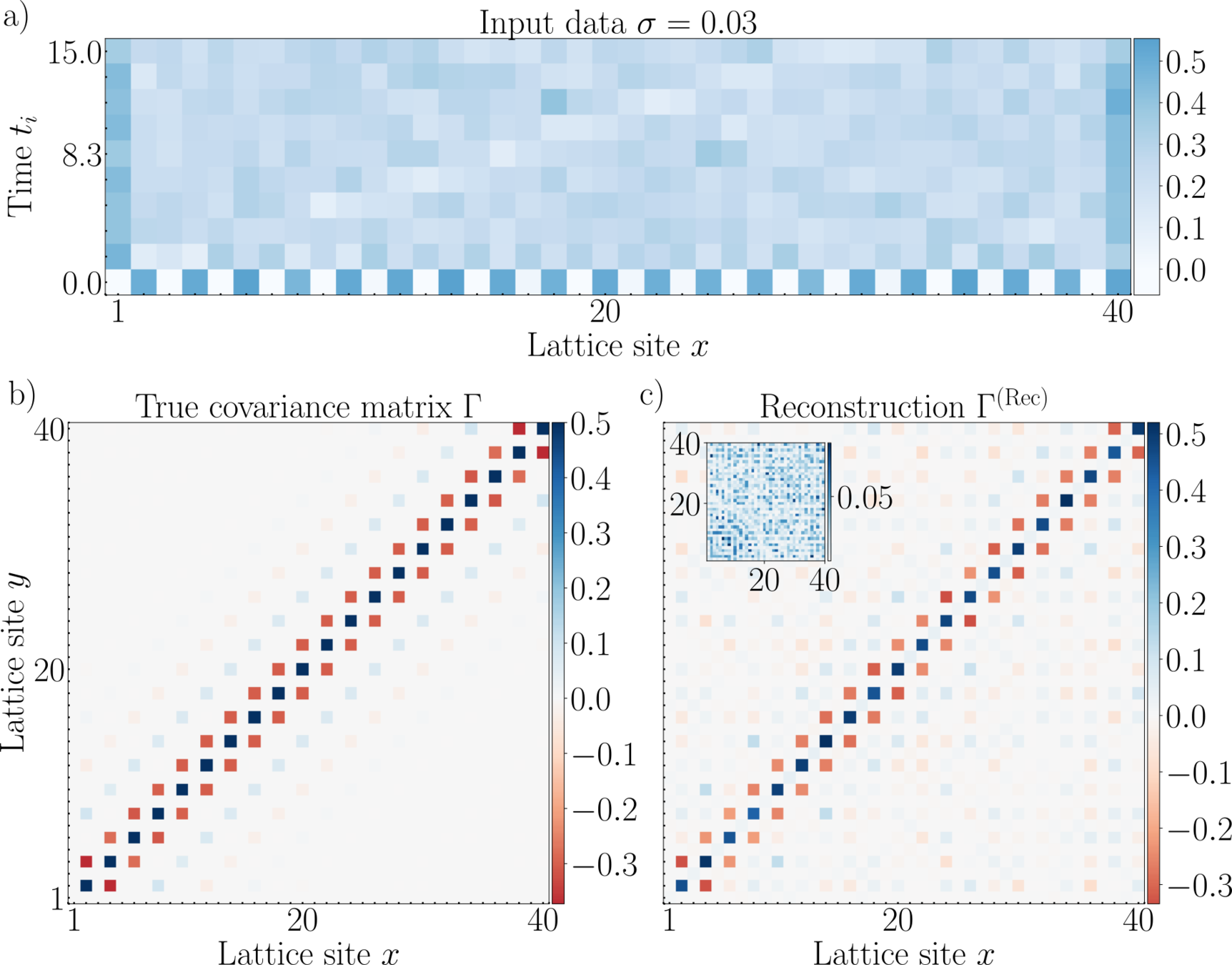
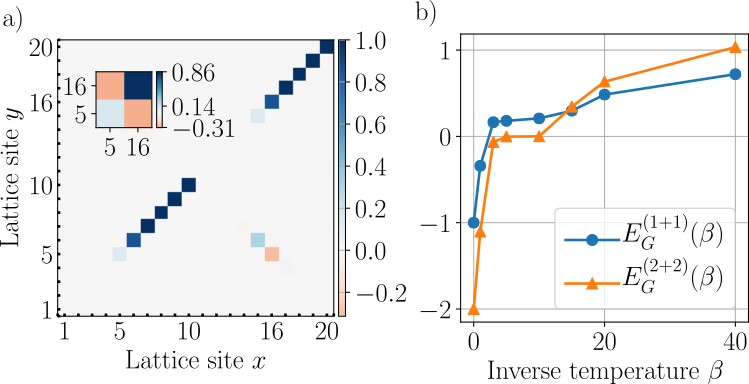
Extracting physical properties
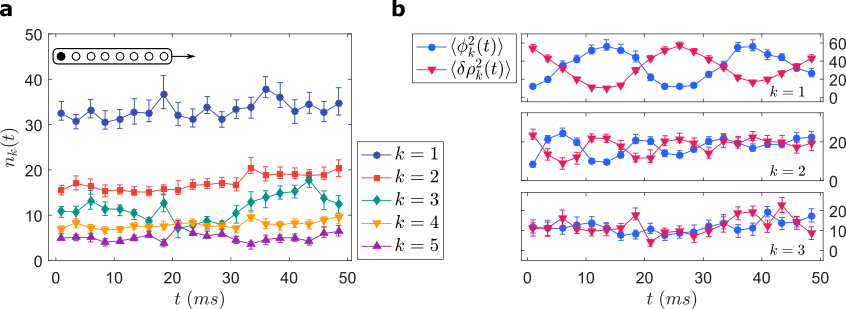
Tomography for optical lattices