Gravity, Projectile Motion and Satellites

M. Rocha   

Physics 1 - Week 4 - Chapters 9 and 10

The Universal Law of Gravity

Is the force pulling an apple down the tree the same as the one keeping the moon around the Earth?

Illustration comparing an apple falling from a tree to the Moon orbiting the Earth

The Universal Law of Gravity

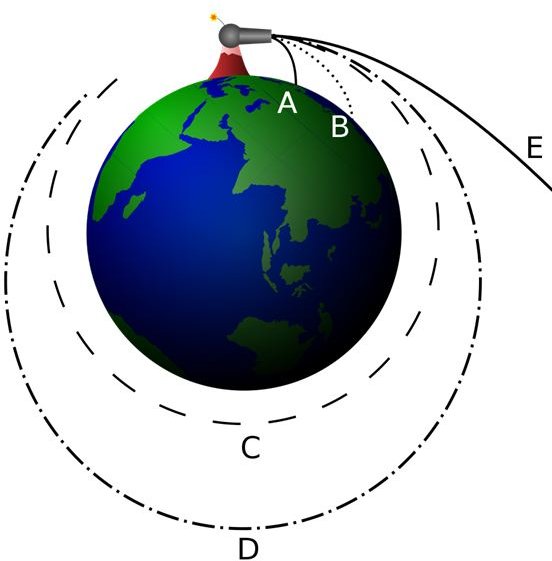
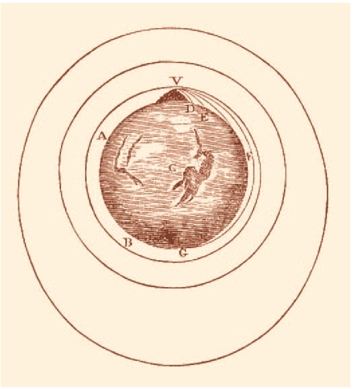
Newton's cannonball thought experiment showing projectile trajectories curving around Earth

Newton's Mountain:

If you throw a stone horizontally fast enough, the stone keeps falling, but it never reaches the ground (because of the curvature of the Earth)

The Universal Law of Gravity

Diagram comparing an apple falling towards Earth and the Moon orbiting Earth
Newton's Mountain thought experiment diagram showing orbital trajectories

Is the force pulling an apple down the tree the same as the one keeping the moon around the Earth?

The Universal Law of Gravity
Is the force pulling an apple down the tree the same keeping the moon around the Earth?
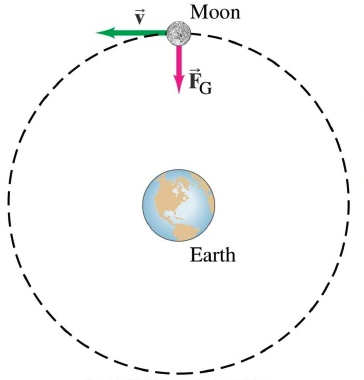
Diagram illustrating gravitational force between Earth, an apple, and the Moon

Yes it is!

Is the force of gravity

Force of Gravity

Sphere representing mass M1
Sphere representing mass M2
Sphere representing mass M1

The force of gravity must be proportional to the product of the mass of the two objects interacting (i.e. M1*M2) 

M1

M1

M2

M2

M1

M1

\mathrm{F_G} \propto M_1 \cdot M_2

The Universal Law of Gravity

The force of gravity is inversely proportional to the square of the distance

\mathrm{F_G} \propto \frac{1}{\mathrm{distance^2}}

This is because intensity spreads over the surface area of a sphere

Inverse-square law diagram showing force or intensity spreading over spherical surface areas at increasing distances

The Universal Law of Gravity

\mathrm{F_G} \propto \frac{1}{\mathrm{distance^2}}

This is because intensity spreads over the surface area of a sphere

The force of gravity is inversely proportional to the square of the distance

Diagram illustrating the inverse-square law of gravity with increasing distance from a sphere

The Universal Law of Gravity

\mathrm{F_G} \propto \frac{\mathrm{mass_1}\times\mathrm{mass_2}}{\mathrm{distance^2}}
\mathrm{F_G} = G \frac{m_1m_2}{d^2}

The force of gravity is proportional to the product of the mass of the objects and inversely proportional the square of the distance

G = 6.67 \times 10^{-11} \mathrm{\frac{N \ m^2}{kg^2}}
Diagram of two masses m1 and m2 separated by distance d with mutual gravitational attraction forces

Checkpoint

An apple weighs 1 N at Earth's surface. How much does it weighs when it is 4 times as far?

Diagram showing weight of an apple decreasing with distance from Earth according to the inverse-square law

4 R

\mathrm{F_G} = \frac{1}{\mathrm{4^2}}\mathrm{N} = \frac{1}{\mathrm{16}}\mathrm{N}

 Weightlessness/Zero Gravity

Diagram comparing weight on a scale in a stationary elevator versus free-fall weightlessness
Astronaut floating inside a spacecraft in free fall

Being weightless does not mean there is no gravity, what it means is that there is no support force (free falling)

Illustration of elevator support force and free-fall weightlessness

Without a support force you experience weightlessness, but that doesn't mean there is zero gravity

Parabolic flight maneuver diagram simulating zero gravity

 Weightlessness/Zero Gravity

Without a support force you experience weightlessness, but that doesn't mean there is zero gravity

Diagram of parabolic flight trajectory showing climb, push-over into free fall, and pull-out

 Weightlessness/Zero Gravity

People experiencing weightlessness inside a parabolic flight aircraft

Ocean Tides

The ocean tides are caused by differences in the gravitational pull of the moon on opposite sides of Earth
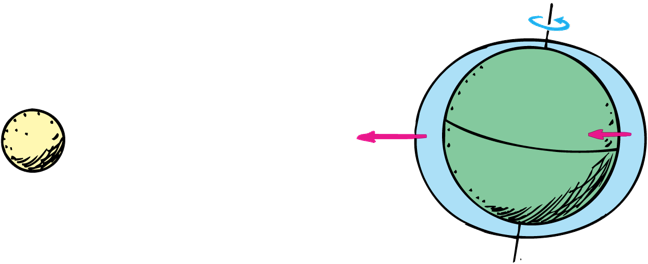
Diagram showing ocean tidal bulges caused by the Moon's gravitational differential across Earth

As the Earth rotates tides change during the day

Diagram illustrating Earth rotating through high and low tidal bulges
Photograph of high tide at a coastal harbor
Photograph of low tide at the same coastal harbor showing exposed seabed

Ocean Tides

The sun also contributes to ocean tides, but only about half as much as the moon

The difference in gravitational pull by the sun on opposite sides of Earth is very small 

Diagram comparing the gravitational gradient of the Sun and Moon acting on Earth's oceans

The Sun's pull on Earth is 180 times greater than the moon’s pull on Earth, so why aren’t tides due to the Sun 180 times greater than tides due to the Moon?

Ocean Tides

When the sun, the moon, and Earth are aligned, spring tides occur

Diagram of spring tides with Sun, Earth, and Moon in direct alignment

Ocean Tides

When the attractions of the sun and the moon are at right angles to each other (at the time of a half moon), neap tides occur

Diagram of neap tides with Sun and Moon at right angles relative to Earth

Ocean Tides

Tides are most noticeable in fjords and basins due to a funneling effect. The Bay of Fundy has some of the most extreme tide swings in the planet (15+ m/48+ ft)

Map of North America highlighting the Bay of Fundy location
Comparison photo of high tide and low tide at the Hopewell Rocks in the Bay of Fundy

Projectile Motion and Satellites

Remember Free Fall Motion?

v = a \ t
d = \frac{a}{2} \ t^2

,

a = g = 9.8 \ \frac{m}{s^2} \simeq 10 \ \frac{m}{s^2}
Diagram showing position, velocity, and distance fallen at 1-second intervals during free fall

Checkpoint

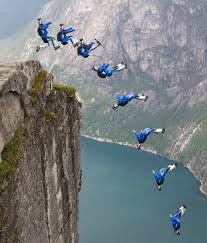
How far down (distance) would you fall in 1 second after you base jump from a cliff. Ignore air resistance.

d = 5 meters after 1 second

d = \frac{a}{2} \ t^2
a = g = 9.8 \ \frac{m}{s^2} \simeq 10 \ \frac{m}{s^2}

,

Remember Free Fall Motion?

v = a \ t
d = \frac{a}{2} \ t^2

,

a = g = 9.8 \ \frac{m}{s^2} \simeq 10 \ \frac{m}{s^2}

d = 5 meters after 1 second

5m in 1s

Diagram showing 5 meters of free-fall drop during the first second

 Projectile Motion is just Free Fall Motion with an horizontal velocity component
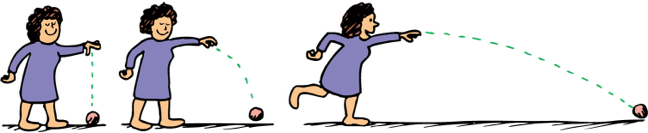
Diagram comparing vertical free fall motion with parabolic projectile motion having horizontal velocity

Free Fall:

V_y = at + v_{y_i}
V_x = 0

Projectile:

V_y = at + v_{y_i}
V_x = v_{x_i} (\mathrm{constant})
V_y
V_x
V_y

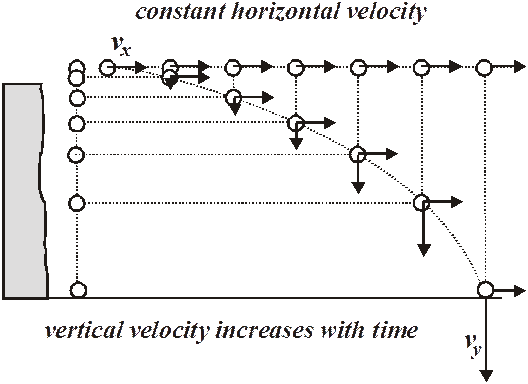
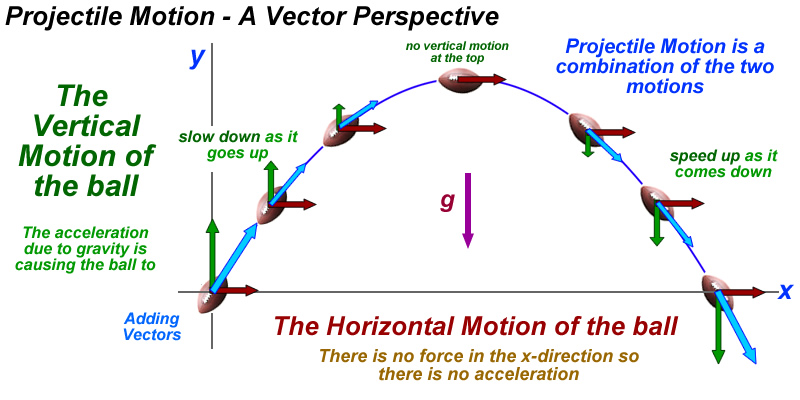
The key to understand Projectile Motion is to treat Vx and Vy separately

Diagram showing constant horizontal velocity vector Vx during projectile motion
Diagram showing changing vertical velocity vector Vy under gravity during projectile motion
Diagram showing combined projectile trajectory resulting from independent horizontal and vertical velocities
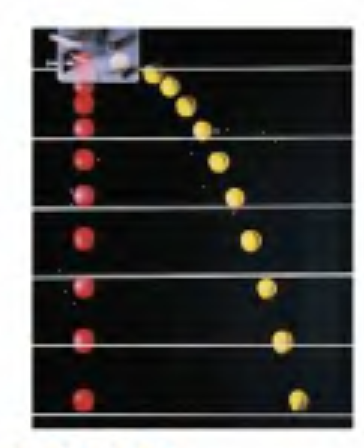
Strobe photo demonstration of a dropped ball and projected ball hitting the ground at the same time

Vx and Vy are independent from each other

The key in understanding Projectile Motion is to treat Vx and Vy separately
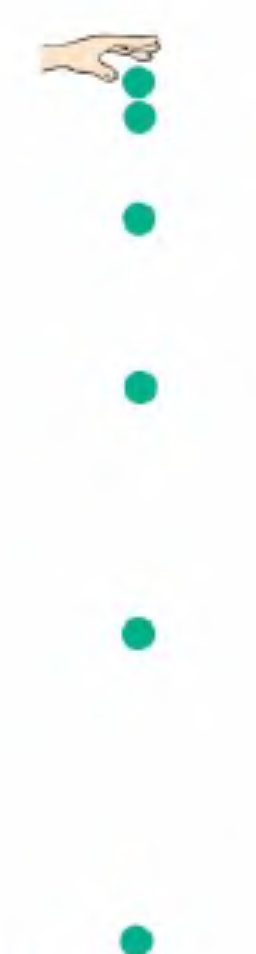
Diagram breaking down parabolic projectile motion into separate horizontal and vertical vector components

Checkpoint

If I kick a soccer ball (from the ground), and it reaches a height of 20 meters, for how long would it be on the air before it hits the ground (HINT: The distance and time going up should be the same as when going down )?

d = \frac{a}{2} \ t^2
a = g = 9.8 \ \frac{m}{s^2} \simeq 10 \ \frac{m}{s^2}

,

t_{up} = t_{down} = \sqrt{\frac{2d}{a}} = \sqrt{\frac{ 2 \ (20 \ m)}{10 \ m/s^2}} = \sqrt{4 \ s^2} = 2 \ s

Total time = tup + tdown = 4 seconds

Checkpoint

If I kick a soccer ball (from the ground) with a horizontal velocity of 20 m/s, and it reaches a hight of 20 meters, how far would it travel in the horizontal direction (i.e. how far would it land )?

d = \frac{a}{2} \ t^2
a = g = 9.8 \ \frac{m}{s^2} \simeq 10 \ \frac{m}{s^2}

,

t_{up} = t_{down} = \sqrt{\frac{2d}{a}} = \sqrt{\frac{ 2 \ (20 \ m)}{10 \ m/s^2}} = \sqrt{4 \ s^2} = 2 \ s

Total time = tup + tdown = 4 seconds

Horizontal Distance = 20 m/s ( 4 seconds) = 80 m

v_\mathrm{horizontal} = \frac{d_\mathrm{horizontal}}{t}
d_\mathrm{horizontal} = v_\mathrm{horizontal}\ t = 20 \frac{m}{s} \ (4 \ s) = 80 \ m

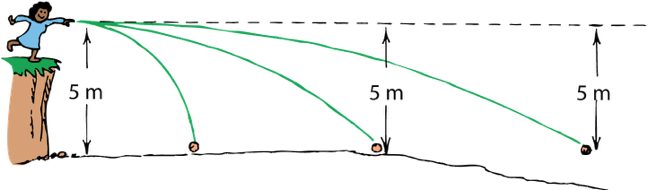
 If a projectile falls 5m in 1s, 

Diagram of projectile falling 5 meters in 1 second
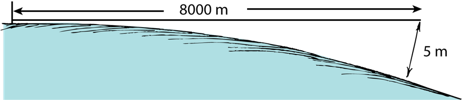
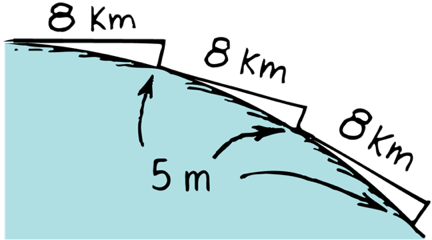
Diagram showing Earth's curvature dropping 5 meters every 8 kilometers

 and  the curvature of earth is so that it drops 5m for every 8 km

What happen if you throw a rock with an horizontal velocity of 8000 m/s = km/s (18,000 mi/h)?

Satellites
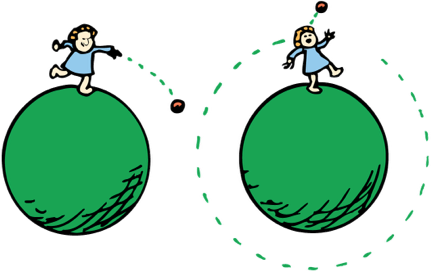
Diagram showing how an 8 km/s horizontal launch matches Earth's curvature to achieve circular orbit

Satellites

Newton's cannon thought experiment with trajectories leading to circular and escape orbits
Diagram of a satellite in circular orbit maintaining constant distance from Earth's surface

Satellites

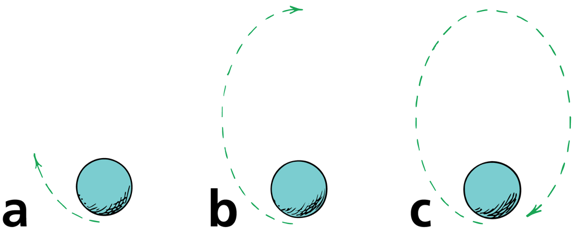
Diagram of an elliptical orbit showing apogee, perigee, and orbital path

A satellite moves in an elliptical orbit

a) When the satellite exceeds 8 km/s, it overshoots a circle. b) At its maximum separation, it starts to come back toward Earth.

c) The cycle repeats itself.

Satellites

a) A projectile's path is a section of an elliptical orbit

b) a satellite moves in an elliptical orbit
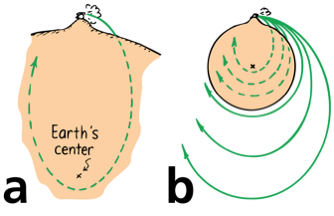
Diagram showing that parabolic projectile trajectories are sections of larger elliptical orbits

Scape Velocity

Illustration of a rocket escaping Earth's gravitational field at escape velocity

Neglecting air resistance if you throw a rock with a velocity greater than 11.2 Km/s (25000 miles/h), it wont come back

Diagram comparing closed orbital trajectories with hyperbolic escape trajectory at 11.2 km/s

Black Holes

Illustration of light bending around a black hole event horizon

At the surface of a black hole the force of gravity is so strong that not even light has enough velocity to scape 

Diagram showing light trajectories trapped by extreme gravity near a black hole

Black Hole Formation

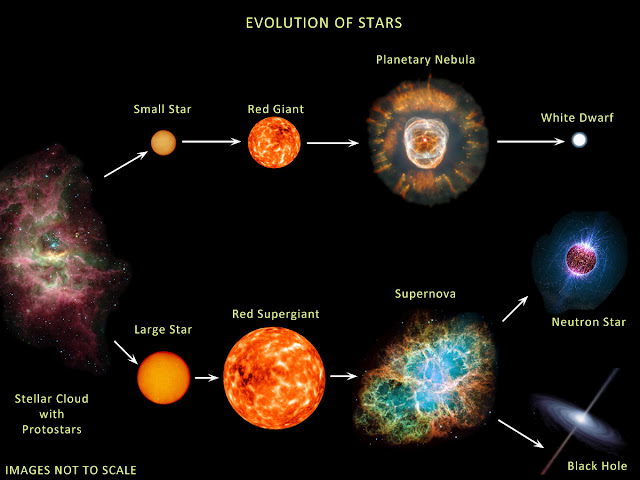
Diagram showing stellar evolution stages leading to supernova and black hole formation

Only stars with a mass > ~1.5x the mass of the sun become black holes

Newtonian Gravity v.s. Einstein's 
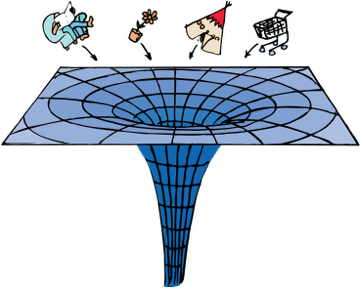
Illustration of general relativity showing spacetime fabric curved by massive celestial bodies

Einstein's

Gravity is the curvature of space and time due to massive objects

V.S.

Diagram of Newtonian gravitational force field vectors pointing toward mass center

Newtons

Gravity is a force field surrounding massive objects. Other masses interact with this force field

Gravitational Waves

First observed in 2015

The End

Energy Conservation on Satellites

Diagram of satellite in circular orbit with gravitational force perpendicular to velocity doing no work
Diagram of satellite in elliptical orbit showing varying speed and component of force along velocity
Diagram of potential and kinetic energy trade-off along an elliptical orbit conserving total mechanical energy

On a circular orbit the force does not work and the PE and KE remain constant

On an elliptical orbit the force does some work and the PE and KE vary, however KE + PE is conserverd

Black Holes

Diagram of stellar hydrostatic equilibrium balancing outward radiation pressure against inward gravitational pull

The size of the sun is the result of a “tug of war” between two opposing processes: nuclear fusion (pressure) and gravitational contraction

If the fusion rate increases, the sun will get hotter and bigger. If the fusion rate decreases, the sun will get cooler and smaller

Black Holes

Diagram of gravitational collapse of a star after exhausting nuclear fuel

When the sun runs out of fusion fuel (hydrogen), gravitation will dominate and the sun will start to collapse
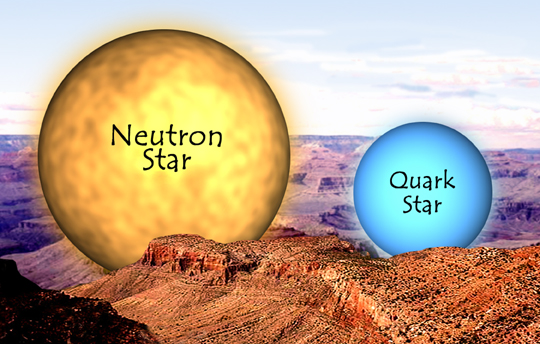
Comparison illustration showing a neutron star diameter relative to a city landscape

Neutron starts can pack up ~1.4x the mass of the sun on a radius that is the size of a city

In order to achieve such a high density they combine electrons and protons to form neutrons