Recent technical & scientific highlights from the CHARA Array
Nic Scott












Heriot-Watt
Center for High Angular Resolution Astronomy
Georgia State University, Atlanta
Director: Douglas Gies
Array
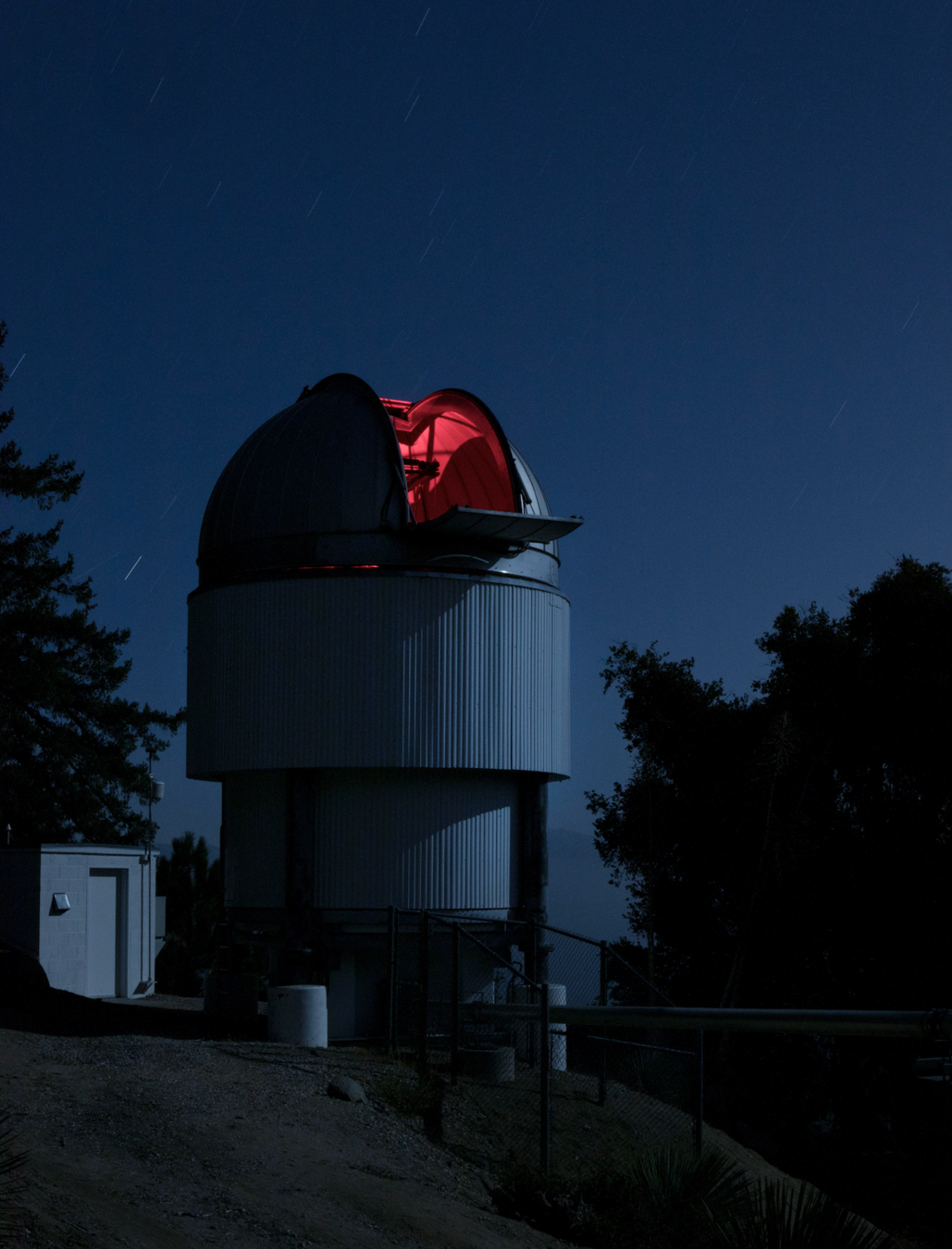
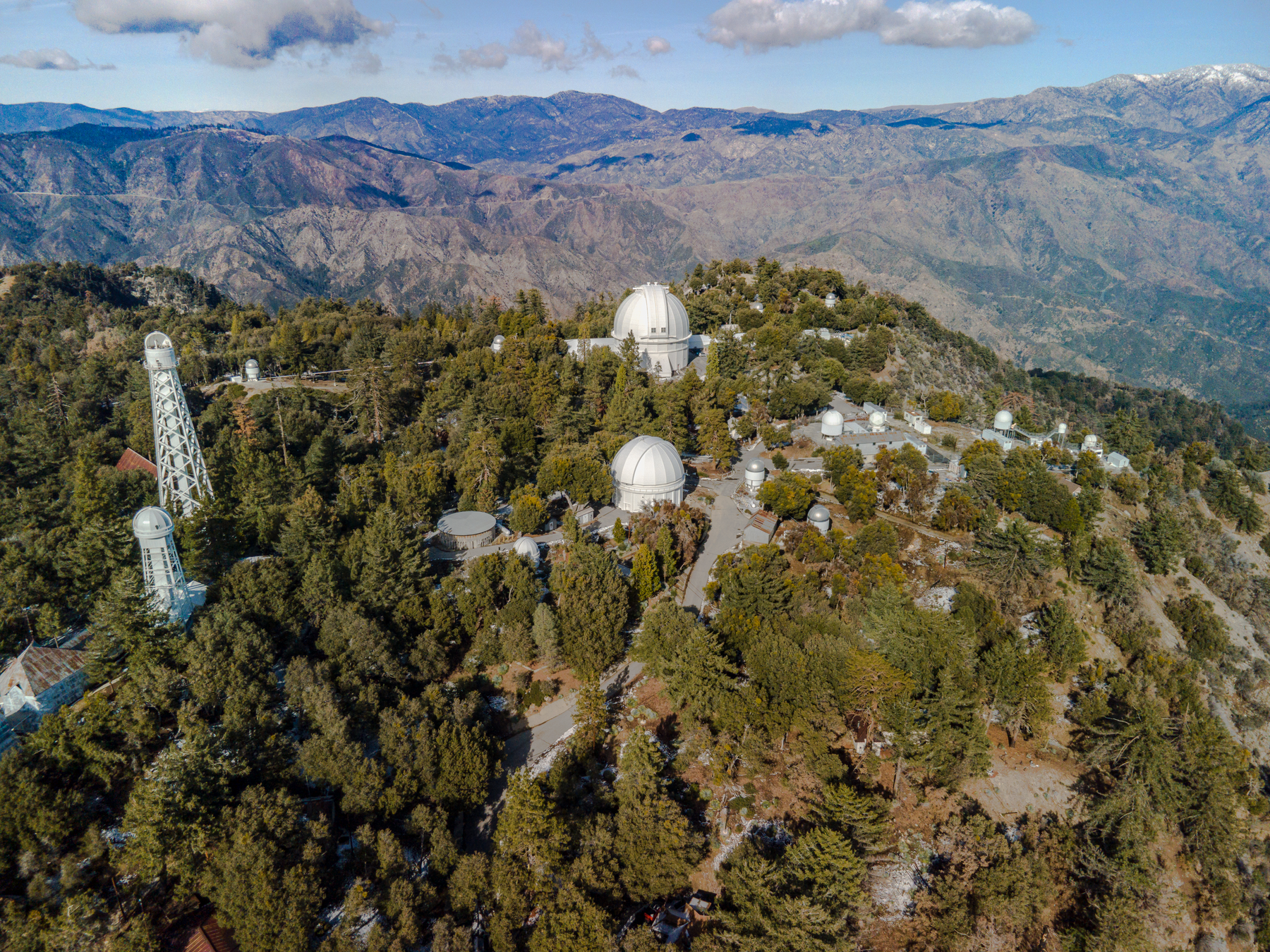
Mount Wilson Observatory, CA
Director: Gail Schaefer
16 staff members onsite
Operations funded through the NSF, GSU, collaboration partners

CHARA timeline
- 1984 - "CHARA" established
- 1992 - Engineering studies
- 1994 - GSU: $5.6 mil 5-telescope array, NSF: $6.3 mil, university matching
- 1996 - Mt. Wilson ground broken
- 1998 - Keck $1.5 mil for 6th telescope
- 1999 - First fringes between S1/S2
- 2001 - First starlight fringes on longest baseline
- 2003 - Construction completed
- 2005 - First journal paper - dia. of Regulus (McAlister)
- 2007 - Image of surface of Altair (Monnier)
- 2010 - Open access program initiated
-
2026 - 294 refereed papers & 61 PhD dissertations so far
" technical improvements in both hardware and software will continue indefinitely.
one rationale for the facility is to serve as a testbed for new developments in optical interferometry."
Georgia State University
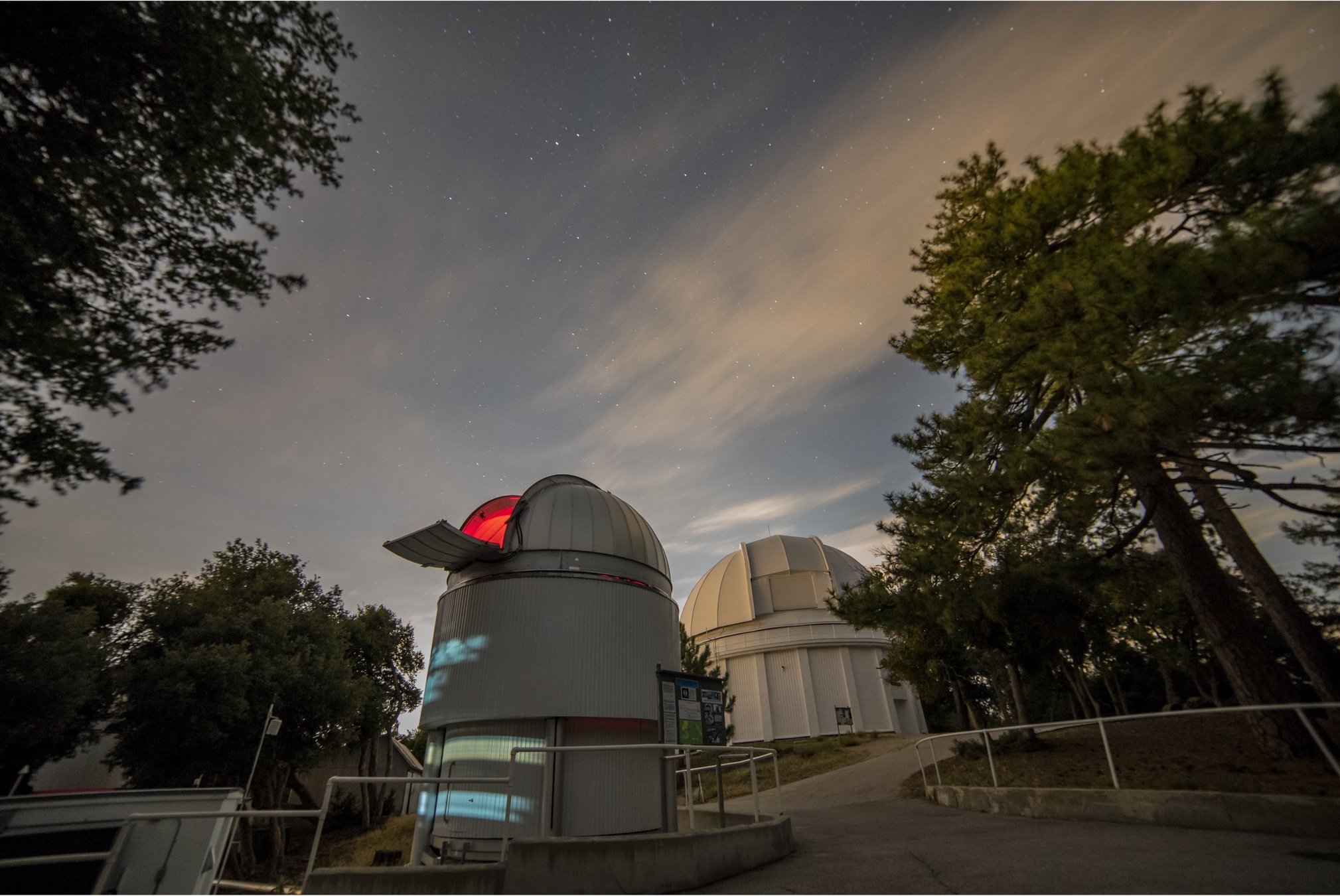
The CHARA Array is operated by the Center for High Angular Resolution Astronomy at Georgia State University in Atlanta.
The two-telescope CLASSIC beam combiner
University of Michigan
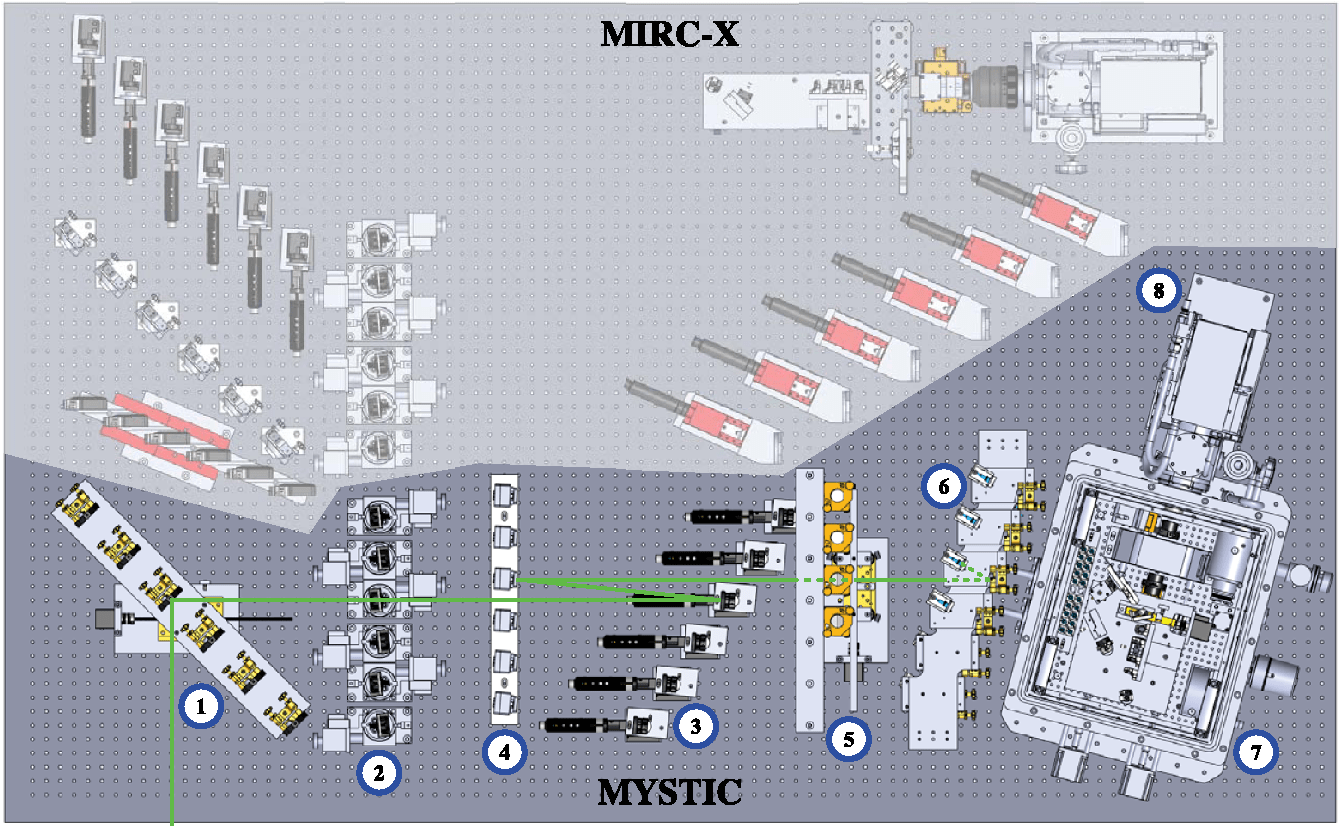
The MIRC-X H-band combiner. A six-telescope cryogenic K-band beam combiner, MYSTIC
University of Exeter
The upgrades to the six-telescope MIRC-X combiner
l’Observatoire de la Côte d’Azur
SPICA combines all six-telescopes and provides a range of spectral dispersions at visible wavelengths.
Sydney University
Precision Astronomical Visible Observations (PAVO) instrument
Australian National University
The (PAVO) visible beam combiner
Université de Limoges
the ALOHA fiber experiment.
Kyoto Sangyo University
Pushing the sensitivity limits of the Array in order to resolve the cores of Active Galactic Nuclei.
National Optical-Infrared Astronomy Research Laboratory
Open access time at the CHARA Array is available to the astronomical community through the National Optical-Infrared Astronomy Research Laboratory (NOIR Lab).
The CHARA Consortium
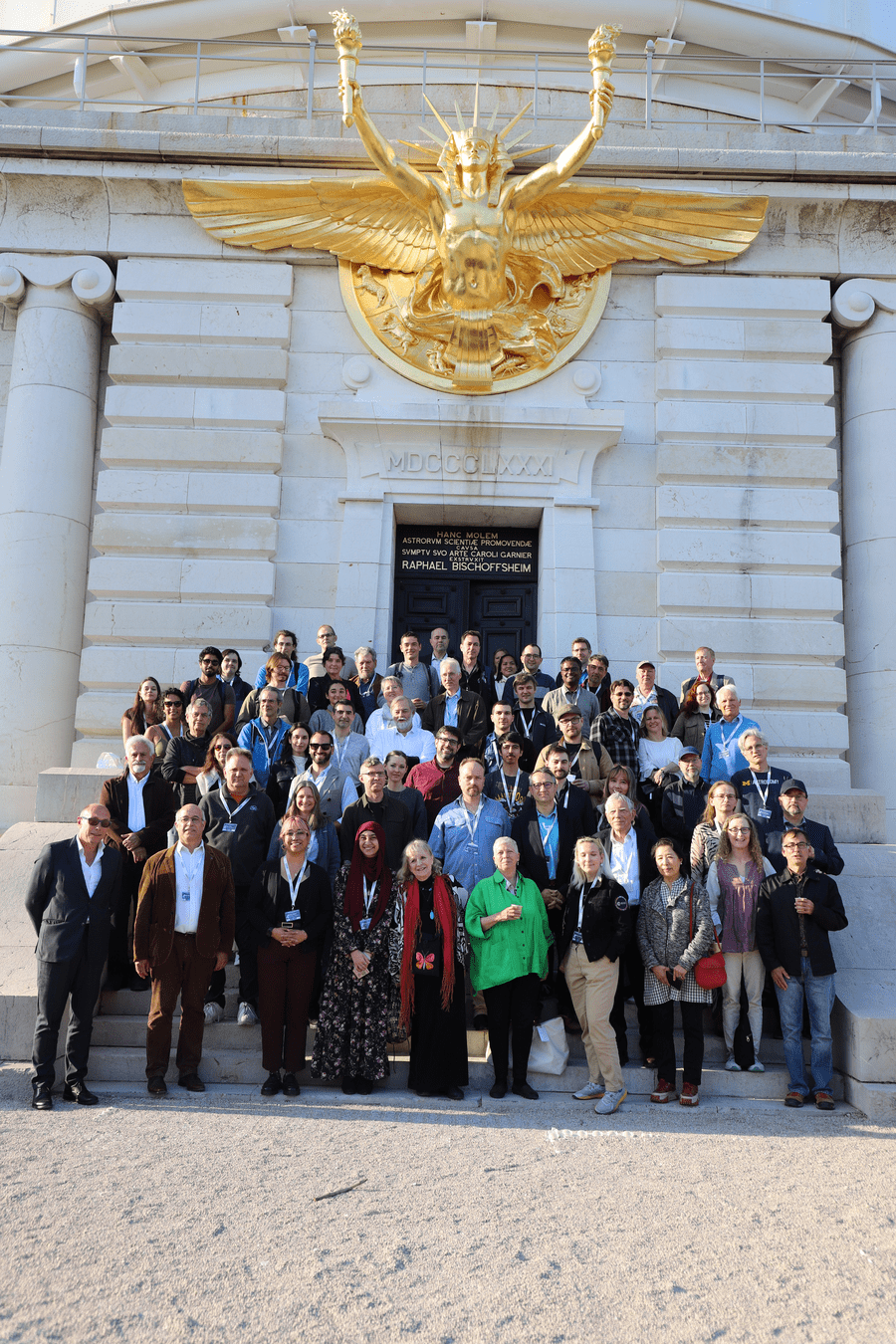
CHARA Science Meeting 2025 - Nice, France
CHARA/MROI Science Meeting and New Visions in Optical Interferometry Workshop 2026 - Socorro, NM
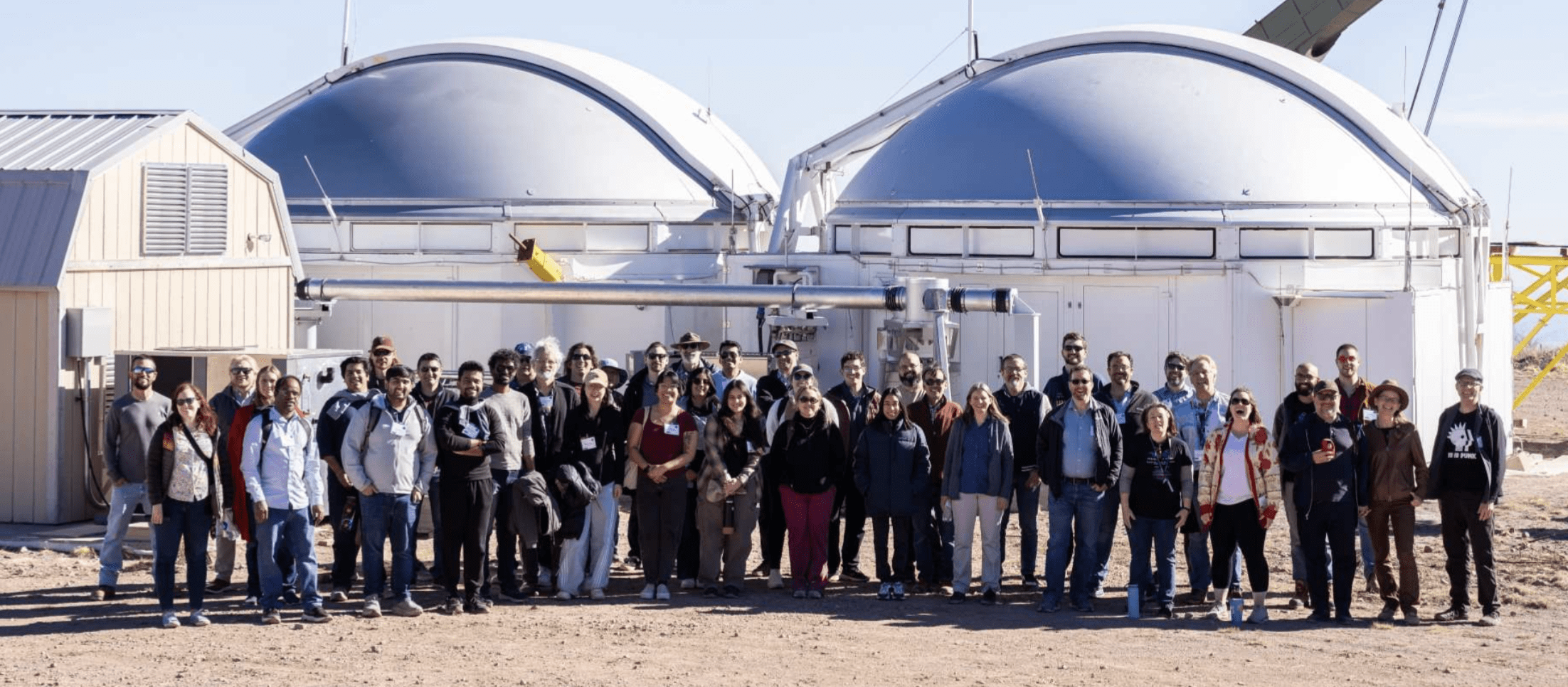

workshop supported by
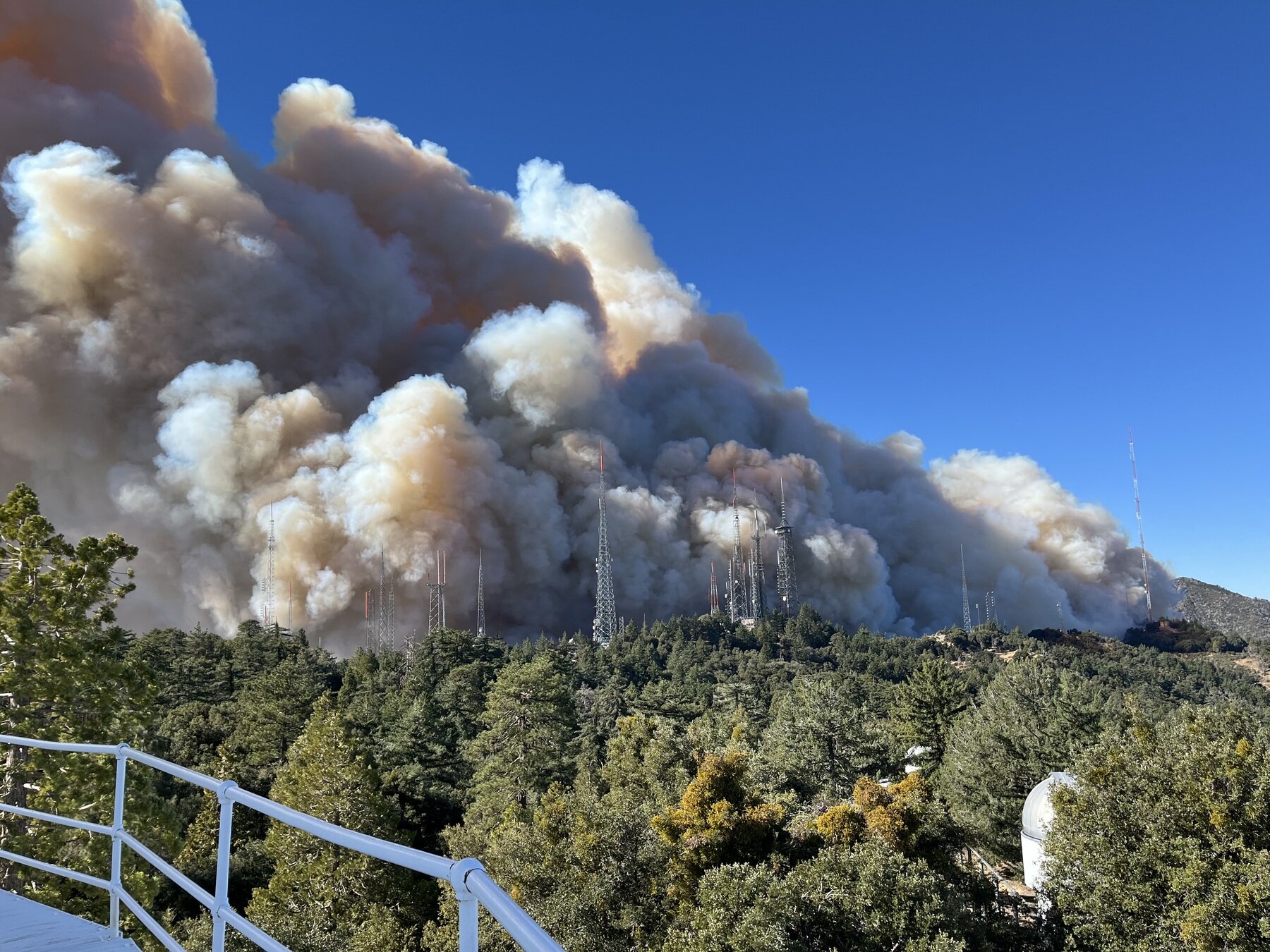
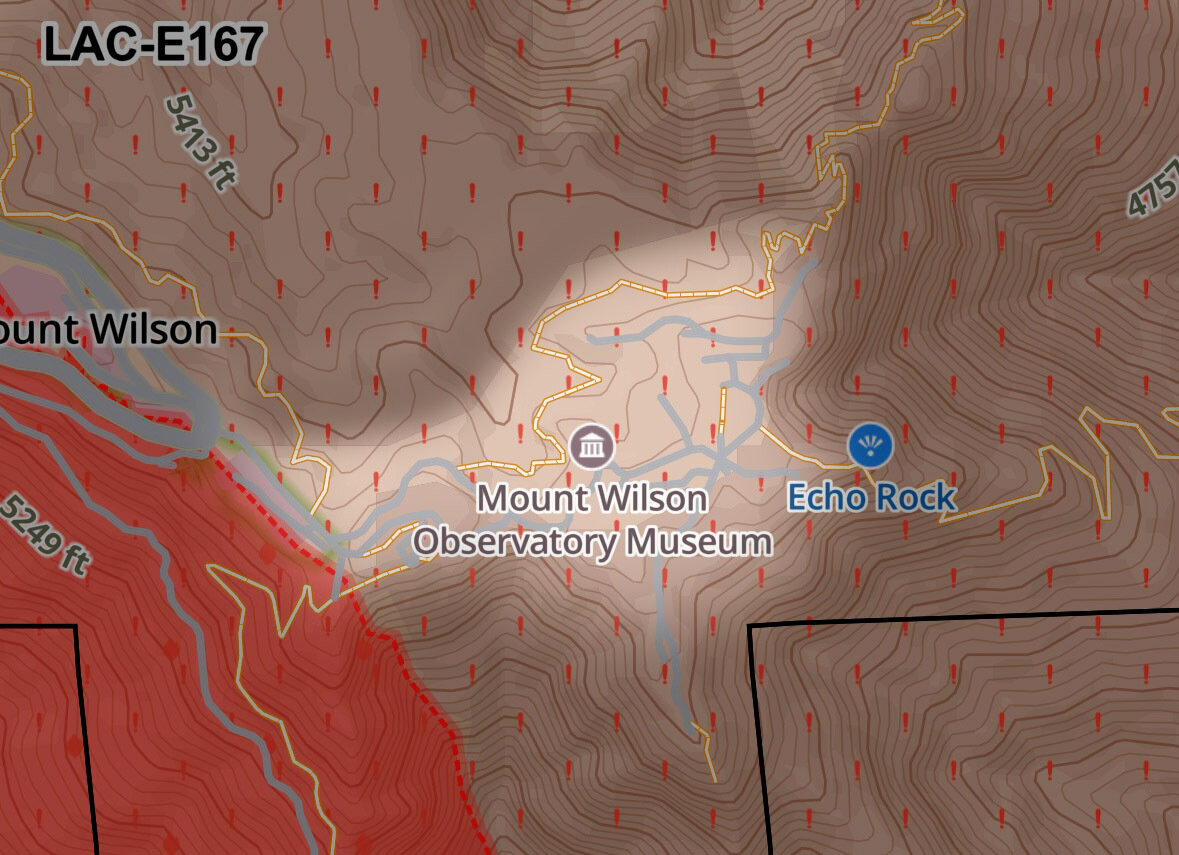
Eaton Fire Jan 2025
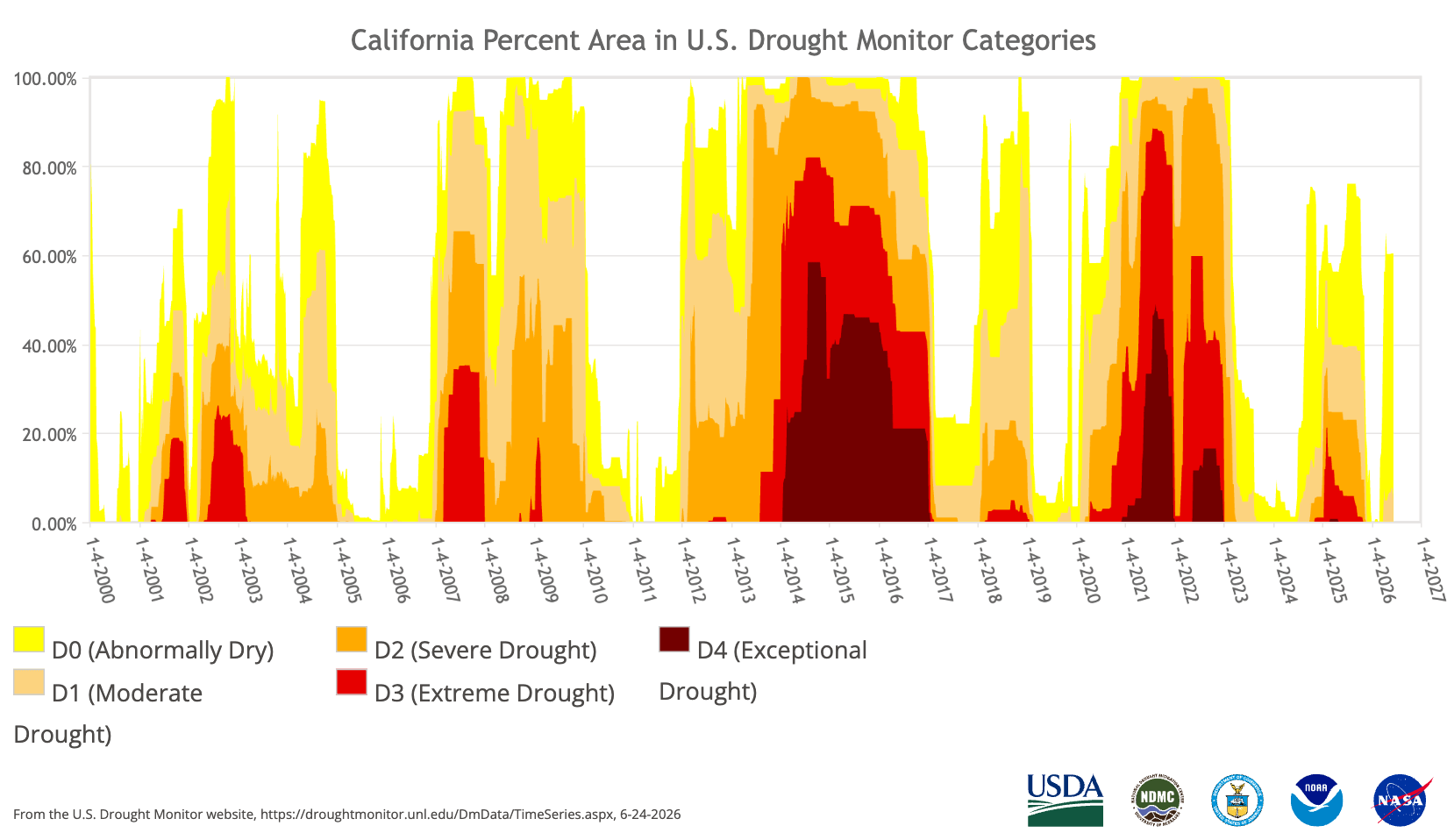
- Jan 7 - fire broke out in high winds
- Jan 9 - fire reached MWO
- Jan 24 - staff back on-site
Station Fire (2009)
Bobcat Fire (2020)
Eaton Fire (2025)
Fizeau - 1850s
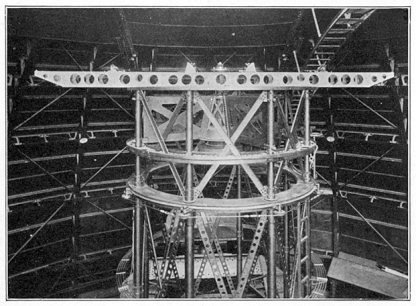
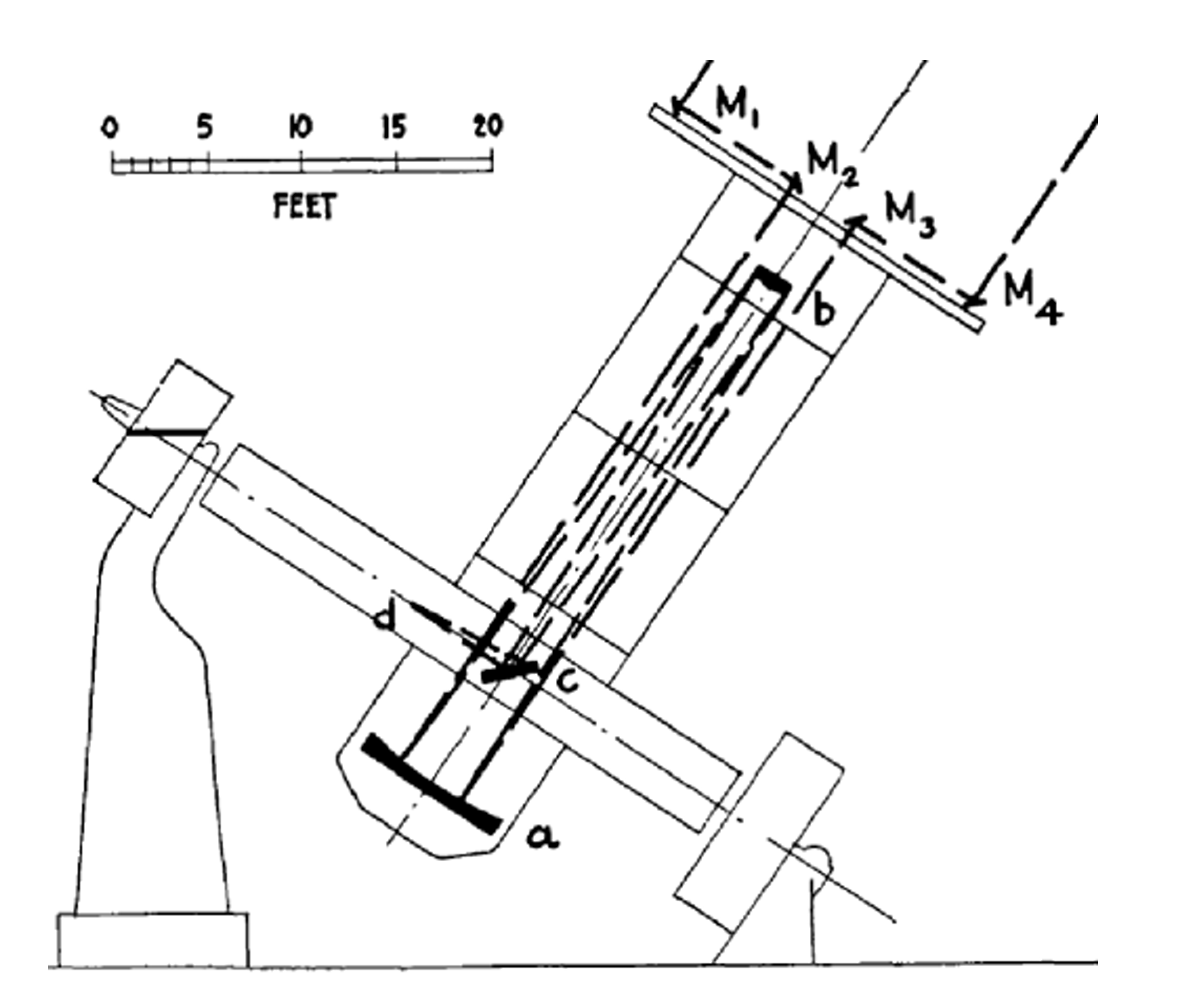
Michelson - 1890s
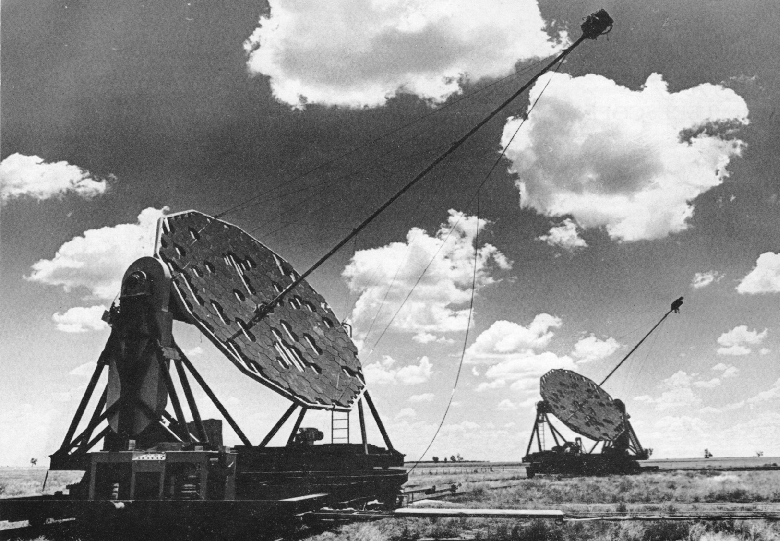
Brown & Twiss - 1950s
1920 - measured Betelgeuse (with Pease)
1956 - HBT effect, correlation b/t coherent photons
Intensity interferometry
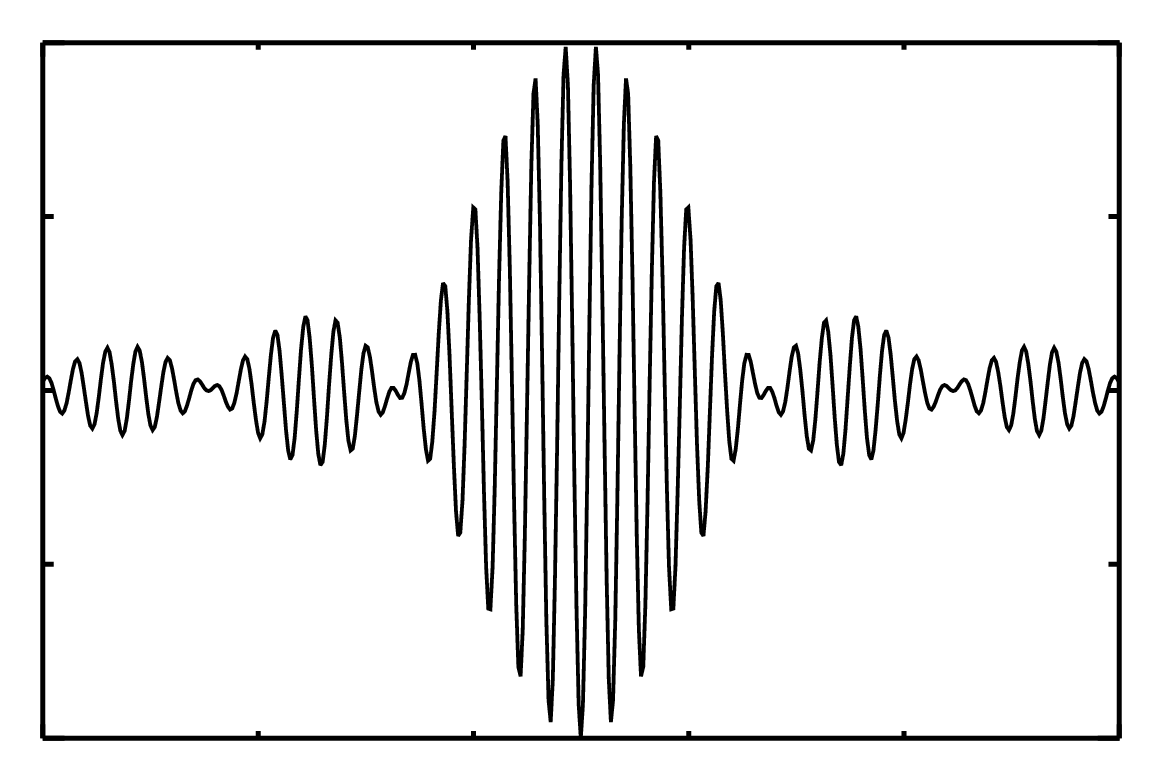
details can be gained through interferometric measures
details can be gained through interferometric measures
details can be gained through interferometric measures
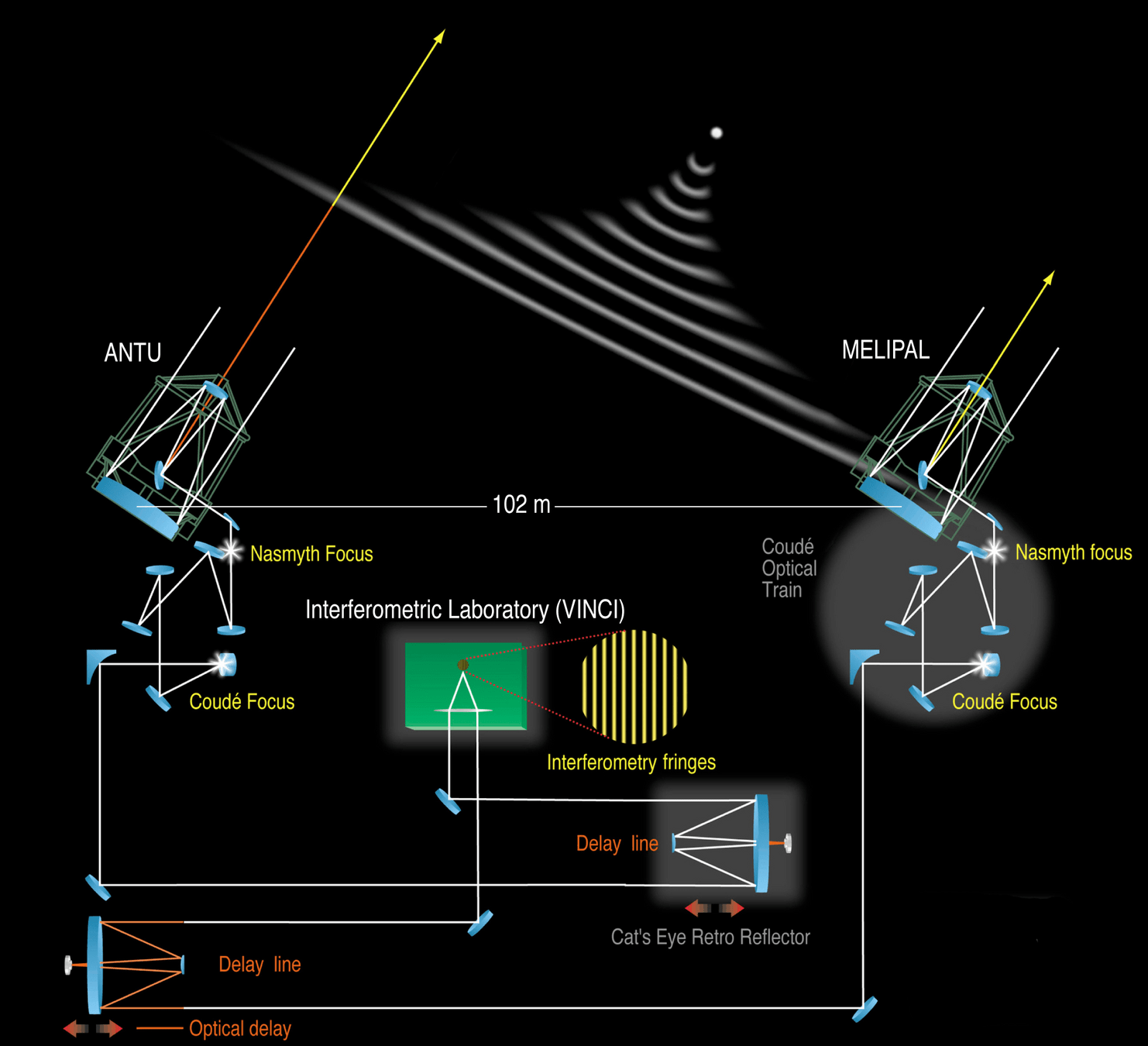
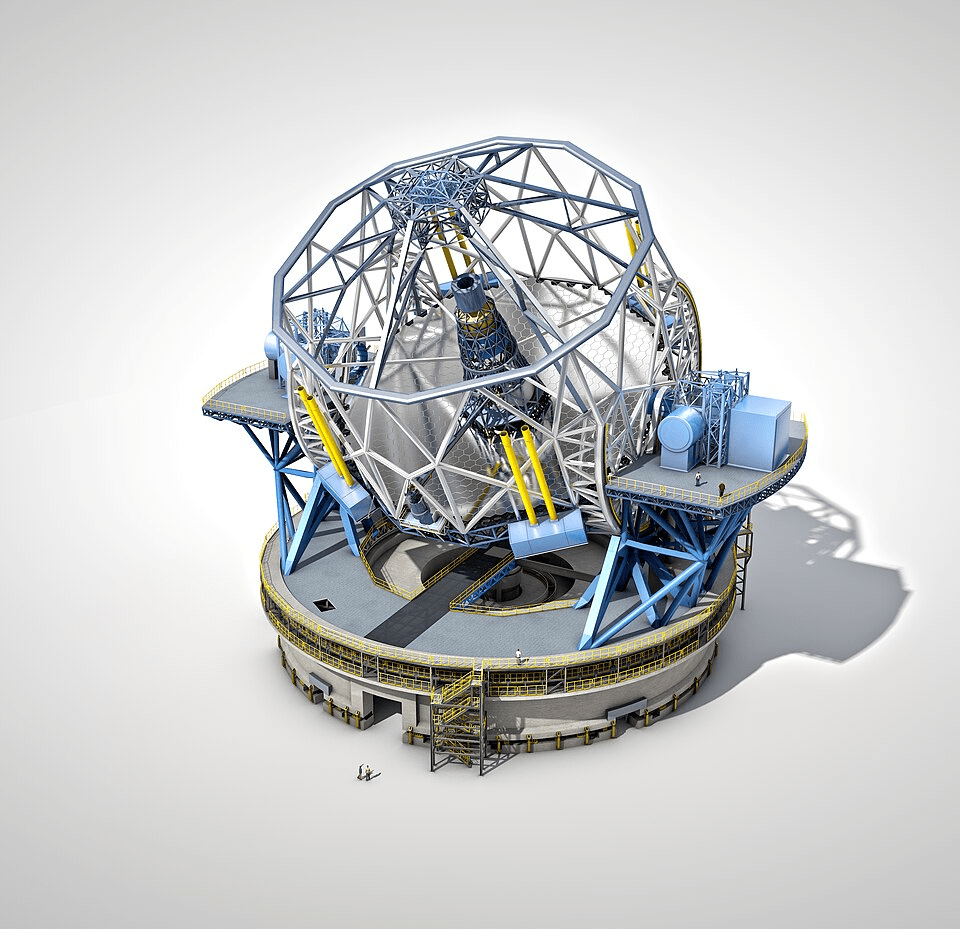
Image credit: ESO
Direct detection
Examples:
- PTI
- KI
- NPOI
- CHARA
- MROI
- IOTA
- VLTI
- SUSI
- LBTI
Labeyrie - 1975
diameter

Lawson 2003, S&T
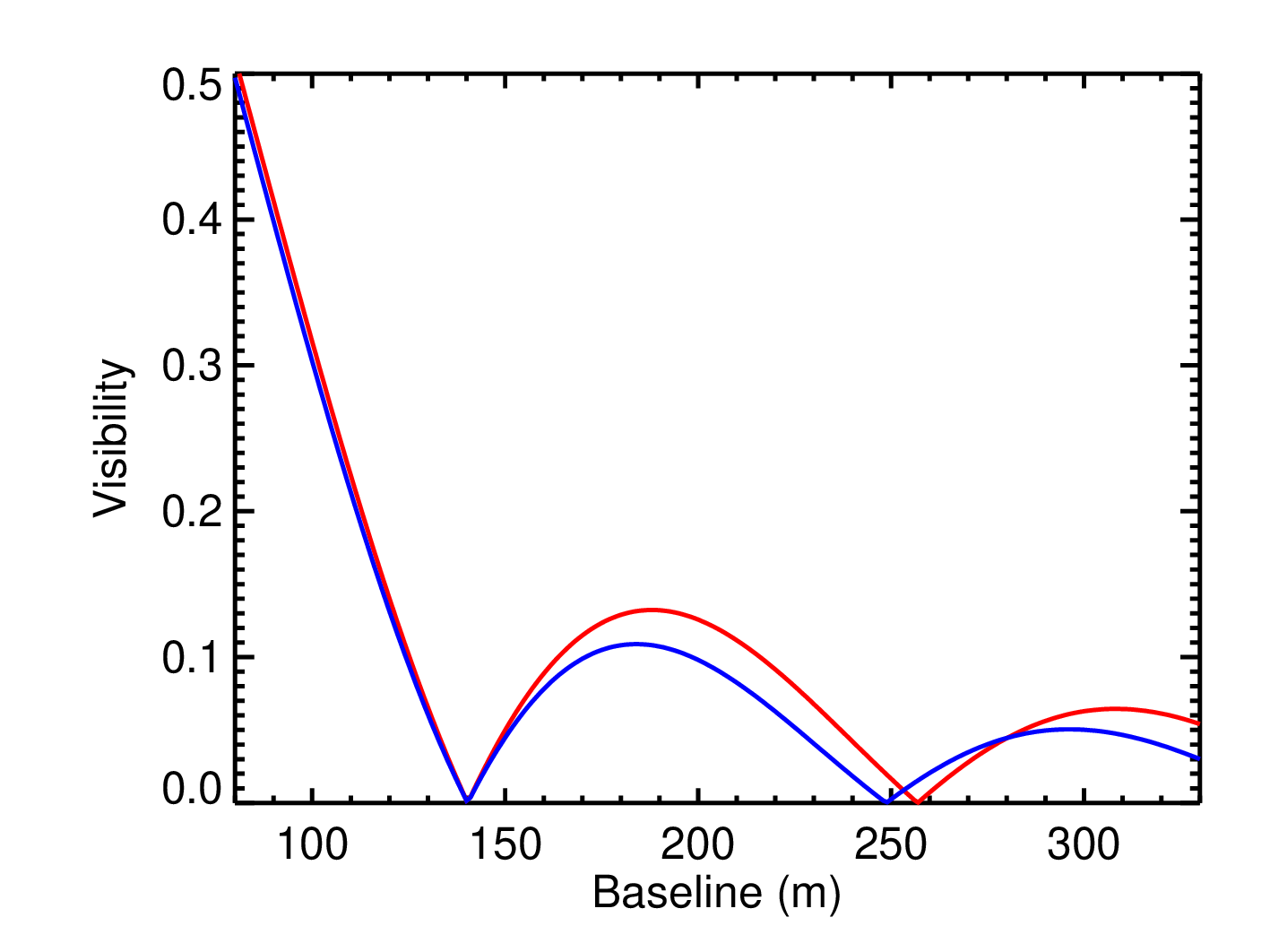
Limb darkened vs Uniform disk
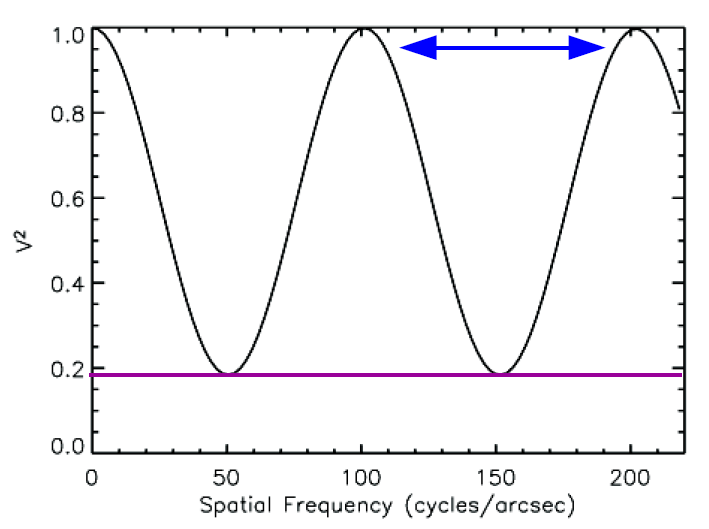
binarity
Separation
flux ratio
(B/λ)
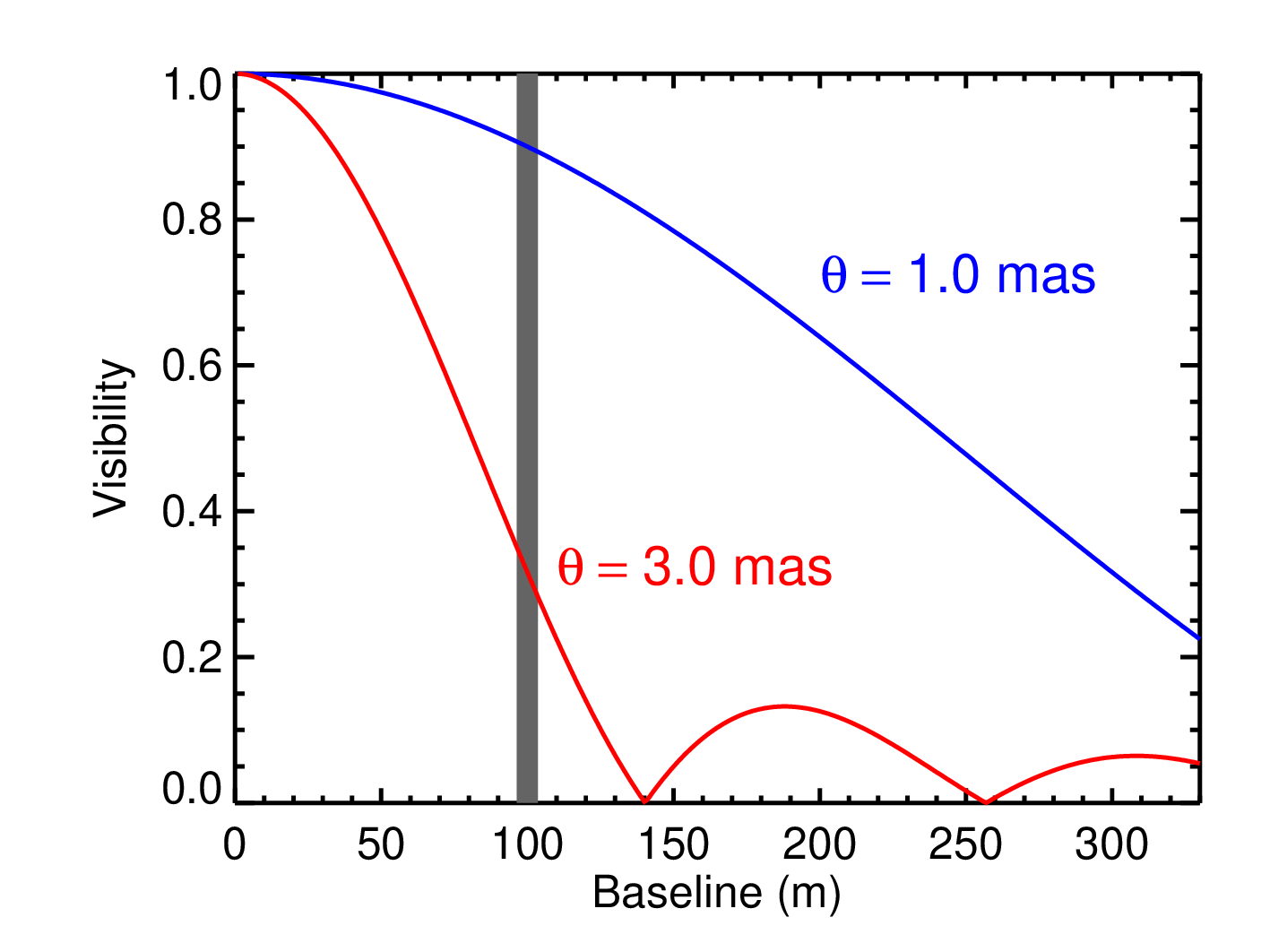
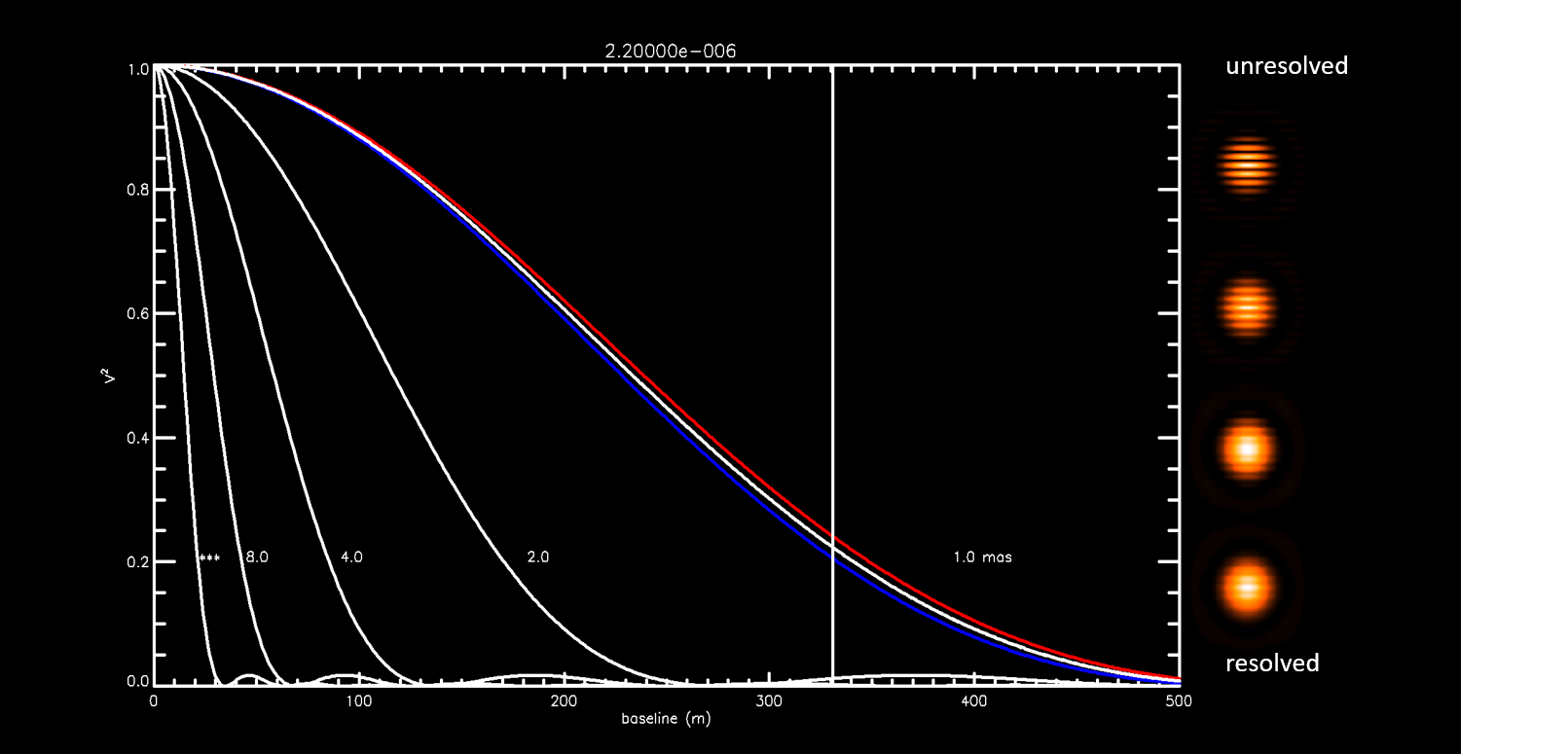
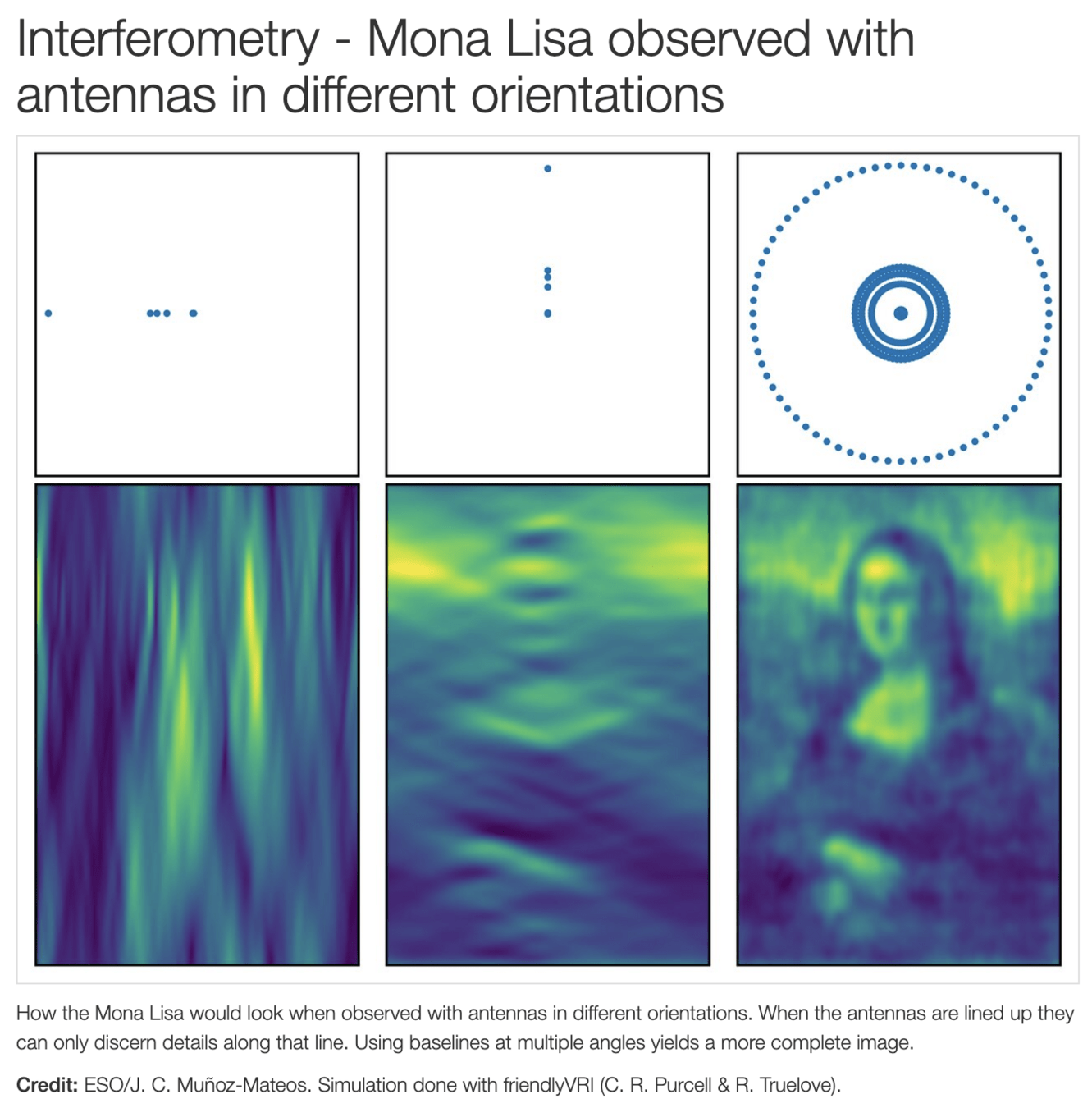
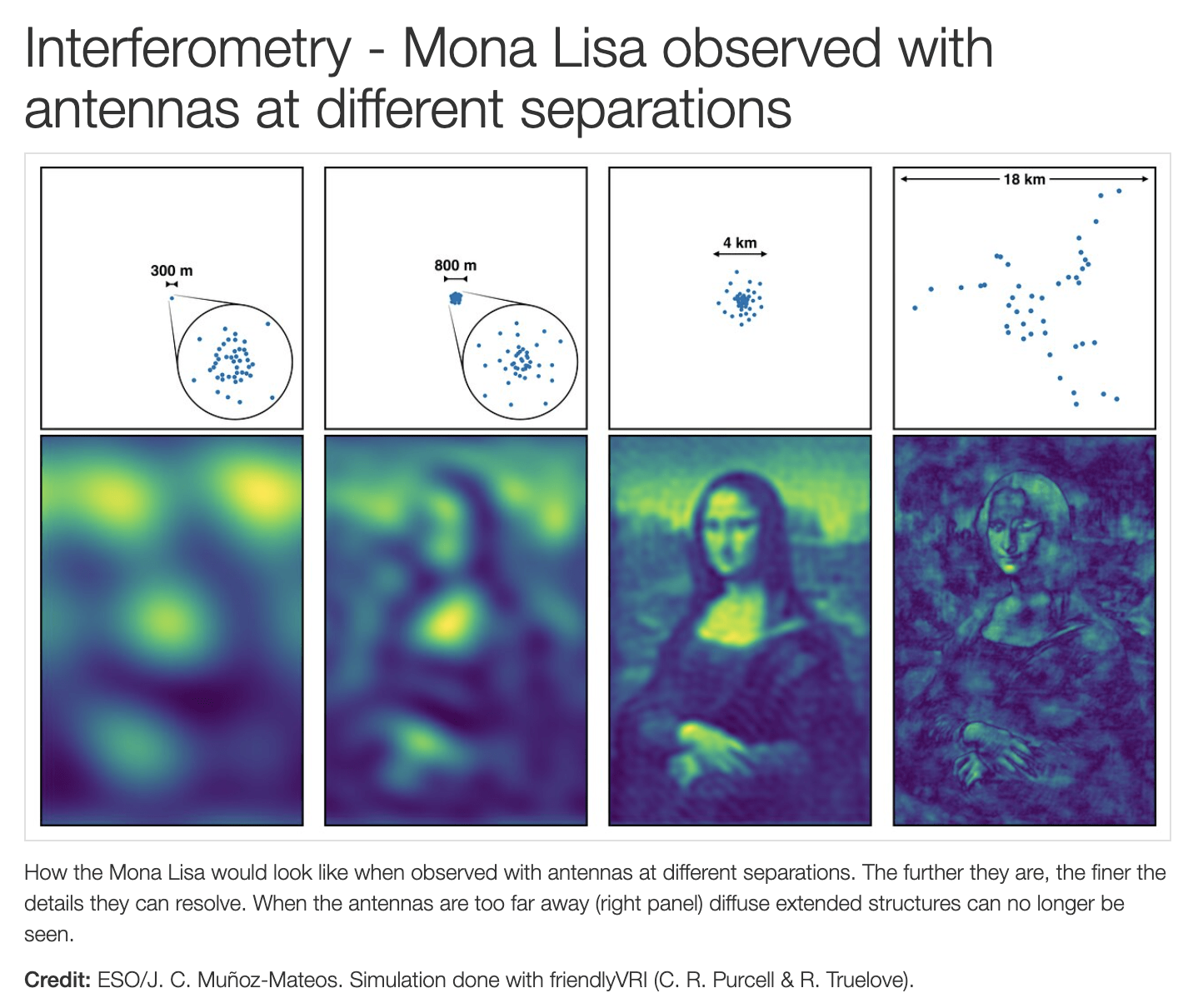
Placement matters
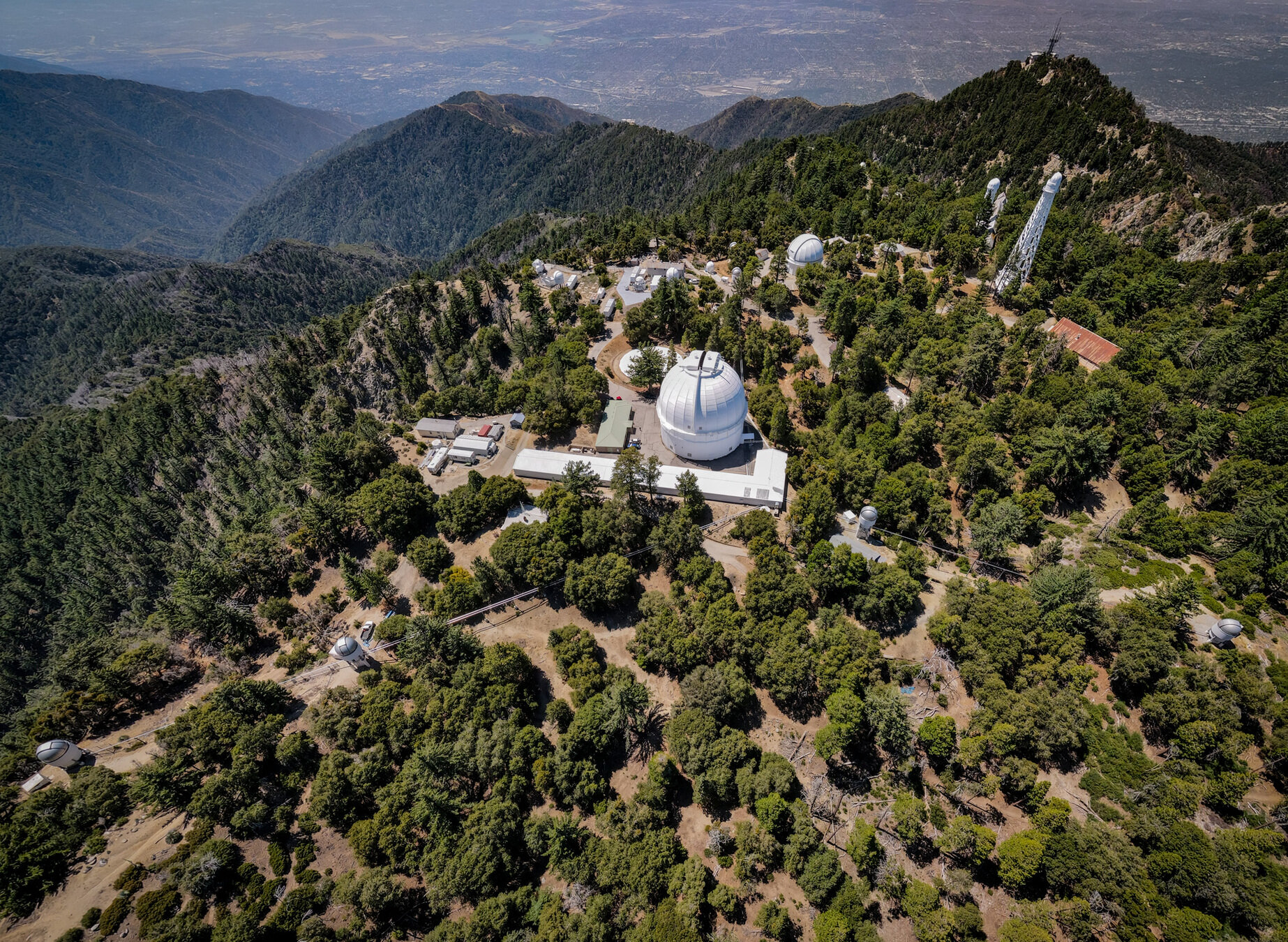
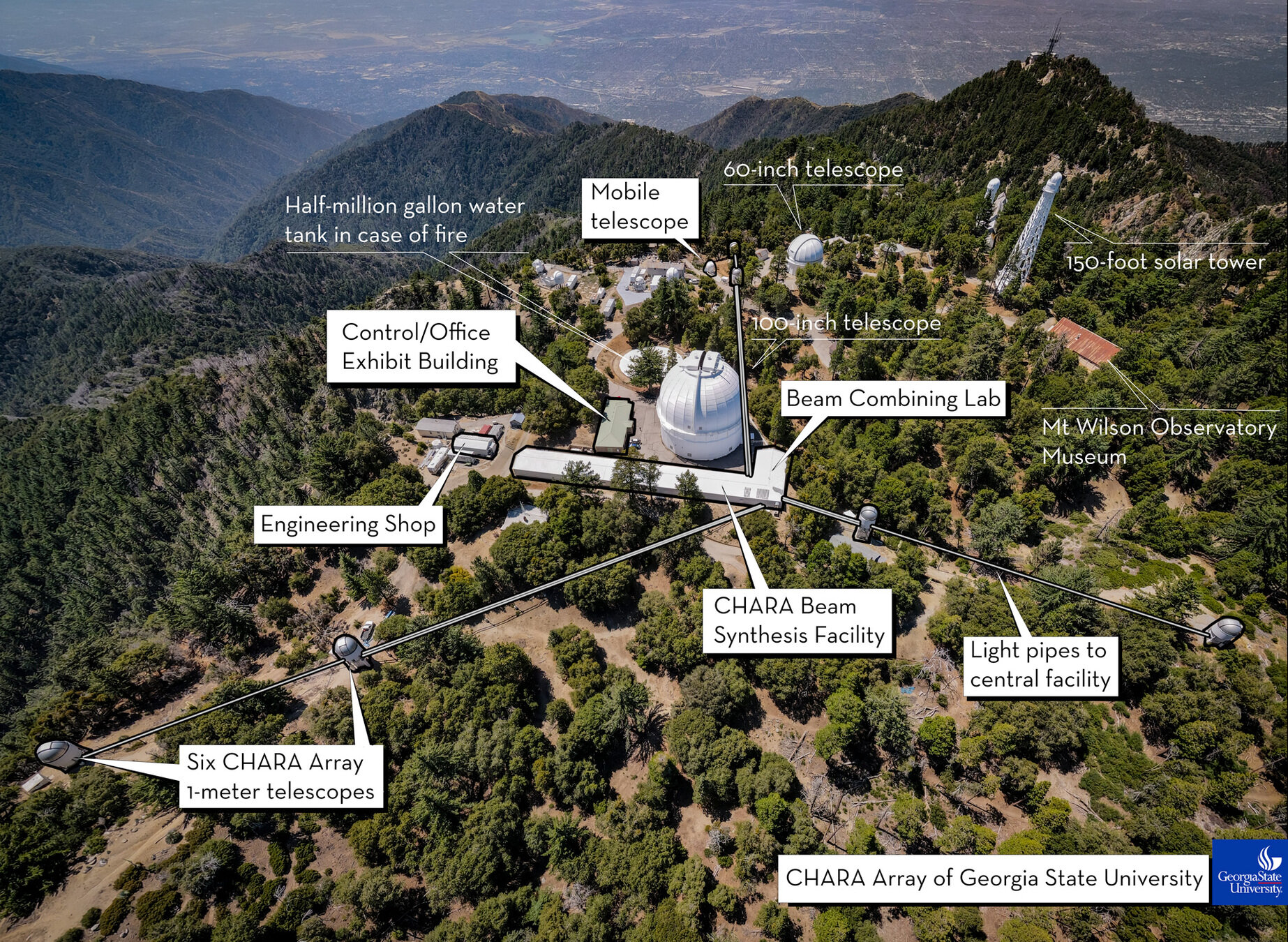
The Array is capable of resolving details as small as 200 micro-arcseconds, equivalent to the angular size of a coin seen from a distance of 16,000 km.
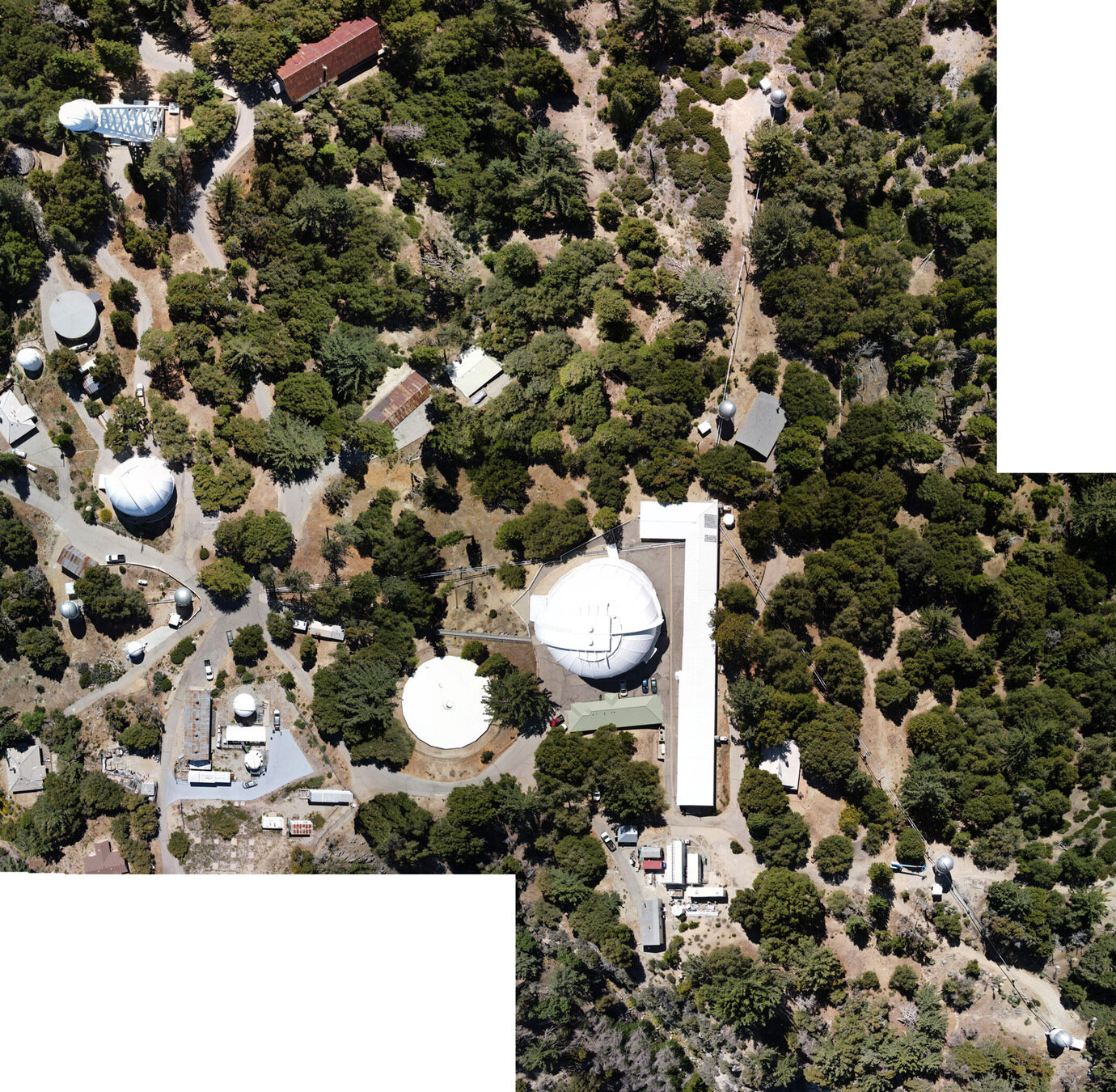
the CHARA Array
"the CHARA Array continues to offer exceptional opportunities for scientific discovery using the longest operating baselines in the world among optical/near-IR interferometers"

Spatial resolution
• 0.20 mas at R (650 nm)
• 0.52 mas at H (1.67 μm)
• 0.66 mas at K (2.13 μm)
34 to 331m
- 15 baselines
- 10 closure triangles





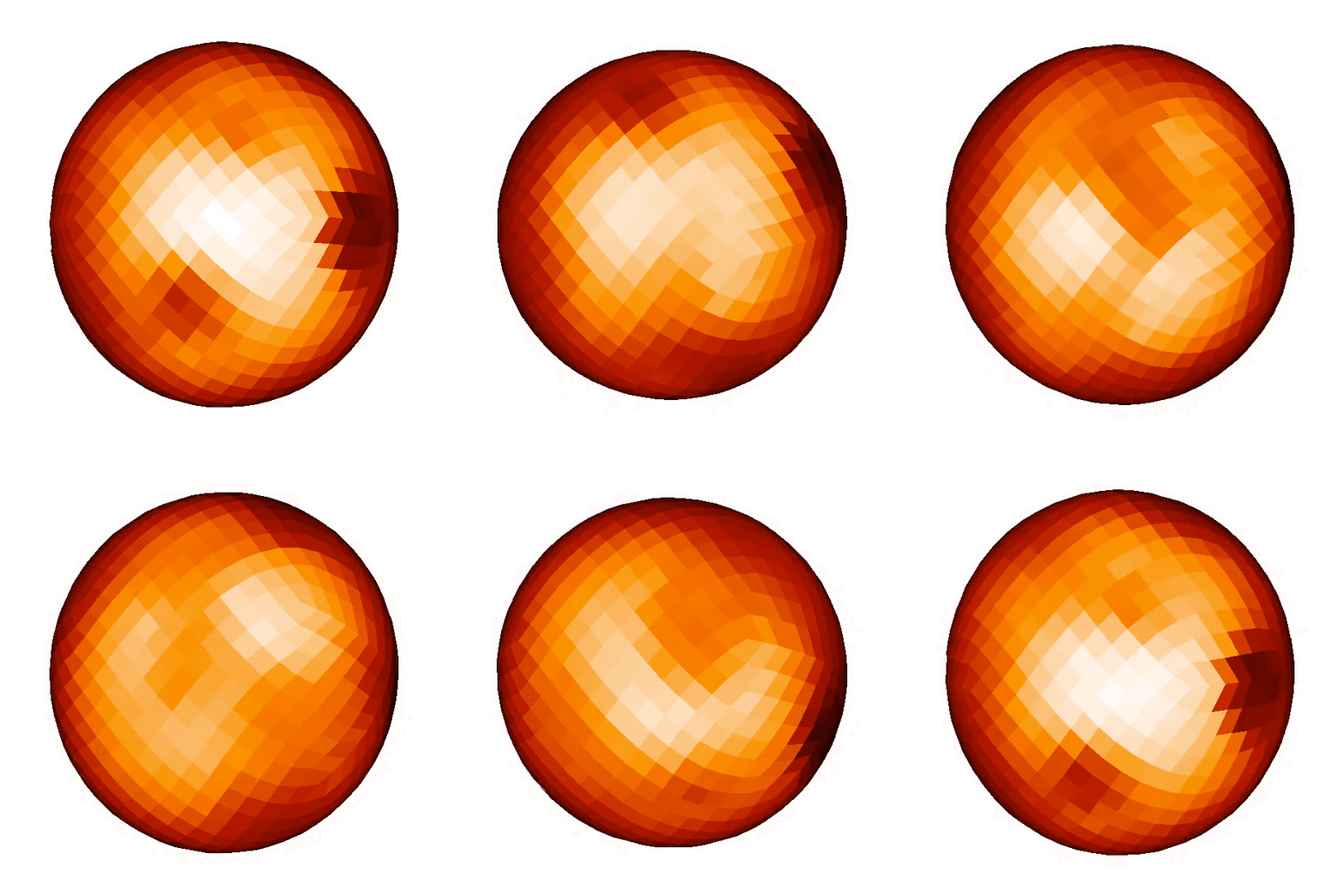
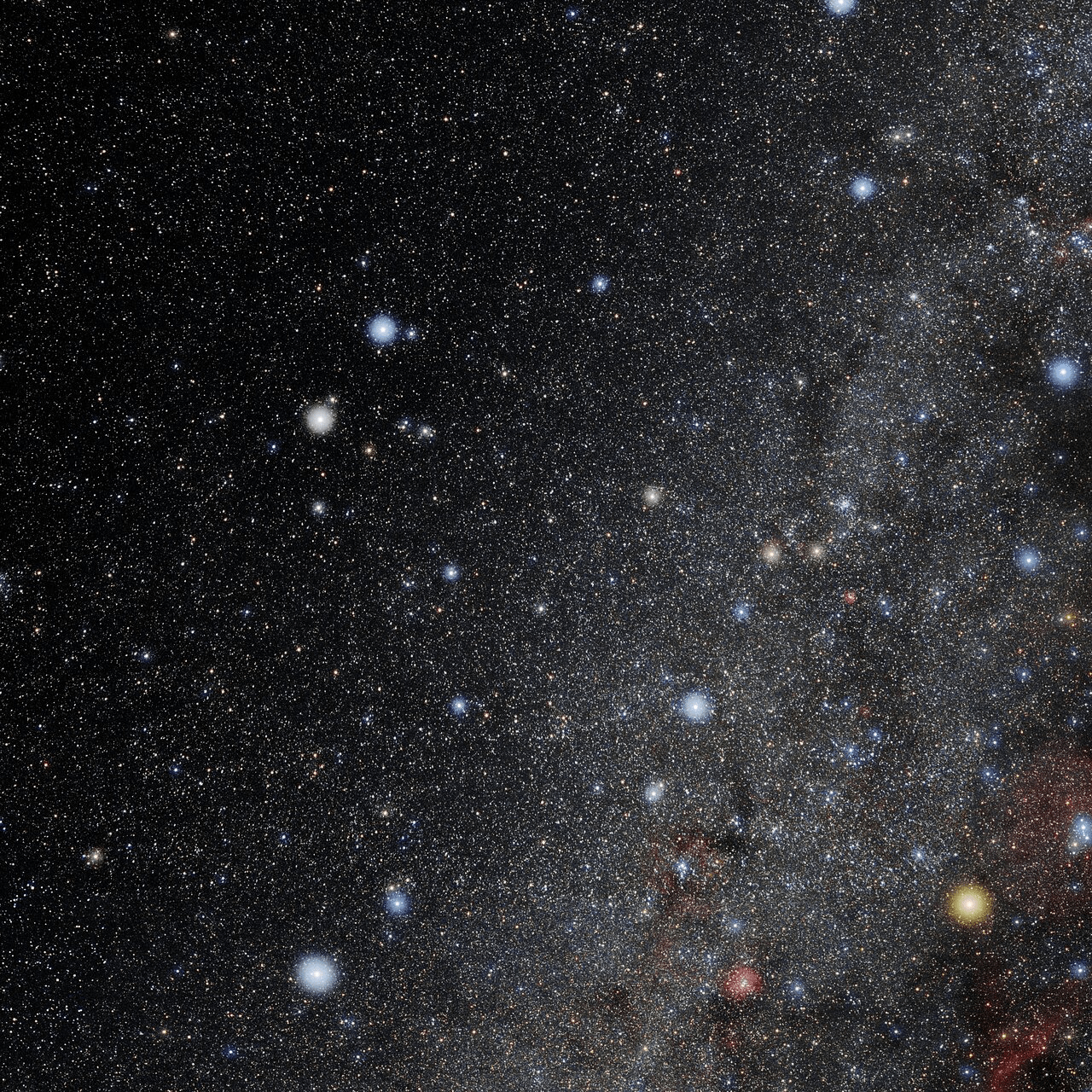
Sigma Geminorum
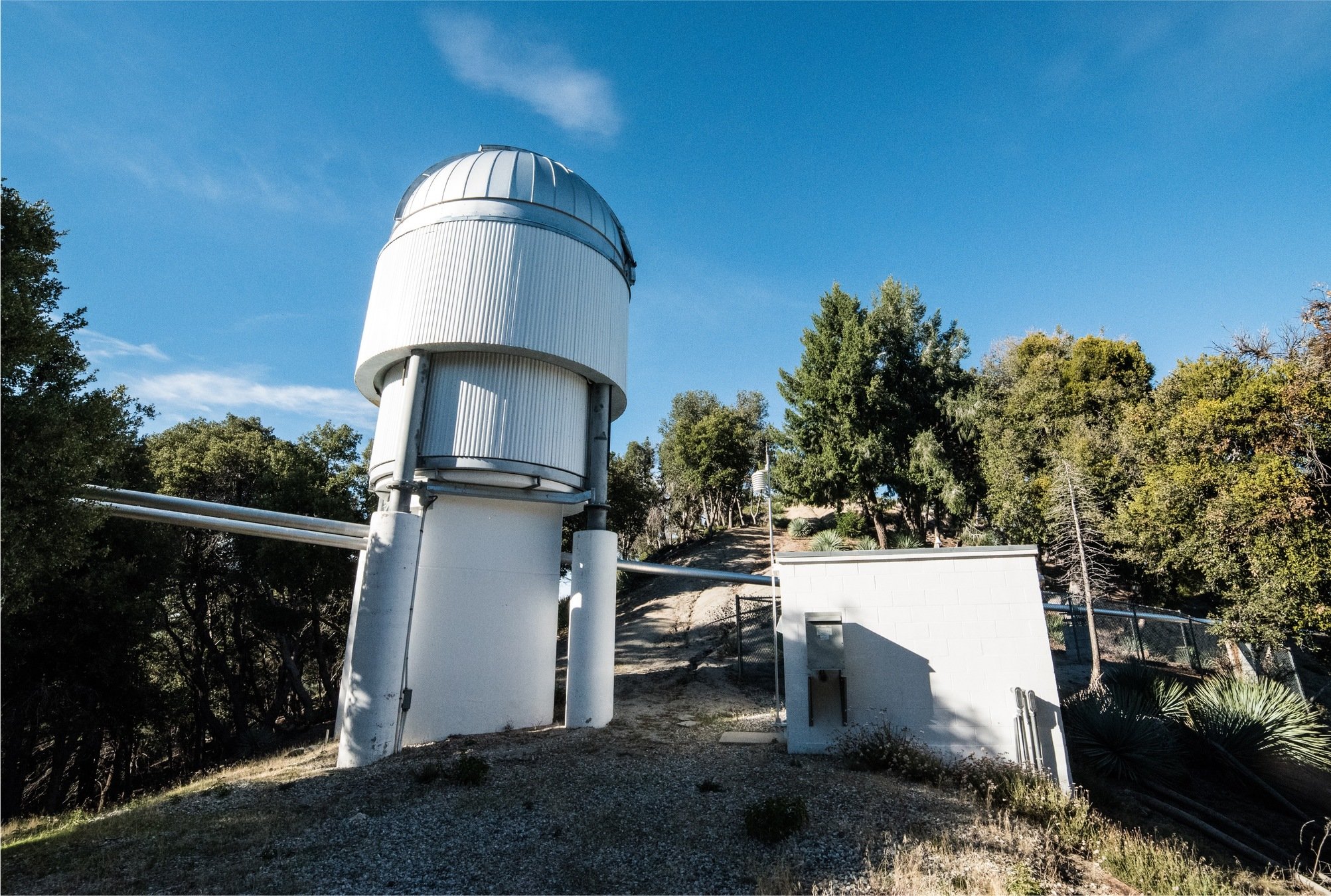
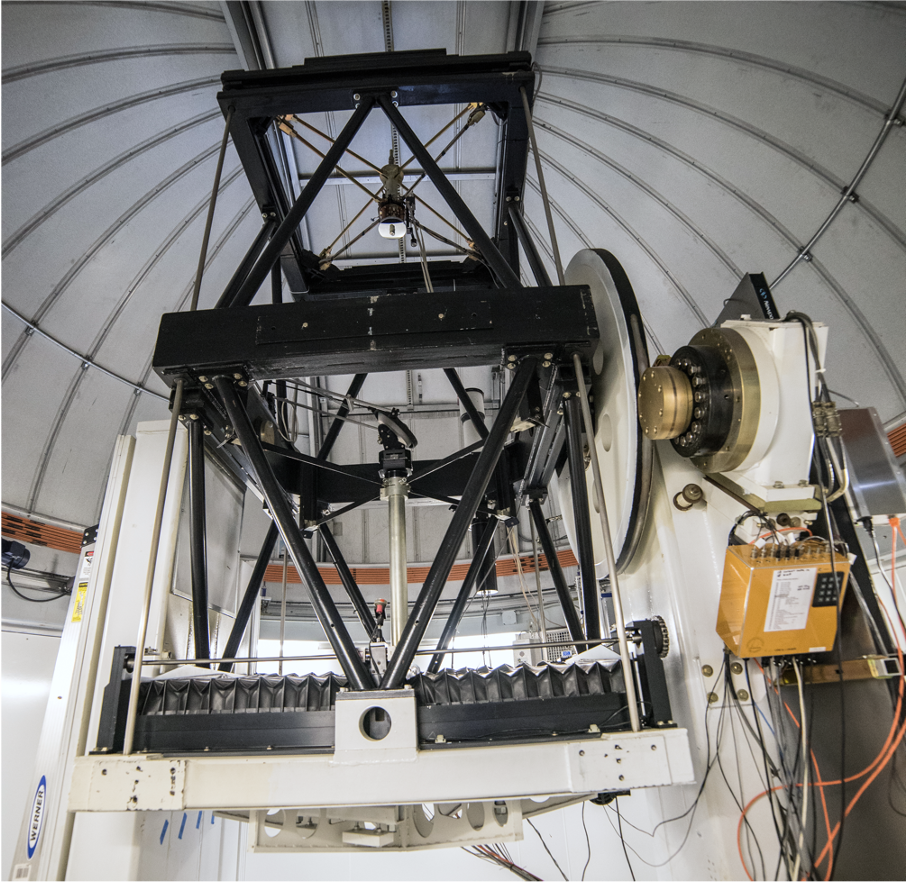
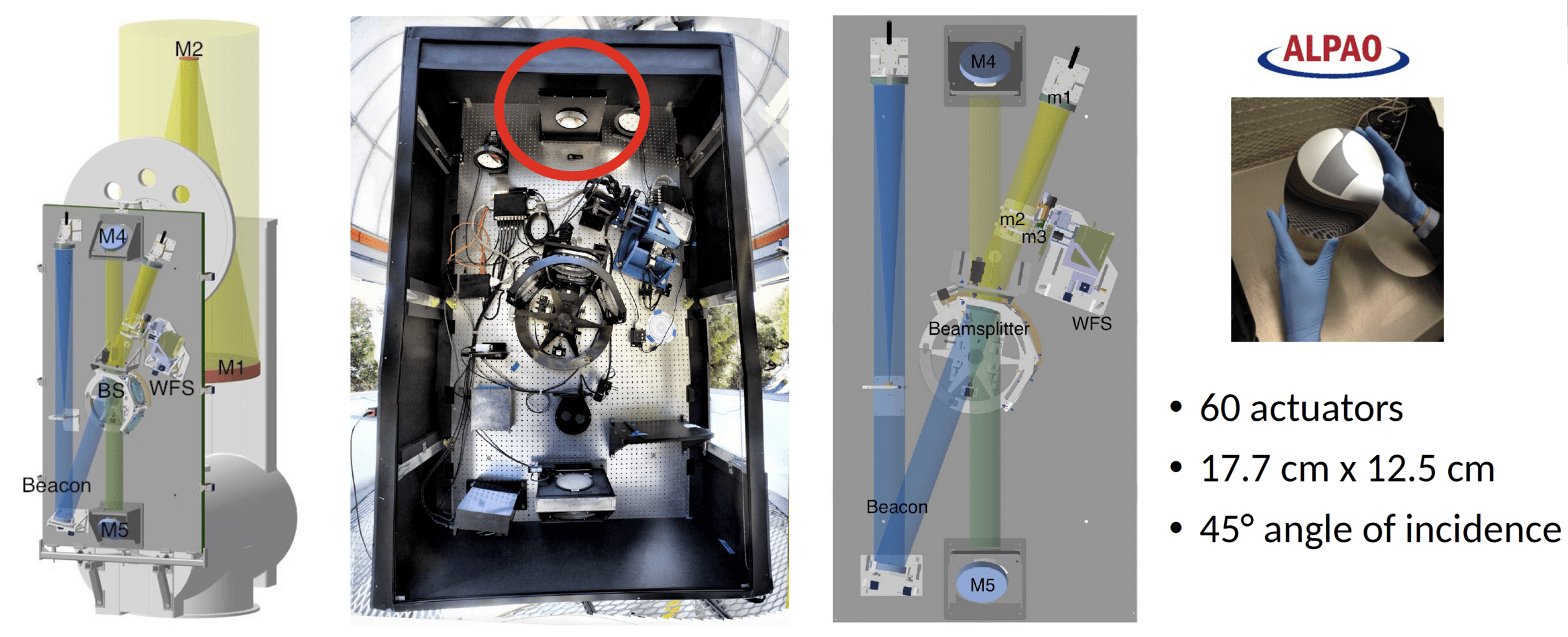
TelAO
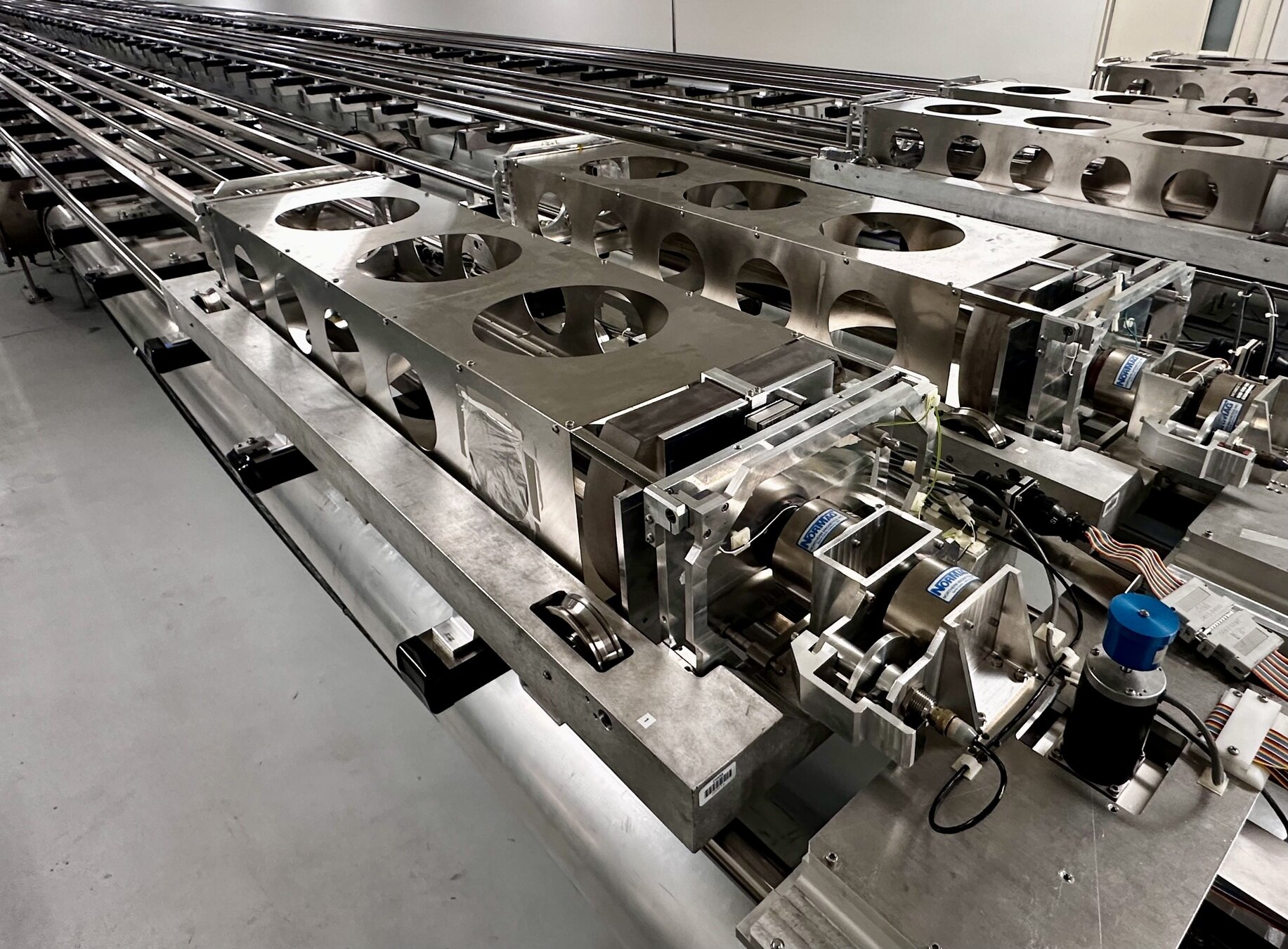
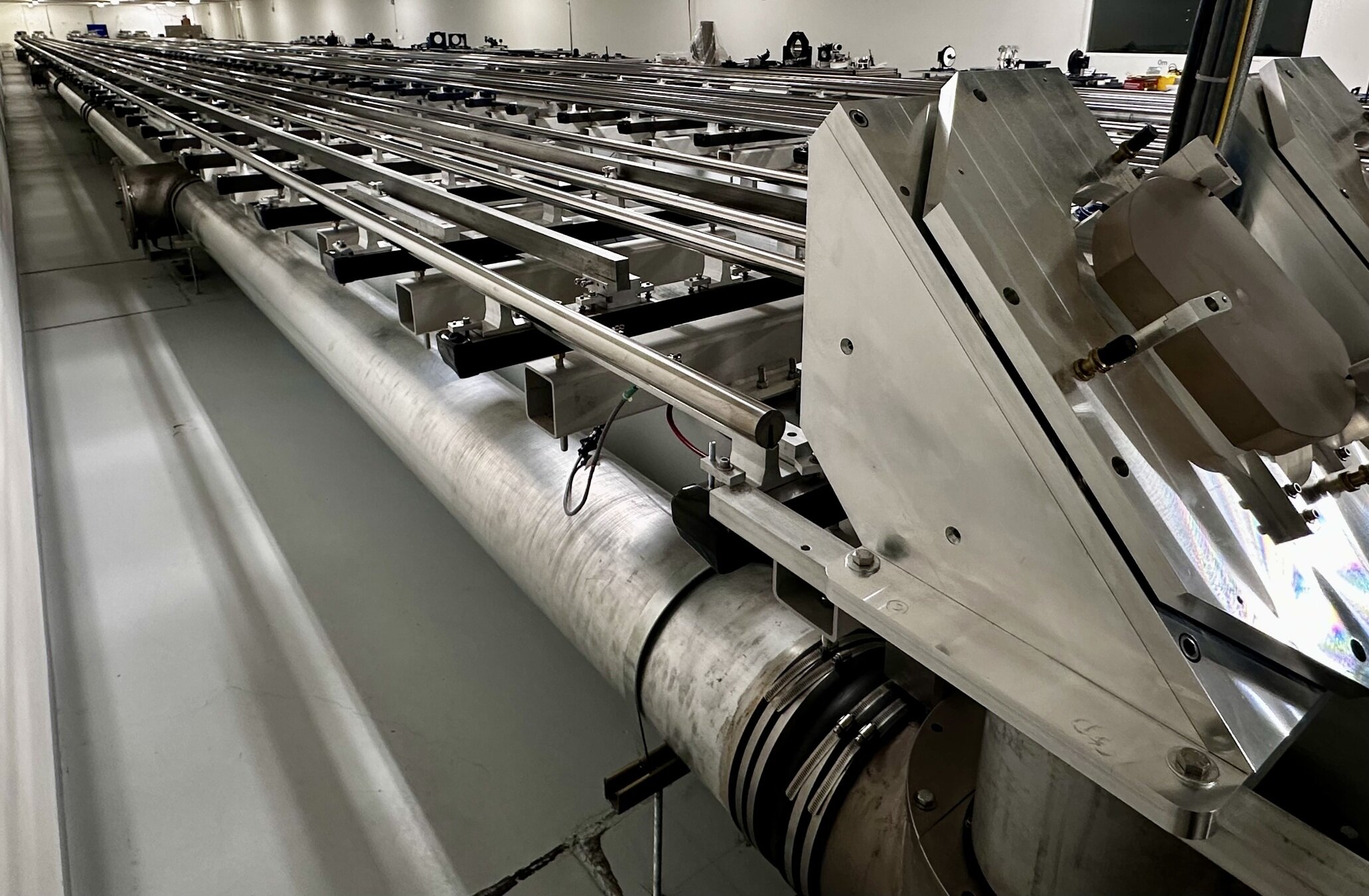
Optical Path Length Equalizers (OPLE) system
- original system: VME (>20yo)
- modern Linux-based system was installed and tested - 2021 to 2024
- tracking uncertainties ~ 12 μm
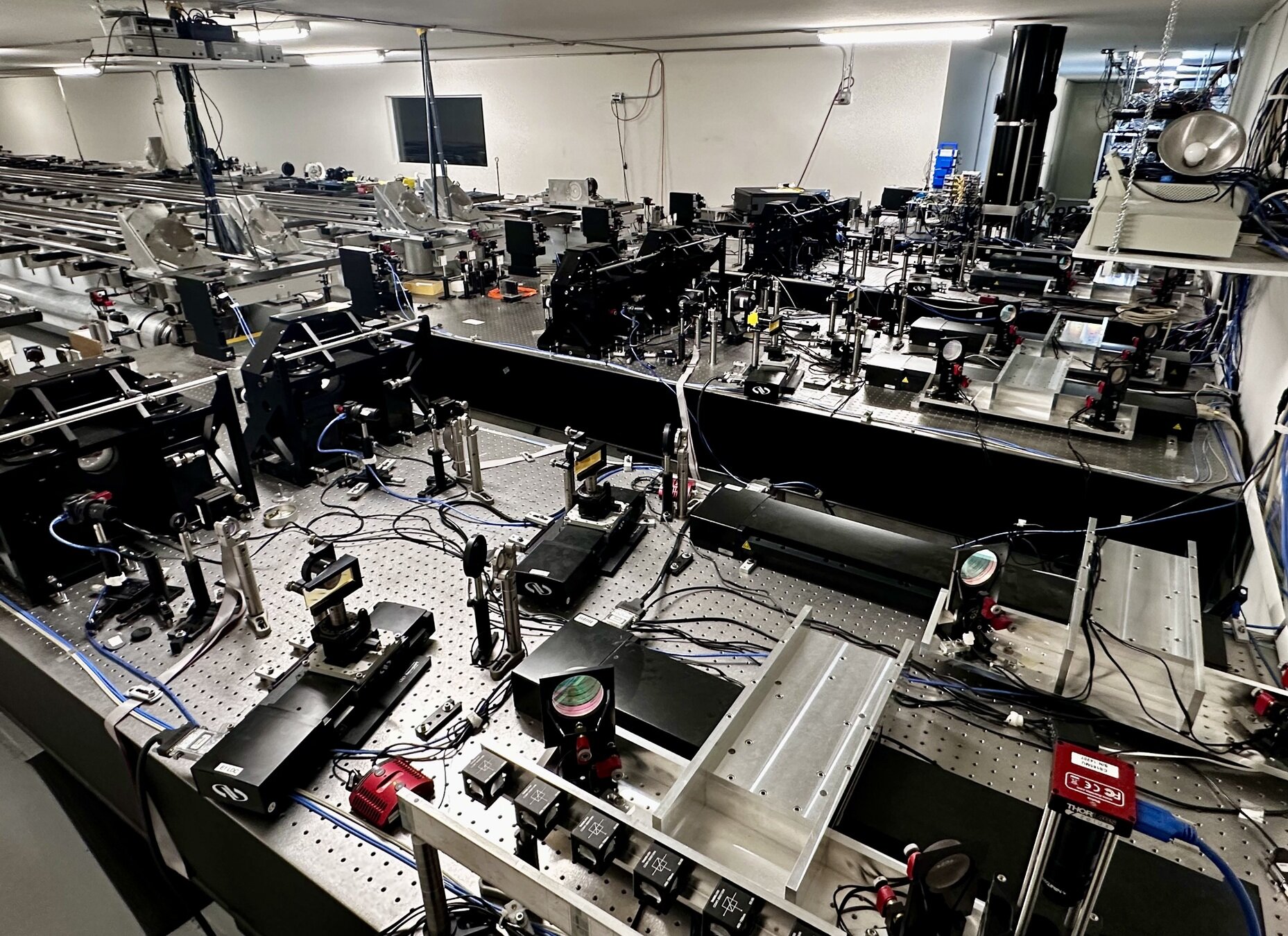
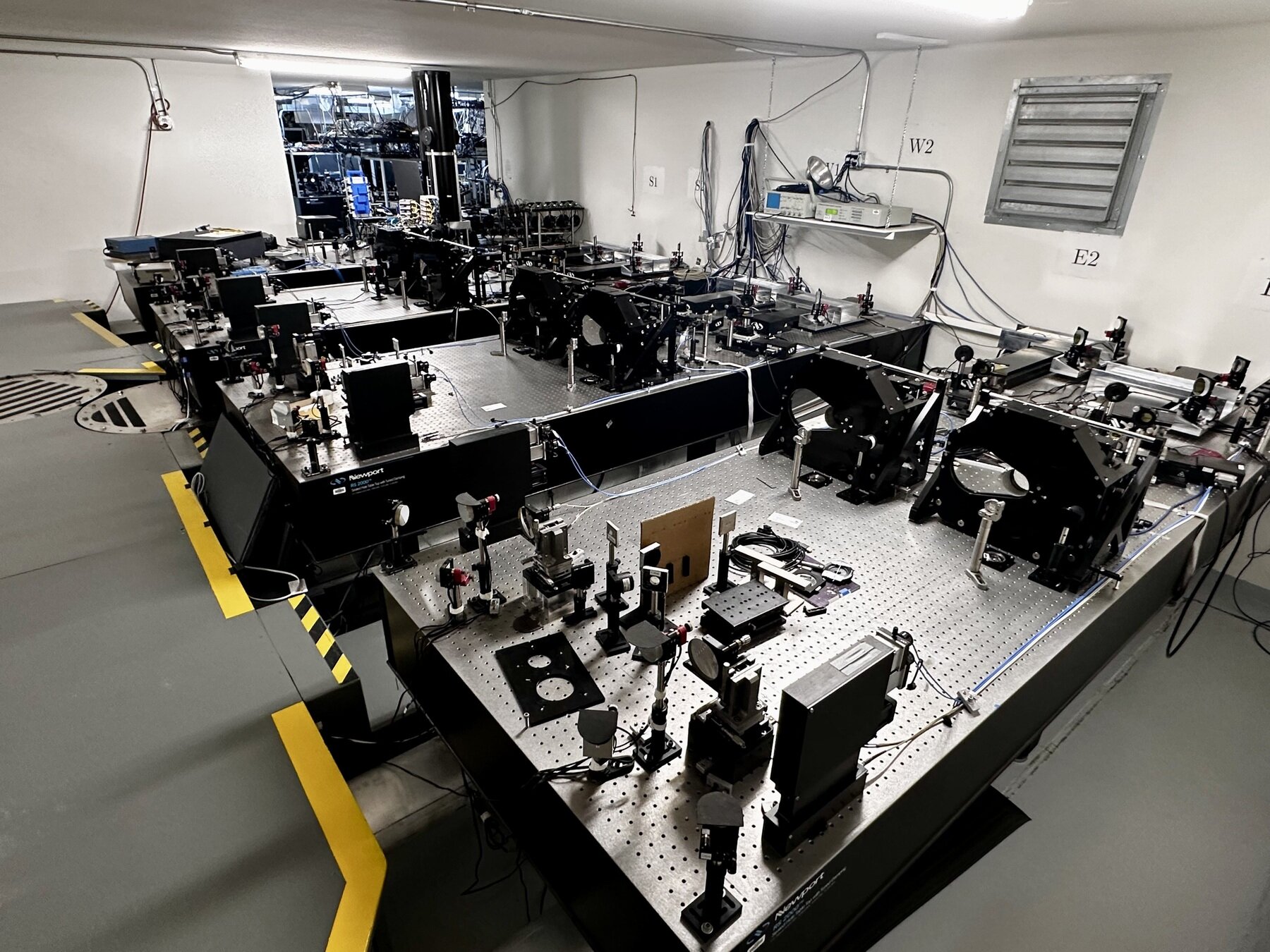
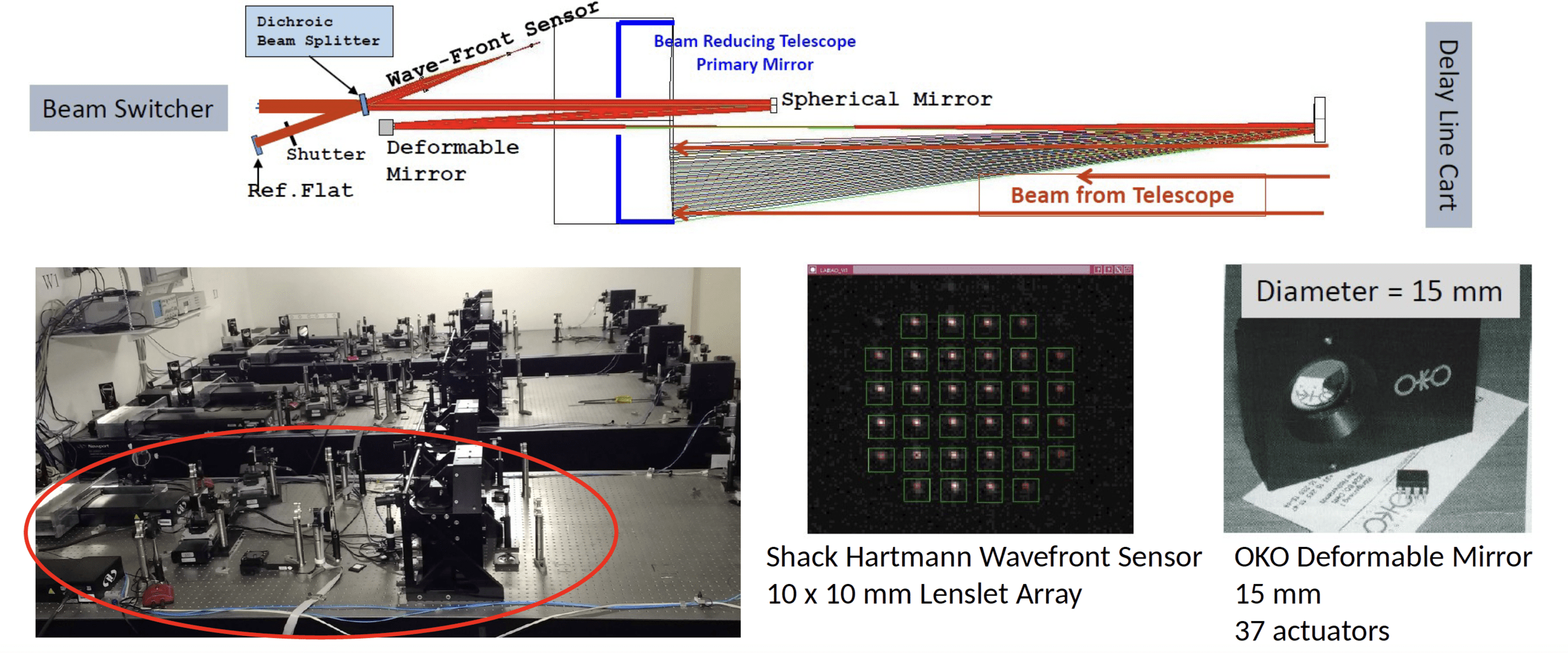
LabAO
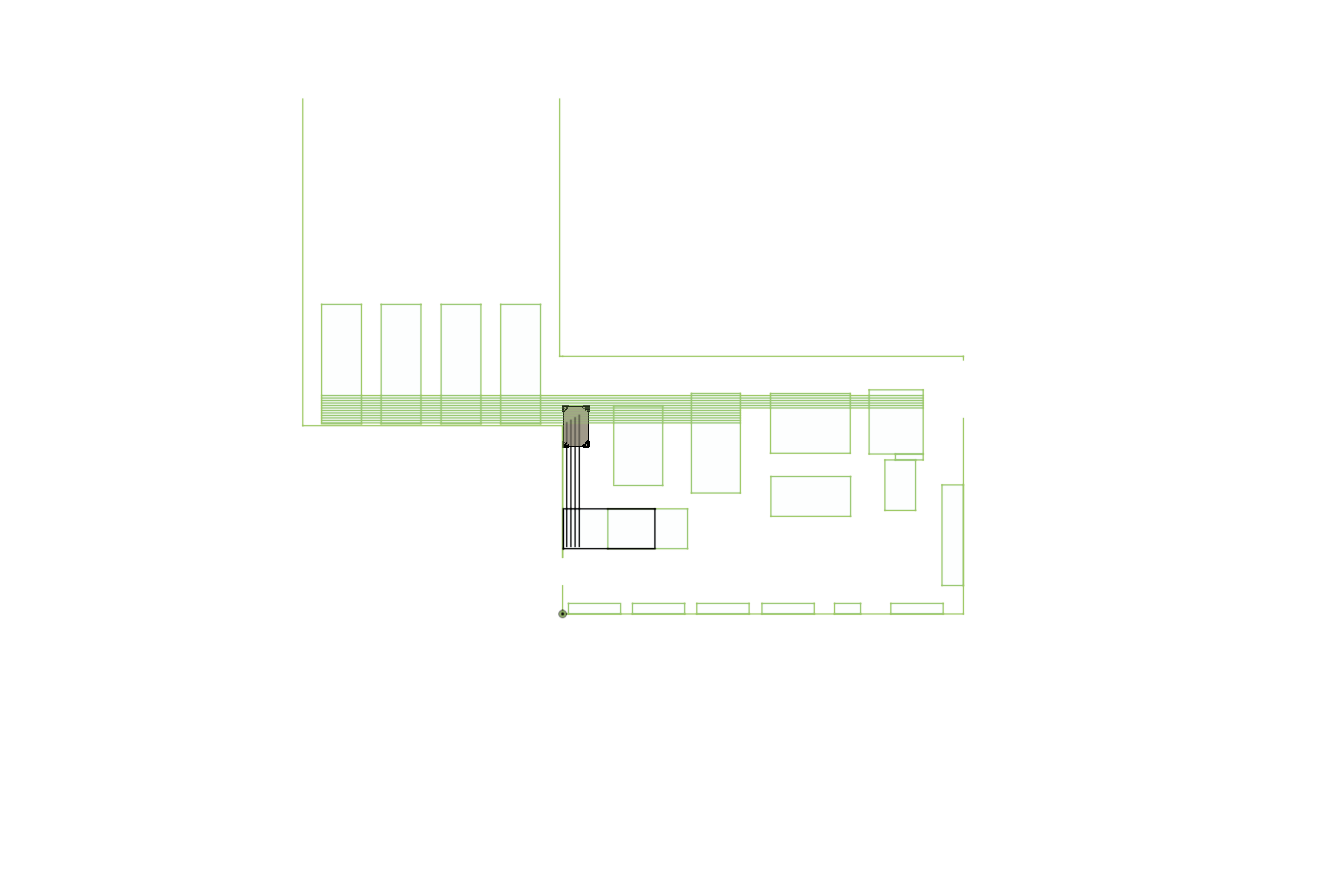
MIRX
MYSTIC
SILMARIL
SPICA
CHARIOT
PAVO
VIS BEAMS
METROLOGY
STS/STST
BEAM SAMPLERS
BEAM Reduction
LabAO
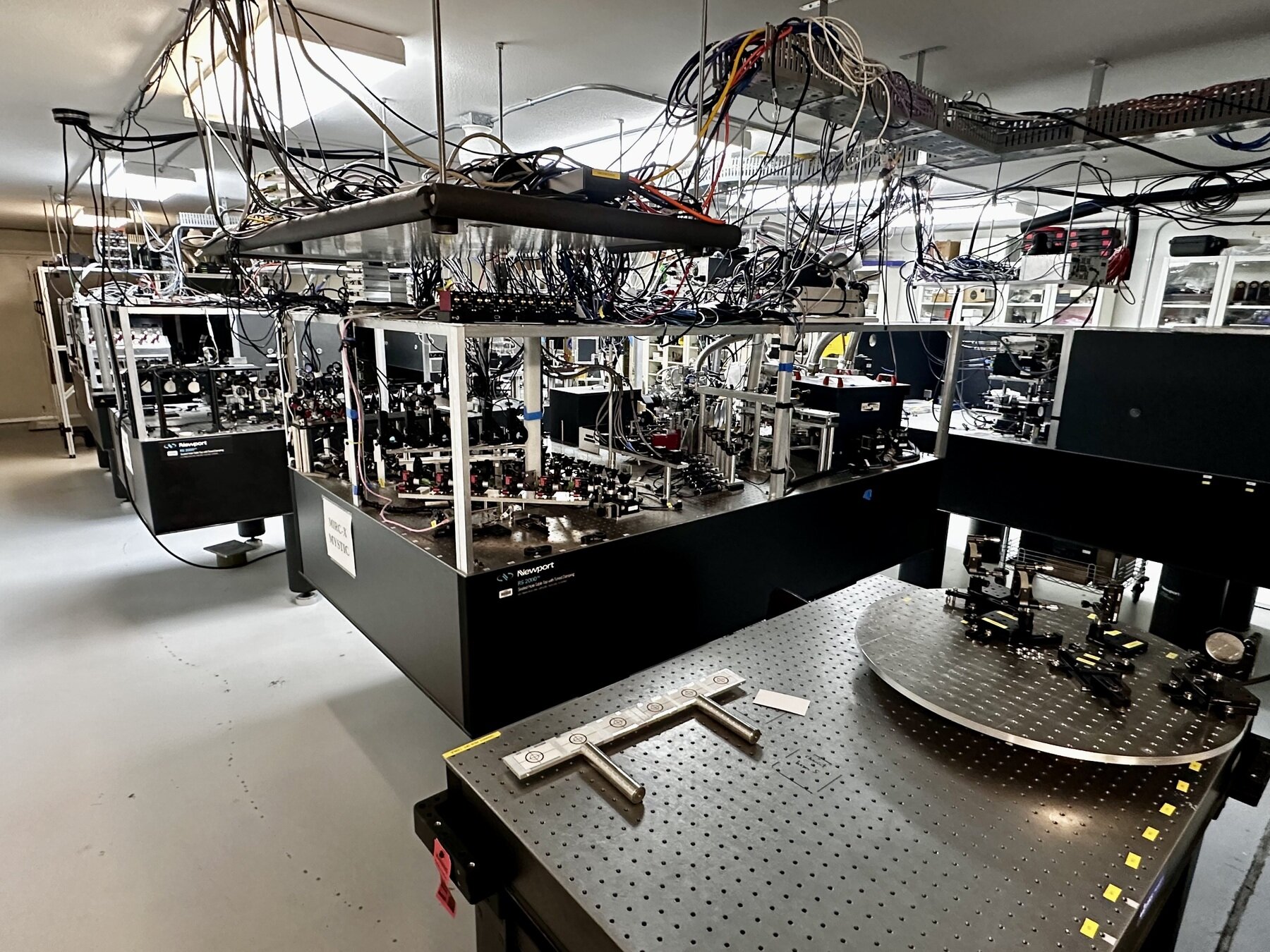

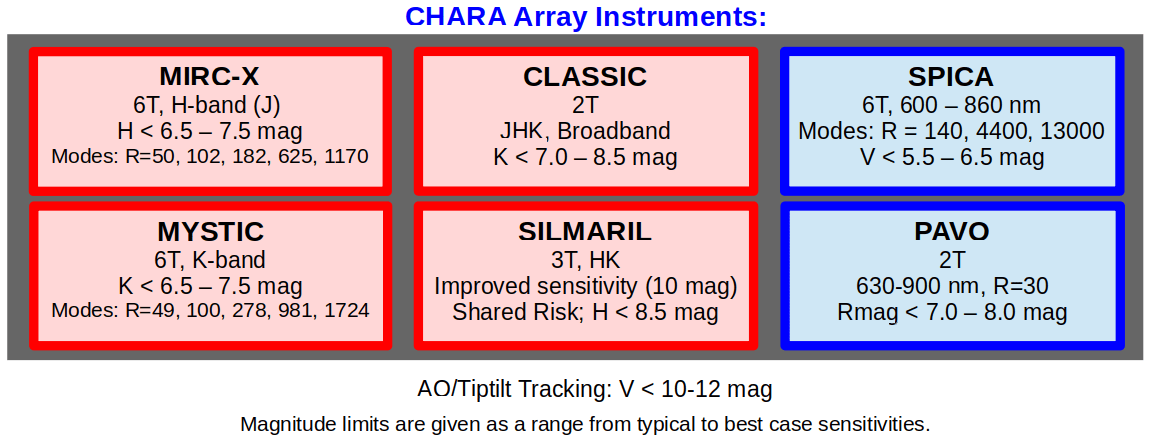
MIRC-X/Mystic
MIRC-X
- dispersed spectral channels
- J and H-bands (simultaneous 4-beam → 6-beam soon)
- MIRC-X/MYSTIC can be used simultaneously
- images of stellar surfaces and circumstellar disks
- precision closure phases
- faint binary companions.
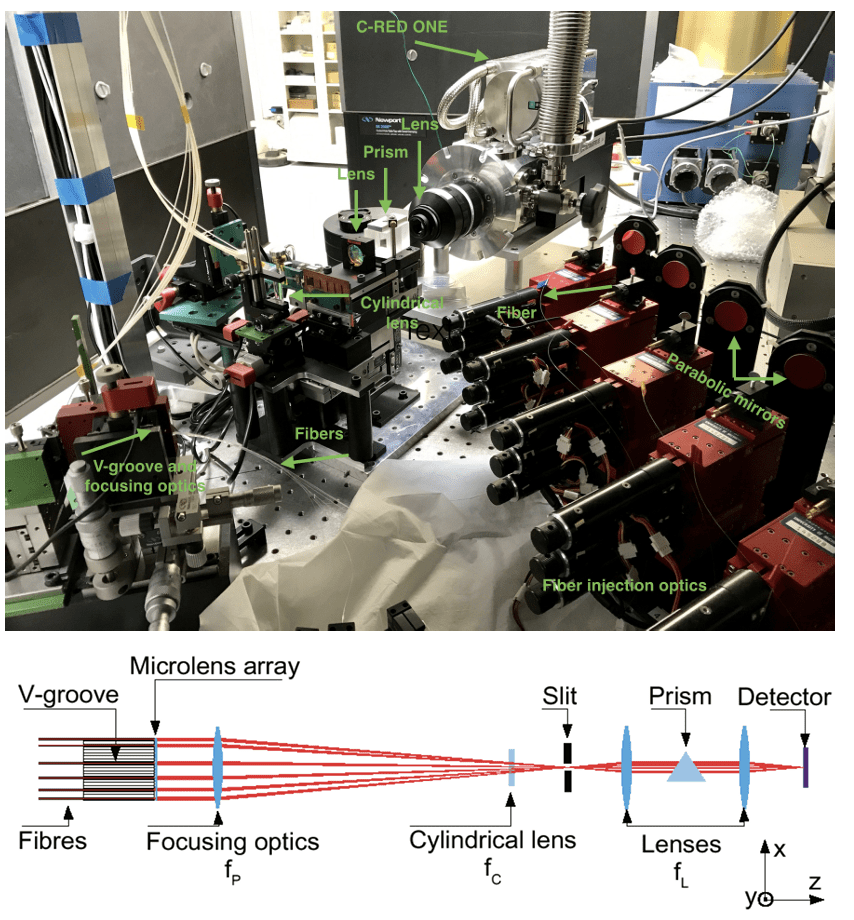
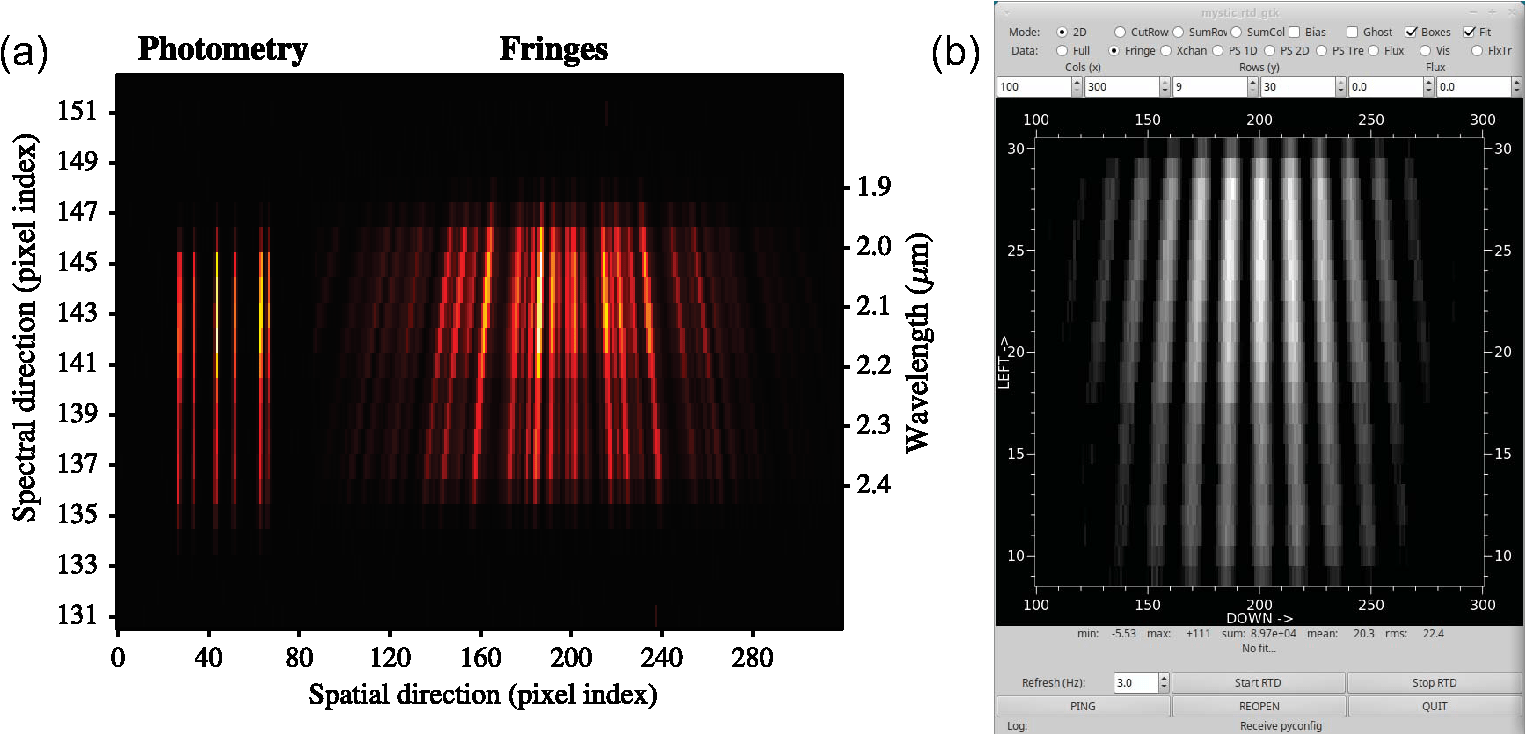
MYSTIC
- K-band, cryogenic, 6-beam combiner
- All-in-One 6T or high sensitivity 4T gravity chip
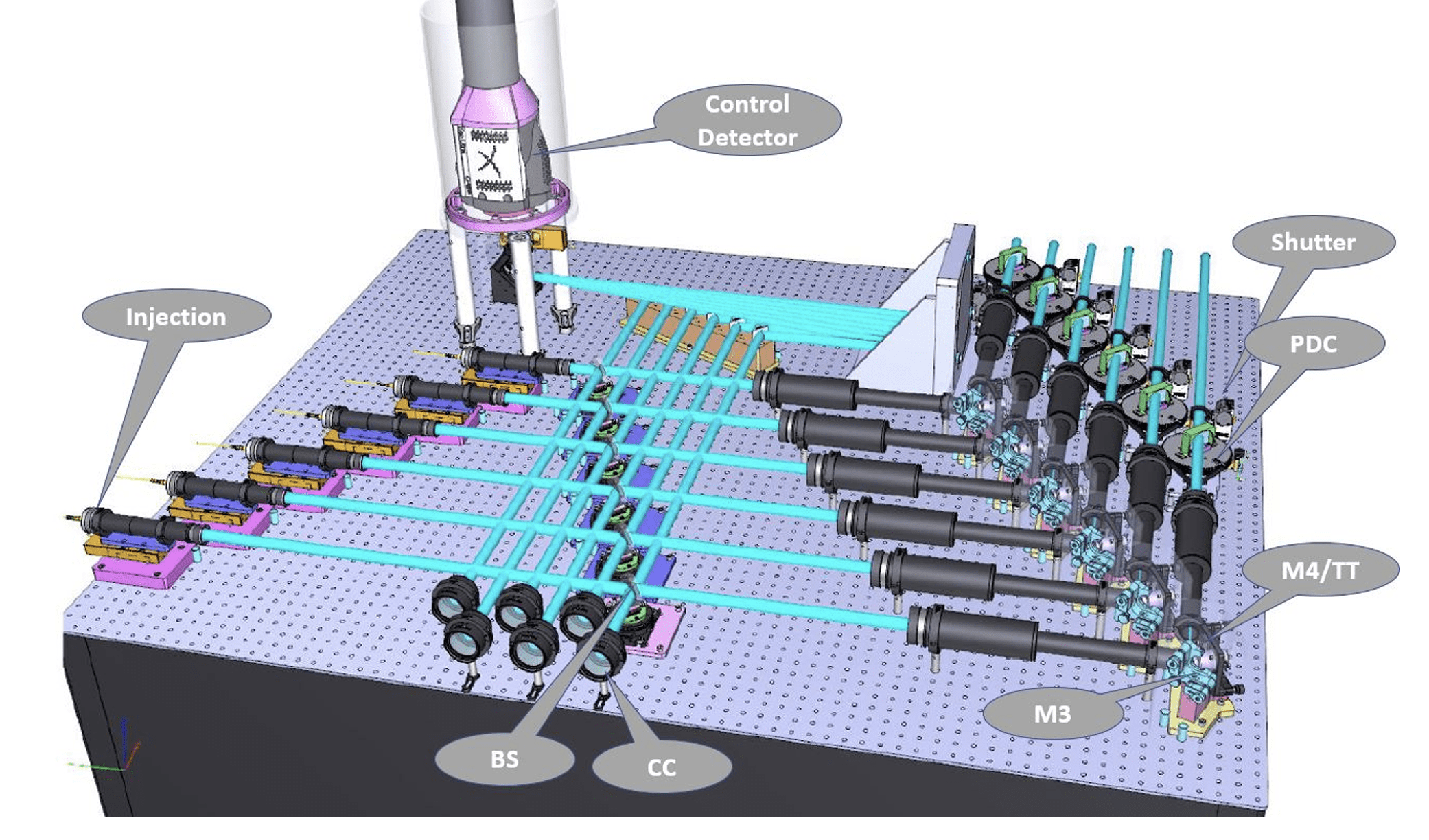
SPICA
(Stellar Parameters and Imaging with a Cophased Array)
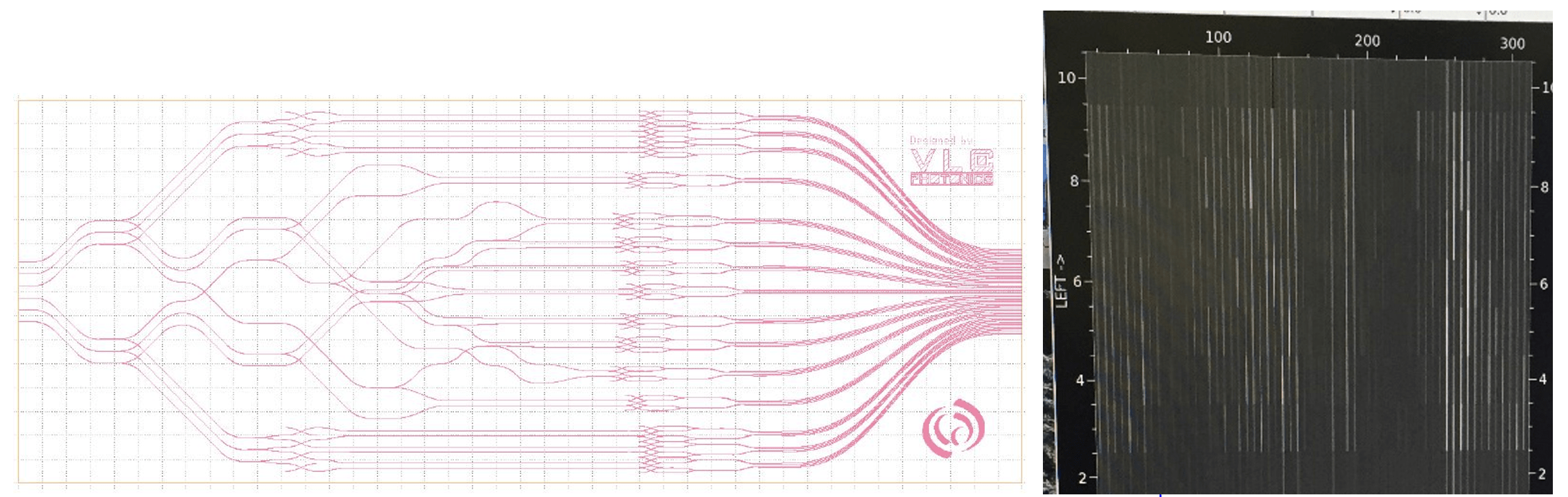
The goal of the SPICA project is to provide a large and homogeneous set of stellar parameters across the HR-diagram.
- measure the angular diameters of 1000 stars
- spectral resolutions of R = 140, 4300, and 13300
- two instruments:
- the visible-light combiner (SPICA-VIS)
- H-band integrated optic 6-beam ABCD combiner (SPICA-FT) installed into the MIRC-X instrument.
- SPICA-FT provides group-delay and phase-delay tracking for SPICA-VIS.
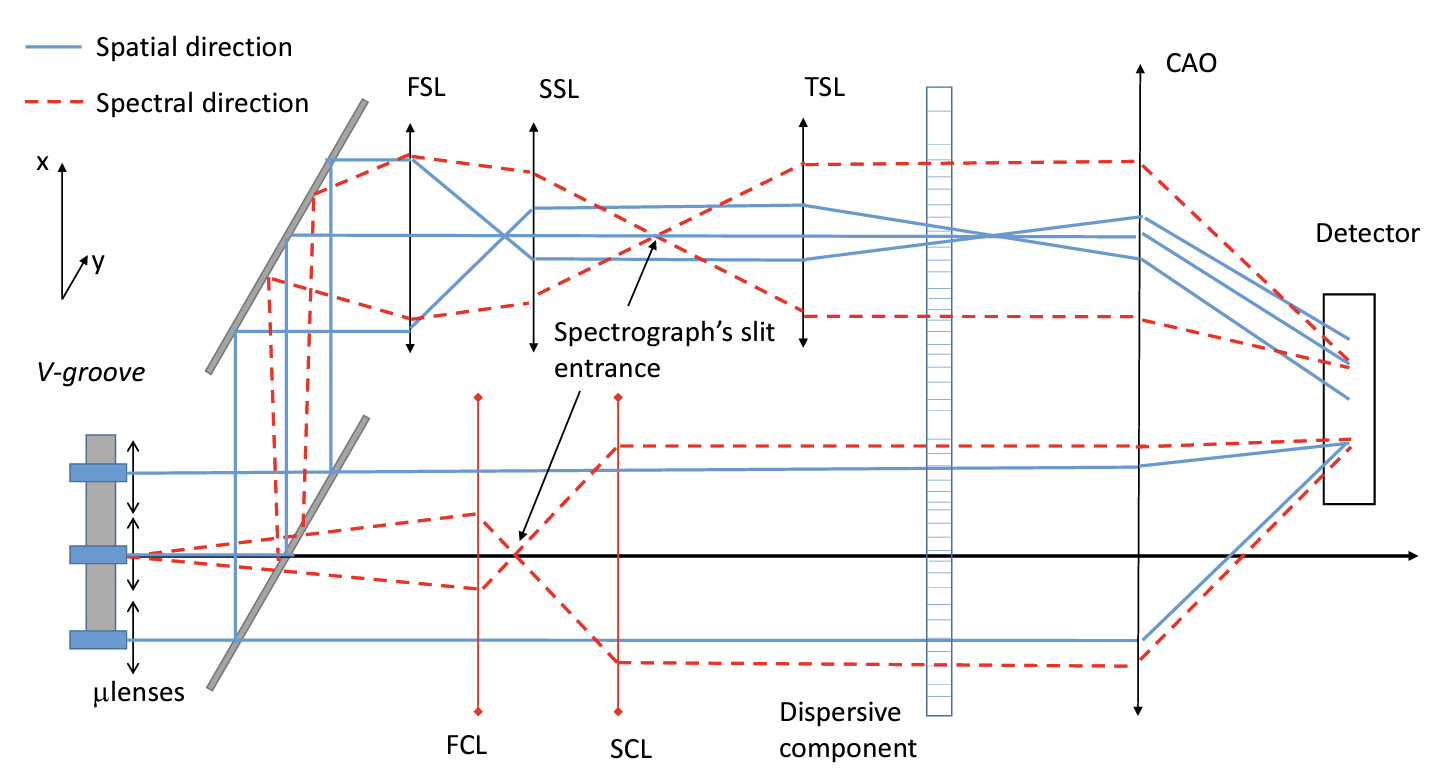
spectrograph

Aug 2023 - First fringes with SPICA/MIRC-X/MYSTIC
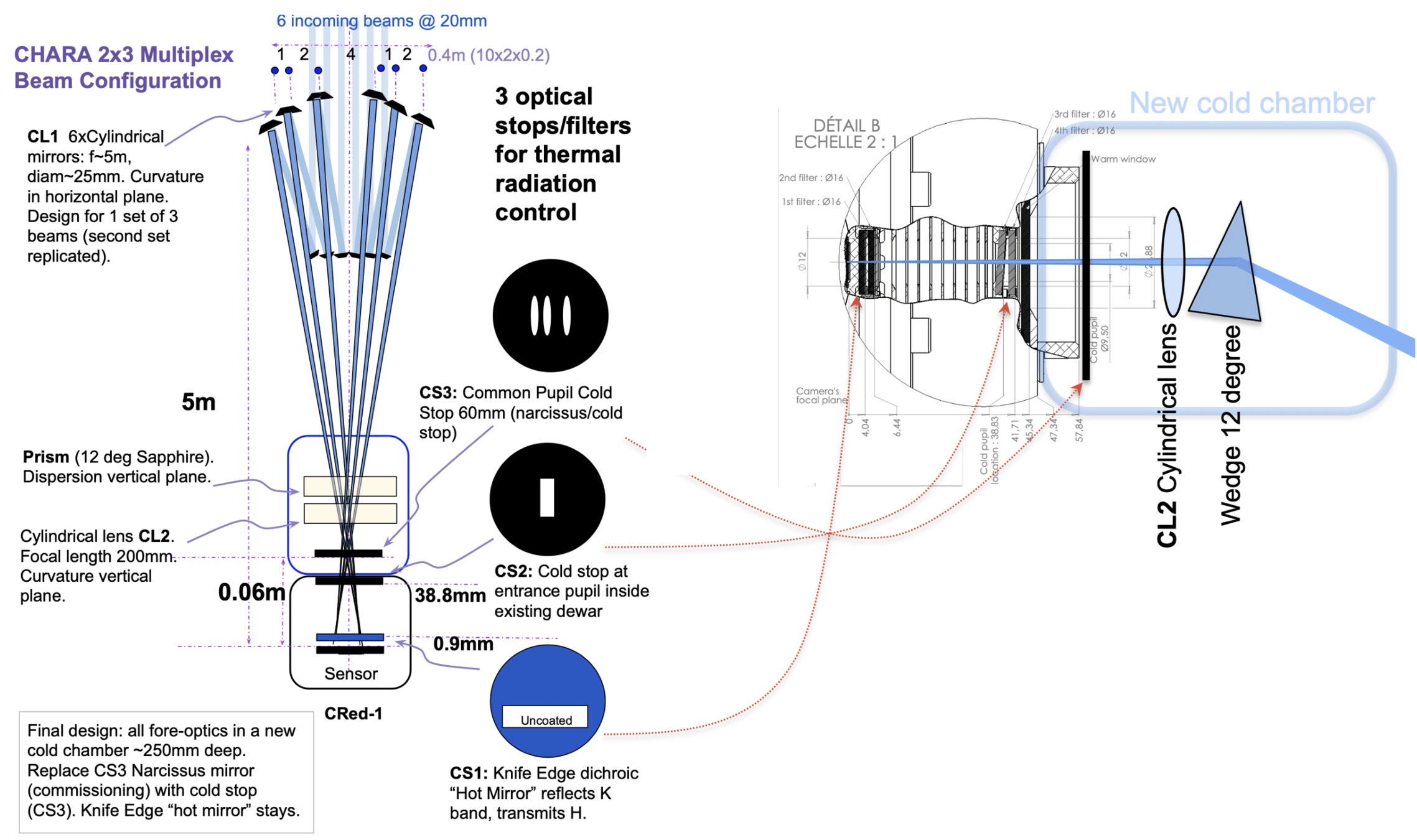
Silmaril
- 3T simultaneous H/K combiner
- Bulk optics / designed for high sensitivity
- CRED-1
- R=35
- pair of narcissus mirrors to reduce background
- J-band dichroic → Niro detector (from Classic) as angle tracker (Strider)
- expect limiting magnitude of H=10-11
- PI: ten Brummelaar (GSU), Tuthill (Sydney)
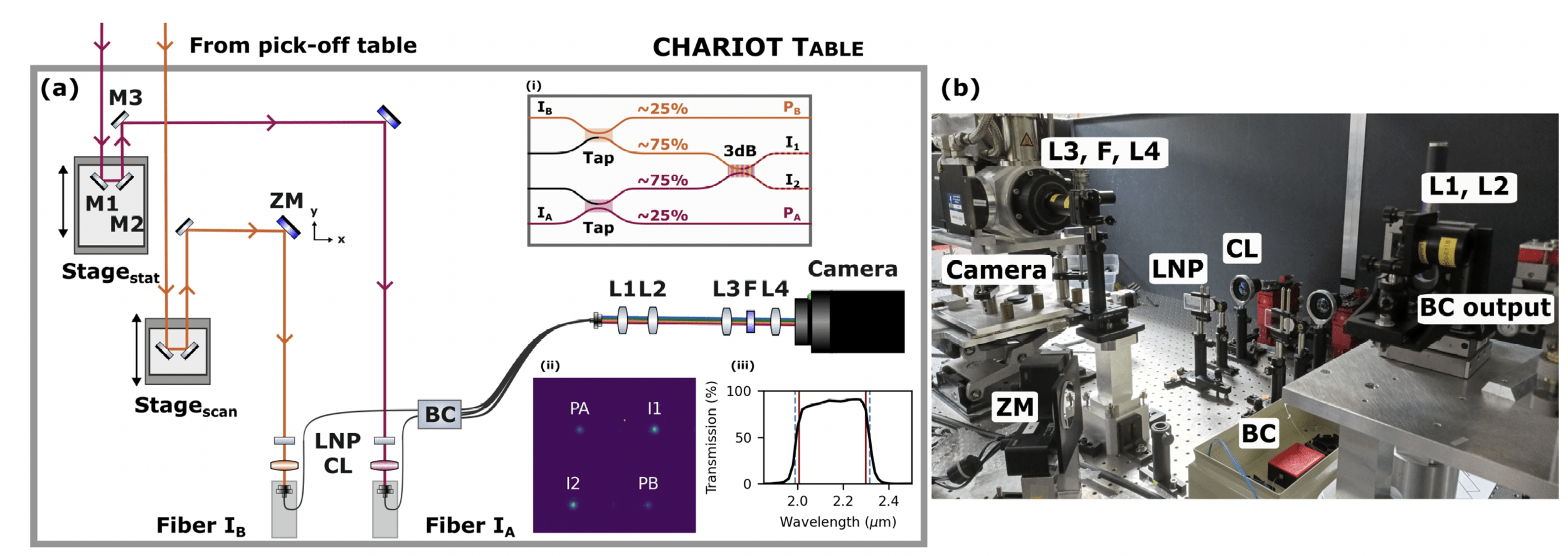
CHARIOT
(CHARA Array Integrated Optics Testbed)
collaboration with Leibniz-Institut fur Astrophysik Potsdam, University of Cologne, Heriot-Watt University
ULI optics for JHK bands

Apr 2024 - First fringes
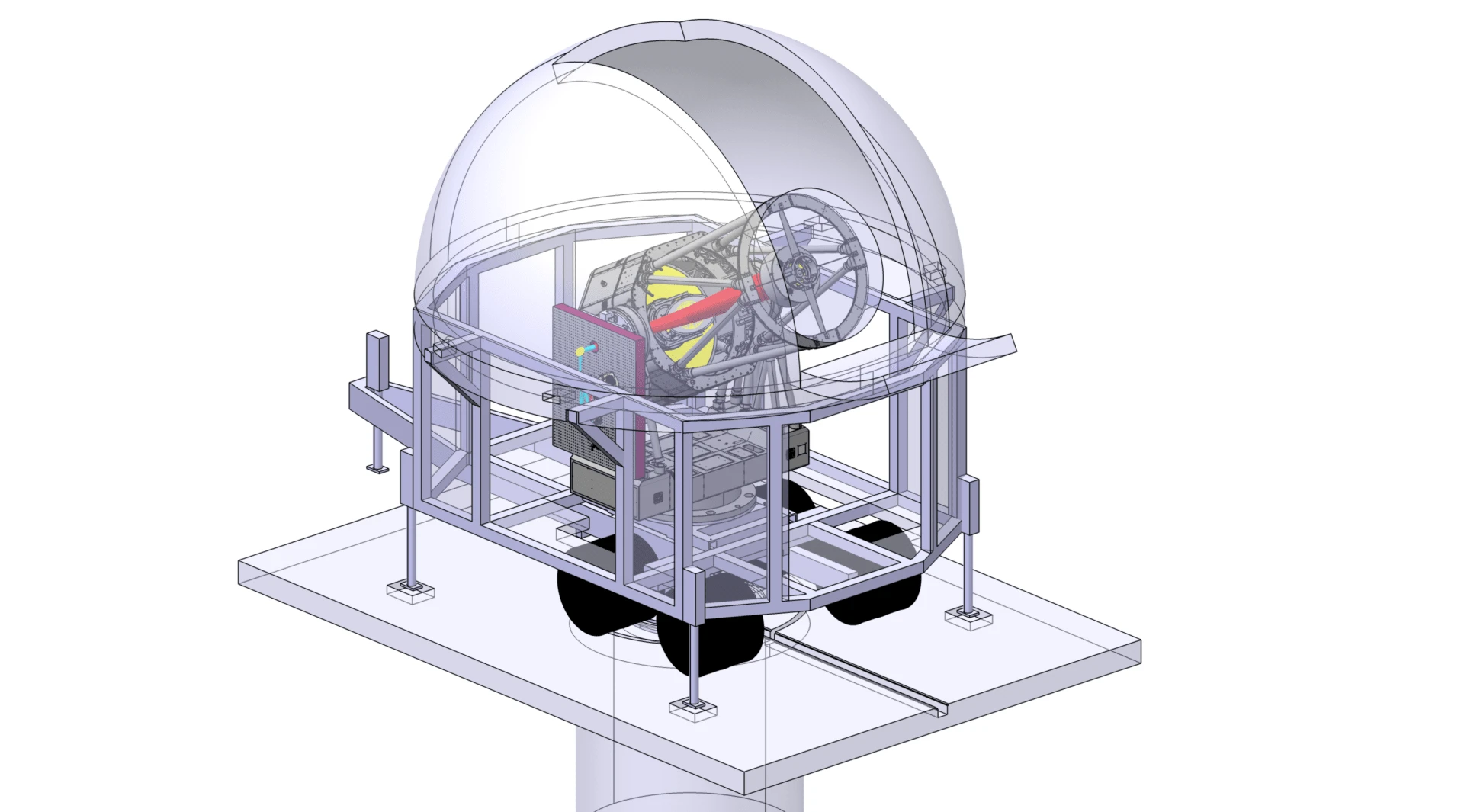
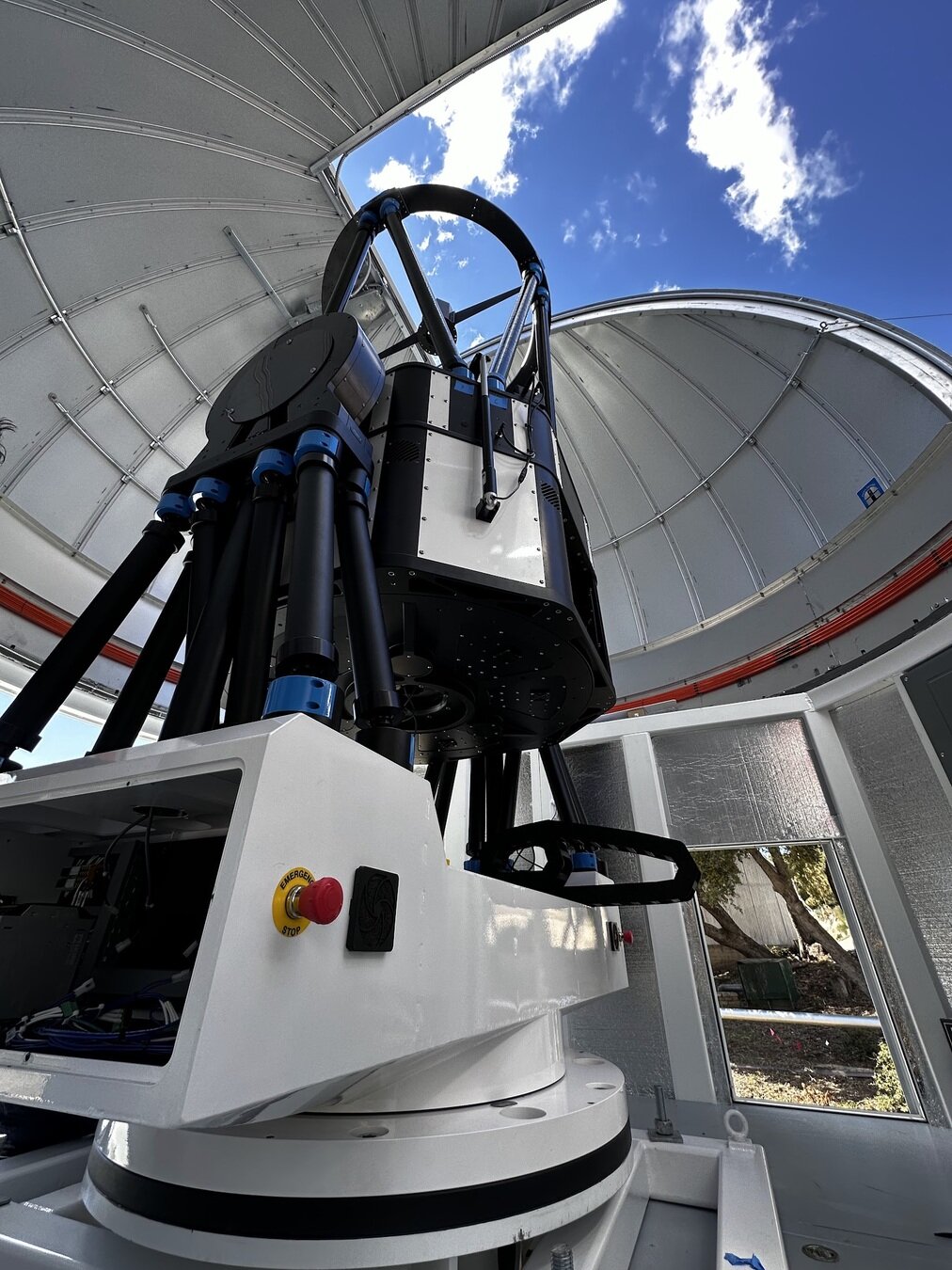
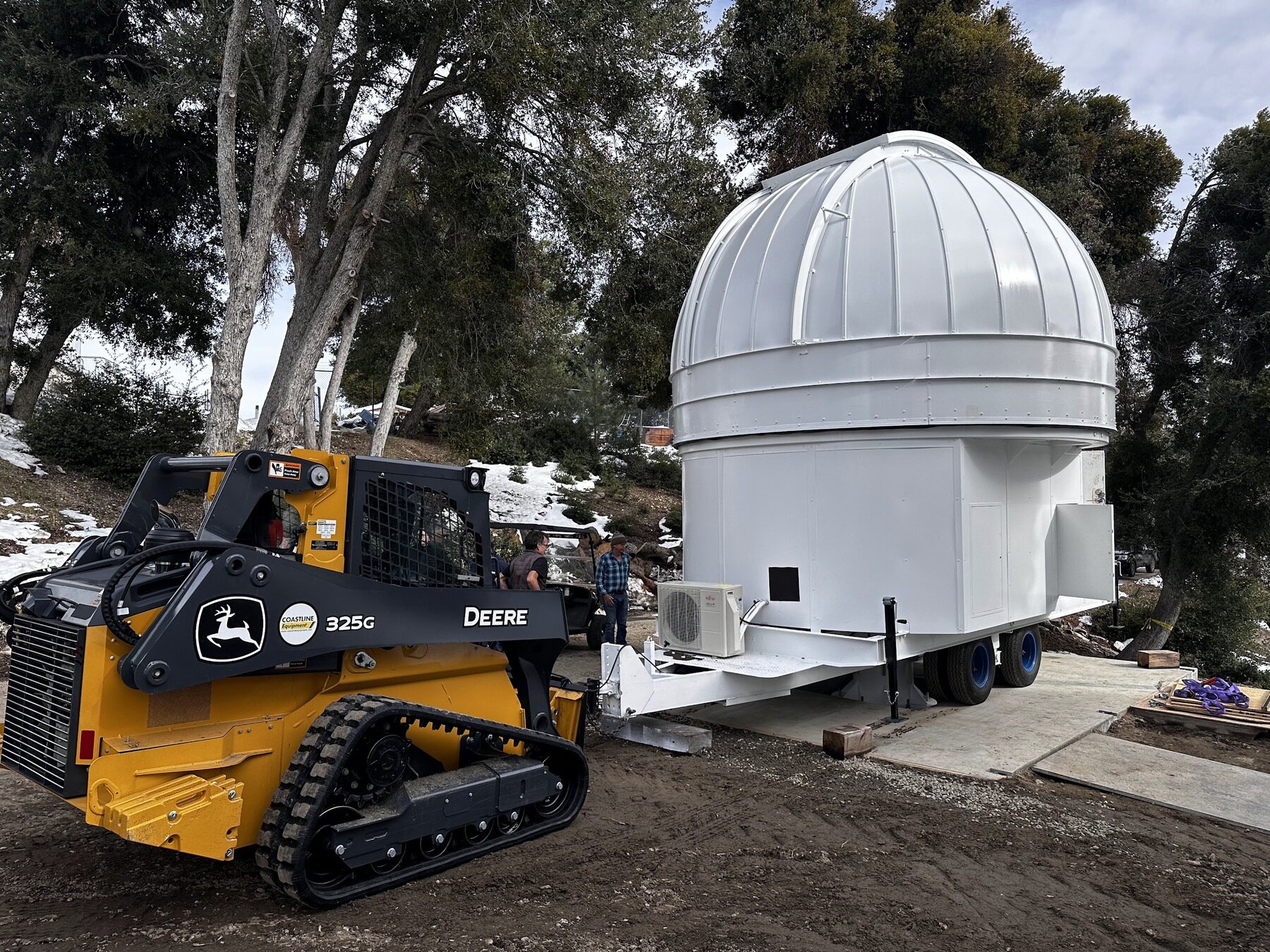
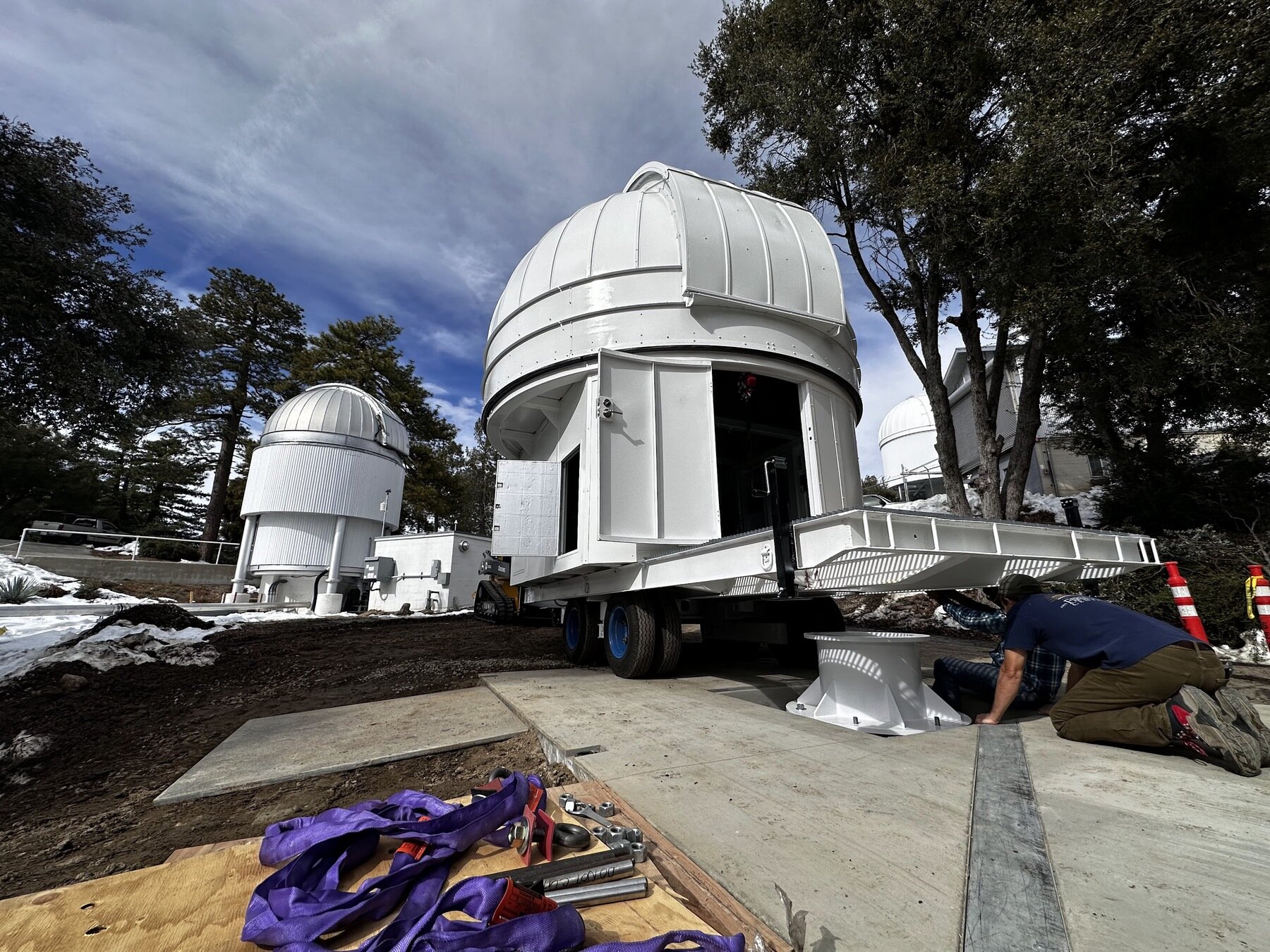
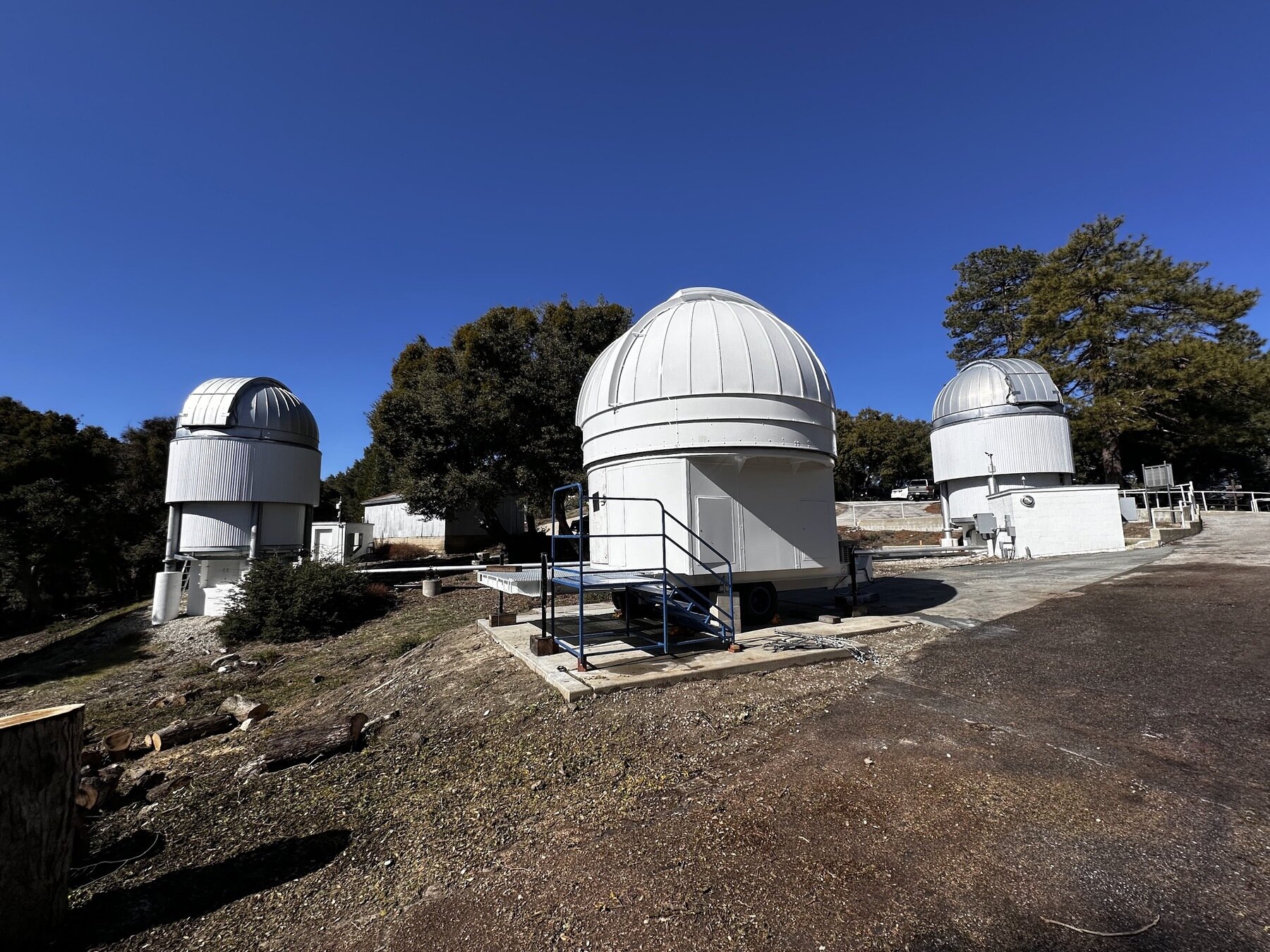
Mobile Telescope Transport (TR116)
CMAP
(CHARA Michelson Array Pathfinder)
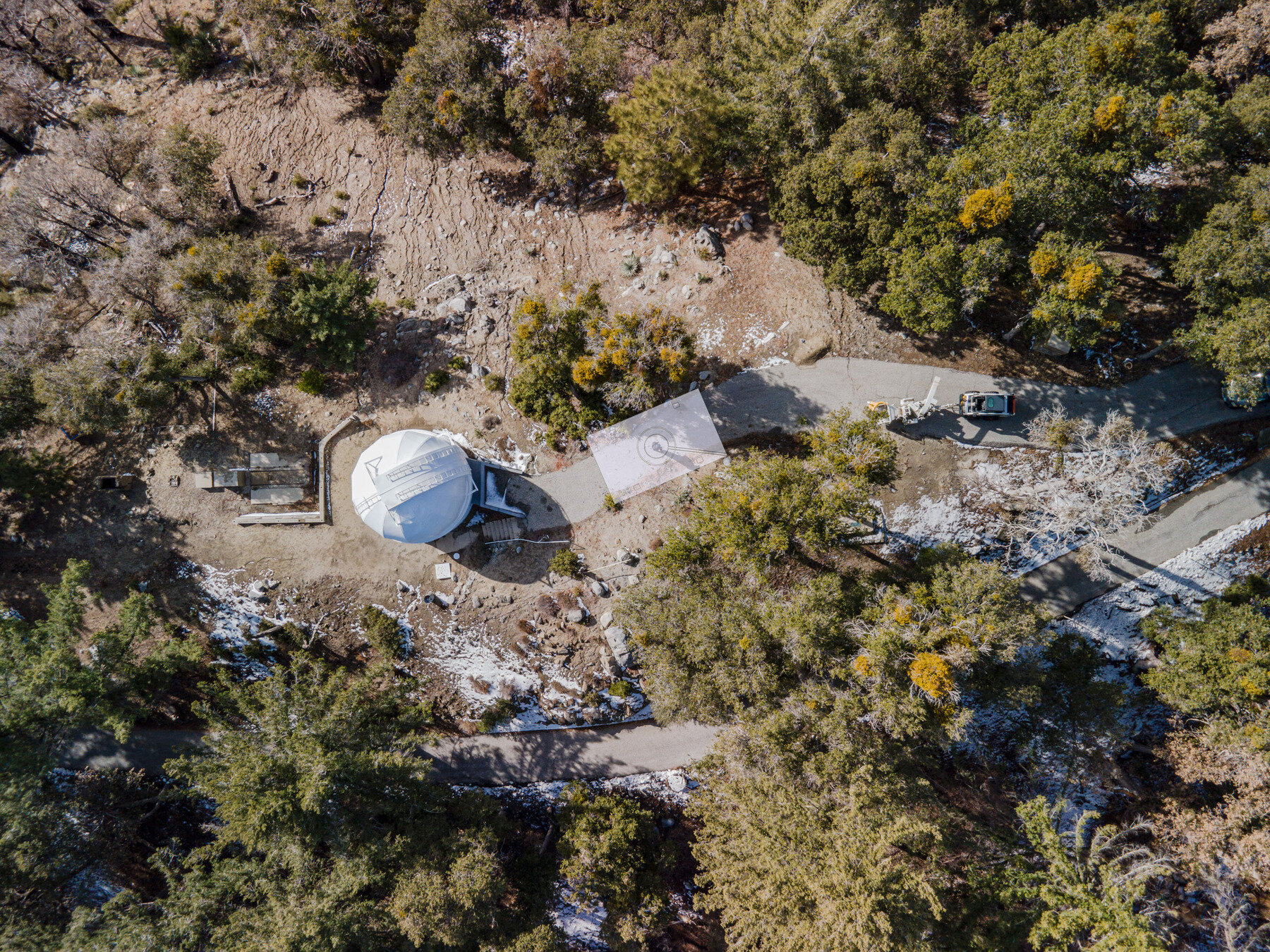
S4
S3
ALOHA – Univ. Limoges
Single-mode PM fibers
λ=810nm, 240m long
Laying on the ground
Connect S1+S2
On-sky fringes Magri+2024
CMAP
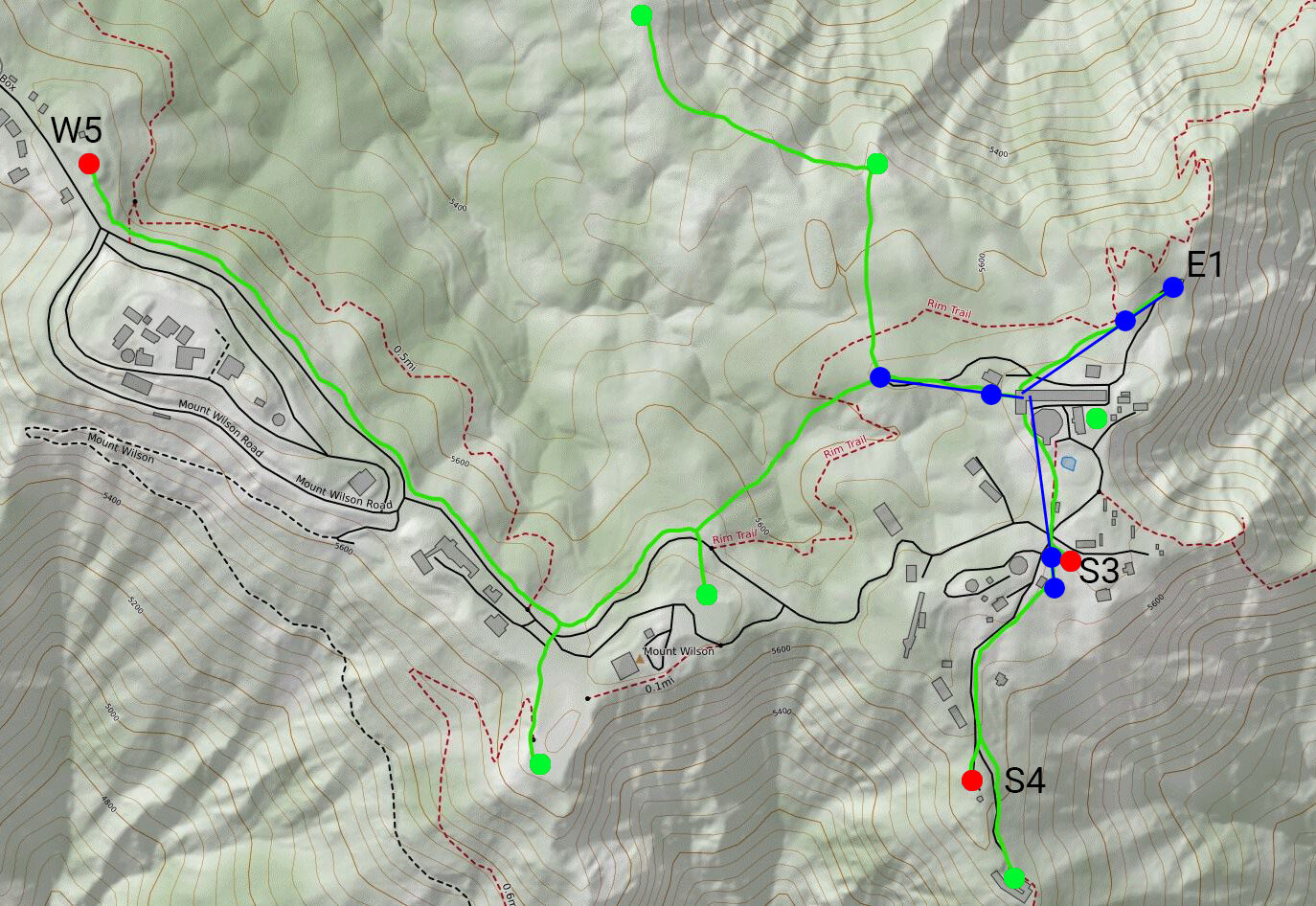
Single-mode PM fibers
λ=1.6μm, 650m long
Trench: 18 inches deep
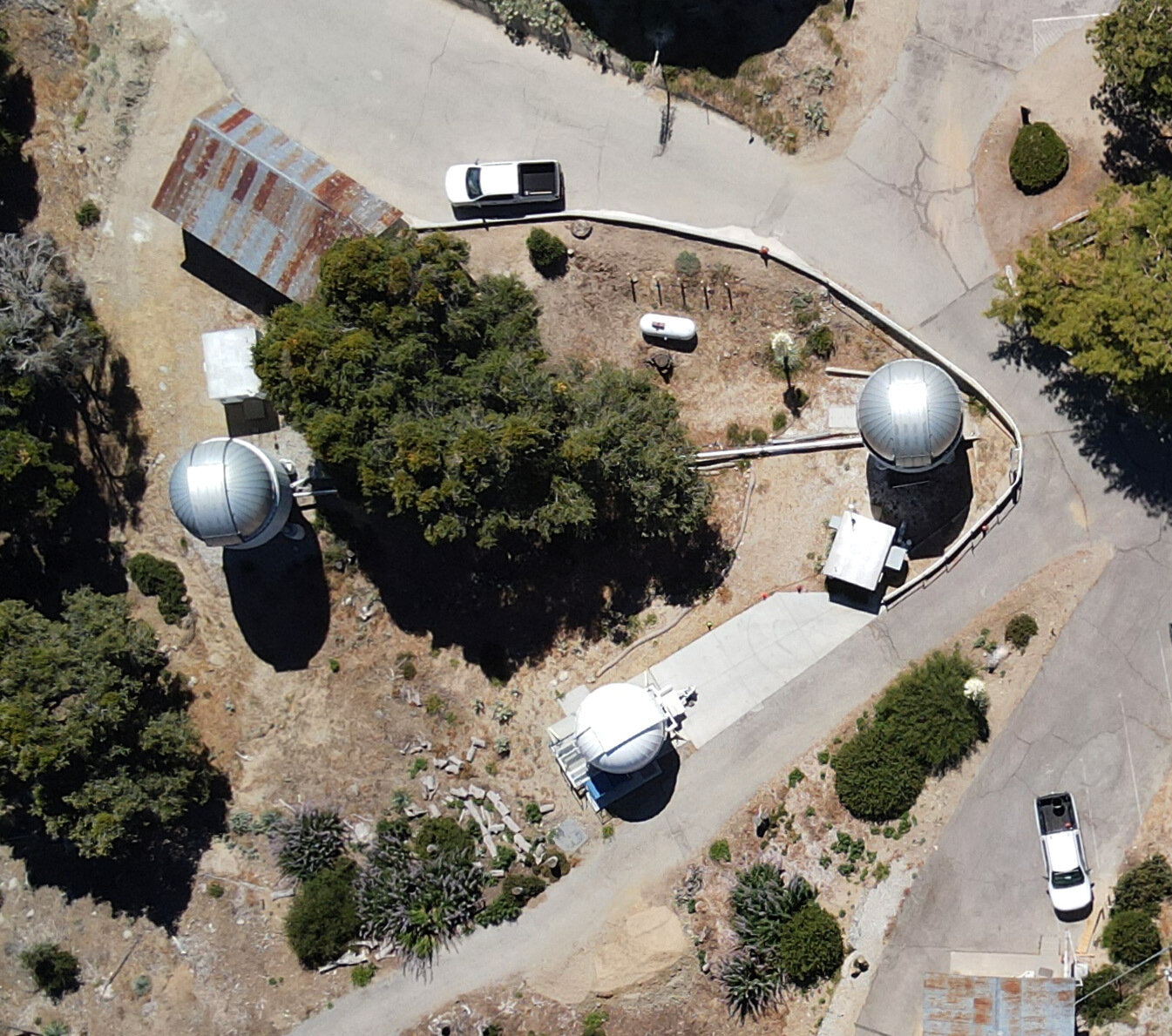
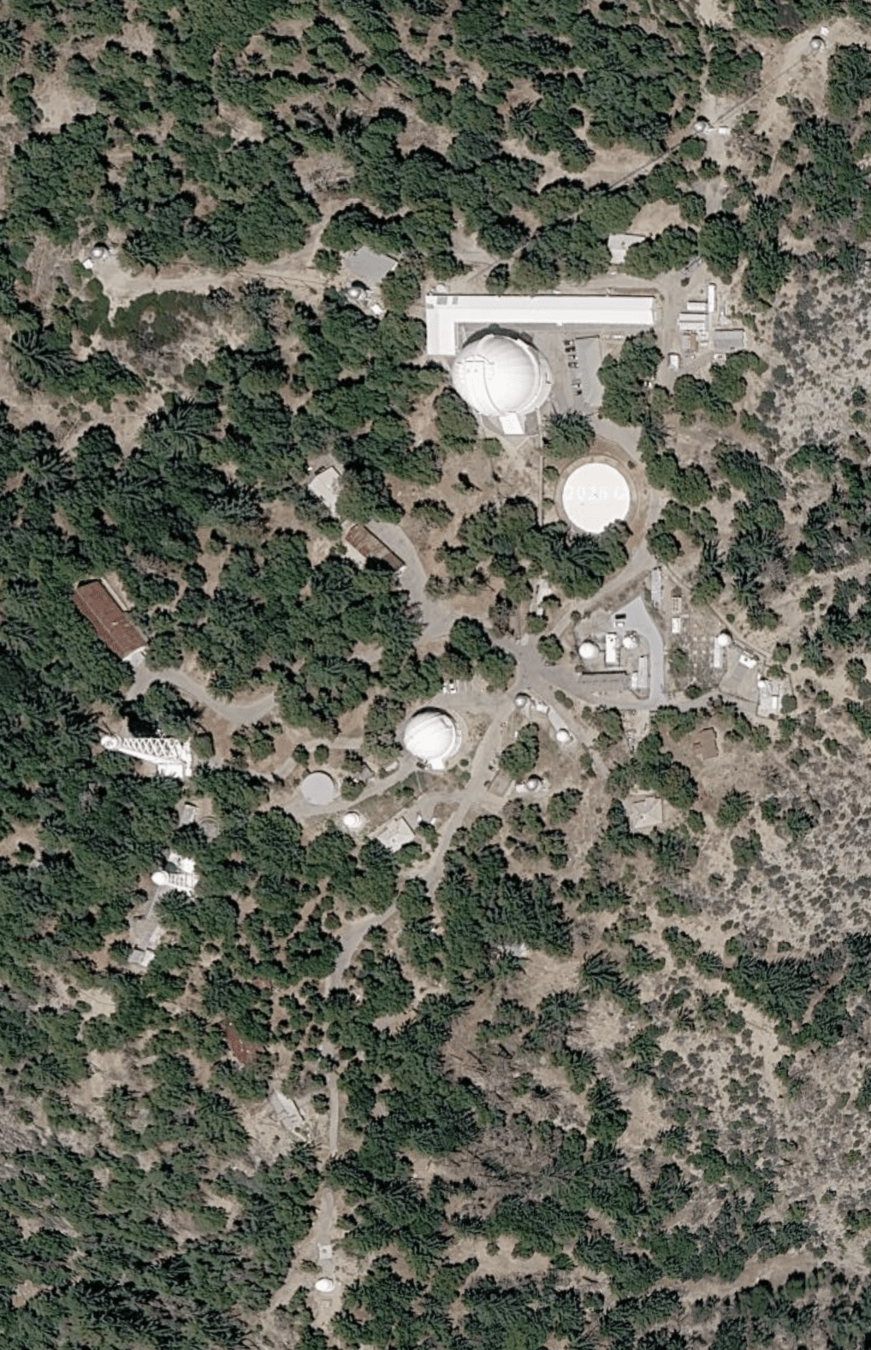
20 ← 34 - 331 → 579 m
S3
S4
Single-mode PM fibers
λ=1.6 μm, 650 m long
Trench: 18 inches deep
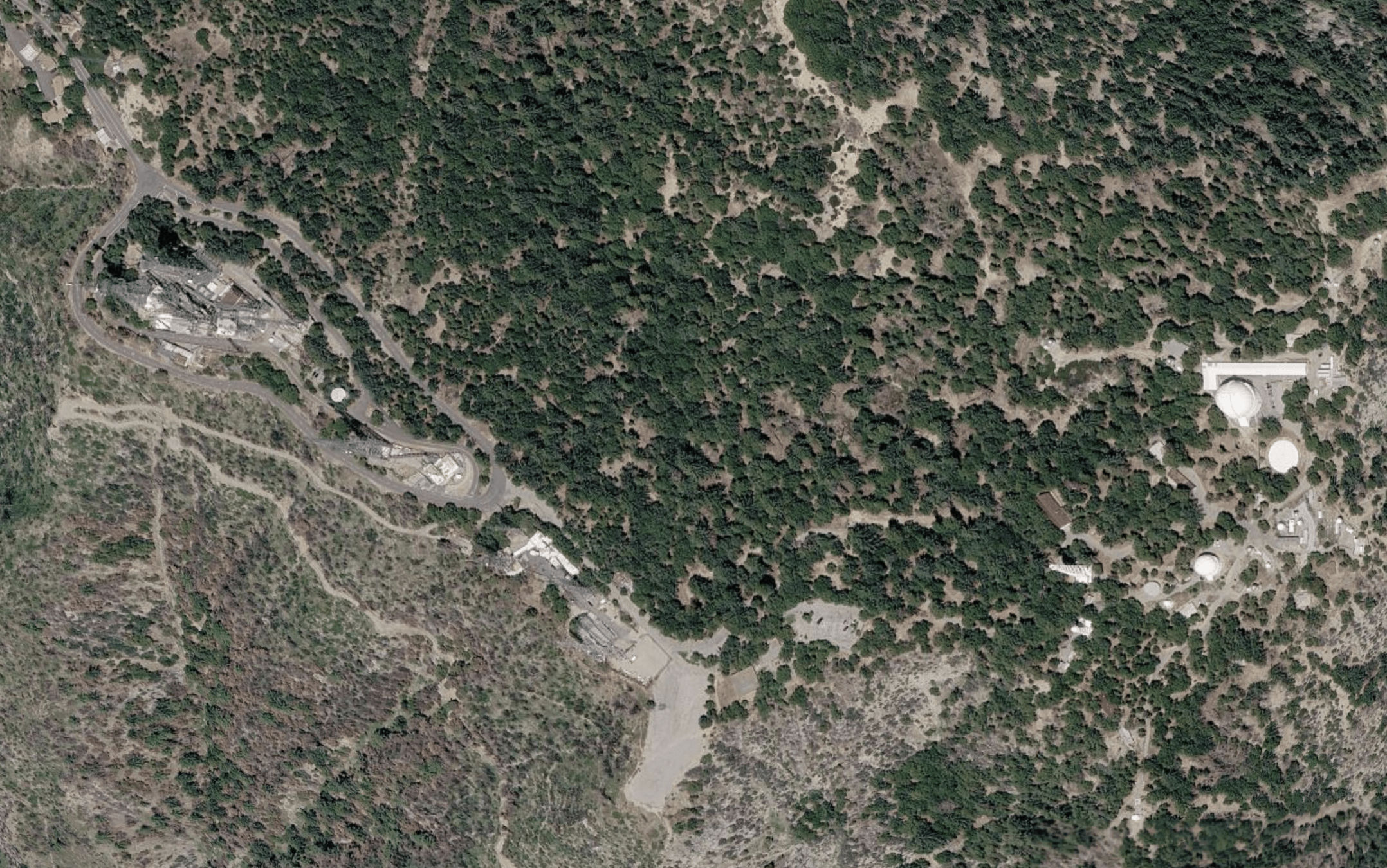
1100 m
W5
S3
S4
Science Drivers
- multiple star systems
- time domain astronomy
- YSOs/planetary formation
- evolved stars
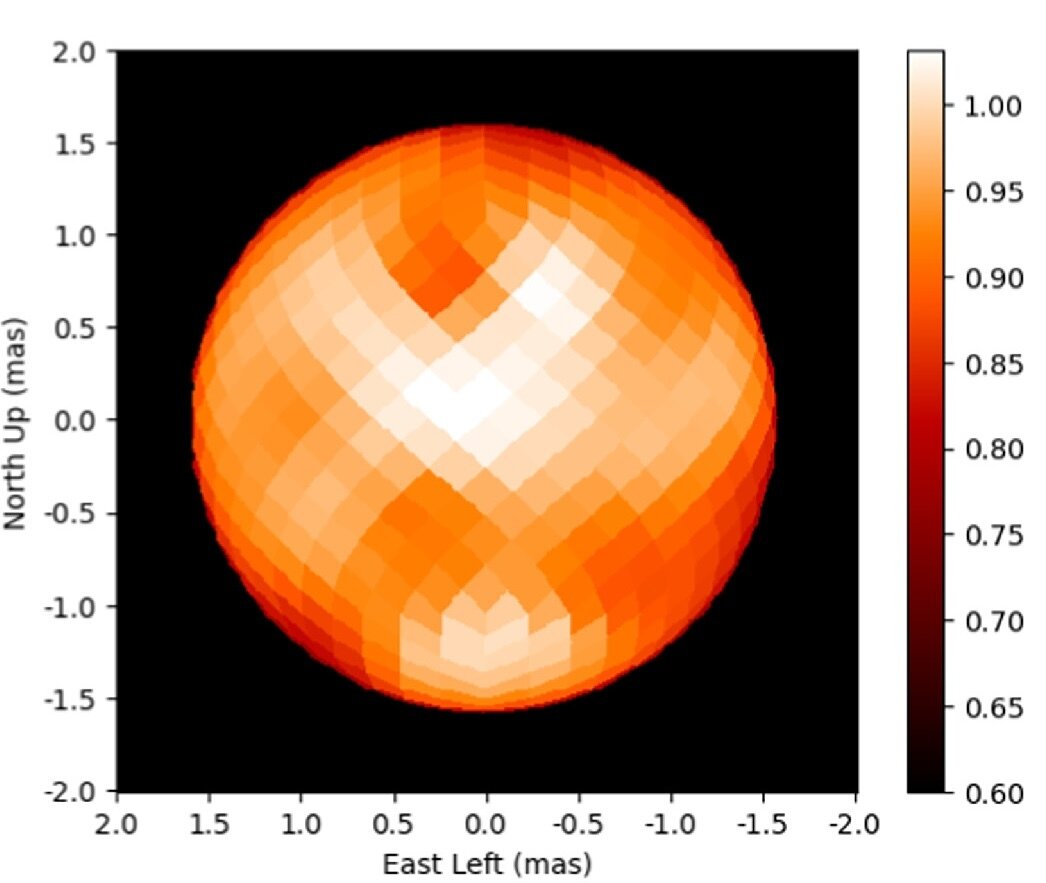
- starspots/surface imaging
- exozodis
- AGN
- HWO/PLATO
- exoplanet hosts
The Gaia orbits give the center-of-light motion of unresolved binaries, and a single resolved CHARA observation is sufficient to determine the full orbit and masses.
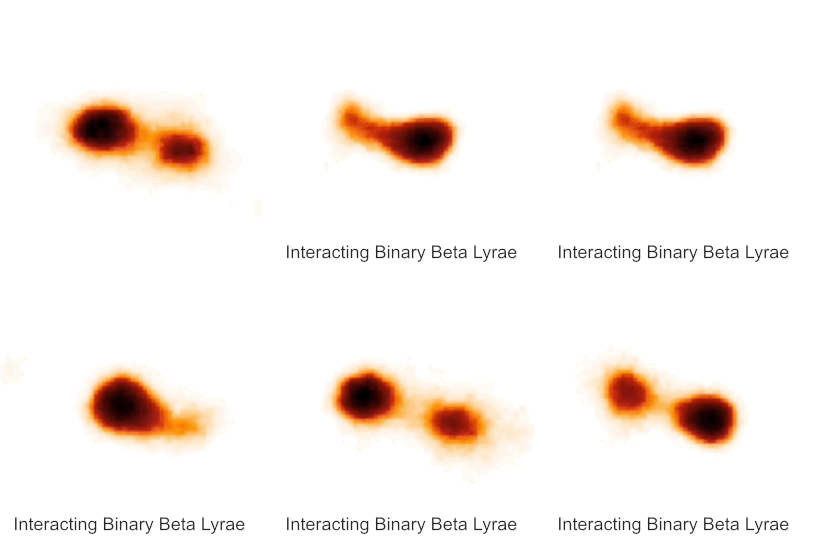
High angular resolution observations also reveal how interacting stars are transformed by mass exchange.


Earliest Science
Rapid Rotators
Regulus -- Che et al. 2011, ApJ, 732, 68
Rasalhague -- Zhao et al. 2009, ApJ, 701, 209
Altair -- Monnier et al. 2007, Science, 317, 324
Alderamin -- Zhao et al. 2009, ApJ, 701, 209
Beta Cas -- Che et al. 2011, ApJ, 732, 68
Star spots


Polaris
sigma Geminorum
zeta Andromedae

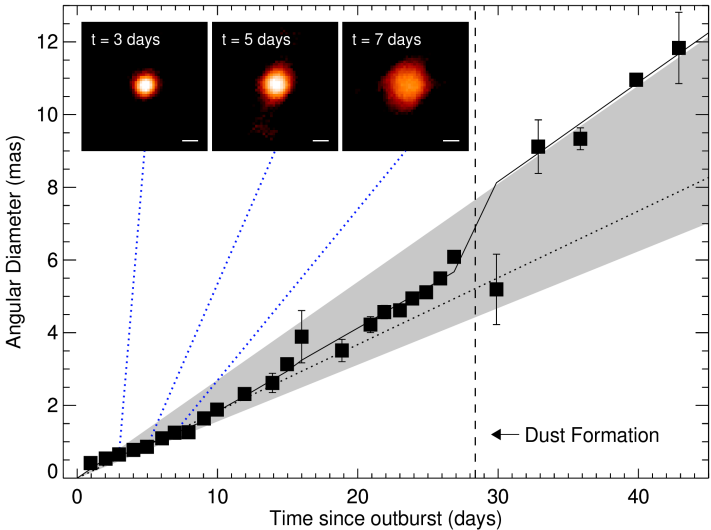
Expansion curve of Nova Del 2013.
- Changes in apparent expansion – optically thick core surrounded by diffuse envelope that cools over time
- Geometric disk: 4.5 kpc
- Asymmetric shape detected as early as 2d
Nova fireballs and dust envelope

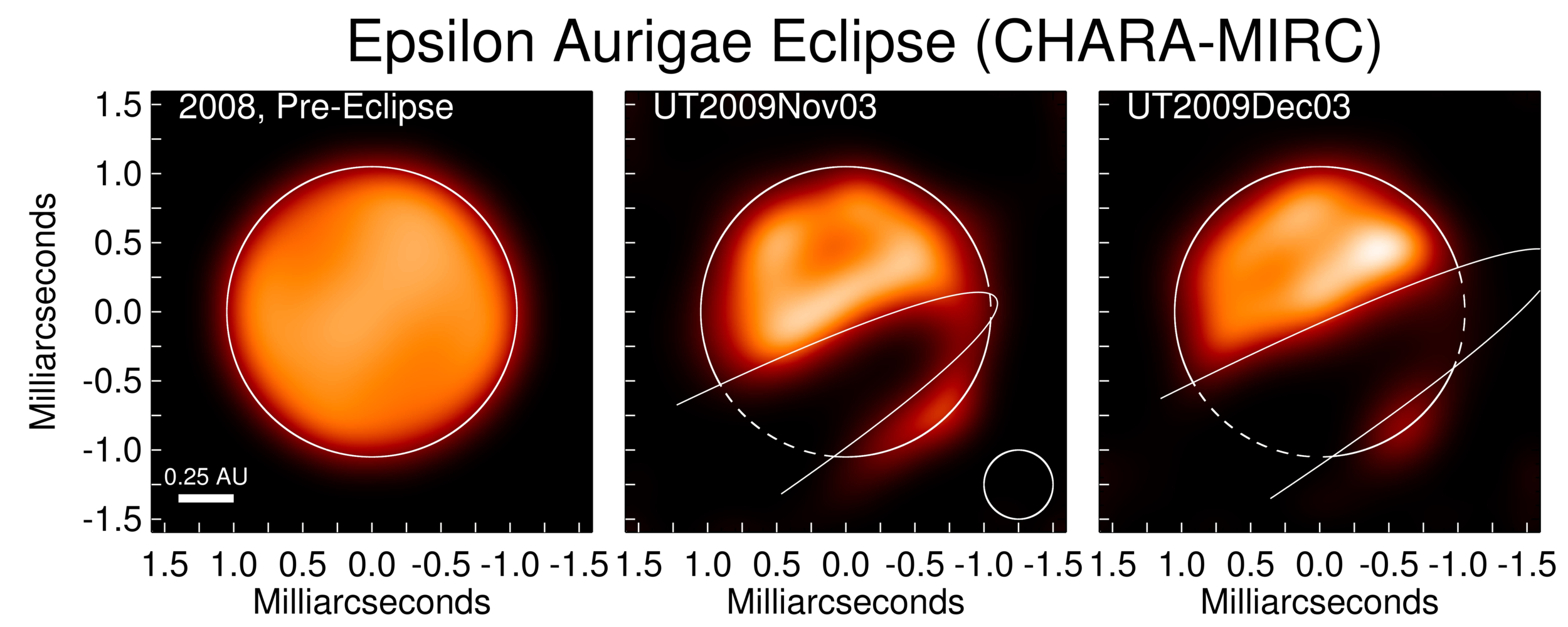
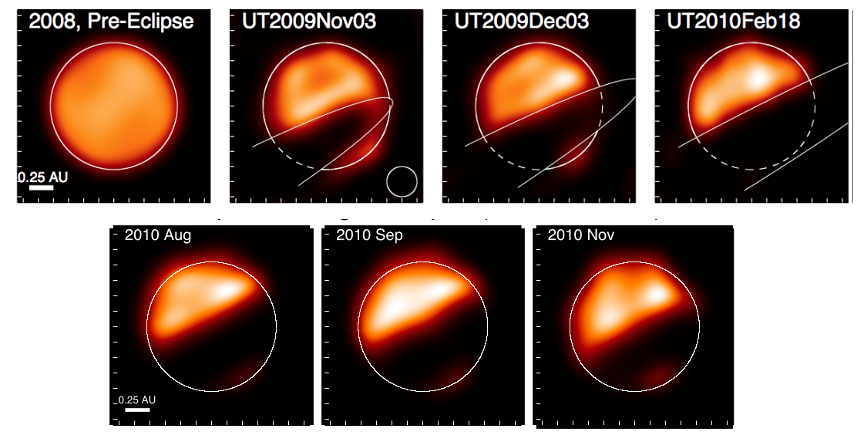
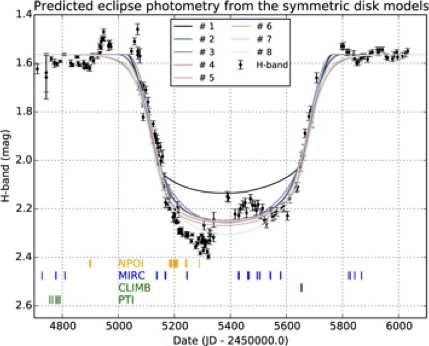
AAVSO, Hopkins et al. (2012)


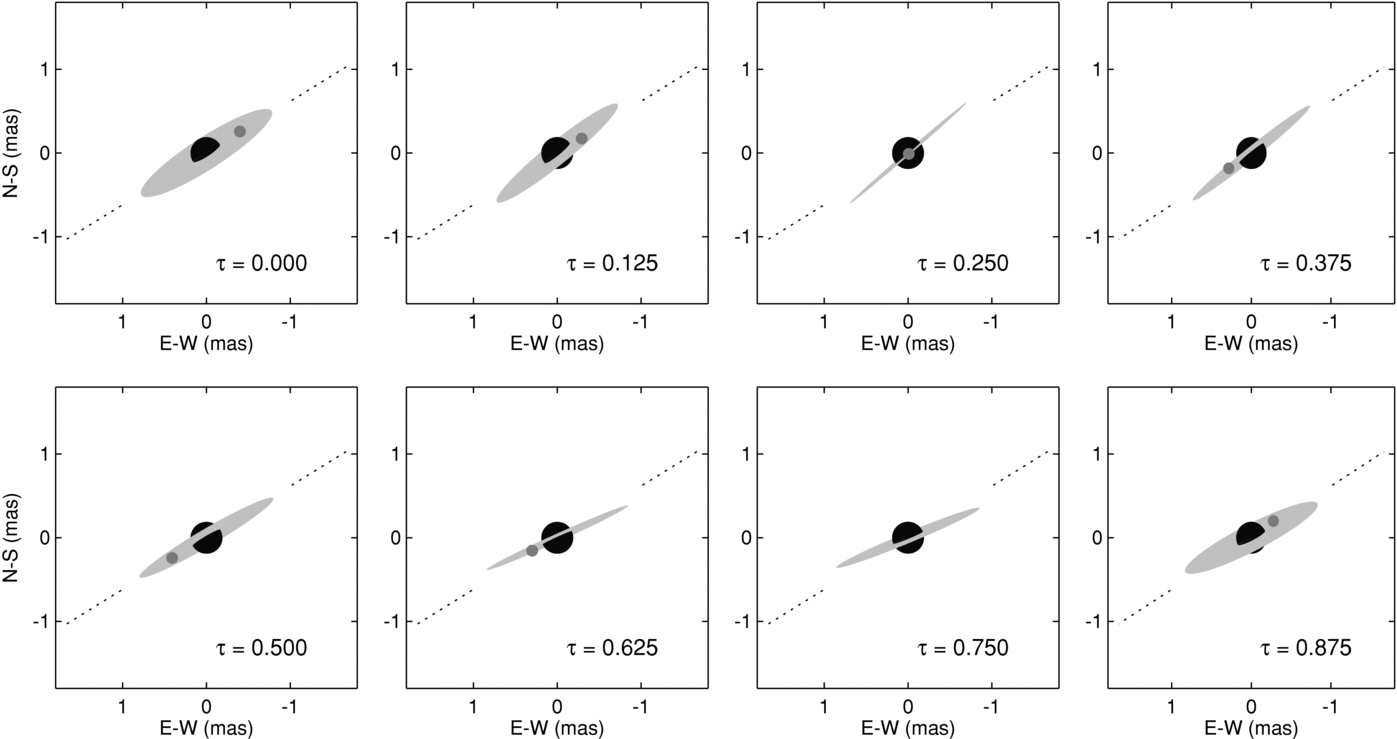
Be stars
P = 12.9 d
a = 0.87 mas

RECENT SCIENTIFIC RESULTS
Exoplanet Systems
- angular size, parallax, and bolometric flux → stellar radius, Teff, and luminosity
Stellar Pulsations
- Cepheid variable stars → period - luminosity relation → distances of local galaxies
- distances, angular diameters, binarity, orbits, masses, limb darkening, imaging
- independent verification for asteroseismology - particularly important for evolved, core helium-burning stars.
Circumstellar Environments
- planet-forming disks of Young Stellar Objects
- Be star decretion disks - gas from the rapidly spinning star is launched outwards into an ionized gas disk
- massive stars become very luminous and variable as they grow to become cool supergiants.
- asymmetrical mass loss can result from energetic processes in binary systems
Binary and Multiple Star Systems
- fundamental means to measure stellar masses.
-
angular orbit + distance estimate → total mass of components
-
angular orbit + radial velocity orbits → individual masses + independent distance measurement
→ stellar evolution processes and interactions between binary stars
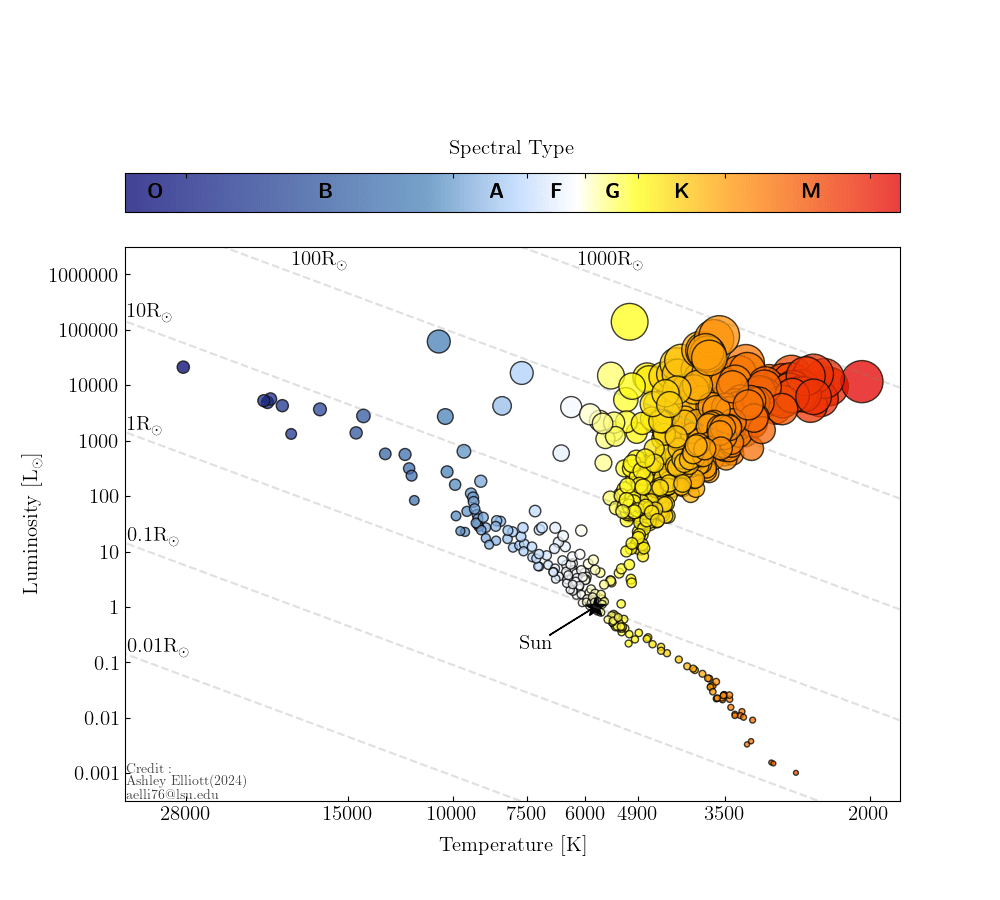
Ashley Elliott 2024
Diameters of Stars
Ashley Elliott (LSU) has compiled interferometric measurements from CHARA and more to create an empirical HR diagram.
Angular Dia. + Parallax → Linear Radius
Diameter + Bolometric Flux → Teff
- masses and ages from evolutionary tracks/isochrones
- evolutionary models
- color-magnitude relations
- surface brightness relations
- asteroseismic scaling relations
SCIENTIFIC RESULTS
interferometric angular diameters provide key benchmark data to evaluate calibrations of effective temperature from large-scale spectroscopic and photometric surveys - SED/CHARA
693 stars, σθ < 5%


Binary & Multiple Stars
Castor A and B
- resolved the inner binary components
- masses and 3D orbits
- mutual orientations of the different components.
HD 284163
hierarchical quadruple system
- orbits of the inner (2.39 d) and first outer (43.1 yr) are nearly orthogonal
- Accurate masses including that of the secondary
- (0.5245 ± 0.0047 M⊙) is now the lowest mass star with a dynamical mass measurement in the Hyades cluster.


Gleise 486
- M3.5 V star at ~8 pc
- transit every 1.467 days.
- MIRC-X → angular size of the the host star
- physical radius and effective temperature.
- transit light curve → ratio of planetary to stellar radius
- exoplanet diameter
- HPRV captured the reflex motion of the star and led to an exoplanet mass
- model of the interior structure and possible atmosphere of this other world in the solar neighborhood.
Exoplanet Systems
Interferometric observations of exoplanet host stars provide the means to determine the detailed stellar characteristics that are required to find the exoplanet properties.
- Radius and Teff of host
- Mass + age from evolutionary tracks
- Size of habitable zone
- Radius of transiting planets


Exoplanet Systems
Planet formation is generally considered in the context of young stars, but mass loss in older stars may also play a role in making planets at the end of a star's life.
Circumbinary disk with close to a polar alignment with respect to the binary orbit.
- Any planet formed in the disk would be relatively stable.
- central cavity in the disk could be result of such a planet.
If so, represents the first example of a polar circumbinary planet.


Image credit: Dr Mark A. Garlick / markgarlick.com
post-AGB star AC Her
- binary system
- surrounded large disk of gas and dust.
- Anugu determined the first 3D orbit for AC Her
- first for any post-AGB system
→ the large cavity in the center of the circumbinary disk is not created by the tidal action of the central binary.
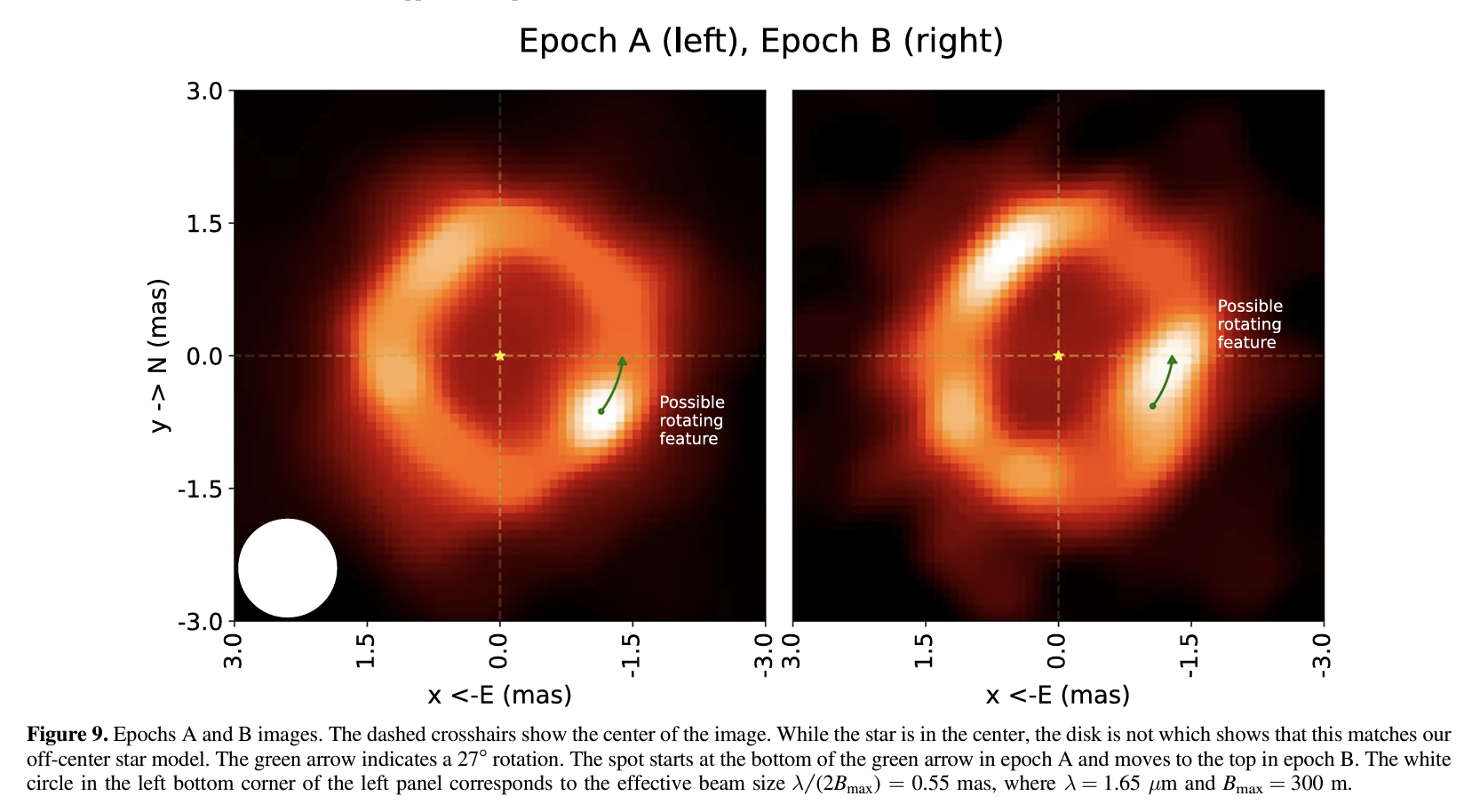
Disks Around Young Stars
The process of planet formation involves the development of instabilities in the disk that can be followed through time series interferometric observations at very high angular resolutions.
luminous Herbig Be star HD 190073
- YSO disk is viewed almost face-on (i<20°)
- clear view of the full extent of the inner gas disk.
- discovered a bright spot in the disk that migrated by 27° over of 32 days
V1925 Aql
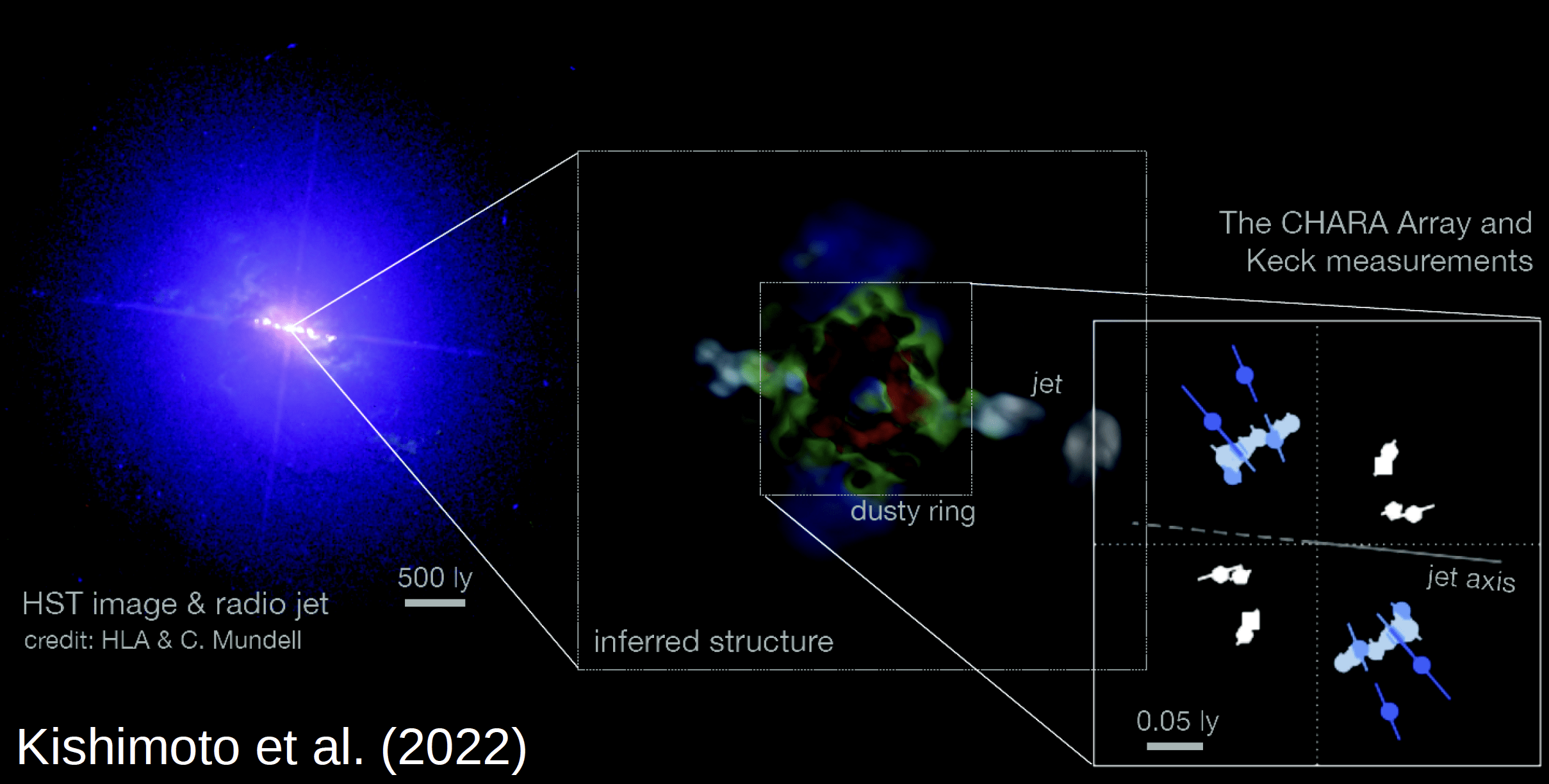
NGC 4151
Active Galactic Nuclei
bright central region of the active galactic nucleus of the Seyfert galaxy NGC 4151.
- Central structure resolved at the 0.5 mas scale.
- ring-like structure viewed at an inclination of 40°
- perpendicular to the radio jet
- K-band flux probably originates in a dust sublimation region on the face of the torus surrounding the black hole.
Exoplanet Systems
-
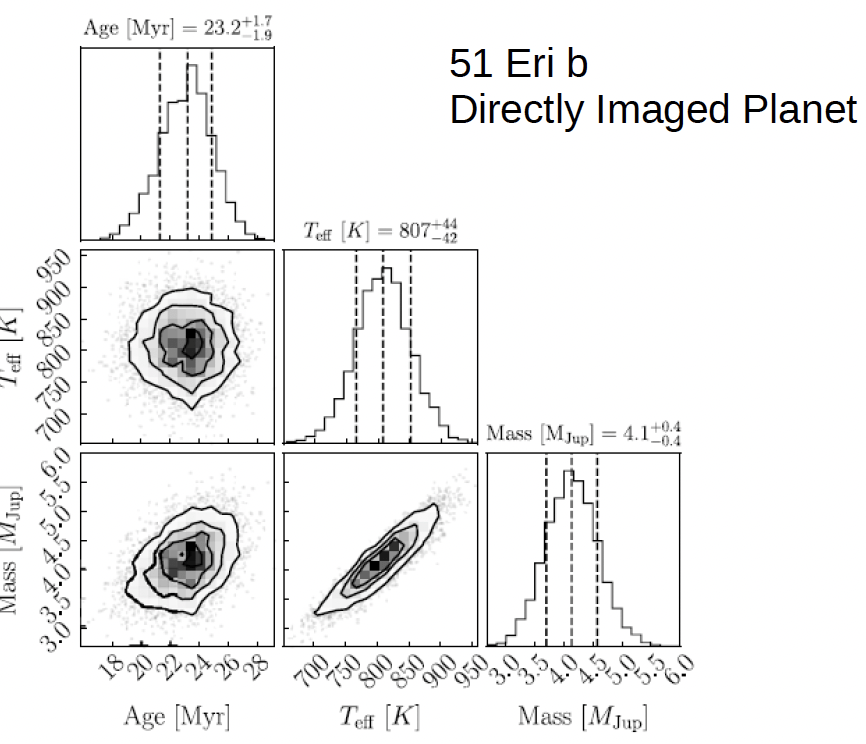
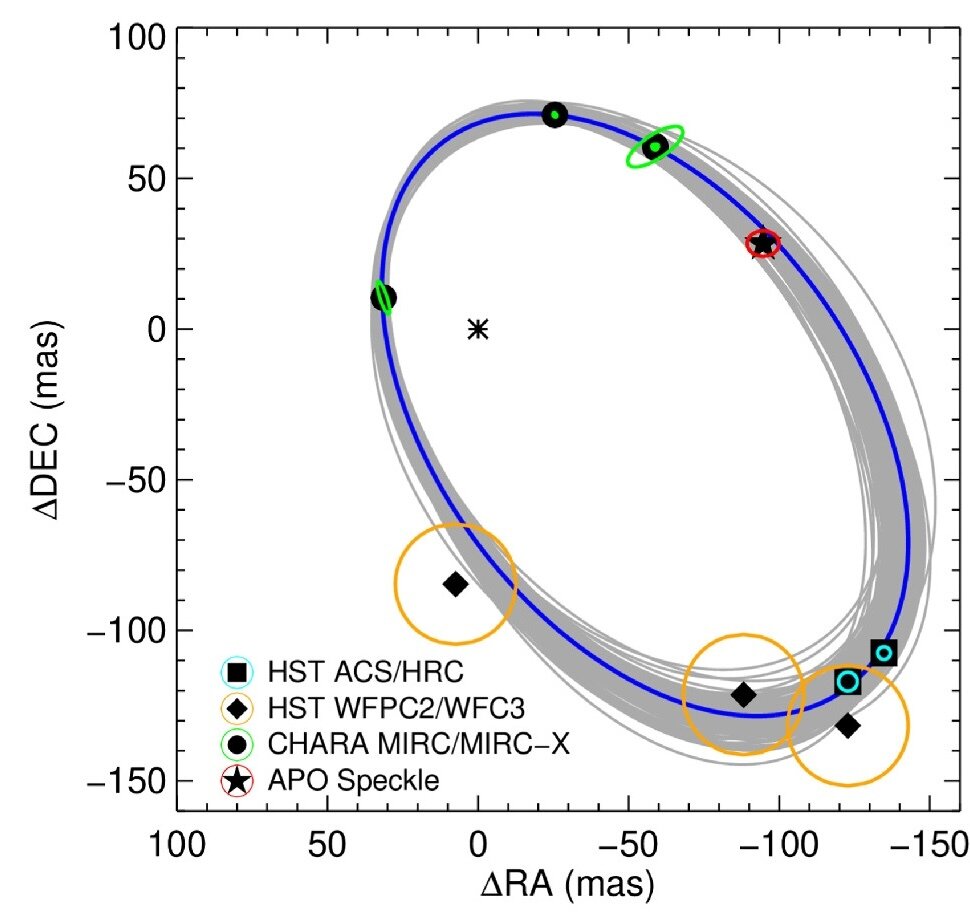
51 Eridani system - resolved planet in 32 yr orbit, PARSEC evolutionary models → stellar mass and age, & a planetary mass of 4MJup Elliott+2024
Stellar Pulsations
- Polaris faint companion detected, 29 yr orbit, Polaris mass 5.13 ± 0.28M⊙, spotted surface image Evans+2024
- various Cepheid model - observation mismatches
Circumstellar Environments
- inner disk of Herbig Ae star HD 163296 → possible tidal wake from wide proto-planet Setterholm+2025
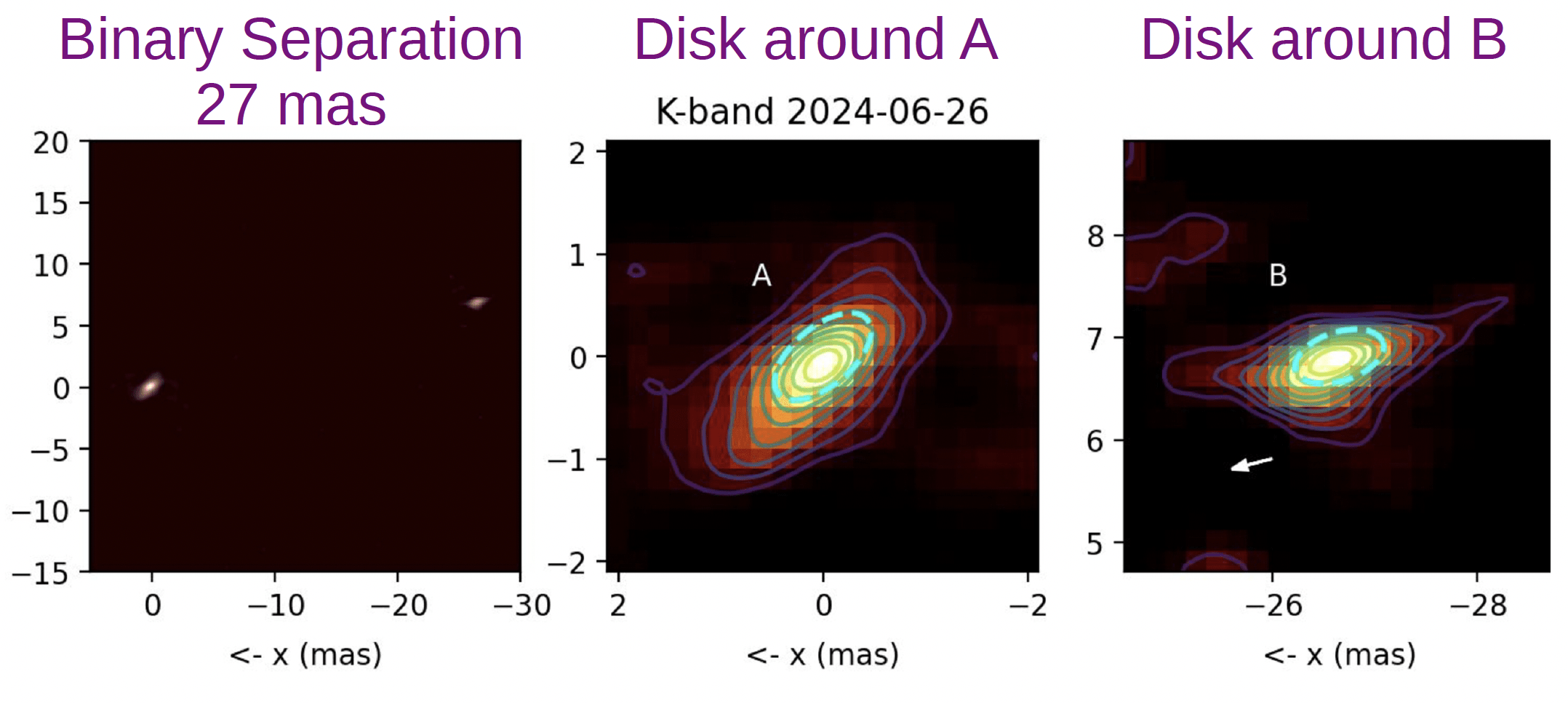
- binary disk system Ibrahim+2026
- T Tauri HD 143006 - inner/outer disk misalignment mystery Codron+2025
- post-mass transfer Be star, smallest orbit yet resolved by the Array = 0.663 mas Rivinius+2026
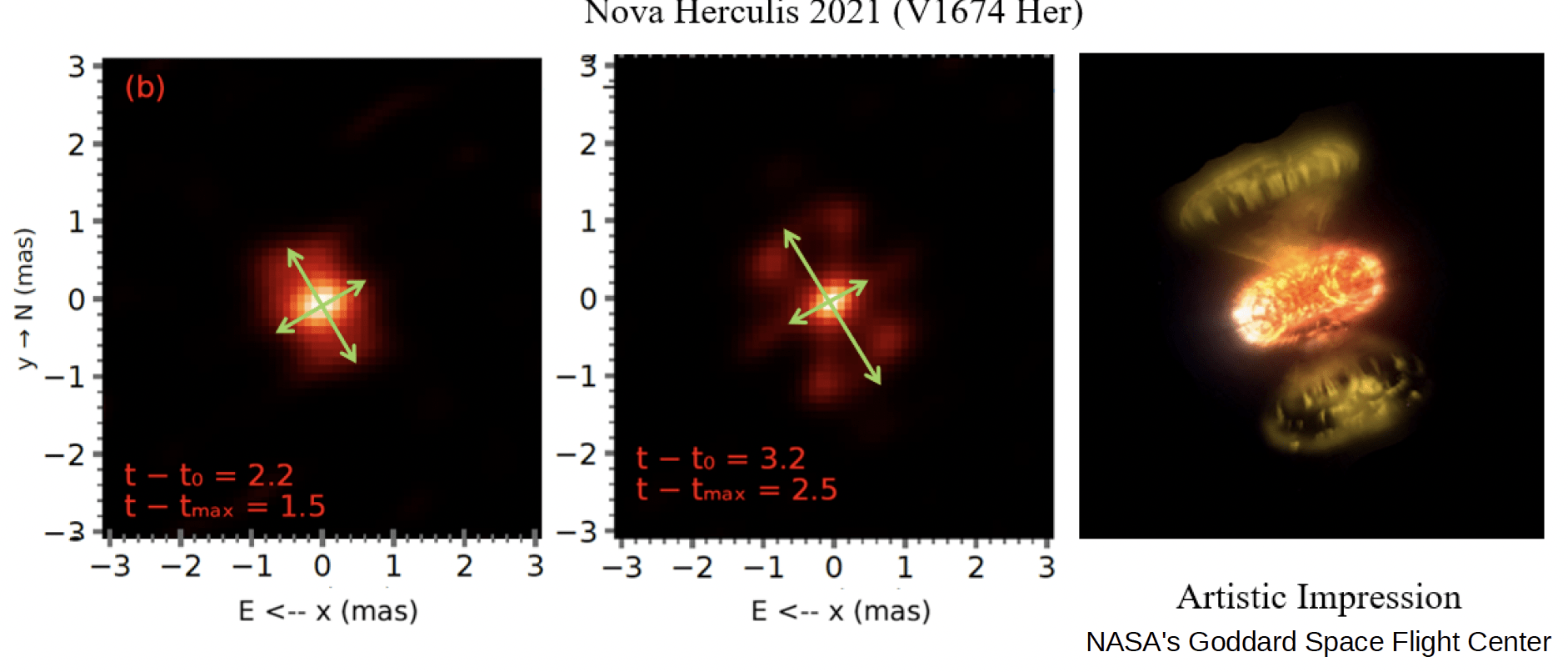
- imaging of fast nova V1674 Her and slow nova V1405 Cas Aydi+2025
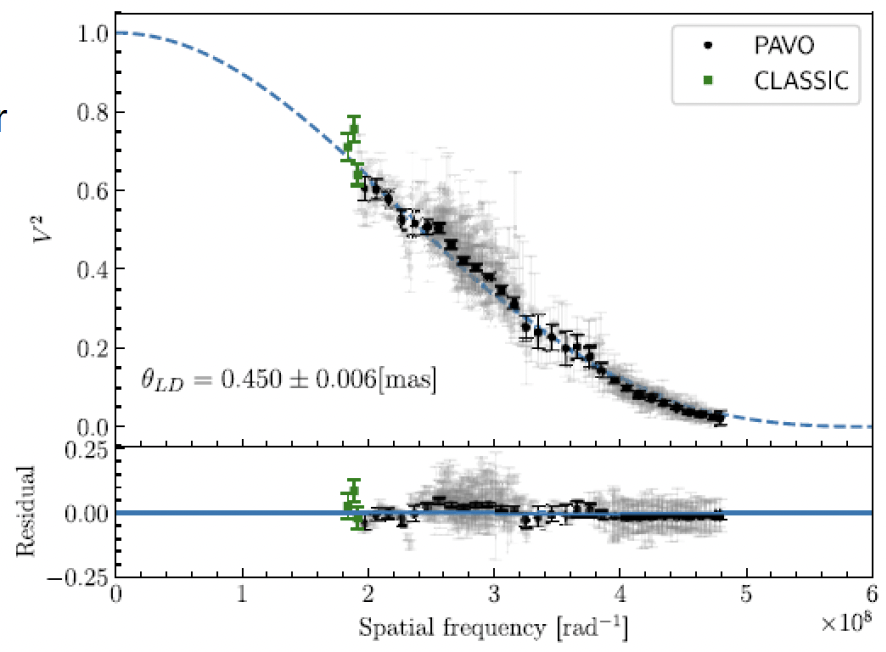

Interferometric Methods
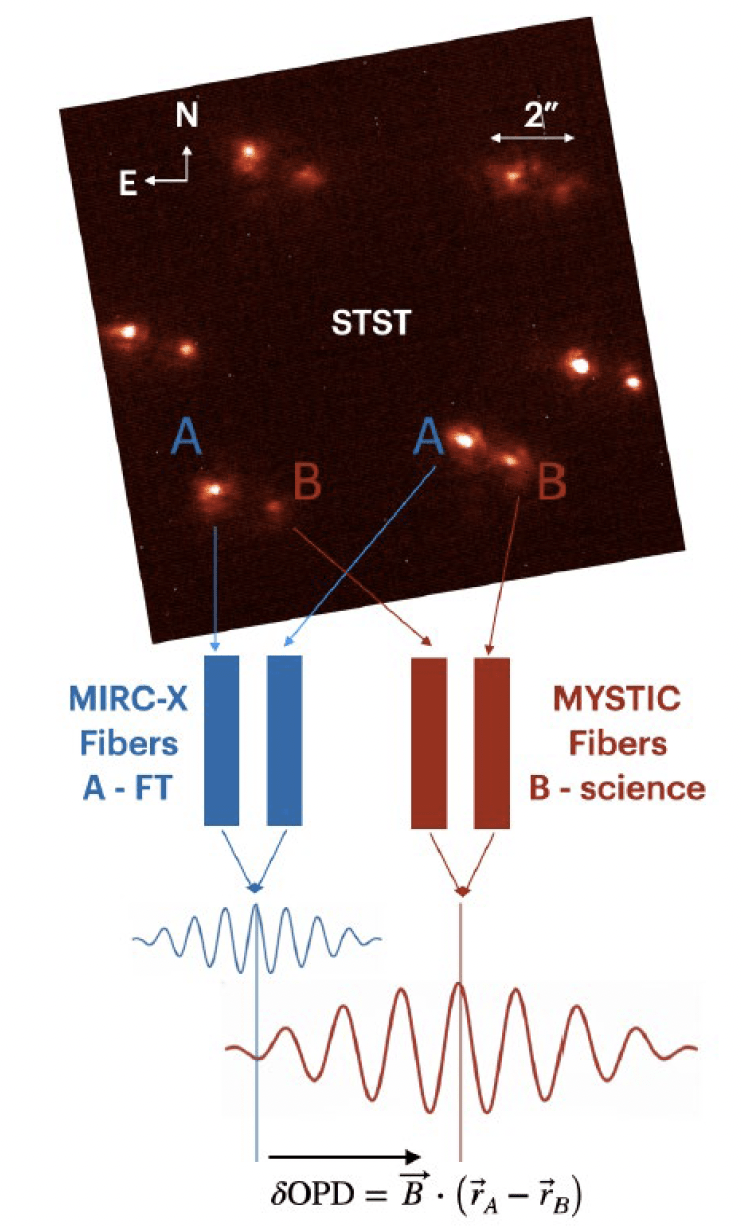
Anugu+2026 first experiments in dual field interferometry at the CHARA Array
- 5" fov into MIRC-X/MYSTIC combiners individually
→ yields measurements of the differential positions
- fringe track on one target and integrate on the other (fainter) target
- observations of the α Psc multiple system.
- B component is itself a close binary
α Psc → hierarchical triple.
Anugu et al. (2026)
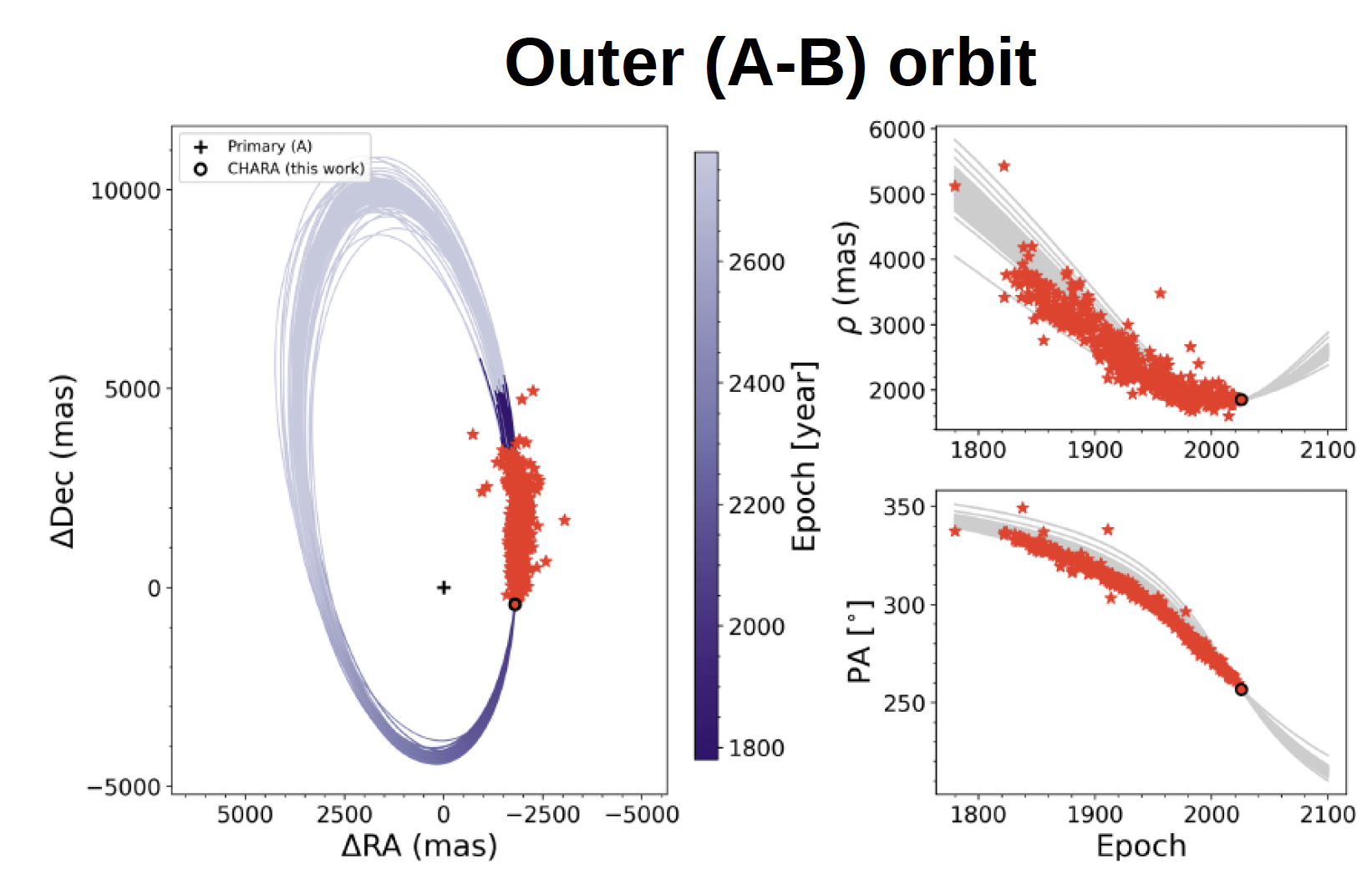
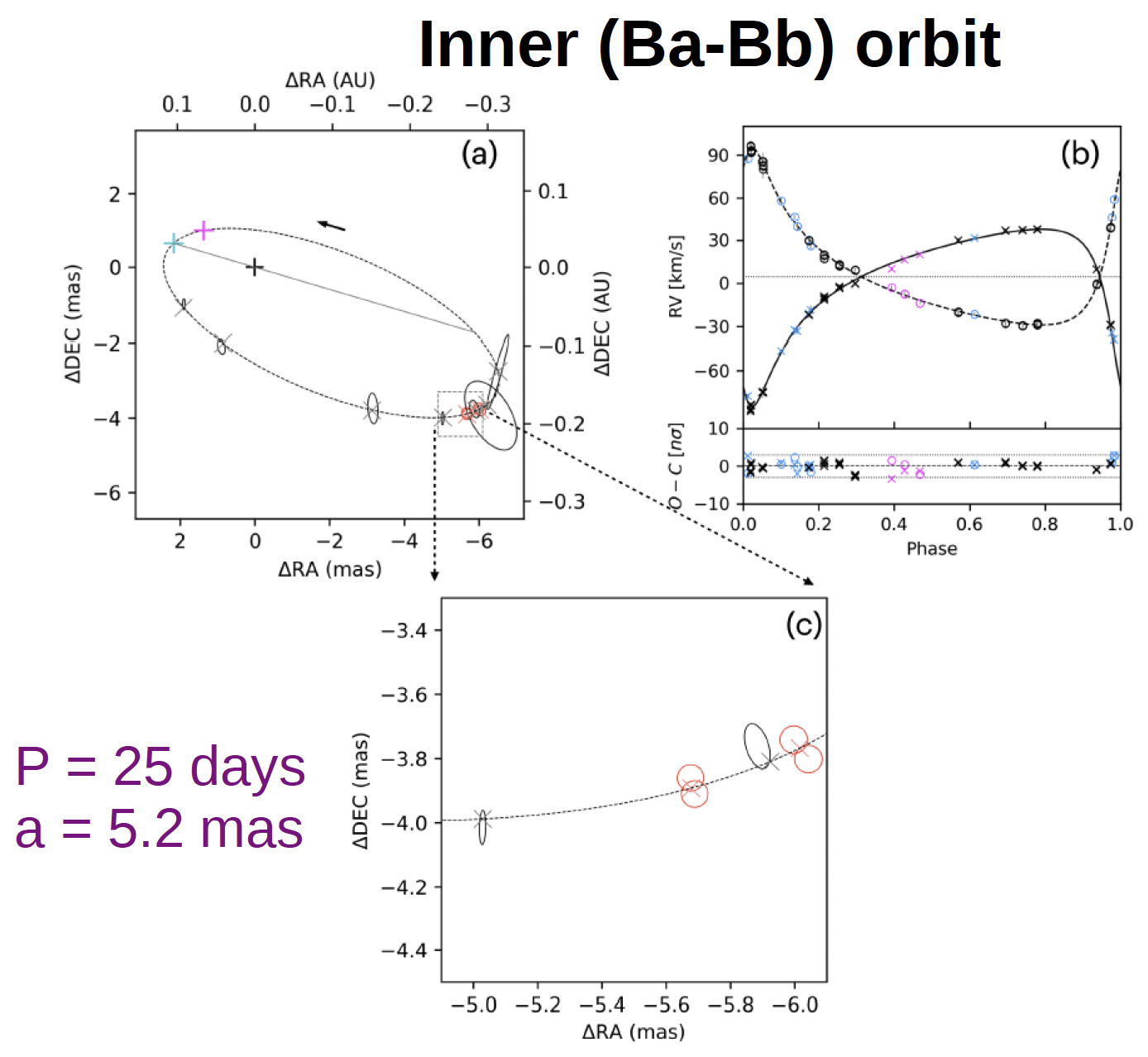
ρ = 1.85"
Outer A-B
-
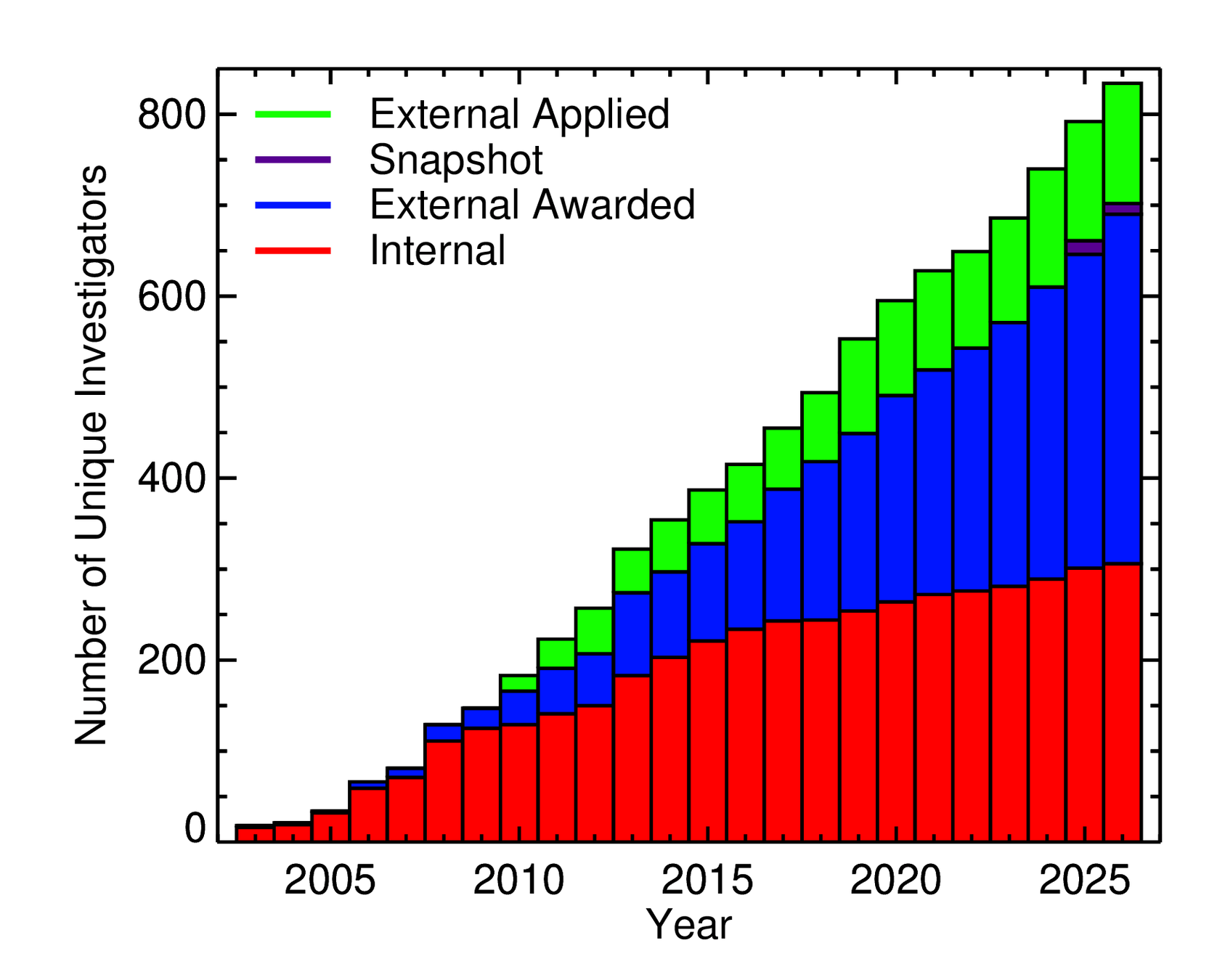
468 proposals submitted since 2010
-
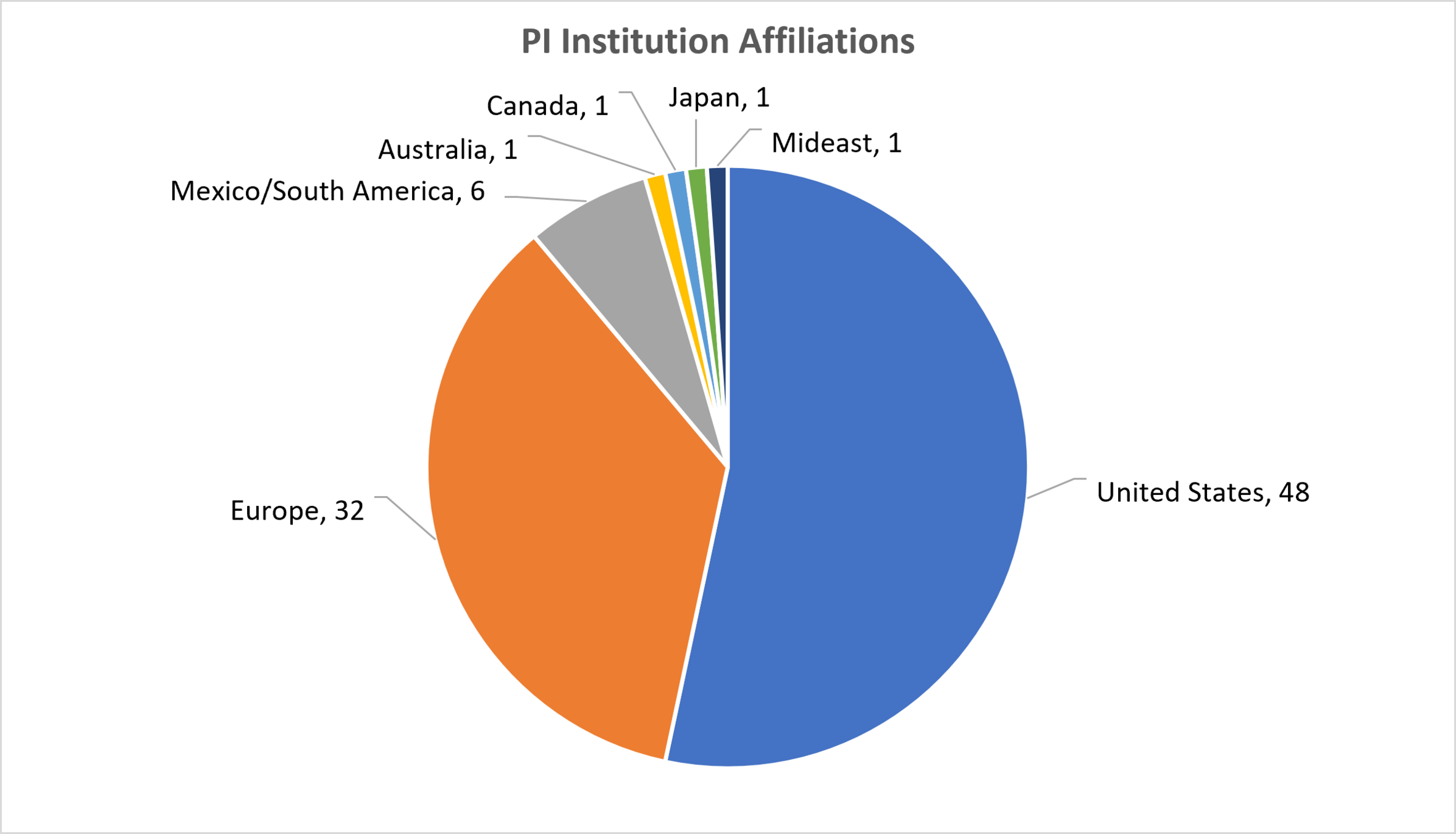
132 unique OA PIs
-
90 distinct institutions
-
up to 300 nights over 3 years of open access time via NOIRLab
-
dedicated to community growth in US and beyond
-
staff assist new investigators with planning observations, collecting data, and reducing data
-
calibrated oifits files provided
NOIRLab Open Access
- started in 2025
- 1n per month available
open to all observers
- confirmation of high impact findings
- feasibility exploratory
- following-up on events
- completion to allow publication
New Fast Turnaround Snapshot Imaging Mode
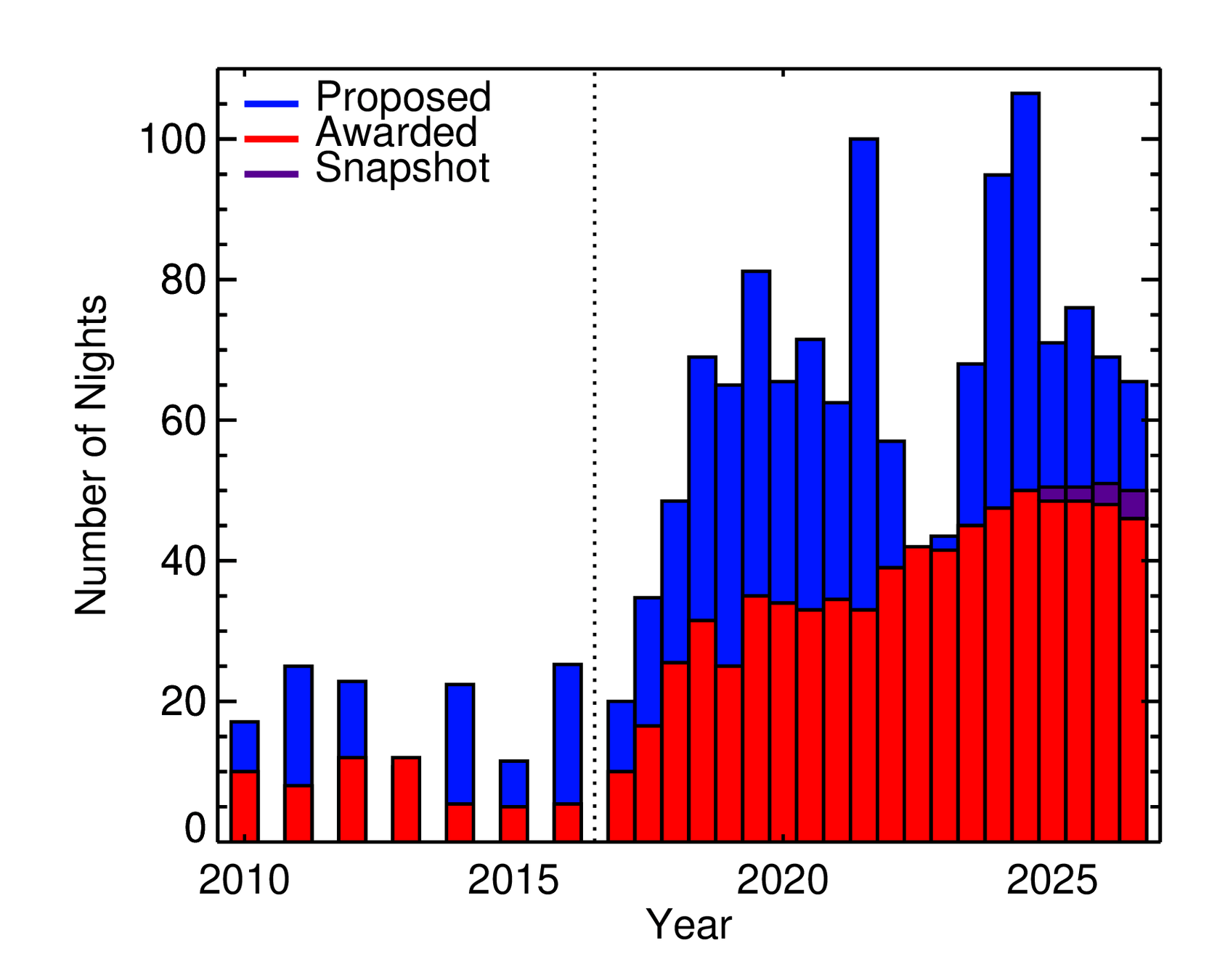
Priority for observers who do not have existing time and for targets not already included in programs with awarded time.
https://chara.gsu.edu/observers/applying-for-chara-time
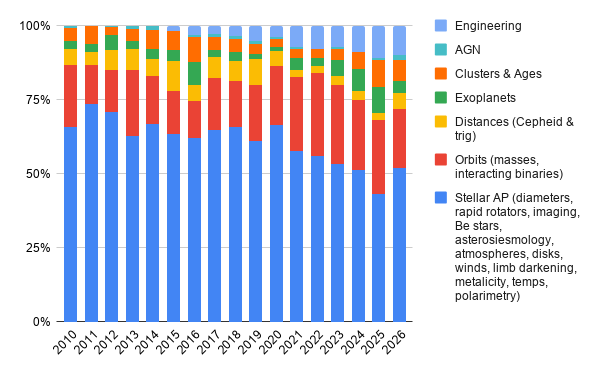
| Stellar AP |
| Diameters |
| Rapid Rotators |
| Surface Imaging |
| Be Stars |
|
Asterosiesmology |
|
Stellar Atmospheres |
| Disks |
| Stellar Winds |
| Limb Darkening |
| Metalicity |
| Temperature |
| Polarimetry |
| Orbits |
| Masses |
| Interacting Binaries |
| Distances |
|
Cepheid Distance |
| Trigonometric |
Exoplanets
Clusters & Ages
AGN
Engineering
Program Stats (2010-2026)
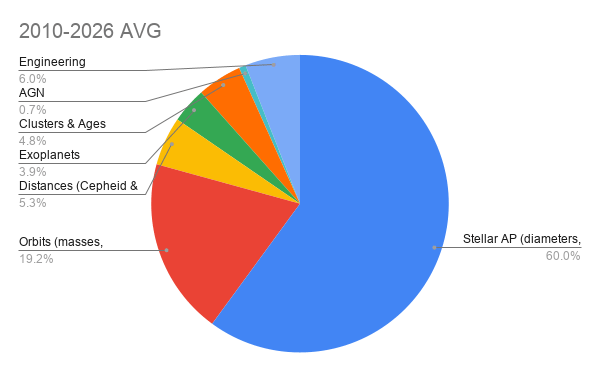
<5% loss to technical issues
Future Plans
- telescope dichroic & STST upgrade ($1.4m NSF MRI1 funded)
-
optimize simultaneous observations in visible + NIR
-
- AOB upgrades ($16k GSU funded)
- automated alignment/tracking
- painting/AC at domes
- continue quantum initiatives
- exploring the feasibility of a B-band combiner (440 nm) → 0.13 mas
- next-gen AO systems
- fibers to all telescopes
- W5/Channel 13 site (1100m)
- expanded / double-pass delay
- nulling instrument(s)
- central 2m telescope
- upgrade existing 1m telescopes to 2m telescopes
- The Michelson Array
2028
2028+
AO upgrades
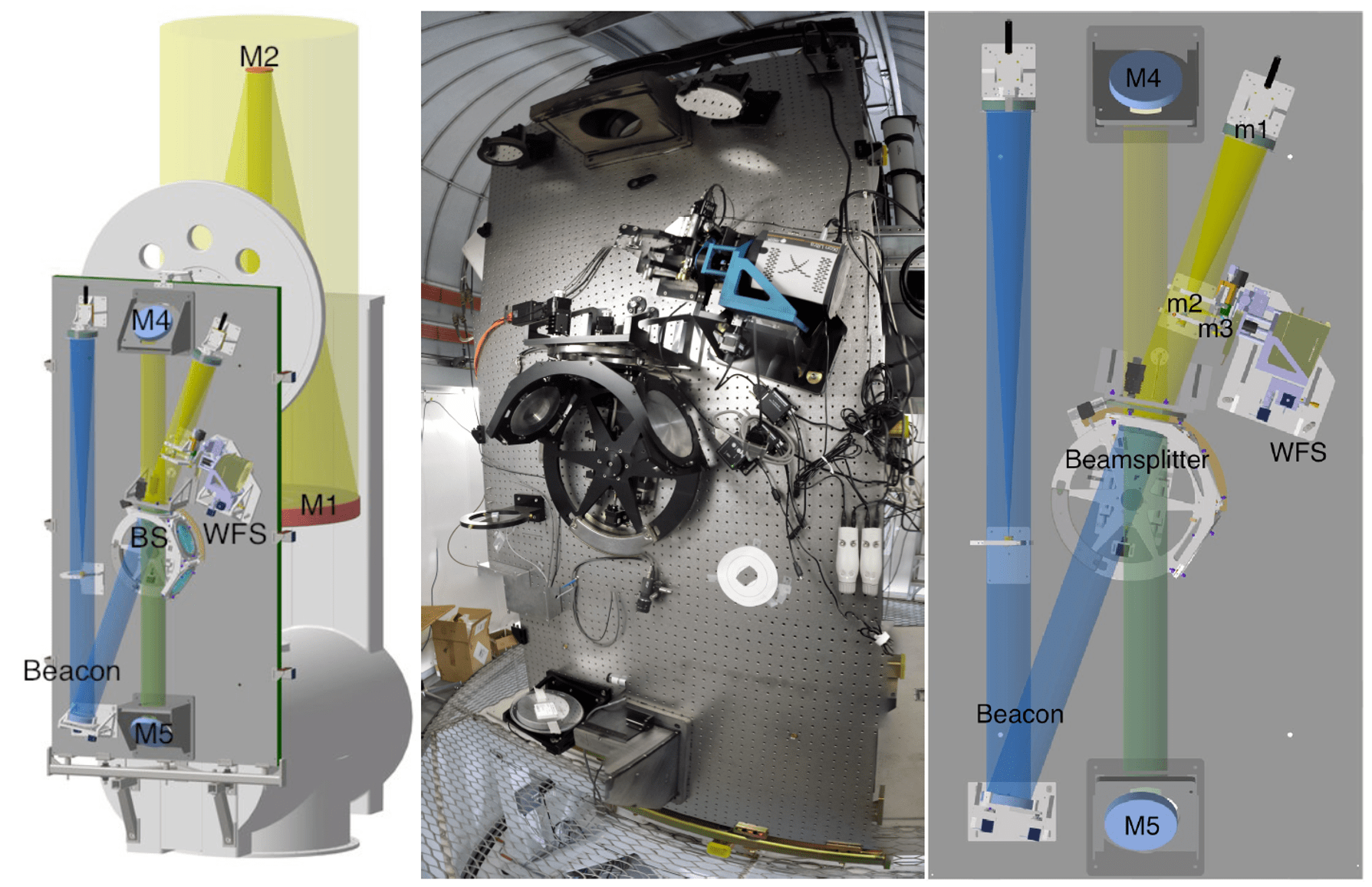
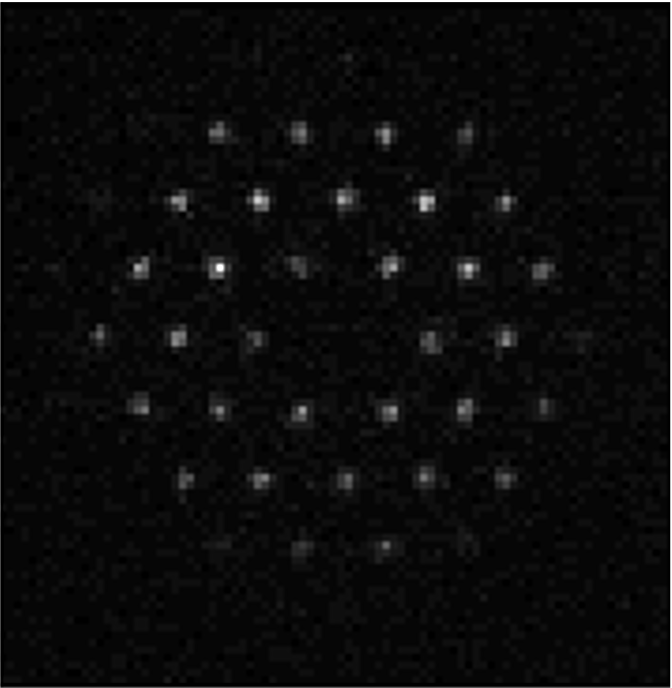
Current sensitivity limits:
- Tiptilt, AO: V = 10-12 mag
-
Visible/NIR fringe recording: 8.0 mag
-
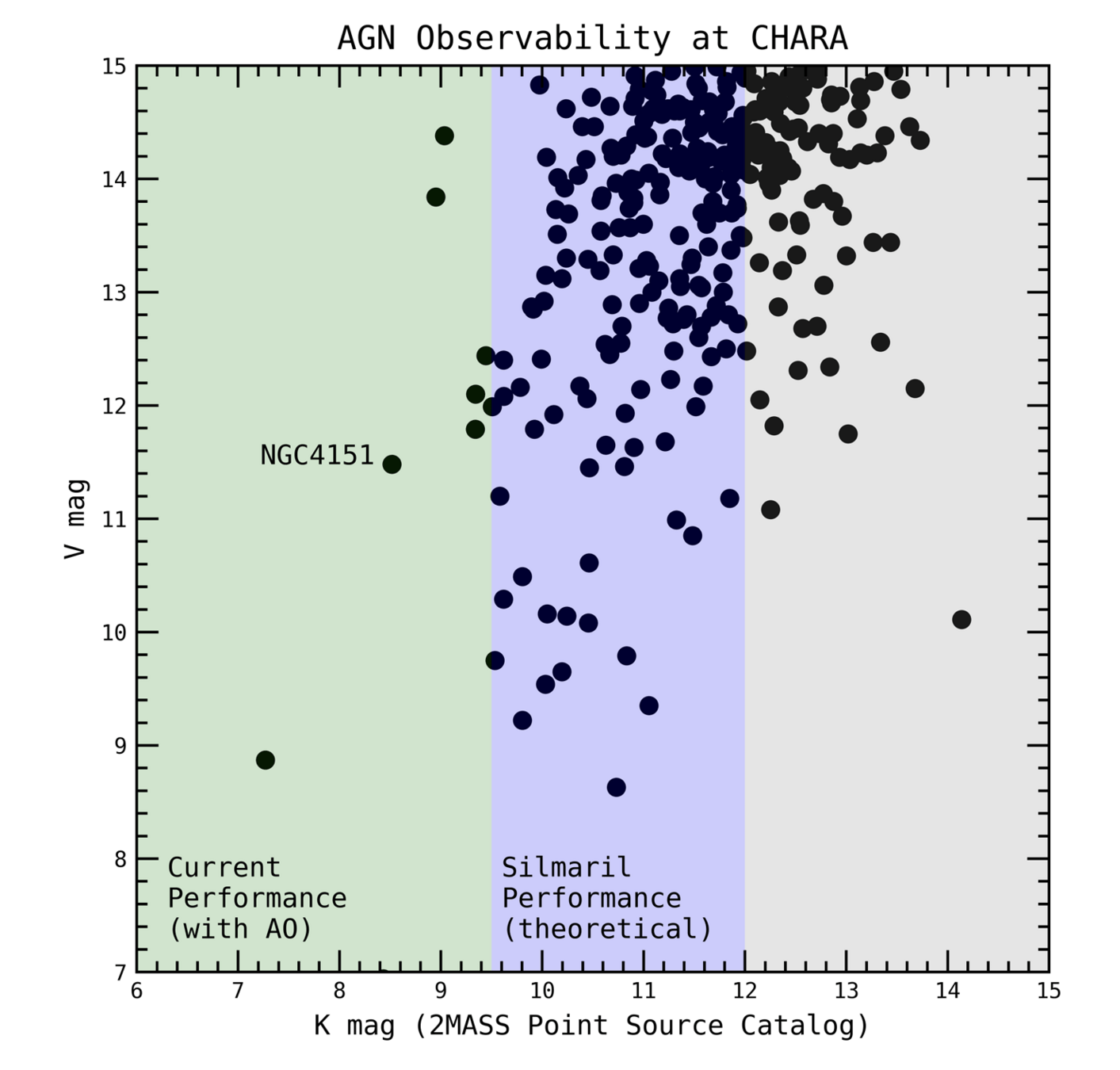
Sensitivity improvements → K = 10-11 mag
- WFS / control max 1kHz / 13-18Hz
-
Injection into fibers at telescope
-
STST Strehl~55–70% (H), 5-15% (R)
Next-gen AO system (planning):
- new DM, WFS(s), ADC
- 90-100 actuators (50-60 sub-apertures)
- current beam dia or compress/re-expand?
- DM at M4 or move elsewhere (M2?)
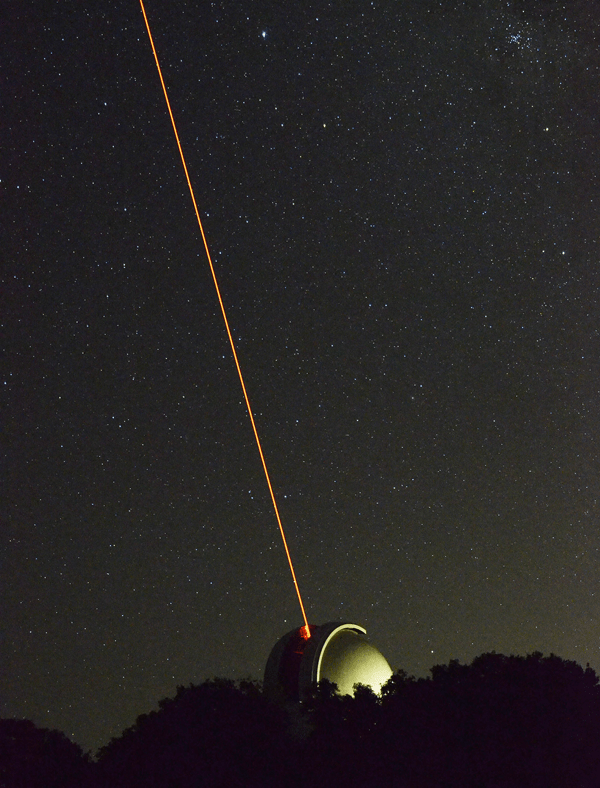
- UV LGS
- reduce maintenance & alignment
- Strehl from 12-15% → >50% in R-band

CHA


Central 2m Telescope
- Vacuum beam transport with fiber option
- Bundled with Delay Line Upgrades
20 to 1100m
• 0.06 mas at R
• 0.16 mas at H
• 0.20 mas at K
The full Michelson Array would offer 12 total positions, creating 66 possible baselines.
Image an exoplanet during transit
There are some 250 known exoplanets with host stars accessible to CHARA.
The new baselines will enable resolution of solar-like stars out to about 70pc in H-band.
Numerical simulations of the transiting hot-Jupiter in HD189773 indicate that the silhouette of the planet can be measured in long baseline observations made during transits.

HD189773
- AGN: dust sublimation and accretion disk could be resolved, binary black holes at the center?
- High contrast/contact/interacting binaries - Outflow/ejection/dimming events, Be star circumstellar disks relations
- Red giant ages
- Star and planet formation: enabled by greater UV coverage, sensitivity, & longer baselines
- Massive stars
- Cool stars
- HR diagram diameters: extended into late type stars
- Solar System Science: Asteroids bright enough are too big for original Array,CMAP+Silmaril → break discrepancies between radar and reflectance measurements
- Other mission support: HWO, JWST and ELT candidate finding and follow-up, Space mission technology testbeds?
"Priorities will include stellar system evolution: planetary formation and young stellar objects, imaging the sites of planet formation in the inner region of circumstellar disks, and measuring the contraction of pre-main sequence stars."
2040 CHARA Science Cases
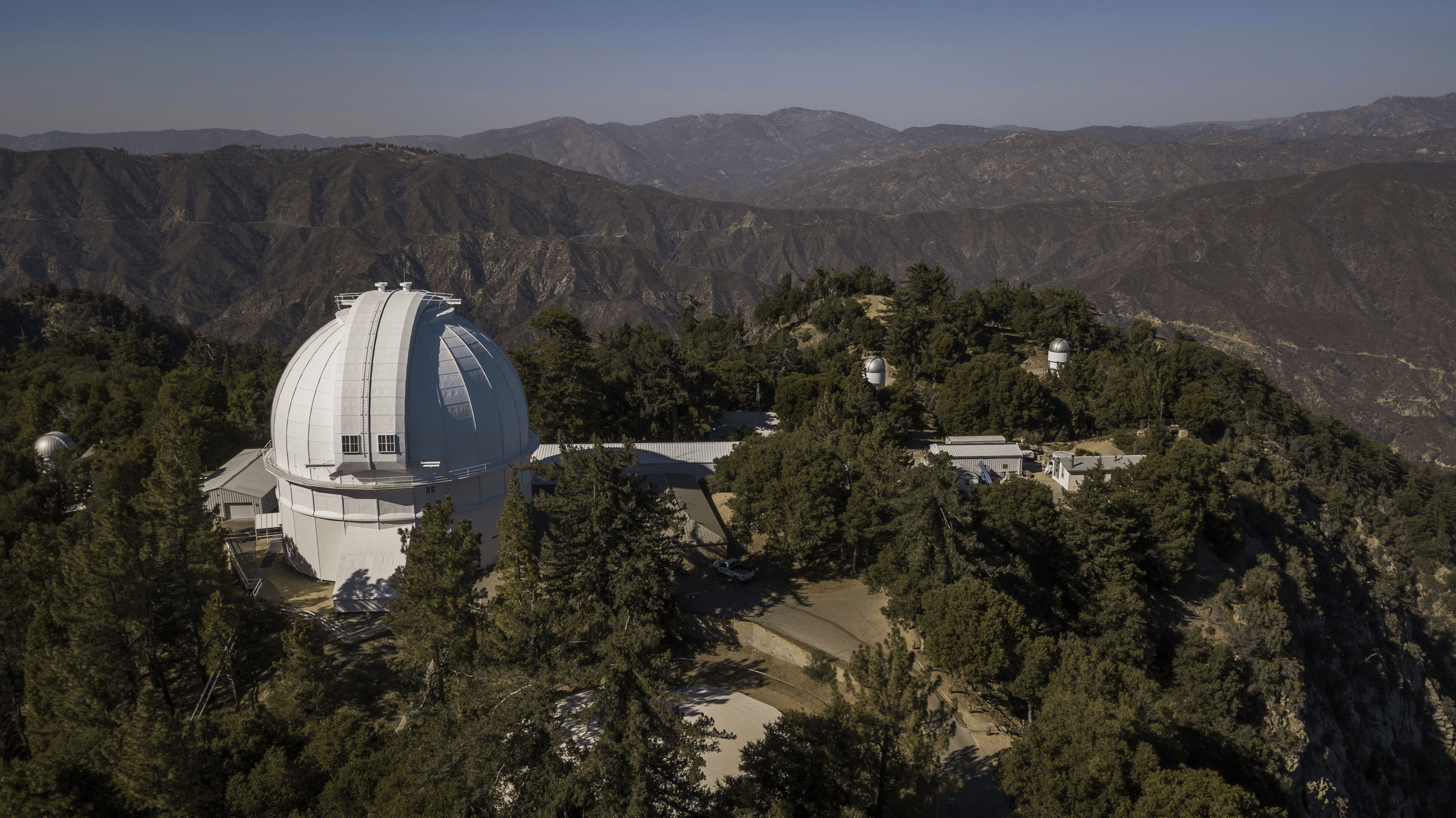
The CHARA Array is supported by the US NSF under grants AST-2018862, 2034336, 2407956, 2511059.
The role of the CHARA Array continues to expand...
- from a university program to community research interests
- providing student access and training opportunities
- serving public outreach activities and those of the Mount Wilson Institute
- supporting observational astrophysics programs and innovative instrument development
- commissioning of new beam combiners, testbeds, the use of fiber optics beam transport for interferometry
We plan to further expand new frontiers in instrumentation through collaboration and to support long-term initiatives for interferometry and the development and testing of new technologies that will provide the foundation for future very large long-baseline interferometers.
[1] Eisenhauer et al. ARA&A 61, 237–285 (Aug. 2023).
[2] Wright, H., “Explorer of the Universe,” AIP (1994).
[3] ten Brummelaar et al. ApJ 628, 453–465 (July 2005).
[4] McAlister, H. A. and McAlister, S. J., “The 2009 Station Fire Threat to Mount Wilson Observatory,” Amazon (2019).
[5] Gies et al. (SPIE) Conference Series 13095, 1309502 (Aug. 2024).
[6] Elliott et al. PASA 41, e043 (Sept. 2024).
[7] Balmer et al. ApJ 1001, L26 (Apr. 2026).
[8] Gardner et al. AJ 171, 30 (Jan. 2026).
[9] Ertel et al. PASP 137, 031001 (Mar. 2025).
[10] Evans et al. ApJ 971, 190 (Aug. 2024).
[11] Evans et al. ApJ 972, 145 (Sept. 2024).
[12] Gallenne et al. A&A 693, A111 (Jan. 2025).
[13] Chowhan et al. MNRAS 548, stag719 (May 2026).
[14] Setterholm et al. AJ 169, 318 (June 2025).
[15] Ibrahim et al. ApJ 947, 68 (Apr. 2023).
[16] Ibrahim et al. ApJ 998, 10 (Feb. 2026).
[17] Codron et al. MNRAS 541, 1600–1612 (Aug. 2025).
[18] Rivinius et al. A&A 694, A172 (Feb. 2025).
[19] Anugu et al. ApJ 973, L5 (Sept. 2024).
[20] Anugu et al. ApJ 974, 113 (Oct. 2024).
[21] Mobeen et al. A&A 686, A260 (June 2024).
[22] Aydi et al. Nature Astronomy 10, 271–280 (Feb. 2026).
[23] De Furio et al. ApJ 990, 54 (Sept. 2025).
[24] Danner et al. ApJ 988, 113 (July 2025).
[25] Torres et al. ApJ 990, 107 (Sept. 2025).
[26] Torres et al. ApJ 971, 31 (Aug. 2024).
References
[27] Richardson et al. ApJ 977, 78 (Dec. 2024).
[28] Lau et al. ApJ 963, 127 (Mar. 2024).
[29] Holdsworth et al. ApJ 977, 185 (Dec. 2024).
[30] Shepard et al. ApJ 977, 236 (Dec. 2024).
[31] Torres et al. ApJ 977, 43 (Dec. 2024)
[32] Anugu et al. JATIS 12, 015008 (Jan. 2026).
[33] Shuai et al. AJ 170, 344 (Dec. 2025).
[34] Anugu et al. AJ 171, 253 (Apr. 2026).
[35] Magri et al. MNRAS 536, 266–273 (Jan. 2025).
[36] Roettenbacher et al. Nature 533, 217–220 (May 2016).
[37] Dholakia et al. PASP 138, 054504 (May 2026).
[38] Mourard et al. A&A , submitted (2026).
[39] Anugu et al. AJ 160, 158 (Oct. 2020).
[40] Setterholm et al. JATIS 9, 025006 (Apr. 2023).
[41] Mourard et al. (SPIE) Conference Series 13095, 1309503 (Aug. 2024).
[42] Lanthermann et al. (SPIE) Conference Series 12183, 121830N (Aug. 2022).
[43] Lanthermann et al. (SPIE) Conference Series 13095, 1309505 (Aug. 2024).
[44] Anugu et al. (SPIE) Conference Series 13095, 130951B
(Aug. 2024).
[45] du Foresto et al. SPIE (2003).
[46] Lhomé et al. SPIE (2012).
[47] Scott et al. JATIS 02(02), 1340005 (2013).
[48] Scott et al. SPIE (2014).
[49] Siliprandi et al. Appl. Opt. 63, 159–166 (Jan 2024).
[50] Gies et al. [Bulletin of the American Astronomical Society], 51, 226 (Sept. 2019).
[51] Rajagopal et al. (SPIE) Conference Series 13095, 130951N (Aug. 2024).
[52] Mourard et al. A & A (2026), accepted

backup slides
Binary and Multiple Star Systems
-
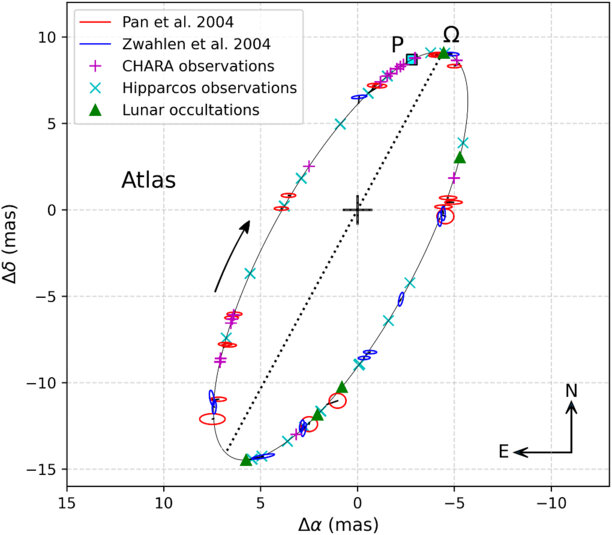
Pleides member star, Atlas: orbit, mass, and rotational distortion of evolved primary Torres+2025
-
interferometry + spectroscopy of 6 solar-mass binaries in the Hyades cluster Torres+2025
Interferometric Methods
- first experiments in dual field interferometry at the CHARA Array Anugu+2026
-
α Psc → hierarchical triple system
-
- observations of Vega via 2x 240m fibers at 810nm from S1 & S2 Magri+2025
-
starspot locations on rotating stars using spherical harmonics
-
open-access code harmonix → reconstruct the intensity map based upon a simulation of observations Dholakia&Pope2026
-
Binary and Multiple Stars
Torres+2025 binary star Atlas, in the Pleiades cluster, age = 104 Myr
- 291d angular orbit + radial velocity measurements → mass 5.04 ± 0.17M⊙ and 3.64 ± 0.12M⊙.
- brighter star is rapid rotator
- rotationally distorted shape + spectroscopic projected rotation velocity → equatorial rotational velocity of 233 ± 45 km s−1 (77% of the critical)
→ Rotational distortion of evolved primary
Relative orbit of companion to Atlas
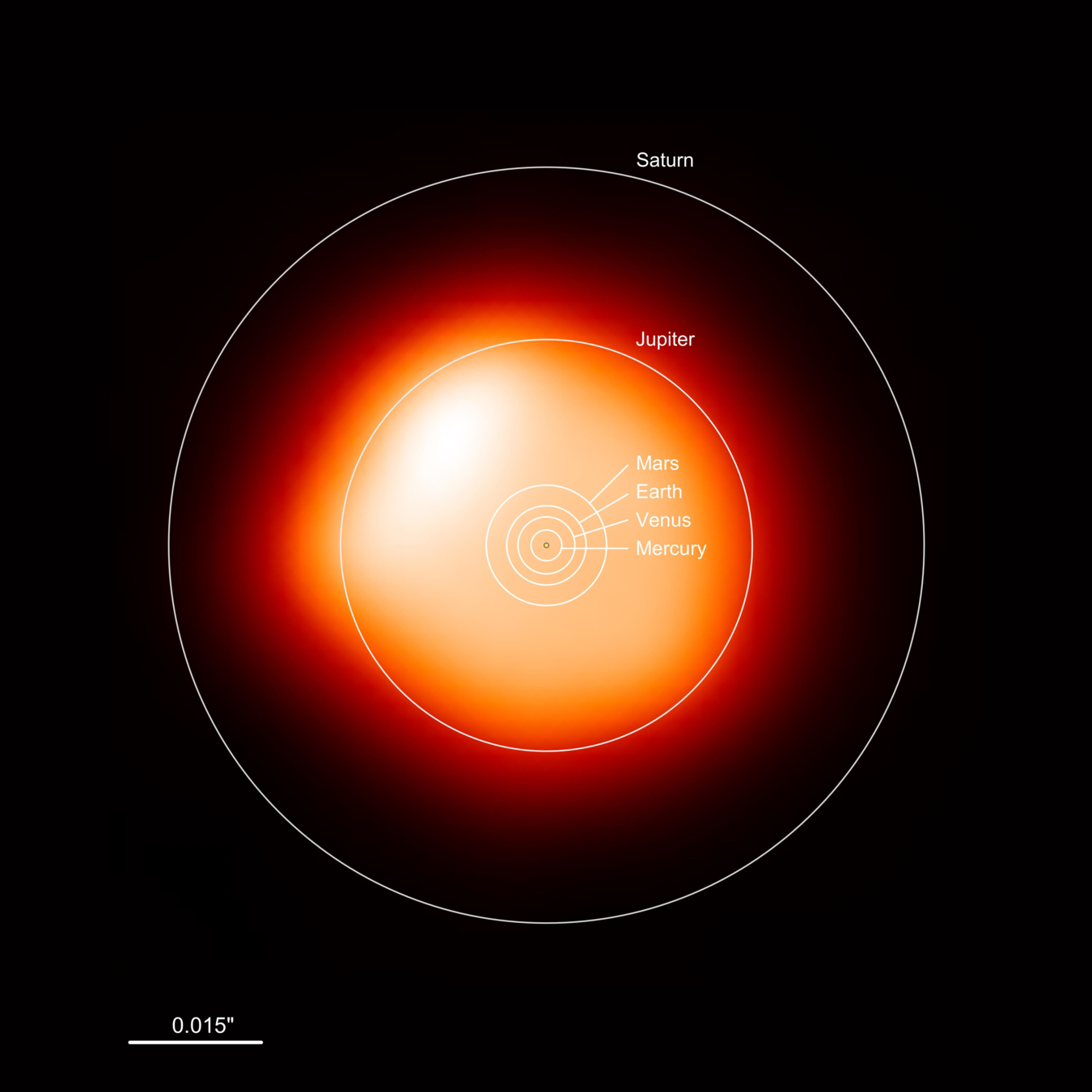


Image Reconstruction of AZ Cyg
Norris et al. (2021)
Model Simulation
Chiavassa et al. (2010)
Giant star surfaces
These "closure phases" also yield information about source symmetry
Combine the phases measured in a closed triangle of three telescopes in a way that cancels out the atmospheric turbulence.
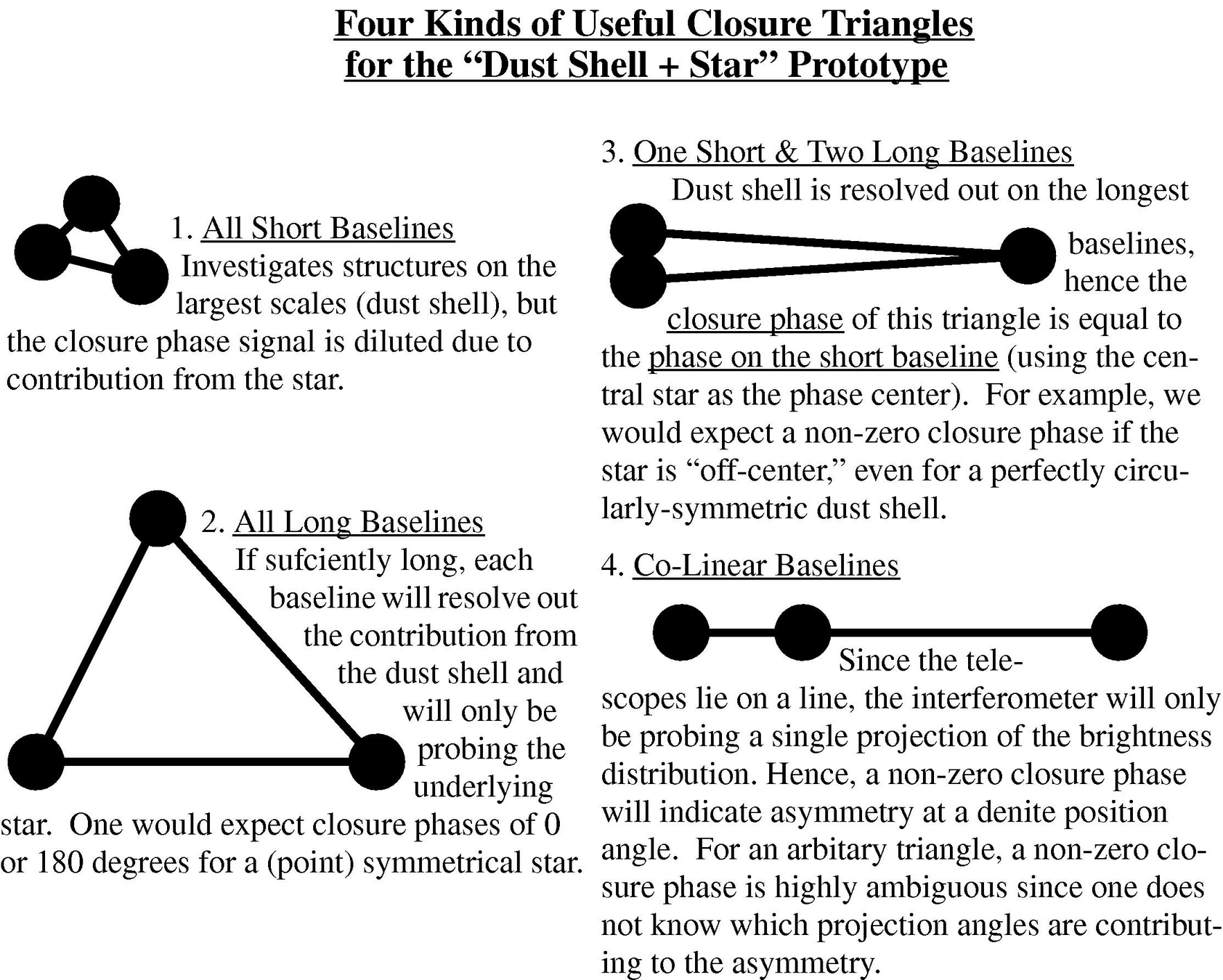
symmetry
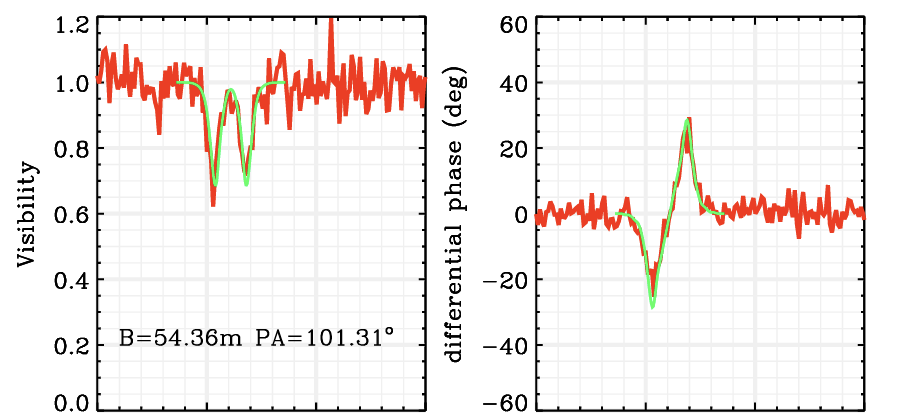
Spectrally dispersed fringes produce differential visibilities and differential phases
- visibility and phase of emission lines relative to the stellar continuum.
- measure the size and velocity structure of rotating circumstellar disks, outflows, and winds around stars.
Differential Vis and Differential Phases
Star + disk.
- drop in the visibility across the emission lines indicate that the disk is more resolved than the stellar continuum.
- double-peaked profile corresponds rotating disk.
- S-shaped profile shows a shift in the photo-center across the wavelength channels.
Exoplanet Systems
Gardner+2026 searched for the NIR signal of the hot Jupiter planet orbiting ups Andromeda
- 1.7MJup mass ~ 4 mas separation, flux should be detectable with CHARA
- 2021 MIRC-X → hints at the expected separation
- 2023 MIRC-X and MYSTIC → no evidence of a planetary flux signal
→ may indicate that the NIR flux is lower than predicted.
Ashley Elliott developed the RADPy code
→ reliable angular diameters of stars from CHARA observations
51 Eridani system
- resolved massive planet in 32 yr orbit
PARSEC evolutionary models
→ stellar mass and age, & a planetary mass of 4MJup
Stellar Pulsations
Evans+2024 investigated the mass of Polaris
CHARA observations made around periastron of a faint companion (2016 - 2021)
- 1300x fainter Polaris in H
radial velocity + angular position measurement → 29.4 yr orbit + Gaia distance → Cepheid mass of 5.13 ± 0.28M⊙
- luminosity > predicted
- additional structure beyond a simple limb darkened disk
- SURFING code image reconstruction revealed a surface with several bright spots
- magnetic spots or convective supergranules?
similar analysis of the Cepheid AW Per
- triple system: 6.8 ± 0.9M⊙ Cepheid and a close binary companion of two similar mass stars → total mass 8.8 ± 0.5M⊙
Relative orbit of Polaris companion from multiple observations
False color image of Polaris in H
Chowhan+2026 PAVO observations of the “secondary red clump” star κ Cyg that exhibits solar-like oscillations
- angular size + Gaia distance → 8.65±0.10R⊙
- oscillation frequencies predicted are poor match to NASA TESS observations
→ mismatch - incomplete treatment of convective boundary mixing in the interior models
Gallenne+2025 triple system Cepheid SU Cyg
- derived mass of the Cepheid is 4.859 ± 0.058M⊙
- orbits a close pair with masses of 3.595 ± 0.033M⊙ and 1.546 ± 0.009M⊙
- component velocities + angular orbit → independent distance estimate of 926.3 ± 5.0 pc
- most accurate distance ever measured for a Cepheid variable
- evolutionary models fail to account for the apparent over-luminosity of the Cepheid for its derived mass
→ revisions to the model tracks are needed.
Stellar Pulsations II
Bras 2026 Cepheid η Aql
- angular size variation & limb darkening variation over pulsation period
- variation in limb darkening coefficient ~2x predicted by current stellar atmospheres model for Cepheids,
→ physical model of the center-to-limb intensity variations may be incomplete
Circumstellar Environments
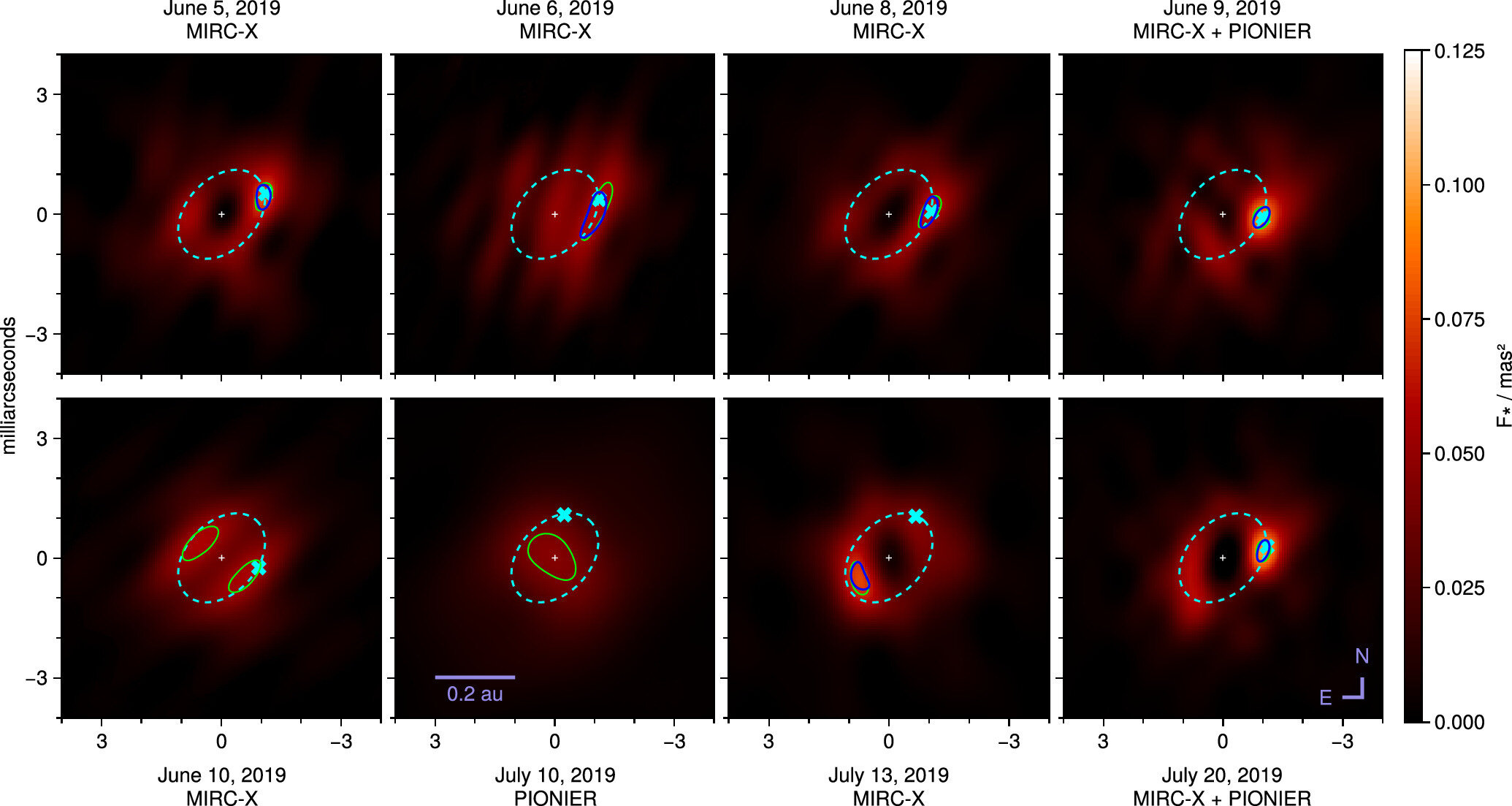
Setterholm+2025 evolution of inner disk of Herbig Ae star HD 163296 - MIRC-X and VLTI PIONIER
- unresolved central star, uniform background, & structured disk
- bright spot migrates clockwise over 44d
> Keplerian motion at that separation
→ might be related to a tidal wake from wider proto-planet
Ibrahim+2026 H and K-band survey of 17 Herbig Be stars
- MWC 34016 → binary system with a resolved disk surrounding the brighter component and possibly with a smaller disk surrounding the companion
→ binary disk system
Rivinius+2025 spectroscopic survey of Be stars in the post-mass transfer stage before the donor star shrinks to subdwarf
- 6 binaries, including HD 698 (V742 Cas)
- 58.4d, 0.663 mas orbit
→ the smallest orbit yet resolved with the CHARA Array.
Circumstellar Environments II
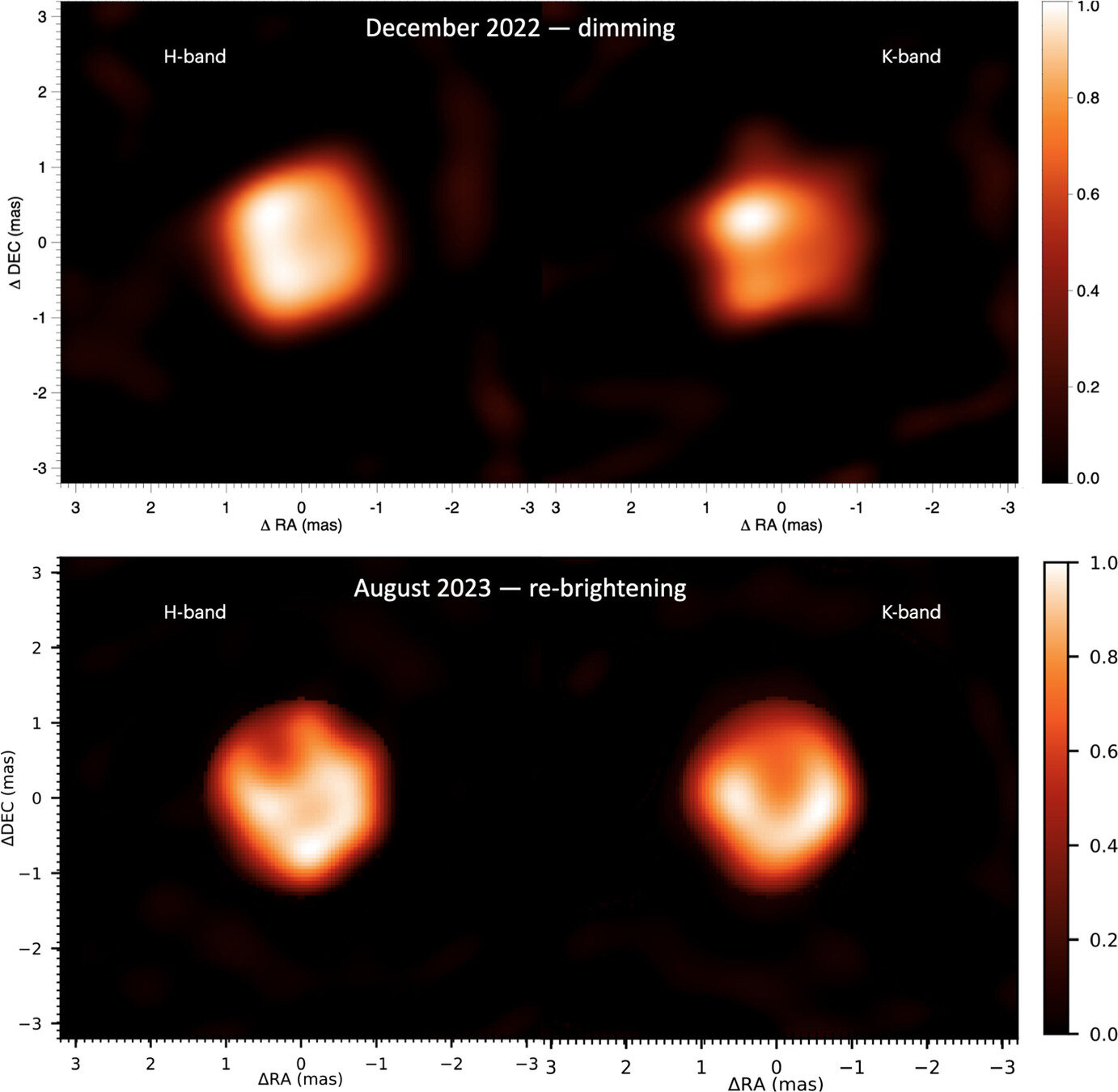
hypergiant star RW Per during and after the Great Dimming
hypergiant star ρ Cas20, R = 3 AU.
- photospheric, limb-darkened angdia = 2.09 ± 0.2 in 2.0-2.3 μm
- 2.91 ± 0.19 mas in 2.3-2.4 μm
→ latter range contains many CO lines, add to the overall opacity and shifts line forming region to higher in the atmosphere
Codron+2025 disk structure around T Tauri HD 143006
- inner and outer disks are misaligned by ~39°
- dark shadow regions in the outer disk cast by the misaligned inner disk
→ no inner binary companion is detected, so the origin of the misalignment remains a mystery
Circumstellar Environments III
2002: luminous red nova V838 Mon erupts:
high mass star + low mass companion merger → dust outflow enshrouding
Aydi et al. 2025 ToO observations with MIRC-X of 2 novae explosions in 2021
interferometric imaging + contemporary spectroscopy + high E γ-ray measurements Fermi fast nova V1674 Her
- 2 and 3 days after the eruption
→ thermonuclear explosion on WD → fast bipolar outflow + slow equatorial expansion
slow nova V1405 Cas
- 53, 55, and 67 days after explosion
- ellipsoidal structure that is smaller in the final observation
→ outflow concentrated in the orbital plane and that appears smaller as the net optical depth decreases with expansion and the inner regions are revealed.
→ merger led to jet formation → bipolar structure of the dust emission
Imaging Luminous Stars
The cool hypergiant star RW Cep experienced a Great Dimming event in 2022:
- imaged near photometric minimum
- H & K-band images show an asymmetric intensity distribution and a distorted shape
- NIR spectroscopy found fading increased towards shorter wavelengths
- implicates dust formation from stellar ejecta as the explanation for the fading and unusual appearance.


Patchy appearance results from dust created by a huge ejection from the star

Illustration credit: NASA, ESA, and E. Wheatley (STScI)
Anugu and colleagues are continuing to monitor the star with CHARA to explore how the surface appearance changes as the star brightens again.
What causes 1.2 mag
drop in V-band flux?

Binary and Multiple Stars
Torres+2025 binary star Atlas, in the Pleiades cluster, age = 104 Myr
- 291d angular orbit + radial velocity measurements → mass 5.04 ± 0.17M⊙ and 3.64 ± 0.12M⊙.
- brighter star is rapid rotator
- rotationally distorted shape + spectroscopic projected rotation velocity → equatorial rotational velocity of 233 ± 45 km s−1 (77% of the critical)
→ Rotational distortion of evolved primary
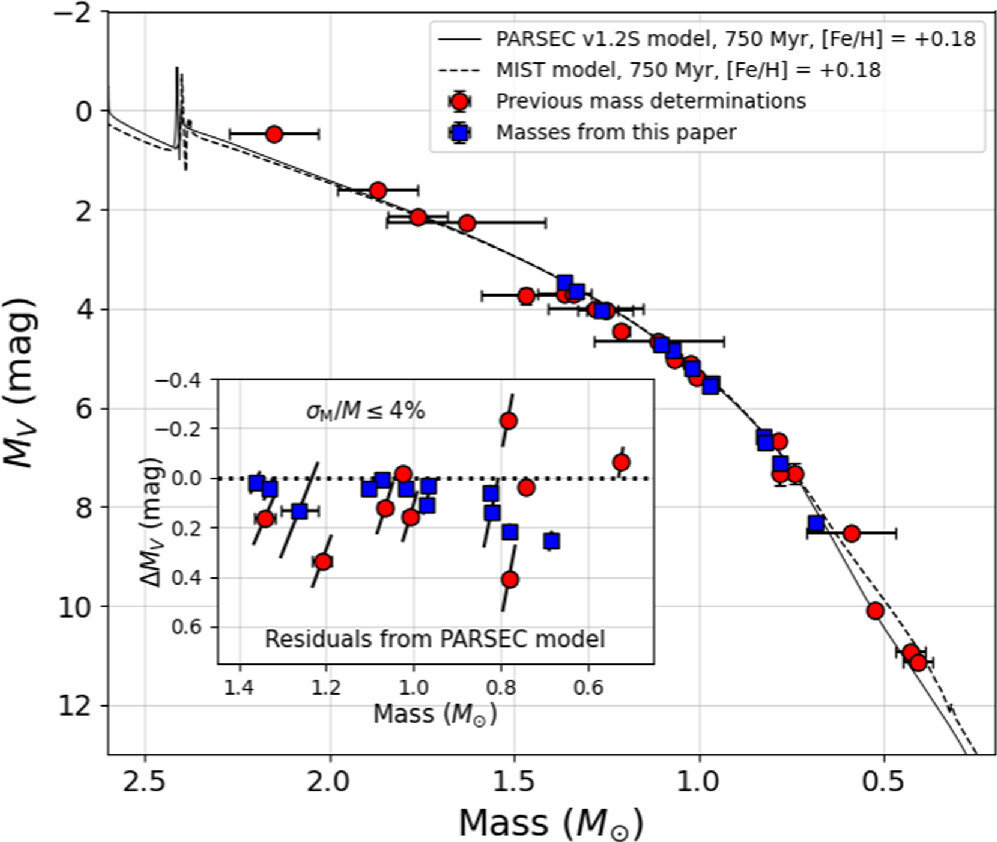
Mass - abs mag for Hyades cluster members
inset - shows how the PARSEC code tends to overestimate the V fluxes
Relative orbit of companion to Atlas
Torres+2024 interferometry + spectroscopy of 6 solar-mass binaries in the Hyades cluster
- CHARA + Palomar Testbed Interferometer (PTI) + a large set of RV measurements to derive masses with sub-1% accuracies
- good agreement with the predicted mass – luminosity relation
- but PARSEC models slightly overestimate the V-band fluxes of such stars
→ perhaps due to some missing component of opacity code calculation


"A gain of a single magnitude doubles the available sample of AGN."
7T Imaging improvements

The RECONS 25 Parsec Database
animation: Adric Riedel

- Taurus star forming region (d=140 pc)
- Measure contraction of young stars to the main sequence.
- Need < 0.2 mas to achieve this.
Angular Diameter of Pre-MS stars
- Verify diameter measurements between eclipsing binaries and singles
- 8% of M dwarfs are photometrically variable by 2% in V, R, I. 92% are stable
- Study flares, spots
- Magnetically active M dwarfs have very large spots that could be imaged

20pc sample → 600 M dwarfs
- volume complete sample to 20pc
- How many could chara resolve/image?
Diameters and resolved surfaces of M dwarfs
Image an exoplanet during transit
- There are some 250 known exoplanets with host stars accessible to CHARA.
- The new baselines will enable resolution of solar-like stars out to about 70pc in H-band.
- Numerical simulations of the transiting hot-Jupiter in HD189773 indicate that the silhouette of the planet can be measured in long baseline observations made during transits.


New improvements
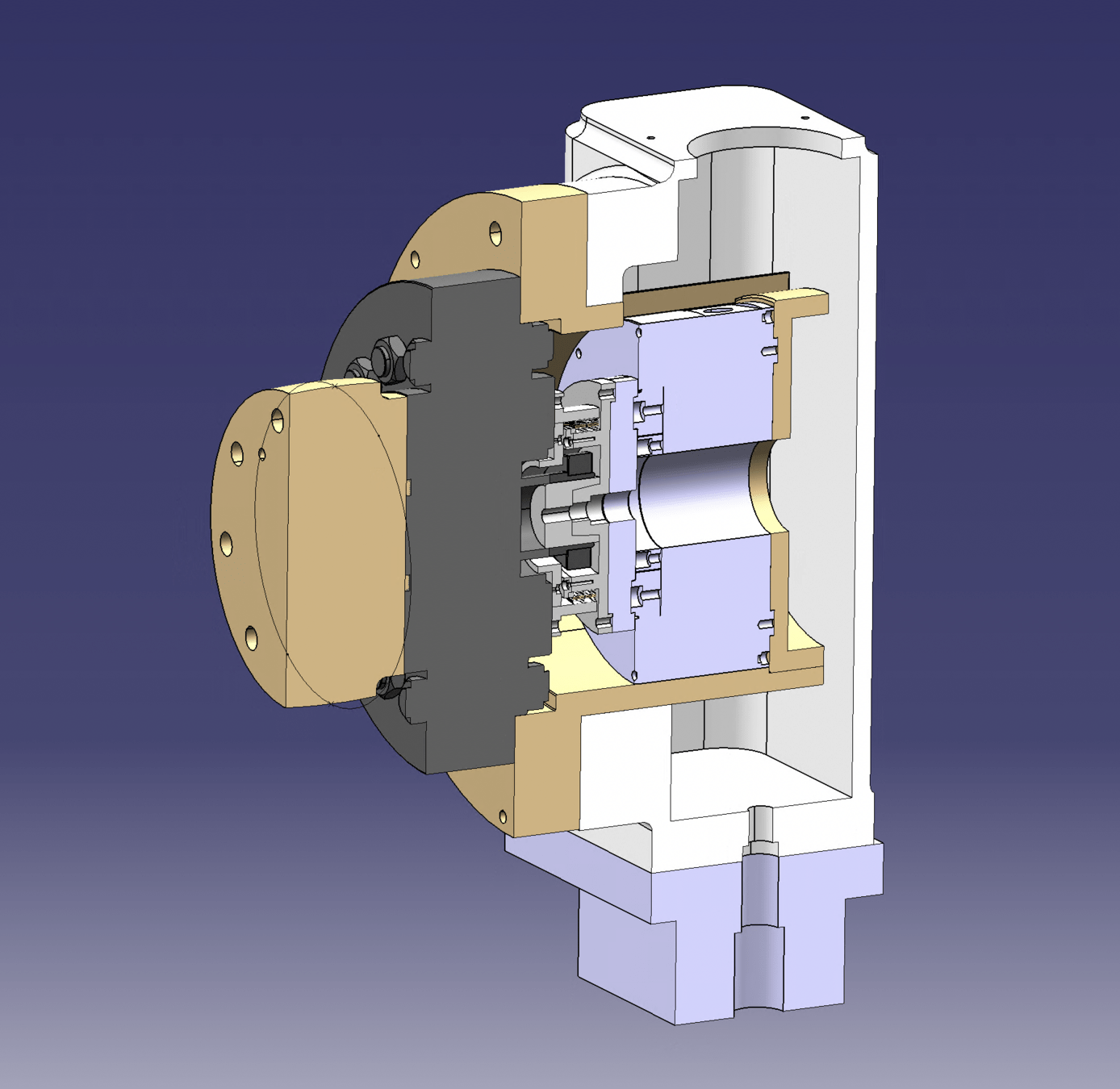
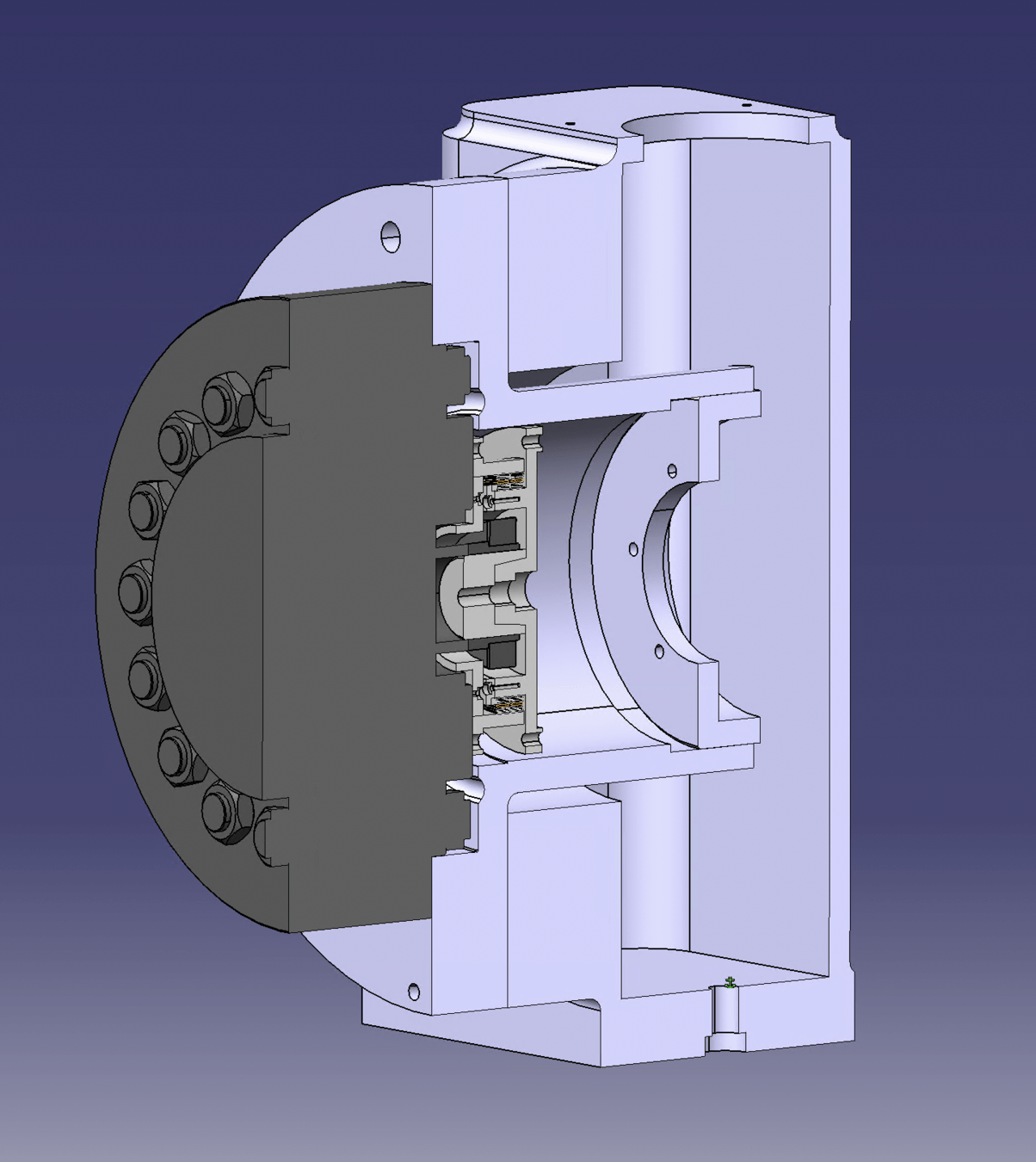
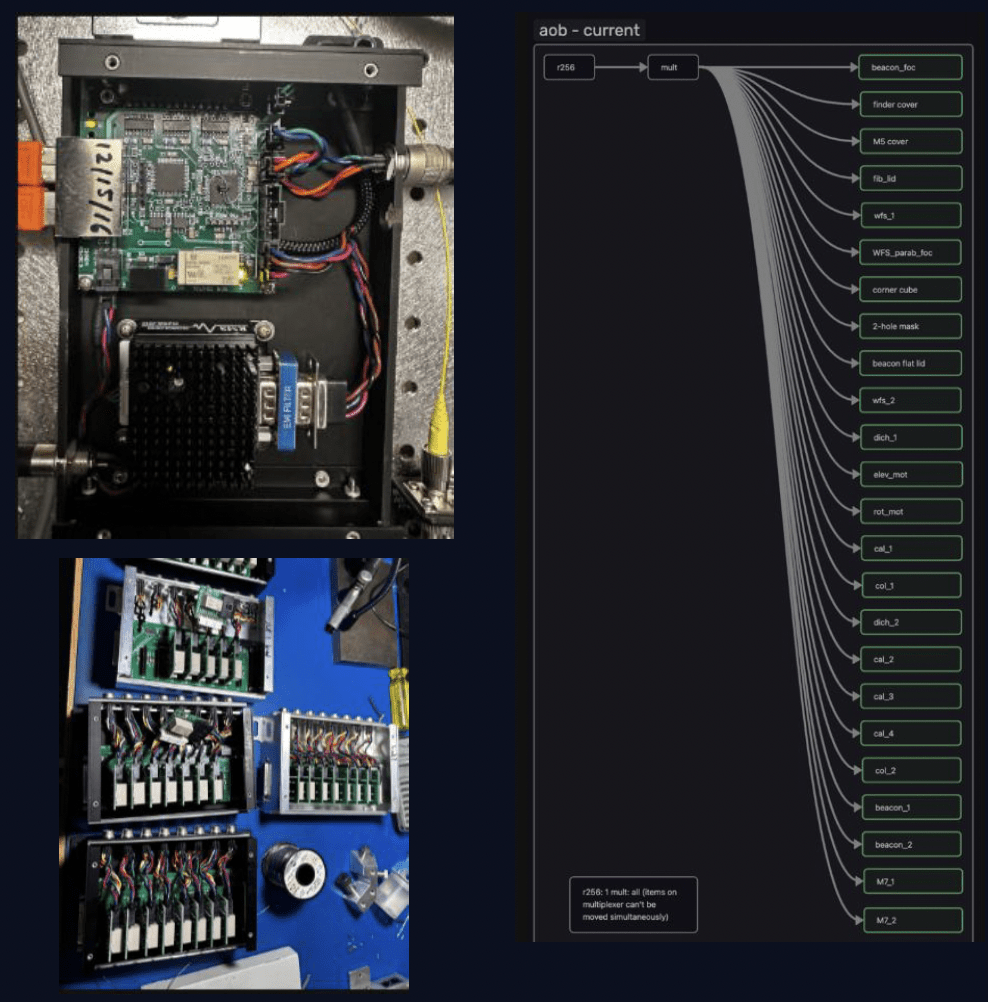
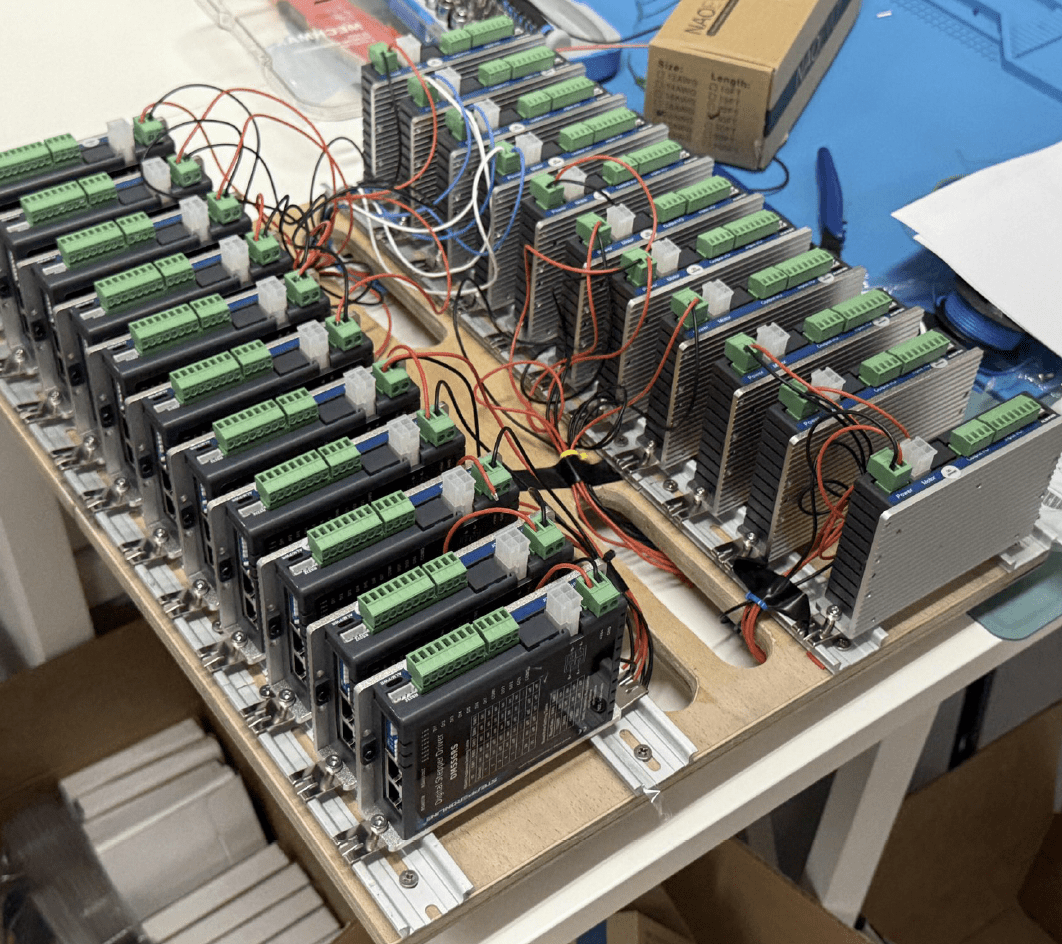
- removes single-point failures
- modular
- easy to troubleshoot
- COTS industrial components
- allows simultaneous movements
- motor state polling
- 5ms delay b/t commands
- expected to save 30-45mins per 7hrs observing
student Noy Hakobyan (UC Irvine)
- drives (4EL/1AZ done)
- cylinder control
- environmental sensing
- GSU data archive was expanded in 2025 to 500 terabytes of RAID storage
- web portal to search the archive
- remote data reduction machine
AO Board (AOB) / Telescope Manager (TEMA) upgrades