Calculating Basin Volumes in
high dimensions
VolumeEstimation.jl
BasinVolumes.jl
Work done with:
Stefano Martiniani


Praharsh Suryadevara
Why Basin volumes
As a resilience measure
Wiley, D. A., Strogatz, S. H., & Girvan, M. (2006). The size of the sync basin. Chaos: An Interdisciplinary Journal of Nonlinear Science, 16(1).
Menck, P. J., Heitzig, J., Marwan, N., & Kurths, J. (2013). How basin stability complements the linear-stability paradigm. Nature physics, 9(2), 89-92.
\(A\)
\(B\)
\(B\) is more stable
To calculate configurational entropy
Martiniani, S., Schrenk, K. J., Ramola, K., Chakraborty, B., & Frenkel, D. (2017). Numerical test of the Edwards conjecture shows that all packings are equally probable at jamming. Nature physics, 13(9), 848-851.
Casiulis et al. Papers in Physics 15 (2023): 150001-150001.
Basin Volumes
Basin Stability
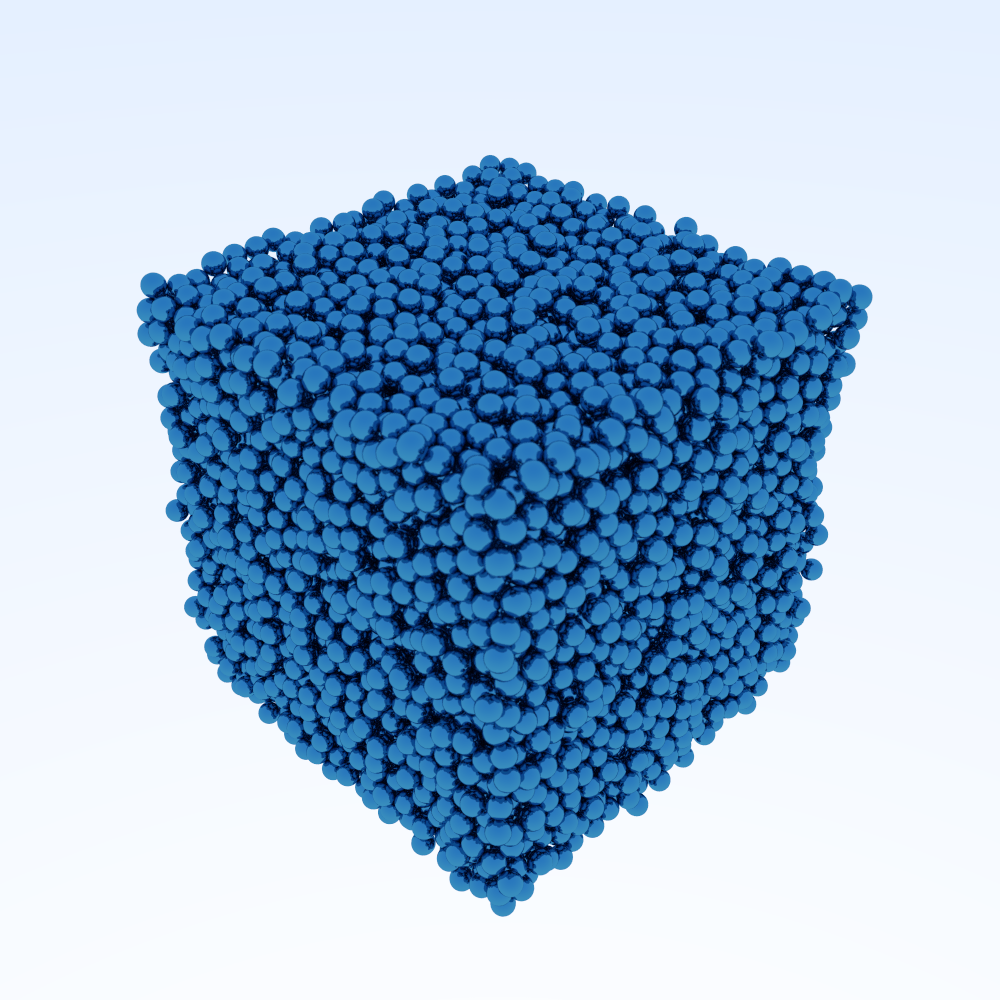
Soft sphere packings
Wiley, D. A., Strogatz, S. H., & Girvan, M. (2006). The size of the sync basin. Chaos: An Interdisciplinary Journal of Nonlinear Science, 16(1).
Menck, P. J., Heitzig, J., Marwan, N., & Kurths, J. (2013). How basin stability complements the linear-stability paradigm. Nature physics, 9(2), 89-92.
Uses naive sampling.
Xu, N., Frenkel, D., & Liu, A. J. (2011). Direct determination of the size of basins of attraction of jammed solids. Physical Review Letters, 106(24), 245502.
Asenjo, Daniel, Fabien Paillusson, and Daan Frenkel. "Numerical calculation of granular entropy." Physical review letters 112.9 (2014): 098002.
Martiniani, S., Schrenk, K. J., Stevenson, J. D., Wales, D. J., & Frenkel, D. (2016). Structural analysis of high-dimensional basins of attraction. Physical Review E, 94(3), 031301.
Martiniani, S., Schrenk, K. J., Ramola, K., Chakraborty, B., & Frenkel, D. (2017). Numerical test of the Edwards conjecture shows that all packings are equally probable at jamming. Nature physics, 13(9), 848-851.
Uses optimizers.
Why Monte Carlo
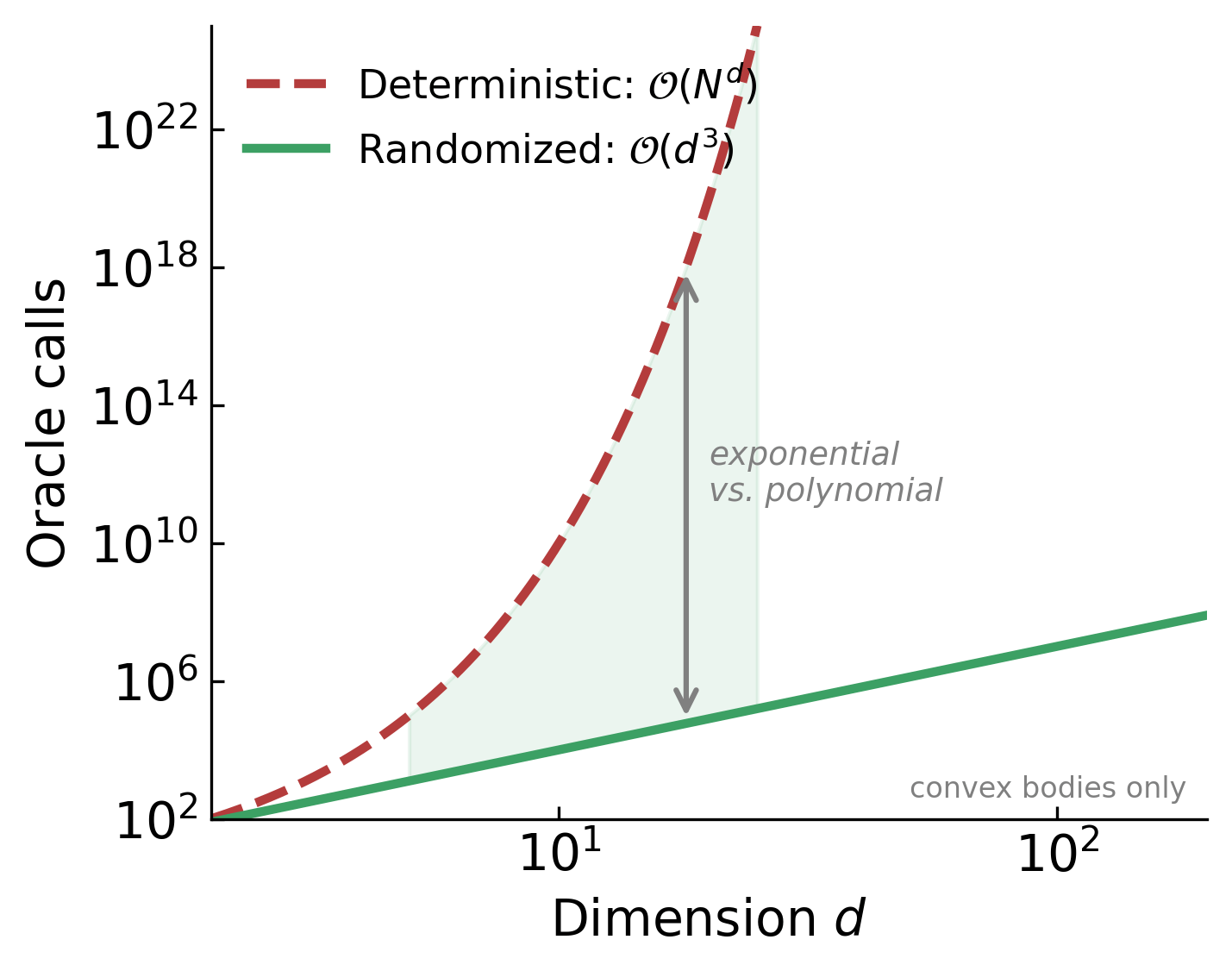
Cousins, Ben, and Santosh Vempala. "Gaussian Cooling and O^*(n^3) Algorithms for Volume and Gaussian Volume." SIAM Journal on Computing 47.3 (2018): 1237-1273.
Algorithm for convex objects
$$Z(k) = \int_{\mathbb{R}^N}^{} \mathcal{O}(x) dx$$
Oracle (1 if inside basin. 0 if outside) defined by ODE solves
Volume
Basin Volume computation
Complexity
Dimension
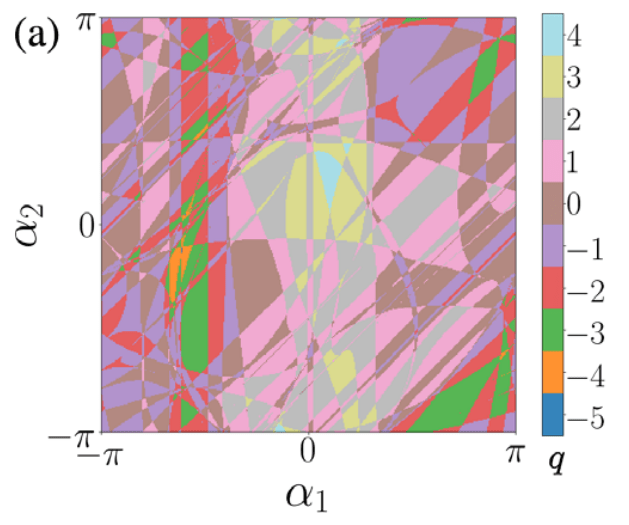
Kuramoto

Soft spheres
Gradient systems, No limit cycles, easy to identify attractors
Calculating volumes in high dimensions
Casiulis et al. Papers in Physics 15 (2023): 150001-150001.
$$Z(k) = \int_{\mathbb{R}^N}^{} \mathcal{O}(x) e^{- \frac{1}{2} k \left|x-x_{0}\right|^{2}} dx$$
Normalizing constant of probability distribution
Oracle (1 if inside basin. 0 if outside)
Gaussian centered around minimum
$$ F(k) = - log(Z_{k}) $$
"Free energy"
$$ F(0) - F(k_{\infty}) = \int_{0}^{k_{\infty}} \frac{\partial F}{\partial k} dk = \int_{k_{\infty}}^{0} \langle \left| x-x_{0}\right|^{2} \rangle_{k} dk$$
Log volume (unknown)
Gaussian normalizing constant
Sampling basins in high dimensions
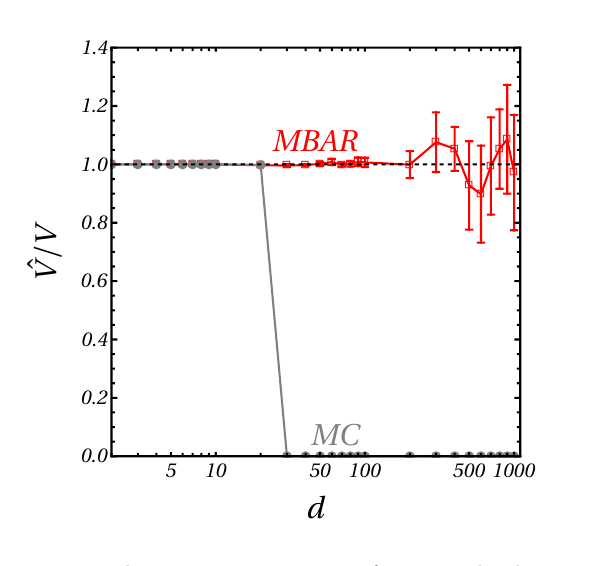
Brute force MC misses most of the volume!!
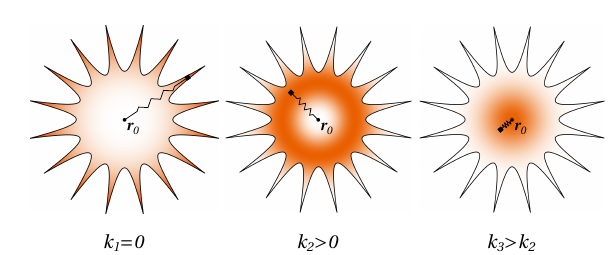
Reconstruct uniform samples from MC walkers at different distances, which can be used to constuct volumes
Casiulis et al. Papers in Physics 15 (2023): 150001-150001.
Replica exchange
Replica Exchange Monte Carlo
Casiulis et al. Papers in Physics 15 (2023): 150001-150001.
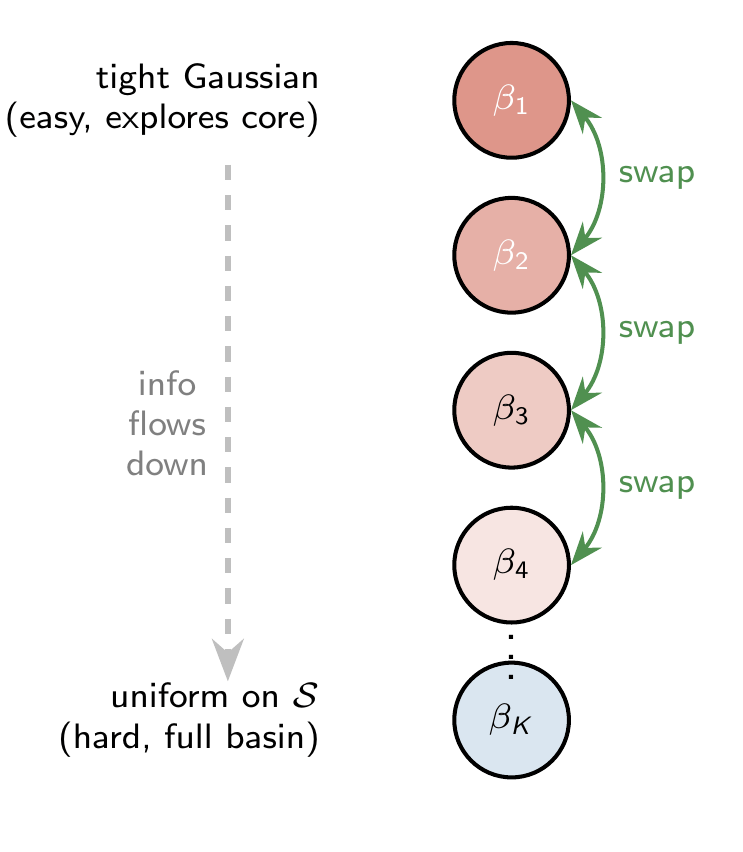
$$\alpha_{\text{swap}} = \min\left(1, \exp\left(-\frac{k}{2}(\beta_k - \beta_l)(|x_l - x^*|^2 - |x_k - x^*|^2)\right)\right)$$
Swap acceptance criterion
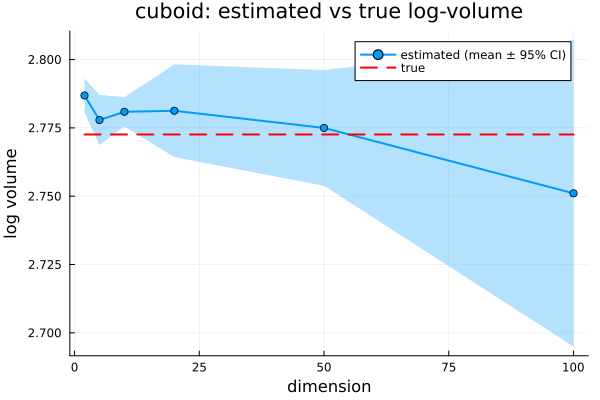
Volumes of cubes/cuboids: Test
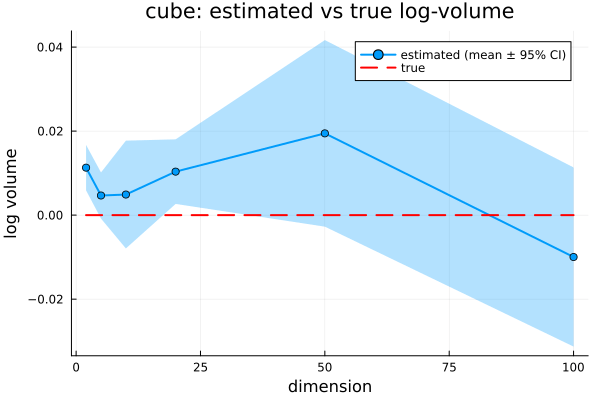
Volume estimation is the hard part
Volumes of polytopes: Test
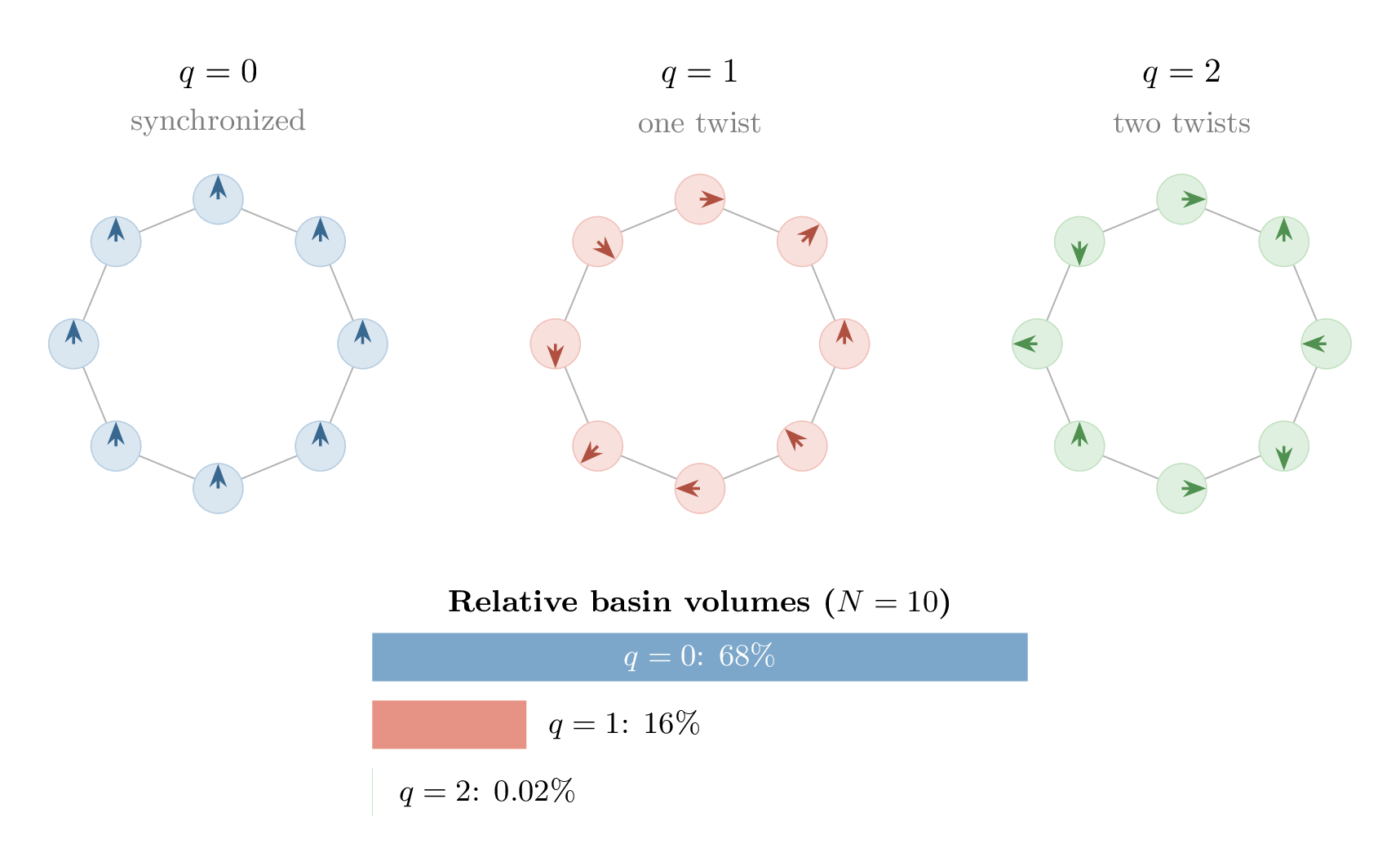
$$ \dot{\theta}_j = \sin(\theta_{j+1} - \theta_j) + \sin(\theta_{j-1} - \theta_j)$$
$$\theta_j^* = \frac{2\pi q \, j}{N}, \quad \text{stable for } |q| < N/4$$
$$\log S_B(q) = \log \frac{V(q)}{|\mathbb{T}_n|} \approx C - k q^2$$
Volumes of polytopes: Test
$$ \dot{\theta}_j = \sin(\theta_{j+1} - \theta_j) + \sin(\theta_{j-1} - \theta_j)$$
$$\theta_j^* = \frac{2\pi q \, j}{N}, \quad \text{stable for } |q| < N/4$$
$$\log S_B(q) = \log \frac{V(q)}{|\mathbb{T}_n|} \approx C - k q^2$$

See https://github.com/JuliaDynamics/Attractors.jl/issues/60
Hard to compute numerically
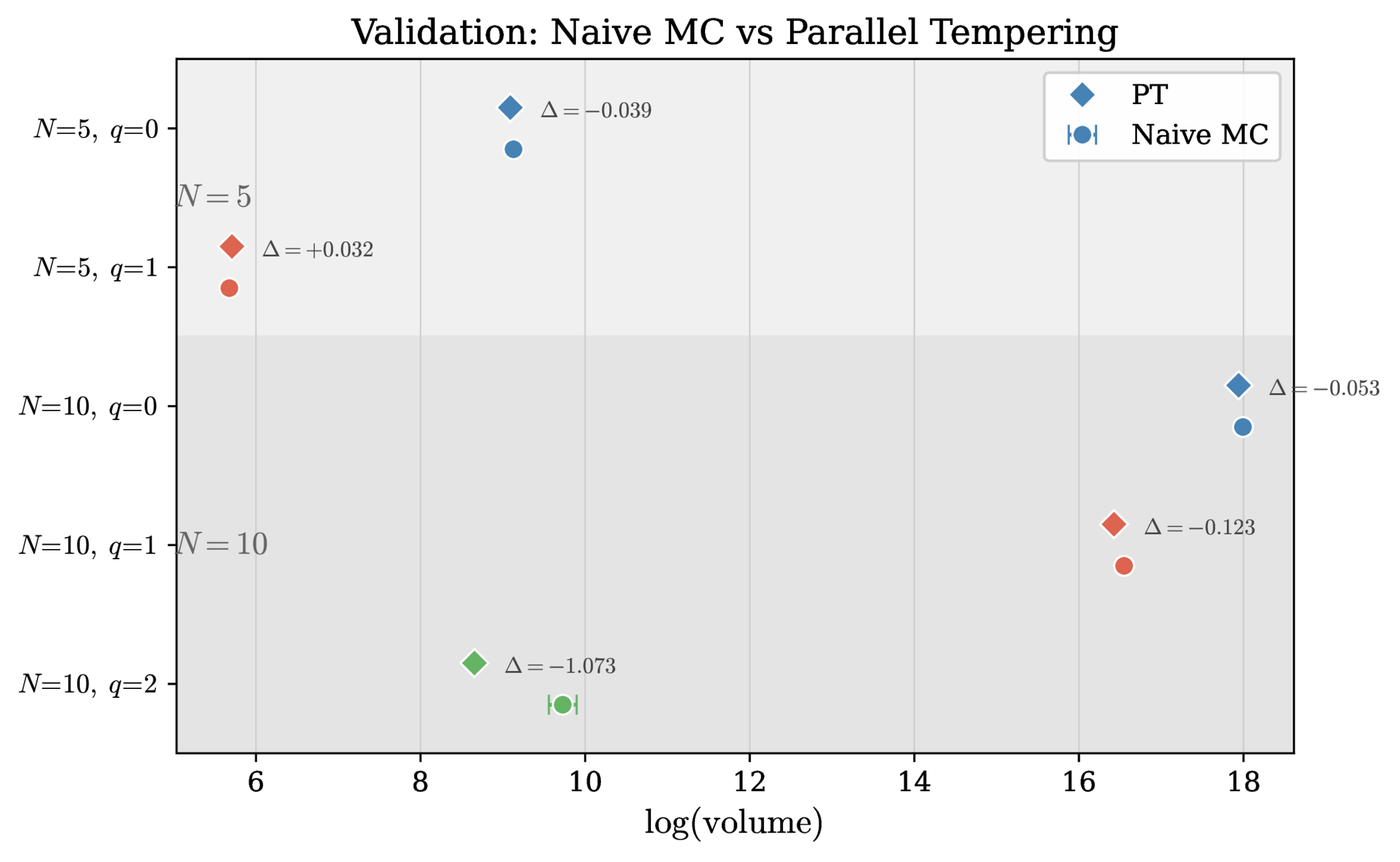
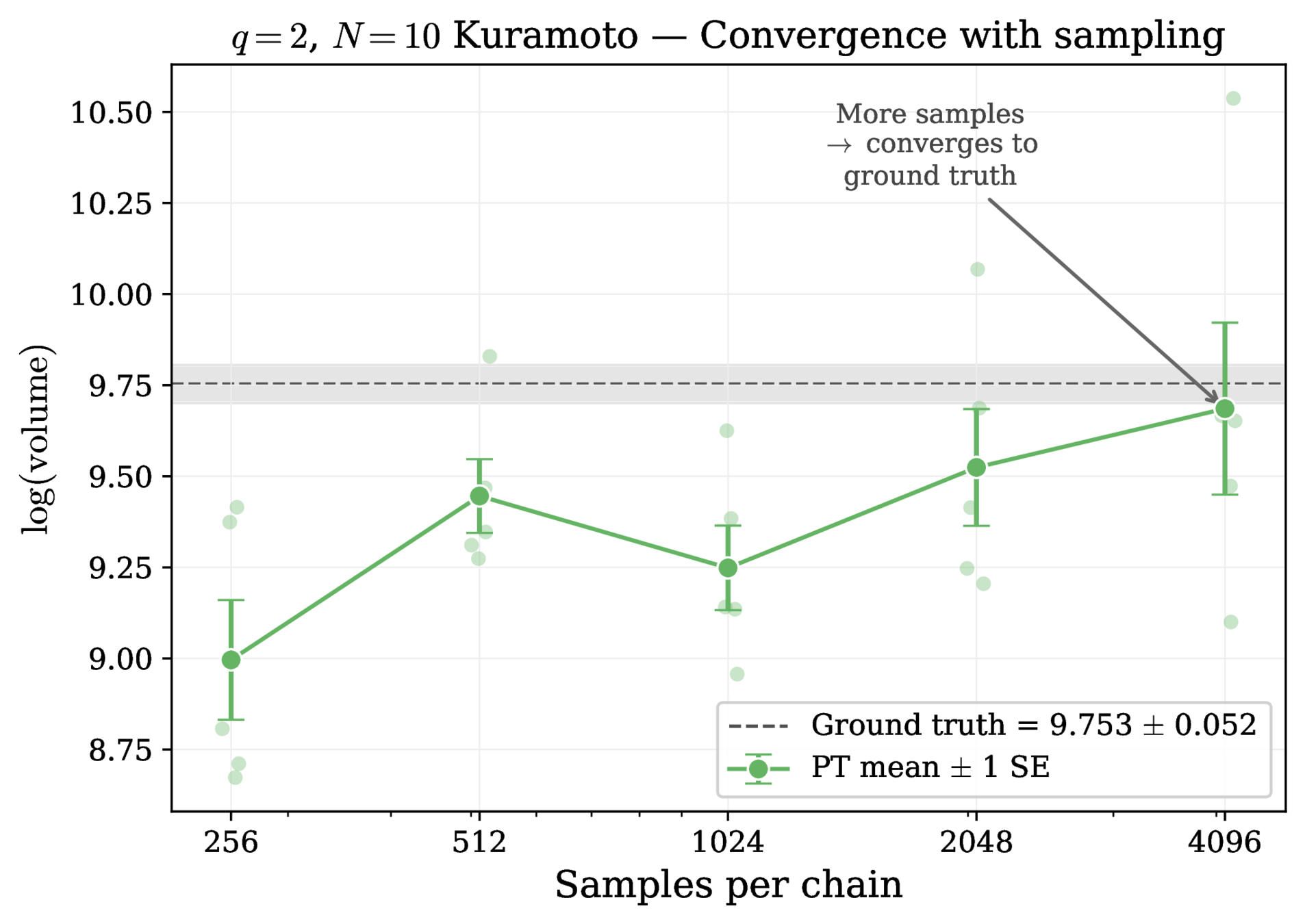
Kuramoto convergence: on single core
Kuramoto convergence: on single core
Interface
using VolumeEstimation, CommonSolve

# Estimate the volume of a 5D unit hypercube (true volume = 1)
membership(x) = all(abs.(x) .<= 0.5)
prob = VolumeProblem(membership, 5)
sol = solve(prob)

sol.log_volume  # ≈ 0.0 (log of 1)
sol.volume      # ≈ 1.0
VolumeEstimation.jl
using BasinVolumes

dim = 2
power = 0.5
offset = 1.0

# Gradient descent on a cosine potential with basins at integer lattice points
function neg_grad(u, p, t)
    S = dim + offset - sum(cos.(2pi .* u))
    -power .* S^(power - 1) .* (2pi) .* sin.(2pi .* u)
end

# Check convergence to the basin at the origin
basin_check(u) = sum(abs2, u) < 1e-6

prob = BasinVolumeProblem(neg_grad, nothing, basin_check, dim; x0=zeros(dim))
sol = solve(prob; n_rounds=8, n_chains=8)

sol.log_volume  # log of the estimated basin volume
sol.volume      # the estimated basin volume
Basinvolumes.jl
What's left/Goals
- MPI parallelization, Pigeons is MPI parallelized but none of the code was tested for it. Also C++/Python version for packings uses a queueing system for efficiency
- VolumeEstimation.jl needs to interface all algorithms for volume estimation, Vempala et. al needs to be integrated
- Testing more systems (Feel free to suggest sysems)
Acknowledgments

Stefano Martiniani
Mathias Casiulis

Martiniani Lab