A comparative study of reconnection

X-line predictions on dayside magnetopause of Earth

Ramiz A. Qudsi,   Brian Walsh, J. Broll

Boston University,   Los Alamos National Lab

*(qudsira@bu.edu)

(https://qudsiramiz.github.io)

Qudsi                                                                                   BU                                                                 qudsira@bu.edu 

Link to the presentation

                                                                                                            1, *                                          1                          2

                                                              1                                               2

Qudsi                                                                                   BU                                                                 qudsira@bu.edu 

Outline:

  • Magnetic Reconnection and x-line
  • Location of x-line
    • Different models
  • Data
  • Results
  • Discussions

Qudsi                                                                                   BU                                                                 qudsira@bu.edu 

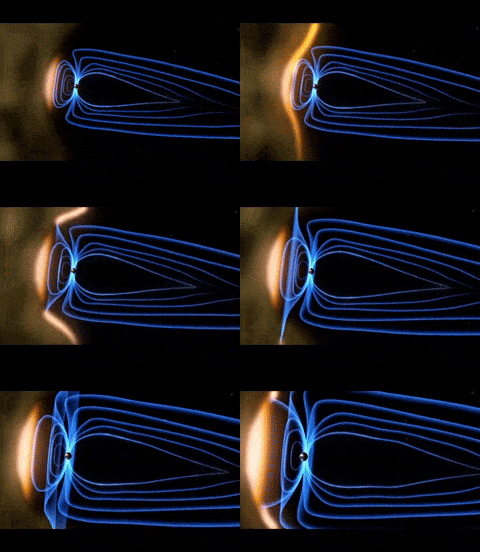
The BASICS

Qudsi                                                                                   BU                                                                 qudsira@bu.edu 
Source: NASA

Qudsi                                                                                   BU                                                                 qudsira@bu.edu 
[Broll et al., 2017]

Source: wikipedia

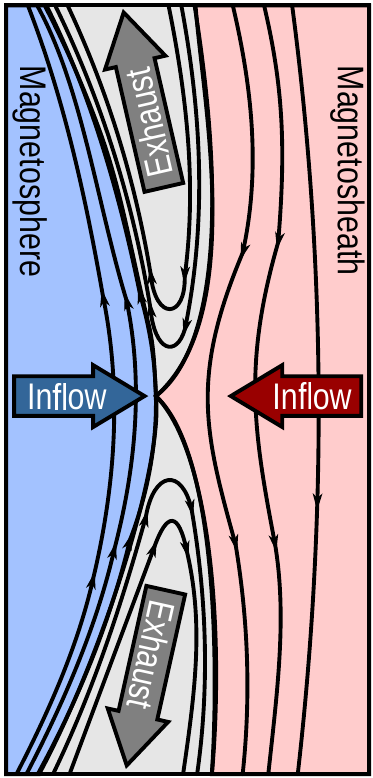
Magnetic Reconnection

Why Magnetic Reconnection?

Gotta work on something!

Why not?

Ubiquitous nature of reconnection

Energy dynamics

Dynamo effect

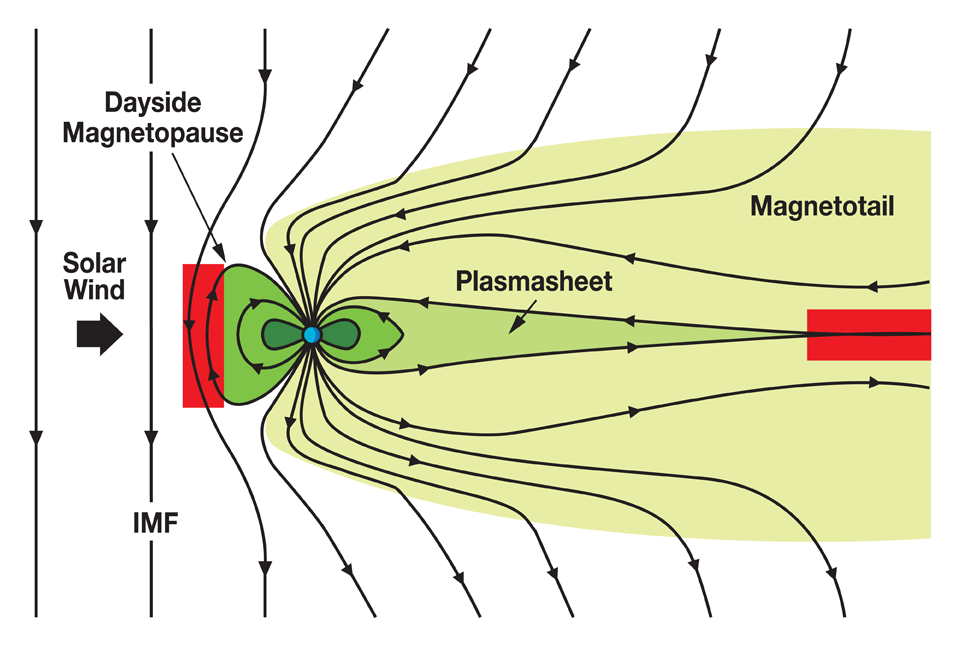
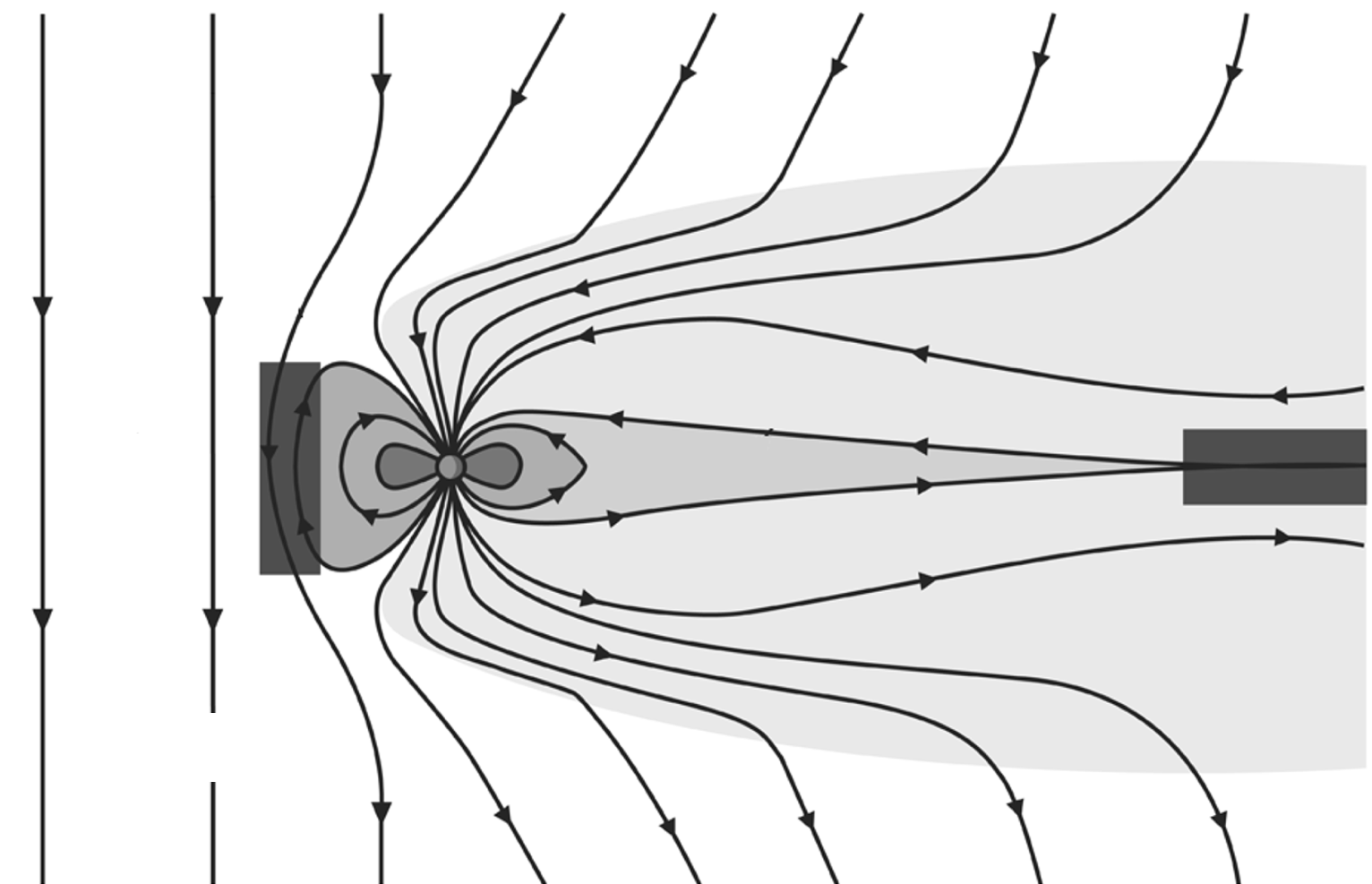
Region of interest:
Qudsi                                                                                   BU                                                                 qudsira@bu.edu 

Location of x-line

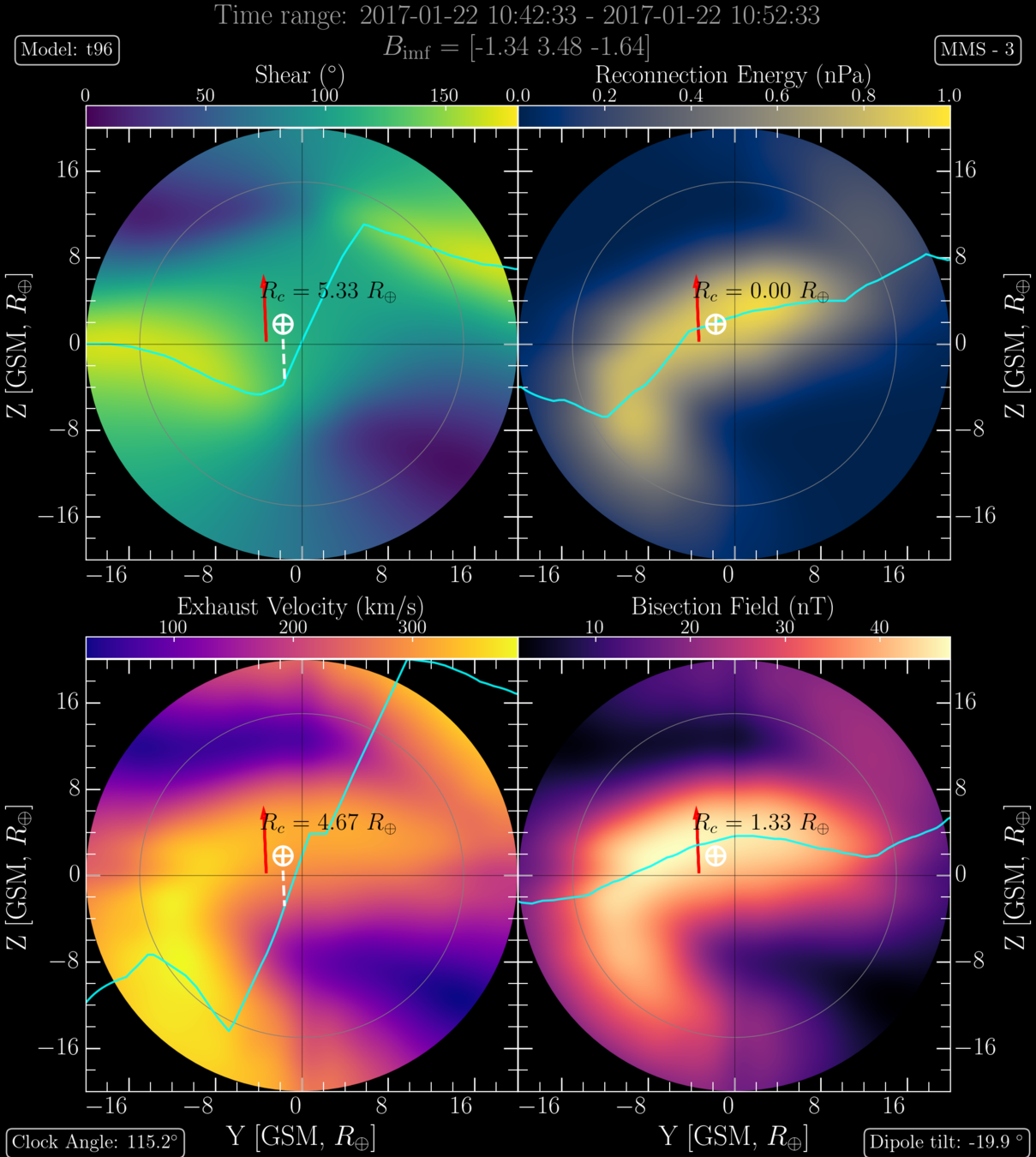
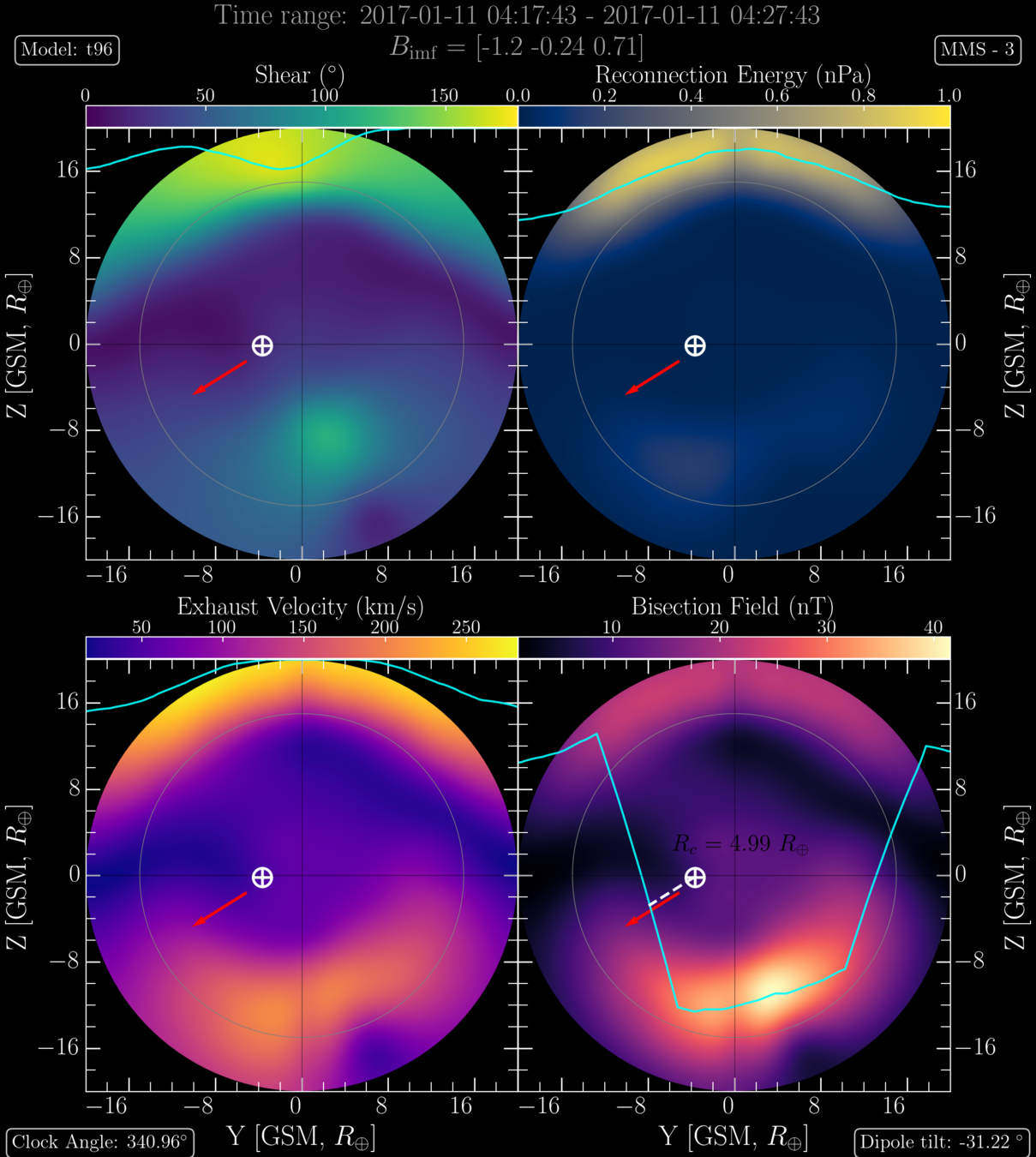
Local field bisection [Moore et al., 2002]

Maximum exhaust speed  [Swisdak and Drake, 2007]

Maximum magnetic shear [Trattner et al., 2007]

Maximum reconnecting field energy [Hesse et al., 2013]

Qudsi                                                                                   BU                                                                 qudsira@bu.edu 

Magnetic shear:

\cos(\theta) = \left(\textbf{B}_{\rm sh} \cdot \textbf{B}_{\rm msp}\right)/ \left(|\textbf{B}_{\rm sh}| |\textbf{B}_{\rm msp}|\right)
B_{\rm rec} = |\textbf{B}_{\rm msp} \cdot \textbf{i}_{\rm xn}|

Local field bisection:

Reconnection field energy:

E \propto \left(B_{\rm sh}^2 \times B_{\rm msp}^2\right)

Exhaust speed:

V_{\rm A} = \left[\frac{B_{\rm sh} B_{\rm msp} \left(B_{\rm sh} + B_{\rm msp}\right)}{\left(n_{\rm p,msp}B_{\rm sh} + n_{\rm p,sh}B_{\rm msp}\right)} \right]^{1/2}

sh: magnetosheath

msp: magnetosphere

Qudsi                                                                                   BU                                                                 qudsira@bu.edu 

DATA

Data:
Solar

Wind

T-96 and IGRF Model

OMNI

Cooling-2001 Model

Magnetosheath

Magnetopause

Shue-1998 Model

Data

Solar Wind data: OMNI (propagated to the magnetopause)

Observational data: MMS (FPI and FGM)

Magnetospheric magnetic field: Models (T96 or T05 and IGRF)

Magnetosheath magnetic field: Models (Cooling model)

x

z

y

GSM coordinate system

Magnetopause stand-off point: Models (Shue Model)

Qudsi                                                                                   BU                                                                 qudsira@bu.edu 
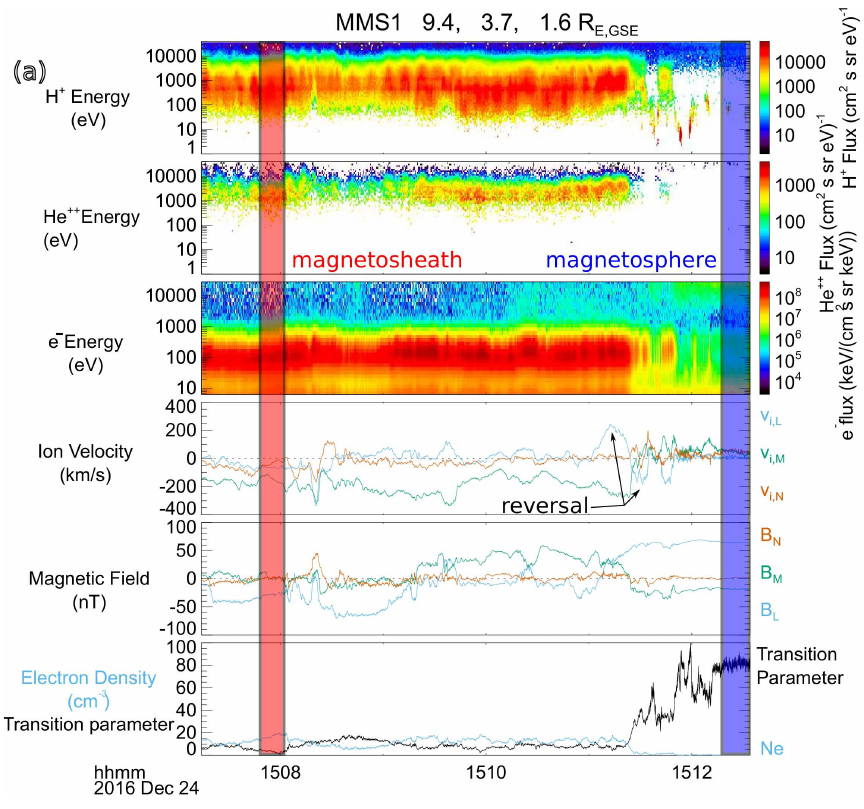
Magnetosheath

Magnetosphere
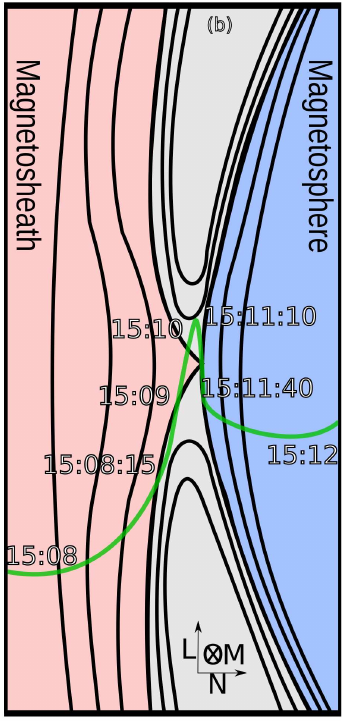
[Broll et al., 2017]

Qudsi                                                                                   BU                                                                 qudsira@bu.edu 

RESULTS
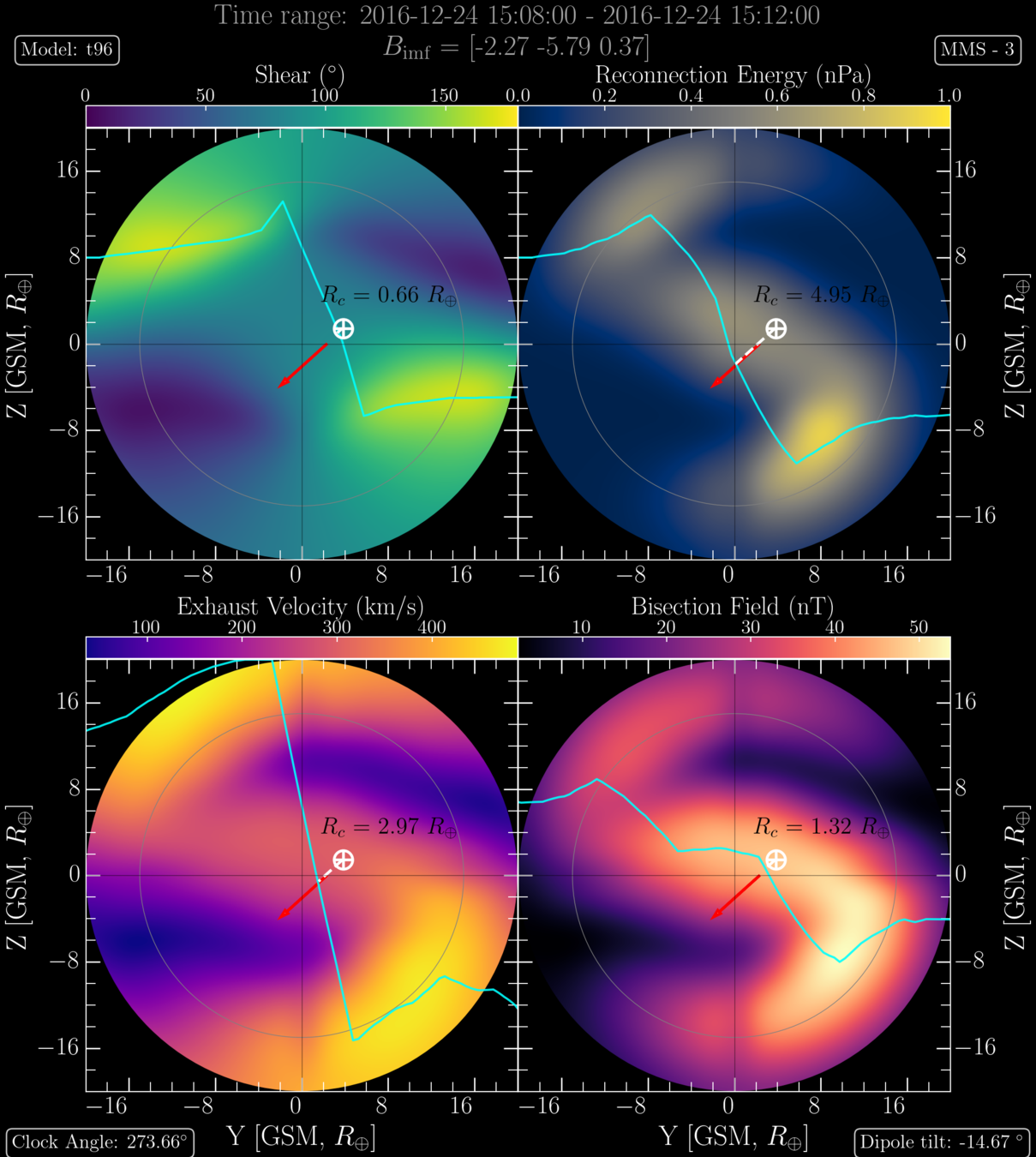
The maximum shear model

The maximum exhaust velocity model
Qudsi                                                                                   BU                                                                 qudsira@bu.edu 
Qudsi                                                                                   BU                                                                 qudsira@bu.edu 
Qudsi                                                                                   BU                                                                 qudsira@bu.edu 
Qudsi                                                                                   BU                                                                 qudsira@bu.edu 
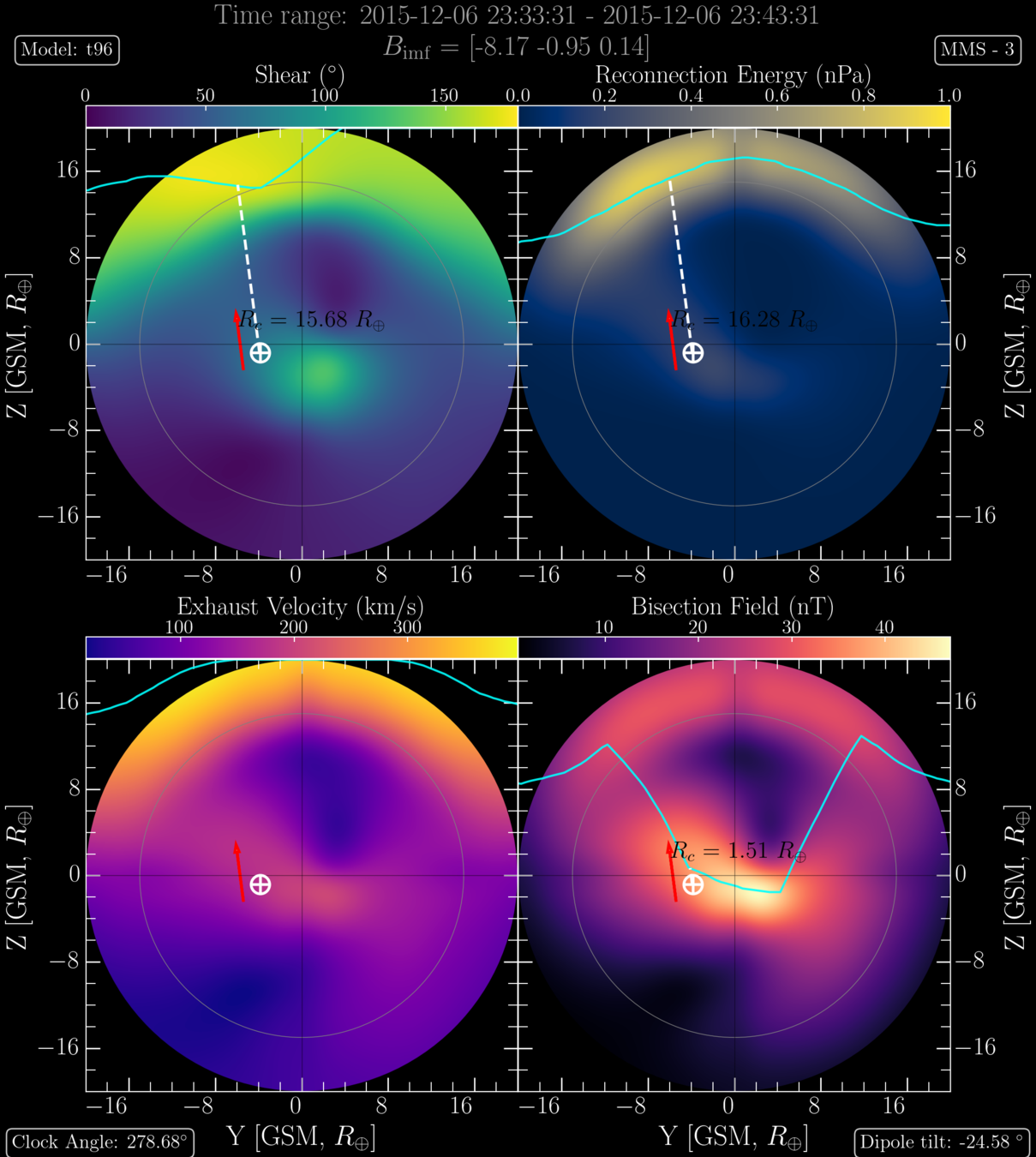
DISCUSSIONS

Qudsi                                                                                   BU                                                                 qudsira@bu.edu 

Discussions:

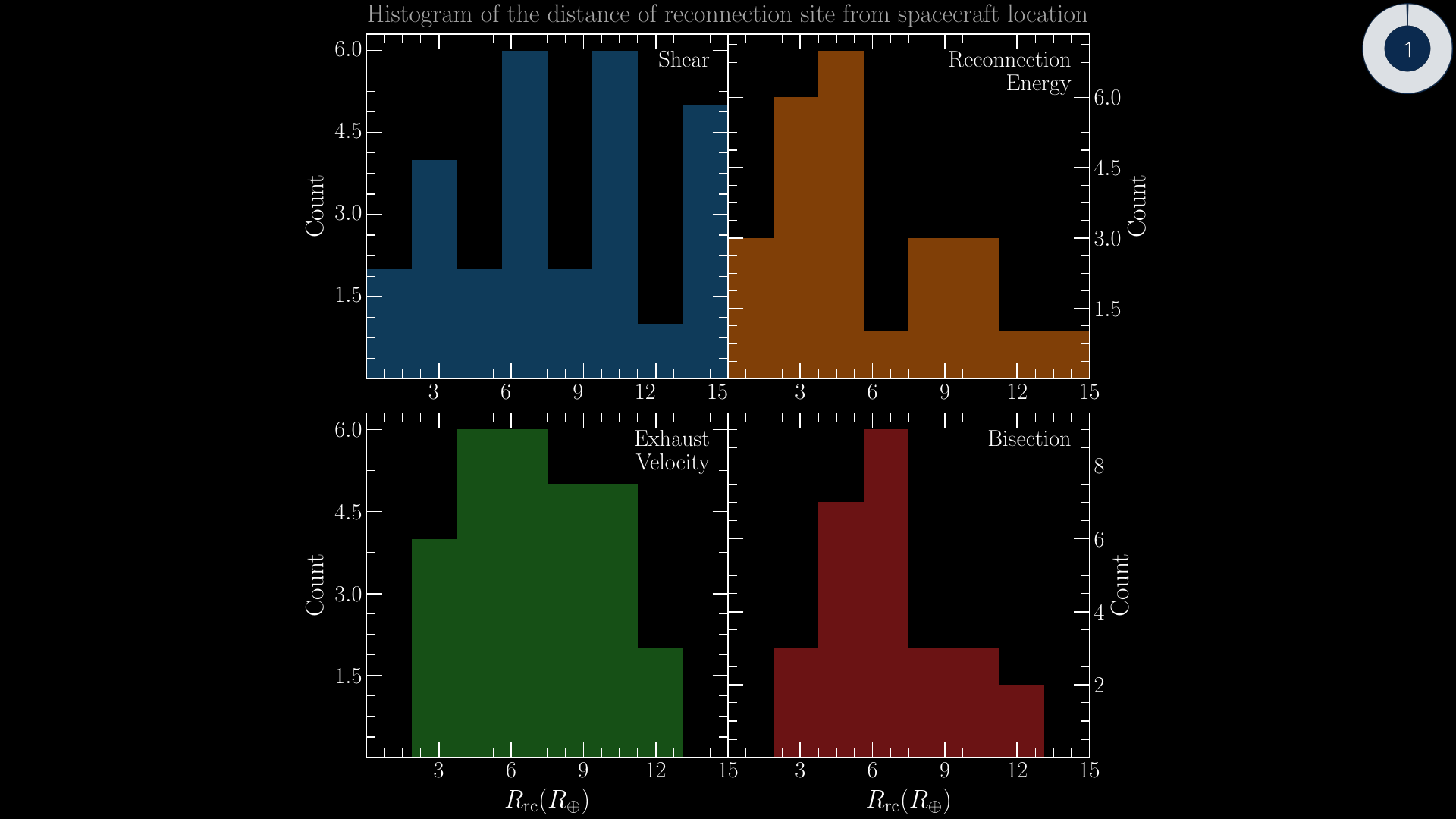
Most model fail when the z-component of magnetic field is positive. Though reconnection energy model seem to perform better than other 3.

The spread in the histogram of shear model appear to be maximum.

Need a lot more reconnection events for a better understanding.

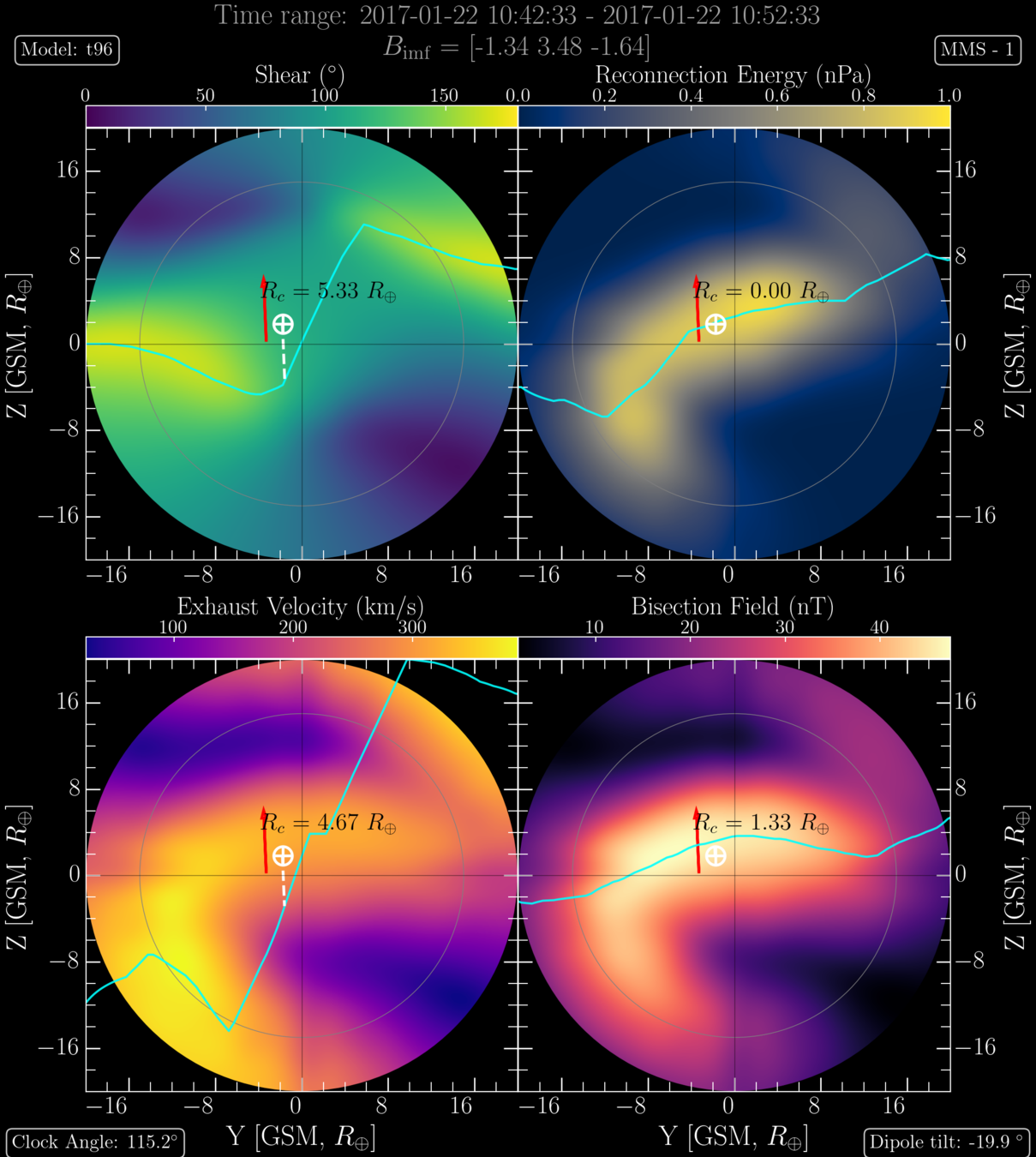
As expected, different models predict different location of x-lines for the same dataset.

Qudsi                                                                                   BU                                                                 qudsira@bu.edu 

Thank You!

Link to the presentation

Qudsi                                                                                   BU                                                                 qudsira@bu.edu 

Thank You!

Link to the presentation

Qudsi                                                                                   BU                                                                 qudsira@bu.edu 

If Paul asks his question:

  • Both earth and the sun are kind of like magnets and thus have magnetic fields around them.


  • These collide in space and a lot of energy is released.


  • Several model predict where that process happens.


  • We are trying to find out which is the most accurate model most of the time and which one is most accurate only sometimes (under specific conditions).