Characterizing the Complexity of
Machine Learning-Enabled Systems
https://renatocf.xyz/jads25-slides
2025
Renato Cordeiro Ferreira
Institute of Mathematics and Statistics (IME)
University of São Paulo (USP) – Brazil
Jheronimus Academy of Data Science (JADS)
Technical University of Eindhoven (TUe) / Tilburg University (TiU) – The Netherlands


Paper
Slides

Former Principal ML Engineer at Elo7 (BR)
4 years of industry experience designing, building, and operating ML products with multidisciplinary teams
B.Sc. and M.Sc. at University of São Paulo (BR)
Theoretical and practical experience with Machine Learning and Software Engineering
Scientific Programmer at JADS (NL)
Currently participating of the MARIT-D European project, using ML techniques for more secure seas
Ph.D. candidate at USP + JADS
Research about SE4AI, in particular about MLOps and software architecture of ML-Enabled Systems
Renato Cordeiro Ferreira
https://renatocf.xyz/contacts

My goal is to
use metrics to identify
where complexity emerges
in the software architecture
of ML-enabled systems
Research Questions
What are the measurable dimensions of complexity
in the architecture of ML-enabled systems?
How can complexity metrics be operationalized
over the architecture of ML-enabled systems?
RQ1
RQ2
RQ3
How can complexity metrics be used to aid
the development, operation, and evolution
of real-world ML-enabled systems?
Research Questions
How can complexity metrics be used to choose between architecture proposals for an ML-enabled system?
How can complexity metrics be used to identify refactoring opportunities in an ML-enabled systems?
RQ3.1
RQ3.2
RQ3
How can complexity metrics be used to aid
the development, operation, and evolution
of real-world ML-enabled systems?
Continuous Delivery
Machine Learning
"Continuous Delivery for Machine Learning is a software engineering approach in which a cross-functional team produces machine learning applications based on code, data and models in small and safe increments that can be reproduced and reliably released at any time, in short adaptation cycles."
-- Danilo Sato, Arif Wider, Christoph Windheuser
"Continuous Delivery for Machine Learning is a software engineering approach in which a cross-functional team produces machine learning applications based on code, data and models in small and safe increments that can be reproduced and reliably released at any time, in short adaptation cycles."
-- Danilo Sato, Arif Wider, Christoph Windheuser
Continuous Delivery for Machine Learning
Data
Model
Code
Schema
Sampling
Volume
Algorithms
More Training
Experiments
Business Needs
Bug Fixes
Configuration
Axis of Change for ML
Based on "Continuous Delivery for Machine Learning", by Danilo Sato, Arif Wider, and Christoph Windheuser -- https://martinfowler.com/articles/cd4ml.html
Reference Architecture
for ML-Enabled Systems

Research Track - ECSA 2025
MLOps in Practice: Requirements and a Reference Architecture from Industry
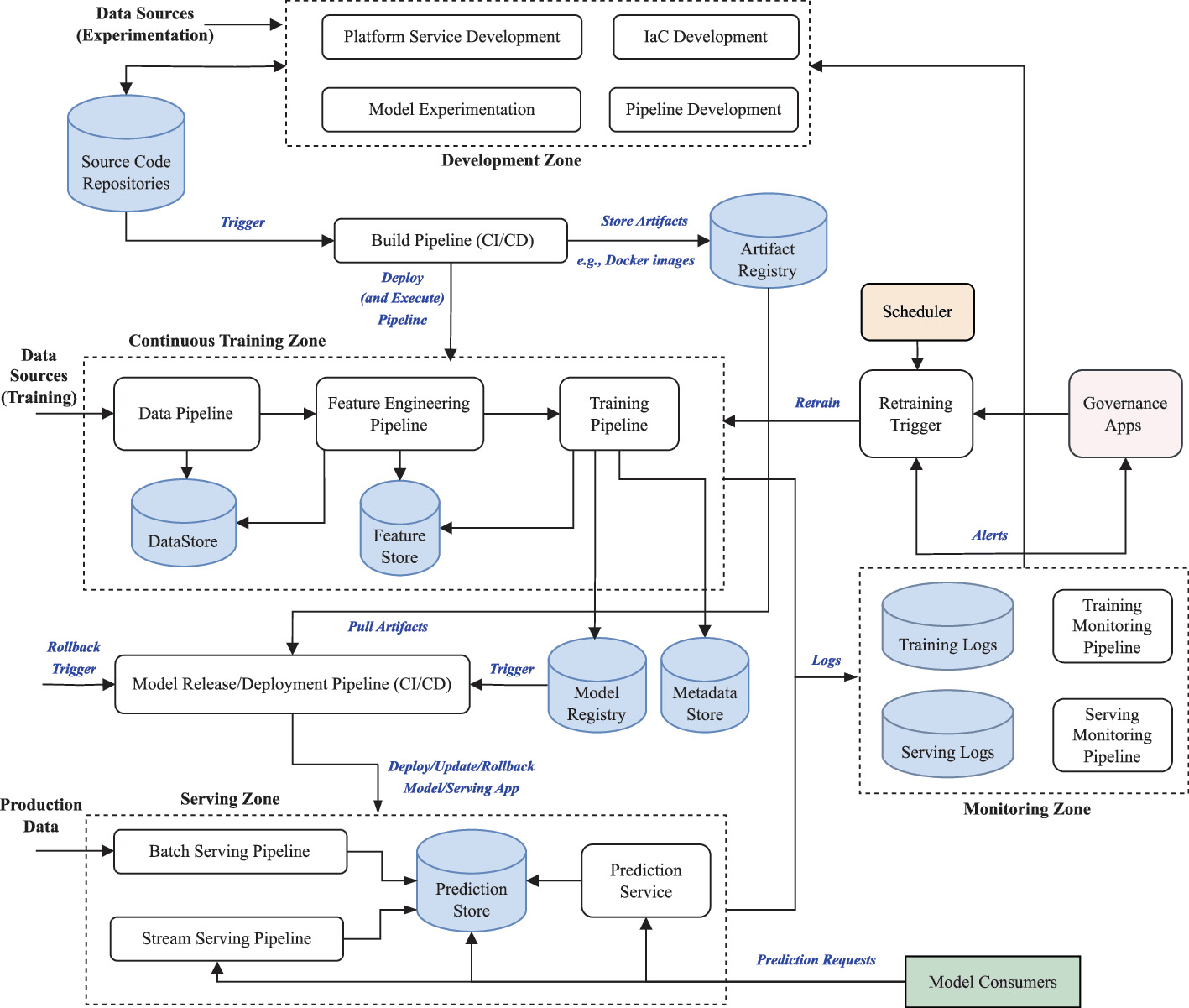


Doctoral Symposium - CAIN 2025
A Metrics-Oriented Architectural Model
to Characterize Complexity on
Machine Learning-Enabled Systems

Doctoral Symposium - CAIN 2025
A Metrics-Oriented Architectural Model
to Characterize Complexity on
Machine Learning-Enabled Systems

Case Study
SPIRA
Making a Pipeline Production-Ready
https://renatocf.xyz/sadis25-slides
2025
Renato Cordeiro Ferreira
Institute of Mathematics and Statistics (IME)
University of São Paulo (USP) – Brazil
Jheronimus Academy of Data Science (JADS)
Technical University of Eindhoven (TUe) / Tilburg University (TiU) – The Netherlands


Paper
Slides
Challenges and Lessons Learned in the Healthcare Domain
Our paper describes
challenges and lessons learned
on evolving the training pipeline of SPIRA:
from a BIG BALL OF MUD (v1)
to a MODULAR MONOLITH (v2)
to a set of MICROSERVICES (v3).


Data Collection App
Scientific Initiation 2021
Francisco Wernke
Streaming
Prediction Server
+ Client API / App
Capstone Project 2022
Vitor Tamae
Highly Availability
with Kubernetes
Capstone Project 2023
Vitor Guidi
Redesign Continuous Training Subsystem
Capstone Project 2023
Daniel Lawand
CI/CD/CD4ML on
Training Pipeline
Capstone Project 2024
Lucas Quaresma
+ Roberto Bolgheroni
Case Study
OCEAN GUARD
MLOps with Microservices
A Case Study on the Maritime Domain
https://renatocf.xyz/ssoc25-slides
2025
Renato Cordeiro Ferreira
Institute of Mathematics and Statistics (IME)
University of São Paulo (USP) – Brazil
Jheronimus Academy of Data Science (JADS)
Technical University of Eindhoven (TUe) / Tilburg University (TiU) – The Netherlands
Paper
Slides
Our paper describes
challenges and lessons learned
on building OCEAN GUARD:
a system for anomaly detection in the
maritime domain


Published at SummerSOC 2025
MLOps with Microservices
A Case Study on the Maritime Domain
Document the expected formats of data exchange between two services or pipelines, which interact as consumer and producer via a data storage


Document the expected protocol of behavior between two services,
which interact synchronously or asynchronously via the network
Document the expected input and output between a trainer and a server, which interact by storing and loading models in a model registry
Code Contracts
Data Contracts
Model Contracts


Research Team
MSc Students
Innovation Team
PDEng Trainees
Ui Dev Team
Hired Developers
Core Dev Team
Scientific Programmers
Research Methodology

State of the art
about metrics
regarding
ML-Enabled
Systems
Industry- and academic-based case study on complexity metrics for
ML-Enabled Systems
Mixed-method approach to assess the impact of complexity in development tasks for
ML-Enabled Systems
I
C
E
R
E
C
Data from
knowledge bases
Researcher
Ontology
Design
Choice of
Case Studies
Selection of
Metrics
Constructed
Examples
Sampling
Population of
Practitioners
I
C
E
R
E
C
Established
Publication
Databases
Guidelines
from
Literature
Inclusion
Criteria for
Case Studies
Exploratory +
Confirmatory
Case Studies
Sampling
Population of
Practitioners
Constructed
Examples
Threats to Validity
Construct Validity
The study can measure what it proposed to measure
Internal Validity
The study can produce the results it reported
External Validity
The study can be generalized to other contexts
Conclusion
The study can be replicated by other researchers
C
I
E
R
A Metrics-Oriented Architectural Model
to Characterize Complexity on
Machine Learning-Enabled Systems
https://renatocf.xyz/phd-quali-live
2025
Renato Cordeiro Ferreira
Supervisor: Prof. Dr. Alfredo Goldman
Co-Supervisor: Prof. Dr. Damian Tamburri
IME-USP