Log in to a computer
Use your Citymail Username & associated password
jausten000@citymail.ccny.edu
WELCOME!
Entrepreneurship -- Prof. Hmaddi
RESEARCH
MARKET & INDUSTRY
PROFESSOR SARAH COHN
HEAD OF REFERENCE
September 16, 2025

Agenda
-
Citation
-
Types of Sources
-
Googling & Evaluating
-
Library Resources
-
Getting Help
What is the purpose of citation?
-
Engage in scholarly conversation or to situate your work in the relevant context
-
Relate your own ideas and analysis to existing scholarship, writing, or reporting
-
Give credit to authors whose ideas, words, data you use
-
Allow your reader to find the original article
How?
-
Anything you cite needs to be in 2 places
-
An in-text citation
-
A works cited or bibliography
-
-
Your sources need to be legit & linked or otherwise findable
-
No fake LLM generated sources!!!
-
In Text
Recent data indicates that more students with depression or anxiety are seeking therapy, 61% of students in 2024, up from 59% in 2022 (Zhou et al. 2024).
Works Cited
Zhou, Sasha, Mac Murphy, Erin Voichoski, and Julia Bell. 2024. The
Healthy Minds Study. https://healthymindsnetwork.org/wp-
content/uploads/2024/09/HMS_national_report_090924.pdf.
Types of Sources
- Government or non-profit data sources
- Raw or interpreted data
- Consumer & target market demographics
- Problem numbers
- Industry & Market reports
- Historical overviews & trends
- Current numbers, areas for growth
- News
- Public perception of a problem or solution
- Interviews with people outside of your circles
Open web & Library databases
Library databases
Open web & Library databases
(and where to find them)
Googling
-
Be specific with your search terms
- sad college students
- college students mental health statistics 2024
-
Quotation marks to glue phrases together
- college students "mental health"
-
Don't rely on the AI-generated summary
- You can't cite it, it might be making stuff up
- Use the site search function
- site:nytimes.com "mental health" college students
Evaluating
Investigate the source
-
Who is providing the information and why?
- Be aware of folks trying to sell you stuff
- Look up the author and organization publishing the information. What can you find about the author/website creators?
- Use lateral reading. Go beyond the 'About Us' section on the organization's website and see what other, trusted sources say about the source.
- What is their mission? Where does their funding come from? Who do they partner with? Would their assessment be biased?
- Do they have authority in the area? Why?
Evaluating
Trace the information
- Attempt to locate the original source of the information. Do they provide links or a bibliography you can access?
- Was the claim, quote, or media fairly represented?
- Does the extracted information support the original claims in the research?
- Is information being cherry-picked to support an agenda or a bias?
- Is information being taken out of context?
Library Resources
-
Business Insights
International & US market, industry & company reports
SWOT analyses
NAICS searching
News & scholarly articles
-
Social Explorer
Interactive demographic data in the United States, 1790-2023
Datasets are available in tables or maps
Getting Help
Professor Sarah Cohn
Head of Reference
scohn@ccny.cuny.edu
Reference Desk: Cohen Library
Monday-Thursday 10am-7pm
Friday 10am-4pm
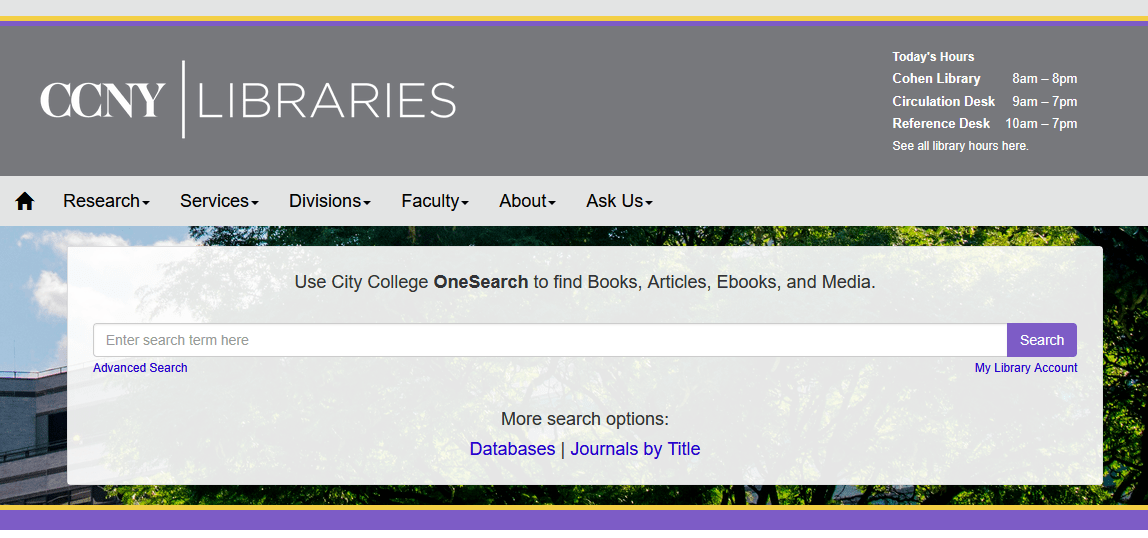
library.ccny.cuny.edu