

Lecture 2: Regularization and Cross-validation
Intro to Machine Learning

Recall
\(\theta^*=\left({X}^{\top} {X}\right)^{-1} {X}^{\top} {Y}\)
\(X = \begin{bmatrix} \text{---} \; {x^{(1)}}^\top \; \text{---} \\ \vdots \\ \text{---} \; {x^{(n)}}^\top \; \text{---} \end{bmatrix} = \begin{bmatrix} x_1^{(1)} & \cdots & x_d^{(1)} \\ \vdots & \ddots & \vdots \\ x_1^{(n)} & \cdots & x_d^{(n)} \end{bmatrix}\)
\(Y = \begin{bmatrix}y^{(1)}\\\vdots\\y^{(n)}\end{bmatrix}\)
\(\theta = \begin{bmatrix}\theta_{1}\\\vdots\\\theta_{d}\end{bmatrix}\)
\( J(\theta) =\frac{1}{n}({X} \theta-{Y})^{\top}({X} \theta-{Y})\)
Let
Then
\(\in \mathbb{R}^{n\times d}\)
\(\in \mathbb{R}^{n\times 1}\)
\(\in \mathbb{R}^{d\times 1}\)
\(\in \mathbb{R}^{1\times 1}\)
By matrix calculus and optimization
\(\in \mathbb{R}^{d\times 1}\)
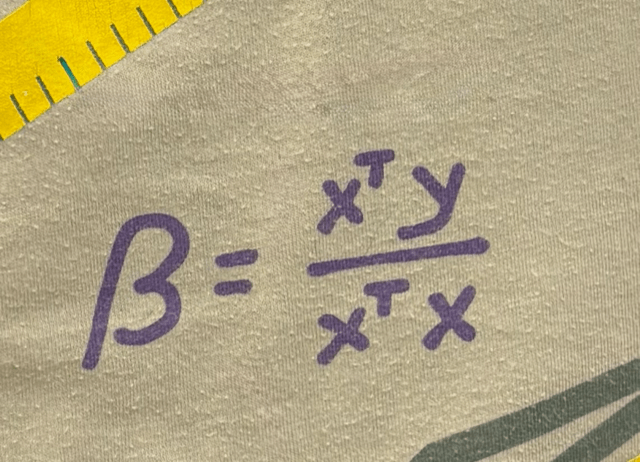
\(\theta^*=\left({X}^{\top} {X}\right)^{-1} {X}^{\top} {Y}\)
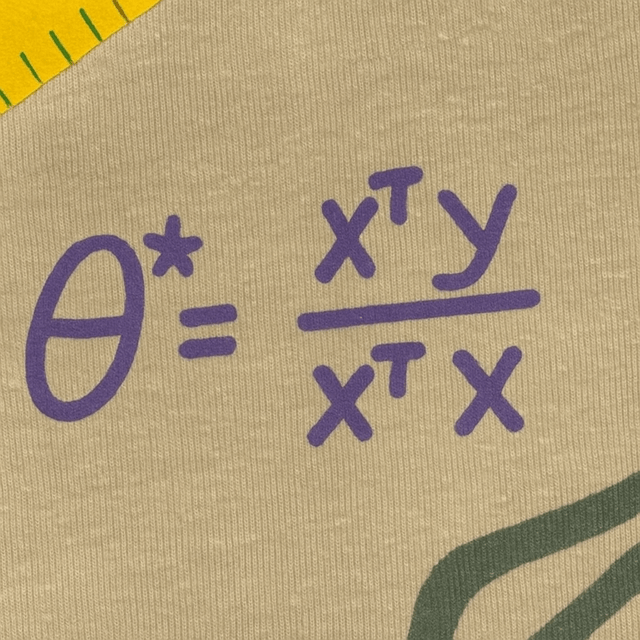
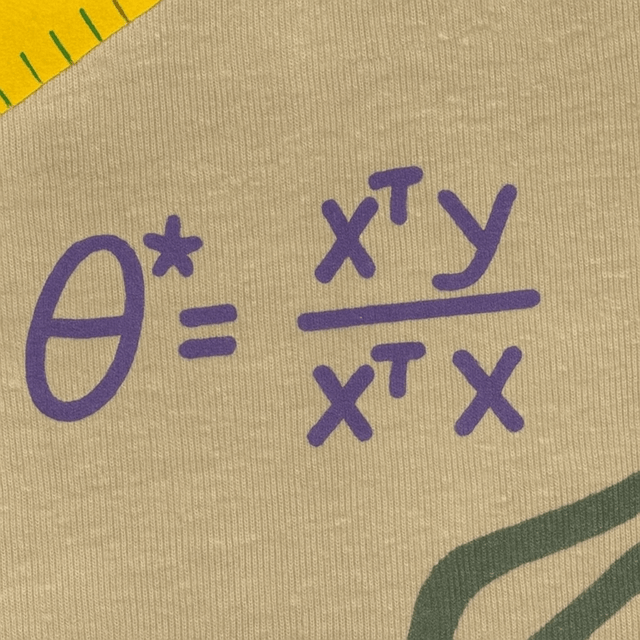
Jane street shirt
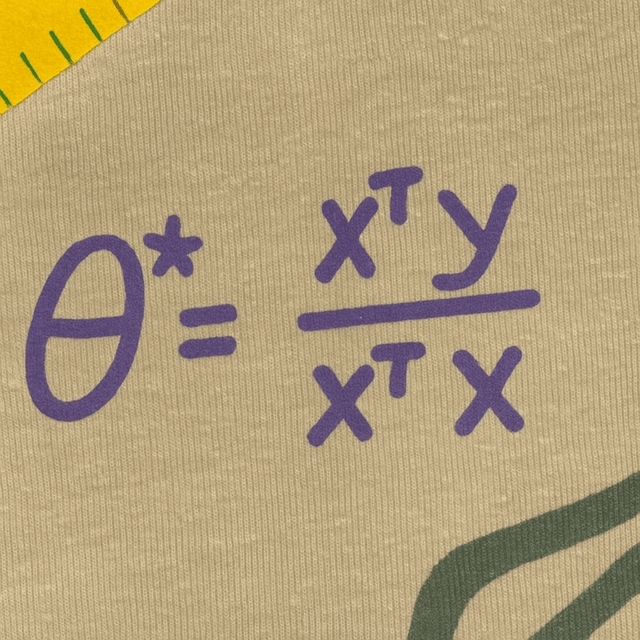
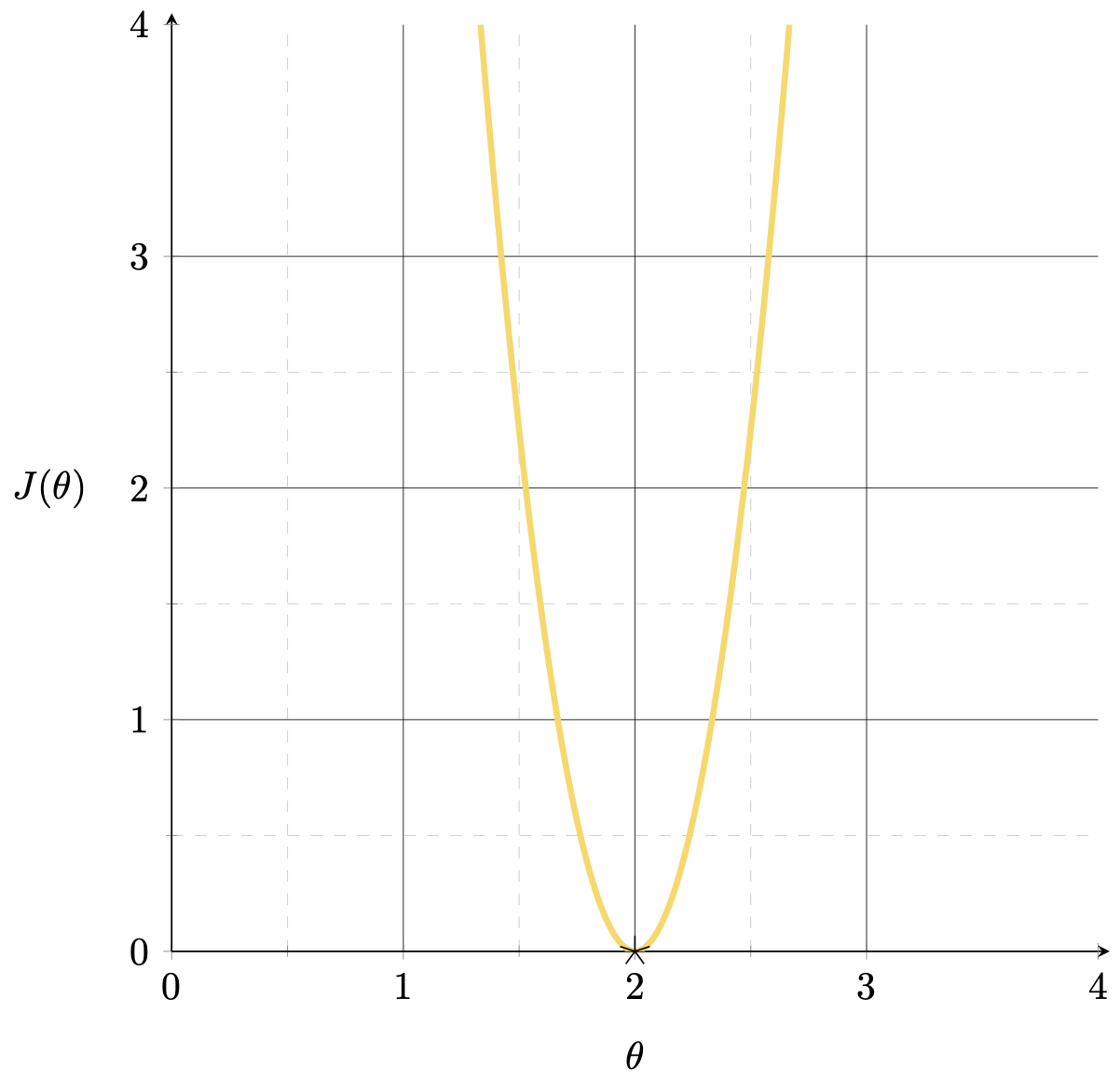
\(J(\theta) = (3 \theta-6)^{2}\)
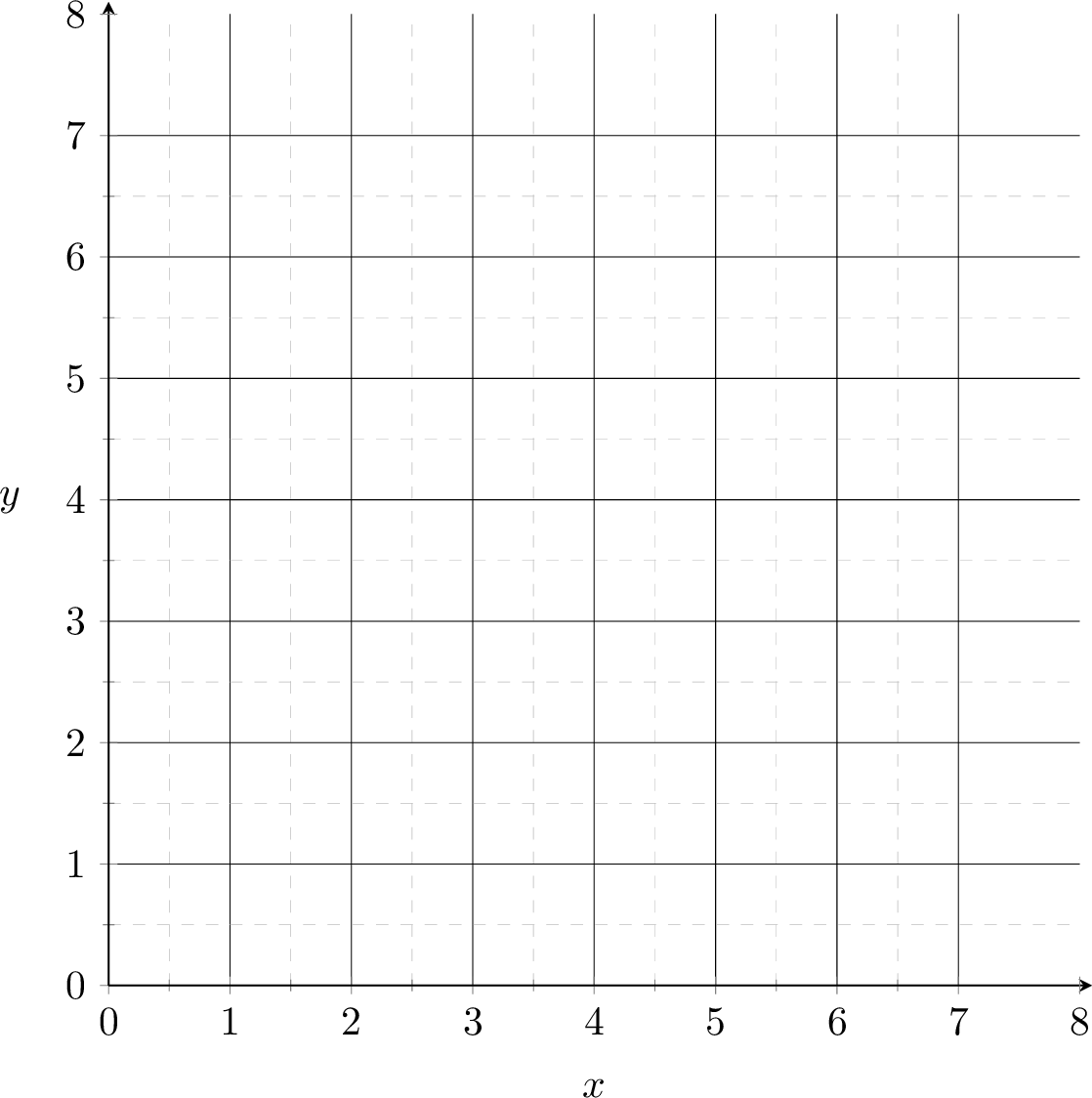
\(X= [3]\)
\(Y= [6]\)
\(\theta^*=\left({X}^{\top} {X}\right)^{-1} {X}^{\top} {Y}\)
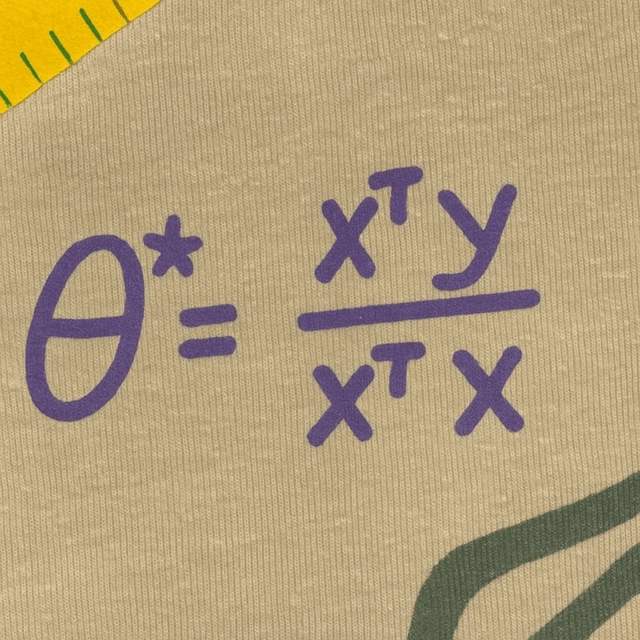
\(\theta^*=(X^\top X)^{-1}(X^\top Y)\)
\(=\frac{X^\top Y}{X^\top X}= \frac{6}{3}=2\)
\(\theta^*\)
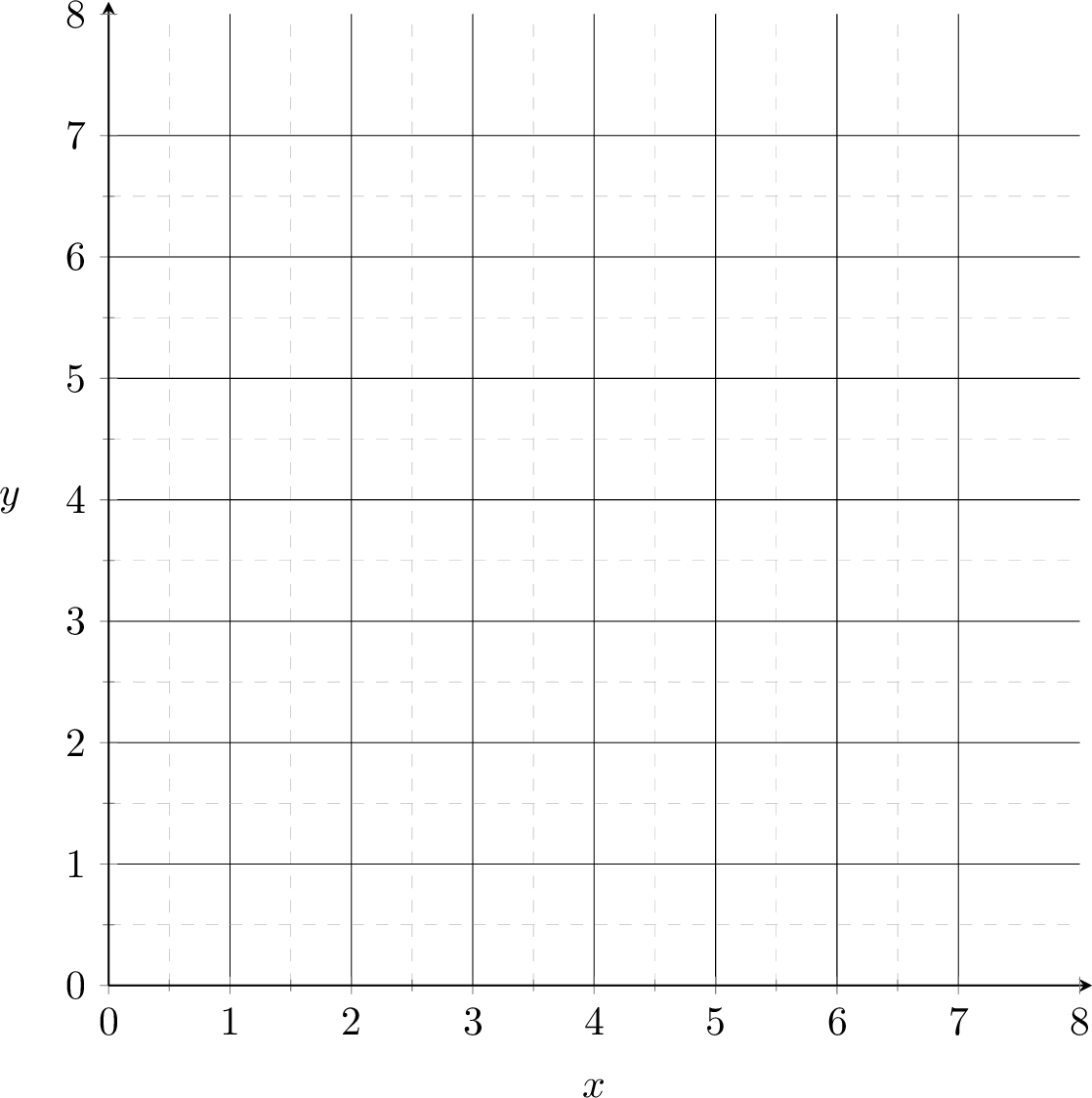
\(\theta^*\)
\(X = \begin{bmatrix}1 \\2\end{bmatrix}\)
\(Y = \begin{bmatrix}3 \\6\end{bmatrix}\)
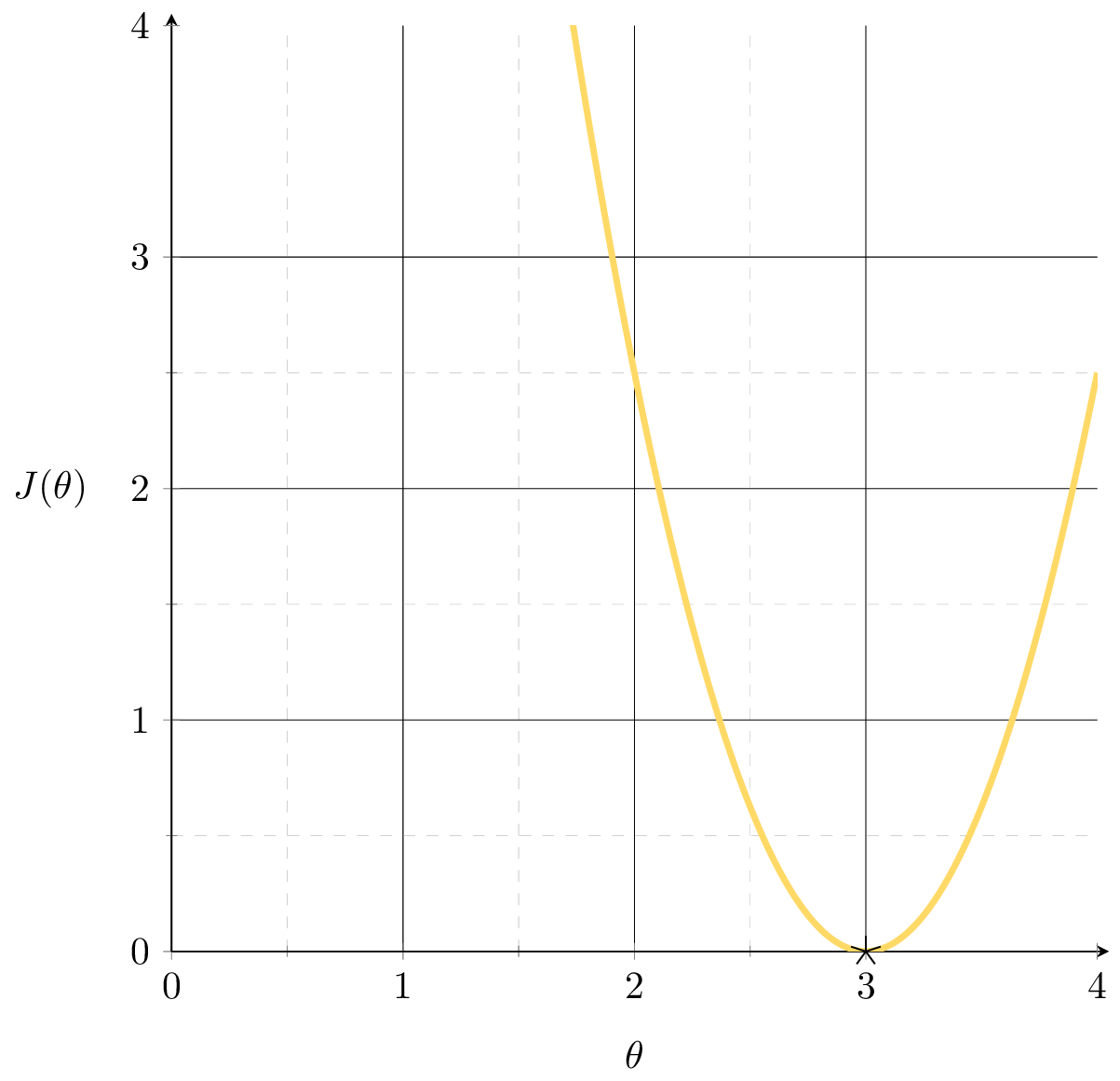
\(=\frac{X^{\top}Y}{X^{\top}X}= \frac{15}{5}= 3\)
\(\theta^*=(X^\top X)^{-1}(X^\top Y)\)
\(\theta^*=\left({X}^{\top} {X}\right)^{-1} {X}^{\top} {Y}\)
\(X = \begin{bmatrix}1 & 0 \\0 & 1 \\ 1 & 1\end{bmatrix}\quad Y = \begin{bmatrix}2 \\3 \\ 5\end{bmatrix}\)
\(X^\top X = \begin{bmatrix}2 & 1 \\1 & 2\end{bmatrix}\quad X^\top Y = \begin{bmatrix}7 \\8\end{bmatrix}\)
\(\theta^* = \begin{bmatrix}2 & 1 \\1 & 2\end{bmatrix}^{-1} \begin{bmatrix}7 \\8\end{bmatrix} = \begin{bmatrix}2 \\3\end{bmatrix}\)
\(\theta^*=\left({X}^{\top} {X}\right)^{-1} {X}^{\top} {Y}\)
Outline
-
The "trouble" with the closed-form solution
- visually, practically, mathematically
- Regularization and ridge regression
- Cross-validation
\(\infty\) many optimal \(\theta^*\)
temperature \(x_1\)
population \(x_2\)
energy used
\(y\)
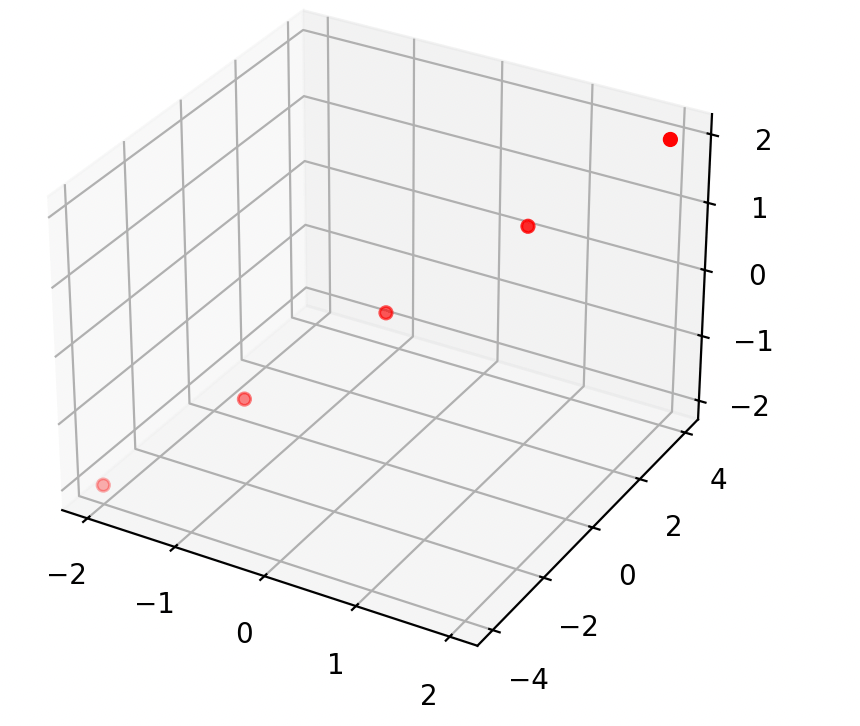
temperature ( °F) \(x_1\)
temperature (°C) \(x_2\)
energy used
\(y\)
data
MSE
\(\theta^*=\left({X}^{\top} {X}\right)^{-1} {X}^{\top} {Y}\)
undefined
(a) \(n < d\)
(b) Linearly-dependent features:
closed-form formula
optimal solution
Not enough info to pin down a unique solution
e.g. genomics, NLP
e.g. temp °F/°C, age/birth_year, ...
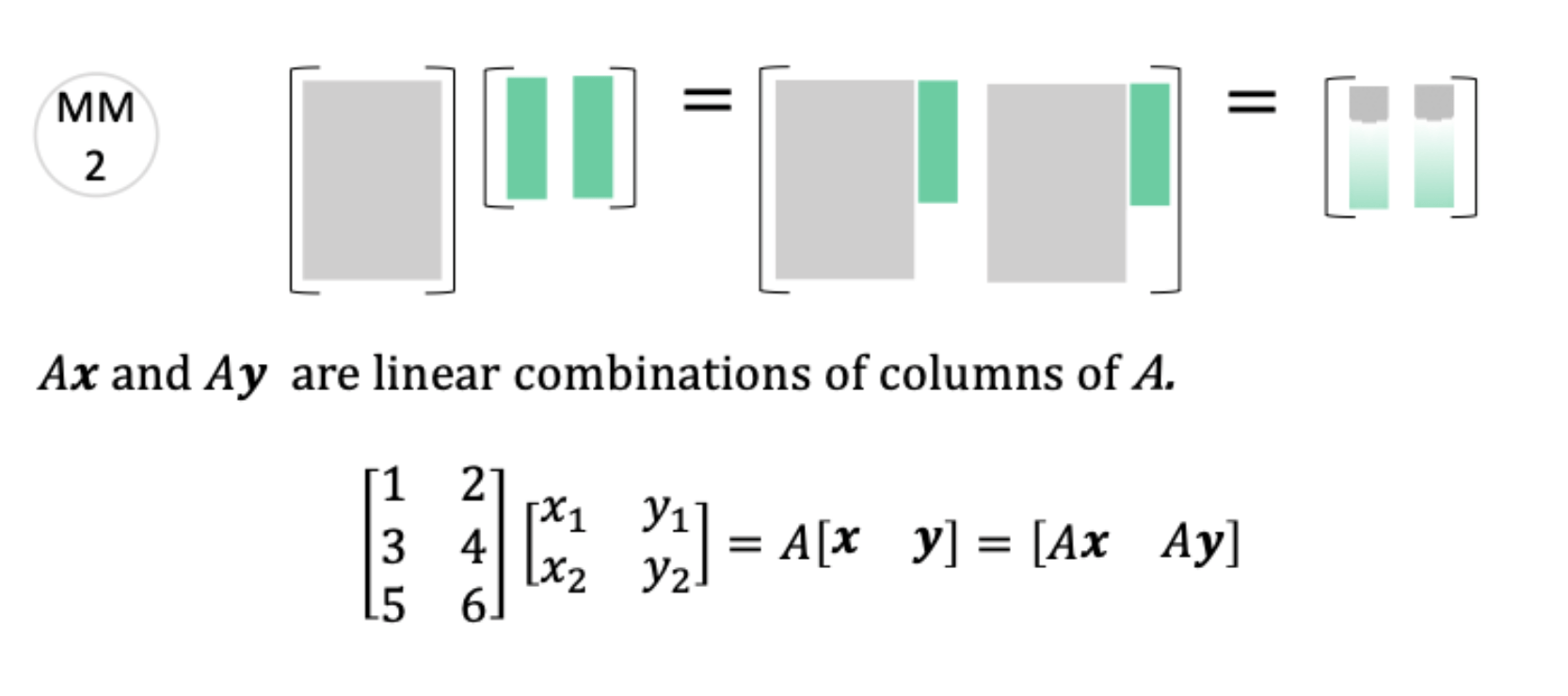
\(\left({X}^{\top} {X}\right)\) is singular
\({X}\) is not full column rank
demo (a) \(n < d\): 1 sample, 2 features
\(X\)
\(X^\top\)
\(=\)
\(\begin{bmatrix}2\\3\end{bmatrix}\)
\(\begin{bmatrix}2 & 3\end{bmatrix}\)
\(= \begin{bmatrix}4 & 6\\6 & 9\end{bmatrix}\)
demo (b) Collinear: \(x_2 = 1.5 \cdot x_1\)
\(X\)
\(X^\top\)
\(=\)
\(\begin{bmatrix}2 & 4 & 6\\3 & 6 & 9\end{bmatrix}\)
\(\begin{bmatrix}2 & 3\\4 & 6\\6 & 9\end{bmatrix}\)
\(= \begin{bmatrix}56 & 84\\84 & 126\end{bmatrix}\)
mathematically,
- This 👉 formula is not well-defined
Typically, \(X\) is full column rank
- \(\theta^*=\left({X}^{\top} {X}\right)^{-1} {X}^{\top} {Y}\)
- \(J(\theta)\) "curves up" everywhere
When \(X\) is not full column rank
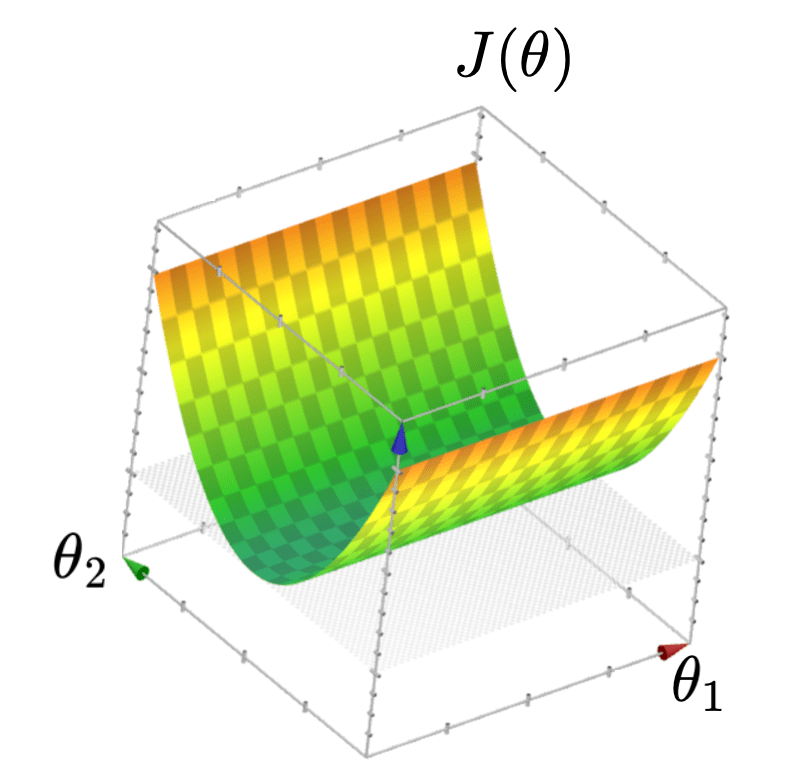
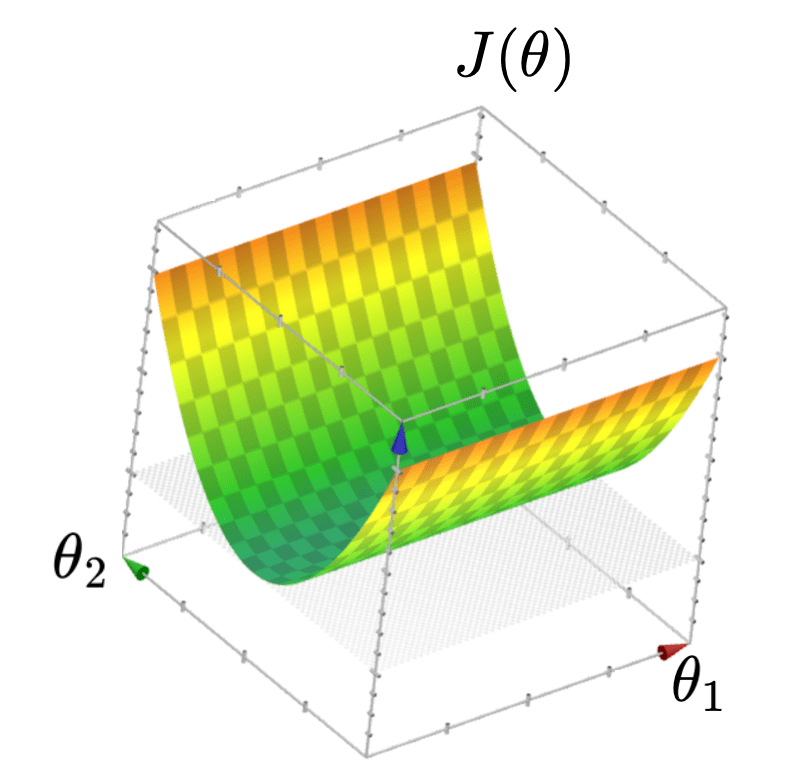
- \(J(\theta)\) has a "flat" bottom
- Infinitely many optimal hyperplanes
- unique optimal hyperplane
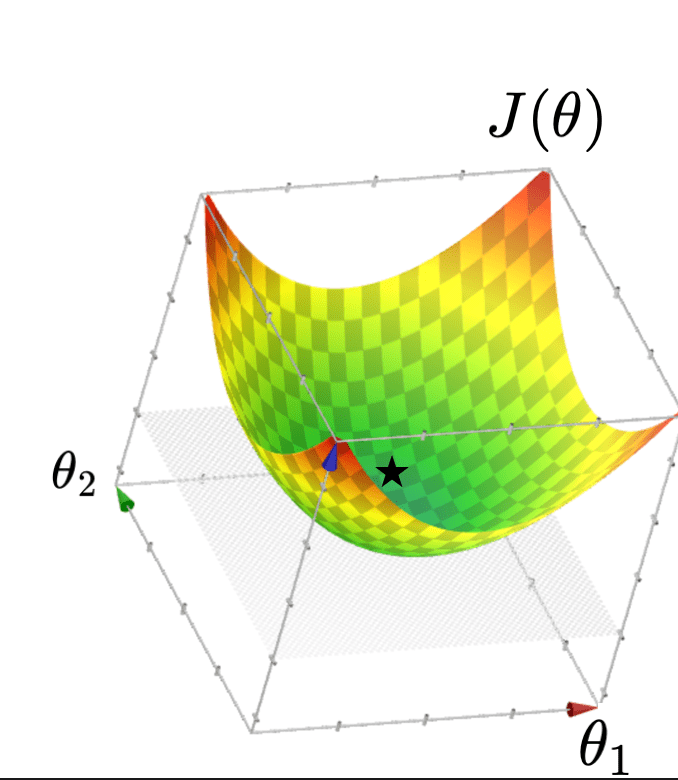
\(X^\top X\) is "more" invertible 🥰
formula isn't wrong, data is trouble-making 🥺
minimum eigenvalue of\((X^\top X)\) increasing
assume \(n=1\) and \(y=1\)
if the data is \((x,1) = (0.002,1)\)
if the data is \((x,y) = (-0.0002,1)\)
\(\theta^* = 500\)
\(\theta^* = -5,000\)
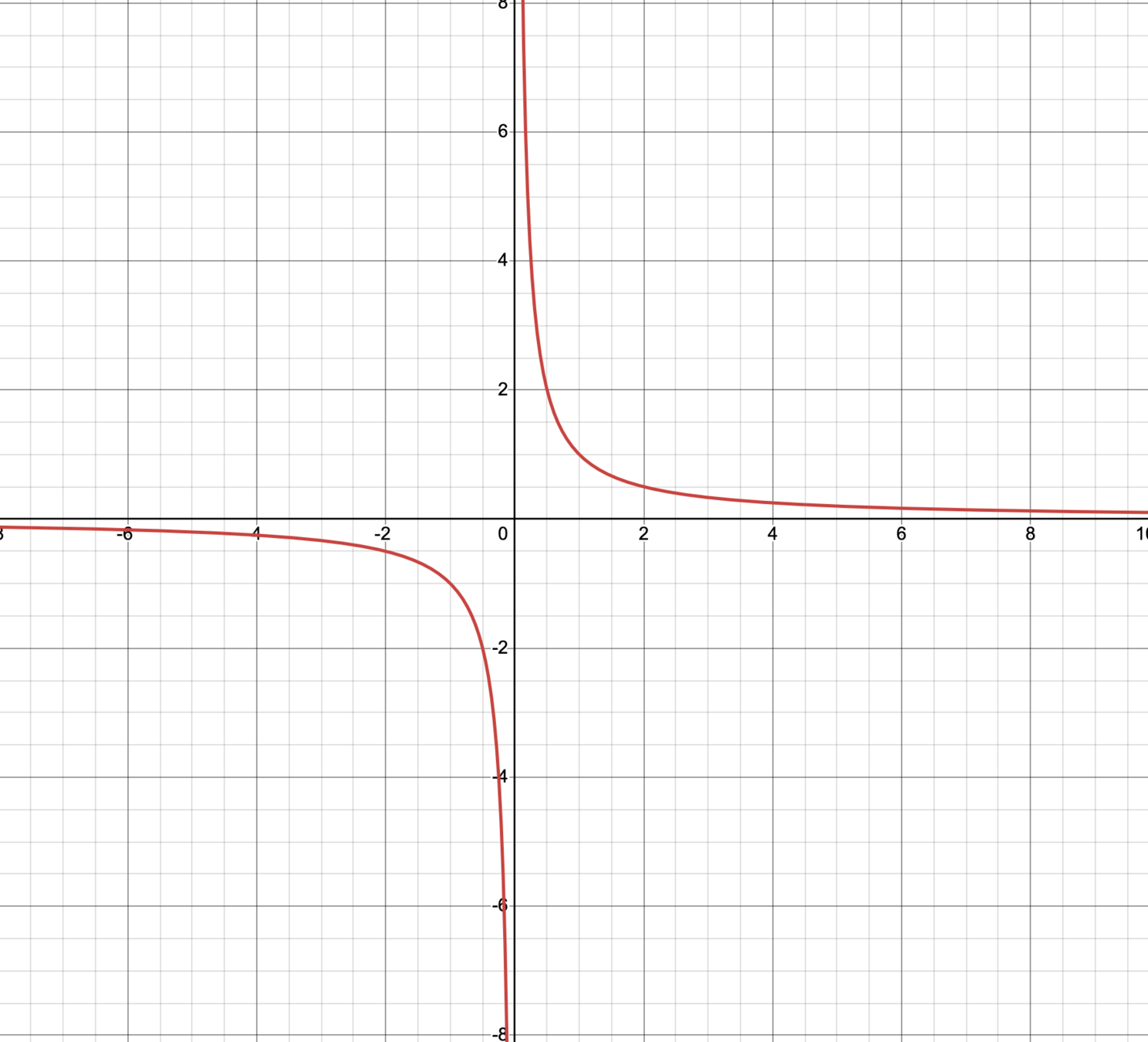
then \(\theta^*=\frac{1}{x}\)
technically, \(\theta^*=\left({X}^{\top} {X}\right)^{-1} {X}^{\top} {Y}\) exists and gives the unique optimal hyperplane
practically,
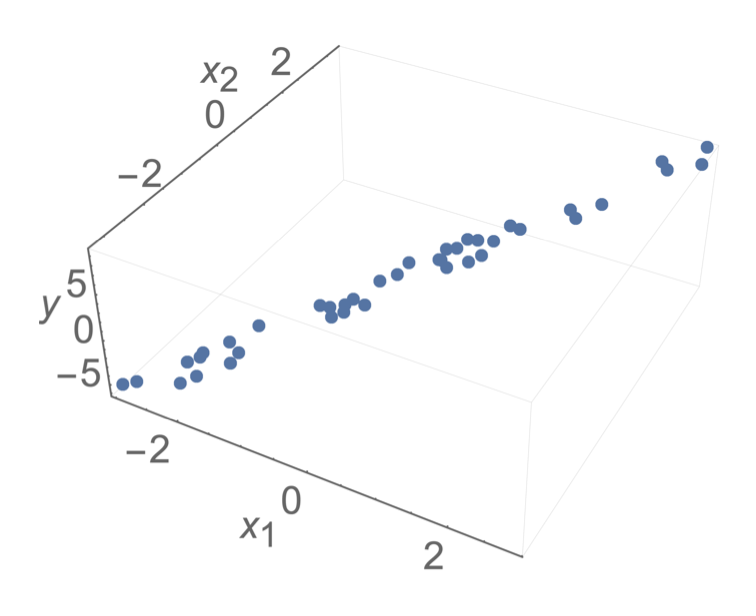
\(\theta^*\) tends to have huge magnitude
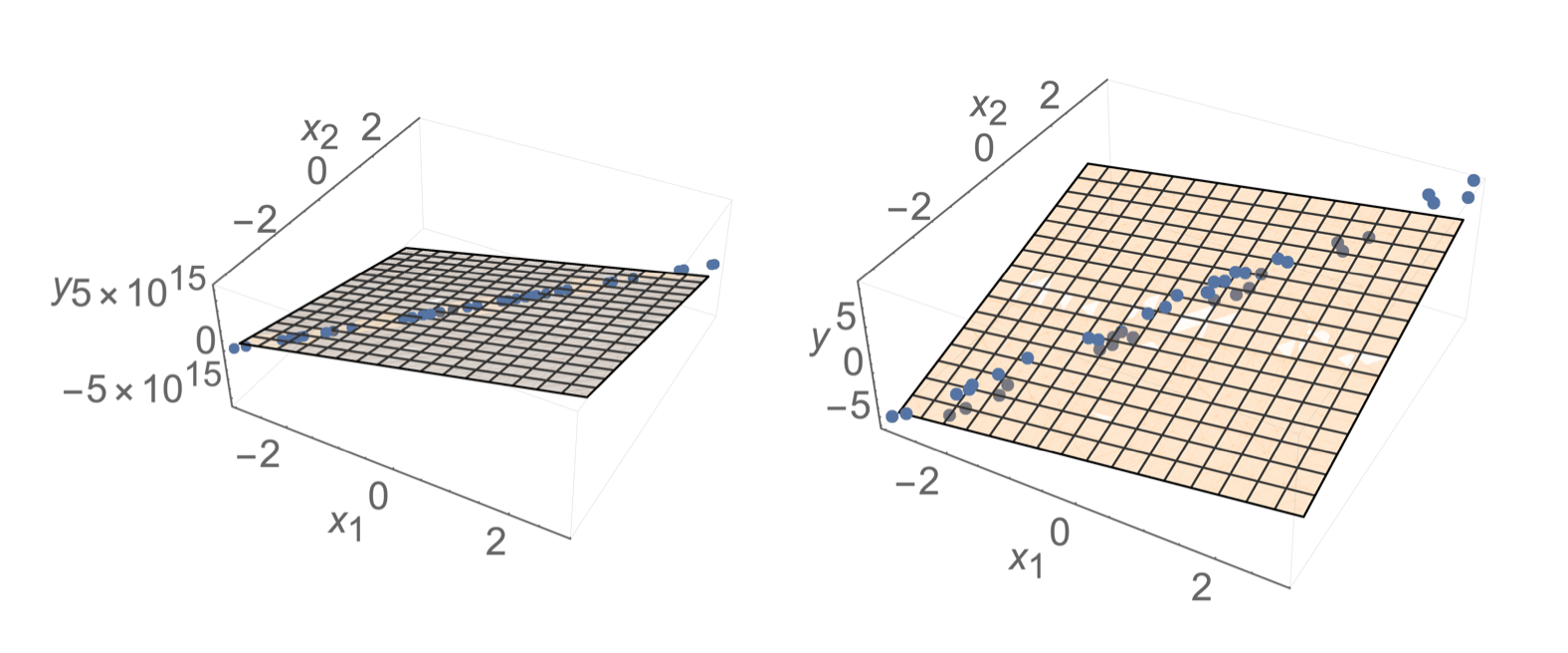
\(\theta^*\) tends to be very sensitive to the small changes in the data
when \(X^\top X\) is almost singular
lots of other \(\theta\)s fit the training data almost equally well
🥺
Outline
- The "trouble" with the closed-form solution
-
Regularization and ridge regression
- hyperparameters
- Cross-validation
Ridge Regression: Objective
- Many \(\theta\) give similar loss, but some have huge magnitude... unstable!
- small change in \(x\) \(\Rightarrow\) wildly different prediction
- Idea: penalize large \(\theta\) in our objective, a.k.a. (explicit) regularization
- Ridge objective:
\(\lambda > 0\) controls how heavily we penalize magnitude relative to MSE
Ridge Regression: Solution
for \(\lambda > 0\): \(\;{X}^{\top} {X}+n \lambda I\) is always invertible, so \(\theta^*_{\text{ridge}}\) always exists and is unique
How does \(\lambda\) affect the learned \(\theta\)?
- \(\lambda = 0\)?
- \(\lambda = 1000\)?
- \(\lambda = -100\)?
- No penalty — reduces to OLS
- Huge penalty — forces \(\theta \approx 0\)
- Rewards large \(\theta\) — counter-productive!
this is why we require \(\lambda > 0\)
\(\theta^*_{\text{ridge}}=\left({X}^{\top} {X}+n \lambda I\right)^{-1} {X}^{\top} {Y}\)
Regression
Algorithm
💻
\(\in \mathbb{R}^d \)
\(\in \mathbb{R}\)
\(\mathcal{D}_\text{train}\)
🧠 ⚙️
- hypothesis class
- loss function
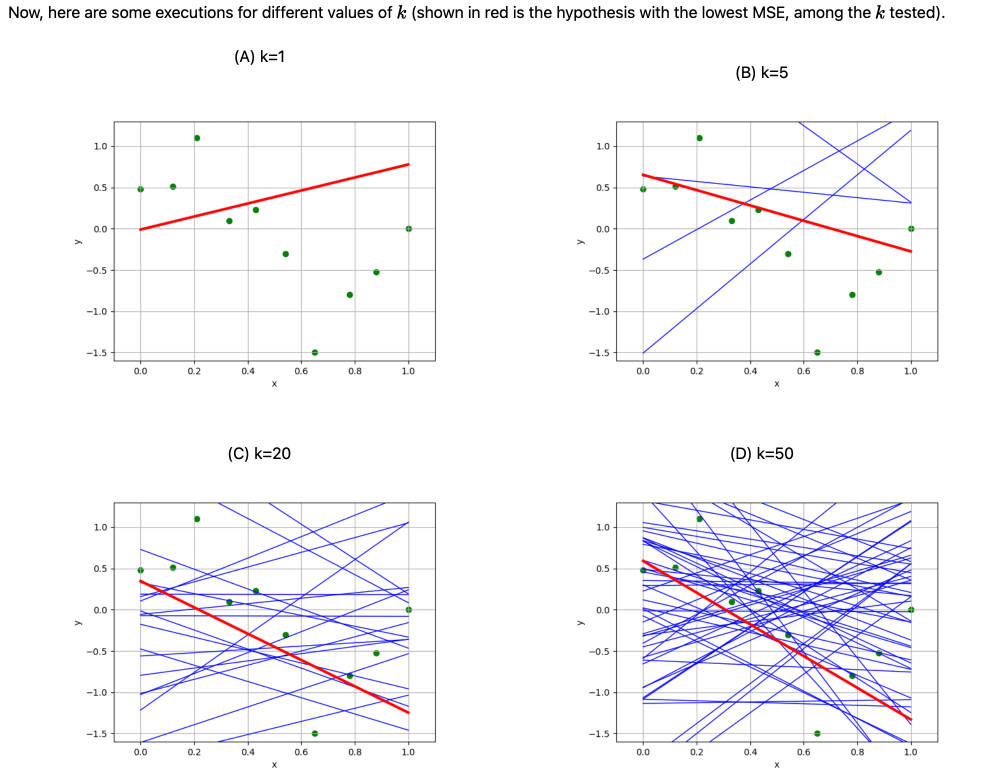
- hyperparameter
\(\lambda\) is a hyperparameter
- affects learning outcome, and not learned by the algorithm
- we already saw a hyperparameter (in lab 1, how many random regressor tried)
Outline
- The "trouble" with the closed-form solution
- Regularization and ridge regression
- Cross-validation
We need to choose hyperparameters (like \(\lambda\))
- Can’t use training error (would always pick \(\lambda=0\))
- Can’t use test error (we don't have test data)
\(\left\{\left(x^{(1)}, y^{(1)}\right), \dots, \left(x^{(n)}, y^{(n)}\right)\right\}\)
\(\mathcal{D}_\text{val}\)
\(\mathcal{D}_\text{train}\)
- Hold-out some data
- Use \(\mathcal{D}_{\text{val}}\) to evaluate how good a hyperparameter \(\lambda\) is
Regression
Algorithm
💻
🧠 ⚙️
- linear hypothesis
- ridge objective
- a fixed \(\lambda\)
train on \(\mathcal{D}_{\text{train}}\) with \(\lambda\)
compute \(\mathcal{E}_{\text{val}}(\lambda)\) on \(\mathcal{D}_{\text{val}}\)
for each \(\lambda \in \{0.1,\, 1,\, 10\}\):
train on \(\mathcal{D}_{\text{train}}\) with \(\lambda\)
compute \(\mathcal{E}_{\text{val}}(\lambda)\) on \(\mathcal{D}_{\text{val}}\)
return \(\arg\min_\lambda \mathcal{E}_{\text{val}}(\lambda)\)
\(\mathcal{D}_\text{val}\)
\(\mathcal{D}_\text{train}\)
in this example, compare \( \mathcal{E}_{\text{val}}(.1), \) \( \mathcal{E}_{\text{val}}(1), \) and \( \mathcal{E}_{\text{val}}(10), \)
return the \(\lambda\) corresponding to smallest validation error
Cross-validation
for \(i = 1, \dots, 5\):
train \(h_i\) on \(\mathcal{D} \setminus \mathcal{D}_i\) with \(\lambda\)
\(\mathcal{E}_i =\) error on \(\mathcal{D}_i\)
for \(i = 1, \dots, 5\):
train \(h_i\) on \(\mathcal{D} \setminus \mathcal{D}_i\) with \(\lambda\)
\(\mathcal{E}_i =\) error on \(\mathcal{D}_i\)
\(\mathcal{E}_{\text{val}}(\lambda) = (\mathcal{E}_1 + \cdots + \mathcal{E}_5) / 5\)
for each \(\lambda \in \{0.1, 1, 10\}\):
for \(i = 1, \dots, 5\):
train \(h_i\) on \(\mathcal{D} \setminus \mathcal{D}_i\) with \(\lambda\)
\(\mathcal{E}_i =\) error on \(\mathcal{D}_i\)
\(\mathcal{E}_{\text{val}}(\lambda) = (\mathcal{E}_1 + \cdots + \mathcal{E}_5) / 5\)
return \(\lambda^* = \arg\min_\lambda\,\mathcal{E}_{\text{val}}(\lambda)\)
for each \(\lambda \in \{0.1, 1, 10\}\):
for \(i = 1, \dots, 5\):
train \(h_i\) on \(\mathcal{D} \setminus \mathcal{D}_i\) with \(\lambda\)
\(\mathcal{E}_i =\) error on \(\mathcal{D}_i\)
\(\mathcal{E}_{\text{val}}(\lambda) = (\mathcal{E}_1 + \cdots + \mathcal{E}_5) / 5\)
return \(\lambda^* = \arg\min_\lambda\,\mathcal{E}_{\text{val}}(\lambda)\)
outer loop of \(\lambda \in \{0.1, 1, 10\}\):
\(\mathcal{E}_{\text{val}}(\lambda) = (\mathcal{E}_1 + \mathcal{E}_2 + \mathcal{E}_3 + \mathcal{E}_4 + \mathcal{E}_5) / 5\)
How many hypotheses trained in this example to pick \(\lambda^*\)?
\(\theta^*_{\text{final}} = (X^\top X + n \lambda^* I)^{-1} X^\top Y\)





finally train using the chosen \(\lambda^*,\) and data from all of \(\mathcal{D}\)
Summary
-
When \(X^\top X\) is singular or ill-conditioned, OLS is undefined or overfits.
-
Regularization combats overfitting by penalizing large \(\theta\).
-
Ridge regression adds \(\lambda\|\theta\|^2\) to the objective — still has a closed-form solution.
-
\(\lambda\) is a hyperparameter that trades off fit vs. regularization.
-
Validation and cross-validation provide principled ways to choose \(\lambda\).
Two Ways X Can Fail
When is X not full column rank?
| (a) \(n < d\) (more features than data points) | [common] |
| (b) linearly dependent features | [very common] |
Common theme: not enough information to pin down a unique solution
- flat MSE surface (like a half-pipe or valley)
- infinitely many optimal \(\theta\)
- \(\theta^* = (X^\top X)^{-1} X^\top Y\) is undefined
Let's visualize each...
\(\left({X}^{\top} {X}\right)\) is singular
\({X}\) is not full column rank
\(\left({X}^{\top} {X}\right)\) has zero eigenvalue(s)
\(\left({X}^{\top} {X}\right)\) is not full rank
the determinant of \(\left({X}^{\top} {X}\right)\) is zero
\(\theta^*=\left({X}^{\top} {X}\right)^{-1} {X}^{\top} {Y}\)
\(d\geq1\)
more generally,
most of the time, behaves nicely
but run into trouble when
The Problem with Validation
Validation error depends on luck of the split!
Same data, different random splits:
- Split A: validation error = 0.15
- Split B: validation error = 0.23
Which \(\lambda\) is actually best?
Cross-validation: average over ALL possible splits
Uses all data efficiently
More stable than single split
Gives reliable estimate of generalization
Uses all data for both training AND validation (just not at same time)
Cross-validation
for each \(\lambda \in \{0.1, 1, 10\}\):
for \(i = 1, \dots, 5\):
train \(h_i\) on \(\mathcal{D} \setminus \mathcal{D}_i\) with \(\lambda\)
\(\mathcal{E}_i =\) error on \(\mathcal{D}_i\)
\(\mathcal{E}_{\text{val}}(\lambda) = (\mathcal{E}_1 + \cdots + \mathcal{E}_5) / 5\)
return \(\lambda^* = \arg\min_\lambda\,\mathcal{E}_{\text{val}}(\lambda)\)
for each \(\lambda \in \{0.1, 1, 10\}\):
for \(i = 1, \dots, 5\):
train \(h_i\) on \(\mathcal{D} \setminus \mathcal{D}_i\) with \(\lambda\)
\(\mathcal{E}_i =\) error on \(\mathcal{D}_i\)
\(\mathcal{E}_{\text{val}}(\lambda) = (\mathcal{E}_1 + \cdots + \mathcal{E}_5) / 5\)
return \(\lambda^* = \arg\min_\lambda\,\mathcal{E}_{\text{val}}(\lambda)\)
for each \(\lambda \in \{0.1, 1, 10\}\):
for \(i = 1, \dots, 5\):
train \(h_i\) on \(\mathcal{D} \setminus \mathcal{D}_i\) with \(\lambda\)
\(\mathcal{E}_i =\) error on \(\mathcal{D}_i\)
\(\mathcal{E}_{\text{val}}(\lambda) = (\mathcal{E}_1 + \cdots + \mathcal{E}_5) / 5\)
return \(\lambda^* = \arg\min_\lambda\,\mathcal{E}_{\text{val}}(\lambda)\)
for each \(\lambda \in \{0.1, 1, 10\}\):
for \(i = 1, \dots, 5\):
train \(h_i\) on \(\mathcal{D} \setminus \mathcal{D}_i\) with \(\lambda\)
\(\mathcal{E}_i =\) error on \(\mathcal{D}_i\)
\(\mathcal{E}_{\text{val}}(\lambda) = (\mathcal{E}_1 + \cdots + \mathcal{E}_5) / 5\)
return \(\lambda^* = \arg\min_\lambda\,\mathcal{E}_{\text{val}}(\lambda)\)
How many hypotheses trained in this example to pick \(\lambda^*\)?
\(\theta^*_{\text{final}} = (X^\top X + n \lambda^* I)^{-1} X^\top Y\)
all of \(\mathcal{D}_1\) to \(\mathcal{D}_5\)





for \(\lambda \in \{0.1, 1, 10\}\):
Cross-validation
for \(i = 1, \dots, 5\):
train \(h_i\) on \(\mathcal{D} \setminus \mathcal{D}_i\) with \(\lambda\)
\(\mathcal{E}_i =\) error on \(\mathcal{D}_i\)
for \(i = 1, \dots, 5\):
train \(h_i\) on \(\mathcal{D} \setminus \mathcal{D}_i\) with \(\lambda\)
\(\mathcal{E}_i =\) error on \(\mathcal{D}_i\)
\(\mathcal{E}_{\text{val}}(\lambda) = (\mathcal{E}_1 + \cdots + \mathcal{E}_5) / 5\)
for each \(\lambda \in \{0.1, 1, 10\}\):
for \(i = 1, \dots, 5\):
train \(h_i\) on \(\mathcal{D} \setminus \mathcal{D}_i\) with \(\lambda\)
\(\mathcal{E}_i =\) error on \(\mathcal{D}_i\)
\(\mathcal{E}_{\text{val}}(\lambda) = (\mathcal{E}_1 + \cdots + \mathcal{E}_5) / 5\)
return \(\lambda^* = \arg\min_\lambda\,\mathcal{E}_{\text{val}}(\lambda)\)
for each \(\lambda \in \{0.1, 1, 10\}\):
for \(i = 1, \dots, 5\):
train \(h_i\) on \(\mathcal{D} \setminus \mathcal{D}_i\) with \(\lambda\)
\(\mathcal{E}_i =\) error on \(\mathcal{D}_i\)
\(\mathcal{E}_{\text{val}}(\lambda) = (\mathcal{E}_1 + \cdots + \mathcal{E}_5) / 5\)
return \(\lambda^* = \arg\min_\lambda\,\mathcal{E}_{\text{val}}(\lambda)\)
outer loop of \(\lambda \in \{0.1, 1, 10\}\):
\(\mathcal{E}_{\text{val}}(\lambda) = (\mathcal{E}_1 + \mathcal{E}_2 + \mathcal{E}_3 + \mathcal{E}_4 + \mathcal{E}_5) / 5\)
How many hypotheses trained in this example to pick \(\lambda^*\)?
\(\theta^*_{\text{final}} = (X^\top X + n \lambda^* I)^{-1} X^\top Y\)
finally train using data from all of \(\mathcal{D}\)