Evidence for Knot Localization in Very Long Self-Avoiding Polygons
/gs26
this talk!
AMS Special Session on Applications of Knot Theory
March 29, 2026
Joint Work With:
University of Georgia
Funding
BIRS, Japan Science and Technology Agency (CREST JPMJCR19T4), National Science Foundation (DMS–2107700), Deutsche Forschungsgemeinschaft (320021702/GRK2326).
Ochanomizu University
RWTH Aachen University
Kyoto University
Take-Home Messages
- We can determine the exact knot types of random self-avoiding polygons (SAPs) with 100M+ edges.
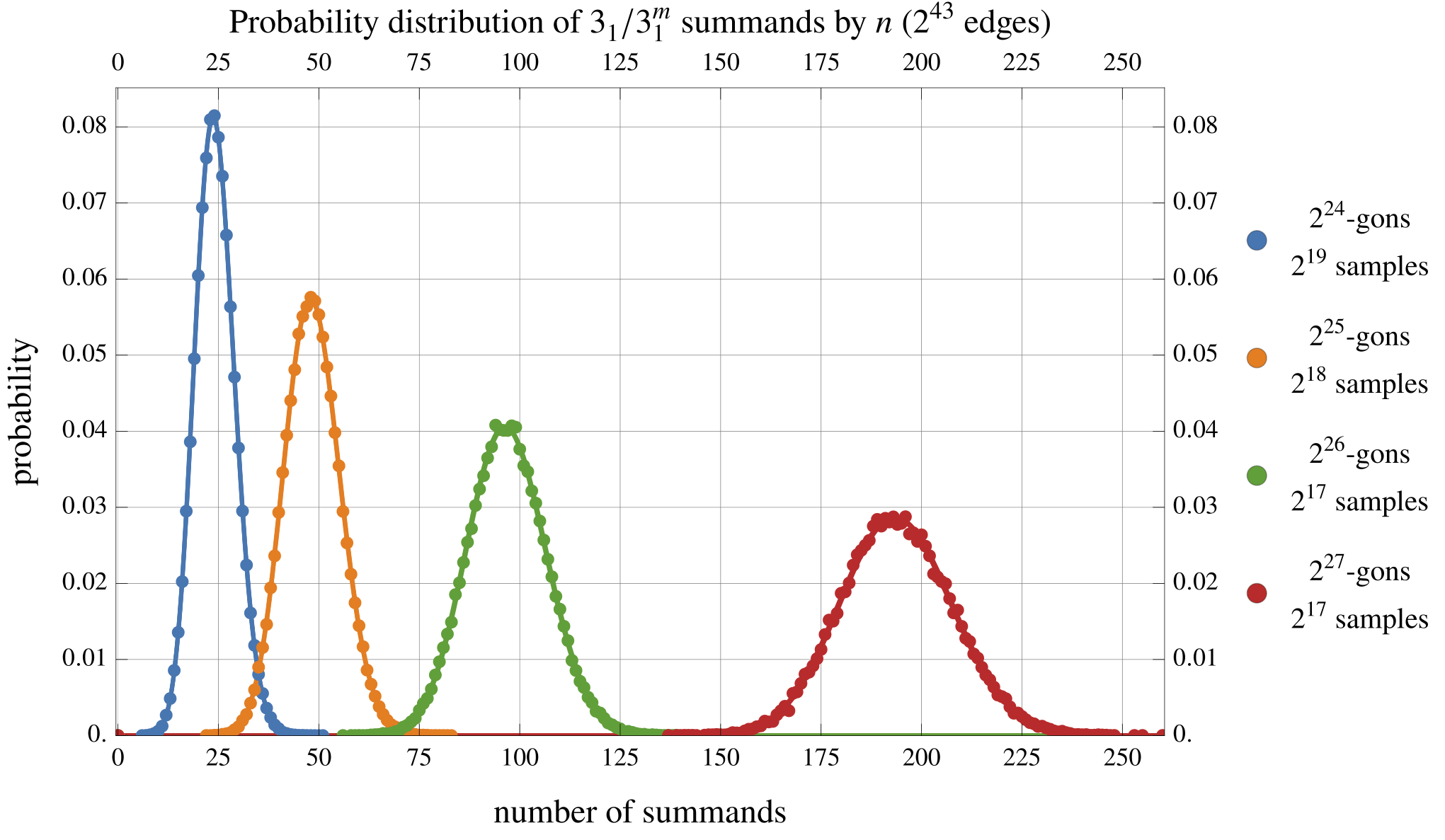
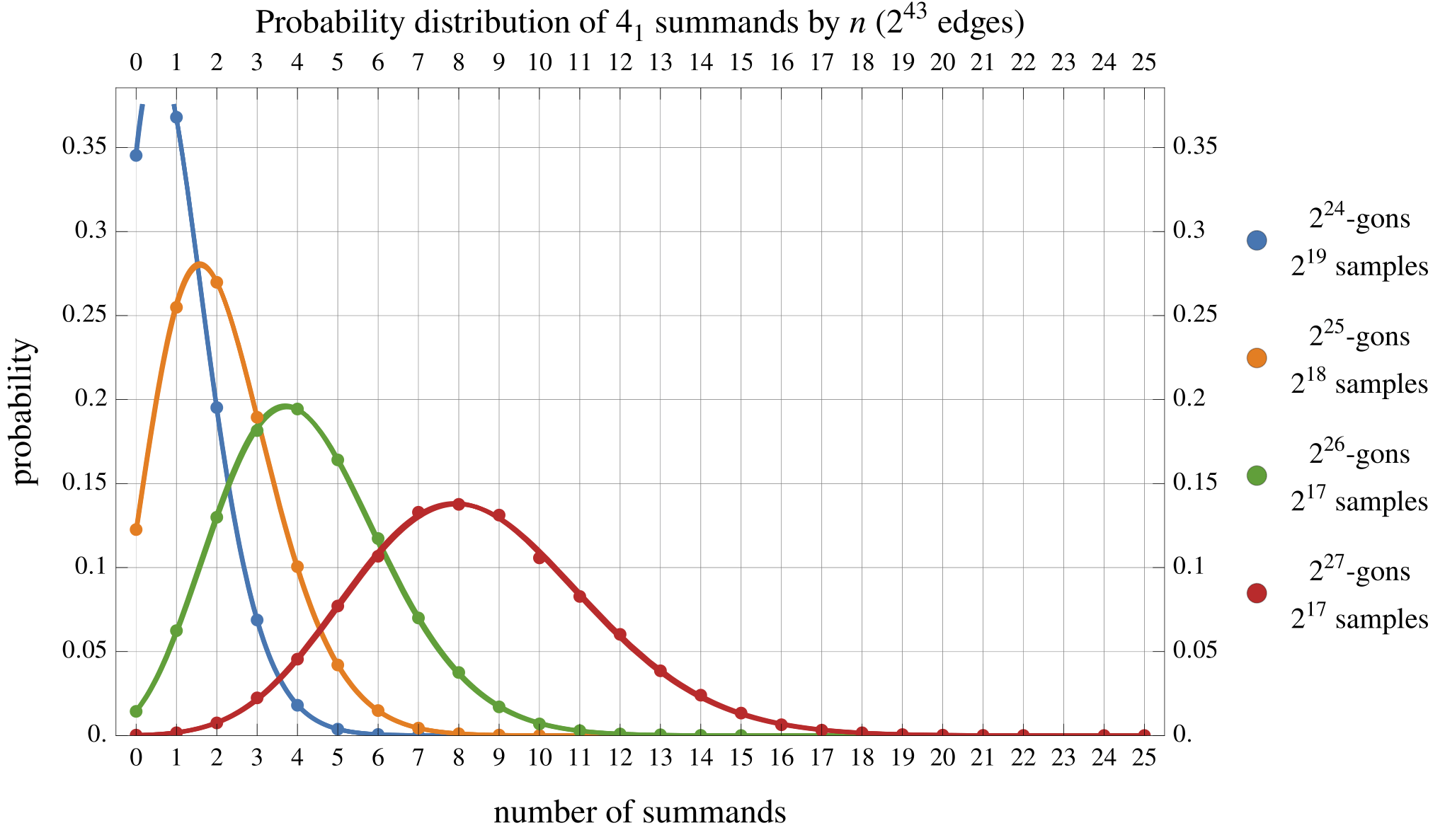
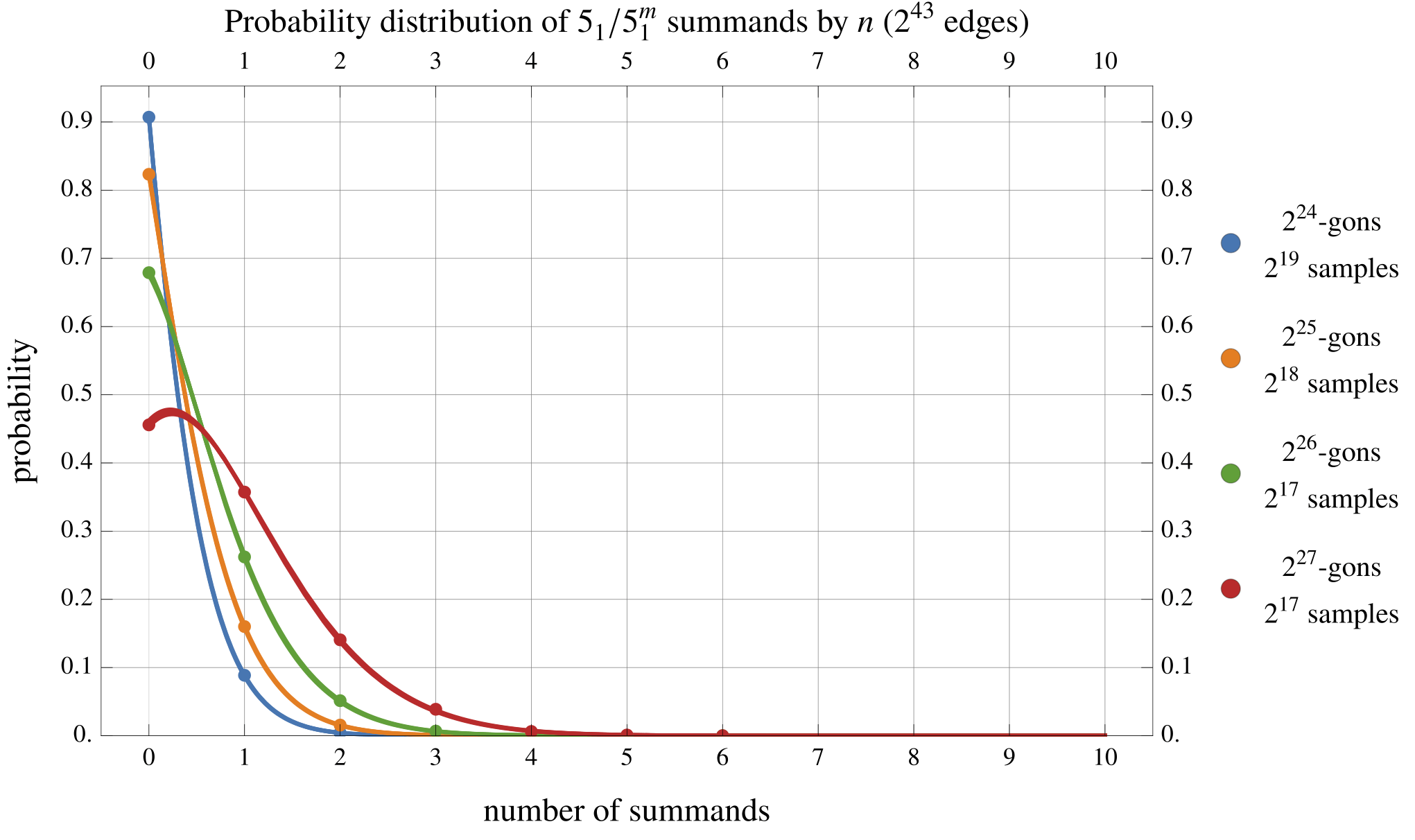
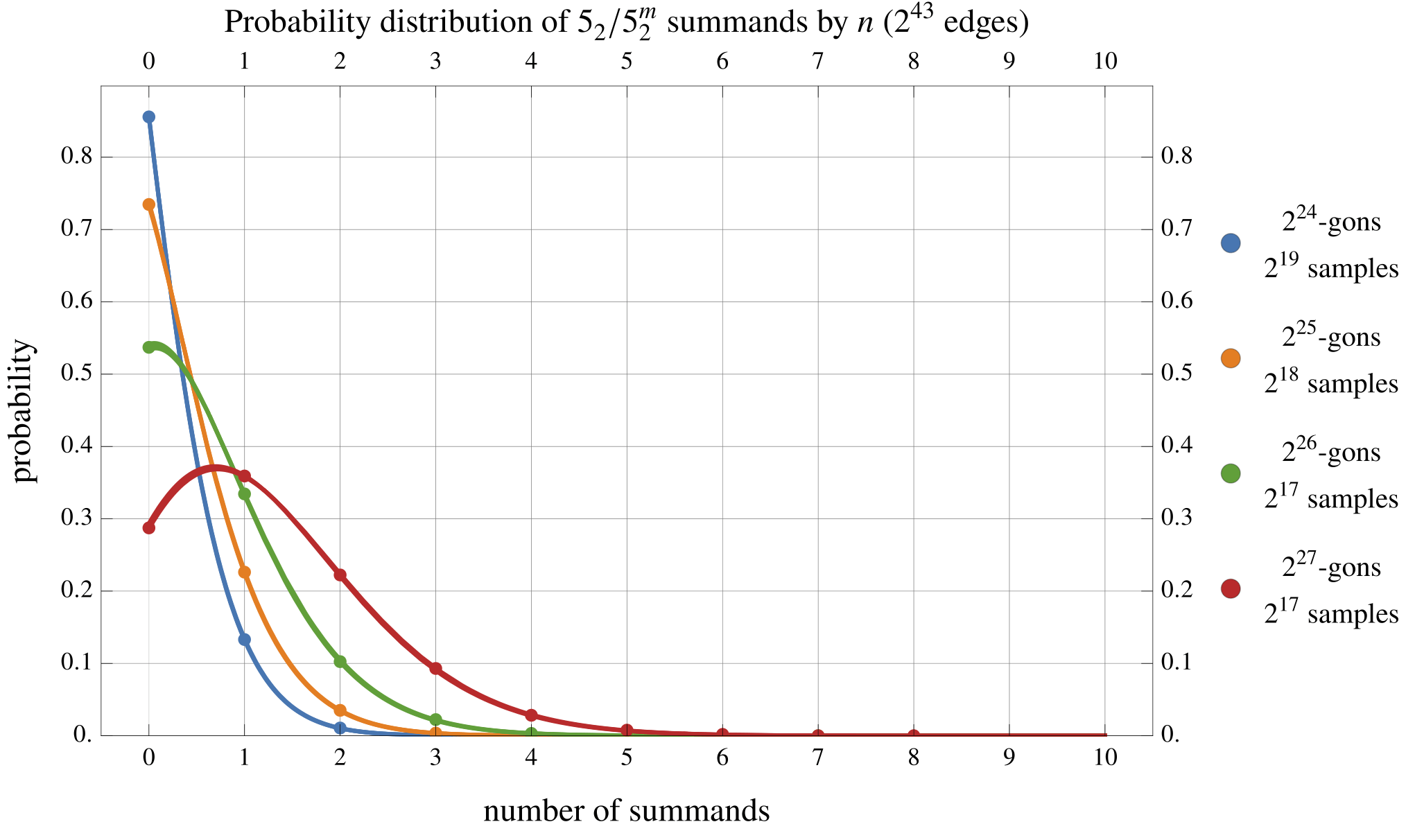
- Counts of prime summands in random SAPs fit well to Poisson distributions.
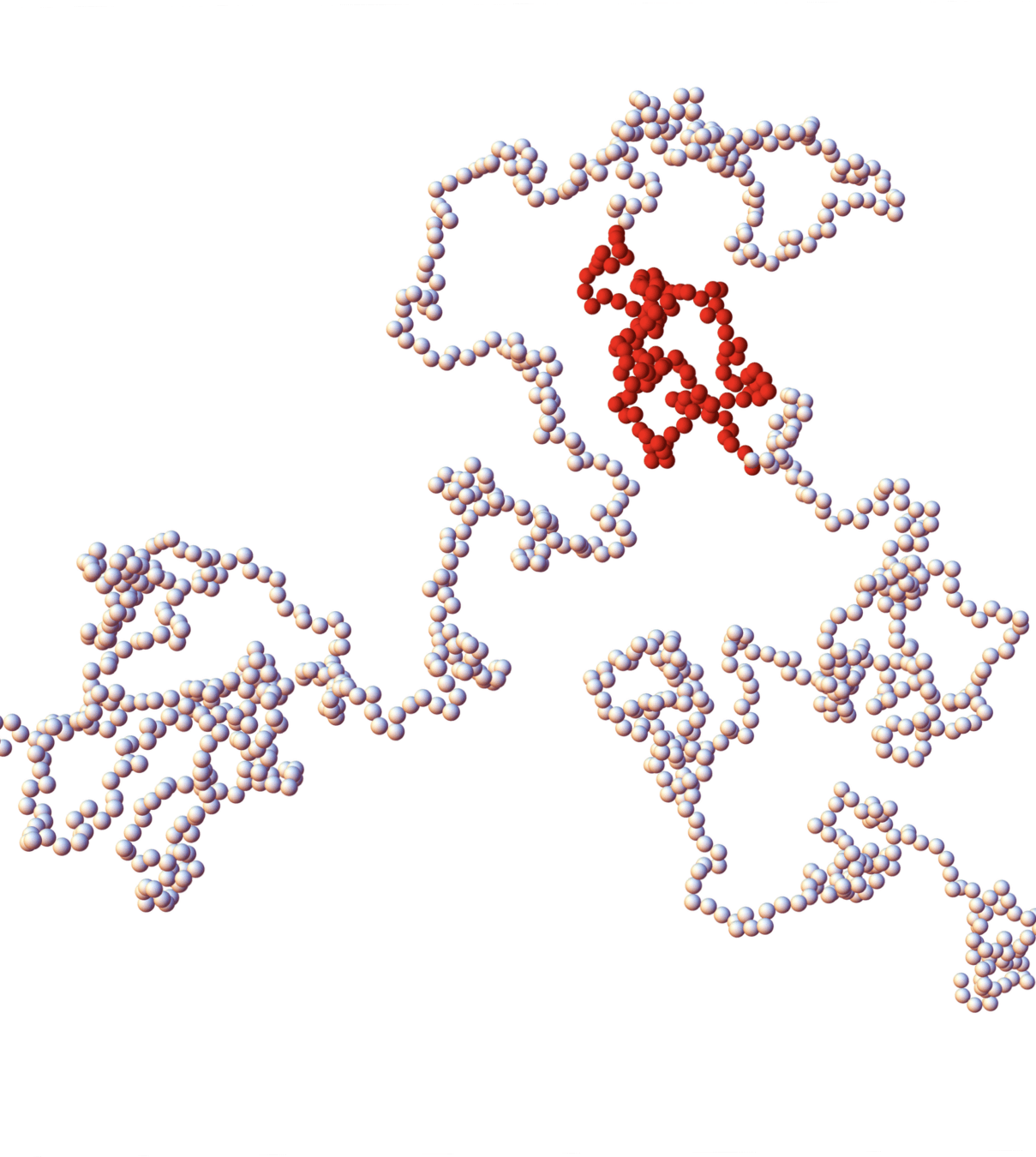
Knot Localization
Localization Hypothesis
In the asymptotic limit, knots of type \(K\) in SAPs are independent events with a characteristic size and a fixed probability of starting at every edge of the polygon.
Two Conjectures
Summand Count Conjecture [Kesten/Hammersley 1960s(?)]
Suppose \(K\) is a prime knot type and let
\(m_K^n := \text{number of prime summands of knot type \(K\) in an \(n\)-gon}.\)
For \(n \gg 1\), \(m_K^n\) is approximately Poisson-distributed:
\(\mathbb{P}(m_K^n = m) \approx \frac{(\lambda_K(n))^m e^{-\lambda_K(n)}}{m!},\)
where \(\lambda_K(n)\) is the expected value of \(m_K^n\). Moreover, \(R_K(n) := \frac{\lambda_K(n)}{n} \to C_K\) as \(n \to \infty\) and, for \(K \neq K'\), \(m_K^n\) and \(m_{K'}^n\) are approximately independent.
Knot Entropy Conjecture [Orlandini, Tesi, Janse van Rensburg, Whittington 1996]
For any knot type \(K\) and \(n \gg 1\),
\(\mathbb{P}_{0_1}(n) \approx e^{-n/n_0} \quad \text{and} \quad \mathbb{P}_K(n) \approx C_K n^{m(K)}e^{-n/n_0} \left(1 + \frac{\beta_K}{n^{1/2}} + \frac{\gamma_K}{n}\right)\).
\(n_0\) is called the characteristic length of knotting.
Note: KEC has been proved for lattice polygons in tubes by Beaton et al. (2024).
SCC Implies KEC
\(\mathbb{P}_{0_1}(n)=\mathbb{P}(m_K^n=0 \text{ for all prime }K)\)
\(\approx \Pi_K \mathbb{P}(m_K^n = 0)\)
\(= \Pi_{K} e^{-R_K(n) n}\)
\(= e^{-\left(\sum_K R_K(n)\right) n}\)
Let \(R_K(n) = \lambda_K(n)/n\) be the rate of knot production, so SCC says
\(\mathbb{P}(m_K^n = m) \approx \frac{(R_K(n)n)^m e^{-R_K(n)n}}{m!}.\)
Unknot Probability
\(= e^{-n/n_0}\)
with \(n_0 = \frac{1}{\sum_K R_K(n)}\)
Prime Knot Probability
\(\mathbb{P}_{K}(n)=\mathbb{P}(m_K^n = 1 \text{ and }m_{K'}^n=0 \text{ for }K' \neq K)\)
\(\approx\mathbb{P}(m_K^n=1) \times \Pi_{K'} \mathbb{P}(m_{K'}^n = 0)\)
\(\approx R_K(n)n e^{-R_K(n)n}\Pi_{K'} e^{-R_{K'}(n) n}\)
\(= R_K(n)n e^{-\left(\sum_{K'} R_{K'}(n)\right) n}\)
\(= R_K(n)n e^{-n/n_0}\)
A Plan for Testing SCC
- Generate SAPs for \(n = 2^{10}=1024\) to \(2^{27}=134,\!217,\!728\).
- Count the number of summands of each prime knot type.
- See if the empirical distribution is approximately Poisson.
- If so, see if the rates \(R_K(n)\) limit to constants.
- Use \(R_K(n)\) rather than \(\mathbb{P}_K(n)\) to measure \(C_K\) in the large-\(n\) limit.
Trefoil Counts and Poisson Fits
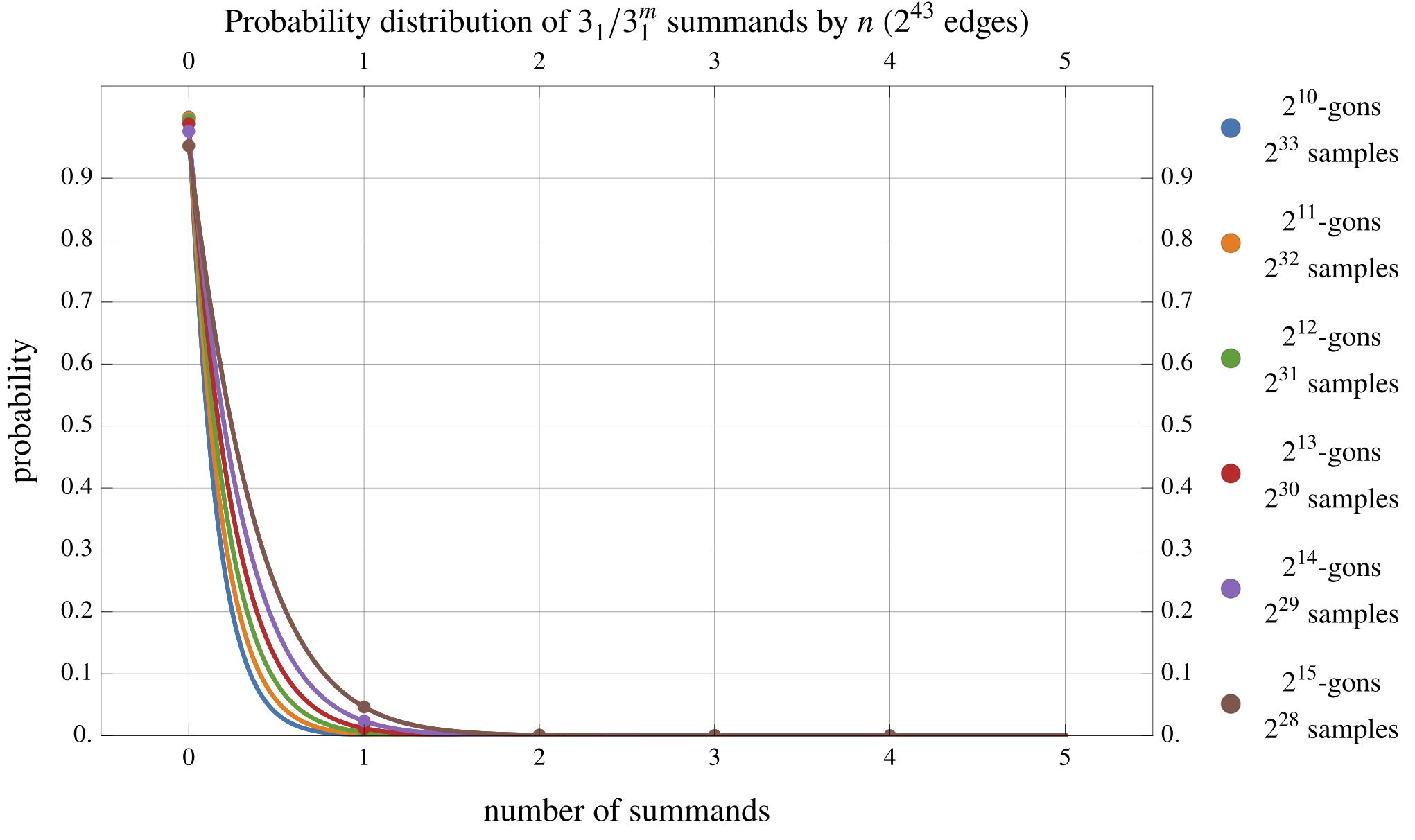
8,589,934,592
268,435,456
Trefoil Counts and Poisson Fits
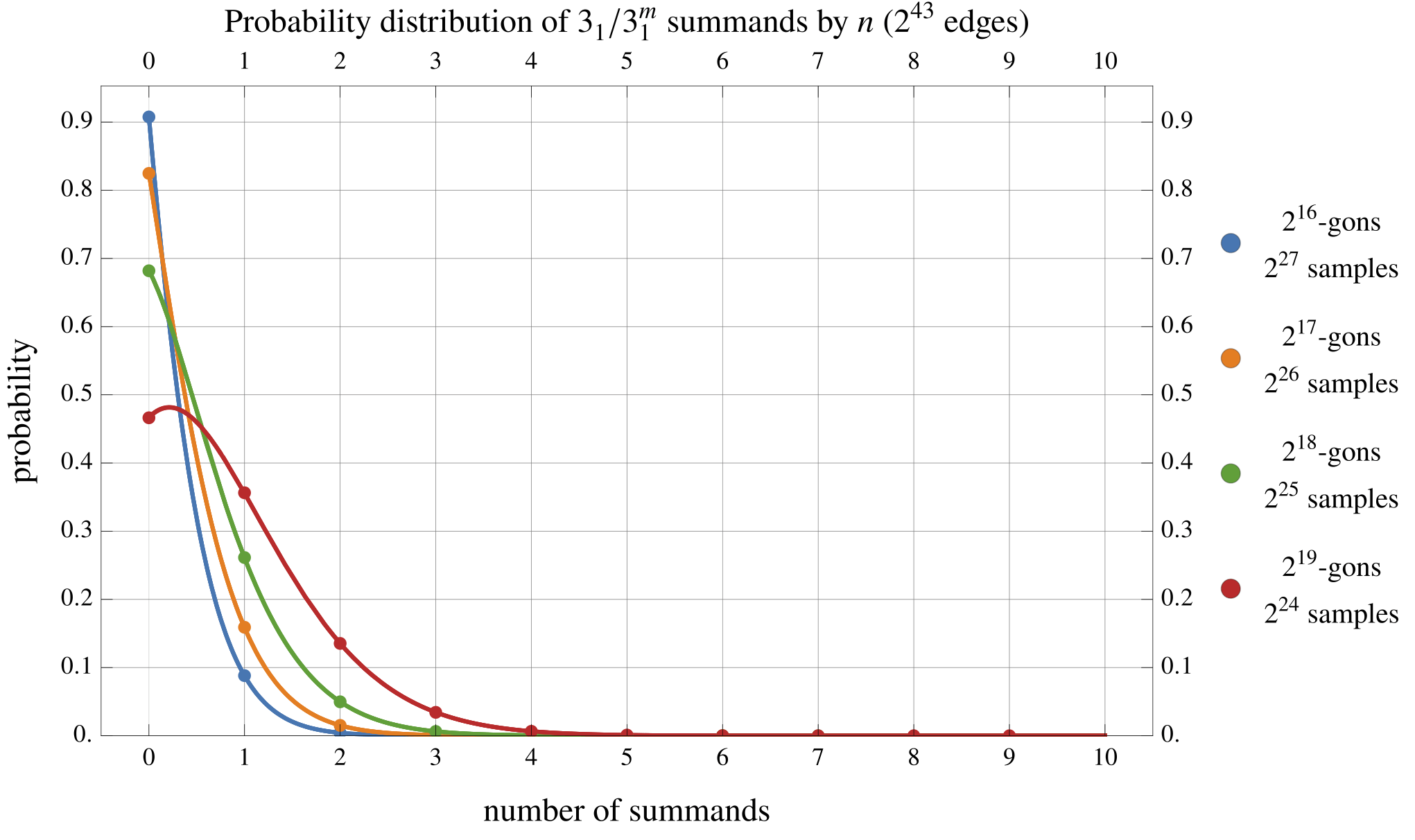
134,217,728
16,777,216
Trefoil Counts and Poisson Fits
8,388,608
1,048,576
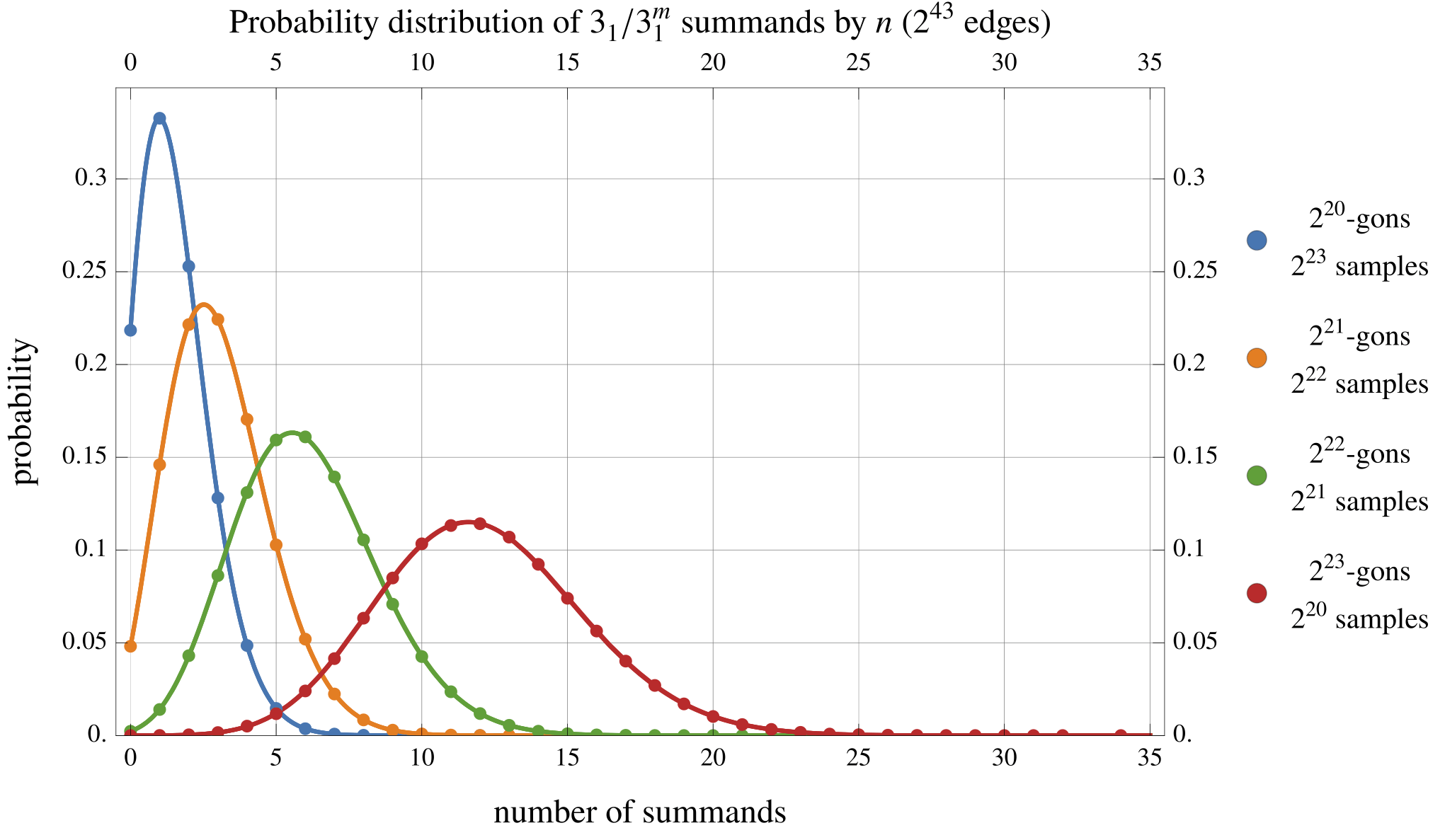
Trefoil Counts and Poisson Fits
524,288
131,072
\(4_1\) Counts and Poisson Fits
524,288
131,072
\(5_1\) Counts and Poisson Fits
524,288
131,072
\(5_2\) Counts and Poisson Fits
524,288
131,072
\(6_1\) Counts and Poisson Fits
524,288
131,072
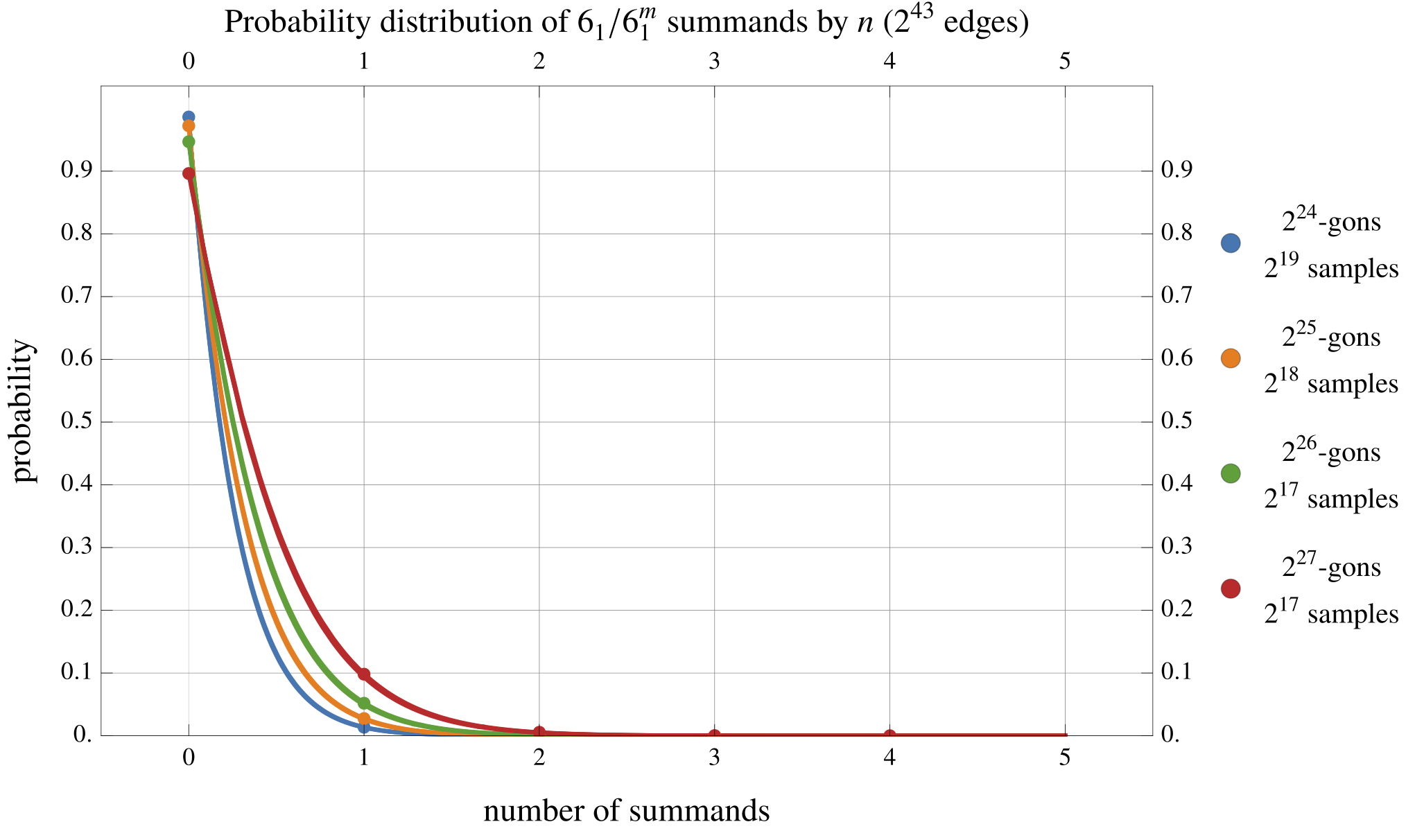
How Poisson Are They?
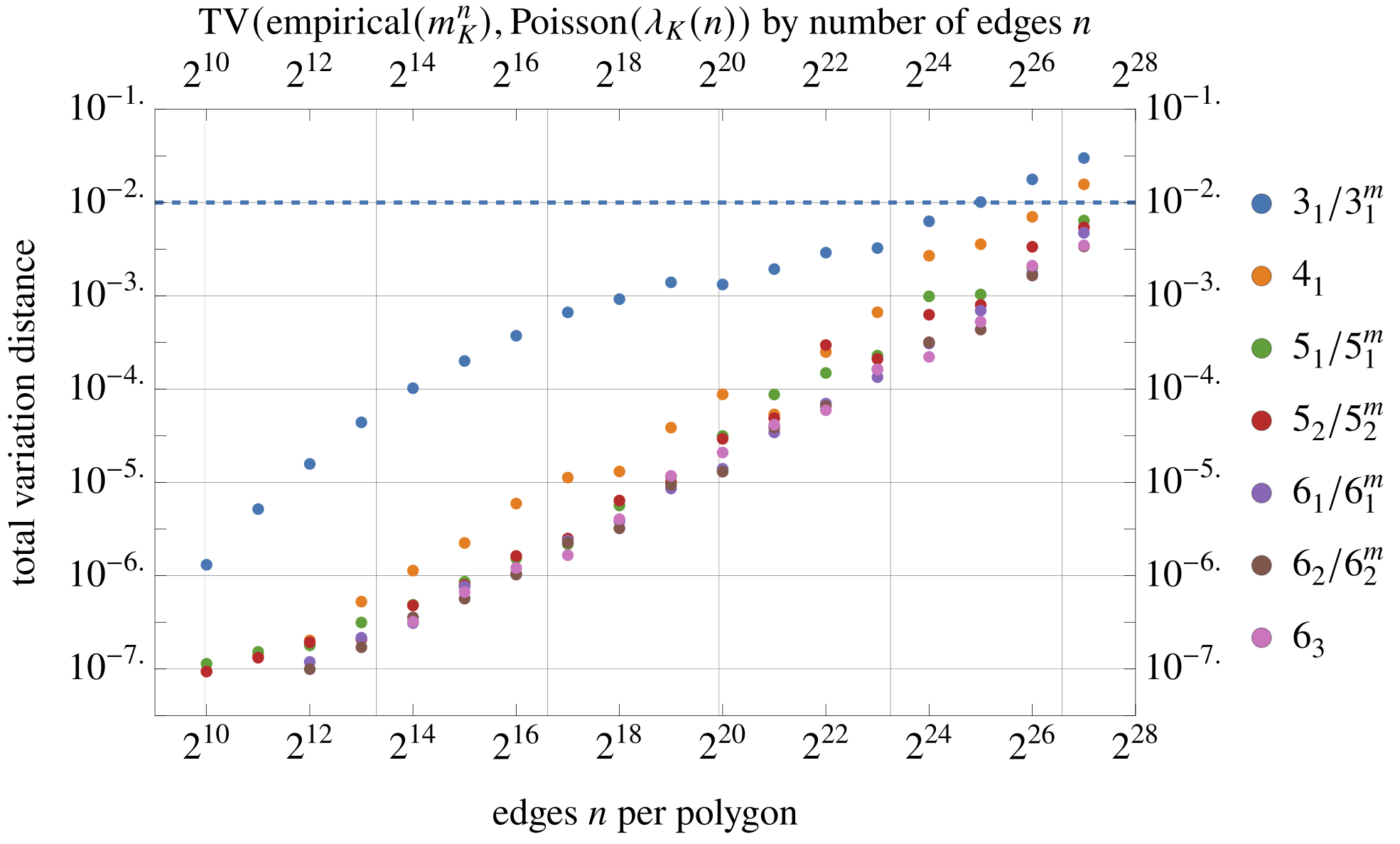
Pretty darn Poisson!
Rate of Knot Production
Conjecture
The knotting rate \(R_K(n) \to C_K\) as \(n \to \infty\).
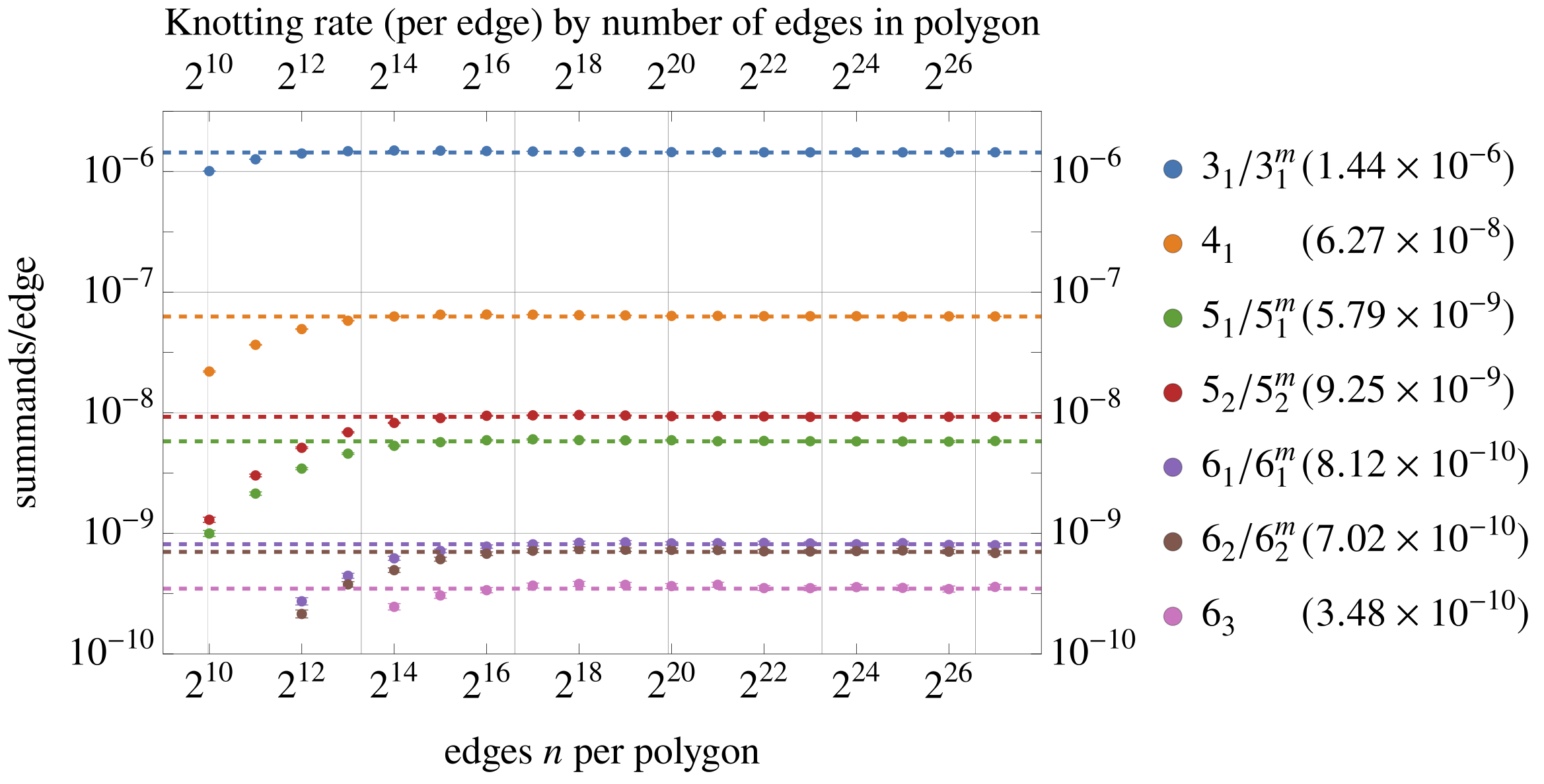
Rate of Knot Production
Conjecture
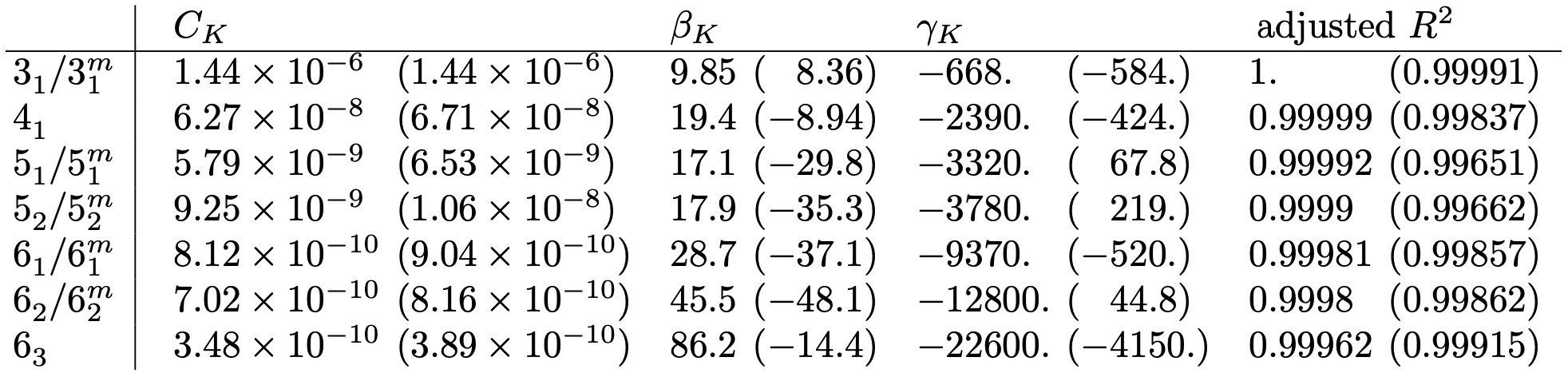
The knotting rate \(R_K(n) \approx C_K\left(1+\frac{\beta_K}{n^{0.5}} + \frac{\gamma_K}{n}\right)\).
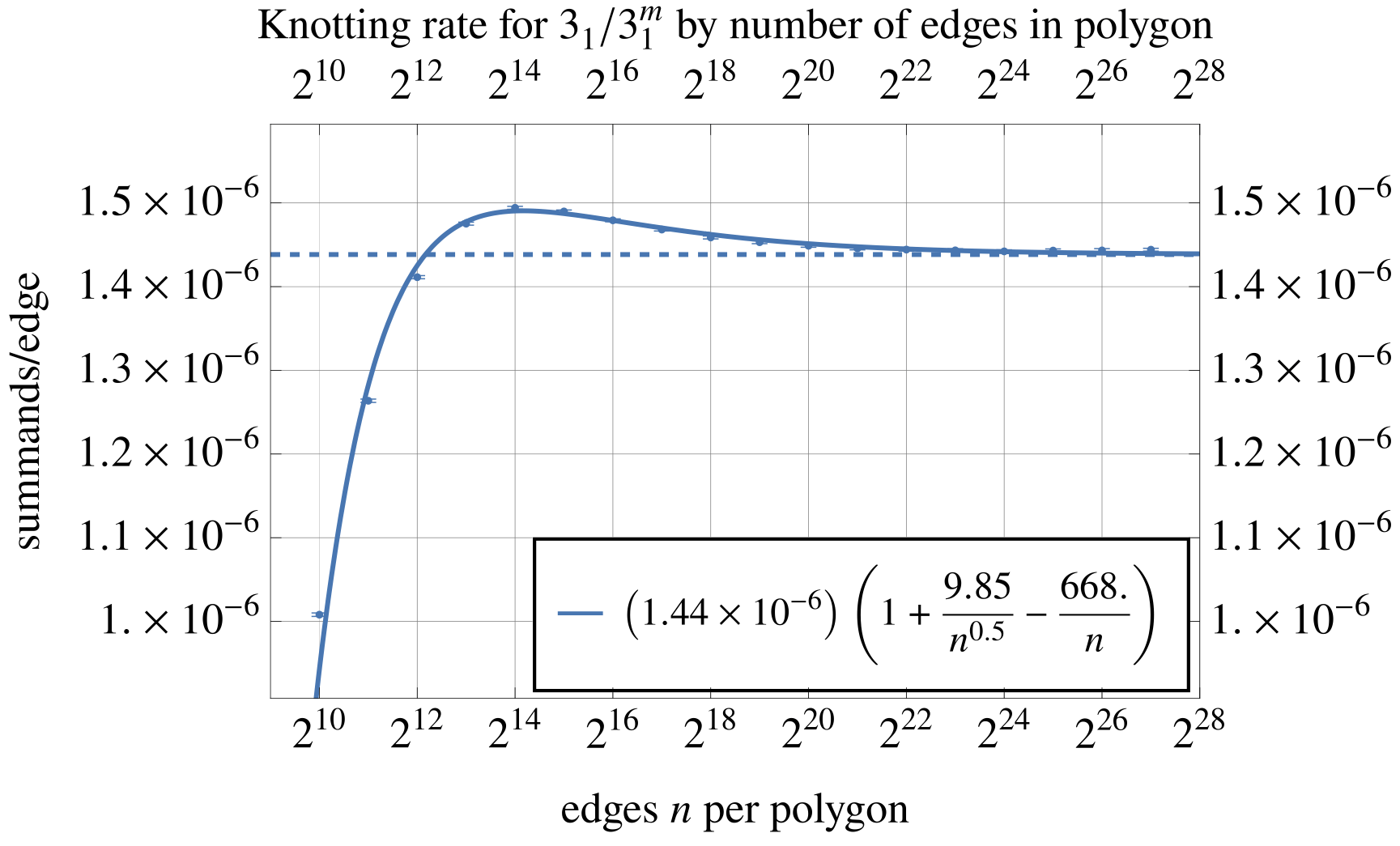
Characteristic Length
KEC: As \(n \to \infty\), \(\mathbb{P}_{0_1}(n) \approx e^{-n/n_0}\).
SCC: \(\mathbb{P}_{0_1}(n) \approx e^{-\left(\sum_K R_K(n)\right)n}\) and \(R_K(n) \to C_K\).
\(n_0 = \frac{1}{\sum_K C_K} = 656,\!600 \pm 2500\)
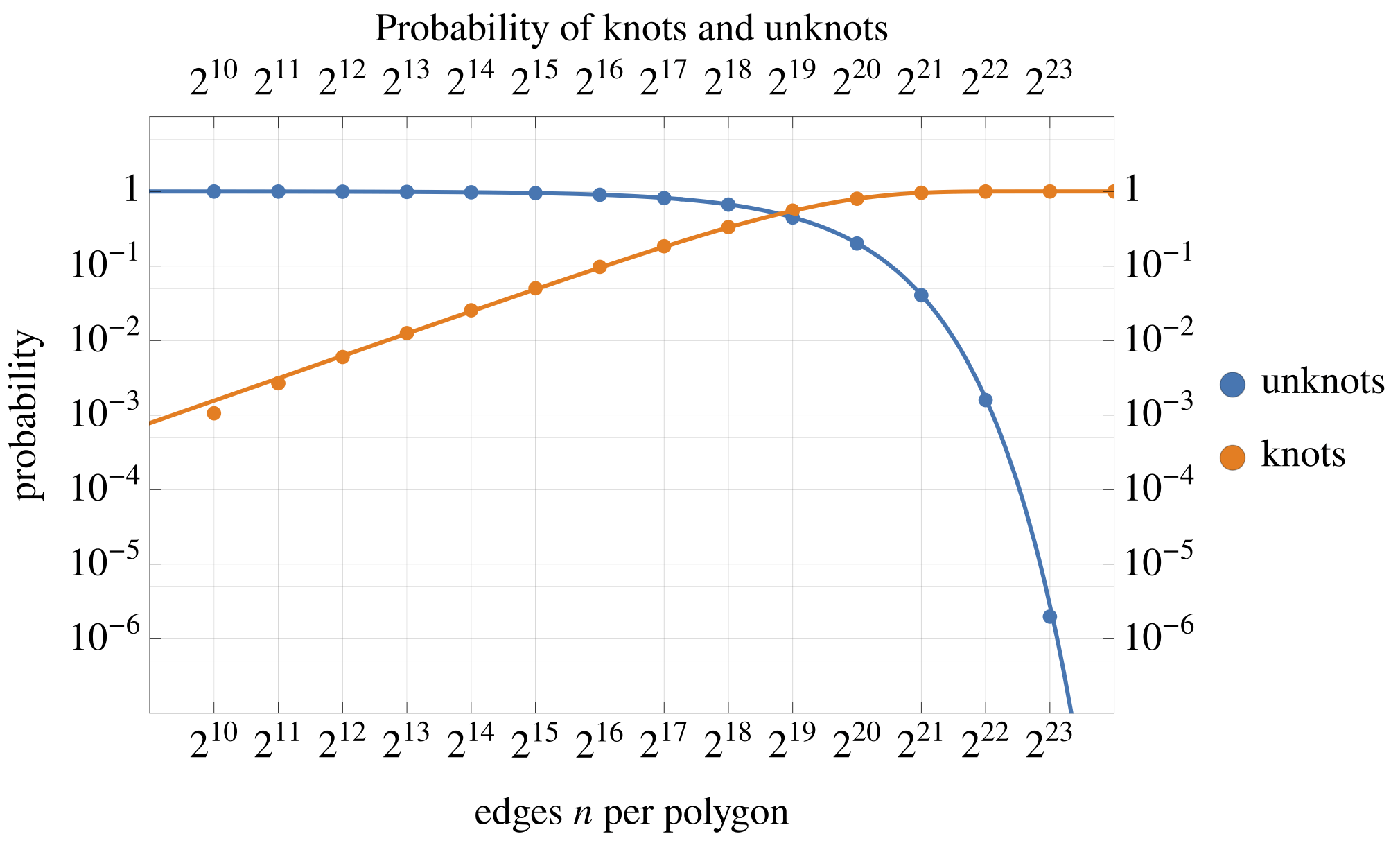
estimated \(n_0 \approx 800,\!000\) based on simulations with \(n\leq 1000\).
SCC and KEC Redux
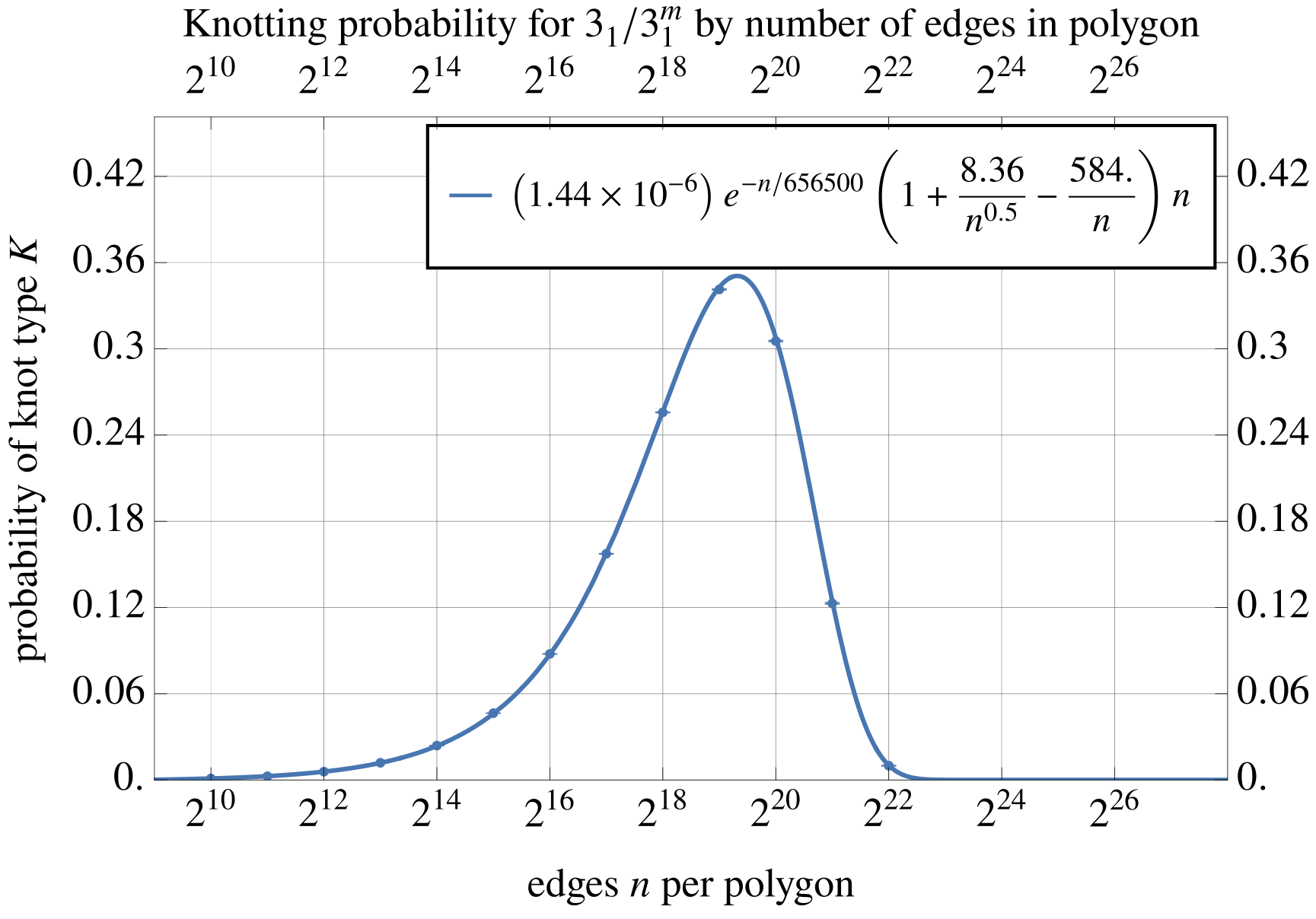
KEC: As \(n \to \infty\), \(\mathbb{P}_{K}(n) \approx C_K n e^{-n/n_0}\left(1 + \frac{\beta_K}{n^{1/2}} + \frac{\gamma_K}{n} \right)\).
SCC: \(\mathbb{P}_{K}(n) \approx R_K(n) n e^{-\left(\sum_K R_K(n)\right)n}\).
\(\approx C_K n e^{-n/656,500}\left(1 + \frac{\beta_K}{n^{1/2}} + \frac{\gamma_K}{n}\right)\)
Questions
What about equilateral random polygons (ERPs)?
What about tightly-confined ERPs?
Prime summands seem to be statistically localized, but are they geometrically localized?
Thank you!
shonkwiler.org/gs26
References
Random knotting in very long off-lattice self-avoiding polygons
Jason Cantarella, Tetsuo Deguchi, Henrik Schumacher, Clayton Shonkwiler, and Erica Uehara
Journal of Physics A: Mathematical and Theoretical, https://doi.org/10.1088/1751-8121/ae55e3
Hard unknots are often easy from a different perspective
Jason Cantarella, Henrik Schumacher, and Clayton Shonkwiler
In preparation