Geometric Methods for Good Representations of Data
/mds26
this talk!
Advances in Geometric Data Science for High-Dimensional Problems
November 16, 2026
Joint Work With:
Florida State University
Funding
National Science Foundation (DMS–2107700)
Arizona State University
Florida State University
Florida State University
Take-Home Messages
- Symmetry + geometry sometimes tells you an optimization problem is easier than expected.
- Optimization can tell us something about topology.
Equal-Norm Parseval Frames
A spanning set \(f_1, \dots , f_n \in \mathbb{C}^d\) is a frame.
\(\Rightarrow F = [f_1 \cdots f_n] \in \mathbb{C}^{d \times n}\)
Definition.
\(\{f_1,\dots, f_n\}\subset \mathbb{C}^d\) is a Parseval frame if \(\operatorname{Id}_{d\times d}=FF^*=f_1f_1^*+\dots+f_nf_n^*\).
An equal-norm Parseval frame (ENP frame) is a Parseval frame \(f_1,\dots , f_n\) with \(\|f_i\|^2=\|f_j\|^2\) for all \(i\) and \(j\).
\(\sum \|f_i\|^2=\operatorname{tr}F^*F=\operatorname{tr}FF^*=\operatorname{tr}\operatorname{Id}_{d \times d} = d\), so each \(\|f_i\|^2=\frac{d}{n}\).
\(v \in \mathbb{C}^d\) a signal, \(Fv\) a redundant representation.
Equal-Norm Parseval Frames
A spanning set \(f_1, \dots , f_n \in \mathbb{C}^d\) is a frame.
\(\Rightarrow F = [f_1 \cdots f_n] \in \mathbb{C}^{d \times n}\)
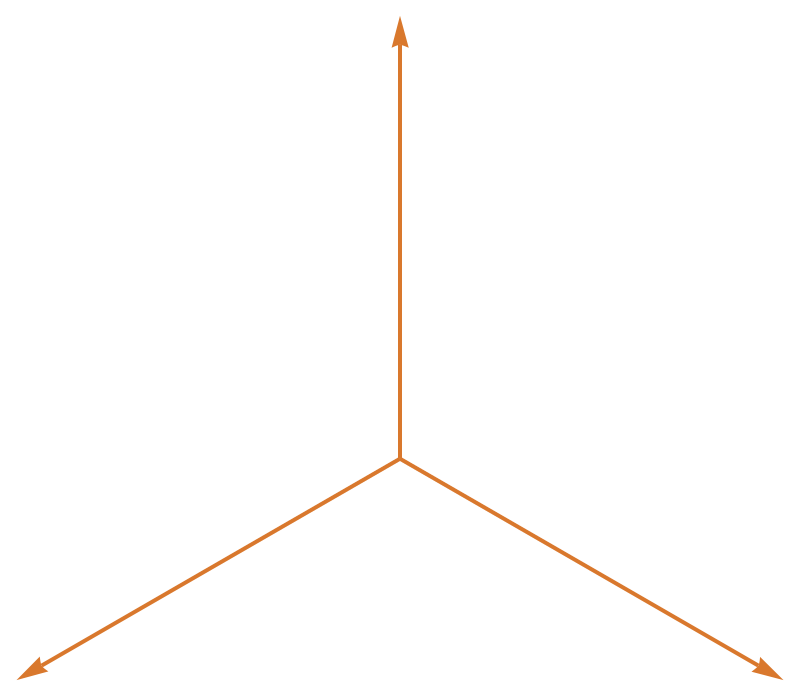
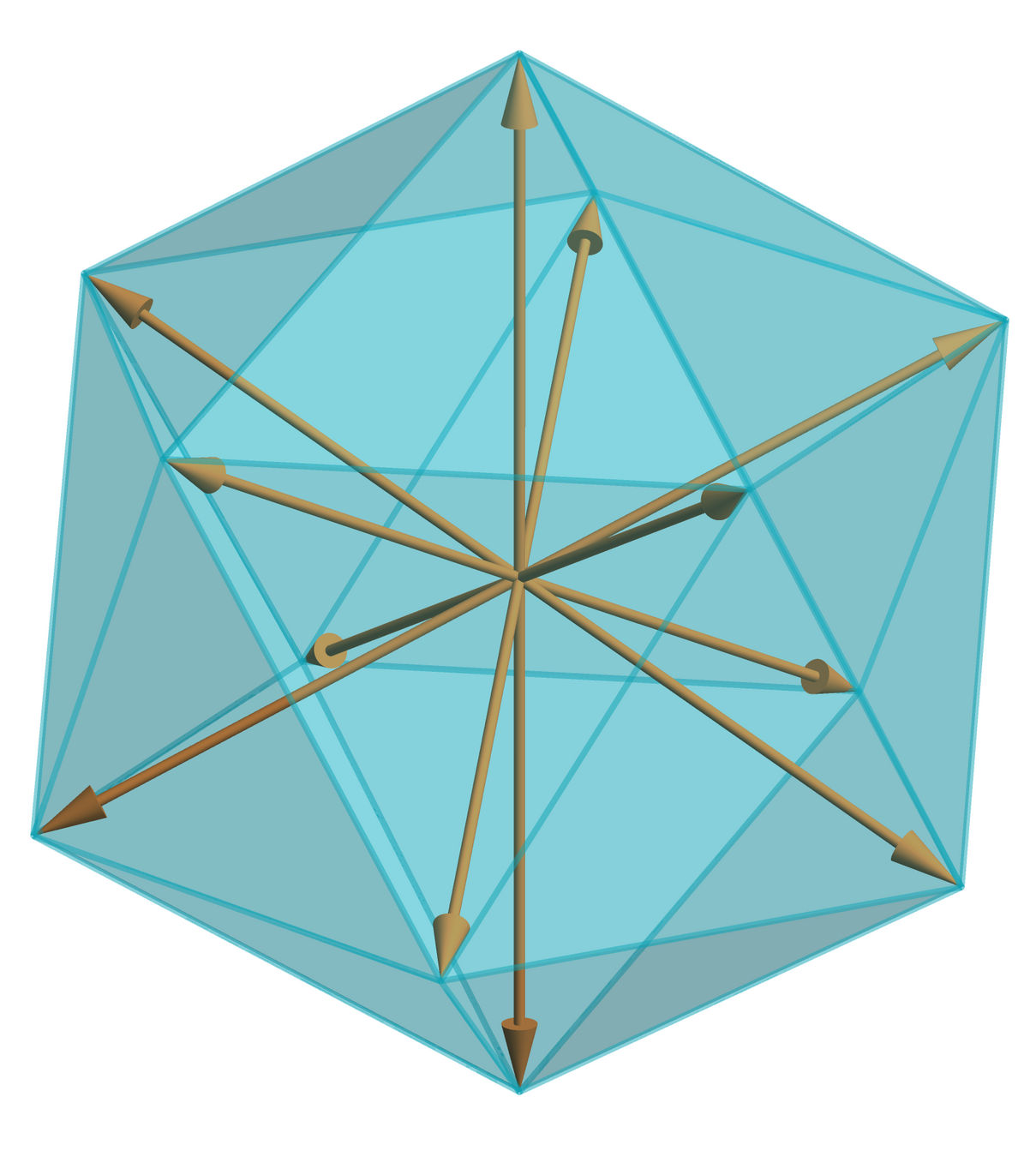
\(v \in \mathbb{C}^d\) a signal, \(Fv\) a redundant representation.
Can these be realized as minima of some (nice) potential?
Frame Potential
Definition [Benedetto–Fickus, Casazza–Fickus]
The frame potential is
\(\operatorname{FP}(F) = \|FF^\ast\|_{\operatorname{Fr}}^2\)
Proposition [cf. Welch]
The equal-norm Parseval frames are exactly the global minima of \(\operatorname{FP}|_{\text{equal norm}}\).
Theorem [Benedetto–Fickus]
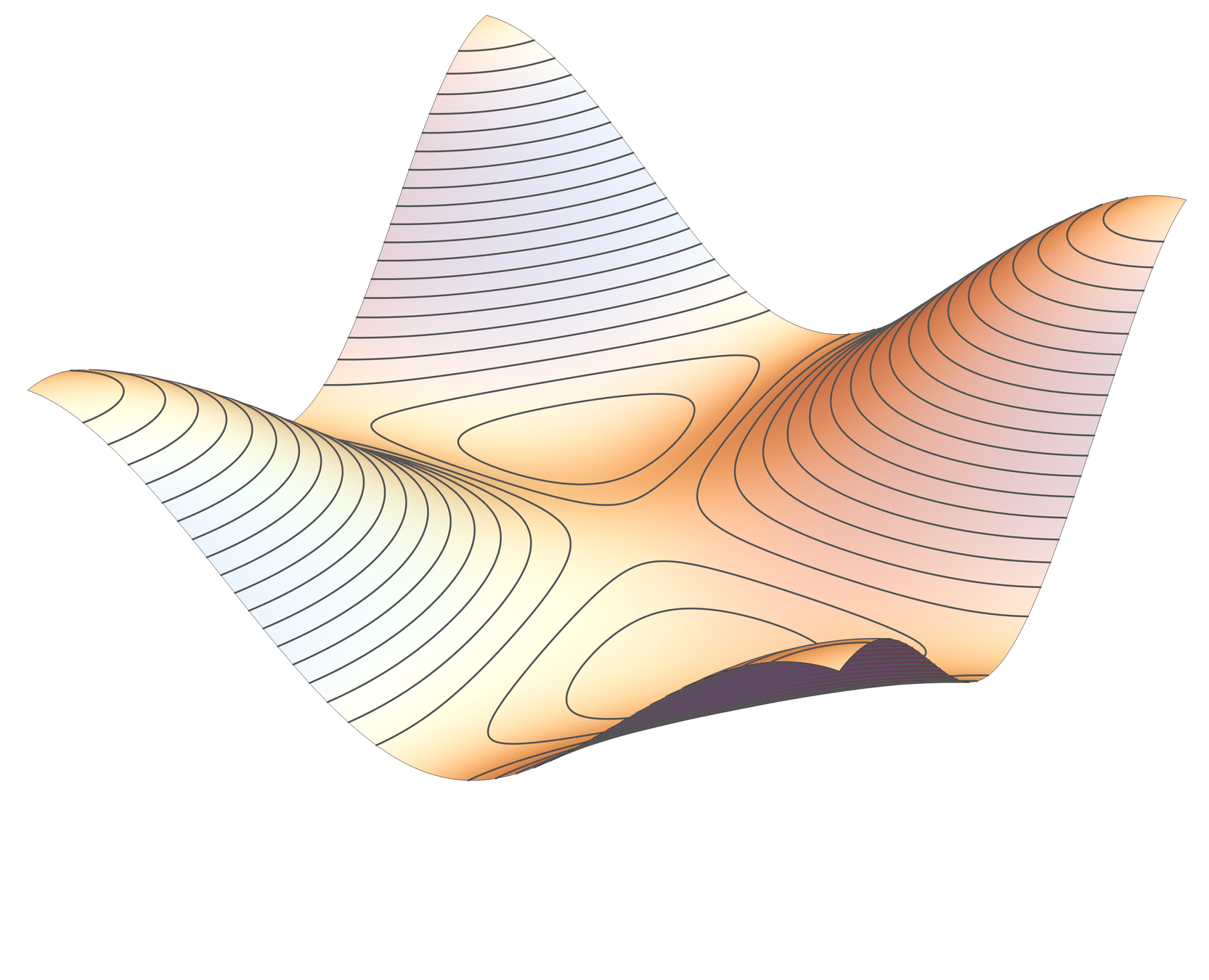
As a function on equal-norm frames with fixed \(d\) and \(n\), \(\operatorname{FP}\) has no spurious local minima.
Optimization
Theorem [with Mixon, Needham, and Villar]
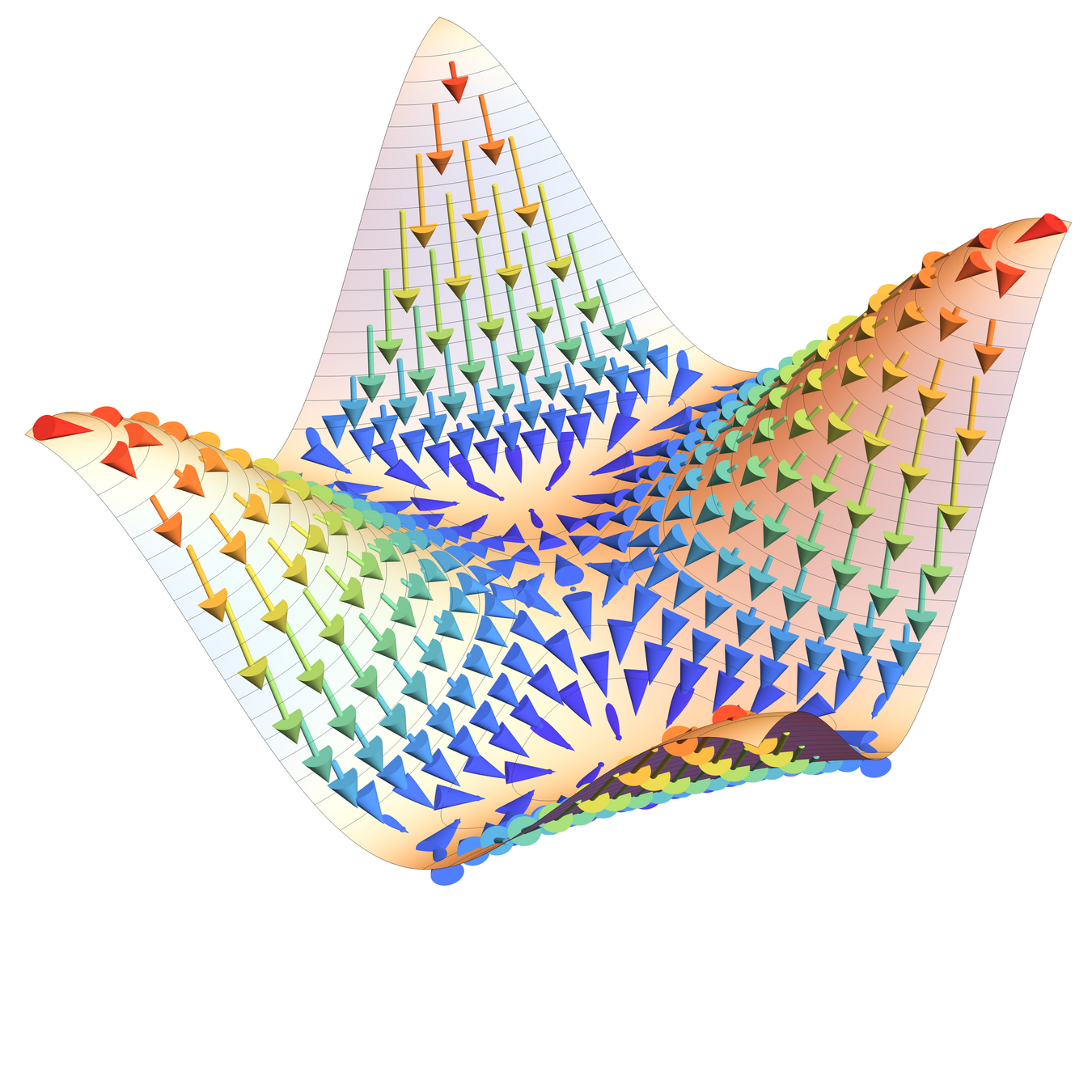
On the space of equal-norm frames, consider the initial value problem
\(\Gamma(F_0,0) = F_0, \qquad \frac{d}{dt}\Gamma(F_0,t) = -\operatorname{grad}\operatorname{FP}(\Gamma(F_0,t))\).
If \(F_0\) has full spark, then \(\lim_{t \to \infty} \Gamma(F_0,t)\) is an ENP frame.
Theorem [with Needham; CodEx 2022 video]
Same for fusion frames.
Frame Energy
Definition [Bodmann–Casazza]
The frame energy is
\(\operatorname{FE}(F) = \sum_{j,k} \left( \|f_j\|^2 - \|f_k\|^2\right)^2 = 2n \sum_j \|f_j\|^4 -2d^2\)
Proposition [Bodmann–Haas]
The equal-norm Parseval frames are exactly the global minima of \(\operatorname{FE}|_{\text{Parseval}}\).
Theorem [Caine]
On the space of Parseval frames, consider the initial value problem
\(\widetilde{\Gamma}(F_0,0) = F_0 \qquad \frac{d}{dt}\widetilde{\Gamma}(F_0,t) = -\operatorname{grad} \operatorname{FE}(\widetilde{\Gamma}(F_0,t))\).
If \(F_0\) is full spark, then \(\lim_{t \to \infty} \widetilde{\Gamma}(F_0,t)\) is an ENP frame.
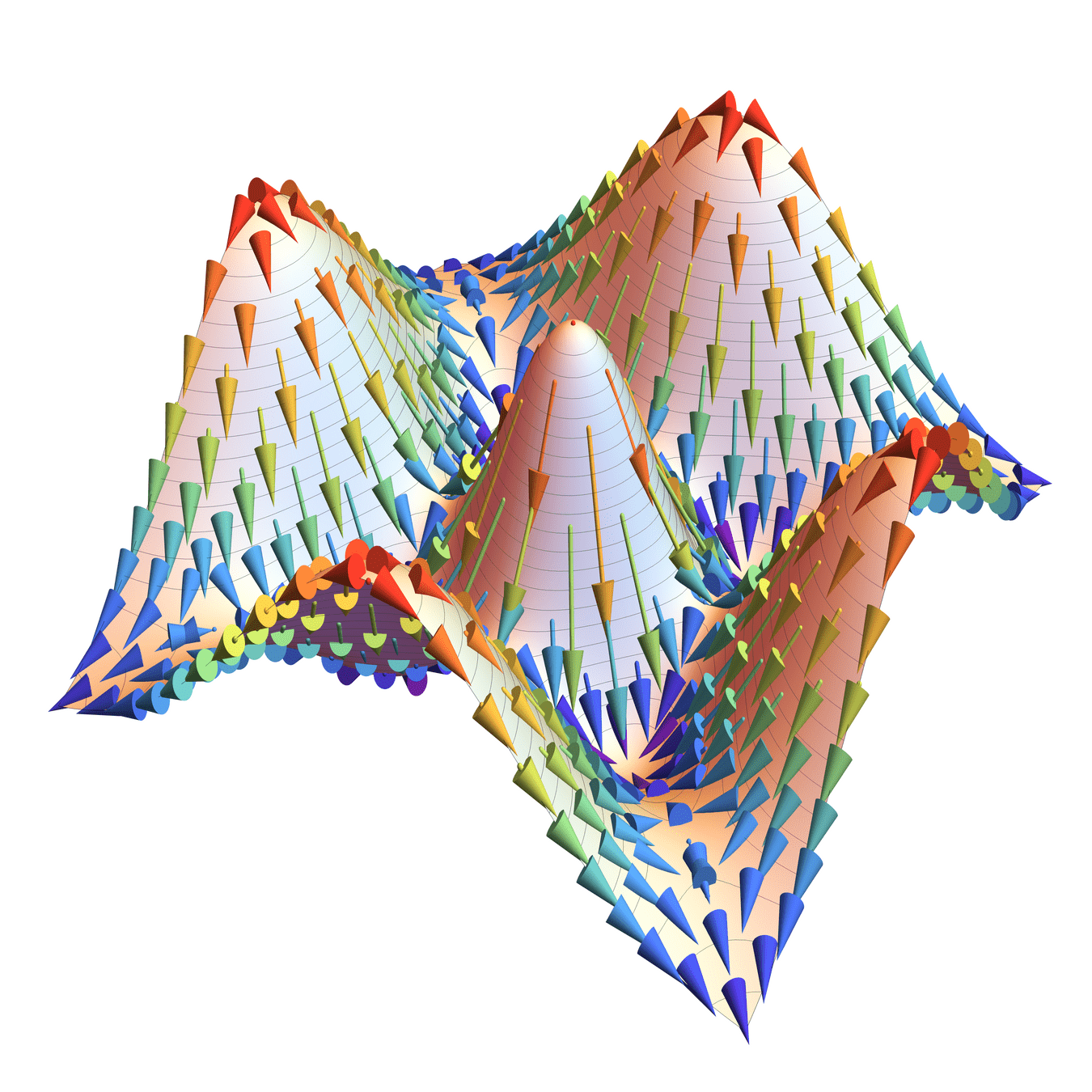
Why?
\(\mathbb{C}^{d \times n}\) is symplectic, with symplectic form \(\omega_A(X,Y) = -\mathrm{Im}\langle X,Y \rangle = -\mathrm{Im}\mathrm{Tr}(Y^\ast X)\).
A symplectic manifold is a smooth manifold \(M\) together with a closed, non-degenerate 2-form \(\omega \in \Omega^2(M)\).
Example: \((\mathbb{R}^2,dx \wedge dy) = (\mathbb{C},\frac{i}{2}dz \wedge d\bar{z})\)
Why?
\(\mathbb{C}^{d \times n}\) is symplectic, with symplectic form \(\omega_A(X,Y) = -\mathrm{Im}\langle X,Y \rangle = -\mathrm{Im}\mathrm{Tr}(Y^\ast X)\).
Consider the conjugation action of \(\operatorname{U}(d)\) on \(\mathbb{C}^{d \times n}\): \(U \cdot A = U A \).
This action is Hamiltonian with associated momentum map \(\mu: \mathbb{C}^{d \times n} \to \mathscr{H}(d)\) given by
\(\mu(F) := FF^\ast\).
So \(\operatorname{FP}(F) = \|\mu(F)\|^2\).
Frances Kirwan
Gert-Martin Greuel [CC BY-SA 2.0 DE], from Oberwolfach Photo Collection
Image by rawpixel.com on Freepik

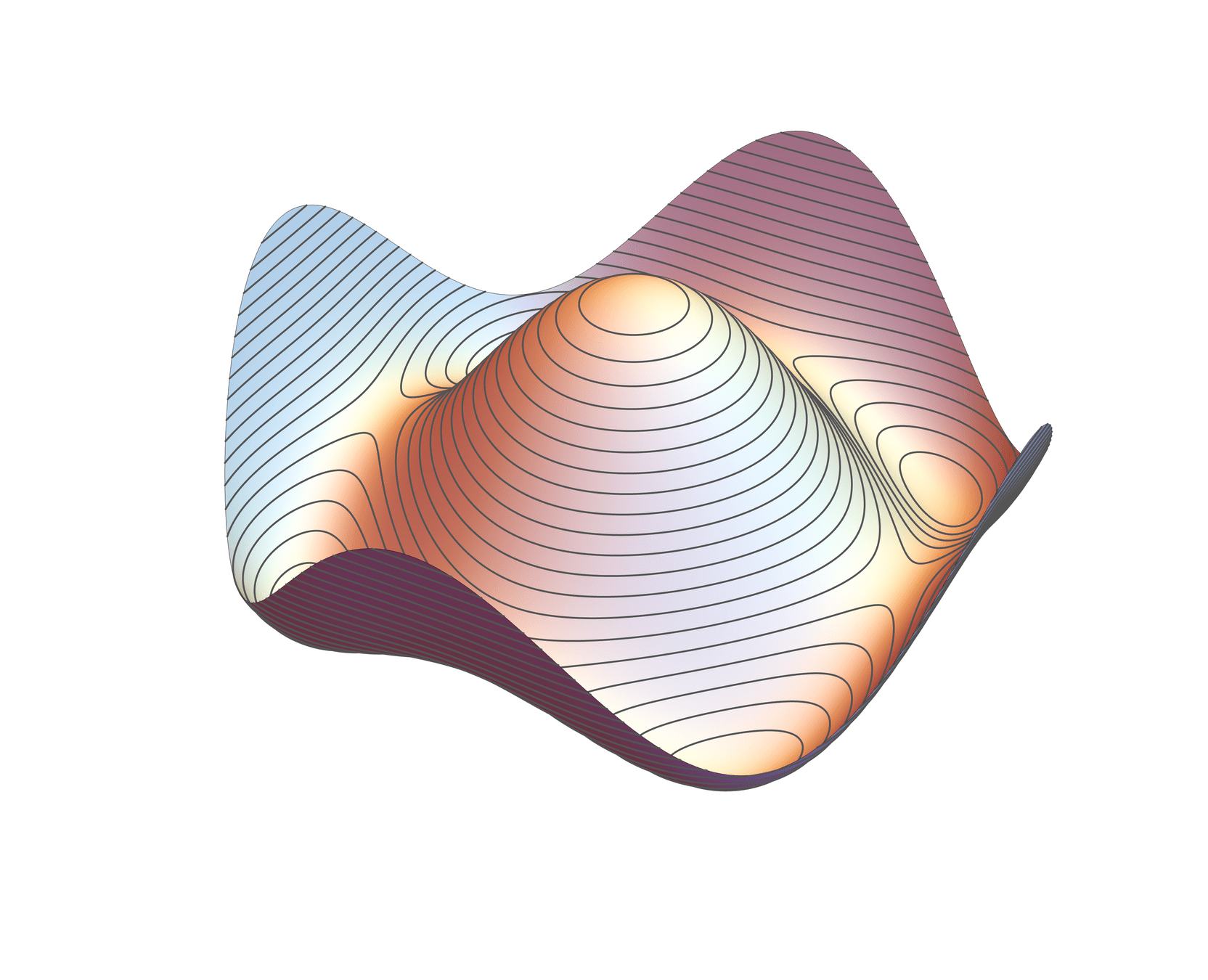
This kind of function is really nice!
Frame potential: \(\operatorname{FP}(F) = \|FF^\ast\|_{\operatorname{Fr}}^2\)
Frame energy: \(\operatorname{FE}(F) = 2n \sum_j \|f_j\|^4 -2d^2\)
Frame energy: \(\operatorname{FE}(F) = \sum_j \|f_j\|^4\)
Total Frame Energy
Definition.
For \(\vec{r} \in \mathbb{R}_+^n\), the total frame energy of a frame is
\(E_{\vec{r}}(F) :=\|FF^* - \mathbb{I}_d \|_{\text{Fr}}^2 + \frac{1}{4}\sum_j \left(\frac{\|f_j\|^2}{r_j}-1 \right)^2\)
Proposition.
The Parseval frames with \(\|f_j\|^2 = r_j\) for \(j=1,\dots , n\) are exactly the global minima of \(E_{\vec{r}}\).
Variations on a Theme
Theorem [with Caine and Needham]
Let \(\vec{r} \in \mathbb{Q}_+^n\) such that \(\operatorname{PF}_d^{\mathbb{K}}(\vec{r}) \neq \emptyset\). Consider
\(\Gamma_{\vec{r}}(F_0,0) = F_0,\quad \frac{d}{dt} \Gamma_{\vec{r}}(F_0,t) = -\nabla E_{\vec{r}}(\Gamma_{\vec{r}}(F_0,t))\).
If \(F_0 \in \mathbb{K}^{d \times n}\) is full spark, then \(\lim_{t \to \infty} \Gamma_{\vec{r}}(F_0,t)\) is in \(\operatorname{PF}_d^{\mathbb{K}}(\vec{r})\).
Definition.
For \(\mathbb{K} \in \{\mathbb{R}, \mathbb{C}\}\) and \(\vec{r} \in \mathbb{R}_+^n\), let \(\operatorname{PF}^{\mathbb{K}}_d(\vec{r})\) be the space of Parseval frames \(F \in \mathbb{K}^{d \times n}\) with \(\|f_i\|^2 = r_i\).
\(\vec{r}\) is admissible
Variations on a Theme
Theorem [with Caine and Needham]
Let \(\vec{r} \in \mathbb{Q}_+^n\) such that \(\operatorname{PF}_d^{\mathbb{K}}(\vec{r}) \neq \emptyset\). Consider
\(\Gamma_{\vec{r}}(F_0,0) = F_0,\quad \frac{d}{dt} \Gamma_{\vec{r}}(F_0,t) = -\nabla E_{\vec{r}}(\Gamma_{\vec{r}}(F_0,t))\).
If \(F_0 \in \mathbb{K}^{d \times n}\) is full spark, then \(\lim_{t \to \infty} \Gamma_{\vec{r}}(F_0,t)\) is in \(\operatorname{PF}_d^{\mathbb{K}}(\vec{r})\).
Topology of Frame Spaces
Frame Homotopy Conjecture [Larson 2002]
The space of ENP frames is path-connected.
Theorem [Cahill, Mixon, Strawn 2017]
The Frame Homotopy Conjecture is true.
Theorem [with Needham 2022]
\(\operatorname{PF}_d^{\mathbb{H}}(\vec{r})\) is path-connected for all admissible \(\vec{r} \in \mathbb{R}_+^n\).
Theorem [with Needham 2021]
\(\operatorname{PF}_d^{\mathbb{C}}(\vec{r})\) is path-connected for all admissible \(\vec{r}\in \mathbb{R}_+^n\).
Topology from Optimization
Meta-Theorem
Gradient flow of \(E_{\vec{r}}\) gives a deformation retract of \(\mathbb{K}^{d \times n} \backslash \mathcal{U}_{\vec{r}}\) onto \(\operatorname{PF}_d^{\mathbb{K}}(\vec{r})\).
Corollary [with Caine and Needham]
Let \(q \in \mathbb{Z}_{\geq 0}\) and
\(d \geq \begin{cases} q+2 & \text{if } \mathbb{K}= \mathbb{R}\\ \frac{q+2}{2} & \text{if } \mathbb{K} = \mathbb{C}.\end{cases}\)
Then the space of ENP frames is \(q\)-connected for all \(n \geq \frac{d}{d-1}(d+q+1)\).
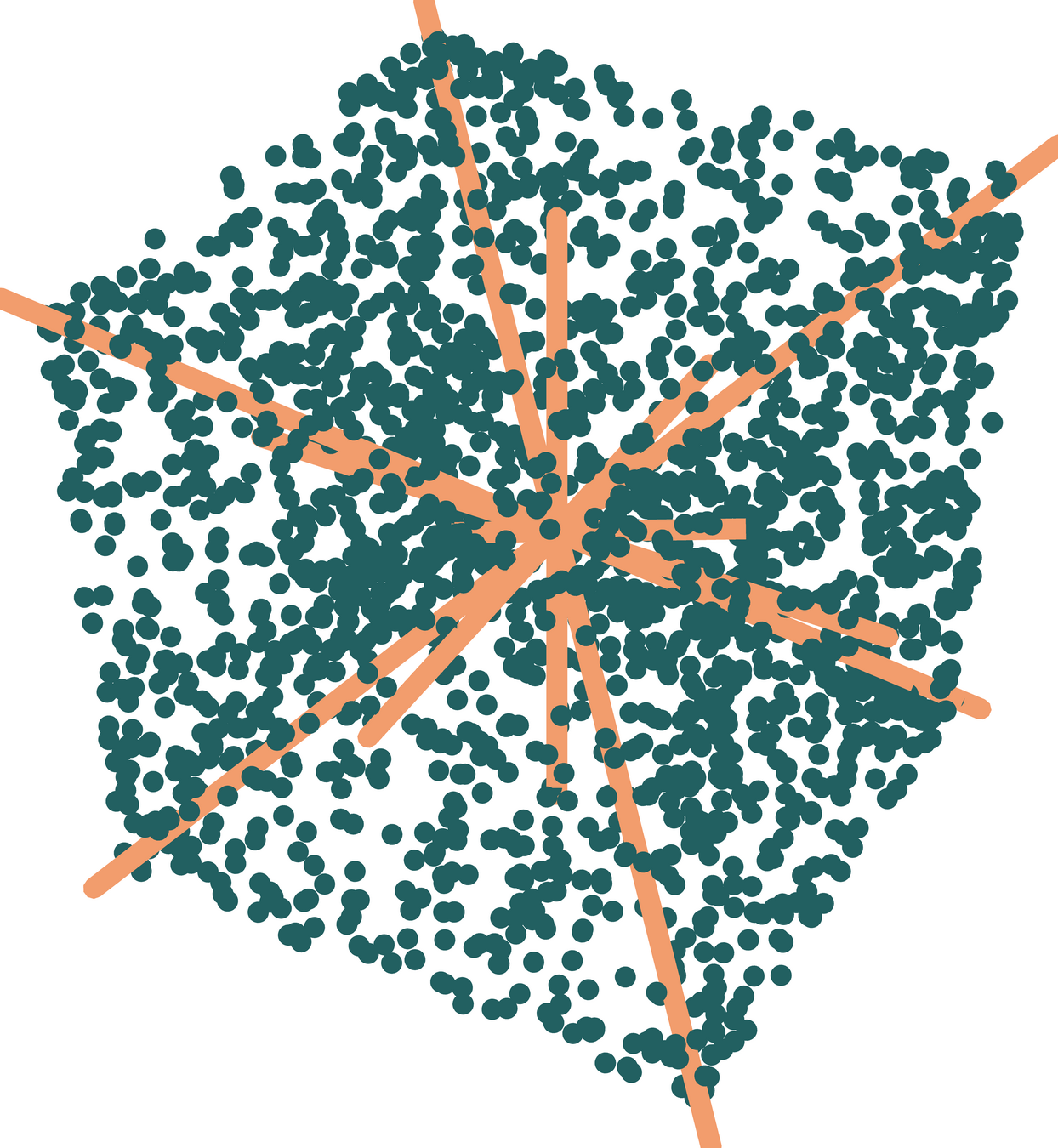
Data on Manifolds
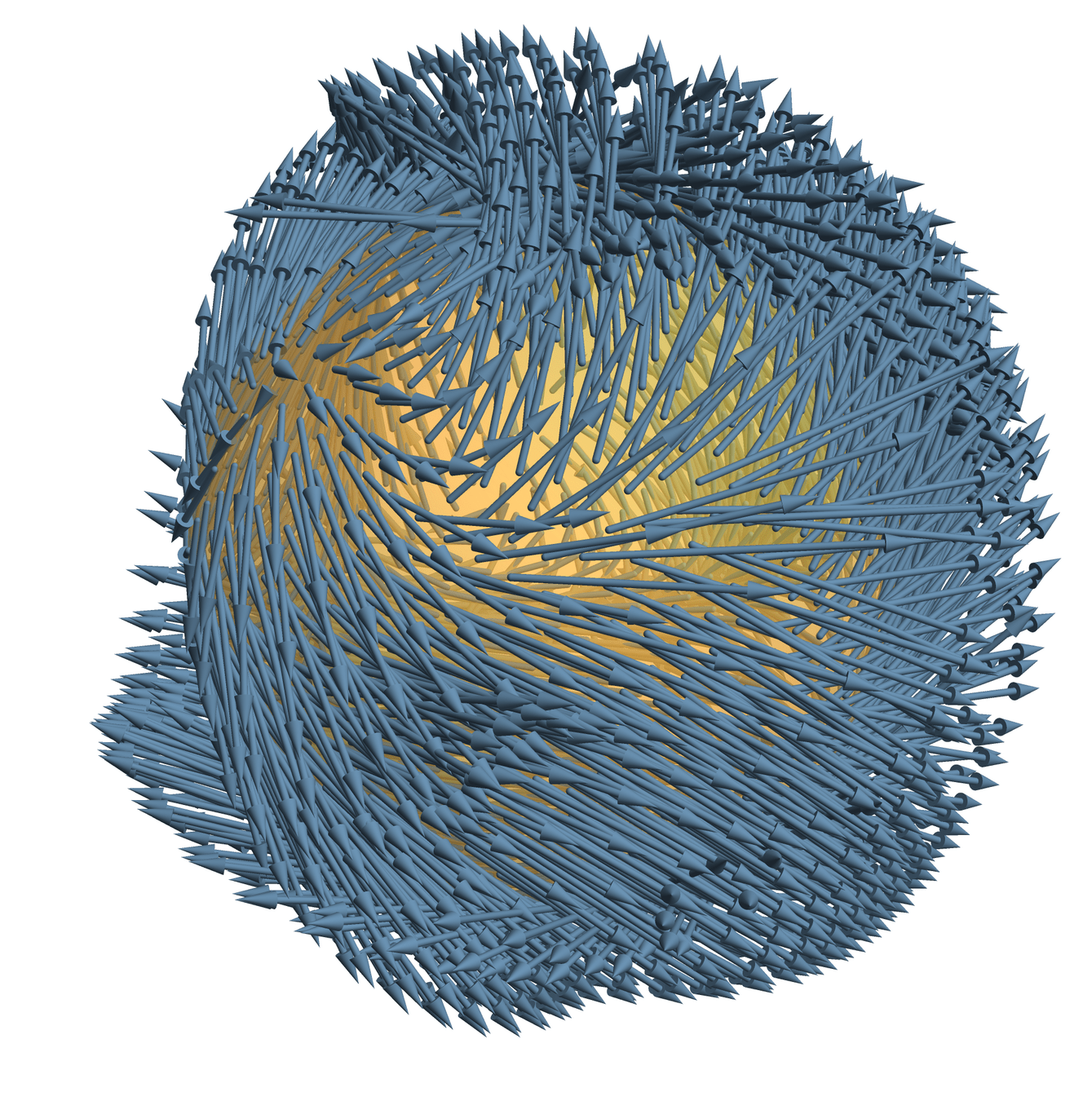
\(\dim(M) = k\), \(E \to M\) a rank-\(d\) vector bundle.
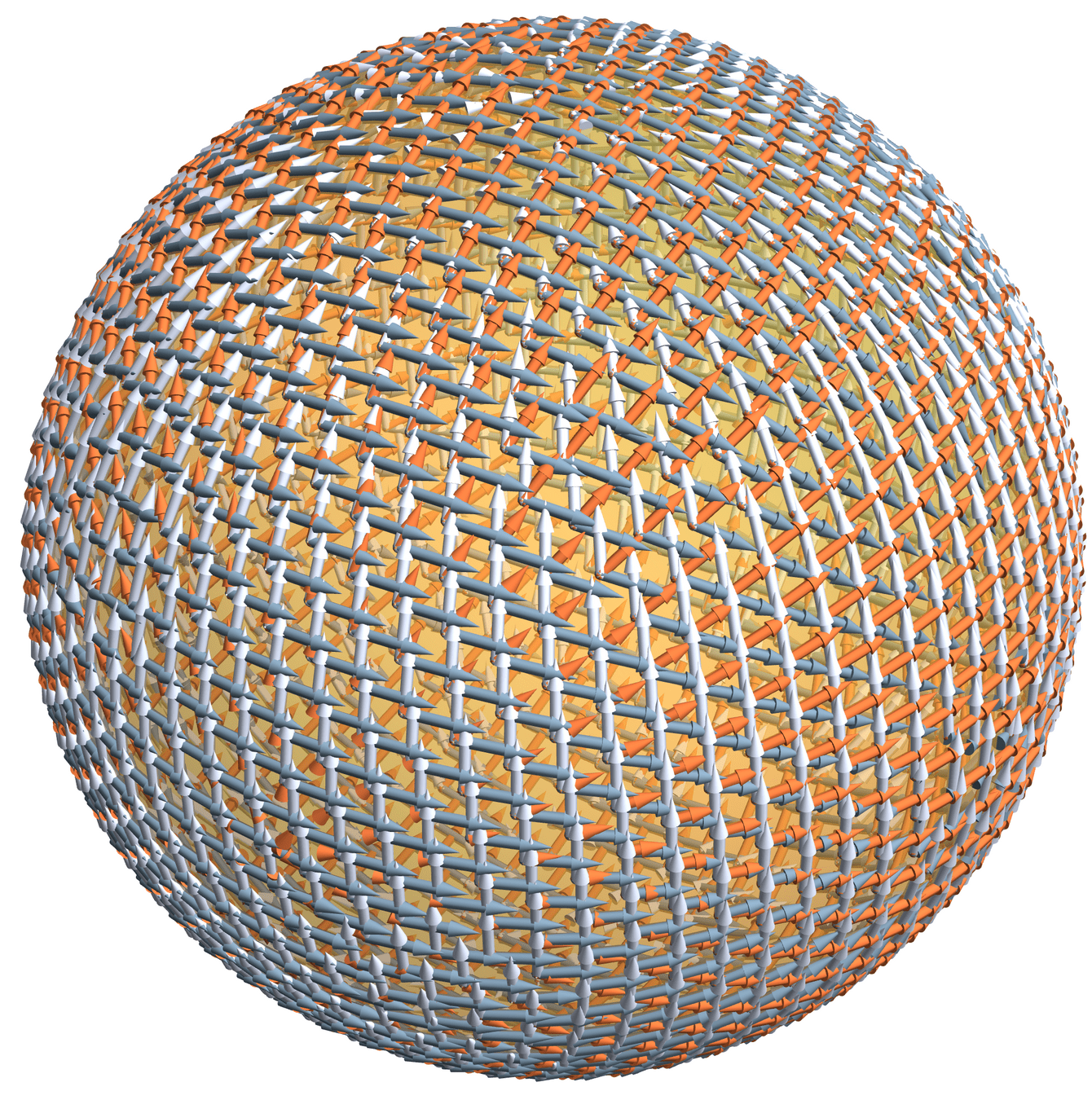
Sections \(\sigma_1, \dots , \sigma_n : M \to E\) give a (equal-norm/Parseval) frame field if \(\sigma_1(p), \dots , \sigma_n(p) \in E_p\) is a (equal-norm/Parseval) frame for all \(p \in M\).
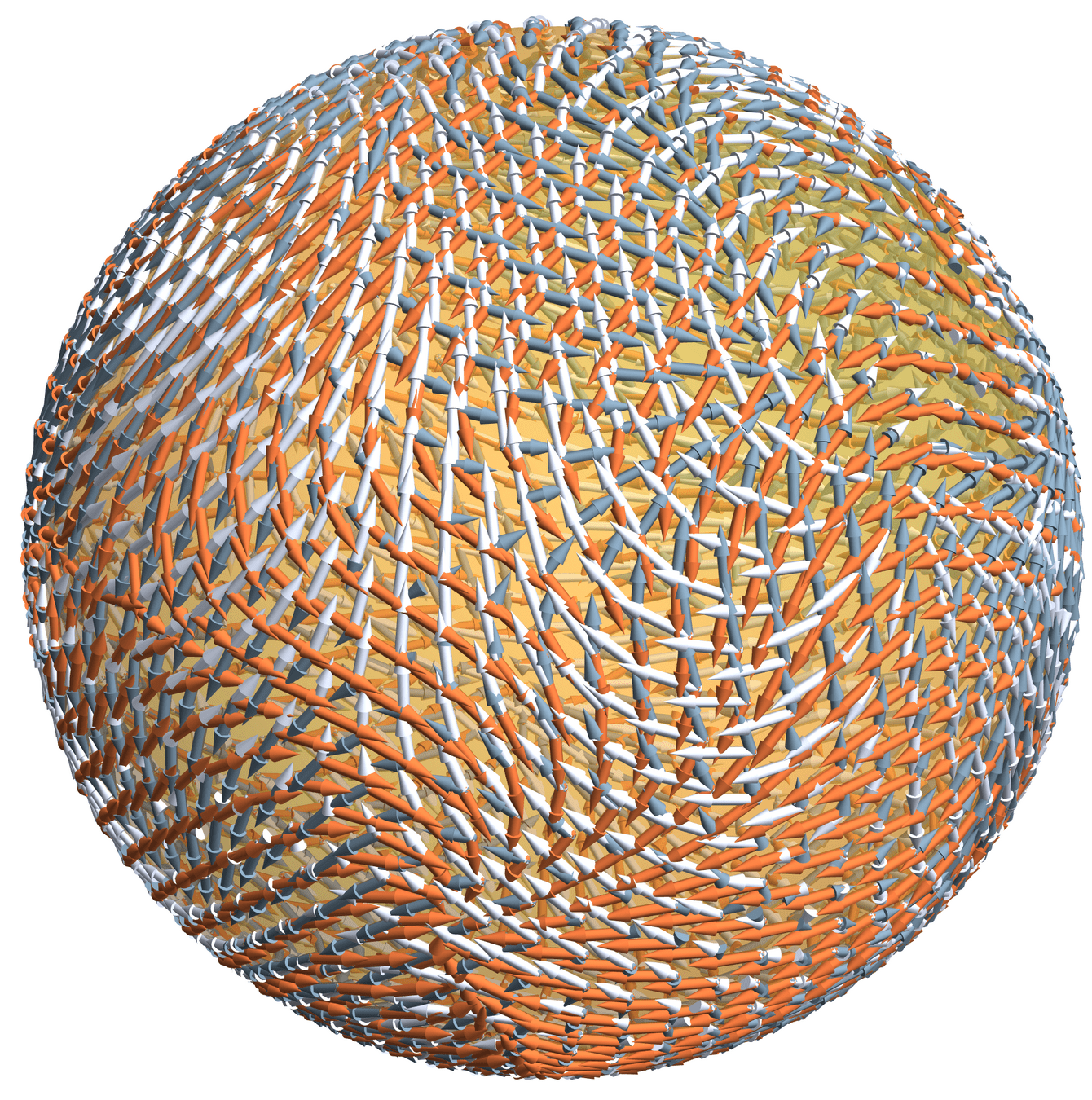
Data on Manifolds
Theorem [with Ballas and Needham]
For all \(n \geq d+k\), there exists a Parseval frame field of size \(n\).
Theorem [with Ballas, Karabatman, and Needham]
If \(k=d\) (e.g., the tangent bundle), then there exists an equal-norm Parseval frame field of size \(n \geq 2d+2\) if and only if the Euler class of \(E\) is trivial.
Question
Can these methods be made numerically tractable?
Thank you!
shonkwiler.org/mds26
References
Optimization and the topology of spaces of Parseval frames
Anthony Caine, Tom Needham, and Clayton Shonkwiler
SIAM Journal on Matrix Analysis and Applications 47 (2026), no. 3, 1375–1399
On the existence of Parseval frames for vector bundles
Samuel A. Ballas, Tom Needham, and Clayton Shonkwiler
Transactions of the American Mathematical Society, Series B 12 (2025), 395–416
The equal norm Grassmannian: topology and applications to frame fields
Samuel A. Ballas, Ferhat Karabatman, Tom Needham, and Clayton Shonkwiler