Agentic AI for project workflows
- Arrêtez de demander des résumés à l’IA
The problem
A typical day for a Product Manager, ScrumMaster, Delivery Manager or a Business Analyst - context is dispersed:
- Tickets in YouTrack / Jira
- Functional notes in Confluence / Youtrack or a team wiki
- Discussions in chat threads or video calls
- Engineering trade-offs in GitHub / GitLab PRs
- The full picture exists only in our heads
Cross-cutting reasoning is manual today. Agentic AI can bridge it.
Level 1 — Pure reasoning
What does a SMART sprint goal look like? Give me 2 examples.
Level 2 — Single tool lookup
List the titles of the user stories closed in our current sprint.
Level 3 — Reasoning + tool
Summarize our last sprint retro notes in Confluence in 5 bullet points, highlighting the improvement actions.
What does a SMART sprint goal look like? Give me 2 examples.
List the titles of the user stories closed in our current sprint.
Level 4 - Reasoning and multiple integrations
Read our last sprint retrospective notes in Confluence. For each improvement action mentioned, find the matching follow-up ticket in YouTrack. List the orphan actions — improvements without a follow-up ticket.
Level 5 - Full end-to-end agentic workflow
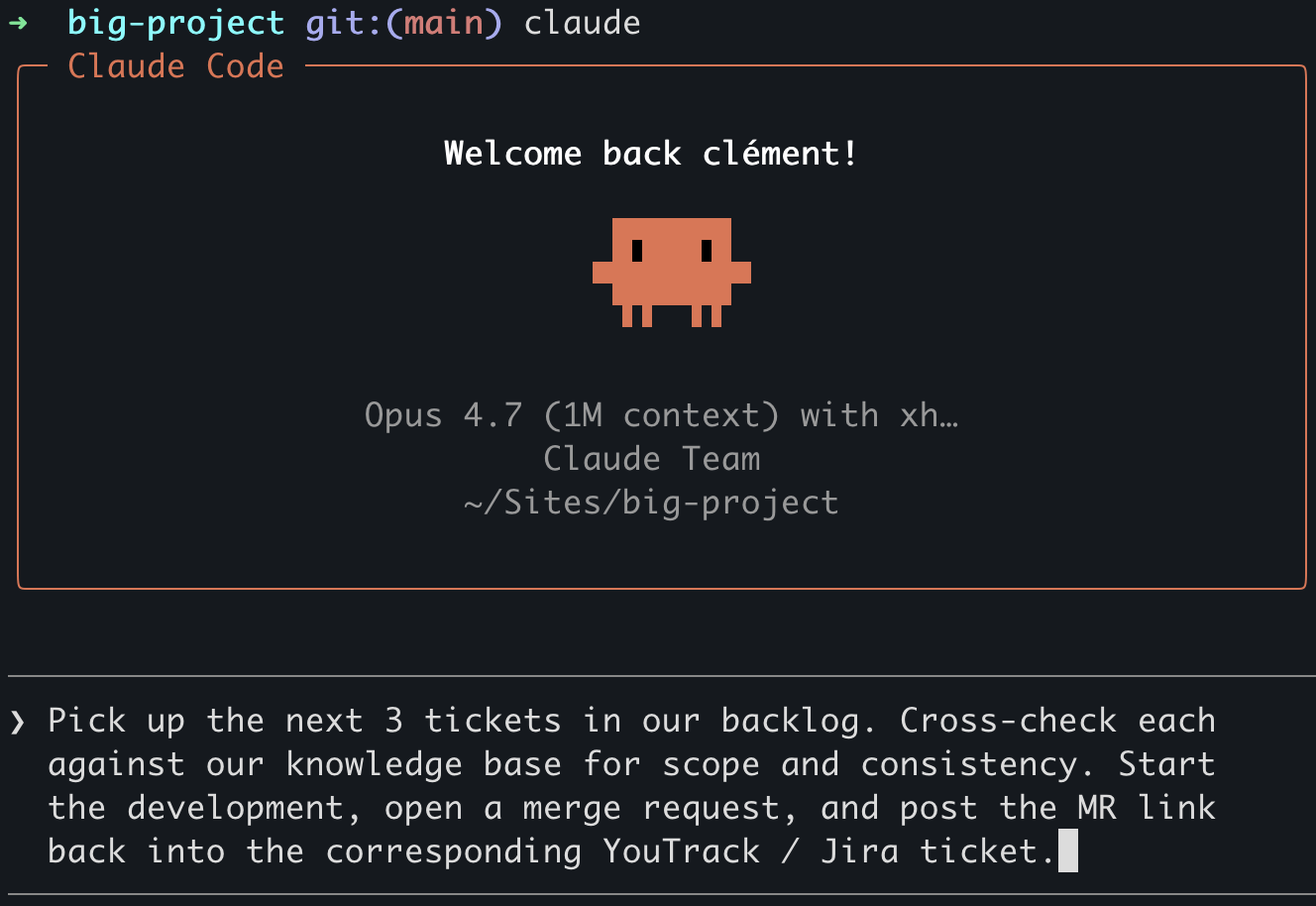
Pick up the next 3 tickets in our backlog. Cross-check each against our knowledge base for scope and consistency. Start the development, open a merge request, and post the MR link back into the corresponding YouTrack / Jira ticket.
The challenge of this talk: bringing Level 4 to non-tech roles. Level 5 is the dev frontier - out of scope today.
Recap - 5 levels of prompt complexity
| Level | Color | Capability |
|---|---|---|
| 1 | violet | Pure reasoning |
| 2 | red | One tool lookup |
| 3 | violet + red | Reasoning + one tool |
| 4 | violet + red (multi-source) | Reasoning + chained tools |
| 5 | + blue | + code / write actions |
Three solutions tested
Claude.ai — out of the box. Skills + token paste in chat.
LibreChat — self-hosted, open source. Docker, MCP YouTrack, Google SSO.
Custom application — self-hosted, our build. Symfony + tool surface custom (codename ScrumIA).
Claude.ai — out of the box
Pros
- Zero install, works immediately
- Top-tier reasoning (Anthropic frontier)
- Sandbox runs arbitrary API calls → any tool reachable
- Connector store mature (Atlassian GA Feb 2026, YouTrack MCP, etc.)
Cons
- 1 license per person at scale (€€€)
- Token pasted in chat or Skill (UX rough)
- Permissions blurry — sandbox can read, write, more
- No enterprise SSO management
- Skills maintained per user
LibreChat - self-hosted, open source
Pros
- Free, open source, self-hosted (data sovereignty)
- Google SSO out of the box
- Per-user token onboarding with guided UI
- Any model provider pluggable
- Clean tool-call UX
Cons
- MCP-only integration — bound by MCP coverage
- Some workflows hit a wall (see next slides)
- Limited UI customization
- Community maintenance (also a pro)
Custom application - self-hosted, our build
Pros
- Fine-grained permissions (per user, per op, per role)
- Full UX control
- Enterprise SSO + encrypted per-user token storage
- Any model provider, swappable at runtime
- Audit log on every tool call
- Combines MCP and REST → bypasses MCP gaps
Cons
- Build cost: several weeks for the POC
- Maintenance on us
- We own the failure mode
Side-by-side recap
| Install effort | None | 1-2 days | 1-2 weeks (POC) |
| Cost | €/user/month | Hosting only | Hosting + dev time |
| Permissions | Loose (sandbox) | Standard MCP | Fine-grained |
| Enterprise SSO | Limited | Yes | Yes |
| Model choice | Anthropic only | Any | Any |
| Tool coverage | Connectors + sandbox | MCP only | MCP + REST + custom |
| Audit trail | Limited | Standard | Custom, queryable |
| Maintenance | None (Anthropic) | Both | Us |
MCP is great - but it's not the full API
- YouTrack MCP → no
get_issue_activity. Can't ask "who changed this ticket's priority and when?" - Jira MCP (Atlassian official) → no
update_issue, notransition_issue, no epic linking, no subtask creation, no delete, no move-to-sprint - Confluence MCP → macros, version history, granular space permissions not exposed
Consequence — for any audit, drill-down, or batch workflow, you need REST fallback.
- LibreChat → wall.
- Custom application → we wire what's missing.
Why not the SaaS-native AI?
"Jira and YouTrack have their own AI now. Why bother?"
1. Siloed tooling — Jira's AI sees Jira. Not Confluence, not GitHub, not your chat. Multi-source reasoning is impossible.
2. Lagging models — SaaS-bundled AI upgrades to frontier models 6-12 months late. Today on Claude.ai we use Opus 4.7; the Jira AI is likely on a GPT-4-class model.
3. No prompt customization — You can't enforce read-only, mandate citation, or impose team tone.
SaaS AI is fine for "summarize this ticket". Cross-tool agentic workflows hit a ceiling fast.