Why do genres change over time?
- Ciara Shrager -
AUDIENCE EXPECTATIONS
Fulfilling the audiences expectation is vital when creating a film. When a genre is well established in the film world, audiences are aware of its typical codes and conventions. For example, it would seem odd if there was a horror film without a secluded and somewhat creepy location, such as the typical haunted house.
Changes in society
Society's opinions, values and ideologies are constantly changing, and films are a good representation of this. Horror films in particular take advantage of their audiences emotions. For example, the moon landing in 1969 spawned a glut of movies that related to non-human entities, linking to the concept of extra-terrestrialism.

Technological advances
The addition of CGI to the editing tools available to filmmakers has been influential in the quality and 'realness' of films. These advancements meant that films like Star Wars and The Abyss were made possible.
These advances created a higher expectation for films of many genres, but in particular horror, as the killings, monsters and locations can be extensively more realistic than they were before.
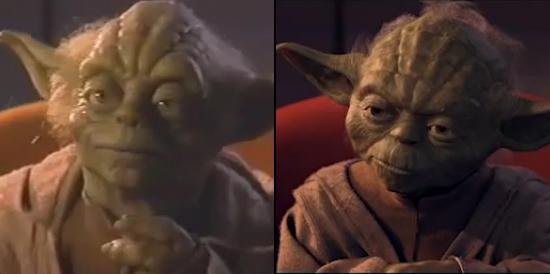
The evolution from puppet Yoda to CGI Yoda in the Star Wars series
Previous films
There is only so many ways filmmakers can use the same codes and conventions whilst making different films. This means that the genre has to constantly change and evolve in order to keep the audience captivated and interested. As well as this, films take inspiration from those that have come before them. This can be seen when looking at the typical convention of a vulnerable young girl being chased by a dangerous man; an aspect of the horror genre that originated in Halloween in 1978