RankSEG: A Consistent Framework
for Segmentation
Ben Dai
The Chinese University of Hong Kong


Segmentation


Input
output
Input: \(\mathbf{X} \in \mathbb{R}^d\)
Outcome: \(\mathbf{Y} \in \{0,1\}^d\)
Segmentation function:
- \( \pmb{\delta}: \mathbb{R}^d \to \{0,1\}^d\)
- \( \pmb{\delta}(\mathbf{X}) = ( \delta_1(\mathbf{X}), \cdots, \delta_d(\mathbf{X}) )^\intercal \)
Predicted segmentation set:
- \( I(\pmb{\delta}(\mathbf{X})) = \{j: \delta_j(\mathbf{X}) = 1 \}\)
Segmentation
Input
output

Input: \(\mathbf{X} \in \mathbb{R}^d\)
Outcome: \(\mathbf{Y} \in \{0,1\}^d\)
Segmentation function:
- \( \pmb{\delta}: \mathbb{R}^d \to \{0,1\}^d\)
- \( \pmb{\delta}(\mathbf{X}) = ( \delta_1(\mathbf{X}), \cdots, \delta_d(\mathbf{X}) )^\intercal \)
Predicted segmentation set:
- \( I(\pmb{\delta}(\mathbf{X})) = \{j: \delta_j(\mathbf{X}) = 1 \}\)
Segmentation
Input
output
$$ Y_j | \mathbf{X}=\mathbf{x} \sim \text{Bern}\big(p_j(\mathbf{x})\big)$$
$$ p_j(\mathbf{x}) := \mathbb{P}(Y_j = 1 | \mathbf{X} = \mathbf{x})$$
Probabilistic model:
The Dice and IoU metrics are introduced and widely used in practice:


Evaluation
IoU
The Dice and IoU metrics are introduced and widely used in practice:
Evaluation
Goal: learn segmentation function \( \pmb{\delta} \) maximizing Dice / IoU
Dice
Medical image segmentation
In the medical domain, over 70% of prize-money Kaggle competitions are segmentation
Autonomous vehicles
The "Cityscapes" Benchmark Dominance

Agriculture
John Deere claims "segmentation" allows farmers to reduce herbicide use by up to 77%




- Given training data \( \{\mathbf{x}_i, \mathbf{y}_i\} _{i=1, \cdots, n}\), most existing methods characterize segmentation as a classification problem:

Existing frameworks
- Given training data \( \{\mathbf{x}_i, \mathbf{y}_i\} _{i=1, \cdots, n}\), most existing methods characterize segmentation as a classification problem:
Existing frameworks




$$ \pmb{\delta}^* = \text{argmax}_{\pmb{\delta}} \ \text{Dice}_\gamma ( \pmb{\delta})$$
Optimal segmentation rule
Direct Dice/IoU Optimization
What form would the Bayes segmentation rule take?
Bayes segmentation rule
Theorem 1 (Dai and Li, 2023). A segmentation rule \(\pmb{\delta}^*\) is a global maximizer of \(\text{Dice}_\gamma(\pmb{\delta})\) if and only if it satisfies that

\( \tau^*(\mathbf{x}) \) is called optimal segmentation volume, defined as

$$ \tau^* = \arg\max_{\tau \in \{0,1,\cdots,d\}} \Big( \sum_{j \in J_\tau(\mathbf{x})} \mathbb{E} \big( \frac{2p_j(\mathbf{x})}{\tau + \Gamma_{-j}(\mathbf{x}) + \gamma + 1 } \big) + \gamma \mathbb{E} \big( \frac{1}{\tau + \Gamma + \gamma} \big) \Big) $$
Bayes segmentation rule
Theorem 1 (Dai and Li, 2023). A segmentation rule \(\pmb{\delta}^*\) is a global maximizer of \(\text{Dice}_\gamma(\pmb{\delta})\) if and only if it satisfies that
\( \tau^*(\mathbf{x}) \) is called optimal segmentation volume, defined as
$$ \tau^* = \arg\max_{\tau \in \{0,1,\cdots,d\}} \Big( \sum_{j \in J_\tau(\mathbf{x})} \mathbb{E} \big( \frac{2p_j(\mathbf{x})}{\tau + \Gamma_{-j}(\mathbf{x}) + \gamma + 1 } \big) + \gamma \mathbb{E} \big( \frac{1}{\tau + \Gamma + \gamma} \big) \Big) $$
Theorem 1 (Dai and Li, 2023). A segmentation rule \(\pmb{\delta}^*\) is a global maximizer of \(\text{Dice}_\gamma(\pmb{\delta})\) if and only if it satisfies that
\( \tau^*(\mathbf{x}) \) is called optimal segmentation volume, defined as
Obs: both the Bayes segmentation rule \(\pmb{\delta}^*(\mathbf{x})\) and the optimal volume function \(\tau^*(\mathbf{x})\) are achievable when the conditional probability \(\mathbf{p}(\mathbf{x}) = ( p_1(\mathbf{x}), \cdots, p_d(\mathbf{x}) )^\intercal\) is well-estimated
Bayes segmentation rule
$$ \tau^* = \arg\max_{\tau \in \{0,1,\cdots,d\}} \Big( \sum_{j \in J_\tau(\mathbf{x})} \mathbb{E} \big( \frac{2p_j(\mathbf{x})}{\tau + \Gamma_{-j}(\mathbf{x}) + \gamma + 1 } \big) + \gamma \mathbb{E} \big( \frac{1}{\tau + \Gamma + \gamma} \big) \Big) $$
Theorem 1 (Dai and Li, 2023). A segmentation rule \(\pmb{\delta}^*\) is a global maximizer of \(\text{Dice}_\gamma(\pmb{\delta})\) if and only if it satisfies that
\( \tau^*(\mathbf{x}) \) is called optimal segmentation volume, defined as
where \(J_\tau(\mathbf{x})\) is the index set of the \(\tau\)-largest probabilities, \(\Gamma(\mathbf{x}) = \sum_{j=1}^d {B}_{j}(\mathbf{x})\), and \( {\Gamma}_{- j}(\mathbf{x}) = \sum_{j' \neq j} {B}_{j'}(\mathbf{x})\) are Poisson-binomial random variables.
RankSEG inspired by Thm 1 (plug-in rule)
-
Ranking the conditional probability \(p_j(\mathbf{x})\)
Plug-in rule
Theorem 1 (Dai and Li, 2023+). A segmentation rule \(\pmb{\delta}^*\) is a global maximizer of \(\text{Dice}_\gamma(\pmb{\delta})\) if and only if it satisfies that
\( \tau^*(\mathbf{x}) \) is called optimal segmentation volume, defined as
RankSEG inspired by Thm 1
-
Ranking the conditional probability \(p_j(\mathbf{x})\)
-
searching for the optimal volume of the segmented features \(\tau(\mathbf{x})\)
Plug-in rule
- Dai, B., & Li, C. (2023). RankSEG: A Consistent Ranking-based Framework for Segmentation. Journal of Machine Learning Research.
- Wang, Z., & Dai, B. (2025). RankSEG-RMA: An Efficient Segmentation Algorithm via Reciprocal Moment Approximation. NeurIPS.
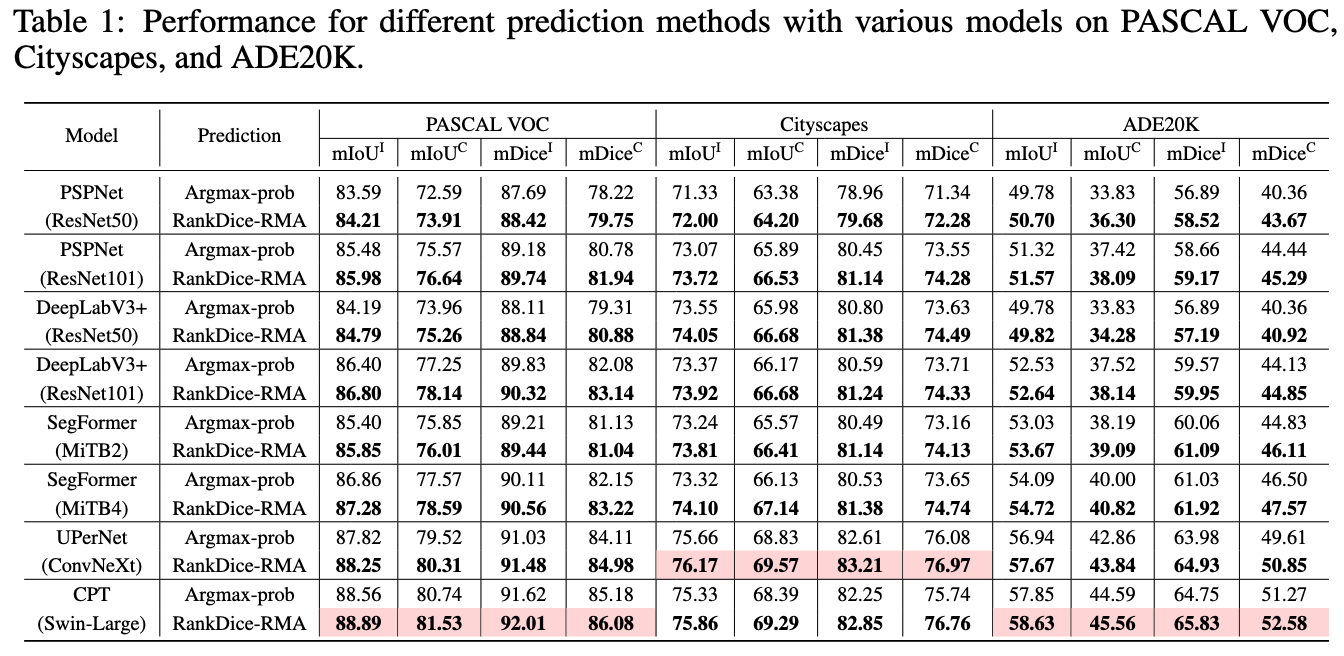
RankSEG: Experiments
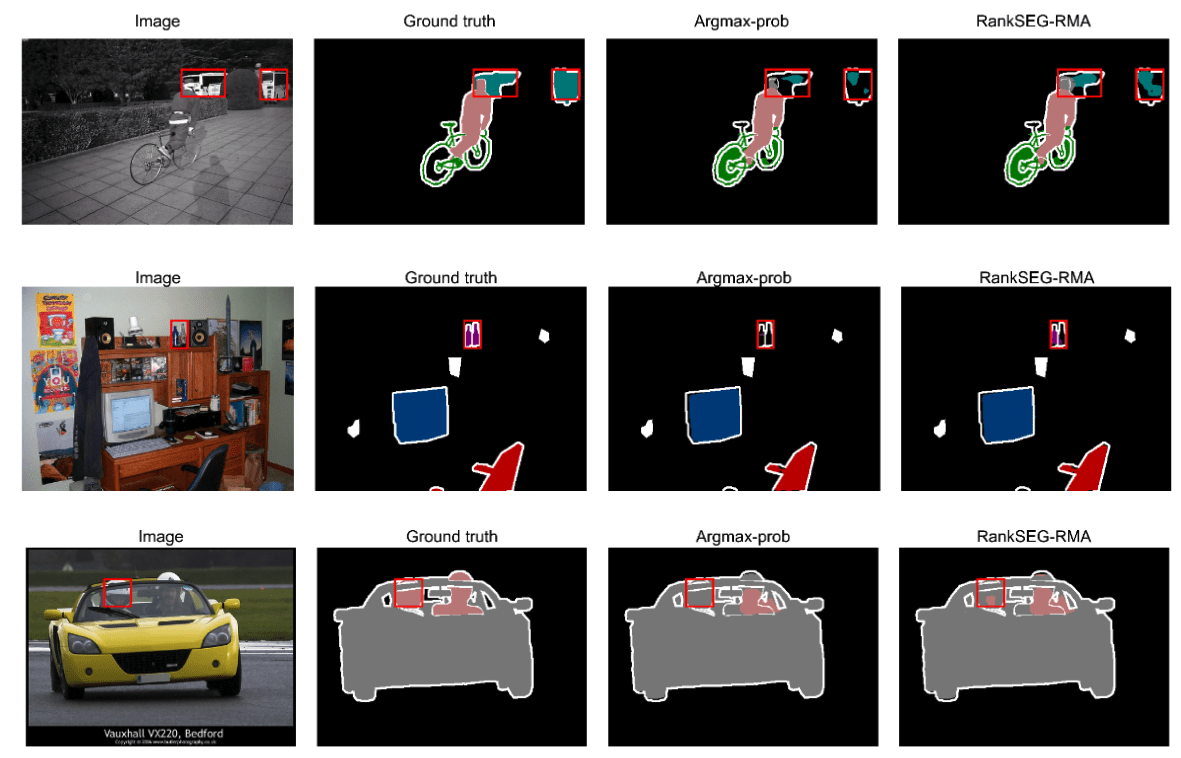
More experimental results in Dai and Li (2023) and Wang and Dai (2025)
RankSEG: Experiments
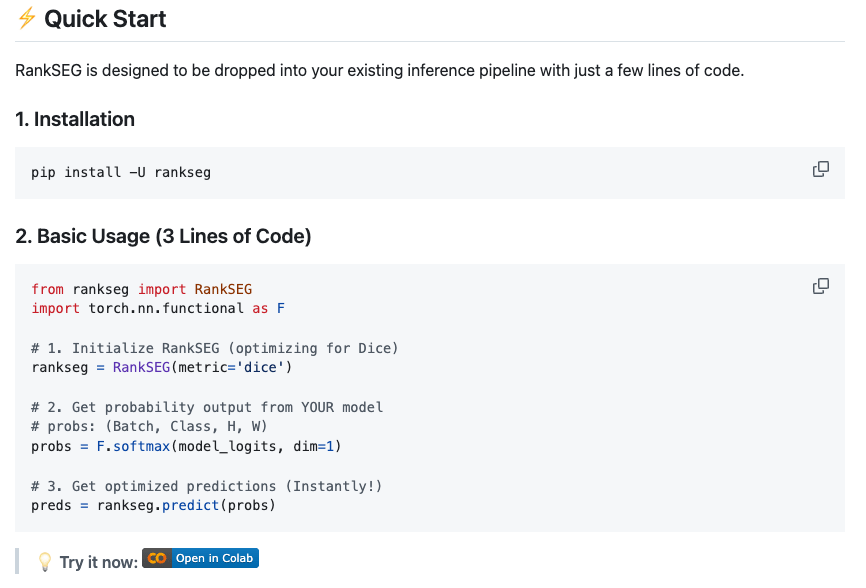
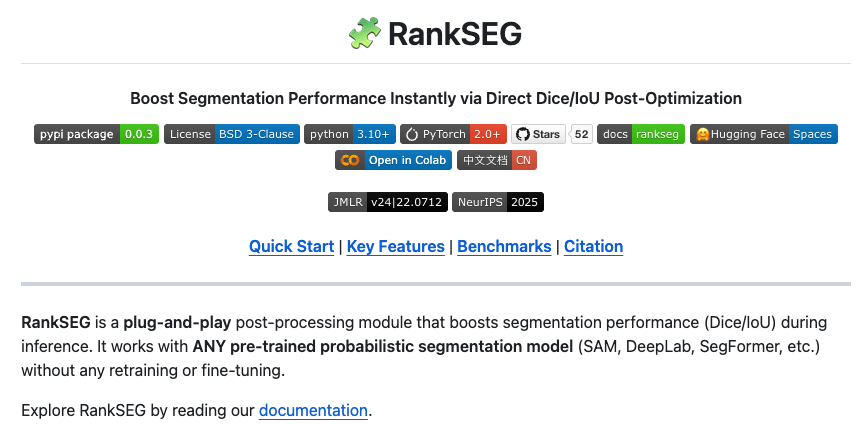
Thank you!


If you like RankSEG please star 🌟 our Github repository, thank you for your support!

This project is largely inspired by Fisher Consistency Fisher (1922) and FC in classification: Lin (2001), Zhang (2004) and Bartlett et al, (2004)