Doing Research
Workshop for HIST 50:
Healing in the Black Atlantic
Simon Elichko (they/he)
Social Sciences & Data Librarian
Christina Bush (she/her)
Research & Instruction Librarian
Workshop Agenda:
- Survey results
- Getting a book from the library
- Exploring the historiography
Survey results
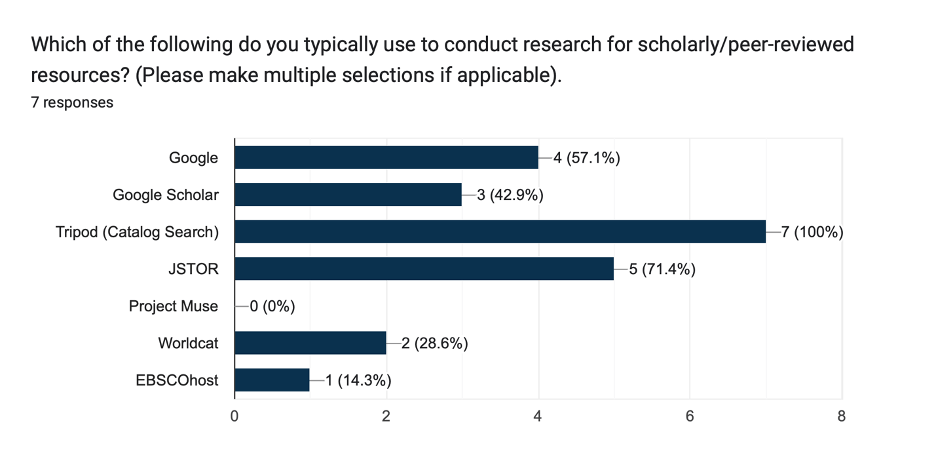
What do you find challenging about finding sources?
Primary Document Analysis
Students must submit a proposal for their primary document analysis on Moodle by Monday, February 23. The proposal must consist of a description of the document, a tentative argument, and a bibliography of at least 3 secondary sources.
Final versions of primary document analyses are due on Moodle by Monday, March 30, 2026 at 5:00PM EST.
Anthology
Students are expected to assemble and submit a table of contents, introduction, and/or a conclusion to an anthology about the histories of health, healing, and Black life. Individually or in pairs, students will select a group of 6-8 readings to include in their anthology. Students may choose 1-3 readings from the syllabus and 4-7 outside readings. Students will submit a proposal on Moodle containing a list of their selected readings and a brief (50-250 word/less than one double-spaced page) description of their anthology’s theme by Monday, April 13.
Drafts of Anthologies are due on Moodle Monday, April 27, 2026. Students are required to meet with the course WAs about their first draft. Revised anthologies are due on Moodle by Friday, May 8, 2026.
Secondary Sources:
Books & Book Chapters
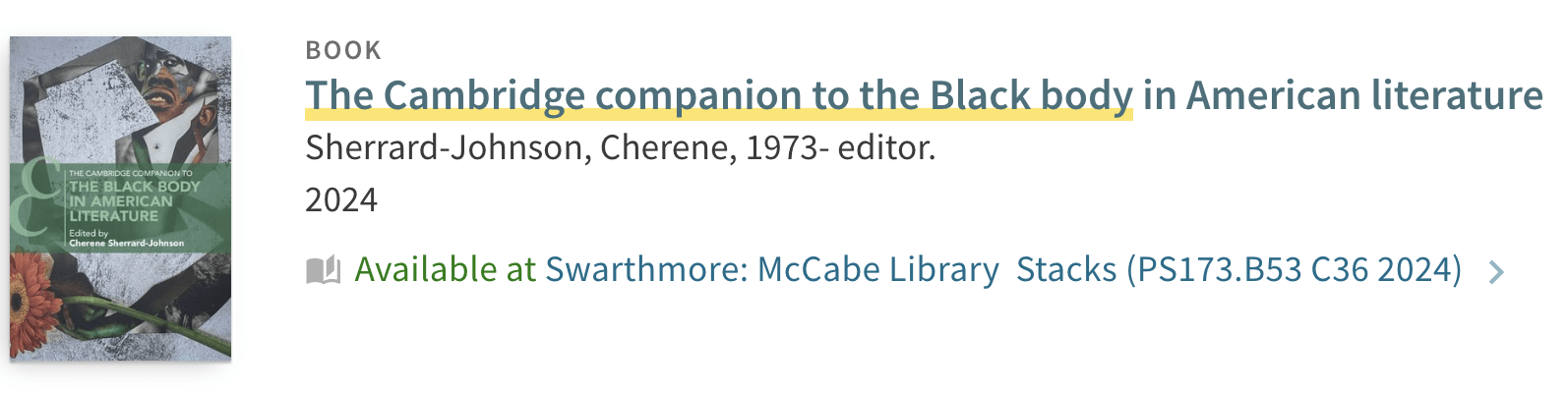
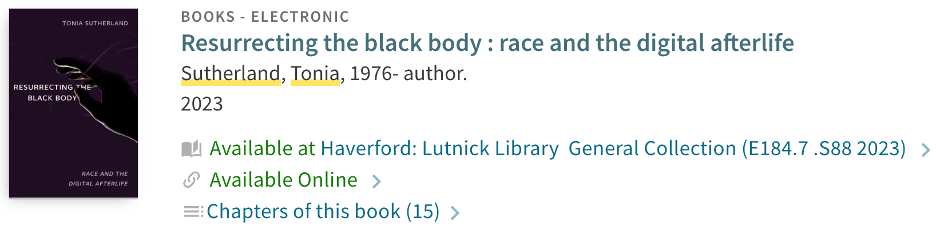
You'll often see chapters published in edited collections, for example:
Summers, Martin. “Diagnosing the Ailments of Black Citizenship: African American Physicians and the Politics of Mental Illness, 1895–1940.” In Precarious Prescriptions: Contested Histories of Race and Health in North America, edited by Martin Summers, Laurie B. Green, and John McKiernan-González, 91–114. University of Minnesota Press, 2014. http://www.jstor.org/stable/10.5749/j.ctt6wr7rq.8.

Secondary Sources: Journal Articles
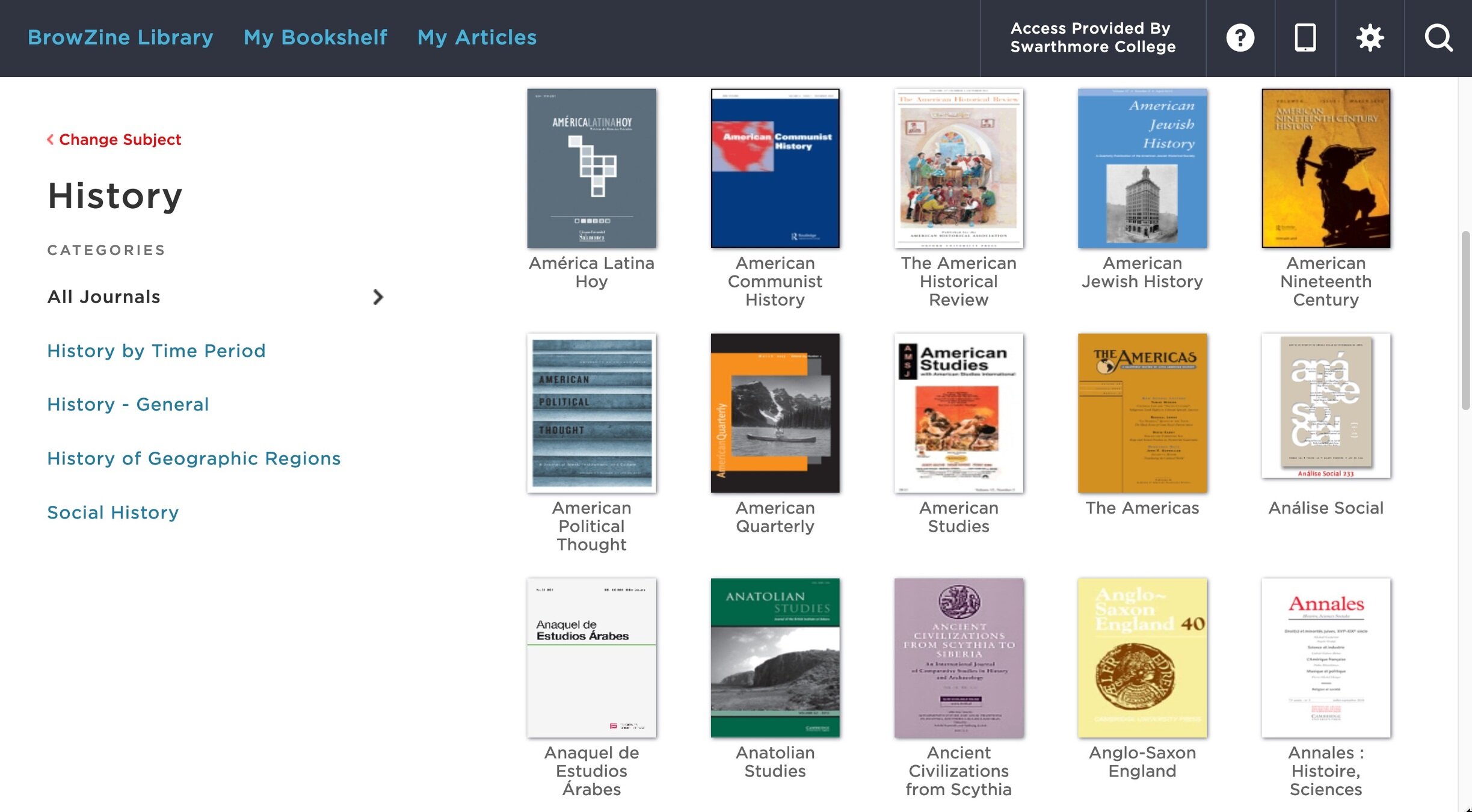
Explore scholarly journals in Browzine and Tripod
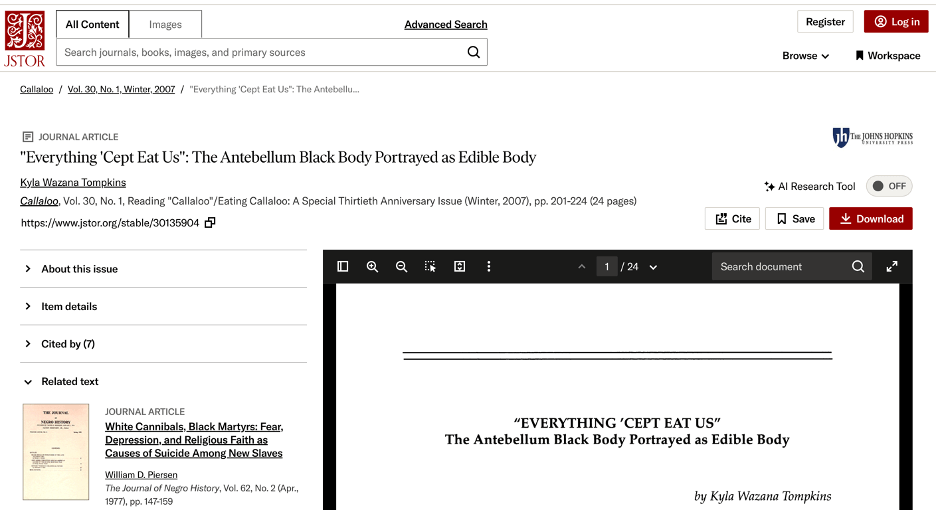
Example articles:
Tompkins, Kyla Wazana. ""Everything'Cept Eat Us": The Antebellum Black Body Portrayed as Edible Body." Callaloo 30.1 (2007): 201-224.
Sullivan, Mecca Jamilah. "Fat Mutha: Hip Hop's Queer Corpulent Poetics." Palimpsest: A Journal on Women, Gender, and the Black International 2.2 (2013): 200-213.
Exploring the historiography
Navigating the stacks
Citing sources
Subject headings
Reviews
Bibliographies

source: McMaster University Library
Books at the Libraries
Example call number:
HQ 1163 .H55 2022
← H = Social Sciences
| Call number starts with | Floor in McCabe |
|---|---|
| A-E | Lower Floor |
| F-K | 2nd Floor |
| L-Z | 3rd Floor |
Tutorial: How to find a book in McCabe
Getting books from the library
- Pair up with a classmate
- Take the paper slip with your book title and call number
- Scan the QR code to open the tutorial on finding a book in McCabe
- Do two things:
• Use the call number to find your book on the shelf
• Find a second book nearby that looks interesting - Bring both of your books back here with you
| Call number starts with | Floor in McCabe |
|---|---|
| A-E | Lower Floor |
| F-K | 2nd Floor |
| L-Z | 3rd Floor |
1. Go to Google Scholar: scholar.google.com
2. Search for one of the books you found on the shelf
Finding out who has cited your books
3. Instead of clicking on the book, click "Cited by ___"
What can you do from here?
Some ways to narrow down results:
- ☑ Search within citing sources
- source:history OR source:historical
- source:compass OR source:reviews
Finding historical scholarship:
key questions to ask
-
Who? Who is this book about?
Who wrote it? (Are they a historian?)
-
When? What time period does it focus on?
When was it written?
-
What? What aspects of the topic are emphasized?
What kind of sources did the author use?
1. Go to Tripod: swarthmore.edu/libraries
2. Search for your book's title to find its record in Tripod.
- Choose the result for the book itself, not a book review
- If you see multiple matching titles, choose the physical / paper copy
3. Explore the subjects used to describe your book.
- Scroll down to Details section. Find the section labeled Subject.
- Click on a subject tag. What do you find (if anything)? (e.g. African Americans -- Medical care)
- What happens if you remove the last term (or terms) from a multi-part subject?
- What happens if you change the subject search from "contains exact phrase" to "contains"?
-
e.g. Subject contains exact phrase African Americans -- Diseases -- History -- 20th century
--> Subject contains African Americans -- Diseases -- History -- 20th century
-
e.g. Subject contains exact phrase African Americans -- Diseases -- History -- 20th century
- Try using Filters like Region and Subject to explore your Tripod results
How to find relevant books
Using subject tags in Tripod to find books on your topic
Two quick notes on accessing books
Borrowing & Reading Books

Some books in Tripod are available to read online.
You can borrow physical books from the TriCo libraries. Generally you can keep them for the semester.
If you login to Tripod, you'll see the option: Request Physical Copy.
The book will be brought to the library front desk for you, usually the next day. Works for Swarthmore, Bryn Mawr, and Haverford books.
TriCo
Login to Tripod to request delivery (arrives 1-2 days)
E-Z Borrow
Borrow from academic libraries in PA, NJ (arrives in ~1 week)
Borrow books, journals, microfilm, DVDs, etc. from all over the world. (arrives in 1-3 weeks)
Penn Drexel Temple NYU Rutgers
Swat Haverford Bryn Mawr
Oxford Columbia University of Amsterdam
Harvard Stanford Museum of Natural History
You can access materials from TriCo libraries and beyond
You can also request PDFs of articles & book chapters not owned in the TriCo.
Useful tools for finding secondary sources:
Library catalogs
- Tripod (books available from the TriCo Libraries)
- Worldcat (books available from libraries in the US and beyond)
History-focused databases
- America History & Life (journal articles about US history)
-
Historical Abstracts (journal articles about history beyond the US)
African American Studies Resources
General academic databases
- JSTOR
- Project Muse
You can get links to databases and other resources for this class on the HIST 50 Research Guide.
Find a link to Research Guides in Tripod
or on the Swarthmore Libaries site.
In Research Guides, search for the class (e.g. Healing Black Atlantic)
From the HIST 50 Research Guide,
go to the page Find Scholarly Books and Articles.
On the Find Scholarly Books and Articles page,
go to America, History and Life.
To access the database, click the yellow S.
Finding more relevant articles
Quaker 2,348
Quaker* 2,412
Quaker* OR "Society 2,687
of Friends"
slavery 20,143
slave* 28,497
slave* OR enslave* 29,105
Quakers slavery → 81 results
Try this search in America, History and Life. How many results did you get?
302
How about in Tripod?
4,170
Time to explore
Get some practice navigating the secondary literature
Research Help & Advice
-
Make an appointment with Christina
- Email cbush1@swarthmore.edu
-
Make an appointment with Simon
- Email selichk1@swarthmore.edu
- Email selichk1@swarthmore.edu
More options:
- Email librarian@swarthmore.edu and your question will reach the right person
- Use Tripod Chat