Information
Ethics & Privacy
Library Internship - 2/28/25
Simon Elichko (they/them)
Social Sciences & Data Librarian
J. Edgar Hoover
Director of the FBI from 1924-1972. Best known for COINTELPRO surveillance of thousands of US citizens, particularly POCs and activists.
Audre Lorde
Poet, activist, professor, publisher. Author of Zami: A New Spelling of My Name, Sister Outsider, The Cancer Journals, and many other books.


what do they have in common?
{ they both worked in libraries }
Today, we'll explore ethics in librarianship by discussing some current issues that are impacting libraries, librarians, and readers in multiple kinds of libraries (public, school, and academic).
What we'll talk about:
-
Defining ethics
-
Advocating for readers: libraries + book bans
-
Taking a break :)
-
Navigating ethics around generative AI
- Privacy
Ethics
?
Information
+
Ethics refers to well-founded standards of right and wrong that prescribe what humans ought to do, usually in terms of rights, obligations, benefits to society, fairness, or specific virtues.
(Source: Velasquez et al, Issues in Ethics)
Ethics as
a library worker
Making
Choices
- Deciding how to approach problems, issues, and opportunities
- Setting agendas and priorities
- Considering who needs to be involved in decisions and in what ways
- Responding to conflicts
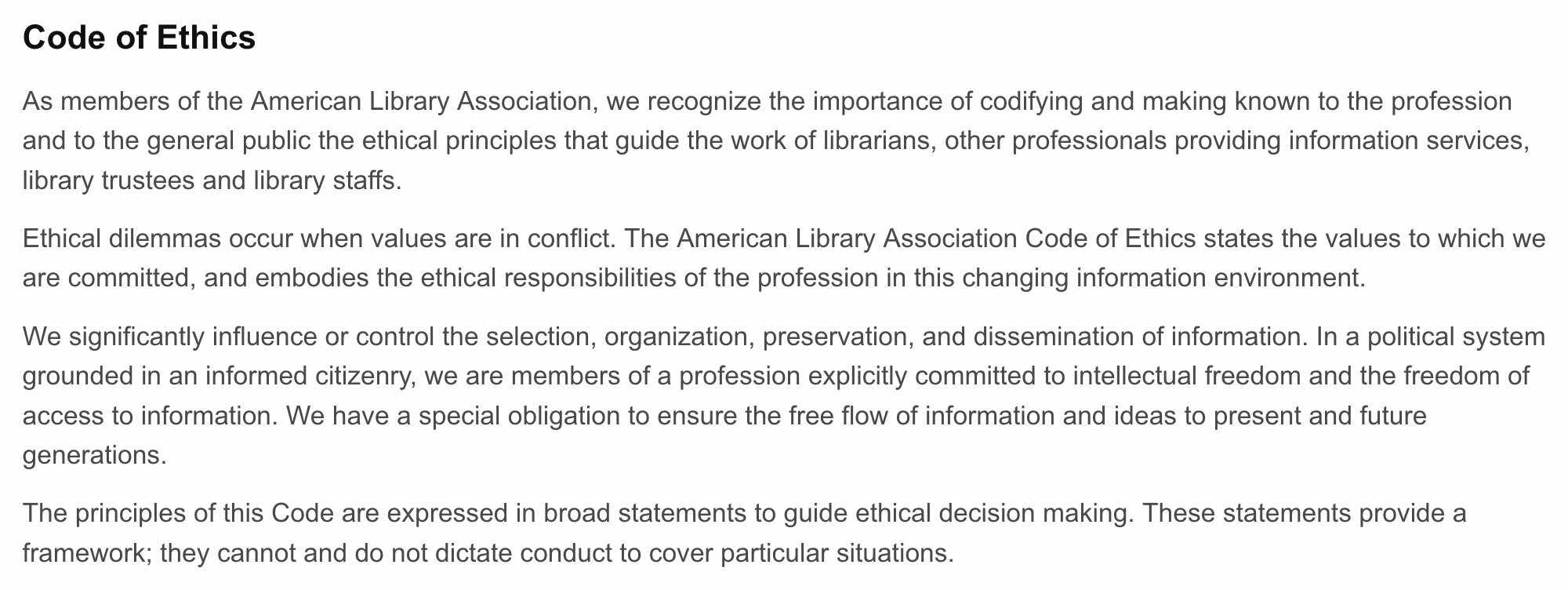
American Library Association Code of Ethics
"A library is a different kind of social reality (of the three dimensional kind), which by its very existence teaches a system of values beyond the fiscal."
A non-profit purpose

Acknowledging the many valid and vital critiques of libraries (vocational awe is particularly relevant here), the non-profit mission of libraries remains distinct from that of many other organizations that shape our access to information (e.g. large-scale search and social media platforms).
"People’s expectations of privacy are affected by legislation, media coverage of related events, community participation in digital platforms, the interfaces and policies of these platforms, and awareness of the flows of their data, among other factors. The library can play a role in shaping these expectations and educating people on what is possible to demand."
How Did We Get Here? A Zine About Privacy at the Library – Data Privacy Project
An educational mission
What we'll talk about:
- Defining ethics
-
Advocating for readers: libraries + book bans
- Taking a break :)
- Navigating ethics around generative AI
- Privacy
Book bans & libraries:
Advocating for readers
Before doing the homework for this week, what had you heard about public and school library book bans?
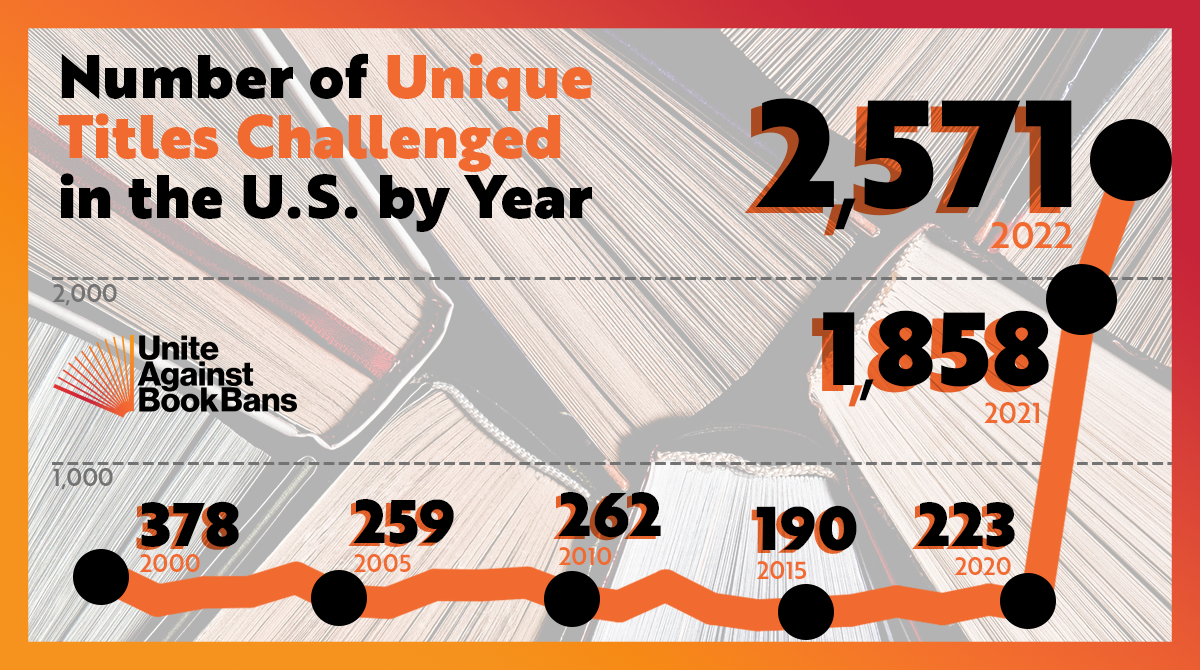
Since 2021, we've seen a large number of books being challenged in US public libraries and schools.

Although book challenges and bans are nothing new, the past few years represent a significant increase in the number of challenges and titles impacted.
Books centering the voices and experiences of POC and/or LGBTQ+ folks are disproportionately impacted by this wave of book challenges: in 2023, these were 47% of titles removed from schools. (Unite Against Book Bans)
Book challenges are not a new phenomenon – ALA reported nearly 1,000 book challenges in 1981 – but recent efforts are more coordinated:
-
"Advocacy groups are working to nationalize book challenges, this time with the help of conservative TV and talk shows, that for the past few decades have been mostly local events." (Washington Post)
"Scarlet Letter" effect on both individual titles and on authors - books challenged in one school district are then challenged in others, and expanding from one title to everything an author has written (see PEN America)
Increase in state-level legislation impacting libraries, amplifying the effect of local book challenges
- In 2023, state legislatures passed 22 laws identified by EveryLibrary:
-
"The bills reflect several recurring themes...provisions related to legal definitions of obscenity and harmful to minors; changes to collection development and collection review/challenge policies; requiring age verifications; creating new liabilities for material distribution; and withholding of funds."
-
- In 2024, state legislatures enacted 7 laws challenging library operations and services (EveryLibrary)
- Some good news: 11 state-level laws were enacted in 2024 to protect libraries and library workers
State-level laws restricting reading and speech in educational settings, including public higher education, and (more recently) federal efforts opposing DEI, "divisive concepts" etc.
See PEN America and AAUP on education, and Data Rescue Project for readings on federal changes
What is different about book bans from the past few years?

"An Open Letter to the Eleven Adults Responsible for the Majority of Book Bans in Schools," Melanie Winklosky, McSweeney's (Dec 2023).
The majority of book complaints come from a minuscule number of hyperactive adults. Just 11 people were responsible for filing 60 percent of the 2021-2022 challenges."
This article goes into detail about some of the organized campaigns and how they've operated.
* Heads up - the article quotes homophobic and transphobic rhetoric, including images depicting this rhetoric in handwriting. (To get a text-only view, use Reader View in Firefox or Safari, or Reader View extension in Chrome.)
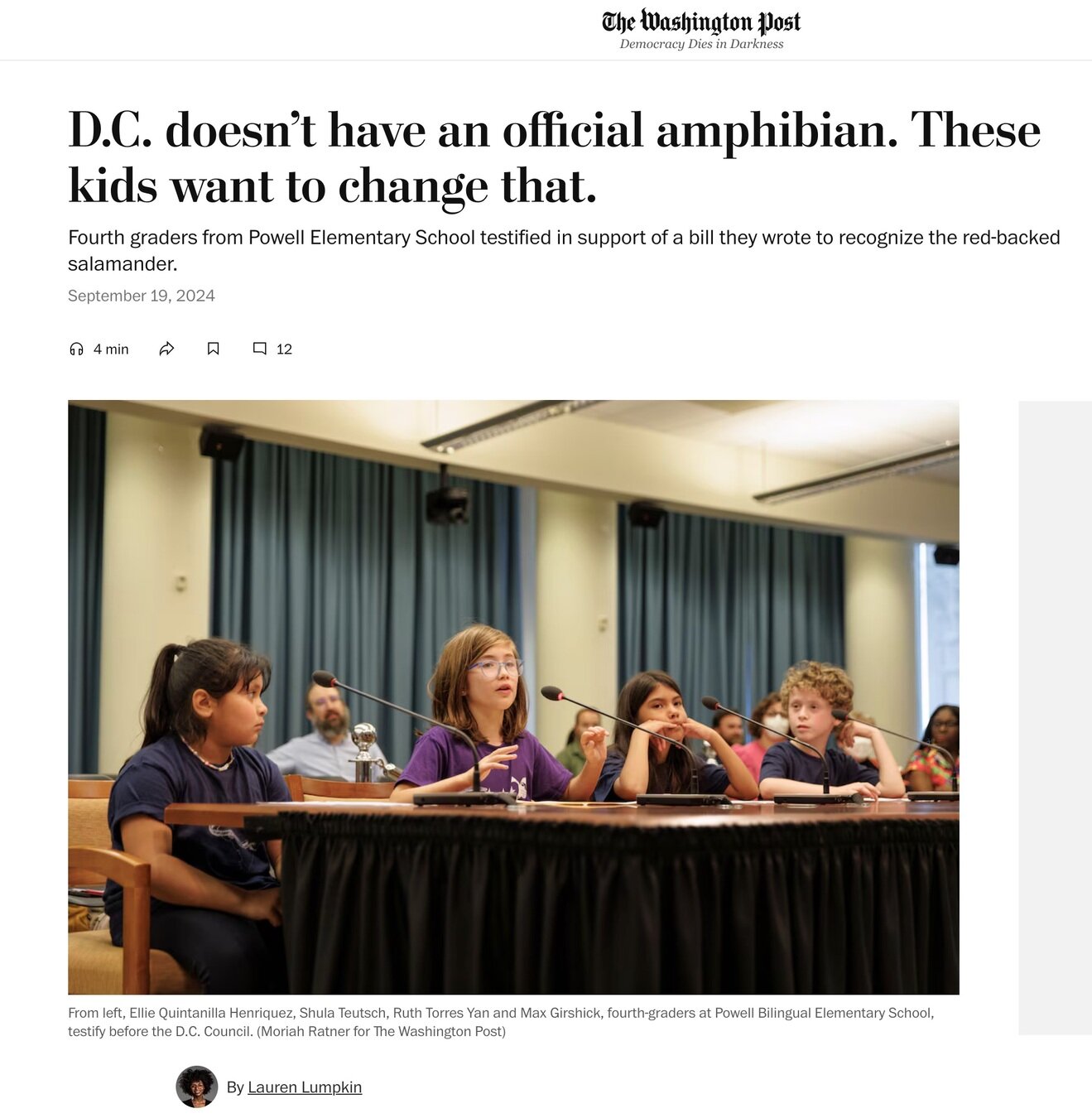
"Objection to sexual, LGBTQ content propels spike in book challenges," Hannah Natanson, Washington Post (May 2023)
Schoolbook challenges have risen to unprecedented levels over the past three years. To understand what and who is driving objections to K-12 texts, Washington Post K-12 Education reporter Hannah Natanson filed records requests with 150 school districts nationwide, seeking copies of every book challenge they received in the 2021-2022 school year.
"Half of challenged books return to schools." Hannah Natanson, Washington Post (Dec. 2023)
What's going on??
- Impact from a relatively small number of people
- Organized efforts
- Copy-and-paste activism (or borrowing of ideas?) -- "scarlet letter effect"
- Ease of participation -- Zeynep Tufekci, Twitter and Tear Gas
- Powerful funding & backing (see AAUP report about higher education)
- Polarization and echo chambers
- Francesca Tripodi on conservative media
- Matt Grossman and David Hopkins on the diploma divide
-
School board elections that are increasingly politicized
- PAC funding
- Library boards?
- Increasing attention, commentary, discussion
- Cultural conflicts
- Shift in the locus of disputes over religion in schools (school prayer, evolution) to contestation over American history - as traced by Jonathan Zimmerman in Whose America? Culture Wars in American Public Schools (2nd ed, 2022)
- Book banning tied to larger parental rights discourse
- Close-reading (example from PEN America, research by Francesa Tripodi)
Consider also the most restricted reading environments in the US: prisons and jails.
PEN America's 2023 report Reading Between the Bars (2023) discusses the landscape of restrictions on reading in prisons, pointing to content-neutral and content-specific banning.
The Marshall Project created this database identifying over 50,000 books that have been banned in state prisons.
Learn more about prison libraries + librarianship:
Freedom Reads • Information censorship in the carceral system (Prism Reports) • Prison Banned Books Week • Law libraries that serve incarcerated people (Am. Assoc. Law Libraries) • Jail and Prison Services (Brooklyn Public Library)
not great.
but it's not all bad news, though.


There are organizations (many library-related) fighting back against censorship efforts
See "Authors Against Book Bans Mobilizes" in Publishers Weekly
Several efforts are providing readers with access to books that are banned in their local communities.
Digital Public Library of America founded The Banned Book Club in 2023 "to provide anyone who is in a library that has banned a book access to the digital version for free."

Started by Brooklyn Public Library in 2022, Books Unbanned lets 13-21 year-olds apply for an e-card granting free online access to banned books. Since 2023, Boston, LA County, San Diego, and Seattle Libraries have joined this effort.
Learn more from BPL's podcast series Borrowed and Banned, or read this article in Library Journal.
(Hit a paywall? You can access Library Journal from Tripod.)
How can you learn more?
- Find out where challenges are happening
- Read about state legislation
-
Learn about successful defenses against challenges
- For example, in Arkansas, Colorado and Alabama
- See more at Fight for the First
- Stay up to date by following Unite Against Book Bans and Marshall Project
-
Look out for research
- What book bans are doing to school library purchases (Eesha Pendharkar, Education Week)
- Book Bans in American Libraries: Impact of Politics on Inclusive Content Consumption (SSRN) (or see summary here)
-
Keep an eye on how things develop
- Go beyond headlines at one point in time - for example, see this article about changes in one Bucks County school district over multiple years.
Making the case
- Pick a public or school (K-12) library, either one you know or one you're curious about. Think about the communities it serves.
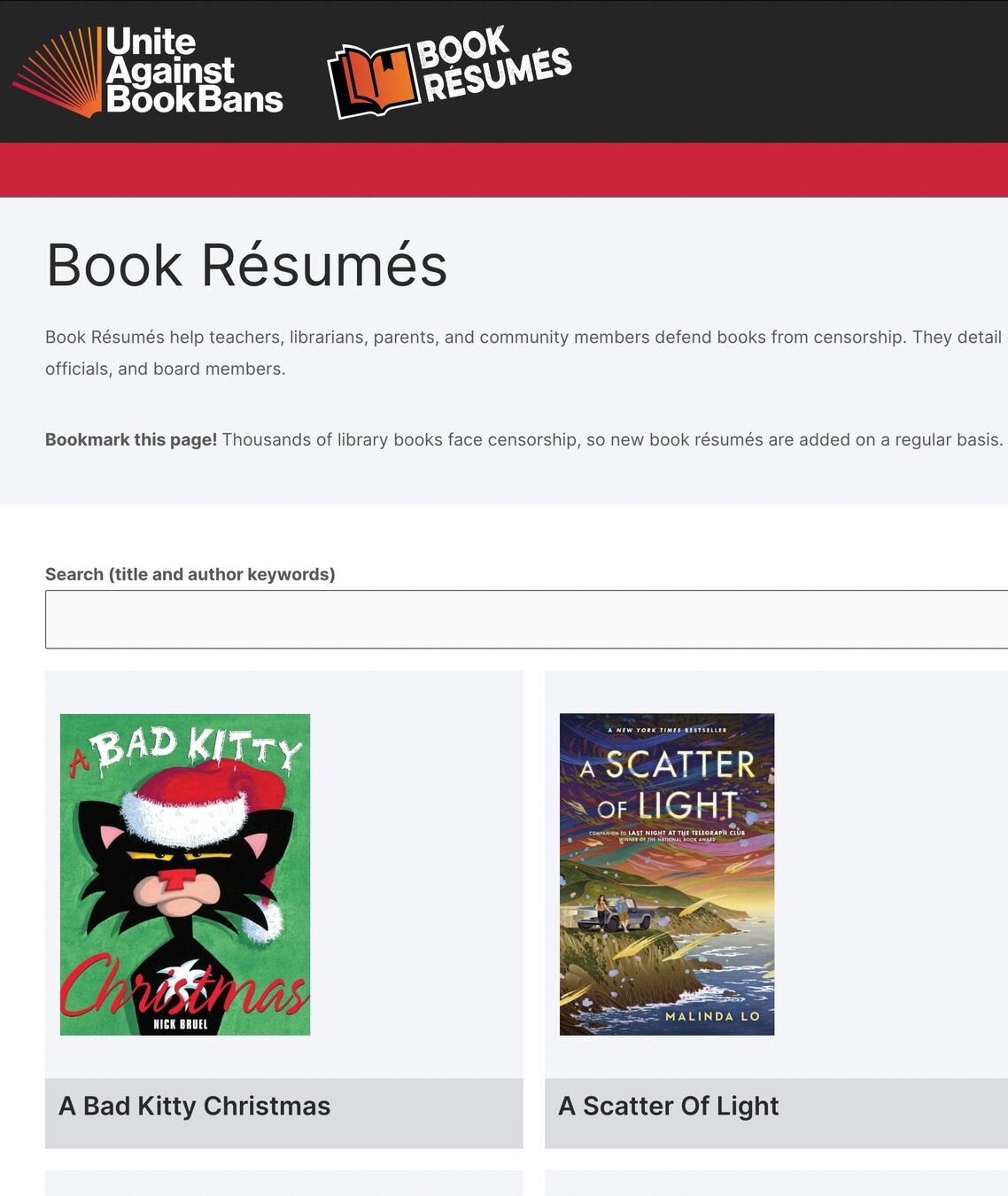
- Explore some Book Résumés available from Unite Against Book Bans. Choose a book that you think could be relevant for readers at your library.
- Read at least one linked review
- Prepare to briefly present your book choice and your reasoning
(This builds on your collection development session with Amy McColl.)
break time
Navigating ethics around generative AI
How will information ethics continue to evolve with expanded use of generative artificial intelligence tools like ChatGPT?
-
Choosing when to use or avoid
- When might we choose to use these tools? When might we avoid using these tools? (In court, for one.)
- How do we understand our role in using these systems?
- When we use generative AI tools, how can we do so ethically? What are the costs of avoiding using these tools? See the Marshall Project for an interesting example project.
-
Copyright and intellectual property
- How much guidance can we get from existing practices around fair use of copyrighted material?
- What should constitute "transformative use" of copyrighted material? Using artwork to train an image generator? Scraping news articles to train a chatbot? (This podcast episode outlines the four factors governing fair use in the context of the New York Times case against OpenAI.)
-
Representativeness and inclusion
- What do we know about the data sources that tools like ChatGPT are based on? (This is often proprietary information, but you can get some clues from investigations like this.)
- How can we take representativeness into account when using (or not using) these tools? When evaluating the results we get from them? (See some concerns raised here.)
-
Other considerations
- Sustainability and efficiency
- Labor
- Experience and opportunities to learn, practice, etc.
How generative AI tools work - interactive explainer from Financial Times
Generative AI
Choosing to use or avoid
Accuracy and trustworthiness
- Hallucinations
-
BBC News study of four popular AI assistants (Feb 2025)
- Gave ChatGPT (OpenAI), Copilot (Microsoft), Gemini (Google), and Perplexity access to BBC News and asked questions about the news
- 51% of all AI answers to questions about the news were judged to have significant issues of some form.
- 19% of AI answers which cited BBC content introduced factual errors – incorrect factual statements, numbers and dates.
- 13% of the quotes sourced from BBC articles were either altered from the original source or not present in the article cited.
-
BBC News study of four popular AI assistants (Feb 2025)
Generative AI
Copyright, fair use, intellectual property
- Legal cases
- Key case: NYT v. OpenAI and Microsoft
- Article about the case from NPR (Jan 2025)
- Case documents and updates via CourtListener
- Recent decision in Thomson Reuters vs Ross Intelligence
- Judge sided with Thomson Reuters (content owner) over Ross
- Weighed the "commercial use" and "market impact" factors heavily
(see: "four factors" of fair use)
- Stay up to date: AI Litigation Tracker (McKool Smith, large law firm)
- Key case: NYT v. OpenAI and Microsoft
- Newspapers & journalists
- "Sue or sign?" News organization lawsuits and content deals - PressGazette (UK)
- How much traffic is ChatGPT directing to news sites? - PressGazette
- Stay up to date: NiemanLab coverage of AI & journalism
Privacy
How Did We Get Here? A Zine about Privacy at the Library - Data Privacy Project
- What was already familiar to you?
- Share some things you learned from this reading
- What are some ways librarians can advocate for and increase readers' privacy?
Privacy is not about technology -
it's about people.

Dark Matters: On the Surveillance of Blackness
Simone Browne (2015)
Duke University Press

Obfuscation
Helen Nissenbaum & Finn Brunton, 2015. MIT Press.
Race After Technology: Abolitionist tools for the New Jim Code Ruha Benjamin, 2019.
Polity Press.

Increasing your privacy and digital literacy
2. Protect your browsing history
Visualize and blocks tracking websites
• Privacy Badger (free from Electronic Frontier Foundation)
• Firefox (browser, alternative to Chrome)
• Blacklight (find out which trackers are enabled on a website)
3. Learn as you go
Browser extension that helps make sense of the privacy policy and other terms and conditions on YouTube, Twitter, etc.
1. Start small
Easy adjustments to help share (or not!) your data more intentionally: Data Detox Kit (Tactical Tech & Firefox)
• Try a module: Control Your Smartphone Data, Escape the Defaults, or another
caveat! Privacy-protecting extensions and settings can cause websites to behave oddly at times.
so: If you have trouble with a website, disable Privacy Badger or Firefox's Enhanced Tracking Protection.
Other resources for increasing your knowledge and agency over your digital life
• Check Please! online course on fact-checking
• The Markup investigates big tech + how platforms operate
• Surveillance Self-Defense, Electronic Frontier Foundation
• Zines & Artwork from Digital Defense Fund
Library-focused:
• Library Freedom Project Resources
Sources
Manuel Velasquez, Claire Andre, Thomas Shanks, S.J., and Michael J. Meyer. (2010 [1987]). What is Ethics? A definition of ethics in terms of standards such as rights and fairness. Issues in Ethics, 1:1. https://www.scu.edu/ethics/ethics-resources/ethical-decision-making/what-is-ethics/
"The FBI Figures Things Out (from "Keeping Tabs"). Backstory [podcast].
-
How Hoover used his Library of Congress experience to expand FBI surveillance
"Audre Lorde, activist, librarian, lesbian and warrior poet." New York Amsterdam News.
- Profile of Audre Lorde published in December 2016
what is a public records librarian??
a very brief introduction to
government documents librarianship
government documents /
government information librarianship


if time permits, let's take a look at some docments on muckrock!


Some state library associations have stepped up to support librarians facing challenges, and to defend legislation that protects librarians and other educators.
See "A State-by-State Guide to the Coalitions and Campaigns Fighting Legislation Criminalizing Librarians" in School Library Journal
Code of ethics?
Definitely a thing that librarians like to create:
-
Code of Ethics for Health Sciences Librarianship (MLA - Medical Library Association)
-
Zine Librarians Code of Ethics [pdf] (web version)
- National codes of ethics for librarians by country (IFLA - International Federation of Library Associations
ALA Code of Ethics, 1939-Present
Click the link for SameDiff.
Select Browse Files:
- Browse File 1 --> Upload 1939 Code
- Browse File 2 --> Upload 2021 Code
Go to Moodle for the Library Internship.
Scroll down to this week.
Download, but don't open or look at these files:
• 1939 ALA Code of Ethics
• 2021 ALA Code of Ethics
ALA Code of Ethics, 1939-Present
Discuss your SameDiff results
with your partner/group:
- What do you notice right away?
- What are some of the most important similarities between the two documents? Differences?
- What sense do you get for librarianship at each of these times?
Now let's take a few minutes to (directly) read both
versions of the ALA Code of Ethics.
- What do you notice reading the full text that you couldn't see through distant analysis?
- How do you think understandings of ethical practice have changed in librarianship?